WO2023140243A1 - リフレクトアレイ - Google Patents
リフレクトアレイ Download PDFInfo
- Publication number
- WO2023140243A1 WO2023140243A1 PCT/JP2023/001140 JP2023001140W WO2023140243A1 WO 2023140243 A1 WO2023140243 A1 WO 2023140243A1 JP 2023001140 W JP2023001140 W JP 2023001140W WO 2023140243 A1 WO2023140243 A1 WO 2023140243A1
- Authority
- WO
- WIPO (PCT)
- Prior art keywords
- bias
- electrode
- reflect array
- common
- liquid crystal
- Prior art date
- Legal status (The legal status is an assumption and is not a legal conclusion. Google has not performed a legal analysis and makes no representation as to the accuracy of the status listed.)
- Ceased
Links
Images







Classifications
-
- H—ELECTRICITY
- H01—ELECTRIC ELEMENTS
- H01Q—ANTENNAS, i.e. RADIO AERIALS
- H01Q15/00—Devices for reflection, refraction, diffraction or polarisation of waves radiated from an antenna, e.g. quasi-optical devices
- H01Q15/14—Reflecting surfaces; Equivalent structures
-
- H—ELECTRICITY
- H01—ELECTRIC ELEMENTS
- H01Q—ANTENNAS, i.e. RADIO AERIALS
- H01Q3/00—Arrangements for changing or varying the orientation or the shape of the directional pattern of the waves radiated from an antenna or antenna system
- H01Q3/44—Arrangements for changing or varying the orientation or the shape of the directional pattern of the waves radiated from an antenna or antenna system varying the electric or magnetic characteristics of reflecting, refracting, or diffracting devices associated with the radiating element
- H01Q3/46—Active lenses or reflecting arrays
-
- G—PHYSICS
- G02—OPTICS
- G02F—OPTICAL DEVICES OR ARRANGEMENTS FOR THE CONTROL OF LIGHT BY MODIFICATION OF THE OPTICAL PROPERTIES OF THE MEDIA OF THE ELEMENTS INVOLVED THEREIN; NON-LINEAR OPTICS; FREQUENCY-CHANGING OF LIGHT; OPTICAL LOGIC ELEMENTS; OPTICAL ANALOGUE/DIGITAL CONVERTERS
- G02F1/00—Devices or arrangements for the control of the intensity, colour, phase, polarisation or direction of light arriving from an independent light source, e.g. switching, gating or modulating; Non-linear optics
- G02F1/01—Devices or arrangements for the control of the intensity, colour, phase, polarisation or direction of light arriving from an independent light source, e.g. switching, gating or modulating; Non-linear optics for the control of the intensity, phase, polarisation or colour
- G02F1/13—Devices or arrangements for the control of the intensity, colour, phase, polarisation or direction of light arriving from an independent light source, e.g. switching, gating or modulating; Non-linear optics for the control of the intensity, phase, polarisation or colour based on liquid crystals, e.g. single liquid crystal display cells
-
- H—ELECTRICITY
- H01—ELECTRIC ELEMENTS
- H01Q—ANTENNAS, i.e. RADIO AERIALS
- H01Q1/00—Details of, or arrangements associated with, antennas
- H01Q1/48—Earthing means; Earth screens; Counterpoises
-
- H—ELECTRICITY
- H01—ELECTRIC ELEMENTS
- H01Q—ANTENNAS, i.e. RADIO AERIALS
- H01Q15/00—Devices for reflection, refraction, diffraction or polarisation of waves radiated from an antenna, e.g. quasi-optical devices
- H01Q15/0006—Devices acting selectively as reflecting surface, as diffracting or as refracting device, e.g. frequency filtering or angular spatial filtering devices
- H01Q15/0013—Devices acting selectively as reflecting surface, as diffracting or as refracting device, e.g. frequency filtering or angular spatial filtering devices said selective devices working as frequency-selective reflecting surfaces, e.g. FSS, dichroic plates, surfaces being partly transmissive and reflective
- H01Q15/002—Devices acting selectively as reflecting surface, as diffracting or as refracting device, e.g. frequency filtering or angular spatial filtering devices said selective devices working as frequency-selective reflecting surfaces, e.g. FSS, dichroic plates, surfaces being partly transmissive and reflective said selective devices being reconfigurable or tunable, e.g. using switches or diodes
-
- H—ELECTRICITY
- H01—ELECTRIC ELEMENTS
- H01Q—ANTENNAS, i.e. RADIO AERIALS
- H01Q3/00—Arrangements for changing or varying the orientation or the shape of the directional pattern of the waves radiated from an antenna or antenna system
- H01Q3/44—Arrangements for changing or varying the orientation or the shape of the directional pattern of the waves radiated from an antenna or antenna system varying the electric or magnetic characteristics of reflecting, refracting, or diffracting devices associated with the radiating element
Definitions
- An embodiment of the present invention relates to a reflect array electrode structure capable of controlling the scattering direction of incident waves.
- Reflect arrays have the function of scattering incident waves in a desired direction, and are used, for example, to scatter radio waves in areas where radio waves do not reach easily (dead zones) in valleys between high-rise buildings.
- a reflect array for example, a structure in which a main array element (dipole element), a subarray element (parasitic element), and a common electrode (ground electrode) are provided with a dielectric substrate interposed therebetween, and the subarray element is arranged close to the main array element (Patent Document 1), and a structure in which the dielectric substrate is sandwiched between the array element and the common electrode (ground electrode), and in which the common electrode has a periodic loop shape (Patent Document 2).
- the dielectric anisotropy of the liquid crystal material can be used, making it possible to make the directivity of the reflected wave variable.
- the wiring for bias is provided carelessly, it affects the electric field between the array elements, resulting in a problem that the intended reflection characteristics cannot be obtained.
- a reflect array includes at least one common electrode arranged on the radio wave incident side, at least one bias electrode arranged so as to overlap the back surface of the at least one common electrode, a bias signal line arranged on the back surface side of the at least one common electrode and connected to the at least one bias electrode, and a liquid crystal layer between the at least one common electrode and the at least one bias electrode.
- At least one common electrode has a constant potential, and a bias voltage that changes the dielectric constant of the liquid crystal layer is applied to at least one bias electrode via a bias signal line.
- FIG. 1 shows a plan view of a reflect array according to an embodiment of the present invention
- FIG. 1 shows a cross-sectional view of a reflect array according to an embodiment of the present invention
- FIG. FIG. 4 shows a plan view of a unit cell that constitutes a reflect array according to an embodiment of the present invention
- FIG. 4 shows a cross-sectional view of a unit cell that constitutes a reflect array according to an embodiment of the present invention
- FIG. 4B is a diagram for explaining the operation of the unit cells that constitute the reflect array according to the embodiment of the present invention, and shows a state in which no bias voltage is applied to the liquid crystal layer.
- FIG. 4B is a diagram for explaining the operation of the unit cells that constitute the reflect array according to the embodiment of the present invention, and shows a state in which a bias voltage is applied to the liquid crystal layer.
- FIG. 4 schematically shows that the traveling direction of scattered waves is changed by the reflect array according to one embodiment of the present invention.
- FIG. 1 shows a plan view of a reflect array according to an embodiment of the present invention;
- FIG. 1 shows a cross-sectional view of a reflect array according to an embodiment of the present invention;
- FIG. 4 shows the configuration and electrical state of bias electrodes of a reflect array according to an embodiment of the present invention
- 4 shows the configuration and electrical state of bias electrodes of a reflect array according to an embodiment of the present invention
- 4 shows the configuration and electrical state of bias electrodes of a reflect array according to an embodiment of the present invention
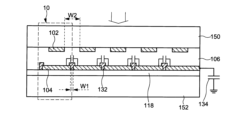
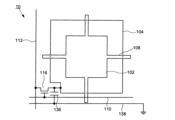
- FIG. 4 is a diagram for explaining the configuration of a unit cell that constitutes a reflect array according to an embodiment of the present invention, and shows a circuit configuration in which a capacitor is connected to a bias electrode
- FIG. 4 is a diagram for explaining the configuration of a unit cell that constitutes a reflect array according to an embodiment of the present invention, and shows the structure when a capacitor is connected to a bias electrode
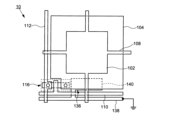
- FIG. 4 is a diagram for explaining the configuration of a unit cell that constitutes a reflect array according to an embodiment of the present invention, and shows the structure when a capacitor is connected to a bias electrode
- FIG. 4 is a diagram for explaining the configuration of a unit cell that constitutes a reflect array according to an embodiment of the present invention, and shows the structure when a capacitor is connected to a bias electrode;
- FIG. 4 is a diagram for explaining the configuration of a unit cell that constitutes the reflect array according to one embodiment of the present invention, and shows the configuration when a coil is connected to a common electrode;
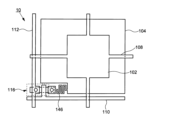
- FIG. 4 is a diagram for explaining the configuration of a unit cell that constitutes a reflect array according to an embodiment of the present invention, and shows a circuit configuration in which an inductor is connected to a bias electrode;
- FIG. 4 is a diagram for explaining the configuration of a unit cell that constitutes a reflect array according to an embodiment of the present invention, and shows the structure when an inductor is connected to a bias electrode;
- the reflect array according to this embodiment has a structure in which a common electrode and a bias electrode are arranged with a liquid crystal layer used as a dielectric layer interposed therebetween. Details thereof will be described below with reference to the drawings.
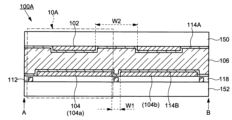
- FIG. 1A shows a plan view of a reflect array 100A according to the first embodiment
- FIG. 1B shows a cross-sectional structure corresponding to AB shown in the plan view.
- both FIGS. 1A and 1B will be referred to as appropriate.
- the reflect array 100A includes at least one common electrode 102, at least one bias electrode 104, and a liquid crystal layer 106 arranged between these electrodes.
- the common electrodes 102 are arranged in the X-axis direction and the Y-axis direction
- the bias electrodes 104 are arranged in a matrix in the X-axis direction and the Y-axis direction so as to correspond to the common electrodes 102 . Therefore, the reflect array 100A has a configuration in which a plurality of common electrodes 102 and a plurality of bias electrodes 104 are arranged to form a matrix.
- the X-axis direction and the Y-axis direction are used for explanation, and specifically indicate the directions displayed in FIG. 1A.
- the X-axis direction and the Y-axis direction can also be read as one direction and a direction crossing the one direction.
- Adjacent common electrodes 102 are interconnected by common wiring 108 .
- the bias electrodes 104 are arranged so that adjacent ones have a gap and are arranged in a physically separated state.
- the common electrode 102 is provided on the first substrate 150 and the bias electrode 104 is provided on the second substrate 152 .
- the reflect array 100A is a device that scatters radio waves incident on an incident surface in a predetermined direction. That is, the common electrode 102 is arranged on the incident surface, and the bias electrode 104 is arranged on the back surface of the common electrode 102 with the liquid crystal layer 106 interposed therebetween.
- the reflect array 100A has a structure in which a common electrode 102, a liquid crystal layer 106, and a bias electrode 104 are arranged so as to overlap in plan view.
- the reflect array 100A is arranged such that the surface of the first substrate 150 on which the common electrode 102 is provided faces the surface of the second substrate 152 on which the bias electrode 104 is provided, and the liquid crystal layer 106 is arranged between them.
- a basic unit of the reflect array 100A is a laminated structure (which may also include the first substrate 150 and the second substrate 152) of a set of common electrodes 102, a liquid crystal layer 106, and a bias electrode 104.
- FIG. This basic unit is hereinafter referred to as a unit cell 10A.
- a selection signal line 110 extending in the X direction, a bias signal line 112 extending in the Y direction, and a switching element 116 are provided on the second substrate 152 .
- the switching elements 116 are provided in one-to-one correspondence with the bias electrodes 104 .
- the switching element 116 has its switching operation (on/off state) controlled by a selection signal on a selection signal line 110 and receives a bias signal (bias voltage) from a bias signal line 112 .
- a bias signal is individually input to the bias electrode 104 by a switching element 116 . That is, bias signals are individually input to the bias electrodes 104 arranged in a matrix from the switching elements 116 .
- a first alignment film 114A is provided on the first substrate 150, and a second alignment film 114B is provided on the second substrate 152.
- the first alignment film 114A is provided to cover the common electrode 102, and the second alignment film 114B is provided to cover the bias electrode 104.
- the first alignment film 114A and the second alignment film 114B are provided to control the alignment state of the liquid crystal layer 106 .
- the liquid crystal layer 106 contains elongated rod-like liquid crystal molecules.
- the initial alignment state (the alignment state in which no electric field acts) of the liquid crystal molecules is controlled by the first alignment film 114A and the second alignment film 114B.
- the alignment state of liquid crystal molecules in the liquid crystal layer 106 is controlled by the bias electrode 104 . Since the bias voltage applied to the bias electrode 104 can be controlled for each unit cell 10A, the alignment state of liquid crystal molecules in the liquid crystal layer 106 can also be controlled for each unit cell 10A.
- the dielectric constant of the liquid crystal layer 106 changes depending on the alignment state of the liquid crystal molecules.
- the phase of the scattered wave of the reflect array 100A changes depending on the dielectric constant of the liquid crystal layer 106. FIG. Therefore, by changing the dielectric constant of the liquid crystal layer 106 for each unit cell 10A, it is possible to generate a phase difference in the plane of the reflect array 100A and control the traveling direction of the scattered wave.
- the unit cell 10A can also be regarded as a patch antenna in which a patch electrode (common electrode 102) is provided on the top surface of a dielectric (liquid crystal layer 106) and a reflective electrode (bias electrode 104) is provided on the back surface, and the reflect array 100A can also be called a reflect array antenna.
- the bias electrode 104 functions as a reflector, it is preferable that the bias electrode 104 be arranged so that the distance between adjacent bias electrodes is as narrow as possible.
- the selection signal line 110 and the bias signal line 112 provided on the second substrate 152 are provided in a layer (lower layer side) different from the bias electrode 104 with an insulating layer 118 interposed therebetween.
- the bias electrodes 104 can be arranged at a narrow pitch without being affected by the wiring. For example, as shown in FIG. 1B, the spacing W1 between the bias electrodes 104a and 104b can be narrower than the spacing W2 between adjacent common electrodes 102 (W1 ⁇ W2).
- the second substrate 152 may be provided with a drive circuit that outputs a selection signal to the selection signal line 110 and a drive circuit that outputs a bias signal to the bias signal line 112. Further, an input terminal for inputting a signal and driving power for driving these driving circuits may be provided.
- FIGS. 2A and 2B show details of the unit cell 10A that constitutes the reflect array 100A.
- FIG. 2A shows a plan view of the unit cell 10A
- FIG. 2B shows a cross-sectional structure along line CD shown in the plan view.
- the unit cell 10A is arranged such that the common electrode 102, the liquid crystal layer 106, and the bias electrode 104 overlap in plan view.
- the common electrode 102 used in this embodiment has a symmetrical shape with respect to the vertical and horizontal polarizations of incident radio waves.
- FIG. 2A shows an example where the common electrode 102 is square.
- the size (vertical and horizontal dimensions) of the common electrode 102 is appropriately set according to the frequency of the target radio wave. Note that the shape of the common electrode 102 is not limited to a square, and may be rectangular or have other geometric shapes.
- the common electrode 102 is connected to the common wiring 108 .
- the connection structure between the common wiring 108 and the common electrode 102 is not limited, but for example, the common wiring 108 and the common electrode 102 are formed of the same conductive layer.
- Common wiring 108 is connected to a power supply circuit (not shown). Alternatively, the common wiring 108 is grounded or connected to a grounded wiring. As shown in FIG. 1A, common wiring 108 connects adjacent common electrodes 102 . By connecting the common electrodes 102 to each other by the common wiring 108, the common electrodes 102 arranged in a matrix have the same potential.
- the bias electrode 104 is formed with a large area in order to function as a reflector. As shown in FIG. 2A, the bias electrode 104 has a larger area than the common electrode 102 in the unit cell 10A. The bias electrode 104 and the common electrode 102 are provided so as to overlap each other, and at this time, the common electrode 102 is arranged in a region inside the bias electrode 104 .
- a switching element 116 , a selection signal line 110 and a bias signal line 112 are provided on the second substrate 152 .
- a switching element 116 connects the bias signal line 112 and the bias electrode 104 .
- a switching operation (ON/OFF operation) of the switching element 116 is controlled by a selection signal on the selection signal line 110 .
- the bias electrode 104 is connected to the bias signal line 112 through the switching element 116 .
- 2A and 2B show an example in which switching element 116 is formed of a transistor.
- the transistor has a structure in which a semiconductor layer 120, a gate insulating layer 122, and a gate electrode 124 are stacked.
- An interlayer insulating layer 126 is provided on the gate electrode 124, and the bias signal line 112 is provided thereon.
- the switching elements 116 and bias signal lines 112 are filled with a planarization layer 128 .
- a bias electrode 104 is provided over the planarization layer 128 .
- the bias electrode 104 is connected to an input/output terminal (source or drain) of a switching element (transistor) 116 through a contact hole.
- a gate electrode 124 of the switching element (transistor) 116 is connected to the selection signal line 110 , and an input/output terminal (source or drain) not connected to the bias electrode 104 is connected to the bias signal line 11
- each bias electrode 104 By connecting each bias electrode 104 to the bias signal line 112 via the switching element 116, the potential of the bias electrode 104 is individually controlled.
- the selection signal line 110 , the bias signal line 112 and the switching element 116 provided on the lower layer side of the bias electrode 104 are buried in the planarization layer 128 . Since the bias electrode 104 is provided on the planarization layer 128, it is possible to increase the area without being affected by the selection signal line 110, the bias signal line 112, and the switching element . Also, the adjacent intervals between the bias electrodes 104 arranged in a matrix can be narrowed.
- the orientation of the liquid crystal molecules in the liquid crystal layer 106 is controlled by the bias electrode 104 . That is, the alignment state of the liquid crystal molecules of the liquid crystal layer 106 is controlled by the bias signal applied to the bias electrode 104 .
- the bias signal is a DC voltage signal or a polarity-inverted DC voltage signal in which a positive DC voltage and a negative DC voltage are alternately inverted.
- the liquid crystal layer 106 is made of a liquid crystal material having dielectric anisotropy.
- nematic liquid crystal, smectic liquid crystal, cholesteric liquid crystal, and discotic liquid crystal can be used as the liquid crystal material forming the liquid crystal layer 106 .
- the dielectric constant of the liquid crystal layer 106 changes depending on the alignment state of the liquid crystal molecules.
- the alignment state of liquid crystal molecules is controlled by the bias electrode 104 .
- the phase of the scattered wave changes according to the dielectric constant of the liquid crystal layer@.
- the frequency bands to which the reflect array 100A is applied are the very high frequency (VHF) band, ultra-high frequency (UHF) band, super high frequency (SHF) band, submillimeter wave (THF), and millimeter wave (EHF: extra high frequency) band.
- VHF very high frequency
- UHF ultra-high frequency
- SHF super high frequency
- THF submillimeter wave
- EHF millimeter wave
- the orientation of the liquid crystal molecules in the liquid crystal layer 106 changes depending on the bias voltage applied to the bias electrode 104 , but the orientation of the liquid crystal molecules hardly follows the frequency of the radio waves incident on the common electrode 102 . Due to such characteristics of the liquid crystal molecules, it is possible to scatter radio waves by the common electrode 102 while changing the dielectric constant of the liquid crystal layer 106 by the bias electrode 104 and control the phase of the scattered radio waves.
- the first substrate 150 is made of glass, quartz, or the like.
- the second substrate 152 is made of a dielectric material such as glass, quartz, resin, or the like. Each layer provided on the first substrate 150 and the second substrate 152 is formed using the following materials.
- the semiconductor layer 120 is formed of an oxide semiconductor including a silicon semiconductor such as amorphous silicon or polycrystalline silicon, or a metal oxide such as indium oxide, zinc oxide, or gallium oxide.
- the gate insulating layer 122 and the interlayer insulating layer 126 are formed of, for example, a silicon oxide film or a laminated structure of a silicon oxide film and a silicon nitride film.
- the selection signal line 110 and the gate electrode 124 are made of, for example, molybdenum (Mo), tungsten (W), or alloys thereof.
- the bias signal line 112 is formed using a metal material such as titanium (Ti), aluminum (Al), molybdenum (Mo).
- the bias signal line 112 has a laminated structure of titanium (Ti)/aluminum (Al)/titanium (Ti) or a laminated structure of molybdenum (Mo)/aluminum (Al)/molybdenum (Mo).
- the planarization layer 128 is made of a resin material such as acrylic or polyimide.
- the common electrode 102 and the bias electrode 104 are formed of a metal film such as aluminum (Al) or copper (Cu), or a transparent conductive film such as indium tin oxide (ITO).
- the first substrate 150 and the second substrate 152 are arranged with a gap therebetween and are bonded together with a sealing material.
- the liquid crystal layer 106 is enclosed within a region surrounded by the first substrate 150, the second substrate 152, and the sealing material.
- the gap between the first substrate 150 and the second substrate 152 is approximately 20 ⁇ m to 100 ⁇ m, for example, 50 ⁇ m.
- a spacer may be provided between the first substrate 150 and the second substrate 152 to keep the gap constant.
- common electrodes 102 arranged in a matrix are connected to each other by common wiring 108, and bias electrodes 104 are connected to bias signal lines 112 via switching elements 116, so that the potential can be individually controlled, so that the dielectric constant of the liquid crystal layer 106 can be changed for each unit cell 10A. Thereby, the phase of scattered waves can be controlled for each unit cell 10A.
- FIGS. 3A and 3B illustrate the operation of the unit cell 10A.
- FIGS. 3A and 3B show the case where the first alignment film 114A and the second alignment film 114B are horizontal alignment films.
- FIG. 3A shows a state in which no bias voltage is applied to the bias electrode 104.
- FIG. 3A shows a state in which no DC voltage is applied to the bias electrode 104 at a level that changes the alignment state of the liquid crystal molecules. This state is hereinafter referred to as the "first state".
- the first state has a state in which the long axis direction of the liquid crystal molecules 130 is aligned horizontally with respect to the surfaces of the common electrode 102 and the bias electrode 104 .
- FIG. 3B shows a state in which a bias voltage having a voltage level that changes the alignment state of the liquid crystal molecules 130 is applied to the bias electrode 104 .
- This state is hereinafter referred to as a "second state".
- the long axis direction of the liquid crystal molecules 130 is oriented perpendicular to the surfaces of the common electrode 102 and the bias electrode 104 under the influence of the electric field generated by the bias voltage.
- the angle at which the long axes of the liquid crystal molecules 130 are oriented can be controlled by the magnitude of the bias signal applied to the bias electrode 104, and can be oriented at an intermediate angle between horizontal and vertical.
- the dielectric constant is larger in the second state (FIG. 3B) than in the first state (FIG. 3A).
- the apparent dielectric constant is smaller in the second state (FIG. 3B) than in the first state (FIG. 3A).
- the liquid crystal layer 106 formed of liquid crystal having dielectric anisotropy can also be regarded as a variable dielectric layer. By using the dielectric anisotropy of the liquid crystal layer 106, the unit cell 10A can be controlled so as to delay (or not delay) the phase of the radio wave scattered by the common electrode 102.
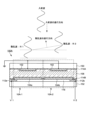
- FIG. 4 schematically shows how the traveling direction of the reflected wave changes due to the first unit cell 10A-1 and the second unit cell 10A-2.
- a bias signal V1 is applied from a bias signal line 112a to the bias electrode 104a of the first unit cell 10A-1
- a bias signal V2 is applied from a bias signal line 112b to the bias electrode 104b of the second unit cell 10A-2.
- the voltage levels of the bias signal V1 and the bias signal V2 are different (V1 ⁇ V2).
- the common electrode 102 of the first unit cell 10A-1 and the second unit cell 10B-1 is grounded.
- FIG. 4 schematically shows that when radio waves are incident on the first unit cell 10A-1 and the second unit cell 10A-2 in the same phase, different bias signals (V1 ⁇ V2) are applied to the first unit cell 10A-1 and the second unit cell 10A-2, so that the phase change of the scattered wave by the second unit cell 10A-2 is greater than that of the first unit cell 10A-1.
- the phase of the scattered wave R1 scattered by the first unit cell 10A-1 is different from the phase of the scattered wave R2 scattered by the second unit cell 10A-2 (in FIG. 4, the phase of the scattered wave R2 leads the phase of the scattered wave R1), and the traveling direction of the scattered wave apparently changes obliquely.
- the reflect array 100A can make the first unit cell 10A-1 and the second unit cell 10A-2 differ in phase of the scattered wave with respect to the incident wave.
- FIG. 4 schematically shows two unit cells, in practice, by individually controlling the unit cells 10A arranged in a matrix, the traveling direction of scattered waves can be arbitrarily controlled without changing the direction of the reflect array 100A.
- a plurality of common electrodes 102 arranged on the reflective surface of the reflect array 100A are held at a constant potential (for example, ground potential), and bias electrodes 104a and 104b and bias signal lines 112a and 112b for applying a bias voltage to the liquid crystal layer 106 are arranged behind the common electrodes 102, so that the front side of the reflect array 100A is not affected by the electric field generated by the bias signal lines 112a and 112b. I can.
- the common electrode 102 is arranged on the plane of incidence of radio waves and held at a constant potential, so that the electric field can be prevented from being disturbed by the bias signal line 112 to which the bias voltage is applied, and the traveling direction of the scattered waves can be accurately controlled.
- This embodiment shows an example of a reflect array in which the structure of the common electrode is different from that of the first embodiment.
- the parts different from the first embodiment will be mainly explained, and overlapping parts will be omitted as appropriate.
- FIG. 5A shows a plan view of a reflect array 100B according to the second embodiment
- FIG. 5B shows a cross-sectional structure corresponding to AB shown in the plan view.
- the reflect array 100B has a structure in which a first substrate 150 and a second substrate 152 are provided, and a common electrode 102b, a liquid crystal layer 106, and a bias electrode 104 are laminated between the two substrates.
- the reflect array 100B has a form in which multiple resonance unit cells 10B are arranged.
- the multiple resonance unit cell 10B differs from the unit cell 10A shown in the first embodiment in the shape of the common electrode 102b.
- the common electrode 102b has a structure in which a plurality of parallel dipoles are arranged.
- the multiple parallel dipoles have different lengths and different resonance frequencies.
- FIG. 5A shows a configuration in which four parallel dipoles with different lengths are arranged along the Y-axis direction. The length and number of parallel dipoles are arbitrary and can be set as appropriate.
- the common electrode 102b is connected by a common wiring 108b.
- the common wiring 108 is arranged in both the X-axis direction and the Y-axis direction, but in this embodiment, the common wiring 108b is arranged only in the Y-axis direction that intersects the parallel dipoles.
- the common wiring 108b may be connected to each other in the outer region where the multiple resonance unit cells 10B are arranged.
- a constant potential (for example, ground potential) is applied to the common wiring 108b.
- the multiple resonance unit cell 10B can be configured by configuring the common electrode 102b with a plurality of parallel dipoles.
- the reflect array 100B according to the present embodiment is the same as the reflect array 100A according to the first embodiment except for the shape of the common electrode 102b, and can obtain the same effects. Furthermore, the reflect array 100B according to the present embodiment can significantly improve the bandwidth, phase range, and loss by being configured with the multiple resonance unit cells 10B.
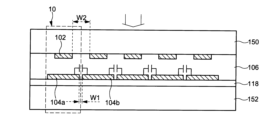
- FIG. 6A shows a cross-sectional schematic structure of the reflect array 100.
- a first substrate 150 provided with a common electrode 102 and a second substrate 152 provided with a bias electrode 104 are arranged to face each other, and a liquid crystal layer 106 is provided therebetween. Since the bias electrodes 104 of the reflect array 100 function as reflectors, the bias electrodes 104 divided for each unit cell 10 are preferably regarded as one continuous conductor plate in terms of high frequency.
- the gap W1 between the bias electrode 104a and the adjacent bias electrode 104b is narrowed so that a capacitor is apparently formed and capacitive coupling is formed.
- the interval W1 is preferably 5 ⁇ m or less, for example, 1 ⁇ m.
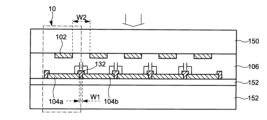
- an insulating member 132 may be provided between the bias electrodes 104a and 104b to adjust the capacitance.
- the insulating member 132 preferably uses an insulating material having a dielectric constant higher than that of the liquid crystal.
- an insulating material having a relative dielectric constant of 3 or more is preferably used, such as silicon nitride, aluminum oxide, hafnium oxide, hafnium silicate, or tantalum oxide. These dielectric materials have relative dielectric constants of about 7 to 18, which is higher than that of liquid crystal materials. Therefore, the bias electrodes can be capacitively coupled more effectively than the structure shown in FIG. 6A.
- the bias electrodes may be capacitively coupled as shown in FIG. 6A or 6B, and grounded via a capacitor 134 at the terminal end.
- FIG. 7A shows the circuit configuration of the unit cell 10.
- the bias electrode 104 is connected to the bias signal line 112 through the switching element 116.
- a capacitor 136 may be connected in parallel between the bias electrode 104 and the switching element 116 and grounded through the capacitor 136.
- a grounded common wiring 138 may be provided and a capacitor 136 may be connected between the bias electrode 104 and the common wiring 138 .
- FIG. 7B shows a specific example of the circuit configuration shown in FIG. 7A.
- the capacitor 136 can be formed by providing the bias electrode 104 and the capacitive electrode 140 overlapping with an insulating layer (not shown) interposed therebetween. By connecting the capacitor electrode 140 to the common wiring 138, the circuit configuration shown in FIG. 7A can be obtained.
- a capacitor electrode 140 extending over substantially the entire surface of the second substrate 152 via the insulating layer 118 may be provided on the lower layer side of the bias electrode 104, and the capacitor electrode 140 may be grounded.
- the gain of the reflect array 100 can be improved by capacitively coupling the plurality of bias electrodes 104 to form continuous reflectors in terms of high frequencies.
- the configuration shown in this embodiment can be implemented by appropriately combining the reflect array 100A shown in the first embodiment and the reflect array 100B shown in the second embodiment.
- FIG. 9 shows a plan view of the reflect array 100B.
- the common electrodes 102b connected by the common wiring 108b extending in the Y-axis direction may be connected at the ends by the common wiring 108a extending in the X-axis direction and connected to the power supply circuit 144.
- a coil 142 is preferably connected in series between the common wiring 108 b and the power supply circuit 144 .
- a power supply circuit 144 is used to control the common electrode 102b to a predetermined potential. By providing the coil 142 between the common electrode 102b and the power supply circuit 144, it is possible to cut high frequencies and prevent circuit failure.
- FIG. 9 shows the common electrode 102b of the reflect array 100B, the same configuration can be applied to the reflect array 100A shown in the first embodiment.
- FIG. 10A shows the circuit configuration of the unit cell 10.
- FIG. An inductor 146 may be connected in series between the bias electrode 104 and the switching element 116, as shown in FIG. 10A.
- Inductor 146 may be formed using the conductive film forming bias electrode 104, as shown in FIG. 10B. With such a configuration, high-frequency current can be prevented from flowing into the switching element 116 and the bias signal line 112, and failure of the switching element 116 and the control circuit can be prevented.
- the configuration shown in this embodiment can be implemented by appropriately combining with the reflect array 100A shown in the first embodiment and the reflect array 100B shown in the second embodiment.
Landscapes
- Physics & Mathematics (AREA)
- Nonlinear Science (AREA)
- Chemical & Material Sciences (AREA)
- Crystallography & Structural Chemistry (AREA)
- General Physics & Mathematics (AREA)
- Optics & Photonics (AREA)
- Electromagnetism (AREA)
- Liquid Crystal (AREA)
- Aerials With Secondary Devices (AREA)
Priority Applications (4)
| Application Number | Priority Date | Filing Date | Title |
|---|---|---|---|
| JP2023575249A JPWO2023140243A1 (https=) | 2022-01-24 | 2023-01-17 | |
| CN202380016971.2A CN118541875A (zh) | 2022-01-24 | 2023-01-17 | 反射阵列 |
| DE112023000346.7T DE112023000346T5 (de) | 2022-01-24 | 2023-01-17 | Reflektorarray |
| US18/766,744 US20240364008A1 (en) | 2022-01-24 | 2024-07-09 | Reflect array |
Applications Claiming Priority (2)
| Application Number | Priority Date | Filing Date | Title |
|---|---|---|---|
| JP2022-008668 | 2022-01-24 | ||
| JP2022008668 | 2022-01-24 |
Related Child Applications (1)
| Application Number | Title | Priority Date | Filing Date |
|---|---|---|---|
| US18/766,744 Continuation US20240364008A1 (en) | 2022-01-24 | 2024-07-09 | Reflect array |
Publications (1)
| Publication Number | Publication Date |
|---|---|
| WO2023140243A1 true WO2023140243A1 (ja) | 2023-07-27 |
Family
ID=87348246
Family Applications (1)
| Application Number | Title | Priority Date | Filing Date |
|---|---|---|---|
| PCT/JP2023/001140 Ceased WO2023140243A1 (ja) | 2022-01-24 | 2023-01-17 | リフレクトアレイ |
Country Status (5)
| Country | Link |
|---|---|
| US (1) | US20240364008A1 (https=) |
| JP (1) | JPWO2023140243A1 (https=) |
| CN (1) | CN118541875A (https=) |
| DE (1) | DE112023000346T5 (https=) |
| WO (1) | WO2023140243A1 (https=) |
Cited By (3)
| Publication number | Priority date | Publication date | Assignee | Title |
|---|---|---|---|---|
| WO2024062780A1 (ja) * | 2022-09-22 | 2024-03-28 | 株式会社ジャパンディスプレイ | 表示パネル一体型電波反射装置 |
| US20250174892A1 (en) * | 2023-11-27 | 2025-05-29 | AUO Corporation | Antenna device |
| WO2025192048A1 (ja) * | 2024-03-14 | 2025-09-18 | 株式会社ジャパンディスプレイ | 電波反射装置 |
Citations (3)
| Publication number | Priority date | Publication date | Assignee | Title |
|---|---|---|---|---|
| JP2003529259A (ja) * | 2000-03-29 | 2003-09-30 | エイチアールエル ラボラトリーズ,エルエルシー | 電子同調可能反射器 |
| CN106450765A (zh) * | 2016-09-08 | 2017-02-22 | 电子科技大学 | 一种毫米波可重构天线 |
| WO2022259789A1 (ja) * | 2021-06-09 | 2022-12-15 | 株式会社ジャパンディスプレイ | 電波反射板及びフェーズドアレイアンテナ |
Family Cites Families (2)
| Publication number | Priority date | Publication date | Assignee | Title |
|---|---|---|---|---|
| JP5371633B2 (ja) | 2008-09-30 | 2013-12-18 | 株式会社エヌ・ティ・ティ・ドコモ | リフレクトアレイ |
| JP2011019021A (ja) | 2009-07-07 | 2011-01-27 | Ntt Docomo Inc | リフレクトアレイ |
-
2023
- 2023-01-17 JP JP2023575249A patent/JPWO2023140243A1/ja active Pending
- 2023-01-17 WO PCT/JP2023/001140 patent/WO2023140243A1/ja not_active Ceased
- 2023-01-17 DE DE112023000346.7T patent/DE112023000346T5/de active Pending
- 2023-01-17 CN CN202380016971.2A patent/CN118541875A/zh active Pending
-
2024
- 2024-07-09 US US18/766,744 patent/US20240364008A1/en active Pending
Patent Citations (3)
| Publication number | Priority date | Publication date | Assignee | Title |
|---|---|---|---|---|
| JP2003529259A (ja) * | 2000-03-29 | 2003-09-30 | エイチアールエル ラボラトリーズ,エルエルシー | 電子同調可能反射器 |
| CN106450765A (zh) * | 2016-09-08 | 2017-02-22 | 电子科技大学 | 一种毫米波可重构天线 |
| WO2022259789A1 (ja) * | 2021-06-09 | 2022-12-15 | 株式会社ジャパンディスプレイ | 電波反射板及びフェーズドアレイアンテナ |
Non-Patent Citations (1)
| Title |
|---|
| DOYLE D. T.; WOEHRLE C. D.; CHRISTODOULOU C. G.: "Development of liquid crystal reflectarrays utilizing a passive matrix control scheme", 2013 IEEE ANTENNAS AND PROPAGATION SOCIETY INTERNATIONAL SYMPOSIUM (APSURSI), IEEE, 6 July 2014 (2014-07-06), pages 1031 - 1032, XP032644994, ISSN: 1522-3965, ISBN: 978-1-4799-3538-3, DOI: 10.1109/APS.2014.6904842 * |
Cited By (3)
| Publication number | Priority date | Publication date | Assignee | Title |
|---|---|---|---|---|
| WO2024062780A1 (ja) * | 2022-09-22 | 2024-03-28 | 株式会社ジャパンディスプレイ | 表示パネル一体型電波反射装置 |
| US20250174892A1 (en) * | 2023-11-27 | 2025-05-29 | AUO Corporation | Antenna device |
| WO2025192048A1 (ja) * | 2024-03-14 | 2025-09-18 | 株式会社ジャパンディスプレイ | 電波反射装置 |
Also Published As
| Publication number | Publication date |
|---|---|
| US20240364008A1 (en) | 2024-10-31 |
| CN118541875A (zh) | 2024-08-23 |
| JPWO2023140243A1 (https=) | 2023-07-27 |
| DE112023000346T5 (de) | 2024-08-22 |
Similar Documents
| Publication | Publication Date | Title |
|---|---|---|
| US20240364008A1 (en) | Reflect array | |
| US20240243484A1 (en) | Reflect array | |
| US20250015508A1 (en) | Reflect array | |
| US20250149800A1 (en) | Reflecting device | |
| WO2022259891A1 (ja) | 液晶位相変調装置、移相器、フェーズドアレイアンテナ装置、及び電波反射板 | |
| US20250023252A1 (en) | Reflecting device having liquid crystal material | |
| WO2024116573A1 (ja) | 電波反射装置 | |
| US12578599B2 (en) | Reflecting device having liquid crystal material | |
| US20250266865A1 (en) | Intelligent reflecting surface | |
| US20260003234A1 (en) | Intelligent reflecting surface | |
| US20260011928A1 (en) | Intelligent reflecting surface | |
| WO2026083760A1 (ja) | 電波反射装置の駆動方法 | |
| US20250379367A1 (en) | Intelligent reflecting surface | |
| US20250379617A1 (en) | Intelligent reflecting surface | |
| WO2025052894A1 (ja) | 電波反射装置及びこれを含む電波反射システム | |
| US20250379366A1 (en) | Intelligent reflecting surface and reflecting device | |
| US20250219681A1 (en) | Intelligent reflecting surface | |
| US20250309554A1 (en) | Intelligent reflecting surface | |
| WO2024070939A1 (ja) | 電波反射装置 | |
| WO2025192048A1 (ja) | 電波反射装置 | |
| WO2023248584A1 (ja) | 電波反射装置 | |
| CN120226211A (zh) | 电波反射装置 | |
| WO2025192577A1 (ja) | 液晶メタサーフェス反射板 |
Legal Events
| Date | Code | Title | Description |
|---|---|---|---|
| 121 | Ep: the epo has been informed by wipo that ep was designated in this application |
Ref document number: 23743237 Country of ref document: EP Kind code of ref document: A1 |
|
| WWE | Wipo information: entry into national phase |
Ref document number: 2023575249 Country of ref document: JP |
|
| WWE | Wipo information: entry into national phase |
Ref document number: 112023000346 Country of ref document: DE |
|
| WWE | Wipo information: entry into national phase |
Ref document number: 202380016971.2 Country of ref document: CN |
|
| 122 | Ep: pct application non-entry in european phase |
Ref document number: 23743237 Country of ref document: EP Kind code of ref document: A1 |