WO2023140225A1 - 電池およびパッチ - Google Patents
電池およびパッチ Download PDFInfo
- Publication number
- WO2023140225A1 WO2023140225A1 PCT/JP2023/001073 JP2023001073W WO2023140225A1 WO 2023140225 A1 WO2023140225 A1 WO 2023140225A1 JP 2023001073 W JP2023001073 W JP 2023001073W WO 2023140225 A1 WO2023140225 A1 WO 2023140225A1
- Authority
- WO
- WIPO (PCT)
- Prior art keywords
- battery
- negative electrode
- positive electrode
- separator
- film
- Prior art date
- Legal status (The legal status is an assumption and is not a legal conclusion. Google has not performed a legal analysis and makes no representation as to the accuracy of the status listed.)
- Ceased
Links
Images

Classifications
-
- H—ELECTRICITY
- H01—ELECTRIC ELEMENTS
- H01M—PROCESSES OR MEANS, e.g. BATTERIES, FOR THE DIRECT CONVERSION OF CHEMICAL ENERGY INTO ELECTRICAL ENERGY
- H01M10/00—Secondary cells; Manufacture thereof
- H01M10/24—Alkaline accumulators
- H01M10/28—Construction or manufacture
-
- H—ELECTRICITY
- H01—ELECTRIC ELEMENTS
- H01M—PROCESSES OR MEANS, e.g. BATTERIES, FOR THE DIRECT CONVERSION OF CHEMICAL ENERGY INTO ELECTRICAL ENERGY
- H01M12/00—Hybrid cells; Manufacture thereof
- H01M12/04—Hybrid cells; Manufacture thereof composed of a half-cell of the fuel-cell type and of a half-cell of the primary-cell type
- H01M12/06—Hybrid cells; Manufacture thereof composed of a half-cell of the fuel-cell type and of a half-cell of the primary-cell type with one metallic and one gaseous electrode
-
- H—ELECTRICITY
- H01—ELECTRIC ELEMENTS
- H01M—PROCESSES OR MEANS, e.g. BATTERIES, FOR THE DIRECT CONVERSION OF CHEMICAL ENERGY INTO ELECTRICAL ENERGY
- H01M4/00—Electrodes
- H01M4/02—Electrodes composed of, or comprising, active material
- H01M4/06—Electrodes for primary cells
-
- H—ELECTRICITY
- H01—ELECTRIC ELEMENTS
- H01M—PROCESSES OR MEANS, e.g. BATTERIES, FOR THE DIRECT CONVERSION OF CHEMICAL ENERGY INTO ELECTRICAL ENERGY
- H01M4/00—Electrodes
- H01M4/02—Electrodes composed of, or comprising, active material
- H01M4/24—Electrodes for alkaline accumulators
-
- H—ELECTRICITY
- H01—ELECTRIC ELEMENTS
- H01M—PROCESSES OR MEANS, e.g. BATTERIES, FOR THE DIRECT CONVERSION OF CHEMICAL ENERGY INTO ELECTRICAL ENERGY
- H01M50/00—Constructional details or processes of manufacture of the non-active parts of electrochemical cells other than fuel cells, e.g. hybrid cells
- H01M50/40—Separators; Membranes; Diaphragms; Spacing elements inside cells
- H01M50/409—Separators, membranes or diaphragms characterised by the material
- H01M50/411—Organic material
- H01M50/414—Synthetic resins, e.g. thermoplastics or thermosetting resins
-
- H—ELECTRICITY
- H01—ELECTRIC ELEMENTS
- H01M—PROCESSES OR MEANS, e.g. BATTERIES, FOR THE DIRECT CONVERSION OF CHEMICAL ENERGY INTO ELECTRICAL ENERGY
- H01M50/00—Constructional details or processes of manufacture of the non-active parts of electrochemical cells other than fuel cells, e.g. hybrid cells
- H01M50/40—Separators; Membranes; Diaphragms; Spacing elements inside cells
- H01M50/489—Separators, membranes, diaphragms or spacing elements inside the cells, characterised by their physical properties, e.g. swelling degree, hydrophilicity or shut down properties
-
- H—ELECTRICITY
- H01—ELECTRIC ELEMENTS
- H01M—PROCESSES OR MEANS, e.g. BATTERIES, FOR THE DIRECT CONVERSION OF CHEMICAL ENERGY INTO ELECTRICAL ENERGY
- H01M6/00—Primary cells; Manufacture thereof
- H01M6/04—Cells with aqueous electrolyte
- H01M6/06—Dry cells, i.e. cells wherein the electrolyte is rendered non-fluid
-
- H—ELECTRICITY
- H01—ELECTRIC ELEMENTS
- H01M—PROCESSES OR MEANS, e.g. BATTERIES, FOR THE DIRECT CONVERSION OF CHEMICAL ENERGY INTO ELECTRICAL ENERGY
- H01M50/00—Constructional details or processes of manufacture of the non-active parts of electrochemical cells other than fuel cells, e.g. hybrid cells
- H01M50/10—Primary casings; Jackets or wrappings
- H01M50/102—Primary casings; Jackets or wrappings characterised by their shape or physical structure
- H01M50/105—Pouches or flexible bags
-
- H—ELECTRICITY
- H01—ELECTRIC ELEMENTS
- H01M—PROCESSES OR MEANS, e.g. BATTERIES, FOR THE DIRECT CONVERSION OF CHEMICAL ENERGY INTO ELECTRICAL ENERGY
- H01M50/00—Constructional details or processes of manufacture of the non-active parts of electrochemical cells other than fuel cells, e.g. hybrid cells
- H01M50/10—Primary casings; Jackets or wrappings
- H01M50/116—Primary casings; Jackets or wrappings characterised by the material
- H01M50/121—Organic material
-
- Y—GENERAL TAGGING OF NEW TECHNOLOGICAL DEVELOPMENTS; GENERAL TAGGING OF CROSS-SECTIONAL TECHNOLOGIES SPANNING OVER SEVERAL SECTIONS OF THE IPC; TECHNICAL SUBJECTS COVERED BY FORMER USPC CROSS-REFERENCE ART COLLECTIONS [XRACs] AND DIGESTS
- Y02—TECHNOLOGIES OR APPLICATIONS FOR MITIGATION OR ADAPTATION AGAINST CLIMATE CHANGE
- Y02E—REDUCTION OF GREENHOUSE GAS [GHG] EMISSIONS, RELATED TO ENERGY GENERATION, TRANSMISSION OR DISTRIBUTION
- Y02E60/00—Enabling technologies; Technologies with a potential or indirect contribution to GHG emissions mitigation
- Y02E60/10—Energy storage using batteries
Definitions
- This application relates to a battery with excellent high-temperature storage characteristics and a patch equipped with the battery.
- Batteries that use an aqueous electrolyte are generally button-shaped with a metal can for the exterior body, or cylindrical with a cylindrical exterior can.
- a separator made of non-woven fabric or paper is used, and there is also a proposal to use a sheet-like material containing polyvinyl alcohol having a crosslinked structure as a separator (Patent Document 1).
- the batteries as described above have also been made into sheet-like batteries using an exterior body made of a resin film (Patent Documents 2, 3, etc.).
- Patent Document 2 uses an electrolyte with a low pH so as to reduce the environmental impact as much as possible even if the user disposes of the replaced battery in order to better meet such needs.
- Patent Document 3 in view of the fact that there is room for improvement in the load characteristics of the battery in the technology described in Patent Document 2, the load characteristics of the battery are improved by using a porous membrane made of resin and having thickness, air permeability, and contact angle with water within specific ranges as the separator.
- batteries with aqueous electrolytes may be exposed to relatively high temperatures when stored in the summer, etc., and there is a demand for excellent high-temperature storage characteristics so that, for example, the decrease in capacity can be suppressed as much as possible even under such circumstances.
- the present application has been made in view of the above circumstances, and provides a battery with excellent high-temperature storage characteristics and a patch including the battery.
- the battery of the present application comprises a battery element including a positive electrode, a negative electrode, an aqueous electrolyte, and a separator.
- the negative electrode contains a metal material as an active material
- the separator is characterized by being a film made of a resin containing a structural unit (A) represented by the following formula (1) at a rate of 70 mol% or more in the total amount of repeating units.
- the patch of the present application includes a power source, is attachable to the body, and is characterized by comprising the battery of the present application as the power source.
- FIG. 1 is a plan view schematically showing an example of an embodiment of the battery of the present application.
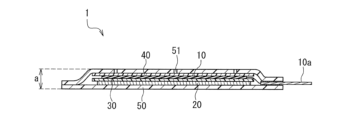
- FIG. 2 is a sectional view taken along line II of FIG.
- the battery of the present embodiment includes a battery element including a positive electrode, a negative electrode using a metal material as an active material, an aqueous electrolytic solution, and a separator interposed between the positive electrode and the negative electrode, and the separator uses a film made of a resin containing a structural unit (A) represented by the following formula (1) at a rate of 70 mol% or more in the total amount of repeating units.
- a battery element including a positive electrode, a negative electrode using a metal material as an active material, an aqueous electrolytic solution, and a separator interposed between the positive electrode and the negative electrode, and the separator uses a film made of a resin containing a structural unit (A) represented by the following formula (1) at a rate of 70 mol% or more in the total amount of repeating units.
- A structural unit represented by the following formula (1)
- the capacity tends to decrease when stored for a long period of time in a high temperature environment of about 60°C.
- the decrease in capacity is considered to be caused by the metal related to the metal material, which is the negative electrode active material, eluted into the aqueous electrolyte solution during storage, passing through the separator and being deposited on the surface of the positive electrode.
- a film composed of a resin having a specific ratio of the structural unit (A) represented by the above formula (1) to the total amount of repeating units is used as the separator.
- the battery of the present embodiment can suppress the decrease in battery capacity during high-temperature storage, it is speculated that metal ions eluted from the negative electrode in the aqueous electrolytic solution are trapped by the hydroxyl groups in the structural unit (A) of the separator, thereby suppressing deposition of the metal on the surface of the positive electrode.
- the film used for the separator of the battery of this embodiment is composed of a resin having the structural unit (A) represented by the formula (1) in its main chain. That is, the resin has hydroxyl groups directly bonded to the carbon atoms forming the main chain.
- resins constituting the film examples include polyvinyl alcohol homopolymer, ethylene-vinyl alcohol copolymer, vinyl acetate-vinyl alcohol copolymer, and vinylon.
- the proportion of the structural unit (A) in the total amount of repeating units constituting the main chain is 70 mol% or more, preferably 90 mol% or more, and particularly preferably 100 mol% (that is, the resin is a homopolymer of polyvinyl alcohol), from the viewpoint of suppressing a decrease in battery capacity during high-temperature storage.
- the repeating unit forming the main chain includes a structural unit represented by the following formula (2).
- the proportion of the structural unit (A) in the total amount of repeating units in the resin constituting the film is the value determined by the method for measuring the degree of saponification described in Japanese Industrial Standards (JIS) K 6726 (1994) (as described later, the values described in the examples are values determined by this method).
- JIS Japanese Industrial Standards
- K 6726 (1994) the values described in the examples are values determined by this method.
- resins (including vinyl acetate copolymers) other than resins obtained by saponifying polyvinyl acetate it can be determined by nuclear magnetic resonance (NMR) measurement.
- NMR nuclear magnetic resonance
- the resin composition [ratio of the structural unit (A) in the total amount of repeating units] is usually provided by the manufacturer of the resin, and can be confirmed by such a nominal value.
- the film which serves as a separator, has substantially no pores from the viewpoint of better suppressing the decrease in capacity of the battery during high-temperature storage.
- the air permeability of the separator is preferably 3000 sec/100 mL or more, more preferably 6000 sec/100 mL or more.
- the air permeability of a film used as a general separator is usually 600 sec/100 mL or less.
- the air permeability of the separator referred to in this specification is a value determined by the Gurley method specified in JIS P 8117.
- the thickness of the separator is preferably 5 ⁇ m or more, more preferably 10 ⁇ m or more, from the viewpoint of enabling the positive electrode and the negative electrode to be separated well, and is preferably 200 ⁇ m or less, more preferably 100 ⁇ m or less, from the viewpoint of suppressing a decrease in the volume capacity density of the battery due to the thick separator.
- a commercially available product can be used for the resin that constitutes the film that serves as the separator.
- the commercially available resins are available in powder form and film form, but the powder form can be used as a separator by molding into a film, and the film form can be used as a separator as it is.
- the battery of the present embodiment only needs to have the above-mentioned separator, a negative electrode using a metal material as an active material, and an aqueous electrolyte solution, and there are no particular restrictions on other configurations. That is, the battery of the present embodiment can take the form of various batteries having an aqueous electrolyte, such as alkaline batteries (alkaline primary batteries, alkaline secondary batteries); manganese batteries; air batteries;
- the alkaline batteries include nickel-zinc batteries using nickel oxyhydroxide as a positive electrode active material and a zinc-based material (a zinc material and a zinc alloy material are collectively referred to as such) as a negative electrode active material; silver-zinc batteries using silver oxide as a positive electrode active material and a zinc-based material as a negative electrode active material; and the like.
- the electrolyte solution, the negative electrode, the positive electrode, and the form of the battery of the present embodiment will be described in detail below.
- the electrolyte of the battery of this embodiment is an aqueous solution in which an electrolyte salt is dissolved in water as a solvent.
- the aqueous solution used as the electrolytic solution preferably has a pH as close to neutral as possible from the viewpoint of reducing the environmental load at the time of disposal and ensuring safety when the electrolytic solution leaks due to damage to the outer package, etc.
- the pH is preferably 3 or more, more preferably 5 or more, and preferably 10 or less, and more preferably less than 7 from the viewpoint of suppressing corrosion of the negative electrode active material.
- the electrolyte salt of the aqueous solution used as the electrolyte includes chlorides such as sodium chloride, potassium chloride, magnesium chloride, calcium chloride, ammonium chloride and zinc chloride; hydroxides of alkali metals and alkaline earth metals (lithium hydroxide, sodium hydroxide, potassium hydroxide, magnesium hydroxide, etc.), acetates (sodium acetate, potassium acetate, magnesium acetate, etc.), nitrates (sodium nitrate, potassium nitrate, magnesium nitrate, etc.), sulfates (sodium sulfate, potassium sulfate, magnesium sulfate, etc.), phosphates (sodium phosphate, potassium phosphate, magnesium phosphate, etc.), Borate (sodium borate, potassium borate, magnesium borate, etc.), citrate (sodium citrate, potassium citrate, magnesium citrate, etc.), glutamate (sodium glutamate,
- the electrolyte salt is preferably a salt of a strong acid selected from hydrochloric acid, sulfuric acid and nitric acid and a weak base typified by hydroxides of metal elements such as ammonia, aluminum hydroxide and magnesium hydroxide, and more preferably an ammonium salt or a salt of a specific metal element. Specifically, it is more preferably a salt of at least one ion selected from Cl ⁇ , SO 4 2 ⁇ , HSO 4 ⁇ and NO 3 ⁇ and at least one ion selected from Al ion, Mg ion, Fe ion and ammonium ion . OH)], magnesium salts such as magnesium nitrate;
- a metal material such as a metal or an alloy is used as an active material for the negative electrode of the battery of the present embodiment, and the electrolytic solution composed of an aqueous solution containing a salt of a strong acid and a weak base as exemplified above has a relatively weak effect of corroding the metal material, which is the negative electrode active material, compared to an electrolytic solution containing a salt of a strong acid and a strong base such as sodium chloride.
- an electrolytic solution containing a salt of a metal element selected from Al, Mg and Fe or an ammonium salt has a relatively high electrical conductivity compared to, for example, an aqueous solution of zinc chloride.
- an electrolytic solution comprising an aqueous solution containing a salt of at least one ion selected from Cl ⁇ , SO 4 2 ⁇ , HSO 4 ⁇ and NO 3 ⁇ and at least one ion selected from Al ions, Mg ions, Fe ions and ammonium ions is used as a salt of a strong acid and a weak base, the discharge characteristics of the battery can be further enhanced.
- the salt of Cl ⁇ ion and Fe 3+ ion [iron chloride (III)] has a stronger corrosive effect on the metal material that is the negative electrode active material than the salt of the combination of other ions. Therefore, it is preferable to use a salt other than iron chloride (III), and it is more preferable to use an ammonium salt because the effect of corroding the metal material that is the negative electrode active material is weaker.
- perchlorate poses a danger such as combustion due to heating, etc. Therefore, from the viewpoint of environmental load and safety at the time of disposal, it is preferable not to include it in the aqueous solution, or even if it does, the amount of perchlorate ion is small (preferably less than 100 ppm, more preferably less than 10 ppm).
- the aqueous solution is not contained, or even if it is contained, the amount of heavy metal ions other than iron ions is small (preferably less than 100 ppm, more preferably less than 10 ppm).
- the aqueous solution that can be used as the electrolyte preferably contains a water-soluble high-boiling solvent with a boiling point of 150° C. or higher as a solvent together with water.
- a water-soluble high-boiling solvent with a boiling point of 150° C. or higher as a solvent together with water.
- the aqueous solution contains a water-soluble high-boiling-point solvent, such fluctuations in voltage in the latter stage of discharge can be suppressed, and an air battery with better discharge characteristics can be obtained.
- the upper limit of the boiling point of the water-soluble high boiling point solvent is usually 320°C.
- the water-soluble high boiling point solvent preferably has high surface tension and dielectric constant.
- specific examples include polyhydric alcohols such as ethylene glycol (boiling point 197°C, surface tension 48 mN/m, dielectric constant 39), propylene glycol (boiling point 188°C, surface tension 36 mN/m, dielectric constant 32), glycerin (boiling point 290°C, surface tension 63 mN/m, dielectric constant 43); , surface tension of 43 mN/m, dielectric constant of 35) and the like (preferably those having a molecular weight of 600 or less); Only one kind of these water-soluble high boiling point solvents may be used in the electrolytic solution, or two or more kinds thereof may be used in combination, but it is more preferable to use glycerin.
- the content of the water-soluble high-boiling solvent in the total solvent of the aqueous solution is preferably 1% by mass or more, more preferably 3% by mass or more, from the viewpoint of ensuring the effects of its use.
- the amount of the water-soluble high-boiling solvent in the aqueous solution is too large, the ionic conductivity of the aqueous solution may become too small, and the battery characteristics may deteriorate.
- the concentration of the electrolyte salt in the aqueous solution may be, for example, a concentration that can adjust the conductivity of the aqueous solution to about 80 to 700 mS/cm, and is usually 5 to 50% by mass.
- various known additives may be added to the aqueous solution as necessary within a range that does not impair the effects of the battery of the present embodiment.
- zinc oxide may be added to prevent corrosion (oxidation) of the metal material used for the negative electrode.
- the aqueous solution constituting the electrolytic solution may be gelled, and it is also preferable to use a gelled electrolytic solution (gelled electrolyte) obtained by blending the aqueous solution containing an electrolyte salt and having a pH of 3 or more and 10 or less and a thickener (sodium polyacrylate, carboxymethylcellulose, etc.) as the electrolytic solution of the battery.
- a gelled electrolytic solution obtained by blending the aqueous solution containing an electrolyte salt and having a pH of 3 or more and 10 or less and a thickener (sodium polyacrylate, carboxymethylcellulose, etc.) as the electrolytic solution of the battery.
- the discharge characteristics of the battery can be further improved by suppressing the voltage fluctuation in the latter half of the discharge, and the volatilization of water from the gelled electrolyte is suppressed. Therefore, especially in an air battery in which air holes are formed in the exterior body, the deterioration of the discharge characteristics due to the compositional fluctu
- the negative electrode of the battery of the present embodiment contains a metal material such as a zinc-based material (zinc or zinc alloy), a magnesium-based material (magnesium or magnesium alloy), or an aluminum-based material (aluminum or aluminum alloy) as an active material.
- a metal material such as a zinc-based material (zinc or zinc alloy), a magnesium-based material (magnesium or magnesium alloy), or an aluminum-based material (aluminum or aluminum alloy) as an active material.
- the metal material used for the negative electrode has a low content of mercury, cadmium, lead, and chromium. Specifically, the content is more preferably 0.1% or less mercury, 0.01% or less cadmium, 0.1% or less lead, and 0.1% or less chromium, based on mass.
- a metal sheet such as a sheet (zinc foil, zinc alloy foil, magnesium foil, magnesium alloy foil, aluminum foil, aluminum alloy foil, etc.) composed of the above materials is preferably used.
- a negative electrode preferably has a thickness of 5 to 1000 ⁇ m.
- the alloy components of zinc alloys include, for example, indium, bismuth, and aluminum, and alloys containing one or more of the above elements are used.
- the content of indium in the zinc alloy is, for example, 0.005% or more and 0.1% or less on a mass basis.
- the content of bismuth is, for example, 0.002% or more and 0.2% or less on a mass basis.
- the aluminum content is, for example, 0.0001% or more and 0.15% or less on a mass basis.
- zinc foil zinc alloy foil
- electrolytic zinc foil is less likely to generate gas due to reaction with the electrolytic solution in the battery
- electrolytic zinc foil is preferably used, and electrolytic zinc foil containing bismuth is particularly preferably used.
- a preferable content range of bismuth in the electrolytic zinc foil is 0.02% or more and 0.1% or less on a mass basis.
- alloy components of magnesium alloys include, for example, calcium, manganese, zinc, and aluminum, and alloys containing one or more of the above elements are used.
- the content of calcium in the magnesium alloy is, for example, 1% or more and 3% or less on a mass basis.
- the manganese content is, for example, 0.1% or more and 0.5% or less on a mass basis.
- the content of zinc is, for example, 0.4% or more and 1% or less on a mass basis.
- the aluminum content is, for example, 8% or more and 10% or less on a mass basis.
- alloy components of aluminum alloys include, for example, zinc, tin, gallium, silicon, iron, magnesium, and manganese, and alloys containing one or more of the above elements are used.
- the content of zinc in the aluminum alloy is, for example, 0.5% or more and 10% or less on a mass basis.
- the content of tin is, for example, 0.04% or more and 1.0% or less on a mass basis.
- the gallium content is, for example, 0.003% or more and 1.0% or less on a mass basis.
- the silicon content is, for example, 0.05% or less on a mass basis.
- the iron content is, for example, 0.1% or less on a mass basis.
- the magnesium content is, for example, 0.1% or more and 2.0% or less on a mass basis.
- the content of manganese is, for example, 0.01% or more and 0.5% or less on a mass basis.
- a negative electrode containing a metal material a negative electrode containing metal particles such as particles made of the above materials can be exemplified.
- the metal particles may be of one type alone or of two or more types.
- the ratio of particles with a particle size of 75 ⁇ m or less in all particles is preferably 50% by mass or less, more preferably 30% by mass or less, and the ratio of particles with a particle size of 100 to 200 ⁇ m is 50% by mass or more, more preferably 90% by mass or more.
- the ratio of particles with a particle size of 30 ⁇ m or less in all particles is preferably 50% by mass or less, more preferably 30% by mass or less, and the ratio of particles with a particle size of 50 to 200 ⁇ m is 50% by mass or more, more preferably 90% by mass or more.
- the particle size of metal particles as used herein is the particle size (D 50 ) at a cumulative frequency of 50% based on volume, measured by dispersing these particles in a medium that does not dissolve the particles using a laser scattering particle size distribution meter (for example, “LA-920” manufactured by Horiba Ltd.).
- the negative electrode containing the metal particles may contain a gelling agent (polyethylene oxide, sodium polyacrylate, carboxymethyl cellulose, etc.) and a binder added as necessary, and a negative electrode agent (gelled negative electrode, etc.) formed by adding an electrolytic solution to this may be used.
- a gelling agent polyethylene oxide, sodium polyacrylate, carboxymethyl cellulose, etc.
- a binder added as necessary
- the amount of the gelling agent in the negative electrode is, for example, preferably 0.5 to 1.5% by mass, and the amount of the binder is preferably 0.5 to 3% by mass.
- the same electrolyte that is injected into the battery can be used as the electrolyte for the negative electrode containing metal particles.
- the content of metal particles in the negative electrode is, for example, preferably 60% by mass or more, more preferably 65% by mass or more, and preferably 95% by mass or less, more preferably 90% by mass or less.
- the negative electrode containing metal particles preferably contains an indium compound.
- an indium compound in the negative electrode it is possible to more effectively prevent generation of hydrogen gas due to corrosion reaction between the metal particles and the electrolyte.
- Examples of the indium compound include indium oxide and indium hydroxide.
- the mass ratio of the indium compound used in the negative electrode is preferably 0.003 to 1 with respect to the metal particles: 100.
- a current collector may be used for the negative electrode containing the metal material, if necessary.
- Examples of current collectors for negative electrodes containing metal materials include metal nets, foils, expanded metals, punching metals such as nickel, copper, and stainless steel; carbon sheets and nets; and the like.
- the thickness of the current collector of the negative electrode is preferably 10 ⁇ m or more and 300 ⁇ m or less.
- the resin film that constitutes the sheet-shaped exterior body can be used as the current collector of the negative electrode.
- carbon paste can be applied to the surface of the resin film, which is expected to become the inner surface of the sheet-like exterior body, to form the current collector.
- the thickness of the carbon paste layer is preferably 50 to 200 ⁇ m.
- the positive electrode has, for example, a positive electrode mixture layer containing a positive electrode active material, a conductive aid, and a binder on one or both sides of a current collector. Can be used.
- Positive electrode active materials that can be used when the battery of the present embodiment is an alkaline battery include silver oxide (silver(I) oxide, silver(II) oxide, etc.); manganese oxides such as manganese dioxide; nickel oxyhydroxide; and composite oxides of silver and cobalt, nickel or bismuth.
- Manganese oxide such as manganese dioxide is used as the positive electrode active material when the battery of the present embodiment is a manganese battery.
- Examples of conductive additives for the positive electrode mixture layer include carbon blacks such as acetylene black, ketjen black, channel black, furnace black, lamp black, and thermal black; carbon fibers; conductive fibers such as metal fibers; carbon fluoride; metal powders such as copper and nickel;
- binders for the positive electrode mixture layer include polyvinylidene fluoride (PVDF), polytetrafluoroethylene (PTFE), styrene-butadiene rubber (SBR), carboxymethylcellulose (CMC), and polyvinylpyrrolidone (PVP).
- PVDF polyvinylidene fluoride
- PTFE polytetrafluoroethylene
- SBR styrene-butadiene rubber
- CMC carboxymethylcellulose
- PVP polyvinylpyrrolidone
- the amount of the positive electrode active material is preferably 80 to 98% by mass
- the content of the conductive aid is preferably 1.5 to 10% by mass
- the content of the binder is preferably 0.5 to 10% by mass.
- the thickness of the positive electrode mixture layer is preferably 30 to 300 ⁇ m.
- a positive electrode having a positive electrode mixture layer can be manufactured by, for example, dispersing a positive electrode active material, a conductive agent, a binder, and the like in water or an organic solvent such as N-methyl-2-pyrrolidone (NMP) to prepare a positive electrode mixture-containing composition (slurry, paste, etc.) (the binder may be dissolved in a solvent), applying this on a current collector, drying it, and subjecting it to press treatment such as calendering as necessary.
- NMP N-methyl-2-pyrrolidone
- an air electrode including a catalyst layer for example, an air electrode having a structure in which a catalyst layer and a current collector are laminated can be used as the positive electrode.
- the catalyst layer can contain catalysts, binders, and the like.
- catalysts for the catalyst layer include phthalocyanine-based air catalysts; silver, platinum group metals or alloys thereof; transition metals; platinum/metal oxides such as Pt/ IrO2 ; perovskite oxides such as La1 - xCaxCoO3 ; black, lamp black , thermal black , etc.), charcoal, activated carbon, etc.], and one or more of these are used.
- the catalyst layer preferably has a heavy metal content of 1% by mass or less, excluding the components of the electrolytic solution.
- a positive electrode having a catalyst layer with a low heavy metal content as described above a battery with a small environmental burden can be obtained even if it is discarded without special treatment.
- the content of heavy metals in the catalyst layer referred to in this specification can be measured by fluorescent X-ray analysis.
- fluorescent X-ray analysis For example, using "ZSX100e” manufactured by Rigaku Corporation, the measurement can be performed under the conditions of excitation source: Rh 50 kV and analysis area: ⁇ 10 mm.
- the catalyst for the catalyst layer does not contain heavy metals, and it is more preferable to use the various types of carbon described above.
- the specific surface area of the carbon used as the catalyst is preferably 200 m 2 /g or more, more preferably 300 m 2 /g or more, and even more preferably 500 m 2 /g or more.
- the specific surface area of carbon referred to in this specification is a value determined by the BET method according to JIS K 6217, and can be measured, for example, using a specific surface area measuring device (“Macsorb HM model-1201” manufactured by Mounttech) using a nitrogen adsorption method.
- the upper limit of the specific surface area of carbon is usually about 2000 m 2 /g.
- the content of the catalyst in the catalyst layer is preferably 20-70% by mass.
- PVDF polylidene fluoride-hexafluoropropylene copolymer
- PVDF-CTFE vinylidene fluoride-chlorotrifluoroethylene copolymer
- PVDF-TFE vinylidene fluoride-tetrafluoroethylene copolymer
- PVDF-HFP-TFE vinylidene fluoride-hexafluoropropylene-tetrafluoroethylene copolymer
- PVDF-HFP-TFE vinylidene fluoride-hexafluoropropylene-tetrafluoroethylene copolymer
- PVDF-HFP-TFE vinylidene fluoride-hexafluoropropylene-tetrafluoroethylene copolymer
- the binder content in the catalyst layer is preferably 3 to 50% by mass.
- a positive electrode having a catalyst layer for example, it can be manufactured by mixing the catalyst, binder, etc. with water, rolling the mixture with rolls, and adhering it to the current collector. Further, a catalyst layer-forming composition (slurry, paste, etc.) prepared by dispersing the above-mentioned catalyst and a binder used as necessary in water or an organic solvent is applied to the surface of the current collector, dried, and then optionally subjected to a press treatment such as calendering.
- a catalyst layer-forming composition slurry, paste, etc.
- current collectors related to positive electrodes having a positive electrode mixture layer and positive electrodes having a catalyst layer for example, metal nets, foils, expanded metals, punching metals such as titanium, nickel, stainless steel, and copper; carbon nets, sheets; and the like can be used.
- the thickness of the current collector for the positive electrode is preferably 10 ⁇ m or more and 300 ⁇ m or less.
- a carbon paste can be applied to the surface of the resin film constituting the sheet-shaped exterior body, which is expected to become the inner surface of the sheet-shaped exterior body, as the current collector for the positive electrode.
- the thickness of the carbon paste layer is preferably 30 to 300 ⁇ m.
- the shape of the battery of the present embodiment is not particularly limited, and a flat type (including a coin shape and a button shape) having a battery case in which the outer can and the sealing plate are crimped and sealed via a gasket or the outer can and the sealing plate are welded and sealed; a sheet type having a sheet-like outer body made of a resin film; a bottomed cylindrical outer can and the sealing plate are crimped and sealed via a gasket; Any shape such as a cylindrical shape [cylindrical shape, prismatic shape (rectangular cylindrical shape)] having a battery case can be used.
- the battery of the present embodiment is used as a power supply for medical and health equipment such as a patch that can be worn on the body, especially a patch that is worn on the surface of the skin and used to measure body conditions such as body temperature, pulse, and perspiration, it is preferable to use a sheet-like battery having a sheet-like outer body made of a resin film.
- the sheet-like exterior body is composed of a resin film, and examples of such a resin film include nylon film (nylon 66 film, etc.) and polyester film (polyethylene terephthalate (PET) film, etc.).
- a resin film include nylon film (nylon 66 film, etc.) and polyester film (polyethylene terephthalate (PET) film, etc.).
- the sealing of the sheet-shaped exterior body is generally performed by heat-sealing the ends of the resin film on the upper side of the sheet-shaped exterior body and the ends of the resin film on the lower side of the sheet-shaped exterior body, but for the purpose of making this heat-sealing easier, the sheet-shaped exterior body may be formed by laminating a heat-sealable resin layer on the resin film exemplified above.
- the heat-sealable resin constituting the heat-sealable resin layer include modified polyolefins (modified polyolefin ionomers, etc.), polypropylene and copolymers thereof.
- the thickness of the heat-sealable resin layer is preferably 20 to 200 ⁇ m.
- a metal layer may be laminated on the resin film.
- the metal layer can be composed of an aluminum film (including aluminum foil and aluminum alloy foil), a stainless steel film (stainless steel foil), or the like.
- the thickness of the metal layer is preferably 10-150 ⁇ m.
- the resin film that constitutes the sheet-like exterior body may be a film having a configuration in which the heat-sealable resin layer and the metal layer are laminated.
- the resin film that constitutes the sheet-like exterior body has an electrically insulating water vapor barrier layer.
- the electrically insulating resin film itself may have a single-layer structure that also serves as a water vapor barrier layer, or may have a multi-layer structure having a plurality of electrically insulating resin film layers, at least one of which serves as a water vapor barrier layer, or may have a multilayer structure having an electrically insulating water vapor barrier layer on the surface of a substrate layer made of a resin film.
- Such resin films those in which a water vapor barrier layer composed of at least an inorganic oxide is formed on the surface of a substrate layer composed of a resin film are preferably used.
- Inorganic oxides constituting the water vapor barrier layer include aluminum oxide and silicon oxide. Note that a water vapor barrier layer made of silicon oxide tends to have a higher function of suppressing permeation of moisture in the electrolytic solution in the battery than a water vapor barrier layer made of aluminum oxide. Therefore, it is more preferable to use silicon oxide as the inorganic oxide that constitutes the water vapor barrier layer.
- a water vapor barrier layer composed of an inorganic oxide can be formed on the surface of the base layer by, for example, a vapor deposition method.
- the thickness of the water vapor barrier layer is preferably 10-300 nm.
- the substrate layer of the resin film having a water vapor barrier layer in addition to the nylon film and polyester film mentioned above, polyolefin film, polyimide film, polycarbonate film and the like can also be used.
- the thickness of the base material layer is preferably 5 to 100 ⁇ m.
- a protective layer for protecting the water vapor barrier layer may be formed on the surface of the water vapor barrier layer (the side opposite to the base layer).
- the heat-sealable resin layer may be further laminated.
- the thickness of the entire resin film is preferably 10 ⁇ m or more from the viewpoint of ensuring sufficient strength for the battery, and preferably 200 ⁇ m or less from the viewpoint of suppressing an increase in battery thickness and a decrease in energy density.
- the water vapor transmission rate of the resin film constituting the sheet-like exterior body is 10 g/m 2 ⁇ 24 h or less. In addition, it is desirable that the resin film does not transmit water vapor as much as possible.
- the water vapor permeability of the resin film referred to in this specification is a value measured according to the JIS K 7129B method.
- the resin film constituting the sheet-shaped outer package has a certain degree of oxygen permeability.
- air holes for introducing oxygen into the battery are formed in the sheet-like outer body in order to supply air (oxygen) to the positive electrode and discharge it.
- oxygen can be introduced into the battery by permeating the outer body from places other than the air holes of the sheet-like outer body.
- the specific oxygen permeability of the resin film constituting the sheet-like exterior body is preferably 0.02 cm 3 /m 2 24 h MPa or more, and more preferably 0.2 cm 3 /m 2 24 h MPa or more.
- the resin film that constitutes the sheet - like exterior body allows too much oxygen to pass through , self-discharge may occur and the capacity may be impaired.
- the battery of the present embodiment is a battery other than an air battery
- the oxygen permeability of the resin film that constitutes the sheet-like outer package there is no particular restriction on the oxygen permeability of the resin film that constitutes the sheet-like outer package, but from the viewpoint of improving the storage stability of the battery, it is preferable that the resin film does not permeate much oxygen.
- the oxygen permeability of the resin film referred to in this specification is a value measured according to the JIS K 7126-2 method.
- materials used in alkaline batteries such as polypropylene and nylon can be used as the material for the gasket interposed between the outer can and the sealing plate.
- the inner surface of the outer can with a corrosion-resistant metal such as tin, zinc, or indium in order to prevent elements such as iron that make up the outer can from eluting during charging.
- a corrosion-resistant metal such as tin, zinc, or indium
- FIGS. 1 and 2 schematically show an example of the battery of this embodiment.
- FIGS. 1 and 2 show an example in which the battery of the present embodiment is an air battery (sheet-shaped air battery) having a sheet-shaped outer package, FIG. 1 shows a plan view thereof, and FIG.
- a battery element including a positive electrode 10, a separator 30, a negative electrode 20, and an aqueous electrolyte solution (not shown) is housed in a sheet-shaped exterior body 50.
- the dotted line in FIG. 1 represents the size of the positive electrode 10 housed in the sheet-like outer package 50 (the size of the wide body portion excluding the terminal portion, which corresponds to the size of the catalyst layer of the positive electrode).
- a terminal portion 10a of the positive electrode 10 and a terminal portion 20a of the negative electrode 20 protrude from the upper side of the sheet-shaped exterior body 50 in the drawing. These terminal portions 10a and 20a are used as external terminals for electrically connecting the battery 1 and applicable equipment.
- the sheet-like exterior body 50 has a plurality of air holes 51 for taking air into the positive electrode on one side on which the positive electrode 10 is arranged, and a water-repellent film 40 for preventing leakage of the electrolytic solution from the air holes 51 is disposed on the side of the sheet-like exterior body 50 of the positive electrode 10.
- the positive electrode 10 has a catalyst layer, and as described above, has, for example, a structure in which the catalyst layer and the current collector are laminated, but in FIG.
- FIG. 2 shows the sheet-like exterior body 50 (the resin film that constitutes it) in a single-layer structure, as described above, the resin film that constitutes the sheet-like exterior body can also have a multilayer structure.
- the terminal portion of the positive electrode may be provided by forming the positive electrode current collector into a main body portion on which the positive electrode mixture layer and the catalyst layer are formed and an exposed portion on which the positive electrode mixture layer and the catalyst layer are not formed, or by attaching a separate lead body to the positive electrode current collector by welding or the like.
- the terminal portion of the negative electrode can also be formed by forming the negative electrode current collector in a shape having a body portion in which a layer containing a negative electrode active material is formed and an exposed portion in which this is not formed, and by providing the exposed portion or by attaching a separate lead body to the negative electrode current collector by welding or the like.
- the metal sheet When the negative electrode is composed of a metal sheet, the metal sheet can be cut into a shape having a main body portion and a terminal portion functioning as a negative electrode active material layer, whereby a negative electrode having a main body portion and a terminal portion can be formed from a single metal sheet.
- the shape of the sheet-like exterior body may be polygonal (triangle, quadrangle, pentagon, hexagon, heptagon, octagon) in plan view, or may be circular or elliptical in plan view.
- the positive electrode terminal portion and the negative electrode terminal portion may be drawn out from the same side or may be drawn out from different sides.
- a water-repellent film is usually arranged between the positive electrode and the outer casing.
- water-repellent films include films made of resins such as fluororesins such as PTFE; polyolefins such as polypropylene and polyethylene; and the like.
- the thickness of the water-repellent film is preferably 50-250 ⁇ m.
- an air diffusion film may be arranged between the exterior body and the water-repellent film for supplying the air taken in the exterior body to the positive electrode.
- a nonwoven fabric made of a resin such as cellulose, polyvinyl alcohol, polypropylene, or nylon can be used for the air diffusion film.
- the thickness of the air diffusion film is preferably 100-250 ⁇ m.
- the thickness (the length of a in FIG. 2) is not particularly limited, and can be changed as appropriate according to the application of the battery.
- One of the advantages of the sheet-like battery is that it can be made thin. From this point of view, the thickness is preferably 1 mm or less, for example.
- the battery of this embodiment is a sheet-like air battery, it is particularly easy to provide such a thin battery.
- the thickness of the sheet-shaped battery there is no particular limit to the lower limit of the thickness of the sheet-shaped battery, but in order to ensure a certain capacity, it is usually preferable to set the thickness to 0.2 mm or more.
- the battery of the present embodiment has an aqueous electrolyte solution, and particularly in the case of an aqueous solution with a suitable pH of 3 or more and 10 or less, the environmental load is small, and even if the electrolyte leaks due to breakage or the like and adheres to the body, problems are unlikely to occur, and safety is excellent. Therefore, the battery of the present embodiment is suitable as a power supply for devices for medical and health use, such as a patch that can be worn on the body, particularly a patch that is worn on the surface of the skin and used to measure body conditions such as body temperature, pulse, and perspiration. It can also be applied to the same applications as conventionally known air batteries, alkaline batteries, and other batteries having an aqueous electrolyte (primary batteries).
- the patch of this embodiment includes a power supply, is a patch that can be worn on the body, and has the battery of the previous embodiment as the power supply. Since the patch of the present embodiment uses the battery of the above embodiment as a power source, it is excellent in safety and high-temperature storage properties, and can be worn on the body, particularly, on the surface of the skin, and can be suitably used as a patch for measuring body conditions such as body temperature, pulse, and perspiration.
- the patch of this embodiment preferably has an adhesive layer formed on one side so that it can be easily attached to the body.
- the battery of the present application will be described in detail below based on examples. However, the following examples do not limit the batteries of the present application.
- Example 1 Carbon having a DBP oil absorption of 495 cm 3 /100 g and a specific surface area of 1270 m 2 /g ("Ketjen Black EC600JD" manufactured by Lion Specialty Chemicals): 10 parts by mass, phthalocyanine-based air catalyst: 1.0 parts by mass, acrylic dispersant: 2.5 parts by mass, polytetrafluoroethylene: 7.5 parts by mass, and ethanol: 500 parts by mass were mixed to form a catalyst layer forming composition. made.
- Porous carbon paper (thickness: 0.25 mm, porosity: 75%) was used as a current collector, and the composition for forming a catalyst layer was applied in stripes on the surface of the carbon paper so that the coating amount after drying was 10 mg/cm 2 , and dried to obtain a current collector having a portion with a catalyst layer formed thereon and a portion without a catalyst layer formed thereon.
- This current collector was punched into a shape having a catalyst layer of 15 mm ⁇ 15 mm and a lead part of 5 mm ⁇ 15 mm on which no catalyst layer was formed at one end, thereby producing a positive electrode (air electrode) having an overall thickness of 0.27 mm.
- a zinc alloy foil (thickness: 0.05 mm, electrolytic zinc foil) containing 0.05% by mass of In, 0.04% by mass of Bi, and 0.001% by mass of Al as additive elements was punched into a shape having a 15 mm ⁇ 15 mm size portion functioning as an active material and a 5 mm ⁇ 15 mm portion serving as a lead portion at one end to prepare a negative electrode.
- An electrolytic solution was prepared by adding glycerin to an ammonium sulfate aqueous solution having a concentration of 20% by mass so that the total amount of glycerin and water contained in the aqueous solution would be 10% by mass.
- the pH of this electrolytic solution was measured at 25° C. using a “LAQUA twin compact pH meter” manufactured by Horiba Ltd., and found to be 5.3. It should be noted that the pH obtained by the same measurement method was the same value for the electrolytic solutions of the sheet-like air batteries of all Examples and Comparative Examples described later.
- the concentrations of heavy metal ions other than perchlorate ions and iron ions in the electrolytic solution were each less than 100 ppm. The same applies to the electrolyte solutions of the sheet-like air batteries of Example 2 and Comparative Examples 1 and 2 described later.
- a film (a) (thickness: 30 ⁇ m, air permeability: >3000 sec/100 mL) containing a homopolymer of polyvinyl alcohol [ratio of structural unit (A) in the total amount of repeating units constituting the main chain: 100 mol%, degree of saponification: 100%] was used.
- the film (a) contains 10% by weight of a plasticizer (glycerin) in addition to a homopolymer of polyvinyl alcohol.
- the degree of saponification of a homopolymer of polyvinyl alcohol is a value determined by the measuring method described in JIS K 6726 (1994). The same applies to the homopolymer of polyvinyl alcohol in Example 2.
- a PTFE sheet having a thickness of 200 ⁇ m was used for the water-repellent film.
- ⁇ Battery assembly> Two aluminum laminate films (thickness: 65 ⁇ m) measuring 25 mm ⁇ 25 mm each having a PET film on the outer surface of the aluminum foil and a PP film as a heat-sealing resin layer on the inner surface were used as the exterior body.
- the positive electrode, the separator, and the negative electrode were sequentially laminated on the water-repellent film of the exterior body, and another exterior body was layered so that the modified polyolefin ionomer film was positioned on the leads of the positive electrode and the negative electrode.
- the three peripheral sides of the two exterior bodies were thermally welded to each other to form a bag, and the electrolytic solution was introduced through the opening, and the opening was thermally welded and sealed to obtain a sheet-shaped air battery.
- Example 2 A sheet-like air battery was fabricated in the same manner as in Example 1, except that the separator was changed to the film (b), which had a thickness of 30 ⁇ m, an air permeability of >3000 sec/100 mL, was composed only of a homopolymer of polyvinyl alcohol [the proportion of the structural unit (A) in the total amount of the repeating units constituting the main chain was 100 mol%, and the degree of saponification was 100%], and did not contain a plasticizer.
- Example 1 A sheet-like air battery was fabricated in the same manner as in Example 1, except that two graft films (thickness per sheet: 15 ⁇ m) composed of a graft copolymer having a structure in which acrylic acid was graft-copolymerized on a PE main chain were used as separators on both sides of a cellophane film (thickness: 20 ⁇ m) (total thickness: 50 ⁇ m).
- the air permeability of the entire separator was a value (>3000 sec/100 mL) exceeding the upper limit of measurement.
- Example 2 A sheet-like air battery was produced in the same manner as in Example 1, except that the separator was changed to a PE microporous membrane (thickness: 16 ⁇ m, air permeability: 150 sec/100 mL).
- a resistor of 3.9 k ⁇ was connected to the sheet-shaped air batteries of Examples and Comparative Examples to discharge them, and the discharge capacity (initial capacity) until the battery voltage dropped to 1 V was measured.
- the batteries of Examples 1 and 2 in which a film made of a resin having an appropriate proportion of the structural unit (A) in the total amount of repeating units constituting the main chain, was used as a separator, maintained a good discharge capacity even after long-term storage in a high-temperature environment.
- the battery of Comparative Example 1 in which a laminate of a graft film and a cellophane film is used as a separator, and the battery of Comparative Example 2, in which a PE microporous film is used as a separator, showed a large decrease in discharge capacity when stored in a high-temperature environment for a long period of time compared to the batteries of Examples.
Landscapes
- Chemical & Material Sciences (AREA)
- Chemical Kinetics & Catalysis (AREA)
- Electrochemistry (AREA)
- General Chemical & Material Sciences (AREA)
- Engineering & Computer Science (AREA)
- Manufacturing & Machinery (AREA)
- Hybrid Cells (AREA)
Priority Applications (1)
| Application Number | Priority Date | Filing Date | Title |
|---|---|---|---|
| JP2023575241A JPWO2023140225A1 (https=) | 2022-01-18 | 2023-01-17 |
Applications Claiming Priority (2)
| Application Number | Priority Date | Filing Date | Title |
|---|---|---|---|
| JP2022005627 | 2022-01-18 | ||
| JP2022-005627 | 2022-01-18 |
Publications (1)
| Publication Number | Publication Date |
|---|---|
| WO2023140225A1 true WO2023140225A1 (ja) | 2023-07-27 |
Family
ID=87348772
Family Applications (1)
| Application Number | Title | Priority Date | Filing Date |
|---|---|---|---|
| PCT/JP2023/001073 Ceased WO2023140225A1 (ja) | 2022-01-18 | 2023-01-17 | 電池およびパッチ |
Country Status (2)
| Country | Link |
|---|---|
| JP (1) | JPWO2023140225A1 (https=) |
| WO (1) | WO2023140225A1 (https=) |
Citations (6)
| Publication number | Priority date | Publication date | Assignee | Title |
|---|---|---|---|---|
| JPS56116274A (en) * | 1980-02-19 | 1981-09-11 | Furukawa Electric Co Ltd:The | Alkaline battery |
| JPH06260162A (ja) * | 1993-03-04 | 1994-09-16 | Japan Vilene Co Ltd | アルカリ電池用セパレータ及びこれを用いたアルカリ電池 |
| JPH08273653A (ja) * | 1995-03-31 | 1996-10-18 | Nippon Oil Co Ltd | アルカリ電池用セパレーター及びアルカリ電池 |
| JPH10275608A (ja) * | 1997-03-28 | 1998-10-13 | Yuasa Corp | アルカリ亜鉛蓄電池用セパレータ及びアルカリ亜鉛蓄電池 |
| JPH1154102A (ja) * | 1997-07-31 | 1999-02-26 | Nippon Oil Co Ltd | 一次電池用セパレーター |
| JP2008218426A (ja) * | 2008-04-25 | 2008-09-18 | Gs Yuasa Corporation:Kk | アルカリ亜鉛蓄電池用セパレータとこれを用いたアルカリ亜鉛蓄電池 |
-
2023
- 2023-01-17 JP JP2023575241A patent/JPWO2023140225A1/ja active Pending
- 2023-01-17 WO PCT/JP2023/001073 patent/WO2023140225A1/ja not_active Ceased
Patent Citations (6)
| Publication number | Priority date | Publication date | Assignee | Title |
|---|---|---|---|---|
| JPS56116274A (en) * | 1980-02-19 | 1981-09-11 | Furukawa Electric Co Ltd:The | Alkaline battery |
| JPH06260162A (ja) * | 1993-03-04 | 1994-09-16 | Japan Vilene Co Ltd | アルカリ電池用セパレータ及びこれを用いたアルカリ電池 |
| JPH08273653A (ja) * | 1995-03-31 | 1996-10-18 | Nippon Oil Co Ltd | アルカリ電池用セパレーター及びアルカリ電池 |
| JPH10275608A (ja) * | 1997-03-28 | 1998-10-13 | Yuasa Corp | アルカリ亜鉛蓄電池用セパレータ及びアルカリ亜鉛蓄電池 |
| JPH1154102A (ja) * | 1997-07-31 | 1999-02-26 | Nippon Oil Co Ltd | 一次電池用セパレーター |
| JP2008218426A (ja) * | 2008-04-25 | 2008-09-18 | Gs Yuasa Corporation:Kk | アルカリ亜鉛蓄電池用セパレータとこれを用いたアルカリ亜鉛蓄電池 |
Also Published As
| Publication number | Publication date |
|---|---|
| JPWO2023140225A1 (https=) | 2023-07-27 |
Similar Documents
| Publication | Publication Date | Title |
|---|---|---|
| JP7354092B2 (ja) | シート状電池、および、パッチ | |
| JP7744942B2 (ja) | シート状空気電池およびパッチ | |
| JP7008630B2 (ja) | 空気電池およびパッチ | |
| EP3916864B1 (en) | Negative electrode for aqueous electrolytic cell and sheet-type cell | |
| JP7406545B2 (ja) | シート状電池およびその製造方法 | |
| JP7017354B2 (ja) | シート状空気電池およびパッチ | |
| JP7802973B2 (ja) | 水系電解液電池およびパッチ | |
| JP7330971B2 (ja) | 電池ロールおよびその製造方法 | |
| JP7534098B2 (ja) | シート状電池およびパッチ | |
| JP7744767B2 (ja) | 一次電池およびその製造方法 | |
| WO2023140225A1 (ja) | 電池およびパッチ | |
| JP7536480B2 (ja) | シート状空気電池およびパッチ | |
| JPWO2023140225A5 (https=) | ||
| JP2024087948A (ja) | 電池 | |
| JP2019067754A (ja) | シート状空気電池およびパッチ | |
| JP6938416B2 (ja) | シート状電池の製造方法 | |
| WO2025070355A1 (ja) | 電池 | |
| WO2025204827A1 (ja) | 電池 | |
| JP2026057783A (ja) | 電池 |
Legal Events
| Date | Code | Title | Description |
|---|---|---|---|
| 121 | Ep: the epo has been informed by wipo that ep was designated in this application |
Ref document number: 23743219 Country of ref document: EP Kind code of ref document: A1 |
|
| ENP | Entry into the national phase |
Ref document number: 2023575241 Country of ref document: JP Kind code of ref document: A |
|
| NENP | Non-entry into the national phase |
Ref country code: DE |
|
| 122 | Ep: pct application non-entry in european phase |
Ref document number: 23743219 Country of ref document: EP Kind code of ref document: A1 |