WO2023139746A1 - センサ制御システム、方法およびプログラム - Google Patents
センサ制御システム、方法およびプログラム Download PDFInfo
- Publication number
- WO2023139746A1 WO2023139746A1 PCT/JP2022/002170 JP2022002170W WO2023139746A1 WO 2023139746 A1 WO2023139746 A1 WO 2023139746A1 JP 2022002170 W JP2022002170 W JP 2022002170W WO 2023139746 A1 WO2023139746 A1 WO 2023139746A1
- Authority
- WO
- WIPO (PCT)
- Prior art keywords
- sensor
- moving object
- captured
- model data
- assigned
- Prior art date
- Legal status (The legal status is an assumption and is not a legal conclusion. Google has not performed a legal analysis and makes no representation as to the accuracy of the status listed.)
- Ceased
Links
Images







Classifications
-
- G—PHYSICS
- G01—MEASURING; TESTING
- G01S—RADIO DIRECTION-FINDING; RADIO NAVIGATION; DETERMINING DISTANCE OR VELOCITY BY USE OF RADIO WAVES; LOCATING OR PRESENCE-DETECTING BY USE OF THE REFLECTION OR RERADIATION OF RADIO WAVES; ANALOGOUS ARRANGEMENTS USING OTHER WAVES
- G01S7/00—Details of systems according to groups G01S13/00, G01S15/00, G01S17/00
- G01S7/02—Details of systems according to groups G01S13/00, G01S15/00, G01S17/00 of systems according to group G01S13/00
- G01S7/40—Means for monitoring or calibrating
- G01S7/4004—Means for monitoring or calibrating of parts of a radar system
- G01S7/4008—Means for monitoring or calibrating of parts of a radar system of transmitters
-
- G—PHYSICS
- G06—COMPUTING OR CALCULATING; COUNTING
- G06N—COMPUTING ARRANGEMENTS BASED ON SPECIFIC COMPUTATIONAL MODELS
- G06N7/00—Computing arrangements based on specific mathematical models
- G06N7/01—Probabilistic graphical models, e.g. probabilistic networks
-
- G—PHYSICS
- G01—MEASURING; TESTING
- G01S—RADIO DIRECTION-FINDING; RADIO NAVIGATION; DETERMINING DISTANCE OR VELOCITY BY USE OF RADIO WAVES; LOCATING OR PRESENCE-DETECTING BY USE OF THE REFLECTION OR RERADIATION OF RADIO WAVES; ANALOGOUS ARRANGEMENTS USING OTHER WAVES
- G01S13/00—Systems using the reflection or reradiation of radio waves, e.g. radar systems; Analogous systems using reflection or reradiation of waves whose nature or wavelength is irrelevant or unspecified
- G01S13/02—Systems using reflection of radio waves, e.g. primary radar systems; Analogous systems
- G01S13/06—Systems determining position data of a target
- G01S13/08—Systems for measuring distance only
-
- G—PHYSICS
- G01—MEASURING; TESTING
- G01S—RADIO DIRECTION-FINDING; RADIO NAVIGATION; DETERMINING DISTANCE OR VELOCITY BY USE OF RADIO WAVES; LOCATING OR PRESENCE-DETECTING BY USE OF THE REFLECTION OR RERADIATION OF RADIO WAVES; ANALOGOUS ARRANGEMENTS USING OTHER WAVES
- G01S13/00—Systems using the reflection or reradiation of radio waves, e.g. radar systems; Analogous systems using reflection or reradiation of waves whose nature or wavelength is irrelevant or unspecified
- G01S13/02—Systems using reflection of radio waves, e.g. primary radar systems; Analogous systems
- G01S13/50—Systems of measurement based on relative movement of target
- G01S13/58—Velocity or trajectory determination systems; Sense-of-movement determination systems
- G01S13/60—Velocity or trajectory determination systems; Sense-of-movement determination systems wherein the transmitter and receiver are mounted on the moving object, e.g. for determining ground speed, drift angle, ground track
-
- G—PHYSICS
- G01—MEASURING; TESTING
- G01S—RADIO DIRECTION-FINDING; RADIO NAVIGATION; DETERMINING DISTANCE OR VELOCITY BY USE OF RADIO WAVES; LOCATING OR PRESENCE-DETECTING BY USE OF THE REFLECTION OR RERADIATION OF RADIO WAVES; ANALOGOUS ARRANGEMENTS USING OTHER WAVES
- G01S13/00—Systems using the reflection or reradiation of radio waves, e.g. radar systems; Analogous systems using reflection or reradiation of waves whose nature or wavelength is irrelevant or unspecified
- G01S13/66—Radar-tracking systems; Analogous systems
- G01S13/72—Radar-tracking systems; Analogous systems for two-dimensional [2D] tracking, e.g. combination of angle and range tracking, track-while-scan radar
- G01S13/723—Radar-tracking systems; Analogous systems for two-dimensional [2D] tracking, e.g. combination of angle and range tracking, track-while-scan radar by using numerical data
- G01S13/726—Multiple target tracking
-
- G—PHYSICS
- G01—MEASURING; TESTING
- G01S—RADIO DIRECTION-FINDING; RADIO NAVIGATION; DETERMINING DISTANCE OR VELOCITY BY USE OF RADIO WAVES; LOCATING OR PRESENCE-DETECTING BY USE OF THE REFLECTION OR RERADIATION OF RADIO WAVES; ANALOGOUS ARRANGEMENTS USING OTHER WAVES
- G01S13/00—Systems using the reflection or reradiation of radio waves, e.g. radar systems; Analogous systems using reflection or reradiation of waves whose nature or wavelength is irrelevant or unspecified
- G01S13/87—Combinations of radar systems, e.g. primary radar and secondary radar
-
- G—PHYSICS
- G01—MEASURING; TESTING
- G01S—RADIO DIRECTION-FINDING; RADIO NAVIGATION; DETERMINING DISTANCE OR VELOCITY BY USE OF RADIO WAVES; LOCATING OR PRESENCE-DETECTING BY USE OF THE REFLECTION OR RERADIATION OF RADIO WAVES; ANALOGOUS ARRANGEMENTS USING OTHER WAVES
- G01S13/00—Systems using the reflection or reradiation of radio waves, e.g. radar systems; Analogous systems using reflection or reradiation of waves whose nature or wavelength is irrelevant or unspecified
- G01S13/88—Radar or analogous systems specially adapted for specific applications
-
- G—PHYSICS
- G08—SIGNALLING
- G08G—TRAFFIC CONTROL SYSTEMS
- G08G1/00—Traffic control systems for road vehicles
- G08G1/01—Detecting movement of traffic to be counted or controlled
- G08G1/017—Detecting movement of traffic to be counted or controlled identifying vehicles
-
- G—PHYSICS
- G08—SIGNALLING
- G08G—TRAFFIC CONTROL SYSTEMS
- G08G1/00—Traffic control systems for road vehicles
- G08G1/16—Anti-collision systems
-
- H—ELECTRICITY
- H04—ELECTRIC COMMUNICATION TECHNIQUE
- H04L—TRANSMISSION OF DIGITAL INFORMATION, e.g. TELEGRAPHIC COMMUNICATION
- H04L67/00—Network arrangements or protocols for supporting network services or applications
- H04L67/01—Protocols
- H04L67/12—Protocols specially adapted for proprietary or special-purpose networking environments, e.g. medical networks, sensor networks, networks in vehicles or remote metering networks
- H04L67/125—Protocols specially adapted for proprietary or special-purpose networking environments, e.g. medical networks, sensor networks, networks in vehicles or remote metering networks involving control of end-device applications over a network
-
- G—PHYSICS
- G01—MEASURING; TESTING
- G01S—RADIO DIRECTION-FINDING; RADIO NAVIGATION; DETERMINING DISTANCE OR VELOCITY BY USE OF RADIO WAVES; LOCATING OR PRESENCE-DETECTING BY USE OF THE REFLECTION OR RERADIATION OF RADIO WAVES; ANALOGOUS ARRANGEMENTS USING OTHER WAVES
- G01S7/00—Details of systems according to groups G01S13/00, G01S15/00, G01S17/00
- G01S7/003—Transmission of data between radar, sonar or lidar systems and remote stations
- G01S7/006—Transmission of data between radar, sonar or lidar systems and remote stations using shared front-end circuitry, e.g. antennas
Definitions
- the present invention relates to a sensor control system, a sensor control method, and a sensor control program for controlling sensors that capture moving objects.
- Patent Literature 1 describes a system that captures a moving object with a plurality of sensors.
- the system described in Patent Document 1 defines a cost based on the probability that a moving object exists in the sensing range of the sensor, the capacity of the sensor, etc., and determines the sensor to be assigned to each moving object so as to minimize the cost.
- the problem of assigning multiple moving objects to multiple sensors to be controlled is a so-called combinatorial optimization problem. Therefore, when the number of sensors and moving objects and the driving range of sensors (for example, the number of driving angle patterns) increase, it is difficult to calculate all combination patterns. For example, general methods using algorithms such as the greedy method have problems in accuracy and speed of results, and are difficult to use in realistic times (for example, real time).
- an object of the present invention is to provide a sensor control system, a sensor control method, and a sensor control program capable of controlling multiple sensors that capture multiple moving objects in a realistic time.
- the sensor control system includes input means for receiving input of the position of a sensor that captures a moving object, the orientation of the sensor, and the position of the moving object; model building means that builds Ising model data that models an optimization problem for optimally allocating moving objects to be captured by the sensor based on the relationship between the position of the sensor and the area that can be captured by the sensor's position and the orientation of the sensor and the position of the moving object; and a control means for controlling the sensor so as to capture the assigned moving object based on the execution result.
- the sensor control method receives inputs of the position of a sensor that captures a moving object, the orientation of the sensor, and the position of the moving object, constructs Ising model data that models an optimization problem for optimally allocating the moving object to be captured by the sensor from the relationship between the position of the sensor and the area that can be captured by the position of the sensor and the orientation of the sensor, and the position of the moving object, maps the Ising model data to an annealing machine, acquires an execution result indicating the moving object to be assigned to the sensor, and based on the execution result. , controlling the sensors to capture assigned moving objects.
- the sensor control program provides a computer with an input process of receiving input of the position of a sensor that captures a moving object, the orientation of the sensor, and the position of the moving object, a model construction process of constructing Ising model data modeling an optimization problem for optimally allocating the moving object to be captured by the sensor from the relationship between the position of the moving object and the area that can be captured by the position of the sensor and the orientation of the sensor, and the execution result indicating the moving object to be assigned to the sensor by mapping the Ising model data on the annealing machine. It is characterized by executing a control process for controlling the sensor so as to capture the assigned moving object based on the obtained optimization process and the execution result.
- multiple sensors that capture multiple moving objects can be controlled in a realistic amount of time.
- FIG. 1 is a block diagram showing a configuration example of an embodiment of a sensor control system
- FIG. FIG. 10 is an explanatory diagram showing an example of an operation in which a sensor captures a moving object
- FIG. 4 is an explanatory diagram showing an example of a method for deriving a set of uncapturable moving objects
- FIG. 4 is an explanatory diagram showing an example of variables used in a QUBO-format formula
- FIG. 4 is an explanatory diagram showing an example of variables used in a QUBO-format formula
- FIG. 5 is an explanatory diagram showing an example of a difference amount between sensor orientations
- FIG. 10 is an explanatory diagram showing a situation in which sensors assigned to moving objects change
- FIG. 10 is an explanatory diagram showing an example of processing for setting dummy sensors to limit the upper limit of resources;
- FIG. 10 is an explanatory diagram showing an example of accuracy points;
- FIG. 5 is an explanatory diagram showing an example of processing for preferentially capturing an important target;
- FIG. 10 is an explanatory diagram showing an example of processing using important sensors;
- 4 is a flow chart showing an operation example of the sensor control system;
- FIG. 4 is an explanatory diagram showing an example in which the sensor control system is applied to capture the current position of a marathon runner;
- 1 is a block diagram showing an overview of a sensor control system according to the present invention;
- An object of the present invention is to control multiple sensors that capture multiple moving objects in a realistic time.
- the practical time means a time that allows real-time control of multiple sensors that capture each moving object.
- FIG. 1 is a block diagram showing a configuration example of one embodiment of the sensor control system.
- a sensor control system 1 of this embodiment includes a plurality of sensors 10 , a sensor control device 100 and an annealing machine 200 .
- the annealing machine 200 is a device dedicated to obtaining the ground state of the Hamiltonian of the Ising model (Ising model data), and is a device that performs annealing based on the Ising model generated by the sensor control device 100 .
- the Ising model is a simple model for calculating the spin directions of atoms forming a crystal, and is one of the formulations of combinatorial optimization problems.
- an annealing machine is a device that stochastically obtains the value of a binary variable that minimizes or maximizes the objective function (that is, the Hamiltonian) of an Ising model with binary variables as arguments.
- Binary variables may be realized by classical bits or quantum bits.
- the aspect of the annealing machine 200 of the present embodiment is arbitrary.
- the annealing machine 200 may be configured with any hardware that stochastically obtains the value of a binary variable that minimizes or maximizes an objective function with binary variables as arguments.
- the annealing machine 200 may be, for example, a non-von Neumann computer whose objective function is implemented by hardware in the form of an Ising model.
- the annealing machine 200 may be a quantum annealing machine or a general annealing machine.
- the QUBO (Quadratic Unconstrained Binary Optimization) model which can be transformed one-to-one with the Ising model, is one of the formulations of combinatorial optimization problems. Therefore, the QUBO-modeled combinatorial optimization problem can be solved by an annealing machine. Therefore, in the following description, the case where the Ising model to be optimized by the annealing machine 200 is expressed in the QUBO format will be described.
- the sensor 10 is a sensor for capturing a moving object using a plurality of resources in the sensor control system 1 of this embodiment.
- a plurality of sensors 10 of the present embodiment exist and are connected to the sensor control device 100 in a communicable mode (for example, wireless communication).
- the sensor 10 of the present embodiment is assumed to be a directional sensor, and captures an assigned moving target based on control by the sensor control device 100. It should be noted that the sensor 10 of this embodiment can change the capturing direction by rotating around a specific axis. Further, it is assumed that the resources (maximum number of moving objects that can be captured) that can be used by the sensor 10 of this embodiment when capturing moving objects are fixed.
- the position of the sensor 10 may or may not be fixed.
- the sensor 10 may be attached to a device such as a vehicle or drone, and the position of the sensor 10 may be changed according to the movement of the moving object to be captured.
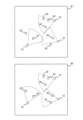
- FIG. 2 is an explanatory diagram showing an example of how the sensor captures a moving object.
- the example shown in FIG. 2 shows the operation of capturing multiple moving objects 20 using multiple sensors 10 .
- the range indicated by the dashed lines illustrated in FIG. 2 is the range in which the sensor 10 can capture the moving object 20 .
- the example shown in FIG. 2 indicates that five moving objects 20 are captured by three sensors 10 in state S1.
- the sensor control system 1 of this embodiment controls the sensor 10 so as to minimize the number of moving objects 20 that cannot be captured (that is, minimize the number of moving objects 20 that have not been captured).
- three sensors 10 can capture more moving objects (seven moving objects 20) as shown in state S2.
- the example shown in FIG. 2 shows that many moving objects can be captured by changing the angle of the sensor 10 .
- the moving object is a flying object (for example, a missile or drone)
- the aspect of the sensor 10 is, for example, radar.
- the moving object is not limited to the flying object, and may be, for example, a person or a mobile terminal.
- the form of the sensor 10 used may be a camera or the like.
- examples of the sensor 10 to be used include an antenna of a base station.
- the sensor control device 100 includes a device control section 110, a storage section 120, an input section 130, a target coordinate estimation section 140, a sensor control optimization section 150, a sensor control section 160, a new target detection section 170, and an output section 180.
- the device control unit 110 controls various functions of the sensor control device 100 .
- the storage unit 120 stores various information used by the sensor control device 100 for processing.
- the storage unit 120 of the present embodiment also stores a sensor coordinate/specification database 121 and a current target coordinate database 122 .
- the sensor coordinate/specification database 121 is a database that stores various specification information such as the position of the sensor 10 and parameter settings. For example, when the position of the sensor 10 changes, the sensor coordinate/specification database 121 may update the position of the sensor 10 after the change.
- the position of the sensor 10 after change may be obtained, for example, from a GPS (Global Positioning System), or may be obtained directly from a device or the like on which the sensor 10 is mounted.
- GPS Global Positioning System
- the sensor coordinate/specification database 121 may update the orientation of the sensor 10 after the change.
- the azimuth of the sensor 10 after the change may be obtained from the sensor control unit 160 or the sensor control optimization unit 150 described later, or may be obtained directly from each sensor 10 .
- the current target coordinate database 122 stores information indicating the current position t of the moving object to be captured by the sensor 10 (hereinafter also referred to as current target coordinates).
- a moving object as the name suggests, is an object that moves, so strictly speaking, it is difficult to grasp the current position. Therefore, the current target coordinate database 122 may store, as the current target coordinates, information indicating the position of the captured moving object at the most recent time t ⁇ 1, or information indicating the position of the moving object at the current time t estimated by the target coordinate estimation unit 140, which will be described later.
- the input unit 130 accepts input of various information used to control the sensor 10 .
- the input unit 130 may receive an input of the position of the sensor 10 after the change from the sensor 10 or a device on which the sensor 10 is mounted. Further, the input unit 130 may receive input of information indicating the current state of the sensor 10 such as the current orientation directly from the sensor 10 or may acquire and receive information stored in the storage unit 120 .
- Input unit 130 may be included in sensor control optimization unit 150, which will be described later.
- the target coordinate estimation unit 140 estimates the position of the moving object at the current time t (that is, the current target coordinates). Any method may be used by the target coordinate estimation unit 140 to estimate the current target coordinates.
- the target coordinate estimator 140 may, for example, identify the velocity of each moving object based on multiple observations of each moving object, and estimate the current target coordinates of the moving object based on the identified velocity and the observed position of the moving object.
- the sensor control optimization unit 150 performs processing for determining sensors to be assigned to capture moving objects. Therefore, a device that implements the sensor control optimization unit 150 can be called an allocation determination device. That is, the sensor control optimization section 150 may be implemented as a single device.
- the sensor control optimization unit 150 includes an Ising model data construction unit 151 and an annealing processing unit 152 .
- the Ising model data constructing unit 151 acquires information indicating the state of the sensor 10 and information indicating the position of the moving object. Specifically, the Ising model data constructing unit 151 receives input of information indicating the position and orientation of the sensor 10 at capture time t and information indicating the position of the moving object.
- the information indicating the position of the moving object at capture time t is, for example, the current target coordinates.
- the Ising model data construction unit 151 may acquire information indicating the position and orientation of the sensor 10 and information indicating the position of the moving object from the sensor coordinate/specification database 121 and the current target coordinate database 122 stored in the storage unit 120. Further, the Ising model data constructing unit 151 may acquire the current target coordinates from the target coordinate estimating unit 140 or directly acquire information indicating the position and orientation of the sensor 10 from the sensor 10 .
- the Ising model data constructing unit 151 constructs Ising model data (hereinafter sometimes simply referred to as a model) that models an optimization problem for optimally allocating a moving object to be captured by the sensor 10, based on the relationship between the position of the sensor 10 and the position of the moving object and the area that can be captured by the orientation of the sensor 10.
- Ising model data hereinafter sometimes simply referred to as a model
- the Ising model data constructing unit 151 derives a set of uncapturable moving objects from the relationship between the position and orientation of the sensor 10 and the positions of the moving objects.
- each sensor 10 is denoted by n
- the orientation of the sensor 10 by d
- the moving object by ⁇ .
- T n,d T represents a superscript bar.
- each sensor 10 has a captureable range determined in advance based on the position and orientation of the sensor itself.
- the capturable range is defined for distance and bearing.
- the capturable range is defined as a range from ⁇ 1 [m] or more to ⁇ 2 [m] or less from the sensor, a range of - ⁇ 1 [degree] or more and ⁇ 2 [degree] or less ( ⁇ 1 , ⁇ 2 > 0) with the front direction of the sensor 10 as a reference direction of 0 degrees.
- the Ising model data constructing unit 151 identifies the capture range of the sensor 10 for each possible posture of the sensor 10 based on the information indicating the captureable range and the position of the sensor 10 . Then, the Ising model data constructing unit 151 identifies moving objects that are not included in the identified capturing range among moving objects to be captured, and derives a set of moving objects that cannot be captured.
- FIG. 3 is an explanatory diagram showing an example of a method for deriving a set of moving objects that cannot be captured.
- the Ising model data constructing unit 151 identifies the moving objects 20a, 20b, 20d, and 20g that do not exist within the range of the region 40 as uncapturable moving objects, and derives a set of these as a set of uncapturable moving objects.
- the Ising model data construction unit 151 constructs Ising model data that models an optimization problem for optimally allocating moving objects to be captured by each sensor.
- an optimization problem modeled in the QUBO format that can be converted into Ising model data will be exemplified.
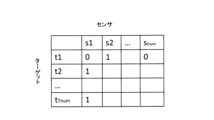
- FIG. 4 and 5 are explanatory diagrams showing examples of variables used in the QUBO format formula.
- a variable indicating whether or not the n-th sensor faces direction d (that is, a variable representing the orientation of the sensor) is represented by s n,d ⁇ 0,1 ⁇ .
- a value of 1 for s n,d indicates that the nth sensor is oriented in direction d, and a value of 0 for s n,d indicates that the nth sensor is not oriented in direction d.
- a variable indicating whether or not the n-th sensor captures the moving object ⁇ is represented by x n, ⁇ ⁇ 0,1 ⁇ .
- a value of 1 for xn, ⁇ indicates that the nth sensor captures the moving object ⁇
- a value of 0 for xn, ⁇ indicates that the nth sensor does not capture the moving object ⁇ .
- the Ising model data constructing unit 151 constructs a model (formula) that expresses, in QUBO format, an objective function that minimizes the number of moving objects that are not assigned to each sensor (that is, minimizes the number of moving objects that are not assigned to each sensor to be captured), with a constraint that at least the number of moving objects to be captured by each sensor does not exceed a defined upper limit.
- the upper limit described above is, for example, the resources available for the sensor 10 to capture moving objects (maximum number of moving objects that can be captured).
- the objective function for minimizing the number of missed captures is represented by Equation 1 below.
- Equation 1 T num is the number of moving objects and S num is the number of sensors. Also, zn , ⁇ is an auxiliary variable to represent anywhere from 0 to the number of sensors. As a result, the value in parentheses in Equation 1 becomes 0 when the number of sensors capturing the moving object is from 1 to S num , and becomes 1 when the number is 0.
- Equation 2 Equation 2 below, which has the advantage of eliminating the need to use the auxiliary variable z.
- Equation 3 the constraint function indicating that each sensor 10 faces only one direction is represented by Equation 3 below.
- C 1 represents a constant
- D num represents the number of orientations that the sensor can be oriented. This corresponds to each sensor facing one direction in FIG.
- Equation 4 a constraint function that suppresses assignment of a moving object that cannot be captured to a sensor is expressed by Equation 4 below. Note that C2 in Equation 4 also represents a constant. Tn ,d represents the set of moving objects that cannot be captured by each sensor as described above. Equation 4 makes it possible to associate the variable s n,d representing the orientation of the sensor with the variable x n, ⁇ representing whether or not a moving object is assigned to the sensor.
- Equation 5 a constraint function that prevents the number of moving objects to be captured by each sensor from exceeding a defined upper limit.
- C3 in Equation 5 represents a constant and capa represents an upper limit.
- y n,m is an auxiliary variable to represent any number from 0 to the upper limit. This corresponds to keeping the sum in the vertical column direction of the table in FIG. 5 within the upper limit.
- the Ising model data constructing unit 151 may construct a model obtained by adding at least the objective function shown in Equation 1 or Equation 2 and the constraint function shown in Equation 5. This makes it possible to construct an objective function that minimizes the number of moving objects that are not assigned to each sensor, with the constraint that the number of moving objects captured by each sensor does not exceed a defined upper limit.
- the Ising model data construction unit 151 may construct a model obtained by adding the constraint functions shown in Equations 3 and 4. As a result, in addition to the above constraints, it is possible to construct an objective function that constrains each sensor 10 to be oriented only in one direction and to suppress assignment of a moving object that cannot be captured to a sensor.
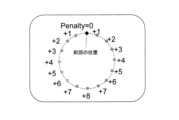
- Equation 6 A constraint function that limits the degree to which the orientation of the sensor changes is represented by Equation 6 below.
- C4 in Equation 6 represents a constant, and Pn ,d indicates the amount of difference from the previous sensor orientation.
- FIG. 6 is an explanatory diagram showing an example of the amount of difference in sensor orientation. The example shown in FIG. 6 indicates that the greater the angle from the previous sensor orientation, the greater the penalty value.
- Equation 7 A constraint function that limits the degree to which sensors assigned to moving objects change is represented by Equation 7 below.
- C5 and C6 in Equation 7 represent constants, and pxn , ⁇ is the value of x indicating whether or not moving object ⁇ was assigned to sensor n last time.
- DB n, ⁇ represents the predicted time during which the sensor n can continuously capture the moving object ⁇ (hereinafter referred to as tracking duration time).
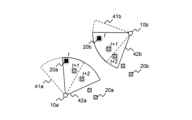
- FIG. 7 is an explanatory diagram showing how the sensors assigned to moving objects change.
- the sensor 10a captures the moving object 20a and the sensor 10b captures the moving object 20b. Further, it is assumed that the moving object 20a and the moving object 20b are respectively moving toward the lower right direction in the drawing.
- the distribution of targets to be captured can be modeled in a so-called elliptical shape that is narrow in the azimuth direction of the sensor and wide in the range direction. Therefore, by capturing a moving object with another sensor, the distribution of ellipses overlaps, so there is an advantage that the error range is reduced. Furthermore, increasing the number of radio wave irradiations used for acquisition by the sensor increases the number of samplings, which has the advantage of reducing the positional error.
- each sensor 10 can use a plurality of predetermined resources.
- the Ising model data construction unit 151 of the present embodiment constructs a model (formula) that expresses in QUBO format an objective function that minimizes the number of moving objects that are allocated to each sensor so that the number of sensors that capture one moving object and the number of resources that each sensor uses for capturing does not exceed a predetermined upper limit, with the restriction that the number of moving objects to be captured by each sensor does not exceed a predetermined upper limit.
- Equation 8 Equation 8 shown below.
- dmy1 shown in Equation 8 represents the first dummy sensor
- dmy2 represents the second dummy sensor. That is, x dmy1, ⁇ is a variable indicating whether or not the first dummy sensor dmy1 captures the moving object ⁇ , and x dmy2, ⁇ is a variable indicating whether the second dummy sensor dmy2 captures or does not capture the moving object ⁇ .
- This dummy sensor is a non-existent sensor for adjusting the number of sensors used to capture a single object so that it does not exceed the upper limit.
- FIG. 8 is an explanatory diagram showing an example of processing for setting dummy sensors to limit the upper limit of sensors.
- the example shown in FIG. 8 illustrates a case where each sensor can use up to two resources.
- the horizontal direction in FIG. 8 indicates the resource of the sensor, and the vertical direction indicates the moving object.
- the objective function exemplified in Equation 8 corresponds to the upper limit of the number of resources each sensor uses to acquire one moving object in the horizontal direction (eg, portion P1) of the table exemplified in FIG. Therefore, for example, when the upper limit of the number of sensors assigned to one moving object is 3, and the upper limit of the number of resources used by each sensor for capturing is 2, optimizing the objective function means optimizing the total resources of the sensors (including the dummy sensors DMY1 and DMY2) that capture each moving object (that is, the total of each row) to 6 in the table illustrated in FIG.
- the Ising model data constructing unit 151 may construct a model including constraints on the amount of resource usage for the same moving object with one sensor. Specifically, the Ising model data constructing unit 151 may construct Ising model data including a constraint that suppresses the use of more than a predetermined number of resources. This makes it possible to suppress the use of wasteful resources. In this case, the resources used by each sensor to capture one moving object should be less than a predetermined number. For example, a constraint function indicating that one sensor does not use three or more resources for the same moving object is represented by Equation 9 below.
- Equation 9 indicates that the number of resources that one sensor allocates to one moving object is either 0, 1, or 2, for example, in part P2.
- the constraint function when the upper limit of the number of sensors assigned to one moving object is 3 and the upper limit of the number of resources used for acquisition by each sensor is 2 is the sum of Equations 8 and 9 with appropriate coefficients.
- Equation 5 the above Equation 5 can be rewritten as Equation 10 below.
- Equation 10 corresponds to, for example, for part P3, ensuring that the total resource used for acquisition by one sensor does not exceed a defined upper limit. Since the dummy sensors are sensors for adjusting the number of moving objects to be captured by each sensor so as not to exceed a predetermined upper limit, there is no upper limit for resources.
- a value (hereinafter referred to as an accuracy point) indicating the tracking accuracy according to the number of resources of the sensors that capture the moving object, the distance of the moving object, and the azimuth between the sensors may be defined, and this value may be used in the optimization process.
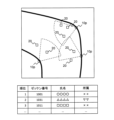
- FIG. 9 is an explanatory diagram showing an example of accuracy points calculated according to the number of sensor resources and the distance of a moving object.
- the example shown in FIG. 9 is an example of an accuracy point defined by dividing the number of resources consumed by one sensor into 1 or 2 and dividing the distance into two divisions (closer or farther than a predetermined distance).
- FIG. 9 shows that the tracking accuracy is higher when the moving object is closer and when it is captured by two resources.
- the value of the accuracy point is an example. Also, the number of resources is not limited to two, and the distance division is not limited to two. Also, the accuracy points may be defined by a function indicating the relationship between the number of resources and the distance, instead of the table format illustrated in FIG. 9 .
- the tracking accuracy according to the azimuth between sensors is maximized when the angles of the radio waves are orthogonal. Therefore, when the accuracy point calculated according to the number of sensor resources and the distance of the moving object is set as the basic point ap, when the moving object is captured by the two sensors s1 and s2, the accuracy point considering the orientation between the sensors is calculated, for example, by Equation 11 illustrated below.
- Equation 11 ap s1 and ap s2 indicate the base points of sensors s1 and s2, respectively, and ⁇ s1s2 indicates the angle formed by the radio wave from sensor s1 and the radio wave from sensor s2.
- the precision points illustrated in Equation 11 are maximized when ⁇ s1s2 is a right angle.
- Equation 12 the accuracy point considering the azimuth between the sensors is calculated, for example, by Equation 12 shown below.
- ap s1 , ap s2 and ap s3 denote the basis points of sensor s1, sensor s2 and sensor s3, respectively.
- ⁇ s1s2 represents the angle formed by the radio waves from the sensors s1 and s2
- ⁇ s2s3 represents the angle formed by the radio waves from the sensors s2 and s3
- ⁇ s1s3 represents the angle formed by the radio waves from the sensors s1 and s3.
- the precision points illustrated in Equation 12 are maximized when each angle is 120 degrees.
- the number of sensors is 2 or 3, but the same applies to the case of 4 or more.
- the Ising model data constructing unit 151 may construct a model that includes constraints such that the total sum of accuracy points calculated as a value indicating tracking accuracy, which increases as more objects are captured and increases as the moving object is closer, becomes greater. Further, the Ising model data constructing unit 151 may construct a model including a constraint that the total sum of accuracy points indicating tracking accuracy, which is defined so as to increase as the angles of the radio waves irradiated according to the azimuth of the sensor become orthogonal, increases.
- the accuracy point may be defined as a value that takes into account both of the above tracking accuracies (that is, a tracking accuracy that increases as more resources capture the object, closer to the moving object, and a value indicating the tracking accuracy that is defined to increase as the angles of the radio waves emitted by the sensors are orthogonal to each other).
- Equation 13 the objective function for increasing the sum of accuracy points is expressed by Equation 13 below.
- s2 is other than s1 and includes the first dummy sensor dmy1.
- s3 is other than s1 and s2 and includes a first dummy sensor dmy1 and a second dummy sensor dmy2.
- important targets there may be moving objects that the sensor wants to capture for as long as possible.
- moving objects are referred to as important targets.
- a sensor that is predetermined as a sensor that should capture an important target compared with other sensors is referred to as an important sensor.
- An important sensor is, for example, a sensor with higher tracking accuracy and performance than other sensors.
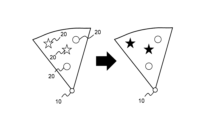
- FIG. 10 is an explanatory diagram showing an example of processing for preferentially capturing important targets.
- the moving objects 20 marked with asterisks are important targets.
- the two star-marked moving objects 20 are selected as important targets because the important target should be captured with priority.
- FIG. 11 is an explanatory diagram showing an example of processing using important sensors.
- sensor 10x is the important sensor and sensor 10y is the normal sensor.
- four moving objects 20 are included in the area that can be captured by both the sensors 10x and 10y, and the star-marked moving object 20 is the important target.
- the sensor 10x which is the important sensor
- the two star-marked moving objects 20, which are important targets are assigned to the sensor 10x, and the remaining two moving objects 20 are assigned to the sensor 10y.
- the Ising model data constructing unit 151 may construct a model in which the objective function includes a weighted formula that reduces the value of the objective function as the more important targets are assigned to the sensors, in order to preferentially assign sensors to moving objects (that is, important targets) that should be captured preferentially.
- An objective function containing a weighted formula that has the effect of preferentially assigning important targets to sensors is, for example, the expression in parentheses in Equation 2 shown above, which is changed to Equation 14 shown below in the case of important targets.
- C target is a constant determined in advance by an administrator or the like according to the degree of preferential assignment of important targets. Note that, in the case of the important target, the expression in parentheses of the above-described expression 1 may be changed to an expression weighted by (1+C target ), similar to expression 14.
- the Ising model data constructing unit 151 may construct a model in which the objective function includes a mathematical expression that has the effect of reducing the value of the objective function when an important sensor is assigned an important target, in order to allocate a moving object (that is, an important target) that should be captured preferentially to an important sensor.
- An objective function that includes a formula that has the effect of preferentially assigning important targets to important sensors is, for example, the formula in the parentheses of formula 2 shown above plus the formula of formula 15 shown below in the case of important targets.
- C sensor is a constant predetermined by an administrator or the like according to the degree of incentive given when an important target is assigned to an important sensor.
- Equation 15 may be added in the case of an important target to the equation of the part of Equation 1 for calculating the sum relating to the target.
- C target and C sensor are constants.
- C target and C sensor do not need to be fixed, and may be fixed or continuously changing values with respect to the moving object. By continuously changing C target and C sensor , it is possible to continuously change the priority.
- the Ising model data construction unit 151 may build a model by adding any Ising model (Hamiltonian) described above according to the constraints to be defined.
- the annealing processing unit 152 maps the modeled optimization problem (that is, Ising model data) to the annealing machine 200 to obtain an optimal solution. As a result, the annealing processing unit 152 acquires execution results indicating moving objects to be assigned to the sensors 10 . Since the method of mapping the Ising model to the annealing machine to obtain a solution is widely known, detailed description thereof will be omitted.
- the sensor control unit 160 controls the sensor 10 to capture the assigned moving object. Specifically, the sensor control unit 160 changes the orientation of the sensor 10 so that the moving object assigned to the sensor 10 can be captured.
- a control method of the sensor 10 is widely known, and detailed description thereof is omitted here.
- the new target detection unit 170 detects new moving objects. For example, if the sensor control system 1 includes a sensor for detecting a new moving object (not shown, hereinafter referred to as a new detection sensor), the new target detection unit 170 may acquire the detection result of the new detection sensor.
- the new detection sensor may be installed, for example, so as to comprehensively capture the presence or absence of a new moving object in the capture space.
- the role of detecting a new moving object may be given to the existing sensor 10 without using a new detection sensor.
- at least one of the plurality of sensors 10 may be installed at a position where the boundary between the capture space and the outside of the capture space can be captured, and when a moving object straddling the boundary is detected, the new target detection unit 170 may detect the moving object as a new moving object. Thereafter, new moving objects detected by the new target detection unit 170 are added to the capture targets.
- the output unit 180 outputs the results of execution by the annealing machine 200.
- the output unit 180 may display each sensor and the moving object assigned to each sensor as a capture target in a manner as illustrated in FIG. 3 according to the respective positions and orientations. That is, the output unit 180 may display the position and orientation of each sensor, and the area that can be captured by each sensor according to its state, in association with the moving object assigned to each sensor as a capture target.
- the output unit 180 may output a log indicating the optimization result, for example.
- the device control unit 110, the input unit 130, the target coordinate estimation unit 140, the sensor control optimization unit 150 (more specifically, the Ising model data construction unit 151 and the annealing processing unit 152), the sensor control unit 160, the new target detection unit 170, and the output unit 180 are realized by a computer processor (for example, a CPU (Central Processing Unit)) that operates according to a program (sensor control program).
- a computer processor for example, a CPU (Central Processing Unit)
- a program sensor control program
- the program may be stored in the storage unit 120 of the sensor control device 100, and the processor may read the program and operate according to the program as the device control unit 110, the input unit 130, the target coordinate estimation unit 140, the sensor control optimization unit 150 (more specifically, the Ising model data construction unit 151 and the annealing processing unit 152), the sensor control unit 160, the new target detection unit 170, and the output unit 180.
- the functions of the sensor control device 100 may be provided in a SaaS (Software as a Service) format.
- the device control unit 110, the input unit 130, the target coordinate estimation unit 140, the sensor control optimization unit 150 (more specifically, the Ising model data construction unit 151 and the annealing processing unit 152), the sensor control unit 160, the new target detection unit 170, and the output unit 180 may each be realized by dedicated hardware. Also, part or all of each component of each device may be implemented by a general-purpose or dedicated circuit (circuitry), processor, etc., or a combination thereof. These may be composed of a single chip, or may be composed of multiple chips connected via a bus. A part or all of each component of each device may be implemented by a combination of the above-described circuits and the like and programs.
- each component of the sensor control device 100 when part or all of each component of the sensor control device 100 is realized by a plurality of information processing devices, circuits, etc., the plurality of information processing devices, circuits, etc. may be centrally arranged or distributed.
- the information processing device, circuits, and the like may be implemented as a form in which each is connected via a communication network, such as a client-server system, a cloud computing system, or the like.
- FIG. 12 is a flowchart showing an operation example of the sensor control system 1.
- the input unit 130 receives inputs of the position of the sensor 10, the orientation of the sensor 10, and the position of the moving object (step S11).
- the Ising model data constructing unit 151 constructs Ising model data modeling an optimization problem for optimally allocating moving objects to be captured by the sensor 10 from the relationship of the input information (step S12).
- the Ising model data constructing unit 151 maps the Ising model data on the annealing machine 200 and acquires execution results indicating moving objects to be assigned to the sensors 10 (step S13).
- the sensor control unit 160 controls the sensor 10 to capture the assigned moving object based on the execution result (step S14).
- the input unit 130 receives the input of the position and orientation of the sensor 10 and the position of the moving object
- the Ising model data construction unit 151 constructs Ising model data that models the optimization problem for optimally allocating the moving object to be captured by the sensor 10 based on the relationship between the position of the moving object and the area that can be captured by the position and orientation of the sensor 10.
- the Ising model data constructing unit 151 maps the Ising model data to the annealing machine 200, acquires an execution result indicating the moving object to be assigned to the sensor 10, and the sensor control unit 160 controls the sensor 10 to capture the assigned moving object based on the execution result. Therefore, multiple sensors that capture multiple moving objects can be controlled in a realistic time.
- the sensor control system 1 of this embodiment captures a flying object that is a moving object (for example, missiles, drones, etc.).
- the sensor control system 1 of this embodiment can be used, for example, to capture the current position of a marathon runner.
- FIG. 13 is an explanatory diagram showing an example in which the sensor control system of this embodiment is applied to capture the current position of a marathon runner.
- the example shown in FIG. 13 shows a situation in which a camera 10p is installed along the road and a runner, which is a moving object 20, is captured. Also, in the example shown in FIG. 13, the bib number, rank, name, etc. of the captured runner are displayed.
- the time measurement of marathon competitions is carried out by installing receivers on the course and having the runners hold measurement chips (for example, RS tags (Runners SporTag)) to which each runner's unique identification information is assigned.However, registering runner information in measurement chips is troublesome, and furthermore, distributing and retaining the measurement chips to runners is complicated.
- RS tags Runners SporTag
- the sensor control system 1 of this embodiment can be applied to these problems.
- the Ising model data construction unit 151 constructs a model that minimizes the number of runners that are allocated to each camera and that the number of runners allocated to each camera does not exceed a predetermined upper limit.
- the sensor control system 1 of this embodiment can be applied not only to capturing the current position of marathon runners, but also to a service for providing commemorative photos of runners during a race.
- a camera for photographing a runner is installed at each point, and there is also a service that provides the photographed image to the runner at a later date.
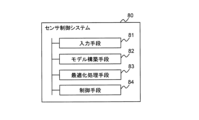
- FIG. 14 is a block diagram showing an overview of the sensor control system according to the invention.
- a sensor control system 80 models an optimization problem for optimally allocating a moving object to be captured by a sensor based on an input means 81 (e.g., input unit 130) that receives input of the position and orientation of a sensor (e.g., sensor 10) that captures a moving object (e.g., a flying object, a person, a mobile terminal, etc.) and the position of the moving object (e.g., target coordinate position), and the relationship between the position of the sensor and the position of the moving object and the area that can be captured by the position and direction of the sensor.
- an input means 81 e.g., input unit 130
- a sensor e.g., sensor 10
- the position of the moving object e.g., target coordinate position
- model building means 82 e.g., Ising model data building unit 151 for building Ising model data
- optimization processing means 83 e.g., annealing processing unit 152 for mapping the Ising model data to an annealing machine and obtaining execution results indicating moving objects assigned to sensors
- control means 84 e.g., sensor control unit 160 for controlling the sensors to capture the assigned moving objects based on the execution results.
- model construction means 82 may construct Ising model data representing an objective function (for example, the above equations 8 and 10) for minimizing the number of moving objects that are allocated to each sensor so that the number of moving objects to be captured by the sensors does not exceed a predetermined upper limit, and that the total number of resources used for capturing one moving object by all sensors does not exceed a predetermined upper limit.
- an objective function for example, the above equations 8 and 10.
- model construction means 82 may construct Ising model data including a constraint (eg, Equation 9 above) that prevents one sensor from using more than a predetermined number of resources for the same moving object.
- a constraint eg, Equation 9 above
- model construction means 82 may construct Ising model data that includes a constraint (for example, Equation 13) that the sum of accuracy points calculated as a value indicating tracking accuracy, which increases as a moving object is captured by a plurality of resources and increases as the moving object is closer to the sensor, becomes larger.
- a constraint for example, Equation 13
- model building means 82 may build Ising model data that includes a constraint (for example, equations 11 and 12) that the total sum of accuracy points indicating the tracking accuracy defined so as to increase as the angles of the radio waves irradiated according to the azimuth of the sensor become orthogonal to each other.
- a constraint for example, equations 11 and 12
- model building means 82 may build Ising model data that includes, in the objective function, a weighted formula (e.g., Equation 14) that reduces the value of the objective function as the important target, which is a moving object that should be preferentially captured, is assigned to the sensor.
- a weighted formula e.g., Equation 14
- model building means 82 may build Ising model data that includes, in the objective function, a formula (e.g., Equation 15) that has the effect of reducing the value of the objective function when the important sensor, which is a sensor that is predetermined as a sensor that should capture the important target, is assigned the important target.
- a formula e.g., Equation 15
- model construction means 82 may construct model data in which constraints and objective functions are expressed in QUBO format.
- the sensor control system 80 may include set derivation means (for example, the Ising model data constructing unit 151) that derives a set of moving objects that cannot be captured from the relationship between the position of the sensor, the orientation of the sensor, and the position of the moving object. Then, the model building means 82 may build a model including a constraint that prevents the moving objects included in the set from being assigned to the sensors.
- set derivation means for example, the Ising model data constructing unit 151
- the model building means 82 may build a model including a constraint that prevents the moving objects included in the set from being assigned to the sensors.
- the model construction means constructs Ising model data representing an objective function for minimizing the number of moving objects that are assigned to each sensor and that the number of moving objects to be captured by the sensors does not exceed a predetermined upper limit, and that the total number of resources used for capturing one moving object by all sensors does not exceed a predetermined upper limit.
- the sensor control system according to Appendix 1.
- Appendix 3 The sensor control system according to appendix 1 or appendix 2, wherein the model construction means constructs Ising model data including a constraint that prevents one sensor from using more than a predetermined number of resources for the same moving object.
- the model construction means constructs Ising model data including a constraint that the sum of accuracy points calculated as a value indicating tracking accuracy, which increases as the object is captured by a plurality of resources and increases as the moving object is closer to the sensor, becomes larger.
- the model construction means constructs Ising model data including, as a constraint, a total sum of accuracy points indicating tracking accuracy defined so as to increase as the angles of the radio waves irradiated according to the azimuth of the sensor become orthogonal to each other.
- Appendix 6 The sensor control system according to any one of Appendices 1 to 5, wherein the model construction means constructs Ising model data including, in the objective function, a weighted formula that reduces the value of the objective function so that an important target, which is a moving object to be captured preferentially, is assigned to the sensor.
- Appendix 8 The sensor control system according to any one of Appendices 1 to 7, wherein the model construction means constructs model data in which the constraint and the objective function are expressed in QUBO format.
- Appendix 9 A set deriving means for deriving a set of uncapturable moving objects from the relationship between the position of the sensor, the orientation of the sensor, and the position of the moving object, 9.
- the sensor control system according to any one of appendices 1 to 8, wherein the model constructing means constructs a model including a constraint that restricts assignment of moving objects included in the set to sensors.
- Supplementary Note 10 The sensor control system according to any one of Supplementary Notes 1 to 9, further comprising output means for displaying the position and orientation of each sensor and the area that can be captured by each sensor according to the state of the sensor in association with the moving object assigned as a capture target to each sensor.
- Input means for receiving input of the position of a sensor that captures a moving object, the orientation of the sensor, and the position of the moving object; model building means for building Ising model data that models an optimization problem for optimally allocating a moving object to be captured by the sensor based on the position of the sensor and the relationship between the captureable area and the position of the moving object; and an optimization processing unit that maps the Ising model data to an annealing machine and obtains an execution result indicating a moving object to be assigned to the sensor.
- (Appendix 12) receiving input of the position of a sensor that captures a moving object, the orientation of the sensor, and the position of the moving object; constructing Ising model data that models an optimization problem for optimally allocating a moving object to be captured by the sensor based on the relationship between the position of the sensor and the position of the moving object and the area that can be captured by the orientation of the sensor; mapping the Ising model data to an annealing machine to obtain an execution result indicating a moving object to be assigned to the sensor;
- a sensor control method comprising: controlling the sensor to capture an assigned moving object based on the execution result.
- the sensor control method is to construct Ising model data representing an objective function that minimizes the number of moving objects that are assigned to each sensor and that the number of moving objects that are to be captured by the sensors does not exceed a predetermined upper limit, and that the total number of resources used for capturing one moving object by the sensors as a whole does not exceed a predetermined upper limit.
- the storage medium which stores a sensor control program for constructing Ising model data representing an objective function for minimizing the number of moving objects that are allocated to each sensor and minimizing the number of moving objects that are allocated to each sensor so that the number of moving objects to be captured by the sensors does not exceed a predetermined upper limit in the model building process, and that the total number of resources used for capturing one moving object by the sensors as a whole does not exceed a predetermined upper limit.
- Input processing for receiving inputs of the position of a sensor that captures a moving object, the orientation of the sensor, and the position of the moving object;
- a model construction process for constructing Ising model data that models an optimization problem for optimally allocating a moving object to be captured by the sensor based on the relationship between the position of the sensor and the position of the moving object and the area that can be captured by the orientation of the sensor, an optimization process of mapping the Ising model data to an annealing machine to obtain an execution result indicating a moving object to be assigned to the sensor;
- a sensor control program for executing a control process for controlling the sensor to capture an assigned moving object based on the execution result.
- sensor 20 moving object 100 sensor control device 110 device control unit 120 storage unit 121 sensor coordinate/specification database 122 current target coordinate database 130 input unit 140 target coordinate estimation unit 150 sensor control optimization unit 151 Ising model data construction unit 152 annealing processing unit 160 sensor control unit 170 new target detection unit 180 output unit 20 0 annealing machine
Landscapes
- Engineering & Computer Science (AREA)
- Remote Sensing (AREA)
- Radar, Positioning & Navigation (AREA)
- Physics & Mathematics (AREA)
- General Physics & Mathematics (AREA)
- Computer Networks & Wireless Communication (AREA)
- Computing Systems (AREA)
- Theoretical Computer Science (AREA)
- Algebra (AREA)
- Mathematical Analysis (AREA)
- Medical Informatics (AREA)
- Probability & Statistics with Applications (AREA)
- Health & Medical Sciences (AREA)
- Artificial Intelligence (AREA)
- Computational Mathematics (AREA)
- Data Mining & Analysis (AREA)
- Evolutionary Computation (AREA)
- Signal Processing (AREA)
- Mathematical Optimization (AREA)
- Pure & Applied Mathematics (AREA)
- General Engineering & Computer Science (AREA)
- Mathematical Physics (AREA)
- Software Systems (AREA)
- General Health & Medical Sciences (AREA)
- Electromagnetism (AREA)
- Control Of Position, Course, Altitude, Or Attitude Of Moving Bodies (AREA)
Priority Applications (3)
| Application Number | Priority Date | Filing Date | Title |
|---|---|---|---|
| US18/726,152 US20240410977A1 (en) | 2022-01-21 | 2022-01-21 | Sensor control system, method, and program |
| JP2023574993A JP7683748B2 (ja) | 2022-01-21 | 2022-01-21 | センサ制御システム、方法およびプログラム |
| PCT/JP2022/002170 WO2023139746A1 (ja) | 2022-01-21 | 2022-01-21 | センサ制御システム、方法およびプログラム |
Applications Claiming Priority (1)
| Application Number | Priority Date | Filing Date | Title |
|---|---|---|---|
| PCT/JP2022/002170 WO2023139746A1 (ja) | 2022-01-21 | 2022-01-21 | センサ制御システム、方法およびプログラム |
Publications (1)
| Publication Number | Publication Date |
|---|---|
| WO2023139746A1 true WO2023139746A1 (ja) | 2023-07-27 |
Family
ID=87348388
Family Applications (1)
| Application Number | Title | Priority Date | Filing Date |
|---|---|---|---|
| PCT/JP2022/002170 Ceased WO2023139746A1 (ja) | 2022-01-21 | 2022-01-21 | センサ制御システム、方法およびプログラム |
Country Status (3)
| Country | Link |
|---|---|
| US (1) | US20240410977A1 (https=) |
| JP (1) | JP7683748B2 (https=) |
| WO (1) | WO2023139746A1 (https=) |
Families Citing this family (1)
| Publication number | Priority date | Publication date | Assignee | Title |
|---|---|---|---|---|
| CN117575083B (zh) * | 2023-11-23 | 2025-05-30 | 广东工业大学 | 一种应用于鸟类入侵检测的雷达布局方法 |
Citations (3)
| Publication number | Priority date | Publication date | Assignee | Title |
|---|---|---|---|---|
| JP2001331892A (ja) * | 2000-05-18 | 2001-11-30 | Mitsubishi Electric Corp | 画像認識処理方式 |
| JP2010151820A (ja) * | 2008-12-23 | 2010-07-08 | Sony Deutsche Gmbh | 適合検出システム |
| JP2017027261A (ja) * | 2015-07-17 | 2017-02-02 | ヤフー株式会社 | 最適化装置、最適化方法および最適化プログラム |
Family Cites Families (2)
| Publication number | Priority date | Publication date | Assignee | Title |
|---|---|---|---|---|
| KR102554215B1 (ko) | 2016-09-20 | 2023-07-11 | 이노비즈 테크놀로지스 엘티디 | Lidar 시스템 및 방법 |
| CN110930692B (zh) | 2019-10-24 | 2021-06-18 | 河北德冠隆电子科技有限公司 | 一种主动式车辆连续跟踪装置、系统及方法 |
-
2022
- 2022-01-21 WO PCT/JP2022/002170 patent/WO2023139746A1/ja not_active Ceased
- 2022-01-21 JP JP2023574993A patent/JP7683748B2/ja active Active
- 2022-01-21 US US18/726,152 patent/US20240410977A1/en active Pending
Patent Citations (3)
| Publication number | Priority date | Publication date | Assignee | Title |
|---|---|---|---|---|
| JP2001331892A (ja) * | 2000-05-18 | 2001-11-30 | Mitsubishi Electric Corp | 画像認識処理方式 |
| JP2010151820A (ja) * | 2008-12-23 | 2010-07-08 | Sony Deutsche Gmbh | 適合検出システム |
| JP2017027261A (ja) * | 2015-07-17 | 2017-02-02 | ヤフー株式会社 | 最適化装置、最適化方法および最適化プログラム |
Also Published As
| Publication number | Publication date |
|---|---|
| US20240410977A1 (en) | 2024-12-12 |
| JP7683748B2 (ja) | 2025-05-27 |
| JPWO2023139746A1 (https=) | 2023-07-27 |
Similar Documents
| Publication | Publication Date | Title |
|---|---|---|
| CN110889808B (zh) | 一种定位的方法、装置、设备及存储介质 | |
| Ponda et al. | Trajectory optimization for target localization using small unmanned aerial vehicles | |
| JP6734940B2 (ja) | 三次元計測装置 | |
| US20220277480A1 (en) | Position estimation device, vehicle, position estimation method and position estimation program | |
| CN110493710B (zh) | 轨迹重建方法、装置、计算机设备和存储介质 | |
| US8897543B1 (en) | Bundle adjustment based on image capture intervals | |
| JP2020030204A (ja) | 距離測定方法、プログラム、距離測定システム、および可動物体 | |
| CN109945864B (zh) | 室内行车定位融合方法、装置、存储介质及终端设备 | |
| TWI714054B (zh) | 用於追蹤和渲染對應於實體對象的虛擬對象的追蹤系統以及用於其的操作方法 | |
| CN106461753A (zh) | 位置转换确定 | |
| KR102823384B1 (ko) | 위치를 탐지하는 전자 장치 및 그 방법 | |
| CN114623836B (zh) | 车辆位姿确定方法、装置及车辆 | |
| US12254041B2 (en) | Position recognition method and system based on visual information processing | |
| CN109769206B (zh) | 一种室内定位融合方法、装置、存储介质及终端设备 | |
| CN119881794A (zh) | 一种基于粒子滤波和pdr的多源融合室内定位方法及设备 | |
| WO2023139746A1 (ja) | センサ制御システム、方法およびプログラム | |
| WO2020237478A1 (zh) | 一种飞行规划方法及相关设备 | |
| US11692829B2 (en) | System and method for determining a trajectory of a subject using motion data | |
| JP2021103168A (ja) | 拡張現実装置及び位置決め方法 | |
| JP2021099303A (ja) | 粒子フィルタを使用した位置特定方法、プログラム、及びシステム | |
| US20190272426A1 (en) | Localization system and method and computer readable storage medium | |
| CN113259652A (zh) | 提供增强现实显示的方法和系统 | |
| CN115457165B (zh) | 基于无人机航拍图的虚拟航道绘制方法、装置及存储介质 | |
| CN118068355A (zh) | 激光雷达数据合并方法、电子设备及存储介质 | |
| CN114698094B (zh) | 一种数据处理方法及装置 |
Legal Events
| Date | Code | Title | Description |
|---|---|---|---|
| 121 | Ep: the epo has been informed by wipo that ep was designated in this application |
Ref document number: 22921903 Country of ref document: EP Kind code of ref document: A1 |
|
| WWE | Wipo information: entry into national phase |
Ref document number: 2023574993 Country of ref document: JP |
|
| WWE | Wipo information: entry into national phase |
Ref document number: 18726152 Country of ref document: US |
|
| NENP | Non-entry into the national phase |
Ref country code: DE |
|
| 122 | Ep: pct application non-entry in european phase |
Ref document number: 22921903 Country of ref document: EP Kind code of ref document: A1 |