WO2023136104A1 - メタン生成システム及びメタン生成方法 - Google Patents
メタン生成システム及びメタン生成方法 Download PDFInfo
- Publication number
- WO2023136104A1 WO2023136104A1 PCT/JP2022/047701 JP2022047701W WO2023136104A1 WO 2023136104 A1 WO2023136104 A1 WO 2023136104A1 JP 2022047701 W JP2022047701 W JP 2022047701W WO 2023136104 A1 WO2023136104 A1 WO 2023136104A1
- Authority
- WO
- WIPO (PCT)
- Prior art keywords
- liquid
- liquid component
- component
- solid
- section
- Prior art date
- Legal status (The legal status is an assumption and is not a legal conclusion. Google has not performed a legal analysis and makes no representation as to the accuracy of the status listed.)
- Ceased
Links
Images

Classifications
-
- B—PERFORMING OPERATIONS; TRANSPORTING
- B09—DISPOSAL OF SOLID WASTE; RECLAMATION OF CONTAMINATED SOIL
- B09B—DISPOSAL OF SOLID WASTE NOT OTHERWISE PROVIDED FOR
- B09B3/00—Destroying solid waste or transforming solid waste into something useful or harmless
- B09B3/30—Destroying solid waste or transforming solid waste into something useful or harmless involving mechanical treatment
- B09B3/35—Shredding, crushing or cutting
-
- B—PERFORMING OPERATIONS; TRANSPORTING
- B09—DISPOSAL OF SOLID WASTE; RECLAMATION OF CONTAMINATED SOIL
- B09B—DISPOSAL OF SOLID WASTE NOT OTHERWISE PROVIDED FOR
- B09B3/00—Destroying solid waste or transforming solid waste into something useful or harmless
- B09B3/60—Biochemical treatment, e.g. by using enzymes
- B09B3/65—Anaerobic treatment
-
- C—CHEMISTRY; METALLURGY
- C12—BIOCHEMISTRY; BEER; SPIRITS; WINE; VINEGAR; MICROBIOLOGY; ENZYMOLOGY; MUTATION OR GENETIC ENGINEERING
- C12P—FERMENTATION OR ENZYME-USING PROCESSES TO SYNTHESISE A DESIRED CHEMICAL COMPOUND OR COMPOSITION OR TO SEPARATE OPTICAL ISOMERS FROM A RACEMIC MIXTURE
- C12P5/00—Preparation of hydrocarbons or halogenated hydrocarbons
- C12P5/02—Preparation of hydrocarbons or halogenated hydrocarbons acyclic
-
- Y—GENERAL TAGGING OF NEW TECHNOLOGICAL DEVELOPMENTS; GENERAL TAGGING OF CROSS-SECTIONAL TECHNOLOGIES SPANNING OVER SEVERAL SECTIONS OF THE IPC; TECHNICAL SUBJECTS COVERED BY FORMER USPC CROSS-REFERENCE ART COLLECTIONS [XRACs] AND DIGESTS
- Y02—TECHNOLOGIES OR APPLICATIONS FOR MITIGATION OR ADAPTATION AGAINST CLIMATE CHANGE
- Y02E—REDUCTION OF GREENHOUSE GAS [GHG] EMISSIONS, RELATED TO ENERGY GENERATION, TRANSMISSION OR DISTRIBUTION
- Y02E50/00—Technologies for the production of fuel of non-fossil origin
- Y02E50/30—Fuel from waste, e.g. synthetic alcohol or diesel
Definitions
- the present disclosure relates to a methane production system and a methane production method.
- bioalcohol as a biofuel by fermenting monosaccharides obtained by hydrolyzing cellulose and hemicellulose in biomass with microorganisms.
- Patent Document 1 discloses a method for producing sugar, which includes a step of wet pulverizing herbaceous biomass, a step of contacting the pulverized biomass with a basic compound, and a step of enzymatically saccharifying the alkali-treated biomass. . Moreover, Patent Document 1 discloses that alcohol can be produced by fermenting sugar.
- biomass is saccharified with enzymes.
- common enzymes are expensive.
- saccharification treatment using saccharifying bacteria instead of enzymes.
- microorganisms such as yeast and to use simple sugars as substrates for alcoholic fermentation. Therefore, when saccharifying bacteria are used, monosaccharides produced from biomass are decomposed by the saccharifying bacteria, which may reduce the amount of substrate for alcoholic fermentation. Therefore, when a saccharifying solution is produced using saccharifying bacteria, the amount of alcohol recovered from biomass and used as biofuel may decrease.
- methane is used not only as a biofuel but also as a raw material for various chemical syntheses.
- an object of the present disclosure is to provide a methane production system and a methane production method capable of efficiently producing methane from lignocellulose biomass using microorganisms.
- the methane production system includes an alkali treatment unit that contacts lignocellulose biomass and an alkali solution to generate an alkali treatment solution containing a first solid component and a first liquid component, and A saccharification unit that decomposes at least one of lignocellulose biomass-derived cellulose and hemicellulose contained in the saccharification unit to generate a saccharification solution containing a second liquid component; An acid generator that generates an organic acid from the mixed liquid containing the organic acid, and a methane generator that generates methane from the organic acid using methanogenic bacteria.
- the biogas produced by saccharification bacteria may be supplied to the methane production unit.
- the methanation system comprises a first solid-liquid separation section for separating the alkaline treated liquid into a first solid component and a first liquid component, the first solid component being supplied to the saccharification section and the first liquid component being supplied to the acid generation section. may be supplied to
- the first solid-liquid separation section includes a first screen and a first ejection section for ejecting the alkali-treated liquid to the first screen. may be separated as a first solid component.
- the methanation system may include a grinding section for grinding the lignocellulose biomass, and the alkali treatment section may bring the lignocellulose biomass ground in the grinding section into contact with the alkaline liquid to generate the alkaline treated liquid. .
- the methane production system includes a second solid-liquid separation section that separates the saccharification liquid into a second solid component and a second liquid component, the second solid component being supplied to at least one of the grinding section and the saccharification section, A second liquid component may be supplied to the acid generator.
- the second solid-liquid separation section includes a second screen and a second ejection section for ejecting the saccharified liquid onto the second screen.
- the remaining solid component may be separated as a second solid component.
- the acid generator mixes the first liquid component and the second liquid component to generate a mixed liquid, and saccharifies at least one selected from the group consisting of cellulose, hemicellulose, and oligosaccharide contained in the first liquid component.
- a mixing part that is decomposed by the saccharifying bacteria flowing from the mixing part, and a containing part that contains the acid-producing bacteria and generates an organic acid from the mixed liquid supplied from the mixing part.
- the acid-producing section is disposed between a first flow path through which the first liquid component passes, a second flow path through which the second liquid component passes, and between the first flow path and the second flow path.
- a container for generating an organic acid from a mixed liquid produced by mixing the first liquid component supplied from the first channel and the second liquid component supplied from the second channel may contain
- the biogas produced by acid-producing bacteria may be supplied to the methanogenic part.
- the lignocellulose biomass may contain food waste.
- the methane production method includes the steps of contacting lignocellulose biomass with an alkaline solution to produce an alkaline-treated solution containing a first solid component and a first liquid component, and a step of decomposing at least one of cellulose and hemicellulose derived from lignocellulose biomass to produce a saccharified solution containing a second liquid component; and a mixed solution containing the first liquid component and the second liquid component by acidogenic bacteria. and producing methane from the organic acid with a methanogen.
- FIG. 1 is a schematic diagram illustrating a methane production system according to one embodiment.
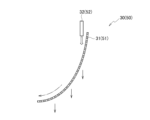
- FIG. 2 is a schematic diagram showing a first solid-liquid separation section or a second solid-liquid separation section according to one embodiment.
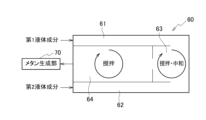
- FIG. 3 is a schematic diagram showing an acid generator according to one embodiment.
- the methane production system 1 includes a grinding section 10, an alkali treatment section 20, a first solid-liquid separation section 30, a saccharification section 40, and a second solid-liquid separation section. 50 , an acid generator 60 , a methane generator 70 and an aerobic processor 80 .
- solid lines indicate liquid channels through which liquid components flow
- dashed lines indicate solid channels through which solid components flow
- dashed lines indicate gas channels through which gas components flow.
- the grinding section 10 grinds the lignocellulose biomass.
- the vascular bundles and soft tissue of the lignocellulose biomass can be destroyed.
- the processing efficiency of the lignocellulose biomass can be improved in the steps subsequent to the grinding unit 10 .
- the shape of the lignocellulose biomass before being treated in the grinding unit 10 may be, for example, powdery, particulate, fibrous, chip-like, plate-like or flake-like.
- Lignocellulose biomass is biomass containing lignocellulose.
- Lignocellulose contains at least one selected from the group consisting of cellulose, hemicellulose and lignin.
- the lignocellulose biomass may contain at least one selected from the group consisting of plant biomass, its processed products and waste.
- Vegetation biomass may include at least one of herbaceous biomass and woody biomass.
- Herbaceous biomass may contain at least one selected from the group consisting of oil palm, rice, wheat, banana, sugar cane, corn, cassava, sago palm, nipa palm, yam, sorghum and potato.
- the woody biomass may contain at least one selected from the group consisting of cedar, cypress, pine, eucalyptus and beech.
- the lignocellulose biomass may contain food waste. Some food waste is incinerated or landfilled, but by using it as biomass, it is possible to reduce garbage and effectively use resources.
- Food waste may include industrial waste, municipal waste, and mixtures thereof.
- Municipal waste may include commercial municipal waste, domestic municipal waste, and mixtures thereof.
- Industrial waste refers to non-edible items that are secondarily obtained during the process of manufacturing, processing or cooking food. Examples of industrial waste include food waste from food processing plants.
- Business-related general waste means food waste generated by businesses that is discarded after the food has been used for human consumption or before it has been used for human consumption. Examples of general commercial waste include food waste from restaurants. Household general waste means food waste generated from households that is discarded after the food has been used for food or without being used for food.
- Household general waste includes food waste such as food waste from households.
- the food waste may contain at least one selected from the group consisting of beer lees, tea lees, coffee husks, soybean lees, rice bran, squeezed fruit lees, and squeezed vegetable lees. .
- the grinding section 10 may include a wet grinder or a dry grinder.
- a wet grinder When the grinding unit 10 is a wet grinder, lignocellulose biomass can be efficiently pulverized. Especially when the lignocellulosic biomass contains food waste, the food waste can be efficiently reduced further.
- the grinding section 10 may contain a whetstone.
- the material of the grindstone may be a non-porous grindstone.
- the grinding unit 10 may include a stone mill grinder. Stone grinders can finely grind lignocellulosic biomass. In addition, a stone grinder can be operated with low power compared to equipment such as a ball mill.
- the grinding section 10 may be a wet stone mill grinder.
- the grindstone may include an upper grinder and a lower grinder. The upper grinder and the lower grinder are arranged to face each other across a clearance, and one of the upper grinder and the lower grinder may be rotatably provided.
- the upper grinder and the lower grinder may have an annular shape with an opening in the center.
- the lignocellulose biomass When the lignocellulose biomass is supplied from the opening in the center of the ring, the lignocellulose biomass is ground within the clearance by the rotation of at least one of the upper grinder and the lower grinder, and is ground from the outer peripheral edge side of the ring as ground material. may be discharged.
- the set value for the clearance of the wet millstone grinder may be -200 ⁇ m to +100 ⁇ m.
- the particle size can be reduced while suppressing a decrease in the processing speed of lignocellulose biomass.
- the rotation speed of the wet stone mill may be 1500 rpm to 2500 rpm. Even when the rotation speed is within such a range, the particle size can be reduced while suppressing a decrease in the processing speed of lignocellulose biomass.
- the average particle size of the lignocellulose biomass after grinding may be 12 ⁇ m or less, or may be 11 ⁇ m or less.
- the average particle size of the lignocellulosic biomass after milling may be 1 ⁇ m or more.
- the average particle size is a number-based median size measured by a laser diffraction scattering method.
- the alkali treatment unit 20 brings the lignocellulose biomass into contact with an alkali solution to generate an alkali treatment solution.
- the alkali treatment section 20 brings the lignocellulose biomass ground in the grinding section 10 into contact with the alkaline liquid to generate the alkaline processing liquid.
- the contact between the lignocellulose biomass and the alkaline solution causes the proteins and lipids of the lignocellulose biomass to dissolve in the alkaline solution. Therefore, the cellulose and hemicellulose in the lignocellulose biomass are exposed, and the enzymes produced by the saccharifying bacteria in the saccharifying section 40 can easily access the cellulose and hemicellulose.
- the decomposition efficiency of cellulose and hemicellulose can be improved.
- food waste often contains large amounts of proteins and lipids, and access to cellulose and hemicellulose by enzymes is highly likely to be inhibited. Therefore, alkali treatment is considered to be highly effective.
- the sterilization effect of the alkali solution can suppress the decay of the lignocellulose biomass.
- contamination of the saccharification section 40 with germs can be suppressed.
- food waste often contains a large amount of proteins and lipids, so that the bactericidal effect of the alkaline solution has a high degree of contribution.
- the alkaline liquid is at least selected from the group consisting of alkali metal hydroxides, alkali metal carbonates, alkali metal hydrogen carbonates, alkaline earth metal hydroxides, alkaline earth metal carbonates and ammonia.
- One may be a dissolved aqueous solution.
- the alkali metal may be sodium or potassium.
- the alkaline earth metal may be calcium or magnesium.
- the alkaline solution is preferably an aqueous sodium hydroxide solution.
- the content of sodium hydroxide in the alkaline solution may be 0.045 g to 0.20 g per 1 g of dry solid content of lignocellulosic biomass.
- Alkali may be added so that the dry solids content of the lignocellulosic biomass is between 1% and 5% by weight.
- the alkali treatment which is the contact between the lignocellulose biomass and the alkaline liquid, may be carried out by immersing the lignocellulose biomass in the alkaline liquid or pouring the alkaline liquid over the lignocellulose biomass.
- the temperature of the alkali treatment may be 60°C to 80°C. When the alkali treatment temperature is within such a temperature range, protein and lipid dissolution and sterilization can be performed simultaneously.
- the alkali treatment time may be 12 hours or more and 20 hours or less. By setting the alkali treatment time to 12 hours or longer, the undissolved protein and lipid can be reduced. Also, by setting the alkali treatment time to 20 hours or less, the treatment cost for the protein and lipid dissolution rate can be reduced.
- the reaction temperature of the alkali treatment is 60° C. or more, and the alkali treatment time is continuously 12 hours or more.
- the alkaline treatment liquid contains a first solid component and a first liquid component.
- the lignocellulose biomass is brought into contact with the alkaline liquid, so that the proteins and lipids in the lignocellulose biomass are dissolved in the alkaline liquid. Therefore, the first solid component contains at least one of cellulose and hemicellulose. Also, the first liquid component contains at least one of protein and lipid. Furthermore, the first liquid component contains at least one of monosaccharides and oligosaccharides.
- the alkali-treated liquid generated in the alkali treatment section 20 is supplied to the first solid-liquid separation section 30 .
- the first solid-liquid separation section 30 separates the alkali-treated liquid into a first solid component and a first liquid component.
- the separation method by the first solid-liquid separation unit 30 is not particularly limited, and the first solid component and the first liquid component may be separated by a centrifugal separation method, a sedimentation method, or the like.
- a centrifugal separation method a large amount of power is required to drive the apparatus, and there is a possibility that the driving cost will be high.
- the precipitation method using a sedimentation tank when the particle size of the solid component is small or when the ionization repulsion between the particles of the solid component is large, the solid component is difficult to precipitate, and solid-liquid separation cannot be performed efficiently.
- the first solid-liquid separator 30 may use a screen to separate the first solid component and the first liquid component.
- the first solid-liquid separation section 30 may include a first screen 31 and a first ejection section 32 for ejecting the alkaline treatment liquid onto the first screen 31, as shown in FIG.
- the first solid-liquid separation section 30 may separate the liquid component that has passed through the first screen 31 as the first liquid component and the solid component remaining on the first screen 31 as the first solid component.
- the alkaline treatment liquid is ejected onto the first screen 31 to separate solid and liquid, so compared to the centrifugal separation method and the sedimentation method, the driving cost is reduced and the treatment efficiency is increased. be able to.
- the first ejection part 32 may be arranged at the first end, which is one end of the first screen 31 . Also, the first jetting section 32 may be provided so as to jet the alkaline treatment liquid substantially parallel to the plane of the first screen 31 at the first end.
- the first screen 31 may be flat, but curved in an arc. With such a configuration, when the first ejection section 32 ejects the alkaline treatment liquid toward the first screen 31, the solid component remains on the first screen 31 as indicated by the dashed line and flows down, while the liquid component is indicated by the solid line. It passes through the first screen 31 as shown. Therefore, the first solid component and the first liquid component can be separated more efficiently.
- the first screen 31 may include a plurality of wires, and the wires extending linearly in one direction may be arranged in arcs perpendicular to the one direction, and may be arranged with a plurality of holes or slits interposed therebetween. .
- the wire may be a metal wedge wire having a wedge-shaped cross section when viewed in the extending direction.
- the hole diameter or slit width of the first screen 31 may be 5 ⁇ m to 100 ⁇ m. When the pore diameter or slit width is 5 ⁇ m or more, clogging is less likely to occur, and the processing speed of solid-liquid separation is high.
- the pore diameter or slit width may be 20 ⁇ m or more. Moreover, when the pore diameter or slit width is 100 ⁇ m or less, most of the cellulose and hemicellulose can be supplied to the saccharification section 40, so that the lignocellulose biomass can be effectively used.
- the pore diameter or slit width may be 75 ⁇ m or less.
- the slit width means the width of the portion where the distance between adjacent wires is the smallest. Also, the pore diameter means the diameter at which the size of the line segment passing through the center is the smallest.
- the first ejection part 32 may include a nozzle, and the alkaline treatment liquid may be ejected from the nozzle toward the first screen 31 at high pressure.
- the ejection pressure of the alkaline treatment liquid from the first ejection part 32 may be 0.2 MPa or more and 0.3 MPa or less.
- the methane production system 1 may have a single first solid-liquid separation section 30 or may have a plurality of first solid-liquid separation sections 30 .
- the hole diameter or slit width of the first screen 31 on the first stage among the plurality of first solid-liquid separation units 30 may be larger than the hole diameter or slit width of the first screen 31 on the second stage. .
- the separation efficiency of the alkaline treatment liquid can be improved.
- the hole diameter or slit width of the first screen 31 on the first stage may be 75 ⁇ m
- the hole diameter or slit width of the first screen 31 on the second stage may be 40 ⁇ m.
- the first liquid component separated by the first solid-liquid separation section 30 is supplied to the acid generation section 60 .
- the first liquid component contains simple sugars, proteins and lipids. These can be used as substrates when acid-producing bacteria produce organic acids.
- the first solid component separated by the first solid-liquid separation section 30 is supplied to the saccharification section 40 .
- the first solid component contains at least one of cellulose and hemicellulose. Therefore, when the first solid component is supplied to the saccharification section 40, at least one of cellulose and hemicellulose can be decomposed in the saccharification section 40 to produce a saccharified liquid.
- the first solid component also contains lignin.
- Water may be added to the first solid component separated by the first solid-liquid separation unit 30 to generate a diluted liquid.
- An acid such as hydrochloric acid is added to the diluent to neutralize it to a pH suitable for processing in the saccharifying section 40 .
- the dry solids content of the first solid component in the diluent may be 1 wt % or more and 4 wt % or less.
- the dry solids content may be 1.5% or more by weight. Also, the dry solids content may be 2.5% by weight or less.
- the saccharifying unit 40 decomposes at least one of lignocellulose biomass-derived cellulose and hemicellulose contained in the first solid component by saccharifying bacteria to produce a saccharified liquid.
- Saccharifying bacteria secrete enzymes that degrade at least one of cellulose and hemicellulose. Therefore, by performing saccharification treatment using saccharifying bacteria, it is possible to produce a saccharified solution without saccharifying using an expensive commercially available enzyme.
- At least one of cellulose and hemicellulose is degraded by the secreted enzyme to produce a saccharified solution containing at least one of monosaccharides and oligosaccharides in which 2 to 10 monosaccharides are bound.
- Monosaccharides may include at least one of pentose and hexose.
- the saccharifying bacteria may be a single strain, or may be a bacterial group containing multiple strains. Strains include strains belonging to the genus Paenibacillus. Such strains are particularly suitable for saccharification of food waste.
- the culture temperature for this strain is preferably medium temperature or higher, more preferably 40° C. or higher and 50° C. or lower.
- the culture period in the saccharification section 40 may be two days or longer.
- the saccharifying bacteria may contain anaerobic cellulose-degrading bacteria in addition to strains belonging to the genus Paenibacillus. It is preferable that the anaerobic cellulolytic bacteria can be cultured at the same culture temperature as the strain.
- Examples of such anaerobic cellulose-degrading bacteria include Ruminiclostridium josui, Ruminiclostridium cellulolyticum, Ruminiclostridium herbifermentans, Ruminiclostridium papyrosolvens, Acetivibrio clariflavus etc.
- Saccharifying bacteria can grow using sugars that decompose cellulose and hemicellulose. If the saccharified liquid containing the saccharifying bacteria is not drawn out at a speed higher than the growth rate of the saccharifying bacteria, the cell concentration in the saccharifying section 40 can be maintained without adding new saccharifying bacteria. Therefore, saccharification treatment can be continuously performed at a lower cost than when using a commercially available enzyme. In addition, commercially available enzymes may be degraded by proteolytic enzymes produced by bacteria. On the other hand, when saccharification treatment is performed using saccharifying bacteria, the saccharifying bacteria can suppress the increase of various bacteria.
- saccharifying bacteria may decompose monosaccharides and generate organic acids.
- alcohol fermentation it is necessary to use a monosaccharide as a substrate, but the methane production system 1 according to this embodiment produces methane.
- Organic acids can be substrates for methane fermentation. Therefore, even if monosaccharides are decomposed by saccharifying bacteria to produce organic acids, methane can be produced.
- the saccharified liquid produced by the saccharifying bacteria contains a second solid component and a second liquid component.
- the second solid component contains cellulose, hemicellulose, protein and lipid left undissolved in the saccharification solution.
- the second liquid component contains at least one of monosaccharide and oligosaccharide.
- the saccharified liquid produced in the saccharification section 40 is supplied to the second solid-liquid separation section 50 .
- the second solid-liquid separation section 50 separates the saccharified liquid into a second solid component and a second liquid component.
- the configuration of the second solid-liquid separation section 50 may be the same as that of the first solid-liquid separation section 30 . That is, the second solid-liquid separation section 50 may separate the second solid component and the second liquid component by a centrifugal separation method, a sedimentation method, or a separation method using a screen.
- the second solid-liquid separation section 50 may include a second screen 51 and a second ejection section 52 for ejecting the saccharified liquid to the second screen 51, as shown in FIG.
- the second solid-liquid separation section 50 may separate the liquid component that has passed through the second screen 51 as the second liquid component and the solid component remaining on the second screen 51 as the second solid component.
- the saccharified liquid is ejected onto the second screen 51 for solid-liquid separation, so compared to the centrifugal separation method and the sedimentation method, the driving cost can be reduced and the sedimentation efficiency can be increased. can be done.
- the second solid-liquid separation section 50 can employ the same one as the first solid-liquid separation section 30 . Therefore, the second screen 51 and the second ejection part 52 can employ the same ones as the first screen 31 and the first ejection part 32, respectively.
- the second liquid component may contain a solid component with a small particle size.
- the saccharification bacteria grown in the saccharification section 40 may be separated into the second liquid component as suspended solids.
- the saccharifying bacteria dissolve and are decomposed by acidogenic bacteria or methanogenic bacteria.
- proteins and lipids that remain as suspended substances without being dissolved in the alkaline solution are also degraded by acid-producing bacteria. Therefore, the movement of the second liquid component containing suspended solids to the acid generator 60 leads to an increase in methanation efficiency.
- the residue of completely solubilized cellulose contains a large amount of lignin, so it may be used as a raw material for bioplastics.
- the second solid component may be supplied to at least one of the grinding section 10 and the saccharification section 40.
- the cellulose and hemicellulose that have not been completely decomposed in the saccharification unit 40 are ground again, and the crystallinity is lowered, so further saccharification in the saccharification unit 40 can be expected.
- the second solid component may be reused by converting it into animal feed or the like, may be incinerated to recover thermal energy, or may be disposed of by landfilling or the like. Since the second solid component contains a large amount of lignin, it may be used as a raw material for bioplastics. Meanwhile, the second liquid component is supplied to the acid generator 60 .
- the acid-producing section 60 produces an organic acid from a liquid mixture containing the first liquid component and the second liquid component contained in the saccharified liquid by acid-producing bacteria.
- the first liquid component contains oligosaccharides, proteins, and lipids dissolved in the alkaline liquid in the alkaline processing section 20 .
- the first liquid component may contain suspended matter that remains as small fine particles without being dissolved in the alkaline liquid.
- the second liquid component may contain oligosaccharides without decomposing cellulose and hemicellulose into monosaccharides. Oligosaccharides, proteins, and lipids contained in the first liquid component and the second liquid component may not be sufficiently decomposed by methanogens alone.
- acid-producing bacteria can use oligosaccharides, proteins and lipids to produce organic acids through anaerobic fermentation.
- an organic acid that serves as a substrate for methane fermentation in the acid generation unit 60 By generating an organic acid that serves as a substrate for methane fermentation in the acid generation unit 60, the amount of methane generated in the methane generation unit 70 can be increased.
- proteins and lipids are less likely to be oxidized to carbon dioxide by acid-producing bacteria, and are less likely to be excessively decomposed. Therefore, the target organic acid can be supplied to the methane generation unit 70, and the amount of methane generated in the methane generation unit 70 can be improved.
- the acid generator 60 may include a first flow path 61, a second flow path 62, a mixing section 63, and a storage section 64.
- the first channel 61 is connected to the alkali treatment section 20 via the first solid-liquid separation section 30 .
- the first liquid component passes through the first channel 61 .
- the second channel 62 is connected to the saccharification section 40 via the second solid-liquid separation section 50 .
- the second liquid component passes through second flow path 62 .
- the mixing section 63 mixes the first liquid component supplied from the first channel 61 and the second liquid component supplied from the second channel 62 to generate a mixed liquid.
- the alkali-treated liquid passing through the first flow path 61 has a high pH because it has been treated with the alkali liquid.
- the saccharified liquid passing through the second flow path 62 has a low pH due to the acidic substances produced by the saccharifying bacteria. Therefore, by mixing the first liquid component and the second liquid component in the mixing section 63, the pH can be adjusted without adding an excessive amount of the pH adjuster. This makes it possible to reduce the amount of alkali neutralization treatment, thereby reducing the environmental load.
- the mixing section 63 has a stirring section, and the first liquid component and the second liquid component may be stirred by the stirring section.
- the mixed solution is not particularly limited as long as it has a pH suitable for acid-producing bacteria, and may be neutral or pH 6-8.
- a pH adjuster is not necessary when the mixture becomes neutral simply by mixing the first liquid component and the second liquid component.
- the pH adjuster may be hydrochloric acid or acidic industrial wastewater.
- the retention time of the liquid mixture in the mixing section 63 may be 1 day or more and 5 days or less.
- the liquid mixture generated in the mixing section 63 is supplied to the storage section 64 .
- the storage unit 64 stores acid-producing bacteria.
- the acid-producing bacteria may contain multiple bacterial groups.
- the temperature inside the housing portion 64 may be any temperature suitable for acid-producing bacteria, and may be, for example, 30° C. or higher and 40° C. or lower.
- the culture period is not particularly limited, but may be 1 day or more and 3 days or less.
- the storage unit 64 has a stirring unit, and the mixed liquid supplied from the mixing unit 63 may be stirred by the stirring unit.
- the acid generation section 60 may include a mixing section 63 and a storage section 64 .
- the mixing unit 63 mixes the first liquid component and the second liquid component to generate a mixed liquid, and saccharifies at least one selected from the group consisting of cellulose, hemicellulose, and oligosaccharide contained in the first liquid component. It may be decomposed by saccharifying bacteria flowing from the unit 40 .
- the storage unit 64 stores acid-producing bacteria and generates an organic acid from the mixed liquid supplied from the mixing unit 63 .
- the first liquid component may contain oligosaccharides that have not been decomposed into monosaccharides.
- the first liquid component may also contain a portion of cellulose and hemicellulose dissolved in the alkaline liquid.
- the second liquid component may contain saccharifying bacteria. Saccharifying bacteria can degrade not only cellulose and hemicellulose, but also oligosaccharides. Therefore, by mixing the first liquid component and the second liquid component in the mixing unit 63, the saccharifying bacteria contained in the second liquid component decompose the cellulose, hemicellulose, and oligosaccharides contained in the first liquid component. be able to. Degraded low molecular weight substances can be used as substrates or nutrients for acidogenic or methanogenic bacteria. Therefore, the temperature of the mixing section 63 is preferably a temperature suitable for saccharifying bacteria, and may be, for example, 40° C. or higher and 50° C. or lower.
- the acid generator 60 may also include a first channel 61 through which the first liquid component passes and a second channel 62 through which the second liquid component passes.
- the acid generator 60 is disposed between the first flow path 61 and the second flow path 62, contains acid-producing bacteria, and contains the first liquid component supplied from the first flow path 61 and the second flow path.
- a container 64 may be included that generates an organic acid from a mixed liquid produced by mixing with the second liquid component supplied from 62 .
- the storage portion 64 By arranging the storage portion 64 between the first flow path 61 and the second flow path 62, the first liquid component flowing through the first flow path 61 and the second liquid component flowing through the second flow path 62 are separated. , heat-exchanges with the liquid mixture in the storage section 64 . Therefore, the liquid mixture in the storage section 64 can be heated by the first liquid component flowing in the first flow path 61 and the second liquid component flowing in the second flow path 62 . For example, when the temperature of the first liquid component is 70.degree. C. and the temperature of the second liquid component is 45.degree.
- the accommodating portion 64 By arranging the accommodating portion 64 between the first channel 61 and the second channel 62, the temperature for culturing the acid-producing bacteria is optimized, so that the energy required for heating can be reduced.
- a part of the first channel 61 and the second channel 62 may be formed by the outer wall of the acid generator 60 .
- the temperature of at least one of the first liquid component passing through the first channel 61 and the second liquid component passing through the second channel 62 may be higher than the optimum temperature of the acid-producing bacteria. Therefore, by forming a part of the first channel 61 and the second channel 62 with the outer wall of the acid generator 60, the first liquid component flowing in the first channel 61 and the second liquid component flowing in the second channel 62 are formed.
- the second liquid component can be heat exchanged with the air outside the acid generator 60 . Thereby, the first liquid component flowing in the first channel 61 and the second liquid component flowing in the second channel 62 can be efficiently cooled.
- the methane production unit 70 produces methane from organic acids using methanogens.
- the methane obtained in the methane production unit 70 can be used as an energy source for power plants, boilers, and the like.
- methane production system 1 since methane is produced in the methane production section 70, there is no need to concentrate fermented alcohol in a distillation column like bioalcohol. Therefore, lignocellulose biomass can be effectively utilized with less energy.
- the methane generation unit 70 discharges biogas containing methane.
- the produced methane can be recovered and used as a biofuel derived from lignocellulosic biomass. Methane can also be used as a raw material for various chemical syntheses.
- the liquid component is also discharged from the methane generation unit 70 . Since acid-producing bacteria are contained in the liquid component discharged from the methanator 70 , at least part of the liquid discharged from the methanator 70 may be transferred to the storage section 64 of the acid generator 60 . By inoculating the acid-producing bacteria in the housing portion 64, the production of organic acid can be promoted.
- the methanogens may include thermophilic methanogens that are active at high temperatures such as 50°C to 60°C, and include mesophilic methanogens that are active at intermediate temperatures such as 35°C to 38°C. You can stay. When using thermophilic methanogens, the methane fermentation time can be shortened. When low-temperature methane bacteria are used, the temperature required for heating the fermenter can be reduced.
- the biogas produced by the saccharification bacteria may be supplied to the methane production unit 70 .
- the first solid component supplied to the saccharification unit 40 contains proteins and lipids that remain undissolved in the alkaline solution.
- proteins and lipids are decomposed under anaerobic conditions to generate biogas containing at least one of organic acid and hydrogen. Volatilization of organic acids causes odor. Therefore, by supplying the biogas generated in the saccharification section 40 to the methane generation section 70, the organic acid is not directly released into the atmosphere, so that the odor can be suppressed.
- Methanogens can also produce methane from organic acids, hydrogen and carbon dioxide. Therefore, by supplying the biogas produced in the saccharification unit 40 to the methane production unit 70, the recovery rate of methane can be improved.
- the biogas generated by acid-producing bacteria may be supplied to the methane-producing unit 70 .
- the biogas may be supplied to the methane production section 70 through the gas flow path, and the liquid containing the organic acid produced in the acid production section 60 may be supplied to the methane production section 70 through the liquid flow path.
- the mixture in the acid generator 60 contains proteins and lipids. Acidogenic bacteria also degrade proteins and lipids to produce biogas containing organic acids, hydrogen and carbon dioxide. Therefore, by supplying the biogas generated in the acid generator 60 to the methane generator 70, the organic acid is not directly released into the atmosphere, so that odor can be suppressed. Methanogens can also produce methane from organic acids, hydrogen and carbon dioxide. Therefore, by supplying the biogas generated in the acid generator 60 to the methane generator 70, the recovery rate of methane can be improved.
- the biogas supplied from at least one of the saccharification section 40 and the acid generation section 60 may be introduced from the lower portion of the methane generation section 70 by aeration.
- the biogas dissolves in the liquid mixture.
- the organic acid, hydrogen and carbon dioxide dissolved in the mixture are consumed by methanogens to produce methane.
- the organic acids, hydrogen and carbon dioxide in the mixed liquid are consumed by methanogens and the concentration becomes low, so even if the biogas continues to be aerated through the mixed liquid, the biogas can continue to dissolve in the mixed liquid. .
- Methane fermentation using hydrogen is performed by a reaction such as 4H 2 +CO 2 ⁇ CH 4 +2H 2 O, for example. Therefore, the alkali concentration of the alkali solution may be lowered in the alkali treatment section 20 to suppress the dissolution of proteins and lipids. As a result, the amount of protein and lipid decomposed in the saccharification unit 40 increases, and the amount of hydrogen produced in the saccharification unit 40 and supplied to the methane production unit 70 can be increased. Also, carbon dioxide may be supplied to the methane generation unit 70 . Thereby, the conversion efficiency of methane generated from hydrogen can be improved. The carbon dioxide supplied to the methane production unit 70 may be, for example, fossil fuel-derived carbon dioxide. Thereby, the amount of carbon dioxide released into the atmosphere can be reduced.
- Carbon dioxide is generated in methane fermentation using organic acids. Therefore, at least part of the gas containing carbon dioxide emitted from the methane production unit 70 may be supplied to the methane production unit 70 . Thereby, carbon dioxide and hydrogen can be reacted to produce methane. Therefore, it is possible to reduce the amount of carbon dioxide discharged into the atmosphere from the methane production unit 70 and increase the amount of methane production.
- the aerobic treatment unit 80 uses aerobic microorganisms and can treat liquid components discharged from the methanation unit 70 by a known activated sludge treatment method. As a result, organic matter remaining in the liquid component can be decomposed into carbon dioxide, water, and the like, and can be discharged into rivers, the sea, and the like. The aerobic treatment unit 80 may not be provided when the liquid component discharged from the methane generation unit 70 is discharged into sewage.
- the grinding unit 10, the alkali treatment unit 20, the first solid-liquid separation unit 30, the saccharification unit 40, the second solid-liquid separation unit 50, the acid generation unit 60, and the methane generation unit 70 supply and discharge raw materials, respectively. may be repeated as one unit, or may be a continuous method in which the steps are continuously performed at the same time.
- the methane production system 1 includes the alkali treatment section 20, the saccharification section 40, the acid production section 60, and the methane production section 70.
- the alkali treatment unit 20 brings the lignocellulose biomass into contact with an alkali solution to produce an alkali treatment solution containing a first solid component and a first liquid component.
- the saccharifying unit 40 decomposes at least one of lignocellulose biomass-derived cellulose and hemicellulose contained in the first solid component by saccharifying bacteria to produce a saccharified liquid containing the second liquid component.
- the acid generator 60 generates an organic acid from a mixture containing the first liquid component and the second liquid component by acid-producing bacteria.
- the methane production unit 70 produces methane from organic acids using methanogens.
- the methane production method includes a step of bringing lignocellulose biomass and an alkaline solution into contact with each other to produce an alkaline treatment solution containing a first solid component and a first liquid component.
- the method includes the step of decomposing at least one of lignocellulosic biomass-derived cellulose and hemicellulose contained in the first solid component with saccharifying bacteria to produce a saccharified solution containing the second liquid component.
- the method includes generating an organic acid from a mixture containing a first liquid component and a second liquid component by an acid-producing bacterium.
- the method includes producing methane from organic acids by methanogens.
- the alkali treatment unit 20 monosaccharides, proteins and lipids in the lignocellulose biomass are dissolved in the alkali solution. Therefore, the enzymes produced by the saccharifying bacteria can easily access cellulose and hemicellulose, and the decomposition efficiency of cellulose and hemicellulose is improved.
- the monosaccharides, proteins and lipids contained in the first liquid component and the second liquid component can serve as substrates for acid-producing bacteria.
- acidogenic bacteria and methanogenic bacteria can also use low-molecular-weight substances, which are monosaccharides decomposed by saccharifying bacteria, as substrates. Therefore, lignocellulose biomass can be effectively used to produce methane. Therefore, according to the methane production system 1 and the methane production method according to the present embodiment, methane can be efficiently produced from lignocellulose biomass using microorganisms.
- This disclosure addresses the United Nations-led Sustainable Development Goals (SDGs) Goal 7 “Ensure access to affordable, reliable, sustainable and modern energy for all” and Goal 12 “Sustainable Securing possible forms of production and consumption” can contribute.
- SDGs Sustainable Development Goals
Landscapes
- Engineering & Computer Science (AREA)
- Chemical & Material Sciences (AREA)
- Life Sciences & Earth Sciences (AREA)
- Organic Chemistry (AREA)
- Wood Science & Technology (AREA)
- Biochemistry (AREA)
- Environmental & Geological Engineering (AREA)
- Zoology (AREA)
- General Chemical & Material Sciences (AREA)
- Chemical Kinetics & Catalysis (AREA)
- Microbiology (AREA)
- Biotechnology (AREA)
- Health & Medical Sciences (AREA)
- Bioinformatics & Cheminformatics (AREA)
- General Engineering & Computer Science (AREA)
- General Health & Medical Sciences (AREA)
- Genetics & Genomics (AREA)
- Preparation Of Compounds By Using Micro-Organisms (AREA)
- Processing Of Solid Wastes (AREA)
- Apparatus Associated With Microorganisms And Enzymes (AREA)
Abstract
Description
10 摩砕部
20 アルカリ処理部
30 第1固液分離部
31 第1スクリーン
32 第1噴出部
40 糖化部
50 第2固液分離部
51 第2スクリーン
52 第2噴出部
60 酸生成部
61 第1流路
62 第2流路
63 混合部
64 収容部
70 メタン生成部
Claims (12)
- リグノセルロースバイオマスとアルカリ液とを接触させて第1固体成分と第1液体成分とを含むアルカリ処理液を生成するアルカリ処理部と、
糖化菌によって前記第1固体成分に含まれる前記リグノセルロースバイオマス由来のセルロース及びヘミセルロースの少なくともいずれか一方を分解して第2液体成分を含む糖化液を生成する糖化部と、
酸生成菌によって前記第1液体成分と前記第2液体成分とを含む混合液から有機酸を生成する酸生成部と、
メタン生成菌によって前記有機酸からメタンを生成するメタン生成部と、
を備える、メタン生成システム。 - 前記メタン生成部には前記糖化菌によって生成されたバイオガスが供給される、請求項1に記載のメタン生成システム。
- 前記アルカリ処理液を第1固体成分と前記第1液体成分とに分離する第1固液分離部を備え、
前記第1固体成分は前記糖化部に供給され、
前記第1液体成分は前記酸生成部に供給される、
請求項1又は2に記載のメタン生成システム。 - 前記第1固液分離部は、第1スクリーンと、前記アルカリ処理液を前記第1スクリーンに噴出する第1噴出部とを含み、前記第1スクリーンを透過した液体成分を前記第1液体成分とし、前記第1スクリーン上に残った固体成分を前記第1固体成分として分離する、請求項3に記載のメタン生成システム。
- 前記リグノセルロースバイオマスを摩砕する摩砕部を備え、
前記アルカリ処理部は前記摩砕部で摩砕されたリグノセルロースバイオマスと前記アルカリ液とを接触させて前記アルカリ処理液を生成する、請求項1~4のいずれか一項に記載のメタン生成システム。 - 前記糖化液を第2固体成分と前記第2液体成分とに分離する第2固液分離部を備え、
前記第2固体成分は前記摩砕部及び前記糖化部の少なくともいずれか一方に供給され、
前記第2液体成分は前記酸生成部に供給される、請求項5に記載のメタン生成システム。 - 前記第2固液分離部は、第2スクリーンと、前記糖化液を前記第2スクリーンに噴出する第2噴出部とを含み、前記第2スクリーンを透過した液体成分を前記第2液体成分とし、前記第2スクリーン上に残った固体成分を前記第2固体成分として分離する、請求項6に記載のメタン生成システム。
- 前記酸生成部は、
前記第1液体成分と前記第2液体成分とを混合して前記混合液を生成し、前記第1液体成分に含まれるセルロース、ヘミセルロース及びオリゴ糖からなる群より選択される少なくとも1つを前記糖化部から流れてきた糖化菌によって分解する混合部と、
前記酸生成菌を収容し、前記混合部から供給された前記混合液から前記有機酸を生成する収容部と、
を含む、請求項1~7のいずれか一項に記載のメタン生成システム。 - 前記酸生成部は、
前記第1液体成分が通過する第1流路と、
前記第2液体成分が通過する第2流路と、
前記第1流路と前記第2流路との間に配置され、前記酸生成菌を収容し、前記第1流路から供給された前記第1液体成分と、前記第2流路から供給された前記第2液体成分とが混合して生成された前記混合液から前記有機酸を生成する収容部と、
を含む、請求項1~8のいずれか一項に記載のメタン生成システム。 - 前記メタン生成部には前記酸生成菌によって生成されたバイオガスが供給される、請求項1~9のいずれか一項に記載のメタン生成システム。
- 前記リグノセルロースバイオマスは食品廃棄物を含む、請求項1~10のいずれか一項に記載のメタン生成システム。
- リグノセルロースバイオマスとアルカリ液とを接触させて第1固体成分と第1液体成分とを含むアルカリ処理液を生成する工程と、
糖化菌によって前記第1固体成分に含まれる前記リグノセルロースバイオマス由来のセルロース及びヘミセルロースの少なくともいずれか一方を分解して第2液体成分を含む糖化液を生成する工程と、
酸生成菌によって前記第1液体成分と前記第2液体成分とを含む混合液から有機酸を生成する工程と、
メタン生成菌によって前記有機酸からメタンを生成する工程と、
を含む、メタン生成方法。
Priority Applications (3)
| Application Number | Priority Date | Filing Date | Title |
|---|---|---|---|
| AU2022433034A AU2022433034B2 (en) | 2022-01-14 | 2022-12-23 | Methane generation system and methane generation method |
| JP2023539092A JP7432910B2 (ja) | 2022-01-14 | 2022-12-23 | メタン生成システム及びメタン生成方法 |
| CN202280077588.3A CN118284702A (zh) | 2022-01-14 | 2022-12-23 | 甲烷生成系统及甲烷生成方法 |
Applications Claiming Priority (2)
| Application Number | Priority Date | Filing Date | Title |
|---|---|---|---|
| JP2022004297 | 2022-01-14 | ||
| JP2022-004297 | 2022-01-14 |
Publications (1)
| Publication Number | Publication Date |
|---|---|
| WO2023136104A1 true WO2023136104A1 (ja) | 2023-07-20 |
Family
ID=87278959
Family Applications (1)
| Application Number | Title | Priority Date | Filing Date |
|---|---|---|---|
| PCT/JP2022/047701 Ceased WO2023136104A1 (ja) | 2022-01-14 | 2022-12-23 | メタン生成システム及びメタン生成方法 |
Country Status (4)
| Country | Link |
|---|---|
| JP (1) | JP7432910B2 (ja) |
| CN (1) | CN118284702A (ja) |
| AU (1) | AU2022433034B2 (ja) |
| WO (1) | WO2023136104A1 (ja) |
Citations (2)
| Publication number | Priority date | Publication date | Assignee | Title |
|---|---|---|---|---|
| WO2017002594A1 (ja) * | 2015-07-02 | 2017-01-05 | 株式会社J-オイルミルズ | 菜種皮及びその用途 |
| JP2021180617A (ja) * | 2020-05-18 | 2021-11-25 | 株式会社クレハ環境 | セルロース含有廃棄物の可溶化処理物の製造方法 |
Family Cites Families (2)
| Publication number | Priority date | Publication date | Assignee | Title |
|---|---|---|---|---|
| DE3711813A1 (de) * | 1987-04-08 | 1988-11-03 | Recycling Energie Abfall | Verfahren und vorrichtung zur aufbereitung und anaerober vergaerung biogen-organischer abfaelle |
| IN201621025611A (ja) * | 2016-07-27 | 2018-02-02 |
-
2022
- 2022-12-23 CN CN202280077588.3A patent/CN118284702A/zh active Pending
- 2022-12-23 WO PCT/JP2022/047701 patent/WO2023136104A1/ja not_active Ceased
- 2022-12-23 JP JP2023539092A patent/JP7432910B2/ja active Active
- 2022-12-23 AU AU2022433034A patent/AU2022433034B2/en active Active
Patent Citations (2)
| Publication number | Priority date | Publication date | Assignee | Title |
|---|---|---|---|---|
| WO2017002594A1 (ja) * | 2015-07-02 | 2017-01-05 | 株式会社J-オイルミルズ | 菜種皮及びその用途 |
| JP2021180617A (ja) * | 2020-05-18 | 2021-11-25 | 株式会社クレハ環境 | セルロース含有廃棄物の可溶化処理物の製造方法 |
Non-Patent Citations (1)
| Title |
|---|
| ICHIKI, SHUICHI: "This and that about cows that are hard to ask now - About Rumen -", YUKI TANE NEWS, no. 387, 1 January 2019 (2019-01-01), pages 6 - 7, XP009547919 * |
Also Published As
| Publication number | Publication date |
|---|---|
| AU2022433034B2 (en) | 2025-11-27 |
| JPWO2023136104A1 (ja) | 2023-07-20 |
| CN118284702A (zh) | 2024-07-02 |
| AU2022433034A1 (en) | 2024-06-13 |
| JP7432910B2 (ja) | 2024-02-19 |
Similar Documents
| Publication | Publication Date | Title |
|---|---|---|
| Chozhavendhan et al. | A review on feedstock, pretreatment methods, influencing factors, production and purification processes of bio-hydrogen production | |
| Sahil et al. | Biomass pretreatment, bioprocessing and reactor design for biohydrogen production: a review | |
| CA2896150C (en) | Method and plant for producing biogas from lignocellulose-containing biomass | |
| JP5711192B2 (ja) | 有機性廃棄物の嫌気性処理方法及び装置 | |
| CN101815788A (zh) | 用于从预处理过的木质纤维素原料产生醇和葡萄糖的基于纤维素酶的方法 | |
| Prasertsan et al. | Direct hydrolysis of palm oil mill effluent by xylanase enzyme to enhance biogas production using two-steps thermophilic fermentation under non-sterile condition | |
| Kim et al. | Fermentative biohydrogen production from solid wastes | |
| JP2011041493A (ja) | 木質系バイオマスからのエタノール製造方法 | |
| CN101544990A (zh) | 一种利用含有木质纤维素的生物质发酵生产气体燃料及副产纤维素酶的方法 | |
| JP5700619B2 (ja) | アルコールの製造方法 | |
| Sathyan et al. | Recent advancements in anaerobic digestion: A Novel approche for waste to energy | |
| JP4170016B2 (ja) | セルロースからの乳酸製造装置および乳酸製造方法 | |
| JP2013039085A (ja) | エタノールの製造方法 | |
| JP2008259517A (ja) | セルロースからの乳酸製造装置および乳酸製造方法 | |
| JP7432910B2 (ja) | メタン生成システム及びメタン生成方法 | |
| CN120485293A (zh) | 基于废糖蜜与城市污泥协同发酵生产短链脂肪酸的方法及系统 | |
| Ghosh et al. | Technological advancement for biohydrogen production from agricultural waste | |
| JP3745978B2 (ja) | 食品系及び木質系廃棄物の混合再資源化方法及び装置 | |
| Gahlot et al. | Effect of digestate recirculation on anaerobic digestion performance | |
| Sivakumar et al. | Enhancement of methane potential in fractionated biogas stream through composite-hybrid biochemical pathway processes: a review | |
| Denchev et al. | Biohydrogen production from lignocellulosic waste with anaerobic bacteria | |
| JP5910427B2 (ja) | リグノセルロース含有バイオマスからのエタノール製造方法 | |
| JP2013183704A (ja) | リグノセルロース系原料からのエタノール製造方法。 | |
| JPH0824919B2 (ja) | 蒸留残液のメタン発酵法 | |
| JP4844951B2 (ja) | 生ごみと紙ごみの処理方法およびその装置 |
Legal Events
| Date | Code | Title | Description |
|---|---|---|---|
| WWE | Wipo information: entry into national phase |
Ref document number: 2023539092 Country of ref document: JP |
|
| 121 | Ep: the epo has been informed by wipo that ep was designated in this application |
Ref document number: 22920621 Country of ref document: EP Kind code of ref document: A1 |
|
| WWE | Wipo information: entry into national phase |
Ref document number: 202280077588.3 Country of ref document: CN |
|
| WWE | Wipo information: entry into national phase |
Ref document number: 2022433034 Country of ref document: AU Ref document number: AU2022433034 Country of ref document: AU |
|
| ENP | Entry into the national phase |
Ref document number: 2022433034 Country of ref document: AU Date of ref document: 20221223 Kind code of ref document: A |
|
| WWE | Wipo information: entry into national phase |
Ref document number: 2401004401 Country of ref document: TH |
|
| NENP | Non-entry into the national phase |
Ref country code: DE |
|
| 122 | Ep: pct application non-entry in european phase |
Ref document number: 22920621 Country of ref document: EP Kind code of ref document: A1 |