WO2023119828A1 - 流量制御弁、流量制御弁の製造方法および流量制御装置 - Google Patents
流量制御弁、流量制御弁の製造方法および流量制御装置 Download PDFInfo
- Publication number
- WO2023119828A1 WO2023119828A1 PCT/JP2022/039109 JP2022039109W WO2023119828A1 WO 2023119828 A1 WO2023119828 A1 WO 2023119828A1 JP 2022039109 W JP2022039109 W JP 2022039109W WO 2023119828 A1 WO2023119828 A1 WO 2023119828A1
- Authority
- WO
- WIPO (PCT)
- Prior art keywords
- valve seat
- valve
- valve body
- seating
- seating surface
- Prior art date
- Legal status (The legal status is an assumption and is not a legal conclusion. Google has not performed a legal analysis and makes no representation as to the accuracy of the status listed.)
- Ceased
Links
Images





Classifications
-
- F—MECHANICAL ENGINEERING; LIGHTING; HEATING; WEAPONS; BLASTING
- F16—ENGINEERING ELEMENTS AND UNITS; GENERAL MEASURES FOR PRODUCING AND MAINTAINING EFFECTIVE FUNCTIONING OF MACHINES OR INSTALLATIONS; THERMAL INSULATION IN GENERAL
- F16K—VALVES; TAPS; COCKS; ACTUATING-FLOATS; DEVICES FOR VENTING OR AERATING
- F16K1/00—Lift valves or globe valves, i.e. cut-off apparatus with closure members having at least a component of their opening and closing motion perpendicular to the closing faces
- F16K1/32—Details
- F16K1/34—Cutting-off parts, e.g. valve members, seats
- F16K1/36—Valve members
-
- F—MECHANICAL ENGINEERING; LIGHTING; HEATING; WEAPONS; BLASTING
- F16—ENGINEERING ELEMENTS AND UNITS; GENERAL MEASURES FOR PRODUCING AND MAINTAINING EFFECTIVE FUNCTIONING OF MACHINES OR INSTALLATIONS; THERMAL INSULATION IN GENERAL
- F16K—VALVES; TAPS; COCKS; ACTUATING-FLOATS; DEVICES FOR VENTING OR AERATING
- F16K1/00—Lift valves or globe valves, i.e. cut-off apparatus with closure members having at least a component of their opening and closing motion perpendicular to the closing faces
- F16K1/32—Details
- F16K1/34—Cutting-off parts, e.g. valve members, seats
- F16K1/42—Valve seats
-
- F—MECHANICAL ENGINEERING; LIGHTING; HEATING; WEAPONS; BLASTING
- F16—ENGINEERING ELEMENTS AND UNITS; GENERAL MEASURES FOR PRODUCING AND MAINTAINING EFFECTIVE FUNCTIONING OF MACHINES OR INSTALLATIONS; THERMAL INSULATION IN GENERAL
- F16K—VALVES; TAPS; COCKS; ACTUATING-FLOATS; DEVICES FOR VENTING OR AERATING
- F16K27/00—Construction of housing; Use of materials therefor
- F16K27/02—Construction of housing; Use of materials therefor of lift valves
- F16K27/0236—Diaphragm cut-off apparatus
-
- F—MECHANICAL ENGINEERING; LIGHTING; HEATING; WEAPONS; BLASTING
- F16—ENGINEERING ELEMENTS AND UNITS; GENERAL MEASURES FOR PRODUCING AND MAINTAINING EFFECTIVE FUNCTIONING OF MACHINES OR INSTALLATIONS; THERMAL INSULATION IN GENERAL
- F16K—VALVES; TAPS; COCKS; ACTUATING-FLOATS; DEVICES FOR VENTING OR AERATING
- F16K31/00—Actuating devices; Operating means; Releasing devices
- F16K31/02—Actuating devices; Operating means; Releasing devices electric; magnetic
-
- F—MECHANICAL ENGINEERING; LIGHTING; HEATING; WEAPONS; BLASTING
- F16—ENGINEERING ELEMENTS AND UNITS; GENERAL MEASURES FOR PRODUCING AND MAINTAINING EFFECTIVE FUNCTIONING OF MACHINES OR INSTALLATIONS; THERMAL INSULATION IN GENERAL
- F16K—VALVES; TAPS; COCKS; ACTUATING-FLOATS; DEVICES FOR VENTING OR AERATING
- F16K37/00—Special means in or on valves or other cut-off apparatus for indicating or recording operation thereof, or for enabling an alarm to be given
-
- F—MECHANICAL ENGINEERING; LIGHTING; HEATING; WEAPONS; BLASTING
- F16—ENGINEERING ELEMENTS AND UNITS; GENERAL MEASURES FOR PRODUCING AND MAINTAINING EFFECTIVE FUNCTIONING OF MACHINES OR INSTALLATIONS; THERMAL INSULATION IN GENERAL
- F16K—VALVES; TAPS; COCKS; ACTUATING-FLOATS; DEVICES FOR VENTING OR AERATING
- F16K37/00—Special means in or on valves or other cut-off apparatus for indicating or recording operation thereof, or for enabling an alarm to be given
- F16K37/0025—Electrical or magnetic means
- F16K37/005—Electrical or magnetic means for measuring fluid parameters
-
- F—MECHANICAL ENGINEERING; LIGHTING; HEATING; WEAPONS; BLASTING
- F16—ENGINEERING ELEMENTS AND UNITS; GENERAL MEASURES FOR PRODUCING AND MAINTAINING EFFECTIVE FUNCTIONING OF MACHINES OR INSTALLATIONS; THERMAL INSULATION IN GENERAL
- F16K—VALVES; TAPS; COCKS; ACTUATING-FLOATS; DEVICES FOR VENTING OR AERATING
- F16K7/00—Diaphragm valves or cut-off apparatus, e.g. with a member deformed, but not moved bodily, to close the passage ; Pinch valves
- F16K7/12—Diaphragm valves or cut-off apparatus, e.g. with a member deformed, but not moved bodily, to close the passage ; Pinch valves with flat, dished, or bowl-shaped diaphragm
-
- F—MECHANICAL ENGINEERING; LIGHTING; HEATING; WEAPONS; BLASTING
- F16—ENGINEERING ELEMENTS AND UNITS; GENERAL MEASURES FOR PRODUCING AND MAINTAINING EFFECTIVE FUNCTIONING OF MACHINES OR INSTALLATIONS; THERMAL INSULATION IN GENERAL
- F16K—VALVES; TAPS; COCKS; ACTUATING-FLOATS; DEVICES FOR VENTING OR AERATING
- F16K7/00—Diaphragm valves or cut-off apparatus, e.g. with a member deformed, but not moved bodily, to close the passage ; Pinch valves
- F16K7/12—Diaphragm valves or cut-off apparatus, e.g. with a member deformed, but not moved bodily, to close the passage ; Pinch valves with flat, dished, or bowl-shaped diaphragm
- F16K7/14—Diaphragm valves or cut-off apparatus, e.g. with a member deformed, but not moved bodily, to close the passage ; Pinch valves with flat, dished, or bowl-shaped diaphragm arranged to be deformed against a flat seat
-
- F—MECHANICAL ENGINEERING; LIGHTING; HEATING; WEAPONS; BLASTING
- F16—ENGINEERING ELEMENTS AND UNITS; GENERAL MEASURES FOR PRODUCING AND MAINTAINING EFFECTIVE FUNCTIONING OF MACHINES OR INSTALLATIONS; THERMAL INSULATION IN GENERAL
- F16K—VALVES; TAPS; COCKS; ACTUATING-FLOATS; DEVICES FOR VENTING OR AERATING
- F16K7/00—Diaphragm valves or cut-off apparatus, e.g. with a member deformed, but not moved bodily, to close the passage ; Pinch valves
- F16K7/12—Diaphragm valves or cut-off apparatus, e.g. with a member deformed, but not moved bodily, to close the passage ; Pinch valves with flat, dished, or bowl-shaped diaphragm
- F16K7/14—Diaphragm valves or cut-off apparatus, e.g. with a member deformed, but not moved bodily, to close the passage ; Pinch valves with flat, dished, or bowl-shaped diaphragm arranged to be deformed against a flat seat
- F16K7/16—Diaphragm valves or cut-off apparatus, e.g. with a member deformed, but not moved bodily, to close the passage ; Pinch valves with flat, dished, or bowl-shaped diaphragm arranged to be deformed against a flat seat the diaphragm being mechanically actuated, e.g. by screw-spindle or cam
-
- F—MECHANICAL ENGINEERING; LIGHTING; HEATING; WEAPONS; BLASTING
- F16—ENGINEERING ELEMENTS AND UNITS; GENERAL MEASURES FOR PRODUCING AND MAINTAINING EFFECTIVE FUNCTIONING OF MACHINES OR INSTALLATIONS; THERMAL INSULATION IN GENERAL
- F16K—VALVES; TAPS; COCKS; ACTUATING-FLOATS; DEVICES FOR VENTING OR AERATING
- F16K7/00—Diaphragm valves or cut-off apparatus, e.g. with a member deformed, but not moved bodily, to close the passage ; Pinch valves
- F16K7/12—Diaphragm valves or cut-off apparatus, e.g. with a member deformed, but not moved bodily, to close the passage ; Pinch valves with flat, dished, or bowl-shaped diaphragm
- F16K7/14—Diaphragm valves or cut-off apparatus, e.g. with a member deformed, but not moved bodily, to close the passage ; Pinch valves with flat, dished, or bowl-shaped diaphragm arranged to be deformed against a flat seat
- F16K7/17—Diaphragm valves or cut-off apparatus, e.g. with a member deformed, but not moved bodily, to close the passage ; Pinch valves with flat, dished, or bowl-shaped diaphragm arranged to be deformed against a flat seat the diaphragm being actuated by fluid pressure
Definitions
- the present invention relates to a flow control valve, a method for manufacturing the flow control valve, and a flow control device including the flow control valve.
- a flow control valve equipped with an actuator controls the flow rate of a fluid such as gas. That is, when the actuator is driven to separate the seating surface of the valve body from the valve seat surface of the valve seat portion, the fluid flows through the opening provided in the valve seat surface. On the other hand, when the seating surface is seated against the valve seat surface, the opening provided in the valve seat surface is closed by the seating surface, so that the fluid does not flow through the opening.
- the present invention has been made to solve the above problems, and an object of the present invention is to provide a flow control valve capable of improving the sealing performance between a valve seat surface and a seating surface; and a flow control device comprising the flow control valve.
- a flow control valve includes a valve seat portion having a valve seat surface, a valve body having a seating surface that contacts and separates from the valve seat surface, and the seating surface with respect to the valve seat surface. and a support for supporting the valve via a diaphragm, wherein the valve is positioned against the seating surface of the valve.
- the diaphragm further has a facing surface positioned opposite to the seating surface and a peripheral surface connecting the seating surface and the facing surface, and the diaphragm portion includes the peripheral surface of the valve body and the opposing surface.
- the support is connected at a position closer to the seating surface than the first surface, and the support has a first surface located on the same side as the opposing surface with respect to the position of the film surface of the diaphragm portion, and the and a second surface located on the side of the valve seat portion, and the opposing surface and the first surface are located on the same plane when the diaphragm portion is in an undeformed state.
- a flow control valve includes: a valve seat portion having a valve seat surface; a valve body having a seating surface that contacts and separates from the valve seat surface; A drive unit for driving the valve body in a contact-separation direction in which the surfaces contact and separate; It further has a facing surface located on the side opposite to the valve seat surface, and a peripheral surface connecting the seating surface and the facing surface, and the diaphragm portion is configured to connect the peripheral surface of the valve body with the facing surface.
- the support is connected at a position closer to the seating surface than the surface, and the support has a first surface positioned on the same side as the opposing surface with respect to the position of the membrane surface of the diaphragm portion, and a first surface positioned on the same side as the opposing surface.
- a second surface located on the side of the valve seat portion, the height of the valve body defined by the distance between the facing surface and the seating surface; the first surface and the second surface; is the same as the height of the support defined by the distance between .
- the above-described method for manufacturing a flow control valve wherein the seating surface of the valve body is pressed against a lapping plate via an abrasive, thereby polishing the seating surface.
- the seating surface is polished while simultaneously pressing the opposing surface of the valve body and the first surface of the support in the same plane against the lapping platen. do.
- a flow control valve includes: a valve seat portion having a valve seat surface; a valve body having a seating surface that contacts and separates from the valve seat surface; A drive unit that drives the valve body in a contact-separation direction in which a seating surface contacts and separates;
- the diaphragm further has a facing surface positioned opposite to the valve seat surface and a peripheral surface connecting the seating surface and the facing surface.
- the supporting body is connected at a position between the facing surface and the seating surface side, and the supporting body includes a first surface positioned on the same side as the facing surface with respect to the position of the membrane surface of the diaphragm part, and the diaphragm part.
- the diaphragm portion is It is located at a distance of 4T or more from the seating surface in the contact/separation direction.
- a flow control valve includes: a valve seat portion having a valve seat surface; a valve body having a seating surface that contacts and separates from the valve seat surface; A drive unit that drives the valve body in a contact-separation direction in which a seating surface contacts and separates;
- the diaphragm further has a facing surface positioned opposite to the valve seat surface and a peripheral surface connecting the seating surface and the facing surface.
- the supporting body is connected at a position between the facing surface and the seating surface side, and the supporting body includes a first surface positioned on the same side as the facing surface with respect to the position of the membrane surface of the diaphragm part, and the diaphragm part. and a second surface located on the opposite side of the first surface with respect to the position of the membrane surface of the diaphragm, and the outer diameter of the seating surface is larger than the inner diameter of the diaphragm portion.
- a flow control device includes any one of the flow control valves described above, a flow detection mechanism for detecting a flow rate of a fluid, and based on a detection result of the flow detection mechanism, the flow control valve and a drive control unit that drives the drive unit of.
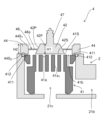
- FIG. 4 is a cross-sectional view showing an enlarged main part of a flow control valve included in the flow control device;
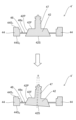
- FIG. 4 is a cross-sectional view showing a schematic configuration of a flow control valve of a comparative example;
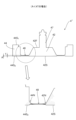
- FIG. 3 is a cross-sectional view schematically showing a manufacturing process of the flow control valve of FIGS. 1 and 2;
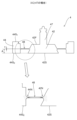
- FIG. 4 is an explanatory view schematically showing the relationship between the thickness T of the diaphragm portion and the distance A from the seating surface of the diaphragm portion in the fluid control valve;
- FIG. 4 is an explanatory diagram schematically showing another configuration of the flow control valve;
- FIG. 4 is a cross-sectional view showing an enlarged main part of a flow control valve included in the flow control device;
- FIG. 4 is a cross-sectional view showing a schematic configuration of a flow control valve of a comparative example;
- FIG. 3 is a cross-sectional view schematically showing a manufacturing process of the flow control valve
- FIG. 4 is an explanatory diagram schematically showing stress distribution when voltage is applied to an actuator in a flow control valve designed under the condition of A ⁇ 4T.
- FIG. 4 is an explanatory diagram schematically showing stress distribution when voltage is applied to an actuator in a flow control valve designed under the condition of A ⁇ 4T.
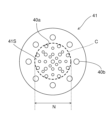
- FIG. 4 is an explanatory diagram schematically showing the relationship between an inner diameter L of a diaphragm portion, an outer diameter M of a seating surface, and a valve seat diameter N of a valve seat portion; It is a top view of the said valve-seat part.
- 4 is a graph schematically showing the relationship between a normal voltage applied to an actuator and the flow rate of fluid.
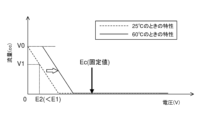
- 5 is a graph schematically showing the relationship between the voltage applied to the actuator and the flow rate of fluid when L ⁇ N is satisfied.
- FIG. 1 is an explanatory diagram showing a schematic configuration of a flow rate control device 1 of this embodiment.
- the flow control device 1 is composed of, for example, a mass flow controller.
- a mass flow controller is used, for example, in a semiconductor manufacturing apparatus, and is a device that controls the flow rate of a fluid such as a gas used in a semiconductor manufacturing process.
- the flow control device 1 includes a main body 2 , a flow detection mechanism 3 , a flow control valve 4 and a drive control section 5 .
- the main body part 2 is a block having a channel part 21 inside.
- the fluid flows through the flow path portion 21 .
- the flow path part 21 has an inflow path 21a positioned upstream, an outflow path 21b positioned downstream, and an intermediate flow path 21c positioned between the inflow path 21a and the outflow path 21b.
- a valve seat portion 41 which will be described later, is positioned in the intermediate flow path 21c.
- the upstream port 2A is located at the upstream end of the flow path portion 21 (especially the inflow path 21a).
- the upstream port 2A is connected to an external inflow pipe (not shown).
- a downstream port 2B is positioned at the downstream end of the flow path portion 21 (particularly, the outflow path 21b).
- the downstream port 2B is connected to an external outflow pipe (not shown).
- the inflow path 21a is connected to the intermediate flow path 21c via the bypass portion 21d.
- the inlet-side channel 22a and the outlet-side channel 22b are connected to the bypass portion 21d.
- the inlet-side channel 22a and the outlet-side channel 22b are connected to one end and the other end of the thin tube 31 of the flow rate detection mechanism 3, respectively.
- the fluid that has flowed into the inflow passage 21a from the external inflow pipe through the upstream port 2A branches and flows through the inlet passage 22a and the bypass portion 21d at a predetermined flow rate ratio.
- the fluid that has flowed through the narrow tube 31 of the flow rate detection mechanism 3 via the inlet-side channel 22a is guided to the bypass portion 21d via the outlet-side channel 22b, and joins the fluid flowing through the bypass portion 21d. After joining, the fluid flows from the bypass portion 21d toward the intermediate flow path 21c.
- the flow rate detection mechanism 3 detects the flow rate of the fluid flowing through the flow path section 21 (especially the inflow path 21a).
- the flow rate detection mechanism 3 employs a configuration that detects the flow rate of the fluid by a thermal method. That is, the flow rate detection mechanism 3 includes the thin tube 31 and a pair of heating resistance wires 32 and 33 . Heating resistance wires 32 and 33 are wound around thin tube 31 and connected to a bridge circuit (not shown). When a current is passed through the heating resistance wires 32 and 33 to heat the heating resistance wires 32 and 33 and a fluid is allowed to flow through the capillary tube 31, a temperature difference corresponding to the mass flow rate of the fluid is generated on the upstream and downstream sides of the capillary tube 31. occurs.
- the calculation unit CA including the bridge circuit, which measures the mass flow rate of the fluid may be included in, for example, the drive control unit 5, which will be described later.
- the flow rate detection mechanism 3 may be configured to detect the flow rate of the fluid by a method other than the thermal method (for example, a pressure method (differential pressure method)).
- the flow rate control valve 4 is a mechanism that controls the flow rate of the fluid flowing through the flow path portion 21, and is configured, for example, as a normally open type.
- a flow control valve 4 includes a valve seat portion 41 , a valve body 42 , an actuator 43 , a support body 44 , a pressing member 45 and a movement restricting member 46 .
- FIG. 2 is a cross-sectional view showing an enlarged main part of the flow control valve 4.
- the valve seat portion 41 of the flow control valve 4 is a block having a valve seat surface 41S.
- a first opening 41a and a second opening 41b are formed in the valve seat surface 41S.
- the first opening 41a communicates with the intermediate flow path 21c, which is an inflow path for fluid, via a communication path 41a 1 .
- the second opening 41b communicates with the outflow path 21b.
- a plurality of first openings 41a are formed on the valve seat surface 41S, but the number of first openings 41a may be one.
- a plurality of second openings 41b are formed in the valve seat surface 41S, but the number of second openings 41b may be one.
- the valve body 42 is a truncated conical moving body that contacts the actuator 43 (especially the piezo stack 431, see FIG. 1) via the plunger 47.
- the valve body 42 has a seating surface 42S.
- the seating surface 42 ⁇ /b>S is a surface that contacts (contacts or separates from) the valve seat surface 41 ⁇ /b>S of the valve seat portion 41 .
- the valve body 42 further has a facing surface 42F.
- the facing surface 42F is located on the opposite side of the seating surface 42S from the valve seat surface 41S.
- the facing surface 42F is located on the side opposite to the seating surface 42S with the position of the film surface 48a of the diaphragm portion 48 as a reference.
- the seating surface 42S is located on the opposite side of the facing surface 42F with respect to the position of the film surface 48a. Therefore, in the direction in which the seating surface 42S contacts and separates from the valve seat surface 41S (hereinafter also referred to as the contact-separation direction), the membrane surface 48a of the diaphragm portion 48 is positioned between the seating surface 42S and the opposing surface 42F. .
- the diaphragm portion 48 is an annular thin film extending in a direction intersecting with the contact/separation direction.
- the film surface 48 a of the diaphragm portion 48 described above refers to the surface of the film of the diaphragm portion 48 . Since the valve body 42 has a truncated cone shape as described above, the seating surface 42S has a larger diameter than the facing surface 42F.
- the plunger 47 is connected to the valve body 42 at the center of the facing surface 42F.
- the valve body 42 further has a peripheral surface 42P.
- the peripheral surface 42P is a surface that connects the seating surface 42S of the valve body 42 and the opposing surface 42F. That is, the peripheral surface 42P intersects with the seating surface 42S and the facing surface 42F.
- the diaphragm portion 48 described above is connected to the peripheral surface 42P of the valve body 42 at a position closer to the seating surface 42S than the facing surface 42F. In particular, the diaphragm portion 48 is connected to the peripheral surface P at a position between the facing surface 42F and the seating surface 42S.
- the actuator 43 is a drive unit that drives the valve body 42 via the plunger 47 in the contact and separation directions.
- the actuator 43 comprises a piezo stack 431, for example.
- the piezo stack 431 is formed by laminating a plurality of piezo elements that are expanded and deformed by voltage application.
- a piezo stack 431 is housed in a housing body 432 and applies a pressing force to the plunger 47 of the valve body 42 .
- the support 44 is a frame positioned around the valve body 42 and supporting the valve body 42 via the diaphragm portion 48 .
- the support 44 has a first surface 44S 1 and a second surface 44S 2 .
- the first surface 44S 1 is positioned on the same side as the facing surface 42F with the position of the film surface 48a of the diaphragm portion 48 as a reference.
- the second surface 44S2 is positioned closer to the valve seat portion 41 than the first surface 44S1.
- the second surface 44S 2 is located on the opposite side of the first surface 44S 1 with respect to the position of the film surface 48a of the diaphragm portion 48 .
- the film surface 48a of the diaphragm portion 48 is positioned between the first surface 44S1 and the second surface 44S2 of the support 44 in the contact and separation direction.
- the first surface 44S 1 of the support 44 is the surface farthest from the second surface 44S 2 in the contact and separation direction.
- a shim 411 is provided between the second surface 44S2 and the valve seat surface 41S. Thereby, a gap corresponding to the thickness of the shim 411 is formed between the seating surface 42S and the valve seat surface 41S.
- the support 44 described above is provided on the upper portion of the main body 2 via an O-ring 412 .
- the pressing member 45 is a cover that presses the support 44 against the main body 2 and sandwiches the movement restricting member 46 between itself and the support 44 .
- the support 44 is fixed to the main body 2 together with the pressing member 45 using fasteners 49 such as bolts.
- the movement restricting member 46 is a member that restricts movement of the valve body 42 in the direction in which the seating surface 42S separates from the valve seat surface 41S (hereinafter also referred to as the first direction), and has a through hole in the center. A plunger 47 is inserted through the through hole. When the valve body 42 moves in the first direction, the facing surface 42F of the valve body 42 contacts the movement restricting member 46, thereby restricting the movement of the valve body 42 in the first direction.
- first biasing member 40a such as a spring is fixed to the surface of the piezo stack 431 of the actuator 43 on the contact side with the plunger 47 .
- the first biasing member 40 a is positioned around the plunger 47 .
- the other end of the first biasing member 40a is fixed to a movement restricting member 46. As shown in FIG. 1, one end of a first biasing member 40a such as a spring is fixed to the surface of the piezo stack 431 of the actuator 43 on the contact side with the plunger 47 .
- the first biasing member 40 a is positioned around the plunger 47 .
- the other end of the first biasing member 40a is fixed to a movement restricting member 46. As shown in FIG.
- a second biasing member 40b such as a spring is positioned inside the first biasing member 40a, that is, between the first biasing member 40a and the plunger 47.
- One end of the second biasing member 40b is fixed to the plunger 47 via a fastener.
- the other end of the second biasing member 40b is fixed to a movement restricting member 46. As shown in FIG.
- the opening of the valve that is, the gap between the seating surface 42S and the valve seat surface 41S is set to a predetermined value.
- the state in which the valve opening degree is a predetermined value is the fully open state of the flow control valve 4 .
- the plunger 47 and the valve body 42 are lifted in the first direction by the biasing force of the second biasing member 40b shown in FIG.
- the diaphragm part 48 moves more toward the connection side with the valve body 42 than at the connection side with the support body 44 . It is deformed so that it shifts in the direction.
- the piezo stack 431 When a voltage is applied to the piezo stack 431, the piezo stack 431 expands. Then, the piezo stack 431 pushes the valve body 42 in the direction opposite to the first direction (hereinafter referred to as the second direction) via the plunger 47 against the biasing forces of the first biasing member 40a and the second biasing member 40b. is also called). Finally, the seating surface 42S of the valve body 42 seats (contacts) with the valve seating surface 41S of the valve seat portion 41 . When the seating surface 42S is seated on the valve seat surface 41S, the diaphragm portion 48 is pulled and deformed by the movement of the valve body 42 in the second direction. At this time, as the valve body 42 moves in the second direction, the diaphragm part 48 moves through the undeformed state shown in FIG. The connecting side with the body 42 deforms so as to shift in the second direction.
- the film surface 48a of the diaphragm portion 48 is positioned along a surface (for example, the valve seat surface 41S) perpendicular to the contact/separation direction (moving direction of the valve body 42). It's becoming This state is the same as the state of the diaphragm portion 48 before the valve element 42 with the plunger 47, the support 44, and the diaphragm portion 48 are integrated and incorporated into the flow control valve 4 (flow control device 1).
- the actuator 43 piezo stack 431 and the plunger 47 are in contact with each other at one point.
- the biasing force applied to the valve body 42 via the plunger 47 by the second biasing member 40b is: It is not uniform in the circumferential direction with the contact/separation direction as the central axis. For these reasons, it is possible that the diaphragm portion 48 may not be in the undeformed state as the valve body 42 moves in the contact/separate direction. In other words, even when a voltage is applied to the actuator 43 to bring the diaphragm part 48 into the non-deformed state, the diaphragm part 48 may not be in the non-deformed state (horizontal state) and tilted from the horizontal.
- the seating surface 42S of the valve body 42 contacts and separates from the valve seat surface 41S of the valve seat portion 41 by driving the actuator 43 (especially the piezo stack 431).
- a voltage (opening degree control signal) corresponding to a desired valve opening degree is applied to the actuator 43 to extend the actuator 43 (piezo stack 431), thereby controlling the valve opening degree according to the value of the opening control signal.
- the drive control unit 5 Based on the detection result (detected flow rate) of the flow rate detection mechanism 3, the drive control unit 5 gives the above opening degree control signal to the actuator 43 of the flow rate control valve 4 to drive the actuator 43.
- a drive control unit 5 includes (1) an amplifier circuit that amplifies the output signal of the bridge circuit, (2) a correction circuit that corrects the output signal of the amplifier circuit and outputs it to the outside of the flow control device 1, ( 3) a comparison control circuit that compares the corrected signal with an externally input flow rate setting signal; and (4) a drive circuit that generates a drive signal (opening control signal) for the actuator 43 based on the output of the comparison control circuit.
- a control unit for example, a CPU
- the valve opening degree is adjusted as described above, and the flow rate of the fluid flowing through the flow path section 21 (especially the outflow path 21b) is brought closer to the predetermined set flow rate. can be done.
- a resin material for coating for example, a fluorine resin such as PFA (perfluoroalkoxyalkane) can be used.
- PFA perfluoroalkoxyalkane
- the surface of the thin film coated on the seating surface 42S is referred to as a seating surface 42S that contacts the valve seating surface 41S.
- valve element 42 tilts when the seating surface 42S wraps, it becomes difficult to ensure parallelism between the seating surface 42S and the valve seating surface 41S when the valve element 42 is used to construct the flow control device 1 .
- the seating surface 42S cannot be in close contact with the valve seat surface 41S, and fluid leakage occurs.
- Such tilting of the valve body 42 during lapping occurs, for example, by supporting only the first surface 44S 1 of the support body 44 during lapping.
- FIG. 3 is a cross-sectional view showing a schematic configuration of a flow control valve 4' of a comparative example.
- the flow control valve 4' of the comparative example when the diaphragm portion 48 is in an undeformed state, the opposing surface 42F of the valve body 42 and the first surface 44S1 of the support 44 are shifted in the contact and separation directions. It is different from the flow control valve 4 (see FIGS. 1 and 2) of the present embodiment in that it More specifically, in the flow control valve 4′ of the comparative example, when the diaphragm portion 48 is in a non-deformed state, the facing surface 42F of the valve body 42 is aligned with the first surface of the support body 44 in the contact/separation direction. It is located closer to the seating surface 42S than 44S1 .
- FIG. 4 is a cross-sectional view schematically showing the manufacturing process of the flow control valve 4 of this embodiment.
- the polishing (lapping) step the seating surface 42S of the valve body 42 is pressed against the lapping platen 61 via the abrasive material 62, and the lapping platen 61 is rotated or moved relative to the valve body 42.
- the seating surface 42S is polished.
- the facing surface 42F of the valve body 42 and the first surface 44S 1 of the support member 44 are simultaneously pressed against the lapping surface plate 61 by the same flat surface 60a of the pressing member 60, and the seating surface 42S is moved. Grind.
- the single pressing member 60 that is, the pressing member 60 having the single (common) flat surface 60a
- the facing surface 42F and the first surface 44S1 can be pressed simultaneously to wrap the seating surface 42S.
- the facing surface 42F of the valve body 42 it is possible to reduce the risk of the valve body 42 tilting during lapping. Therefore, the parallelism between the seat surface 42S and the valve seat surface 41S can be maintained satisfactorily. Therefore, when seated, the seating surface 42S is brought into close contact with the valve seat surface 41S, thereby improving the sealing performance between the seating surface 42S and the valve seat surface 41S.
- the seating surface 42S by polishing the seating surface 42S in a state in which the opposing surface 42F and the first surface 44S 1 are simultaneously pressed against the lapping plate 61 by the same flat surface 60a of the pressing member 60, the occurrence of core runout can be prevented. can be reliably reduced. As a result, good parallelism between the seating surface 42S and the valve seating surface 41S can be reliably realized, and the sealing performance between the seating surface 42S and the valve seating surface 41S can be reliably improved.
- the seating surface 42S of the valve body 42 is located on the opposite side of the facing surface 42F with respect to the position of the membrane surface 48a of the diaphragm portion 48, and the second surface 44S 2 of the support 44 is located on the opposite side. It is located on the side opposite to the first surface 44S 1 with respect to the position of the film surface 48a.
- the membrane surface 48a of the diaphragm portion 48 is positioned between the seating surface 42S and the opposing surface 42F of the valve body 42 in the contact and separation direction, and is positioned between the first surface 44S1 and the second surface 44S2 of the support 44 .
- the facing surface 42F and the first surface 44S 1 are spatially separated and discontinuous, and the seating surface 42S and the second surface 44S 2 are spatially separated and discontinuous. Therefore, when only the first surface 44S.sub.1 is pressed and the seating surface 42S is lapped, the valve body 42 tends to become very unstable, and the above-described core deflection tends to occur. Therefore, in the configuration of the present embodiment, which can improve the sealing property by locating the facing surface 42F and the first surface 44S1 on the same plane, the facing surface 42F and the first surface 44S1 are discontinuous. It is very effective when there is and the seating surface 42S and the second surface 44S2 are discontinuous.
- the seating surface 42S and the second surface 44S 2 may be configured to be continuous with the diaphragm portion 48 interposed therebetween. That is, the seating surface 42S, the second surface 44S 2 and the diaphragm portion 48 may be arranged on the same plane. Even with such a configuration, it is possible to employ a configuration in which the opposing surface 42F and the first surface 44S1 are positioned on the same plane when the deformation of the diaphragm portion 48 is released. Effects similar to those of the embodiment can be obtained.
- the seating surface 42S and the second surface 44S2 are simultaneously lapped by the method shown in FIG. , and the height H2 (in the direction of contact and separation) of the support 44 defined by the distance between the first surface 44S 1 and the second surface 44S 2 (see FIG. 2). Therefore, if the height H1 of the valve body 42 and the height H2 of the support body 44 are the same, the seating surface 42S is brought into close contact with the valve seat surface 41S when seated. It can also be said that the sealing property between and can be improved. It should be noted that the height H1 and the height H2 are constant in the direction perpendicular to the contact/separation direction.
- the height H1 of the valve body 42 is greater than the height H2 of the support body 44 in the configuration in which the opposing surface 42F and the first surface 44S1 are positioned on the same plane. It can be expensive. Even in this case, it is possible to wrap the seating surface 42S by simultaneously pressing the facing surface 42F and the first surface 44S1 with the pressing member 60 having a single (common) flat surface 60a. In this case, the seating surface 42S may be mechanically polished and the second surface 44S.sub.2 may be manually polished.
- FIG. 5 schematically shows the relationship between the thickness T (mm) of the diaphragm portion 48 in the contact and separation direction and the distance A (mm) of the diaphragm portion 48 from the seating surface 42S in the flow control valve 4 described above. showing.
- the flow control valve 4 satisfies A ⁇ 4T. That is, the diaphragm portion 48 is positioned at a distance of 4T or more from the seating surface 42S in the contact/separation direction.
- T 0.25 mm
- the distance A should be 1 mm or more.
- a ⁇ 4T is the configuration of the flow control valve 4 shown in FIG.
- a configuration in which the surfaces 44S 1 and 44S 1 are shifted in the contact/separation direction (a configuration in which they are not located on the same plane) is also applicable. Satisfying A ⁇ 4T in this way also makes it possible to improve the sealing performance between the seating surface 42S and the valve seat surface 41S. The reason is as follows.
- FIG. 7 schematically shows the distribution of stress when a voltage is applied to the actuator 43 (see FIG. 1) in the flow control valve 4'' designed under the condition of A ⁇ 4T (stress generated shown by hatching).
- a ⁇ 4T stress generated shown by hatching
- FIG. 8 schematically shows the distribution of stress when voltage is applied to the actuator 43 in the flow control valve 4 designed under the condition of A ⁇ 4T.
- the diaphragm portion 48 Under the condition of A ⁇ 4T, the diaphragm portion 48 is sufficiently separated from the seating surface 42S in the contact/separation direction, so stress generated in the diaphragm portion 48 and the connecting portion 42N is less likely to be transmitted to the seating surface 42S.
- This point is clear from the fact that the hatching indicating the stress generated at the connecting portion 42N does not reach the seating surface 42S in FIG. As a result, the deformation of the seating surface 42S due to the stress can be reduced, and the flatness of the seating surface 42S can be ensured.
- the diaphragm part 48 may be positioned at a distance of 4T or more (on the seating surface 42S side) from the facing surface 42F in the contact/separation direction. That is, the diaphragm portion 48 is located between a position 4T away from the seating surface 42S (toward the facing surface 42F side) and a position 4T away from the facing surface 42F (toward the seating surface 42S side) in the contact and separation direction. may be located in the range of
- FIG. 9 shows the inner diameter L (mm) of the annular diaphragm portion 48, the outer diameter M (mm) of the seating surface 42S of the valve body 42, and the valve seat of the valve seat portion 41 in the flow control valve 4 of this embodiment. It schematically shows the relationship between the diameter N (mm) and .
- the valve seat diameter N is defined as follows.
- valve seat diameter N orifice diameter
- the opening is the first opening that communicates with the intermediate flow path 21c (see FIG. 9), which is the flow path on the inflow side of the fluid, of the first opening 41a and the second opening 41b that the valve seat surface 41S has. 41a. Therefore, when a plurality of first openings 42a are formed in the valve seat surface 41S as in this embodiment, the valve seat diameter N is equal to the minimum diameter of the circle C that includes the plurality of first openings 42a.
- the valve seat diameter N is the minimum value of the diameter of a circle C that includes one first opening 42a, that is, one It is the diameter of the circle of the first opening 42a.
- the outer diameter M of the seating surface 42S of the valve body 42 is larger than the inner diameter L of the diaphragm portion 48 (M>L).
- the valve seat diameter N can be ensured to be larger than the inner diameter L while keeping the inner diameter L constant (N>L).
- the valve seat diameter N can be set to a value larger than the inner diameter L of the diaphragm portion 48 and smaller than the outer diameter M of the seating surface 42S. can be done).
- the condition of M > L is that when the configuration of the flow control valve 4 shown in FIG. A staggered configuration is also applicable.
- a predetermined flow rate can be secured as the flow rate of the fluid flowing through the first opening 41a with a small amount of movement of the valve body 42 in the contact/separation direction. . That is, when the amount of movement of the valve body 42 in the contact/separation direction is constant, the flow rate of the fluid flowing through the first opening 41a of the valve seat surface 41S can be increased. Thereby, for example, even when the temperature of the fluid rises, the closing start voltage can be kept fixed. Note that the closing start voltage is required to cause the seating surface 42S to be seated on the valve seat surface 41S and to make the flow rate of the fluid flowing through the first opening 41a of the valve seat surface 41S zero (or close to zero). , refers to the voltage applied to the actuator 43 .
- FIG. 11 is a graph schematically showing the relationship between the voltage applied to the actuator 43 and the flow rate of the fluid flowing through the first opening 41a.
- the closing start voltage Ec is set as a fixed value to a voltage (for example, 90 V) that is smaller than the maximum voltage that can be applied to the actuator 43 from the viewpoint of preventing destruction of the actuator 43 (particularly the piezo element).
- the relationship between voltage and flow rate is the characteristic indicated by the dashed line in FIG. 11 at room temperature (for example, 25° C.).
- the dashed line generally shifts to the solid line.
- the solid line characteristic indicates that the fluid is flowing even when the closing start voltage Ec is applied. This is because the temperature rise of the fluid causes the piezo element to contract under the influence of thermal expansion, and the metallic container 432 to expand. This is because there is a gap with the seat surface 41S. In this case, in order to make the flow rate of the fluid zero, it is necessary to change the closing start voltage Ec to a higher voltage value.
- FIG. 12 is a graph schematically showing the relationship between the voltage applied to the actuator 43 and the flow rate of the fluid flowing through the first opening 41a when the valve seat diameter N is increased by M>L.
- the characteristic indicating the relationship between voltage and flow rate at room temperature (for example, 25°C) can be the characteristic indicated by the dashed line in FIG. 11, if the voltage applied to the actuator 43 required to achieve the flow rate V1 is E1 (V), then the characteristics shown in FIG. The applied voltage to 43 can be E2 (V) which is smaller than E1.
- the closing start voltage Ec is applied to reduce the flow rate of the fluid. can approach zero. In other words, the flow rate can be brought close to zero without changing the closing start voltage Ec to a high voltage.
- the flow control device 1 includes the flow control valve 4 of the present embodiment described above, thereby improving the sealing performance between the valve seat surface 41S and the seating surface 42S. 1 can be realized.
- the flow control valve 4 by appropriately combining the configurations and conditions described in the present embodiment. For example, (1) as shown in FIG. 2, when the diaphragm portion 48 is in an undeformed state, the facing surface 42F and the first surface 44S1 are positioned on the same plane, or the valve body (2) As shown in FIG. 5, the diaphragm portion 48 is positioned at a distance of 4T or more from the seating surface 42S in the contact/separation direction. (3) As shown in FIG. 9, the outer diameter M of the seating surface 42S is larger than the inner diameter L of the diaphragm portion 48.
- the flow control valve 4 may be configured by combining at least two. It is possible.
- the configuration of the flow control valve 4 described in this embodiment can be applied not only to the flow control device 1 that controls the flow rate of fluid, but also to a pressure control device that controls the pressure of the fluid.
- the present invention can be used for flow control devices such as mass flow controllers.
Landscapes
- Engineering & Computer Science (AREA)
- General Engineering & Computer Science (AREA)
- Mechanical Engineering (AREA)
- Physics & Mathematics (AREA)
- Fluid Mechanics (AREA)
- Lift Valve (AREA)
Priority Applications (4)
| Application Number | Priority Date | Filing Date | Title |
|---|---|---|---|
| KR1020247020580A KR20240122779A (ko) | 2021-12-24 | 2022-10-20 | 유량 제어 밸브, 유량 제어 밸브의 제조 방법 및 유량 제어 장치 |
| CN202280084671.3A CN118414509A (zh) | 2021-12-24 | 2022-10-20 | 流量控制阀、流量控制阀的制造方法和流量控制装置 |
| US18/723,382 US12578021B2 (en) | 2021-12-24 | 2022-10-20 | Flow rate control valve, manufacturing method of flow rate control valve, and flow rate control apparatus |
| JP2023569098A JPWO2023119828A1 (https=) | 2021-12-24 | 2022-10-20 |
Applications Claiming Priority (2)
| Application Number | Priority Date | Filing Date | Title |
|---|---|---|---|
| JP2021-210178 | 2021-12-24 | ||
| JP2021210178 | 2021-12-24 |
Publications (1)
| Publication Number | Publication Date |
|---|---|
| WO2023119828A1 true WO2023119828A1 (ja) | 2023-06-29 |
Family
ID=86901940
Family Applications (1)
| Application Number | Title | Priority Date | Filing Date |
|---|---|---|---|
| PCT/JP2022/039109 Ceased WO2023119828A1 (ja) | 2021-12-24 | 2022-10-20 | 流量制御弁、流量制御弁の製造方法および流量制御装置 |
Country Status (5)
| Country | Link |
|---|---|
| US (1) | US12578021B2 (https=) |
| JP (1) | JPWO2023119828A1 (https=) |
| KR (1) | KR20240122779A (https=) |
| CN (1) | CN118414509A (https=) |
| WO (1) | WO2023119828A1 (https=) |
Families Citing this family (1)
| Publication number | Priority date | Publication date | Assignee | Title |
|---|---|---|---|---|
| US20250102074A1 (en) * | 2023-09-25 | 2025-03-27 | Applied Materials, Inc. | Proportional fluid flow valve and methods of operating thereof |
Citations (6)
| Publication number | Priority date | Publication date | Assignee | Title |
|---|---|---|---|---|
| JPH067240Y2 (ja) * | 1986-08-12 | 1994-02-23 | エスエムシ−株式会社 | 方向切換弁 |
| JP2000035821A (ja) * | 1998-07-17 | 2000-02-02 | Horiba Ltd | 気体流量制御装置 |
| JP2010230159A (ja) * | 2009-03-27 | 2010-10-14 | Horiba Stec Co Ltd | 流量制御弁 |
| JP2011214713A (ja) * | 2010-04-02 | 2011-10-27 | Ckd Corp | 流体制御弁 |
| CN102797870A (zh) * | 2011-05-26 | 2012-11-28 | 南京金口机械制造有限公司 | 卫生级无菌隔膜阀 |
| CN203282329U (zh) * | 2013-03-22 | 2013-11-13 | 武汉钢铁(集团)公司 | 一种压缩机阀片研磨装置 |
Family Cites Families (6)
| Publication number | Priority date | Publication date | Assignee | Title |
|---|---|---|---|---|
| JPH0434275A (ja) * | 1990-05-26 | 1992-02-05 | Stec Kk | 常閉型流体制御バルブ |
| EP0973080B1 (en) | 1998-07-17 | 2004-06-09 | Horiba, Ltd. | Gas flow rate control apparatus |
| WO2015191960A1 (en) * | 2014-06-13 | 2015-12-17 | Vistadeltek, Llc | High conductance valve for fluids and vapors |
| MY183458A (en) * | 2015-06-17 | 2021-02-18 | Vistadeltek Llc | Low hysteresis diaphragm for a valve |
| DE102016112115B4 (de) * | 2016-07-01 | 2025-10-23 | Bürkert Werke GmbH | Ventillinearantrieb sowie Ventil |
| DE102020115057A1 (de) * | 2020-06-05 | 2021-12-09 | Bürkert Werke GmbH & Co. KG | Ventillinearantrieb sowie Ventil |
-
2022
- 2022-10-20 JP JP2023569098A patent/JPWO2023119828A1/ja active Pending
- 2022-10-20 KR KR1020247020580A patent/KR20240122779A/ko active Pending
- 2022-10-20 WO PCT/JP2022/039109 patent/WO2023119828A1/ja not_active Ceased
- 2022-10-20 US US18/723,382 patent/US12578021B2/en active Active
- 2022-10-20 CN CN202280084671.3A patent/CN118414509A/zh active Pending
Patent Citations (6)
| Publication number | Priority date | Publication date | Assignee | Title |
|---|---|---|---|---|
| JPH067240Y2 (ja) * | 1986-08-12 | 1994-02-23 | エスエムシ−株式会社 | 方向切換弁 |
| JP2000035821A (ja) * | 1998-07-17 | 2000-02-02 | Horiba Ltd | 気体流量制御装置 |
| JP2010230159A (ja) * | 2009-03-27 | 2010-10-14 | Horiba Stec Co Ltd | 流量制御弁 |
| JP2011214713A (ja) * | 2010-04-02 | 2011-10-27 | Ckd Corp | 流体制御弁 |
| CN102797870A (zh) * | 2011-05-26 | 2012-11-28 | 南京金口机械制造有限公司 | 卫生级无菌隔膜阀 |
| CN203282329U (zh) * | 2013-03-22 | 2013-11-13 | 武汉钢铁(集团)公司 | 一种压缩机阀片研磨装置 |
Also Published As
| Publication number | Publication date |
|---|---|
| US12578021B2 (en) | 2026-03-17 |
| US20250067347A1 (en) | 2025-02-27 |
| JPWO2023119828A1 (https=) | 2023-06-29 |
| CN118414509A (zh) | 2024-07-30 |
| KR20240122779A (ko) | 2024-08-13 |
Similar Documents
| Publication | Publication Date | Title |
|---|---|---|
| US9746102B2 (en) | Fluid control valve | |
| JP7257056B2 (ja) | バルブ装置および流体制御装置、流体制御方法、半導体製造装置及び半導体製造方法 | |
| US6062246A (en) | Mass flow controller and operating method thereof | |
| JP7237370B2 (ja) | バルブ装置 | |
| JPWO2015060176A1 (ja) | 流体制御弁 | |
| JP7270990B2 (ja) | バルブ装置、流体制御装置、流体制御方法、半導体製造装置及び半導体製造方法 | |
| WO2023119828A1 (ja) | 流量制御弁、流量制御弁の製造方法および流量制御装置 | |
| US20220082176A1 (en) | Valve device, flow control method, fluid control device, semiconductor manufacturing method, and semiconductor manufacturing apparatus | |
| WO2019102882A1 (ja) | バルブ装置およびその制御装置を用いた制御方法、流体制御装置および半導体製造装置 | |
| US11899475B2 (en) | Fluid control valve and fluid control device | |
| JP2022076122A (ja) | 定圧弁 | |
| JP7259839B2 (ja) | ダイアフラム弁及びそれを用いた質量流量制御装置 | |
| US11976748B2 (en) | Diaphragm valve | |
| US20240360918A1 (en) | Fluid control valve and fluid control device | |
| JP2023162518A (ja) | 定圧弁 | |
| JP3856259B2 (ja) | マスフローコントローラ | |
| JP2009162319A (ja) | 真空バルブ | |
| JP6405019B1 (ja) | ガス導入のための弁開放を行う弁装置及び弁装置の弁開放方法 | |
| WO2023203969A1 (ja) | 流体制御バルブ、流体制御装置、及び流体制御バルブの製造方法 | |
| JP2022074523A (ja) | 定圧弁 | |
| JPH01105082A (ja) | 圧電式流量制御弁 |
Legal Events
| Date | Code | Title | Description |
|---|---|---|---|
| 121 | Ep: the epo has been informed by wipo that ep was designated in this application |
Ref document number: 22910550 Country of ref document: EP Kind code of ref document: A1 |
|
| WWE | Wipo information: entry into national phase |
Ref document number: 2023569098 Country of ref document: JP |
|
| ENP | Entry into the national phase |
Ref document number: 20247020580 Country of ref document: KR Kind code of ref document: A |
|
| WWE | Wipo information: entry into national phase |
Ref document number: 202280084671.3 Country of ref document: CN |
|
| WWE | Wipo information: entry into national phase |
Ref document number: 18723382 Country of ref document: US |
|
| NENP | Non-entry into the national phase |
Ref country code: DE |
|
| 122 | Ep: pct application non-entry in european phase |
Ref document number: 22910550 Country of ref document: EP Kind code of ref document: A1 |
|
| WWP | Wipo information: published in national office |
Ref document number: 18723382 Country of ref document: US |
|
| WWG | Wipo information: grant in national office |
Ref document number: 18723382 Country of ref document: US |