WO2023112778A1 - 2次元粒子、導電性膜、導電性ペーストおよび複合材料 - Google Patents
2次元粒子、導電性膜、導電性ペーストおよび複合材料 Download PDFInfo
- Publication number
- WO2023112778A1 WO2023112778A1 PCT/JP2022/044947 JP2022044947W WO2023112778A1 WO 2023112778 A1 WO2023112778 A1 WO 2023112778A1 JP 2022044947 W JP2022044947 W JP 2022044947W WO 2023112778 A1 WO2023112778 A1 WO 2023112778A1
- Authority
- WO
- WIPO (PCT)
- Prior art keywords
- component
- particles
- dimensional
- mxene
- less
- Prior art date
- Legal status (The legal status is an assumption and is not a legal conclusion. Google has not performed a legal analysis and makes no representation as to the accuracy of the status listed.)
- Ceased
Links
Images

Classifications
-
- C—CHEMISTRY; METALLURGY
- C01—INORGANIC CHEMISTRY
- C01B—NON-METALLIC ELEMENTS; COMPOUNDS THEREOF; METALLOIDS OR COMPOUNDS THEREOF NOT COVERED BY SUBCLASS C01C
- C01B32/00—Carbon; Compounds thereof
- C01B32/90—Carbides
- C01B32/914—Carbides of single elements
- C01B32/921—Titanium carbide
-
- C—CHEMISTRY; METALLURGY
- C01—INORGANIC CHEMISTRY
- C01B—NON-METALLIC ELEMENTS; COMPOUNDS THEREOF; METALLOIDS OR COMPOUNDS THEREOF NOT COVERED BY SUBCLASS C01C
- C01B32/00—Carbon; Compounds thereof
- C01B32/90—Carbides
-
- H—ELECTRICITY
- H01—ELECTRIC ELEMENTS
- H01B—CABLES; CONDUCTORS; INSULATORS; SELECTION OF MATERIALS FOR THEIR CONDUCTIVE, INSULATING OR DIELECTRIC PROPERTIES
- H01B1/00—Conductors or conductive bodies characterised by the conductive materials; Selection of materials as conductors
- H01B1/20—Conductive material dispersed in non-conductive organic material
- H01B1/22—Conductive material dispersed in non-conductive organic material the conductive material comprising metals or alloys
-
- H—ELECTRICITY
- H01—ELECTRIC ELEMENTS
- H01B—CABLES; CONDUCTORS; INSULATORS; SELECTION OF MATERIALS FOR THEIR CONDUCTIVE, INSULATING OR DIELECTRIC PROPERTIES
- H01B5/00—Non-insulated conductors or conductive bodies characterised by their form
- H01B5/16—Non-insulated conductors or conductive bodies characterised by their form comprising conductive material in insulating or poorly conductive material, e.g. conductive rubber
-
- H—ELECTRICITY
- H01—ELECTRIC ELEMENTS
- H01G—CAPACITORS; CAPACITORS, RECTIFIERS, DETECTORS, SWITCHING DEVICES, LIGHT-SENSITIVE OR TEMPERATURE-SENSITIVE DEVICES OF THE ELECTROLYTIC TYPE
- H01G11/00—Hybrid capacitors, i.e. capacitors having different positive and negative electrodes; Electric double-layer [EDL] capacitors; Processes for the manufacture thereof or of parts thereof
- H01G11/22—Electrodes
- H01G11/30—Electrodes characterised by their material
-
- C—CHEMISTRY; METALLURGY
- C01—INORGANIC CHEMISTRY
- C01P—INDEXING SCHEME RELATING TO STRUCTURAL AND PHYSICAL ASPECTS OF SOLID INORGANIC COMPOUNDS
- C01P2002/00—Crystal-structural characteristics
- C01P2002/08—Intercalated structures, i.e. with atoms or molecules intercalated in their structure
-
- C—CHEMISTRY; METALLURGY
- C01—INORGANIC CHEMISTRY
- C01P—INDEXING SCHEME RELATING TO STRUCTURAL AND PHYSICAL ASPECTS OF SOLID INORGANIC COMPOUNDS
- C01P2002/00—Crystal-structural characteristics
- C01P2002/20—Two-dimensional structures
-
- C—CHEMISTRY; METALLURGY
- C01—INORGANIC CHEMISTRY
- C01P—INDEXING SCHEME RELATING TO STRUCTURAL AND PHYSICAL ASPECTS OF SOLID INORGANIC COMPOUNDS
- C01P2002/00—Crystal-structural characteristics
- C01P2002/80—Crystal-structural characteristics defined by measured data other than those specified in group C01P2002/70
- C01P2002/86—Crystal-structural characteristics defined by measured data other than those specified in group C01P2002/70 by NMR- or ESR-data
-
- C—CHEMISTRY; METALLURGY
- C01—INORGANIC CHEMISTRY
- C01P—INDEXING SCHEME RELATING TO STRUCTURAL AND PHYSICAL ASPECTS OF SOLID INORGANIC COMPOUNDS
- C01P2004/00—Particle morphology
- C01P2004/20—Particle morphology extending in two dimensions, e.g. plate-like
-
- C—CHEMISTRY; METALLURGY
- C01—INORGANIC CHEMISTRY
- C01P—INDEXING SCHEME RELATING TO STRUCTURAL AND PHYSICAL ASPECTS OF SOLID INORGANIC COMPOUNDS
- C01P2006/00—Physical properties of inorganic compounds
- C01P2006/40—Electric properties
-
- Y—GENERAL TAGGING OF NEW TECHNOLOGICAL DEVELOPMENTS; GENERAL TAGGING OF CROSS-SECTIONAL TECHNOLOGIES SPANNING OVER SEVERAL SECTIONS OF THE IPC; TECHNICAL SUBJECTS COVERED BY FORMER USPC CROSS-REFERENCE ART COLLECTIONS [XRACs] AND DIGESTS
- Y02—TECHNOLOGIES OR APPLICATIONS FOR MITIGATION OR ADAPTATION AGAINST CLIMATE CHANGE
- Y02E—REDUCTION OF GREENHOUSE GAS [GHG] EMISSIONS, RELATED TO ENERGY GENERATION, TRANSMISSION OR DISTRIBUTION
- Y02E60/00—Enabling technologies; Technologies with a potential or indirect contribution to GHG emissions mitigation
- Y02E60/10—Energy storage using batteries
Definitions
- the present disclosure relates to two-dimensional particles, conductive films, conductive pastes and composite materials.
- MXene has attracted attention as a new conductive material.
- MXene is a type of so-called two-dimensional material, which is a layered material having the form of one or more layers, as described below.
- MXenes generally have the form of particles (which can include powders, flakes, nanosheets, etc.) of such layered materials.
- MXene Various researches are currently being conducted to apply MXene to various electrical devices. For the above applications, materials containing MXene are required to have higher conductivity and moisture resistance. As part of the study, a cleaning treatment method for MXene is being studied.
- Non-Patent Document 1 describes that Li + can be removed by washing MXene in the presence of acid.
- An object of the present disclosure is to provide two-dimensional particles capable of realizing a conductive film having high conductivity and moisture resistance. Another object of the present disclosure is to provide a conductive film, a conductive paste, and a conductive composite material using such two-dimensional particles.
- the disclosure includes: [1] A two-dimensional particle having one or more layers, containing Li atoms,
- the layer has the following formula: M m X n (wherein M is at least one Group 3, 4, 5, 6, 7 metal; X is a carbon atom, a nitrogen atom, or a combination thereof; n is 1 or more and 4 or less, m is greater than n and less than or equal to 5) and a modification or termination T (T is at least one selected from the group consisting of a hydroxyl group, a fluorine atom, a chlorine atom, an oxygen atom and a hydrogen atom) present on the surface of the layer body represented by and Li atoms include a first component and a second component having a larger chemical shift as measured by 7 Li NMR than the first component, Two-dimensional particles, wherein the ratio of the first component in the total of the first component and the second component is 17 atomic % or more and 70 atomic % or less.
- the chemical shift of the first component measured by the 7 Li NMR is less than 0.6 ppm, and the chemical shift of the second component measured by the 7 Li NMR is 0.6 ppm or more and 2.0 ppm or less.
- [3] The two-dimensional particle of [1] or [2], containing a phosphorus atom.
- [5] The two-dimensional particle according to any one of [1] to [4], wherein the phosphorus atom is in the form of PO 4 3- .
- [6] The two-dimensional particle according to any one of [1] to [5], which has an average thickness of 1 nm or more and 10 nm or less.
- a conductive film comprising the two-dimensional particles according to any one of [1] to [6].
- a conductive paste containing the two-dimensional particles according to any one of [1] to [6].
- a conductive composite material comprising the two-dimensional particles according to any one of [1] to [6] and a resin.
- the present disclosure it is possible to provide two-dimensional particles capable of realizing a conductive film having high conductivity and moisture resistance. Also, the present disclosure can provide a conductive film, a conductive paste, and a conductive composite material using such two-dimensional particles.
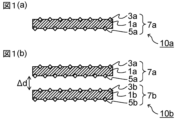
- FIG. 1 is a schematic cross-sectional view showing MXene particles of a layered material in one embodiment of the present disclosure, where (a) shows a monolayer MXene particle and (b) shows a multi-layer (illustratively bi-layer) MXene particle; . 1 is a schematic cross-sectional view showing a conductive film in one embodiment of the present disclosure; FIG.
- a two-dimensional particle in this embodiment is a two-dimensional particle of a layered material having one or more layers and contains Li atoms.
- the above layer has the following formula: M m X n (wherein M is at least one Group 3, 4, 5, 6, 7 metal; X is a carbon atom, a nitrogen atom, or a combination thereof; n is 1 or more and 4 or less, m is greater than n and less than or equal to 5) (the layer body may have a crystal lattice in which each X is located in an octahedral array of M) and a surface of the layer body (more particularly, the surfaces of the layer bodies facing each other a modification or termination T (T is at least one selected from the group consisting of hydroxyl groups, fluorine atoms, chlorine atoms, oxygen atoms and hydrogen atoms) present on at least one of the two surfaces that Li atoms include a first component and a second component having a larger chemical shift than the first component as measured by 7 Li NMR (nuclear magnetic resonance), The proportion of the first component in the total of the first component and the second component is 17 atomic % or more and
- the conductive film obtained using the two-dimensional particles of the present disclosure has high conductivity and good moisture resistance.
- moisture resistance means the ability to maintain electrical conductivity even when placed under high humidity conditions for a long period of time.
- electrodes comprising such conductive films can be used in applications where high conductivity and high moisture resistance are required, such as electrodes for antennas, especially as electrodes for RFID (radio frequency identifier).
- the oxidation number of the element is not limited to 0, and may be any number within the range of possible oxidation numbers of the element.
- the layered material may be understood as a layered compound, also denoted as "M m X n T s ", where s is any number, conventionally x or z may be used instead of s.
- n can be 1, 2, 3 or 4, but is not so limited.
- M is preferably at least one selected from the group consisting of Ti, Zr, Hf, V, Nb, Ta, Cr, Mo and Mn, and from Ti, V, Cr and Mo At least one selected from the group consisting of is more preferable.
- M can be titanium or vanadium and X can be a carbon or nitrogen atom.
- MAX phase is Ti 3 AlC 2 and MXene is Ti 3 C 2 T s (in other words, M is Ti, X is C, n is 2, m is 3 is).
- MXene may contain A atoms derived from the MAX phase of the precursor in a relatively small amount, for example, 10% by mass or less relative to the original A atoms.
- the residual amount of A atoms can be preferably 8% by mass or less, more preferably 6% by mass or less. However, even if the residual amount of A atoms exceeds 10% by mass, there may be no problem depending on the application and usage conditions of the two-dimensional particles.
- the layer may be referred to as an MXene layer, and the two-dimensional particles may be referred to as MXene two-dimensional particles or MXene particles.
- the two-dimensional particles of the present embodiment are aggregates containing one layer of MXene particles (hereinafter simply referred to as "MXene particles") 10a (single-layer MXene particles) schematically illustrated in FIG. 1(a).
- MXene particles 10a include a layer body (M m X n layer) 1a represented by M m X n and a surface of the layer body 1a (more specifically, two surfaces facing each other in each layer). (at least one of) is the MXene layer 7a with modifications or terminations T3a, 5a present in the . Therefore, the MXene layer 7a is also denoted as "M m X n T s ", where s is any number.
- the two-dimensional particles of this embodiment may contain one or more layers.
- multiple layers of MXene particles include two layers of MXene particles 10b as schematically shown in FIG. 1(b), but are not limited to these examples.
- 1b, 3b, 5b and 7b in FIG. 1(b) are the same as 1a, 3a, 5a and 7a in FIG. 1(a) described above.
- Two adjacent MXene layers (eg 7a and 7b) of a multi-layered MXene particle are not necessarily completely separated and may be in partial contact.
- the above-mentioned MXene particles 10a are those in which the above-mentioned multi-layered MXene particles 10b are individually separated and exist in one layer. may be a mixture of
- the thickness of each layer (corresponding to the MXene layers 7a and 7b described above) contained in the MXene particles is, for example, 0.8 nm or more and 5 nm or less, particularly 0.8 nm or more and 3 nm or less. Yes (mainly depending on the number of M atomic layers included in each layer).
- the interlayer distance or pore size, indicated by ⁇ d in FIG. 1(b) is for example 0.8 nm or more and 10 nm or less, especially 0.8 nm or more and 5 nm or less. , more particularly about 1 nm, and the total number of layers can be greater than or equal to 2 and less than or equal to 20,000.
- the multilayered MXene particles that can be contained are preferably MXene particles with a small number of layers obtained through a delamination process.
- the phrase “the number of layers is small” means, for example, that the number of MXene layers to be stacked is 6 or less.
- the thickness of the multi-layered MXene particles having a small number of layers in the stacking direction is preferably 15 nm or less, more preferably 10 nm or less.
- this "multilayer MXene particle with a small number of layers” may be referred to as "small layer MXene particle”.
- single-layer MXene particles and low-layer MXene particles are sometimes collectively referred to as "single-layer/low-layer MXene particles.”
- the two-dimensional particles of the present embodiment preferably include single-layer MXene particles and low-layer MXene particles, ie, single-layer/low-layer MXene particles.
- the ratio of single-layer/small-layer MXene particles having a thickness of 15 nm or less is preferably 90% by volume or more, more preferably 95% by volume or more.
- the Li atoms include a first component and a second component having a larger chemical shift than the first component as measured by 7 Li NMR, and the first component in the total of the first component and the second component is 17 atomic % or more and 70 atomic % or less. Thereby, a conductive film having high conductivity and moisture resistance can be realized.
- the proportion of the first component in the sum of the first component and the second component can be measured by 7 Li NMR.
- 7 Li NMR the proportion of the first component in the total
- the integration delay time for the 7 Li NMR measurement is 4 seconds.
- the first component is bound by water and exists in a state with a low degree of freedom
- the second component is loosely adsorbed on the layer surface of the two-dimensional particles and has a degree of freedom is considered to exist at a relatively high level.
- the degrees of freedom of the first component and the second component can be confirmed, for example, by comparing the T2 relaxation time (spin-spin relaxation time).
- T2 relaxation time spin-spin relaxation time
- the T2 relaxation time of the first component is shorter than the T2 relaxation time of the second component, for example, the T2 relaxation time of the first component is 0.6 ms or less, and the T2 relaxation time of the second component is 1.2 ms or more. is.
- a comparison of the T2 relaxation times of the first component and the second component suggests that the first component interacts more strongly with the substance than the second component.
- the chemical shift of the first component as measured by 7 Li NMR can be for example less than 0.6 ppm, even -0.2 ppm to 0.55 ppm, especially -0.15 ppm to 0.5 ppm.
- the chemical shift of the second component measured by 7 Li NMR can be, for example, 0.6 ppm or more and 2.0 ppm or less, and further 0.7 ppm or more and 1.7 ppm or less.
- the reference material for 7 Li NMR measurements is Li in a 1 mol/L LiCl aqueous solution.
- the chemical shift of the first component measured by 7 Li NMR represents the chemical shift value of the peak assigned to the first component in the 7 Li NMR spectrum.
- the chemical shift of the second component measured by 7 Li NMR represents the chemical shift value of the peak assigned to the second component in the 7 Li NMR spectrum.
- the chemical shift of the second component is larger than the chemical shift of the first component measured by 7 Li NMR, and the peak attributed to the second component is relative to the peak attributed to the first component by the 7 Li NMR Located on the low-field side of the spectrum.
- the peak attributed to the first component overlaps with the peak attributed to the second component, the peaks may be separated by regression using the Lorenz curve.
- the Li atoms are typically present on the layer. That is, it may be in contact with the layer or may exist on the layer via another element.
- the content of Li atoms in the two-dimensional particles is, for example, 0.1% by mass or more and 20% by mass or less, further 0.1% by mass or more and 10% by mass or less, especially It may be 0.2% to 5% by mass, particularly 0.2% to 3% by mass.
- the Li atom content can be measured by, for example, inductively coupled plasma atomic emission spectrometry (ICP-AES).
- ICP-AES inductively coupled plasma atomic emission spectrometry
- the two-dimensional particles contain phosphorus atoms. It is thought that the inclusion of phosphorus atoms facilitates the presence of Li atoms of the second component, thereby facilitating the manifestation of high electrical conductivity and high moisture resistance.
- the phosphorus atom content can be, for example, 0.1% by mass or more and 14% by mass or less, further 0.15% by mass or more and 5% by mass or less, and particularly 0.15% by mass or more and 1% by mass or less.
- Said phosphorus atoms can be present, for example, in the form of anions containing phosphorus atoms, especially in the form of PO 4 3- .
- An anion containing a phosphorus atom may be attached to M in the layer.
- the ratio of (average length of two-dimensional surface of two-dimensional particles)/(average thickness of two-dimensional particles) is 1.2 or more, preferably 1.5 or more, more preferably 2 That's it.
- the average major diameter of the two-dimensional surfaces of the two-dimensional particles and the average thickness of the two-dimensional particles may be obtained by the method described later.
- the average value of the long diameters of the two-dimensional surfaces is 1 ⁇ m or more and 20 ⁇ m or less.
- the average value of the major diameters of the two-dimensional surfaces may be referred to as "average flake size”.
- the average value of the long axis of the two-dimensional surface is preferably 1.5 ⁇ m or more, more preferably 2.5 ⁇ m or more.
- the average value of the major axis of the two-dimensional surface is 20 ⁇ m or less, preferably 15 ⁇ m or less, and more preferably 10 ⁇ m or less.
- the major axis of the two-dimensional surface refers to the major axis of each MXene particle approximated to an elliptical shape in an electron micrograph, and the average value of the major axis of the two-dimensional surface is 80 particles or more. The number average of the above major diameters. Scanning electron microscope (SEM) and transmission electron microscope (TEM) photographs can be used as electron microscopes.
- the average value of the major diameters of the two-dimensional particles of the present embodiment may be measured by dissolving a conductive film containing the two-dimensional particles in a solvent and dispersing the two-dimensional particles in the solvent. Alternatively, it may be measured from the SEM image of the conductive film.
- the average thickness of the two-dimensional particles of the present embodiment is preferably 1 nm or more and 15 nm or less.
- the thickness is preferably 10 nm or less, more preferably 7 nm or less, and even more preferably 5 nm or less.
- the lower limit of the thickness of two-dimensional particles can be 1 nm.
- the average value of the thickness of the two-dimensional particles is obtained as a number average dimension (for example, number average of at least 40 particles) based on an atomic force microscope (AFM) photograph or a transmission electron microscope (TEM) photograph.
- AFM atomic force microscope
- TEM transmission electron microscope
- the method for producing two-dimensional particles of this embodiment includes: (a) providing a predetermined precursor; (b) performing an etching treatment using an etchant to remove at least some A atoms from the precursor; (c) performing a water washing treatment, including a step of washing the etched product obtained by the etching treatment with water; (d) performing an intercalation treatment including a step of mixing the water-washed product obtained by the water washing with a metal-containing compound; (e) obtaining two-dimensional particles by performing a delamination process, including the step of stirring the intercalated product obtained by the intercalation process;
- the etching solution contains phosphorus atoms,
- the metal-containing compound contains at least Li atoms.
- a predetermined precursor that can be used in this embodiment is the MAX phase, which is a precursor of MXene, The formula below: M m AX n (wherein M is at least one Group 3, 4, 5, 6, 7 metal; X is a carbon atom, a nitrogen atom, or a combination thereof; A is at least one Group 12, 13, 14, 15, 16 element; n is 1 or more and 4 or less, m is greater than n and less than or equal to 5) is represented by
- A is at least one Group 12, 13, 14, 15, 16 element, usually a Group A element, typically Groups IIIA and IVA, more particularly Al, Ga, In, It may contain at least one selected from the group consisting of Tl, Si, Ge, Sn, Pb, P, As, S and Cd, preferably Al.
- a MAX phase is a crystal in which a layer composed of A atoms is located between two layers denoted by M m X n (each X may have a crystal lattice located in an octahedral array of M). have a structure.
- the MAX phase can be produced by a known method. For example, TiC powder, Ti powder and Al powder are mixed in a ball mill, and the resulting mixed powder is fired in an Ar atmosphere to obtain a fired body (block-shaped MAX phase). After that, the obtained sintered body can be pulverized with an end mill to obtain a powdery MAX phase for the next step.
- step (b) an etching treatment is performed using an etchant to remove at least some of the A atoms from the precursor.
- the etchant contains a phosphorus atom, especially an anion containing a phosphorus atom.
- a phosphorus atom such as a phosphorus atom, especially a phosphorus atom
- the etchant contains a phosphorus atom, especially an anion containing a phosphorus atom.
- an anion containing a phosphorus atom such as a phosphorus atom, especially a phosphorus atom
- the inclusion of phosphorus atoms in the etching solution facilitates the presence of Li atoms of the second component.
- a sufficient etching process becomes possible, and it becomes easy to intercalate Li atoms in the subsequent intercalation process.
- the form of existence of the anion containing the phosphorus atom is not particularly limited. good too.
- Anions containing phosphorus atoms include PO 4 3- .
- the etching solution preferably contains H 3 PO 4 and may further contain HF.
- a specific example of the etching solution is a mixed solution of an aqueous solution of HF and an aqueous solution of H3PO4 .
- the etchant may further contain HCl and LiF.
- the concentration of anions containing phosphorus atoms, particularly PO 4 3- is, for example, 2 mol/L or more and 20 mol/L or less, further 2.5 mol/L or more and 18 mol/L or less, and particularly 3 mol/L or more and 15 mol/L.
- concentration of anions containing phosphorus atoms, particularly PO 4 3- is, for example, 2 mol/L or more and 20 mol/L or less, further 2.5 mol/L or more and 18 mol/L or less, and particularly 3 mol/L or more and 15 mol/L.
- the concentration of HF can be, for example, 2 mol/L or more and 20 mol/L or less, further 2.5 mol/L or more and 18 mol/L or less, and particularly 2.5 mol/L or more and 15 mol/L or less.
- the sum of the concentration of the anion containing the phosphorus atom and the concentration of HF is, for example, 7 mol/L or more and 30 mol/L or less, further 7.5 mol/L or more and 27 mol/L or less, especially 8 mol/L or more and 25 mol/L. /L or less.
- the etched product obtained by the above etching treatment is washed with water.
- the acid and the like used in the etching process can be sufficiently removed.
- the amount of water to be mixed with the etched material and the cleaning method are not particularly limited.
- water may be added, followed by stirring, centrifugation, and the like.
- Stirring methods include handshake, automatic shaker, shear mixer, pot mill, and the like.
- the degree of stirring such as stirring speed and stirring time may be adjusted according to the amount, concentration, etc. of the acid-treated material to be treated.
- the washing with water may be performed once or more. It is preferable to wash with water several times.
- An intercalation treatment is performed, which includes a step of mixing the water-washed product obtained by the water washing with a metal-containing compound containing metal ions. This intercalates the metal ions between the layers.
- the above metal ions include monovalent metal ions, specifically alkali metal ions such as lithium ions, sodium ions and potassium ions, copper ions, silver ions, and gold ions.
- alkali metal ions such as lithium ions, sodium ions and potassium ions
- copper ions such as silver ions, and gold ions.
- metal-containing compounds containing the above metal ions include iodides, phosphates, sulfide salts including sulfates, nitrates, acetates, and carboxylates of the above metal ions.
- the metal ions include at least lithium ions.
- the metal-containing compound preferably contains a metal compound containing lithium ions, more preferably contains an ionic compound of lithium ions, and is one of iodide, phosphate, and sulfide salts of lithium ions. It is more preferable to include the above, and it is particularly preferable to include a lithium ion phosphate.
- the resulting two-dimensional particles can contain Li atoms.
- the content of the metal-containing compound in the intercalation treatment compound when the water-washed product and the metal-containing compound are mixed is, for example, 0.001% by mass or more and 10% by mass or less, and further 0.01% by mass. It may be 0.1% by mass or more and 1% by mass or less, especially 0.1% by mass or more and 1% by mass or less. When the content of the metal-containing compound is within the above range, the dispersibility in the compound for intercalation treatment is good.
- the specific method of the intercalation treatment is not particularly limited.
- a metal-containing compound may be mixed with the water-washed product, and the mixture may be stirred or allowed to stand still.
- stirring at room temperature is mentioned.
- the stirring method include a method using a stirrer such as a stirrer, a method using a stirring blade, a method using a mixer, and a method using a centrifugal device.
- step (e) delamination treatment is performed, including a step of stirring the intercalated product obtained by performing the intercalation treatment.
- delamination treatment MXene particles can be formed into a single layer or a small layer.
- the conditions for the delamination treatment are not particularly limited, and can be performed by a known method.
- stirring methods include ultrasonic treatment, handshake, and stirring using an automatic shaker.
- the degree of stirring such as stirring speed and stirring time may be adjusted according to the amount, concentration, etc. of the material to be treated. For example, after centrifuging the slurry after the intercalation and discarding the supernatant liquid, pure water is added to the remaining precipitate, and the layers are separated by, for example, handshaking or stirring with an automatic shaker. mentioned.
- the removal of unexfoliated matter includes a step of centrifuging, discarding the supernatant, and washing the remaining precipitate with water.
- phosphorus atoms may coexist during delamination.
- Such phosphorus atoms may be present in the form of anions containing phosphorus atoms and may be present in the form of PO 4 3- .
- the pure water added to the precipitate may be an aqueous solution of phosphoric acid.
- the pH of such an aqueous solution of phosphoric acid may be, for example, 2-5, or 2.5-4.5.
- the phosphorus atoms may coexist only during layer separation, and the phosphorus atoms may not coexist during washing.
- an aqueous phosphoric acid solution is used instead of the pure water added to the remaining precipitate, and pure water is added in the operation of (i).
- phosphorus atoms may coexist during layer separation and washing.
- an aqueous phosphoric acid solution is used instead of the pure water added to the remaining precipitate, and the pure water added in the operation of (i)
- An aqueous solution of phosphoric acid may be used instead of .
- the delaminated material obtained by stirring can be used as it is as two-dimensional particles containing single-layer/small-layer MXene particles, and may be washed with water if necessary.
- Electrode 3 Conductive film
- Applications of the two-dimensional particles of the present embodiment include conductive films containing two-dimensional particles.
- a conductive film has high electrical conductivity, high moisture resistance, and high smoothness.
- the conductive film of this embodiment will be described with reference to FIG.
- FIG. 2 illustrates the conductive film 30 obtained by stacking only the two-dimensional particles 10, the present invention is not limited to this.
- the conductive film may contain additives such as a binder added during film formation, if necessary.
- the proportion of the additive in the conductive film (dry) is preferably 30% by volume or less, more preferably 10% by volume or less, even more preferably 5% by volume or less, and most preferably 0% by volume. .
- the supernatant liquid containing the two-dimensional particles obtained by the delamination is subjected to suction filtration, or the two-dimensional particles are mixed with a dispersion medium.
- a conductive film can be produced by performing the step of removing the dispersion medium by drying or the like after spraying in the form of a slurry having an appropriate concentration, one or more times.
- the method of spraying may be, for example, an airless spray method or an air spray method, and specific examples include a method of spraying using a nozzle such as a one-fluid nozzle, a two-fluid nozzle, and an airbrush.
- Dispersion media that can be contained in the slurry include water; organic media such as N-methylpyrrolidone, N-methylformamide, N,N-dimethylformamide, methanol, ethanol, dimethylsulfoxide, ethylene glycol and acetic acid.
- organic media such as N-methylpyrrolidone, N-methylformamide, N,N-dimethylformamide, methanol, ethanol, dimethylsulfoxide, ethylene glycol and acetic acid.
- binder examples include acrylic resins, polyester resins, polyamide resins, polyolefin resins, polycarbonate resins, polyurethane resins, polystyrene resins, polyether resins, and polylactic acid.
- the conductivity of the conductive film is preferably 2,000 S/cm or more, more preferably 5,000 S/m or more, still more preferably 10,000 S/cm or more, for example 100,000 S/cm or less, or It may be 50,000 S/cm or less.
- the conductivity of the conductive film of this embodiment is obtained by substituting the thickness of the conductive film and the surface resistivity of the conductive film measured by the four-probe method into the following equation.
- Conductivity [S / cm] 1 / (thickness of conductive film [cm] ⁇ surface resistivity of conductive film [ ⁇ / sq.])
- Electrodiment 4 Conductive paste and conductive composite material
- Other applications using the two-dimensional particles of the present embodiment include a conductive paste containing the two-dimensional particles and optionally a resin or additive (dispersion medium, viscosity modifier, etc.), the two-dimensional particles and and a conductive composite material containing a resin. These are also suitable for applications that require the ability to maintain high conductivity even under high humidity conditions.
- Examples of resins that can be contained in the conductive paste and conductive composite material include the same resins that can be contained in the conductive film.
- Dispersion media that can be contained in the conductive paste include water; organic media such as N-methylpyrrolidone, N-methylformamide, N,N-dimethylformamide, methanol, ethanol, dimethylsulfoxide, ethylene glycol, and acetic acid. is mentioned.
- the electrode according to this embodiment includes the conductive film.
- Such an electrode may be formed only from the conductive film, or may include the conductive film and, for example, a substrate.
- Electrodes include those in a solid state to those in a flexible soft state.
- the conductive film may be exposed to the outside air so as to be in direct contact with the object to be measured, or may be covered with a base material or the like.
- the conductive film and the base material may be in direct contact.
- the material of the substrate is not particularly limited, and may be, for example, an inorganic material such as ceramic or glass, or an organic material. Examples of such organic materials include flexible organic materials, and specific examples include thermoplastic polyurethane elastomers (TPU), PET films, polyimide films, and the like.
- the material of the base material may be a fibrous material such as paper or cloth (for example, a sheet-like fibrous material).
- Electrodes of the present embodiments may be utilized for any suitable application. Examples include counter electrodes and reference electrodes for electrochemical measurements, electrodes for electrochemical capacitors, electrodes for batteries, bio-electrodes, electrodes for sensors, and electrodes for antennas. It can also be used in applications where maintaining high conductivity (reducing initial conductivity loss and preventing oxidation) is required, such as electromagnetic shielding (EMI shielding). Details of these applications are described below.
- EMI shielding electromagnetic shielding
- the electrodes are not particularly limited, but may be, for example, capacitor electrodes, battery electrodes, biosignal sensing electrodes, sensor electrodes, antenna electrodes, and the like.
- capacitor electrodes capacitor electrodes
- battery electrodes biosignal sensing electrodes
- sensor electrodes sensor electrodes
- antenna electrodes and the like.
- the capacitor can be an electrochemical capacitor.
- An electrochemical capacitor is a capacitor that utilizes the capacity that is generated due to the physicochemical reaction between an electrode (electrode active material) and ions in an electrolyte (electrolyte ion). device).
- the battery can be a chemical cell that can be repeatedly charged and discharged.
- the battery can be, for example, but not limited to, a lithium ion battery, a magnesium ion battery, a lithium sulfur battery, a sodium ion battery, and the like.
- a biosignal sensing electrode is an electrode for acquiring biosignals.
- the biosignal sensing electrodes can be, but are not limited to, electrodes for measuring EEG (electroencephalogram), ECG (electrocardiogram), EMG (electromyography), EIT (electrical impedance tomography), for example.
- the sensor electrode is an electrode for detecting the target substance, state, abnormality, etc.
- the sensor can be, for example, a gas sensor, a biosensor (a chemical sensor that utilizes a biogenic molecular recognition mechanism), or the like, but is not limited thereto.
- the antenna electrode is an electrode for radiating electromagnetic waves into space and/or receiving electromagnetic waves in space.
- the antenna formed by the antenna electrode is an antenna for mobile communication such as a mobile phone (so-called 3G, 4G, 5G antenna), an RFID antenna, or an NFC (Near Field Communication) antenna. Not limited.
- the electrode of this embodiment is preferably used as an antenna electrode.
- An electrode including the conductive film has high electrical conductivity and high moisture resistance, and has high smoothness as a conductive film. Electrodes having such characteristics can be advantageously used to extend the communication distance.
- the two-dimensional particles in one embodiment of the present disclosure have been described in detail above, various modifications are possible.
- the two-dimensional particles of the present disclosure may be produced by a method different from the production method in the above-described embodiment, and the two-dimensional particle production method of the present disclosure is the same as the two-dimensional particles in the above-described embodiment. Note that you are not limited to just what you provide.
- Example 1-8, Comparative Examples 1-2 [Preparation of two-dimensional particles]
- (1) Precursor (MAX) preparation, (2) Precursor etching, (3) Cleaning, (4) Intercalation, (5) Delamination and (6) water washing were performed in order to prepare two-dimensional particles.
- Precursor (MAX) preparation TiC powder, Ti powder and Al powder (all manufactured by Kojundo Chemical Laboratory Co., Ltd.) were placed in a ball mill containing zirconia balls at a molar ratio of 2:1:1. mixed for 24 hours. The obtained mixed powder was fired at 1,350° C. for 2 hours in an Ar atmosphere. The obtained sintered body (block) was pulverized with an end mill to a maximum size of 40 ⁇ m or less. As a result, Ti 3 AlC 2 particles were obtained as a precursor (MAX).
- Ti 3 C 2 T s - water-borne clay (MXene after washing): 0.5 g solids ⁇ Metal-containing compound: 0.68 g of Li 3 PO 4 ⁇ Intercalation container: 100 mL eyeboy ⁇ Temperature: 20°C or higher and 25°C or lower (room temperature) ⁇ Time: 24 hours ⁇ Stirrer rotation speed: 700 rpm
- the slurry obtained by performing delamination intercalation was put into a 50 mL centrifuge tube, centrifuged for 5 minutes at 3,500 G using a centrifuge, and then the supernatant was recovered. . Furthermore, after adding 35 mL of an aqueous solution of phosphoric acid adjusted to pH 3.5, stirring with a shaker for 15 minutes, centrifuging at 3,500 G for 5 minutes, and recovering the supernatant as a monolayer MXene particle-containing liquid. This was repeated several times to obtain a supernatant containing monolayer MXene particles. Furthermore, after centrifuging the supernatant using a centrifuge at 4,300 G for 2 hours, the supernatant was discarded to obtain a clay containing two-dimensional particles (single-layer MXene particles). rice field.
- Example 9 After the preparation of the precursor (MAX), the etching step, the washing step and the delamination step were performed in the same manner as in Example 1, the following step (5) was performed to prepare two-dimensional particles (single-layer MXene particles). A clay was made.
- Precursor (MAX) preparation same as Examples 1-8
- Precursor etching same as Examples 1-8
- Cleaning same as Example 1
- intercalation The slurry obtained by performing the same (5) delamination intercalation as in Examples 1 to 8 was put into a 50 mL centrifuge tube, and centrifuged at 3500 G for 5 minutes using a centrifuge. A supernatant was obtained. Furthermore, after centrifuging the supernatant using a centrifuge at 4,300 G for 2 hours, the supernatant was discarded to obtain a clay containing two-dimensional particles (single-layer MXene particles). rice field.
- Example 10 After the preparation of the precursor (MAX), the etching step, the washing step and the delamination step were performed in the same manner as in Example 1, the following step (5) was performed to prepare two-dimensional particles (single-layer MXene particles). A clay was made.
- Precursor (MAX) preparation same as Examples 1-8
- Precursor etching same as Examples 1-8
- Cleaning same as Example 1
- intercalation The slurry obtained by performing the same (5) delamination intercalation as in Examples 1 to 8 was put into a 50 mL centrifuge tube and centrifuged at 3,500 G for 5 minutes using a centrifuge.
- the supernatant was collected to obtain a clay containing two-dimensional particles (single-layer MXene particles). Furthermore, after adding 35 mL of pure water and stirring with a shaker for 15 minutes, centrifugation was performed at 3,500 G for 5 minutes, and the supernatant liquid was recovered as a monolayer MXene particle-containing liquid. I got the liquid. Furthermore, after centrifuging the supernatant using a centrifuge at 4,300 G for 2 hours, the supernatant was discarded to obtain a clay containing two-dimensional particles (single-layer MXene particles). rice field.
- Example 11 After the preparation of the precursor (MAX), the etching step, the washing step and the delamination step were performed in the same manner as in Example 1, the following step (5) was performed to prepare two-dimensional particles (single-layer MXene particles). A clay was made.
- Precursor (MAX) preparation same as Examples 1-8
- Precursor etching same as Examples 1-8
- Cleaning same as Example 1
- intercalation The slurry obtained by performing the same (5) delamination intercalation as in Examples 1 to 8 was put into a 50 mL centrifuge tube and centrifuged at 3,500 G for 5 minutes using a centrifuge.
- the supernatant was collected to obtain a clay containing two-dimensional particles (single-layer MXene particles). Furthermore, the operation of adding 35 mL of pure water, stirring with a shaker for 15 minutes, centrifuging at 3,500 G for 5 minutes, and recovering the supernatant as a liquid containing monolayer MXene particles was repeated twice. A containing supernatant was obtained. Furthermore, after centrifuging the supernatant using a centrifuge at 4,300 G for 2 hours, the supernatant was discarded to obtain a clay containing two-dimensional particles (single-layer MXene particles). rice field.
- Example 12 After the preparation of the precursor (MAX), the etching step, the washing step and the delamination step were performed in the same manner as in Example 1, the following step (5) was performed to prepare two-dimensional particles (single-layer MXene particles). A clay was made.
- Precursor (MAX) preparation same as Examples 1-8
- Precursor etching same as Examples 1-8
- Cleaning same as Example 1
- intercalation The slurry obtained by performing the same (5) delamination intercalation as in Examples 1 to 8 was put into a 50 mL centrifuge tube and centrifuged at 3,500 G for 5 minutes using a centrifuge.
- the supernatant was collected to obtain a clay containing two-dimensional particles (single-layer MXene particles). Furthermore, the operation of adding 35 mL of pure water, stirring with a shaker for 15 minutes, centrifuging at 3,500 G for 5 minutes, and recovering the supernatant as a liquid containing monolayer MXene particles was repeated three times. A containing supernatant was obtained. Furthermore, after centrifuging the supernatant using a centrifuge at 4,300 G for 2 hours, the supernatant was discarded to obtain a clay containing two-dimensional particles (single-layer MXene particles). rice field.
- Example 13 After the preparation of the precursor (MAX), the etching step, the washing step and the delamination step were performed in the same manner as in Example 1, the following step (5) was performed to prepare two-dimensional particles (single-layer MXene particles). A clay was made.
- Precursor (MAX) preparation same as Examples 1-8
- Precursor etching same as Examples 1-8
- Cleaning same as Example 1
- intercalation The slurry obtained by performing the same (5) delamination intercalation as in Examples 1 to 8 was put into a 50 mL centrifuge tube and centrifuged at 3,500 G for 5 minutes using a centrifuge.
- the supernatant was collected to obtain a clay containing two-dimensional particles (single-layer MXene particles). Furthermore, the operation of adding 35 mL of pure water, stirring with a shaker for 15 minutes, centrifuging at 3,500 G for 5 minutes, and recovering the supernatant as a liquid containing monolayer MXene particles was repeated four times. A containing supernatant was obtained. Furthermore, after centrifuging the supernatant using a centrifuge at 4,300 G for 2 hours, the supernatant was discarded to obtain a clay containing two-dimensional particles (single-layer MXene particles). rice field.
- a clay containing two-dimensional particles (monolayer MXene particles) was obtained. Furthermore, the operation of adding 35 mL of pure water, stirring with a shaker for 15 minutes, centrifuging at 3,500 G for 5 minutes, and recovering the supernatant as a liquid containing monolayer MXene particles was repeated four times. A containing supernatant was obtained. Furthermore, after centrifuging the supernatant using a centrifuge at 4,300 G for 2 hours, the supernatant was discarded to obtain a clay containing two-dimensional particles (single-layer MXene particles). rice field.
- etching and intercalation conditions ⁇ Precursor: Ti 3 AlC 2 (through a 45 ⁇ m sieve) ⁇ Etching liquid composition: LiF 3 g HCl (9M) 30 mL ⁇ Precursor input amount: 3.0 g ⁇ Etching container: 100 mL eyeboy ⁇ Etching temperature: 35 ° C. ⁇ Etching time: 24h ⁇ Stirrer rotation speed: 400 rpm (3) Washing: The same as in Example 1 (5) Delamination The slurry obtained by performing intercalation is put into a 50 mL centrifuge tube and centrifuged at 3,500 G for 5 minutes using a centrifuge.
- the supernatant was recovered to obtain a clay containing two-dimensional particles (single-layer MXene particles). Furthermore, the operation of adding 35 mL of pure water, stirring with a shaker for 15 minutes, centrifuging at 3,500 G for 5 minutes, and recovering the supernatant as a liquid containing monolayer MXene particles was repeated four times. A containing supernatant was obtained. Furthermore, after centrifuging the supernatant using a centrifuge at 4,300 G for 2 hours, the supernatant was discarded to obtain a clay containing two-dimensional particles (single-layer MXene particles). rice field.
- the supernatant was collected to obtain a clay containing two-dimensional particles (single-layer MXene particles). Furthermore, the operation of adding 35 mL of pure water, stirring with a shaker for 15 minutes, centrifuging at 3,500 G for 5 minutes, and recovering the supernatant as a liquid containing monolayer MXene particles was repeated four times. A containing supernatant was obtained. Furthermore, after centrifuging the supernatant using a centrifuge at 4,300 G for 2 hours, the supernatant was discarded to obtain a clay containing two-dimensional particles (single-layer MXene particles). rice field.
- Clays containing two-dimensional particles (single-layer MXene particles) obtained in Examples 1-13 and Comparative Examples 1-6 were subjected to suction filtration. After filtration, vacuum drying was performed at 80° C. for 24 hours to prepare a conductive film containing two-dimensional particles.
- a membrane filter manufactured by Merck Ltd., Durapore, pore size 0.45 ⁇ m was used as a filter for suction filtration.
- the supernatant liquid contained 0.05 g of solid content of two-dimensional particles and 40 mL of pure water.
- the conductive film containing the obtained two-dimensional particles was measured by X-ray photoelectron spectroscopy (XPS) to measure the content of phosphorus atoms contained in the two-dimensional particles.
- Quantum 2000 manufactured by ULVAC-PHI was used for the XPS measurement.
- the content of phosphorus atoms contained in the two-dimensional particles was 0.20% by mass in Example 1, 0.25% by mass in Example 2, 0.32% by mass in Example 3, and 0.34% in Example 4. % by mass, Comparative Example 1 was 0.14 mass %, Comparative Example 2 was 0.18 mass %, Comparative Example 5 was 0.20 mass %, and Comparative Example 6 was 0.34 mass %.
- the content of Li atoms contained in the two-dimensional particles was 0.30% by mass in Example 1.
- Two-dimensional particles (single-layer MXene particles) and dried Al 2 O 3 powder were mixed at a mass ratio of 1:9 in a glove box in an Ar atmosphere (dew point less than ⁇ 60° C.) and pulverized in an agate mortar. to obtain a mixed powder.
- the mixed powder was packed in a zirconia sample tube for solid NMR with an outer diameter of 4 mm in the glove box, capped with a Kel-F cap, and used as a sample for NMR measurement.
- a Bruker AVANCE III 400 (magnetic field strength: 9.4 T, resonance frequency of 7 Li nucleus: 155.455 MHz) was used.
- PH MAS 400S1 BL4 NP/H VTN manufactured by Bruker was used.
- the ratio of the first component to the total of the first component and the second component was in the range of 17 atomic % or more and 70 atomic % or less.
- the phosphoric acid aqueous solution was used during delamination, while in Examples 9 to 13, only pure water was used during delamination without using the phosphoric acid aqueous solution. Since Examples 4 and 5 and Examples 9 to 13 have different etching conditions, the state of the surface group of the MXene layer is different. It is considered that two-dimensional particles were obtained in which the ratio of the first component to the total of the second component was 17 atomic % or more and 70 atomic % or less.
- the relative area of each echo was plotted against the refocus time for the real component after phase correction was applied to the obtained time domain data. Regression is performed on this echo attenuation profile by the sum of exponential functions in which the relative areas of the first component and the second component obtained in the above quantitative measurement are fixed as a coefficient ratio, and the respective time constants (T2 relaxation times) are obtained. rice field.
- the T2 relaxation time of the first component was 0.47 ms, and the T2 relaxation time of the second component was 1.7 ms.
- the T2 relaxation time of the first component was 0.36 ms, and the T2 relaxation time of the second component was 2 ms.
- the T2 relaxation time of the first component was 0.56 ms, and the T2 relaxation time of the second component was 1.5 ms.
- the T2 relaxation time of the first component was 0.44 ms, and the T2 relaxation time of the second component was 1.2 ms.
- the T2 relaxation time of the first component is shorter than the T2 relaxation time of the first component, and it is considered that the first component interacts strongly with the substance.
- Conductive composite film preparation method 1 Polyurethane solution (manufactured by Dainichiseika Kogyo Co., Ltd., non-volatile content concentration 35% by mass) was added to 50 g of the two-dimensional particle dispersion liquid of Example 5 (two-dimensional particle (MXene solid content) concentration: 6.4% by mass) in pure water. 52.750 g of a 100-fold diluted solution was added to form a composite. Thereafter, the composite was stirred for 15 minutes using an automatic shaker (SK550 manufactured by F&FM).
- SK550 automatic shaker manufactured by F&FM
- the resulting composite spray film had a thickness of 4.4 ⁇ m and an initial conductivity of 17,668 S/cm as measured by the conductivity measurement method described later.
- the electrical conductivity measured in the same manner after a humidity resistance test of 99% humidity at room temperature for 14 days was 8,127 S/cm, and the rate of change from the initial electrical conductivity was 46%.
- Polyurethane solution (manufactured by Dainichi Seika Kogyo Co., Ltd., non-volatile content concentration 35% by mass) was added to 25.221 g of the two-dimensional particle dispersion liquid (two-dimensional particle (MXene solid content) concentration: 3.25% by mass) of Comparative Example 3. 14.779 g of a solution diluted 100 times with pure water was added to prepare a composite. After that, the composite was stirred for 15 minutes using an automatic shaker (SK550 manufactured by F&FM).
- SK550 automatic shaker manufactured by F&FM
- the resulting composite spray film had a film thickness of 3.2 ⁇ m and an initial conductivity of 10,269 S/cm as measured by the conductivity measurement method described later, which is lower than that of the two-dimensional particles of Example 5. result. Further, after the humidity resistance test was conducted for 14 days under normal temperature humidity of 99%, the electrical conductivity measured in the same manner was 3,081 S/cm, and the rate of change from the initial electrical conductivity was 30%.
- the conductive composite film containing the two-dimensional particles of Example 5 had high initial conductivity and good moisture resistance.
- the ratio of the first component to the total of the first component and the second component exceeds 70 atomic %, and the initial conductivity and moisture resistance are not sufficiently satisfactory. rice field.
- the conductive film containing two-dimensional particles obtained in Example 4 had a film density of 3.6 g/cm 3 and an electrical conductivity of 14,000 S/cm.
- the conductive film containing two-dimensional particles obtained in Example 6 had a film density of 3.7 g/cm 3 , a conductivity of 15,700 S/cm, and a conductivity change rate of 95%.
- the conductive film containing two-dimensional particles obtained in Example 7 had a film density of 3.2 g/cm 3 , a conductivity of 13,600 S/cm, and a conductivity change rate of 94%.
- the conductive film containing two-dimensional particles obtained in Comparative Example 3 had a film density of 2 g/cm 3 , a conductivity of 9,000 S/cm, and a conductivity change rate of 78%.
- the conductive film containing two-dimensional particles obtained in Comparative Example 4 had a film density of 2 g/cm 3 , a conductivity of 6,000 S/cm, and a conductivity change rate of 23%.
- Method 2 for producing a conductive film The clay containing the two-dimensional particles (single-layer MXene particles) obtained in Examples 1 to 13 was coated on a polyethylene terephthalate film (manufactured by Toray Industries, Inc., Lumirror) to a thickness of 120 ⁇ m or less. Then, it was air-dried to obtain a conductive film by coating. The film thickness of the obtained conductive film was 1 ⁇ m.
- the film density, conductivity, and conductivity change rate of the conductive film were measured by the following methods.
- Film density measurement method A film having a diameter of 12 mm ⁇ was punched out from the film, the weight was measured with an electronic balance, and the thickness was measured with a height gauge. Film density was calculated from the values obtained.
- the conductivity of the obtained conductive film containing two-dimensional particles was determined.
- the electrical conductivity was measured at three points per sample for resistivity ( ⁇ ) and thickness ( ⁇ m), and the electrical conductivity (S/cm) was calculated from these measurements. The average value of the ratio was adopted.
- a simple low resistivity meter Mitsubishi Chemical Analytic Co., Ltd., Loresta AX MCP-T370
- a micrometer MDH-25MB manufactured by Mitutoyo Co., Ltd.
- the volume resistivity was obtained from the obtained surface resistance and the thickness of the conductive film, and the reciprocal of the obtained value was obtained to obtain the conductivity, which was defined as E 0 .
Landscapes
- Chemical & Material Sciences (AREA)
- Organic Chemistry (AREA)
- Inorganic Chemistry (AREA)
- Engineering & Computer Science (AREA)
- Power Engineering (AREA)
- Physics & Mathematics (AREA)
- Dispersion Chemistry (AREA)
- Spectroscopy & Molecular Physics (AREA)
- Materials Engineering (AREA)
- Microelectronics & Electronic Packaging (AREA)
- Conductive Materials (AREA)
- Inorganic Compounds Of Heavy Metals (AREA)
Abstract
Description
[1]1つまたは複数の層を有する2次元粒子であって、
Li原子を含み、
前記層が、以下の式:
MmXn
(式中、Mは、少なくとも1種の第3、4、5、6、7族金属であり、
Xは、炭素原子、窒素原子またはそれらの組み合わせであり、
nは、1以上4以下であり、
mは、nより大きく、5以下である)
で表される層本体と、該層本体の表面に存在する修飾または終端T(Tは、水酸基、フッ素原子、塩素原子、酸素原子および水素原子からなる群より選択される少なくとも1種である)とを含み、
Li原子は、第1成分と、前記第1成分よりも、7Li NMRにより測定される化学シフトが大きい第2成分とを含み、
前記第1成分と前記第2成分の合計における、前記第1成分の割合は、17原子%以上70原子%以下である、2次元粒子。
[2]前記7Li NMRにより測定される第1成分の化学シフトは0.6ppm未満であり、前記7Li NMRにより測定される第2成分の化学シフトは0.6ppm以上2.0ppm以下である、[1]に記載の2次元粒子。
[3]リン原子を含む、[1]または[2]に記載の2次元粒子。
[4]前記リン原子の含有率が、0.1質量%以上14質量%以下である、[1]~[3]のいずれか1つに記載の2次元粒子。
[5]前記リン原子は、PO4 3-の形態である、[1]~[4]のいずれか1つに記載の2次元粒子。
[6]平均厚さは、1nm以上10nm以下である、[1]~[5]のいずれか1つに記載の2次元粒子。
[7][1]~[6]のいずれか1つに記載の2次元粒子を含む、導電性膜。
[8][1]~[6]のいずれか1つに記載の2次元粒子を含む、導電性ペースト。
[9][1]~[6]のいずれか1つに記載の2次元粒子と樹脂とを含む、導電性複合材料。
以下、本開示の1つの実施形態における2次元粒子について詳述するが、本開示はかかる実施形態に限定されない。
MmXn
(式中、Mは、少なくとも1種の第3、4、5、6、7族金属であり、
Xは、炭素原子、窒素原子またはそれらの組み合わせであり、
nは、1以上4以下であり、
mは、nより大きく、5以下である)
で表される層本体(該層本体は、各XがMの八面体アレイ内に位置する結晶格子を有しうる)と、該層本体の表面(より詳細には、該層本体の互いに対向する2つの表面の少なくとも一方)に存在する修飾または終端T(Tは、水酸基、フッ素原子、塩素原子、酸素原子および水素原子からなる群より選択される少なくとも1種である)とを含み、
Li原子は、第1成分と、7Li NMR(核磁気共鳴)により測定される化学シフトが上記第1成分よりも大きい第2成分とを含み、
上記第1成分と上記第2成分の合計における、上記第1成分の割合は、17原子%以上70原子%以下である。
Sc2C、Ti2C、Ti2N、Zr2C、Zr2N、Hf2C、Hf2N、V2C、V2N、Nb2C、Ta2C、Cr2C、Cr2N、Mo2C、Mo1.3C、Cr1.3C、(Ti,V)2C、(Ti,Nb)2C、W2C、W1.3C、Mo2N、Nb1.3C、Mo1.3Y0.6C(上記式中、「1.3」および「0.6」は、それぞれ約1.3(=4/3)および約0.6(=2/3)を意味する。)、
Ti3C2、Ti3N2、Ti3(CN)、Zr3C2、(Ti,V)3C2、(Ti2Nb)C2、(Ti2Ta)C2、(Ti2Mn)C2、Hf3C2、(Hf2V)C2、(Hf2Mn)C2、(V2Ti)C2、(Cr2Ti)C2、(Cr2V)C2、(Cr2Nb)C2、(Cr2Ta)C2、(Mo2Sc)C2、(Mo2Ti)C2、(Mo2Zr)C2、(Mo2Hf)C2、(Mo2V)C2、(Mo2Nb)C2、(Mo2Ta)C2、(W2Ti)C2、(W2Zr)C2、(W2Hf)C2、
Ti4N3、V4C3、Nb4C3、Ta4C3、(Ti,Nb)4C3、(Nb,Zr)4C3、(Ti2Nb2)C3、(Ti2Ta2)C3、(V2Ti2)C3、(V2Nb2)C3、(V2Ta2)C3、(Nb2Ta2)C3、(Cr2Ti2)C3、(Cr2V2)C3、(Cr2Nb2)C3、(Cr2Ta2)C3、(Mo2Ti2)C3、(Mo2Zr2)C3、(Mo2Hf2)C3、(Mo2V2)C3、(Mo2Nb2)C3、(Mo2Ta2)C3、(W2Ti2)C3、(W2Zr2)C3、(W2Hf2)C3、(Mo2.7V1.3)C3(上記式中、「2.7」および「1.3」は、それぞれ約2.7(=8/3)および約1.3(=4/3)を意味する。)
本実施形態の2次元粒子は、2次元面の長径の平均値が、1μm以上20μm以下である。以下、2次元面の長径の平均値を「平均フレークサイズ」ということがある。
本実施形態の2次元粒子の厚さの平均値は、1nm以上15nm以下であることが好ましい。上記厚さは、好ましくは10nm以下であり、より好ましくは7nm以下であり、さらに好ましくは5nm以下である。一方、単層MXene粒子の厚さを考慮すると、2次元粒子の厚さの下限は1nmとなりうる。
以下、本開示の1つの実施形態における2次元粒子の製造方法について詳述するが、本開示はかかる実施形態に限定されるものではない。
(a)所定の前駆体を準備すること、
(b)エッチング液を用いて、上記前駆体から少なくとも一部のA原子を除去する、エッチング処理を行うこと、
(c)上記エッチング処理により得られたエッチング処理物を、水洗浄する工程を含む、水洗浄処理を行うこと、
(d)上記水洗浄により得られた水洗浄処理物と、金属含有化合物とを混合する工程を含む、インターカレーション処理を行うこと、
(e)上記インターカレーション処理して得られたインターカレーション処理物を撹拌する工程を含む、デラミネーション処理を行って2次元粒子を得ることを含み、
上記エッチング液は、リン原子を含み、
上記金属含有化合物は、Li原子を少なくとも含む。
まず、所定の前駆体を準備する。本実施形態において使用可能な所定の前駆体は、MXeneの前駆体であるMAX相であり、
以下の式:
MmAXn
(式中、Mは、少なくとも1種の第3、4、5、6、7族金属であり、
Xは、炭素原子、窒素原子またはそれらの組み合わせであり、
Aは、少なくとも1種の第12、13、14、15、16族元素であり、
nは、1以上4以下であり、
mは、nより大きく、5以下である)
で表される。
工程(b)では、エッチング液を用いて、上記前駆体から少なくとも一部のA原子を除去する、エッチング処理を行う。
上記エッチング処理により得られたエッチング処理物を、水洗浄する。水洗浄を行うことによって、上記エッチング処理で用いた酸等を十分に除去できる。エッチング処理物と混合させる水の量や洗浄方法は特に限定されない。例えば水を加えて撹拌、遠心分離等を行うことが挙げられる。撹拌方法として、ハンドシェイク、オートマチックシェイカー、シェアミキサー、ポットミルなどを用いた撹拌が挙げられる。撹拌速度、撹拌時間等の撹拌の程度は、処理対象となる酸処理物の量や濃度等に応じて調整すればよい。上記水での洗浄は1回以上行えばよい。好ましくは水での洗浄を複数回行うことである。例えば具体的に、(i)(エッチング処理物または下記(iii)で得られた残りの沈殿物に)水を加えて撹拌、(ii)撹拌物を遠心分離する、(iii)遠心分離後に上澄み液を廃棄する、の工程(i)~(iii)を2回以上、例えば15回以下の範囲内で行うことが挙げられる。
上記水洗浄により得られた水洗浄処理物と、金属イオンを含む金属含有化合物とを混合する工程を含む、インターカレーション処理を行う。これにより、金属イオンが層間にインターカレートされる。
工程(e)では、インターカレーション処理を行って得られたインターカレーション処理物を撹拌する工程を含む、デラミネーション処理を行う。デラミネーション処理により、MXene粒子の単層・少層化を図ることができる。
本実施形態の2次元粒子の用途として、2次元粒子を含有する導電性膜が挙げられる。かかる導電性膜は、高い導電率および高い耐湿性を有するとともに、高い平滑性を有する。図2を参照して、本実施形態の導電性膜を説明する。図2では2次元粒子10のみが積層して得られた導電性膜30を例示しているが、これに限定されない。導電性膜は、必要に応じて、膜形成時に添加されるバインダー等の添加物が含まれていてもよい。上記添加物は、導電性膜(乾燥時)に占める割合で好ましくは30体積%以下、更に好ましくは10体積%以下、より更に好ましくは5体積%以下であり、最も好ましくは0体積%である。
導電率[S/cm]=1/(導電性膜の厚さ[cm]×導電性膜の表面抵抗率[Ω/sq.])
本実施形態の2次元粒子を用いたその他の用途として、上記2次元粒子と必要に応じて用いる樹脂や添加剤(分散媒、粘度調整剤等)とを含む導電性ペースト、上記2次元粒子と樹脂とを含む導電性複合材料が挙げられる。これらも、高湿条件下であっても高い導電率を維持できることが求められる用途に適している。
本実施形態に係る電極は、上記導電性膜を含む。かかる電極は、上記導電性膜のみから形成されていてもよいし、上記導電性膜と、例えば基材とを含んでいてもよい。
本実施形態の電極は、任意の適切な用途に利用され得る。例えば、電気化学測定をする際の対極や参照極、電気化学キャパシタ用電極、電池用電極、生体電極、センサ用電極、アンテナ用電極などが挙げられる。電磁シールド(EMIシールド)等、高い導電率を維持すること(初期導電率の低下を低減し、酸化を防止すること)が要求されるような用途にも利用され得る。以下、これらの用途の詳細について説明する。
〔2次元粒子の作製〕
実施例1~8、比較例1~2では、以下に詳述する、(1)前駆体(MAX)の準備、(2)前駆体のエッチング、(3)洗浄、(4)インターカレーション、(5)デラミネーション、(6)水洗浄、を順に実施して、2次元粒子を作製した。
TiC粉末、Ti粉末およびAl粉末(いずれも株式会社高純度化学研究所製)を2:1:1のモル比で、ジルコニアボールを入れたボールミルに投入して24時間混合した。得られた混合粉末をAr雰囲気下にて1,350℃で2時間焼成した。得られた焼成体(ブロック)をエンドミルで最大寸法40μm以下まで粉砕した。これにより、前駆体(MAX)としてTi3AlC2粒子を得た。
上記方法で調製したTi3AlC2粒子(粉末)を用い、下記エッチング条件でエッチングを行って、Ti3AlC2粉末に由来する固体成分を含む固液混合物(スラリー)を得た。
(エッチング条件)
・前駆体:Ti3AlC2(目開き45μmふるい通し)
・エッチング液組成は表1参照
・前駆体投入量:3.0g
・エッチング容器:100mLアイボーイ
・エッチング温度:35℃
・エッチング時間:24時間
・スターラー回転数:400rpm
上記スラリーを2分割して、50mL遠沈管2本にそれぞれ挿入し、遠心分離機を用いて3500Gの条件で5分間遠心分離を行った後、上澄み液を廃棄した。各遠沈管に純水35mLを追加し、再度3500Gで5分間遠心分離を行って上澄み液を分離除去する操作を11回繰り返した。最終遠心分離後に、上澄み液を廃棄し、Ti3C2Ts-水分媒体クレイを得た。
上記方法で調製したTi3C2Ts-水分媒体クレイに対し、85質量%リン酸水溶液 5.3g、Li3PO4 0.68g、純水31.9gとを添加し、20℃以上25℃以下で24時間撹拌して、リチウムイオンをインターカレーターとするインターカレーションを行った。インターカレーションの詳細な条件は以下の通りである。
(インターカレーションの条件)
・Ti3C2Ts-水分媒体クレイ(洗浄後MXene):固形分0.5g
・金属含有化合物:Li3PO4 0.68g
・インターカレーション容器:100mLアイボーイ
・温度:20℃以上25℃以下(室温)
・時間:24時間
・スターラー回転数:700rpm
インターカレーションを行って得られたスラリーを、50mL遠沈管に投入し、遠心分離機を用いて3,500Gの条件で5分間遠心分離を行った後、上澄み液を回収した。さらに、pH3.5に調整したリン酸水溶液35mLを追加してからシェーカーで15分間撹拌後に、3,500Gで5分間遠心分離し、上澄み液を単層MXene粒子含有液として回収する操作を、4回繰り返して、単層MXene粒子含有上澄み液を得た。さらに、この上澄み液に対し、遠心分離機を用いて4,300G、2時間の条件で遠心分離を行った後、上澄み液を廃棄し、2次元粒子(単層MXene粒子)を含むクレイを得た。
前駆体(MAX)の準備、エッチング工程、洗浄工程およびデラミネーション工程を実施例1と同様に行った後、下記(5)の工程を実施して、2次元粒子(単層MXene粒子)を含むクレイを作製した。
(1)前駆体(MAX)の準備:実施例1~8と同じ
(2)前駆体のエッチング:実施例1~8と同じ
(3)洗浄:実施例1と同じ
(4)インターカレーション:実施例1~8と同じ
(5)デラミネーション
インターカレーションを行って得られたスラリーを、50mL遠沈管に投入し、遠心分離機を用いて3500Gの条件で5分間遠心分離を行った後、上澄み液を得た。さらに、この上澄み液に対し、遠心分離機を用いて4,300G、2時間の条件で遠心分離を行った後、上澄み液を廃棄し、2次元粒子(単層MXene粒子)を含むクレイを得た。
前駆体(MAX)の準備、エッチング工程、洗浄工程およびデラミネーション工程を実施例1と同様に行った後、下記(5)の工程を実施して、2次元粒子(単層MXene粒子)を含むクレイを作製した。
(1)前駆体(MAX)の準備:実施例1~8と同じ
(2)前駆体のエッチング:実施例1~8と同じ
(3)洗浄:実施例1と同じ
(4)インターカレーション:実施例1~8と同じ
(5)デラミネーション
インターカレーションを行って得られたスラリーを、50mL遠沈管に投入し、遠心分離機を用いて3,500Gの条件で5分間遠心分離を行った後、上澄み液を回収し、2次元粒子(単層MXene粒子)を含むクレイを得た。さらに、純水35mLを追加してからシェーカーで15分間撹拌後に、3,500Gで5分間遠心分離し、上澄み液を単層MXene粒子含有液として回収する操作を行って、単層MXene粒子含有上澄み液を得た。さらに、この上澄み液に対し、遠心分離機を用いて4,300G、2時間の条件で遠心分離を行った後、上澄み液を廃棄し、2次元粒子(単層MXene粒子)を含むクレイを得た。
前駆体(MAX)の準備、エッチング工程、洗浄工程およびデラミネーション工程を実施例1と同様に行った後、下記(5)の工程を実施して、2次元粒子(単層MXene粒子)を含むクレイを作製した。
(1)前駆体(MAX)の準備:実施例1~8と同じ
(2)前駆体のエッチング:実施例1~8と同じ
(3)洗浄:実施例1と同じ
(4)インターカレーション:実施例1~8と同じ
(5)デラミネーション
インターカレーションを行って得られたスラリーを、50mL遠沈管に投入し、遠心分離機を用いて3,500Gの条件で5分間遠心分離を行った後、上澄み液を回収し、2次元粒子(単層MXene粒子)を含むクレイを得た。さらに、純水35mLを追加してからシェーカーで15分間撹拌後に、3,500Gで5分間遠心分離し、上澄み液を単層MXene粒子含有液として回収する操作を、2回繰り返し、単層MXene粒子含有上澄み液を得た。さらに、この上澄み液に対し、遠心分離機を用いて4,300G、2時間の条件で遠心分離を行った後、上澄み液を廃棄し、2次元粒子(単層MXene粒子)を含むクレイを得た。
前駆体(MAX)の準備、エッチング工程、洗浄工程およびデラミネーション工程を実施例1と同様に行った後、下記(5)の工程を実施して、2次元粒子(単層MXene粒子)を含むクレイを作製した。
(1)前駆体(MAX)の準備:実施例1~8と同じ
(2)前駆体のエッチング:実施例1~8と同じ
(3)洗浄:実施例1と同じ
(4)インターカレーション:実施例1~8と同じ
(5)デラミネーション
インターカレーションを行って得られたスラリーを、50mL遠沈管に投入し、遠心分離機を用いて3,500Gの条件で5分間遠心分離を行った後、上澄み液を回収し、2次元粒子(単層MXene粒子)を含むクレイを得た。さらに、純水35mLを追加してからシェーカーで15分間撹拌後に、3,500Gで5分間遠心分離し、上澄み液を単層MXene粒子含有液として回収する操作を、3回繰り返し、単層MXene粒子含有上澄み液を得た。さらに、この上澄み液に対し、遠心分離機を用いて4,300G、2時間の条件で遠心分離を行った後、上澄み液を廃棄し、2次元粒子(単層MXene粒子)を含むクレイを得た。
前駆体(MAX)の準備、エッチング工程、洗浄工程およびデラミネーション工程を実施例1と同様に行った後、下記(5)の工程を実施して、2次元粒子(単層MXene粒子)を含むクレイを作製した。
(1)前駆体(MAX)の準備:実施例1~8と同じ
(2)前駆体のエッチング:実施例1~8と同じ
(3)洗浄:実施例1と同じ
(4)インターカレーション:実施例1~8と同じ
(5)デラミネーション
インターカレーションを行って得られたスラリーを、50mL遠沈管に投入し、遠心分離機を用いて3,500Gの条件で5分間遠心分離を行った後、上澄み液を回収し、2次元粒子(単層MXene粒子)を含むクレイを得た。さらに、純水35mLを追加してからシェーカーで15分間撹拌後に、3,500Gで5分間遠心分離し、上澄み液を単層MXene粒子含有液として回収する操作を、4回繰り返し、単層MXene粒子含有上澄み液を得た。さらに、この上澄み液に対し、遠心分離機を用いて4,300G、2時間の条件で遠心分離を行った後、上澄み液を廃棄し、2次元粒子(単層MXene粒子)を含むクレイを得た。
前駆体(MAX)の準備を実施例1と同様に行った後、下記(2)の工程を実施し、洗浄工程は実施例と同様に行い、さらに下記(4)および(5)の工程を実施して、2次元粒子(単層MXene粒子)を含むクレイを作製した。
(1)前駆体(MAX)の準備:実施例1と同じ
(2)前駆体のエッチング
上記(1)の工程で調製したTi3AlC2粒子(粉末)を用い、下記エッチング条件でエッチングを行って、Ti3AlC2粉末に由来する固体成分を含む固液混合物(スラリー)を得た。
(エッチング条件)
・前駆体:Ti3AlC2(目開き45μmふるい通し)
・エッチング液組成:49%HF 6mL
H2O 18mL
HCl(12M) 36mL
・前駆体投入量:3.0g
・エッチング容器:100mLアイボーイ
・エッチング温度:35℃
・エッチング時間:24h
・スターラー回転数:400rpm
(3)洗浄:実施例1と同じ
(4)インターカレーション
上記方法で調製したTi3C2Ts-水分媒体クレイに対し、LiCl 0.75gと、純水37.2gとを添加し、20℃以上25℃以下で24時間撹拌して、リチウムイオンをインターカレーターとするインターカレーションを行った。インターカレーションの詳細な条件は以下の通りである。
(インターカレーションの条件)
・Ti3C2Ts-水分媒体クレイ(洗浄後MXene):固形分0.5g
・金属含有化合物:LiCl 0.75g
・インターカレーション容器:100mLアイボーイ
・温度:20℃以上25℃以下(室温)
・時間:24時間
・スターラー回転数:700rpm
(5)デラミネーション
インターカレーションを行って得られたスラリーを、50mL遠沈管に投入し、遠心分離機を用いて3,500Gの条件で5分間遠心分離を行った後、上澄み液を回収し、2次元粒子(単層MXene粒子)を含むクレイを得た。さらに、純水35mLを追加してからシェーカーで15分間撹拌後に、3,500Gで5分間遠心分離し、上澄み液を単層MXene粒子含有液として回収する操作を、4回繰り返し、単層MXene粒子含有上澄み液を得た。さらに、この上澄み液に対し、遠心分離機を用いて4,300G、2時間の条件で遠心分離を行った後、上澄み液を廃棄し、2次元粒子(単層MXene粒子)を含むクレイを得た。
前駆体(MAX)の準備を実施例1と同様に行った後、下記(2)の工程を実施し、洗浄工程を実施した後、下記(5)の工程を実施して、2次元粒子(単層MXene粒子)を含むクレイを作製した。
(1)前駆体(MAX)の準備:実施例1と同じ
(2)前駆体のエッチングおよびインターカレーション
上記(1)の工程で調製したTi3AlC2粒子(粉末)を用い、下記エッチング条件でエッチングを行って、Ti3AlC2粉末に由来する固体成分を含む固液混合物(スラリー)を得た。
(エッチングおよびインターカレーション条件)
・前駆体:Ti3AlC2(目開き45μmふるい通し)
・エッチング液組成:LiF 3g
HCl(9M) 30mL
・前駆体投入量:3.0g
・エッチング容器:100mLアイボーイ
・エッチング温度:35℃
・エッチング時間:24h
・スターラー回転数:400rpm
(3)洗浄:実施例1と同じ
(5)デラミネーション
インターカレーションを行って得られたスラリーを、50mL遠沈管に投入し、遠心分離機を用いて3,500Gの条件で5分間遠心分離を行った後、上澄み液を回収し、2次元粒子(単層MXene粒子)を含むクレイを得た。さらに、純水35mLを追加してからシェーカーで15分間撹拌後に、3,500Gで5分間遠心分離し、上澄み液を単層MXene粒子含有液として回収する操作を、4回繰り返し、単層MXene粒子含有上澄み液を得た。さらに、この上澄み液に対し、遠心分離機を用いて4,300G、2時間の条件で遠心分離を行った後、上澄み液を廃棄し、2次元粒子(単層MXene粒子)を含むクレイを得た。
前駆体(MAX)の準備、エッチング工程、洗浄工程およびデラミネーション工程を実施例1と同様に行った後、下記(5)の工程を実施して、2次元粒子(単層MXene粒子)を含むクレイを作製した。
(1)前駆体(MAX)の準備:実施例1~8と同じ
(2)前駆体のエッチング:実施例1~8と同じ
(3)洗浄:実施例1と同じ
(4)インターカレーション:実施例1~8と同じ
(5)デラミネーション
インターカレーションを行って得られたスラリーを、50mL遠沈管に投入し、遠心分離機を用いて3,500Gの条件で5分間遠心分離を行った後、上澄み液を回収し、2次元粒子(単層MXene粒子)を含むクレイを得た。さらに、純水35mLを追加してからシェーカーで15分間撹拌後に、3,500Gで5分間遠心分離し、上澄み液を単層MXene粒子含有液として回収する操作を、4回繰り返し、単層MXene粒子含有上澄み液を得た。さらに、この上澄み液に対し、遠心分離機を用いて4,300G、2時間の条件で遠心分離を行った後、上澄み液を廃棄し、2次元粒子(単層MXene粒子)を含むクレイを得た。
実施例1~13、比較例1~6で得られた2次元粒子(単層MXene粒子)を含むクレイを吸引ろ過した。ろ過後は80℃で24時間の真空乾燥を行って2次元粒子を含む導電性膜を作製した。吸引ろ過のフィルターには、メンブレンフィルター(メルク株式会社製、デュラポア、孔径0.45μm)を用いた。上記上澄み液中には、2次元粒子の固形分で0.05g、純水40mLが含まれていた。
実施例1~13、比較例1~6で得られた2次元粒子(単層MXene粒子)をアルカリ溶融法により溶液化して得られた溶液を、誘導結合プラズマ発光分光分析法(ICP-AES)により測定し、2次元粒子に含まれる金属カチオンを検出した。ICP-AES測定には、サーモフィッシャーサイエンティフィック社製のiCAP7400を使用した。

Ar雰囲気(露点-60℃未満)のグローブボックス内において、2次元粒子(単層MXene粒子)と乾燥させたAl2O3粉とを、質量比1:9で混合し、メノウ乳鉢で粉砕して、混合粉を得た。混合粉を、上記グローブボックス内において、外径4mmの固体NMR用ジルコニア製試料管に充填し、Kel-F製キャップをし、NMR測定試料とした。2次元粒子(単層MXene粒子)とAl2O3粉とを合わせた試料の量は、200mgとした。
測定法:マジック角回転+シングルパルス法
マジック角回転速度:15kHz
パルス強度:28~56kHz(出力は100Wに固定)
パルスフリップ角:90°
積算遅延時間:4秒
積算回数:1,024回

実施例5および比較例2~4の2次元粒子について、第1成分および第2成分の定量と同様にNMR測定試料を調製し、第1成分および第2成分の定量と同じ7Li NMR装置を用いた。
測定法:マジック角回転+CPMG法
マジック角回転速度:12.5kHz
パルス強度:28~56kHz(出力は100Wに固定)
エコー時間:160μ秒
エコー回数:48回
積算遅延時間:4秒
積算回数:1,024回
実施例5の2次元粒子の分散液(2次元粒子(MXene固形分)濃度:6.4質量%)50gにポリウレタン溶液(大日精化工業株式会社製、不揮発分濃度35質量%)を純水で100倍希釈した溶液を52.750g加え、コンポジットとした。その後、コンポジットをオートマチックシェイカー(F&FM社製 SK550)を用いて15分攪拌した。ポリイミドフィルム(東レ・デュポン株式会社製カプトンフィルム)を用意し、酸素プラズマ処理(サムコ株式会社製 PC-1000)でポリイミドフィルム表面を親水化させた後、前述のコンポジットをフィルムに30回スプレー塗付した。なお、1回スプレー塗布ごとにドライヤーで2分乾燥させた。スプレーノズルにはATOMAX社製ノズルを用いた。
実施例4、6、7、比較例3、4で得られた2次元粒子(単層MXene粒子)を含むクレイ0.5gに純水15mLを加えた後、ヌッチェを用いて吸引ろ過した。ろ過後は、80℃で24時間の真空乾燥を行って2次元粒子を含む導電性膜を作製した。吸引ろ過のフィルターには、メンブレンフィルター(孔径0.22um)を用いた。
実施例1~13で得られた2次元粒子(単層MXene粒子)を含むクレイを、ポリエチレンテレフタレートフィルム(東レ社製、ルミラー)上に120μm以下の厚さとなるように塗工した。その後、空気乾燥して、塗工による導電性膜を得た。得られた導電性膜の膜厚は、1μmであった。
実施例1~13で得られた2次元粒子(単層MXene粒子)を含むクレイ0.5gに純水4mLを加えた。その後、スプレーガン(タミヤ製エアブラシ)で、ポリエチレンテレフタレートフィルム(東レ社製、ルミラー)上に1~30回スプレー塗布した。なお、1回スプレー塗布ごとにドライヤーで2分乾燥させた。塗付後、80℃の常圧オーブンで2時間乾燥させ、その後150℃の真空オーブンで一晩乾燥させ、スプレー膜を得た。
フィルムをパンチで直径12mmφに打ち抜き、電子天秤で重量を測定し、ハイトゲージで厚さを測定した。得られた値からフィルム密度を計算した。
得られた2次元粒子を含む導電性膜の導電率を求めた。導電率は、1サンプルにつき3箇所で、抵抗率(Ω)および厚さ(μm)を測定して、これら測定値から導電率(S/cm)を算出し、これにより得られた3つの導電率の平均値を採用した。抵抗率測定には、簡易型低抵抗率計(株式会社三菱ケミカルアナリティック製、ロレスタAX MCP-T370)を用いて導電性膜の表面抵抗を4端子法にて測定した。厚さ測定には、マイクロメーター(株式会社ミツトヨ製、MDH-25MB)を用いた。そして、得られた表面抵抗と導電性膜の厚さから体積抵抗率を求め、その値の逆数を取ることで導電率を求めE0とした。
相対湿度99%温度25℃の恒温恒湿槽内に導電性膜を設置した。7日間静置後、導電率を測定し、Eとした。EをE0で除することで、導電率変化率とした。
3a、5a、3b、5b 修飾または終端T
7a、7b MXene層
10、10a、10b MXene粒子(層状材料の2次元粒子)
Claims (9)
- 1つまたは複数の層を有する2次元粒子であって、
Li原子を含み、
前記層が、以下の式:
MmXn
(式中、Mは、少なくとも1種の第3、4、5、6、7族金属であり、
Xは、炭素原子、窒素原子またはそれらの組み合わせであり、
nは、1以上4以下であり、
mは、nより大きく、5以下である)
で表される層本体と、該層本体の表面に存在する修飾または終端T(Tは、水酸基、フッ素原子、塩素原子、酸素原子および水素原子からなる群より選択される少なくとも1種である)とを含み、
Li原子は、第1成分と、前記第1成分よりも、7Li NMRにより測定される化学シフトが大きい第2成分とを含み、
前記第1成分と前記第2成分の合計における、前記第1成分の割合は、17原子%以上70原子%以下である、2次元粒子。 - 前記7Li NMRにより測定される第1成分の化学シフトは0.6ppm未満であり、前記7Li NMRにより測定される第2成分の化学シフトは0.6ppm以上2.0ppm以下である、請求項1に記載の2次元粒子。
- リン原子を含む、請求項1または2に記載の2次元粒子。
- 前記リン原子の含有率が、0.1質量%以上14質量%以下である、請求項1~3のいずれか1項に記載の2次元粒子。
- 前記リン原子は、PO4 3-の形態である、請求項1~4のいずれか1項に記載の2次元粒子。
- 平均厚さは、1nm以上10nm以下である、請求項1~5のいずれか1項に記載の2次元粒子。
- 請求項1~6のいずれか1項に記載の2次元粒子を含む、導電性膜。
- 請求項1~6のいずれか1項に記載の2次元粒子を含む、導電性ペースト。
- 請求項1~6のいずれか1項に記載の2次元粒子と樹脂とを含む、導電性複合材料。
Priority Applications (3)
| Application Number | Priority Date | Filing Date | Title |
|---|---|---|---|
| CN202280082647.6A CN118382599A (zh) | 2021-12-16 | 2022-12-06 | 二维粒子、导电性膜、导电性糊剂和复合材料 |
| JP2023567718A JP7729403B2 (ja) | 2021-12-16 | 2022-12-06 | 2次元粒子、導電性膜、導電性ペーストおよび複合材料 |
| US18/739,780 US20240327227A1 (en) | 2021-12-16 | 2024-06-11 | Two-dimensional particle, conductive film, conductive paste, and composite material |
Applications Claiming Priority (2)
| Application Number | Priority Date | Filing Date | Title |
|---|---|---|---|
| JP2021-204423 | 2021-12-16 | ||
| JP2021204423 | 2021-12-16 |
Related Child Applications (1)
| Application Number | Title | Priority Date | Filing Date |
|---|---|---|---|
| US18/739,780 Continuation US20240327227A1 (en) | 2021-12-16 | 2024-06-11 | Two-dimensional particle, conductive film, conductive paste, and composite material |
Publications (1)
| Publication Number | Publication Date |
|---|---|
| WO2023112778A1 true WO2023112778A1 (ja) | 2023-06-22 |
Family
ID=86774583
Family Applications (1)
| Application Number | Title | Priority Date | Filing Date |
|---|---|---|---|
| PCT/JP2022/044947 Ceased WO2023112778A1 (ja) | 2021-12-16 | 2022-12-06 | 2次元粒子、導電性膜、導電性ペーストおよび複合材料 |
Country Status (4)
| Country | Link |
|---|---|
| US (1) | US20240327227A1 (ja) |
| JP (1) | JP7729403B2 (ja) |
| CN (1) | CN118382599A (ja) |
| WO (1) | WO2023112778A1 (ja) |
Citations (3)
| Publication number | Priority date | Publication date | Assignee | Title |
|---|---|---|---|---|
| CN113077991A (zh) * | 2021-04-16 | 2021-07-06 | 中国石油大学(华东) | 一种MXene/磷酸镍电极材料及其制备方法和应用 |
| CN113209933A (zh) * | 2021-04-15 | 2021-08-06 | 中国工程物理研究院材料研究所 | 一种MXene气凝胶的制备方法及其对磷和铀酰的吸附应用 |
| WO2022138456A1 (ja) * | 2020-12-22 | 2022-06-30 | 株式会社村田製作所 | ウイルス不活化液状剤およびウイルス不活化物品 |
Family Cites Families (3)
| Publication number | Priority date | Publication date | Assignee | Title |
|---|---|---|---|---|
| KR20100086413A (ko) * | 2009-09-14 | 2010-07-30 | 한화케미칼 주식회사 | 전극 활물질인 음이온 부족형 비화학양론 리튬 전이금속 다중산 화합물, 그 제조 방법 및 그를 이용한 전기화학 소자 |
| CN111029172A (zh) * | 2019-12-31 | 2020-04-17 | 青岛科技大学 | 一种二维层状超级电容器电极材料Ti3C2 MXene的层间结构调控方法 |
| WO2023162423A1 (ja) * | 2022-02-28 | 2023-08-31 | 株式会社村田製作所 | 2次元粒子、2次元粒子の製造方法および材料 |
-
2022
- 2022-12-06 WO PCT/JP2022/044947 patent/WO2023112778A1/ja not_active Ceased
- 2022-12-06 CN CN202280082647.6A patent/CN118382599A/zh active Pending
- 2022-12-06 JP JP2023567718A patent/JP7729403B2/ja active Active
-
2024
- 2024-06-11 US US18/739,780 patent/US20240327227A1/en active Pending
Patent Citations (3)
| Publication number | Priority date | Publication date | Assignee | Title |
|---|---|---|---|---|
| WO2022138456A1 (ja) * | 2020-12-22 | 2022-06-30 | 株式会社村田製作所 | ウイルス不活化液状剤およびウイルス不活化物品 |
| CN113209933A (zh) * | 2021-04-15 | 2021-08-06 | 中国工程物理研究院材料研究所 | 一种MXene气凝胶的制备方法及其对磷和铀酰的吸附应用 |
| CN113077991A (zh) * | 2021-04-16 | 2021-07-06 | 中国石油大学(华东) | 一种MXene/磷酸镍电极材料及其制备方法和应用 |
Also Published As
| Publication number | Publication date |
|---|---|
| JP7729403B2 (ja) | 2025-08-26 |
| US20240327227A1 (en) | 2024-10-03 |
| CN118382599A (zh) | 2024-07-23 |
| JPWO2023112778A1 (ja) | 2023-06-22 |
Similar Documents
| Publication | Publication Date | Title |
|---|---|---|
| JP7513110B2 (ja) | 導電性2次元粒子およびその製造方法、導電性膜、導電性複合材料、ならびに導電性ペースト | |
| JP7670151B2 (ja) | 導電性2次元粒子含有組成物、導電性膜、および導電性2次元粒子含有組成物の製造方法 | |
| CN114901470A (zh) | 导电性复合结构体及其制造方法 | |
| JP7501645B2 (ja) | 導電性2次元粒子およびその製造方法 | |
| CN116745864B (zh) | 导电性膜及其制造方法 | |
| US20240321475A1 (en) | Conductive film, electrode, and method for producing conductive film | |
| US12046389B2 (en) | Conductive film and method for producing same | |
| WO2023002916A1 (en) | Electrode and method for producing the same | |
| US20250388740A1 (en) | Two-dimensional particle-containing composition and production method for two-dimensional particle-containing composition | |
| WO2023048081A1 (ja) | 2次元粒子、導電性膜、導電性ペーストおよび2次元粒子の製造方法 | |
| WO2023162423A1 (ja) | 2次元粒子、2次元粒子の製造方法および材料 | |
| US20250161977A1 (en) | Film and method for producing same | |
| US20240279069A1 (en) | Two-dimensional particle, conductive film, conductive paste, and method for producing two-dimensional particle | |
| JP7729403B2 (ja) | 2次元粒子、導電性膜、導電性ペーストおよび複合材料 | |
| CN116033971A (zh) | 膜的制造方法和导电性膜 | |
| CN120641044A (zh) | 电极和电极的制造方法 | |
| JP7750406B2 (ja) | 電極および電極の製造方法 | |
| JP7537613B2 (ja) | 磁性材料、電磁気部品及び磁性材料の製造方法 | |
| WO2024203470A1 (ja) | 2次元粒子、導電性膜およびその製造方法 | |
| WO2025127029A1 (ja) | 導電性膜、導電性膜の製造方法および電極 |
Legal Events
| Date | Code | Title | Description |
|---|---|---|---|
| 121 | Ep: the epo has been informed by wipo that ep was designated in this application |
Ref document number: 22907306 Country of ref document: EP Kind code of ref document: A1 |
|
| ENP | Entry into the national phase |
Ref document number: 2023567718 Country of ref document: JP Kind code of ref document: A |
|
| WWE | Wipo information: entry into national phase |
Ref document number: 202280082647.6 Country of ref document: CN |
|
| NENP | Non-entry into the national phase |
Ref country code: DE |
|
| 122 | Ep: pct application non-entry in european phase |
Ref document number: 22907306 Country of ref document: EP Kind code of ref document: A1 |