WO2023112597A1 - ガス分析装置、排ガス分析システム及びガス分析方法 - Google Patents
ガス分析装置、排ガス分析システム及びガス分析方法 Download PDFInfo
- Publication number
- WO2023112597A1 WO2023112597A1 PCT/JP2022/042840 JP2022042840W WO2023112597A1 WO 2023112597 A1 WO2023112597 A1 WO 2023112597A1 JP 2022042840 W JP2022042840 W JP 2022042840W WO 2023112597 A1 WO2023112597 A1 WO 2023112597A1
- Authority
- WO
- WIPO (PCT)
- Prior art keywords
- gas
- channel
- measurement cell
- measured
- concentration
- Prior art date
- Legal status (The legal status is an assumption and is not a legal conclusion. Google has not performed a legal analysis and makes no representation as to the accuracy of the status listed.)
- Ceased
Links
Images



Classifications
-
- G—PHYSICS
- G01—MEASURING; TESTING
- G01N—INVESTIGATING OR ANALYSING MATERIALS BY DETERMINING THEIR CHEMICAL OR PHYSICAL PROPERTIES
- G01N21/00—Investigating or analysing materials by the use of optical means, i.e. using sub-millimetre waves, infrared, visible or ultraviolet light
- G01N21/17—Systems in which incident light is modified in accordance with the properties of the material investigated
- G01N21/25—Colour; Spectral properties, i.e. comparison of effect of material on the light at two or more different wavelengths or wavelength bands
- G01N21/31—Investigating relative effect of material at wavelengths characteristic of specific elements or molecules, e.g. atomic absorption spectrometry
- G01N21/35—Investigating relative effect of material at wavelengths characteristic of specific elements or molecules, e.g. atomic absorption spectrometry using infrared light
- G01N21/3504—Investigating relative effect of material at wavelengths characteristic of specific elements or molecules, e.g. atomic absorption spectrometry using infrared light for analysing gases, e.g. multi-gas analysis
-
- G—PHYSICS
- G01—MEASURING; TESTING
- G01N—INVESTIGATING OR ANALYSING MATERIALS BY DETERMINING THEIR CHEMICAL OR PHYSICAL PROPERTIES
- G01N21/00—Investigating or analysing materials by the use of optical means, i.e. using sub-millimetre waves, infrared, visible or ultraviolet light
- G01N21/17—Systems in which incident light is modified in accordance with the properties of the material investigated
- G01N21/25—Colour; Spectral properties, i.e. comparison of effect of material on the light at two or more different wavelengths or wavelength bands
- G01N21/31—Investigating relative effect of material at wavelengths characteristic of specific elements or molecules, e.g. atomic absorption spectrometry
- G01N21/39—Investigating relative effect of material at wavelengths characteristic of specific elements or molecules, e.g. atomic absorption spectrometry using tunable lasers
-
- G—PHYSICS
- G01—MEASURING; TESTING
- G01N—INVESTIGATING OR ANALYSING MATERIALS BY DETERMINING THEIR CHEMICAL OR PHYSICAL PROPERTIES
- G01N21/00—Investigating or analysing materials by the use of optical means, i.e. using sub-millimetre waves, infrared, visible or ultraviolet light
- G01N21/84—Systems specially adapted for particular applications
- G01N21/85—Investigating moving fluids or granular solids
- G01N2021/8557—Special shaping of flow, e.g. using a by-pass line, jet flow, curtain flow
-
- G—PHYSICS
- G01—MEASURING; TESTING
- G01N—INVESTIGATING OR ANALYSING MATERIALS BY DETERMINING THEIR CHEMICAL OR PHYSICAL PROPERTIES
- G01N21/00—Investigating or analysing materials by the use of optical means, i.e. using sub-millimetre waves, infrared, visible or ultraviolet light
- G01N21/84—Systems specially adapted for particular applications
- G01N21/85—Investigating moving fluids or granular solids
- G01N2021/8578—Gaseous flow
-
- G—PHYSICS
- G01—MEASURING; TESTING
- G01N—INVESTIGATING OR ANALYSING MATERIALS BY DETERMINING THEIR CHEMICAL OR PHYSICAL PROPERTIES
- G01N21/00—Investigating or analysing materials by the use of optical means, i.e. using sub-millimetre waves, infrared, visible or ultraviolet light
- G01N21/17—Systems in which incident light is modified in accordance with the properties of the material investigated
- G01N21/25—Colour; Spectral properties, i.e. comparison of effect of material on the light at two or more different wavelengths or wavelength bands
- G01N21/27—Colour; Spectral properties, i.e. comparison of effect of material on the light at two or more different wavelengths or wavelength bands using photo-electric detection ; circuits for computing concentration
- G01N21/274—Calibration, base line adjustment, drift correction
- G01N21/276—Calibration, base line adjustment, drift correction with alternation of sample and standard in optical path
-
- G—PHYSICS
- G01—MEASURING; TESTING
- G01N—INVESTIGATING OR ANALYSING MATERIALS BY DETERMINING THEIR CHEMICAL OR PHYSICAL PROPERTIES
- G01N2201/00—Features of devices classified in G01N21/00
- G01N2201/12—Circuits of general importance; Signal processing
- G01N2201/121—Correction signals
- G01N2201/1218—Correction signals for pressure variations
-
- Y—GENERAL TAGGING OF NEW TECHNOLOGICAL DEVELOPMENTS; GENERAL TAGGING OF CROSS-SECTIONAL TECHNOLOGIES SPANNING OVER SEVERAL SECTIONS OF THE IPC; TECHNICAL SUBJECTS COVERED BY FORMER USPC CROSS-REFERENCE ART COLLECTIONS [XRACs] AND DIGESTS
- Y02—TECHNOLOGIES OR APPLICATIONS FOR MITIGATION OR ADAPTATION AGAINST CLIMATE CHANGE
- Y02A—TECHNOLOGIES FOR ADAPTATION TO CLIMATE CHANGE
- Y02A50/00—TECHNOLOGIES FOR ADAPTATION TO CLIMATE CHANGE in human health protection, e.g. against extreme weather
- Y02A50/20—Air quality improvement or preservation, e.g. vehicle emission control or emission reduction by using catalytic converters
Definitions
- the present invention relates to a gas analyzer, an exhaust gas analysis system, and a gas analysis method for analyzing, for example, exhaust gas.
- gas analyzers using absorption analysis methods such as FTIR (Fourier transform infrared spectroscopy) and QCL-IR (mid-infrared laser spectroscopy)
- FTIR Fastier transform infrared spectroscopy
- QCL-IR mid-infrared laser spectroscopy
- concentration of the component to be measured in the sample gas is analyzed based on the intensity of the light that has passed through.
- the amount of infrared light absorbed by the molecules in the measurement cell changes depending on the pressure in the measurement cell. It is preferable to correct the concentrations of the components.
- the pressure of the sample gas in the measurement cell is measured by attaching a pressure sensor inside the measurement cell.
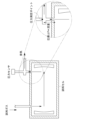
- the inventors considered attaching a pressure sensor to the gas lead-out channel for leading the sample gas from the measurement cell to measure the pressure of the sample gas, as shown in FIG.
- a pressure sensor to the gas lead-out channel for leading the sample gas from the measurement cell to measure the pressure of the sample gas, as shown in FIG.
- pressure loss occurs between the sample gas leaving the measurement cell and reaching the pressure measurement point, but this pressure loss is negligible. Therefore, it was thought that the pressure in the measurement cell could be measured almost accurately.
- the present invention has been made in view of the above-mentioned problems, and a main object of the present invention is to accurately measure the pressure in a measurement cell while maintaining high responsiveness in a gas analyzer that performs absorption analysis. .
- a gas analyzer analyzes the concentration of a component to be measured contained in a sample gas, and includes a measurement cell, a gas introduction passage for introducing the sample gas into the measurement cell, and the A gas lead-out channel for leading the sample gas from the measurement cell, a pressure sensor for measuring the pressure in the measurement cell, a light source for irradiating the measurement cell with light, and the light intensity of the light passing through the measurement cell. and a concentration correction unit for correcting the calculated concentration of the measurement target component based on the pressure measured by the pressure sensor.
- the pressure sensor comprises a sensor main body and a communication pipe communicating between the sensor main body and the measurement cell, and the tip of the communication pipe serves as an introduction port of the gas introduction flow path that opens into the measurement cell.
- the tip of the communication pipe serves as an introduction port of the gas introduction flow path that opens into the measurement cell.
- it is installed in the vicinity of the outlet of the gas outlet channel.
- the pressure measurement point of the pressure sensor can be set in the measurement cell by placing the tip of the communicating tube of the pressure sensor near the inlet of the gas introduction channel or the outlet of the gas outlet channel. Since it can be set at a position close to the space, the pressure in the measuring cell can be accurately measured with less influence of pressure loss. As a result, it is also possible to reduce the difference in line indication when the flow rate of the sample gas differs between the time of measurement and the time of calibration, for example. Moreover, since there is no need to provide a pressure sensor inside the measuring cell, the structure inside the measuring cell can be simplified. For this reason, turbulence is less likely to occur in the measurement cell, and the surface area can be reduced to suppress gas adsorption, so high responsiveness can be maintained.
- the tubular body of the communication tube that communicates the sensor main body and the measurement cell is a gas introduction tube that forms the gas introduction flow path or a gas discharge tube that forms the gas discharge flow path. It is preferable that it is provided inside and has a double-tube structure together with the gas inlet pipe or the gas outlet pipe. By doing so, the tip of the communicating tube can be brought closer to the inside of the sample cell, so that the influence of pressure loss can be reduced and the pressure inside the measuring cell can be measured more accurately.
- the gas communication port formed at the tip of the communication pipe and the inlet port of the gas introduction channel or the outlet port of the gas outlet channel are substantially flush with each other. .
- the gas communication port can be brought very close to the inside of the measuring cell, and the pressure inside the measuring cell can be measured more accurately.
- the tip of the communicating tube does not protrude into the sample cell, the responsiveness is not lowered.
- the outer diameter of the communication pipe is half or less than the inner diameter of the gas introduction pipe or the gas outlet pipe provided outside thereof.
- the wall of the outer tube of the communication tube is polished.
- the tip of the communicating tube of the pressure sensor when the tip of the communicating tube of the pressure sensor is provided on the flow path of the sample gas, turbulence occurs to some extent in the vicinity of this tip. It is preferably provided downstream in the flow path. Therefore, in the gas analysis device, it is preferable that the tip of the communicating tube is installed closer to the outlet port of the gas outlet channel than to the vicinity of the inlet port of the gas inlet channel.
- a plurality of nitrogen compound components may be measured, and span gas corresponding to each nitrogen compound component is supplied.
- span gas corresponding to each nitrogen compound component may be provided with a plurality of flow paths (span gas supply flow paths).
- span gas supply flow paths may be provided with a plurality of flow paths.
- the NH 3 gas (or NO 2 gas) remaining in the flow path may , and the supplied NO 2 gas (NH 3 gas) may be mixed with each other to generate ammonium nitrate on the flow path.
- the gas analyzer further comprises a calibration gas flow path supplying a calibration gas to the measurement cell, said calibration gas flow path being connected to said gas introduction flow path or to said measurement cell.
- a NH3 gas supply channel for supplying NH3 gas as a span gas to the main calibration gas channel; and a non- NH3 gas other than NH3 gas as a span gas for the main calibration gas channel.
- a non- NH3 gas supply channel for supplying the gas, wherein the NH3 gas supply channel and the non- NH3 gas supply channel are provided independently of each other and separately merged into the main calibration gas channel.
- the NH 3 gas supply channel is provided independently of the non-NH 3 gas supply channel, and separately joined to the main calibration gas channel, so that when NO 2 is included as the non-NH 3 gas, In addition, direct mixing of NH 3 and NO 2 on the flow path to the main calibration gas flow path can be prevented, preventing the formation of ammonium nitrate.
- the NH 3 gas supply channel includes a plurality of the NH 3 gas supply channels, and the non-NH 3 gas supply channels include NO, NO, and NO as the span gas.
- a plurality of non-NH 3 gas supply channels for supplying at least two of NO 2 and N 2 O comprising: a plurality of the NH 3 gas supply channels; a plurality of the non-NH 3 gas supply channels; an NH 3 gas collecting flow path for collecting the NH 3 gas supplied from each NH 3 gas supply flow path, and each non-NH 3 gas supply flow path, to which the downstream ends of the respective NH 3 gas supply flow paths are connected; and a non-NH 3 gas collecting flow path for collecting the non-NH 3 gas supplied from each of the non-NH 3 gas supply flow paths.
- the NH 3 gas aggregate channel and the non-NH 3 gas aggregate channel are connected to vent channels for venting gas remaining in each aggregate channel. By doing so, it is possible to promote replacement of the gas in each integrated flow path.
- exhaust gas is regulated by the exhaust mass value, and when measuring the exhaust mass value, it is the mainstream to use the dilution measurement method.
- the exhaust gas emitted from the exhaust pipe of the vehicle, which is the specimen is introduced into the dilution tunnel using the introduction pipe, and the concentration of the diluted exhaust gas is measured, or the bag is sampled from the dilution tunnel.
- a highly adsorptive component such as ammonia (NH 3 ) contained in the exhaust gas
- NH 3 ammonia
- an exhaust gas analysis system for analyzing a measurement target component contained in an exhaust gas emitted from a vehicle or a test object that is a part thereof, and is connected to an exhaust pipe of the test object, is introduced, a flow meter for measuring the flow rate of the exhaust gas flowing through the main flow channel, a sampling unit for sampling a portion of the exhaust gas from the main flow channel, and the sampled by the sampling unit
- the gas analyzer that analyzes the exhaust gas and measures the concentration of the component to be measured, the flow rate of the exhaust gas measured by the flow meter, and the concentration of the component to be measured measured by the gas analyzer. It is preferable to include a release amount calculation unit that calculates the release amount of the component to be measured based on the above. With this configuration, the gas analyzer can accurately measure the pressure in the measurement cell while maintaining high responsiveness. Mass can be measured with high accuracy.
- the gas analysis method of the present invention is characterized by analyzing the concentration of the component to be measured contained in the sample gas using the gas analyzer described above. There can exist the same effect as a gas analyzer.
- the flow rate of the sample gas introduced into the measurement cell during analysis is higher than the flow rate of the calibration gas introduced into the measurement cell during calibration.
- FIG. 1 is an overall schematic diagram of a gas analyzer according to an embodiment of the present invention
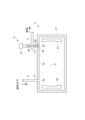
- FIG. FIG. 2 is a cross-sectional view schematically showing the configuration of the multi-reflection cell of the same embodiment
- FIG. 2 is an overall schematic diagram of an exhaust gas analysis system including the gas analyzer of the same embodiment.
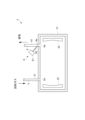
- FIG. 4 is a cross-sectional view schematically showing the configuration of a multi-reflection cell according to another embodiment
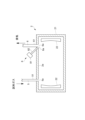
- FIG. 4 is a cross-sectional view schematically showing the configuration of a multi-reflection cell according to another embodiment;
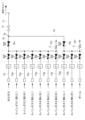
- FIG. 2 is an overall schematic diagram of an exhaust gas analysis system according to another embodiment
- FIG. 2 is a cross-sectional view schematically showing the configuration of a conventional multi-reflection cell;
- the analyzer 100 of this embodiment is an exhaust gas analyzer 100 that measures the concentration of one or more components contained in exhaust gas emitted from an internal combustion engine such as an automobile.
- the gas analyzer 100 is configured such that a part or all of the exhaust gas emitted from the tail pipe of an automobile, for example, is sampled by a sampling unit P0, and the exhaust gas sampled by the sampling unit P0 is analyzed. (hereinafter also referred to as a sample gas) is introduced into the multi-reflection measurement cell 2, and one or more components to be measured in the exhaust gas (for example, NO, NO 2 , N 2 O or NH 3 and other nitrogen compound components).
- this gas analyzer 100 comprises a light irradiation section 1, a measurement cell 2 into which a sample gas is introduced and which multiple-reflects the light from the light irradiation section 1, and light emitted from the measurement cell 2 is detected.
- a light detection unit 3 and an information processing device 4 for analyzing the measurement target component contained in the sample gas based on the light intensity signal detected by the light detection unit 3 are provided.
- the light irradiation unit 1 includes one or more laser light sources 11 that emit laser light, and a guide mechanism 12 such as a reflecting mirror that guides the light from the laser light sources 11 to the measurement cell 2 .
- the laser light source 11 is a wavelength tunable laser that emits laser light having an oscillation wavelength in the infrared region such as the mid-infrared region and the near infrared region, or an oscillation wavelength in the ultraviolet region. It is conceivable to use semiconductor lasers such as lasers, solid state lasers or liquid lasers.
- the laser light source 11 it is particularly preferable to use a quantum cascade laser (QCL).
- QCL quantum cascade laser
- absorptiometric method (QCL-IR method) using this QCL as a light source an element adjusted to oscillate light in the wavenumber region where the absorption peak of the target component exists is used.
- the measuring cell 2 is of a type called a Herriott cell.
- the measurement cell 2 includes a cell body 21 into which a sample gas is introduced into an internal space S, and a pair of reflecting mirrors 22 provided facing each other inside the cell body 21 .
- the photodetector 3 includes one or more photodetectors 31 that detect the light intensity of the light emitted after being multiple-reflected within the measurement cell 2 .
- the photodetector 31 may be, for example, a thermal type such as a relatively inexpensive thermopile, or may be a quantum type photoelectric element such as HgCdTe, InGaAs, InAsSb, or PbSe with good responsiveness.
- a guide mechanism 32 such as a reflecting mirror is provided between the measurement cell 2 and the photodetector 31 to guide the light emitted from the measurement cell 2 to the photodetector 31 .
- a light intensity signal obtained by the photodetector 31 is output to the information processing device 4 .
- the information processing device 4 includes an analog electric circuit including buffers and amplifiers, a digital electric circuit including a CPU and memory, and an AD converter, a DA converter, and the like that mediate between the analog/digital electric circuits. be.
- the information processing device 4 has a light intensity signal acquisition unit that acquires the light intensity signal output from the photodetector 31 through cooperation of the CPU and its peripheral devices according to a predetermined program stored in a predetermined area of the memory. 41, a concentration calculator 42 that calculates the concentration of each component to be measured by arithmetically processing the acquired light intensity signal, and a measurement calculated according to the pressure in the measurement cell 2 measured by the pressure sensor 8 described later. It exhibits at least a function as the concentration correction unit 43 that corrects the concentration of the target component.
- the information processing device 4 may have a function as a display section for displaying the concentration of the component to be measured.
- the gas analyzer 100 also has a gas introduction channel 5 for introducing sample gas sampled into the measurement cell 2 and a gas delivery channel 5 for leading the analyzed sample gas from the measurement cell 2. 6.
- the gas introduction channel 5 is connected at its upstream end to the sampling part P ⁇ b>0 and at its downstream end to the measurement cell 2 .
- a gas introduction port 5a formed at the downstream end of an introduction pipe 51 forming the gas introduction flow path 5 opens into the inner wall 2a of the measurement cell 2.
- a sample gas is introduced into The gas introduction channel 5 is provided with one or more filters F for removing dust contained in the collected sample gas, and a flow rate limiter for limiting the flow rate of the sample gas that has passed through the upstream filter F. 52 are provided in order from the upstream.
- the upstream filter F is heated by a heating mechanism to a predetermined temperature (eg, 113° C.).
- the flow restrictor 52 is an orifice (FO) or a needle valve here, and the pressure on the downstream side is reduced compared to the upstream side.
- a heating pipe is provided between the upstream filter F and the flow rate limiting portion 52 in the gas introduction passage 5 to prevent adsorption of adsorbable gases such as NH 3 in the sample gas and condensation.
- the gas outlet channel 6 is connected to the measurement cell 2 at its upstream end. Specifically, an outlet port 6a formed at the upstream end of a gas lead-out pipe 61 forming the gas lead-out flow path 6 is open to the inner wall 2a of the measurement cell 2, and the analyzed sample gas is passed through the outlet port 6a. take it in and lead it downstream.
- a pump 62 for introducing the sample gas into the measurement cell 2 is provided in the gas lead-out channel 6 .
- the pump 62 creates a negative pressure in the measurement cell 2 , and pumps the flow path from the downstream side of the flow restricting portion 52 in the gas introduction flow path 5 to the measurement cell 2 and the flow path 6 from the measurement cell 2 in the gas discharge flow path 6 .
- a negative pressure (eg, about 25 kPa) is applied to the flow path up to 62 .
- the gas analyzer 100 also includes a calibration gas flow path 7 that supplies calibration gases such as zero gas and span gas to the measurement cell 2 for performing calibration (zero calibration and span calibration).
- the calibration gas channel 7 is provided with a main opening/closing valve 7v for opening and closing the channel.
- This calibration gas flow path 7 supplies a gas (for example, N 2 or the like) that does not contain the component to be measured and does not affect the spectrum around the component to be measured as a zero gas. Further, this calibration gas flow path 7 supplies a gas containing a predetermined concentration of the component to be measured as a span gas.
- the component to be measured is at least one of NH 3 , NO, NO 2 and N 2 O.
- the gas analyzer 100 also has a pressure sensor 8 outside the measurement cell 2 for measuring the pressure of the sample gas in the measurement cell 2 .
- the pressure sensor 8 is, for example, an electrostatic capacity type diaphragm vacuum gauge.
- a communicating pipe 82 is provided.
- the communication pipe 82 has, for example, a straight pipe shape, with one end connected to the sensor main body 81 and a communication port 8a formed at the tip 82t, which is the other end.
- the pressure sensor 8 is provided such that the communication port 8a of the communication pipe 82 is positioned on the flow path through which the sample gas flows.
- the pressure sensor 8 is installed so that the gas communication port 8a is located near the outlet port 6a of the gas outlet channel 6, as shown in FIG. there is
- the communication pipe 82 of the pressure sensor 8 (specifically, the tubular body constituting the communication pipe 82) is partly or wholly of the gas outlet pipe 61 of the gas outlet flow path 6. It is provided inside and configured to form a double pipe structure together with the gas lead-out pipe 61 .
- a communication pipe 82, which is an inner pipe, is provided inside the gas lead-out pipe 61, which is an outer pipe. The sample gas is led downstream through the channel.
- the tubular body constituting the communication pipe 82 has a thin tubular shape, and the outer diameter thereof is half or less than the inner diameter of the gas lead-out pipe 61 . In this way, by reducing the proportion of the communication pipe 82 occupying the inside of the gas lead-out pipe 61, the sample gas can flow easily and the responsiveness can be further improved.
- the gas outlet pipe 61 and the communication pipe 82 are coaxial in the vicinity of the outlet port 6a, and that the gas communication port 8a and the outlet port 6a are open so as to face the same direction. By doing so, it is possible to further improve the responsiveness to pressure fluctuations of the sample gas.
- the distance between the ends of the gas communication port 8a and the outlet 6a is the same as the outlet. It is preferably less than or equal to the diameter length of 6a, for example, preferably less than or equal to 10 mm or less than or equal to 5 mm. Further, it is preferable that the gas communication port 8a and the outlet port 6a are opened along the inner wall 2a of the measuring cell 2 so as to be substantially flush with each other. By doing so, the gas communication port 8a can be brought very close to the inside of the measuring cell 2, and the pressure inside the measuring cell 2 can be measured more accurately.
- the gas communication port 8a may protrude from the inner wall 2a of the measuring cell 2 toward the internal space S, or conversely may recede toward the gas lead-out tube 61 side.
- the pressure sensor 8 can be Since the pressure measurement point can be set at a position close to the internal space S of the measurement cell 2, the pressure in the measurement cell 2 can be accurately measured while reducing the influence of pressure loss. As a result, it is also possible to reduce the difference in line indication when the flow rate of the sample gas differs between the time of measurement and the time of calibration, for example. Moreover, since the pressure sensor 8 is provided outside the measuring cell 2, the structure inside the measuring cell 2 can be simplified. As a result, turbulence is less likely to occur in the measurement cell 2, and the surface area of the cell 2 can be reduced to suppress gas adsorption, thereby maintaining high responsiveness.
- This exhaust gas analysis system 200 is for analyzing exhaust gas emitted from a test vehicle, which is a specimen, and measuring the emission amount of measurement target components contained in the exhaust gas. As shown in FIG. 3, this exhaust gas analysis system 200 is connected to the chassis dynamometer SD on which the test vehicle V is mounted, and the exhaust pipe EH of the test vehicle V, and the exhaust gas (undiluted) emitted from the engine. A main flow path 210 into which raw exhaust gas is introduced, a flowmeter 220 that measures the flow rate of the exhaust gas flowing through the main flow path 210, a sampling unit 230 that collects a portion of the exhaust gas from the main flow path 210, and a sampling unit 230.
- the gas analyzer 100 analyzes the exhaust gas sampled by and measures the concentration of the measurement target component, and the control device 240 having a function as an emission amount calculation unit 241 for calculating the emission amount of the measurement target component. I have.
- the flowmeter 220 is, for example, an ultrasonic flowmeter, but is not limited to this, and may be a pitot tube flowmeter or other type.
- the sampling unit 230 is configured to sample exhaust gas from a sample point SP set downstream of the flow meter 220 in the main flow path 210 .
- the emission amount calculator 241 is configured to calculate the emission amount of the measurement target component based on the flow rate (Q1) of the exhaust gas measured by the flow meter 220 and the concentration of the measurement target component measured by the gas analyzer 100. It is Specifically, the discharge amount calculation unit 241 multiplies the flow rate (Q1) of the exhaust gas obtained from the flow meter 220 on the main flow path 210 by the concentration of the measurement target component obtained from the gas analyzer 100 to obtain the measurement Calculate the emission mass of the target component.
- the gas analyzer 100 can accurately measure the pressure in the measurement cell 2 while maintaining high responsiveness. In addition to being able to measure well, it becomes possible to accurately measure the mass of the component to be measured.
- gas analyzer 100 and the exhaust gas analysis system 200 of the present invention are not limited to the above embodiments.
- the pressure sensor 8 is installed so that the communication port 8a is positioned near the outlet port 6a of the gas outlet channel 6, but the present invention is not limited to this.
- the pressure sensor 8 may be installed such that the gas communication port 8a is located near the inlet 5a of the gas inlet channel 5. FIG. Also in this way, the gas communication port 8a can be brought closer to the inside of the measurement cell 2, and the pressure inside the measurement cell 2 can be measured more accurately.
- the distance between the ends of the gas communication port 8a and the introduction port 5a (that is, the distance between the end of the introduction port 5a of the gas introduction pipe 51 and the end of the gas communication port 8a) It is preferably set to be equal to or less than the diameter length of 5a, for example, to be equal to or less than 10 mm or equal to or less than 5 mm.
- the gas communication port 8a and the introduction port 5a are preferably opened along the inner wall 2a of the measurement cell 2 so as to be substantially flush with each other.
- the gas communication port 8a may protrude toward the internal space S from the inner wall 2a of the measurement cell 2, or may be recessed toward the gas introduction pipe 51 side.
- the gas outlet pipe 61 and the communication pipe 82 may not be concentric, and the outlet port 6a and the gas communication port 8a may not be flush. Further, the tubular body constituting the communication tube 82 may not be thin, and the outer diameter thereof may not be half or less than the inner diameter of the gas lead-out tube 61 .
- the communicating tube 82 of the pressure sensor 8 and the gas lead-out tube 61 do not have to have a double tube structure.
- the pressure sensor 8 has a communicating tube 82 whose distal end portion penetrates the tube wall of the gas lead-out tube 61 so that the gas communicating port 8a is the lead-out port. 6a (the distance from the outlet 6a is preferably equal to or less than the diameter of the outlet 6a, for example, 10 mm or less, preferably 5 mm or less).
- the pressure measurement point of the pressure sensor 8 can be set at a position close to the internal space S of the measurement cell 2, so that the pressure in the measurement cell 2 can be accurately measured while reducing the influence of pressure loss. will be able to
- the pressure sensor 8 has a communication tube 82 passing through the side wall 2a of the measurement cell 2 and a gas communication port 8a formed on the side wall 2a. is located near the outlet 6a formed on the side wall 2a (the distance from the outlet 6a is preferably equal to or less than the diameter length of the outlet 6a, for example, 10 mm or less, preferably 5 mm or less).
- the gas communication port 8a and the outlet port 6a may be connected to each other on the side wall 2a to form a common opening. Even in such a case, the pressure measurement point of the pressure sensor 8 can be set at a position close to the internal space S of the measurement cell 2, so that the pressure in the measurement cell 2 can be accurately measured while reducing the influence of pressure loss. will be able to
- the gas analyzer 100 in the above embodiment can be applied to gas analyzers 100 using the principle of absorption analysis, such as the FTIR method, QCL-IR method, and NDIR method.
- the measurement cell 2 may not be a multi-reflection cell.
- the measuring cell 2 may not be a Herriott cell, but may be, for example, a White cell.
- the light irradiation unit 1 includes the laser light source 11 as a light source, but the present invention is not limited to this.
- the light irradiation section 1 may include a light emitting diode (LED), a halogen lamp, or the like as a light source.
- the gas analyzer 100 of another embodiment can detect hydrocarbons such as CH4 , sulfur compounds such as SO2, CO, CO2 , H2O , alcohols, aldehydes, and the like. It may be configured to measure the concentration of the component to be measured.
- the calibration gas flow path 7 includes a plurality of types of span gases corresponding to a plurality of components to be measured (here, low-concentration NO gas, high-concentration NO gas, low-concentration NO 2 gas, high-concentration NO 2 gas, low-concentration N 2 O gas, high-concentration N 2 O gas, low-concentration NH 3 gas, or high-concentration NH 3 gas).
- the calibration gas flow path 7 of this embodiment may include a plurality of span gas supply flow paths 73 corresponding to each span gas described above.
- the calibration gas channel 7 includes a plurality of span gas supply channels (also referred to as non-NH 3 gas supply channels) 73a to 73f for supplying gases other than NH 3 (also referred to as non-NH 3 gas) as span gases. and a plurality of span gas supply passages (also referred to as NH 3 gas supply passages) 73g and 73h for supplying NH 3 gas as span gas.
- the zero gas supply channel 72 and the plurality of span gas supply channels 73 a - 73 h may be in a parallel relationship with respect to the main calibration gas channel 71 .
- the zero gas supply channel 72 and each of the span gas supply channels 73a to 73f may be connected to corresponding gas sources such as gas cylinders at their upstream ends.
- the zero gas supply channel 72 and the span gas supply channels 73a to 73f may be provided with on-off valves and filters for opening and closing the channels.
- a plurality of NH 3 gas supply channels 73g and 73h and a plurality of non-NH 3 gas supply channels 73a to 73f are provided independently of each other. It may be provided so as to join the calibration gas flow path 71 separately.
- the calibration gas channel 7 of this embodiment is connected to the downstream ends of the NH 3 gas supply channels 73g and 73h, and collects the NH 3 gas supplied from the NH 3 gas supply channels 73g and 73h.
- the NH 3 gas aggregation passage 74 is connected to the downstream ends of the non-NH 3 gas supply passages 73a to 73f, and the non-NH 3 gases supplied from the non-NH 3 gas supply passages 73a to 73f are aggregated. and a non-NH 3 gas aggregate flow path 75 .
- the NH 3 gas aggregate channel 74 and the non-NH 3 gas aggregate channel 75 are provided independently of each other and are low, and are in a parallel relationship with respect to the main calibration gas channel 71, and their downstream ends are It may be connected to a confluence point 7p set upstream of the main on-off valve 7v in the main calibration gas flow path 71 .
- On-off valves 74v and 75v for opening and closing the flow paths may be provided in the integrated flow paths 74 and 75, respectively.
- Vent channels 741 and 751 for venting gas remaining in each channel are connected to the upstream side of the on-off valves 74v and 75v in the NH 3 gas aggregate channel 74 and the non-NH 3 gas aggregate channel 75, respectively.
- Each vent channel 741, 751 may be provided with a pressure loss mechanism C such as a capillary or an orifice.
- the non-NH 3 gas aggregate channel 75 of this embodiment is connected to the downstream end of the zero gas supply channel 72 so as to aggregate the zero gas such as N 2 gas flowing through the zero gas supply channel 72 together with the non-NH 3 gas. may be configured to
- the calibration gas flow path 7 may not have multiple non-NH 3 gas supply flow paths and multiple NH 3 gas supply flow paths, but only one of either or both. may Even in this case, the NH 3 gas supply channel and the non-NH 3 gas supply channel are provided independently of each other, and are separately joined to the main calibration gas channel 71, so that the main calibration gas Direct mixing of NH 3 and NO 2 in the flow path up to the flow path 71 can be prevented to prevent generation of ammonium nitrate.
- the sampling unit 230 samples part of the exhaust gas from directly below the exhaust pipe EH upstream of the flow meter 220 in the main flow path 210. It may be configured as
- the flow meter 220 of this embodiment may measure the flow rate (also referred to as main flow rate) of the exhaust gas flowing downstream of the sample point SP of the sampling section 230 in the main flow path 210 . That is, the flow rate of the exhaust gas measured by the flow meter 220 is obtained by subtracting the flow rate of the exhaust gas sampled by the sampling unit 230 from the total flow rate of the exhaust gas introduced into the main flow path 210 from the exhaust pipe EH of the test vehicle V. It can be said.
- the sampling unit 230 may be configured to sample the exhaust gas from directly below the exhaust pipe EH in the main flow path 210 (immediately after the exit).
- the area from the outlet of the exhaust pipe EH in the main flow path 210 to the sample point SP may be heated and temperature-controlled by a heating mechanism 211 in order to prevent adsorption of adsorptive gases such as NH 3 and condensation. It may be kept warm by a heat insulating material or the like. In this way, gas adsorption on the pipe inner wall between the outlet of the exhaust pipe EH and the sample point SP can be reduced, and the discharge amount of the component to be measured can be calculated more accurately. Further, the inner surface of the piping in the temperature control section of the main flow path 210 may be polished so as to prevent the adsorption of the adsorptive gas.
- the discharge amount calculation unit 241 corrects the main flow rate measured by the flow meter 220 with the sampling flow rate, which is the flow rate sampled by the sampling unit 230, and the measured flow rate measured by the gas analyzer 100. It may be configured to calculate the emission amount of the measurement target component based on the concentration of the target component. Specifically, the discharge amount calculation unit 241 calculates the main flow rate (Q1) measured by the flow meter 220 on the main flow path 210 and the sampling flow rate (Q2 ) and summed up to calculate the corrected flow rate (Q3). Then, the emission mass of the measurement target component may be calculated by multiplying the concentration of the measurement target component acquired from the gas analyzer 100 by the corrected flow rate. As the sampling flow rate (Q2), a suction flow rate or the like preset in the gas analyzer 100 may be used.
- the exhaust gas analysis system 200 of another embodiment configured in this way, the exhaust gas is sampled immediately after it is discharged from the exhaust pipe EH at the upstream side of the flow meter 220, so that the adsorptive It is possible to accurately measure the concentration of the component to be measured that has a high adsorption on the inner wall of the pipe.
- the flow rate measured by the flow meter 220 is corrected by the flow rate of the sampled exhaust gas, it is possible to suppress the influence on the flow rate value used for calculating the emission amount while sampling the exhaust gas from the upstream of the flow meter 220. can be done. As a result, the influence of adsorption of the measurement target component on the inner wall of the tube can be suppressed, and the discharge amount can be measured with high accuracy.
- the exhaust gas analysis system 200 measures the components to be measured in the exhaust gas emitted in a test using a chassis dynamometer, but is not limited to this.
- the component to be measured in the exhaust gas discharged in a test using an engine test device or a drive test device such as a power train may be measured.
- the exhaust gas analysis system 200 may be an on-vehicle type that is attached to the test vehicle V. FIG.
- the gas analyzer 100 and the exhaust gas analysis system 200 analyze the components to be measured in the exhaust gas discharged from an internal combustion engine such as an engine, but are not limited to this.
- the component to be measured in flue gas discharged from an external combustion engine such as a thermal power plant or a factory may be measured.
- the gas analyzer 100 may be used to analyze not only exhaust gas but also other gases.
- the gas analyzer 100 may be used to analyze gas emitted from a secondary battery such as a storage battery, or a fuel cell. .
Landscapes
- Physics & Mathematics (AREA)
- Spectroscopy & Molecular Physics (AREA)
- Analytical Chemistry (AREA)
- Health & Medical Sciences (AREA)
- Life Sciences & Earth Sciences (AREA)
- Chemical & Material Sciences (AREA)
- Biochemistry (AREA)
- General Health & Medical Sciences (AREA)
- General Physics & Mathematics (AREA)
- Immunology (AREA)
- Pathology (AREA)
- Optics & Photonics (AREA)
- Investigating Or Analysing Materials By Optical Means (AREA)
- Sampling And Sample Adjustment (AREA)
Priority Applications (2)
| Application Number | Priority Date | Filing Date | Title |
|---|---|---|---|
| JP2023567638A JPWO2023112597A1 (https=) | 2021-12-15 | 2022-11-18 | |
| DE112022005962.1T DE112022005962T5 (de) | 2021-12-15 | 2022-11-18 | Gasanalysevorrichtung, abgasanalysesystem und gasanalyseverfahren |
Applications Claiming Priority (2)
| Application Number | Priority Date | Filing Date | Title |
|---|---|---|---|
| JP2021-203648 | 2021-12-15 | ||
| JP2021203648 | 2021-12-15 |
Publications (1)
| Publication Number | Publication Date |
|---|---|
| WO2023112597A1 true WO2023112597A1 (ja) | 2023-06-22 |
Family
ID=86774075
Family Applications (1)
| Application Number | Title | Priority Date | Filing Date |
|---|---|---|---|
| PCT/JP2022/042840 Ceased WO2023112597A1 (ja) | 2021-12-15 | 2022-11-18 | ガス分析装置、排ガス分析システム及びガス分析方法 |
Country Status (3)
| Country | Link |
|---|---|
| JP (1) | JPWO2023112597A1 (https=) |
| DE (1) | DE112022005962T5 (https=) |
| WO (1) | WO2023112597A1 (https=) |
Citations (9)
| Publication number | Priority date | Publication date | Assignee | Title |
|---|---|---|---|---|
| JP2006308056A (ja) * | 2005-05-02 | 2006-11-09 | Horiba Ltd | 多方切換弁およびこれを用いた分析装置 |
| JP2011149718A (ja) * | 2010-01-19 | 2011-08-04 | Shimadzu Corp | ガス分析装置 |
| JP2013015434A (ja) * | 2011-07-05 | 2013-01-24 | Shimadzu Corp | ガス分析装置 |
| WO2013035657A1 (ja) * | 2011-09-08 | 2013-03-14 | 株式会社堀場製作所 | 吸着性ガス分析装置及び吸着性ガス分析方法 |
| JP2015127678A (ja) * | 2013-12-27 | 2015-07-09 | 株式会社堀場製作所 | ガス分析装置及びガス分析方法 |
| JP2019200076A (ja) * | 2018-05-15 | 2019-11-21 | 株式会社堀場製作所 | ボンベ管理システム、ボンベ管理プログラム及びガスリーク検出システム |
| JP2020095013A (ja) * | 2018-12-12 | 2020-06-18 | 株式会社堀場製作所 | 排ガス分析装置、排ガス分析方法、及び補正式作成方法 |
| JP2020106364A (ja) * | 2018-12-27 | 2020-07-09 | 株式会社堀場製作所 | ガス分析装置、ガス分析用プログラム、及びガス分析方法 |
| US20210115832A1 (en) * | 2019-10-22 | 2021-04-22 | Johnson Matthey Catalysts (Germany) Gmbh | System And Method For Monitoring Exhaust Gas |
-
2022
- 2022-11-18 DE DE112022005962.1T patent/DE112022005962T5/de active Pending
- 2022-11-18 JP JP2023567638A patent/JPWO2023112597A1/ja active Pending
- 2022-11-18 WO PCT/JP2022/042840 patent/WO2023112597A1/ja not_active Ceased
Patent Citations (9)
| Publication number | Priority date | Publication date | Assignee | Title |
|---|---|---|---|---|
| JP2006308056A (ja) * | 2005-05-02 | 2006-11-09 | Horiba Ltd | 多方切換弁およびこれを用いた分析装置 |
| JP2011149718A (ja) * | 2010-01-19 | 2011-08-04 | Shimadzu Corp | ガス分析装置 |
| JP2013015434A (ja) * | 2011-07-05 | 2013-01-24 | Shimadzu Corp | ガス分析装置 |
| WO2013035657A1 (ja) * | 2011-09-08 | 2013-03-14 | 株式会社堀場製作所 | 吸着性ガス分析装置及び吸着性ガス分析方法 |
| JP2015127678A (ja) * | 2013-12-27 | 2015-07-09 | 株式会社堀場製作所 | ガス分析装置及びガス分析方法 |
| JP2019200076A (ja) * | 2018-05-15 | 2019-11-21 | 株式会社堀場製作所 | ボンベ管理システム、ボンベ管理プログラム及びガスリーク検出システム |
| JP2020095013A (ja) * | 2018-12-12 | 2020-06-18 | 株式会社堀場製作所 | 排ガス分析装置、排ガス分析方法、及び補正式作成方法 |
| JP2020106364A (ja) * | 2018-12-27 | 2020-07-09 | 株式会社堀場製作所 | ガス分析装置、ガス分析用プログラム、及びガス分析方法 |
| US20210115832A1 (en) * | 2019-10-22 | 2021-04-22 | Johnson Matthey Catalysts (Germany) Gmbh | System And Method For Monitoring Exhaust Gas |
Also Published As
| Publication number | Publication date |
|---|---|
| DE112022005962T5 (de) | 2024-10-02 |
| JPWO2023112597A1 (https=) | 2023-06-22 |
Similar Documents
| Publication | Publication Date | Title |
|---|---|---|
| CN102338740B (zh) | 吸附性气体分析装置 | |
| US10955398B2 (en) | Calibration method for gas analysis apparatus, gas analysis system, and pressure varying device | |
| CN106164648B (zh) | 借助红外线吸收光谱确定试样气流内至少一种气体的浓度的装置 | |
| US9121793B2 (en) | Semi-open-path gas analysis systems and methods | |
| US10598601B2 (en) | Gas concentration measuring device | |
| KR101460874B1 (ko) | 암모니아 화합물 농도 계측 장치 및 암모니아 화합물 농도 계측 방법 | |
| US10094771B2 (en) | Device and method for determining the concentration of at least one gas in a sample gas stream by means of infrared absorption spectroscopy | |
| JP4925489B1 (ja) | ガス分析装置 | |
| JP4413160B2 (ja) | 排気ガス成分分析装置 | |
| KR20250023979A (ko) | 가스 연속 분석 시스템 및 가스 연속 분석 방법 | |
| WO2023112597A1 (ja) | ガス分析装置、排ガス分析システム及びガス分析方法 | |
| WO2023276762A1 (ja) | ガス分析装置の校正方法、ガス分析装置の圧力補正方法、ガス分析装置の検査方法、圧力変動方法、圧力変動装置、及び、ガス分析システム | |
| JP4677462B2 (ja) | ガス分析装置、及び当該ガス分析装置を用いたガスセルの圧力又は流量の制御方法 | |
| JP2011007534A (ja) | ガス分析装置、及び当該ガス分析装置を用いたガスセルの圧力又は流量の制御方法 | |
| Kondo et al. | Development Of On-board Multi-component Gas Analyzer Toward Euro 7 | |
| US20250035544A1 (en) | Gas analysis device, gas analysis method, and program for gas analysis device | |
| JP2012230011A (ja) | ガス分析装置、及び当該ガス分析装置を用いたガスセルの圧力又は流量の制御方法 | |
| CN118794891B (zh) | 一种痕量氢气浓度检测装置及方法 |
Legal Events
| Date | Code | Title | Description |
|---|---|---|---|
| 121 | Ep: the epo has been informed by wipo that ep was designated in this application |
Ref document number: 22907128 Country of ref document: EP Kind code of ref document: A1 |
|
| WWE | Wipo information: entry into national phase |
Ref document number: 2023567638 Country of ref document: JP |
|
| WWE | Wipo information: entry into national phase |
Ref document number: 18705733 Country of ref document: US |
|
| 122 | Ep: pct application non-entry in european phase |
Ref document number: 22907128 Country of ref document: EP Kind code of ref document: A1 |