WO2023100682A1 - 化粧料 - Google Patents
化粧料 Download PDFInfo
- Publication number
- WO2023100682A1 WO2023100682A1 PCT/JP2022/042808 JP2022042808W WO2023100682A1 WO 2023100682 A1 WO2023100682 A1 WO 2023100682A1 JP 2022042808 W JP2022042808 W JP 2022042808W WO 2023100682 A1 WO2023100682 A1 WO 2023100682A1
- Authority
- WO
- WIPO (PCT)
- Prior art keywords
- cosmetic
- component
- carbon atoms
- group
- oil
- Prior art date
- Legal status (The legal status is an assumption and is not a legal conclusion. Google has not performed a legal analysis and makes no representation as to the accuracy of the status listed.)
- Ceased
Links
Classifications
-
- A—HUMAN NECESSITIES
- A61—MEDICAL OR VETERINARY SCIENCE; HYGIENE
- A61K—PREPARATIONS FOR MEDICAL, DENTAL OR TOILETRY PURPOSES
- A61K8/00—Cosmetics or similar toiletry preparations
- A61K8/18—Cosmetics or similar toiletry preparations characterised by the composition
- A61K8/30—Cosmetics or similar toiletry preparations characterised by the composition containing organic compounds
- A61K8/49—Cosmetics or similar toiletry preparations characterised by the composition containing organic compounds containing heterocyclic compounds
-
- A—HUMAN NECESSITIES
- A61—MEDICAL OR VETERINARY SCIENCE; HYGIENE
- A61K—PREPARATIONS FOR MEDICAL, DENTAL OR TOILETRY PURPOSES
- A61K8/00—Cosmetics or similar toiletry preparations
- A61K8/18—Cosmetics or similar toiletry preparations characterised by the composition
- A61K8/72—Cosmetics or similar toiletry preparations characterised by the composition containing organic macromolecular compounds
- A61K8/84—Cosmetics or similar toiletry preparations characterised by the composition containing organic macromolecular compounds obtained by reactions otherwise than those involving only carbon-carbon unsaturated bonds
- A61K8/87—Polyurethanes
-
- A—HUMAN NECESSITIES
- A61—MEDICAL OR VETERINARY SCIENCE; HYGIENE
- A61Q—SPECIFIC USE OF COSMETICS OR SIMILAR TOILETRY PREPARATIONS
- A61Q1/00—Make-up preparations; Body powders; Preparations for removing make-up
-
- A—HUMAN NECESSITIES
- A61—MEDICAL OR VETERINARY SCIENCE; HYGIENE
- A61Q—SPECIFIC USE OF COSMETICS OR SIMILAR TOILETRY PREPARATIONS
- A61Q19/00—Preparations for care of the skin
Definitions
- the present invention relates to a cosmetic comprising a cyclic carboxamide derivative having a specific structure or a salt thereof and a hydrophobically modified polyether urethane.
- Hydrophobic-modified polyether urethane is known as a viscosity modifier (also known as an associative thickener) whose viscosity is less dependent on temperature.
- a viscosity modifier also known as an associative thickener
- Many cosmetics containing urethane are commercially available. For example, there has been proposed a cosmetic containing hydrophobically-modified polyether urethane, nicotinic acid amide, and a specific surfactant to improve the feel of use (Patent Document 1). With regard to such cosmetics, users are demanding that they have a better feeling during use, and there is room for further improvement in the feeling during use.
- R a is a hydroxyalkyl group having 1 to 3 carbon atoms
- component (A) is 1-(2-hydroxyethyl)-2-imidazolidinone.
- component (B) is represented by formula (b).
- R b1 is an alkyl group having 2 to 36 carbon atoms
- R b2 and R b4 are each independently a phenylethylene group or an alkylene group having 2 to 4 carbon atoms
- R b3 is an alkylene group having 1 to 10 carbon atoms which may have a urethane bond
- R b5 is an alkyl group having 8 to 36 carbon atoms
- m is a number of 2 or more
- h is a number of 1 or more
- k is a number from 1 to 500
- j is a number from 1 to 200
- the present invention it is possible to provide cosmetics with excellent usability.
- it has good compatibility with the skin during application, does not feel slimy after application, and can impart a rich feeling.
- the present invention relates to a cosmetic comprising (A) a cyclic carboxamide derivative having a specific structure or a salt thereof, (B) a hydrophobically modified polyether urethane, and (C) water.
- the cosmetic according to the present invention is a cyclic carboxamide derivative represented by formula (a) or a salt thereof (hereinafter sometimes referred to as component (A).
- component (A) Cyclic carboxamide derivative or salt thereof
- the cosmetic according to the present invention is a cyclic carboxamide derivative represented by formula (a) or a salt thereof (hereinafter sometimes referred to as component (A).
- component (A) Cyclic carboxamide derivative or salt thereof
- component (A) is a cyclic carboxamide derivative represented by formula (a) or a salt thereof.
- component (A) The same applies to other components).
- R a is a hydrocarbon group having 1 to 6 carbon atoms which may be substituted with a hydroxyl group, or a hydrogen atom
- X is —CH 2 — or —N(R 1 )—, wherein R 1 is a hydrocarbon group having 1 to 6 carbon atoms which may be substituted with a hydroxyl group, or a hydrogen atom
- the above hydrocarbon group is not particularly limited, and may be, for example, an alkyl group, a cycloalkyl group, an alkenyl group, an alkynyl group, a cycloalkylalkyl group, a haloalkyl group, an alkoxyalkyl group, or an alkoxycarbonylalkyl group, preferably is an alkyl group.
- R a is a hydroxyalkyl group having 1 to 3 carbon atoms
- X is —CH 2 — or —NH—
- n is 1.
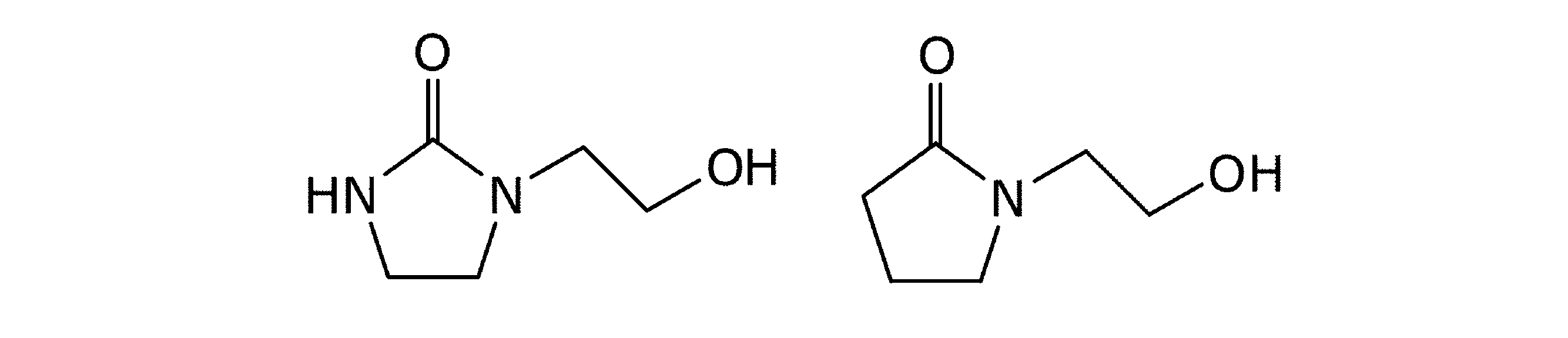
- Specific examples of the cyclic carboxamide derivative represented by formula (a) include the following.
- Component (A) is most preferably 1-(2-hydroxyethyl)-2-imidazolidinone.
- the (A) component may be a salt of the cyclic carboxamide derivative represented by formula (a).
- the type of salt is not particularly limited as long as it is a pharmacologically acceptable salt, and may be an inorganic salt or an organic salt.
- inorganic salts include hydrochlorides, sulfates, phosphates, hydrobromides, sodium salts, potassium salts, magnesium salts, calcium salts, magnesium salts, ammonium salts and the like.
- organic salts include acetates, lactates, maleates, fumarates, tartrates, methanesulfonates, p-toluenesulfonates, triethanolamine salts, amino acid salts and the like.
- component (A) component can be blended one or two or more.
- the amount of component (A) is preferably 0.1 to 5% by mass, more preferably 0.3 to 3% by mass, and still more preferably 1 to 2% by mass, relative to the total amount of the cosmetic. is.
- the cosmetic according to the present invention comprises (B) a hydrophobically modified polyetherurethane.
- the component (B) is a compound called associative thickener or associative polymer.
- component (B) is represented by formula (b).
- R b1 is an alkyl group having 2 to 36 carbon atoms, preferably an alkyl group having 2 to 4 carbon atoms.
- R b2 and R b4 are each independently a phenylethylene group or an alkylene group having 2 to 4 carbon atoms, preferably an alkyl group having 2 to 4 carbon atoms.
- R b3 is an alkylene group having 1 to 10 carbon atoms which may have a urethane bond.
- R b5 is an alkyl group having 8 to 36 carbon atoms, preferably an alkyl group having 12 to 24 carbon atoms.
- m is a number of 2 or more, preferably 2;
- h is a number of 1 or more, preferably 1;
- k is a number from 1 to 500, preferably a number from 100 to 300.
- j is a number from 1 to 200, preferably a number from 10 to 100.
- the (B) component is preferably a (PEG-240/decyltetradeceth-20/HDI) copolymer.
- Commercially available products include, for example, “ADEKA NOL GT-700” (manufactured by ADEKA Corporation).
- the component (B) can be blended either alone or in combination of two or more.
- the blending amount of component (B) is preferably 0.5 to 2.3% by mass, more preferably 1 to 1.8% by mass, based on the total amount of the cosmetic. Within this range, it is possible to further obtain the unique film feeling of the component (B).
- the term "feel of film” means the feeling that a soft film gently covers and protects the skin when applied to the skin.
- the cosmetic according to the present invention comprises (C) water.
- water water used in cosmetics, quasi-drugs, etc. can be used, and for example, purified water, ion-exchanged water, tap water, etc. can be used.
- the amount of water to be blended is preferably 40-98% by mass, more preferably 60-90% by mass, based on the total amount of the cosmetic composition according to the present invention.
- the cosmetic composition of the present invention may contain other optional ingredients as long as they do not impair the effects of the present invention.
- Other optional ingredients include, for example, aqueous solvents, thickeners (excluding component (B)), moisturizers, oils, UV absorbers, chemicals, chelating agents, preservatives, antioxidants, powders, Perfumes, colorants, pigments and the like can be mentioned, and can be appropriately blended according to the form and application of the cosmetic.
- aqueous solvents examples include lower alcohols such as ethanol, 1-propanol, 2-propanol, isobutyl alcohol and t-butyl alcohol.
- Thickeners include, for example, gum arabic, carrageenan, karaya gum, tragacanth gum, carob gum, quince seed (quince), casein, dextrin, gelatin, sodium pectate, sodium araginate, methylcellulose, ethylcellulose, CMC, hydroxyethylcellulose, hydroxypropyl Cellulose, PVA, PVM, PVP, sodium polyacrylate, carboxyvinyl polymer (carbomer), (dimethylacrylamide/acryloyldimethyltaurate Na) crosspolymer, (acryloyldimethyltaurate ammonium/VP) copolymer, (acryloyldimethyltaurate ammonium methacrylate) Henneth-25) Crosspolymer, (Na acrylate/Na acryloyldimethyltaurate) copolymer, locust bean gum, guar gum, tamarind gum, dialkyldimethylammonium cellulose sulfate
- moisturizing agents examples include polyethylene glycol, propylene glycol, dipropylene glycol (DPG), glycerin, 1,3-butylene glycol, chondroitin sulfate, hyaluronic acid, mucoitin sulfate, caronin acid, atelocollagen, and cholesteryl-12-hydroxystearate. , sodium lactate, bile salts, Dl-pyrrolidone carboxylate, alkylene oxide derivatives, short-chain soluble collagen, diglycerin (EO) PO adducts, and the like.
- EO represents ethylene oxide
- PO propylene oxide.
- the oil is not particularly limited, and various oils that are widely used in cosmetics can be blended, regardless of whether they are solid or liquid.
- a solid oil is an oil that is solid or semi-solid at room temperature and is generally used in cosmetics.
- oils include cacao butter, coconut oil, horse oil, hydrogenated coconut oil, palm oil, beef tallow, sheep oil, hydrogenated beef tallow, palm kernel oil, pork oil, beef bone oil, Japanese wax kernel oil, hydrogenated oil, Beeswax, candelilla wax, cotton wax, carnauba wax, bayberry wax, vegetation wax, whale wax, montan wax, bran wax, lanolin, kapok wax, lanolin acetate, sugarcane wax, lanolin fatty acid isopropyl, Waxes such as hexyl laurate, reduced lanolin, jojoba wax, hard lanolin, shellac wax, POE lanolin alcohol ether, POE lanolin alcohol acetate, POE cholesterol ether, POE hydrogenated lanolin alcohol ether; polyethylene wax, paraffin wax, ceresin, vaseline, micro Hydrocarbon waxes such as crystalline wax and lunasera;
- a liquid oil is an oil that is liquid at room temperature and is generally used in cosmetics.
- oils include, for example, avocado oil, evening primrose oil, camellia oil, turtle oil, macadamia nut oil, sunflower oil, almond oil, corn oil, mink oil, olive oil, rapeseed oil, egg yolk oil, sesame oil, persic oil, and wheat germ.
- Liquid fats and oils cetyl octanoate, cetyl 2-ethylhexanoate, hexyldecyl dimethyloctanoate, ethyl laurate, hexyl laurate, isopropyl myristate, 2-hexyldecyl myristate, myristyl myristate, octyldodecyl myristate, palmitic acid Isopropyl acid, 2-ethylhexyl palmitate, 2-hexyldecyl palmitate, 2-heptylundecyl palmitate, butyl stearate, isocetyl stearate, isocetyl isostearate, decyl oleate, dodecyl oleate, oleyl oleate, myristyl lactate , cetyl lactate, diisostearyl malate, cholesteryl 12-hydroxy
- ultraviolet absorbers examples include benzoic acid-based ultraviolet absorbers such as para-aminobenzoic acid; anthranilic acid-based ultraviolet absorbers such as methyl anthranilate; salicylic acid-based ultraviolet absorbers such as octyl salicylate; cinnamic acid UV absorbers such as octyl formate; pyridazine derivatives such as dimorpholinopyridazinone; benzoylmethane derivatives such as 4-methoxy-4'-t-butyldibenzoylmethane; 3-(4'-methylbenzylidene )-D,l-camphor, 3-benzylidene-D,l-camphor and other camphor derivatives; 2,2′-hydroxy-5-methylphenylbenzotriazole, 2-(2′-hydroxy-5′-t-octyl Benzotriazole derivatives such as phenyl)benzotriazole, 2-(2'-hydroxy-5'-methylphenylbenzo
- drugs include ascorbic acid (vitamin C), tranexamic acid, kojic acid, ellagic acid, nicotinic acid, arbutin, alkoxysalicylic acid, glycyrrhizic acid, tocopherol, retinol and salts or derivatives thereof (e.g., sodium L-ascorbate , L-ascorbic acid ester magnesium salt, L-ascorbic acid glucoside, 2-O-ethyl-L-ascorbic acid, 3-O-ethyl-L-ascorbic acid, 4-methoxysalicylic acid sodium salt, 4-methoxysalicylic acid potassium salt , dipotassium glycyrrhizinate, stearyl glycyrrhizinate, nicotinamide, tocophenol acetate, retinol acetate, retinol palmitate, etc.).
- various extracts can be blended,
- Chelating agents include citramalic acid, agaric acid, glyceric acid, shikimic acid, hinokitiol, gallic acid, tannic acid, caffeic acid, ethylenediaminetetraacetic acid, ethyleneglycoldiaminetetraacetic acid, diethylenetriaminepentaacetic acid, phytic acid, polyphosphoric acid, and metaphosphoric acid. , and their analogues, alkali metal salts and carboxylic acid esters, and the like.
- Preservatives include paraoxybenzoic acid esters such as methylparaben, ethylparaben, and butylparaben, benzoic acid, salicylic acid, sorbic acid, parachlorometacresol, hexachlorophen, benzalkonium chloride, chlorhexidine chloride, trichlorocarbanilide, and photosensitizers. and phenoxyethanol.
- Antioxidants include ⁇ -tocopherol and carotenoids.
- Cosmetics according to the present invention include pharmaceuticals, quasi-drugs (ointments, etc.), and basic cosmetics such as facial cleansers, lotions, milky lotions, creams, gels, essences (beauty liquids), packs, and masks; foundations, lipsticks, and the like. make-up cosmetics; sun care products such as sunscreen; aromatic cosmetics; body cosmetics and the like. In one preferred form, it is used as a skin cosmetic in view of the feel of use when applied to the skin. More preferably, the cosmetics according to the present invention are gel cosmetics.
- the viscosity of the cosmetic according to the present invention is preferably 2,000 to 80,000 mPa ⁇ s, more preferably 4,000 to 20,000 mPa ⁇ s, when measured at 30° C. using a Brookfield rotational viscometer. is s.
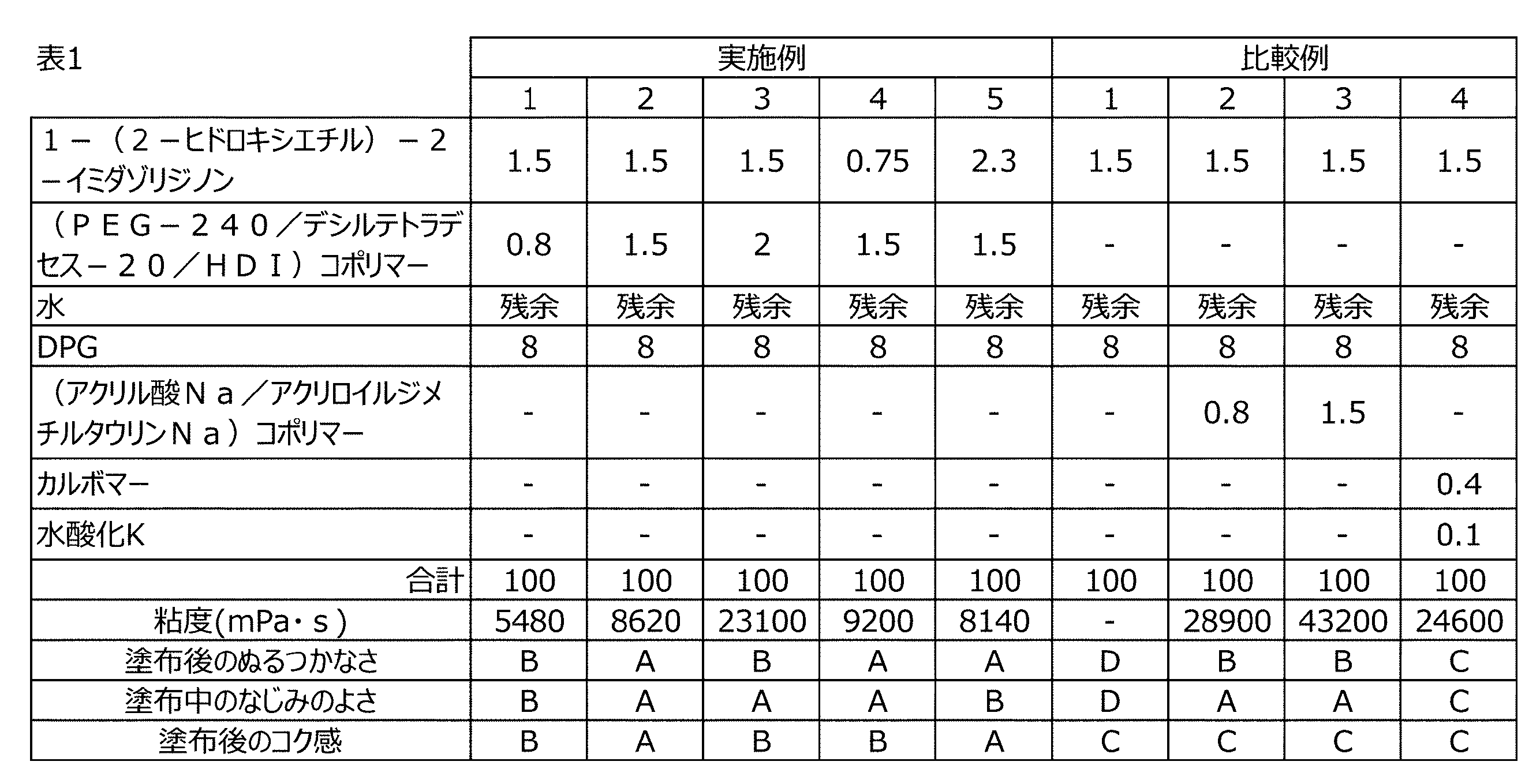
- Examples 1 to 5 and Comparative Examples 1 to 4 Cosmetics of Examples 1 to 5 and Comparative Examples 1 to 4 were prepared with the formulations shown in Table 1. The numerical value of each component in the table indicates % by mass. The viscosities of the obtained cosmetics are shown in Table 1. Viscosity was measured with a Brookfield viscometer (30°C). The viscosity of Comparative Example 1 could not be measured because it was liquid, and was 1,000 mPa ⁇ s or less. The cosmetics of Examples 1 to 5 and Comparative Examples 2 to 4 were gel-like, and the cosmetic of Comparative Example 1 was liquid.
- B 4 or more and 6 or less out of 10 panelists answered that they were familiar with it.
- C 1 or more and 3 or less of the 10 panelists answered that they were familiar with it.
- D All 10 panelists answered that they were familiar with it. [Body feeling after application] A: More than 7 out of 10 panelists answered that there was a rich feeling.
- B 4 or more and 6 or less out of 10 panelists answered that there was a rich feeling.
- C 1 or more and 3 or less out of 10 panelists answered that there was a rich feeling.
- D All 10 panelists answered that the skin lacked richness.
Landscapes
- Health & Medical Sciences (AREA)
- Life Sciences & Earth Sciences (AREA)
- Animal Behavior & Ethology (AREA)
- General Health & Medical Sciences (AREA)
- Public Health (AREA)
- Veterinary Medicine (AREA)
- Birds (AREA)
- Epidemiology (AREA)
- Dermatology (AREA)
- Cosmetics (AREA)
Abstract
Description
[1](A)式(a)で表される環状カルボキサミド誘導体またはその塩

Raは、水酸基で置換されていてもよい炭素数1~6の炭化水素基、または水素原子であり、
Xは、-CH2-または-N(R1)-であり、ここで、R1は、水酸基で置換されていてもよい炭素数1~6の炭化水素基、または水素原子であり、かつ
nは、1~3の整数である)、
(B)疎水変性ポリエーテルウレタン、および
(C)水
を含んでなる化粧料。
[2](A)成分の式(a)において、
Raが、炭素数1~3のヒドロキシアルキル基であり、
Xが、-CH2-または-NH-であり、かつ
nが、1である、[1]に記載の化粧料。
[3](A)成分が、1-(2-ヒドロキシエチル)-2-イミダゾリジノンである、[1]または[2]に記載の化粧料。
[4](A)成分の配合量が、化粧料の総量に対して、0.1~5質量%である、[1]~[3]のいずれかに記載の化粧料。
[5](B)成分が、式(b)で表される、[1]~[4]のいずれかに記載の化粧料。

Rb1は、炭素数2~36のアルキル基であり、
Rb2およびRb4は、それぞれ独立に、フェニルエチレン基または炭素数2~4のアルキレン基であり、
Rb3は、ウレタン結合を有していてもよい炭素数1~10のアルキレン基であり、
Rb5は、炭素数8~36のアルキル基であり、
mは、2以上の数であり、
hは、1以上の数であり、
kは、1~500の数であり、かつ
jは、1~200の数である)
[6](B)成分が、(PEG-240/デシルテトラデセス―20/HDI)コポリマーである、[1]~[5]のいずれかに記載の化粧料。
[7](B)成分の配合量が、化粧料の総量に対して、0.5~2.3質量%である、[1]~[6]のいずれかに記載の化粧料。
[8](B)成分の配合量が、化粧料の総量に対して、0.1~5質量%である、[1]~[6]のいずれかに記載の化粧料。
[9]B型回転粘度計を用いて30℃で測定した粘度が、2,000~80,000mPa・sである、[1]~[8]のいずれかに記載の化粧料。
[10]ジェル化粧料である、[1]~[9]のいずれかに記載の化粧料。
本発明による化粧料は、式(a)で表される環状カルボキサミド誘導体またはその塩(以下、(A)成分と称することがある。他の成分についても同様である。)を含んでなる。

Raは、水酸基で置換されていてもよい炭素数1~6の炭化水素基、または水素原子であり、
Xは、-CH2-または-N(R1)-であり、ここで、R1は、水酸基で置換されていてもよい炭素数1~6の炭化水素基、または水素原子であり、かつ
nは、1~3の整数である。
上記の炭化水素基は、特に限定されず、例えば、アルキル基、シクロアルキル基、アルケニル基、アルキニル基、シクロアルキルアルキル基、ハロアルキル基、アルコキシアルキル基、アルコキシカルボニルアルキル基であってよく、好ましくはアルキル基である。
Raが、炭素数1~3のヒドロキシアルキル基であり、
Xが、-CH2-または-NH-であり、かつ
nが、1である。
式(a)で表される環状カルボキサミド誘導体の具体例としては、例えば、以下が挙げられる。
本発明による化粧料は、(B)疎水変性ポリエーテルウレタンを含んでなる。(B)成分は、会合性増粘剤、会合性高分子ともよばれる化合物である。
好ましい一形態において、(B)成分は、式(b)で表される。

Rb1は、炭素数2~36のアルキル基であり、好ましくは炭素数2~4のアルキル基である。
Rb2およびRb4は、それぞれ独立に、フェニルエチレン基または炭素数2~4のアルキレン基であり、好ましくは炭素数2~4のアルキル基である。
Rb3は、ウレタン結合を有していてもよい炭素数1~10のアルキレン基である。
Rb5は、炭素数8~36のアルキル基であり、好ましくは炭素数12~24のアルキル基である。
mは、2以上の数であり、好ましくは2である。
hは、1以上の数であり、好ましくは1である。
kは、1~500の数であり、好ましくは100~300の数である。
jは、1~200の数であり、好ましくは10~100の数である。
本発明による化粧料は、(C)水を含んでなる。水としては、化粧品、医薬部外品等に使用される水を使用することができ、例えば、精製水、イオン交換水、水道水等を使用することができる。
水の配合量は、本発明による化粧料の総量に対して、好ましくは40~98質量%であり、より好ましくは60~90質量%である。
好ましい一形態において、肌に塗布したときの使用感触に鑑みて、皮膚化粧料として使用される。より好ましくは、本発明による化粧料は、ジェル化粧料である。
本発明による化粧料の粘度は、B型回転粘度計を用いて30℃で測定したときに、好ましくは2,000~80,000mPa・sであり、より好ましくは4,000~20,000mPa・sである。
表1に示される配合で、実施例1~5および比較例1~4の化粧料を調製した。表中の各成分の数値は質量%を示す。
得られた化粧料の粘度は表1のとおりである。粘度はB型粘度計(30℃)で測定した。比較例1の粘度は、液状のため測定できず、1,000mPa・s以下であった。
実施例1~5および比較例2~4の化粧料はジェル状であり、比較例1の化粧料は液状であった。
[塗布後のぬるつかなさ]
A:パネル10名中7名以上がぬるつきがないと回答した。
B:パネル10名中4名以上6名以下がぬるつきがないと回答した。
C:パネル10名中1名以上3名以下がぬるつきがないと回答した。
D:パネル10名全員がぬるつきがあると回答した。
[塗布中のなじみのよさ]
A:パネル10名中7名以上がなじみがよいと回答した。
B:パネル10名中4名以上6名以下がなじみがよいと回答した。
C:パネル10名中1名以上3名以下がなじみがよいと回答した。
D:パネル10名全員がなじみがよいと回答した。
[塗布後のコク感]
A:パネル10名中7名以上がコク感があると回答した。
B:パネル10名中4名以上6名以下がコク感があると回答した。
C:パネル10名中1名以上3名以下がコク感があると回答した。
D:パネル10名全員が肌のコク感に欠けると回答した。
Claims (10)
- (A)式(a)で表される環状カルボキサミド誘導体またはその塩

Raは、水酸基で置換されていてもよい炭素数1~6の炭化水素基、または水素原子であり、
Xは、-CH2-または-N(R1)-であり、ここで、R1は、水酸基で置換されていてもよい炭素数1~6の炭化水素基、または水素原子であり、かつ
nは、1~3の整数である)、
(B)疎水変性ポリエーテルウレタン、および
(C)水
を含んでなる化粧料。 - (A)成分の式(a)において、
Raが、炭素数1~3のヒドロキシアルキル基であり、
Xが、-CH2-または-NH-であり、かつ
nが、1である、請求項1に記載の化粧料。 - (A)成分が、1-(2-ヒドロキシエチル)-2-イミダゾリジノンである、請求項1または2に記載の化粧料。
- (A)成分の配合量が、化粧料の総量に対して、0.1~5質量%である、請求項1または2に記載の化粧料。
- (B)成分が、式(b)で表される、請求項1または2に記載の化粧料。

Rb1は、炭素数2~36のアルキル基であり、
Rb2およびRb4は、それぞれ独立に、フェニルエチレン基または炭素数2~4のアルキレン基であり、
Rb3は、ウレタン結合を有していてもよい炭素数1~10のアルキレン基であり、
Rb5は、炭素数8~36のアルキル基であり、
mは、2以上の数であり、
hは、1以上の数であり、
kは、1~500の数であり、かつ
jは、1~200の数である) - (B)成分が、(PEG-240/デシルテトラデセス―20/HDI)コポリマーである、請求項1または2に記載の化粧料。
- (B)成分の配合量が、化粧料の総量に対して、0.5~2.3質量%である、請求項1または2に記載の化粧料。
- (B)成分の配合量が、化粧料の総量に対して、0.1~5質量%である、請求項1~または2に記載の化粧料。
- B型回転粘度計を用いて30℃で測定した粘度が、2,000~80,000mPa・sである、請求項1または2に記載の化粧料。
- ジェル化粧料である、請求項1または2に記載の化粧料。
Priority Applications (2)
| Application Number | Priority Date | Filing Date | Title |
|---|---|---|---|
| CN202280073325.5A CN118201590A (zh) | 2021-12-03 | 2022-11-18 | 化妆品 |
| JP2023564881A JPWO2023100682A1 (ja) | 2021-12-03 | 2022-11-18 |
Applications Claiming Priority (2)
| Application Number | Priority Date | Filing Date | Title |
|---|---|---|---|
| JP2021-196753 | 2021-12-03 | ||
| JP2021196753 | 2021-12-03 |
Publications (1)
| Publication Number | Publication Date |
|---|---|
| WO2023100682A1 true WO2023100682A1 (ja) | 2023-06-08 |
Family
ID=86612094
Family Applications (1)
| Application Number | Title | Priority Date | Filing Date |
|---|---|---|---|
| PCT/JP2022/042808 Ceased WO2023100682A1 (ja) | 2021-12-03 | 2022-11-18 | 化粧料 |
Country Status (3)
| Country | Link |
|---|---|
| JP (1) | JPWO2023100682A1 (ja) |
| CN (1) | CN118201590A (ja) |
| WO (1) | WO2023100682A1 (ja) |
Citations (4)
| Publication number | Priority date | Publication date | Assignee | Title |
|---|---|---|---|---|
| WO2011040496A1 (ja) * | 2009-09-30 | 2011-04-07 | 株式会社資生堂 | ヘパラナーゼ活性阻害剤 |
| JP2012067024A (ja) * | 2010-09-22 | 2012-04-05 | Shiseido Co Ltd | 皮膚外用剤 |
| JP2019014709A (ja) * | 2017-07-07 | 2019-01-31 | ポーラ化成工業株式会社 | 皮膚外用組成物 |
| JP2021172610A (ja) * | 2020-04-24 | 2021-11-01 | 株式会社 資生堂 | 化粧料 |
-
2022
- 2022-11-18 WO PCT/JP2022/042808 patent/WO2023100682A1/ja not_active Ceased
- 2022-11-18 CN CN202280073325.5A patent/CN118201590A/zh active Pending
- 2022-11-18 JP JP2023564881A patent/JPWO2023100682A1/ja active Pending
Patent Citations (4)
| Publication number | Priority date | Publication date | Assignee | Title |
|---|---|---|---|---|
| WO2011040496A1 (ja) * | 2009-09-30 | 2011-04-07 | 株式会社資生堂 | ヘパラナーゼ活性阻害剤 |
| JP2012067024A (ja) * | 2010-09-22 | 2012-04-05 | Shiseido Co Ltd | 皮膚外用剤 |
| JP2019014709A (ja) * | 2017-07-07 | 2019-01-31 | ポーラ化成工業株式会社 | 皮膚外用組成物 |
| JP2021172610A (ja) * | 2020-04-24 | 2021-11-01 | 株式会社 資生堂 | 化粧料 |
Also Published As
| Publication number | Publication date |
|---|---|
| CN118201590A (zh) | 2024-06-14 |
| JPWO2023100682A1 (ja) | 2023-06-08 |
Similar Documents
| Publication | Publication Date | Title |
|---|---|---|
| JP4608584B1 (ja) | 皮膚外用剤 | |
| JP2008231010A (ja) | 皮膚外用剤 | |
| EP2474296A1 (en) | Method for producing o/w emulsion composition | |
| JPH1053510A (ja) | 外用組成物 | |
| JP7608217B2 (ja) | 皮膚外用組成物 | |
| KR100826503B1 (ko) | 피부 외용제 | |
| JP4601031B2 (ja) | W/o/w型乳化化粧料 | |
| EP2082729A1 (en) | External preparation for skin and cleansing agent for skin | |
| JP2025124783A (ja) | 水中油型乳化化粧料 | |
| JP5305574B2 (ja) | 皮膚外用剤 | |
| WO2023068065A1 (ja) | 油中水型乳化化粧料 | |
| JP2018123067A (ja) | 水中油型化粧料 | |
| JP2005281133A (ja) | 皮膚外用剤 | |
| JP7821035B2 (ja) | 水中油型乳化化粧料 | |
| JP2005281135A (ja) | 皮膚外用剤 | |
| WO2021215423A1 (ja) | 化粧料 | |
| US20250000768A1 (en) | Oil-in-water emulsion cosmetic | |
| WO2023047979A1 (ja) | 水中油型乳化化粧料 | |
| JP2000178124A (ja) | ボディー化粧料 | |
| JP2022548683A (ja) | 高オイル含有量のゲル組成物、その調製方法及び使用 | |
| JP7663564B2 (ja) | 化粧料 | |
| WO2023063106A1 (ja) | 化粧料 | |
| JP7811836B2 (ja) | 水中油型乳化化粧料 | |
| JP7800831B2 (ja) | ハイドロキノン含有皮膚外用剤および該ハイドロキノン含有皮膚外用剤の製造方法 | |
| CN118201590A (zh) | 化妆品 |
Legal Events
| Date | Code | Title | Description |
|---|---|---|---|
| 121 | Ep: the epo has been informed by wipo that ep was designated in this application |
Ref document number: 22901115 Country of ref document: EP Kind code of ref document: A1 |
|
| WWE | Wipo information: entry into national phase |
Ref document number: 202280073325.5 Country of ref document: CN |
|
| ENP | Entry into the national phase |
Ref document number: 2023564881 Country of ref document: JP Kind code of ref document: A |
|
| NENP | Non-entry into the national phase |
Ref country code: DE |
|
| 122 | Ep: pct application non-entry in european phase |
Ref document number: 22901115 Country of ref document: EP Kind code of ref document: A1 |