WO2023100315A1 - 決定装置、決定方法、記録媒体 - Google Patents
決定装置、決定方法、記録媒体 Download PDFInfo
- Publication number
- WO2023100315A1 WO2023100315A1 PCT/JP2021/044259 JP2021044259W WO2023100315A1 WO 2023100315 A1 WO2023100315 A1 WO 2023100315A1 JP 2021044259 W JP2021044259 W JP 2021044259W WO 2023100315 A1 WO2023100315 A1 WO 2023100315A1
- Authority
- WO
- WIPO (PCT)
- Prior art keywords
- evaluation
- data
- evaluation period
- period
- relationship
- Prior art date
- Legal status (The legal status is an assumption and is not a legal conclusion. Google has not performed a legal analysis and makes no representation as to the accuracy of the status listed.)
- Ceased
Links
Images




Classifications
-
- G—PHYSICS
- G06—COMPUTING OR CALCULATING; COUNTING
- G06Q—INFORMATION AND COMMUNICATION TECHNOLOGY [ICT] SPECIALLY ADAPTED FOR ADMINISTRATIVE, COMMERCIAL, FINANCIAL, MANAGERIAL OR SUPERVISORY PURPOSES; SYSTEMS OR METHODS SPECIALLY ADAPTED FOR ADMINISTRATIVE, COMMERCIAL, FINANCIAL, MANAGERIAL OR SUPERVISORY PURPOSES, NOT OTHERWISE PROVIDED FOR
- G06Q10/00—Administration; Management
- G06Q10/02—Reservations, e.g. for tickets, services or events
-
- G—PHYSICS
- G06—COMPUTING OR CALCULATING; COUNTING
- G06Q—INFORMATION AND COMMUNICATION TECHNOLOGY [ICT] SPECIALLY ADAPTED FOR ADMINISTRATIVE, COMMERCIAL, FINANCIAL, MANAGERIAL OR SUPERVISORY PURPOSES; SYSTEMS OR METHODS SPECIALLY ADAPTED FOR ADMINISTRATIVE, COMMERCIAL, FINANCIAL, MANAGERIAL OR SUPERVISORY PURPOSES, NOT OTHERWISE PROVIDED FOR
- G06Q10/00—Administration; Management
- G06Q10/06—Resources, workflows, human or project management; Enterprise or organisation planning; Enterprise or organisation modelling
-
- G—PHYSICS
- G06—COMPUTING OR CALCULATING; COUNTING
- G06Q—INFORMATION AND COMMUNICATION TECHNOLOGY [ICT] SPECIALLY ADAPTED FOR ADMINISTRATIVE, COMMERCIAL, FINANCIAL, MANAGERIAL OR SUPERVISORY PURPOSES; SYSTEMS OR METHODS SPECIALLY ADAPTED FOR ADMINISTRATIVE, COMMERCIAL, FINANCIAL, MANAGERIAL OR SUPERVISORY PURPOSES, NOT OTHERWISE PROVIDED FOR
- G06Q30/00—Commerce
- G06Q30/02—Marketing; Price estimation or determination; Fundraising
-
- G—PHYSICS
- G06—COMPUTING OR CALCULATING; COUNTING
- G06Q—INFORMATION AND COMMUNICATION TECHNOLOGY [ICT] SPECIALLY ADAPTED FOR ADMINISTRATIVE, COMMERCIAL, FINANCIAL, MANAGERIAL OR SUPERVISORY PURPOSES; SYSTEMS OR METHODS SPECIALLY ADAPTED FOR ADMINISTRATIVE, COMMERCIAL, FINANCIAL, MANAGERIAL OR SUPERVISORY PURPOSES, NOT OTHERWISE PROVIDED FOR
- G06Q30/00—Commerce
- G06Q30/02—Marketing; Price estimation or determination; Fundraising
- G06Q30/0201—Market modelling; Market analysis; Collecting market data
- G06Q30/0206—Price or cost determination based on market factors
-
- G—PHYSICS
- G06—COMPUTING OR CALCULATING; COUNTING
- G06Q—INFORMATION AND COMMUNICATION TECHNOLOGY [ICT] SPECIALLY ADAPTED FOR ADMINISTRATIVE, COMMERCIAL, FINANCIAL, MANAGERIAL OR SUPERVISORY PURPOSES; SYSTEMS OR METHODS SPECIALLY ADAPTED FOR ADMINISTRATIVE, COMMERCIAL, FINANCIAL, MANAGERIAL OR SUPERVISORY PURPOSES, NOT OTHERWISE PROVIDED FOR
- G06Q30/00—Commerce
- G06Q30/02—Marketing; Price estimation or determination; Fundraising
- G06Q30/0283—Price estimation or determination
-
- G—PHYSICS
- G06—COMPUTING OR CALCULATING; COUNTING
- G06Q—INFORMATION AND COMMUNICATION TECHNOLOGY [ICT] SPECIALLY ADAPTED FOR ADMINISTRATIVE, COMMERCIAL, FINANCIAL, MANAGERIAL OR SUPERVISORY PURPOSES; SYSTEMS OR METHODS SPECIALLY ADAPTED FOR ADMINISTRATIVE, COMMERCIAL, FINANCIAL, MANAGERIAL OR SUPERVISORY PURPOSES, NOT OTHERWISE PROVIDED FOR
- G06Q50/00—Information and communication technology [ICT] specially adapted for implementation of business processes of specific business sectors, e.g. utilities or tourism
- G06Q50/40—Business processes related to the transportation industry
Definitions
- the present invention relates to a decision device and the like that can improve various efficiencies such as control efficiency and cost performance.
- Patent Document 1 discloses technology for a system that predicts demand from the time transition of the number of reservations for services and a system that determines prices based on the demand prediction. Further, Patent Document 2 discloses a technology of a method of predicting demand based on the price of inventory with a time limit.
- Cited Document 1 Even if the technology described in Cited Document 1 and the technology described in Cited Document 2 are used, for example, a price is determined that increases the evaluation index such as remuneration for a certain period of time. is difficult. The reason for this is that these techniques do not evaluate over a period of time.
- one of the objects of the present invention is to provide a decision device, a seat reservation device, a transaction control device, an advertisement control device, a navigation device, a control device, a decision method, and a recording device that can improve efficiency such as control efficiency and cost performance. It is to provide media, etc.
- the determination device converts the second data in the evaluation period from the first data in the evaluation period based on the relationship model representing the relationship between the first data and the second data.
- the determination method is such that the computer performs from the first data in the evaluation period to the first data in the evaluation period based on a relationship model representing the relationship between the first data and the second data. calculating two data, calculating an evaluation value for the evaluation period using an evaluation model including the second data as a parameter, and the calculated second data in the evaluation period, and calculating the evaluation value determining the first data during the evaluation period when .
- the recording medium converts the second data in the evaluation period from the first data in the evaluation period based on the relationship model representing the relationship between the first data and the second data. calculating an evaluation value for the evaluation period using the evaluation model that includes the second data as a parameter and the calculated second data in the evaluation period, and the calculated evaluation value increases.
- a program is stored that causes a computer to perform the function of determining first data in said evaluation period of time.
- FIG. 4 is a flow chart showing the flow of processing in the determination device according to the first embodiment; 4 is a flow chart showing the flow of processing in the determination device according to the first embodiment; It is a block diagram which shows the structure which the seat reservation apparatus which concerns on 2nd Embodiment has.
- FIG. 2 conceptually illustrates an example of applying a decision device to aircraft seat reservations.
- It is a block diagram which shows the structure which the transaction control apparatus which concerns on 3rd Embodiment has.
- FIG. 11 is a block diagram showing the configuration of a navigation device according to a fifth embodiment; FIG. FIG.
- FIG. 12 is a block diagram showing the configuration of a control device according to a sixth embodiment.
- FIG. It is a block diagram which shows roughly the hardware structural example of the calculation processing apparatus which can implement
- FIG. 1 is a block diagram showing the configuration of a determining device 1 according to the first embodiment of the present invention.
- the determination device 1 according to the first embodiment has a calculation unit 11 , an evaluation unit 12 and a determination unit 13 .
- the determining device 1 may further include a creating unit 14 and an updating unit 15 .
- the decision device 1 may be connected to, for example, the control device 2, the display device 3, or the like. Alternatively, the determination device 1 may have a component that implements the functions of the control device 2 or the functions of the display device 3 .
- the determination device 1 uses a relationship model representing the relationship between the first data and the second data to perform processing as described in detail with reference to FIGS. 2 and 3, thereby improving control efficiency and cost performance. Determine data that can improve efficiency, such as
- the first data represents the price when reserving an airplane seat.
- Second data represents the amount of demand that would occur for the reservation given the price.
- the first data may represent business partners who trade commodities.
- the second data may represent the quantity demanded by the trading partner.
- the first data may represent, for example, advertisements displayed over the communication network.
- the second data may represent the rate at which the advertisement is viewed (or click rate).
- the first data may represent routes for transporting products.
- the second data may represent the required time (or travel time, etc.) for transportation on the route.
- the first data may represent the generator when power is obtained using the generator.
- the second data may represent power consumption when power is obtained using the generator.
- a relationship model represents the relationship between the first data and the second data.
- a relational model is realized by, for example, regression analysis, machine learning (for example, neural network, support vector machine), or the like.
- the relationship model may have a plurality of parameters determined by regression analysis, and may be represented by an ensemble of the parameters.
- a relationship model is, for example, a demand model that expresses the relationship between price and quantity demanded, as shown in the example of the second embodiment.
- the relationship model may be, for example, a demand model representing the relationship between the customer and the amount of demand from the customer, as shown in the example of the third embodiment.
- the relationship model may be, for example, a rate model representing the relationship between advertisements and the rate at which they are viewed, as shown in the example of the fourth embodiment.
- the relationship model may be, for example, a travel time model representing the relationship between the route and the travel time on the route, as shown in the example of the fifth embodiment.
- the relationship model may be, for example, a power model representing the relationship between the generator and the power consumed by the generator, as shown in the example of the sixth embodiment.
- FIG. 2 is a flow chart showing the flow of processing in the determination device 1 according to the first embodiment.
- the calculation unit 11 calculates the second data in the evaluation period from the first data in the evaluation period based on the relationship model representing the relationship between the first data and the second data as described above (step S101). .
- the calculation unit 11 calculates the second data in the evaluation period, for example, by applying the process representing the relationship to the first data in the evaluation period.
- the evaluation unit 12 calculates the evaluation value for the evaluation period using the evaluation model including the second data as a parameter and the calculated second data for the evaluation period (step S102).
- the evaluation unit 12 calculates the evaluation value for the evaluation period by, for example, applying the process indicated by the evaluation model to the second data in the calculated evaluation period.
- the evaluation model represents, for example, a process of calculating an evaluation value representing the degree of desirability (or desirability) as described later in the second to sixth embodiments.
- the evaluation model represents, for example, profit (reward, revenue) during the evaluation period.
- the evaluation model represents, for example, demand during the evaluation period.
- the determination unit 13 determines the first data in the evaluation period when the calculated evaluation value increases (step S103).
- the determining unit 13 determines the first data such that the value calculated according to the evaluation model (for example, the objective function) increases, as illustrated in the second embodiment.
- This processing can be realized, for example, by a method of finding a solution to an optimization problem with constraints, or a method of sequentially searching the first data when the objective function increases.
- the determining unit 13 may determine the first data in the evaluation period when the constraint condition including the second data in the evaluation period as a parameter is satisfied and the evaluation value increases.
- the constraint is, for example, the condition that the number of reservations during the evaluation period is less than or equal to the remaining amount, as shown in the example of the second embodiment.
- the constraint condition may be, for example, the condition that the demand amount of the product during the evaluation period is equal to or less than the inventory amount of the product, as shown in the example of the third embodiment.
- the constraint condition may be, for example, a condition that the time during which the advertisement is displayed in the evaluation period is equal to or less than a reference value, as shown in the example of the fourth embodiment.
- the constraint may be, for example, a condition that the time required to move the evaluation period is less than or equal to a reference value, as shown in the example of the fifth embodiment.
- the constraint may be, for example, the condition that the total power consumption of the generator during the evaluation period is equal to or less than the reference value, as shown in the example of the sixth embodiment.
- the control device 2 receives the first data and performs control according to the received first data.
- the control device 2 controls, for example, a system that controls objects to be controlled such as a plurality of generators, as shown in the example of the sixth embodiment.
- the control device 2 controls, for example, power to be obtained from the generator represented by the received first data.
- the object to be controlled may be, for example, a robot, a manufacturing machine, an automatic guided vehicle, a truck, or a construction heavy machine.
- the display device 3 may display the determined first data on the display.
- the display device 3 is, for example, a system for reserving seats, as shown in the example of the second embodiment. In this case, the display device 3 displays the determined first data on the display of the seat reservation system.
- the display device 3 may be, for example, a system for displaying advertisements, as shown in the example of the fourth embodiment.
- the display device 3 displays the determined first data, for example, on the right side of the browser.
- the determining device 1 calculates the evaluation value for the evaluation period using the relationship model.
- the decision device 1 may also create a relationship model. The process of creating a relationship model will be explained.
- the creating unit 14 inputs a data set in which the first data and the second data are associated.
- the creating unit 14 creates the relationship model that fits the data set.
- the creation unit 14 applies, for example, regression analysis, machine learning (for example, neural network, support vector machine), etc. to the input data set, so that between the first data and the second data Create a relationship model that represents the relationship between
- the calculation unit 11 uses the relationship model created by the creation unit 14 to perform the processing described above with reference to FIG.
- the update unit 15 acquires second data for the first data determined by the determination unit 13, and executes the same processing as the creation unit 14 on the first data and the acquired second data, A relationship model representing relationships between the first data and the second data may be created.
- the calculation unit 11 uses the relationship model created by the update unit 15 to perform the processing described above with reference to FIG. Therefore, it can be said that the updating unit 15 acquires the second data corresponding to the first data determined by the determining unit 13, and uses the acquired second data to update the relationship model.
- the relationship between the first data and the second data may be, for example, the relationship regarding the first period.
- the first period includes timings before each timing in the evaluation period.
- the determination device 1 calculates the evaluation value for the evaluation period using the relationship model.
- FIG. 3 is a flow chart showing the flow of processing in the determination device 1 according to the first embodiment.
- the calculation unit 11 uses a data set including a plurality of sets in which first data and second data are associated, and calculates a relationship model so as to fit the data set (step S201). In this case, the calculator 11 calculates the relationship model based on the distribution (or probability distribution) of the second data.
- the data set is, for example, a data set in which a price is associated with a quantity demanded at that price, as will be described later in the second embodiment.
- the data set may include a set for each timing in the first time period.
- the length of a plurality of periods is You can create a data set by aligning them.
- the data set includes a set in which first data (for example, price) and second data (for example, quantity demanded) are associated with each timing in the period.
- the evaluation unit 12 acquires the first data and the likelihood of occurrence of the first data (step S202). This likelihood of occurrence is determined so that the evaluation value increases in the processing of steps S202 to S205.
- the probability of occurrence may represent a probability or may be a value calculated from the probability.
- the evaluation unit 12 may determine a plurality of first data and the likelihood of occurrence of each first data.
- the first data may be selected from the first data set.
- the first dataset may be a given dataset or a dataset extracted from a relational model.
- the evaluation unit 12 calculates second data for the first data using a first data set including a plurality of first data and the relationship model (step S203).
- the evaluation unit 12 uses the evaluation model including the second data as a parameter, the probability of occurrence of the first data, and the calculated second data in the evaluation period to obtain the evaluation value for the evaluation period. is calculated (step S204).
- the evaluation model is similar to the model described above, and represents a process of calculating an evaluation value representing the degree of desirability (or likeability).
- the evaluation model represents, for example, a process as described below with reference to equation (3).
- the determining unit 13 determines the first data and the likelihood of occurrence during the evaluation period when the calculated evaluation value increases (step S205).
- the determining unit 13 may output the determined first data to an external device such as the control device 2 or the display device 3 .
- the relationship model may be created by the creating unit 14 and updated by the updating unit 15 .
- the relational model may also be, for example, second data to first data for a first time period. In this case, the first period includes timings before each timing in the evaluation period.
- Patent Documents 1 and 2 predict demand, but cannot evaluate an evaluation model that includes the demand as a parameter.
- the determination device 1 according to the first embodiment in accordance with the processing described above with reference to FIGS. determine the first data of Therefore, according to the decision device 1 according to the first embodiment, efficiency such as control efficiency and cost performance can be improved.
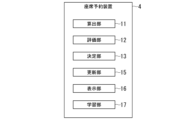
- FIG. 4 is a block diagram showing the configuration of the seat reservation device 4 according to the second embodiment of the invention.
- a seat reservation device 4 according to the second embodiment has a calculation unit 11 , an evaluation unit 12 , a determination unit 13 and a display unit 16 .
- the seat reservation device 4 may have a learning section 17 and an updating section 15 .
- the calculation unit 11 has functions similar to those of the calculation unit 11 as described above with reference to FIG.
- the evaluation unit 12 has functions similar to those of the evaluation unit 12 as described above with reference to FIG.
- the determination unit 13 has functions similar to those of the determination unit 13 as described above with reference to FIG.
- the display unit 16 has functions similar to those of the display device 3 as described above with reference to FIG.
- the learning unit 17 has functions similar to those of the learning unit 17 as described above with reference to FIG.
- the updating unit 15 has functions similar to those of the updating unit 15 as described above with reference to FIG. Therefore, the seat reservation device 4 has functions similar to those of the determination device 1 as described above with reference to FIG.
- FIG. 5 is a diagram conceptually showing an example in which the determination device 1 is applied to aircraft seat reservations.
- a seat reservation for an aircraft can be made in a period from the timing at which the reservation is started (hereinafter referred to as "start timing") to the timing at which the reservation is terminated (hereinafter referred to as "end timing T").
- the end timing T is, for example, the timing when the number of reservations equals the number of seats, or the timing just before the aircraft takes off. In the following description, for convenience of explanation, the end timing T is assumed to be the timing immediately before the aircraft takes off.
- a period from the start timing to the end timing is referred to as a “sales period”.
- the price of a seat reservation fluctuates depending on, for example, the type of seat and the length of the period from the timing of reservation (hereinafter referred to as timing t) to the end timing T (hereinafter referred to as "remaining period"). do.
- the price is set lower when the remaining period is 30 days or more than when the remaining period is less than 30 days.
- a period from the start timing to the timing 30 days before take-off is referred to as a “discount period”.
- a period from the timing 29 days before takeoff to the end timing T is referred to as a “normal period”.
- the price during the discount period is referred to as "discount price”.
- the price during the regular period is referred to as the "regular price”.
- the difference between the number of seats on an aircraft and the number of reserved seats is referred to as "remaining capacity.”
- the remaining amount at timing t is expressed as n(t).
- the amount of demand during the discount period is assumed to be greater than the amount of demand during the normal period. This indicates that there are many requests to reserve seats at low prices before seat reservations are completed. Even in the normal period, it is assumed that the amount of demand is higher near the end timing T (for example, two days before the end timing T, one day before the end timing T) than other periods in the normal period. In this case, the total sales amount (hereafter referred to as "total sales amount”) is better when the price is set according to the increase or decrease in demand, rather than when the price is set in two stages, a discount price and a regular price. ) may increase. Therefore, in order to increase the total sales amount (or maximize the total sales amount), for example, it is necessary to appropriately set the price in consideration of changes in demand.
- total sales amount or maximize the total sales amount
- Demand quantity D(t, p(t)) is related to, for example, timing t and price p(t) at timing t. That is, timing t, price p(t), and quantity demanded have a relationship.
- the quantity demanded when the price is the price p(t) at timing t is expressed as "D(t, p(t)))".
- a model representing the relationship is represented as "demand model ⁇ ". Therefore, in this case, the quantity demanded ⁇ (t, p) is calculated by applying the demand model ⁇ to the timing t and the price p(t). It can also be said that the price p(t) is a parameter related to the quantity demanded.
- the demand model ⁇ can also be said to be a bivariate function of timing t and price p at timing t.
- Information about the demand model ⁇ may be stored in a storage unit (not shown).
- processing procedure information representing the demand model ⁇ may be stored in a storage unit (not shown).
- the seat reservation device 4 may determine parameters in the demand model ⁇ using training data as described later.
- the sales period is an example of the evaluation period described above in the first embodiment.
- a price for reserving an airplane seat is an example of the first data described above in the first embodiment.
- the demand amount is an example of the second data described above in the first embodiment.
- the demand model is an example of the relationship model described in the first embodiment, and the process of calculating the total sales amount is an example of the evaluation model described in the first embodiment.
- the determination unit 13 in the seat reservation device 4 finds a solution to the problem that maximizes the objective function representing the total sales amount (or the expected value of the total sales amount) while satisfying the following constraint conditions: determine the price.
- Constraint condition the total demand amount in the remaining period (that is, the sum of ⁇ (t', p) for each timing t' in the remaining period) is less than or equal to the remaining amount n(t). That is, it is not possible to reserve more seats during the remaining period than the number of seats remaining at timing t.
- the seat reservation device 4 calculates a solution to the problem of finding the price when the expected value of the total sales amount increases while satisfying the above constraints.
- the solution may be an optimum solution that maximizes the objective function under the constraint conditions, or may be an output when a predetermined calculation termination condition is satisfied in the solution-finding process.
- optimization problem such a problem
- optical solution Values such as mean, median, etc. are collectively referred to as "average.”
- the determining unit 13 obtains the price p(t) when the expected value of the total sales amount is the maximum.
- the determining unit 13 may obtain the price p(t) when the expected value of the total sales increases. In other words, the determination unit 13 obtains a solution to the optimization problem as described above with reference to the objective function. Details of the processing of the seat reservation device 4 will be described below.
- the learning unit 17 uses the first data set (for example, the price and the corresponding A data set associated with the distribution of quantity demanded against price) is used to determine a demand model ⁇ that calculates the quantity demanded ⁇ (t,p) to fit the first data set.
- the demand model ⁇ represents the relationship between the price p and the quantity demanded (or mean, median, etc.) of the quantity demanded for the price p.
- the evaluation unit 12 uses the first data set exemplified by the formula (1) to calculate the total sales amount by executing the processing shown by the formula (3) and the like.
- a first data set (hereafter referred to as a “price set”) P for prices at timing t is, for example, a set like Equation (1).
- K represents the number of prices.
- the first data set for example, the price set
- the first data set is common at the timings described below with reference to equation (2).
- the number of elements in the first data set and the element values p i may change.
- a price set may contain multiple prices for each timing.
- a timing set T (hereinafter referred to as a "timing set”) can be expressed as in Equation (2).
- the timing set includes multiple timings as elements.
- a timing set includes, for example, each timing in a period from the start timing to the end timing.
- the learning unit 17 estimates the demand model ⁇ using training data including the demand amount (or the average demand amount) at each timing, the timing, and the price set at the timing.
- the quantity demanded may be the actual data measured against the price or the data calculated by the process of estimating the quantity demanded.
- the learning unit 17 may calculate the demand model ⁇ by, for example, determining the parameters of a curved surface (or curve, plane, straight line) that fits the training data (hereinafter referred to as “regression analysis”). .
- the parameter may be a single fixed value or an ensemble of multiple values.
- the learning unit 17 may use a machine learning algorithm such as a neural network or a support vector machine to calculate the demand model ⁇ that fits the training data.
- the learning unit 17 may obtain the relationship between the price and the quantity demanded at each timing. When there are multiple prices at each timing, the learning unit 17 may calculate demand for each price.
- FIG. 5 is a flow chart showing the flow of processing in the seat reservation device 4 according to the second embodiment.
- the calculator 11 acquires the demand model ⁇ .
- the demand model ⁇ may be given or created by the learning unit 17 .
- the demand model ⁇ represents the relationship between the price p and the quantity demanded for the price p.
- the calculator 11 calculates the price p and the likelihood of the price p occurring.
- the calculator 11 may, for example, select the price p from the price set exemplified in Equation (1).
- Price p and the likelihood that price p will occur are updated to increase the total sales in the remaining period, as described below with reference to equation (3).
- the calculation unit 11 calculates the demand amount when the price is p at the timing t, using the price p at the timing t within the evaluation period and the demand model ⁇ .
- the evaluation period may be after the first period, or may overlap with the first period. Alternatively, the evaluation period may be the same period as the first period. In this case, it can be said that the calculation unit 11 calculates the demand amount in the evaluation period using the demand model ⁇ in the first period.
- the first period and the evaluation period may be two of the repeated periods.
- the timing set in the evaluation period has timing 1 and timing 2 .
- the evaluation period is, for example, the remaining period.
- the calculation unit 11 determines the price and the likelihood of the price occurring for each timing, as shown below. (1, p 1 (1), x 1 (1)), (1, p 2 (1), x 2 (1)), (2, p 1 (2), x 1 (2)), (2 , p 2 (2), x 2 (2))
- the likelihood of price p 1 (1) occurring is x 1 (1).
- the likelihood of occurrence of price p 2 (1) is x 2 (1).
- the likelihood of price p 1 (2) occurring is x 1 (2).
- the likelihood of price p 2 (2) occurring is x 2 (2).
- the evaluation unit 12 uses the demand model ⁇ to calculate the quantity demanded for each price. For example, the evaluation unit 12 uses the demand model ⁇ to calculate the quantity demanded ⁇ (1, p 1 (1)) for the price p 1 (1). The evaluation unit 12 uses the demand model ⁇ to calculate the quantity demanded ⁇ (1, p 2 (1)) for the price p 2 (1). The evaluation unit 12 uses the demand model ⁇ to calculate the quantity demanded ⁇ (2, p 1 (2)) for the price p 1 (2). The evaluation unit 12 uses the demand model ⁇ to calculate the quantity demanded ⁇ (2, p 2 (2)) for the price p 2 (2).
- the evaluation unit 12 finds the expected value of the total sales amount in the remaining period according to the processing procedure (hereinafter referred to as "remuneration model") exemplified in formula (3).
- the processing procedure for calculating the expected value of the total sales amount is an example of the evaluation model. It can also be said that the processing procedure exemplified in equation (3) is a processing procedure for obtaining the expected value of the total sales amount in the remaining period.
- ⁇ represents the process of calculating the sum.
- p k represents one member of the price set P illustrated in equation (1).
- t' represents one element in the timing set illustrated in equation (2).
- ⁇ (t′, p k ) indicates the quantity demanded at timing t′ and price p k using the demand model ⁇ .
- x k (t) represents the likelihood of the k-th price p k occurring at time t.
- Equation (3) “p k ⁇ (t′, p k )” represents processing for calculating the total sales amount at timing t. Therefore, the left side of equation (3) represents the expected value of the total sales amount in the remaining period.
- E P(t) [P(t′) ⁇ (t′, P(t′)] represents the expected value of total sales given timing t′ and price p k
- the evaluation unit 12 calculates total sales according to the following processing, for example. Calculate the expected value of the amount. ⁇ ij p i ⁇ (j, p i ) ⁇ x i (j) However, ⁇ ij represents the process of calculating the sum of i and j.
- the determining unit 13 selects the price and , and the likelihood of occurrence when the price occurs. That is, the determination unit 13 calculates the expected value of the total sales amount according to the processing shown in Equation (3) under the constraint conditions, and the price that increases the calculated expected value and the price The likelihood of occurrence is determined.
- the constraint expresses the condition that it is not possible to reserve more seats than the remaining amount during the remaining period. That is, the constraint condition expresses the condition that the statistical value (for example, average value) of the demand amount ⁇ (t′, P(t′)) during the remaining period is equal to or less than the remaining amount n(t) at timing t′. .
- the determining unit 13 can execute the process of calculating the expected value of the demand amount (the number of reserved seats in this example) under the constraint conditions according to the processes shown in the following formulas (4) to (6). can.
- Equation (4) The processing shown on the left side of Equation (4) can also be expressed, for example, as follows. ⁇ _i ⁇ _j ⁇ (j, p i ) ⁇ x i (j)
- the evaluation unit 12 obtains the expected value of the total sales amount according to the processing shown in formula (3). Then, the determining unit 13 determines the price and the likelihood of occurrence of the price so that the expected value of the total sales amount increases. The determining unit 13 may determine, for example, the price and the likelihood of the price occurring when the expected value of the total sales amount is the maximum.
- the determining unit 13 may output the calculated price to an external device such as the display device 3 or the control device 2, for example.
- the determination unit 13 may output information representing the price to a system such as an electronic commerce system or a network auction system. The system receives information representing the price and presents the price represented by the received information.
- a system such as an electronic commerce system or a network auction system is assumed to have a measuring instrument (sensor) that measures the quantity demanded according to the price.
- the sensor measures the quantity demanded according to the price.
- the sensor measures the quantity demanded for the price at the timing t, which is calculated by the determining unit 13, for example.
- the update unit 15 acquires the demand amount d(t) measured by the sensor.
- the quantity demanded d(t) represents the quantity demanded for the price at timing t.
- the update unit 15 updates the demand model ⁇ using the set of (t, P(t), d(t)) at timing t.
- the updating unit 15 presents the price p1 at the timing t1 to the system and obtains the demand quantity d1 for the price p1 from the sensor.
- the update unit 15 updates, for example, the average demand for each price using the acquired demand quantity.
- the updating unit 15 updates the average demand quantity by calculating the average of the plurality of demand quantities. This process can also be said to be a process in which the update unit 15 updates the demand model ⁇ to fit the demand using the demand acquired from the sensor.
- the actual demand for the price is obtained, and the demand model ⁇ is updated according to the obtained demand. Future good data relationships can be estimated.
- the processing of the determination device 1 has been described with reference to an example of calculating the objective function and constraint conditions without using the demand model ⁇ .
- the calculation unit 11 may perform the same processing as described above using the acquired demand model ⁇ .
- the process of calculating the expected value of the total sales amount as exemplified in formula (3) is performed by executing the processes shown in the following steps A and B for each timing in the remaining period, and calculating It may also be a process of calculating the total sales amount (that is, a process of obtaining the total sales amount).
- Step A Apply the demand model ⁇ to the timing in the remaining period and the price at the timing. That is, the quantity demanded is calculated for the price at that timing.
- Step B The sales amount is obtained by multiplying the calculated demand amount by the price.
- the learning unit 17 may determine parameters in the process of calculating the demand model ⁇ so as to fit the training data.
- the determining device 1 may perform the same processing as described above with reference to steps A and B using the obtained demand model ⁇ .
- the seat reservation device 4 according to the second embodiment effects of the seat reservation device 4 according to the second embodiment of the present invention will be described.
- efficiency such as control efficiency and cost performance can be improved.
- the reason for this is the same as the reason explained in the first embodiment.
- a third embodiment of the present invention based on the first embodiment described above will be described.
- products are delivered from a collection and delivery center that manages the purchase of products to each business partner (for example, a store, a convenience store, a sales agent, etc.), and the business partner It represents an example of selling the product.
- business partner for example, a store, a convenience store, a sales agent, etc.
- FIG. 6 is a block diagram showing the configuration of transaction control device 5 according to the third embodiment of the present invention.
- a transaction control device 5 according to the third embodiment has a calculation unit 11 , an evaluation unit 12 , a determination unit 13 and a control unit 18 .
- the transaction control device 5 may have a learning section 17 and an updating section 15 .
- the calculation unit 11 has functions similar to those of the calculation unit 11 as described above with reference to FIG.
- the evaluation unit 12 has functions similar to those of the evaluation unit 12 as described above with reference to FIG.
- the determination unit 13 has functions similar to those of the determination unit 13 as described above with reference to FIG.
- the learning unit 17 has functions similar to those of the learning unit 17 as described above with reference to FIG.
- the control unit 18 has functions similar to those of the control device 2 as described above with reference to FIG.
- the updating unit 15 has functions similar to those of the updating unit 15 as described above with reference to FIG. Therefore, the transaction control device 5 has functions similar to those of the decision making device 1 as described above with reference to FIG.
- N represents a trading partner set containing multiple trading partners. If the trading partners are N K (K is a natural number), the trading partner set N is represented as follows.
- N ⁇ N 1 , N 2 , . . . , N K ⁇ (7)
- information representing business partners is an example of the first data described above in the first embodiment.
- the demand model ⁇ represents the average amount of demand when the number of customers at timing t is N(t).
- the average demand amount is an example of the second data described above in the first embodiment.
- the demand model ⁇ is an example of the relationship model described above in the first embodiment.
- the reward model represents the process of totaling the rewards calculated according to the process represented by formula (8) for each timing t in the evaluation period for the evaluation period.
- r(t) represents the reward at timing t.
- r(t) is assumed to be constant regardless of the trading partner.
- the reward model is an example of the evaluation model in the first embodiment.
- transaction control device 5 determines the trading partner in the evaluation period by executing the same processing as described above with reference to FIG. 2 or FIG.
- the transaction control device 5 may perform control to trade with the determined trading partner. This process will be specifically described.
- the calculation unit 11 calculates the amount of demand from the customer during the evaluation period based on a demand model ⁇ representing the relationship between the customer and the amount of demand from the customer.
- the evaluation unit 12 calculates an evaluation value for the evaluation period using a remuneration model including the demand amount as a parameter and the demand amount in the evaluation period.
- the determining unit 13 determines a supplier in the evaluation period when the calculated evaluation value increases. Then, the control unit 18 controls to trade with the determined supplier.
- the example shown in the fourth embodiment is, for example, an example of efficiently selecting an advertisement that is likely to be referred to (or that the website indicated by the advertisement is likely to be accessed or viewed) when the advertisement is displayed on the Internet. is.
- FIG. 7 is a block diagram showing the configuration of the advertisement control device 6 according to the fourth embodiment of the invention.
- An advertisement control device 6 according to the fourth embodiment has a calculation unit 11 , an evaluation unit 12 , a determination unit 13 and a display unit 16 .
- the advertisement control device 6 may have a learning section 17 and an updating section 15 .
- the calculation unit 11 has functions similar to those of the calculation unit 11 as described above with reference to FIG.
- the evaluation unit 12 has functions similar to those of the evaluation unit 12 as described above with reference to FIG.
- the determination unit 13 has functions similar to those of the determination unit 13 as described above with reference to FIG.
- the display unit 16 has functions similar to those of the display device 3 as described above with reference to FIG.
- the learning unit 17 has functions similar to those of the learning unit 17 as described above with reference to FIG.
- the updating unit 15 has functions similar to those of the updating unit 15 as described above with reference to FIG. Therefore, the advertisement control device 6 has functions similar to those of the decision device 1 as described above with reference to FIG.
- Ad represents an ad set containing multiple ads.
- the advertisement is Ad K (K is a natural number)
- the advertisement set Ad is represented as follows.
- Ad ⁇ Ad 1 , Ad 2 , . . . , Ad K ⁇ (9)
- information representing an advertisement is an example of the first data described above in the first embodiment.
- the rate model ⁇ represents the number of accesses when the advertisement at timing t is Ad(t).
- the number of accesses is an example of the second data described above in the first embodiment.
- the rate model ⁇ is an example of the relationship model described above in the first embodiment.
- the evaluation model represents the process of totaling the number of accesses ⁇ (t, Ad(t)) for each timing t in the evaluation period.
- a constraint is a condition that the total cost in the evaluation period is less than or equal to a predetermined limit.
- the cost is, for example, the length of time the advertisement is displayed, the monetary cost of displaying the advertisement, and the like.
- the cost of the advertisement being Ad(t) at timing t can be expressed, for example, by Equation (10).
- Predetermined limits represent, for example, the upper limit of the length of time during which advertisements can be displayed, and the upper limit of monetary costs for displaying advertisements. Therefore, the advertisement control device 6 determines the advertisement for the evaluation period by executing the same processing as described above with reference to FIG. 2 or FIG. The advertisement control device 6 may perform control to display the determined advertisement. This process will be specifically described.
- the calculation unit 11 calculates the rate for the advertisement in the evaluation period based on the rate model ⁇ representing the relationship between the advertisement and the rate at which the advertisement is viewed.
- the evaluation unit 12 calculates the evaluation value for the evaluation period using the evaluation model including the ratio as a parameter and the ratio in the evaluation period.
- the determining unit 13 determines the advertisement in the evaluation period when the calculated evaluation value increases. Then, the display unit 16 controls to display the determined advertisement.
- the advertisement control device 6 according to the fourth embodiment effects of the advertisement control device 6 according to the fourth embodiment of the present invention will be described.
- efficiency such as control efficiency and cost performance can be improved.
- the reason for this is the same as the reason explained in the first embodiment.
- the example shown in the fifth embodiment is an example of selecting a route for efficiently delivering an object such as a product to a delivery destination.
- the target is delivered to a plurality of specified points
- the delivery route of the product to be delivered from one point to another point changes according to the timing.
- FIG. 8 is a block diagram showing the configuration of the navigation device 7 according to the fifth embodiment of the invention.
- a navigation device 7 according to the fifth embodiment has a calculation unit 11 , an evaluation unit 12 , a determination unit 13 and a display unit 16 .
- the navigation device 7 may have a learning section 17 and an updating section 15 .
- the calculation unit 11 has functions similar to those of the calculation unit 11 as described above with reference to FIG.
- the evaluation unit 12 has functions similar to those of the evaluation unit 12 as described above with reference to FIG.
- the determination unit 13 has functions similar to those of the determination unit 13 as described above with reference to FIG.
- the display unit 16 has functions similar to those of the display device 3 as described above with reference to FIG.
- the learning unit 17 has functions similar to those of the learning unit 17 as described above with reference to FIG.
- the updating unit 15 has functions similar to those of the updating unit 15 as described above with reference to FIG.
- the navigation device 7 thus has similar functionality to that of the decision device 1 as described above with reference to FIG.
- R represents a route set containing multiple routes. If the paths are r K (K is a natural number), the path set R is expressed as follows.
- the information representing the route is an example of the first data described above in the first embodiment.
- the required time model ⁇ represents the required time required to deliver an object to the next point when delivering an object via route r at timing t.
- the information representing the required time is an example of the second data described above in the first embodiment.
- the required time model ⁇ is an example of the relationship model described above in the first embodiment.
- the evaluation model represents the process of totaling the values calculated according to the process represented by formula (12) for each timing t in the evaluation period for the evaluation period.
- G(r(t), t) represents the reward or the like obtained when the target is delivered via route r(t) at timing t.
- the constraint condition is that the total required time during the evaluation period is equal to or less than a predetermined time. Therefore, the navigation device 7 determines the route during the evaluation period by executing processing similar to the processing described above with reference to FIG. 2 or FIG. Transaction control device 5 may perform control to display the determined route. This process will be specifically described.
- the calculation unit 11 calculates the travel time for the route during the evaluation period based on the required time model ⁇ representing the relationship between the route and the travel time required for travel using the route.
- the evaluation unit 12 calculates an evaluation value for the evaluation period using an evaluation model including the travel time as a parameter and the travel time during the evaluation period.
- a determination unit 13 determines a route in an evaluation period when the calculated evaluation value increases. Then, the control unit 18 controls to display the determined route.
- FIG. 9 is a block diagram showing the configuration of the control device 2 according to the sixth embodiment of the invention.
- a control device 2 has a calculation unit 11 , an evaluation unit 12 , a determination unit 13 and a control unit 18 .
- the control device 2 may have a learning section 17 and an updating section 15 .
- the calculator 11 has functions similar to those of the calculator 11 as described above with reference to FIG.
- the evaluation unit 12 has functions similar to those of the evaluation unit 12 as described above with reference to FIG.
- the determination unit 13 has functions similar to those of the determination unit 13 as described above with reference to FIG.
- the control unit 18 has functions similar to those of the control device 2 as described above with reference to FIG.
- the learning unit 17 has functions similar to those of the learning unit 17 as described above with reference to FIG.
- the updating unit 15 has functions similar to those of the updating unit 15 as described above with reference to FIG. Therefore, the control device 2 has functions similar to those of the decision device 1 as described above with reference to FIG.
- I represents a generator set comprising a plurality of generators. If the generator is I K (K is a natural number), the path set I is expressed as follows.
- the information representing the generator is an example of the first data described above in the first embodiment.
- the power model ⁇ represents the power consumption when using the generator I(t) at timing t.
- information representing power consumption is an example of the second data described above in the first embodiment.
- the power model ⁇ is an example of the relational model described above in the first embodiment.
- the total power model represents the process of totaling the conversion coefficients calculated according to the process represented by Equation (14) for each timing t in the evaluation period for the evaluation period.
- R(I(t)) represents the conversion coefficient between power and power for the generator I(t) at timing t.
- the total power model is an example of the evaluation model described above in the first embodiment.
- the constraint condition is that the total power consumption during the evaluation period must be less than or equal to the total power consumption (that is, the upper limit of total power consumption) that can be consumed during the evaluation period.
- the total power consumption during the evaluation period is calculated by totaling the power consumption ⁇ (t, I(t)) for each timing during the evaluation period. Therefore, the control device 2 determines the trading partner in the evaluation period by executing the same processing as described above with reference to FIG. 2 or FIG. The control device 2 may perform control so that the determined generator is used to convert to power. This process will be specifically described.
- the power consumption of the power generator during the evaluation period is calculated.
- the evaluation unit 12 calculates an evaluation value for the evaluation period using a power model representing the efficiency of conversion from power consumption to power and the power consumption during the evaluation period.
- the determination unit 13 determines the generator in the evaluation period when the calculated evaluation value increases. Then, the control unit 18 performs control so that the power is converted into power using the determined generator.
- control device 2 according to the sixth embodiment of the present invention effects of the control device 2 according to the sixth embodiment of the present invention will be described.
- efficiency such as control efficiency and cost performance can be improved.
- the reason for this is the same as the reason explained in the first embodiment.
- control device 2 According to the control device 2 according to the sixth embodiment, power can be efficiently obtained from the system. This is because the generator to be used in the evaluation period can be determined using a power model representing the relationship between the generator and the power consumption of the generator.
- FIG. 10 shows the hardware of a calculation processing device capable of realizing the determination device 1, the control device 2, the seat reservation device 4, the transaction control device 5, the advertisement control device 6, and the navigation device 7 according to each embodiment of the present invention. It is a block diagram which shows the structural example roughly.
- a hardware resource that realizes the determination device 1, the control device 2, the seat reservation device 4, the transaction control device 5, the advertisement control device 6, and the navigation device 7 using one calculation processing device (information processing device, computer) will be described.
- a determination device 1 may be physically or functionally implemented using at least two computational processing devices.
- the determining device 1 may be implemented as a dedicated device.
- the calculation processing unit 20 includes a central processing unit (Central_Processing_Unit, hereinafter referred to as "CPU") 21, a volatile storage device 22, a disk 23, a nonvolatile recording medium 24, and a communication interface (hereinafter referred to as "communication IF” ) 27.
- the computing device 20 may be connectable to an input device 25 and an output device 26 .
- the calculation processing device 20 can transmit and receive information to and from other calculation processing devices and communication devices via the communication IF 27 .
- the non-volatile recording medium 24 is a computer-readable, for example, compact disc (Compact_Disc) or digital versatile disc (Digital_Versatile_Disc). Also, the non-volatile recording medium 24 may be a universal serial bus memory (USB memory), a solid state drive (Solid_State_Drive), or the like. The non-volatile recording medium 24 retains such programs without supplying power, making it portable. The nonvolatile recording medium 24 is not limited to the media described above. Also, instead of the non-volatile recording medium 24, the program may be carried via the communication IF 27 and a communication network.
- the volatile storage device 22 is computer readable and can temporarily store data.
- the volatile storage device 22 is a memory such as a DRAM (dynamic random access memory) or an SRAM (static random access memory).
- the CPU 21 copies a software program (computer program: hereinafter simply referred to as "program") stored in the disk 23 to the volatile storage device 22 when executing it, and executes arithmetic processing.
- the CPU 21 reads data necessary for program execution from the volatile storage device 22 .
- the CPU 21 displays the output result on the output device 26 .
- the CPU 21 reads the program from the input device 25 . 1, 4, 6, 7, 8, or 9.
- the CPU 21 stores programs (FIG. 2 or FIG. 3) is interpreted and executed.
- the CPU 21 executes the processing described in each embodiment of the present invention described above. That is, in such a case, it can be considered that each embodiment of the present invention can also be realized by such a program. Further, each embodiment of the present invention can also be realized by a computer-readable non-volatile recording medium in which such a program is recorded.
- Appendix 3 further comprising a creation means for creating the relationship model that fits the data set using the data set in which the first data and the second data are associated, The determination device according to Appendix 1 or 2, wherein the calculation means calculates the second data in the evaluation period using the created relationship model.
- Appendix 4 further comprising creating means for creating the relationship model that fits the data set based on the distribution of the second data using the data set in which the first data and the second data are associated, The determination device according to Appendix 1 or 2, wherein the calculation means calculates the second data in the evaluation period using the created relationship model.
- the determining device according to any one of appendices 1 to 4, wherein the calculation means calculates the second data in the evaluation period using the updated relationship model.
- the relationship model represents a relationship between the first data in the first period and the second data in the first period; 6.
- the determining device according to any one of appendices 1 to 5, wherein the first period includes a timing before each timing in the evaluation period.
- a computer calculates the second data in the evaluation period from the first data in the evaluation period based on the relationship model representing the relationship between the first data and the second data, and the evaluation includes the second data as a parameter. Using the model and the calculated second data in the evaluation period, calculate the evaluation value for the evaluation period, and determine the first data in the evaluation period when the calculated evaluation value increases. How to decide.
- Appendix 8 an evaluation model that calculates the second data in the evaluation period from the first data in the evaluation period based on a relationship model representing the relationship between the first data and the second data, and includes the second data as a parameter; calculating an evaluation value for the evaluation period using the calculated second data for the evaluation period, and determining the first data for the evaluation period when the calculated evaluation value increases.
- a recording medium in which a program to be realized is stored.
- (Appendix 9) a calculation means for calculating the demand amount in the evaluation period from the price in the evaluation period based on the relationship between the price when reserving a seat and the demand amount for the price; evaluation means for calculating an evaluation value for the evaluation period using the evaluation model representing the profit in the evaluation period, the price in the evaluation period, and the demand amount in the evaluation period; determining means for determining a price in the evaluation period when the calculated evaluation value increases; and display means for displaying a determined price.
- Calculation means for calculating the amount of demand from the business partner during the evaluation period based on the relationship between the business partner and the amount of demand from the business partner; evaluation means for calculating an evaluation value for the evaluation period using an evaluation model including the demand amount as a parameter and the demand amount in the evaluation period; determining means for determining a trading partner in the evaluation period when the calculated evaluation value increases; and control means for controlling to trade with the determined trading partner.
- (Appendix 11) a calculation means for calculating the ratio of the advertisement in an evaluation period based on the relationship between the advertisement and the ratio of viewing of the advertisement; evaluation means for calculating an evaluation value for the evaluation period using an evaluation model including the ratio as a parameter and the ratio for the evaluation period; determining means for determining an advertisement in the evaluation period when the calculated evaluation value increases; and display means for displaying the determined advertisement.
- a navigation device comprising: display means for displaying a determined route;
- (Appendix 13) a calculation means for calculating the power consumption of the generator during the evaluation period based on the relationship between the power generator and the power consumption of the generator; evaluation means for calculating an evaluation value for the evaluation period using an evaluation model representing the efficiency of conversion from the power consumption to motive power and the power consumption during the evaluation period; determining means for determining a generator in the evaluation period when the calculated evaluation value increases; and control means for controlling conversion to the motive power using the determined generator.
Landscapes
- Business, Economics & Management (AREA)
- Engineering & Computer Science (AREA)
- Strategic Management (AREA)
- Development Economics (AREA)
- Economics (AREA)
- Marketing (AREA)
- Physics & Mathematics (AREA)
- General Business, Economics & Management (AREA)
- General Physics & Mathematics (AREA)
- Theoretical Computer Science (AREA)
- Entrepreneurship & Innovation (AREA)
- Finance (AREA)
- Accounting & Taxation (AREA)
- Tourism & Hospitality (AREA)
- Human Resources & Organizations (AREA)
- Game Theory and Decision Science (AREA)
- Operations Research (AREA)
- Quality & Reliability (AREA)
- General Health & Medical Sciences (AREA)
- Health & Medical Sciences (AREA)
- Primary Health Care (AREA)
- Data Mining & Analysis (AREA)
- Educational Administration (AREA)
- Management, Administration, Business Operations System, And Electronic Commerce (AREA)
Priority Applications (3)
| Application Number | Priority Date | Filing Date | Title |
|---|---|---|---|
| JP2023564362A JP7768245B2 (ja) | 2021-12-02 | 2021-12-02 | 決定装置、決定方法、プログラム、座席予約装置、取引制御装置 |
| US18/713,772 US20250029155A1 (en) | 2021-12-02 | 2021-12-02 | Determination device, determination method, and recording medium |
| PCT/JP2021/044259 WO2023100315A1 (ja) | 2021-12-02 | 2021-12-02 | 決定装置、決定方法、記録媒体 |
Applications Claiming Priority (1)
| Application Number | Priority Date | Filing Date | Title |
|---|---|---|---|
| PCT/JP2021/044259 WO2023100315A1 (ja) | 2021-12-02 | 2021-12-02 | 決定装置、決定方法、記録媒体 |
Publications (1)
| Publication Number | Publication Date |
|---|---|
| WO2023100315A1 true WO2023100315A1 (ja) | 2023-06-08 |
Family
ID=86611660
Family Applications (1)
| Application Number | Title | Priority Date | Filing Date |
|---|---|---|---|
| PCT/JP2021/044259 Ceased WO2023100315A1 (ja) | 2021-12-02 | 2021-12-02 | 決定装置、決定方法、記録媒体 |
Country Status (3)
| Country | Link |
|---|---|
| US (1) | US20250029155A1 (https=) |
| JP (1) | JP7768245B2 (https=) |
| WO (1) | WO2023100315A1 (https=) |
Citations (2)
| Publication number | Priority date | Publication date | Assignee | Title |
|---|---|---|---|---|
| JP2016531376A (ja) * | 2013-09-18 | 2016-10-06 | オラクル・インターナショナル・コーポレイション | 製品販売促進最適化システム |
| JP2019530916A (ja) * | 2016-07-18 | 2019-10-24 | エアビーアンドビー インコーポレイテッドAirbnb, Inc. | 期限切れ在庫の需要予測 |
-
2021
- 2021-12-02 US US18/713,772 patent/US20250029155A1/en active Pending
- 2021-12-02 JP JP2023564362A patent/JP7768245B2/ja active Active
- 2021-12-02 WO PCT/JP2021/044259 patent/WO2023100315A1/ja not_active Ceased
Patent Citations (2)
| Publication number | Priority date | Publication date | Assignee | Title |
|---|---|---|---|---|
| JP2016531376A (ja) * | 2013-09-18 | 2016-10-06 | オラクル・インターナショナル・コーポレイション | 製品販売促進最適化システム |
| JP2019530916A (ja) * | 2016-07-18 | 2019-10-24 | エアビーアンドビー インコーポレイテッドAirbnb, Inc. | 期限切れ在庫の需要予測 |
Non-Patent Citations (1)
| Title |
|---|
| KOIDE, TAKESHI: "Multi-period optimal discounting problem considering reference effects", THE 2013 SPRING CONFERENCE ABSTRACTS OF THE OPERATIONS RESEARCH SOCIETY OF JAPAN (THE 30TH BUSINESS CASE STUDY EXCHANGE MEETING), 5 March 2013 (2013-03-05), pages 200 - 201, XP009546697 * |
Also Published As
| Publication number | Publication date |
|---|---|
| JP7768245B2 (ja) | 2025-11-12 |
| JPWO2023100315A1 (https=) | 2023-06-08 |
| US20250029155A1 (en) | 2025-01-23 |
Similar Documents
| Publication | Publication Date | Title |
|---|---|---|
| AU2009217349B2 (en) | Automatically prescribing total budget for marketing and sales resources and allocation across spending categories | |
| US10181138B2 (en) | System and method for determining retail-business-rule coefficients from current prices | |
| US7921061B2 (en) | System and method for simultaneous price optimization and asset allocation to maximize manufacturing profits | |
| US7330839B2 (en) | Method and system for dynamic pricing | |
| US6963854B1 (en) | Target pricing system | |
| JP6303015B2 (ja) | 製品販売促進最適化システム | |
| Wittman et al. | Customized dynamic pricing of airline fare products | |
| US20070143171A1 (en) | Target pricing method | |
| US20100293047A1 (en) | System and method for optimizing purchase of inventory for online display advertising | |
| CN117495492A (zh) | 基于消费升级推荐模型进行信息强化学习推荐的方法 | |
| Wang et al. | A capacitated firm’s pricing strategies for strategic consumers with different search costs | |
| Colias et al. | Optimizing B2B product offers with machine learning, mixed logit, and nonlinear programming | |
| US20100114648A1 (en) | System and method for incorporating qualitative inputs into econometric models | |
| Gorin et al. | Incorporating cancel and rebook behavior in revenue management optimization | |
| JP7768245B2 (ja) | 決定装置、決定方法、プログラム、座席予約装置、取引制御装置 | |
| US20150081424A1 (en) | Item bundle determination using transaction data | |
| US12182728B1 (en) | Price-demand elasticity as feature in machine learning model for demand forecasting | |
| Kong et al. | Do not waste money on advertising spend: Bid recommendation via concavity changes | |
| Gunther et al. | Airline distribution | |
| Anttikoski | Revenue management strategies in the Finnish hospitality industry | |
| TWI916008B (zh) | 商品折扣價格確定方法及其系統 | |
| Vinod | Influence of Revenue Management on the Airline Business Process | |
| Vinod | The Last Frontier: Room Attribute Pricing and Inventory Control | |
| Wu et al. | An advance selling strategy with a trade-in program | |
| Haensel et al. | Evaluating extraordinarily large requests in a revenue management environment |
Legal Events
| Date | Code | Title | Description |
|---|---|---|---|
| 121 | Ep: the epo has been informed by wipo that ep was designated in this application |
Ref document number: 21966398 Country of ref document: EP Kind code of ref document: A1 |
|
| ENP | Entry into the national phase |
Ref document number: 2023564362 Country of ref document: JP Kind code of ref document: A |
|
| WWE | Wipo information: entry into national phase |
Ref document number: 18713772 Country of ref document: US |
|
| NENP | Non-entry into the national phase |
Ref country code: DE |
|
| 122 | Ep: pct application non-entry in european phase |
Ref document number: 21966398 Country of ref document: EP Kind code of ref document: A1 |