WO2023095594A1 - パラメータ生成装置、方法およびプログラム - Google Patents
パラメータ生成装置、方法およびプログラム Download PDFInfo
- Publication number
- WO2023095594A1 WO2023095594A1 PCT/JP2022/041341 JP2022041341W WO2023095594A1 WO 2023095594 A1 WO2023095594 A1 WO 2023095594A1 JP 2022041341 W JP2022041341 W JP 2022041341W WO 2023095594 A1 WO2023095594 A1 WO 2023095594A1
- Authority
- WO
- WIPO (PCT)
- Prior art keywords
- model
- input
- annealing
- parameter
- generation device
- Prior art date
- Legal status (The legal status is an assumption and is not a legal conclusion. Google has not performed a legal analysis and makes no representation as to the accuracy of the status listed.)
- Ceased
Links
Images


Classifications
-
- G—PHYSICS
- G06—COMPUTING OR CALCULATING; COUNTING
- G06F—ELECTRIC DIGITAL DATA PROCESSING
- G06F17/00—Digital computing or data processing equipment or methods, specially adapted for specific functions
- G06F17/10—Complex mathematical operations
- G06F17/11—Complex mathematical operations for solving equations, e.g. nonlinear equations, general mathematical optimization problems
-
- G—PHYSICS
- G06—COMPUTING OR CALCULATING; COUNTING
- G06N—COMPUTING ARRANGEMENTS BASED ON SPECIFIC COMPUTATIONAL MODELS
- G06N99/00—Subject matter not provided for in other groups of this subclass
Definitions
- the present invention relates to a parameter generation device, parameter generation method, and parameter generation program that generate parameters using an annealing machine, and a simulation system and simulation method that perform trials based on the generated parameters.
- An annealing machine is a dedicated device for obtaining the ground state of the Hamiltonian of the Ising model.
- Patent Document 1 describes an integer programming device that uses an annealing machine to find a solution to a constrained integer programming problem.
- the device described in Patent Document 1 has a first term that represents the objective function of a constrained integer programming problem, and a second term that represents a constraint condition and is represented by a linear expression related to multiple spins and a quadratic expression. Set the Hamiltonian including the third term in the annealing machine, and obtain the multiple spin values obtained.
- Patent Document 1 is supposed to solve a combinatorial optimization problem such as the knapsack problem as an integer programming problem, and does not derive a parameter set that satisfies each condition.
- the present invention provides a parameter generation device, a parameter generation method and a parameter generation program that can efficiently generate a parameter set that satisfies desired conditions, and a simulation system and simulation method that perform trials based on the generated parameters. for the purpose.
- a parameter generation device includes input means for receiving input of conditions to be satisfied by parameters, model generation means for converting the input conditions into a model expressed by Hamiltonian, and generating an Ising model from the converted model,
- the method is characterized by comprising annealing processing means for inputting the generated Ising model to an annealing machine and executing annealing, and output means for converting the results of the execution of annealing into parameters and outputting them.
- a simulation system includes a simulator that performs trials based on input parameters, a parameter generation device that generates parameters to be input to the simulator, and an annealing machine that performs annealing based on an Ising model, and generates parameters.
- the apparatus includes input means for receiving input of conditions to be satisfied by the parameters, model generation means for converting the input conditions into a model expressed by Hamiltonian, and generating an Ising model from the converted model to generate the generated Ising model.
- annealing machine and output means for converting the results of annealing performed by the annealing machine into parameters and outputting them to the simulator, wherein the annealing machine is based on the Ising model input from the parameter generation device Annealing is performed by the parameters, the result of the annealing is output to the parameter generation device, and the simulator performs a trial on the input parameter set and outputs the result of the trial.
- a parameter generation method receives input of conditions to be satisfied by parameters, converts the input conditions into a model expressed by Hamiltonian, generates an Ising model from the converted model, and anneals the generated Ising model. It is characterized by inputting to a machine, executing annealing, and converting the execution result of annealing into a parameter and outputting it.
- a parameter generation device that generates parameters to be input to a simulator that performs trials based on input parameters receives input of conditions to be satisfied by the parameters, and the parameter generation device determines the input conditions. Convert to a model expressed in Hamiltonian, a parameter generation device generates an Ising model from the converted model, the parameter generation device outputs the generated Ising model to the annealing machine, and the annealing machine outputs from the parameter generation device Annealing is performed based on the input Ising model, the annealing machine outputs the execution result of annealing to the parameter generation device, the parameter generation device converts the execution result of annealing by the annealing machine into parameters, and outputs them to the simulator.
- the simulator is characterized by executing a trial for the input parameter set and outputting the trial result.
- the parameter generation program performs input processing for accepting input of conditions to be satisfied by the parameters, model generation processing for converting the input conditions into a model expressed by Hamiltonian, and generation of an Ising model from the converted model. 3, an annealing process of inputting the generated Ising model to an annealing machine to perform annealing, and an output process of converting the results of the annealing execution into parameters and outputting them.
- parameter sets that satisfy desired conditions can be efficiently generated.
- FIG. 1 is a block diagram showing a configuration example of a first embodiment of a simulation system of the present invention
- FIG. FIG. 4 is an explanatory diagram showing an example of conditions
- FIG. 4 is an explanatory diagram showing an example of parameter sets
- FIG. 11 is an explanatory diagram showing an example of trial results
- It is a flowchart which shows the operation example of a parameter generation apparatus.
- It is a flowchart which shows the operation example of a simulation system.
- It is a block diagram which shows the structural example of 2nd Embodiment of the simulation system of this invention.
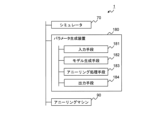
- 1 is a block diagram showing an overview of a parameter generation device according to the present invention
- FIG. 1 is a block diagram showing an overview of a simulation system according to the present invention
- FIG. 1 is a block diagram showing a configuration example of the first embodiment of the simulation system of the present invention.
- a simulation system 100 of this embodiment includes a parameter generator 10 , an annealing machine 20 and a simulator 30 .
- the parameter generation device 10 of this embodiment is a device that generates parameters to be input to the simulator 30, and the simulator 30 performs trials based on the generated parameters.
- the annealing machine 20 is a device dedicated to obtaining the ground state of the Hamiltonian of the Ising model, and is a device that performs annealing based on the Ising model generated by the parameter generation device 10 .
- an annealing machine is a device that stochastically obtains the value of a binary variable that minimizes or maximizes the objective function (that is, the Hamiltonian) of an Ising model with binary variables as arguments.
- Binary variables may be realized by classical bits or quantum bits.
- the aspect of the annealing machine 20 of this embodiment is arbitrary.
- the annealing machine 20 may be configured by any hardware that stochastically obtains the value of a binary variable that minimizes or maximizes an objective function having binary variables as arguments.
- the annealing machine 20 may be, for example, a non-von Neumann computer whose objective function is implemented by hardware in the form of an Ising model.
- the annealing machine 20 may be a quantum annealing machine or a general annealing machine.
- the parameter in this embodiment means the value of each attribute to be generated, and more specifically, the value of the attribute to be input to the simulator 30 in order to perform a trial.
- the parameters are values indicating, for example, the amount of each material, the processing temperature and pressure set in the manufacturing process, the processing time, and the like.
- the parameters are, for example, the economic index of each country, the linkage index of GDP of each country, the amount of exports and imports, the population It is a value that indicates dynamics and the like.
- the parameter generation device 10 of this embodiment generates a parameter set that satisfies desired conditions.
- the "parameter set that satisfies desired conditions” includes a parameter set that satisfies all conditions as well as a parameter set that satisfies set conditions as much as possible (that is, constraint violations are predetermined). parameter set within acceptable limits). Note that the allowable degree and range may be determined in advance by the user or the like.
- the "parameter set that satisfies the desired conditions" is a so-called 100-point parameter set that satisfies all the conditions, and a so-called 95-point parameter set that allows some constraint violations. Also includes parameter sets.
- an annealing machine is used for deriving the parameters, it can be said that the values obtained as a result of deriving the ground state of the Hamiltonian are the parameter set that satisfies the desired conditions.
- the parameter generation device 10 includes an input unit 11, a model generation unit 12, an annealing processing unit 13, and an output unit 14.
- the input unit 11 accepts input of conditions to be satisfied by the parameters (hereinafter also simply referred to as parameter conditions). Specifically, the input unit 11 receives inputs of conditions to be satisfied by the parameters themselves and conditions to be satisfied in relation to other parameters.
- the contents of the conditions and the mode of expression of the conditions are arbitrary.
- the conditions for processing the material itself for example, upper limit temperature, pressure, processing time, etc.
- exclusive material conditions for example, the sum of the amounts of materials, the amount of individual materials, etc.
- Other parameter conditions include conditions related to material type selection (for example, designation of one material from each material group).
- FIG. 2 is an explanatory diagram showing an example of input conditions.
- materials a to z exist, and the amount of each material and the temperature and pressure for each material are included as conditions.
- the total amount of material a, material c, material q, and material z is 0.8 or less, and the total amount of material c, material h, and material i is approximately 2.
- .0 represents the condition to be set to 0.
- the materials a and b, the materials i and j, and the materials p and q are not used simultaneously (exclusively), and the upper limit temperature of the material a is 60, the condition indicating that the upper limit temperature of material p is 150 and the upper limit pressure of material c is 1.2.
- the parameter conditions may be given in natural language expressions.
- the input unit 11 may receive an input of the degree to which each condition is emphasized (hereinafter referred to as condition weight).
- condition weight may be an absolute value or a relative value.
- the input unit 11 may receive an input specifying the number of times the annealing processing unit 13 (to be described later) generates parameters (hereinafter referred to as parameter generation times).
- the model generation unit 12 converts the input conditions into a model expressed by Hamiltonian. Specifically, the model generator 12 converts each input condition into a model represented by Hamiltonian, and generates a final model from the linear sum of the converted models.
- the method of converting the conditions into a model expressed by Hamiltonian is arbitrary.
- a conversion template corresponding to the content of the condition is predetermined for each condition, and the model generation unit 12 determines the content of the input condition, selects a conversion template, and then converts each element included in the condition. It may be applied to a transform template to generate a model.
- the model generation unit 12 may convert the conditions into a model, for example, using a dedicated library for inputting the conditions and generating a model represented by the Hamiltonian.
- model generation unit 12 converts the conditions into a model
- parameter conditions for testing a new material manufacturing method will be described as an example.
- type (amount) of material and the type of environment (temperature and pressure) are assumed as parameters.
- a decision variable (quantum bit) xq representing the type of material is defined as follows. xq [type, quantity] "type” indicates the type of material, and “quantity” indicates the quantity in 0.1 ⁇ 10 bits, for example.
- a decision variable (quantum bit) xe representing the type of environment is defined as follows.
- xe [type, volume] "type” represents the type of environment, and "volume” represents a value, for example, in 10x10 bits.
- auxiliary variables s1[] and s2[] are used as appropriate.
- the model generator 12 models each condition as a Hamiltonian.
- the constraints illustrated in FIG. 2 will be described.
- the Hamiltonian H1 shown in Equation 1 above is a model that indicates that the lowest energy state (ground state) occurs when the value in parentheses (that is, the sum of the amounts of each material) is within 0.8. .
- Equation 2 (The Hamiltonian H2 shown in Equation 2 above is a model indicating that the closer the value in parentheses (that is, the sum of the amounts of each material) to 2.0, the lower the energy.
- Equation 3 (3) Regarding a and b being exclusive
- the Hamiltonian H3 shown in Equation 3 above is a model that indicates that the value of the Hamiltonian increases when both material a and material b are present (becomes 0 if at least one is not included).
- the Hamiltonian H4 shown in the above equation 4 is a model showing that when the temperature is within 60 when the material a is contained, the energy becomes the lowest state.
- the model generation unit 12 when these Hamiltonians H1 to H4 are generated, the model generation unit 12 generates a linear sum of each model as an example, as shown in Equation 5 below, as a final model.
- w1 to w4 are weighting constants indicating weights of conditions.
- the weighting constants exemplified in Equation 5 are arbitrary, and may be set randomly, for example, or may be the weights of the conditions for which the input unit 11 has received the input.
- the annealing processing unit 13 generates an Ising model from the converted model. Specifically, the annealing processing unit 13 generates an Ising model from the linear sum of the converted models (for example, the Hamiltonian shown in Equation 5). where both the transformed model and the linear sum of each transformed model are Hamiltonians. Since the method of generating the Ising model from the Hamiltonian is widely known, detailed description is omitted here.
- the annealing processing unit 13 inputs the generated Ising model to the annealing machine 20 to perform annealing and obtain an execution result.
- the annealing processing unit 13 may cause the annealing machine 20 to perform annealing only once, or may perform annealing the number of times specified as the number of parameter generation times. That is, the annealing processing unit 13 may cause the annealing machine 20 to perform annealing for the same Ising model multiple times.
- the optimum solution can be obtained approximately uniquely, but the results of execution by the annealing machine usually have such a variety of variations that it is difficult to find the same solution. This can be suitably applied to a situation in which various variations are obtained while satisfying the conditions, such as in the case of trying a new material manufacturing method.
- the output unit 14 converts the execution result of annealing into a parameter set and outputs it. This is because the result of annealing is different from the expression of parameters.
- the output unit 14 may convert the execution result of annealing into the original parameter set (in other words, values executable by the simulator 30), for example, based on the defined decision variables (quantum bits).
- the output unit 14 may output the converted parameter set directly to the simulator 30, or may output it in a file format (for example, CSV (Comma Separated Value) format).
- FIG. 3 is an explanatory diagram showing an example of the parameter set output by the output unit 14. As shown in FIG. The example shown in FIG. 3 shows the result of the output unit 14 outputting a parameter set in CSV format when the parameter set includes materials a to z, temperature and pressure.
- the simulator 30 executes trials for the input parameter set and outputs trial results (simulation results). For example, when there are multiple trial results (that is, when multiple parameter sets are input), the simulator 30 may associate the multiple output trial results with the parameter sets and display them in a list.
- FIG. 4 is an explanatory diagram showing an example of trial results.
- the trial results illustrated in FIG. 4 show a table in which columns corresponding to conditions to be satisfied are circled in association with each parameter set.
- the simulator 30 may display the parameter sets in descending order of the number of conditions that are satisfied, or may display the parameter sets in descending order of energy indicated by the Hamiltonian.
- the input unit 11, the model generation unit 12, the annealing processing unit 13, and the output unit 14 are implemented by a computer processor (for example, a CPU (Central Processing Unit)) that operates according to a program (parameter generation program).
- a computer processor for example, a CPU (Central Processing Unit)
- a program parameter generation program
- the program is stored in the storage unit (not shown) of the parameter generation device 10, the processor reads the program, and according to the program, the input unit 11, the model generation unit 12, the annealing processing unit 13, and the output unit 14 may work.
- the functions of the parameter generation device 10 may be provided in a SaaS (Software as a Service) format.
- the input unit 11, the model generation unit 12, the annealing processing unit 13, and the output unit 14 may each be realized by dedicated hardware. Also, part or all of each component of each device may be implemented by a general-purpose or dedicated circuit (circuitry), processor, etc., or a combination thereof. These may be composed of a single chip, or may be composed of multiple chips connected via a bus. A part or all of each component of each device may be implemented by a combination of the above-described circuits and the like and programs.
- each component of the parameter generation device 10 when part or all of each component of the parameter generation device 10 is realized by a plurality of information processing devices, circuits, etc., the plurality of information processing devices, circuits, etc. may be centrally arranged, They may be distributed.
- the information processing device, circuits, and the like may be implemented as a form in which each is connected via a communication network, such as a client-server system, a cloud computing system, or the like.
- FIG. 5 is a flowchart showing an operation example of the parameter generating device 10. As shown in FIG.
- the input unit 11 receives input of parameter conditions (step S11).
- the model generator 12 converts the input conditions into a model expressed by Hamiltonian (step S12).
- the annealing processing unit 13 generates an Ising model from the converted model (step S13), and inputs the generated Ising model to the annealing machine to perform annealing (step S14). Then, the output unit 14 converts the execution result of annealing into a parameter set and outputs the parameter set (step S15).
- FIG. 6 is a flow chart showing an operation example of the simulation system 100. As shown in FIG. In this operation example, it is assumed that the output result from the parameter generation device 10 is input to the simulator 30 .
- the process from converting the input parameter conditions into a model to generating the Ising model is the same as the process from step S11 to step S13 illustrated in FIG.
- the annealing processing unit 13 outputs the generated Ising model to the annealing machine (step S21).
- the annealing machine 20 performs annealing based on the input Ising model (step S22).
- the annealing machine 20 obtains a plurality of spin values by annealing, for example.
- the annealing machine 20 outputs the execution result of annealing to the parameter generation device 10 (step S23).
- the output unit 14 converts the execution result of annealing into a parameter set and outputs it to the simulator 30 (step S24).
- the simulator 30 executes trials for the input parameter set and outputs trial results (step S25).
- the input unit 11 receives input of parameter conditions
- the model generation unit 12 converts the input conditions into a model expressed by Hamiltonian.
- the annealing processing unit 13 generates an Ising model from the converted model, inputs the generated Ising model to the annealing machine, and executes annealing.
- the output unit 14 converts the execution result of annealing into a parameter and outputs the parameter. Therefore, it is possible to efficiently generate a parameter set that satisfies desired conditions.
- Objective function conditions can be obtained, for example, by having AI (Artificial Intelligence) perform machine learning using a large amount of experimental data.
- Objective functional conditions include, for example, a linear regression model that predicts a performance index.
- the simulation system 100 introduces this linear regression model into the Hamiltonian and uses it as a condition for exhibiting desired performance.
- a linear regression model is represented by a linear regression equation with a performance index (hereinafter also simply referred to as an index) as an objective variable and the parameters described above as explanatory variables. For example, if the predicted value of the i-th index is yi , yi is represented by the linear sum of each parameter.
- Performance indicators include hardness, flexibility, and heat resistance.
- the input unit 11 inputs the above-described objective function condition as an input of the condition to be satisfied by the parameter, that is, the linear regression model y i represented by the linear regression equation with the performance index as the objective variable and the parameter as the explanatory variable. Accept input.
- the model generator 12 converts the input objective function condition into a model expressed by Hamiltonian. For example, when the input unit 11 receives an input of a linear regression model indicating N performance indicators, the model generation unit 12 models the Hamiltonian HO exemplified in Equation 6 below from the received linear regression model. good too.
- Lmed i is the target median value for the i-th index. For example, if the hardness index is considered desirable in the range of 20-25, then 23 would be the target median. Also, W i is a weight preset according to the importance of each index. For example, if heat resistance is more important than hardness, the heat resistance weight is set higher than the altitude weight.
- the model generator 12 generates a linear sum of each model to which the H 2 O is also added as shown in Equation 5 above to obtain a final model. Subsequent processing is the same as in the above embodiment.
- the input unit 11 receives the input of the linear regression model represented by the linear regression equation with the performance index as the objective variable and the parameter as the explanatory variable
- the model generation unit 12 receives the input Convert a linear regression model to a model expressed in Hamiltonian. Therefore, in addition to the effects of the above embodiments, it is possible to efficiently generate a parameter set that satisfies more desirable conditions.
- FIG. 7 is a block diagram showing a configuration example of the second embodiment of the simulation system of the present invention.
- a simulation system 200 of this embodiment includes a parameter generator 110 , an annealing machine 20 and a simulator 30 . Aspects of the annealing machine 20 and the simulator 30 are the same as in the first embodiment.
- the parameter generation device 110 includes an input unit 111, a model generation unit 112, an annealing processing unit 13, and an output unit 14. That is, the parameter generation device 110 of this embodiment includes an input unit 111 and a model generation unit 112 instead of the input unit 11 and the model generation unit 12, compared to the parameter generation device 10 of the first embodiment. different in that Other configurations are the same as those of the first embodiment.
- the input unit 111 accepts input of parameter conditions, similar to the input unit 11 of the first embodiment. Furthermore, the input unit 111 of the present embodiment receives input of a reference parameter set in addition to the parameter conditions.
- a reference parameter set is a parameter set that has produced good results in the past. By accepting an input of a parameter set that has produced good results in the past, it is possible to generate a parameter set close to this parameter set.
- the reference parameter set is not limited to the parameter set with good results in the past.
- the reference parameter set may be, for example, a parameter set currently in operation. By accepting the input of the parameter set currently in operation, it is possible to generate a parameter set that does not significantly change the current operation.
- the model generation unit 112 converts the input conditions into a model expressed in Hamiltonian, similar to the model generation unit 12 of the first embodiment. Furthermore, the model generating unit 112 generates a Hamiltonian modeled such that the closer the generated parameters are to the reference parameter set, the smaller the energy. Then, the model generator 112 generates a final model from the linear sum of each model.
- Equation 7 the linear sum of each model is generated as shown in Equation 7 exemplified below.
- the input unit 111, the model generation unit 112, the annealing processing unit 13, and the output unit 14 are implemented by a computer processor that operates according to a program (parameter generation program).
- the input unit 111 receives an input of a reference parameter set, and the model generation unit 112 generates parameters so that the closer they are to the reference parameter set, the smaller the energy. Generate a modeled Hamiltonian. Therefore, in addition to the effect of the first embodiment, a parameter set can be generated so as to be close to the reference parameter set.
- FIG. 8 is a block diagram showing an overview of the parameter generation device according to the present invention.
- a parameter generation device 80 according to the present invention includes input means 81 (for example, the input unit 11) that receives input of conditions to be satisfied by the parameters, and model generation means 82 (for example, model generation unit 12), annealing processing means 83 (for example, annealing processing unit 13) that generates an Ising model from the converted model, inputs the generated Ising model to an annealing machine, and performs annealing; and an output means 84 (for example, the output unit 14) that converts the execution result into a parameter and outputs the parameter.
- model generation means 82 for example, model generation unit 12
- annealing processing means 83 for example, annealing processing unit 13
- an output means 84 for example, the output unit 14
- the model generating means 82 may convert each input condition into a model represented by Hamiltonian, and the annealing processing means 83 may generate an Ising model from the linear sum of the converted models. .
- the input means 81 receives an input of a reference parameter set
- the model generating means 82 generates a Hamiltonian modeled so that the closer the generated parameters are to the reference parameter set, the smaller the energy. good too.
- Such a configuration makes it possible to generate a parameter set that is close to the reference parameter set.
- the annealing processing means 83 may cause the annealing machine to perform annealing for the same Ising model multiple times. The properties of the annealing machine make it possible to obtain different variations of parameter sets.
- the input means 81 sets at least one of the conditions to be satisfied by the parameters to process the material itself, the exclusive material condition, the material allocation condition, and the material type selection condition. input may be accepted.
- FIG. 9 is a block diagram showing an overview of the parameter generation device according to the present invention.
- the simulation system 1 includes a simulator 70 (for example, the simulator 30) that performs trials based on input parameters, and a parameter generation device 180 (for example, the parameter generation device 10) that generates parameters to be input to the simulator 30. , and an annealing machine 90 (annealing machine 20) that performs annealing based on the Ising model.
- the parameter generation device 180 includes input means 181 (for example, the input unit 11) that receives input of conditions to be satisfied by the parameters, and model generation means 182 (for example, the model generation unit 12), annealing processing means 183 (for example, the annealing processing unit 13) that generates an Ising model from the converted model and outputs the generated Ising model to the annealing machine 90; and an output means 184 (for example, the output unit 14) that converts the parameters into parameters and outputs them to the simulator 70.
- model generation means 182 for example, the model generation unit 12
- annealing processing means 183 for example, the annealing processing unit 13
- an output means 184 for example, the output unit 14
- the annealing machine 90 performs annealing based on the Ising model input from the parameter generation device 180 and outputs the results of the annealing to the parameter generation device 180 .
- the simulator 70 then executes a trial for the input parameter set and outputs the trial result.
- (Appendix 1) input means for receiving input of conditions to be satisfied by parameters; a model generating means for converting the input conditions into a model expressed by Hamiltonian; Annealing processing means for generating an Ising model from the converted model, inputting the generated Ising model to an annealing machine, and performing annealing; and output means for converting the execution result of the annealing into the parameter and outputting the parameter.
- the model generation means converts each input condition into a model expressed by Hamiltonian,
- the parameter generation device according to appendix 1, wherein the annealing processing means generates an Ising model from a linear sum of the transformed models.
- the input means receives an input of a reference parameter set,
- the parameter generation device according to appendix 1 or appendix 2, wherein the model generation means generates a modeled Hamiltonian such that the closer the generated parameters are to the reference parameter set, the smaller the energy.
- Appendix 4 The parameter generation device according to any one of Appendices 1 to 3, wherein the annealing processing means causes the annealing machine to perform annealing for the same Ising model a plurality of times.
- the input means has at least one condition for processing the raw material itself, an exclusive raw material condition, a raw material allocation condition, and a raw material type selection condition as conditions to be satisfied by the parameters.
- the parameter generation device according to any one of appendices 1 to 4, wherein an input of a condition is received.
- the input means accepts input of a linear regression model represented by a linear regression equation in which the performance index is the objective variable and the parameter is the explanatory variable
- the parameter generation device according to any one of appendices 1 to 5, wherein the model generation means transforms an input linear regression model into a model represented by a Hamiltonian.
- a simulator that performs trials based on input parameters; a parameter generation device that generates parameters to be input to the simulator; and an annealing machine that performs annealing based on the Ising model
- the parameter generation device is input means for receiving input of conditions to be satisfied by the parameters; a model generating means for converting the input conditions into a model expressed by Hamiltonian; Annealing processing means for generating an Ising model from the converted model and outputting the generated Ising model to the annealing machine; an output means for converting the execution result of annealing by the annealing machine into the parameter and outputting it to the simulator;
- the annealing machine is Annealing is performed based on the Ising model input from the parameter generation device, and the execution result of the annealing is output to the parameter generation device,
- a simulation system wherein the simulator executes a trial for an input parameter set and outputs a result of the trial.
- a parameter generation method comprising: converting the execution result of the annealing into the parameter and outputting the parameter.
- a parameter generation device that generates parameters to be input to a simulator that performs a trial based on the input parameters receives input of conditions to be satisfied by the parameters, The parameter generation device converts the input conditions into a model expressed by Hamiltonian, The parameter generation device generates an Ising model from the transformed model, The parameter generation device outputs the generated Ising model to the annealing machine, The annealing machine performs annealing based on the Ising model input from the parameter generation device, The annealing machine outputs the execution result of the annealing to the parameter generation device, The parameter generation device converts the execution result of annealing by the annealing machine into the parameter and outputs it to the simulator, A simulation method, wherein the simulator executes a trial for an input parameter set and outputs a result of the trial.
Landscapes
- Engineering & Computer Science (AREA)
- Physics & Mathematics (AREA)
- Mathematical Physics (AREA)
- General Physics & Mathematics (AREA)
- Theoretical Computer Science (AREA)
- Computational Mathematics (AREA)
- Mathematical Analysis (AREA)
- Mathematical Optimization (AREA)
- Pure & Applied Mathematics (AREA)
- Data Mining & Analysis (AREA)
- Software Systems (AREA)
- General Engineering & Computer Science (AREA)
- Operations Research (AREA)
- Algebra (AREA)
- Databases & Information Systems (AREA)
- Computing Systems (AREA)
- Management, Administration, Business Operations System, And Electronic Commerce (AREA)
Priority Applications (2)
| Application Number | Priority Date | Filing Date | Title |
|---|---|---|---|
| JP2023563598A JP7758055B2 (ja) | 2021-11-24 | 2022-11-07 | パラメータ生成装置、方法およびプログラム |
| US18/712,310 US20250013711A1 (en) | 2021-11-24 | 2022-11-07 | Parameter generation device, method and program |
Applications Claiming Priority (2)
| Application Number | Priority Date | Filing Date | Title |
|---|---|---|---|
| JP2021190203 | 2021-11-24 | ||
| JP2021-190203 | 2021-11-24 |
Publications (1)
| Publication Number | Publication Date |
|---|---|
| WO2023095594A1 true WO2023095594A1 (ja) | 2023-06-01 |
Family
ID=86539294
Family Applications (1)
| Application Number | Title | Priority Date | Filing Date |
|---|---|---|---|
| PCT/JP2022/041341 Ceased WO2023095594A1 (ja) | 2021-11-24 | 2022-11-07 | パラメータ生成装置、方法およびプログラム |
Country Status (3)
| Country | Link |
|---|---|
| US (1) | US20250013711A1 (https=) |
| JP (1) | JP7758055B2 (https=) |
| WO (1) | WO2023095594A1 (https=) |
Cited By (1)
| Publication number | Priority date | Publication date | Assignee | Title |
|---|---|---|---|---|
| WO2025158988A1 (ja) * | 2024-01-26 | 2025-07-31 | 株式会社村田製作所 | シミュレーション装置、シミュレーションシステム、シミュレーション方法、およびシミュレーションプログラム |
Citations (2)
| Publication number | Priority date | Publication date | Assignee | Title |
|---|---|---|---|---|
| JP2020181575A (ja) * | 2019-04-23 | 2020-11-05 | 日本製鉄株式会社 | 最適化支援装置、最適化支援方法、プログラムおよび最適化システム |
| JP2021127418A (ja) * | 2020-02-17 | 2021-09-02 | 富士通株式会社 | 混合物性能最適化装置、混合物性能最適化プログラム、混合物性能最適化方法、及び混合冷媒 |
Family Cites Families (1)
| Publication number | Priority date | Publication date | Assignee | Title |
|---|---|---|---|---|
| JP7411397B2 (ja) | 2019-12-04 | 2024-01-11 | 株式会社リクルート | 整数計画装置、整数計画方法及び整数計画プログラム |
-
2022
- 2022-11-07 US US18/712,310 patent/US20250013711A1/en active Pending
- 2022-11-07 WO PCT/JP2022/041341 patent/WO2023095594A1/ja not_active Ceased
- 2022-11-07 JP JP2023563598A patent/JP7758055B2/ja active Active
Patent Citations (2)
| Publication number | Priority date | Publication date | Assignee | Title |
|---|---|---|---|---|
| JP2020181575A (ja) * | 2019-04-23 | 2020-11-05 | 日本製鉄株式会社 | 最適化支援装置、最適化支援方法、プログラムおよび最適化システム |
| JP2021127418A (ja) * | 2020-02-17 | 2021-09-02 | 富士通株式会社 | 混合物性能最適化装置、混合物性能最適化プログラム、混合物性能最適化方法、及び混合冷媒 |
Cited By (1)
| Publication number | Priority date | Publication date | Assignee | Title |
|---|---|---|---|---|
| WO2025158988A1 (ja) * | 2024-01-26 | 2025-07-31 | 株式会社村田製作所 | シミュレーション装置、シミュレーションシステム、シミュレーション方法、およびシミュレーションプログラム |
Also Published As
| Publication number | Publication date |
|---|---|
| US20250013711A1 (en) | 2025-01-09 |
| JP7758055B2 (ja) | 2025-10-22 |
| JPWO2023095594A1 (https=) | 2023-06-01 |
Similar Documents
| Publication | Publication Date | Title |
|---|---|---|
| Pan et al. | A local-best harmony search algorithm with dynamic sub-harmony memories for lot-streaming flow shop scheduling problem | |
| CN116644804B (zh) | 分布式训练系统、神经网络模型训练方法、设备和介质 | |
| JP2020204928A (ja) | 最適化装置および最適化方法 | |
| JP2015004996A (ja) | 複数の文書をクラスタリングする装置 | |
| RU2010130189A (ru) | Способ компьютеризованного анализа технической системы | |
| GB2568660A (en) | Generating randomness in neural networks | |
| WO2021185579A1 (en) | Manufacturing or controlling a technical system using an optimized parameter set | |
| WO2023095594A1 (ja) | パラメータ生成装置、方法およびプログラム | |
| CN113761026A (zh) | 基于条件互信息的特征选择方法、装置、设备和存储介质 | |
| CN113591271A (zh) | 一种确定电力系统状态转移矩阵稳态特征值的方法及系统 | |
| JP5687122B2 (ja) | ソフトウェア評価装置、ソフトウェア評価方法およびシステム評価装置 | |
| Zhang et al. | An Improved shuffled frog-leaping algorithm to Solving 0–1 Knapsack Problem | |
| JP2021114117A (ja) | 情報処理プログラム、情報処理方法および情報処理装置 | |
| Shylo et al. | Solving the maxcut problem by the global equilibrium search | |
| JP7242595B2 (ja) | 学習装置、推論装置、学習方法及び推論方法 | |
| CN117010508B (zh) | 多项式的计算方法及相关设备 | |
| JP6985480B1 (ja) | 計算方法、計算装置、計算プログラム、記録媒体 | |
| WO2007020391A1 (en) | Electronic circuit design | |
| US20250342222A1 (en) | Parameter generation device, system, method, and program | |
| Kumar et al. | Improved-Hybrid GA-Based Technique to Optimize the Resource Utilization in Cloud | |
| JP5418052B2 (ja) | 遺伝的処理装置、遺伝的処理方法およびプログラム | |
| JP2024127272A (ja) | 最適化装置、最適化方法および最適化プログラム | |
| JP2024070014A (ja) | 回路設計に関する知識を再利用するための装置、システム、機械学習プログラム、および機械学習方法 | |
| KR20260043419A (ko) | 폴리머 복합소재의 레시피 생성 방법 및 그 장치 | |
| Shouman et al. | Static Workload Distribution of Parallel Applications in Heterogeneous Distributed Computing Systems with Memory and Communication Capacity Constraints |
Legal Events
| Date | Code | Title | Description |
|---|---|---|---|
| 121 | Ep: the epo has been informed by wipo that ep was designated in this application |
Ref document number: 22898378 Country of ref document: EP Kind code of ref document: A1 |
|
| ENP | Entry into the national phase |
Ref document number: 2023563598 Country of ref document: JP Kind code of ref document: A |
|
| WWE | Wipo information: entry into national phase |
Ref document number: 18712310 Country of ref document: US |
|
| NENP | Non-entry into the national phase |
Ref country code: DE |
|
| 122 | Ep: pct application non-entry in european phase |
Ref document number: 22898378 Country of ref document: EP Kind code of ref document: A1 |