WO2023084954A1 - レコメンド装置 - Google Patents
レコメンド装置 Download PDFInfo
- Publication number
- WO2023084954A1 WO2023084954A1 PCT/JP2022/037338 JP2022037338W WO2023084954A1 WO 2023084954 A1 WO2023084954 A1 WO 2023084954A1 JP 2022037338 W JP2022037338 W JP 2022037338W WO 2023084954 A1 WO2023084954 A1 WO 2023084954A1
- Authority
- WO
- WIPO (PCT)
- Prior art keywords
- user
- feature vector
- contents
- preference information
- content
- Prior art date
- Legal status (The legal status is an assumption and is not a legal conclusion. Google has not performed a legal analysis and makes no representation as to the accuracy of the status listed.)
- Ceased
Links
Images




Classifications
-
- G—PHYSICS
- G06—COMPUTING OR CALCULATING; COUNTING
- G06Q—INFORMATION AND COMMUNICATION TECHNOLOGY [ICT] SPECIALLY ADAPTED FOR ADMINISTRATIVE, COMMERCIAL, FINANCIAL, MANAGERIAL OR SUPERVISORY PURPOSES; SYSTEMS OR METHODS SPECIALLY ADAPTED FOR ADMINISTRATIVE, COMMERCIAL, FINANCIAL, MANAGERIAL OR SUPERVISORY PURPOSES, NOT OTHERWISE PROVIDED FOR
- G06Q30/00—Commerce
- G06Q30/06—Buying, selling or leasing transactions
- G06Q30/0601—Electronic shopping [e-shopping]
- G06Q30/0631—Recommending goods or services
-
- G—PHYSICS
- G06—COMPUTING OR CALCULATING; COUNTING
- G06F—ELECTRIC DIGITAL DATA PROCESSING
- G06F16/00—Information retrieval; Database structures therefor; File system structures therefor
- G06F16/90—Details of database functions independent of the retrieved data types
- G06F16/903—Querying
- G06F16/9035—Filtering based on additional data, e.g. user or group profiles
-
- G—PHYSICS
- G06—COMPUTING OR CALCULATING; COUNTING
- G06Q—INFORMATION AND COMMUNICATION TECHNOLOGY [ICT] SPECIALLY ADAPTED FOR ADMINISTRATIVE, COMMERCIAL, FINANCIAL, MANAGERIAL OR SUPERVISORY PURPOSES; SYSTEMS OR METHODS SPECIALLY ADAPTED FOR ADMINISTRATIVE, COMMERCIAL, FINANCIAL, MANAGERIAL OR SUPERVISORY PURPOSES, NOT OTHERWISE PROVIDED FOR
- G06Q30/00—Commerce
- G06Q30/06—Buying, selling or leasing transactions
- G06Q30/0601—Electronic shopping [e-shopping]
Definitions
- One aspect of the present disclosure relates to a recommendation device that recommends content to users.
- a recommendation system that recommends products, etc. according to the user to the user is known.
- Such a recommendation system extracts information related to the user's interest using, for example, a log of user clicks or page transitions related to product selection. Then, the recommendation system sorts products using information about the user's interests, and recommends the sorted products to the user.
- Japanese Patent Laid-Open No. 2002-200000 discloses a learning method that generates and holds feature amount data of content as a multidimensional vector, performs clustering processing using the feature amount data of content selected based on the user's preference, and shows the user's preference.
- a system is disclosed that generates result data in the form of a multidimensional vector, extracts feature amount data whose Euclidean distance from learning result data is within a predetermined distance, and searches for content.
- Users may search for content such as products based on preference information that differs from user to user, such as whether the product looks good or bad or product information (specifications) is good or bad. It is difficult for a person other than the user (for example, a third party) to properly grasp the user's preference information. Therefore, it is also difficult to sort and recommend contents using preference information. Therefore, there is a demand for a mechanism that can appropriately capture preference information that differs from user to user.
- one aspect of the present disclosure aims to provide a recommendation device capable of appropriately grasping preference information that differs from user to user and recommending content that matches the user's preference.
- a recommendation device stores a content feature vector indicating a content feature for each of a plurality of pieces of content, a storage unit that stores a user feature vector indicating a user feature, and a user an acquisition unit for acquiring information indicating a plurality of favorite contents selected by a user and preference information indicating a user's preference for each of a plurality of favorite contents inputted by comparing the plurality of favorite contents with each other; a learning unit that learns such that the position of the user feature vector and the position of the content feature vectors of a plurality of favorite contents approach each other in the vector space in which the content feature vectors of the content and the user feature vectors are indicated; and weighting based on preference information and a correction unit that corrects the position of the user feature vector in the vector space using and an output unit for outputting a recommendation result of content selected based on the score.
- information indicating a plurality of favorite contents selected by the user is acquired, and a plurality of favorite contents are input by the user by comparing the plurality of favorite contents.
- Preference information for each content is acquired.
- learning is performed so that the position of the user feature vector and the position of the content feature vectors of a plurality of favorite contents are closer in the vector space, and the position of the user feature vector is corrected using weighting based on preference information.
- a score is calculated based on the distance between the position of the user feature vector and the position of each content feature vector, and a recommendation result of content selected based on the score is output.
- the favorite content is selected by the user from a plurality of contents, and the favorite contents are compared to obtain the user's preference information, thereby making it possible to appropriately grasp the preference information that differs for each user. Become. Then, in addition to learning so that the position of the user feature vector and the position of the content feature vector of the favorite content are closer to each other, the position of the user feature vector is corrected using the above-described weighting based on the preference information, and the vector By selecting the recommendation target based on the spatial distance, it is possible to fully reflect the user's taste and recommend content that matches the user's taste.
- a recommendation device capable of appropriately capturing preference information that differs from user to user and recommending content that matches the user's preference.
- FIG. 10 is a diagram illustrating correction of the position of user feature vectors; 4 is a flowchart showing processing executed by a recommendation device; It is a figure which shows the hardware constitutions of a recommendation apparatus.
- FIG. 1 is a diagram showing the functional configuration of the recommendation device 10 according to this embodiment.
- the recommendation device 10 is a device that recommends content according to each user's preference to the user (that is, delivers the content to the user's user terminal 30).
- a content is, for example, any tangible or intangible that is traded for a fee or for free, and is a concept that includes the provision of goods and services.
- the recommendation device 10 selects content to be recommended to a user, taking into account preference information that differs from user to user.
- the preference information that differs from user to user is information that may differ in the way of feeling or the viewpoint of importance depending on the user.
- the preference information that differs from user to user includes, for example, appearance or product information (specifications), but is not limited to these.
- the recommendation device 10 learns the user's preferences based on information on a plurality of favorite contents selected by the user and preference information on each of the plurality of favorite contents input by the user.
- Favorite content refers to content that the user likes among multiple pieces of content belonging to the same category (for example, smartphones).
- the recommendation device 10 selects content to be recommended to the user so that content that meets the user's taste is targeted for distribution.
- the recommendation system 1 includes a recommendation device 10 and a user terminal 30.
- the user terminal 30 is a communication terminal having a communication function, such as a smart phone, a tablet terminal, or a personal computer.
- the user terminal 30 is communicably connected to the recommendation device 10 via a network.
- the user terminal 30 has a function of displaying various screens, a function of receiving input from the user, a function of transmitting information input by the user to the recommendation device 10, and receiving distribution of recommended content from the recommendation device 10. and a function of displaying the content.
- the recommendation system 1 actually includes a plurality of user terminals 30 for each user.
- the recommendation device 10 includes a storage unit 11, a screen management unit 12, an acquisition unit 13, a learning unit 14, a correction unit 15, a calculation unit 16, and an output unit 17. I have.
- the storage unit 11 stores a content feature vector 21 indicating the feature of each of a plurality of contents, and stores a user feature vector 22 indicating the feature of the user.
- the plurality of contents are smartphones.
- the storage unit 11 stores appearance feature vectors as content feature vectors 21 indicating the appearance features of each of a plurality of pieces of content. Appearance is the external appearance of the product.
- the storage unit 11 also stores user feature vectors in the appearance vector space as the user feature vectors 22 .
- An appearance vector space is a vector space in which appearance feature vectors of multiple contents are indicated.
- the storage unit 11 stores detailed sentence feature vectors as content feature vectors 21 that indicate features of detailed sentences of each of a plurality of contents.
- a detailed sentence is a sentence explaining the product details (specifications). Examples of detailed statements include, but are not limited to, dimensions, weight, installed functions, and the like.
- the storage unit 11 also stores user feature vectors in the detailed sentence vector space as the user feature vectors 22 .
- the detailed sentence vector space is a vector space in which detailed sentence feature vectors of multiple contents are indicated.
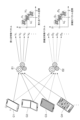
- FIG. 2 is a diagram for explaining feature vectors and vector spaces.
- the image recognition model E1 vectorizes an input image, for example.
- the image recognition model E1 is, for example, a CNN (Convolutional Neural Network) or the like.
- the image recognition model E1 receives an image of each of a plurality of contents as an input and outputs an appearance feature vector.
- the appearance feature vector is the hidden layer output of the CNN.
- the image recognition model E1 receives images of smartphones C1, C2, C3, and C4 as inputs, and outputs appearance feature vectors V1 , V2 , V3 , and V4, respectively.
- the appearance vector space shown in FIG. 2 shows appearance feature vectors V 1 and V 3 and user feature vector U 1 as some examples.
- the appearance feature vector and the user feature vector are arranged on the same appearance vector space.
- the natural language model E2 vectorizes the input natural language.
- the natural language model E2 is, for example, BERT (Bidirectional Encoder Representations from Transformers).
- the natural language model E2 receives as input the natural language of each of a plurality of contents and outputs a detailed sentence feature vector.
- the detailed sentence feature vector is a BERT-based document vector.
- the natural language model E2 receives the detailed sentences of the smartphones C1, C2, C3 and C4 as inputs, and outputs detailed sentence feature vectors D1 , D2 , D3 and D4, respectively.
- the detailed sentence vector space shown in FIG. 4 shows detailed sentence feature vectors D 1 and D 3 and user feature vector U 2 as a partial example. In this way, detailed sentence feature vectors and user feature vectors are arranged on the same detailed sentence vector space.
- the screen management unit 12 manages various screens to be displayed on the user terminal 30.
- the screen management unit 12 manages a product selection screen for selecting favorite content from a plurality of contents, a comparison screen for comparing a plurality of favorite contents, and the like.
- the screen management unit 12 acquires information from the user terminal 30 via various screens and outputs the acquired information to the acquisition unit 13 .
- FIG. 3 is a diagram illustrating an example of the product selection screen G1.
- the product selection screen G1 is displayed on the user terminal 30 and is a screen for selecting favorite content from among a plurality of content.
- the product selection screen G1 may display a page or a pop-up window or the like for confirming more detailed information (for example, appearance, detailed sentences, etc.) for each of the plurality of contents.
- Smartphones C1, C2, C3 and C4 are displayed as a plurality of contents on the product selection screen G1.
- the user terminal 30 receives an operation from the user to select multiple favorite contents from multiple contents. For example, the user terminal 30 receives an operation from the user who selects the smartphones C1 and C3 on the product selection screen G1.
- Icons F1 and F2 indicating the selected smartphones C1 and C3, respectively, are displayed on the product selection screen G1.
- the user terminal 30 transmits information indicating the selected smartphones C ⁇ b>1 and C ⁇ b>3 to the recommendation device 10 .
- the recommendation device 10 receives information indicating smartphones C1 and C3.
- FIG. 4 is a diagram illustrating an example of the comparison screen G2.
- the comparison screen G2 is a screen displayed on the user terminal 30 for comparing a plurality of favorite contents.
- a plurality of favorite contents are contents selected on the product selection screen G1 shown in FIG.
- the comparison screen G2 may display a page or a pop-up window or the like for confirming more detailed information (for example, appearance, detailed sentences, etc.) for each of the plurality of contents.
- a plurality of smartphones C1 (item A) and C3 (item B) are displayed as a plurality of favorite contents on the comparison screen G2.
- the comparison screen G2 also displays an input interface P1 for inputting preference information regarding appearance, an input interface P3 for inputting preference information regarding product details (detailed sentences), and a result display button B1.
- the user terminal 30 accepts an operation from the user who inputs preference information for each of a plurality of favorite contents. More specifically, the user terminal 30 accepts an operation from the user who inputs preference information as to which of the plurality of favorite contents is preferred.
- the user terminal 30 receives an operation of inputting appearance preference information as preference information on appearance for each of the smartphones C1 and C3.
- the input interface P1 displays a pointer P2 indicating appearance preference information input by the user by comparing the smartphones C1 and C3.
- the position of the pointer P2 on the input interface P1 is the fourth stage of the five stages of evaluation from the smartphone C1 to the smartphone C3.
- the position of the pointer P2 indicates that the user prefers the appearance of the smartphone C3 to that of the smartphone C1.
- the user terminal 30 receives an operation of inputting detailed sentence preference information as preference information related to detailed sentences for each of the smartphones C1 and C3.
- the user terminal 30 receives, via the input interface P3, an operation for evaluating which of the detailed sentences of the smartphones C1 and C3 is preferred in 5 levels.
- the input interface P3 displays a pointer P4 indicating detailed sentence preference information input by the user by comparing the smartphones C1 and C3.
- the position of the pointer P4 on the input interface P3 is the first step of the five-step evaluation from the smartphone C1 to the smartphone C3.
- the position of the pointer P4 indicates that the user prefers the detailed sentence of the smartphone C1 to the smartphone C3.
- the user terminal 30 transmits the preference information related to each of the smartphones C1 and C3 to the recommendation device 10.
- the user terminal 30 transmits appearance preference information and detailed sentence preference information to the recommendation device 10 as preference information.
- the result display button B1 is a button for displaying recommendation results. For example, when the user presses the result display button B1, the user terminal 30 displays a recommendation result in line with the user's preference. The user terminal 30 may transmit the preference information to the recommendation device 10 by using the pressing of the result display button B1 as a trigger.
- the acquisition unit 13 acquires information indicating a plurality of favorite contents selected by the user from among a plurality of contents. For example, the acquisition unit 13 acquires information indicating two favorite contents as information indicating a plurality of favorite contents. For example, the acquisition unit 13 may acquire information indicating a plurality of favorite contents based on the user's input on the product selection screen G1.
- the acquisition unit 13 acquires preference information indicating the user's preference for each of a plurality of favorite contents inputted by comparing a plurality of favorite contents with each other. For example, the acquiring unit 13 acquires appearance preference information as preference information regarding appearance. Further, the acquisition unit 13 acquires detailed sentence preference information as the preference information regarding the detailed sentence. For example, the acquisition unit 13 may acquire preference information related to each of a plurality of favorite contents based on the user's input on the comparison screen G2.
- the learning unit 14 learns so that the positions of the user feature vectors and the positions of the content feature vectors of the plurality of favorite contents are close to each other in the vector space in which the content feature vectors of the plurality of contents and the user feature vectors are shown.
- the learning unit 14 adjusts the position of the user feature vector in each of the appearance vector space and the detailed sentence vector space using a technique such as CML (Collaborative Metric Learning).
- the learning unit 14 learns so that the position of the user feature vector and the position of the content feature vectors of the smartphones C1 and C3, which are the multiple favorite contents acquired by the acquisition unit 13, are close to each other in the appearance vector space. Further, the learning unit 14 may learn such that the position of the user feature vector is separated from the position of the content feature vector of smartphones other than smartphones C1 and C3 (for example, smartphones C2 and C4) in the appearance vector space.
- the learning unit 14 learns so that the position of the user feature vector and the position of the content feature vectors of the smartphones C1 and C3, which are the plurality of favorite contents acquired by the acquisition unit 13, are close to each other in the detailed sentence vector space.
- the learning unit 14 may learn such that the position of the user feature vector is separated from the position of the content feature vector of smartphones other than smartphones C1 and C3 (for example, smartphones C2 and C4) in the detailed sentence vector space.
- the correction unit 15 corrects the position of the user feature vector in the vector space using weighting based on preference information. For example, the correction unit 15 corrects the position of the user feature vector to a position that is an internal dividing point of the positions of the content feature vectors of the two favorite contents and that takes into account weighting based on preference information.
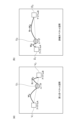
- FIG. 5 is a diagram explaining correction of the position of the user feature vector.
- (a) of FIG. 5 is a diagram illustrating correction of the position of the user feature vector in the appearance vector space.
- “item A” indicates the position of appearance feature vector V1 of smartphone C1
- “item B” indicates the position of appearance feature vector V3 of smartphone C3
- “item B” indicates the position of appearance feature vector V3 of smartphone C3.
- ” indicates the position of the user feature vector U1 .
- the correction unit 15 corrects the position of the user feature vector U1 in the appearance vector space using the weighting wv based on the appearance preference information.
- the correction unit 15 corrects the position of the user feature vector U1 in the appearance vector space using the following equation (1). ⁇ wv * V1 +(n ⁇ wv )* V3 ⁇ /n (1)
- the position of the user feature vector U1 is corrected using the equation (1) to be the point of internal division between the position of the appearance feature vector V1 and the position of the appearance feature vector V3 , and the appearance preference information is It becomes a position considering the weighting based on.
- the correction unit 15 defines the initial position of the user feature vector U1 by using equation (1).
- the correction unit 15 stores the information of the user feature vector U1 in the appearance vector space in the storage unit 11 .
- FIG. 5 is a diagram illustrating correction of the position of the user feature vector in the detailed sentence vector space.
- “item A” indicates the position of detailed sentence feature vector D1 of smartphone C1
- “item B” indicates the position of detailed sentence feature vector D3 of smartphone C3
- "User” indicates the position of the user feature vector U2 .
- the correction unit 15 corrects the position of the user feature vector U2 in the detailed sentence vector space using weighting wd based on the detailed sentence preference information.
- the correction unit 15 corrects the position of the user feature vector U2 in the detailed sentence vector space using the following equation (2). ⁇ w d *D 1 +(n ⁇ w d )*D 3 ⁇ /n (2)
- the position of the user feature vector U2 is corrected using Equation (2) to be the point of internal division between the positions of the detailed sentence feature vector D1 and the position of the detailed sentence feature vector D3 . It is a position that considers weighting based on preference information.
- the correction unit 15 defines the initial position of the user feature vector U2 by using equation (2).
- the correction unit 15 stores the information of the user feature vector U2 in the detailed sentence vector space in the storage unit 11.
- the calculation unit 16 calculates the score of each of the plurality of contents based on the separation distance between the position of the user feature vector and the position of the content feature vector of the plurality of contents in the vector space. For example, the calculation unit 16 calculates the separation distance SV between the position of the user feature vector and the position of the content feature vector of certain content in the appearance vector space. The calculation unit 16 also calculates the separation distance SD between the position of the user feature vector and the position of the content feature vector of certain content in the detailed sentence vector space. The calculation unit 16 adds the distance S V in the appearance vector space and the distance S D in the detailed sentence vector space to calculate a score (S V +S D ). The smaller the score, the closer the position of the user feature vector and the position of the content feature vector in the vector space.
- the output unit 17 outputs the recommendation result of the content selected based on the score. For example, the output unit 17 selects one or a plurality of contents in ascending order of score from a plurality of contents, and transmits the recommendation result of the selected contents to the user terminal 30 .
- the acquisition unit 13 acquires information indicating a plurality of favorite contents selected by the user from among a plurality of contents (step S1). For example, the acquisition unit 13 acquires information indicating a plurality of favorite contents selected by the user via the product selection screen G1 shown in FIG. For example, the acquisition unit 13 acquires information indicating two favorite contents as information indicating a plurality of favorite contents.
- the acquisition unit 13 acquires preference information indicating the user's preference for each of a plurality of favorite contents inputted by comparing a plurality of favorite contents with each other (step S2). For example, the acquisition unit 13 acquires the preference information input by the user via the comparison screen G2 shown in FIG. For example, the acquiring unit 13 acquires appearance preference information as preference information regarding appearance. Further, the acquisition unit 13 acquires detailed sentence preference information as the preference information regarding the detailed sentence.
- step S3 If the user feature vector exists in the appearance vector space (YES in step S3), the process proceeds to step S5. If the user feature vector does not exist in the appearance vector space (NO in step S3), the process proceeds to step S4.
- the correction unit 15 defines user feature vectors in the appearance vector space (step S4).
- the correction unit 15 defines the initial position of the user feature vector to be the point of internal division between the positions of the content feature vectors of the two favorite contents, which is weighted based on the appearance preference information.
- the correction unit 15 defines the initial position of the user feature vector by Equation (1).
- the learning unit 14 learns so that the position of the user feature vector and the positions of the appearance feature vectors of the plurality of favorite contents are close to each other in the appearance vector space (step S5).
- the correction unit 15 corrects the position of the user feature vector in the appearance vector space using weighting based on the appearance preference information (step S6). For example, the correcting unit 15 corrects the position of the user feature vector to a position that is an internal dividing point of the positions of the content feature vectors of the two favorite contents and is weighted based on the appearance preference information. In one example, the correction unit 15 corrects the position of the user feature vector using Equation (1).
- step S7 If the user feature vector exists in the detailed sentence vector space (YES in step S7), the process proceeds to step S9. If no user feature vector exists in the detailed sentence vector space (NO in step S7), the process proceeds to step S8.
- the correction unit 15 defines user feature vectors in the detailed sentence vector space (step S8).
- the correction unit 15 defines the initial position of the user feature vector to be the point of internal division between the positions of the content feature vectors of the two favorite contents, which is weighted based on the detailed sentence preference information.
- the correction unit 15 defines the initial position of the user feature vector by Equation (2).
- the learning unit 14 learns so that the position of the user feature vector and the positions of the detailed sentence feature vectors of the plurality of favorite contents are close to each other in the detailed sentence vector space (step S9).
- the correction unit 15 corrects the position of the user feature vector in the detailed sentence vector space using weighting based on the detailed sentence preference information (step S10). For example, the correction unit 15 corrects the position of the user feature vector to a position that is an internal dividing point of the positions of the content feature vectors of the two favorite contents and that is weighted based on the detailed sentence preference information. In one example, the correction unit 15 corrects the position of the user feature vector using Equation (2).
- the calculation unit 16 calculates the score of each of the plurality of contents based on the separation distance between the position of the user feature vector and the position of the content feature vector of the plurality of contents in the vector space (step S11).
- the output unit 17 outputs the recommendation result of the content selected based on the score (step S12).
- the recommendation device 10 stores a content feature vector indicating a content feature for each of a plurality of contents, and a storage unit 11 for storing a user feature vector indicating a user feature.
- an acquisition unit 13 for acquiring information indicating a plurality of favorite contents selected by the user and preference information indicating a user's preference for each of the plurality of favorite contents inputted by comparing the plurality of favorite contents with each other;
- a learning unit 14 that learns so that the position of a user feature vector and the position of a content feature vector of a plurality of favorite contents are close to each other in a vector space in which content feature vectors of a plurality of contents and user feature vectors are indicated;
- a correction unit 15 that corrects the position of the user feature vector in the vector space using weighting based on a plurality of and an output unit 17 for outputting the recommendation result of the content selected based on the score.
- the recommendation device 10 information indicating a plurality of favorite contents selected by the user is acquired, and each of the plurality of favorite contents input by the user comparing the plurality of favorite contents. is acquired. Furthermore, learning is performed so that the position of the user feature vector and the position of the content feature vectors of a plurality of favorite contents are closer in the vector space, and the position of the user feature vector is corrected using weighting based on preference information. Then, a score is calculated based on the distance between the position of the user feature vector and the position of each content feature vector, and a recommendation result of content selected based on the score is output.
- the favorite content is selected by the user from a plurality of contents, and the favorite contents are compared to obtain the user's preference information, thereby making it possible to appropriately grasp the preference information that differs for each user. Become. Then, in addition to learning so that the position of the user feature vector and the position of the content feature vector of the favorite content are closer to each other, the position of the user feature vector is corrected using the above-described weighting based on the preference information, and the vector By selecting the recommendation target based on the spatial distance, it is possible to fully reflect the user's taste and recommend content that matches the user's taste.
- the storage unit 11 stores appearance feature vectors as content feature vectors indicating the appearance features of each of a plurality of pieces of content.
- the acquisition unit 13 acquires appearance preference information as preference information regarding appearance.
- the learning unit 14 learns so that the position of the user feature vector and the position of the appearance feature vector of the plurality of favorite contents are brought closer in the appearance vector space, which is a vector space in which the appearance feature vectors of the plurality of contents are indicated.
- the correction unit 15 corrects the position of the user feature vector in the appearance vector space using weighting based on the appearance preference information. According to such a configuration, preference information regarding appearance is reflected in the position of the user feature vector. As a result, preference information that differs from user to user can be captured more appropriately.
- the storage unit 11 stores detailed sentence feature vectors as content feature vectors indicating features of detailed sentences of each of a plurality of contents.
- the acquisition unit 13 acquires detailed sentence preference information as the preference information on the detailed sentence.
- the learning unit 14 learns so that the position of the user feature vector and the position of the detailed sentence feature vector of the plurality of favorite contents are close to each other in the detailed sentence vector space, which is a vector space in which the detailed sentence feature vectors of the plurality of contents are indicated. do.
- the correction unit 15 corrects the position of the user feature vector in the detailed sentence vector space using weighting based on the detailed sentence preference information. According to such a configuration, the preference information regarding the detailed sentence is reflected in the position of the user feature vector. As a result, preference information that differs from user to user can be captured more appropriately.
- the acquisition unit 13 acquires information indicating two favorite contents as information indicating a plurality of favorite contents.
- the correcting unit 15 corrects the position of the user feature vector to a position that is an internal dividing point of the positions of the content feature vectors of the two favorite contents and is weighted based on the preference information. According to such a configuration, the position of the user feature vector is corrected between the positions of the content feature vectors of the two favorite contents.
- the user's preference information is leaning towards.
- the user can specify an abstract preference such as "If anything, I prefer this product.” Therefore, preference information that differs from user to user can be captured more appropriately.
- the preference information may be expressed using a stepwise bias.
- the user terminal 30 may accept an input in which the appearance preference information and the detailed sentence preference information are evaluated in n levels, as in the comparison screen G2 shown in FIG. This allows the user to visually adjust the distance between favorite content. Furthermore, user preference analysis is facilitated.
- preference information may be either one, different preference information, or a combination thereof.
- the calculation unit 16 calculates the score (S V +S D ) by adding the distance S V in the visual vector space and the distance S D in the detailed sentence vector space. may be performed.
- the acquisition unit 13 may further acquire importance information indicating whether the user emphasizes the appearance or detailed sentences of the content.
- the importance information may be a fixed value or a variable.
- the calculation unit 16 may calculate the score using weighting based on the importance information.
- each functional block may be implemented using one device physically or logically coupled, or directly or indirectly using two or more physically or logically separated devices (e.g. , wired, wireless, etc.) and may be implemented using these multiple devices.
- a functional block may be implemented by combining software in the one device or the plurality of devices.
- Functions include judging, determining, determining, calculating, calculating, processing, deriving, examining, searching, checking, receiving, transmitting, outputting, accessing, resolving, selecting, choosing, establishing, comparing, assuming, expecting, assuming, Broadcasting, notifying, communicating, forwarding, configuring, reconfiguring, allocating, mapping, assigning, etc.
- a functional block (component) that performs transmission is called a transmitting unit or transmitter. In either case, as described above, the implementation method is not particularly limited.
- the recommendation device 10 may function as a computer that performs information processing of the present disclosure.
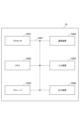
- FIG. 7 is a diagram illustrating an example of a hardware configuration of the recommendation device 10 according to an embodiment of the present disclosure.
- the recommendation device 10 described above may be physically configured as a computer device including a processor 1001, a memory 1002, a storage 1003, a communication device 1004, an input device 1005, an output device 1006, a bus 1007, and the like.
- the hardware configuration of the user terminal 30 may be the one described here.
- the term "apparatus” can be read as a circuit, device, unit, or the like.
- the hardware configuration of the recommendation device 10 may be configured to include one or more of each device shown in the figure, or may be configured without including some of the devices.
- Each function in the recommendation device 10 is performed by causing the processor 1001 to perform calculations, controlling communication by the communication device 1004, controlling communication by the communication device 1004, and controlling the and by controlling at least one of reading and writing of data in the storage 1003 .
- the processor 1001 for example, operates an operating system and controls the entire computer.
- the processor 1001 may be configured by a central processing unit (CPU) including an interface with peripheral devices, a control device, an arithmetic device, registers, and the like.
- CPU central processing unit
- each function in the recommendation device 10 described above may be implemented by the processor 1001 .
- the processor 1001 reads programs (program codes), software modules, data, etc. from at least one of the storage 1003 and the communication device 1004 to the memory 1002, and executes various processes according to them.
- programs program codes
- software modules software modules
- data etc.
- the program a program that causes a computer to execute at least part of the operations described in the above embodiments is used.
- each function of the recommendation device 10 may be implemented by a control program stored in the memory 1002 and running on the processor 1001 .
- FIG. Processor 1001 may be implemented by one or more chips.
- the program may be transmitted from a network via an electric communication line.
- the memory 1002 is a computer-readable recording medium, and is composed of at least one of, for example, ROM (Read Only Memory), EPROM (Erasable Programmable ROM), EEPROM (Electrically Erasable Programmable ROM), RAM (Random Access Memory), etc. may be
- ROM Read Only Memory
- EPROM Erasable Programmable ROM
- EEPROM Electrical Erasable Programmable ROM
- RAM Random Access Memory
- the memory 1002 may also be called a register, cache, main memory (main storage device), or the like.
- the memory 1002 can store executable programs (program code), software modules, etc. for performing information processing according to an embodiment of the present disclosure.
- the storage 1003 is a computer-readable recording medium, for example, an optical disc such as a CD-ROM (Compact Disc ROM), a hard disk drive, a flexible disc, a magneto-optical disc (for example, a compact disc, a digital versatile disc, a Blu-ray disk), smart card, flash memory (eg, card, stick, key drive), floppy disk, magnetic strip, and/or the like.
- Storage 1003 may also be called an auxiliary storage device.
- a storage medium included in the recommendation device 10 may be, for example, a database including at least one of the memory 1002 and the storage 1003, a server, or other suitable medium.
- the communication device 1004 is hardware (transmitting/receiving device) for communicating between computers via at least one of a wired network and a wireless network, and is also called a network device, a network controller, a network card, a communication module, or the like.
- the input device 1005 is an input device (for example, keyboard, mouse, microphone, switch, button, sensor, etc.) that receives input from the outside.
- the output device 1006 is an output device (eg, display, speaker, LED lamp, etc.) that outputs to the outside. Note that the input device 1005 and the output device 1006 may be integrated (for example, a touch panel).
- Each device such as the processor 1001 and the memory 1002 is connected by a bus 1007 for communicating information.
- the bus 1007 may be configured using a single bus, or may be configured using different buses between devices.
- the recommendation device 10 includes hardware such as a microprocessor, a digital signal processor (DSP), an ASIC (Application Specific Integrated Circuit), a PLD (Programmable Logic Device), and an FPGA (Field Programmable Gate Array).
- DSP digital signal processor
- ASIC Application Specific Integrated Circuit
- PLD Physical Location Deposition
- FPGA Field Programmable Gate Array
- processor 1001 may be implemented using at least one of these pieces of hardware.
- Input/output information may be stored in a specific location (for example, memory) or managed using a management table. Input/output information and the like can be overwritten, updated, or appended. The output information and the like may be deleted. The entered information and the like may be transmitted to another device.
- the determination may be made by a value represented by one bit (0 or 1), by a true/false value (Boolean: true or false), or by numerical comparison (for example, a predetermined value).
- notification of predetermined information is not limited to being performed explicitly, but may be performed implicitly (for example, not notifying the predetermined information). good too.
- Software whether referred to as software, firmware, middleware, microcode, hardware description language or otherwise, includes instructions, instruction sets, code, code segments, program code, programs, subprograms, and software modules. , applications, software applications, software packages, routines, subroutines, objects, executables, threads of execution, procedures, functions, and the like.
- system and “network” used in this disclosure are used interchangeably.
- information, parameters, etc. described in the present disclosure may be expressed using absolute values, may be expressed using relative values from a predetermined value, or may be expressed using other corresponding information. may be represented.
- determining and “determining” used in this disclosure may encompass a wide variety of actions.
- “Judgement” and “determination” are, for example, judging, calculating, computing, processing, deriving, investigating, looking up, searching, inquiring (eg, lookup in a table, database, or other data structure);
- "judgment” and “determination” are used for receiving (e.g., receiving information), transmitting (e.g., transmitting information), input, output, access (accessing) (for example, accessing data in memory) may include deeming that a "judgment” or “decision” has been made.
- judgment and “decision” are considered to be “judgment” and “decision” by resolving, selecting, choosing, establishing, comparing, etc. can contain.
- judgment and “decision” may include considering that some action is “judgment” and “decision”.
- judgment (decision) may be read as “assuming”, “expecting”, “considering”, or the like.
- connection means any direct or indirect connection or coupling between two or more elements, It can include the presence of one or more intermediate elements between two elements being “connected” or “coupled.” Couplings or connections between elements may be physical, logical, or a combination thereof. For example, “connection” may be read as "access”.
- two elements are defined using at least one of one or more wires, cables, and printed electrical connections and, as some non-limiting and non-exhaustive examples, in the radio frequency domain. , electromagnetic energy having wavelengths in the microwave and optical (both visible and invisible) regions, and the like.
- any reference to elements using the "first,” “second,” etc. designations used in this disclosure does not generally limit the quantity or order of those elements. These designations may be used in this disclosure as a convenient method of distinguishing between two or more elements. Thus, reference to a first and second element does not imply that only two elements can be employed or that the first element must precede the second element in any way.
- a and B are different may mean “A and B are different from each other.”
- the term may also mean that "A and B are different from C”.
- Terms such as “separate,” “coupled,” etc. may also be interpreted in the same manner as “different.”
Landscapes
- Business, Economics & Management (AREA)
- Engineering & Computer Science (AREA)
- Accounting & Taxation (AREA)
- Finance (AREA)
- Theoretical Computer Science (AREA)
- Physics & Mathematics (AREA)
- General Physics & Mathematics (AREA)
- General Business, Economics & Management (AREA)
- Strategic Management (AREA)
- Marketing (AREA)
- Economics (AREA)
- Development Economics (AREA)
- Databases & Information Systems (AREA)
- Computational Linguistics (AREA)
- Data Mining & Analysis (AREA)
- General Engineering & Computer Science (AREA)
- Information Retrieval, Db Structures And Fs Structures Therefor (AREA)
Priority Applications (2)
| Application Number | Priority Date | Filing Date | Title |
|---|---|---|---|
| JP2023559476A JP7664413B2 (ja) | 2021-11-15 | 2022-10-05 | レコメンド装置 |
| US18/709,656 US20250005647A1 (en) | 2021-11-15 | 2022-10-05 | Recommendation device |
Applications Claiming Priority (2)
| Application Number | Priority Date | Filing Date | Title |
|---|---|---|---|
| JP2021185393 | 2021-11-15 | ||
| JP2021-185393 | 2021-11-15 |
Publications (1)
| Publication Number | Publication Date |
|---|---|
| WO2023084954A1 true WO2023084954A1 (ja) | 2023-05-19 |
Family
ID=86335572
Family Applications (1)
| Application Number | Title | Priority Date | Filing Date |
|---|---|---|---|
| PCT/JP2022/037338 Ceased WO2023084954A1 (ja) | 2021-11-15 | 2022-10-05 | レコメンド装置 |
Country Status (3)
| Country | Link |
|---|---|
| US (1) | US20250005647A1 (https=) |
| JP (1) | JP7664413B2 (https=) |
| WO (1) | WO2023084954A1 (https=) |
Cited By (1)
| Publication number | Priority date | Publication date | Assignee | Title |
|---|---|---|---|---|
| CN119166869A (zh) * | 2024-08-07 | 2024-12-20 | 中国标准化研究院 | 一种基于大数据的消费者偏好行为信息推荐方法及系统 |
Citations (3)
| Publication number | Priority date | Publication date | Assignee | Title |
|---|---|---|---|---|
| JP2019113945A (ja) * | 2017-12-21 | 2019-07-11 | ヤフー株式会社 | 情報処理装置、情報処理方法、およびプログラム |
| JP2020154784A (ja) * | 2019-03-20 | 2020-09-24 | 富士通株式会社 | アイテム提示方法、アイテム提示プログラムおよびアイテム提示装置 |
| JP2021157442A (ja) * | 2020-03-26 | 2021-10-07 | 大阪瓦斯株式会社 | サービス提供体推薦システム |
Family Cites Families (4)
| Publication number | Priority date | Publication date | Assignee | Title |
|---|---|---|---|---|
| US20130325627A1 (en) * | 2012-06-01 | 2013-12-05 | Kurt L. Kimmerling | System and method for eliciting information |
| US11188831B2 (en) * | 2017-10-27 | 2021-11-30 | Amazon Technologies, Inc. | Artificial intelligence system for real-time visual feedback-based refinement of query results |
| US10949471B2 (en) * | 2018-01-04 | 2021-03-16 | Facebook, Inc. | Generating catalog-item recommendations based on social graph data |
| CN114691973B (zh) * | 2020-12-31 | 2025-04-01 | 华为技术有限公司 | 一种推荐方法、推荐网络及相关设备 |
-
2022
- 2022-10-05 JP JP2023559476A patent/JP7664413B2/ja active Active
- 2022-10-05 US US18/709,656 patent/US20250005647A1/en active Pending
- 2022-10-05 WO PCT/JP2022/037338 patent/WO2023084954A1/ja not_active Ceased
Patent Citations (3)
| Publication number | Priority date | Publication date | Assignee | Title |
|---|---|---|---|---|
| JP2019113945A (ja) * | 2017-12-21 | 2019-07-11 | ヤフー株式会社 | 情報処理装置、情報処理方法、およびプログラム |
| JP2020154784A (ja) * | 2019-03-20 | 2020-09-24 | 富士通株式会社 | アイテム提示方法、アイテム提示プログラムおよびアイテム提示装置 |
| JP2021157442A (ja) * | 2020-03-26 | 2021-10-07 | 大阪瓦斯株式会社 | サービス提供体推薦システム |
Cited By (1)
| Publication number | Priority date | Publication date | Assignee | Title |
|---|---|---|---|---|
| CN119166869A (zh) * | 2024-08-07 | 2024-12-20 | 中国标准化研究院 | 一种基于大数据的消费者偏好行为信息推荐方法及系统 |
Also Published As
| Publication number | Publication date |
|---|---|
| JPWO2023084954A1 (https=) | 2023-05-19 |
| JP7664413B2 (ja) | 2025-04-17 |
| US20250005647A1 (en) | 2025-01-02 |
Similar Documents
| Publication | Publication Date | Title |
|---|---|---|
| KR101982081B1 (ko) | 대응 메시지 추천 시스템 | |
| CN111292168B (zh) | 数据处理方法、装置及设备 | |
| JP7103957B2 (ja) | データ生成装置 | |
| US20250166026A1 (en) | Product reviews generation and analysis platform | |
| US20250335493A1 (en) | Systems and methods for generating interactable elements in text strings relating to media assets | |
| JP7664413B2 (ja) | レコメンド装置 | |
| JP2022026683A (ja) | レコメンド装置 | |
| JP7728805B2 (ja) | 情報処理装置 | |
| US12052474B2 (en) | Systems and methods for generating interactable elements in text strings relating to media assets | |
| US11768867B2 (en) | Systems and methods for generating interactable elements in text strings relating to media assets | |
| US20230351436A1 (en) | Advertising effect prediction device | |
| US12105759B2 (en) | Recommendation system that selects an optimal algorithm for making an appropriate content recommendation to a user | |
| CN110727853A (zh) | 向用户呈现控制的异构数字内容 | |
| JP7705861B2 (ja) | レコメンドシステム | |
| JP7809798B2 (ja) | 興味推定装置 | |
| US20240428289A1 (en) | Region value evaluation system | |
| US20250021158A1 (en) | Recommendation device | |
| WO2023188808A1 (ja) | レコメンドシステム | |
| JP7737404B2 (ja) | 情報処理装置 | |
| CN114021000B (zh) | 商品推荐的方法及装置、存储介质、电子设备 | |
| WO2021186892A1 (ja) | 翻訳文章算出装置 | |
| TWI870874B (zh) | 處理商品銷售註冊請求之方法及電子裝置 | |
| WO2025243472A1 (ja) | 装置及び方法 | |
| US20240135407A1 (en) | Information processing device | |
| WO2025177468A1 (ja) | 端末及び方法 |
Legal Events
| Date | Code | Title | Description |
|---|---|---|---|
| 121 | Ep: the epo has been informed by wipo that ep was designated in this application |
Ref document number: 22892454 Country of ref document: EP Kind code of ref document: A1 |
|
| WWE | Wipo information: entry into national phase |
Ref document number: 2023559476 Country of ref document: JP |
|
| WWE | Wipo information: entry into national phase |
Ref document number: 18709656 Country of ref document: US |
|
| 122 | Ep: pct application non-entry in european phase |
Ref document number: 22892454 Country of ref document: EP Kind code of ref document: A1 |