WO2023084874A1 - 人口状態判定システム及びモデル生成システム - Google Patents
人口状態判定システム及びモデル生成システム Download PDFInfo
- Publication number
- WO2023084874A1 WO2023084874A1 PCT/JP2022/032591 JP2022032591W WO2023084874A1 WO 2023084874 A1 WO2023084874 A1 WO 2023084874A1 JP 2022032591 W JP2022032591 W JP 2022032591W WO 2023084874 A1 WO2023084874 A1 WO 2023084874A1
- Authority
- WO
- WIPO (PCT)
- Prior art keywords
- population
- encoder
- model
- learning
- information
- Prior art date
- Legal status (The legal status is an assumption and is not a legal conclusion. Google has not performed a legal analysis and makes no representation as to the accuracy of the status listed.)
- Ceased
Links
Images




Classifications
-
- G—PHYSICS
- G06—COMPUTING OR CALCULATING; COUNTING
- G06N—COMPUTING ARRANGEMENTS BASED ON SPECIFIC COMPUTATIONAL MODELS
- G06N3/00—Computing arrangements based on biological models
- G06N3/02—Neural networks
- G06N3/04—Architecture, e.g. interconnection topology
- G06N3/045—Combinations of networks
- G06N3/0455—Auto-encoder networks; Encoder-decoder networks
-
- G—PHYSICS
- G06—COMPUTING OR CALCULATING; COUNTING
- G06N—COMPUTING ARRANGEMENTS BASED ON SPECIFIC COMPUTATIONAL MODELS
- G06N3/00—Computing arrangements based on biological models
- G06N3/02—Neural networks
- G06N3/04—Architecture, e.g. interconnection topology
- G06N3/045—Combinations of networks
-
- G—PHYSICS
- G06—COMPUTING OR CALCULATING; COUNTING
- G06Q—INFORMATION AND COMMUNICATION TECHNOLOGY [ICT] SPECIALLY ADAPTED FOR ADMINISTRATIVE, COMMERCIAL, FINANCIAL, MANAGERIAL OR SUPERVISORY PURPOSES; SYSTEMS OR METHODS SPECIALLY ADAPTED FOR ADMINISTRATIVE, COMMERCIAL, FINANCIAL, MANAGERIAL OR SUPERVISORY PURPOSES, NOT OTHERWISE PROVIDED FOR
- G06Q10/00—Administration; Management
- G06Q10/04—Forecasting or optimisation specially adapted for administrative or management purposes, e.g. linear programming or "cutting stock problem"
Definitions
- the present invention relates to a population status determination system that determines the population status of an area and a model generation system that generates an encoder/decoder model.
- Patent Document 1 Conventionally, techniques have been proposed for estimating the population for each area and time period using data from mobile terminals such as mobile phones (see Patent Document 1, for example).
- Population anomaly detection methods include statistical methods based on the average and variance of the population in an area and time period. This method can detect anomalies in a certain area and time period. However, this method does not take population transitions into account and cannot always detect abnormalities with high accuracy.
- One embodiment of the present invention has been made in view of the above, and aims to provide a population state determination system that can appropriately determine the population state, and a model generation system related to population determination.
- a population state determination system includes an acquisition unit that acquires population information indicating the time-series population of an area whose population state is to be determined; inputting the population information acquired by to a pre-stored encoder/decoder model that compresses and restores the input data, performs a computation, and obtains an output from the encoder/decoder model; a determination unit that compares the acquired population information with the output obtained by the model calculation unit to determine the state of the population of the area.
- the population status determination system it is possible to determine the population status in consideration of the time-series population of an area. Also, the input to the encoder-decoder model is compared with the output to make a decision. Therefore, according to the population condition determination system according to one embodiment of the present invention, the population condition can be appropriately determined.
- the model generation system includes a learning acquisition unit that acquires learning population information indicating time-series population, which is used to generate an encoder/decoder model that compresses and restores input data. and a model generation unit that performs machine learning based on the learning population information acquired by the learning acquisition unit and generates an encoder/decoder model for inputting information indicating time-series population.
- model generation system it is possible to generate an encoder/decoder model used in the population state determination system.
- the state of population can be determined appropriately.
- FIG. 3 is a graph of an example of population information and an output value from an encoder/decoder model when the population information is used as an input value;
- FIG. 2 is a diagram showing an example of information used by a computer;
- FIG. 2 is a diagram schematically illustrating an example of an encoder-decoder model generated and used by a computer;
- FIG. 2 schematically illustrates another example of a computer-generated and used encoder-decoder model;
- FIG. 2 is a diagram showing an example of information used by a computer;
- FIG. 4 is a flow chart showing processing executed by the model generation system according to the embodiment of the present invention. It is a flowchart which shows the process performed with the population state determination system which concerns on embodiment of this invention. It is a figure which shows the hardware constitutions of the computer which is the population state determination system and model generation system which concern on embodiment of this invention.
- FIG. 1 shows a computer 1 that is a population state determination system 10 and a model generation system 20 according to this embodiment.
- the population condition determination system 10 is a system (apparatus) that determines (estimates) the population condition of a geographical area.
- the area to be determined is, for example, a 500 m square area that divides a region. A standard area mesh or a half area mesh may be used as the area. Also, as the area, administrative divisions such as municipalities or prefectures, or preset land use divisions may be used. In the following description, areas are described as meshes. Note that the area to be determined does not have to be the above, and can be any geographical area.
- the determination by the population state determination system 10 is made based on population information that indicates the chronological population of the area to be determined. For example, for the determination, population information indicating the population for each hour on a day basis is used as described later.
- the determination is, for example, whether or not the population in the determination target area is in an abnormal state different from normal. That is, the determination is to detect an abnormality in the population transition in the determination target area.
- An abnormal state in which the population is different from normal is, for example, a state in which population transition is excessively different from normal population transition.
- the determination by the population state determination system 10 may be a determination of the degree of abnormality instead of determination of whether or not the state is abnormal.
- the determination by the population condition determination system 10 may be other than the above as long as it is the determination of the population condition of the area.
- determination by the population state determination system 10 is performed by performing calculations on population information using encoder/decoder models, which are trained models generated by machine learning.
- the encoder/decoder model is a model that compresses and restores input data.
- the model generation system 20 generates an encoder/decoder model used for determination by the population state determination system 10 .
- a conventional computer can be used as the computer 1, which is the population state determination system 10 and the model generation system 20 according to the present embodiment.
- the computer 1 may be a computer system including a plurality of computers.
- the model generation system 20 includes a learning acquisition unit 21 and a model generation unit 22 .
- the learning acquisition unit 21 is a functional unit that acquires learning population information indicating time-series population, which is used to generate an encoder/decoder model.
- the acquisition unit for learning 21 may acquire type information for learning indicating the type of area related to the population information for learning.
- the acquisition unit for learning 21 may acquire the type information for learning by performing clustering using the population information for learning.
- the acquisition unit for learning 21 acquires each information as follows.
- Individual learning population information is information in the same format as the population information used to determine population status.
- the population information is information indicating the population of an area for each hour of the day (0:00, 1:00, . . . , 23:00).
- FIG. 2 shows part of a graph G1 as an example of population information.
- the population status determination system 10 determines the population status of the determination target area on that day.
- the time period (1 day in the above example), the time interval (1 hour in the above example), and the format of the population information for the entire population information to be determined need not necessarily be the above.
- a large amount of learning population information is used to generate the encoder/decoder model.
- a large amount of training population information usually includes training population information for multiple areas.
- the acquisition unit for learning 21 acquires, for example, the data shown in FIG. 3(a).
- the data shown in FIG. 3(a) includes a mesh code (information in the "meshcode” column), information indicating the time (information in the "timestamp” column), and information indicating the population (information in the "population” column). This is associated information.
- a mesh code is information such as a character string that specifies a mesh that is an area, and is set in advance for each area.
- Information indicating the time is, for example, information indicating the date and time of the day.
- the information indicating the population indicates the population in the area and time indicated by the information indicating the corresponding mesh code and time.
- the population-related data shown in FIG. 3(a) is generated, for example, by an existing method as spatial statistical information from information indicating the location of mobile phones and information registered about subscribers of mobile phones. Also, the population data shown in FIG. 3A may be generated by any method other than the above.
- the learning acquisition unit 21 acquires population data shown in FIG.
- the acquisition unit 21 for learning acquires the acquired data as shown in FIG. Format data into daily population transition data in units. This population transition data corresponds to learning population information.
- the acquisition unit for learning 21 acquires a sufficient number of population transition data for generating an encoder/decoder model by machine learning.
- the population transition data may or may not include data of an area whose population state is to be determined. Note that the acquisition unit for learning 21 may acquire information indicating time-series population other than the above as population information for learning.
- the acquisition unit for learning 21 may acquire type information for learning indicating the type of area related to population transition data.
- the type of area is a type that can affect the population transition in the area.
- the type of area is a city type such as "office district” and "residential district.”
- the learning acquisition unit 21 acquires learning type information stored in advance in a database of the computer 1 or other device.
- FIG. 3(c) shows an example of data that is pre-stored learning type information.
- the data shown in FIG. 3(c) includes a mesh code (information in the "meshcode” column), information indicating the city type (information in the "city type” column), and a type code (information in the "type code” column). is associated information.
- the information indicating the city type is information indicating the meaning of the area type indicated by the corresponding mesh code.
- Information indicating the city type is set in advance for each area. Note that the information indicating the city type need not be used in the processing in the model generation system 20, so it does not have to be acquired.
- a type code is information (a flag indicating an area) that specifies the type of area indicated by the corresponding mesh code, and is set in advance for each area.
- the type code is a numerical value that can be used for machine learning.
- the type code has the same numerical value for the same city type, and a different numerical value for different city types.
- the acquisition unit for learning 21 acquires the type code corresponding to the mesh code of the area related to the population transition data as the type information for learning.
- the acquisition unit 21 for learning may acquire the type information for learning by performing clustering using the population information for learning instead of acquiring the type information for learning stored in advance.
- the acquisition unit for learning 21 performs clustering using the daily population transition data for each area. For example, as described below, the acquisition unit for learning 21 performs area clustering using the daily population transition data for each area. By performing such clustering, areas with similar population transitions can be divided into clusters.
- the acquisition unit for learning 21 averages the population for each time for each area, and generates one piece of population transition data for one area. For example, the acquisition unit for learning 21 averages daily population transition data for each time during a period set in advance for each area (for example, a period from one month before the current time to the current time). Generates one piece of population transition data for each The acquisition unit for learning 21 clusters the population transition data to perform area clustering. Clustering itself may be performed by a conventional method (eg, k-means method).
- the acquisition unit for learning 21 may cluster population transition data that may include a plurality of population transition data for one area. For each area, the acquisition unit for learning 21 sets the cluster containing the most population transition data as the cluster of the area.
- the learning acquisition unit 21 assigns a different type code (cluster number) to each cluster.
- the acquisition unit 21 for learning uses the type code of the cluster to which the area belongs as the type information for learning related to the area.
- the acquisition unit 21 for learning causes the computer 1 to store the correspondence between the mesh code and the type code for each area so that the population state determination system 10 can also use it.
- clustering is performed and the classification information for learning is acquired, there is no information which shows a city classification.
- the learning acquisition unit 21 outputs the acquired learning population information to the model generation unit 22 .
- the learning acquisition section 21 also outputs the acquired learning type information to the model generating section 22 .
- the model generation unit 22 is a functional unit that performs machine learning based on the learning population information acquired by the learning acquisition unit 21 and generates an encoder/decoder model that inputs information indicating time-series population.
- the model generation unit 22 may generate an encoder/decoder model based on the learning type information acquired by the learning acquisition unit 21 .
- the model generating unit 22 may generate an encoder/decoder model to which type information indicating the type of area is also input.
- the model generation unit 22 may generate a plurality of encoder/decoder models according to type information indicating the type of area.
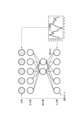
- FIG. 4 shows an example of an encoder/decoder model.
- the encoder/decoder model is composed of a neural network, which is trained to output the original population information after inputting population information that indicates the time series population of the area and performing dimension compression. It is a finished model.
- Encoder/decoder models include autoencoders (Geoffrey Hinton and Salakhutdinov Ruslan, "Reducing the dimensionality of data with neural network.” Science, pp. 504-507, 2006) or Transformers ( Ashish Vaswani et al., "Attention Is All You Need.” Advances in neural information processing system 2017), etc. can be used.
- the input layer of the encoder/decoder model is provided with as many neurons as the number of demographic information elements (the number of demographic information dimensions). If the population information is information (numerical values) indicating the population of an area for each hour of the day (0:00, 1:00, . There are 24 neurons (vectors) that input numerical values of the population of the area of .
- the output layer of the encoder/decoder model is provided with as many neurons (vectors) as the number of neurons in the input layer corresponding to each neuron in the input layer.
- the configuration of the encoder/decoder model itself may be the same as the conventional encoder/decoder model.
- a hidden layer provided with a plurality of neurons (vectors) is provided between the input layer and the output layer.
- Each neuron in the input layer and each neuron in the hidden layer are connected with a weight w used for computation.
- each neuron in the hidden layer and each neuron in the output are connected with a weight w used for computation.
- the number of neurons provided in the hidden layer is less than the number of neurons in the input and output layers. This results in dimensionality reduction in the hidden layer.
- the model generation unit 22 generates an encoder/decoder model as follows. First, an example of a mode in which the type information for learning is not used will be described, and then an example of a mode in which the type information for learning is used will be described.
- the model generation unit 22 inputs population transition data, which is population information for learning, from the learning acquisition unit 21 . As shown in FIG. 4, the model generation unit 22 performs machine learning to generate an encoder/decoder model by using population transition data as an input value to the encoder/decoder model and an output value (correct answer) of the encoder/decoder model. do.
- the machine learning itself for generating the encoder-decoder model can be performed in the same manner as conventional machine learning methods. The above is an example of the case where the learning type information is not used.
- the model generation unit 22 inputs the type code, which is the type information for learning, from the acquisition unit 21 for learning together with the population transition data.
- the model generation unit 22 generates an encoder/decoder model to which the type code is also input.
- FIG. 5 shows an example of this encoder/decoder model.
- neurons corresponding to type codes are provided in the input layer and the output layer.
- the model generating unit 22 associates the area and the daily population transition data with the type code of the area. This correspondence is performed using the mesh code as a key. As shown in FIG. 5, the model generation unit 22 inputs the associated data of population transition and the type code (data D1 shown in FIG. 6A) to the encoder/decoder model, and Machine learning is performed as the output value (correct answer) to generate an encoder/decoder model.
- the model generation unit 22 may generate a plurality of encoder/decoder models corresponding to the type code. For example, the model generation unit 22 may generate an encoder/decoder model for each type code. The model generating unit 22 uses the area of the same type code as shown in FIG. 6B and the population transition data for each day to generate one encoder/decoder model. That is, the model generation unit 22 filters the population transition data for each type code, and uses the filtered population transition data to generate the encoder/decoder model.
- the model generation unit 22 may generate an encoder/decoder model (an encoder/decoder model that does not input the type code) that inputs only the population transition data as shown in FIG.
- the model generating unit 22 generates an encoder/decoder model by performing machine learning using the population transition data as an input value to the encoder/decoder model and as an output value (correct answer) of the encoder/decoder model.
- the model generation unit 22 may generate an encoder/decoder model that inputs the type code in addition to the population transition data as shown in FIG.
- the model generating unit 22 uses the population transition data and the type code (data D2 shown in FIG. 6B) that are associated with each other as input values to the encoder/decoder model, and As an output value (correct answer), machine learning is performed to generate an encoder/decoder model.
- the model generation unit 22 performs machine learning as described above for each type code to generate an encoder/decoder model for each type code.
- the model generation unit 22 outputs the generated encoder/decoder model to the population state determination system 10 .
- the model generation unit 22 also outputs the type code corresponding to each encoder/decoder model to the population state determination system 10 .
- the above are the functions of the model generation system 20 according to the present embodiment.
- the population state determination system 10 is configured including an acquisition unit 11 , a model calculation unit 12 and a determination unit 13 .
- the acquisition unit 11 is a functional unit that acquires population information indicating the time-series population of an area whose population state is to be determined.
- the acquisition unit 11 acquires the above-described population information of the area and time zone to be determined.
- the acquisition unit 11 may acquire type information indicating the type of the area whose population state is to be determined.
- the acquisition unit 11 receives designation of an area and time period (date) to be determined from the user of the population state determination system 10, and acquires the population information related to the designated area and time period for the above-described learning purpose. It is obtained in the same manner as the learning population information is obtained by the obtaining unit 21 .
- the acquisition unit 11 may acquire type information indicating the type of the area whose population status is to be determined.
- the acquiring unit 11 acquires the same type information as the learning type information acquired by the learning acquiring unit 21 for the area related to the population information to be acquired. For example, when the acquisition unit for learning 21 acquires the type information for learning stored in advance shown in FIG. Acquire the type code corresponding to as type information.
- the acquisition unit 11 extracts the area related to the population information from the information on the correspondence between the mesh code and the type code stored in the computer 1 as a result of the clustering. Acquire the type code corresponding to the mesh code of as type information.
- the acquisition unit 11 outputs the acquired population information to the model calculation unit 12 and the determination unit 13. When acquiring type information, the acquiring unit 11 also outputs the acquired type information to the model computing unit 12 .
- the model computing unit 12 is a functional unit that inputs the population information acquired by the acquiring unit 11 to a pre-stored encoder/decoder model, performs computation, and obtains an output from the encoder/decoder model.
- the model computing unit 12 may perform computation using the encoder/decoder model based on the type information acquired by the acquiring unit 11 .
- the model calculation unit 12 may also input the type information to the encoder/decoder model and obtain an output from the encoder/decoder model.
- the model computing unit 12 may select an encoder/decoder model to be used for computation from a plurality of encoder/decoder models stored in advance based on the type information, and perform computation using the selected encoder/decoder model.
- the model calculation unit 12 receives and stores the encoder/decoder model generated by the model generation system 20 .
- the model calculation unit 12 receives population information from the acquisition unit 11 .
- the model calculation unit 12 uses the population information as an input value to the encoder/decoder model and performs calculation using the weight w of the encoder/decoder model to obtain an output value from the encoder/decoder model.
- the output value from the encoder/decoder model is the restored data of the population transition data, which is the population information, and is information in the same format as the population information.
- a graph G2 of an example of output values when the population information indicated by the graph G1 shown in FIG. 2 is used as an input value is shown.
- the model calculation unit 12 receives type information from the acquisition unit 11 and performs the following processing.
- the model generation system 20 generates an encoder/decoder model to which type information is also input, as described above.
- the model calculation unit 12 performs calculation using the weight w of the encoder/decoder model with the population information and type information as input values to the encoder/decoder model, and obtains an output value from the encoder/decoder model.
- the model generation system 20 generates a plurality of encoder/decoder models corresponding to the type code as described above.
- the model calculation unit 12 selects an encoder/decoder model corresponding to the type code, which is the input type information, from a plurality of encoder/decoder models.
- the model calculation unit 12 uses the selected encoder/decoder model to obtain an output value from the encoder/decoder model in the same manner as described above.
- the model calculation unit 12 outputs the obtained output value from the encoder/decoder model to the determination unit 13 .
- the output value output to the determination unit 13 may be only the part corresponding to the population information.
- the determination unit 13 is a functional unit that compares the population information acquired by the acquisition unit 11 and the output obtained by the model calculation unit 12 to determine the state of the population of the area.
- the determination by the determination unit 13 is, for example, whether or not the population in the determination target area is in an abnormal state different from the normal state as described above. However, if the determination can be made by comparing the population information input to the encoder/decoder model and the output from the encoder/decoder model, determination other than the above may be used.
- the determination unit 13 determines the state of the population of the area as follows.
- the determination unit 13 inputs the population information from the acquisition unit 11.
- the determination unit 13 receives the output value corresponding to the population information from the model calculation unit 12 .
- the determination unit 13 uses the input to the encoder/decoder model (data of population transition, for example, graph G1 in FIG. 2) and the output from the encoder/decoder model (restored data of the data of population transition, for example, graph G1 in FIG. 2). G2) to calculate the error as the degree of abnormality.
- the determination unit 13 calculates the absolute value of the difference between the input and the output in each hourly time period, and uses the total for all time periods as the error.
- the determination unit 13 compares the calculated error with a preset threshold. If the error is equal to or greater than the threshold, the determination unit 13 determines that the population in the determination target area is in an abnormal state. In this case, it is presumed that an event, such as an event, is occurring in the determination target area. If the error is not equal to or greater than the threshold, the determination unit 13 determines that the population in the determination target area is not in an abnormal state.
- the normal time for determination is based on the learning population information used in generating the encoder/decoder model in the model generation system 20 .
- the determination unit 13 outputs information indicating the determination result.
- the determination unit 13 may display the determination result on a display device included in the computer 1 so that the user can refer to the determination result.
- the determination unit 13 may transmit information indicating the determination result to another device.
- the determination unit 13 may output information indicating the determination result to an output destination other than the above by a method other than the above.
- learning population information is first acquired by the learning acquisition unit 21 (S01).
- learning type information is acquired by the learning acquisition unit 21 (S02).
- the model generation unit 22 performs machine learning based on the learning population information to generate an encoder/decoder model (S03).
- an encoder/decoder model is generated based on the learning type information.
- the generated encoder/decoder model is output to the population state determination system 10 and stored by the model calculation unit 12 .
- population information and type information are acquired by the acquisition unit 11 (S11).
- type information may not be acquired.
- the population information is input to the encoder/decoder model by the model calculation unit 12, calculation is performed, and an output from the encoder/decoder model is obtained (S12).
- calculation using an encoder/decoder model is performed based on the type information.
- the determination unit 13 compares the input to the encoder/decoder model and the output from the encoder/decoder model (S13). Subsequently, the determination unit 13 determines the population state of the area based on the above comparison (S14). Subsequently, information indicating the determination result is output by the determination unit 13 (S15).
- the above is the processing executed by the population state determination system 10 according to the present embodiment.
- the population state determination system 10 since time-series population information is used, it is possible to determine the state of population in consideration of the time-series population of an area. Also, the input to the encoder-decoder model is compared with the output to make a decision. Therefore, according to the population condition determination system 10 according to the present embodiment, the population condition can be accurately and appropriately determined.
- type information may be used as in the above-described embodiment.
- type information it is possible to appropriately determine the state of the population according to the characteristics of the area. For example, it is possible to make a determination considering the functional characteristics of cities such as office districts and residential districts. As a result, it is possible to perform more accurate and appropriate determinations than determinations based on average population changes that do not consider type information.
- the type information may be used as an input to the encoder/decoder model as described above.
- an encoder/decoder model to be used for calculation may be selected based on the type information. According to such a configuration, the type information can be reliably and appropriately used, and determination can be performed reliably and appropriately.
- the type information may be used in a method other than the above. Also, the type information does not necessarily have to be used.
- an encoder/decoder model used in the population state determination system 10 can be generated. Also, when generating the encoder/decoder model, the learning type information corresponding to the type information may be used. Further, the learning type information may be acquired by performing clustering using the learning population information as described above. According to this configuration, it is possible to generate an encoder/decoder model based on the type of the area and to make a determination using the encoder/decoder model, even if type information is not associated with the area in advance.
- the computer 1 includes the population state determination system 10 and the model generation system 20.
- the population state determination system 10 and the model generation system 20 are implemented independently. may be
- each functional block may be implemented using one device physically or logically coupled, or directly or indirectly using two or more physically or logically separated devices (e.g. , wired, wireless, etc.) and may be implemented using these multiple devices.
- a functional block may be implemented by combining software in the one device or the plurality of devices.
- Functions include judging, determining, determining, calculating, calculating, processing, deriving, examining, searching, checking, receiving, transmitting, outputting, accessing, resolving, selecting, choosing, establishing, comparing, assuming, expecting, assuming, Broadcasting, notifying, communicating, forwarding, configuring, reconfiguring, allocating, mapping, assigning, etc.
- a functional block (component) responsible for transmission is called a transmitting unit or transmitter. In either case, as described above, the implementation method is not particularly limited.
- the computer 1 in one embodiment of the present disclosure may function as a computer that performs information processing of the present disclosure.
- FIG. 9 is a diagram showing an example of a hardware configuration of computer 1 according to an embodiment of the present disclosure.
- the computer 1 described above may be physically configured as a computer device including a processor 1001, a memory 1002, a storage 1003, a communication device 1004, an input device 1005, an output device 1006, a bus 1007, and the like.
- the term "apparatus” can be read as a circuit, device, unit, or the like.
- the hardware configuration of the computer 1 may be configured to include one or more of each device shown in the figure, or may be configured without some of the devices.
- Each function in the computer 1 is performed by causing the processor 1001 to perform calculations, controlling communication by the communication device 1004, controlling communication by the communication device 1004, and controlling the communication by the memory 1002 and the It is realized by controlling at least one of data reading and writing in the storage 1003 .
- the processor 1001 for example, operates an operating system and controls the entire computer.
- the processor 1001 may be configured by a central processing unit (CPU) including an interface with peripheral devices, a control device, an arithmetic device, registers, and the like.
- CPU central processing unit
- each function in the computer 1 described above may be implemented by the processor 1001 .
- the processor 1001 reads programs (program codes), software modules, data, etc. from at least one of the storage 1003 and the communication device 1004 to the memory 1002, and executes various processes according to them.
- programs program codes
- software modules software modules
- data etc.
- the program a program that causes a computer to execute at least part of the operations described in the above embodiments is used.
- each function in computer 1 may be implemented by a control program stored in memory 1002 and running in processor 1001 .
- FIG. Processor 1001 may be implemented by one or more chips.
- the program may be transmitted from a network via an electric communication line.
- the memory 1002 is a computer-readable recording medium, and is composed of at least one of, for example, ROM (Read Only Memory), EPROM (Erasable Programmable ROM), EEPROM (Electrically Erasable Programmable ROM), RAM (Random Access Memory), etc. may be
- ROM Read Only Memory
- EPROM Erasable Programmable ROM
- EEPROM Electrical Erasable Programmable ROM
- RAM Random Access Memory
- the memory 1002 may also be called a register, cache, main memory (main storage device), or the like.
- the memory 1002 can store executable programs (program code), software modules, etc. for performing information processing according to an embodiment of the present disclosure.
- the storage 1003 is a computer-readable recording medium, for example, an optical disc such as a CD-ROM (Compact Disc ROM), a hard disk drive, a flexible disc, a magneto-optical disc (for example, a compact disc, a digital versatile disc, a Blu-ray disk), smart card, flash memory (eg, card, stick, key drive), floppy disk, magnetic strip, and/or the like.
- Storage 1003 may also be called an auxiliary storage device.
- a storage medium included in the computer 1 may be, for example, a database including at least one of the memory 1002 and the storage 1003, a server, or other suitable medium.
- the communication device 1004 is hardware (transmitting/receiving device) for communicating between computers via at least one of a wired network and a wireless network, and is also called a network device, a network controller, a network card, a communication module, or the like.
- the input device 1005 is an input device (for example, keyboard, mouse, microphone, switch, button, sensor, etc.) that receives input from the outside.
- the output device 1006 is an output device (eg, display, speaker, LED lamp, etc.) that outputs to the outside. Note that the input device 1005 and the output device 1006 may be integrated (for example, a touch panel).
- Each device such as the processor 1001 and the memory 1002 is connected by a bus 1007 for communicating information.
- the bus 1007 may be configured using a single bus, or may be configured using different buses between devices.
- the computer 1 includes hardware such as a microprocessor, a digital signal processor (DSP), an ASIC (Application Specific Integrated Circuit), a PLD (Programmable Logic Device), and an FPGA (Field Programmable Gate Array).
- DSP digital signal processor
- ASIC Application Specific Integrated Circuit
- PLD Physical Location Deposition
- FPGA Field Programmable Gate Array
- a part or all of each functional block may be implemented by the hardware.
- processor 1001 may be implemented using at least one of these pieces of hardware.
- Input/output information may be stored in a specific location (for example, memory) or managed using a management table. Input/output information and the like can be overwritten, updated, or appended. The output information and the like may be deleted. The entered information and the like may be transmitted to another device.
- the determination may be made by a value represented by one bit (0 or 1), by a true/false value (Boolean: true or false), or by numerical comparison (for example, a predetermined value).
- notification of predetermined information is not limited to being performed explicitly, but may be performed implicitly (for example, not notifying the predetermined information). good too.
- Software whether referred to as software, firmware, middleware, microcode, hardware description language or otherwise, includes instructions, instruction sets, code, code segments, program code, programs, subprograms, and software modules. , applications, software applications, software packages, routines, subroutines, objects, executables, threads of execution, procedures, functions, and the like.
- software, instructions, information, etc. may be transmitted and received via a transmission medium.
- the software uses at least one of wired technology (coaxial cable, fiber optic cable, twisted pair, digital subscriber line (DSL), etc.) and wireless technology (infrared, microwave, etc.) to website, Wired and/or wireless technologies are included within the definition of transmission medium when sent from a server or other remote source.
- wired technology coaxial cable, fiber optic cable, twisted pair, digital subscriber line (DSL), etc.
- wireless technology infrared, microwave, etc.
- system and “network” used in this disclosure are used interchangeably.
- information, parameters, etc. described in the present disclosure may be expressed using absolute values, may be expressed using relative values from a predetermined value, or may be expressed using other corresponding information. may be represented.
- determining and “determining” used in this disclosure may encompass a wide variety of actions.
- “Judgement” and “determination” are, for example, judging, calculating, computing, processing, deriving, investigating, looking up, searching, inquiring (eg, lookup in a table, database, or other data structure);
- "judgment” and “determination” are used for receiving (e.g., receiving information), transmitting (e.g., transmitting information), input, output, access (accessing) (for example, accessing data in memory) may include deeming that a "judgment” or “decision” has been made.
- judgment and “decision” are considered to be “judgment” and “decision” by resolving, selecting, choosing, establishing, comparing, etc. can contain.
- judgment and “decision” may include considering that some action is “judgment” and “decision”.
- judgment (decision) may be read as “assuming”, “expecting”, “considering”, or the like.
- connection means any direct or indirect connection or coupling between two or more elements, It can include the presence of one or more intermediate elements between two elements being “connected” or “coupled.” Couplings or connections between elements may be physical, logical, or a combination thereof. For example, “connection” may be read as "access”.
- two elements are defined using at least one of one or more wires, cables, and printed electrical connections and, as some non-limiting and non-exhaustive examples, in the radio frequency domain. , electromagnetic energy having wavelengths in the microwave and optical (both visible and invisible) regions, and the like.
- any reference to elements using the "first,” “second,” etc. designations used in this disclosure does not generally limit the quantity or order of those elements. These designations may be used in this disclosure as a convenient method of distinguishing between two or more elements. Thus, reference to a first and second element does not imply that only two elements can be employed or that the first element must precede the second element in any way.
- a and B are different may mean “A and B are different from each other.”
- the term may also mean that "A and B are different from C”.
- Terms such as “separate,” “coupled,” etc. may also be interpreted in the same manner as “different.”
Landscapes
- Engineering & Computer Science (AREA)
- Theoretical Computer Science (AREA)
- Physics & Mathematics (AREA)
- General Physics & Mathematics (AREA)
- Software Systems (AREA)
- Health & Medical Sciences (AREA)
- Biophysics (AREA)
- Computational Linguistics (AREA)
- Data Mining & Analysis (AREA)
- Evolutionary Computation (AREA)
- General Health & Medical Sciences (AREA)
- Molecular Biology (AREA)
- Computing Systems (AREA)
- General Engineering & Computer Science (AREA)
- Artificial Intelligence (AREA)
- Mathematical Physics (AREA)
- Life Sciences & Earth Sciences (AREA)
- Biomedical Technology (AREA)
- Business, Economics & Management (AREA)
- Human Resources & Organizations (AREA)
- Economics (AREA)
- Strategic Management (AREA)
- Entrepreneurship & Innovation (AREA)
- Game Theory and Decision Science (AREA)
- Development Economics (AREA)
- Marketing (AREA)
- Operations Research (AREA)
- Quality & Reliability (AREA)
- Tourism & Hospitality (AREA)
- General Business, Economics & Management (AREA)
- Management, Administration, Business Operations System, And Electronic Commerce (AREA)
- Information Retrieval, Db Structures And Fs Structures Therefor (AREA)
Priority Applications (2)
| Application Number | Priority Date | Filing Date | Title |
|---|---|---|---|
| JP2023559437A JP7692496B2 (ja) | 2021-11-15 | 2022-08-30 | 人口状態判定システム及びモデル生成システム |
| US18/703,771 US20250124260A1 (en) | 2021-11-15 | 2022-08-30 | Population state determination system and model generation system |
Applications Claiming Priority (2)
| Application Number | Priority Date | Filing Date | Title |
|---|---|---|---|
| JP2021185665 | 2021-11-15 | ||
| JP2021-185665 | 2021-11-15 |
Publications (1)
| Publication Number | Publication Date |
|---|---|
| WO2023084874A1 true WO2023084874A1 (ja) | 2023-05-19 |
Family
ID=86335524
Family Applications (1)
| Application Number | Title | Priority Date | Filing Date |
|---|---|---|---|
| PCT/JP2022/032591 Ceased WO2023084874A1 (ja) | 2021-11-15 | 2022-08-30 | 人口状態判定システム及びモデル生成システム |
Country Status (3)
| Country | Link |
|---|---|
| US (1) | US20250124260A1 (https=) |
| JP (1) | JP7692496B2 (https=) |
| WO (1) | WO2023084874A1 (https=) |
Cited By (1)
| Publication number | Priority date | Publication date | Assignee | Title |
|---|---|---|---|---|
| WO2025052743A1 (ja) * | 2023-09-06 | 2025-03-13 | 株式会社Nttドコモ | 人口状態判定システム及びモデル生成システム |
Citations (3)
| Publication number | Priority date | Publication date | Assignee | Title |
|---|---|---|---|---|
| US20200394526A1 (en) * | 2019-06-11 | 2020-12-17 | Samsung Electronics Co., Ltd. | Method and apparatus for performing anomaly detection using neural network |
| WO2021215096A1 (ja) * | 2020-04-23 | 2021-10-28 | 株式会社Nttドコモ | 人口抽出装置 |
| JP2021177284A (ja) * | 2020-05-07 | 2021-11-11 | Kddi株式会社 | 複数の投稿時系列データを用いた異常・変化推定方法、プログラム及び装置 |
-
2022
- 2022-08-30 WO PCT/JP2022/032591 patent/WO2023084874A1/ja not_active Ceased
- 2022-08-30 US US18/703,771 patent/US20250124260A1/en active Pending
- 2022-08-30 JP JP2023559437A patent/JP7692496B2/ja active Active
Patent Citations (3)
| Publication number | Priority date | Publication date | Assignee | Title |
|---|---|---|---|---|
| US20200394526A1 (en) * | 2019-06-11 | 2020-12-17 | Samsung Electronics Co., Ltd. | Method and apparatus for performing anomaly detection using neural network |
| WO2021215096A1 (ja) * | 2020-04-23 | 2021-10-28 | 株式会社Nttドコモ | 人口抽出装置 |
| JP2021177284A (ja) * | 2020-05-07 | 2021-11-11 | Kddi株式会社 | 複数の投稿時系列データを用いた異常・変化推定方法、プログラム及び装置 |
Non-Patent Citations (1)
| Title |
|---|
| May 2021 (2021-05-01), Retrieved from the Internet <URL:https://forr.bosai.go.jp/prism/reports/pdf/rpt_p8_2020.pdf> [retrieved on 20221014] * |
Cited By (1)
| Publication number | Priority date | Publication date | Assignee | Title |
|---|---|---|---|---|
| WO2025052743A1 (ja) * | 2023-09-06 | 2025-03-13 | 株式会社Nttドコモ | 人口状態判定システム及びモデル生成システム |
Also Published As
| Publication number | Publication date |
|---|---|
| JP7692496B2 (ja) | 2025-06-13 |
| US20250124260A1 (en) | 2025-04-17 |
| JPWO2023084874A1 (https=) | 2023-05-19 |
Similar Documents
| Publication | Publication Date | Title |
|---|---|---|
| CN111612037A (zh) | 异常用户检测方法、装置、介质及电子设备 | |
| WO2018207878A1 (ja) | 需要予測装置 | |
| JP7312161B2 (ja) | 在宅予測装置 | |
| WO2023084874A1 (ja) | 人口状態判定システム及びモデル生成システム | |
| CN114330885A (zh) | 目标状态的确定方法、装置、设备以及存储介质 | |
| US20220232348A1 (en) | Traffic amount estimation system | |
| WO2021039797A1 (ja) | クリック率予測モデル構築装置 | |
| US20230214716A1 (en) | Learning device | |
| WO2019159585A1 (ja) | 学習システム、推定システム及び学習済モデル | |
| US20230169414A1 (en) | Population extraction device | |
| JP7734852B2 (ja) | 人口状態判定システム | |
| JP7705861B2 (ja) | レコメンドシステム | |
| WO2025052743A1 (ja) | 人口状態判定システム及びモデル生成システム | |
| US11500913B2 (en) | Determination device | |
| JP2018181008A (ja) | サーバ装置 | |
| US20250095030A1 (en) | Recommendation system | |
| US20240386499A1 (en) | Investment trust price prediction device and prediction model | |
| JP7663581B2 (ja) | レコメンドシステム | |
| US20220351050A1 (en) | Type estimation model generation system and type estimation system | |
| WO2022239496A1 (ja) | レコメンドシステム | |
| JP2019028687A (ja) | サーバ装置及びパンデミック予測方法 | |
| US20250156775A1 (en) | Change rate exploration system | |
| JP2022138603A (ja) | テキスト入力タスクに基づいたタスク実行抑制機能の推定システム | |
| WO2024190038A1 (ja) | データ処理システム | |
| JP7576178B2 (ja) | 時系列データ処理装置 |
Legal Events
| Date | Code | Title | Description |
|---|---|---|---|
| 121 | Ep: the epo has been informed by wipo that ep was designated in this application |
Ref document number: 22892377 Country of ref document: EP Kind code of ref document: A1 |
|
| WWE | Wipo information: entry into national phase |
Ref document number: 2023559437 Country of ref document: JP |
|
| WWE | Wipo information: entry into national phase |
Ref document number: 18703771 Country of ref document: US |
|
| 122 | Ep: pct application non-entry in european phase |
Ref document number: 22892377 Country of ref document: EP Kind code of ref document: A1 |
|
| WWP | Wipo information: published in national office |
Ref document number: 18703771 Country of ref document: US |