WO2023062898A1 - 情報処理装置、プログラム、及び情報処理方法 - Google Patents
情報処理装置、プログラム、及び情報処理方法 Download PDFInfo
- Publication number
- WO2023062898A1 WO2023062898A1 PCT/JP2022/027365 JP2022027365W WO2023062898A1 WO 2023062898 A1 WO2023062898 A1 WO 2023062898A1 JP 2022027365 W JP2022027365 W JP 2022027365W WO 2023062898 A1 WO2023062898 A1 WO 2023062898A1
- Authority
- WO
- WIPO (PCT)
- Prior art keywords
- vehicle
- profit
- returned
- battery
- rental
- Prior art date
- Legal status (The legal status is an assumption and is not a legal conclusion. Google has not performed a legal analysis and makes no representation as to the accuracy of the status listed.)
- Ceased
Links
Images









Classifications
-
- G—PHYSICS
- G06—COMPUTING OR CALCULATING; COUNTING
- G06Q—INFORMATION AND COMMUNICATION TECHNOLOGY [ICT] SPECIALLY ADAPTED FOR ADMINISTRATIVE, COMMERCIAL, FINANCIAL, MANAGERIAL OR SUPERVISORY PURPOSES; SYSTEMS OR METHODS SPECIALLY ADAPTED FOR ADMINISTRATIVE, COMMERCIAL, FINANCIAL, MANAGERIAL OR SUPERVISORY PURPOSES, NOT OTHERWISE PROVIDED FOR
- G06Q30/00—Commerce
- G06Q30/06—Buying, selling or leasing transactions
-
- G—PHYSICS
- G06—COMPUTING OR CALCULATING; COUNTING
- G06Q—INFORMATION AND COMMUNICATION TECHNOLOGY [ICT] SPECIALLY ADAPTED FOR ADMINISTRATIVE, COMMERCIAL, FINANCIAL, MANAGERIAL OR SUPERVISORY PURPOSES; SYSTEMS OR METHODS SPECIALLY ADAPTED FOR ADMINISTRATIVE, COMMERCIAL, FINANCIAL, MANAGERIAL OR SUPERVISORY PURPOSES, NOT OTHERWISE PROVIDED FOR
- G06Q50/00—Information and communication technology [ICT] specially adapted for implementation of business processes of specific business sectors, e.g. utilities or tourism
- G06Q50/40—Business processes related to the transportation industry
-
- G—PHYSICS
- G06—COMPUTING OR CALCULATING; COUNTING
- G06Q—INFORMATION AND COMMUNICATION TECHNOLOGY [ICT] SPECIALLY ADAPTED FOR ADMINISTRATIVE, COMMERCIAL, FINANCIAL, MANAGERIAL OR SUPERVISORY PURPOSES; SYSTEMS OR METHODS SPECIALLY ADAPTED FOR ADMINISTRATIVE, COMMERCIAL, FINANCIAL, MANAGERIAL OR SUPERVISORY PURPOSES, NOT OTHERWISE PROVIDED FOR
- G06Q30/00—Commerce
- G06Q30/06—Buying, selling or leasing transactions
- G06Q30/0645—Rental transactions; Leasing transactions
-
- G—PHYSICS
- G06—COMPUTING OR CALCULATING; COUNTING
- G06Q—INFORMATION AND COMMUNICATION TECHNOLOGY [ICT] SPECIALLY ADAPTED FOR ADMINISTRATIVE, COMMERCIAL, FINANCIAL, MANAGERIAL OR SUPERVISORY PURPOSES; SYSTEMS OR METHODS SPECIALLY ADAPTED FOR ADMINISTRATIVE, COMMERCIAL, FINANCIAL, MANAGERIAL OR SUPERVISORY PURPOSES, NOT OTHERWISE PROVIDED FOR
- G06Q40/00—Finance; Insurance; Tax strategies; Processing of corporate or income taxes
- G06Q40/12—Accounting
Definitions
- the present invention relates to an information processing device, a program, and an information processing method for determining reuse of a returned vehicle in a vehicle rental service.
- Car lease hereinafter also referred to as “lease”
- subscription hereinafter also referred to as “subscription” or “SB”
- rental hereinafter referred to as “car sharing” or “CS”
- a vehicle that is rented by lease is called a “lease car”
- a vehicle that is rented by subscription is called a “subscription car” or “SB car”
- a vehicle that is rented by rental is called a “rental car”.
- Vehicles rented out in car sharing are called “shared cars” or “CS cars.”
- EV electric vehicle powered by a battery has been provided.
- Patent Literature 1 discloses that the reuse type of the vehicle battery is determined and notified by diagnosing the deterioration state of the vehicle battery.
- Patent Document 2 discloses setting a lease fee for a selected form in consideration of the respective characteristics of an EV and an on-vehicle battery.
- Patent Document 1 what is disclosed in Patent Document 1 is the reuse of the vehicle battery, not the reuse of the vehicle. Therefore, when the contract period with the user expires and the vehicle is returned, efficient reuse of the returned vehicle is not assumed.
- the type of reuse of the returned vehicle (for example, whether to re-rent as a lease vehicle or as a shared vehicle) was not determined.
- the selection of the lease type disclosed in Patent Document 2 is a selection of a lease type such as leasing only the vehicle, leasing only the vehicle battery, or leasing the vehicle and the vehicle battery. When reusing, the lending type is not selected. In this way, in the conventional vehicle rental service, the rental type of the returned vehicle was not determined, but as a business, it is required to reuse the returned vehicle efficiently. Efficient judgment based on such judgment criteria has been demanded.
- an information processing apparatus is an information processing apparatus capable of determining a rental type of a vehicle returned by a user in a vehicle rental service for renting a vehicle to the user, A first profit when the returned vehicle is rented as a first vehicle rental service and a second profit when the returned vehicle is rented as a second vehicle rental service with a rental period different from that of the first vehicle rental service are obtained as the returned vehicle.
- a first calculation means capable of calculating the first profit and the second profit based on information corresponding to the state value of the battery provided in the vehicle or, in the case of battery replacement after the vehicle is returned, the battery after the replacement; determination means for determining the first vehicle rental service or the second vehicle rental service as the rental type for the returned vehicle based on the above.
- a program provides a computer with a first profit when renting a returned vehicle as a first vehicle rental service and a second vehicle having a rental period different from that of the first vehicle rental service.
- an information processing method is an information processing method capable of determining a rental type of a vehicle returned by the user in a vehicle rental service for renting a vehicle to the user, A first profit when the returned vehicle is rented as a first vehicle rental service and a second profit when the returned vehicle is rented as a second vehicle rental service whose rental period is different from that of the first vehicle rental service are provided to the returned vehicle.
- the present invention it is possible to conveniently determine the rental type when reusing (re-lending) a vehicle such as an EV while improving profits.
- FIG. 1 is a schematic diagram of an information processing system according to one embodiment of the present invention
- FIG. It is a hardware block diagram of a server.
- 3 is a hardware configuration diagram of a business operator terminal
- FIG. It is a hardware block diagram of a vehicle.
- 1 is a functional configuration diagram of an information processing system
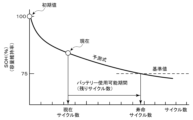
- FIG. FIG. 4 is a diagram showing the relationship between SOH and the number of cycles;
- the upper stage is the vehicle information of the vehicle with the vehicle ID: a001
- the lower stage is the vehicle information of the vehicle with the vehicle ID: a002.
- Table of coefficients related to service coefficient k1 (a) table of years of production coefficient k11, (b) table of mileage coefficient k12, (c) table of accident coefficient k13, (d) order number coefficient k14 table.
- FIG. 4 is a sequence diagram showing an information processing procedure
- the information processing system 1 can determine the rental type of a vehicle 500 returned by a user (hereinafter also referred to as a "returned vehicle") in a vehicle rental service in which a business operator rents a vehicle 500 to a user.
- the rental types of the vehicle 500 include “lease”, “subscription”, “car sharing”, and “rental”. These lending types differ in terms of contract period (usage period), settlement method (payment method), charge system, and the like.
- “Lease” has a medium- to long-term contract period of six months to ten years, and adopts a method (fixed amount) in which the user pays a fixed amount annually or monthly as a settlement method.
- “Subscription” has a medium- to long-term contract period similar to leasing, and adopts a method (fixed amount) in which the user pays a fixed amount (for example, 35,000 yen per month) as a settlement method.
- "Rental” enables short-term contracts on an hourly basis, and adopts a method (pay-as-you-go) in which the user pays an amount corresponding to the usage time after returning the vehicle 500 as a settlement method.
- “Car sharing” allows short-term contracts as well as ultra-short-term contracts such as 15-minute increments. As a payment method, after returning the vehicle 500, the user pays the amount according to the usage time (pay-as-you-go). ing.
- the pay-as-you-go amount is 350 yen/15 minutes.
- the information processing system 1 of the present embodiment is capable of two types of rental, that is, subscription and car sharing.
- the operator not only rents out the vehicle 500, but also performs maintenance such as parts replacement and repair.
- FIG. 1 is a schematic diagram of an information processing system 1 of the present invention.
- the information processing system 1 includes a server 100, a business terminal 200, and a vehicle 500, which are communicably connected via the Internet 900.
- FIG. 1 is a schematic diagram of an information processing system 1 of the present invention.
- the information processing system 1 includes a server 100, a business terminal 200, and a vehicle 500, which are communicably connected via the Internet 900.
- FIG. 1 is a schematic diagram of an information processing system 1 of the present invention.
- the information processing system 1 includes a server 100, a business terminal 200, and a vehicle 500, which are communicably connected via the Internet 900.
- the server 100 is an information processing device owned and managed by a management company that operates and manages a vehicle rental service.
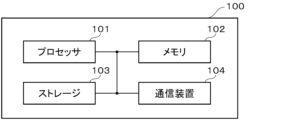
- FIG. 2 is a hardware configuration diagram of the server 100.
- the server 100 includes a processor 101 , memory 102 , storage 103 and communication device 104 .
- the processor 101 executes a program to control each unit of the server 100 and perform processing for realizing the functions of the server 100 .
- a CPU Central Processing Unit
- the memory 102 is a computer-readable recording medium and stores programs executed by the processor 101 .
- a RAM Random Access Memory
- ROM Read Only Memory
- the storage 103 is a computer-readable recording medium, and stores various data and programs used by the processor 101 .
- an HDD Hard Disk Drive
- SSD Solid State Drive
- the communication device 104 is connected to the Internet 900 and performs data communication with the business terminal 200 and the vehicle 500 via the Internet 900, for example.
- the business terminal 200 is an information terminal installed in an office (for example, SS), and is an information terminal such as a personal computer, a tablet terminal, or a smart phone used by an employee of the office.
- FIG. 3 is a hardware configuration diagram of the operator terminal 200.
- Business operator terminal 200 includes processor 201 , memory 202 , storage 203 , operation device 204 , display device 205 , and communication device 206 .
- the processor 201 executes a program to control each part of the operator terminal 200 and perform processing for realizing the functions of the operator terminal 200 .
- a CPU for example, is used for the processor 201 .
- the memory 202 is a computer-readable recording medium and stores programs executed by the processor 201 .
- the RAM and ROM are used for the memory 202, for example.
- the storage 203 is a computer-readable recording medium and stores various data and programs used by the processor 201 .
- a HDD Hard Disk Drive
- an SSD Solid State Drive
- a flash memory or the like is used for the storage 203 .
- the operation device 204 is a device used to operate the operator terminal 200, and corresponds to, for example, a keyboard and mouse in a personal computer, a touch panel in a smart phone and a tablet terminal, and the like.
- the display device 205 displays various screens. A liquid crystal display, for example, is used for the display device 205 .
- the display device 205 may be configured as a touch panel integrated with a touch sensor.
- the communication device 206 is connected to the Internet 900 and performs data communication with the server 100 via the Internet 900 .
- the vehicle 500 is a means of transportation that is rented to a user, and is an automobile such as an internal combustion engine vehicle or an electric vehicle (hereinafter also referred to as an EV).
- An internal combustion locomotive burns fuel such as gasoline and uses the combustion gas to drive an engine to enable running.
- An EV includes a storage battery such as a lithium ion battery (hereinafter also referred to as a battery 506), and can run by driving a motor with electric power stored in the storage battery by charging.
- the rented vehicle 500 is an EV.
- the ultra-compact EV has a passenger capacity of 4 or less, a maximum speed of 60 km/h or less, a rated output of 0.6 kW or more, a length of 2.5 m or less, a width of 1.3 m or less, a height of 2.0 m or less, and a maximum payload of 350 kg.
- the battery 506 installed in the ultra-compact EV has a capacity of 9 to 10 kWh (1 cell type), a charging time of 5 to 16 hours, and a cruising range of about 100 to 150 km when fully charged.
- the state of the EV battery 506 is managed by the vehicle-mounted device 501 .
- the vehicle-mounted device 501 includes a processor 502 , a memory 503 , a storage 504 and a communication device 505 .
- the processor 502 controls each part of the onboard equipment 501, and performs the process which implement
- FIG. A CPU is used for the processor 502, for example.
- the memory 503 is a computer-readable recording medium and stores programs executed by the processor 502 .
- RAM and ROM are used for the memory 503, for example.
- the storage 504 is a computer-readable recording medium and stores various data and programs used by the processor 502 .
- the storage 504 for example, an HDD (Hard Disk Drive), SSD (Solid State Drive), flash memory, or the like is used.
- the communication device 505 performs wireless communication with the server 100 according to a predetermined wireless communication standard (for example, 4G or 5G such as LTE (Long Term Evolution)).
- the vehicle-mounted device 501 manages the battery capacity, the number of times of charging/discharging (the number of cycles), etc. as the state values of the battery 506 .
- FIG. 5 is a functional configuration diagram of the information processing system 1.
- the operator terminal 200 is used for inputting the status value of the returned vehicle and displaying the rental type when the returned vehicle is rented again (reused).
- the operator terminal 200 includes an operation means 211, a communication means 212, and a display means 213, as shown in FIG.
- the functions of the operator's terminal 200 are realized by the processor 201 executing a program, performing calculations or controlling each part of the operator's terminal 200 .
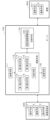
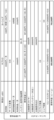
- the operating means 211 executes various operations on the operating device 204 . Specifically, the operating means 211 inputs various information (vehicle information) indicating the state of the returned vehicle according to the operation of the operating device 204 by the employee of the company. As shown in FIG. 7, the "vehicle information" is information in which information indicating the production year, mileage, accident, latest order quantity, latest monthly average operation rate, and replacement parts are linked for each vehicle ID. . The upper part of FIG. 7 shows the vehicle information when the vehicle 500 with the vehicle ID: a001 is returned, and the lower part of FIG. 7 shows the vehicle information when the vehicle 500 with the vehicle ID: a002 is returned.
- “Production years” is the number of years that have passed since vehicle 500 was produced. “Mileage” is the distance traveled since vehicle 500 was manufactured. “Accident” is information indicating the presence or absence of an accident.
- the “number of most recent orders” is the number of orders for renting the vehicle 500 in the most recent month at the time of return. Note that the "most recent number of orders” is not limited to the most recent one month, and may be, for example, the number of orders “per month” derived from the most recent "one week” or "one year”.
- the number of orders may basically be the number of rentals of the same model as the returned vehicle, the number of sales of that model, or the number of orders (the number of rentals + the number of sales).
- the "operating hours in the most recent month” is the vehicle information of the shared car, and is the operating hours of the vehicle 500 in the most recent month at the time of return. For example, if the returned vehicle was used as a shared car, the operating hours in the most recent month are calculated by calculating the total rental hours per month or the converted hours. If the vehicle-mounted device 501 has a function that can output the operating time and the operating rate, the "operating time in the most recent month" may be calculated based on the output value and transmitted from the vehicle 500 to the server 100. . It is also possible to use the average operating time of the same type of vehicle as the returned vehicle.
- Replacement parts include tires, brake pads, brake oil, batteries (second-hand), etc., among these, the parts that are determined to require replacement as a result of checking the condition of each part by employees, etc. Only the information (“ ⁇ ” in FIG. 7) is treated as a replacement part.
- the communication means 212 includes transmission means for transmitting information to the server 100 and reception means for receiving information from the server 100 .
- Information to be transmitted to the server 100 includes vehicle information (FIG. 7) of the returned vehicle input by the operation means 211, and information to be received from the server 100 includes rental type information.
- the display means 213 displays various screens on the display device 205 .
- the display unit 213 displays various operation screens (vehicle information input screen, etc.), and displays a rental type determination screen (FIGS. 11 and 13) based on the rental type information received from the server 100.
- the vehicle 500 is an EV and can be rented as a subscription vehicle or a shared vehicle.
- the vehicle 500 includes a computing means 511 and a communication means 512, as shown in FIG.
- the functions of the vehicle 500 are realized by the processor 502 performing calculations or controlling each part of the vehicle-mounted device 501 by executing a program stored by the processor 502 .
- the processor 502 calculates the battery information in response to the battery information request from the server 100 .
- the battery information includes SOH (State Of Health) and the number of cycles.
- SOH is also called a capacity retention rate that can indicate the state of deterioration of the battery capacity, and can be calculated based on the following formula (1).
- SOH (%) current capacity/initial capacity x 100 (1)
- Computing means 511 calculates the current SOH in response to a request from server 100 and stores the calculation result in storage 504 .
- the number of cycles is the number of times the battery 506 is charged/discharged.
- the computing means 511 calculates the SOH and counts the number of cycles of the battery 506 up to the present.
- the calculated SOH and the counted number of cycles are linked and stored in the storage 504 .
- the computing means 511 periodically calculates the SOH and counts the number of cycles, and each time, stores the SOH and the number of cycles in the storage 504 in association with each other. That is, in response to a request from the server 100, the storage 504 stores, as battery information, data relating the current SOH and the number of cycles and data relating the previous SOH and the number of cycles.
- Communication means 512 receives battery information request information from server 100 and transmits battery information stored in storage 504 to server 100 .
- the server 100 determines by calculation what type (subscription vehicle or shared vehicle) the returned vehicle should be rented out.
- the server 100 comprises a receiving means 111, a computing means 112, a transmitting means 118, and a storing means 119, as shown in FIG.
- the function of the server 100 is that the processor 101 executes a program stored in the memory 102 or the storage 103 so that the processor 101 performs calculations or controls each part of the server 100 .
- the receiving means 111 receives information transmitted from the operator terminal 200 (communication means 212), and receives information transmitted from the vehicle 500 (communication means 512). Information received by the receiving means 111 is output to the computing means 112 . Information received by the receiving means 111 includes vehicle information ( FIG. 7 ) transmitted from the business terminal 200 and battery information transmitted from the returned vehicle 500 .
- the transmission means 118 transmits information to the operator terminal 200 (communication means 212) and also transmits information to the vehicle 500 (communication means 512).
- the information transmitted by the transmitting means 118 includes rental type information transmitted to the operator terminal 200 and battery information request information transmitted to the vehicle 500 .
- the fixed amount information that does not change is stored in the fixed amount information DB 120 in the storage means 119 .
- Fixed amount information includes, for example, subscription usage fee: 35000/month, share usage fee: 350 yen/15 minutes, replacement cost of each part (e.g. tire: 40000 yen, battery (used): 200000 yen, brake pad: 7000 yen, brake oil: 5000 yen, etc.).
- the storage means 119 stores a table of coefficients (k11 to k14) related to the service coefficient k1, a table of coefficients (k21 to k23) related to the subscription coefficient k2, and coefficients (k31 to k33) related to the share coefficient k3, which will be described later. are stored (FIGS. 8-10).
- the calculation means 112 executes various calculation processes, and includes a first calculation means 113 , a second calculation means 114 , a third calculation means 115 , a fourth calculation means 116 and a determination means 117 .
- the first calculation means 113 calculates the profit expected when renting the returned vehicle 500 as a subscription (first vehicle rental service) (first profit: hereinafter also referred to as "subscription profit”) and the subscription (first vehicle rental service). service) and the profit (second profit: hereinafter also referred to as "share profit”) that can be expected when renting as a car share (second vehicle rental service) with a different rental period is calculated.
- the subscription profit and share profit are calculated based on the following formulas (2) and (3).
- Subscription profit subscription revenue - subscription cost (2)
- Share profit share profit - share cost (3)
- the determining means 117 determines that the subscription is the rental type of the returned vehicle. If it is larger, the car share is determined as the rental type of the returned vehicle. That is, based on the subscription profit (first profit) and the share profit (second profit), the determination means 117 determines the rental type of the returned vehicle 500 as a subscription (first vehicle rental service) or car sharing (second profit). vehicle rental service).
- Subscription profit is the profit (sales) that can be expected when the returned vehicle is rented as a subscription vehicle.
- the subscription revenue can be calculated based on the subscription usage fee, the service coefficient k1, and the battery usable period.
- Subscription usage fee is the usage fee for a subscription vehicle when the vehicle is new, and uses "35,000 yen/month” stored in the fixed amount information DB 120 in advance.
- the “service coefficient k1” is a coefficient for calculating the usage fee after refreshing the returned vehicle, and varies within a range of 0 to 1.0 depending on the state of the vehicle 500.
- the service coefficient k1 decreases as the number of years of production decreases, decreases as the mileage decreases, decreases as there are no accidents, and decreases as the number of recent orders increases.
- the service coefficient k1 can be calculated, for example, by the following formula (4).
- k1 1-year production coefficient k11-mileage coefficient k12-accident coefficient k13-order quantity coefficient k14 (4)
- the "years of production coefficient k11" is selected, for example, within a range of 0 to 0.3 according to the number of years of production, as shown in FIG. 8(a).
- the "travel distance coefficient k12” is selected, for example, within a range of 0 to 0.3 according to the travel distance, as shown in FIG. 8(b).
- 0 is selected for "no” accident and 0.1 for "present” accident.
- the "number of orders coefficient k14" is selected within a range of 0.05 to 0.2 according to the number of recent orders (the number of loans made recently), as shown in FIG. 8(d).
- the information (years of production, mileage, presence/absence of accidents, number of recent orders) necessary for calculating the service coefficient k1 is included in the vehicle information received from the operator terminal 200 .
- the vehicle 500 with the vehicle ID: a001 has a production period of 1.5 years, a mileage of 20,000 km, no accidents, and the number of recent orders: 20 units.
- the vehicle 500 with the vehicle ID: a002 has a production period of 4 years, a mileage of 70,000 km, no accidents, and the number of recent orders: 15 units.
- a second calculator 114 calculates the usable period of the battery 506 based on the state value SOH of the battery 506 . That is, the second calculator 114 calculates the battery usable period, which is the remaining usable period from the present to the life of the battery 506 , based on the SOH of the battery 506 .
- the battery 506 is used as it is after being refreshed (for example, by replacing the electrolyte or electrodes) if the SOH is equal to or higher than a specified reference value (75%).
- the battery 506 is determined to have reached the end of its service life when the SOH reaches 75%, and the remaining usable period up to that point is regarded as the battery usable period.
- the reference value is not limited to 75%, and any value such as 80% can be set. If the SOH is less than the reference value, the battery 506 is replaced.
- the battery usable period may be calculated based on the SOH of the battery 506 after replacement. For example, when replacing with a (used) battery, the usable period of the battery may be calculated based on the SOH of the (used) battery.
- a fixed period for example, 5 years
- the battery usable period may be set as the battery usable period, and may be excluded from the object of the present invention.
- a battery 506 that does not meet the standard value can also be used for other purposes (for example, use as a stationary storage battery, recycling, etc.). For example, if the SOH is less than 75%, it can be reused as a stationary storage battery, and if the SOH is less than 50%, the battery can be disassembled and recycled for each material.
- the determination means 117 can be executed when the SOH of the battery 506 provided in the returned vehicle 500 is included in the threshold value (for example, 75% or more).
- the SOH has a characteristic that gradually decreases in a curved manner as the number of cycles increases, so a prediction formula that approximates this characteristic can be derived.
- the prediction formula is represented by the number of cycles on the X axis and the SOH on the Y axis. It can be derived by fitting. For example, a prediction formula can be derived by inputting (X, Y) into known software such as spreadsheet software. According to this prediction formula, when SOH: 75% is substituted, the number of cycles (life cycle number) until the SOH drops to 75% can be calculated. By subtracting the number of cycles up to the present (current number of cycles) from the number of life cycles, the remaining number of cycles until the SOH drops to 75% can be calculated.
- the server 100 connects with the vehicle 500 based on the reception of the request from the operator terminal 200, and the battery information received from the vehicle 500 (the SOH and the number of cycles are Generate a prediction formula based on information including Then, the server 100 obtains the life cycle number based on the generated prediction formula, and calculates the battery usable period based on the remaining cycle number obtained by subtracting the current cycle number from the life cycle number. It is assumed that the battery usable period of the returned vehicle with vehicle ID: a001 is calculated as "36 months" and the battery usable period of the returned vehicle with vehicle ID: a002 is calculated as "60 months". That is, in this example, although the vehicle-mounted battery 506 is replaced with another (used) battery as described later, the battery usable period is calculated based on the state value of the vehicle-mounted battery 506. shall be
- the subscription revenue can be calculated based on the following formula (5).
- Subscription revenue subscription usage fee x service coefficient k1 x battery usable period (5)
- the “share profit” is the profit (sales) that can be expected when the returned vehicle is rented out as a share car.
- the share profit can be specifically calculated based on the share usage fee and the battery usable period.
- the server 100 uses the most recent month's operating hours (the most recent month's operating hours) received from the business operator terminal 200 to calculate the share usage fee per month.
- the share earnings can be specifically calculated based on the following formula (6).
- the subscription cost corresponds to the cost required to reuse the returned vehicle as a subscription vehicle.
- the subscription cost is calculated based on the part replacement cost and the subscription coefficient (first coefficient) k2.
- the “parts replacement cost” is the amount required to replace the “replacement parts” included in the vehicle information received from the business terminal 200 .
- the vehicle 500 with the vehicle ID: a001 and the vehicle 500 with the vehicle ID: a002 require tire replacement, and the battery 506 needs to be replaced with a battery. Therefore, referring to the replacement costs (tire: 40,000 yen, re-battery (used): 200,000 yen) from the fixed amount DB 120, the total replacement cost is calculated as 240,000 yen.
- the “subscription coefficient k2” is a coefficient for calculating the cost of refreshing the returned vehicle, and is a variable value that varies in the range of 0 to 1.0 depending on the state of the vehicle 500, and is also a state value.
- the subscription coefficient (first coefficient) k2 is set to be a larger value than the share coefficient (second coefficient) k3. This is because the subscription period is longer than car sharing, so it is necessary to consider the risk of cost increases.
- the subscription coefficient k2 is the same as the service coefficient k1 in that the shorter the production years, the smaller the smaller the mileage, the smaller the number of accidents, and the smaller the number of accidents. is not provided. This is because the number of orders is related to expected revenue, but not to cost.
- the subscription coefficient k2 can be calculated, for example, by the following equation (7).
- k2 1-year production factor k21-mileage factor k22-accident factor k23 (7)
- the "years of production coefficient k21" is selected, for example, within a range of 0 to 0.3 according to the number of years of production, as shown in FIG. 9(a).
- the "travel distance coefficient k22" is selected, for example, within a range of 0 to 0.3 according to the travel distance, as shown in FIG. 9(b).
- 0 is selected for "no" accident, and 0.1 is selected for "presence" of accident.
- Information (years of production, mileage, presence/absence of accidents) necessary for calculating the subscription coefficient k2 is included in the vehicle information received from the operator terminal 200 .
- the vehicle 500 with the vehicle ID: a001 has a production period of 1.5 years, a mileage of 20,000 km, and no accidents.
- the vehicle 500 with the vehicle ID: a002 has a production period of 4 years, a mileage of 70,000 km, and no accidents.
- the subscription cost can be calculated based on the following formula (8).
- Subscription cost total exchange cost x subscription coefficient k2 (8)
- the share cost corresponds to the cost required to reuse the returned vehicle as a share car.
- the share cost is calculated based on the part replacement cost and the share coefficient (second coefficient) k3.
- the “parts replacement cost” is the amount required to replace the “replacement parts” included in the vehicle information received from the business terminal 200 .
- both the vehicle 500 with the vehicle ID: a001 and the vehicle 500 with the vehicle ID: a002 require tire replacement, and the battery 506 needs to be replaced with a battery. Therefore, referring to the replacement costs (tire: 40,000 yen, battery (used): 200,000 yen) from the fixed amount DB 120, the total replacement cost is calculated as 240,000 yen.
- the “share coefficient k3” is a coefficient for calculating the cost of refreshing the returned vehicle, and is a variable value within the range of 0 to 1.0 depending on the state of the vehicle 500, and is also a state value.
- the share coefficient (second coefficient) k3 is set to a smaller value than the subscription coefficient (first coefficient) k2. This is because car sharing has a shorter usage period than subscription, so there is no need to consider the risk of cost increases.
- the share coefficient k3 is similar to the service coefficient k1 and the subscription coefficient k2 in that the smaller the number of production years, the smaller the smaller the mileage, the smaller the number of accidents, and the smaller the number of accidents. Therefore, the coefficient for the number of recent orders is not adopted. This is because although the number of orders is an indicator related to expected revenue, it is not related to cost.
- the traveling distance coefficient k32 is set to a larger value than the traveling distance coefficient k22.
- the "accident coefficient k33" is selected for "no” accident and 0.1 for "presence” of accident.
- Information (years of production, mileage, presence/absence of accidents) necessary for calculating the share coefficient k3 is included in the vehicle information received from the operator terminal 200 .
- the vehicle 500 with the vehicle ID: a001 has a production period of 1.5 years, a mileage of 20,000 km, and no accidents.
- the vehicle 500 with the vehicle ID: a002 has a production period of 4 years, a mileage of 70,000 km, and no accidents.
- the share cost can be calculated based on the following formula (10).
- Share cost total replacement cost ⁇ share coefficient k3 (10)
- the server 100 calculates the subscription profit and the share profit of the vehicle 500 with the vehicle ID: a001 based on the above equations (2) and (3).
- Judgment means 117 is subscription profit > share profit Therefore, the lending type when reusing is determined to be “subscription”.
- the transmitting means 118 of the server 100 transmits the lending type information indicating the determination result to the operator terminal 200 .
- the lending type information can be received by the operator terminal 200 (communication means 212 ), and the lending type information can be displayed on the display device 205 by the display means 213 .
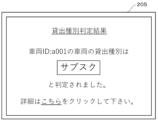
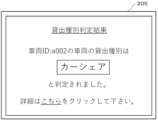
- FIG. 11 is an example of a display screen (rental type determination screen) showing that the rental type of the vehicle 500 with the vehicle ID: a001 is determined to be subscription.
- the lending type determination screen is generated so that a predetermined portion (" here " in FIG. 11) is clickable, and when this portion is clicked, the breakdown of the lending type determination is displayed.
- FIG. 12 is a chart showing the details of the rental type determination for the vehicle 500 with the vehicle ID: a001. As a result, the business operator can check the breakdown of the judgment in detail. It can be used as a reference for determining the type.
- the server 100 calculates the subscription profit and the share profit of the vehicle 500 with the vehicle ID: a002 based on the above equations (2) and (3).
- Judging means 117 of server 100 is sub-profit ⁇ share profit, so the lending type for reuse is determined to be "car sharing".
- FIG. 13 is an example of a display screen (rental type determination screen) showing that the rental type of the vehicle 500 with the vehicle ID: a002 is determined to be car sharing.
- FIG. 14 is a chart showing the breakdown of the rental type determination for the vehicle 500 with the vehicle ID: a002. If both the subscription profit and the share profit are negative, the vehicle 500 may not be reused, and the battery alone may be reused (re-lent or recycled).
- the server 100 calculates the battery usable period calculated based on the SOH of the battery 506 provided in the returned vehicle or the SOH of the battery 506 after the replacement when the battery is replaced after the vehicle is returned.
- revenue subscription revenue and share revenue
- subscription profit and share profit are determined. That is, the first calculation means 113 calculates the profit based on the battery usable period derived from the SOH and the number of cycles, which are the state values of the battery 506, and calculates the subscription profit (second 1 profit) and share profit (second profit).
- the subscription is a type of vehicle rental service in which the rental period of the vehicle 500 is longer than the rental period of the vehicle 500 in the car share (second vehicle rental service). calculates the subscription profit (first profit) based on the subscription cost and subscription revenue calculated based on the subscription coefficient (first coefficient), which is a variable value, and calculates the share coefficient (first A share profit (second profit) is calculated based on the share cost and the share profit calculated based on the second coefficient).
- the information processing system 1 and the server 100 include a third calculation means 115 for calculating a subscription profit (first profit) and a share profit (second profit), a subscription cost (first cost) and a share cost ( and a fourth calculation means 116 for calculating the second cost), and the first calculation means 113 calculates the subscription profit (first profit) based on the subscription profit (first profit) and the subscription cost (first cost) is calculated, and the share profit (second profit) is calculated based on the share profit (second profit) and the share cost (second expense).
- FIG. 15 is a sequence diagram showing procedures (steps) in the program operation and information processing method of the present invention.
- fixed amount information DB 120 (subscript usage fee: 35000 yen/month, share usage fee: 350 yen/15 minutes, replacement cost of each part (for example, tire: 40000 yen, battery (used): 200000 yen) is stored in the server 100 in advance.
- yen, brake pads: 7,000 yen, brake oil: 5,000 yen, etc.) are stored.
- An example of processing after the vehicle 500 with the vehicle ID: a001 is returned will be described below.
- the business operator inputs the vehicle information of the vehicle 500 with the vehicle ID: a001 at the business operator terminal 200 (S101).
- the vehicle information shown in the upper part of FIG. 7 is transmitted from the business operator terminal 200 to the server 100 .
- the server 100 When the server 100 receives the vehicle information from the operator terminal 200, the server 100 requests the vehicle 500 for battery information (S102). Accordingly, the server 100 transmits the battery information request information to the vehicle 500 identified by the vehicle ID: a001. Vehicle 500 transmits battery information to server 100 in response to receiving the battery information request information.
- the server 100 calculates the battery usable period (S103). Specifically, a prediction formula is generated based on the history of the SOH and the number of cycles included in the battery information received from the vehicle 500, the number of life cycles is obtained, the current number of cycles is subtracted from the number of life cycles, and the remaining cycles are calculated.
- the battery usable period is calculated by dividing the operation time in the most recent month from the number of remaining cycles.
- the server 100 calculates the expected profit in the subscription car sharing (S104).
- the subscription revenue and share revenue are calculated.
- the subscription revenue is calculated based on the above formula (5)
- the share revenue is calculated based on the above formula (6).
- the subscription revenue of vehicle 500 with vehicle ID: a001 is calculated as 1,071,000 yen
- the share revenue is calculated as 763,200 yen.
- the server 100 calculates the reuse cost in subscription car sharing (S105). That is, the subscription cost and share cost are calculated.
- the subscription cost is calculated based on the above formula (8), and the share cost is calculated based on the above formula (10).
- the subscription cost of the vehicle 500 with the vehicle ID: a001 is calculated as 216,000 yen, and the share cost is calculated as 144,000 yen.
- the server 100 determines the rental type of the returned vehicle (S106). Specifically, the subscription profit is calculated based on the above formula (2), and the share profit is calculated based on the above formula (3). In the vehicle 500 with the vehicle ID: a001, the subscription profit (855,000 yen) is larger than the share profit (763,200 yen), so the lending type is determined as subscription.
- the server 100 transmits the lending type information, which is the determination result, to the operator terminal 200 .
- the display means 213 displays the rental type information on the display device 205 (FIG. 11).
- the first profit (subscription profit) when renting the returned vehicle 500 as the first vehicle rental service (subscription) and the first vehicle rental service are defined as the rental period
- the second profit (share profit) when renting out as a second vehicle rental service (car share) with a different value is the battery 506 provided in the returned vehicle 500, or the battery after the replacement if the battery is replaced after the vehicle is returned.
- the step of calculating, and based on the calculated first profit (subscript profit) and the second profit (share profit) the returned and a step of determining the first vehicle rental service (subscription) or the second vehicle rental service (car share) as the rental type for the vehicle 500 .
- the second profit (share profit) when renting as a two-vehicle rental service (car sharing) is the battery 506 provided in the returned vehicle 500, or the battery 506 after replacement if the battery is replaced after the vehicle is returned.
- the returned vehicle 500 is calculated based on the information (revenue and cost) corresponding to the state value, and based on the calculated first profit (subscription profit) and the second profit (share profit). and a step of determining the first vehicle rental service (subscription) or the second vehicle rental service (car share) as the rental type for the vehicle.
- a part of the configuration of the information processing system 1 described above can also be provided outside.
- some or all of the calculation means provided in the server 100 can be provided in an external device, and the server 100 can determine the lending type based on the calculation result obtained from the external device.
- the external device calculates the subscription profit and the share profit, inputs it to the server 100 by a predetermined method (e.g., wireless or wired communication processing, a method via a USB memory, etc.), and stores it in the storage device ( storage 103, etc.), and the determining means 117 can determine the lending type based on the subscription profit and the share profit stored in this storage device.
- the computer displays the first profit (subscription profit) when renting the returned vehicle 500 as the first vehicle rental service (subscription) and the second vehicle having a different rental period from the first vehicle rental service.
- the second profit (share profit) when renting out as a rental service (car sharing) is the state value of the battery 506 provided in the returned vehicle 500 or the battery 506 after replacement when the battery is replaced after the vehicle is returned.
- a storage device storage 103 the information based on the state value of the battery 506; and the first benefit (subscription benefit) stored in the storage device and the second profit (share profit), determining the first vehicle rental service (subscription) or the second vehicle rental service (car sharing) as the rental type for the returned vehicle 500; should be executed.
- the first profit (subscript profit) when renting the returned vehicle 500 as the first vehicle rental service (subscription) and the second vehicle rental service ( The second profit (share profit) when renting out as a car share is based on the state value of the battery 506 provided in the returned vehicle 500 or the battery 506 after replacement if the battery is replaced after the vehicle is returned.
- the server 100 is an information processing device capable of determining the rental type of the vehicle 500 returned by the user in the vehicle rental service for renting the vehicle 500 to the user.
- the second profit (share profit) in the case of renting as a vehicle is the information (revenue and cost), the first calculation means 113 that can be calculated, and the first profit (subscription profit) and the second profit (share profit) as the rental type for the returned vehicle 500 and determination means 117 for determining the first vehicle rental service (subscription) or the second vehicle rental service (car share).
- the first calculation means 113 calculates the first profit (subscription profit) based on the information (cost (subscription cost) and profit (subscription profit)) corresponding to the first coefficient (subscription coefficient), which is a variable value. Then, the second profit is calculated based on information (cost (share cost) and profit (share profit)) corresponding to a second coefficient (share coefficient) smaller than the first coefficient. In this way, the subscription cost and share cost are calculated using the coefficients indicating the state of the vehicle 500, and the subscription profit and share profit are calculated using these, the subscription profit and the share profit, and the lending type is determined.
- the rental type based on an appropriate criterion that comprehensively considers the state of the vehicle 500 and the state of the battery 506 at the time of return.
- the subscription coefficient and the share coefficient are directly used to calculate the subscription cost and the share cost. By doing so, it is possible to avoid cost increases in subscriptions that accompany long-term use and the resulting reduction in profits.
- the server 100 generates a subscription profit (first profit) when the returned vehicle 500 is rented as a subscription (first vehicle rental service) and a share when rented as a car share (second vehicle rental service).
- Third calculation means 115 for calculating profit (second profit), subscription cost (first cost) and car sharing (second vehicle rental service) when the returned vehicle 500 is rented as a subscription (first vehicle rental service) and a fourth calculation means 116 for calculating the share cost (second cost) when renting as a service
- the first calculation means 113 calculates the subscription profit (first profit) and the subscription cost (first cost). Based on this, the subscription profit (first profit) is calculated, and the share profit (second profit) is calculated based on the share profit (second profit) and the share cost (second cost).
- the present invention calculates the subscription profit and the share profit by subtracting the reuse cost from the expected profit, and determines the loan type based on which of these is larger.
- EV can be reused while acquiring
- the configuration of the information processing system 1 is not limited to the above-described embodiment, and part or all of the configuration of one device can be provided by another component device.
- the procedure of the information processing method is not limited to the above procedure, and a part of the procedure may be changed.
- part or all of the vehicle information may be managed in the vehicle 500 and output to the server 100 upon return.
- the battery information (except when the device is returned) may be periodically output to the server 100 and managed by the server 100 .
- a coefficient indicating the degree of deterioration of the exterior/interior of the vehicle 500 can be added to the service coefficient.
- the coefficients (k11 to k13) related to the service coefficient k1 and the coefficients (k21 to k23) related to the subscription coefficient k2 use a table in which the same values are assigned. Some or all of them may be non-identical. That is, the service coefficient k1 is the state value of the returned vehicle necessary for calculating the profit, and the subscription coefficient k2 and share coefficient k3 are also the state values necessary for calculating the subscription cost.
- a prediction model may be generated by learning a large number of these set data. By doing so, the life cycle number can be obtained by inputting the life SOH (75%) into the prediction model, and the battery usage based on the remaining cycle number obtained based on the life cycle number and the current cycle number Possible period can be calculated.
- environmental temperature can also be added to the data set, since the SOH-cycle number characteristic is also correlated with ambient temperature. In this case, data sets of SOH, number of cycles, and temperature are sequentially obtained, and these are learned to generate a prediction model capable of outputting the number of life cycles.
- the state value of the battery (used) is stored in advance in the storage 103 of the server 100 in consideration of calculating the battery usable period based on the battery (used). You can also let it go.
- other means of transportation for example, electric motorcycles
- batteries are installed not only in EVs but also in general vehicles such as internal combustion engine vehicles, such general vehicles can be included in rental targets.
- Subscription revenue and share revenue may be calculated by including the admission fee in the usage fee.
- the rented vehicle 500 is targeted, the same criteria may be applied to determine the rental type when a new or used vehicle is rented for the first time.
Landscapes
- Business, Economics & Management (AREA)
- Accounting & Taxation (AREA)
- Finance (AREA)
- Engineering & Computer Science (AREA)
- General Physics & Mathematics (AREA)
- Economics (AREA)
- Marketing (AREA)
- Strategic Management (AREA)
- Theoretical Computer Science (AREA)
- Physics & Mathematics (AREA)
- General Business, Economics & Management (AREA)
- Development Economics (AREA)
- Technology Law (AREA)
- Health & Medical Sciences (AREA)
- General Health & Medical Sciences (AREA)
- Human Resources & Organizations (AREA)
- Primary Health Care (AREA)
- Tourism & Hospitality (AREA)
- Management, Administration, Business Operations System, And Electronic Commerce (AREA)
Priority Applications (4)
| Application Number | Priority Date | Filing Date | Title |
|---|---|---|---|
| CN202280068227.2A CN118119961A (zh) | 2021-10-12 | 2022-07-12 | 信息处理装置、程序以及信息处理方法 |
| EP22880603.0A EP4418192A1 (en) | 2021-10-12 | 2022-07-12 | Information processing device, program, and information processing method |
| US18/699,660 US20240403990A1 (en) | 2021-10-12 | 2022-07-12 | Information processing device, program, and information processing method |
| JP2023554266A JPWO2023062898A1 (https=) | 2021-10-12 | 2022-07-12 |
Applications Claiming Priority (2)
| Application Number | Priority Date | Filing Date | Title |
|---|---|---|---|
| JP2021-167336 | 2021-10-12 | ||
| JP2021167336 | 2021-10-12 |
Publications (1)
| Publication Number | Publication Date |
|---|---|
| WO2023062898A1 true WO2023062898A1 (ja) | 2023-04-20 |
Family
ID=85988242
Family Applications (1)
| Application Number | Title | Priority Date | Filing Date |
|---|---|---|---|
| PCT/JP2022/027365 Ceased WO2023062898A1 (ja) | 2021-10-12 | 2022-07-12 | 情報処理装置、プログラム、及び情報処理方法 |
Country Status (5)
| Country | Link |
|---|---|
| US (1) | US20240403990A1 (https=) |
| EP (1) | EP4418192A1 (https=) |
| JP (1) | JPWO2023062898A1 (https=) |
| CN (1) | CN118119961A (https=) |
| WO (1) | WO2023062898A1 (https=) |
Cited By (3)
| Publication number | Priority date | Publication date | Assignee | Title |
|---|---|---|---|---|
| CN116596643A (zh) * | 2023-07-14 | 2023-08-15 | 深圳市古石科技有限公司 | 一种共享充电器充电智慧管理系统 |
| WO2024262088A1 (ja) * | 2023-06-22 | 2024-12-26 | パナソニックIpマネジメント株式会社 | 情報処理方法、情報処理装置、および情報処理プログラム |
| WO2025094351A1 (ja) * | 2023-11-02 | 2025-05-08 | 日本電気株式会社 | 情報処理装置、情報処理システム、情報処理方法及び記録媒体 |
Citations (3)
| Publication number | Priority date | Publication date | Assignee | Title |
|---|---|---|---|---|
| JPS55116199A (en) * | 1979-02-28 | 1980-09-06 | Omron Tateisi Electronics Co | Vehicle control system |
| JP2013084199A (ja) * | 2011-10-12 | 2013-05-09 | Nissan Motor Co Ltd | 賃貸料金設定装置および賃貸料金設定方法 |
| JP2015141600A (ja) * | 2014-01-29 | 2015-08-03 | 株式会社日立システムズ | リース残価設定額算出システム及びリース残価設定額算出方法、車両ビジネス活性化システム |
Family Cites Families (6)
| Publication number | Priority date | Publication date | Assignee | Title |
|---|---|---|---|---|
| JP2002291110A (ja) * | 2001-03-26 | 2002-10-04 | Tokyo R & D Co Ltd | バッテリのレンタル料金徴収方法 |
| JP5439242B2 (ja) * | 2010-03-18 | 2014-03-12 | 株式会社東芝 | エネルギーナビゲーション制御装置、エネルギーナビゲーションシステム、およびエネルギーナビゲータ |
| JP2021057046A (ja) * | 2019-09-30 | 2021-04-08 | 株式会社リロケーション・インターナショナル | 情報処理装置 |
| US12352821B2 (en) * | 2020-02-21 | 2025-07-08 | Panasonic Intellectual Property Management Co., Ltd. | Calculation system, battery characteristic estimation method, and battery characteristic estimation program |
| CN111885155B (zh) * | 2020-07-22 | 2021-06-18 | 大连理工大学 | 一种车联网资源融合的车载任务协作迁移方法 |
| CN116018286A (zh) * | 2020-09-23 | 2023-04-25 | 东洋系统株式会社 | 电池租赁系统 |
-
2022
- 2022-07-12 EP EP22880603.0A patent/EP4418192A1/en not_active Withdrawn
- 2022-07-12 JP JP2023554266A patent/JPWO2023062898A1/ja active Pending
- 2022-07-12 US US18/699,660 patent/US20240403990A1/en active Pending
- 2022-07-12 CN CN202280068227.2A patent/CN118119961A/zh not_active Withdrawn
- 2022-07-12 WO PCT/JP2022/027365 patent/WO2023062898A1/ja not_active Ceased
Patent Citations (3)
| Publication number | Priority date | Publication date | Assignee | Title |
|---|---|---|---|---|
| JPS55116199A (en) * | 1979-02-28 | 1980-09-06 | Omron Tateisi Electronics Co | Vehicle control system |
| JP2013084199A (ja) * | 2011-10-12 | 2013-05-09 | Nissan Motor Co Ltd | 賃貸料金設定装置および賃貸料金設定方法 |
| JP2015141600A (ja) * | 2014-01-29 | 2015-08-03 | 株式会社日立システムズ | リース残価設定額算出システム及びリース残価設定額算出方法、車両ビジネス活性化システム |
Cited By (4)
| Publication number | Priority date | Publication date | Assignee | Title |
|---|---|---|---|---|
| WO2024262088A1 (ja) * | 2023-06-22 | 2024-12-26 | パナソニックIpマネジメント株式会社 | 情報処理方法、情報処理装置、および情報処理プログラム |
| CN116596643A (zh) * | 2023-07-14 | 2023-08-15 | 深圳市古石科技有限公司 | 一种共享充电器充电智慧管理系统 |
| CN116596643B (zh) * | 2023-07-14 | 2023-10-20 | 深圳市古石科技有限公司 | 一种共享充电器充电智慧管理系统 |
| WO2025094351A1 (ja) * | 2023-11-02 | 2025-05-08 | 日本電気株式会社 | 情報処理装置、情報処理システム、情報処理方法及び記録媒体 |
Also Published As
| Publication number | Publication date |
|---|---|
| EP4418192A1 (en) | 2024-08-21 |
| US20240403990A1 (en) | 2024-12-05 |
| CN118119961A (zh) | 2024-05-31 |
| JPWO2023062898A1 (https=) | 2023-04-20 |
Similar Documents
| Publication | Publication Date | Title |
|---|---|---|
| JP7294716B2 (ja) | 二次電池管理装置 | |
| Ouyang et al. | The total cost of electric vehicle ownership: A consumer-oriented study of China's post-subsidy era | |
| WO2023062898A1 (ja) | 情報処理装置、プログラム、及び情報処理方法 | |
| US10518655B2 (en) | System and method for electric vehicle mobile payment | |
| Hagman et al. | Total cost of ownership and its potential implications for battery electric vehicle diffusion | |
| Wang et al. | Two-dimensional warranty: A literature review | |
| CN111095721B (zh) | 聚合能量资源 | |
| JP2022136082A (ja) | 二次電池管理装置 | |
| US8180655B1 (en) | Systems and methods for processing vehicle or driver performance data | |
| US9217779B2 (en) | Method and system for obtaining degradation of battery using degradation model and parameters related to the degradation | |
| CN111942222B (zh) | 电池信息管理系统和电池信息管理方法 | |
| US8566126B1 (en) | Systems and methods for processing vehicle or driver performance data | |
| CN114926231A (zh) | 利用费用设定装置、利用费用设定方法、记录介质 | |
| US11676083B2 (en) | Arrangement planning device | |
| JP7244589B2 (ja) | 情報処理方法、プログラム及び情報処理装置 | |
| Malya et al. | Electric vehicles as distribution grid batteries: a reality check | |
| Noll et al. | Managing trade-offs between electric vehicle taxation and adoption | |
| CN120410658A (zh) | 电动车辆充电推荐系统和方法 | |
| Zhang et al. | Comparative cost analysis of FCVs, BEVs, and ICVs: A consumer perspective in Japan | |
| CN117035889A (zh) | 新能源车辆残值计算方法、装置、电子设备和存储介质 | |
| Dash et al. | Cost comparison of battery swapping, point charging, and ICE two-wheelers in India | |
| JP7503815B2 (ja) | 情報処理方法、情報処理装置、及び、プログラム | |
| JP7170104B1 (ja) | 情報処理方法、プログラム及び情報処理装置 | |
| JP5228134B1 (ja) | 車両に関する経費管理支援システム、経費管理支援方法、情報処理装置及びコンピュータプログラム | |
| US20250111321A1 (en) | Systems and methods for providing dynamic fleet transition climate impact reports |
Legal Events
| Date | Code | Title | Description |
|---|---|---|---|
| 121 | Ep: the epo has been informed by wipo that ep was designated in this application |
Ref document number: 22880603 Country of ref document: EP Kind code of ref document: A1 |
|
| WWE | Wipo information: entry into national phase |
Ref document number: 2023554266 Country of ref document: JP |
|
| WWE | Wipo information: entry into national phase |
Ref document number: 202280068227.2 Country of ref document: CN |
|
| WWE | Wipo information: entry into national phase |
Ref document number: 2022880603 Country of ref document: EP |
|
| NENP | Non-entry into the national phase |
Ref country code: DE |
|
| ENP | Entry into the national phase |
Ref document number: 2022880603 Country of ref document: EP Effective date: 20240513 |