WO2023058519A1 - 組成探索方法 - Google Patents
組成探索方法 Download PDFInfo
- Publication number
- WO2023058519A1 WO2023058519A1 PCT/JP2022/036163 JP2022036163W WO2023058519A1 WO 2023058519 A1 WO2023058519 A1 WO 2023058519A1 JP 2022036163 W JP2022036163 W JP 2022036163W WO 2023058519 A1 WO2023058519 A1 WO 2023058519A1
- Authority
- WO
- WIPO (PCT)
- Prior art keywords
- composition
- prediction
- data
- search
- weighted distance
- Prior art date
- Legal status (The legal status is an assumption and is not a legal conclusion. Google has not performed a legal analysis and makes no representation as to the accuracy of the status listed.)
- Ceased
Links
Images





Classifications
-
- G—PHYSICS
- G16—INFORMATION AND COMMUNICATION TECHNOLOGY [ICT] SPECIALLY ADAPTED FOR SPECIFIC APPLICATION FIELDS
- G16C—COMPUTATIONAL CHEMISTRY; CHEMOINFORMATICS; COMPUTATIONAL MATERIALS SCIENCE
- G16C60/00—Computational materials science, i.e. ICT specially adapted for investigating the physical or chemical properties of materials or phenomena associated with their design, synthesis, processing, characterisation or utilisation
-
- G—PHYSICS
- G06—COMPUTING OR CALCULATING; COUNTING
- G06N—COMPUTING ARRANGEMENTS BASED ON SPECIFIC COMPUTATIONAL MODELS
- G06N20/00—Machine learning
-
- G—PHYSICS
- G16—INFORMATION AND COMMUNICATION TECHNOLOGY [ICT] SPECIALLY ADAPTED FOR SPECIFIC APPLICATION FIELDS
- G16C—COMPUTATIONAL CHEMISTRY; CHEMOINFORMATICS; COMPUTATIONAL MATERIALS SCIENCE
- G16C20/00—Chemoinformatics, i.e. ICT specially adapted for the handling of physicochemical or structural data of chemical particles, elements, compounds or mixtures
- G16C20/30—Prediction of properties of chemical compounds, compositions or mixtures
-
- G—PHYSICS
- G16—INFORMATION AND COMMUNICATION TECHNOLOGY [ICT] SPECIALLY ADAPTED FOR SPECIFIC APPLICATION FIELDS
- G16C—COMPUTATIONAL CHEMISTRY; CHEMOINFORMATICS; COMPUTATIONAL MATERIALS SCIENCE
- G16C20/00—Chemoinformatics, i.e. ICT specially adapted for the handling of physicochemical or structural data of chemical particles, elements, compounds or mixtures
- G16C20/70—Machine learning, data mining or chemometrics
-
- Y—GENERAL TAGGING OF NEW TECHNOLOGICAL DEVELOPMENTS; GENERAL TAGGING OF CROSS-SECTIONAL TECHNOLOGIES SPANNING OVER SEVERAL SECTIONS OF THE IPC; TECHNICAL SUBJECTS COVERED BY FORMER USPC CROSS-REFERENCE ART COLLECTIONS [XRACs] AND DIGESTS
- Y02—TECHNOLOGIES OR APPLICATIONS FOR MITIGATION OR ADAPTATION AGAINST CLIMATE CHANGE
- Y02P—CLIMATE CHANGE MITIGATION TECHNOLOGIES IN THE PRODUCTION OR PROCESSING OF GOODS
- Y02P90/00—Enabling technologies with a potential contribution to greenhouse gas [GHG] emissions mitigation
- Y02P90/30—Computing systems specially adapted for manufacturing
Definitions
- the present invention relates to a composition search method.
- Patent Document 1 a Bayesian model is generated for searching for a combination of values of a plurality of parameters that give an optimum value as a physical property value for a target substance, and a search for a combination using the Bayesian model is performed in a search space. method has been proposed.
- Non-Patent Document 1 it is one of the sequential search methods using a prediction model, in which the next candidate point is determined using the distance between the prediction value and the learning data, and the hyperparameters of the model are optimized.
- the prediction method is not limited in the parameter search.
- Patent Document 2 when searching for parameters that provide desired physical properties using a prediction model that predicts physical property values from design parameters of metal materials, a plurality of different learning data sets are used. Search for design conditions that reduce the variability of multiple predicted values, and include new areas that differ from past performance data so that the difference between parameters and parameters in past performance data increases. searching for parameters, etc. have been proposed.
- Patent Document 1 uses a Bayesian model and is limited to optimization methods or Gaussian process regression. Therefore, there is a problem that other prediction methods expected to have high prediction performance (for example, gradient boosting, neural networks, etc.) cannot be used flexibly, and the prediction methods are limited.
- other prediction methods expected to have high prediction performance for example, gradient boosting, neural networks, etc.
- the technology described in Non-Patent Document 1 does not limit the prediction method in searching for parameters.
- the prediction accuracy verified with the past parameter is weighted in the term of the distance from the learning data so that the parameter distant from the past parameter can be searched while considering the accuracy of the prediction model. be done.
- all parameters are uniformly weighted, and a search is uniformly performed including parameters that have a small relationship with the objective variable. Therefore, there is a problem that it takes time to reach the optimum parameters.
- Patent Document 2 is configured to weight each parameter so that the difference from the parameter in the past performance data increases, but the weight is determined by the user. Since it is arbitrary, there is a problem that the search is not always performed properly.
- An object of the present invention is to provide a composition search method for more efficiently searching for a composition for obtaining target physical property values.
- the present invention has the configuration shown below.
- a method of searching for the composition of a material comprising the step of building a prediction model by learning data for learning with information about the composition of the material as an explanatory variable and the physical property value of the material as an objective variable; A step of calculating predicted values of physical properties by inputting prediction data for searching into the prediction model, and calculating the degree of influence of each explanatory variable on prediction using the learning data and the prediction model. calculating a weighted distance of the prediction data to the learning data using the degree of influence; displaying the relationship between the prediction value and the weighted distance, and searching for the corresponding prediction data. and outputting as a candidate.
- the data for prediction is a combination of information about the composition exhaustively created according to preset step width and composition ratio constraint conditions, and the weighted distance is calculated from the step of calculating the predicted value of physical properties. [1] or [ 2].
- [4] further comprising the step of grouping the predicted values according to the weighted distance, and in the step of displaying the relationship between the predicted value and the weighted distance, dividing the prediction data into groups and outputting them; 3].
- composition search method according to [4] or [5], wherein in the grouping step, the grouping is performed by equally dividing the weighted distance by a predetermined value between 0 and 1.
- grouping is performed by dividing the weighted distance between 0 and 1 so that the number of predicted values in each group after division is the same, [4] or [ 5].
- [9] further comprising the step of calculating an acquisition function Acq(X i ) using the following formula (1) for the predicted value and the weighted distance calculated from the prediction data;
- X i is the i-th prediction data
- f(X i ) is the predicted value of X i scaled to a value between 0 and 1
- s g is the weight in the g-th group.
- the coefficient, D i is the weighted distance of X i .
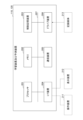
- FIG. 1 is a first diagram showing an example of the system configuration of a composition search system.
- FIG. 2 is a diagram illustrating an example of a hardware configuration of a learning device and a prediction device;
- FIG. 3 is a diagram showing an example of learning data and prediction data.
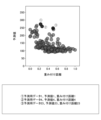
- FIG. 4 is a first diagram showing an example of a graph displaying the relationship between predicted values and weighted distances.
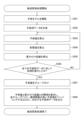
- FIG. 5 is a first flowchart showing the flow of composition search processing.
- FIG. 6 is a second diagram showing an example of the system configuration of the composition search system.
- FIG. 7 is a second diagram showing an example of a graph displaying the relationship between predicted values and weighted distances.
- FIG. 8 is a third diagram showing an example of a graph displaying the relationship between predicted values and weighted distances.
- FIG. 9 is a second flowchart showing the flow of composition search processing.
- FIG. 10 is a third diagram showing an example of the system configuration of the composition search system.
- FIG. 11 is a third flowchart showing the flow of composition search processing.
- FIG. 12 is a diagram showing the number of search completion times in the example and the comparative example.
- the composition search method includes the step of building a prediction model by learning data for learning with information about the composition of a material as an explanatory variable and the physical property value of the material as an objective variable; A step of calculating predicted values of physical properties by inputting prediction data for searching into the prediction model, and calculating the degree of influence of each explanatory variable on prediction using the learning data and the prediction model. calculating a weighted distance of the prediction data to the learning data using the degree of influence; displaying the relationship between the prediction value and the weighted distance, and searching for the corresponding prediction data. and outputting as a candidate.
- the composition may be an element that constitutes an alloy material, or may be various raw materials that constitute an organic material or a composite material. Further, in this specification, raw material types, preparation ratios, feature amounts, and the like, which are information related to composition, are also referred to as raw material parameters. The details of the composition search method according to the first embodiment will be described below with reference to FIGS. 1 to 5. FIG.
- FIG. 1 is a first diagram showing an example of the system configuration of a composition search system.
- FIG. 3 is a diagram showing an example of learning data and prediction data.
- FIG. 4 is a first diagram showing an example of a graph displaying the relationship between predicted values and weighted distances.
- composition search system 100 has learning device 110 and prediction device 120 .
- a learning program is installed in the learning device 110, and the learning device 110 functions as a learning unit 112 by executing the program.
- the learning unit 112 uses the learning data stored in the learning data storage unit 111 to construct a prediction model (learned model).
- the learning data used by the learning unit 112 to construct a prediction model includes raw material parameters (type/preparation ratio, feature amount) for a plurality of experimental samples, and measured physical property values. (see FIG. 3(A)).
- the model learned by the learning unit 112 includes arbitrary methods such as random forest, Gaussian process regression, neural network, and ensemble learning model combining a plurality of methods.
- the prediction model (learned model) constructed by the learning unit 112 is set in the prediction unit 122 of the prediction device 120 .
- a prediction program is installed in the prediction device 120.
- the prediction device 120 includes a prediction data generation unit 121, a prediction unit 122, a display unit 123, an influence calculation unit 124, and a weighting unit. It functions as the distance calculator 125 .
- the prediction data generation unit 121 creates prediction data. Prediction data consists of combinations of compositions comprehensively created according to specified constraints such as upper and lower limits and step sizes of composition ratios, raw materials that cannot be used at the same time, or data of feature amounts related to compositions ( See FIG. 3(B)).
- the prediction data generation unit 121 inputs the generated prediction data to the prediction unit 122 and notifies the weighted distance calculation unit 125 of it.
- the prediction unit 122 uses a prediction model to calculate a prediction value from prediction data. Also, the prediction unit 122 notifies the display unit 123 of the calculated prediction value.
- the impact calculation unit 124 uses the learning data stored in the learning data storage unit 111 and the prediction model to calculate the impact of each explanatory variable on prediction. Specifically, the impact calculator 124 calculates the impact using various algorithms stored in various Python libraries.
- the impact calculation unit 124 calculates the impact using the coefficient of each variable. If the prediction model is a decision tree-based model, the impact calculation unit 124 calculates an impact such as Permutation importance or Gini importance. Alternatively, the impact calculation unit 124 may calculate the impact using the SAGE or SHAP algorithm of the Python library that can calculate the impact using any method.
- the weighted distance calculator 125 uses the influence calculated by the influence calculator 124 to calculate the weighted distance of the prediction data to the learning data. Specifically, the weighted distance calculator 125 calculates the weighted distance using the following equations (2) and (3).
- d n is the weighted average distance between the n-th prediction data and the learning data
- N is the total number of experiments in which measurements were performed
- k is the total number of explanatory variables (raw material parameters)
- Xnt is the tth explanatory variable in the nth learning data
- xnt is the tth explanatory variable in the nth prediction data
- wt is the degree of influence.
- the weighted distance D i is a value obtained by scaling the calculated d n to a value between 0 and 1.
- the display unit 123 displays multiple relationships between the predicted values calculated by the prediction unit 122 and the weighted distances calculated by the weighted distance calculation unit 125 .
- the display unit 123 displays a plurality of relationships between predicted values and weighted distances using a two-dimensional graph in which the horizontal axis is the weighted distance and the vertical axis is the predicted value (see FIG. 4).
- the display unit 123 also outputs the corresponding prediction data as search candidates.
- FIG. 2 is a diagram illustrating an example of a hardware configuration of a learning device and a prediction device
- the learning device 110 and the prediction device 120 have a processor 201, a memory 202, an auxiliary storage device 203, an I/F (Interface) device 204, a communication device 205, and a drive device 206.
- the hardware of the learning device 110 and the prediction device 120 are interconnected via a bus 207 .
- the processor 201 has various computing devices such as a CPU (Central Processing Unit) and a GPU (Graphics Processing Unit).
- the processor 201 reads various programs (for example, a learning program, a prediction program, etc.) onto the memory 202 and executes them.
- programs for example, a learning program, a prediction program, etc.
- the memory 202 has main storage devices such as ROM (Read Only Memory) and RAM (Random Access Memory).
- the processor 201 and the memory 202 form a so-called computer, and the processor 201 executes various programs read onto the memory 202, thereby realizing various functions of the computer.
- the auxiliary storage device 203 stores various programs and various data used when the various programs are executed by the processor 201 .
- the learning data storage unit 111 is implemented in the auxiliary storage device 203 .
- the I/F device 204 is a connection device that connects with the operation device 211 and the display device 212, which are examples of user interface devices.
- a communication device 205 is a communication device for communicating with an external device (not shown) via a network.
- a drive device 206 is a device for setting a recording medium 213 .
- the recording medium 213 here includes media such as CD-ROMs, flexible disks, magneto-optical disks, etc., which record information optically, electrically or magnetically.
- the recording medium 213 may include a semiconductor memory or the like that electrically records information such as a ROM or a flash memory.
- auxiliary storage device 203 Various programs to be installed in the auxiliary storage device 203 are installed by, for example, setting the distributed recording medium 213 in the drive device 206 and reading the various programs recorded in the recording medium 213 by the drive device 206. be done. Alternatively, various programs installed in the auxiliary storage device 203 may be installed by being downloaded from the network via the communication device 205 .
- FIG. 5 is a first flowchart showing the flow of composition search processing.
- step S501 the learning device 110 constructs a prediction model.
- the learning data used by the learning device 110 to construct a prediction model includes raw material parameters (type/preparation ratio, feature amount) for a plurality of experimental samples, A set of measured physical property values is included (see FIG. 3(A)).
- the prediction model constructed by the learning device 110 performs machine learning using the learning data in which the parameter of the raw material of the learning data is the explanatory variable and the measured physical property value is the objective variable. It is a trained model obtained by
- the prediction device 120 creates prediction data.
- the prediction data created by the prediction device 120 in the present embodiment is a composition comprehensively created according to constraints such as the upper and lower limits of the composition ratio, the step size, and the raw materials that cannot be used at the same time. It is composed of feature amount data relating to combination or composition (see FIG. 3(B)).
- step S503 the prediction device 120 uses the prediction model constructed in step S501 to calculate a prediction value from the prediction data.
- step S504 the prediction device 120 uses the learning data and the prediction model to calculate the degree of influence of each explanatory variable on prediction.
- step S505 the prediction device 120 uses the degree of influence calculated in step S504 to calculate the weighted distance of the prediction data to the learning data.
- step S506 the prediction device 120 checks whether or not prediction values and weighted distances have been calculated for all prediction data. If prediction values and weighted distances have been calculated for all prediction data (YES in step S506), the process proceeds to step S507. On the other hand, if there is prediction data for which prediction value calculation and weighted distance calculation have not been performed (NO in step S506), the process returns to step S503.
- step S507 the prediction device 120 displays a plurality of relationships between predicted values and weighted distances, and outputs corresponding prediction data as search candidates.
- the prediction device 120 plots and displays predicted values on a two-dimensional graph in which the horizontal axis is the weighted distance and the vertical axis is the predicted value ( See Figure 4).
- composition search method according to the first embodiment the user can select search candidates in consideration of the predicted value and the weighted distance of the prediction data to the learning data.
- the unweighted distance is treated uniformly because the important parameters are buried in the information about the composition, and it is not suitable for use as a reliability index for the predicted value.
- the weighted distance used in the first embodiment is more suitable than the unweighted distance as an index indicating whether the predicted value is highly reliable or challenging.
- search candidates can be selected while maintaining a balance between high reliability of predicted values and high challenge. Composition can be searched more efficiently.
- FIG. 6 is a second diagram showing an example of the system configuration of the composition search system.
- FIGS. 7 and 8 are second and third diagrams showing examples of graphs displaying the relationship between predicted values and weighted distances.
- the difference from the system configuration described using FIG. 1 is that in the case of the system configuration shown in FIG.
- the function of the unit 602 is different from the function of the display unit 123 .
- the classification unit 601 groups the predicted values calculated by the prediction unit 122 based on the weighted distance of the prediction data to the learning data. Also, the classification unit 601 notifies the display unit 602 of the grouping result.
- the method of grouping by the classification unit 601 is arbitrary. For example, a method of equally dividing the weighted distance by a predetermined value between 0 and 1, or a method such that the number of data in each group after division is the same. You can choose any of the methods of dividing into Also, the number of groups may be set in advance or may be set by the user.
- the classification unit 601 also calculates an acquisition function that serves as a reference for determining whether or not the prediction data is a search candidate, and notifies the display unit 602 of it. Specifically, the classification unit 601 calculates an acquisition function using, for example, the following formula (4).
- X i is the i-th prediction data
- Acq(X i ) is the acquisition function of the i-th prediction data
- f(X i ) is the predicted value of the i-th prediction data between 0 and 1
- sg is the weighting factor in the gth group
- D i is the weighted distance of the ith prediction data to the learning data.
- sg may be set to 0 in all groups.
- the acquisition function Acq(X i ) is then equal to the predicted value f(X i ).
- sg can also be set by the user, and if sg is not 0 in all groups, it becomes possible to select candidates further considering the weighted distance (D i ) to the training data within the group.
- the display unit 602 displays a plurality of relationships between predicted values and weighted distances, and outputs corresponding prediction data as search candidates for each group in descending order of acquisition function. Specifically, prediction data (information on composition) is selected from each group in descending order of acquisition function and output as a search candidate.
- the number of search candidates output from each group can be appropriately set for each group, and can be set by the user in consideration of the experimental environment. For example, the user may set so that search candidates are evenly output in each group. Alternatively, the user may set a larger number of search candidates to be output from a group with a longer weighted distance. In this case, it is possible to perform a search that emphasizes a composition with a long weighted distance to the learning data.
- the predicted values when displaying multiple relationships between predicted values and weighted distances, the predicted values are plotted on a two-dimensional graph with the weighted distance on the horizontal axis and the predicted value on the vertical axis.
- the predicted values are numbered and displayed, and corresponding prediction data are output as search candidates.
- the classification unit 601 calculates the acquisition function after grouping the predicted values, and the display unit 602 displays the predicted values with the highest acquisition function by number for each group, and also displays the corresponding prediction values. It has been described as outputting data as search candidates.
- the functions of the classification unit 601 and the display unit 602 are not limited to this. and the corresponding prediction data may be output as search candidates.
- the classification unit 601 may select prediction data based on an acquisition function calculated using the following formula (5) or formula (6), and output it as a search candidate.
- X i is the i-th prediction data
- Acq(X i ) is the acquisition function of the i-th prediction data
- f(X i ) is the predicted value of the i-th prediction data between 0 and 1
- D i is the weighted distance of the i-th prediction data to the learning data
- ⁇ is the weighting factor in D i .
- the user can select which of the predicted value f(X i ) and the weighted distance D i or 1 ⁇ D i more effectively. You can adjust what you value. For example, in the case of Equation (5), if ⁇ is increased, it is possible to search for a high predicted value f(X i ) while emphasizing compositions with long weighted distances to the learning data. Conversely, in the case of Equation (6), if ⁇ is decreased, a high predicted value f(X i ) is searched for while emphasizing compositions whose weighted distance to the learning data is close and whose predicted value is highly reliable. be able to.
- the display unit 602 selects prediction data in descending order of acquisition function and outputs them as search candidates (see FIG. 8). Note that the display unit 602 can use either the above formula (5) or formula (6) as the acquisition function, or both of them can be used together. When using both formulas, the total number of search candidates to be output may be considered, and the number of search candidates to be output by each formula may be appropriately set.
- FIG. 9 is a second flowchart showing the flow of composition search processing.
- steps S501 to S506 is the same as the processing described using FIG. 5 in the first embodiment, so the description is omitted here.
- the prediction device 120 groups the predicted values by weighted distance.
- step S902 the prediction device 120 displays the relationship between the predicted value and the weighted distance, and outputs corresponding prediction data as search candidates for each group in descending order of acquisition function.
- the prediction device 120 plots the predicted value on a two-dimensional graph with the weighted distance on the horizontal axis and the predicted value on the vertical axis, as shown in FIG. , the prediction values with high acquisition functions are numbered and displayed, and the corresponding prediction data are output as search candidates.
- the predicted values are grouped by the weighted distance, and the relationship between the predicted value and the weighted distance is displayed.
- prediction data with high prediction values can be selected and output as search candidates for the level of challenge of each group.
- the acquisition function of the prediction data is calculated, and the prediction data corresponding to the predicted value with the high calculated acquisition function is output as the search candidate.
- the composition search method according to the second embodiment it is possible to output search candidates while maintaining a balance between high reliability of predicted values and high challenge.
- FIG. 8 is a third diagram showing an example of the system configuration of the composition search system.
- the experimental device 1010 is used by the experimenter 1011 to evaluate the physical properties of the output search candidate composition.
- An experimenter 1011 confirms whether or not the physical property values obtained by evaluating the physical properties using the experimental device 1010 have reached the target values, and if the target values have been reached, searches for the composition. finish. On the other hand, if the target value is not reached, the experimenter 1011 adds a set of information about the composition of the search candidate that was tested and the obtained physical property value to the learning data, and stores the data in the learning data storage unit 111 store in
- FIG. 11 is a third flowchart showing the flow of composition search processing.
- steps S501 to S902 is the same as the processing described with reference to FIG. 9 in the second embodiment, so description thereof will be omitted here.
- the experimenter 1011 uses the experimental device 1010 to evaluate the physical properties of the search candidate compositions output in step S902, and obtain physical property values.
- step S1102 the experimenter 1011 confirms whether the physical property values obtained in step S1101 have reached the target values. If the target value has been reached (YES in step S1102), the composition search ends. On the other hand, if the target value has not been reached (NO in step S1102), the process proceeds to step S1103.
- step S1103 the experimenter 1011 adds a set of information on the composition of the search candidate tested in step S1101 and the obtained physical property value to the learning data, and then returns to step S501.
- the steps S501 to S1103 are repeated using the updated learning data until the physical property value reaches the target value in step S1102.
- the physical properties of the search candidate composition are evaluated, and if the physical property value does not reach the target value, the search A set of information on the candidate composition and the obtained physical property value is added to the learning data.
- composition searching method according to the third embodiment will be described below.
- the data set is an elastic modulus data set for 223 M 2 AX compound compositions (M: transition metal, A: p-block element, X: nitrogen (N) or carbon (C)). Some are shown. From the second column to the eighth column of Table 1, the p, d, s orbital radii of each element at the element site (M, A, X) are described, and these are used as learning data and prediction used as an explanatory variable for the data. Also, the Young's modulus in the ninth column is used as the objective variable of the learning data.
- Example 1 and Comparative Examples 1 and 2 reproduced the search for the optimum composition by repeating the output (selection and proposal) of search candidates and the evaluation (measurement) of physical properties by experiment. Specifically, the number of times until the composition with the highest Young's modulus is found in the data set is compared. It can be said that the smaller the number of times, the more efficiently the optimum composition can be searched for.
- Example 1 shows the case where the composition is searched according to the flowchart of FIG. 11, which is the composition search method according to the third embodiment.
- Comparative Example 1 shows a case where composition search is performed without performing the processing of steps S504 and S505 in the flowchart of FIG. 11 in order to compare the effect of weighting.
- Comparative Example 2 compositions were searched by a composition search method in which corresponding prediction data were simply output as search candidates in descending order of predicted values without considering the distance from the learning data.
- the learning device 110 uses combinations of orbital radii and Young's moduli of 24 elements with low Young's moduli among the 223 compound compositions included in the data set as learning data to be used first. to extract Also, the learning device 110 uses the remaining 199 compound compositions included in the data set as explanatory variables (orbital radii of each element) of the prediction data. Then, the learning device 110 constructs a prediction model by performing learning using a scikit-learn random forest regression model as a prediction model method.
- step S503 the prediction device 120 uses the prediction model constructed in step S501 to calculate a prediction value from the prediction data.
- step S504 the prediction device 120 calculates the Gini importance built into scikit-learn as the degree of influence.
- step S505 the prediction device 120 calculates a weighted distance using the degree of influence calculated in step S504.
- the prediction device 120 repeats steps S503 to S506 to calculate prediction values and weighted distances for all prediction data, and then proceeds to step S901.
- step S901 the prediction device 120 groups prediction data according to the weighted distance. Here, they are divided into three groups according to the method of dividing the weighted distance by a constant numerical value.
- step S902 prediction device 120 outputs one composition from each group as a search candidate.
- the prediction device 120 uses Equation (4) described above as the acquisition function, sets sg to 0 in all groups, and outputs corresponding prediction data as search candidates in descending order of the acquisition function in each group. do.
- step S1102 the experimenter 1011 confirmed whether the Young's modulus acquired in step S1101 reached the target value (the highest value in the data set). If reached, the search was terminated and the number of times the search was completed was obtained. If not reached, the process proceeds to the next step S1103.
- step S1103 the experimenter 1011 updates the learning data by adding the combination of the output information about the composition of the search candidate and the obtained physical property value, and returns to step S501 for constructing the prediction model.
- the experimenter 1011 repeated the above steps until the Young's modulus reached the target value in step S1102. That is, by adopting one search candidate from each group, the prediction data for all three groups is reduced by three, and the orbital radius of each element, which was the prediction data, and the corresponding Young's modulus are learned. added to the data for
- Example 1 has randomness in the search, and it is conceivable that the search candidate with the highest Young's modulus may be accidentally found the first time. Therefore, in order to appropriately compare the number of times until the end of the search, in Example 1, Comparative Example 1, and Comparative Example 2, the procedure until reaching the target value in step S1102 is repeated 100 times, thereby obtaining 100 search results. The search completion count was obtained, and the average value and standard deviation were calculated and compared.
- Step S503 of Example 1 the processing corresponding to Step S503 of Example 1 is not performed, and in Step S504, the unweighted distance is calculated by setting the influence w t of the explanatory variables in the above equation (2) to 1. calculate. Also, in step S901, a non-weighted distance is used instead of a weighted distance. Other procedures are the same as in Example 1.
- step S1101 is performed.
- Other procedures are the same as in Example 1.
- Table 2 and Figure 12 show the above results.
- the average search completion count was 5.2 in Example 1, 7.7 in Comparative Example 1, and 26.0 in Comparative Example 2, with Example 1 showing the lowest number of times.
- Table 2 also shows the average value and standard deviation of the number of searches completed.
- FIG. 12 plots the average search completion counts in Example 1 and Comparative Examples 1 and 2, and shows the standard deviation as an error bar.
- Comparative Example 2 is less efficient than Example 1 and Comparative Example 1 because the value of the average search completion count is clearly large.
- the difference between the results of Example 1 and Comparative Example 1 was tested with the null hypothesis, which is the hypothesis that if there is no difference between the two groups, it is null.
- the null hypothesis is that there is no difference in the mean values between the two groups.
- Student's t-test was performed as a specific statistical method. As a result of the test, the p-value was less than the significance level of 0.01, and the null hypothesis was rejected. I was able to judge. From this, it was confirmed that the composition search method according to the third embodiment is a method capable of efficiently searching for a composition.
- composition search method of the present invention can be used for material design in alloy materials, organic materials, composite materials, and the like.
Landscapes
- Engineering & Computer Science (AREA)
- Theoretical Computer Science (AREA)
- Software Systems (AREA)
- Computing Systems (AREA)
- General Physics & Mathematics (AREA)
- Medical Informatics (AREA)
- Data Mining & Analysis (AREA)
- Physics & Mathematics (AREA)
- Computer Vision & Pattern Recognition (AREA)
- General Engineering & Computer Science (AREA)
- Evolutionary Computation (AREA)
- Mathematical Physics (AREA)
- Artificial Intelligence (AREA)
- Life Sciences & Earth Sciences (AREA)
- Bioinformatics & Cheminformatics (AREA)
- Bioinformatics & Computational Biology (AREA)
- Management, Administration, Business Operations System, And Electronic Commerce (AREA)
Priority Applications (5)
| Application Number | Priority Date | Filing Date | Title |
|---|---|---|---|
| EP22878389.0A EP4414993A4 (en) | 2021-10-04 | 2022-09-28 | COMPOSITION SEARCH METHOD |
| CN202280066352.XA CN118043896A (zh) | 2021-10-04 | 2022-09-28 | 组成搜索方法 |
| US18/694,641 US20250005451A1 (en) | 2021-10-04 | 2022-09-28 | Composition search method |
| JP2023519190A JP7315124B1 (ja) | 2021-10-04 | 2022-09-28 | 組成探索方法 |
| JP2023102209A JP2023126824A (ja) | 2021-10-04 | 2023-06-22 | 材料製造方法 |
Applications Claiming Priority (2)
| Application Number | Priority Date | Filing Date | Title |
|---|---|---|---|
| JP2021-163338 | 2021-10-04 | ||
| JP2021163338 | 2021-10-04 |
Publications (1)
| Publication Number | Publication Date |
|---|---|
| WO2023058519A1 true WO2023058519A1 (ja) | 2023-04-13 |
Family
ID=85804243
Family Applications (1)
| Application Number | Title | Priority Date | Filing Date |
|---|---|---|---|
| PCT/JP2022/036163 Ceased WO2023058519A1 (ja) | 2021-10-04 | 2022-09-28 | 組成探索方法 |
Country Status (5)
| Country | Link |
|---|---|
| US (1) | US20250005451A1 (https=) |
| EP (1) | EP4414993A4 (https=) |
| JP (2) | JP7315124B1 (https=) |
| CN (1) | CN118043896A (https=) |
| WO (1) | WO2023058519A1 (https=) |
Cited By (2)
| Publication number | Priority date | Publication date | Assignee | Title |
|---|---|---|---|---|
| WO2024252858A1 (ja) * | 2023-06-07 | 2024-12-12 | ソニーグループ株式会社 | 制御装置、制御方法および非一時的記憶媒体 |
| EP4636656A1 (en) | 2024-04-18 | 2025-10-22 | Fujitsu Limited | Information processing program, information processing method, and information processing device |
Families Citing this family (1)
| Publication number | Priority date | Publication date | Assignee | Title |
|---|---|---|---|---|
| KR102673710B1 (ko) * | 2023-08-23 | 2024-06-10 | 희래 주식회사 | 인공지능 기반의 포뮬레이션 데이터베이스를 구축하기 위한 전자 장치 및 그 동작 방법 |
Citations (4)
| Publication number | Priority date | Publication date | Assignee | Title |
|---|---|---|---|---|
| JP2020128962A (ja) * | 2019-02-12 | 2020-08-27 | 株式会社日立製作所 | 材料特性予測装置および材料特性予測方法 |
| JP2020187642A (ja) | 2019-05-16 | 2020-11-19 | 富士通株式会社 | 最適化装置、最適化システム、最適化方法および最適化プログラム |
| JP2020187417A (ja) * | 2019-05-10 | 2020-11-19 | 株式会社日立製作所 | 物性予測装置及び物性予測方法 |
| JP2021163338A (ja) | 2020-04-01 | 2021-10-11 | トヨタ自動車株式会社 | 設計支援装置 |
Family Cites Families (1)
| Publication number | Priority date | Publication date | Assignee | Title |
|---|---|---|---|---|
| EP4027260A4 (en) * | 2019-09-06 | 2023-09-27 | Resonac Corporation | MATERIAL DESIGN DEVICE, MATERIAL DESIGN METHOD, AND MATERIAL DESIGN PROGRAM |
-
2022
- 2022-09-28 CN CN202280066352.XA patent/CN118043896A/zh active Pending
- 2022-09-28 WO PCT/JP2022/036163 patent/WO2023058519A1/ja not_active Ceased
- 2022-09-28 JP JP2023519190A patent/JP7315124B1/ja active Active
- 2022-09-28 US US18/694,641 patent/US20250005451A1/en active Pending
- 2022-09-28 EP EP22878389.0A patent/EP4414993A4/en active Pending
-
2023
- 2023-06-22 JP JP2023102209A patent/JP2023126824A/ja active Pending
Patent Citations (4)
| Publication number | Priority date | Publication date | Assignee | Title |
|---|---|---|---|---|
| JP2020128962A (ja) * | 2019-02-12 | 2020-08-27 | 株式会社日立製作所 | 材料特性予測装置および材料特性予測方法 |
| JP2020187417A (ja) * | 2019-05-10 | 2020-11-19 | 株式会社日立製作所 | 物性予測装置及び物性予測方法 |
| JP2020187642A (ja) | 2019-05-16 | 2020-11-19 | 富士通株式会社 | 最適化装置、最適化システム、最適化方法および最適化プログラム |
| JP2021163338A (ja) | 2020-04-01 | 2021-10-11 | トヨタ自動車株式会社 | 設計支援装置 |
Non-Patent Citations (2)
| Title |
|---|
| IKEDA YUKO, OKUYAMA MICHIHIRO, NAKAZAWA YUKIHITO, OSHIYAMA TOMOHIRO, FUNATSU KIMITO: "Materials Informatics Approach to Predictive Models for Elastic Modulus of Polypropylene Composites Reinforced by Fillers and Additives", JOURNAL OF COMPUTER CHEMISTRY, JAPAN -INTERNATIONAL EDITION, vol. 7, 11 June 2021 (2021-06-11), pages 1 - 8, XP093056379, DOI: 10.2477/jccjie.2020-0007 * |
| See also references of EP4414993A4 |
Cited By (2)
| Publication number | Priority date | Publication date | Assignee | Title |
|---|---|---|---|---|
| WO2024252858A1 (ja) * | 2023-06-07 | 2024-12-12 | ソニーグループ株式会社 | 制御装置、制御方法および非一時的記憶媒体 |
| EP4636656A1 (en) | 2024-04-18 | 2025-10-22 | Fujitsu Limited | Information processing program, information processing method, and information processing device |
Also Published As
| Publication number | Publication date |
|---|---|
| JP2023126824A (ja) | 2023-09-12 |
| CN118043896A (zh) | 2024-05-14 |
| EP4414993A4 (en) | 2025-08-13 |
| JP7315124B1 (ja) | 2023-07-26 |
| US20250005451A1 (en) | 2025-01-02 |
| JPWO2023058519A1 (https=) | 2023-04-13 |
| EP4414993A1 (en) | 2024-08-14 |
Similar Documents
| Publication | Publication Date | Title |
|---|---|---|
| JP7315124B1 (ja) | 組成探索方法 | |
| Blaschke et al. | Memory-assisted reinforcement learning for diverse molecular de novo design | |
| Zeng et al. | Revealing high-fidelity phase selection rules for high entropy alloys: A combined CALPHAD and machine learning study | |
| Yu et al. | L2-norm multiple kernel learning and its application to biomedical data fusion | |
| Camproux et al. | A hidden markov model derived structural alphabet for proteins | |
| Chipman et al. | BART: Bayesian additive regression trees | |
| Hollinger et al. | Sampling-based robotic information gathering algorithms | |
| JP6839342B2 (ja) | 情報処理装置、情報処理方法およびプログラム | |
| CN112189211B (zh) | 材料描述符生成方法、生成装置及生成程序、预测模型构建方法、构建装置及构建程序 | |
| US20110208495A1 (en) | Method, system, and program for generating prediction model based on multiple regression analysis | |
| EP4288966A1 (en) | Drug optimisation by active learning | |
| US9367812B2 (en) | Compound selection in drug discovery | |
| JP2020166706A (ja) | 結晶形予測装置、結晶形予測方法、ニューラルネットワークの製造方法、及びプログラム | |
| Azzali et al. | A vectorial approach to genetic programming | |
| CN116130018A (zh) | 有机晶体结构预测方法、装置、设备及存储介质 | |
| Akinpelu et al. | Interpretable machine learning methods to predict the mechanical properties of ABX3 perovskites | |
| Schatz et al. | Accuracy of climate-based forecasts of pathogen spread | |
| JP2007249354A (ja) | 指標推計装置、指標推計方法、及び指標推計プログラム | |
| Wei et al. | Exploring local discriminative information from evolutionary profiles for cytokine–receptor interaction prediction | |
| Schowe | Feature selection for high-dimensional data with RapidMiner | |
| JP4591793B2 (ja) | 推定装置および方法、並びにプログラム | |
| Kusanda et al. | Assessing multi-objective optimization of molecules with genetic algorithms against relevant baselines | |
| WO2023204029A1 (ja) | 情報処理方法、情報処理システム、及びプログラム | |
| WO2022176293A1 (ja) | 物性予測装置及びプログラム | |
| JP2024134113A (ja) | モデル設定支援装置、モデル設定支援方法およびプログラム |
Legal Events
| Date | Code | Title | Description |
|---|---|---|---|
| WWE | Wipo information: entry into national phase |
Ref document number: 2023519190 Country of ref document: JP |
|
| 121 | Ep: the epo has been informed by wipo that ep was designated in this application |
Ref document number: 22878389 Country of ref document: EP Kind code of ref document: A1 |
|
| WWE | Wipo information: entry into national phase |
Ref document number: 18694641 Country of ref document: US |
|
| WWE | Wipo information: entry into national phase |
Ref document number: 202280066352.X Country of ref document: CN |
|
| WWE | Wipo information: entry into national phase |
Ref document number: 2022878389 Country of ref document: EP |
|
| NENP | Non-entry into the national phase |
Ref country code: DE |
|
| ENP | Entry into the national phase |
Ref document number: 2022878389 Country of ref document: EP Effective date: 20240506 |