WO2023022016A1 - 半導体ナノ粒子の製造に用いられるカルボン酸亜鉛塩 - Google Patents
半導体ナノ粒子の製造に用いられるカルボン酸亜鉛塩 Download PDFInfo
- Publication number
- WO2023022016A1 WO2023022016A1 PCT/JP2022/030043 JP2022030043W WO2023022016A1 WO 2023022016 A1 WO2023022016 A1 WO 2023022016A1 JP 2022030043 W JP2022030043 W JP 2022030043W WO 2023022016 A1 WO2023022016 A1 WO 2023022016A1
- Authority
- WO
- WIPO (PCT)
- Prior art keywords
- carboxylic acid
- zinc
- shell
- core
- semiconductor nanoparticles
- Prior art date
- Legal status (The legal status is an assumption and is not a legal conclusion. Google has not performed a legal analysis and makes no representation as to the accuracy of the status listed.)
- Ceased
Links
Classifications
-
- C—CHEMISTRY; METALLURGY
- C09—DYES; PAINTS; POLISHES; NATURAL RESINS; ADHESIVES; COMPOSITIONS NOT OTHERWISE PROVIDED FOR; APPLICATIONS OF MATERIALS NOT OTHERWISE PROVIDED FOR
- C09K—MATERIALS FOR MISCELLANEOUS APPLICATIONS, NOT PROVIDED FOR ELSEWHERE
- C09K11/00—Luminescent materials, e.g. electroluminescent or chemiluminescent
- C09K11/08—Luminescent materials, e.g. electroluminescent or chemiluminescent containing inorganic luminescent materials
- C09K11/88—Luminescent materials, e.g. electroluminescent or chemiluminescent containing inorganic luminescent materials containing selenium, tellurium or unspecified chalcogen elements
- C09K11/881—Chalcogenides
- C09K11/883—Chalcogenides with zinc or cadmium
-
- B—PERFORMING OPERATIONS; TRANSPORTING
- B82—NANOTECHNOLOGY
- B82Y—SPECIFIC USES OR APPLICATIONS OF NANOSTRUCTURES; MEASUREMENT OR ANALYSIS OF NANOSTRUCTURES; MANUFACTURE OR TREATMENT OF NANOSTRUCTURES
- B82Y30/00—Nanotechnology for materials or surface science, e.g. nanocomposites
-
- C—CHEMISTRY; METALLURGY
- C07—ORGANIC CHEMISTRY
- C07C—ACYCLIC OR CARBOCYCLIC COMPOUNDS
- C07C53/00—Saturated compounds having only one carboxyl group bound to an acyclic carbon atom or hydrogen
- C07C53/126—Acids containing more than four carbon atoms
-
- C—CHEMISTRY; METALLURGY
- C07—ORGANIC CHEMISTRY
- C07C—ACYCLIC OR CARBOCYCLIC COMPOUNDS
- C07C53/00—Saturated compounds having only one carboxyl group bound to an acyclic carbon atom or hydrogen
- C07C53/126—Acids containing more than four carbon atoms
- C07C53/128—Acids containing more than four carbon atoms the carboxylic group being bound to a carbon atom bound to at least two other carbon atoms, e.g. neo-acids
-
- C—CHEMISTRY; METALLURGY
- C07—ORGANIC CHEMISTRY
- C07F—ACYCLIC, CARBOCYCLIC OR HETEROCYCLIC COMPOUNDS CONTAINING ELEMENTS OTHER THAN CARBON, HYDROGEN, HALOGEN, OXYGEN, NITROGEN, SULFUR, SELENIUM OR TELLURIUM
- C07F3/00—Compounds containing elements of Groups 2 or 12 of the Periodic Table
- C07F3/06—Zinc compounds
-
- C—CHEMISTRY; METALLURGY
- C09—DYES; PAINTS; POLISHES; NATURAL RESINS; ADHESIVES; COMPOSITIONS NOT OTHERWISE PROVIDED FOR; APPLICATIONS OF MATERIALS NOT OTHERWISE PROVIDED FOR
- C09K—MATERIALS FOR MISCELLANEOUS APPLICATIONS, NOT PROVIDED FOR ELSEWHERE
- C09K11/00—Luminescent materials, e.g. electroluminescent or chemiluminescent
- C09K11/08—Luminescent materials, e.g. electroluminescent or chemiluminescent containing inorganic luminescent materials
-
- C—CHEMISTRY; METALLURGY
- C09—DYES; PAINTS; POLISHES; NATURAL RESINS; ADHESIVES; COMPOSITIONS NOT OTHERWISE PROVIDED FOR; APPLICATIONS OF MATERIALS NOT OTHERWISE PROVIDED FOR
- C09K—MATERIALS FOR MISCELLANEOUS APPLICATIONS, NOT PROVIDED FOR ELSEWHERE
- C09K11/00—Luminescent materials, e.g. electroluminescent or chemiluminescent
- C09K11/08—Luminescent materials, e.g. electroluminescent or chemiluminescent containing inorganic luminescent materials
- C09K11/0883—Arsenides; Nitrides; Phosphides
-
- B—PERFORMING OPERATIONS; TRANSPORTING
- B82—NANOTECHNOLOGY
- B82Y—SPECIFIC USES OR APPLICATIONS OF NANOSTRUCTURES; MEASUREMENT OR ANALYSIS OF NANOSTRUCTURES; MANUFACTURE OR TREATMENT OF NANOSTRUCTURES
- B82Y20/00—Nanooptics, e.g. quantum optics or photonic crystals
-
- B—PERFORMING OPERATIONS; TRANSPORTING
- B82—NANOTECHNOLOGY
- B82Y—SPECIFIC USES OR APPLICATIONS OF NANOSTRUCTURES; MEASUREMENT OR ANALYSIS OF NANOSTRUCTURES; MANUFACTURE OR TREATMENT OF NANOSTRUCTURES
- B82Y40/00—Manufacture or treatment of nanostructures
Definitions
- the present invention relates to a zinc salt of a carboxylic acid for the production of semiconductor nanoparticles used in the production of core/shell semiconductor nanoparticles.
- Microscopic semiconductor nanoparticles are used as wavelength conversion materials for displays.
- Such semiconductor nanoparticles are minute particles capable of exhibiting a quantum confinement effect, and the width of the bandgap varies depending on the size of the nanoparticles.
- Excitons formed in semiconductor particles by means of photoexcitation, charge injection, or the like emit photons with energy corresponding to the bandgap due to recombination. It becomes possible to control the wavelength and obtain light emission of a desired wavelength.
- semiconductor nanoparticles with a core/shell structure are often used as semiconductor nanoparticles. This is because the adoption of the core/shell structure has the effect of filling dangling bonds on the core surface and reducing surface defects.
- Semiconductor nanoparticles composed of a III-V group core and a II-VI group shell are used as semiconductor nanoparticles having such a core/shell structure.
- defect levels are likely to be formed, and the semiconductor nanoparticles in which the defect levels are formed are excited via the defect levels. Since non-radiative recombination of electrons occurs, the optical properties tend to deteriorate. Therefore, it is important to form a II-VI group shell in which defect levels are suppressed on the surface of the III-V group core.
- the SILAR method is known as a method for forming a shell on the surface of core particles.
- the SILAR method is a method of alternately adding shell precursors to core particles and reacting the added shell precursors on the particle surface to form shells.
- the Zn precursor is first added to the core particle, then the S precursor is added, then the Zn precursor is added, then the S precursor is added, and so on.
- Two types of shell precursors which are raw materials for the shell, are alternately brought into contact with the core particles to alternately form layers of the two types of shell precursors on the particle surface, and the two types of shell precursors are allowed to react. to form a shell.
- Patent Document 1 describes the use of zinc oleate, zinc hexanoate, zinc octanoate, zinc laurate, zinc palmitate, zinc stearate, zinc dithiocarbamate, etc. as Zn precursors for shell formation. .
- the SILAR method requires strict control of the amount of precursor added in the formation of each precursor layer. On the other hand, if the amount of precursor added is too large, there is a problem that the excessive amount of precursor causes deterioration of particles and formation of by-products.
- an object of the present invention is to produce a core/shell structure that is simple and has excellent optical properties in the case of producing semiconductor nanoparticles with a core/shell structure using two or more types of shell precursors.
- An object of the present invention is to provide a zinc salt used in the production of semiconductor nanoparticles.
- the present inventors have found that as a group II element precursor that is added to the core particle dispersion and reacted with the group VI element precursor on the surface of the core particles, By using a zinc salt of a carboxylic acid having a number of carbon atoms and a degree of branching of , the group II element precursor and the group IV element precursor are contacted separately and alternately multiple times without performing an operation, that is, group II It was found that core/shell type semiconductor nanoparticles with excellent optical properties can be obtained even if the total amount of the element precursor and the group VI element precursor is brought into contact with the core particles at once and allowed to react. I came to complete it.
- the present invention (1) is a zinc salt of a carboxylic acid,
- the ratio of carboxylic acids having 8 to 10 carbon atoms is 80.0% by mass or more in the total carboxylic acids that form zinc salts of the carboxylic acids,
- the average branching degree of the entire carboxylic acid forming the zinc salt of the carboxylic acid is 1.1 to 2.9; It provides a zinc carboxylate used in the production of semiconductor nanoparticles characterized by
- the present invention (2) is for producing semiconductor nanoparticles according to (1), wherein the average branching degree of the entire carboxylic acid forming the zinc salt of the carboxylic acid is 1.3 to 2.7. It provides the zinc carboxylate used.
- the present invention (3) is characterized in that the ratio of carboxylic acids having 8 to 10 carbon atoms is 85.0% by mass or more in the total carboxylic acids forming the zinc salts of the carboxylic acids ( Provided is a zinc carboxylate used for producing the semiconductor nanoparticles of 1) or (2).
- the present invention (4) is characterized in that the zinc salt of carboxylic acid has a viscosity change rate represented by the following formula (1) of 95.0 to 100.0% (1) to (3)
- the present invention provides a zinc carboxylate used for producing semiconductor nanoparticles according to any one of the above.
- the 130° C. viscosity (Pa s) is the value obtained by measuring the zinc carboxylate at a temperature of 130° C. with a dynamic viscoelasticity measuring device
- the 50° C. viscosity is the value of the zinc carboxylate. It is a value measured by a dynamic viscoelasticity measuring device at a temperature of 50°C.
- the semiconductor nanoparticles having a core/shell structure when manufacturing semiconductor nanoparticles having a core/shell structure using two or more kinds of shell precursors, the semiconductor nanoparticles having a core/shell structure which are simple and have excellent optical properties can be obtained.
- a zinc carboxylate can be provided for use in making particles.
- the proportion of carboxylic acids having 8 to 10 carbon atoms is 80.0% by mass or more in the total carboxylic acids forming the zinc carboxylate,
- the average branching degree of all the carboxylic acids forming the zinc carboxylate starting material is 1.1 to 2.9;
- a zinc carboxylate used for the production of semiconductor nanoparticles characterized by
- the zinc carboxylate of the present invention is used for the production of semiconductor nanoparticles.
- the zinc carboxylate of the present invention can be obtained by adding a starting zinc carboxylate and a group VI element precursor to a dispersion of core particles to obtain the starting zinc carboxylate and the VI group element precursor in the presence of the core particles.
- a semiconductor nanoparticle having a shell forming step (hereinafter also referred to as a shell forming step (1)) in which a shell containing zinc and a group VI element is formed on the surface of the core particle by reacting a group element precursor. It is used as a raw material zinc carboxylate in the method for producing particles.
- the code " ⁇ " indicating the numerical range indicates the range including the numerical values described before and after the code “ ⁇ ” unless otherwise specified. In other words, 0 to ⁇ represent 0 or more and ⁇ or less.
- the core particles on which the shell layer is formed are not particularly limited as long as they are used as core particles of core/shell type semiconductor nanoparticles, and preferably contain In and P.
- Core particles containing In, P and halogen are particularly preferred. It is preferable that the core particles contain In and P from the viewpoint of obtaining semiconductor nanoparticles with low environmental load and high optical properties.
- the core particles contain halogen because the optical properties of the core particles and the semiconductor nanoparticles can be enhanced.
- Halogens contained in the core particles include F, Cl, Br and I. Of these, Cl and Br are preferable as halogens because they have a narrow half width.
- the core particles may contain other elements such as Ga, Al, Zn, N, S, Si and Ge.
- the Cd content of the core particles is 100 mass ppm or less, preferably 80 mass ppm or less, and particularly preferably 50 mass ppm or less.
- the average particle diameter of the core particles is not particularly limited, it is preferably 1.0 nm to 5.0 nm. When the average particle size of the core particles is within the above range, excitation light of 450 nm can be converted into green to red light emission.
- the average particle size of the core particles is calculated by calculating the particle size of 10 or more particles in terms of area circle equivalent diameter (Heywood diameter) in a particle image observed with a transmission electron microscope (TEM). required by
- the method for synthesizing the core particles is not particularly limited and can be selected as appropriate.
- the In precursor, P precursor and halogen precursor are as follows.
- the In precursor is not particularly limited. Indium thiolate, trialkylindium and the like can be mentioned.
- the P precursor is not particularly limited, and examples thereof include tris(trimethylsilyl)phosphine, tris(trimethylgermyl)phosphine, tris(dimethylamino)phosphine, tris(diethylamino)phosphine, tris(dioctylamino)phosphine, and trialkylphosphine. , PH 3 gas and the like.
- tris(trimethylsilyl)phosphine is used as the P precursor, Si may be incorporated into the semiconductor nanoparticles, but this does not impair the effects of the present invention.
- Halogen precursors are not particularly limited, and examples include HF, HCl, HBr, HI, oleyl chloride, oleyl bromide, octanoyl chloride, octanoyl bromide, carboxylic acid halides such as oleyl chloride, zinc chloride, and indium chloride. and metal halides such as gallium chloride.
- Examples of methods for synthesizing core particles containing In and P include the following methods.
- the method for synthesizing the core particles described below is an example, and the core particles are not limited to those synthesized by the following synthesis method.
- Core particles are synthesized, for example, by reacting an In precursor and a P precursor. First, the In precursor and solvent are mixed, and if necessary, the In precursor solution added with a dispersant and/or additive is mixed under vacuum or under a nitrogen atmosphere, and once heated at 100 to 300 ° C. After heating for up to 24 hours, a P precursor is added, and after heating at 200 to 400° C. for several seconds (for example, 2 or 3 seconds) to 60 minutes, the core particles in which the core particles are dispersed are cooled.
- a dispersion is obtained.
- a halogen precursor is added to the core particle dispersion liquid, heated at 25 to 350° C. for several seconds (for example, 2 or 3 seconds) to 60 minutes, and then cooled to obtain halogen on part of the surface of the particles.
- a halogen-doped core particle dispersion is obtained.
- the dispersant is not particularly limited, and examples include carboxylic acids, amines, thiols, phosphines, phosphine oxides, phosphines, and phosphonic acids.
- the dispersant can also serve as a solvent.
- the solvent is not particularly limited, and examples thereof include 1-octadecene, hexadecane, squalane, oleylamine, trioctylphosphine, trioctylphosphine oxide and the like.
- Additives include the aforementioned S precursors, Zn precursors, halogen precursors, and the like.
- the dispersion of core particles in the shell forming step (1) is a dispersion in which core particles are dispersed in a dispersion medium.
- the dispersion medium in which the core particles are dispersed is not particularly limited, and includes 1-octadecene, hexadecane, squalane, squalene, mineral spirit, liquid paraffin, trioctylamine, trioctylphosphine, trioctylphosphine oxide, toluene, hexane, and diphenyl ether, which may be used singly or in combination of two or more, preferably selected from the group consisting of 1-octadecene, hexadecane, squalane, squalene, mineral spirits and liquid paraffin. is at least one
- the raw material zinc carboxylate for the shell formation step (1) is the zinc carboxylate of the present invention, which is a zinc precursor to be added to the core particle dispersion. is a zinc precursor that reacts with
- the ratio of the carboxylic acid having 8 to 10 carbon atoms in the total carboxylic acid forming the zinc carboxylate of the present invention is 80.0% by mass or more, preferably 85.0% by mass or more, more preferably 90.0% by mass. 0% by mass or more, particularly preferably 100.0% by mass. That is, the proportion of carboxylic acids having 8 to 10 carbon atoms in the total carboxylic acids forming the zinc carboxylate of the present invention is 80.0% by mass or more, preferably 85.0% by mass or more. It is preferably 90.0% by mass or more, particularly preferably 100.0% by mass. When the ratio of the carboxylic acid having 8 to 10 carbon atoms in the total carboxylic acid forming the zinc carboxylate of the present invention is within the above range, semiconductor nanoparticles with high optical properties can be obtained.
- Examples of the carboxylic acid having 8 to 10 carbon atoms include octanoic acid, 2-ethylhexanoic acid, isooctanoic acid, nonanoic acid, isononanoic acid, neononanoic acid, decanoic acid, isodecanoic acid, and neodecanoic acid. or two or more of them are used in combination so as to obtain a predetermined average degree of branching. It is desirable to use 2-ethylhexanoic acid, isononanoic acid, and neodecanoic acid as main components in combination with two or more carboxylic acids.
- the proportion of carboxylic acids having 8 to 10 carbon atoms in the total carboxylic acids forming the zinc carboxylate of the present invention can be determined by gas chromatography, liquid chromatography mass spectrometry, or the like. Species identification and quantity are measured, and percentages are calculated from the results of the measurements. For example, reacting with a carboxylic acid (a mixture of two or more carboxylic acids when the carboxylic acid forming the starting zinc carboxylate salt is a mixture of these carboxylic acids) as a raw material for producing the zinc carboxylate salt of the present invention, i.e., a zinc compound.
- a carboxylic acid a mixture of two or more carboxylic acids when the carboxylic acid forming the starting zinc carboxylate salt is a mixture of these carboxylic acids
- the carboxylic acid (when the carboxylic acid forming the zinc carboxylic acid salt of the present invention consists of two or more carboxylic acids, a mixture of these carboxylic acids) before forming the zinc carboxylic acid salt of the present invention by gas chromatography
- a part of the carboxylic acid was sampled, subjected to methyl esterification treatment, introduced into gas chromatography, heated at 350 ° C. or higher, passed through a column with a carrier gas, and then obtained with a detector.
- the type and amount of carboxylic acid are identified from the retention time and peak area of the signal, and from the results, the ratio of carboxylic acid having 8 to 10 carbon atoms in the total carboxylic acid forming the zinc carboxylic acid salt of the present invention. can be calculated.
- a part of the raw material zinc carboxylate before being added to the core particle dispersion liquid is sampled, and a strong acid such as hydrochloric acid or nitric acid is added to separate the carboxylic acid.
- the type and amount of the carboxylic acid can be identified from the retention time and peak area of the signal obtained by the detector. Based on the result, the proportion of carboxylic acids having 8 to 10 carbon atoms in the total carboxylic acids forming the zinc carboxylate of the present invention can be calculated.
- the average branching degree of all carboxylic acids forming the zinc carboxylate of the present invention is 1.1 to 2.9, preferably 1.3 to 2.7, and particularly preferably 1.5 to 2.5. That is, the average degree of branching when all carboxylic acids forming the zinc carboxylate of the present invention are measured is 1.1 to 2.9, preferably 1.3 to 2.7, and particularly preferably 1.5 to 2.5.
- the average branching degree of the entire carboxylic acid forming the carboxylic acid zinc salt is within the above range, the solubility in organic hydrocarbon solvents is high, the workability is improved, and during the production of semiconductor nanoparticles, the present invention
- the zinc carboxylate salt of the invention as a Zn precursor, semiconductor nanoparticles having high optical properties can be obtained.
- the zinc carboxylate has a certain amount of bulk and reacts with other shell-forming precursors on the surface of the core particles, so that the obtained semiconductor nanoparticles have high optical properties. Conceivable.
- the average branching degree of the entire carboxylic acid forming the zinc carboxylic acid salt of the present invention represents the branching degree of the alkyl group from the main chain of the carboxylic acid.
- the measurement sample is analyzed by gas chromatography or the like, and the average molecular weight (14n+32) of the carboxylic acid is calculated from the obtained compositional ratio.
- the value obtained by dividing the integrated value of .7 to 1.1 ppm by 3 is taken as the number of methyl groups in the carboxylic acid.
- the degree of branching is calculated by subtracting 1, which is the number of terminal methyl groups of the main chain structure, from the obtained number of methyl groups.
- a carboxylic acid as a raw material for producing the zinc carboxylate salt of the present invention (when the carboxylic acid forming the zinc carboxylate salt of the present invention consists of two or more carboxylic acids, a mixture of these carboxylic acids), that is, a zinc compound Part of the carboxylic acid (when the carboxylic acid forming the starting zinc carboxylate is composed of two or more carboxylic acids, a mixture of these carboxylic acids) before being reacted with to form the starting zinc carboxylate, is collected , It is calculated by subtracting 1, which is the number of terminal methyl groups of the main chain structure, from the number of methyl groups obtained from the NMR chart obtained by analyzing with H-NMR.
- a part of the zinc carboxylate of the present invention before being added to the dispersion liquid of the core particles is sampled, and a strong acid such as hydrochloric acid or nitric acid is added to separate the carboxylic acid as a production raw material, followed by 1 H-NMR. and subtracting 1, which is the number of terminal methyl groups of the main chain structure, from the number of methyl groups obtained from the obtained NMR chart.
- the zinc carboxylate of the present invention is obtained by reacting a carboxylic acid with a zinc raw material.
- a zinc carboxylate is generally produced by a direct method and a metathesis method, and either method may be employed in the present invention.
- the direct method is a method of obtaining a carboxylic acid metal salt by direct reaction of a molten carboxylic acid and a metal oxide or metal hydroxide.
- the secondary decomposition method is a method of obtaining a metal carboxylate by reacting an aqueous solution of an alkali metal carboxylate with an inorganic metal salt.
- the zinc carboxylate of the present invention may be produced by either the direct method or the metathesis method, but the zinc carboxylate by the direct method is more preferable because water is less likely to be mixed into the zinc carboxylate.
- a zinc salt composed of two or more carboxylic acids When a zinc salt composed of two or more carboxylic acids is prepared, it may be prepared by mixing carboxylic acids whose degree of branching is known in advance and adjusting the degree of branching, or by mixing after preparing the zinc carboxylate. Although the degree of branching may be adjusted, it is preferable to mix the carboxylic acid in advance from the viewpoint of productivity. Also, preparation of the zinc carboxylate may be made in the solvent used to make the semiconductor nanoparticles.
- the zinc carboxylate of the present invention is excellent in dispersibility in solvents and solubility stability, and the viscosity change rate represented by the following formula (1) is preferably 95.0 to 100.0%, more preferably 97.0% to 100.0%, particularly preferably 97.0% to 99.9%.
- Viscosity change rate (%) ((130 ° C viscosity (Pa s) - 50 ° C viscosity (Pa s)) / 50 ° C viscosity (Pa s)) ⁇ 100 (1)
- the 130°C viscosity (Pa s) is the value measured by a dynamic viscoelasticity measuring device at a temperature of 130°C for the zinc carboxylate; It is a value measured by a dynamic viscoelasticity measuring device at a temperature of
- the group VI element precursor added to the core particle dispersion liquid in other words, the group VI element precursor to be reacted with the zinc precursor includes a Se precursor, an S precursor, and a Te precursor.
- the Group VI element precursor may be used singly or in combination of two or more, and preferably contains at least Se precursor. That is, the Group VI element precursor reacted with the zinc precursor may be a precursor of any one of the VI elements, such as only the Se precursor, or alternatively, for example, the Se precursor Precursors of two or more of the VI elements, such as a combined use of a precursor and an S precursor, a combined use of a Se precursor and a Te precursor, a combined use of a Se precursor, an S precursor, and a Te precursor. It may be a combination.
- the Se precursor is not particularly limited, and examples thereof include trialkylphosphine selenide and selenol.
- a preferred Se precursor is a trialkylphosphine selenide.
- the Se precursor may be used singly or in combination of two or more.
- the S precursor is not particularly limited, and examples thereof include trialkylphosphine sulfides such as trioctylphosphine sulfide and tributylphosphine sulfide, thiols, and bis(trimethylsilyl) sulfide.
- trialkylphosphine sulfides such as trioctylphosphine sulfide and tributylphosphine sulfide, thiols, and bis(trimethylsilyl) sulfide.
- trioctylphosphine sulfide is preferred.
- the S precursor may be used singly or in combination of two or more.
- the Te precursor is not particularly limited, and examples thereof include trioctylphosphine telluride.
- a preferred Te precursor is trioctylphosphine telluride.
- the Te precursor may be used singly or in combination of two or more.
- the shell formation step (1) when only Se precursor is used as the group VI element precursor, a shell layer containing zinc and Se is formed, and when both Se precursor and S precursor are used A shell layer containing zinc, Se and S is formed. Moreover, when a Se precursor and a Te precursor are used together, a shell layer containing zinc, Se and Te is formed. Moreover, when a Se precursor, an S precursor and a Te precursor are used in combination, a shell layer containing zinc, Se, S and Te is formed.
- a starting zinc carboxylate and a group VI element precursor are added to a dispersion of core particles, and the starting zinc carboxylate and the group VI element precursor are added in the presence of the core particles.
- the method of forming a shell containing zinc and a group VI element on the surface of the core particles by reacting them is not particularly limited. are added, and the raw material zinc carboxylate and the group VI element precursor are reacted in the presence of the core particles.
- the starting zinc carboxylate and the group VI element precursor are added to the dispersion of the core particles, and in the presence of the core particles, the starting zinc carboxylate and the group VI element precursor are A shell containing zinc and a group VI element is formed on the surface of the core particles by reacting the body.
- the temperature of the core particle dispersion is appropriately selected within the range of 180 to 320°C. be done.
- the temperature of the dispersion liquid of the core particles is within the above range. , it is possible to form a shell in which non-radiative recombination of excitons via defect levels is difficult to occur, and core/shell type semiconductor nanoparticles having excellent optical properties can be obtained.
- the addition time when adding the raw material zinc carboxylate to the core particle dispersion is appropriately selected within the range of 5 to 600 minutes.
- the solution of the starting zinc carboxylate or the solution of the starting zinc carboxylate and the group VI element precursor is added to the core particle dispersion liquid within the above range, the added shell precursor is deposited on the core particle surface. A shell can be efficiently formed.
- the addition time when adding the Group VI element precursor to the core particle dispersion is appropriately selected within the range of 5 to 600 minutes.
- the added shell precursor efficiently forms a shell on the surface of the core particles. be able to.
- the reaction between the raw material zinc carboxylate and the group VI element precursor can be carried out in the presence of a dispersant.
- a dispersant present in the core particle dispersion liquid include amines such as oleylamine and trioctylamine, carboxylic acids such as oleic acid, and thiols such as dodecanethiol.
- the amount of the dispersant to be used is appropriately selected, but is preferably 5 to 200 in terms of molar ratio of the core particles to In, more preferably 10 to 100 in terms of molar ratio of the core particles to In.
- the reaction between the zinc carboxylate starting material and the group VI element precursor can be carried out in the presence of a halogen precursor.
- Halogen precursors are not particularly limited, and examples include HF, HCl, HBr, HI, oleyl chloride, oleyl bromide, octanoyl chloride, carboxylic acid halides such as octanoyl bromide, zinc chloride, indium chloride, gallium chloride, and the like. of metal halides.
- the amount of halogen to be used is appropriately selected, but the molar ratio of the core particles to In is preferably 0.3 to 100.0, and more preferably the molar ratio of the core particles to In is 0.3 to 30.0.
- a halogen precursor is allowed to exist in the core particle dispersion, thereby obtaining core/shell semiconductor nanoparticles in which halogen is present on the surface of the core particles or in the shell layer.
- carboxylic acids, amines, thiols, phosphines, phosphine oxides, phosphines, phosphonic acids, etc. are present in the core particle dispersion liquid. Then, the raw material zinc carboxylate and the Group VI element precursor may be reacted.
- the core particles used in the shell forming step (1) are synthesized, and then the produced core particles are produced without purification.
- Core particles can be used. That is, core particles that have not undergone the purification process can be used as the core particles used in the shell forming step (1).
- the reaction liquid in which the core particles are dispersed after synthesis of the core particles can be used as the dispersion liquid of the core particles used in the shell forming step (1).
- a zinc salt of a carboxylic acid having a specific number of carbon atoms and a degree of branching is used as a zinc precursor to form the shell layer.
- core particles that have not undergone the purification process can be used as the core particles used in the shell forming step (1).
- the total amount of the raw material zinc carboxylate salt and the group VI element precursor used for shell formation is can be added to the dispersion liquid of the core particles all at once, which is convenient.
- a specific carbon By using the raw material zinc salt of a carboxylic acid having a number and a degree of branching, the group II element precursor and the group VI element precursor are not required to be contacted separately and alternately multiple times.
- core/shell type semiconductor nanoparticles with excellent optical properties can be obtained.
- the total amount of the group II element precursor and the group VI element precursor is brought into contact with the core particles at once and reacted. Even if it is allowed to increase, the effect of obtaining core/shell type semiconductor nanoparticles having excellent optical properties is enhanced.
- the zinc carboxylate of the present invention contains 80.0% by mass or more, preferably 85.0% by mass or more, of carboxylic acids having 8 to 10 carbon atoms in the total carboxylic acids forming the zinc carboxylate. More preferably 90.0% by mass or more, particularly preferably 100.0% by mass, and the average branching degree of the entire carboxylic acid forming the raw material zinc carboxylate is 1.1 to 2.9, preferably 1 .3 to 2.7, particularly preferably 1.5 to 2.5, and by using the zinc carboxylate in the shell formation step (1), the full width at half maximum (FWHM) of the emission spectrum is small and the quantum efficiency is reduced. Core/shell type semiconductor nanoparticles with high (QY) are obtained.
- FWHM full width at half maximum
- the emission peak wavelength ⁇ max is 590 to 650 nm compared to the core/shell type semiconductor nanoparticles for green light emission whose emission peak wavelength ⁇ max is 500 to 560 nm. Since the core/shell type semiconductor nanoparticles for red light emission have a large particle diameter, core/shell type semiconductor nanoparticles having a small emission spectrum half width (FWHM) and a high quantum efficiency (QY) can be obtained. hard.
- FWHM emission spectrum half width
- QY quantum efficiency
- a Group VI element precursor and a starting zinc carboxylate salt are added to the core particle dispersion liquid. , reacting the raw material zinc carboxylate with a group VI element precursor, and reacting the raw material zinc carboxylate with the ratio of carboxylic acids having 8 to 10 carbon atoms in the total carboxylic acids forming the raw material zinc carboxylate.
- the zinc carboxylate of the present invention is 80.0% by mass or more, preferably 85.0% by mass or more, more preferably 90.0% by mass or more, and particularly preferably 100.0% by mass, and a carboxylic acid that forms a raw material zinc carboxylate Starting zinc carboxylate having an overall average branching degree of 1.1 to 2.9, preferably 1.3 to 2.7, particularly preferably 1.5 to 2.5, that is, the zinc carboxylate of the present invention
- a salt even in the production of core/shell type semiconductor nanoparticles for red light emission with an emission peak wavelength ⁇ max of 590 to 650 nm, the half width (FWHM) of the emission spectrum is small and the quantum efficiency (QY) is high. Highly core/shell semiconductor nanoparticles are obtained.
- a zinc salt of a carboxylic acid having a specific number of carbon atoms and a degree of branching is likely to be arranged on the surface of the core particle of the semiconductor nanoparticle, and a specific number of carbons and a degree of branching arranged on the surface of the core particle. It is surmised that the reaction between the zinc salt of the carboxylic acid and the group VI element precursor can form a group II-VI system shell that suppresses the generation of defect levels on the surface of the core particle. .
- the produced particles having a core/shell type structure are converted into core/shell type semiconductor particles as the target product.
- the produced core/shell type particles may be subjected to one or more shell formation steps to form a core/shell having two or more layers of shells.
- type semiconductor nanoparticles may be obtained. That is, in the method for producing semiconductor nanoparticles using zinc carboxylate of the present invention, in addition to the shell forming step (1), a core/shell type containing zinc and a group VI element obtained by performing the shell forming step (1) may have a shell-forming step of forming a shell on the particles of (1) or more.
- the shell forming step which is performed once or twice or more includes the same method as the shell forming step (1). That is, the shell-forming step can be performed in the same manner as the shell-forming step (1), except that instead of the core particles, core/shell particles in which one or more layers of shells are formed on the surface of the core particles are used. can. Moreover, as the shell forming step which is further performed once or twice or more, a method other than the same method as the shell forming step (1) may be used.
- the shell formation step (1) and the shell formation step (1) are performed to obtain "core particles and a one-layer shell formed on the surface of the core particle”, a raw material zinc carboxylate and a Group VI element precursor are added to the dispersion liquid of the “core particle and the surface of the core particle
- a shell-forming step (2) for forming a shell containing zinc and a group VI element on the surface of "a particle consisting of a single-layer shell formed in a core/shell-type semiconductor characterized by having Methods of manufacturing nanoparticles are included.
- the zinc carboxylate of the present invention On the surface of the core/shell-type semiconductor nanoparticles obtained by the method for producing semiconductor nanoparticles using a salt, branched chains derived from the raw material zinc carboxylate used as the zinc precursor in the shell formation step (1) are formed.
- the carboxylic acid having is coordinated.
- the carboxylic acid having a branched chain that coordinates to the surface of the core/shell semiconductor nanoparticles functions as a ligand that enhances the dispersibility of the core/shell semiconductor nanoparticles in the dispersion medium.
- the In the shell formation step (1) and the shell formation step (x), on the surface of the core/shell type semiconductor nanoparticles obtained by the method for producing semiconductor nanoparticles using the zinc carboxylate of A carboxylic acid derived from the starting zinc carboxylate is coordinated.
- the carboxylic acid coordinated to the surface of the core/shell semiconductor nanoparticles functions as a ligand that enhances the dispersibility of the core/shell semiconductor nanoparticles in the dispersion medium.
- Elemental analysis of semiconductor nanoparticles can be performed using an inductively coupled plasma emission spectrometer (ICP) or an X-ray fluorescence spectrometer (XRF).
- ICP inductively coupled plasma emission spectrometer
- XRF X-ray fluorescence spectrometer
- purified semiconductor nanoparticles are dissolved in nitric acid, heated, diluted with water, and measured by a calibration curve method using an ICP emission spectrometer (ICPS-8100 manufactured by Shimadzu Corporation).
- ICPS-8100 ICP emission spectrometer
- XRF X-ray fluorescence spectrometer
- a filter paper impregnated with the dispersion liquid is placed in a sampling holder, and a quantitative analysis is performed using a fluorescent X-ray analyzer (ZSX100e manufactured by Rigaku).
- the optical properties of semiconductor nanoparticles can be measured using a fluorescence quantum efficiency measurement system (QE-2100, manufactured by Otsuka Electronics Co., Ltd.) and a visible ultraviolet spectrophotometer (V670, manufactured by JASCO Corporation).
- a dispersion liquid in which semiconductor nanoparticles are dispersed in a dispersion medium is irradiated with excitation light to obtain an emission spectrum. From the emission spectrum obtained here, the peak wavelength ( ⁇ max ), the fluorescence quantum efficiency (QY) and the half width (FWHM) is calculated.
- dispersion media include normal hexane, octadecene, toluene, acetone, and PGMEA.
- the absorption spectrum can be measured by applying ultraviolet to visible light to a dispersion liquid in which semiconductor nanoparticles are dispersed in a dispersion medium.
- gas chromatography can be used to identify the type and calculate the mole fraction.
- the core/shell type semiconductor nanoparticles were introduced into the sample vaporization chamber, heated to 350°C or higher, and passed through the column together with a carrier gas. Identify type and quantity. From the obtained types and amounts of each ligand, the types and proportions of ligands that coordinate to the core/shell semiconductor nanoparticles can be calculated.
- the zinc salt used for producing the semiconductor nanoparticles of the present invention is a zinc salt of a carboxylic acid,
- the ratio of carboxylic acids having 8 to 10 carbon atoms is 80.0% by mass or more in the total carboxylic acids that form zinc salts of the carboxylic acids,
- the average branching degree of the entire carboxylic acid forming the zinc salt of the carboxylic acid is 1.1 to 2.9;
- the zinc salt used for producing the semiconductor nanoparticles of the present invention is used for shell formation in the production of core/shell semiconductor nanoparticles.
- the zinc salt used in the production of the semiconductor nanoparticles of the present invention is a zinc salt of a carboxylic acid. 80.0% by mass or more, preferably 85.0% by mass or more, more preferably 90.0% by mass or more, particularly preferably 100.0% by mass, and the total carboxylic acid that forms a zinc salt of the carboxylic acid is 1.1 to 2.9, preferably 1.3 to 2.7, particularly preferably 1.5 to 2.5.
- a branched carboxylic acid zinc salt was prepared according to the following method.
- carboxylic acids include 3,5,5-trimethylhexanoic acid (reagent manufactured by Tokyo Chemical Industry Co., Ltd.; purity >98.0%), neodecanoic acid (reagent manufactured by Fujifilm Wako Pure Chemical Industries, Ltd.), and 2-ethylhexanoic acid. (Reagent manufactured by Tokyo Chemical Industry Co., Ltd.; purity >99.0%) and decanoic acid (NAA-102 manufactured by NOF Corporation) were used.
- Table 1 shows the analysis results of the carbon number composition of each carboxylic acid
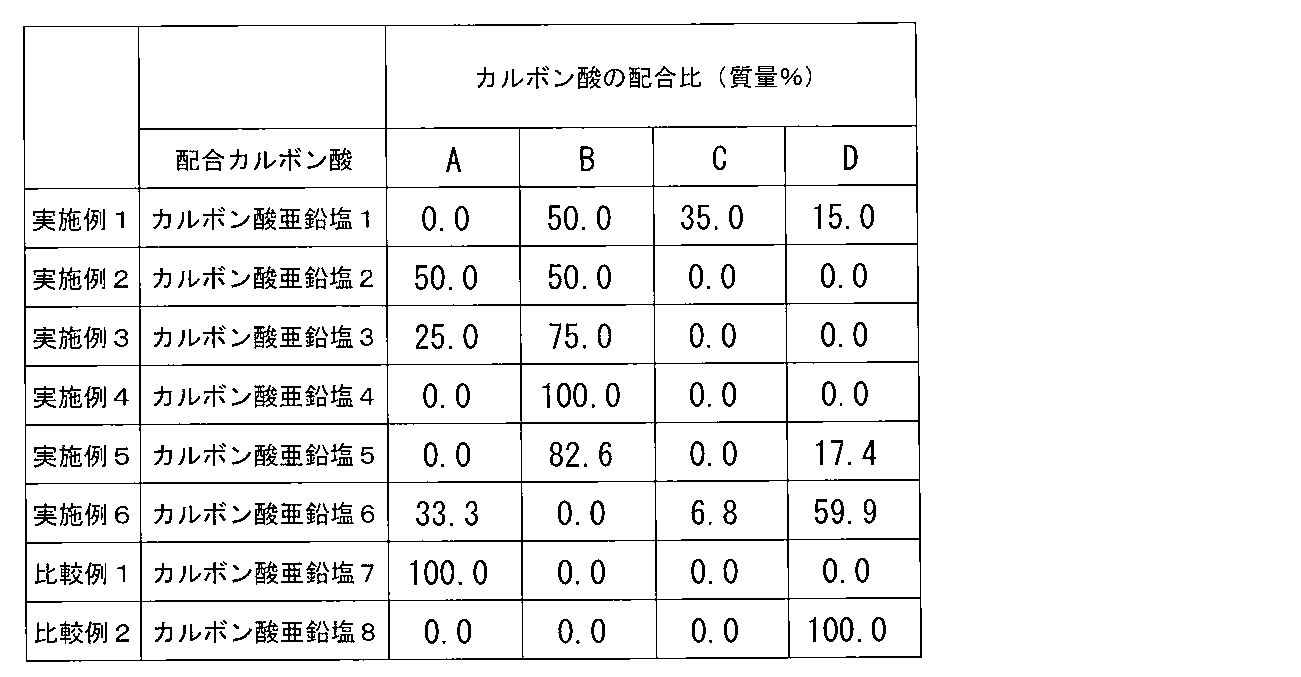
- Table 2 shows the carboxylic acid compounding ratio.
- Neodecanoic acid (158 g, 0.91 mol), 2-ethylhexanoic acid (91.8 g, 0.64 mol), decanoic acid (47.1 g, 0.27 mol) were stirred while heating at 40° C., and the carboxylic acid mixture was was prepared.
- the prepared carboxylic acid mixture and zinc oxide (58.8 g, 0.90 mol) were charged into a separable flask equipped with a water content meter, stirred, and heated to 170° C. under a nitrogen atmosphere. The generated water was removed from the water content receiver and held at 170°C for 2 hours. After evacuating for 1 hour, the system was purged with nitrogen and cooled to room temperature (25° C.) to obtain carboxylic acid zinc salt 1.
- Example 2 3,5,5-Trimethylhexanoic acid (144 g, 0.91 mol) and neodecanoic acid (158 g, 0.91 mol) were stirred while being heated at 40° C. to prepare a carboxylic acid mixture.
- the prepared carboxylic acid mixture and zinc oxide (58.8 g, 0.90 mol) were charged into a separable flask equipped with a water content meter, stirred, and heated to 170° C. under a nitrogen atmosphere. The generated water was removed from the water content receiver and held at 170°C for 2 hours. After evacuating for 1 hour, the inside was replaced with nitrogen and cooled to room temperature (25° C.) to obtain carboxylic acid zinc salt 2.
- Example 3 3,5,5-Trimethylhexanoic acid (71.9 g, 0.45 mol) and neodecanoic acid (237 g, 1.36 mol) were stirred at 40° C. to prepare a carboxylic acid mixture.
- the prepared carboxylic acid mixture and zinc oxide (58.8 g, 0.90 mol) were charged into a separable flask equipped with a water content meter, stirred, and heated to 170° C. under a nitrogen atmosphere. The generated water was removed from the water content receiver and held at 170°C for 2 hours. After evacuating for 1 hour, the inside was replaced with nitrogen and cooled to room temperature (25° C.) to obtain carboxylic acid zinc salt 3.
- Neodecanoic acid (316 g, 1.82 mol) and zinc oxide (58.8 g, 0.90 mol) were charged into a separable flask equipped with a moisture meter, stirred, and heated to 170° C. under a nitrogen atmosphere. The generated water was removed from the water content receiver and held at 170°C for 2 hours. After evacuating for 1 hour, it was replaced with nitrogen and cooled to room temperature (25° C.) to obtain carboxylic acid zinc salt 4.
- Neodecanoic acid (261 g, 1.50 mol) and decanoic acid (54.6 g, 0.32 mol) were stirred while being heated at 40° C. to prepare a carboxylic acid mixture.
- the prepared carboxylic acid mixture and zinc oxide (58.8 g, 0.90 mol) were charged into a separable flask equipped with a water content meter, stirred, and heated to 170° C. under a nitrogen atmosphere. The generated water was removed from the water content receiver and held at 170°C for 2 hours. After evacuating for 1 hour, the atmosphere was replaced with nitrogen and cooled to room temperature (25° C.) to obtain carboxylic acid zinc salt 5.
- Example 6 3,5,5-trimethylhexanoic acid (95.8 g, 0.61 mol), 2-ethylhexanoic acid (17.8 g, 0.12 mol) and decanoic acid (188 g, 1.09 mol) were heated at 40°C. while stirring to prepare a carboxylic acid mixture.
- the prepared carboxylic acid mixture and zinc oxide (58.8 g, 0.90 mol) were charged into a separable flask equipped with a water content meter, stirred, and heated to 170° C. under a nitrogen atmosphere. The generated water was removed from the water content receiver and held at 170°C for 2 hours. After evacuating for 1 hour, the system was purged with nitrogen and cooled to room temperature (25° C.) to obtain carboxylic acid zinc salt 6.
- C8-10 carboxylic acid ratio From the carbon number composition of the carboxylic acid in Table 1 and the carboxylic acid blending ratio in Table 2, the C8-10 carboxylic acid ratio (% by mass) of the carboxylic acid zinc salts 1-8 was calculated.
- Metal content; Zn content 0.1 g of the zinc carboxylates 1 to 8 were precisely weighed and heated in a porcelain crucible at 650° C. for 4 hours to remove organic matter. 1 ml of hydrochloric acid was added to the residue to dissolve it, and water was added to bring the volume to 100 ml. Using this solution as a sample, the metal content (Zn content) was measured by atomic absorption spectrophotometry.
- the dynamic viscosities of zinc carboxylates 1 to 8 were measured using a dynamic viscoelasticity measuring device (modular concept rheometer MCR302 manufactured by Anton Paar). The zinc carboxylate was placed on the hot plate of the rheometer, heated to 130° C., and kept warm with a sample cover. A cone plate (CP25-2) was used to measure the dynamic viscosity when the rotational speed was swept from 1.0 rpm to 1000 rpm, and the 130° C. viscosity (Pa ⁇ s) at the rotational speed of 150 rpm was calculated.
- Semiconductor nanoparticles and semiconductor nanoparticle composites were produced according to the following method, and the optical properties of the obtained semiconductor nanoparticles and semiconductor nanoparticle composites were measured.
- tris(trimethylsilyl)phosphine was mixed with tri-n-octylphosphine at a molar concentration of 0.2M in a glove box in a nitrogen atmosphere to obtain a P precursor. Then, 2 mL of P precursor was injected into the In precursor at room temperature (25° C.) under a nitrogen atmosphere, and the temperature was raised to 300° C. at 30° C./min. After being held at 300° C. for 2 minutes, the reaction liquid was cooled to room temperature to obtain a reaction liquid as a dispersion liquid of InP core particles.
- ⁇ Zinc precursor solution The zinc carboxylate shown in Table 2 and octadecene were mixed so that the molar concentration of zinc was 0.3 M, and the mixture was evacuated at 100°C for 1 hour, then replaced with nitrogen and cooled to room temperature (25°C). to obtain a solution of each zinc precursor.
- ⁇ Solution of Se precursor 100 mmol of powdered selenium and 50 mL of tri-n-octylphosphine were mixed under a nitrogen atmosphere and stirred until the selenium powder was completely dissolved to obtain a Se precursor solution.
- ⁇ Solution of S precursor 100 mmol of powdered sulfur and 50 mL of tri-n-octylphosphine were mixed under a nitrogen atmosphere and stirred until the sulfur powder was completely dissolved to obtain an S precursor solution.
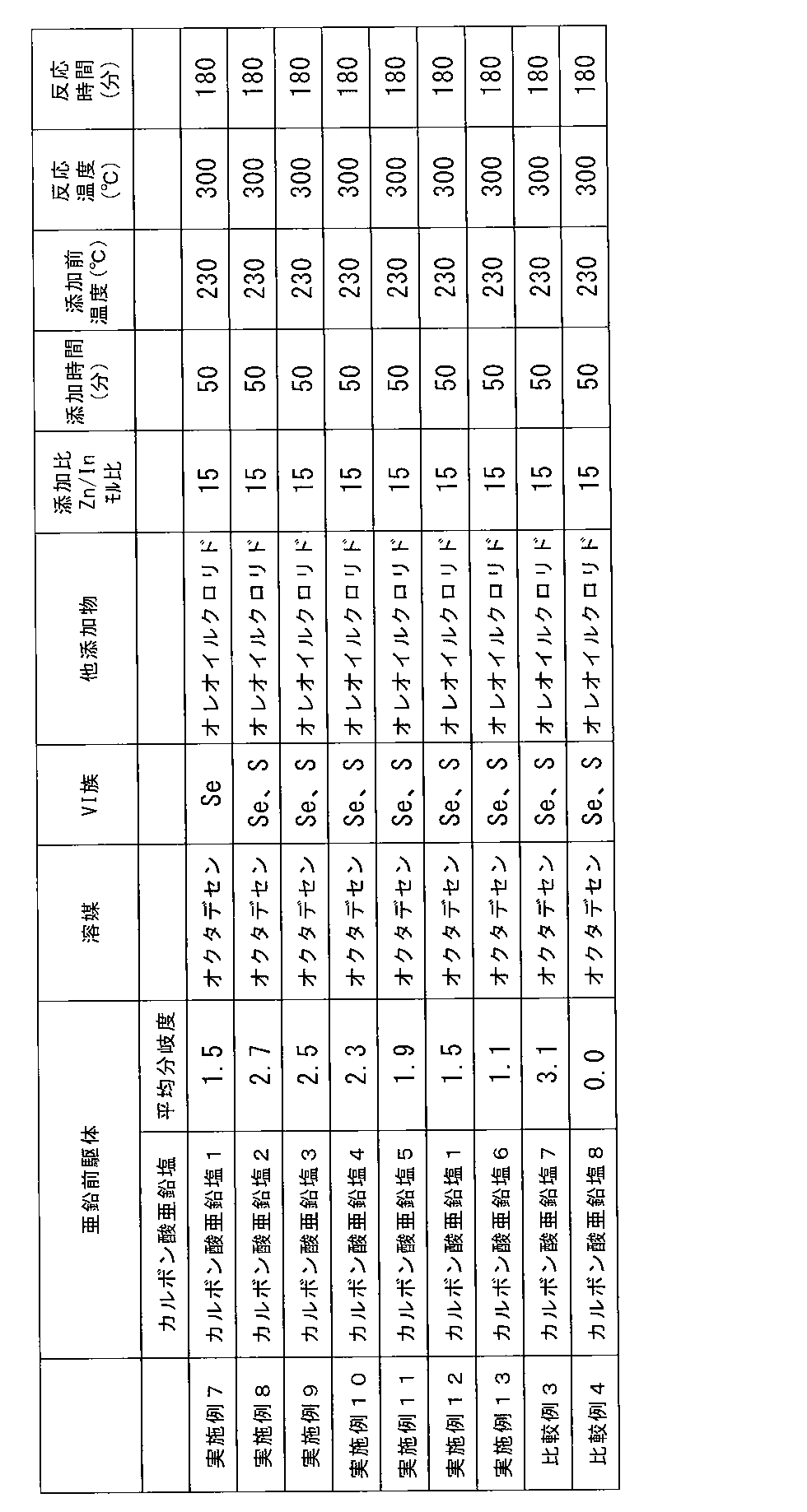
- Example 7 5 mL of trioctylamine was added to 10 mL of InP core particle dispersion (In: 0.4 mmol), and the InP core particle dispersion was heated to 230°C. Next, when the InP core particle dispersion reached 230° C., 20 mL of the zinc precursor solution and 2.0 mL of the Se precursor solution shown in Table 4 were added within 1 minute to disperse the InP core particles. The liquid was heated up to 300°C at a rate of 1°C/min.
- Addition of the solution was started simultaneously at a rate of 0.03 mL/min, and 100 minutes after the addition of the zinc precursor solution and the S precursor solution was started, the addition of both was completed simultaneously (addition time: 100 minutes). Then, 180 minutes after the end of the addition, the heating was terminated and the mixture was cooled to room temperature (25° C.) to obtain core/shell/shell semiconductor nanoparticles. A dispersion liquid (reaction liquid) was obtained. Next, acetone was added to the resulting dispersion of core/shell/shell semiconductor nanoparticles to aggregate the semiconductor nanoparticles.
Landscapes
- Chemical & Material Sciences (AREA)
- Organic Chemistry (AREA)
- Engineering & Computer Science (AREA)
- Materials Engineering (AREA)
- Inorganic Chemistry (AREA)
- Nanotechnology (AREA)
- Composite Materials (AREA)
- Condensed Matter Physics & Semiconductors (AREA)
- General Physics & Mathematics (AREA)
- Crystallography & Structural Chemistry (AREA)
- Physics & Mathematics (AREA)
- Luminescent Compositions (AREA)
- Inorganic Compounds Of Heavy Metals (AREA)
Abstract
Description
また、特許文献1には、シェル形成用のZn前駆体として、オレイン酸亜鉛、ヘキサン酸亜鉛、オクタン酸亜鉛、ラウリン酸亜鉛、パルミチン酸亜鉛、ステアリン酸亜鉛、ジチオカルバミン酸亜鉛などを用いる記載がある。
該カルボン酸の亜鉛塩を形成するカルボン酸全体のうち、炭素数が8~10のカルボン酸の割合が80.0質量%以上であり、
該カルボン酸の亜鉛塩を形成するカルボン酸全体の平均分岐度が1.1~2.9であること、
を特徴とする半導体ナノ粒子の製造に用いられるカルボン酸亜鉛塩を提供するものである。
一般式(1)
粘度変化率(%)=((130℃粘度(Pa・s)-50℃粘度(Pa・s))/50℃粘度(Pa・s))×100 (1)
(式中、130℃粘度(Pa・s)は、前記カルボン酸亜鉛塩を130℃の温度下で動的粘弾性測定装置により測定した値であり、50℃粘度は、前記カルボン酸亜鉛塩を50℃の温度下で動的粘弾性測定装置により測定した値である。)
該原料カルボン酸亜鉛塩を形成するカルボン酸全体の平均分岐度が1.1~2.9であること、
を特徴とする半導体ナノ粒子の製造に用いられるカルボン酸亜鉛塩である。
一般式(1)
粘度変化率(%)=((130℃粘度(Pa・s)-50℃粘度(Pa・s))/50℃粘度(Pa・s))×100 (1)
(式中、130℃粘度(Pa・s)は、カルボン酸亜鉛塩を130℃の温度下で動的粘弾性測定装置により測定した値であり、50℃粘度は、カルボン酸亜鉛塩を50℃の温度下で動的粘弾性測定装置により測定した値である。)
半導体ナノ粒子の元素分析については、高周波誘導結合プラズマ発光分析装置(ICP)又は蛍光X線分析装置(XRF)を用いて元素分析を行うことができる。ICP測定では、精製した半導体ナノ粒子を硝酸で溶解し加熱後、水で希釈してICP発光分析装置(島津製作所製、ICPS-8100)を用いて検量線法で測定する。XRF測定では、分散液をろ紙に含浸させたものをサンプリングホルダに入れ、蛍光X線分析装置(リガク製、ZSX100e)を用いて定量分析を行う。
該カルボン酸の亜鉛塩を形成するカルボン酸全体のうち、炭素数が8~10のカルボン酸の割合が80.0質量%以上であり、
該カルボン酸の亜鉛塩を形成するカルボン酸全体の平均分岐度が1.1~2.9であること、
を特徴とする半導体ナノ粒子の製造に用いられる亜鉛塩である。
以下の方法に従って、分岐カルボン酸亜鉛塩の作製を行った。カルボン酸としては、3,5,5-トリメチルヘキサン酸(東京化成工業株式会社製試薬;純度>98.0%)、ネオデカン酸(富士フイルム和光純薬株式会社製試薬)、2-エチルヘキサン酸(東京化成工業株式会社製試薬;純度>99.0%)、デカン酸(日油株式会社製NAAー102)を用いた。それぞれのカルボン酸の炭素数組成の分析結果を表1、カルボン酸配合比を表2に示す。
ネオデカン酸(158g、0.91mol)、2-エチルヘキサン酸(91.8g、0.64mol)、デカン酸(47.1g、0.27mol)を40℃で加温しながら撹拌し、カルボン酸混合物を調製した。調製したカルボン酸混合物と酸化亜鉛(58.8g、0.90mol)を、水分定量受器を備えたセパラブルフラスコに投入して撹拌し、窒素雰囲気下で170℃に加熱した。発生した水は水分定量受器から除去し、170℃で2時間保持した。1時間真空引きした後、窒素置換して室温(25℃)まで冷却し、カルボン酸亜鉛塩1を得た。
3,5,5-トリメチルヘキサン酸(144g、0.91mol)、ネオデカン酸(158g、0.91mol)を40℃で加温しながら撹拌し、カルボン酸混合物を調製した。調製したカルボン酸混合物と酸化亜鉛(58.8g、0.90mol)を、水分定量受器を備えたセパラブルフラスコに投入して撹拌し、窒素雰囲気下で170℃に加熱した。発生した水は水分定量受器から除去し、170℃で2時間保持した。1時間真空引きした後、窒素置換して室温(25℃)まで冷却し、カルボン酸亜鉛塩2を得た。
3,5,5-トリメチルヘキサン酸(71.9g、0.45mol)、ネオデカン酸(237g、1.36mol)を40℃で加温しながら撹拌し、カルボン酸混合物を調製した。調製したカルボン酸混合物と酸化亜鉛(58.8g、0.90mol)を、水分定量受器を備えたセパラブルフラスコに投入して撹拌し、窒素雰囲気下で170℃に加熱した。発生した水は水分定量受器から除去し、170℃で2時間保持した。1時間真空引きした後、窒素置換して室温(25℃)まで冷却し、カルボン酸亜鉛塩3を得た。
ネオデカン酸(316g、1.82mol)と酸化亜鉛(58.8g、0.90mol)を、水分定量受器を備えたセパラブルフラスコに投入して撹拌し、窒素雰囲気下で170℃に加熱した。発生した水は水分定量受器から除去し、170℃で2時間保持した。1時間真空引きした後、窒素置換して室温(25℃)まで冷却し、カルボン酸亜鉛塩4を得た。
ネオデカン酸(261g、1.50mol)、デカン酸(54.6g、0.32mol)を40℃で加温しながら撹拌し、カルボン酸混合物を調製した。調製したカルボン酸混合物と酸化亜鉛(58.8g、0.90mol)を、水分定量受器を備えたセパラブルフラスコに投入して撹拌し、窒素雰囲気下で170℃に加熱した。発生した水は水分定量受器から除去し、170℃で2時間保持した。1時間真空引きした後、窒素置換して室温(25℃)まで冷却し、カルボン酸亜鉛塩5を得た。
3,5,5-トリメチルヘキサン酸(95.8g、0.61mol)、2-エチルヘキサン酸(17.8g、0.12mol)、デカン酸(188g、1.09mol)を40℃で加温しながら撹拌し、カルボン酸混合物を調製した。調製したカルボン酸混合物と酸化亜鉛(58.8g、0.90mol)を、水分定量受器を備えたセパラブルフラスコに投入して撹拌し、窒素雰囲気下で170℃に加熱した。発生した水は水分定量受器から除去し、170℃で2時間保持した。1時間真空引きした後、窒素置換して室温(25℃)まで冷却し、カルボン酸亜鉛塩6を得た。
3,5,5-トリメチルヘキサン酸(288g、1.82mol)と酸化亜鉛(58.8g、0.90mol)を、水分定量受器を備えたセパラブルフラスコに投入して撹拌し、窒素雰囲気下で170℃に加熱した。発生した水は水分定量受器から除去し、170℃で2時間保持した。1時間真空引きした後、窒素置換して室温(25℃)まで冷却し、カルボン酸亜鉛塩7を得た。
デカン酸(316g、1.82mol)、水(2000g)をセパラブルフラスコに仕込み、60℃に加熱した。次いで48.0wt%水酸化ナトリウム水溶液(154g、1.82mol)を加え20分間撹拌した後、25.0wt%硫酸亜鉛水溶液(650g、2.00mol)を60分間かけて滴下した。滴下終了後、得られたカルボン酸亜鉛スラリーを吸引ろ過し、1000gの水で3回水洗した。得られたケーキについて棚段乾燥機内に60℃で36時間静置した後、室温(25℃)まで冷却し、カルボン酸亜鉛塩8を得た。
上記で得られたカルボン酸亜鉛塩1~8について、物性の測定を行った。その結果を表3に示す。
表1のカルボン酸の炭素数組成、および表2のカルボン酸配合比から、カルボン酸亜鉛塩1~8のC8~10カルボン酸比率(質量%)を算出した。
表1のカルボン酸の分岐度、および表2のカルボン酸配合比から、カルボン酸亜鉛塩1~8の平均分岐度を算出した。
カルボン酸亜鉛塩1~8を0.1gを精秤し、磁製ルツボ中で650℃にて4時間加熱して有機物を除去した。残渣に塩酸1mlを加えて溶解させ、水を加えて100mlとした。この溶液を試料として、原子吸光光度法により金属含有量(Zn含有量)を測定した。
カルボン酸亜鉛塩1~8について、動的粘弾性測定装置(アントンパール社製、モジュラーコンセプトレオメータMCR302)を用いて動的粘度の測定を行った。カルボン酸亜鉛をレオメータのホットプレート上に乗せて130℃に加熱し、サンプルカバーで保温した。コーンプレート(CP25-2)を用いて回転数1.0rpmから1000rpmまで掃引したときの動的粘度を測定し、回転数が150rpmのときの130℃粘度(Pa・s)を算出した。その後、温度を50℃に下げ、同様に回転数1.0rpmから1000rpmまで掃引したときの動的粘度を測定し、回転数が150rpmのときの50℃粘度(Pa・s)を算出した。
130℃粘度(Pa・s)と50℃粘度(Pa・s)の差を取り、50℃粘度(Pa・s)で除した値に100を乗することで、温度変化に対する粘度変化率を算出した。
粘度変化率(%)=((130℃粘度(Pa・s)-50℃粘度(Pa・s))/50℃粘度(Pa・s))×100
酢酸インジウム(0.5mmol)、ミリスチン酸(1.5mmol)、ミリスチン酸亜鉛(0.2mmol)、オクタデセン(10mL)を、二つ口フラスコに投入し、フラスコ内を真空にして、真空下(<10Pa)で120℃に加熱し、真空度が10Paを下回った時点から、30分間保持した後、フラスコ内に窒素を導入し、室温(25℃)まで冷却して、In前駆体を得た。
また、窒素雰囲気のグローブボックス内で、トリス(トリメチルシリル)ホスフィンを、モル濃度が0.2Mとなるように、トリ-n-オクチルホスフィンと混合し、P前駆体を得た。
次いで、室温(25℃)、窒素雰囲気下で、In前駆体に2mLのP前駆体を注入し、30℃/分で300℃まで昇温した。300℃で、2分間保持した後、反応液を室温まで冷却して、反応液を、InPコア粒子の分散液として得た。
亜鉛のモル濃度が0.3Mとなるように、表2に記載のカルボン酸亜鉛塩とオクタデセンを混合し、100℃で1時間真空引きした後、窒素置換して室温(25℃)まで冷却して、各亜鉛前駆体の溶液を得た。
粉末セレン100mmolとトリ-n-オクチルホスフィン50mLを、窒素雰囲気下で混合し、セレン粉末が完全に溶けるまで撹拌して、Se前駆体の溶液を得た。
粉末硫黄100mmolとトリ-n-オクチルホスフィン50mLを、窒素雰囲気下で混合し、硫黄粉末が完全に溶けるまで撹拌して、S前駆体の溶液を得た。
(実施例7)
InPコア粒子の分散液10mL(In:0.4mmol)にトリオクチルアミン5mLを加え、InPコア粒子の分散液を230℃まで昇温した。次いで、InPコア粒子の分散液が230℃に到達した時点で、表4に示す亜鉛前駆体の溶液20mL及びSe前駆体の溶液2.0mLを、1分以内で添加し、InPコア粒子の分散液を300℃まで1℃/分で昇温した。次いで、InPコア粒子の分散液が300℃に到達した時点から180分後に、加熱を終了し、室温(25℃)まで冷却して、コア/シェル半導体ナノ粒子の分散液(反応液)を得た。
次いで、得られたコア/シェル半導体ナノ粒子の分散液にアセトンを加え、半導体ナノ粒子を凝集させた。次いで、遠心分離(4000rpm、10分間)後、上澄みを除去し、コア/シェル半導体ナノ粒子をヘキサンに再分散させた。これを繰り返して、精製されたコア/シェル半導体ナノ粒子を得た。
得られたコア/シェル半導体ナノ粒子の光学特性を測定した。その結果を表5に示す。
なお、半導体ナノ粒子の光学特性の測定では、励起波長は450nmの単一波長とした。以下の半導体ナノ粒子の光学特性の測定についても同じである。
(実施例8~13、比較例3~4)
上記の各実施例又は比較例と同様に行い、コア/シェル半導体ナノ粒子の分散液(反応液)を得た。次いで、得られたコア/シェル半導体ナノ粒子の分散液(反応液)を、300℃まで加熱した。300℃に到達後、コア/シェル半導体ナノ粒子の分散液(反応液)に、表4に示す亜鉛前駆体の溶液を0.2mL/分の速度で、Se前駆体の溶液及びS前駆体の溶液を0.03mL/分の速度で、添加を同時に開始し、亜鉛前駆体の溶液及びS前駆体の溶液の添加を開始してから100分後に、両者の添加を同時に終了した(添加時間:100分間)。次いで、添加が終了した時点から180分後に、加熱を終了し、室温(25℃)まで冷却して、コア/シェル/シェル半導体ナノ粒子を得た。分散液(反応液)を得た。
次いで、得られたコア/シェル/シェル半導体ナノ粒子の分散液にアセトンを加え、半導体ナノ粒子を凝集させた。次いで、遠心分離(4000rpm、10分間)後、上澄みを除去し、コア/シェル/シェル半導体ナノ粒子をヘキサンに再分散させた。これを繰り返して、精製されたコア/シェル/シェル半導体ナノ粒子を得た。
得られたコア/シェル/シェル半導体ナノ粒子の光学特性を測定した。その結果を表5に示す。



Claims (4)
- カルボン酸の亜鉛塩であり、
該カルボン酸の亜鉛塩を形成するカルボン酸全体のうち、炭素数が8~10のカルボン酸の割合が80.0質量%以上であり、
該カルボン酸の亜鉛塩を形成するカルボン酸全体の平均分岐度が1.1~2.9であること、
を特徴とする半導体ナノ粒子の製造に用いられるカルボン酸亜鉛塩。 - 前記カルボン酸の亜鉛塩を形成するカルボン酸全体の平均分岐度が1.3~2.7であることを特徴とする請求項1に記載の半導体ナノ粒子の製造に用いられるカルボン酸亜鉛塩。
- 前記カルボン酸の亜鉛塩を形成するカルボン酸全体のうち、炭素数が8~10のカルボン酸の割合が85.0質量%以上であることを特徴とする請求項1または2に記載の半導体ナノ粒子の製造に用いられるカルボン酸亜鉛塩。
- 前記カルボン酸の亜鉛塩の下記式(1)で示される粘度変化率が95.0~100.0%であることを特徴とする請求項1~3のいずれか1項に記載の半導体ナノ粒子の製造に用いられるカルボン酸亜鉛塩。
一般式(1)
粘度変化率(%)=((130℃粘度(Pa・s)-50℃粘度(Pa・s))/50℃粘度(Pa・s))×100 (1)
(式中、130℃粘度(Pa・s)は、前記カルボン酸亜鉛塩を130℃の温度下で動的粘弾性測定装置により測定した値であり、50℃粘度は、前記カルボン酸亜鉛塩を50℃の温度下で動的粘弾性測定装置により測定した値である。)
Priority Applications (4)
| Application Number | Priority Date | Filing Date | Title |
|---|---|---|---|
| KR1020247005097A KR20240049272A (ko) | 2021-08-18 | 2022-08-05 | 반도체 나노 입자의 제조에 이용되는 카르복시산 아연염 |
| JP2023542332A JP7852641B2 (ja) | 2021-08-18 | 2022-08-05 | 半導体ナノ粒子の製造に用いられるカルボン酸亜鉛塩 |
| CN202280054506.3A CN117794891A (zh) | 2021-08-18 | 2022-08-05 | 半导体纳米颗粒的制造中使用的羧酸锌盐 |
| US18/683,994 US20250136538A1 (en) | 2021-08-18 | 2022-08-05 | Zinc carboxylate salt for production of semiconductor nanoparticle |
Applications Claiming Priority (2)
| Application Number | Priority Date | Filing Date | Title |
|---|---|---|---|
| JP2021133632 | 2021-08-18 | ||
| JP2021-133632 | 2021-08-18 |
Publications (1)
| Publication Number | Publication Date |
|---|---|
| WO2023022016A1 true WO2023022016A1 (ja) | 2023-02-23 |
Family
ID=85239487
Family Applications (1)
| Application Number | Title | Priority Date | Filing Date |
|---|---|---|---|
| PCT/JP2022/030043 Ceased WO2023022016A1 (ja) | 2021-08-18 | 2022-08-05 | 半導体ナノ粒子の製造に用いられるカルボン酸亜鉛塩 |
Country Status (5)
| Country | Link |
|---|---|
| US (1) | US20250136538A1 (ja) |
| JP (1) | JP7852641B2 (ja) |
| KR (1) | KR20240049272A (ja) |
| CN (1) | CN117794891A (ja) |
| WO (1) | WO2023022016A1 (ja) |
Citations (5)
| Publication number | Priority date | Publication date | Assignee | Title |
|---|---|---|---|---|
| US3513122A (en) * | 1967-02-20 | 1970-05-19 | Neville Chemical Co | Printing on lubricated surfaces and ink composition useful therein |
| JP2004025711A (ja) * | 2002-06-27 | 2004-01-29 | Fuji Photo Film Co Ltd | 感熱記録材料 |
| JP2008071585A (ja) * | 2006-09-13 | 2008-03-27 | Nof Corp | 色素増感型太陽電池用電極の製造方法 |
| JP2012033936A (ja) * | 2010-07-28 | 2012-02-16 | Sharp Corp | Ii−iii−v化合物半導体 |
| JP2020521707A (ja) * | 2017-05-23 | 2020-07-27 | メルク パテント ゲゼルシャフト ミット ベシュレンクテル ハフツングMerck Patent Gesellschaft mit beschraenkter Haftung | 半電導性材料を合成するための方法 |
Family Cites Families (1)
| Publication number | Priority date | Publication date | Assignee | Title |
|---|---|---|---|---|
| AU2017255530A1 (en) | 2016-04-26 | 2018-11-22 | Nanosys, Inc. | Stable InP quantum dots with thick shell coating and method of producing the same |
-
2022
- 2022-08-05 KR KR1020247005097A patent/KR20240049272A/ko active Pending
- 2022-08-05 CN CN202280054506.3A patent/CN117794891A/zh active Pending
- 2022-08-05 WO PCT/JP2022/030043 patent/WO2023022016A1/ja not_active Ceased
- 2022-08-05 JP JP2023542332A patent/JP7852641B2/ja active Active
- 2022-08-05 US US18/683,994 patent/US20250136538A1/en active Pending
Patent Citations (5)
| Publication number | Priority date | Publication date | Assignee | Title |
|---|---|---|---|---|
| US3513122A (en) * | 1967-02-20 | 1970-05-19 | Neville Chemical Co | Printing on lubricated surfaces and ink composition useful therein |
| JP2004025711A (ja) * | 2002-06-27 | 2004-01-29 | Fuji Photo Film Co Ltd | 感熱記録材料 |
| JP2008071585A (ja) * | 2006-09-13 | 2008-03-27 | Nof Corp | 色素増感型太陽電池用電極の製造方法 |
| JP2012033936A (ja) * | 2010-07-28 | 2012-02-16 | Sharp Corp | Ii−iii−v化合物半導体 |
| JP2020521707A (ja) * | 2017-05-23 | 2020-07-27 | メルク パテント ゲゼルシャフト ミット ベシュレンクテル ハフツングMerck Patent Gesellschaft mit beschraenkter Haftung | 半電導性材料を合成するための方法 |
Non-Patent Citations (1)
| Title |
|---|
| XIONG, G. ; JONES, G.A.C. ; RUNGSAWANG, R. ; ANDERSON, D.: "Non-aqueous solution processed ZnO thin film transistors", THIN SOLID FILMS, ELSEVIER, AMSTERDAM, NL, vol. 518, no. 14, 3 May 2010 (2010-05-03), AMSTERDAM, NL , pages 4019 - 4023, XP026996862, ISSN: 0040-6090 * |
Also Published As
| Publication number | Publication date |
|---|---|
| US20250136538A1 (en) | 2025-05-01 |
| KR20240049272A (ko) | 2024-04-16 |
| JP7852641B2 (ja) | 2026-04-28 |
| JPWO2023022016A1 (ja) | 2023-02-23 |
| CN117794891A (zh) | 2024-03-29 |
Similar Documents
| Publication | Publication Date | Title |
|---|---|---|
| JP6114369B2 (ja) | ナノ粒子 | |
| JP5682902B2 (ja) | 水分散性を有する高発光効率ナノ粒子 | |
| US11542432B2 (en) | Method for synthesizing a semiconducting nanosized material | |
| CN102084041B (zh) | 制备发光纳米晶体的方法、形成的纳米晶体及其用途 | |
| US20040151898A1 (en) | Luminescent materials formed consisting of nanocrystals with core/shell structure and method for preparing same | |
| TW201831657A (zh) | 發出可見螢光之不含Cd之膠體量子點及其之製造方法 | |
| Mishra et al. | A molecular precursor approach to monodisperse scintillating CeF 3 nanocrystals | |
| TW202442849A (zh) | Iii-v膠態奈米晶體之形狀控制合成 | |
| KR102786180B1 (ko) | 코어/셸형 반도체 나노 입자의 제조 방법 | |
| JP7852641B2 (ja) | 半導体ナノ粒子の製造に用いられるカルボン酸亜鉛塩 | |
| WO2023021897A1 (ja) | コア/シェル型半導体ナノ粒子の製造方法、及び半導体ナノ粒子複合体 | |
| WO2020225072A1 (en) | Method for synthesizing a semiconducting nanosized material | |
| KR102358680B1 (ko) | Iii-v족 코어를 포함하는 코어-쉘 구조의 양자점 제조방법 및 이에 의해 제조된 양자점 | |
| JPS60191006A (ja) | カルコゲナイド粉末の製造方法 | |
| WO2026029090A1 (ja) | コア/シェル型半導体ナノ粒子及びその製造方法 | |
| WO2022233424A1 (en) | Method for synthesizing a semiconducting nanosized material | |
| WO2025238338A1 (en) | Quantum technologies | |
| JP2019019299A (ja) | 波長変換半導体ナノ粒子及びその製造方法 |
Legal Events
| Date | Code | Title | Description |
|---|---|---|---|
| 121 | Ep: the epo has been informed by wipo that ep was designated in this application |
Ref document number: 22858337 Country of ref document: EP Kind code of ref document: A1 |
|
| WWE | Wipo information: entry into national phase |
Ref document number: 2023542332 Country of ref document: JP |
|
| WWE | Wipo information: entry into national phase |
Ref document number: 202280054506.3 Country of ref document: CN |
|
| WWE | Wipo information: entry into national phase |
Ref document number: 18683994 Country of ref document: US |
|
| NENP | Non-entry into the national phase |
Ref country code: DE |
|
| 122 | Ep: pct application non-entry in european phase |
Ref document number: 22858337 Country of ref document: EP Kind code of ref document: A1 |
|
| WWP | Wipo information: published in national office |
Ref document number: 18683994 Country of ref document: US |