WO2023008173A1 - 探索方法、探索システム、プログラム、予測モデル構築方法、及び予測モデル構築装置 - Google Patents
探索方法、探索システム、プログラム、予測モデル構築方法、及び予測モデル構築装置 Download PDFInfo
- Publication number
- WO2023008173A1 WO2023008173A1 PCT/JP2022/027344 JP2022027344W WO2023008173A1 WO 2023008173 A1 WO2023008173 A1 WO 2023008173A1 JP 2022027344 W JP2022027344 W JP 2022027344W WO 2023008173 A1 WO2023008173 A1 WO 2023008173A1
- Authority
- WO
- WIPO (PCT)
- Prior art keywords
- energy
- initial
- atomic arrangement
- structures
- prediction model
- Prior art date
- Legal status (The legal status is an assumption and is not a legal conclusion. Google has not performed a legal analysis and makes no representation as to the accuracy of the status listed.)
- Ceased
Links
Images












Classifications
-
- G—PHYSICS
- G06—COMPUTING OR CALCULATING; COUNTING
- G06N—COMPUTING ARRANGEMENTS BASED ON SPECIFIC COMPUTATIONAL MODELS
- G06N5/00—Computing arrangements using knowledge-based models
- G06N5/02—Knowledge representation; Symbolic representation
- G06N5/022—Knowledge engineering; Knowledge acquisition
-
- G—PHYSICS
- G16—INFORMATION AND COMMUNICATION TECHNOLOGY [ICT] SPECIALLY ADAPTED FOR SPECIFIC APPLICATION FIELDS
- G16C—COMPUTATIONAL CHEMISTRY; CHEMOINFORMATICS; COMPUTATIONAL MATERIALS SCIENCE
- G16C20/00—Chemoinformatics, i.e. ICT specially adapted for the handling of physicochemical or structural data of chemical particles, elements, compounds or mixtures
- G16C20/70—Machine learning, data mining or chemometrics
-
- G—PHYSICS
- G16—INFORMATION AND COMMUNICATION TECHNOLOGY [ICT] SPECIALLY ADAPTED FOR SPECIFIC APPLICATION FIELDS
- G16C—COMPUTATIONAL CHEMISTRY; CHEMOINFORMATICS; COMPUTATIONAL MATERIALS SCIENCE
- G16C20/00—Chemoinformatics, i.e. ICT specially adapted for the handling of physicochemical or structural data of chemical particles, elements, compounds or mixtures
- G16C20/30—Prediction of properties of chemical compounds, compositions or mixtures
-
- G—PHYSICS
- G16—INFORMATION AND COMMUNICATION TECHNOLOGY [ICT] SPECIALLY ADAPTED FOR SPECIFIC APPLICATION FIELDS
- G16C—COMPUTATIONAL CHEMISTRY; CHEMOINFORMATICS; COMPUTATIONAL MATERIALS SCIENCE
- G16C60/00—Computational materials science, i.e. ICT specially adapted for investigating the physical or chemical properties of materials or phenomena associated with their design, synthesis, processing, characterisation or utilisation
-
- G—PHYSICS
- G06—COMPUTING OR CALCULATING; COUNTING
- G06N—COMPUTING ARRANGEMENTS BASED ON SPECIFIC COMPUTATIONAL MODELS
- G06N3/00—Computing arrangements based on biological models
- G06N3/02—Neural networks
- G06N3/04—Architecture, e.g. interconnection topology
- G06N3/042—Knowledge-based neural networks; Logical representations of neural networks
-
- G—PHYSICS
- G06—COMPUTING OR CALCULATING; COUNTING
- G06N—COMPUTING ARRANGEMENTS BASED ON SPECIFIC COMPUTATIONAL MODELS
- G06N3/00—Computing arrangements based on biological models
- G06N3/02—Neural networks
- G06N3/04—Architecture, e.g. interconnection topology
- G06N3/0464—Convolutional networks [CNN, ConvNet]
-
- G—PHYSICS
- G06—COMPUTING OR CALCULATING; COUNTING
- G06N—COMPUTING ARRANGEMENTS BASED ON SPECIFIC COMPUTATIONAL MODELS
- G06N3/00—Computing arrangements based on biological models
- G06N3/02—Neural networks
- G06N3/08—Learning methods
- G06N3/09—Supervised learning
Definitions
- the present disclosure relates to a search method and the like for searching for a stable structure of atomic arrangement for the composition of a material after desorption of atoms.
- Non-Patent Document 1 Conventionally, structural optimization techniques have been developed to obtain stable atomic arrangement structures by first-principles calculations (see, for example, Non-Patent Document 1).
- Non-Patent Document 2 discloses a method of estimating characteristic values such as energy using machine learning for input of atomic arrangement structure.
- the present disclosure provides a search method and the like that can efficiently search for a stable structure of atomic arrangement for the composition of a material after desorption of atoms.
- a search method is a search method for searching for a stable structure of atomic arrangement in a three-dimensional space for the composition of a material, wherein a computer desorbs atoms contained in the material to a first step of obtaining a plurality of initial structures, which are structures of atomic arrangements in the three-dimensional space that the composition of the material after separation can take; A second step of performing optimization and calculating a first energy corresponding to a structure with an optimized atomic arrangement, and using a prediction model for other initial structures of the plurality of initial structures, A third step of predicting a second energy corresponding to the structure of the atomic arrangement when the structure optimization is performed on the other initial structure, and a local minimum value based on the first energy and the second energy and a fourth step of extracting a third energy indicating the third energy, a first structure that is a structure of an atomic arrangement corresponding to the third energy, or a third energy and the first structure that are output 5 steps are executed, and the prediction model inputs a structure with
- Computer-readable recording media include non-volatile recording media such as CD-ROMs (Compact Disc-Read Only Memory).
- FIG. 1 is a block diagram showing an overall configuration including a search system according to Embodiment 1.
- FIG. 2 is a diagram illustrating an example of an input structure input to an input unit according to Embodiment 1.
- FIG. 3 is a diagram illustrating an example of a process in which a generation unit according to Embodiment 1 generates an initial structure;
- FIG. 4 is a diagram illustrating an example of a process of generating an initial structure by a generation unit according to Embodiment 1.
- FIG. 5 is a diagram illustrating an example of a process of generating an initial structure by a generation unit according to Embodiment 1.
- FIG. 6 is a diagram depicting an example of data stored in a structure storage unit according to Embodiment 1;
- FIG. 1 is a block diagram showing an overall configuration including a search system according to Embodiment 1.
- FIG. 2 is a diagram illustrating an example of an input structure input to an input unit according to Embodiment 1.
- FIG. 3 is a diagram
- FIG. 7 is a diagram illustrating an example of a process of calculating first energy by a calculating unit according to Embodiment 1.
- FIG. 8 is a diagram showing an example of data stored in a calculation result storage unit according to Embodiment 1.
- FIG. 9 is a diagram illustrating an example of a process of machine learning a prediction model by a learning unit according to Embodiment 1.
- FIG. 10 is a diagram illustrating an example of a process of predicting the second energy by the prediction unit according to Embodiment 1.
- FIG. 11 is a diagram illustrating an example of data generated by a comparing unit according to Embodiment 1;
- FIG. 12 is a diagram illustrating an evaluation example of prediction accuracy of a prediction unit according to Embodiment 1.
- FIG. 13 is a diagram showing a result of verification of prediction accuracy of the prediction unit according to Embodiment 1.
- FIG. 14 is a diagram showing a result of verifying the correlation between the prediction accuracy of the prediction unit and the learning data ratio according to Embodiment 1.
- FIG. 15 is a flowchart showing an operation example of the search system according to Embodiment 1.
- FIG. 16 is a block diagram showing an overall configuration including a search system according to Embodiment 2.
- FIG. 17 is a diagram depicting an example of data stored in a calculation result storage unit according to Embodiment 2;
- FIG. 18 is a diagram illustrating an example of a process of machine-learning a prediction model by a learning unit according to Embodiment 2.
- FIG. 19 is a diagram showing a result of verifying the prediction accuracy of the prediction unit according to Embodiment 2.
- FIG. FIG. 20 is a diagram showing the result of verifying the correlation between the prediction accuracy of the prediction unit and the learning data set ratio according to the second embodiment.
- 21 is a flowchart illustrating an operation example of the search system according to Embodiment 2.
- FIG. 22 is a block diagram showing an overall configuration including a search system according to Embodiment 3.
- FIG. 23 is a diagram depicting an example of data generated by a comparison unit according to Embodiment 3;
- FIG. 24 is a flowchart showing an operation example of the search system according to Embodiment 3.
- FIG. 25 is a block diagram showing an overall configuration including a search system according to Embodiment 4.
- FIG. 26 is a flowchart showing an operation example of the search system according to Embodiment 4.
- Non-Patent Document 1 discloses a structure optimization method based on first-principles calculation.
- a lithium ion battery has a positive electrode active material and a negative electrode active material, and is charged or discharged by moving lithium ions between them.
- lithium ions contained in the positive electrode active material are desorbed, and the desorbed lithium ions move to the negative electrode active material.
- the charging process can be simulated by modeling the atomic arrangement structure of the positive electrode active material and considering a stable atomic arrangement structure in a state where Li (lithium) atoms are sequentially desorbed one by one. .
- the electrode voltage can be calculated from the calculated value of the energy of the stable atomic configuration after the Li atoms are desorbed. Further, by calculating the energy difference from the stable atomic arrangement structure of the substance from which the O (oxygen) atom is detached, the oxygen desorption energy indicating the likelihood of detachment of the O atom can be calculated.
- O atoms are detached from the positive electrode active material, they may bond with the electrolyte and cause an exothermic reaction, so the oxygen desorption energy is an indicator of battery safety.
- the electrical characteristics and safety of the battery can be calculated from the stable atomic arrangement structure after desorption of the elements contained in the substance of the battery.
- the substance before the Li atoms are desorbed is a known substance
- the substance after the Li atoms are desorbed is an unknown new substance.
- structural optimization is performed for the possible candidate atomic arrangement structure of the new substance.
- Candidate atomic configurations are obtained by partially removing atoms contained in the atomic configurations of known substances, here Li atoms. Therefore, a plurality of candidate structures can be obtained depending on which Li atoms are removed.
- one or more structural optimizations are performed for each of the plurality of candidate structures, and the energy of the structurally optimized candidate structure, that is, the total energy is calculated.
- the atomic arrangement structure corresponding to the lowest energy among the calculated energies, that is, the structure-optimized candidate structure is determined to be the thermodynamically most stable atomic arrangement structure in the new substance.
- Non-Patent Document 2 describes a graph neural network model that converts atoms into nodes and bonds into edges in the atomic arrangement structure of the material composition, and predicts characteristic values such as energy from the atomic arrangement structure. Proposed. It has been shown that this method can construct a model that predicts material properties such as energy with high accuracy from the atomic arrangement structure included in the public database.
- Non-Patent Document 1 is a prior art document that discloses the basic technology of structural optimization, and does not disclose learning of a prediction model by machine learning.
- Non-Patent Document 2 merely discloses a technique for predicting material properties from an atomic arrangement structure, and does not disclose a search for a stable atomic arrangement structure.
- the inventors of the present application focused on the fact that the relationship between atomic arrangement structure and energy can be associated with a graph neural network. According to the study of the inventors of the present application, from the atomic arrangement structures that are candidates for the composition of the material after the desorption of the atoms present in a plurality of ways, the atomic arrangement structure that is thermodynamically more stable than the conventional We have found a technique that can efficiently search for As a result, it has become clear that the calculation cost can be reduced, and a stable atomic configuration can be searched with high accuracy.
- a search method is a search method for searching for a stable structure of atomic arrangement in a three-dimensional space for the composition of a material, wherein a computer performs desorption of atoms contained in the material.
- the material contains x atoms (x is an integer of 2 or more) that can be desorbed, and in the first step, z atoms (z is 1 ⁇ z ⁇ x-1) (integer), a plurality of x C z initial structures may be generated for the desorbed system.
- the partial initial structures in the second step are m (m is 1 ⁇ m ⁇ n integer), and the other initial structures in the third step may be (n ⁇ m) initial structures.
- the third energy may be the minimum value of the first energy and the second energy.
- the prediction model may be a model machine-learned using a first learning data set that includes the initial structure as input data and the first energy corresponding to the initial structure as correct data.
- the prediction model is a model machine-learned using a second learning data set that further includes the structure of the optimized atomic arrangement as input data and the first energy corresponding to the structure as correct data. There may be.
- the number of the partial initial structures in the second step may be 90% or less of the number of the plurality of initial structures.
- a search system is a search system for searching for a stable structure of atomic arrangement in a three-dimensional space for the composition of a material, wherein after desorption by desorption of atoms contained in the material
- a generation unit that generates a plurality of initial structures, which are structures of atomic arrangements in the three-dimensional space that the material composition can take, and a structure optimization is performed on some of the plurality of initial structures.
- a calculation unit that calculates a first energy corresponding to a structure of an atomic arrangement whose structure has been optimized;
- a prediction unit that predicts a second energy corresponding to the structure of the atomic arrangement when structural optimization is performed for the prediction model, and an output unit that outputs the first energy and the second energy, and the prediction model is machine-learned so that a structure with an arbitrary atomic arrangement is input, and the energy corresponding to the structure when structural optimization is performed on the structure is output as the second energy.
- the output unit is a third energy indicating a minimum value extracted based on the first energy and the second energy, a first structure that is a structure of an atomic arrangement corresponding to the third energy, or the first 3 energies and the first structure may be output.
- a program is a program for searching for a stable structure of atomic arrangement in a three-dimensional space for the composition of a material, wherein the material after desorption by desorption of atoms contained in the material
- the predictive model is machine-learned so that a structure with an arbitrary atomic arrangement is input, and the energy corresponding to the structure when structural optimization is performed on the structure is output as the second energy.
- the computer further executes a fourth step of extracting a third energy indicating a minimum value based on the first energy and the second energy, and in the sixth step, the third energy, the third
- the first structure which is the structure of the atomic arrangement corresponding to the energy, or the third energy and the first structure may be further output.
- a computer obtains an initial structure, which is an atomic arrangement structure in a three-dimensional space that can be taken by a composition of a material after desorption by desorption of atoms contained in the material.
- a predictive model construction device includes a generation unit that generates an initial structure, which is an atomic arrangement structure in a three-dimensional space that can be taken by a composition of a material after desorption by desorption of atoms contained in the material; , using a learning data set containing the initial structure as input data and the energy corresponding to the structure of the atomic arrangement obtained by performing structural optimization on the initial structure as correct data, any atomic arrangement a learning unit that performs machine learning so as to output energy corresponding to the structure when the structure is structurally optimized with respect to the input of the structure.
- a search method is a search for searching for a stable structure of atomic arrangement in the three-dimensional space for the composition of the material using a prediction model machine-learned by the prediction model construction device.
- a method wherein a computer performs geometry optimization on the initial structures by first obtaining a plurality of the initial structures and using the predictive model for each of the plurality of initial structures.
- the eighth step of predicting the energy corresponding to the structure of the atomic arrangement in the case of and the ninth step of extracting the energy indicating the minimum value from the plurality of predicted energies are executed.
- a search method is a search for searching for a stable structure of atomic arrangement in the three-dimensional space for the composition of the material using a prediction model machine-learned by the prediction model construction device.
- a method wherein a computer performs a first step of obtaining a plurality of said initial structures, performing structure optimization on some initial structures of said plurality of initial structures, and obtaining structure-optimized atoms a second step of calculating a first energy corresponding to a configuration structure; and using the prediction model for at least one initial structure among the partial initial structures to perform structural optimization for the initial structure a tenth step of predicting the second energy corresponding to the structure of the atomic configuration if the transformation were performed; and an eleventh step of verifying prediction accuracy of the prediction model by comparing the first energy and the second energy.
- the computer uses the predictive model for the other initial structure among the plurality of initial structures, thereby for the other initial structure.
- a twelfth step of predicting the second energy corresponding to the structure of the atomic arrangement when the structure optimization is performed, and extracting the third energy indicating the minimum value based on the first energy and the second energy. and a thirteenth step may be further performed.
- Such a computer program can also be realized as a computer program that causes a computer to execute the characteristic processing included in the search method or predictive model construction method of the present disclosure.
- a computer program can be distributed via a computer-readable non-temporary recording medium such as a CD-ROM or a communication network such as the Internet.
- the search system may be configured such that all components are included in one computer, or may be configured as a system in which multiple components are distributed to multiple computers. .
- Search system 100 (search method or program) according to Embodiment 1 of the present disclosure will be described in detail using the drawings.
- Search system 100 (search method or program) according to Embodiment 1 is a system (method or program) for searching for a stable structure of atomic arrangement in three-dimensional space for the composition of a material.
- stable structure refers to a structure in which the force acting on each atom contained in the structure of the atomic arrangement (that is, the crystal structure) is below the threshold, and the energy corresponding to the structure (total energy) is the minimum.
- the threshold can be appropriately set by the user, but may be a value close to zero. This is because the closer the force acting on each atom to zero, the more thermodynamically stable the structure.
- the search system 100 searches for a stable structure as described above and outputs it to the user. It may include a mode of outputting data necessary for performing. In other words, the process of searching for stable structures need not be completed only by the search system 100 (search method or program).
- FIG. 1 is a block diagram showing the overall configuration including a search system 100 according to Embodiment 1.
- the search system 100 is configured as a computer such as a personal computer or a server, for example.
- the search system 100 includes a generator 102 , a calculator 103 , a learner 104 , a predictor 105 , a comparator 106 and an output unit 107 .
- Peripheral configurations of the search system 100 include an input unit 101 , a structure storage unit 108 , a calculation result storage unit 109 , and a prediction model storage unit 110 .
- the peripheral configuration of the search system 100 may be included in the components of the search system 100 .
- the generation unit 102 and the learning unit 104 in the search system 100 are also components of a prediction model construction device.
- the input unit 101 is an input interface that receives a user's input, acquires information about the composition of the material to be searched by user's input, and outputs the information to the generation unit 102 .
- the information about the composition is, for example, the structure of the atomic arrangement in the three-dimensional space of the composition of the material to be searched. Hereinafter, this structure will also be referred to as an "input structure".
- the input unit 101 includes, for example, a keyboard, touch sensor, touch pad, mouse, or the like.
- FIG. 2 is a diagram showing an example of an input structure input to the input unit 101 according to the first embodiment.
- the composition possessed by the material to be searched can be represented by the composition formula as "Li 12 Mn 6 Ni 6 O 24 ". That is, in this case, the composition of the material to be searched is composed of 12 Li (lithium) atoms, 6 Mn (manganese) atoms, 6 Ni (nickel) atoms, and 24 O (oxygen) atoms. indicates that
- the input structure includes, for example, information described in the Crystallographic Information Common Data Format (Crystallographic Information File: CIF).
- CIF Crystallographic Information Common Data Format
- the description format of the information is not limited to the CIF data format, and any description format that enables structural optimization calculations by first-principles calculations such as the composition formula, crystal structure, and lattice vector can be used. can be written in any format.
- the CIF describes the composition formula indicating the composition of the material, the length of the unit cell vector, the angle at which atoms intersect, the arrangement of atoms in the unit cell, and the like.
- FIG. 2(a) shows the atomic arrangement for the composition of the material "Li 12 Mn 6 Ni 6 O 24 ".
- the atomic coordinates (x-coordinate, y-coordinate, z-coordinate) of each atom for example, in the case of Li atoms, a total of 12 atoms from "Li0" to [Li11]) are described. Note that the numbers such as "0" in "Li0" are added only to distinguish elements of the same type.
- the input structure includes, for example, the unit cell of the crystal structure, that is, the atomic arrangement.
- the smallest spheres are O atoms
- the unhatched spheres are Li atoms
- the hatched spheres that are about the same size as the Li atoms are Ni atoms
- the spheres are blacked out.
- the closed spheres represent Mn atoms.
- the generation unit 102 removes atoms from the input structure obtained from the input unit 101, that is, performs atom detachment processing, thereby generating a plurality of initial structures that can be taken by the structure after detachment.
- atoms are removed from the input structure by deleting lines describing the atoms to be removed from the CIF.
- the atoms to be eliminated are Li atoms. That is, the generation unit 102 (in the first step) acquires a plurality of initial structures, which are structures of atomic arrangements in a three-dimensional space that can be taken by the composition of the material after desorption by desorption of atoms contained in the material.
- the “initial structure” referred to here is the composition after one or more atoms are desorbed from the composition of the material to be searched, and is a candidate structure that can become a stable structure of atomic arrangement.
- FIG. 3 to 5 are diagrams each showing an example of the process of generating an initial structure by the generation unit 102 according to Embodiment 1.
- FIG. (a) of FIG. 3 represents the CIF of the input structure
- (b) of FIG. 3 represents the CIF of the structure after one Li atom is eliminated from the input structure
- (c) of FIG. represents the CIF of the structure after two Li atoms are eliminated from the input structure.
- the generation unit 102 generates an initial structure in the case where one Li atom is eliminated by removing "Li4" from the input structure.
- the generation unit 102 generates an initial structure when two Li atoms are desorbed by removing “Li2” and “Li6” from the input structure.
- FIG. 4 shows an example of the initial structure when two Li atoms are eliminated from the input structure.
- the initial structure shown in (a) of FIG. 4 is a structure generated by the generation unit 102 removing “Li2” and “Li6” from the input structure.
- the initial structure shown in (b) of FIG. 4 is a structure generated by the generation unit 102 removing “Li5” and “Li6” from the input structure.
- the initial structure shown in (c) of FIG. 4 is a structure generated by the generation unit 102 removing “Li0” and “Li4” from the input structure.
- the generation unit 102 generates a plurality of initial structures according to the number of Li atoms desorbed from the input structure.
- the leftmost configuration in FIG. 5 represents an example of the initial structure when one Li atom is eliminated from the input structure.
- Generate 12 C 1 12 initial structures, which is the number of combinations that leave one Li atom from .
- the second configuration from the left in FIG. 5 represents an example of the initial structure when two Li atoms are eliminated from the input structure.
- 12 C 2 66 initial structures are generated, which is the number of combinations in which two Li atoms are eliminated from a Li atom.
- the rightmost configuration in FIG. 5 represents an example of the initial structure when eight Li atoms are eliminated from the input structure.
- produces 12 C 8 495 initial structures, the number of combinations that leave 8 Li atoms from .
- a structure corresponding to the formula of the material to be searched includes x atoms represented by the same element symbol, and z atoms can be detached from the x atoms.
- x is an integer of 2 or more
- z is an integer satisfying 1 ⁇ z ⁇ x ⁇ 1.
- the generation unit 102 (at the first step) generates a plurality of x C z initial structures for a system in which z atoms are eliminated. That is, the number of initial structures generated by the generation unit 102 is ( 12 C 1 + . . . + 12 C z ).
- the generator 102 generates a plurality of initial structures for each system.
- the term "system” refers to a set of structures classified by the number of atoms detached from the input structure.
- the generator 102 generates a plurality of initial structures for each (x ⁇ 1) systems.
- the above contents are exemplified below.
- x is an integer of 2 or more
- z is an integer satisfying 1 ⁇ z ⁇ 11.
- the generation unit 102 (in the first step) generates an initial structure of 12 C for a system in which one Li atom has been removed , . Generate structure.
- the number of initial structures generated by the generation unit 102 is ( 12 C 1 + . . . + 12 C 11 ).
- the number of systems is 11.
- the generation unit 102 outputs a plurality of initial structures generated for each system to the structure storage unit 108.
- all the generated initial structures may be output to the structure storage unit 108, or equivalent structures from the viewpoint of symmetry are screened using an existing program or the like, Only the filtered initial structure may be output.
- the structure storage unit 108 is composed of a recording medium such as a hard disk drive or a non-volatile semiconductor memory.
- Structure storage unit 108 stores a plurality of initial structures generated for each system by generation unit 102 .
- the data of each initial structure is stored in a descriptive format such as a composition formula, a crystal structure, and a lattice vector, in which structure optimization calculations such as first-principles calculations can be performed.
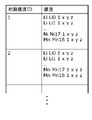
- FIG. 6 is a diagram showing an example of data stored in the structure storage unit 108 according to the first embodiment.
- the left column represents the initial structure ID (Identifier) assigned to distinguish each initial structure
- the right column represents the atomic arrangement of the initial structure.
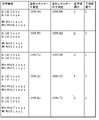
- FIG. 7 is a diagram showing an example of a process of calculating the first energy by calculation section 103 according to Embodiment 1. In FIG.
- the calculation unit 103 (in the second step) performs structure optimization on a part of the initial structures among the plurality of initial structures, and the first energy corresponding to the structure with the optimized atomic arrangement Calculate
- the "first energy” here may indicate the energy corresponding to the final structure obtained by repeating the structure optimization, or may indicate the energy corresponding to the intermediate structure that has not yet reached the final structure. be.
- the calculation unit 103 uses a first-principles calculation package such as VASP (Vienna Abinitio Simulation Package), for example, to execute the process of calculating the first energy corresponding to the structural optimization and the final structure.
- VASP Vehicle Abinitio Simulation Package
- the "final structure” is a structure obtained by performing structural optimization on the initial structure, and is a structure in which the force acting on each atom contained in the structure is equal to or less than the threshold.
- the “intermediate structure” is a structure obtained by performing structure optimization on the initial structure, and the force acting on at least one or more atoms contained in the structure exceeds the threshold value. It is a structure that has not reached the final structure.
- the calculation unit 103 calculates the force F acting on each atom included in the structure to be processed, and the structure (that is, the final structure) in which the magnitude of the force F calculated in each atom is equal to or less than the threshold value. to explore.
- the threshold may be a value close to zero. Specifically, if the magnitude of the force F acting on at least one atom exceeds a threshold in the structure obtained by performing the structure optimization, the calculation unit 103 determines that the force F is applied. Each atom is moved in a direction and the position of each atom is adjusted so that the force F becomes small.
- the calculation unit 103 repeats the above-described process of calculating the force F of each atom and the process of adjusting the position of each atom as one structural optimization, and the magnitude of the force F is equal to or less than the threshold value for all atoms.
- a structure that is, the final structure
- the structure optimization is terminated.
- the calculation unit 103 calculates the energy corresponding to the obtained final structure, that is, the final energy.
- the calculation unit 103 outputs the initial structure, the final structure obtained by repeatedly performing structural optimization on the initial structure, and the final energy corresponding to the calculated final structure to the calculation result storage unit 109 for each system. do.
- the calculation result storage unit 109 stores a set of the final energy calculated by the calculation unit 103 and the corresponding initial structure for each system.
- FIG. 8 is a diagram showing an example of data stored in the calculation result storage unit 109 according to Embodiment 1. As shown in FIG. In FIG. 8, the left column is the initial structure ID, the middle column is the atomic arrangement of the initial structure, and the right column is the final energy corresponding to the final structure obtained by optimizing the initial structure. represents. Thus, the calculation result storage unit 109 may store at least a set of the initial structure and the final energy of the final structure. In Embodiment 1, the calculation result storage unit 109 further stores the atomic arrangement of the final structure.
- the learning unit 104 acquires the initial structure and the final energy of the final structure from the calculation result storage unit 109, and makes the prediction model learn using the acquired initial structure and final energy.
- the set of input and output learned by the prediction model is, for example, the input as the initial structure and the output as the final energy.
- the learning unit 104 uses the learning data set to generate a structure obtained by optimizing the structure (here, the initial structure) with respect to the input structure of an arbitrary atomic arrangement.
- Machine learning is performed on the prediction model so as to output the energy corresponding to (here, the final structure).
- the learning data set includes the initial structure as input data and the energy corresponding to the atomic arrangement structure (here, the final structure) obtained by performing structural optimization on the initial structure as correct data.
- the prediction model is composed of a graph neural network with graph structure as input.
- the graph neural network is, for example, CGCNN (Crystal Graph Convolutional Neural Network) or MEGNet (Material Graph Network).
- the prediction model is constructed by MEGNet.
- MEGNet is a graph neural network that uses not only nodes (nodes/vertices) and edges (branches/sides) as feature quantities, but also global state quantities that represent the features of the entire target system as feature quantities.
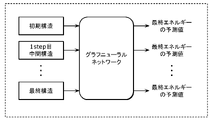
- FIG. 9 is a diagram showing an example of a process of machine learning a prediction model by the learning unit 104 according to Embodiment 1.
- the learning unit 104 first converts the atomic coordinates and types of atoms in the initial structure as shown in FIG. 9A into a graph structure as shown in FIG. 9B.
- a node corresponds to each atom of the initial structure and an edge corresponds to a bond between each atom of the initial structure.
- the learning unit 104 inputs the converted graph structure to a graph neural network as shown in FIG. 9(c).
- the learning unit 104 compares the predicted value of the final energy shown in (d) of FIG. 9 output from the graph neural network and the final energy as correct data.
- the learning unit 104 updates the weight of the graph neural network. In this way, the learning unit 104 machine-learns the prediction model by supervised learning using a plurality of learning data sets.
- the learning unit 104 outputs a prediction model for which machine learning has been completed, that is, a learned model to the prediction unit 105 and the prediction model storage unit 110 .
- the prediction model for which this machine learning has been completed takes as input a structure with an arbitrary atomic arrangement (here, the initial structure), and the structure (here, the final structure) when the structure is optimized for the structure. Machine learning is performed so that the corresponding energy is output as second energy, which will be described later.
- This prediction model is machine-learned using a first learning data set that includes an initial structure as input data and a first energy (here, final energy) corresponding to the initial structure as correct data.
- the prediction model storage unit 110 stores the graph neural network structure and weights of the prediction model machine-learned by the learning unit 104 .
- the prediction unit 105 acquires an initial structure whose final energy has not yet been calculated from the structure storage unit 108 . Then, the prediction unit 105 predicts the final energy of the initial structure by inputting the initial structure into the prediction model acquired from the learning unit 104, that is, the learned prediction model.
- the “initial structure whose final energy has not been calculated” means a structure other than a part of the initial structure whose energy has been calculated by the calculation unit 103 among the plurality of initial structures, and other initial structures.
- the prediction unit 105 uses the prediction model for other initial structures among the plurality of initial structures, so as to obtain Predict the second energy corresponding to the structure of the atomic arrangement.
- the second energy is the predicted value of the final energy corresponding to the final structure when geometry optimization is performed on other initial structures.
- FIG. 10 is a diagram showing an example of the process of predicting the second energy by the prediction unit 105 according to Embodiment 1.
- the prediction unit 105 converts the initial structure into a graph structure, and inputs the converted initial structure to the prediction model.
- illustration of the process of converting the initial structure to the graph structure is omitted.
- the predictive model outputs a predicted value of the final energy corresponding to the final structure when structural optimization is performed on the input initial structure, that is, the second energy.
- the prediction model as disclosed in Non-Patent Document 2 outputs a prediction value of the energy corresponding to the input initial structure
- the prediction model according to Embodiment 1 outputs the input initial structure
- the predicted value of the energy output by the prediction model corresponds to the energy corresponding to the structure obtained by the calculation unit 103 actually performing structural optimization on the initial structure. do.
- Embodiment 1 by using a prediction model, a structure optimized for a structure (for example, an intermediate structure or It is possible to obtain the energy corresponding to the final structure). Therefore, in Embodiment 1, calculations for structural optimization can be omitted to some extent, so that calculation costs can be reduced.
- the prediction unit 105 outputs the initial structure and the final energy prediction value corresponding to the initial structure to the comparison unit 106 for each system.
- the comparison unit 106 obtains a set of predicted values of the initial structure and final energy from the prediction unit 105 .
- the comparison unit 106 acquires a set of final structure and final energy from the calculation result storage unit 109 . Then, the comparison unit 106 generates a list in which the set of the initial structure and the predicted value of the final energy and the set of the final structure and the final energy are arranged.
- FIG. 11 is a diagram showing an example of data generated by the comparison unit 106 according to Embodiment 1.
- the left column represents the atomic arrangement of the initial structure or the final structure
- the middle column represents the final energy corresponding to the final structure
- the right column represents the predicted value of the final energy corresponding to the initial structure.
- the comparison unit 106 rearranges the final energies and the predicted values of the final energies in a predetermined order.
- comparison section 106 rearranges the final energy and the predicted value of final energy in order from the lowest energy value.
- Such rearrangement of the final energies and the predicted values of the final energies corresponds to the process of extracting the smallest value, in other words, the minimum value or the minimum value, from the final energies and the predicted values of the final energies.
- the comparison unit 106 extracts the third energy indicating the minimum value based on the first energy and the second energy.
- the first energy is the final energy obtained from the calculation result storage unit 109
- the second energy is the predicted value of the final energy obtained from the prediction unit 105 .
- the minimum value is the minimum value of the first energy and the second energy.
- the third energy is the minimum value of the first energy and the second energy.
- the comparison unit 106 outputs a list in which the final energy and the predicted value of the final energy are rearranged as described above to the output unit 107 for each system.
- the output unit 107 displays the predicted values of the initial structures and final energies, and the final structures and final energies included in the list output by the comparison unit 106, according to the above-described predetermined order, that is, in order from the structure with the lowest energy to the display. indicate. That is, the output unit 107 (in the fifth step) outputs the third energy, the first structure, which is the structure of the atomic arrangement corresponding to the third energy, or the third energy and the first structure.
- the output unit 107 may display only the third energy and the atomic arrangement structure corresponding to the third energy on the display.
- the output unit 107 may display the list before the final energy and the predicted value of the final energy are rearranged by the comparison unit 106 on the display. That is, the output unit 107 (in the sixth step) may output the first energy and the second energy. In this case, the above extraction processing (fourth step) by the comparison unit 106 is unnecessary.
- the output unit 107 displays the above-mentioned output results on the display in a manner in which each system can be distinguished. The display on the display may be performed sequentially for each system, or may be performed collectively for all systems.
- Embodiment 1 Verification of prediction accuracy
- Verification of the prediction accuracy of the prediction unit 105 according to Embodiment 1 will be described below. This verification is based on whether or not the prediction unit 105 can predict a stable structure for each system with respect to the composition of the substance after one or more Li atoms are desorbed from the substance having the composition Li 12 Mn 6 Ni 6 O 24 . The purpose is to ascertain whether
- a total of 4070 sets of initial structures and final energies were prepared for the composition of matter after desorption. That is, for each of a total of 4070 initial structures, structural optimization was performed to obtain the final structure, and the final energy corresponding to the obtained final structure was calculated. Of the total 4070 pairs, 10% of the total, 407 pairs, were used as verification data (test data), and the remaining 90%, 3663 pairs, were used as learning data (train data).
- machine learning of the prediction model was performed by using the initial structure as the input data and the final energy as the correct data as the learning data set.
- the machine-learned prediction model was then used to predict the final energy of the verification data. That is, by inputting the initial structure contained in the verification data into a machine-learned prediction model, a predicted value of the final energy corresponding to the initial structure output from the prediction model was obtained.
- FIG. 12 is a diagram showing an evaluation example of the prediction accuracy of the prediction unit 105 according to the first embodiment.
- the “correct final energy value” referred to here is the final energy corresponding to the final structure obtained by actually performing structural optimization on the initial structure.
- the “predicted value of final energy” referred to here is the predicted value of final energy output from the prediction model by inputting the initial structure into the prediction model.
- the “ranking” referred to here is the ranking when the final structure with the smallest correct value of final energy or the smallest predicted value of final energy is ranked first.
- the structure with the most stable atomic arrangement obtained by actually performing structural optimization is predicted by the prediction unit 105 to be the structure with the second most stable atomic arrangement. become.
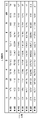
- FIG. 13 is a diagram showing the result of verifying the prediction accuracy of the prediction unit 105 according to Embodiment 1.
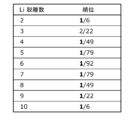
- the left column represents the number of Li atoms detached, in other words, the system, and the right column represents the order.
- the number on the left side of the “order” here indicates the order of the most stable atomic arrangement structure predicted by the prediction unit 105 among the verification data in the system.
- the numbers to the right of "Rank” represent the number of validation data in the system. This representation is the same in FIGS. 14, 19, and 20, which will be described later.
- the prediction accuracy of the prediction unit 105 will decrease.
- the structure of the atomic arrangement that is actually considered to be the most stable among the 79 sets of verification data is predicted by the prediction unit 105 to be the most stable structure. was done.
- the structure of the atomic arrangement that is actually considered to be the most stable among the 79 sets of verification data is predicted by the prediction unit 105 to be the 17th most stable structure. .
- the prediction unit 105 determines the structure of the atomic arrangement that is actually considered to be the most stable for any system within 25% of the total verification data for the system. It can be seen that it can be predicted that it has a simple structure. In other words, even if the number of verification data increases, the prediction accuracy of the prediction unit 105 hardly deteriorates.
- the prediction unit 105 determines the structure of the atomic arrangement that is actually considered to be the most stable within 10% of the entire verification data for the system, and further within 5%. It may be possible to predict that it is a structure.
- FIG. 14 is a diagram showing the result of verifying the correlation between the prediction accuracy of prediction section 105 and the ratio of learning data according to the first embodiment. Specifically, FIG. 14 shows the results of the prediction unit 105 while changing the ratio of the learning data for each number of LI atoms detached from the substance having the composition Li 14 Mn 5 Ni 5 O 24 , that is, for each system. It is a figure which shows the result at the time of verifying prediction accuracy.
- the "proportion of learning data” here is the ratio of the number of learning data to the total number of learning data and verification data in the system.
- the ratio of the learning data is 40%
- the structure of the atomic arrangement that is actually considered to be the most stable among 297 sets of verification data in a system in which four Li atoms are detached is determined by the prediction unit 105. was predicted to be the second most stable structure.
- the ratio of the learning data is 40%
- the structure of the atomic arrangement that is actually considered to be the most stable among the 554 sets of verification data in the system in which six Li atoms are desorbed is the prediction unit 105 was predicted to be the 60th most stable structure.
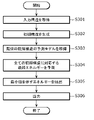
- FIG. 15 is a flowchart showing an operation example of the search system 100 according to Embodiment 1.
- FIG. 15 is a flowchart showing an operation example of the search system 100 according to Embodiment 1.
- Step S101 The input unit 101 acquires an input structure through user input, and outputs the acquired input structure to the generation unit 102 .
- Step S102 The generating unit 102 executes desorption processing on the input structure acquired in step S101. As a result, generation unit 102 generates a plurality of initial structures for each system and outputs them to structure storage unit 108 .
- Step S103 The calculation unit 103 performs structure optimization on some of the initial structures generated in step S102, and calculates the final energy corresponding to the final structure obtained by performing the structure optimization. Calculate Then, the calculation unit 103 outputs the calculation result to the calculation result storage unit 109 for each system.
- n is an integer equal to or greater than 2
- initial structures are obtained in the generating unit 102 (first step)
- m ( m is an initial structure of 1 ⁇ m ⁇ n integer).
- “m” is a number that is 90% or less of "n”.
- “m” may be a number that is 40% or more and 90% or less of “n”. That is, the number of partial initial structures in the calculation unit 103 (second step) is 90% or less of the number of multiple initial structures.
- Step S104 The learning unit 104 performs machine learning of a prediction model configured by a graph neural network using the set of the final energy and the initial structure calculated in step S103 as a learning data set.
- the learning unit 104 then outputs the machine-learned prediction model to the prediction unit 105 and the prediction model storage unit 110 .
- the number of training datasets is the same as the number of some initial structures, which is m.
- Step S105 The prediction unit 105 acquires from the structure storage unit 108 an initial structure for which the final energy has not been calculated, that is, another initial structure among the plurality of initial structures. Then, the prediction unit 105 calculates predicted values of final energies corresponding to other initial structures using the prediction model machine-learned in step S104.
- the number of other initial structures is the number obtained by excluding some initial structures from the plurality of initial structures. That is, the other initial structures in the prediction unit 105 (third step) are (nm) initial structures.
- the prediction model is the prediction model machine-learned in step S104.
- Step S106 The comparison unit 106 generates a list in which the final energy calculated in step S103 and the predicted value of the final energy calculated in step S105 are rearranged in order from the lowest energy value for each system.
- the list is output to the output unit 107 . That is, the comparison unit 106 extracts the energy indicating the minimum value from the final energy and the predicted value of the final energy for each system.
- Step S107 The output unit 107 outputs the predicted values of the initial structures and final energies and the final structures and final energies included in the list generated in step S106 by displaying them on the display in order from the structure with the lowest energy.
- Embodiment 1 instead of performing structural optimization on all initial structures, structural optimization is performed only on some initial structures, and the rest of the initial structures are optimized. On the other hand, by using a predictive model, calculations for structural optimization are omitted. Therefore, in Embodiment 1, it is possible to search for a structure with the most thermodynamically stable atomic arrangement in the new substance, as in the case where structural optimization is performed for all initial structures. Moreover, it is possible to omit the computation required for the search to some extent. That is, in Embodiment 1, compared to the case where structure optimization is performed for all initial structures, the computation cost can be reduced, and the atomic arrangement of the composition of the material after desorption of atoms can be reduced. Stable structures can be searched efficiently.
- the search system 200 (search method or program) according to Embodiment 2 of the present disclosure will be described in detail below with reference to the drawings.
- the search system 200 according to Embodiment 2 differs from the search system 100 according to Embodiment 1 in that it uses not only an initial structure but also an intermediate structure and a final structure when performing machine learning on a prediction model.
- the same reference numerals are given to the same components as in the first embodiment, and the description thereof is omitted.
- FIG. 16 is a block diagram showing the overall configuration including the search system 200 according to the second embodiment.
- the search system 200 includes a generator 102 , a calculator 203 , a learning unit 204 , a predictor 105 , a comparator 106 and an output unit 107 .
- Peripheral configurations of the search system 200 include an input unit 101 , a structure storage unit 108 , a calculation result storage unit 209 , and a prediction model storage unit 210 .
- the peripheral configuration of the search system 200 may be included in the components of the search system 200 .
- the generation unit 102 and the learning unit 204 in the search system 200 are also components of a prediction model construction device.
- the calculation unit 203 acquires part of the initial structure from the structure storage unit 108, and performs structural optimization on the acquired initial structure.
- the calculation unit 103 executes a process of calculating energy (first energy) corresponding to the final structure obtained by repeating the structure optimization.
- the calculation unit 203 outputs the initial structure, the final structure obtained by repeatedly executing structure optimization on the initial structure, and the final energy corresponding to the calculated final structure to the calculation result storage unit 209 for each system. do. In the second embodiment, the calculation unit 203 also outputs to the calculation result storage unit 209 an intermediate structure obtained each time structure optimization is performed on the initial structure.
- the calculation result storage unit 209 stores a set of the final energy calculated by the calculation unit 203, the corresponding initial structure, the corresponding intermediate structure, and the corresponding final structure for each system.
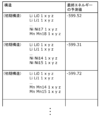
- FIG. 17 shows an example of data stored in the calculation result storage unit 209 according to the second embodiment.
- the left column is the initial structure ID
- the middle column is the atomic arrangement of the intermediate structure and the atomic arrangement of the final structure obtained each time the structure implementation is performed
- the right column is the final energy corresponding to the final structure. represents.
- illustration of the atomic arrangement of the initial structure is omitted.
- the learning unit 204 acquires the initial structure, the intermediate structure, the final structure, and the final energy of the final structure from the calculation result storage unit 209, and uses these to learn the prediction model.
- FIG. 18 is a diagram showing an example of a process of machine learning a prediction model by the learning unit 204 according to the second embodiment.
- the input data included in the training data set includes not only the initial structure but also the intermediate structure and final structure obtained each time structure optimization is performed. .
- the learning unit 204 not only includes the first learning data set including the initial structure as input data and the final energy as correct data, but also the intermediate structure or final structure as input data and the final energy as correct data.
- the prediction model is machine-learned further using a second training data set including as .
- the prediction model further includes, in addition to the first learning data set, the structure of the structure-optimized atomic arrangement, that is, the intermediate structure or the final structure as input data, corresponding to the structure
- This model is machine-learned using a second learning data set that includes the first energy, that is, the final energy as correct data. Note that the details of the prediction model machine learning process by the learning unit 204 are the same as those in the first embodiment, and thus the description thereof is omitted.
- the learning unit 204 outputs a prediction model for which machine learning has been completed, that is, a learned model to the prediction unit 105 and the prediction model storage unit 210 .
- the prediction model storage unit 210 stores the graph neural network structure and weights for the prediction model machine-learned by the learning unit 204 .
- Embodiment 2 Verification of prediction accuracy
- Verification of the prediction accuracy of the prediction unit 105 according to the second embodiment will be described below.
- This verification similar to the verification in Embodiment 1, was carried out for each system with respect to the composition of the substance after one or more Li atoms were desorbed from the substance having the composition Li 12 Mn 6 Ni 6 O 24 .
- the purpose is to confirm whether the predictor 105 can predict a stable structure.
- Verification in Embodiment 2 is that the learning data set used for machine learning of the prediction model further includes not only the above-described first learning data set but also the above-described second learning data set, This is different from the verification in the first embodiment.
- FIG. 19 is a diagram showing the result of verifying the prediction accuracy of the prediction unit 105 according to the second embodiment.
- what each column represents is the same as in FIG. 13 of Embodiment 1, so the description is omitted here.
- the prediction accuracy of the prediction unit 105 will decrease.
- the structure of the atomic arrangement that is actually considered to be the most stable among the 22 sets of verification data is predicted by the prediction unit 105 to be the second most stable structure. was done.
- the prediction unit 105 predicted that the structure with the most stable atomic arrangement among the 92 sets of verification data would be the most stable structure. .
- the prediction unit 105 determines the structure of the atomic arrangement that is actually considered to be the most stable for any system as the first or second most stable among all the verification data for the system. It can be seen that it can be predicted that it has a simple structure. In other words, even if the number of verification data increases, the prediction accuracy of the prediction unit 105 hardly deteriorates.
- FIG. 20 is a diagram showing the result of verifying the correlation between the prediction accuracy of prediction section 105 and the ratio of learning data according to the second embodiment. Specifically, FIG. 20 shows the results of prediction unit 105 while changing the ratio of learning data for each number of LI atoms detached from a substance having the composition Li 14 Mn 5 Ni 5 O 24 , that is, for each system. It is a figure which shows the result at the time of verifying prediction accuracy. In FIG. 20, what each column represents is the same as in FIG. 14 of Embodiment 1, so the description is omitted here.
- the prediction model is machine-learned by further using a learning data set containing the structure of the structurally optimized atomic arrangement, that is, the intermediate structure or the final structure as input data. Even if the ratio is low, it is considered possible to make highly accurate predictions.
- FIG. 21 is a flow chart showing an operation example of the search system 200 according to the second embodiment.
- the processes of steps S201 to S203 and steps S205 to S207 are the same as the processes of steps S101 to S103 and S105 to S107 shown in FIG. 15, respectively, so description thereof will be omitted. That is, the overall flow of the processing of the search system 100 according to Embodiment 1 is the same as that of step S204.
- Step S204 The learning unit 204 uses the set of the final energy and the initial structure calculated in step S203 and the set of the final energy and the optimized structure as learning data sets to create a prediction model configured by a graph neural network. machine learning.
- a "structure optimized structure" as used herein is an intermediate structure or a final structure.
- the learning unit 204 then outputs the machine-learned prediction model to the prediction unit 105 and the prediction model storage unit 210 .
- the prediction model is machine-learned by further using a learning data set containing as input data the structure of the structurally optimized atomic arrangement, that is, the intermediate structure or the final structure. Therefore, in the second embodiment, compared with the first embodiment, it is easier to more accurately predict the energy corresponding to the structure when the structure optimization is performed on the input initial structure.
- Embodiment 3 A search system 300 (search method or program) according to Embodiment 3 of the present disclosure will be described in detail below with reference to the drawings.
- the search system 300 according to Embodiment 3 when predicting the second energy corresponding to the structure of the atomic arrangement when structural optimization is performed on the initial structure, the prediction of a known structure that has been machine-learned in advance is performed. It differs from the search system 100 according to the first embodiment or the search system 200 according to the second embodiment in that a model is used.
- the same reference numerals are assigned to the same constituent elements as those in the first or second embodiment, and the description thereof is omitted.
- FIG. 22 is a block diagram showing the overall configuration including search system 300 according to Embodiment 3.
- the search system 300 includes a generation unit 102, a prediction unit 305, a comparison unit 306, and an output unit 107, and does not include the learning unit 104 or the learning unit 204.
- Peripheral configurations of the search system 300 include an input unit 101 , a structure storage unit 108 , and a prediction model storage unit 310 .
- the peripheral configuration of the search system 300 may be included in the components of the search system 300 .
- the prediction model storage unit 310 stores the structure and weights of the graph neural network for a prediction model that has undergone machine learning in advance.
- the prediction model employed here is, for example, a prediction model relating to a known structure of a known composition similar to the composition of the material after desorption of atoms, or a general-purpose learned prediction model.
- the term "similar” as used herein means, for example, that the composition of the material after desorption of atoms and the composition of the known material differ only in part. "Similar" means that the composition of the known material contains at least one element contained in the composition of the material after atomic desorption.
- the prediction model is the former prediction model, that is, the prediction model for known structures.
- This prediction model uses, for example, a known structure as input data and a learning data set that includes, as correct data, the final energy corresponding to the final structure obtained by performing structural optimization on the known structure. machine-learned.
- the prediction unit 305 acquires the initial structure from the structure storage unit 108. FIG. Then, the prediction unit 305 inputs the initial structure into the trained prediction model acquired from the prediction model storage unit 310, thereby predicting the final energy of the initial structure. In Embodiment 3, the prediction unit 305 predicts the final energy for each of all initial structures using prediction models. That is, the prediction unit 305 (in the eighth step) uses a prediction model for each of a plurality of initial structures to correspond to the structure of the atomic arrangement when the structure optimization is performed for the initial structure. Predict energy. The "energy” here is the predicted value of the final energy corresponding to the final structure when geometry optimization is performed on the initial structure.
- the prediction unit 305 outputs the initial structure and the final energy prediction value corresponding to the initial structure to the comparison unit 306 for each system.
- the comparison unit 306 obtains a set of predicted values of initial structure and final energy from the prediction unit 305 . Then, the comparison unit 306 generates a list in which sets of predicted values of initial structures and final energies are arranged.
- FIG. 23 is a diagram showing an example of data generated by the comparison unit 306 according to the third embodiment.
- the left column represents the atomic arrangement of the initial structure
- the right column represents the predicted value of the final energy corresponding to the initial structure.
- the comparison unit 306 rearranges the final energy prediction values in a predetermined order based on the list.
- the comparison unit 306 rearranges the predicted final energy values in descending order of energy. Such rearrangement of the final energy predicted values corresponds to a process of extracting the smallest value from the final energy predicted values, in other words, the minimum value or minimum value.
- the comparison unit 306 extracts the energy indicating the minimum value from the plurality of predicted energies.
- the "energy” is the predicted value of the final energy corresponding to the final structure when geometry optimization is performed on the initial structure.
- the local minimum is the minimum of the energies.
- the comparison unit 306 outputs a list in which the predicted values of the final energy are rearranged as described above to the output unit 107 for each system.
- FIG. 24 is a flow chart showing an operation example of processing of the search system 300 according to the third embodiment.
- the processing of steps S301 and S302 is the same as the processing of steps S101 and S102 shown in FIG. 15, respectively, so description thereof will be omitted.
- Step S303 The search system 300 obtains a prediction model related to a known structure with a composition similar to that of the material after atom detachment, which has undergone machine learning in advance, and outputs the prediction model to the prediction model storage unit 310 .
- Step S304 The prediction unit 305 acquires the initial structure from the structure storage unit 108. FIG. Then, the prediction unit 305 calculates the predicted value of the final energy corresponding to the initial structure using the prediction model acquired in step S303.
- Step S305 The comparison unit 306 generates a list for each system in which the predicted values of the final energy calculated in step S304 are rearranged in order from the lowest energy value, and outputs the generated list to the output unit 107 .
- the comparison unit 306 extracts the energy indicating the minimum value from the predicted values of the final energy for each system.
- Step S306 The output unit 107 outputs the predicted values of the initial structures and final energies included in the list generated in step S305 by displaying them on the display in order from the structure with the lowest energy.
- Embodiment 3 prediction models that have undergone machine learning in advance are used for all initial structures, so there is no need to perform calculations for structure optimization. Therefore, in Embodiment 3, as in Embodiment 1 or 2, it is possible to search for the structure of the atomic arrangement that is considered to be thermodynamically most stable in the novel substance, and the search It is possible to greatly omit the calculation required for In other words, in Embodiment 3, compared to the case where structural optimization is performed for a part of the initial structure, the calculation cost can be reduced, and the stable structure of the atomic arrangement for the composition of the material can be efficiently obtained. can be explored.
- Search system 400 (search method or program) according to Embodiment 4 of the present disclosure will be described in detail below with reference to the drawings.
- the search system 400 according to Embodiment 4 uses a prediction model for a known structure that has been machine-learned in advance, and verifies whether or not to relearn the prediction model. It differs from system 300 .
- the same reference numerals are given to the same constituent elements as in the first, second, or third embodiment, and the description thereof is omitted.
- FIG. 25 is a block diagram showing the overall configuration including the search system 400 according to the fourth embodiment.
- the search system 400 includes a generator 102, a calculator 103, a learning unit 404, a predictor 405, a comparator 106, and an output unit 107.
- Peripheral configurations of the search system 400 include an input unit 101 , a structure storage unit 108 , a calculation result storage unit 109 , and a prediction model storage unit 310 . Note that the configuration around the search system 400 may be included in the components of the search system 400 .
- the learning unit 404 re-learns the prediction model when the prediction unit 405 determines that the prediction accuracy of the prediction model does not satisfy the conditions. Specifically, the learning unit 404 acquires the final energies of the initial structure and the final structure from the calculation result storage unit 109 and re-learns the prediction model acquired from the prediction model storage unit 310 using these.
- the learning data set used for re-learning the prediction model includes the initial structure as input data and the final energy as correct data.
- the learning unit 404 outputs the re-learned prediction model to the prediction unit 405 and the prediction model storage unit 310 .
- the prediction model storage unit 310 stores the graph neural network structure and weights for the prediction model re-learned by the learning unit 404 . That is, in the prediction model storage unit 310, the already stored prediction model is updated to the re-learned prediction model.
- the prediction unit 405 acquires the final energies of the initial structure and final structure from the calculation result storage unit 109 .
- the prediction unit 405 acquires prediction models from the prediction model storage unit 310 .
- the prediction model acquired by the prediction unit 405 here is a prediction model before being re-learned by the learning unit 404 .
- the prediction unit 405 predicts the final energy of the initial structure by inputting the initial structure into the obtained prediction model. Then, the prediction unit 405 verifies the prediction accuracy of the prediction model by comparing the predicted value of the final energy with the final energy acquired from the calculation result storage unit 109 .
- the prediction unit 405 if the root mean squared error (RMSE) between the final energy and the predicted final energy is below a certain value, the prediction accuracy of the prediction model is sufficient, that is, it satisfies the conditions for prediction accuracy. On the other hand, if the above RMSE exceeds a certain value, the prediction unit 405 determines that the prediction accuracy of the prediction model is insufficient, that is, the prediction accuracy condition is not satisfied. For example, the prediction unit 405 may determine that a structure with an atomic arrangement that is actually considered to be the most stable satisfies the prediction accuracy condition by predicting that the structure is stable within a certain order. Note that the method for verifying the prediction accuracy of the prediction model is not limited to the above method, and other methods may be used.
- RMSE root mean squared error
- the prediction unit 405 uses a prediction model for at least one initial structure out of some of the initial structures, so that when structure optimization is performed on the initial structure Predict the second energy corresponding to the structure of the atomic configuration of .
- the second energy is the predicted value of the final energy corresponding to the final structure when geometry optimization is performed on at least one initial structure.
- the prediction unit 405 verifies the prediction accuracy of the prediction model by comparing the first energy and the second energy.
- the first energy is the final energy of the final structure corresponding to at least one initial structure.
- the prediction unit 405 acquires an initial structure whose final energy has not yet been calculated from the structure storage unit 108.
- the “initial structure for which the final energy has not yet been calculated” as used herein is a structure excluding some of the initial structures, that is, other initial structures. Then, the prediction unit 405 predicts the final energy of the initial structure by inputting the initial structure into the prediction model.
- the prediction unit 405 selects another initial structure among the plurality of initial structures.
- a prediction model is used for the structure to predict the second energy corresponding to the structure of the atomic arrangement if the geometry optimization were performed on the other initial structure.
- the second energy is the predicted value of the final energy corresponding to the final structure when geometry optimization is performed on other initial structures.
- the prediction unit 405 outputs the initial structure and the final energy prediction value corresponding to the initial structure to the comparison unit 106 for each system.
- FIG. 26 is a flow chart showing an operation example of processing of the search system 400 according to the fourth embodiment.
- the processing of steps S401 to S403 is the same as the processing of steps S301 to S303 shown in FIG. 24, respectively, so the description is omitted.
- Step S404 The calculation unit 103 performs structure optimization on some of the initial structures generated in step S403, and calculates the final energy corresponding to the final structure obtained by performing the structure optimization. Calculate Then, the calculation unit 103 outputs the calculation result to the calculation result storage unit 109 for each system.
- Step S405 The prediction unit 405 acquires an initial structure, that is, a partial initial structure, from the calculation result storage unit 109 . Then, the prediction unit 405 calculates a predicted final energy value corresponding to a part of the initial structures using the prediction model acquired in step S403.
- Step S406 The prediction unit 405 verifies the prediction accuracy of the prediction model by comparing the predicted value of the final energy calculated in step S405 and the final energy calculated in step S404. If the prediction result satisfies the prediction accuracy condition (step S406: Yes), the process proceeds to step S408. On the other hand, if the prediction result does not satisfy the prediction accuracy condition (step S406: No), the process proceeds to step S407.
- Step S407 The learning unit 404 performs re-learning of the prediction model configured by the graph neural network using the set of the final energy and the initial structure calculated in step S404 as a learning data set.
- the learning unit 404 then outputs the re-learned prediction model to the prediction unit 405 and the prediction model storage unit 310 .
- a set of an initial structure and a final energy different from the partial initial structure may be used as a learning data set. In this case, the calculation unit 103 needs to separately calculate the final energy corresponding to the different initial structure.
- Step S408 The prediction unit 405 acquires from the structure storage unit 108 an initial structure for which the final energy has not been calculated, that is, another initial structure among the plurality of initial structures. Then, the prediction unit 405 calculates predicted values of final energies corresponding to other initial structures using the prediction model.
- the prediction model if the prediction result satisfies the prediction accuracy condition in step S406, the prediction model acquired in S403 is adopted. On the other hand, if the prediction result does not satisfy the prediction accuracy condition in step S406, the re-learned prediction model is adopted in step S407.
- Step S409 The comparison unit 106 generates a list in which the final energy calculated in step S404 and the predicted value of the final energy calculated in step S408 are rearranged in order from the lowest energy value for each system.
- the list is output to the output unit 107 .
- the comparison unit 106 extracts the energy indicating the minimum value from the final energy and the predicted value of the final energy.
- the comparison unit 106 (at the thirteenth step) extracts the third energy indicating the minimum value based on the first energy and the second energy.
- the first energy is the final energy obtained from the calculation result storage unit 109
- the second energy is the predicted value of the final energy obtained from the prediction unit 405 .
- the third energy is the minimum value of the first energy and the second energy.
- Step S410 The output unit 107 outputs the predicted values of the initial structures and final energies included in the list generated in step S409 by displaying them on the display in order from the structure with the lowest energy.
- Embodiment 4 the prediction accuracy of the prediction model is verified while using the prediction model that has undergone machine learning in advance. Therefore, in Embodiment 4, it becomes easier to realize a prediction model with sufficient prediction accuracy.
- Embodiment 4 by using a prediction model that satisfies the condition of prediction accuracy, that is, a prediction model with relatively high prediction accuracy, it is easier to more efficiently search for a stable structure of atomic arrangement for the material composition.
- the minimum value is the minimum value of the first energy and the second energy, but is not limited to this.
- the first energy is the final energy calculated by the calculator 103
- the second energy is the predicted value of the final energy predicted by the predictors 105, 306, and 406.
- FIG. For example, the smallest value of the first energy and the second energy is the minimum value of the second energy, the second smallest value is the minimum value of the first energy, and these values are approximate. Assume. For example, the difference between the two values is within 1/10000 of the minimum value of the second energy.
- the minimum value may be the minimum value of the first energy instead of the minimum value of the second energy. This is because the actually calculated value is considered to be more accurate than the predicted value.
- the atom detached from the material to be searched is the Li atom, but it is not limited to this.
- the atoms detached from the search target material may be O atoms or other atoms.
- the search systems 100 to 400 acquire a plurality of initial structures by generating a plurality of initial structures by the generation unit 102, but the present invention is not limited to this.
- search systems 100-400 may obtain multiple initial structures generated by other systems.
- the generator 102 is unnecessary. That is, the obtaining step may obtain by generating a plurality of initial structures, or obtain a plurality of initial structures generated by another system.
- each component may be configured with dedicated hardware or implemented by executing a software program suitable for each component.
- Each component may be implemented by a program execution unit such as a CPU (Central Processing Unit) or processor reading and executing a software program recorded in a recording medium such as a hard disk or semiconductor memory.
- a program execution unit such as a CPU (Central Processing Unit) or processor reading and executing a software program recorded in a recording medium such as a hard disk or semiconductor memory.
- the at least one system described above is specifically a computer system composed of a microprocessor, ROM, RAM, hard disk unit, display unit, keyboard, mouse, and the like.
- a computer program is stored in the RAM or hard disk unit.
- At least one of the above systems achieves its functions by a microprocessor operating according to a computer program.
- the computer program is constructed by combining a plurality of instruction codes indicating instructions to the computer in order to achieve a predetermined function.
- a part or all of the components constituting at least one of the above systems may be composed of one system LSI (Large Scale Integration).
- a system LSI is an ultra-multifunctional LSI manufactured by integrating multiple components on a single chip. Specifically, it is a computer system that includes a microprocessor, ROM, RAM, etc. . A computer program is stored in the RAM. The system LSI achieves its functions by the microprocessor operating according to the computer program.
- a part or all of the components that make up at least one of the above systems may be made up of an IC card or a single module that can be attached to and removed from the device.
- An IC card or module is a computer system composed of a microprocessor, ROM, RAM, and the like.
- the IC card or module may include the super multifunctional LSI.
- the IC card or module achieves its function by the microprocessor operating according to the computer program. This IC card or this module may have tamper resistance.
- the present disclosure may be the method shown above. Moreover, it may be a computer program for realizing these methods by a computer, or it may be a digital signal composed of a computer program.
- the present disclosure is a computer-readable recording medium for computer programs or digital signals, such as flexible discs, hard disks, CD (Compact Disc)-ROM, DVD, DVD-ROM, DVD-RAM, BD (Blu-ray (registered trademark) ) Disc), or recorded in a semiconductor memory or the like. It may be a digital signal recorded on these recording media.
- CD Compact Disc
- DVD DVD-ROM
- DVD-RAM DVD-RAM
- BD Blu-ray (registered trademark) ) Disc
- computer programs or digital signals may be transmitted via electric communication lines, wireless or wired communication lines, networks represented by the Internet, data broadcasting, and the like.
- It may be implemented by another independent computer system by recording the program or digital signal on a recording medium and transferring it, or by transferring the program or digital signal via a network or the like.
- the present disclosure makes it possible to search for stable atomic arrangement structures without performing calculations for all atomic arrangement structure candidates, and in situations where large-scale computational resources cannot be prepared, stable atomic arrangement of new materials Useful for searching structures.
Landscapes
- Engineering & Computer Science (AREA)
- Theoretical Computer Science (AREA)
- Computing Systems (AREA)
- Life Sciences & Earth Sciences (AREA)
- Bioinformatics & Cheminformatics (AREA)
- Bioinformatics & Computational Biology (AREA)
- General Engineering & Computer Science (AREA)
- Evolutionary Computation (AREA)
- Artificial Intelligence (AREA)
- Data Mining & Analysis (AREA)
- Software Systems (AREA)
- Crystallography & Structural Chemistry (AREA)
- Chemical & Material Sciences (AREA)
- Mathematical Physics (AREA)
- Physics & Mathematics (AREA)
- Computational Linguistics (AREA)
- General Physics & Mathematics (AREA)
- Computer Vision & Pattern Recognition (AREA)
- Medical Informatics (AREA)
- General Health & Medical Sciences (AREA)
- Databases & Information Systems (AREA)
- Health & Medical Sciences (AREA)
- Management, Administration, Business Operations System, And Electronic Commerce (AREA)
Priority Applications (3)
| Application Number | Priority Date | Filing Date | Title |
|---|---|---|---|
| JP2023538412A JPWO2023008173A1 (https=) | 2021-07-27 | 2022-07-12 | |
| CN202280051390.8A CN117678025A (zh) | 2021-07-27 | 2022-07-12 | 探索方法、探索系统、程序、预测模型构建方法及预测模型构建装置 |
| US18/408,658 US20240144046A1 (en) | 2021-07-27 | 2024-01-10 | Search method, search system, recording medium, prediction model construction method, and prediction model construction device |
Applications Claiming Priority (2)
| Application Number | Priority Date | Filing Date | Title |
|---|---|---|---|
| JP2021-122633 | 2021-07-27 | ||
| JP2021122633 | 2021-07-27 |
Related Child Applications (1)
| Application Number | Title | Priority Date | Filing Date |
|---|---|---|---|
| US18/408,658 Continuation US20240144046A1 (en) | 2021-07-27 | 2024-01-10 | Search method, search system, recording medium, prediction model construction method, and prediction model construction device |
Publications (1)
| Publication Number | Publication Date |
|---|---|
| WO2023008173A1 true WO2023008173A1 (ja) | 2023-02-02 |
Family
ID=85086780
Family Applications (1)
| Application Number | Title | Priority Date | Filing Date |
|---|---|---|---|
| PCT/JP2022/027344 Ceased WO2023008173A1 (ja) | 2021-07-27 | 2022-07-12 | 探索方法、探索システム、プログラム、予測モデル構築方法、及び予測モデル構築装置 |
Country Status (4)
| Country | Link |
|---|---|
| US (1) | US20240144046A1 (https=) |
| JP (1) | JPWO2023008173A1 (https=) |
| CN (1) | CN117678025A (https=) |
| WO (1) | WO2023008173A1 (https=) |
Families Citing this family (4)
| Publication number | Priority date | Publication date | Assignee | Title |
|---|---|---|---|---|
| CN118974837A (zh) * | 2022-03-31 | 2024-11-15 | 松下知识产权经营株式会社 | 信息处理方法、信息处理系统以及程序 |
| US12587274B2 (en) | 2023-03-28 | 2026-03-24 | Quantum Generative Materials Llc | Satellite optimization management system based on natural language input and artificial intelligence |
| US12368503B2 (en) | 2023-12-27 | 2025-07-22 | Quantum Generative Materials Llc | Intent-based satellite transmit management based on preexisting historical location and machine learning |
| US12603701B2 (en) | 2023-12-27 | 2026-04-14 | Quantum Generative Materials Llc | Distributed satellite constellation management and control system |
Citations (2)
| Publication number | Priority date | Publication date | Assignee | Title |
|---|---|---|---|---|
| WO2020054841A1 (ja) * | 2018-09-14 | 2020-03-19 | 富士フイルム株式会社 | 化合物探索方法、化合物探索プログラム、記録媒体、及び化合物探索装置 |
| JP2020166706A (ja) * | 2019-03-29 | 2020-10-08 | 株式会社クロスアビリティ | 結晶形予測装置、結晶形予測方法、ニューラルネットワークの製造方法、及びプログラム |
-
2022
- 2022-07-12 JP JP2023538412A patent/JPWO2023008173A1/ja active Pending
- 2022-07-12 CN CN202280051390.8A patent/CN117678025A/zh active Pending
- 2022-07-12 WO PCT/JP2022/027344 patent/WO2023008173A1/ja not_active Ceased
-
2024
- 2024-01-10 US US18/408,658 patent/US20240144046A1/en not_active Abandoned
Patent Citations (2)
| Publication number | Priority date | Publication date | Assignee | Title |
|---|---|---|---|---|
| WO2020054841A1 (ja) * | 2018-09-14 | 2020-03-19 | 富士フイルム株式会社 | 化合物探索方法、化合物探索プログラム、記録媒体、及び化合物探索装置 |
| JP2020166706A (ja) * | 2019-03-29 | 2020-10-08 | 株式会社クロスアビリティ | 結晶形予測装置、結晶形予測方法、ニューラルネットワークの製造方法、及びプログラム |
Non-Patent Citations (2)
| Title |
|---|
| HIROYUKI MATSUI, OKADA TOMOHARU: "Machine-Learning-Assisted Design Tool for Semiconducting and Fluorescent Molecules", THE 67TH JSAP SPRING MEETING 2020, 12 March 2020 (2020-03-12), pages 10 - 115, XP055956660, Retrieved from the Internet <URL:https://confit.atlas.jp/guide/event-img/jsap2020s/12p-A405-15/public/pdf?type=in> [retrieved on 20220831] * |
| KIYOHARA, SHIN ET AL.: "Interface Structure Determination and Spectrum Analysis Using Machine Learning", JOURNAL OF JAPANESE SOCIETY FOR ARTIFICIAL INTELLIGENCE, vol. 34, no. 3, 1 May 2019 (2019-05-01), pages 345 - 350, XP009542998, ISSN: 2188-2266, DOI: 10.11517/jjsai.34.3_345 * |
Also Published As
| Publication number | Publication date |
|---|---|
| JPWO2023008173A1 (https=) | 2023-02-02 |
| US20240144046A1 (en) | 2024-05-02 |
| CN117678025A (zh) | 2024-03-08 |
Similar Documents
| Publication | Publication Date | Title |
|---|---|---|
| WO2023008173A1 (ja) | 探索方法、探索システム、プログラム、予測モデル構築方法、及び予測モデル構築装置 | |
| Samadian et al. | Application of data-driven surrogate models in structural engineering: a literature review | |
| WO2023008172A1 (ja) | 探索方法、探索システム、プログラム、予測モデル構築方法、及び予測モデル構築装置 | |
| CN109657805A (zh) | 超参数确定方法、装置、电子设备及计算机可读介质 | |
| EP4071764A2 (en) | Information processing program, information processing apparatus, and information processing method for determining properties of molecules | |
| JP7487155B2 (ja) | 情報処理装置、プログラム、及び、情報処理方法 | |
| CN111783238B (zh) | 涡轮轴结构可靠性分析方法、分析装置及可读存储介质 | |
| CN116964678A (zh) | 使用以蛋白质结构嵌入为条件的生成模型预测蛋白质氨基酸序列 | |
| CN115856641B (zh) | 一种电池剩余充电时间预测方法、装置及电子设备 | |
| CN118837775A (zh) | 一种锂离子电池健康状态和剩余使用寿命联合估计方法 | |
| JPWO2023008173A5 (https=) | ||
| CN116796623A (zh) | 锂电池soc的预测方法、系统、设备和介质 | |
| CN117313873A (zh) | 基于量子计算的化学反应路径的生成方法、装置及介质 | |
| Saraswathi et al. | Fast learning optimized prediction methodology (FLOPRED) for protein secondary structure prediction | |
| CN116256639A (zh) | 车辆电池荷电状态的估计方法、装置及电子装置 | |
| CN116011681A (zh) | 一种气象数据预测方法、装置、存储介质及电子装置 | |
| CN118051780B (zh) | 智能体的训练方法、交互方法及相应系统 | |
| Xu | Hybrid adaptive sequential sampling for reliability-based design optimization | |
| WO2021250752A1 (ja) | 学習方法、学習装置及びプログラム | |
| CN118537038A (zh) | 一种基于朴素贝叶斯的业务营销分析方法及其设备 | |
| EP1920367A1 (en) | Electronic circuit design | |
| Zhao et al. | Prediction of protein secondary structure based on lightweight convolutional neural network | |
| Liu et al. | You Only Measure Once: On Designing Single-Shot Quantum Machine Learning Models | |
| CN119578915B (zh) | 一种基于生成式模型的城中村改造规划方法及系统 | |
| CN116151505B (zh) | 小区动线规划方法、装置、电子设备及可读存储介质 |
Legal Events
| Date | Code | Title | Description |
|---|---|---|---|
| 121 | Ep: the epo has been informed by wipo that ep was designated in this application |
Ref document number: 22849237 Country of ref document: EP Kind code of ref document: A1 |
|
| WWE | Wipo information: entry into national phase |
Ref document number: 2023538412 Country of ref document: JP |
|
| WWE | Wipo information: entry into national phase |
Ref document number: 202280051390.8 Country of ref document: CN |
|
| NENP | Non-entry into the national phase |
Ref country code: DE |
|
| 122 | Ep: pct application non-entry in european phase |
Ref document number: 22849237 Country of ref document: EP Kind code of ref document: A1 |