WO2023007661A1 - 組織属性解析システムおよび組織属性解析装置 - Google Patents
組織属性解析システムおよび組織属性解析装置 Download PDFInfo
- Publication number
- WO2023007661A1 WO2023007661A1 PCT/JP2021/028143 JP2021028143W WO2023007661A1 WO 2023007661 A1 WO2023007661 A1 WO 2023007661A1 JP 2021028143 W JP2021028143 W JP 2021028143W WO 2023007661 A1 WO2023007661 A1 WO 2023007661A1
- Authority
- WO
- WIPO (PCT)
- Prior art keywords
- user
- biological reaction
- analysis unit
- tissue
- attribute analysis
- Prior art date
- Legal status (The legal status is an assumption and is not a legal conclusion. Google has not performed a legal analysis and makes no representation as to the accuracy of the status listed.)
- Ceased
Links
Images

Classifications
-
- G—PHYSICS
- G06—COMPUTING OR CALCULATING; COUNTING
- G06Q—INFORMATION AND COMMUNICATION TECHNOLOGY [ICT] SPECIALLY ADAPTED FOR ADMINISTRATIVE, COMMERCIAL, FINANCIAL, MANAGERIAL OR SUPERVISORY PURPOSES; SYSTEMS OR METHODS SPECIALLY ADAPTED FOR ADMINISTRATIVE, COMMERCIAL, FINANCIAL, MANAGERIAL OR SUPERVISORY PURPOSES, NOT OTHERWISE PROVIDED FOR
- G06Q10/00—Administration; Management
- G06Q10/06—Resources, workflows, human or project management; Enterprise or organisation planning; Enterprise or organisation modelling
-
- Y—GENERAL TAGGING OF NEW TECHNOLOGICAL DEVELOPMENTS; GENERAL TAGGING OF CROSS-SECTIONAL TECHNOLOGIES SPANNING OVER SEVERAL SECTIONS OF THE IPC; TECHNICAL SUBJECTS COVERED BY FORMER USPC CROSS-REFERENCE ART COLLECTIONS [XRACs] AND DIGESTS
- Y02—TECHNOLOGIES OR APPLICATIONS FOR MITIGATION OR ADAPTATION AGAINST CLIMATE CHANGE
- Y02A—TECHNOLOGIES FOR ADAPTATION TO CLIMATE CHANGE
- Y02A90/00—Technologies having an indirect contribution to adaptation to climate change
- Y02A90/10—Information and communication technologies [ICT] supporting adaptation to climate change, e.g. for weather forecasting or climate simulation
Definitions
- the present invention relates to an organization attribute analysis system and an organization attribute analysis device, and is particularly suitable for use in systems that analyze the attributes of organizations to which users participating in online sessions belong.
- Patent Document 1 Conventionally, there is known a technology for visualizing organizational culture (including organizational culture) by analyzing data (e-mails, commands, web content, call data, etc.) that are routinely circulated within an organization. (See Patent Document 1, for example).
- data e-mails, commands, web content, call data, etc.
- Patent Document 1 as examples of organizational culture, relationships between departments, relationships between companies, negative/positive, inward/outward, amount of activity, and innovation/bureaucratic orientation are given.
- Patent Document 1 analyzes the culture of an organization based on the data collected within that organization.
- Patent Document 1 also describes data used in a web conference as data used for analysis. Specifically, it is disclosed to analyze the situation of an organization such as organizational activities and organizational culture from information specifying terminals participating in a web conference. However, it does not disclose how to analyze the organizational culture, etc. from the information specifying the terminals participating in the Web conference, and the analysis contents are unknown.
- the purpose of the present invention is to enable analysis of tissue attributes through changes in the biological reactions of users who participate in online sessions held in an organization.
- the organization attribute analysis system of the present invention provides an online session of a plurality of organizations in which the same user participates, based on moving images obtained for the user during an online session conducted by a plurality of users.
- the change in the user's biological reaction is analyzed for each online session, and the attribute of the tissue is analyzed based on the changes in the biological reaction analyzed for each online session of a plurality of tissues.
- tissue attributes can be analyzed through analysis results of changes in biological reactions of users who participate in online sessions held in each tissue.
- FIG. 1 is a block diagram showing an example of the overall configuration of a tissue attribute analysis system according to this embodiment;
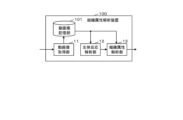
- FIG. 1 is a block diagram showing a functional configuration example of a tissue attribute analysis device according to this embodiment;
- FIG. 1 is a block diagram showing a functional configuration example of a tissue attribute analysis device according to this embodiment;
- FIG. 1 is a diagram showing an example of the overall configuration of a tissue attribute analysis system according to this embodiment.
- the tissue attribute analysis system of this embodiment includes a tissue attribute analysis device 100, a plurality of user terminals 200-1 , 200-2 , . ) and a session management server 300 .
- These tissue attribute analysis device 100, user terminal 200 and session management server 300 are connected via a communication network 500 such as the Internet or a mobile phone network.
- the tissue attribute analysis system of this embodiment is a system that analyzes changes in biological reactions of users who participate in online sessions held in multiple organizations, and analyzes tissue attributes based on the analysis results. Specifically, changes in the user's biological reaction are analyzed for each online session of a plurality of tissues in which the same user participates, and the attributes of the plurality of tissues are analyzed based on the respective analysis results.
- the moving images handled in the online session include facial images (actually, body parts other than the face and background images are also included) and voices of users (participants in the online session) using the user terminal 200.
- a user's face image and voice are acquired by a camera and a microphone provided in the user terminal 200 or connected to the user terminal 200 and transmitted to the session management server 300 .
- the face image and voice of each user transmitted to the session management server 300 are acquired by the tissue attribute analysis device 100 and transmitted from the tissue attribute analysis device 100 to the session application of each user terminal 200 .
- the moving image transmitted from the user terminal 200 may be acquired by the tissue attribute analysis device 100 and transferred from the tissue attribute analysis device 100 to the session management server 300 .
- moving images may be transmitted from user terminal 200 to both tissue attribute analysis device 100 and session management server 300 .
- moving images also include images such as materials that are shared and viewed by multiple users.
- a material image viewed by the user is transmitted from any user terminal 200 to the session management server 300 .
- the material image transmitted to the session management server 300 is acquired by the tissue attribute analysis device 100 and transmitted from the tissue attribute analysis device 100 to the session application of each user terminal 200 .
- the face images or document images of the plurality of users are displayed on the display, and the voices of the plurality of users are output from the speakers.
- the face image and the document image are switched on the screen of the display to display only one of them, or the face image and the document image are displayed by dividing the display area. can be displayed at the same time.
- the function of the session application installed in the user terminal 200 For example, when the camera of the user terminal 200-1 is turned off, the face image captured by the camera of the user terminal 200-1 is transmitted to the session management server 300 and the tissue attribute analysis device 100. to each user terminal 200.
- the microphone of the user terminal 200-1 is turned off, the sound collected by the microphone of the user terminal 200-1 is transmitted to the session management server 300 and the organization attribute analysis device 100. 100 to each user terminal 200.
- the tissue attribute analysis device 100 acquires moving images transmitted from a plurality of user terminals 200, and analyzes changes in biological reactions of users (online session participants) based on the moving images.
- FIG. 2 is a block diagram showing a functional configuration example of the tissue attribute analysis device 100 according to this embodiment.
- the tissue attribute analysis device 100 of this embodiment includes a moving image acquisition unit 11, a biological reaction analysis unit 12, and a tissue attribute analysis unit 13 as functional configurations.
- the tissue attribute analysis apparatus 100 of this embodiment includes a moving image storage unit 101 as a storage medium.
- Each of the functional blocks 10 to 13 can be configured by hardware, DSP (Digital Signal Processor), or software.
- DSP Digital Signal Processor
- each of the functional blocks 10 to 13 is actually configured with a CPU, RAM, ROM, etc. of a computer, and a program stored in a recording medium such as RAM, ROM, hard disk, or semiconductor memory. is realized by the operation of
- the moving image acquisition unit 11 acquires, from the session management server 300, moving images (face images, voices, and material images) transmitted from each user terminal 200 during an online session.
- the moving image acquisition unit 11 stores the moving images acquired from each user terminal 200 via the session management server 300 in the moving image storage unit 101 in association with information (for example, user ID) that can identify each user.
- the moving image acquisition unit 11 acquires moving images of multiple users participating in each online session held in multiple organizations, and stores them in the moving image storage unit 101 .
- the moving image acquisition unit 11 acquires face images from the session management server 300 including face images being displayed and face images not being displayed on the display of each user terminal 200 . Also, it does not matter whether the voice acquired from the session management server 300 is set to be output from the speaker of each user terminal 200 (whether the microphone is set to ON or OFF). do not have. That is, the moving image acquisition unit 11 acquires sounds from the session management server 300 including sounds being output and sounds not being output from the speaker of each user terminal 200 .
- the biological reaction analysis unit 12 acquires the moving image acquired by the moving image acquiring unit 11 and stored in the moving image storage unit 101 (whether or not it is a face image being displayed on the screen of the user terminal 200, output from the speaker of the user terminal 200 It does not matter whether it is the voice in the middle or not), the change in biological reaction caused by the change in emotion is analyzed for each of a plurality of users.
- the biological reaction analysis unit 12 separates the moving image acquired by the moving image acquisition unit 11 into a set of face images (collection of frame images) and voice, and analyzes changes in the biological reaction from each.
- the biological reaction analysis unit 12 analyzes the user's facial image using a frame image separated from the moving image acquired by the moving image acquisition unit 11 to obtain at least one of facial expression, gaze, pulse, and facial movement. Analyze changes in biological reactions related to Further, the biological reaction analysis unit 12 analyzes the voice separated from the moving image acquired by the moving image acquisition unit 11 to analyze changes in the biological reaction related to at least one of the user's utterance content and voice quality.
- a person's emotions change, it manifests as a change in biological reactions such as facial expressions, eye gaze, pulse, facial movements, content of remarks, and voice quality.
- changes in biological reactions caused by changes in user's emotions are analyzed.
- the change in the user's emotion may be analyzed through the analysis of the change in biological reaction.
- the analysis of changes in facial expressions is performed as follows. That is, for each frame image, the biological reaction analysis unit 12 identifies the facial region from the frame image, and analyzes which facial expression element corresponds to the facial expression according to the image analysis model machine-learned in advance. do. Then, based on the analysis results, it is determined whether facial expression changes occur between consecutive frame images, and if facial expression changes occur, whether the facial expression changes are positive or negative, and to what extent. Analyze whether there is a change in facial expression.
- Facial expression elements include, for example, neutral/calm/happy/surprised/sad/angry/fearful/disgust. be. Of these, joy and surprise are positive facial expression elements, and sadness, anger, fear, and disgust are negative facial expression elements.
- expression score the facial expression score determined for each frame image (maximum score among scores calculated for a plurality of facial expression elements) is referred to as "expression score”.
- the biological reaction analysis unit 12 determines whether or not at least one of the facial expression element determined for each frame image and the facial expression score calculated for each frame image has changed from the previous frame. Determine whether or not facial expression change occurs. Here, if there is no change in the facial expression element with the maximum score, the biological reaction analysis unit 12 may determine that the facial expression has changed if the amount of change in the score from the previous frame is equal to or greater than a predetermined threshold. good. The magnitude of change in facial expression can be determined by the amount of change in the facial expression score from the previous frame.
- the biological reaction analysis unit 12 determines that a positive facial expression change occurs when the facial expression score of a positive facial expression increases from the previous frame, or when a negative facial expression in the previous frame changes to a positive facial expression in the current frame. determined to be On the other hand, the biological reaction analysis unit 12 determines that a negative facial expression change occurs when the facial expression score of the negative facial expression increases from the previous frame, or when the positive facial expression in the previous frame changes to the negative facial expression in the current frame. determined to be
- facial expression changes may be analyzed for each predetermined time interval (for example, every 500 milliseconds). This also applies to the analysis of changes in line of sight, the analysis of changes in pulse, and the analysis of changes in facial movements, which will be described below.
- the analysis of changes in line of sight is performed as follows. That is, for each frame image, the biological reaction analysis unit 12 identifies an eye region in the frame image and analyzes the direction of both eyes (line of sight). For example, it analyzes whether the person is looking at the face of the speaker being displayed, whether the shared material being displayed is being looked at, where in the shared material being displayed is being looked at, and whether the user is looking outside the screen. Also, it may be analyzed whether the eye movement is large or small, or whether the movement is frequent or infrequent. A change in line of sight is also related to the user's degree of concentration.
- the analysis of pulse changes is performed, for example, as follows. That is, for each frame image, the face area is specified in the frame image. Then, using a trained image analysis model that captures numerical values of face color information (G of RGB), changes in the G color of the face surface are analyzed. By arranging the results along the time axis, a waveform representing changes in color information is formed, and the pulse is identified from this waveform. When a person is tense, the pulse speeds up, and when the person is calm, the pulse slows down.
- G of RGB face color information
- the biological reaction analysis unit 12 identifies the facial region in each frame image and analyzes the direction of the face, thereby analyzing where the user is looking. For example, it analyzes whether the person is looking at the face of the speaker being displayed, whether the shared material being displayed is being looked at, where in the shared material being displayed is being looked at, and whether the user is looking outside the screen. Further, it may be analyzed whether the movement of the face is large or small, or whether the movement is frequent or infrequent. The movement of the face and the movement of the line of sight may be analyzed together. For example, it may be analyzed whether the face of the speaker being displayed is viewed straight, whether the face is viewed with upward or downward gaze, or whether the face is viewed obliquely.
- the biological reaction analysis unit 12 converts the voice into a character string by performing known voice recognition processing on the voice for a specified time (for example, about 30 to 150 seconds), and morphologically analyzes the character string. By doing so, words such as particles and articles that are unnecessary for expressing conversation are removed. Then, the remaining words are vectorized by the TF-IDF (Term Frequency - Inverse Document Frequency) method or the like, and based on the characteristics of the vector, whether a positive emotional change is occurring or a negative emotional change is occurring, and which Analyze whether emotional changes of a certain magnitude occur. For example, based on the feature of the vector calculated according to the content of the statement, using a database that stores information that associates the feature amount of the vector with the type of the content of the statement, what type of statement is to estimate
- the biological reaction analysis unit 12 compares the words extracted from the content of the utterances within the designated time with a dictionary (which defines whether each word is positive or negative), and determines the number of occurrences of positive words and the number of negative words. By counting the number of appearances, it is analyzed whether a positive emotional change has occurred, whether a negative emotional change has occurred, and to what extent the emotional change has occurred.
- a dictionary which defines whether each word is positive or negative
- Voice quality analysis is performed, for example, as follows. That is, the biological reaction analysis unit 12 performs a known sound analysis process on the sound for a specified time (for example, about 30 to 150 seconds) to determine the acoustic characteristics of the sound (for example, MFCC (Mel frequency cepstrum coefficient)). ). Then, based on the values representing the acoustic features, it is analyzed whether a positive change in voice quality has occurred, whether a negative change in voice quality has occurred, and to what extent the change in voice quality has occurred.
- MFCC Mel frequency cepstrum coefficient
- MFCC is an example of acoustic features of speech, and the present invention is not limited to this.
- the tissue attribute analysis unit 13 analyzes tissue attributes based on the changes in the user's biological reactions analyzed by the biological reaction analysis unit 12 for each online session of a plurality of tissues. Even for the same user, if there is a difference in how the body reacts depending on the online session of the participating organization, the unique atmosphere of the online session of the organization, that is, the unique atmosphere of the organization attributes may be affected.
- the tissue attribute analysis unit 13 analyzes such tissue-specific attributes from differences in biological reactions in online sessions of a plurality of organizations in which the same user participates.
- the tissue attribute analysis unit 13 analyzes the correlation between the performance of the organization and the changes in the user's biological reaction analyzed for each online session of the organization, thereby determining whether the organization performs well or poorly. Analyze the attribute of the organization presumed to be the factor of
- the tissue attribute analysis unit 13 sets the performance index of the organization (for example, company sales and profit) as the objective variable, sets the change in the user's biological reaction as the explanatory variable, and performs statistical processing or machine learning. Analyze the correlation between performance indicators and changes in biological reactions by (linear regression analysis, logistic regression analysis, clustering, deep learning, etc.).
- the performance index of the organization for example, the value of sales that is increasing compared to the previous period (index value when the organization is performing well) is used, and as the change in the user's biological reaction, for example, the face It is possible to use the facial expression score of the facial expression element calculated as described above for the facial expression. In this case, it is possible to analyze the correlation between the organization's good performance and the facial expressions of the users participating in the online session.
- the average value of the facial expression score for each facial expression element is calculated from the facial expression score for each facial expression element calculated for each frame image or for each predetermined time interval for each of a plurality of users participating in a certain online session. Then, a cross-user average value is further calculated from the average facial expression score of each facial expression element calculated for each user in this way, and the average cross-user facial expression score of each facial expression element is used as an explanatory variable for statistical processing or machine learning. By doing so, the correlation between the performance index and the cross-user average facial expression score of each facial expression element is analyzed. Through this analysis, the user's facial expressions during an online session are neutral, calm, joyful, surprised, sad, angry, fearful, and disgusted. It becomes possible to
- the variance may be calculated in addition to this.
- the length of time during which the facial expression score of each facial expression element is obtained in a series of online sessions may be calculated.
- the average value of each facial expression element is calculated through a series of online sessions using the facial expression score, which is the maximum value among the scores of each facial expression element calculated in one frame image or a predetermined time interval.
- the score of each facial expression element may be used to calculate the average value of each facial expression element.
- the organization attribute analysis unit 13 further analyzes the attributes of how the organization affects the user's communication style based on the correlations analyzed as described above. For example, analysis results show that positive facial expressions such as joy or surprise have a high correlation with good performance of the organization, while negative facial expressions such as sadness, anger, fear or disgust have a low correlation with good performance of the organization. is obtained, it is determined that the organization has a communication style that tends to produce positive facial expressions in online sessions, and that organizational attributes that facilitate communication may contribute to the organization's good performance. Is possible.
- performance indicators such as company sales and profits as an indicator of organizational performance
- an index other than performance such as the number of proposals for new projects, may be used.
- the score for each facial expression element or the expression score, which is the maximum value among them may be used.
- a score representing the degree of concentration for the online session may be calculated based on changes in line of sight or facial movements.
- a score representing the degree of calmness (calm) among emotional factors may be calculated based on changes in pulse.
- a score representing the degree of positivity or degree of negativity may be calculated based on the facial expression, the content of the statement, or the sound quality.
- the amount of the user's biological reaction may be used as the change in the user's biological reaction.
- the amount of remarks it is possible to analyze whether or not the organization has an attribute that makes it easy to make remarks in online sessions (whether the environment facilitates communication).
- the tissue attribute analysis unit 13 standardizes the amount of speech analyzed by the biological reaction analysis unit 12 for each online session of a plurality of organizations for the same user. Standardization is a calculation commonly used in statistics, and refers to conversion processing that is performed so that the average of the amount of speech for each online session of multiple organizations is "0" and the variance is "1". .
- the organization attribute analysis unit 13 further calculates the average and variance of the values of the amount of speech standardized for each user across users. Then, for example, when the average calculated across users is high and the variance is low, the organization attribute analysis unit 13 determines that the organization has an organization attribute that facilitates communication. determined to have an organizational attribute that makes it difficult to perform
- the analysis may be performed by taking into account the quality of voice (pitch of voice, length or amount of blank space between words, volume, etc.).
- the sound quality value representing voice quality the sound quality value analyzed for each online session of a plurality of organizations is standardized in the same way as for the amount of speech, and then the average and variance of the standardized values for each user are calculated. is calculated across users, and based on the average and variance calculated for the amount of speech and the average and variance calculated for sound quality, it is determined whether or not the organization has an organizational attribute that facilitates communication. .
- the organization attribute analysis device 100 may have the functions of the session management server 300 , or the session management server 300 may have the functions of the organization attribute analysis device 100 .
Landscapes
- Engineering & Computer Science (AREA)
- Business, Economics & Management (AREA)
- Human Resources & Organizations (AREA)
- Economics (AREA)
- Strategic Management (AREA)
- Entrepreneurship & Innovation (AREA)
- Operations Research (AREA)
- Physics & Mathematics (AREA)
- Educational Administration (AREA)
- Marketing (AREA)
- Development Economics (AREA)
- Quality & Reliability (AREA)
- Tourism & Hospitality (AREA)
- Game Theory and Decision Science (AREA)
- General Business, Economics & Management (AREA)
- General Physics & Mathematics (AREA)
- Theoretical Computer Science (AREA)
- Two-Way Televisions, Distribution Of Moving Picture Or The Like (AREA)
- Management, Administration, Business Operations System, And Electronic Commerce (AREA)
- Image Analysis (AREA)
Priority Applications (4)
| Application Number | Priority Date | Filing Date | Title |
|---|---|---|---|
| PCT/JP2021/028143 WO2023007661A1 (ja) | 2021-07-29 | 2021-07-29 | 組織属性解析システムおよび組織属性解析装置 |
| JP2022517957A JPWO2023007661A1 (cg-RX-API-DMAC7.html) | 2021-07-29 | 2021-07-29 | |
| JP2023006990A JP2023055761A (ja) | 2021-07-29 | 2023-01-20 | 組織属性解析システムおよび組織属性解析装置 |
| JP2026013284A JP2026071277A (ja) | 2021-07-29 | 2026-01-29 | 組織属性解析システムおよび組織属性解析装置 |
Applications Claiming Priority (1)
| Application Number | Priority Date | Filing Date | Title |
|---|---|---|---|
| PCT/JP2021/028143 WO2023007661A1 (ja) | 2021-07-29 | 2021-07-29 | 組織属性解析システムおよび組織属性解析装置 |
Publications (1)
| Publication Number | Publication Date |
|---|---|
| WO2023007661A1 true WO2023007661A1 (ja) | 2023-02-02 |
Family
ID=85087677
Family Applications (1)
| Application Number | Title | Priority Date | Filing Date |
|---|---|---|---|
| PCT/JP2021/028143 Ceased WO2023007661A1 (ja) | 2021-07-29 | 2021-07-29 | 組織属性解析システムおよび組織属性解析装置 |
Country Status (2)
| Country | Link |
|---|---|
| JP (3) | JPWO2023007661A1 (cg-RX-API-DMAC7.html) |
| WO (1) | WO2023007661A1 (cg-RX-API-DMAC7.html) |
Citations (4)
| Publication number | Priority date | Publication date | Assignee | Title |
|---|---|---|---|---|
| JP2005269207A (ja) * | 2004-03-18 | 2005-09-29 | Nippon Telegr & Teleph Corp <Ntt> | 情報伝達方法及びこの方法を実現するための通信装置とそのプログラム |
| JP2006133925A (ja) * | 2004-11-04 | 2006-05-25 | Fuji Xerox Co Ltd | 情報処理システム及び情報処理方法、並びにコンピュータ・プログラム |
| WO2014097752A1 (ja) * | 2012-12-19 | 2014-06-26 | 日本電気株式会社 | 価値可視化装置、価値可視化方法、及びコンピュータ読み取り可能な記録媒体 |
| JP2016170635A (ja) * | 2015-03-12 | 2016-09-23 | ヴイ・インターネットオペレーションズ株式会社 | 組織管理装置、プログラム |
Family Cites Families (1)
| Publication number | Priority date | Publication date | Assignee | Title |
|---|---|---|---|---|
| US11290686B2 (en) * | 2017-09-11 | 2022-03-29 | Michael H Peters | Architecture for scalable video conference management |
-
2021
- 2021-07-29 JP JP2022517957A patent/JPWO2023007661A1/ja active Pending
- 2021-07-29 WO PCT/JP2021/028143 patent/WO2023007661A1/ja not_active Ceased
-
2023
- 2023-01-20 JP JP2023006990A patent/JP2023055761A/ja active Pending
-
2026
- 2026-01-29 JP JP2026013284A patent/JP2026071277A/ja active Pending
Patent Citations (4)
| Publication number | Priority date | Publication date | Assignee | Title |
|---|---|---|---|---|
| JP2005269207A (ja) * | 2004-03-18 | 2005-09-29 | Nippon Telegr & Teleph Corp <Ntt> | 情報伝達方法及びこの方法を実現するための通信装置とそのプログラム |
| JP2006133925A (ja) * | 2004-11-04 | 2006-05-25 | Fuji Xerox Co Ltd | 情報処理システム及び情報処理方法、並びにコンピュータ・プログラム |
| WO2014097752A1 (ja) * | 2012-12-19 | 2014-06-26 | 日本電気株式会社 | 価値可視化装置、価値可視化方法、及びコンピュータ読み取り可能な記録媒体 |
| JP2016170635A (ja) * | 2015-03-12 | 2016-09-23 | ヴイ・インターネットオペレーションズ株式会社 | 組織管理装置、プログラム |
Also Published As
| Publication number | Publication date |
|---|---|
| JP2026071277A (ja) | 2026-04-28 |
| JP2023055761A (ja) | 2023-04-18 |
| JPWO2023007661A1 (cg-RX-API-DMAC7.html) | 2023-02-02 |
Similar Documents
| Publication | Publication Date | Title |
|---|---|---|
| JP2025186362A (ja) | 感情解析システムおよび感情解析装置 | |
| JP7757636B2 (ja) | 接客支援システム、接客支援装置、接客支援方法およびプログラム | |
| JP2023075197A (ja) | 反応解析システムおよび反応解析装置 | |
| WO2023097269A1 (en) | System and method for analysis and optimization of video conferencing | |
| JP2023015068A (ja) | 感情解析システムおよび感情解析装置 | |
| DK180951B1 (en) | System with post-conversation representation, electronic device, and related methods | |
| JP7197957B2 (ja) | 反応解析システムおよび反応解析装置 | |
| JP2023055761A (ja) | 組織属性解析システムおよび組織属性解析装置 | |
| JP7805427B2 (ja) | 情報処理システム、情報処理装置、情報処理方法、およびプログラム | |
| JP7705177B2 (ja) | 動画像分析システム | |
| WO2022180860A1 (ja) | ビデオセッション評価端末、ビデオセッション評価システム及びビデオセッション評価プログラム | |
| JP7734990B2 (ja) | 動画像分析システム | |
| JP7691150B2 (ja) | 動画像分析システム | |
| WO2024142291A1 (ja) | コミュニケーション可視化システム | |
| EP4706042A1 (en) | System for processing text, image and audio signals using artificial intelligence and method thereof | |
| JP2026052766A (ja) | 情報処理システム、情報処理装置、情報処理方法、およびプログラム | |
| WO2025238726A1 (ja) | 提示装置および提示方法 | |
| WO2025253580A1 (ja) | 提示装置および提示方法 | |
| Paul | Neural Networks in Voice AI: Powering Clear Calls and Beyond | |
| WO2024176469A1 (ja) | 提示装置、提示方法および提示プログラム | |
| WO2022024356A1 (ja) | 組織属性解析システム | |
| JP2022180533A (ja) | 動画像分析プログラム | |
| WO2022230049A1 (ja) | 動画像分析システム | |
| WO2022230070A1 (ja) | 動画像分析システム | |
| WO2022180862A1 (ja) | ビデオセッション評価端末、ビデオセッション評価システム及びビデオセッション評価プログラム |
Legal Events
| Date | Code | Title | Description |
|---|---|---|---|
| ENP | Entry into the national phase |
Ref document number: 2022517957 Country of ref document: JP Kind code of ref document: A |
|
| 121 | Ep: the epo has been informed by wipo that ep was designated in this application |
Ref document number: 21951861 Country of ref document: EP Kind code of ref document: A1 |
|
| NENP | Non-entry into the national phase |
Ref country code: DE |
|
| 122 | Ep: pct application non-entry in european phase |
Ref document number: 21951861 Country of ref document: EP Kind code of ref document: A1 |