WO2022272007A2 - Fault current bypass based solid state circuit breakers and active clamping snubbers for dc circuit breakers - Google Patents
Fault current bypass based solid state circuit breakers and active clamping snubbers for dc circuit breakers Download PDFInfo
- Publication number
- WO2022272007A2 WO2022272007A2 PCT/US2022/034815 US2022034815W WO2022272007A2 WO 2022272007 A2 WO2022272007 A2 WO 2022272007A2 US 2022034815 W US2022034815 W US 2022034815W WO 2022272007 A2 WO2022272007 A2 WO 2022272007A2
- Authority
- WO
- WIPO (PCT)
- Prior art keywords
- snubber
- current
- mov
- voltage
- solid state
- Prior art date
- Legal status (The legal status is an assumption and is not a legal conclusion. Google has not performed a legal analysis and makes no representation as to the accuracy of the status listed.)
- Ceased
Links
Classifications
-
- H—ELECTRICITY
- H03—ELECTRONIC CIRCUITRY
- H03K—PULSE TECHNIQUE
- H03K17/00—Electronic switching or gating, i.e. not by contact-making and –breaking
- H03K17/08—Modifications for protecting switching circuit against overcurrent or overvoltage
- H03K17/081—Modifications for protecting switching circuit against overcurrent or overvoltage without feedback from the output circuit to the control circuit
- H03K17/0812—Modifications for protecting switching circuit against overcurrent or overvoltage without feedback from the output circuit to the control circuit by measures taken in the control circuit
- H03K17/08122—Modifications for protecting switching circuit against overcurrent or overvoltage without feedback from the output circuit to the control circuit by measures taken in the control circuit in field-effect transistor switches
-
- H—ELECTRICITY
- H02—GENERATION; CONVERSION OR DISTRIBUTION OF ELECTRIC POWER
- H02H—EMERGENCY PROTECTIVE CIRCUIT ARRANGEMENTS
- H02H3/00—Emergency protective circuit arrangements for automatic disconnection directly responsive to an undesired change from normal electric working condition with or without subsequent reconnection ; integrated protection
- H02H3/08—Emergency protective circuit arrangements for automatic disconnection directly responsive to an undesired change from normal electric working condition with or without subsequent reconnection ; integrated protection responsive to excess current
- H02H3/087—Emergency protective circuit arrangements for automatic disconnection directly responsive to an undesired change from normal electric working condition with or without subsequent reconnection ; integrated protection responsive to excess current for DC applications
Definitions
- HCBs benefit from the extremely low on-state resistance (10s of mW) of the mechanical disconnectors (MDs) and fast commutation semiconductor devices. Although the operating speed of the MDs has achieved 10 microseconds, the response time of HCBs generally places in the milliseconds range. Implementing MDs reduces the power-density of the design and the operation of the moving contacts impacts the lifetime.
- SSCBs with wide bandgap (WBG) devices present ultrafast response times in the microseconds range.
- High efficiency can be achieved in SSCBs by connecting solid-state switches in parallel.
- Exemplary progresses in control and gate-driver designs, and incorporating soft-starting, fault detection, and fault location functions justify the effectiveness of SSCBs in newly established DC systems.
- MOV-RCD snubber based SSCBs benefit from lower oscillations, lower clamping voltage, and smaller dv/dt.
- the capability of MOV-RCD snubber in interrupting kA ranges DC currents have been verified in the literature, and may be superior compared to the MOV- RC snubbers in achieving lower power shock on the switch during the turn-off.
- MOV-RCD snubber based SSCBs suffer from low reliability due to the MOV degradation.
- MOVs are well known to degrade as the number of surge currents increase, and they experience long duration transients. When the MOV degrades, its energy absorbing capability decreases, the leakage current increases, and the duration to failure reduces. Problems occur when the MOV fails, which may cause a short circuit.
- MOVs are sintered ceramic blocks whose most structure includes metal oxide (ZnO) grains with small portions of bismuth, cobalt, manganese, and other metal oxides. Being voltage dependent, MOVs are highly non-linear devices; the resistance of the MOV changes several orders of magnitude as it is exposed to high voltage overshoots. During conduction mode, it provides a highly conductive path for the fault currents, absorbs the stored inductive energy of the line inductance, converts it to heat, and dissipates it to ambience.
- ZnO metal oxide
- MOVs typically show negative temperature dependance. As the leakage current increases with the progress of the MOV degradation, the power consumption on the MOV increases. Increasing the power consumption raises the MOV temperature. As the MOV heats up, its leakage current rises. This process repeats until the power consumption on the MOV goes higher than the MOV power dissipation capability. In this case, the MOV temperature exceeds thermal stability temperature, and the thermal runaway happens, concluding in the MOV failure.
- Solid-state circuit breakers have been witnessing an impressive progress with the aid of wide bandgap (WBG) devices such as silicon carbide (SiC)
- MOSFETs MOSFETs.
- MOSFETs MOSFETs.
- MOSFETs MOSFETs.
- MOSFETs MOSFETs.
- MOSFETs MOSFETs.
- a MOV-resistive capacitive switch (MOV-RCS) snubber for solid state circuit breakers may address the following: 1) the MOV degradation issue in DCCBs is solved, 2) the maximum allowable DC bus voltage on DCCBs is extended.
- MOV-RCS MOV-resistive capacitive switch
- FIG. 1 shows a circuit topology of the MOV-RCS snubber.
- FIG. 2 shows the proposed SSCB in a typical DC system where the breaker connected between positive and negative lines.
- FIGS. 3 and 4 represent the operating modes and the electrical waveforms of the proposed SSCB in interrupting DC current, respectively.
- FIG. 5 shows the flowchart of the proposed current interruption process.
- FIG. 6 summarizes the presented design procedures of C s and the MOV.
- FIG. 7 shows the proposed MOV-RCS snubber based SSCB in a typical DC system.
- FIG. 8 shows the working principle herein and FIG. 9 displays the related electrical waveforms during a fault current interruption.
- FIG. 10 summarizes the design procedure to optimize the snubber components.
- FIG. 11 displays the implemented SSCB and the 3D design view.
- FIG. 12 shows the experimental results of 375V/170A with the S m drain-source voltage (V Sm ) and the line inductor L Line current (i Line ) waveforms in the top and the gate- source voltages and load current (i Load ) waveforms in the bottom.
- FIG. 14 (a) shows the implemented hardware set up with respect to FIG. 7.
- FIG. 14 (b) indicates the 3D design view of the SSCB.
- FIG. 15 indicates the experimental results discussed in Section 4.
- FIG. 16 shows the experimental results of Section 4.2
- FIG. 17 shows Table I.
- FIG. 18 shows Table II.
- FIG. 1 shows a circuit topology of the MOV-RCS snubber. It includes four components defined as follows:
- MOV This may be used to clamp the oscillation voltage across the DCCBs, and dissipate stored inductive energy of the line inductance during DC current interruption.
- the design methodology of choosing MOV in a typical DC system has been analyzed and the deciding parameters illustrated.
- Capacitor (C) This is used to slow down the rising voltage across the DCCBs during DC current interruption. That is, the fault current commutates to the capacitor after turning the main switch off, and the voltage across the main switch in DCCBs may be built slowly to limit the dV/dt and reduce the voltage overshoot. It also may reduce the voltage oscillations on the gate of the main switch in DCCBs.
- resistor (R) This is used to discharge the voltage on the capacitor after DC current interruption and place the voltage on the snubber switch (S s ). That is, the resistor reduces the equivalent resistor across the MOV and capacitor. The functionality of the resistor is further explained in next sections.
- - Switch (S) The switch may be used to remove the voltage on the MOV after DC current interruption.
- MOSFET metal-oxide-semiconductor field-effect transistor
- FIG. 1 a metal-oxide-semiconductor field-effect transistor (MOSFET) has been used; however, this switch can be insulated-gate bipolar transistor (IGBT), silicon-controlled rectifier (SCR), integrated gate-commutated thyristor (IGCT), or other SCR based semiconductor switches.
- IGBT insulated-gate bipolar transistor
- SCR silicon-controlled rectifier
- IGCT integrated gate-commutated thyristor
- FIG. 2 shows the proposed SSCB in a typical DC system where the breaker is connected between positive and negative lines.
- the MOV is removed from the main switch and leakage current may not be a further a design criteria; clamping voltage can be chosen near to the nominal voltage; 2) dV/dt across the main switch S m may be reduced using the snubber capacitor C s ; 3) the snubber switch S s turns off at almost zero current; no oscillations may appear on S s during current interruption; 4) the stored inductive energy of the line inductor i Line may be prevented to flow through the faulty section, which increases the safety; 5) the maximum allowable DC bus voltage may be extended by choosing the clamping voltage of the MOV near to the nominal voltage.
- FIGS. 3 and 4 represent the operating modes and the electrical waveforms of the proposed SSCB in interrupting DC current, respectively.
- the working principle of the SSCB shown in FIG. 2 is explained in detailed in the following.
- Mode I (before to): SSCB operates at normal condition.
- V D1 V DC .
- Mode VI (t 6 ⁇ t ⁇ t 7 ): There is a leakage current in the system due to the MOV
- R s resistance value of R s
- VDC the resistance value across S s gradually.
- the response time of the SSCB is t 2 -t 1 .
- FIG. 5 shows the flowchart of the proposed current interruption process. The turn-off process and the logic implemented in the proposed SSCB is clear in this figure. [0050] 2.3.
- C s design objective is minimizing dV/dt across the main switch S m .
- choosing the value of V Clamp is important in determining the value of dV/dt. So, C s is selected optimally to optimize dV/dt.
- R e is the parasitic resistance of the V DC -L Line -Ss-V Cs loop.
- V Cs (t) V Cs (t)
- Eq. (6) can be simplified and rewritten as below to find the optimized value of C s based on a desired T p :
- V Clamp 2) the allowable continuous DC voltage on the MOV (V DC,MOV ), 3) the surge energy rating of the MOV (E r ), and 4) the surge current capability (i Peak ). Since reducing Vciamp helps to decrease the voltage overshoots across the SSCBs and enhance the compactness, minimizing Vciamp may be the design objective. However, according to the working principle of the proposed SSCB explained in section 2.2, two design criteria may considered in selecting the optimal MOV which are explained below.
- T ET t 5 -t 3
- Eq.(9) approximates the MOV current in this interval:
- T ET depends on four factors including i dc,max , L Line , V DC , and V clamp .
- the surge energy on the MOV during T ET can be calculated as below:
- V Clamp should be selected in a way that:
- FIG. 6 summarizes the presented design procedures of C s and the MOV.
- MOV-RCS Snubber based SSCBs [0082] 3.1. Circuit Topology
- the proposed MOV-RCS snubber based SSCB in a typical DC system is shown in
- FIG. 7 The system voltage is VDC, the line inductance is considered as L .Line, and the load is regarded as pure resistive R Load . It should be understood that resistive-inductive loads also can be modeled the same as FIG. 7.
- the main switch S m provides the conduction path for continuous load currents. To achieve high efficiency, multiple switches can be connected in parallel in S m .
- the working principle and the components design procedure of the proposed topology are presented in the following subsections.
- the proposed SSCB addresses the reliability issue in SSCBs due to the MOVs degradation.
- the presented MOV-RCS snubber based SSCB has at least two advantages as follows:
- the MOV is separated from the power line during the SSCB turn-off mode; that is, there is no voltage across the MOV after the DC current interruption. Therefore, the MOV degradation is not further a reliability issue in SSCB.
- FIG. 8 shows the working principle
- FIG. 9 displays the related electrical waveforms during a fault current interruption.
- the operation of the proposed MOV-RCS snubber based SSCB is explained in detail as follows:
- Mode I (t ⁇ to): This mode describes the normal operating condition.
- Mode III (t 1 ⁇ t ⁇ t 2 ):
- the fault current interruption process begins.
- the impedance of the MOV reduces several orders of magnitude, and a highly conductive path is provided. Therefore, the fault current commutates to the MOV element, and the voltage is clamped to V clamp considering the non-linear characteristic of the MOV.
- V clamp determines the voltage ratings of the solid-state switch S m and the snubber capacitor C s ; the lower the V clamp is, the more compact S m and C s are.
- the MOV current reduces to leakage values as shown in FIGS. 8 and 9.
- time interval of t 3 -t 2 depends on the maximum fault current value, the value of line inductance L Line , the fault resistance, and the MOV clamping voltage V clamp . Higher V clamp helps to shorten t 3 -t 2 period; therefore, V clamp needs to be selected carefully.
- the parallel resistance of S s in the off-state is several orders of magnitude lower than the parallel resistance of the MOV-RC configuration (k ⁇ range)
- the leakage current in the system reduces to zero, and there is no voltage across the MOV and the snubber capacitor C s in the SSCB off-mode.
- the MOV-RCS snubber design procedure includes selecting the values of the C s , R s , MOV, and the snubber switch S s . The design criteria of these components are discussed below.
- Vc s gets the following formula:
- i dc,max is the maximum value of i dc
- ⁇ d and ⁇ are given below:
- the snubber resistor R s may be chosen to reduce the equivalent parallel resistance of the snubber capacitor C s and the MOV compared with the snubber switch S s in the breaker's off-state. In other words, R s helps to discharge the voltage across the C s and the MOV after DC current interruption.
- R s selection There are at least three design criteria for R s selection:
- the resistance of R s is chosen at least two orders of magnitude less than the parallel resistance of S s in the off-mode.
- Silicon carbide (SiC) MOSFETs show at least MW range parallel resistances when a negative gate-source voltage is applied on the switch; in this case, R s is chosen in a few k ⁇ range.
- T dis t6-t5 is desirable to be minimize.
- T diS is related to the C s discharge time interval on the snubber resistor R s . Considering tc s as the C s discharge time constant:
- the rating voltage (VDC.MOV), the clamping voltage (Vciamp), the rated surge energy (E Rated ), and the peak pulse current (ipeak) may be considered in selecting the MOV in SSCBs.
- VDC.MOV the clamping voltage
- Vciamp the rated surge energy
- E Rated the rated surge energy
- ipeak the peak pulse current
- Vclamp determines the voltage ratings of the main switch Sm and the snubber capacitor C s . Besides, lower Vclamp reduces the dV/dt across the main switch Sm and leads to lower voltage overshoots, which enhance the reliabity and lifetime. On the other hand, there are two design criteria impacting the minimum value of the V Clamp ⁇
- FIG. 9. This time interval is considered as t 3 -t 2 in FIG. 9 in the proposed SSCB.
- t ET increases, the MOV should dissipate more energy. If this energy exceeds the MOV's E Rated , it may be completely destroyed, or the MOV can fail as a short circuit. Therefore, t ET and the E Rated are considered to define the lower boundary of the MOV as follows:
- VSs,Tr is the di/dt voltage across the S s during the turn-off in the snubber branch.
- the value of iSs should be limited in a way that the voltage across the main switch does not exceed Vciamp, meaning:
- FIG. 10 summarizes the design procedure to optimize the snubber components. Given the values of V DC , L Line , i dc,max desire dV/dt, T dis and t ET , the optimal V Clamp can be found using Eq. (25). Next, Eq. (20) is used to optimize C s . The value of R s is selected based on Eq. (24) to limit i Ss . Given the values of Vciamp, C s , and R s , if V Ss,Tr satisfies Eq. (27), S s is selected in the next step. Otherwise, V clamp is increased and the process repeats.
- FIG. 11 displays the implemented SSCB and the 3D design view.
- FIG. 17 displays the implemented SSCB and the 3D design view.
- FIG. 12 shows the experimental results of 375V/170A with the S m drain-source voltage (Vsm) and the line inductor L Line current (i Line ) waveforms in the top and the gate- source voltages and load current (i Load ) waveforms in the bottom.
- the main switch S m turns on for 65 ⁇ s, and when the DC current reaches about 160A, current interruption begins by turning S s on. After a safe delay ( «2 ⁇ s), S m is triggered to be turned off. S m turns off completely after 400ns, and the DC current is interrupted in the main switch after 2.4 ⁇ s. Next, the current commutates to S s and charges C s .
- S s turns off after 250 ⁇ s. This interval is determined considering the fault current extinguishing time interval (T ET ) which depends on i dc,mx , L Line , VDC, and V Clamp factors. As S s turns off, it holds the VDC in the auxiliary branch. Also, the current in the load side begins to decrease after S m turn-off, reducing to zero in 55 ⁇ s.
- T ET fault current extinguishing time interval
- FIG. 14 (a) shows the implemented hardware set up with respect to figure 7. Also, FIG. 14 (b) indicates the 3D design view of the SSCB. The DC system and the SSCB parameters are listed in FIG. 18, Table II. The current interruption process is controlled by a TMS320F28335 processor in a time sequence manner.
- MOV-RCS Snubber based SSCB Experiments of 375V/160A/1.6 ⁇ s SSCB
- FIG. 15 indicates the experimental results.
- the drain-source voltage on the main switch (V Sm ), the line current (i Line ), the voltage on the snubber capacitor C s (Vc s ), the drain-source voltage on the snubber switch (V Ss ), the gate-source voltages on the main switch S m (V Gs,Sm ) and the snubber switch S s (V GS,SS ) are represented, respectively.
- the details are also provided to show the transient.
- FIG. 15 shows the working process.
- S m turns on, the DC current flows through the line inductor (L Line ) and the load (R Load ).
- the DC current reaches 160A and the current interruption process begins.
- the leakage current in the snubber switch includes the MOV leakage current (i MOV ) and the discharge current through the snubber resistor R s (IR s ).
- i MOV MOV leakage current
- IR s discharge current through the snubber resistor
- IMOV should be around 10s of mA for a non-degraded MOV.
- the response time has two intervals: 1) S m turn-off delay to reduce the current in the main branch to zero, which is 0.4 ⁇ s, 2) C s charging time to increase Vc s until V Clamp , which is 1.2 ⁇ s. Then, the response time is 1.6 ⁇ s (0.4 ⁇ s+1.2 ⁇ s). For other current values (i dc ), the response time can be found as below:
- T op is defined as the response time of the SSCB.
- MOV-RCS Snubber based SSCB Experiments of 550V/158A/1.6 ⁇ s SSCB
- the SSCB is also tested in a 550V (V DC ) system to interrupt 158A with the same components in Table II.
- V DC 550V
- the DC bus voltage is higher than the MOV rating voltage, meaning VDC,MOV ⁇ VDC.
- the response time of the breaker is still 1.6 ⁇ s.
- the experimental results are shown in FIG. 16.
- the disclosure is a new solid state circuit breaker and a new active clamping snubber are presented.
- First circuit is a new fault current bypass based solid state breaker for low voltage direct current systems. It can bypass fault currents using a new developed auxiliary branch, reduce the overshoot voltage across the breaker, remove the leakage current of the energy absorbing elements, and provide fast speed operation.
- Second circuit is a new active clamping circuits which can be used for a variety of direct current breakers.
- the device(s) address the MOV degradation issue, enhancing the lifetime and reliability of the breakers, reducing the voltage overshoot across the breakers, and avoiding leakage current of the energy absorbing elements.
- Proposed circuit breakers obtain current scalability and extend the allowable DC bus voltage on the breakers. Mathematical calculations, simulations, and experiments have been conducted to verify the effectiveness and practicality of the proposed topologies.
- Fault current bypass based solid state breaker advantages: 1) it can bypass fault currents using a new developed auxiliary branch, 2) it reduces the overshoot voltage across the breaker, 3) it removes the leakage current of the energy absorbing elements, 4) it extends the allowable DC bus voltage on the breakers, and 5) it provides a fast speed operation.
- Active clamping snubber advantages 1) addressing the MOV degradation issue, 2) enhancing the lifetime and reliabity of the breakers, 3) reducing the voltage overshoot across the breakers, 4) it extends the allowable DC bus voltage on the breakers, and 5) avoiding leakage current of the energy absorbing elements.
- Embodiment 1 A fault current bypass based solid state circuit breaker comprising: a voltage source (V DC ) connected in series a line inductor (i Line ) through which a DC current (i DC ) flows; wherein the line inductor (i Line ) is connected in parallel to a main switch (S m ) and a metal oxide varistor resistive capacitive switch (MOV-RCS) snubber, wherein the DC current (i DC ) splits to provide main switch current (i Sm ) to the main switch (S m ) and snubber current (iSl) to the snubber; wherein the main switch (S m ) and a diode (Di) provide load current (i Load ) across a load inductor (L Load ); wherein the load inductor current (i Load ) from the load inductor (L Load ) then passes through a load resistor (R Load ); where
- Embodiment 2 The fault current bypass based solid state circuit breaker of embodiment 1, wherein the snubber comprises: a snubber switch (S s ) in series with the following components that are in parallel with one another: a snubber Resistor (R s ), a snubber capacitor (C s ) and a metal oxide varistor (MOV).
- S s snubber switch
- R s snubber Resistor
- C s snubber capacitor
- MOV metal oxide varistor
- Embodiment 3 The fault current bypass based solid state circuit breaker of embodiment 2, wherein a nominal voltage flows through the solid state circuit breaker at a voltage near to a clamping voltage of the metal oxide varistor.
- Embodiment 4 The fault current bypass based solid state circuit breaker of embodiment 2, wherein the rate of change of voltage (dV/dt) across the main switch (S m ) is reduced by the snubber capacitor (C s ).
- Embodiment 5 The fault current bypass based solid state circuit breaker of embodiment 2, wherein the snubber switch (Ss) turns off at almost zero current.
- Embodiment 6 The fault current bypass based solid state circuit breaker of embodiment 5, wherein no oscillations appear on the snubber switch (Ss) during current interruption.
- Ss snubber switch
- Embodiment 7 The fault current bypass based solid state circuit breaker of embodiment 2, wherein stored inductive energy of the line inductor (i Line ) is prevented to flow through a faulty section of a circuit.
- Embodiment 8 A solid state circuit breaker comprising: a voltage source (V DC ) connected in series a line inductor (i Line ) through which a DC current (I DC ) flows; wherein the line inductor (i Line ) is connected in parallel to a main switch (S m ) and a metal oxide varistor resistive capacitive switch (MOV-RCS) snubber, wherein the DC current (I DC ) splits to provide main switch current (i Sm ) to the main switch (S m ) and snubber current (i Ss ) to the snubber; wherein the main switch (S m ) and the snubber provide current to a load resistor (R Load ); and wherein the load resistor (R Load ) is connected to the voltage source (V DC ).
- V DC voltage source
- I DC DC current
- MOV-RCS metal oxide varistor resistive capacitive switch
- Embodiment 9 The fault current bypass based solid state circuit breaker of embodiment 8, wherein the snubber comprises: a snubber switch (S s ) in series with the following components that are in parallel with one another: a snubber Resistor (R s ), a snubber capacitor (C s ) and a metal oxide varistor (MOV).
- S s snubber switch
- R s snubber Resistor
- C s snubber capacitor
- MOV metal oxide varistor
Landscapes
- Power Conversion In General (AREA)
Abstract
Solid-state circuit breakers (SSCBs) have been witnessing an impressive progress with the aid of wide bandgap (WBG) devices such as silicon carbide (SiC) MOSFETs. Along with obtaining high efficiency as the result of low on-state resistance, response times have been gaining remarkable achievements in microseconds range. Not only that, the reported successes in control and gate drivers design and incorporating fault detection/location techniques in SSCBs are promising. A MOV- resistive capacitive switch (MOV-RCS) snubber for solid state circuit breakers addresses the following: 1) the MOV degradation issue in DCCBs is solved, 2) the maximum allowable DC bus voltage on DCCBs is extended. The solid state circuit breaker and an active clamping snubber includes a first circuit including a fault current bypass based solid state breaker for low voltage direct current systems.
Description
FAULT CURRENT BYPASS BASED SOLID STATE CIRCUIT BREAKERS
AND ACTIVE CLAMPING SNUBBERS FOR DC CIRCUIT BREAKERS
STATEMENT REGARDING GOVERNMENT SUPPORT [0001] This invention was made with government support under Contract No. DE-AR0001114 awarded by the U.S. Department of Energy Advanced Research Projects Agency-Energy (ARPA-E). The government has certain rights in the invention.
BACKROUND
[0002] Direct current (DC) systems have been witnessing remarkable developments worldwide, resulted in the state-of-the-art technologies in control, operation, and protection. Among them, DC circuit breakers (DCCBs) as the heart of implemented protective schemes have attracted the attention of researchers to introduce more reliable and efficient topologies. Hybrid CBs (HCBs) and solid-state CBs (SSCBs) dominate DCCBs literature and publications.
[0003] HCBs benefit from the extremely low on-state resistance (10s of mW) of the mechanical disconnectors (MDs) and fast commutation semiconductor devices. Although the operating speed of the MDs has achieved 10 microseconds, the response time of HCBs generally places in the milliseconds range. Implementing MDs reduces the power-density of the design and the operation of the moving contacts impacts the lifetime.
[0004] SSCBs with wide bandgap (WBG) devices present ultrafast response times in the microseconds range. High efficiency can be achieved in SSCBs by connecting solid-state switches in parallel. Exemplary progresses in control and gate-driver designs, and incorporating soft-starting, fault detection, and fault location functions justify the effectiveness of SSCBs in newly established DC systems.
[0005] Energy absorbing elements are commonly used in SSCBs. First, DC currents have no zero-crossing point. Second, dissipating the residual energy of the line inductance is beyond the capacity of solid-state switches. So, energy absorbing components are vital to realize the stored inductive energy of the line inductance and clamp voltage oscillations. [0006] Resistive-capacitive (RC), resistive-capacitive-diode (RCD), metal-oxide- varistors (MOVs), MOV-RC, MOV-RCD, and parallel MOVs snubbers have been applied in
SSCBs. Pure capacitive (C) and transient voltage suppressions (TVSs) snubbers are also used in SSCBs but their applications are limited due to power ratings.
[0007] MOV-RCD snubber based SSCBs benefit from lower oscillations, lower clamping voltage, and smaller dv/dt. The capability of MOV-RCD snubber in interrupting kA ranges DC currents have been verified in the literature, and may be superior compared to the MOV- RC snubbers in achieving lower power shock on the switch during the turn-off.
[0008] On the other hand, MOV-RCD snubber based SSCBs suffer from low reliability due to the MOV degradation. MOVs are well known to degrade as the number of surge currents increase, and they experience long duration transients. When the MOV degrades, its energy absorbing capability decreases, the leakage current increases, and the duration to failure reduces. Problems occur when the MOV fails, which may cause a short circuit.
[0009] MOVs are sintered ceramic blocks whose most structure includes metal oxide (ZnO) grains with small portions of bismuth, cobalt, manganese, and other metal oxides. Being voltage dependent, MOVs are highly non-linear devices; the resistance of the MOV changes several orders of magnitude as it is exposed to high voltage overshoots. During conduction mode, it provides a highly conductive path for the fault currents, absorbs the stored inductive energy of the line inductance, converts it to heat, and dissipates it to ambience.
[0010] MOVs typically show negative temperature dependance. As the leakage current increases with the progress of the MOV degradation, the power consumption on the MOV increases. Increasing the power consumption raises the MOV temperature. As the MOV heats up, its leakage current rises. This process repeats until the power consumption on the MOV goes higher than the MOV power dissipation capability. In this case, the MOV temperature exceeds thermal stability temperature, and the thermal runaway happens, concluding in the MOV failure.
[0011] To prevent the MOV failure in CBs, usually a safe margin is considered in selecting the MOV's DC voltage rating. However, this method leads to dimensioning issue in CBs and usually results in overdesigned and ineffective transient protections. Also, increasing the voltage rating of the MOV leads to higher clamping voltage of the MOV. To address the MOV degradation and eliminate the leakage currents, current limiting fuses in series with MOVs and residual current mechanical disconnectors have also been proposed; however, the first one is not effective in preventing MOV degradation, and the latter slows down the operating speed of the SSCBs.
SUMMARY
[0012] Solid-state circuit breakers (SSCBs) have been witnessing an impressive progress with the aid of wide bandgap (WBG) devices such as silicon carbide (SiC)
MOSFETs. Along with obtaining high efficiency as the result of low on-state resistance, response times have been gaining remarkable achievements in microseconds range. Not only that, the reported successes in control and gate drivers design and incorporating fault detection/location techniques in SSCBs are promising. A MOV-resistive capacitive switch (MOV-RCS) snubber for solid state circuit breakers may address the following: 1) the MOV degradation issue in DCCBs is solved, 2) the maximum allowable DC bus voltage on DCCBs is extended.
BRIEF DESCRIPTION OF THE DRAWINGS [0013] FIG. 1 shows a circuit topology of the MOV-RCS snubber.
[0014] FIG. 2 shows the proposed SSCB in a typical DC system where the breaker connected between positive and negative lines.
[0015] FIGS. 3 and 4 represent the operating modes and the electrical waveforms of the proposed SSCB in interrupting DC current, respectively.
[0016] FIG. 5 shows the flowchart of the proposed current interruption process.
[0017] FIG. 6 summarizes the presented design procedures of Cs and the MOV.
[0018] FIG. 7 shows the proposed MOV-RCS snubber based SSCB in a typical DC system.
[0019] FIG. 8 shows the working principle herein and FIG. 9 displays the related electrical waveforms during a fault current interruption.
[0020] FIG. 10 summarizes the design procedure to optimize the snubber components.
[0021] FIG. 11 displays the implemented SSCB and the 3D design view.
[0022] FIG. 12 shows the experimental results of 375V/170A with the Sm drain-source voltage (VSm) and the line inductor LLine current (iLine) waveforms in the top and the gate- source voltages and load current (iLoad) waveforms in the bottom.
[0023] The resulted waveforms from the FIG. 11 device are shown in FIG. 13.
[0024] FIG. 14 (a) shows the implemented hardware set up with respect to FIG. 7. [0025] FIG. 14 (b) indicates the 3D design view of the SSCB.
[0026] FIG. 15 indicates the experimental results discussed in Section 4.
[0027] FIG. 16 shows the experimental results of Section 4.2
[0028] FIG. 17 shows Table I.
[0029] FIG. 18 shows Table II.
DETAILED DESCRIPTION OF THE EMBODIMENTS [0030] 1. MOV-RCS Snubber
[0031] FIG. 1 shows a circuit topology of the MOV-RCS snubber. It includes four components defined as follows:
[0032] - MOV: This may be used to clamp the oscillation voltage across the DCCBs, and dissipate stored inductive energy of the line inductance during DC current interruption. The design methodology of choosing MOV in a typical DC system has been analyzed and the deciding parameters illustrated.
[0033] - Capacitor (C) : This is used to slow down the rising voltage across the DCCBs during DC current interruption. That is, the fault current commutates to the capacitor after turning the main switch off, and the voltage across the main switch in DCCBs may be built slowly to limit the dV/dt and reduce the voltage overshoot. It also may reduce the voltage oscillations on the gate of the main switch in DCCBs.
[0034] - Resistor (R): This is used to discharge the voltage on the capacitor after DC current interruption and place the voltage on the snubber switch (Ss). That is, the resistor reduces the equivalent resistor across the MOV and capacitor. The functionality of the resistor is further explained in next sections.
[0035] - Switch (S): The switch may be used to remove the voltage on the MOV after DC current interruption. In FIG. 1, a metal-oxide-semiconductor field-effect transistor (MOSFET) has been used; however, this switch can be insulated-gate bipolar transistor (IGBT), silicon-controlled rectifier (SCR), integrated gate-commutated thyristor (IGCT), or other SCR based semiconductor switches.
[0036] In the following, two SSCBs are proposed based on the presented MOV-RCS snubber. It should be noted that also the following topologies are solid-state type, they are also applicable to mechanical circuit breakers (MCBs) and HCBs.
[0037] 2. Fault Current Bypass based SSCBs
[0038] 2.1. Circuit Topology
[0039] FIG. 2 shows the proposed SSCB in a typical DC system where the breaker is connected between positive and negative lines. There are several things to note in this
SSCB: 1) The MOV is removed from the main switch and leakage current may not be a further a design criteria; clamping voltage can be chosen near to the nominal voltage; 2) dV/dt across the main switch Sm may be reduced using the snubber capacitor Cs; 3) the snubber switch Ss turns off at almost zero current; no oscillations may appear on Ss during current interruption; 4) the stored inductive energy of the line inductor iLine may be prevented to flow through the faulty section, which increases the safety; 5) the maximum allowable DC bus voltage may be extended by choosing the clamping voltage of the MOV near to the nominal voltage.
[0040] B.2. Working Principle
[0041] FIGS. 3 and 4 represent the operating modes and the electrical waveforms of the proposed SSCB in interrupting DC current, respectively. The working principle of the SSCB shown in FIG. 2 is explained in detailed in the following.
[0042] Mode I (before to): SSCB operates at normal condition. The main switch Sm conducts the DC current, meaning iLf=iLine=idc.Ss and Di are off, so iSs= 1D1=0, and VSs=
VD1=VDC.
[0043] Mode II (t0≤t<t1): Fault occurs in the system at t=to, and the fault current rises quickly as the inertia of DC system is relatively low in comparison with the AC systems. [0044] Mode III (t1≤t<t2): The fault is detected at t=ti. Ss turns on, but the fault current cannot commutate to Ss. That is, the fault current cannot reduce to zero in the main switch Sm-
[0045] Mode IV (t2≤t<t3): Sm turns off (iSm=0) at t=t2; the fault current commutates to Ss (iLf=iss), and Vcs begins to increase, Di turns on to conduct the line current (iLine=iD1)- In this case, VSm=Vcs till Ss is on.
[0046] Mode V(t3≤t≤t6): Vcs is clamped by the MOV at t=t3 (VCs= VClamp), and the fault current commutates to the MOV (iLf=iSs=iMOV); the line current decays to zero at t=t4 (iDi=iLine=0); at t=t5 the line inductor current reduces to the MOV leakage current (iSs=iLf=iMov-Leakage), and the voltage across the MOV starts to return to the nominal voltage; finally, Vcs=Vsm=VDc at t=t6.
[0047] Mode VI (t6<t<t7): There is a leakage current in the system due to the MOV
Operation (iss=iLf=i|VIOV-Leakage)·
[0048] Mode VII (t7≤t≤t8): Ss turns off to eliminate the MOV's leakage current (iSs=iLf=0) at t=t7. As the resistance value across Ss at the off-state (MW range) is much higher than the
resistance value of Rs (kΩ range), VDC places across Ss gradually. At t=t8, VSs=VDC and Vcs=0; then, the interruption completes. It is noteworthy that the response time of the SSCB is t2-t1. [0049] FIG. 5 shows the flowchart of the proposed current interruption process. The turn-off process and the logic implemented in the proposed SSCB is clear in this figure. [0050] 2.3. Design Methodology [0051] 2.3.1. Cs Design Procedure [0052] With respect to FIG. 4, Cs design objective is minimizing dV/dt across the main switch Sm. According to section 2.2, choosing the value of VClamp is important in determining the value of dV/dt. So, Cs is selected optimally to optimize dV/dt. Based on FIG. 4, ts-t2 is defined as Tp. At t=t2, following equation can be developed in the loop of VDc-LLine-Ss-VCs:
[0053]
 (1)
(1)
[0054] where Re is the parasitic resistance of the VDC-LLine-Ss-VCsloop. Considering Eq.
(1), VCs(t) can be described by the following differential equation:
[0055]
 (2)
(2)
[0056] where the initial conditions for VCs(t) are defined as follows:
[0057]
 (3)
(3)
[0058] In Eq. (3), idc,max is the maximum DC current value aimed to be interrupted.
Regarding Eqs. (2)- (3):
[0059]
 (4)
(4)
[0060] where ωd and a are defined by Eq. (5):
[0061]
 (5)
(5)
[0062] For a given value of Cs, Tp is the time instant in which Vcs(Tp)=Vclamp; that is:
[0063]
 (6)
(6)
[0064] Solving Eq. (6) leads to a complex statement. To simply find Tp, following approximations can be made as Tp places in microseconds range:
[0065]
 (7)
(7)
[0066] In this case, Eq. (6) can be simplified and rewritten as below to find the optimized value of Cs based on a desired Tp:
[0067]
 (8)
(8)
[0068] 2.3.2. MOV Design Procedure [0069] There are four parameters which may be of importance in selecting the MOV: 1)
V Clamp, 2) the allowable continuous DC voltage on the MOV (VDC,MOV), 3) the surge energy rating of the MOV (Er), and 4) the surge current capability (iPeak). Since reducing Vciamp helps to decrease the voltage overshoots across the SSCBs and enhance the compactness, minimizing Vciamp may be the design objective. However, according to the working principle of the proposed SSCB explained in section 2.2, two design criteria may considered in selecting the optimal MOV which are explained below.
[0070] - According to FIG. 4, the time interval of t3≤t<t5 may be regarded as the fault current extinguishing time (TET=t5-t3) in which the MOV conducts the current and clamps the voltage on Sm and Cs. Eq.(9) approximates the MOV current in this interval:
[0071]
 (9)
(9)
[0072] where VMOV is the transient voltage across the MOV which limits to Vciamp. With respect to Eq. (9), TET depends on four factors including idc,max, LLine, VDC, and Vclamp. The surge energy on the MOV during TET can be calculated as below:
[0073]
 (10)
(10)
[0074] This surge energy may not exceed the Er in the MOV; therefore, the selected MOV needs to satisfy Eq. (11):
[0075]
 (11)
(11)
[0076] - With respect to the working principle in section 2.2 and FIG. 4, at t=t7, the auxiliary switch Ss turns off to remove the MOV leakage current ( iMOV) in the system. Regarding the value of LLine, the di/dt voltage across Ss in interrupting iMOV is:
[0077]
 (12)
[0078] In Eq. (12), Cs discharge current on the auxiliary resistor Rshas been neglected.
(12)
[0078] In Eq. (12), Cs discharge current on the auxiliary resistor Rshas been neglected.
Regarding Eq. (12), VClamp should be selected in a way that:
[0079]
 (13)
(13)
[0080] Therefore, Eqs. (11) and (13) are used to optimize the MOV in the proposed SSCB. FIG. 6 summarizes the presented design procedures of Cs and the MOV. [0081] 3. MOV-RCS Snubber based SSCBs [0082] 3.1. Circuit Topology [0083] The proposed MOV-RCS snubber based SSCB in a typical DC system is shown in
FIG. 7. The system voltage is VDC, the line inductance is considered as L .Line, and the load is regarded as pure resistive RLoad. It should be understood that resistive-inductive loads also can be modeled the same as FIG. 7. The main switch Sm provides the conduction path for continuous load currents. To achieve high efficiency, multiple switches can be connected in parallel in Sm. The working principle and the components design procedure of the proposed topology are presented in the following subsections.
[0084] The proposed SSCB addresses the reliability issue in SSCBs due to the MOVs degradation. The presented MOV-RCS snubber based SSCB has at least two advantages as follows:
[0085] • The MOV is separated from the power line during the SSCB turn-off mode; that is, there is no voltage across the MOV after the DC current interruption. Therefore, the MOV degradation is not further a reliability issue in SSCB.
[0086] • The maximum allowable operating voltage of the SSCB is extended, and the voltage overshoots across the SSCB is reduced during current interruption. This improves the power-density of the SSCBs by decreasing the voltage rating obligations on the main switch and the snubber components.
[0087] 3.2. Working Principle
[0088] FIG. 8 shows the working principle, and FIG. 9 displays the related electrical waveforms during a fault current interruption. The operation of the proposed MOV-RCS snubber based SSCB is explained in detail as follows:
[0089] Mode I (t<to): This mode describes the normal operating condition. The main switch Sm is on, and it conducts the load current (iSm=idc). Also, the snubber switch Ss is already on. By neglecting the on-state resistance of Sm, the voltage across the SSCB and
MOV-RCS snubber is zero (VSm=VSs=VCs=VMOV=0), therefore, there is no current flowing through the snubber branch (iSs=ics=iMOV=0).
[0090] Mode II (t0≤t<t1): A fault occurs in the system at the load side as shown in figure 8 at t=to. The current begins to increase. The SSCB monitors the current value continuously
(iSm=idc=iFault)·
[0091] Mode III (t1≤t<t2): The SSCB detects the fault at t=ti. The fault current interruption process begins. Sm turns off to interrupt the current in the main conduction branch (iSm=0). Then, the fault current commutates to the snubber circuit (iSs=ics=idc=iFauit), and it charges the snubber capacitor Cs. As Ss is on (VSs=0), by ignoring the parasitic inductive and resistive components in the snubber branch, the voltage on Sm rises as Cs charges (VSm=VCs=VMOV). It is noteworthy that turning Sm off includes a hardware delay which has not been shown in FIG. 9. The presented experimental results show this delay time interval.
[0092] Mode IV (t2≤t<t3): The voltage across the snubber capacitor Cs exceeds the clamping voltage of the MOV (Vcs=VMOV≥ VClamp) at t=t2. The impedance of the MOV reduces several orders of magnitude, and a highly conductive path is provided. Therefore, the fault current commutates to the MOV element, and the voltage is clamped to Vclamp considering the non-linear characteristic of the MOV. In this case, the maximum voltage peak across the Sm and the snubber capacitor Cs are limited to the MOV clamping voltage (Vciamp), meaning Vcs=VSm= Vclamp- That is, Vclamp determines the voltage ratings of the solid-state switch Sm and the snubber capacitor Cs; the lower the Vclamp is, the more compact Sm and Cs are. As the inductive energy of the line inductance LLine is absorbed by the MOV, the MOV current reduces to leakage values as shown in FIGS. 8 and 9.
[0093] It should be noted that the time interval of t3-t2 depends on the maximum fault current value, the value of line inductance LLine, the fault resistance, and the MOV clamping voltage Vclamp. Higher Vclamp helps to shorten t3-t2 period; therefore, Vclamp needs to be selected carefully.
[0094] Mode V (t3≤t<t5): The voltage across the MOV begins to return to the DC nominal value, reaching VMOV=VCs=VSm=VDc at t=U. The MOV includes the leakage currents (iMov=iLeakage) whose value is determined based on the MOV V-I characteristic and the degradation levels. In addition, the voltage across the snubber resistor Rs produces a Cs discharge current (iRS=VDc/Rs). As a result, the leakage current in the system is iDc=iSs=iMOV+iRs·
[0095] Mode VI (t3≤t<t6): The snubber switch Ss turns of at t=ts. As the parallel resistance of Ss in the off-state (MW range) is several orders of magnitude lower than the parallel resistance of the MOV-RC configuration (kΩ range), the voltage on the Cs and the MOV starts to decrease, and the voltage on Ss begins to increase simultaneously, finally reaching VCS=VMOV=VRs=0 and VSS=VDC at t=t6. In his case, the leakage current in the system reduces to zero, and there is no voltage across the MOV and the snubber capacitor Cs in the SSCB off-mode.
[0096] 3.3. Design Methodology
[0097] The MOV-RCS snubber design procedure includes selecting the values of the Cs, Rs, MOV, and the snubber switch Ss. The design criteria of these components are discussed below.
[0098] C.3.1. Cs Design Procedure
[0099] The Cs design objective reduces the voltage peak and decelerates dV/dt across the Sm The overshoot across Sm is determined by Vclamp in the MOV, and Tc is defined as t2-ti in FIG. 9. Therefore, Cs is designed to achieve a desired Cs in Mode III according to FIG. 8. Considering the series RLC circuit in this mode, following equation is valid:
[00100]
 (14)
(14)
[00101] where Rf is the fault resistance during fault current interruption; idC is the current following through the breaker; and Vcs is the voltage across the snubber capacitor Cs. The following differential equation can be derived to describe Vcs:
[00102]
 (15)
(15)
[00103] As the initial conditions of Cs are zero, Vcs gets the following formula:
[00104]
 (16)
(16)
[00105] where idc,max is the maximum value of idc, and ωd and α are given below:
[00106]
 (17)
(17)
[00107] As the voltage across the Cs reaches Vclamp in Tc, Eq. (16) can be rewritten as follows:
[00108]
 (18)
(18)
[00109] Regarding Eqs. (17) and (18), finding Cs for a given value of Tc leads to a complicated formula. To simplify Eq. (18), following approximations are made considering Tc in microseconds range: [00110]
 (19)
(19)
[00111] In this case, the optimum value of Cs can be found as below:
[00112]
 (20)
(20)
[00113] 3.3.2. Rs Design Procedure
[00114] As mentioned in the previous section, the snubber resistor Rs may be chosen to reduce the equivalent parallel resistance of the snubber capacitor Cs and the MOV compared with the snubber switch Ss in the breaker's off-state. In other words, Rs helps to discharge the voltage across the Cs and the MOV after DC current interruption. There are at least three design criteria for Rs selection:
[00115] (1) As the snubber switch Ss aims to hold the DC voltage during off-state, the resistance of Rs is chosen at least two orders of magnitude less than the parallel resistance of Ss in the off-mode. Silicon carbide (SiC) MOSFETs show at least MW range parallel resistances when a negative gate-source voltage is applied on the switch; in this case, Rs is chosen in a few kΩ range.
[00116] (2) After reducing the fault current to leakage values in mode V (t3£t<ts) according to figure 8 and figure 9, the Rs discharge current (IRs) is added to MOV leakage current (idc=iSs=iMOV+iRs). iRs is limited to iRs,max, resulting in:
[00117]
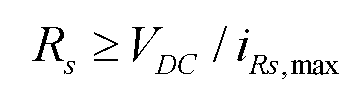 (21)
(21)
[00118] (3) Tdis=t6-t5 is desirable to be minimize. TdiS is related to the Cs discharge time interval on the snubber resistor Rs. Considering tcs as the Cs discharge time constant:
[00119]
 (22)
(22)
[00120] In this case, by assuming 5XτCS as the stabilizing time interval, the value of Rs should satisfy the following equation:
[00121]
 (23)
(23)
[00122] Eqs. (21)-(23) are combined to find the optimized value of Rs based on Eq. (11):
[00123]
 (24)
(24)
[00124] 3.3.3. MOV Design Procedure
[00125] The rating voltage (VDC.MOV), the clamping voltage (Vciamp), the rated surge energy (ERated), and the peak pulse current (ipeak) may be considered in selecting the MOV in SSCBs. As the proposed MOV-RCS snubber based SSCB removes the leakage current of the MOV using the controlling switch Ss, the design may find the optimized value of Vciamp.
[00126] As the Vclamp determines the voltage ratings of the main switch Sm and the snubber capacitor Cs, choosing an MOV with lower clamping voltage helps to achieve a compact design and reduces the cost. Besides, lower Vclamp reduces the dV/dt across the main switch Sm and leads to lower voltage overshoots, which enhance the reliabity and lifetime. On the other hand, there are two design criteria impacting the minimum value of the VClamp·
[00127] - Lower Vclamp increases the fault current extinguishing time (tET) as shown in
FIG. 9. This time interval is considered as t3-t2 in FIG. 9 in the proposed SSCB. As the tET increases, the MOV should dissipate more energy. If this energy exceeds the MOV's ERated, it may be completely destroyed, or the MOV can fail as a short circuit. Therefore, tET and the ERated are considered to define the lower boundary of the MOV as follows:
[00128]
 (25)
(25)
[00129] where RTr is the transient power on the MOV during DC current interruption. [00130] - Lower Vclamp leads to higher leakage currents. As the snubber switch Ss interrupts the leakage currents after DC current interruption (with respect to mode IV at t=ts), high values of leakage currents lead to high di/dt across the Ss. Regarding the leakage current iSs=iMov+iRs in mode V, the voltage overshoot across the Ss is calculated as follows:
[00131]
 (26)
(26)
[00132] where VSs,Tr is the di/dt voltage across the Ss during the turn-off in the snubber branch. The value of iSs should be limited in a way that the voltage across the main switch does not exceed Vciamp, meaning:
[00133]
 (27)
(27)
[00134] 3.3.4. Snubber Switch Ss Design Procedure
[00135] There are at least two design criteria in selecting the snubber switch Ss: the voltage rating and the pulse current capability. In contrast to the main switch Sm that may hold the Vclamp, the maximum voltage on Ss is VDC during DC current interruption as indicated in FIG. 9. Also, SiC MOSFETs usually tolerate higher values of pulse currents, which helps to obtain compactness. As transient time interval places in 10s of microseconds range, there is no obligations on cooling systems for the snubber switch Ss.
[00136] FIG. 10 summarizes the design procedure to optimize the snubber components. Given the values of VDC, LLine, idc,max desire dV/dt, Tdis and tET, the optimal VClamp can be found using Eq. (25). Next, Eq. (20) is used to optimize Cs. The value of Rs is selected based on Eq. (24) to limit iSs. Given the values of Vciamp, Cs, and Rs, if VSs,Tr satisfies Eq. (27), Ss is selected in the next step. Otherwise, Vclamp is increased and the process repeats.
[00137] 4. Design Examples
[00138] In this section, the design examples of the proposed fault current bypass based SSCB and the MOV-RCS snubber based SSCB are presented and the experimental results are included to validate the correctness of the proposed designs.
[00139] 4.1 Fault Current Bypass based SSCB
[00140] In this section, experimental results of 375V/170A/2.4μs and 600V/163A/2.4μs are presented. FIG. 11 displays the implemented SSCB and the 3D design view. FIG. 17,
Table I shows the selected semiconductor devices and the components values. The MOV voltage rating (VDC, v) is 420V with the maximum clamping voltage (Vcimap) of 830V. [00141] 4.1.1. Fault Current bypass based SSCB: Experiments of 375V/170A/2.4μs [00142] FIG. 12 shows the experimental results of 375V/170A with the Sm drain-source voltage (Vsm) and the line inductor LLine current (iLine) waveforms in the top and the gate- source voltages and load current (iLoad) waveforms in the bottom. To compensate the leakage inductance in the main switch Sm, an RC snubber (R=1Ω and C=100nF) has been connected to the drain-source terminals of Sm.
[00143] As illustrated in FIG. 12, the main switch Sm turns on for 65μs, and when the DC current reaches about 160A, current interruption begins by turning Ss on. After a safe delay («2μs), Sm is triggered to be turned off. Sm turns off completely after 400ns, and the DC current is interrupted in the main switch after 2.4μs. Next, the current commutates to Ss and charges Cs. The Vcs (=VSm) rises to 799V in 2.7μs which is close to the expected value of Eq. (8) (2.5μs considering Cs=500nF, VClamp=799V, and idc,max=160A). The peak of the current in the Ss reaches 170A, and it reduces to leakage values in 37μs.
[00144] Ss turns off after 250μs. This interval is determined considering the fault current extinguishing time interval (TET) which depends on idc,mx, LLine, VDC, and VClamp factors. As Ss turns off, it holds the VDC in the auxiliary branch. Also, the current in the load side begins to decrease after Sm turn-off, reducing to zero in 55μs.
[00145] According to the gate-source voltage waveforms in FIG. 12, it is concluded that no voltage oscillations appear on the gate terminals during the DC current breaking, which facilitates the fully utilization of the electrical ratings of SiC MOSFETs in practice. The dV/dt across Sm is controlled using the correct selectin of Cs. Also, the stored inductive energy of LLine is prevented to flow through the faulty section after Sm turn-off.
[00146] 4.1.2. Fault Current bypass based SSCB: Experiments of 600V/163A/2.4μs
[00147] The designed SSCB of FIG. 11 is tested in a 600V DC system with the same components. The resulted waveforms are represented in FIG. 13. Sm turns on for 25μs, and when the value of the DC current reaches around 141.5A, Ss turns on. Then, Sm turns off completely after 2.4μs, showing the same response time.
[00148] The current in Ss gets the peak value of 163.3A, and it reduces to 2.3A (=iSs) in 177μs where the current share of resistor Rs (=6.8kΩ) is 88mA, and the remaining 2.212A flows through the MOV as the leakage current. Also, the current at the load side decays to zero in 55μs after Sm turn-off. The maximum voltage across Cs (VCs=VSm) reaches 799V (Vciamp) in 3μs (Tp). As indicated in FIG. 13, Ss turns off after 250μs, and the leakage current in the auxiliary branch (=iSs) reduces to zero.
[00149] The experimental results in 600V DC system show that MOVs with the DC ratings below the nominal voltage of the DC system can be used to achieve lower clamping voltage. In this case, the voltage overshoot across the main switch is decreased, and the dV/dt is reduced. Besides, the designed SSCB has the capability to be adjusted for different voltage and current ratings, which is highly beneficial in industrial applications.
[00150] 4.2 MOV-RCS Snubber based SSCB
[00151] To validate the proposed MOV-RCS snubber based SSCB, it is tested at two different voltages. First, the SSCB interrupts 160A current in a 375V DC system where VDC,MOV>VDC. Second, the SSCB is tested in a 550V DC system to interrupt 158A with the same components; while, VDC,MOV<VDC. FIG. 14 (a) shows the implemented hardware set up with respect to figure 7. Also, FIG. 14 (b) indicates the 3D design view of the SSCB. The DC system and the SSCB parameters are listed in FIG. 18, Table II. The current interruption process is controlled by a TMS320F28335 processor in a time sequence manner.
[00152] 4.2.1. MOV-RCS Snubber based SSCB: Experiments of 375V/160A/1.6μs SSCB
[00153] In this section, the SSCB is tested in a 375V DC system to interrupt 160A current, where it achieves 1.6μs response time. FIG. 15 indicates the experimental results. At the left side, the drain-source voltage on the main switch (VSm), the line current (iLine), the voltage on the snubber capacitor Cs (Vcs), the drain-source voltage on the snubber switch (VSs), the gate-source voltages on the main switch Sm (VGs,Sm) and the snubber switch Ss (VGS,SS) are represented, respectively. At the right side, the details are also provided to show the transient.
[00154] FIG. 15 shows the working process. As Sm turns on, the DC current flows through the line inductor (LLine) and the load (RLoad). After 5μs, the snubber switch Ss turns on. Since the voltage across Sm is zero, there is no current in the snubber branch (iSs=0). During on- state, the DC current reaches 160A and the current interruption process begins.
[00155] To interrupt the current, Sm turns off at t=320μs. The current commutates to the snubber branch and charges Cs to 777V (Vclamp) in 1.2μs interval (=Tc), which is close to the estimated 1.03μs according to Eq. (20) (Vciamp,max=830V, Cs=200nF, and idc,max=160A). The voltage across Cs is clamped by the MOV. As Vcs exceeds VDC, the line current (iune) starts to decrease, iLine reduces to the leakage value in 34μs.
[00156] The leakage current in the snubber switch (iSs) includes the MOV leakage current (iMOV) and the discharge current through the snubber resistor Rs (IRs). AS the DC voltage (VDC=375V) is lower than the MOV rating (VDC,MOV=420V), IMOV should be around 10s of mA for a non-degraded MOV. Also, the discharge current through Rs is limited to 55mA (IRS). After 250μs of Sm turn-off (at t=320+250 μs), Ss turns off to completely eliminate the leakage current in the snubber branch.
[00157] After turning Ss off, Vcs (=VMOV) starts to discharge through Rs, and the voltage across Ss increases and finally reaches VDC. In this case, the voltage on Cs and MOV is reduced to zero, and Ss holds the DC bus voltage.
[00158] In FIG. 15, the response time has two intervals: 1) Sm turn-off delay to reduce the current in the main branch to zero, which is 0.4μs, 2) Cs charging time to increase Vcs until VClamp, which is 1.2μs. Then, the response time is 1.6μs (0.4μs+1.2μs). For other current values (idc), the response time can be found as below:
[00159]
 (28)
(28)
[00160] where Top is defined as the response time of the SSCB.
[00161] 4.2.2. MOV-RCS Snubber based SSCB: Experiments of 550V/158A/1.6μs SSCB
[00162] The SSCB is also tested in a 550V (VDC) system to interrupt 158A with the same components in Table II. In this case, the DC bus voltage is higher than the MOV rating voltage, meaning VDC,MOV<VDC. The response time of the breaker is still 1.6μs. The experimental results are shown in FIG. 16.
[00163] As indicated in FIG. 16, the main switch Sm turns on at t≈175μs, and the current begins to increase. Also, the snubber switch Ss turns on after 5μs. As Sm is on, there is no current in the snubber branch (iSs=iCs≈0). After 25μs, the current reaches 158A, and Sm is triggered to interrupt the current.
[00164] By turning Sm off (with a delay of 0.4μs), the current commutates to the snubber branch and charges Cs. Vcs reaches 777V (Vclamp) in 1.2 μs (Tc). As the MOV clamμs the voltage, it absorbs the stored inductive energy in LLine and forces the current to the leakage value in lOOμs.
[00165] The leakage current flowing through the snubber switch Ss is measured as 1.6A, where the share of the snubber resistor Rs is 80mA (=iRS=VDc/Rs). The rest of the current (=1.52A) is the leakage current flowing through the MOV. As shown in FIG. 16, this leakage current is obvious. It needs to be mentioned that this leakage current increases as the MOV degrades.
[00166] After 250ps of Sm turn-off, the snubber switch Ss also turns off at t=450ps to eliminate the leakage current. Regarding the line current (iLine) in FIG. 16, the time instance in which Ss breaks the leakage current is clear.
[00167] Due to the stored inductive energy in LLine, interrupting 1.6A leakage current leads to 180V voltage peak across Ss which is lower than the expected 252V (VSs Tr) according to Eq. (26) (for LLine=63μ, iSs=1.6A, and Ss turn-off delay of 0.4μs). The source of difference can be found within the drain-source capacitance of the Ss which helps to reduce the voltage peak. As shown in FIG. 16, after turning Ss off, the voltage on the MOV (VMOV=VCs) begins to decrease, and the voltage across Ss rises at the same time. It will finally reach the DC bus voltage VDC, where the interruption process completes.
[00168] CONCLUSION
[00169] The disclosure is a new solid state circuit breaker and a new active clamping snubber are presented. First circuit is a new fault current bypass based solid state breaker for low voltage direct current systems. It can bypass fault currents using a new developed auxiliary branch, reduce the overshoot voltage across the breaker, remove the leakage
current of the energy absorbing elements, and provide fast speed operation. Second circuit is a new active clamping circuits which can be used for a variety of direct current breakers. The device(s) address the MOV degradation issue, enhancing the lifetime and reliability of the breakers, reducing the voltage overshoot across the breakers, and avoiding leakage current of the energy absorbing elements. Proposed circuit breakers obtain current scalability and extend the allowable DC bus voltage on the breakers. Mathematical calculations, simulations, and experiments have been conducted to verify the effectiveness and practicality of the proposed topologies.
[00170] Two designs are presented as named as "fault current bypass based solid state breaker" and "active clamping snubbers." The advantages of the presented topologies over current methods are summarized as follows:
[00171] Fault current bypass based solid state breaker advantages: 1) it can bypass fault currents using a new developed auxiliary branch, 2) it reduces the overshoot voltage across the breaker, 3) it removes the leakage current of the energy absorbing elements, 4) it extends the allowable DC bus voltage on the breakers, and 5) it provides a fast speed operation.
[00172] Active clamping snubber advantages: 1) addressing the MOV degradation issue, 2) enhancing the lifetime and reliabity of the breakers, 3) reducing the voltage overshoot across the breakers, 4) it extends the allowable DC bus voltage on the breakers, and 5) avoiding leakage current of the energy absorbing elements.
[00173] EMBODIMENTS
[00174] Embodiment 1: A fault current bypass based solid state circuit breaker comprising: a voltage source (VDC) connected in series a line inductor (iLine) through which a DC current (iDC) flows; wherein the line inductor (iLine) is connected in parallel to a main switch (Sm) and a metal oxide varistor resistive capacitive switch (MOV-RCS) snubber, wherein the DC current (iDC) splits to provide main switch current (iSm) to the main switch (Sm) and snubber current (iSl) to the snubber; wherein the main switch (Sm) and a diode (Di) provide load current (iLoad) across a load inductor (LLoad); wherein the load inductor current (iLoad) from the load inductor (LLoad) then passes through a load resistor (RLoad); wherein the load resistor (RLoad) is connected in series to an anode side of the diode (Di) and an output of the snubber (MOV-RCS); and wherein the output of the snubber is connected to the voltage source (VDC).
[00175] Embodiment 2 : The fault current bypass based solid state circuit breaker of embodiment 1, wherein the snubber comprises: a snubber switch (Ss) in series with the following components that are in parallel with one another: a snubber Resistor (Rs), a snubber capacitor (Cs) and a metal oxide varistor (MOV).
[00176] Embodiment 3 : The fault current bypass based solid state circuit breaker of embodiment 2, wherein a nominal voltage flows through the solid state circuit breaker at a voltage near to a clamping voltage of the metal oxide varistor.
[00177] Embodiment 4: The fault current bypass based solid state circuit breaker of embodiment 2, wherein the rate of change of voltage (dV/dt) across the main switch (Sm) is reduced by the snubber capacitor (Cs).
[00178] Embodiment 5 : The fault current bypass based solid state circuit breaker of embodiment 2, wherein the snubber switch (Ss) turns off at almost zero current.
[00179] Embodiment 6: The fault current bypass based solid state circuit breaker of embodiment 5, wherein no oscillations appear on the snubber switch (Ss) during current interruption.
[00180] Embodiment 7 : The fault current bypass based solid state circuit breaker of embodiment 2, wherein stored inductive energy of the line inductor (iLine) is prevented to flow through a faulty section of a circuit.
[00181] Embodiment 8: A solid state circuit breaker comprising: a voltage source (VDC) connected in series a line inductor (iLine) through which a DC current (IDC) flows; wherein the line inductor (iLine) is connected in parallel to a main switch (Sm) and a metal oxide varistor resistive capacitive switch (MOV-RCS) snubber, wherein the DC current (IDC) splits to provide main switch current (iSm) to the main switch (Sm) and snubber current (iSs) to the snubber; wherein the main switch (Sm) and the snubber provide current to a load resistor (RLoad); and wherein the load resistor (RLoad) is connected to the voltage source (VDC). [00182] Embodiment 9: The fault current bypass based solid state circuit breaker of embodiment 8, wherein the snubber comprises: a snubber switch (Ss) in series with the following components that are in parallel with one another: a snubber Resistor (Rs), a snubber capacitor (Cs) and a metal oxide varistor (MOV).
[00183] While the invention has been described with reference to the embodiments herein, a person of ordinary skill in the art would understand that various changes or modifications may be made thereto without departing from the scope of the claims.
Claims
1. A fault current bypass based solid state circuit breaker comprising: a voltage source (VDC) connected in series a line inductor (iune) through which a DC current (iDC) flows; wherein the line inductor (iune) is connected in parallel to a main switch (Sm) and a metal oxide varistor resistive capacitive switch (MOV-RCS) snubber, wherein the DC current (iDC) splits to provide main switch current (iSm) to the main switch (Sm) and snubber current (iSl) to the snubber; wherein the main switch (Sm) and a diode (Di) provide load current (lLoad) across a load inductor (LLoad); wherein the load inductor current (lLoad) from the load inductor (LLoad) then passes through a load resistor (RLoad); wherein the load resistor (RLoad) is connected in series to an anode side of the diode (Di) and an output of the snubber (MOV-RCS); and wherein the output of the snubber is connected to the voltage source (VDC).
2. The fault current bypass based solid state circuit breaker of claim 1, wherein the snubber comprises: a snubber switch (Ss) in series with the following components that are in parallel with one another: a snubber Resistor (Rs), a snubber capacitor (Cs) and a metal oxide varistor (MOV).
3. The fault current bypass based solid state circuit breaker of claim 2, wherein a nominal voltage flows through the solid state circuit breaker at a voltage near to a clamping voltage of the metal oxide varistor.
4. The fault current bypass based solid state circuit breaker of claim 2, wherein the rate of change of voltage (dV/dt) across the main switch (Sm) is reduced by the snubber capacitor (Cs).
5. The fault current bypass based solid state circuit breaker of claim 2, wherein the snubber switch (Ss) turns off at almost zero current.
6. The fault current bypass based solid state circuit breaker of claim 5, wherein no oscillations appear on the snubber switch (Ss) during current interruption.
7. The fault current bypass based solid state circuit breaker of claim 2, wherein stored inductive energy of the line inductor (iune) is prevented to flow through a faulty section of a circuit.
8. A solid state circuit breaker comprising: a voltage source (VDC) connected in series a line inductor (iLine) through which a DC current (iDC) flows; wherein the line inductor (iLine) is connected in parallel to a main switch (Sm) and a metal oxide varistor resistive capacitive switch (MOV-RCS) snubber, wherein the DC current (iDC) splits to provide main switch current (iSm) to the main switch (Sm) and snubber current (iSs) to the snubber; wherein the main switch (Sm) and the snubber provide current to a load resistor (RLoad); and wherein the load resistor (RLoad) is connected to the voltage source (VDC).
9. The fault current bypass based solid state circuit breaker of claim 8, wherein the snubber comprises: a snubber switch (Ss) in series with the following components that are in parallel with one another: a snubber Resistor (Rs), a snubber capacitor (Cs) and a metal oxide varistor (MOV).
Priority Applications (1)
| Application Number | Priority Date | Filing Date | Title |
|---|---|---|---|
| US18/574,128 US20240333277A1 (en) | 2021-06-25 | 2022-06-24 | Fault current bypass based solid state circuit breakers and active clamping snubbers for dc circuit breakers |
Applications Claiming Priority (2)
| Application Number | Priority Date | Filing Date | Title |
|---|---|---|---|
| US202163214873P | 2021-06-25 | 2021-06-25 | |
| US63/214,873 | 2021-06-25 |
Publications (2)
| Publication Number | Publication Date |
|---|---|
| WO2022272007A2 true WO2022272007A2 (en) | 2022-12-29 |
| WO2022272007A3 WO2022272007A3 (en) | 2023-03-16 |
Family
ID=84544699
Family Applications (1)
| Application Number | Title | Priority Date | Filing Date |
|---|---|---|---|
| PCT/US2022/034815 Ceased WO2022272007A2 (en) | 2021-06-25 | 2022-06-24 | Fault current bypass based solid state circuit breakers and active clamping snubbers for dc circuit breakers |
Country Status (2)
| Country | Link |
|---|---|
| US (1) | US20240333277A1 (en) |
| WO (1) | WO2022272007A2 (en) |
Cited By (2)
| Publication number | Priority date | Publication date | Assignee | Title |
|---|---|---|---|---|
| CN116203354A (en) * | 2023-03-24 | 2023-06-02 | 中国能源建设集团湖南省电力设计院有限公司 | Direct-current line fault distance measurement method based on series hybrid circuit breaker |
| WO2024184126A1 (en) * | 2023-03-03 | 2024-09-12 | Siemens Mobility GmbH | Short-circuit protection with a semiconductor switch |
Families Citing this family (1)
| Publication number | Priority date | Publication date | Assignee | Title |
|---|---|---|---|---|
| CN121602974A (en) * | 2026-01-27 | 2026-03-03 | 广东伟邦科技股份有限公司 | Hybrid direct current breaker and control method thereof |
Family Cites Families (10)
| Publication number | Priority date | Publication date | Assignee | Title |
|---|---|---|---|---|
| US7405910B2 (en) * | 2005-11-30 | 2008-07-29 | Electric Power Research Institute, Inc. | Multifunction hybrid solid-state switchgear |
| EP2669921A1 (en) * | 2012-05-31 | 2013-12-04 | Alstom Technology Ltd | Circuit breaker apparatus |
| CN104620345B (en) * | 2012-08-27 | 2016-10-26 | Abb瑞士股份有限公司 | Arrangement of means for breaking the current |
| US9520713B2 (en) * | 2013-08-22 | 2016-12-13 | Varian Semiconductor Equipment Associates, Inc. | Fast switch fault current limiter |
| CN103762547A (en) * | 2014-01-08 | 2014-04-30 | 西安交通大学 | Modular high-voltage vacuum direct current on-off device based on artificial zero crossing |
| SE539392C2 (en) * | 2015-12-28 | 2017-09-12 | Scibreak Ab | Arrangement, system, and method of interrupting current |
| WO2018157915A1 (en) * | 2017-02-28 | 2018-09-07 | Abb Schweiz Ag | Load transfer switching |
| GB2578897A (en) * | 2018-11-12 | 2020-06-03 | Eaton Intelligent Power Ltd | Circuit-breaker with reduced breakdown voltage requirement |
| US11532933B2 (en) * | 2019-11-13 | 2022-12-20 | Abb Schweiz Ag | Current control and circuit protection for distributed energy resources |
| KR102465165B1 (en) * | 2020-07-07 | 2022-11-09 | 현대일렉트릭앤에너지시스템(주) | Circuit breaker composed of semiconductor element |
-
2022
- 2022-06-24 WO PCT/US2022/034815 patent/WO2022272007A2/en not_active Ceased
- 2022-06-24 US US18/574,128 patent/US20240333277A1/en active Pending
Cited By (2)
| Publication number | Priority date | Publication date | Assignee | Title |
|---|---|---|---|---|
| WO2024184126A1 (en) * | 2023-03-03 | 2024-09-12 | Siemens Mobility GmbH | Short-circuit protection with a semiconductor switch |
| CN116203354A (en) * | 2023-03-24 | 2023-06-02 | 中国能源建设集团湖南省电力设计院有限公司 | Direct-current line fault distance measurement method based on series hybrid circuit breaker |
Also Published As
| Publication number | Publication date |
|---|---|
| WO2022272007A3 (en) | 2023-03-16 |
| US20240333277A1 (en) | 2024-10-03 |
Similar Documents
| Publication | Publication Date | Title |
|---|---|---|
| US11973493B2 (en) | Voltage clamping circuit for solid state circuit breaker | |
| EP3651175B1 (en) | Circuit-breaker with reduced breakdown voltage requirement | |
| US7079363B2 (en) | Hybrid DC electromagnetic contactor | |
| Kheirollahi et al. | Fault current bypass-based LVDC solid-state circuit breakers | |
| WO2022272007A2 (en) | Fault current bypass based solid state circuit breakers and active clamping snubbers for dc circuit breakers | |
| US8503138B2 (en) | Hybrid circuit breaker | |
| US6952335B2 (en) | Solid-state DC circuit breaker | |
| CN108141209B (en) | Circuit for isolating load from source | |
| JP6288534B2 (en) | Power converter | |
| CN105917431A (en) | Device for switching a direct current | |
| CN112997373A (en) | Electric switch with overvoltage protection | |
| US20200335968A1 (en) | Current interrupting device and transistor selecting method | |
| US11888312B2 (en) | Solid state circuit breaker with reduced clamping voltage | |
| CN121219961A (en) | Electronic devices | |
| US20210297073A1 (en) | Switching Device for Separating a Current Path | |
| CN119448155A (en) | DC solid state circuit breaker | |
| JP2018195565A (en) | Direct current shut-down device | |
| Cha et al. | Surge voltage suppression using dual MOVs and modified RC snubber circuit structure in a DC solid-state circuit breaker | |
| JP7250266B1 (en) | DC current interrupter | |
| JP7312727B2 (en) | DC interrupter | |
| EP4622105A1 (en) | Voltage clamping circuit for solid state circuit breakers | |
| Mena | Comparison of Electrical Fault Response In Z-source Circuit Breaker Topologies For DC Microgrid Applications | |
| Perea Mena | Comparison of Electrical Fault Response In Z-source Circuit Breaker Topologies For DC Microgrid Applications | |
| Tang et al. | Multi-stage DC hybrid switch with slow switching | |
| JP2024151750A (en) | Power Conversion Equipment |
Legal Events
| Date | Code | Title | Description |
|---|---|---|---|
| 121 | Ep: the epo has been informed by wipo that ep was designated in this application |
Ref document number: 22829348 Country of ref document: EP Kind code of ref document: A2 |
|
| WWE | Wipo information: entry into national phase |
Ref document number: 18574128 Country of ref document: US |
|
| NENP | Non-entry into the national phase |
Ref country code: DE |
|
| 122 | Ep: pct application non-entry in european phase |
Ref document number: 22829348 Country of ref document: EP Kind code of ref document: A2 |