WO2022270501A1 - 水素生成助触媒、光触媒、水素の製造方法、水素の製造装置、及び半導体材料 - Google Patents
水素生成助触媒、光触媒、水素の製造方法、水素の製造装置、及び半導体材料 Download PDFInfo
- Publication number
- WO2022270501A1 WO2022270501A1 PCT/JP2022/024714 JP2022024714W WO2022270501A1 WO 2022270501 A1 WO2022270501 A1 WO 2022270501A1 JP 2022024714 W JP2022024714 W JP 2022024714W WO 2022270501 A1 WO2022270501 A1 WO 2022270501A1
- Authority
- WO
- WIPO (PCT)
- Prior art keywords
- hydrogen
- srtio
- photocatalyst
- formula
- catalyst
- Prior art date
- Legal status (The legal status is an assumption and is not a legal conclusion. Google has not performed a legal analysis and makes no representation as to the accuracy of the status listed.)
- Ceased
Links
Images











Classifications
-
- B—PERFORMING OPERATIONS; TRANSPORTING
- B01—PHYSICAL OR CHEMICAL PROCESSES OR APPARATUS IN GENERAL
- B01J—CHEMICAL OR PHYSICAL PROCESSES, e.g. CATALYSIS OR COLLOID CHEMISTRY; THEIR RELEVANT APPARATUS
- B01J23/00—Catalysts comprising metals or metal oxides or hydroxides, not provided for in group B01J21/00
- B01J23/70—Catalysts comprising metals or metal oxides or hydroxides, not provided for in group B01J21/00 of the iron group metals or copper
- B01J23/76—Catalysts comprising metals or metal oxides or hydroxides, not provided for in group B01J21/00 of the iron group metals or copper combined with metals, oxides or hydroxides provided for in groups B01J23/02 - B01J23/36
- B01J23/78—Catalysts comprising metals or metal oxides or hydroxides, not provided for in group B01J21/00 of the iron group metals or copper combined with metals, oxides or hydroxides provided for in groups B01J23/02 - B01J23/36 with alkali- or alkaline earth metals
-
- B—PERFORMING OPERATIONS; TRANSPORTING
- B01—PHYSICAL OR CHEMICAL PROCESSES OR APPARATUS IN GENERAL
- B01J—CHEMICAL OR PHYSICAL PROCESSES, e.g. CATALYSIS OR COLLOID CHEMISTRY; THEIR RELEVANT APPARATUS
- B01J21/00—Catalysts comprising the elements, oxides, or hydroxides of magnesium, boron, aluminium, carbon, silicon, titanium, zirconium, or hafnium
- B01J21/18—Carbon
-
- B—PERFORMING OPERATIONS; TRANSPORTING
- B01—PHYSICAL OR CHEMICAL PROCESSES OR APPARATUS IN GENERAL
- B01J—CHEMICAL OR PHYSICAL PROCESSES, e.g. CATALYSIS OR COLLOID CHEMISTRY; THEIR RELEVANT APPARATUS
- B01J23/00—Catalysts comprising metals or metal oxides or hydroxides, not provided for in group B01J21/00
- B01J23/002—Mixed oxides other than spinels, e.g. perovskite
-
- B—PERFORMING OPERATIONS; TRANSPORTING
- B01—PHYSICAL OR CHEMICAL PROCESSES OR APPARATUS IN GENERAL
- B01J—CHEMICAL OR PHYSICAL PROCESSES, e.g. CATALYSIS OR COLLOID CHEMISTRY; THEIR RELEVANT APPARATUS
- B01J23/00—Catalysts comprising metals or metal oxides or hydroxides, not provided for in group B01J21/00
- B01J23/02—Catalysts comprising metals or metal oxides or hydroxides, not provided for in group B01J21/00 of the alkali- or alkaline earth metals or beryllium
-
- B—PERFORMING OPERATIONS; TRANSPORTING
- B01—PHYSICAL OR CHEMICAL PROCESSES OR APPARATUS IN GENERAL
- B01J—CHEMICAL OR PHYSICAL PROCESSES, e.g. CATALYSIS OR COLLOID CHEMISTRY; THEIR RELEVANT APPARATUS
- B01J31/00—Catalysts comprising hydrides, coordination complexes or organic compounds
- B01J31/16—Catalysts comprising hydrides, coordination complexes or organic compounds containing coordination complexes
- B01J31/1616—Coordination complexes, e.g. organometallic complexes, immobilised on an inorganic support, e.g. ship-in-a-bottle type catalysts
-
- B—PERFORMING OPERATIONS; TRANSPORTING
- B01—PHYSICAL OR CHEMICAL PROCESSES OR APPARATUS IN GENERAL
- B01J—CHEMICAL OR PHYSICAL PROCESSES, e.g. CATALYSIS OR COLLOID CHEMISTRY; THEIR RELEVANT APPARATUS
- B01J31/00—Catalysts comprising hydrides, coordination complexes or organic compounds
- B01J31/16—Catalysts comprising hydrides, coordination complexes or organic compounds containing coordination complexes
- B01J31/1691—Coordination polymers, e.g. metal-organic frameworks [MOF]
-
- B—PERFORMING OPERATIONS; TRANSPORTING
- B01—PHYSICAL OR CHEMICAL PROCESSES OR APPARATUS IN GENERAL
- B01J—CHEMICAL OR PHYSICAL PROCESSES, e.g. CATALYSIS OR COLLOID CHEMISTRY; THEIR RELEVANT APPARATUS
- B01J31/00—Catalysts comprising hydrides, coordination complexes or organic compounds
- B01J31/16—Catalysts comprising hydrides, coordination complexes or organic compounds containing coordination complexes
- B01J31/22—Organic complexes
- B01J31/2204—Organic complexes the ligands containing oxygen or sulfur as complexing atoms
- B01J31/2208—Oxygen, e.g. acetylacetonates
- B01J31/2226—Anionic ligands, i.e. the overall ligand carries at least one formal negative charge
- B01J31/223—At least two oxygen atoms present in one at least bidentate or bridging ligand
-
- B—PERFORMING OPERATIONS; TRANSPORTING
- B01—PHYSICAL OR CHEMICAL PROCESSES OR APPARATUS IN GENERAL
- B01J—CHEMICAL OR PHYSICAL PROCESSES, e.g. CATALYSIS OR COLLOID CHEMISTRY; THEIR RELEVANT APPARATUS
- B01J31/00—Catalysts comprising hydrides, coordination complexes or organic compounds
- B01J31/16—Catalysts comprising hydrides, coordination complexes or organic compounds containing coordination complexes
- B01J31/22—Organic complexes
- B01J31/2204—Organic complexes the ligands containing oxygen or sulfur as complexing atoms
- B01J31/226—Sulfur, e.g. thiocarbamates
-
- B—PERFORMING OPERATIONS; TRANSPORTING
- B01—PHYSICAL OR CHEMICAL PROCESSES OR APPARATUS IN GENERAL
- B01J—CHEMICAL OR PHYSICAL PROCESSES, e.g. CATALYSIS OR COLLOID CHEMISTRY; THEIR RELEVANT APPARATUS
- B01J35/00—Catalysts, in general, characterised by their form or physical properties
- B01J35/20—Catalysts, in general, characterised by their form or physical properties characterised by their non-solid state
- B01J35/23—Catalysts, in general, characterised by their form or physical properties characterised by their non-solid state in a colloidal state
-
- B—PERFORMING OPERATIONS; TRANSPORTING
- B01—PHYSICAL OR CHEMICAL PROCESSES OR APPARATUS IN GENERAL
- B01J—CHEMICAL OR PHYSICAL PROCESSES, e.g. CATALYSIS OR COLLOID CHEMISTRY; THEIR RELEVANT APPARATUS
- B01J35/00—Catalysts, in general, characterised by their form or physical properties
- B01J35/30—Catalysts, in general, characterised by their form or physical properties characterised by their physical properties
- B01J35/39—Photocatalytic properties
-
- B—PERFORMING OPERATIONS; TRANSPORTING
- B01—PHYSICAL OR CHEMICAL PROCESSES OR APPARATUS IN GENERAL
- B01J—CHEMICAL OR PHYSICAL PROCESSES, e.g. CATALYSIS OR COLLOID CHEMISTRY; THEIR RELEVANT APPARATUS
- B01J37/00—Processes, in general, for preparing catalysts; Processes, in general, for activation of catalysts
- B01J37/02—Impregnation, coating or precipitation
- B01J37/0201—Impregnation
- B01J37/0203—Impregnation the impregnation liquid containing organic compounds
-
- B—PERFORMING OPERATIONS; TRANSPORTING
- B01—PHYSICAL OR CHEMICAL PROCESSES OR APPARATUS IN GENERAL
- B01J—CHEMICAL OR PHYSICAL PROCESSES, e.g. CATALYSIS OR COLLOID CHEMISTRY; THEIR RELEVANT APPARATUS
- B01J37/00—Processes, in general, for preparing catalysts; Processes, in general, for activation of catalysts
- B01J37/02—Impregnation, coating or precipitation
- B01J37/0201—Impregnation
- B01J37/0211—Impregnation using a colloidal suspension
-
- B—PERFORMING OPERATIONS; TRANSPORTING
- B01—PHYSICAL OR CHEMICAL PROCESSES OR APPARATUS IN GENERAL
- B01J—CHEMICAL OR PHYSICAL PROCESSES, e.g. CATALYSIS OR COLLOID CHEMISTRY; THEIR RELEVANT APPARATUS
- B01J37/00—Processes, in general, for preparing catalysts; Processes, in general, for activation of catalysts
- B01J37/08—Heat treatment
-
- C—CHEMISTRY; METALLURGY
- C01—INORGANIC CHEMISTRY
- C01B—NON-METALLIC ELEMENTS; COMPOUNDS THEREOF; METALLOIDS OR COMPOUNDS THEREOF NOT COVERED BY SUBCLASS C01C
- C01B3/00—Hydrogen; Gaseous mixtures containing hydrogen; Separation of hydrogen from mixtures containing it; Purification of hydrogen; Reversible storage of hydrogen
- C01B3/02—Production of hydrogen; Production of gaseous mixtures containing hydrogen
- C01B3/04—Production of hydrogen; Production of gaseous mixtures containing hydrogen by decomposition of inorganic compounds
-
- C—CHEMISTRY; METALLURGY
- C01—INORGANIC CHEMISTRY
- C01B—NON-METALLIC ELEMENTS; COMPOUNDS THEREOF; METALLOIDS OR COMPOUNDS THEREOF NOT COVERED BY SUBCLASS C01C
- C01B3/00—Hydrogen; Gaseous mixtures containing hydrogen; Separation of hydrogen from mixtures containing it; Purification of hydrogen; Reversible storage of hydrogen
- C01B3/02—Production of hydrogen; Production of gaseous mixtures containing hydrogen
- C01B3/04—Production of hydrogen; Production of gaseous mixtures containing hydrogen by decomposition of inorganic compounds
- C01B3/042—Decomposition of water
-
- C—CHEMISTRY; METALLURGY
- C01—INORGANIC CHEMISTRY
- C01B—NON-METALLIC ELEMENTS; COMPOUNDS THEREOF; METALLOIDS OR COMPOUNDS THEREOF NOT COVERED BY SUBCLASS C01C
- C01B3/00—Hydrogen; Gaseous mixtures containing hydrogen; Separation of hydrogen from mixtures containing it; Purification of hydrogen; Reversible storage of hydrogen
- C01B3/02—Production of hydrogen; Production of gaseous mixtures containing hydrogen
- C01B3/04—Production of hydrogen; Production of gaseous mixtures containing hydrogen by decomposition of inorganic compounds
- C01B3/042—Decomposition of water
- C01B3/046—Decomposition of water using catalysts
-
- B—PERFORMING OPERATIONS; TRANSPORTING
- B01—PHYSICAL OR CHEMICAL PROCESSES OR APPARATUS IN GENERAL
- B01J—CHEMICAL OR PHYSICAL PROCESSES, e.g. CATALYSIS OR COLLOID CHEMISTRY; THEIR RELEVANT APPARATUS
- B01J21/00—Catalysts comprising the elements, oxides, or hydroxides of magnesium, boron, aluminium, carbon, silicon, titanium, zirconium, or hafnium
- B01J21/02—Boron or aluminium; Oxides or hydroxides thereof
- B01J21/04—Alumina
-
- B—PERFORMING OPERATIONS; TRANSPORTING
- B01—PHYSICAL OR CHEMICAL PROCESSES OR APPARATUS IN GENERAL
- B01J—CHEMICAL OR PHYSICAL PROCESSES, e.g. CATALYSIS OR COLLOID CHEMISTRY; THEIR RELEVANT APPARATUS
- B01J21/00—Catalysts comprising the elements, oxides, or hydroxides of magnesium, boron, aluminium, carbon, silicon, titanium, zirconium, or hafnium
- B01J21/06—Silicon, titanium, zirconium or hafnium; Oxides or hydroxides thereof
- B01J21/063—Titanium; Oxides or hydroxides thereof
-
- B—PERFORMING OPERATIONS; TRANSPORTING
- B01—PHYSICAL OR CHEMICAL PROCESSES OR APPARATUS IN GENERAL
- B01J—CHEMICAL OR PHYSICAL PROCESSES, e.g. CATALYSIS OR COLLOID CHEMISTRY; THEIR RELEVANT APPARATUS
- B01J2235/00—Indexing scheme associated with group B01J35/00, related to the analysis techniques used to determine the catalysts form or properties
-
- B—PERFORMING OPERATIONS; TRANSPORTING
- B01—PHYSICAL OR CHEMICAL PROCESSES OR APPARATUS IN GENERAL
- B01J—CHEMICAL OR PHYSICAL PROCESSES, e.g. CATALYSIS OR COLLOID CHEMISTRY; THEIR RELEVANT APPARATUS
- B01J2235/00—Indexing scheme associated with group B01J35/00, related to the analysis techniques used to determine the catalysts form or properties
- B01J2235/30—Scanning electron microscopy; Transmission electron microscopy
-
- B—PERFORMING OPERATIONS; TRANSPORTING
- B01—PHYSICAL OR CHEMICAL PROCESSES OR APPARATUS IN GENERAL
- B01J—CHEMICAL OR PHYSICAL PROCESSES, e.g. CATALYSIS OR COLLOID CHEMISTRY; THEIR RELEVANT APPARATUS
- B01J2531/00—Additional information regarding catalytic systems classified in B01J31/00
- B01J2531/02—Compositional aspects of complexes used, e.g. polynuclearity
- B01J2531/0213—Complexes without C-metal linkages
- B01J2531/0216—Bi- or polynuclear complexes, i.e. comprising two or more metal coordination centres, without metal-metal bonds, e.g. Cp(Lx)Zr-imidazole-Zr(Lx)Cp
-
- B—PERFORMING OPERATIONS; TRANSPORTING
- B01—PHYSICAL OR CHEMICAL PROCESSES OR APPARATUS IN GENERAL
- B01J—CHEMICAL OR PHYSICAL PROCESSES, e.g. CATALYSIS OR COLLOID CHEMISTRY; THEIR RELEVANT APPARATUS
- B01J2531/00—Additional information regarding catalytic systems classified in B01J31/00
- B01J2531/10—Complexes comprising metals of Group I (IA or IB) as the central metal
- B01J2531/16—Copper
-
- B—PERFORMING OPERATIONS; TRANSPORTING
- B01—PHYSICAL OR CHEMICAL PROCESSES OR APPARATUS IN GENERAL
- B01J—CHEMICAL OR PHYSICAL PROCESSES, e.g. CATALYSIS OR COLLOID CHEMISTRY; THEIR RELEVANT APPARATUS
- B01J2531/00—Additional information regarding catalytic systems classified in B01J31/00
- B01J2531/80—Complexes comprising metals of Group VIII as the central metal
- B01J2531/84—Metals of the iron group
- B01J2531/845—Cobalt
-
- B—PERFORMING OPERATIONS; TRANSPORTING
- B01—PHYSICAL OR CHEMICAL PROCESSES OR APPARATUS IN GENERAL
- B01J—CHEMICAL OR PHYSICAL PROCESSES, e.g. CATALYSIS OR COLLOID CHEMISTRY; THEIR RELEVANT APPARATUS
- B01J2531/00—Additional information regarding catalytic systems classified in B01J31/00
- B01J2531/80—Complexes comprising metals of Group VIII as the central metal
- B01J2531/84—Metals of the iron group
- B01J2531/847—Nickel
-
- Y—GENERAL TAGGING OF NEW TECHNOLOGICAL DEVELOPMENTS; GENERAL TAGGING OF CROSS-SECTIONAL TECHNOLOGIES SPANNING OVER SEVERAL SECTIONS OF THE IPC; TECHNICAL SUBJECTS COVERED BY FORMER USPC CROSS-REFERENCE ART COLLECTIONS [XRACs] AND DIGESTS
- Y02—TECHNOLOGIES OR APPLICATIONS FOR MITIGATION OR ADAPTATION AGAINST CLIMATE CHANGE
- Y02E—REDUCTION OF GREENHOUSE GAS [GHG] EMISSIONS, RELATED TO ENERGY GENERATION, TRANSMISSION OR DISTRIBUTION
- Y02E60/00—Enabling technologies; Technologies with a potential or indirect contribution to GHG emissions mitigation
- Y02E60/30—Hydrogen technology
- Y02E60/36—Hydrogen production from non-carbon containing sources, e.g. by water electrolysis
Definitions
- the present invention relates to a hydrogen production cocatalyst, a photocatalyst, a method for producing hydrogen, an apparatus for producing hydrogen, and a semiconductor material.
- Patent Literature 1 discloses a semiconductor material that can be used as a photocatalyst.
- Patent Document 1 describes that the photocatalyst may be provided with a promoter, and that a metal such as Pt or a metal oxide such as NiOx can be used as a hydrogen generation reaction promoter (hydrogen generation promoter). It is The co-catalyst is expected to improve the efficiency of hydrogen generation by photodecomposition by suppressing the recombination of excited carriers generated in the semiconductor material by light irradiation and promoting the surface reaction. However, according to the studies of the present inventors, these conventional cocatalysts are still insufficient to further improve hydrogen production efficiency.
- An object of the present invention is to provide a novel hydrogen production co-catalyst suitable for further improving the efficiency of hydrogen production by photocatalyst.
- a hydrogen-producing cocatalyst in combination with a light-excitable semiconductor catalyst, including a metal organic structure having a molecular structure represented by the following formula (1), hydrogen production cocatalyst, I will provide a.
- M in formula (1) is at least one selected from Ni, Co, Fe, Cu, Zn, Pd, Pt, Au and Ir, L 1 to L 4 are each independently at least one selected from S, Se, Te, NH and O, C 1 and C 2 are carbon atoms forming the first aromatic group; C3 and C4 are carbon atoms forming a second aromatic group.
- the present invention provides a semiconductor catalyst excited by light; and the hydrogen generation co-catalyst of the present invention, photocatalyst, I will provide a.
- the present invention provides By irradiating the photocatalyst of the present invention with light containing at least one selected from ultraviolet light, visible light and near-infrared light, water is decomposed to obtain hydrogen. a method for producing hydrogen, I will provide a.
- the present invention provides Equipped with a reaction part containing the photocatalyst of the present invention, hydrogen production equipment, I will provide a.
- the present invention provides a semiconductor excited by light; a metal organic framework having a molecular structure represented by the following formula (1), semiconductor materials, I will provide a.
- M in formula (1) is at least one selected from Ni, Co, Fe, Cu, Zn, Pd, Pt, Au and Ir, L 1 to L 4 are each independently at least one selected from S, Se, Te, NH and O, C 1 and C 2 are carbon atoms forming the first aromatic group; C3 and C4 are carbon atoms forming a second aromatic group.
- FIG. 1 is a conceptual diagram schematically showing an example of water splitting using a semiconductor material as a photocatalyst and a reaction mechanism of hydrogen generation by water splitting.
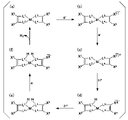
- FIG. 2 is a conceptual diagram showing an example of a promotion mechanism for the reduction reaction of water presumed in the hydrogen production cocatalyst of the present invention.
- FIG. 3A is a diagram showing examples of aromatic groups that can be possessed by the metal organic framework contained in the hydrogen production cocatalyst of the present invention.
- FIG. 3B is a diagram showing examples of ligands that the metal-organic framework contained in the hydrogen-producing cocatalyst of the present invention may have.
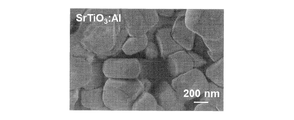
- 4A is a scanning electron microscope (SEM) observation image of SrTiO 3 :Al produced in Example 1.
- FIG. 1 is a conceptual diagram schematically showing an example of water splitting using a semiconductor material as a photocatalyst and a reaction mechanism of hydrogen generation by water splitting.
- FIG. 2 is a conceptual diagram showing an
- FIG. 4B is a SEM observation image of the NiDT produced in Example 1.
- FIG. 4C is a SEM observation image of NiDT/SrTiO 3 :Al produced in Example 1.
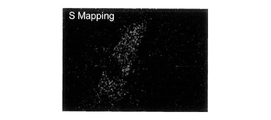
- FIG. 4D is a sulfur elemental mapping image by energy dispersive X-ray analysis (EDX) for NiDT/SrTiO 3 :Al produced in Example 1.
- FIG. 4E is a titanium elemental mapping image by EDX for NiDT/SrTiO 3 :Al produced in Example 1.
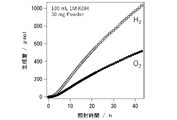
- FIG. FIG. 5 is a graph showing temporal changes in the amount of hydrogen produced when each of SrTiO 3 :Al and NiDT/SrTiO 3 :Al produced in Example 1 is used as a photocatalyst.
- FIG. 5 is a graph showing temporal changes in the amount of hydrogen produced when each of SrTiO 3 :Al and NiDT/SrTiO 3 :Al produced in Example 1 is used as a photocata
- FIG. 6 shows measurement results of linear sweep voltammetry (LSV) for SrTiO 3 :Al and NiDT/SrTiO 3 :Al produced in Example 1, respectively.
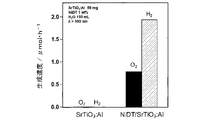
- FIG. 7 is a graph showing the generation rate of hydrogen and oxygen (gas generation rate) when SrTiO 3 :Al and NiDT/SrTiO 3 :Al prepared in Example 1 are used as photocatalysts.
- FIG. 8 is a graph showing changes over time in the amounts of hydrogen and oxygen produced when a cycle test was performed using the NiDT/SrTiO 3 :Al produced in Example 1 as a photocatalyst.
- FIG. 7 is a graph showing the generation rate of hydrogen and oxygen (gas generation rate) when SrTiO 3 :Al and NiDT/SrTiO 3 :Al prepared in Example 1 are used as photocatalysts.
- FIG. 8 is a graph showing changes over time in the amounts of hydrogen and oxygen produced when a cycle
- FIG. 9 shows the case where the NiDT/SrTiO 3 :Al produced in Example 1 is used as a photocatalyst, and the case where the SrTiO 3 :Al produced in Example is used as a photocatalyst and an aqueous solution of nickel nitrate is added to the reaction solution.
- is a graph showing the production rate of hydrogen and oxygen in each of FIG. 10A is an SEM observation image of NiDT/SrTiO 3 :Al produced in Example after water decomposition reaction for 120 hours.
- FIG. 10B is an EDX profile of NiDT/SrTiO 3 :Al produced in Example before and after the water splitting reaction for 120 hours.
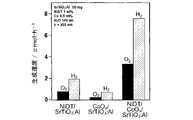
- FIG. 11 shows the generation rates of hydrogen and oxygen when each of NiDT/CoO x /SrTiO 3 :Al, CoO x /SrTiO 3 :Al and NiDT/SrTiO 3 :Al produced in Example 1 is used as a photocatalyst. It is a graph showing.
- FIG. 12 shows changes over time in the amount of hydrogen and oxygen produced when each of NiDT/CoO x /SrTiO 3 :Al and Pt/CoO x /SrTiO 3 :Al produced in Examples is used as a photocatalyst. graph.
- FIG. 12 shows changes over time in the amount of hydrogen and oxygen produced when each of NiDT/CoO x /SrTiO 3 :Al and Pt/CoO x /SrTiO 3 :Al produced in Examples is used as a photocatalyst. graph.
- FIG. 13 shows changes over time in the pressure of NiDT/SrTiO 3 :Al and Pt/SrTiO 3 :Al produced in Examples when placed in a closed system containing hydrogen and oxygen.
- FIG. 15 is a graph showing temporal changes in the amounts of hydrogen and oxygen produced when CoDT/SrTiO 3 :Al produced in Example 2 was used as a photocatalyst.
- FIG. 16 is a SEM observation image of CoDT/SrTiO 3 :Al produced in Example 2 after a water decomposition reaction for 22 hours.
- FIG. 17 is a SEM observation image of the NiDT-NCs produced in Example 3.
- FIG. 18 is a graph showing temporal changes in the amounts of hydrogen and oxygen produced when the NiDT-NCs/CoO x /SrTiO 3 :Al produced in Example 3 was used as a photocatalyst.
- FIG. 19 is a graph showing temporal changes in the amounts of hydrogen and oxygen produced when the NiDT-NCs/SrTiO 3 :Al produced in Example 3 was used as a photocatalyst.
- FIG. 20 is a graph showing the relationship between the amount of NiDT-NCs added and the gas generation rate of hydrogen and oxygen when the NiDT-NCs/SrTiO 3 :Al prepared in Example 4 is used as a photocatalyst.
- FIG. 21A is a graph showing temporal changes in the amounts of hydrogen and oxygen produced when CuCo--CAT/SrTiO 3 :Al produced in Example 5 is used as a photocatalyst.
- FIG. 21B is a graph showing temporal changes in the amount of hydrogen and oxygen produced when the CuCo-CAT/CoO x /SrTiO 3 :Al produced in Example 5 was used as a photocatalyst.
- FIG. 22 is a graph showing temporal changes in the amounts of hydrogen and oxygen produced when the CuNi-CAT/SrTiO 3 :Al produced in Example 6 was used as a photocatalyst.
- the hydrogen production co-catalyst of the present embodiment contains a metal organic framework (A) having a molecular structure represented by the following formula (1).
- M in formula (1) is at least one selected from Ni, Co, Fe, Cu, Zn, Pd, Pt, Au and Ir, L 1 to L 4 are each independently at least one selected from S, Se, Te, NH and O, C 1 and C 2 are carbon atoms forming the first aromatic group; C3 and C4 are carbon atoms forming a second aromatic group.
- the molecular structure of formula (1) typically has M as a metal nucleus, a structure containing a first aromatic group and L 1 and L 2 and a second aromatic group and L 3 and L It is a kind of complex structure in which each structure containing 4 is used as a ligand (organic ligand).
- a typical example of the molecular structure of formula (1) is a four-planar coordination structure.
- FIG. 1 schematically shows an example of water splitting using a semiconductor material as a photocatalyst and a reaction mechanism of hydrogen generation by water splitting.
- a semiconductor material 1 when a semiconductor material 1 is irradiated with light 2 having a predetermined energy or more, electrons in the valence band 12 are excited to the conduction band 13, resulting in photoexcited carriers (excited electrons (e ⁇ ) and holes (h + )) are generated.
- the generated excited electrons and holes reach the surface of the semiconductor material 1 and reduce and oxidize water, respectively, to generate hydrogen (H 2 ) and oxygen (O 2 ).
- the metal-organic structure (A) captures excited electrons that have reached the surface of the semiconductor material 1, and also causes a reduction reaction of water (more specifically, a reduction reaction of hydrogen ions (H + ) in water) on the surface. have the ability to promote
- FIG. 2 shows an example of a presumed water reduction reaction promoting mechanism in the metal-organic framework (A).
- the first aromatic group is represented by two carbon atoms corresponding to C 1 and C 2 and X 1 and X 2 and the second aromatic group is C 3 and C 4 are represented by two carbon atoms corresponding to and X 3 and X 4 .
- X 1 and X 2 together with two carbon atoms corresponding to C 1 and C 2 form the first aromatic group
- X 3 and X 4 corresponding to C 3 and C 4 together with one carbon atom forms a second aromatic group.
- the state of the metal-organic framework (A) is a state in which nothing is captured by capturing excited electrons (e ⁇ ) generated in the semiconductor material (a), so ( b) and (c), and then by capturing hydrogen ions (H + ), it changes to (d) and (e). After that, it changes in order from (e) to (f) by trapping excited electrons (e ⁇ ).
- the state (f) is reached, hydrogen is produced by reduction of the pair of trapped hydrogen ions, and the metal-organic framework (A) returns to the state (a).
- the metal-organic framework (A) that has returned to the state (a) can capture excited electrons and hydrogen ions again. Also, as shown in FIG.
- the changes in the above states are from (a) to (b), (c) . . . to (f), but not in the opposite direction.
- the reaction due to the change in state is selective, and the reverse reaction, i.e., the reduction reaction of oxygen (reaction in which water is produced from hydrogen and oxygen), is inhibited.
- the reverse reaction i.e., the reduction reaction of oxygen (reaction in which water is produced from hydrogen and oxygen)
- a co-catalyst containing the metal-organic framework (A) having reaction selectivity that inhibits the reverse reaction is suitable for further improving the efficiency of photocatalytic hydrogen production.
- M in formula (1) may be any one of Ni, Co, Fe, Cu, Zn, Pd, Pt, Au and Ir, or a combination of two or more of these metals good.
- M may be, for example, at least one selected from Ni, Co and Cu.
- M may be one type of Ni or one type of Co, or two types of a combination of Ni and Cu, or two types of a combination of Co and Cu.
- L 1 to L 4 are each independently at least one selected from S, Se, Te, NH and O.
- L 1 to L 4 may each independently be at least one selected from S, Se, Te and O, or at least one selected from S, Se and Te; It may be at least one selected from Se, may be at least one selected from S and O, may be S, and may be O.
- L 1 to L 4 may all be the same.
- Aromatic group as used herein means a group derived from an aromatic compound.
- Aromatic compounds include bicyclic, tricyclic and polycyclic compounds as well as monocyclic compounds. Two or more rings may form a fused ring.
- Aromatic compounds include heteroaromatic compounds as well as aromatic hydrocarbon compounds. Examples of heteroatoms in heteroaromatic compounds are N, O, and S.
- the aromatic compound may be a complex of a cyclic compound having aromaticity and a metal nucleus.
- aromatic compounds are benzene, triphenylene, hexaazatriphenylene, tricycloquinoazoline, porphyrin, benzoporphyrin, tetraazaporphyrin, phthalocyanine, subporphyrin, and subphthalocyanine.
- cyclic compounds that can form complexes with metal nuclei are porphyrins, benzoporphyrins, tetraazaporphyrins, phthalocyanines, subporphyrins, and subphthalocyanines.
- Subporphyrins and subphthalocyanines include benzosubporphyrins and benzosubphthalocyanines, respectively.
- At least one selected from the first aromatic group and the second aromatic group may be a group represented by the following formula (2a) or (2b).
- the group represented by formula (2a) is a hexavalent group derived from benzene.
- the group represented by formula (2b) is a hexavalent group derived from triphenylene.
- FIG. 3A Another example of a group that at least one selected from the first aromatic group and the second aromatic group can take is shown in FIG. 3A.
- R that the groups shown in FIG. 3A can take are hydrogen atoms, aliphatic groups (such as alkyl groups), and aromatic groups. R may also be a group containing heteroatoms such as a -NR'R'' group.
- the metal nucleus M are the same as the examples of M in formula (1).
- the first aromatic group and the second aromatic group may be the same or different.
- L 11 to L 16 in formula (3a) are elements that can be taken by L 1 to L 4 in formula (1) independently of each other.
- One may be a triphenylene-derived ligand represented by the following formula (3b).
- L 21 to L 26 in formula (3b) are elements independently of each other that can be taken by L 1 to L 4 in formula (1).
- FIG. 3B Another example of ligands that at least one selected from the first ligand and the second ligand can take is shown in FIG. 3B.
- R and metal core M in FIG. 3B are the same as R and metal core M in FIG. 3A, respectively.
- Each L in FIG. 3B is an element that can be taken by L 1 to L 4 in formula (1) independently of each other.
- Each L in FIG. 3B may independently be at least one selected from S, NH, O, and Se.
- the first ligand and the second ligand may be the same or different.
- the molecule of formula (1) is a bis(dithiolate)nickel structure.
- M and L in formula (1) are Co and S, respectively, and the first aromatic group and the second aromatic group are groups represented by formula (2a), the molecule of formula (1)
- the structure is a bis(dithiolate)cobalt structure.
- a metal-organic framework (A) having one or more bis(dithiolate)nickel structures and a metal-organic framework (A) having one or more bis(dithiolate)cobalt structures are referred to as , NiDT and CoDT.
- the metal organic structure (A) may contain two or more molecular structures of formula (1), or may be a polymer having the above molecular structure.
- the metal-organic framework (A), which is a polymer body, is particularly suitable for further improving the efficiency of photocatalytic hydrogen production.
- the polymer body may have a structure in which two or more metal atoms (M in Formula (1)) are linked to each other by a first ligand and/or a second ligand.
- the polymer body may have a one-dimensional structure in which the molecular structures of formula (1) are linearly bonded, or may have a two-dimensional structure in which the molecular structures are planarly bonded.
- a two-dimensional structure may be a planar structure.
- An example of the two-dimensional planar structure is shown in Equation (4) below.
- the hydrogen production co-catalyst of this embodiment may have a molecular structure represented by the following formula (4).
- the molecular structure of formula (4) is composed of a metal atom M and C 6 L 6 ligands and has a 6-fold symmetrical structure.
- the molecular structure of formula (4) has a graphene-like two-dimensional conjugated planar structure, it is particularly excellent in conductivity and chemically stable. These points can contribute to further improvement in the efficiency of hydrogen generation by photocatalyst.
- excellent electrical conductivity is advantageous for constructing a Z-Scheme (two-stage excitation energy acquisition mechanism), which will be described later.
- conductivity for example, it is possible to achieve electrical conductivity of 1.0 ⁇ 10 2 S/cm or more, and further 1.6 ⁇ 10 2 S/cm or more.
- M in formula (4) is the same as M in formula (1), ie, at least one selected from Ni, Co, Fe, Cu, Zn, Pd, Pt, Au and Ir.
- M may be, for example, one type of Ni or one type of Co, or two types of a combination of Ni and Cu, or two types of a combination of Co and Cu.
- L 11 to L 16 , L 21 to L 26 , L 31 to L 36 , L 41 to L 46 , L 51 to L 56 and L 61 to L 66 independently of each other, element.
- M is Ni
- L 11 to L 16 , L 21 to L 26 , L 31 to L 36 , L 41 to L 46 , L 51 to L 56 and L 61 to L 66 are all It is S.
- the molecular structure of formula (4a) consists of Ni and a benzenehexathiol (C 6 S 6 ) ligand.
- the metal organic framework (A) having the molecular structure of formula (4a) is a type of NiDT.
- the C 6 S 6 ligand can particularly contribute to further improving the efficiency of photocatalytic hydrogen production.
- the hydrogen production co-catalyst of the present embodiment may have a molecular structure represented by the following formula (4b).
- the molecular structure of formula (4b) is composed of a metal atom M and C 6 L 6 ligands and has a 6-fold symmetrical structure.
- the molecular structure of formula (4b) has a two-dimensional conjugated planar structure like graphene.
- M in formula (6) is the same as M in formula (1), ie, at least one selected from Ni, Co, Fe, Cu, Zn, Pd, Pt, Au and Ir.
- L 101 to L 106 , L 111 to L 116 , L 121 to L 126 , L 131 to L 136 , L 141 to L 146 , L 151 to L 156 and L 161 to L 166 are each independently 1 to L 4 are elements that can be taken.
- the hydrogen production co-catalyst of the present embodiment may have a molecular structure represented by the following formula (5).
- the molecular structure of formula (5) is composed of a metal atom M and a triphenylene-derived ligand, and has a six-fold symmetrical structure. Since the molecular structure of formula (5) has a graphene-like two-dimensional conjugated planar structure, it is particularly excellent in conductivity and chemically stable. These points can contribute to further improvement in the efficiency of hydrogen generation by photocatalyst.
- excellent electrical conductivity is advantageous for constructing a Z-Scheme (two-stage excitation energy acquisition mechanism), which will be described later.
- As for conductivity for example, it is possible to achieve electrical conductivity of 1.0 ⁇ 10 2 S/cm or more, and further 1.6 ⁇ 10 2 S/cm or more.
- M in formula (5) is the same as M in formula (1), ie, at least one selected from Ni, Co, Fe, Cu, Zn, Pd, Pt, Au and Ir.
- M may be, for example, one type of Ni or one type of Co, or two types of a combination of Ni and Cu, or two types of a combination of Co and Cu.
- L 211 to L 214 , L 221 to L 224 , L 231 to L 234 , L 241 to L 244 , L 251 to L 254 and L 261 to L 264 are independent of each other, and L 1 to L 4 take element.
- M is a combination of Co and Cu
- L 211 to L 214 , L 221 to L 224 , L 231 to L 234 , L 241 to L 244 , L 251 to L 254 and L 261 to L 264 are all O.
- the molecular structure of formula (5a) is composed of two types of Co and Cu combined and a ligand derived from oxytriphenylene. Ligands derived from oxytriphenylene can particularly contribute to further improving the efficiency of photocatalytic hydrogen production.
- the metal organic framework (A) having the catecholate structure of formula (5a) is referred to as CuCo-CAT.
- Each molecular structure of formulas (4), (4a), (4b), (5), and (5a) can be the minimum unit constituting the metal organic framework (A).
- the molecular structure may be further extended by bonding the above units together in the wavy line portions of formulas (4), (4a), (4b), (5), and (5a).
- the molecular structure may extend planarly and may form a nanosheet.
- the hydrogen-producing co-catalyst of the present embodiment has a metal organic structure (A); ), or a laminate in which nanosheets are laminated.
- the laminate can be sheet-like or particulate-like.
- the thickness of one nanosheet layer is usually about 0.3 to 2.0 nm, and may be 0.5 to 1.0 nm.
- the size of a laminate in which nanosheets are laminated is, for example, 0.3 to 2000 nm, and may be 50 to 200 nm.
- the size in the in-plane direction is not limited, but considering the efficiency as a co-catalyst, the maximum length is, for example, 1 nm or more and 10 ⁇ m or less, 50 nm or more and 5 ⁇ m or less, or 100 nm or more and 2 ⁇ m or less. , 200 nm or more and 1 ⁇ m or less, or 500 nm or more and 800 nm or less.
- the size of the nanosheet and the laminate can be evaluated, for example, by image analysis of the observed image of the hydrogen-producing promoter by SEM.
- the size is the average value measured for at least 50 hydrogen-producing cocatalysts.
- the primary particle diameter of a particle can be defined as the diameter of a circle having an area equal to the area of the particle to be measured on the observed image.
- the hydrogen-producing co-catalyst of this embodiment can be used to produce hydrogen by combining it with a semiconductor catalyst that is excited by light. Hydrogen production is typically carried out by splitting water.
- the light that excites the semiconductor catalyst is, for example, light containing at least one selected from ultraviolet light, visible light, and near-infrared light.
- the light that excites the semiconductor catalyst may have a wavelength in the range of 300 nm or more and 1200 nm or less.
- the energy at the lower end of the conduction band in the semiconductor catalyst is negatively larger than the reduction potential (hydrogen-producing potential) of water.
- the energy at the lower end of the conduction band in the semiconductor catalyst is negatively larger than the reduction potential of water, and the energy at the upper end of the valence band is It is positively larger than the oxidation potential (oxygen evolution potential) of This example is suitable for producing not only hydrogen but also oxygen by splitting water by irradiation with light.
- Examples of semiconductor catalysts are SrTiO3 , K2Ti6O13 , TiO2 , Nb2O5 , KTaO3 /KNbO3 solid solution, ZnO, ZrO2 , GaP, GaN, Si, CdS , CdSe and C3N4 . and at least one selected from these metal dopes.
- the energy at the bottom of the conduction band in each of the above examples is negatively larger than the reduction potential of water.
- the semiconductor catalyst may be at least one selected from SrTiO 3 , KTiO 3 , KTaNbO, ZrO 2 , GaP, CdS, CdSe and C 3 N 4 and metal dopes thereof. It may be at least one selected from the body. Examples of doped metals are Al, Ga, In, Rh, Ir, Cr, Sb, La, Na and Ta.
- the semiconductor catalyst may be SrTiO 3 :Al, which is SrTiO 3 doped with Al.
- the semiconductor catalyst may be a catalyst (including a visible light responsive type) disclosed in JP-A-2017-154959, JP-A-2020-138188, and JP-A-2020-142213.
- the semiconductor catalyst is not limited to the above examples.
- the semiconductor catalyst may be particulate.
- the primary particle size of the particulate semiconductor catalyst may be, for example, 1 nm or more and 500 ⁇ m or less, 5 nm or more and 20 ⁇ m or less, and further 10 nm or more and 10 ⁇ m or less.
- the primary particle size of the semiconductor catalyst can be evaluated, for example, by image analysis of the observed image of the semiconductor catalyst by SEM.
- the primary particle size is the average of the values measured for at least 50 semiconductor catalysts.
- the hydrogen production co-catalyst and the semiconductor catalyst of the present embodiment can be combined, for example, by mixing the two. Further, by synthesizing the hydrogen-producing cocatalyst in the presence of the semiconductor catalyst and attaching the produced hydrogen-producing co-catalyst to the surface of the semiconductor catalyst, the hydrogen-producing cocatalyst and the semiconductor catalyst can be combined. .
- the hydrogen-producing co-catalyst of the present embodiment may be combined with an oxygen-producing co-catalyst in addition to the semiconductor catalyst.
- oxygen-producing promoters include metals such as Mg, Ti, Mn, Fe, Co, Ni, Cu, Ga, Ru, Rh, Pd, Ag, Cd, In, Ce, Ta, W, Ir, Pt and Pb. , and oxides and composite oxides thereof.
- Preferred examples of the oxygen-producing cocatalyst are Mn, Co, Ni, Ru, Rh and Ir, and their oxides and composite oxides, and more preferred examples are Ir, MnO x , CoO x , NiCoO x and RuO. x , RhO x and IrO x .
- a photocatalyst that combines a hydrogen production cocatalyst and a semiconductor catalyst can be used, for example, for the production of hydrogen and the decomposition of water.
- first photocatalyst photocatalyst
- second photocatalyst photocatalyst
- hydrogen is generated by the first photocatalyst
- oxygen is generated by the second photocatalyst.
- You may construct a Z-Scheme that generates Z-Scheme is particularly suitable for efficient use of low-energy light such as visible light, and for increasing the degree of freedom in selecting semiconductor catalysts and designing photocatalysts.
- a photocatalyst that combines a hydrogen-producing co-catalyst, an oxygen-producing co-catalyst, and a semiconductor catalyst can be used, for example, for the production of hydrogen and oxygen and the decomposition of water.
- the method and mode of using the photocatalyst containing the hydrogen production cocatalyst of the present embodiment are not limited to the above examples.
- the hydrogen generation cocatalyst of the present embodiment includes, for example, a first solution containing metal atoms M (typically contained as ions) and a second solution containing organic ligands and incompatible with the first solution.
- a first solution containing metal atoms M typically contained as ions
- a second solution containing organic ligands and incompatible with the first solution can be formed by a liquid-liquid interfacial synthesis method in which a complex formation reaction proceeds at the interface between the solution of
- a second solution containing an organic ligand is dropped onto the surface of a first solution containing metal atoms M (typically contained as ions), and a second It may be formed by a gas-liquid interfacial synthesis method in which a complex formation reaction proceeds on the surface of the first solution while evaporating the solvent of the solution.
- the first solution and the second solution in the liquid-liquid interfacial synthesis method and the gas-liquid interfacial synthesis method are, for example, an aqueous solution and an organic solution, respectively.
- a sheet in which nanosheets of the metal organic framework (A) are laminated is usually obtained.
- the gas-liquid interfacial synthesis method it is also possible to obtain single-layer nanosheets of the metal-organic framework (A).
- the photocatalyst of this embodiment includes a semiconductor catalyst that is excited by light and the hydrogen production co-catalyst of this embodiment. Examples of hydrogen-producing cocatalysts and semiconducting catalysts, as well as methods and embodiments of the use of photocatalysts, including preferred examples, are described above.
- the amount of the hydrogen production promoter contained in the photocatalyst is, for example, 1 part by weight or less, 0.5 parts by weight or less, 0.1 parts by weight or less, 0.01 parts by weight or less, with respect to 100 parts by weight of the semiconductor catalyst. Furthermore, it may be 0.001 part by weight or less.
- the lower limit of the amount of the hydrogen-producing co-catalyst is, for example, 0.00001 parts by weight or more with respect to 100 parts by weight of the semiconductor catalyst.
- the hydrogen production co-catalyst is usually in contact with the semiconductor catalyst.
- the hydrogen-producing promoter and the semiconductor catalyst may be bonded together.
- the hydrogen-producing co-catalyst may be carried on a semiconductor catalyst.
- the photocatalyst may have a configuration in which fine hydrogen-producing co-catalysts are carried on a granular semiconductor catalyst.
- the hydrogen production co-catalyst may be sheet-like (flake-like) or amorphous colloidal particles.
- the oxygen-generating co-catalyst is usually in contact with the semiconductor catalyst.
- the oxygen-producing cocatalyst and the semiconductor catalyst may be bonded together.
- the oxygen-generating co-catalyst and the semiconductor catalyst can be bonded by a known method such as an impregnation method or a photoelectrodeposition method.
- the amount of the oxygen-generating co-catalyst that can be contained in the photocatalyst is, for example, 0.001 to 1 part by weight, and may be 0.005 to 0.5 part by weight, with respect to 100 parts by weight of the semiconductor catalyst.
- the photocatalyst is, for example, particulate.
- the shape of the photocatalyst is not limited to the above examples.
- the photocatalyst of this embodiment can be formed, for example, by mixing the hydrogen-producing promoter of this embodiment and a semiconductor catalyst. Mixing may be carried out in a solution such as an aqueous solution. In one example of mixing in a solution, a photocatalyst is obtained by mixing a particulate photocatalyst with a solution in which a sheet-like and/or particulate hydrogen-producing cocatalyst is dispersed, and then removing the solvent from the solution.
- the dispersed solution may be a nanocolloidal solution.
- the photocatalyst of this embodiment can be used, for example, to generate hydrogen by splitting water.
- the use of the photocatalyst is not limited to the above examples.
- the present invention provides a semiconductor excited by light; and a metal organic framework (A) having a molecular structure represented by the following formula (1), semiconductor materials, I will provide a.
- M in formula (1) is at least one selected from Ni, Co, Fe, Cu, Zn, Pd, Pt, Au and Ir, L 1 to L 4 are each independently at least one selected from S, Se, Te, NH and O, C 1 and C 2 are carbon atoms forming the first aromatic group; C3 and C4 are carbon atoms forming a second aromatic group.
- hydrogen can be produced using the hydrogen production promoter of the present embodiment or the photocatalyst of the present embodiment.
- the present invention provides a method for producing hydrogen, including obtaining hydrogen using the hydrogen production cocatalyst of the present embodiment or the photocatalyst of the present embodiment.
- the present invention also discloses a hydrogen production apparatus comprising a reaction section containing the hydrogen production co-catalyst of the present embodiment or the photocatalyst of the present embodiment.
- An example of a method for producing hydrogen includes irradiating the photocatalyst of the present embodiment with ultraviolet light and/or visible light to decompose water and obtain hydrogen.
- water decomposition For example, water can be decomposed using the hydrogen production promoter of the present embodiment or the photocatalyst of the present embodiment.
- the present invention provides a method for decomposing water, which includes decomposing water using the hydrogen production promoter of the present embodiment or the photocatalyst of the present embodiment.
- the present invention also discloses a hydrogen production apparatus (water decomposition apparatus) including a reaction section containing the hydrogen generation co-catalyst of the present embodiment or the photocatalyst of the present embodiment.
- hydrogen may be obtained alone, or hydrogen and oxygen may be obtained.
- Examples of embodiments in which a photocatalyst is used in each of the methods and apparatuses described above include an embodiment in which photocatalyst particles are dispersed in a solution containing water (the solution may be water), and a molded body in which photocatalyst particles are solidified in a solution. and a mode in which a composite having a photocatalyst layer containing a photocatalyst (for example, a laminate of a photocatalyst layer and a substrate) is placed in a solution.
- the aqueous solution may contain a sacrificial reducing agent. Methanol, for example, can be used as the sacrificial reducing agent.
- the amount of the sacrificial reducing agent added is not particularly limited, and is, for example, in the range of more than 0% by volume and less than 100% by volume.
- the mode of using the photocatalyst is not limited to the above examples.
- the hydrogen production device water decomposition device
- the reaction section may be a container that can accommodate each of the above solutions and that has an opening or a window that allows light to be applied to the accommodated solution.
- a molded body in which photocatalyst particles are hardened can be formed, for example, by sintering the particles or binding the particles using a binder such as a resin binder.
- a resin having excellent binding properties such as a fluororesin may be used as the resin binder.
- the photocatalyst layer containing a photocatalyst may be the molded article described above.
- substrates to be combined with the photocatalyst layer are metal substrates such as stainless steel substrates and aluminum substrates, and glass substrates.
- the electrode may be constructed by laminating the photocatalyst layer and the conductive layer. According to the electrode including the photocatalyst layer, the generation of hydrogen and the decomposition of water can be further promoted by applying a bias voltage in addition to light irradiation.
- conductive layers are layers containing conductive particles such as carbon particles and metal particles, and conductive sheets such as carbon sheets and metal sheets.
- the electrode can be formed by, for example, forming a coating film containing photocatalyst particles on the surface of the conductive layer and then drying and/or sintering the coating film.
- the generation of hydrogen and the decomposition of water by the photocatalyst of this embodiment may be performed without applying a bias voltage, in other words, without forming electrodes.
- the manufacturing apparatus may be equipped with members other than the reaction section.
- members such as other members are a collecting part such as a tank for collecting the generated hydrogen and/or oxygen, a light source for irradiating the solution, and a water supply part for supplying water to the reaction part.
- light sources are lamps capable of emitting light similar to sunlight, such as xenon lamps and metal halide lamps, mercury lamps, and LEDs.
- the manufacturing apparatus may include optical members such as windows and mirrors that allow sunlight to pass therethrough and lead it to the reaction section.
- Example 1 NiDT having a two-dimensional conjugated planar structure represented by the formulas (4) and (4a) was produced as a hydrogen generation co-catalyst, and hydrogen generation ability and water resolution when combined with a semiconductor catalyst were evaluated. .
- SrTiO 3 synthesized by a solid phase method was doped with Al by a molten salt method to prepare SrTiO 3 :Al. Specifically, it is as follows. Dry SrCO3 powder (1.48 g, 0.01 mol) and TiO2 powder ( 0.799 g, 0.01 mol) were mixed using an agate mortar for 15 min. The mixed powder was placed in an alumina crucible and fired in an electric furnace at 1373 K for 10 hours to obtain SrTiO 3 powder as a precursor. The formation of SrTiO 3 was confirmed by X-ray diffraction.
- the obtained SrTiO 3 powder, SrCl 2.6H 2 O powder, and Al 2 O 3 powder were mixed at a mixing ratio (molar ratio) of 1 :10:0.02. Mix for a minute.
- the mixed powder was placed in an alumina crucible and fired in an electric furnace at 1373K for 10 hours to obtain SrTiO 3 :Al powder.
- the resulting powder was washed with Milli-Q water (400 mL) three times and then dried overnight in a vacuum dryer.
- a xenon lamp 300 W output, wavelength ⁇ >300 nm was used as the light source, and the irradiation time was 2 hours.
- the powder after light irradiation was washed with Milli-Q water (400 mL) and ethanol (50 mL) three times each, and then dried overnight in a vacuum dryer.
- SrTiO 3 :Al after carrying CoO x is hereinafter referred to as CoO x /SrTiO 3 :Al.
- NiDT was supported on SrTiO 3 :Al and CoO x /SrTiO 3 :Al by an impregnation method. Specifically, it is as follows. SrTiO 3 :Al (or CoO x /SrTiO 3 :Al) was placed in an evaporating dish and an ethanol dispersion of NiDT (NiDT content 1% by weight) was added to it.
- NiDT/SrTiO 3 :Al a sample in which only NiDT is supported on SrTiO 3 :Al
- NiDT/CoO x /SrTiO 3 :Al a sample in which NiDT and CoO x are co-supported on SrTiO 3 :Al
- NiDT/CoO x /SrTiO 3 :Al a sample in which NiDT and CoO x are co-supported on SrTiO 3 :Al.
- FIGS. 4D and 4E The mapping of elemental sulfur and elemental titanium to NiDT/SrTiO 3 :Al is shown in FIGS. 4D and 4E, respectively.
- FIGS. 4A to 4E in the produced NiDT/SrTiO 3 :Al, it was confirmed that sheet-like NiDT was supported on particulate SrTiO 3 :Al. In addition, NiDT was confirmed to be a laminate of nanosheets.
- FIG. 5 shows the time course of the amount of hydrogen produced when unmodified SrTiO 3 :Al and NiDT/SrTiO 3 :Al are used as photocatalysts.
- methanol was used as a sacrificial reducing agent that captures holes (h + ) generated in SrTiO 3 :Al.
- the high efficiency of methanol as a sacrificial reductant is well known to those skilled in the art.
- the LSV measurement results for unmodified SrTiO 3 :Al and NiDT/SrTiO 3 :Al are shown in FIG.
- a significant reduction in hydrogen evolution overvoltage was observed for NiDT/SrTiO 3 :Al compared to unmodified SrTiO 3 :Al.
- a decrease in hydrogen generation overvoltage means a decrease in activation energy required for hydrogen generation, in other words, it means that NiDT functions as an activation site for hydrogen generation.
- FIG. 8 shows changes over time in the amounts of hydrogen and oxygen produced when NiDT/SrTiO 3 :Al is used. As shown in FIG. 8, even if the reaction was continued for 3 cycles (120 hours), almost no decrease in the gas production rate was confirmed. At the end of the first cycle, the ratio of hydrogen to oxygen produced was about 3:1, and from this, about 47.5 ⁇ mol of holes (h + ) were not used for water oxidation. It was presumed that Since the amount was much larger than the amount of NiDT used (2.13 ⁇ mol), it was considered that the organic matter remaining on the surface of the SrTiO 3 :Al powder was oxidized.
- Ni(NO 3 ) 2 nickel nitrate
- Ni content 0.25% by weight nickel nitrate
- FIG. 9 even when Ni species (Ni 2+ ions) were added to the reaction solution, the water decomposition reaction proceeded to produce hydrogen and oxygen.
- higher activity was obtained when NiDT/SrTiO 3 :Al was used (see FIG. 9), it is unlikely that Ni species were eluted from NiDT and water decomposition was promoted.
- NiDT/CoO x /SrTiO 3 :Al and Pt/CoO x /SrTiO 3 :Al were used as photocatalysts, respectively.
- changes over time in the amounts of hydrogen and oxygen produced by water decomposition were measured.
- FIG. 12 shows the measurement results. As shown in FIG. 12, when Pt is used as a reduction cocatalyst, a high production rate of hydrogen and oxygen can be obtained in the initial stage of the reaction, but after several hours, gas production apparently stops. stopped.
- NiDT/SrTiO 3 :Al and Pt/SrTiO 3 :Al (SrTiO 3 :Al powder supporting Pt particles) as photocatalysts were placed in a reaction vessel made of Pyrex. , was carried out in the gas phase. Specifically, a reaction vessel containing a photocatalyst is connected to a closed circulation system, and then hydrogen (pressure 180 Torr) and air (pressure 450 Torr) were introduced, and changes in air pressure in the circulatory system were measured over time in the dark without light irradiation.
- FIG. 13 shows the measurement results. As shown in FIG.
- NiDT is a hydrogen production co-catalyst that also has reaction selectivity as a molecular catalyst.
- Example 2 CoDT having a two-dimensional conjugated planar structure represented by the formula (4) was produced as a hydrogen-generating co-catalyst, and the hydrogen-generating ability and water resolution when combined with a semiconductor catalyst were evaluated.
- CoDT/SrTiO 3 :Al was evaluated for water decomposition by photocatalytic reaction.
- the sample powder (0.05 g) and Milli-Q water (100 mL) to be evaluated were placed in a Pyrex side-illuminated cell, and in the same manner as described above, light containing ultraviolet light (wavelength ⁇ > 300 nm) from a xenon lamp (output 300 W).
- the gas generated by light irradiation was analyzed over time by a gas chromatograph connected to a closed circulation system.
- FIG. 15 shows changes over time in the amounts of hydrogen and oxygen produced when CoDT/SrTiO 3 :Al is used as a photocatalyst. As shown in FIG. 15, generation of hydrogen and oxygen was confirmed.
- FIG. 16 shows a SEM observation image of CoDT/SrTiO 3 :Al used in the water decomposition reaction for 22 hours. As shown in FIG. 16, no significant change was observed in the shape of CoDT.
- Example 3 In Example 3, a NiDT nanocolloid having a two-dimensional conjugated planar structure represented by formulas (4) and (4a) was prepared as a hydrogen generation catalyst, and hydrogen generation ability and water resolution when combined with a semiconductor catalyst were evaluated. evaluated.
- FIG. 17 shows an SEM observation image of the solid content filtered from the NiDT-NCs solution.
- NiDT-NCs solution prepared above (NiDT-NCs content: 1% by weight) was used instead of the ethanol dispersion of NiDT. Except for this, the loading of NiDT on SrTiO 3 :Al and CoO x /SrTiO 3 :Al in Example 1 was carried out by the impregnation method.
- NiDT-NCs/SrTiO 3 :Al a sample in which only NiDT-NCs are supported on SrTiO 3 :Al is expressed as NiDT-NCs/SrTiO 3 :Al
- NiDT-NCs and CoO x are co-supported on SrTiO 3 :Al
- NiDT-NCs/SrTiO 3 :Al and NiDT-NCs/CoO x /SrTiO 3 :Al were each evaluated for water decomposition by photocatalytic reaction.
- the sample powder (0.05 g) and Milli-Q water (100 mL) to be evaluated were placed in a Pyrex top-illuminated cell, and light containing ultraviolet light (wavelength ⁇ > 300 nm) was irradiated with a xenon lamp ( It was carried out by irradiating from an output of 300 W).
- FIG. 18 shows changes over time in the amounts of hydrogen and oxygen produced when NiDT-NCs/CoO x /SrTiO 3 :Al is used as a photocatalyst.
- FIG. 19 shows changes over time in the amount of hydrogen and oxygen produced when NiDT-NCs/SrTiO 3 :Al is used as a photocatalyst. As shown in FIGS. 18 and 19, generation of hydrogen and oxygen was confirmed.
- Example 4 In Example 4, the hydrogen generating ability and water resolution were evaluated when the amount of NiDT-NCs added to the semiconductor catalyst was changed.
- NiDT-NCs on CoO x /SrTiO 3 :Al
- the amount of the NiDT-NCs solution (containing 1% by weight of NiDT-NCs) added to CoO x /SrTiO 3 :Al was converted to the amount of NiDT-NCs in the NiDT-NCs solution relative to SrTiO 3 :Al, which was 0.00.
- Impregnation was performed in the same manner as the NiDT-NCs support on CoO x /SrTiO 3 :Al in Example 3, except that the values were adjusted to 0.25 wt%, 0.10 wt%, 0.25 wt%, and 0.50 wt%. implemented by law.
- a time-gas production amount graph was created by plotting the analysis time and the gas production amount, and the gas production rate of the gases (hydrogen and oxygen) was calculated from the obtained graph. Gas production rates are shown in FIG.
- the gas generation rate of hydrogen and oxygen when NiDT-NCs/CoO x /SrTiO 3 :Al is used as a photocatalyst is the fastest when the amount of NiDT-NCs added to SrTiO 3 :Al is 0.25 wt%. It was confirmed.
- Example 5 CuCo-CAT having a two-dimensional conjugated planar structure represented by formulas (5) and (5a) was prepared as a hydrogen generation catalyst, and hydrogen generation ability and water resolution when combined with a semiconductor catalyst were evaluated. did.
- CuCo-CAT obtained as a blackish blue precipitate was filtered off, washed with dimethylformamide, acetone and methanol, and vacuum-dried for 24 hours.
- CuCo-CAT was refined as follows. 50 mg of CuCo-CAT was dispersed in 30 mL of methanol together with 170 g of 100 ⁇ m ⁇ zirconia beads, and pulverized using a bead mill (manufactured by Aimex, Easy Nano RMB II) at 2500 rpm for 2 hours. The resulting suspension was filtered through a qualitative filter paper (2A (retained particle size: 5 ⁇ m) manufactured by ADVANTEC) to collect a filtrate containing finely divided CuCo-CAT.
- 2A quantitative filter paper manufactured by ADVANTEC
- CuCo-CAT supported on SrTiO 3 :Al and CoO x /SrTiO 3 :Al CuCo-CAT was supported on SrTiO 3 :Al and CoO x /SrTiO 3 :Al by an impregnation method. Specifically, it is as follows. SrTiO 3 :Al (or CoO x /SrTiO 3 :Al) was placed in an evaporating dish, and CuCo-CAT methanol dispersion (CuCo-CAT content 0.5% by weight) was added thereto.
- the loading of CoO x on SrTiO 3 :Al was carried out in the same manner as in the examples except that the content of Co in the aqueous solution of cobalt nitrate was changed to 0.1% by weight, and the amount of CoOx carried in terms of Co was changed to 0.1% by weight. Same as 1.
- FIG. 21A shows the temporal change in the amount of hydrogen and oxygen produced when CuCo -CAT/SrTiO 3 : Al is used as a photocatalyst.
- FIG. 21B shows changes over time in the amount of oxygen produced. As shown in FIGS. 21A and 21B, generation of hydrogen and oxygen was also confirmed in the combination of CuCo-CAT and SrTiO 3 :Al.
- Example 6 As a hydrogen generation catalyst, a CuNi-CAT having a two-dimensional conjugated planar structure represented by the formula (5) (the Co of the CuCo-CAT represented by the formula (5a) was replaced with Ni) was produced, and a semiconductor Hydrogen generation ability and water resolution when combined with a catalyst were evaluated.
- the resulting suspension was transferred to a Teflon (registered trademark) container for hydrothermal synthesis (capacity: 100 mL) and heated at 85° C. for 10 hours. After centrifuging the suspension, the CuNi-CAT-modified SrTiO 3 :Al was separated by filtration, washed five times with Milli-Q water, and vacuum-dried for 24 hours. This sample is hereinafter referred to as CuNi-CAT/SrTiO 3 :Al.
- the hydrogen-producing co-catalyst of the present invention can be used, for example, in a photoreaction device such as a hydrogen production device that produces hydrogen by light irradiation and a water decomposition device that decomposes water by light irradiation.
- a photoreaction device such as a hydrogen production device that produces hydrogen by light irradiation and a water decomposition device that decomposes water by light irradiation.
Landscapes
- Chemical & Material Sciences (AREA)
- Organic Chemistry (AREA)
- Engineering & Computer Science (AREA)
- Materials Engineering (AREA)
- Chemical Kinetics & Catalysis (AREA)
- Inorganic Chemistry (AREA)
- Health & Medical Sciences (AREA)
- General Health & Medical Sciences (AREA)
- Combustion & Propulsion (AREA)
- Physics & Mathematics (AREA)
- Thermal Sciences (AREA)
- Catalysts (AREA)
Priority Applications (2)
| Application Number | Priority Date | Filing Date | Title |
|---|---|---|---|
| US18/572,292 US20250025865A1 (en) | 2021-06-22 | 2022-06-21 | Cocatalyst for hydrogen generation , photocatalyst, hydrogen production method, hydrogen production apparatus, and semiconductor material |
| JP2023530480A JPWO2022270501A1 (https=) | 2021-06-22 | 2022-06-21 |
Applications Claiming Priority (2)
| Application Number | Priority Date | Filing Date | Title |
|---|---|---|---|
| JP2021-103593 | 2021-06-22 | ||
| JP2021103593 | 2021-06-22 |
Publications (1)
| Publication Number | Publication Date |
|---|---|
| WO2022270501A1 true WO2022270501A1 (ja) | 2022-12-29 |
Family
ID=84545762
Family Applications (1)
| Application Number | Title | Priority Date | Filing Date |
|---|---|---|---|
| PCT/JP2022/024714 Ceased WO2022270501A1 (ja) | 2021-06-22 | 2022-06-21 | 水素生成助触媒、光触媒、水素の製造方法、水素の製造装置、及び半導体材料 |
Country Status (3)
| Country | Link |
|---|---|
| US (1) | US20250025865A1 (https=) |
| JP (1) | JPWO2022270501A1 (https=) |
| WO (1) | WO2022270501A1 (https=) |
Cited By (5)
| Publication number | Priority date | Publication date | Assignee | Title |
|---|---|---|---|---|
| CN115888846A (zh) * | 2023-02-15 | 2023-04-04 | 昆明理工大学 | 一种复合光催化剂及其制备方法和应用 |
| JP2023074937A (ja) * | 2021-11-18 | 2023-05-30 | 学校法人東京理科大学 | 配位高分子膜及び配位高分子膜の製造方法 |
| CN118904346A (zh) * | 2024-07-18 | 2024-11-08 | 西安交通大学 | 一种Ni,Co双金属合金-钛酸锶复合光催化剂和制备方法及应用 |
| WO2025058039A1 (ja) * | 2023-09-14 | 2025-03-20 | 学校法人東京理科大学 | 二次元配位高分子の製造方法、二次元配位高分子、及び、二次元配位高分子形成用溶液 |
| WO2025263498A1 (ja) * | 2024-06-17 | 2025-12-26 | AZUL Energy株式会社 | 水素発生反応用触媒、水素発生反応用触媒を含む液状組成物、水素発生反応用触媒を含む電極及び電極を備える水電解装置 |
Citations (4)
| Publication number | Priority date | Publication date | Assignee | Title |
|---|---|---|---|---|
| US4325793A (en) * | 1979-03-06 | 1982-04-20 | Studiengesellschaft Kohle M.B.H. | Catalysis of photochemical production of hydrogen from water |
| WO2015005346A1 (ja) * | 2013-07-09 | 2015-01-15 | 日東電工株式会社 | 有機エレクトロルミネッセンスデバイス、及び冷蔵庫 |
| JP2015231593A (ja) * | 2014-06-09 | 2015-12-24 | 国立研究開発法人物質・材料研究機構 | 光触媒複合体材料及びその製造方法 |
| JP2017124365A (ja) * | 2016-01-13 | 2017-07-20 | 国立大学法人京都大学 | シレン−アウリビリアス層状酸ハロゲン化物を光触媒として用いた可視光照射下での水分解方法 |
-
2022
- 2022-06-21 WO PCT/JP2022/024714 patent/WO2022270501A1/ja not_active Ceased
- 2022-06-21 US US18/572,292 patent/US20250025865A1/en active Pending
- 2022-06-21 JP JP2023530480A patent/JPWO2022270501A1/ja active Pending
Patent Citations (4)
| Publication number | Priority date | Publication date | Assignee | Title |
|---|---|---|---|---|
| US4325793A (en) * | 1979-03-06 | 1982-04-20 | Studiengesellschaft Kohle M.B.H. | Catalysis of photochemical production of hydrogen from water |
| WO2015005346A1 (ja) * | 2013-07-09 | 2015-01-15 | 日東電工株式会社 | 有機エレクトロルミネッセンスデバイス、及び冷蔵庫 |
| JP2015231593A (ja) * | 2014-06-09 | 2015-12-24 | 国立研究開発法人物質・材料研究機構 | 光触媒複合体材料及びその製造方法 |
| JP2017124365A (ja) * | 2016-01-13 | 2017-07-20 | 国立大学法人京都大学 | シレン−アウリビリアス層状酸ハロゲン化物を光触媒として用いた可視光照射下での水分解方法 |
Cited By (7)
| Publication number | Priority date | Publication date | Assignee | Title |
|---|---|---|---|---|
| JP2023074937A (ja) * | 2021-11-18 | 2023-05-30 | 学校法人東京理科大学 | 配位高分子膜及び配位高分子膜の製造方法 |
| JP7779512B2 (ja) | 2021-11-18 | 2025-12-03 | 学校法人東京理科大学 | 配位高分子膜及び配位高分子膜の製造方法 |
| CN115888846A (zh) * | 2023-02-15 | 2023-04-04 | 昆明理工大学 | 一种复合光催化剂及其制备方法和应用 |
| CN115888846B (zh) * | 2023-02-15 | 2024-03-29 | 昆明理工大学 | 一种复合光催化剂及其制备方法和应用 |
| WO2025058039A1 (ja) * | 2023-09-14 | 2025-03-20 | 学校法人東京理科大学 | 二次元配位高分子の製造方法、二次元配位高分子、及び、二次元配位高分子形成用溶液 |
| WO2025263498A1 (ja) * | 2024-06-17 | 2025-12-26 | AZUL Energy株式会社 | 水素発生反応用触媒、水素発生反応用触媒を含む液状組成物、水素発生反応用触媒を含む電極及び電極を備える水電解装置 |
| CN118904346A (zh) * | 2024-07-18 | 2024-11-08 | 西安交通大学 | 一种Ni,Co双金属合金-钛酸锶复合光催化剂和制备方法及应用 |
Also Published As
| Publication number | Publication date |
|---|---|
| JPWO2022270501A1 (https=) | 2022-12-29 |
| US20250025865A1 (en) | 2025-01-23 |
Similar Documents
| Publication | Publication Date | Title |
|---|---|---|
| Zheng et al. | Room-temperature photooxidation of CH4 to CH3OH with nearly 100% selectivity over hetero-ZnO/Fe2O3 porous nanosheets | |
| Mansingh et al. | A mechanistic approach on oxygen vacancy-engineered CeO2 nanosheets concocts over an oyster shell manifesting robust photocatalytic activity toward water oxidation | |
| Zhang et al. | Embedding ultrafine metal oxide nanoparticles in monolayered metal–organic framework nanosheets enables efficient electrocatalytic oxygen evolution | |
| Wang et al. | Cu2O@ Cu@ UiO-66-NH2 ternary nanocubes for photocatalytic CO2 reduction | |
| WO2022270501A1 (ja) | 水素生成助触媒、光触媒、水素の製造方法、水素の製造装置、及び半導体材料 | |
| Zhang et al. | Ag/ultrathin-layered double hydroxide nanosheets induced by a self-redox strategy for highly selective CO2 reduction | |
| Miyoshi et al. | Water splitting on rutile TiO2‐based photocatalysts | |
| Maeda et al. | Photocatalytic hydrogen evolution from hexaniobate nanoscrolls and calcium niobate nanosheets sensitized by ruthenium (II) bipyridyl complexes | |
| Yu et al. | Enhanced activity and stability of carbon-decorated cuprous oxide mesoporous nanorods for CO2 reduction in artificial photosynthesis | |
| Lian et al. | Pt-enhanced mesoporous Ti3+/TiO2 with rapid bulk to surface electron transfer for photocatalytic hydrogen evolution | |
| Payra et al. | Photo-and electrocatalytic reduction of CO2 over metal–organic frameworks and their derived oxides: A correlation of the reaction mechanism with the electronic structure | |
| Maeda | Z-scheme water splitting using two different semiconductor photocatalysts | |
| Liu et al. | Boosting the photocatalytic degradation of ethyl acetate by a Z-scheme Au–TiO 2@ NH 2-UiO-66 heterojunction with ultrafine Au as an electron mediator | |
| Jin et al. | Solvent-free synthesis of CuO/HKUST-1 composite and its photocatalytic application | |
| Mondal et al. | Synthesis of MOF templated Cu/CuO@ TiO 2 nanocomposites for synergistic hydrogen production | |
| Sohail et al. | Enhanced photocatalytic performance of a Ti-based metal-organic framework for hydrogen production: Hybridization with ZnCr-LDH nanosheets | |
| Li et al. | Spatial separation of photogenerated electrons and holes among {010} and {110} crystal facets of BiVO4 | |
| Wang et al. | Hybridization of CuO with Bi2MoO6 nanosheets as a surface multifunctional photocatalyst for toluene oxidation under solar irradiation | |
| Shan et al. | Highly effective silver/semiconductor photocatalytic composites prepared by a silver mirror reaction | |
| Jin et al. | SrTiO3 nanoparticle/SnNb2O6 nanosheet 0D/2D heterojunctions with enhanced interfacial charge separation and photocatalytic hydrogen evolution activity | |
| Qamar et al. | Single-pot synthesis of⟨ 001⟩-faceted N-doped Nb2O5/reduced graphene oxide nanocomposite for efficient photoelectrochemical water splitting | |
| Mansoor et al. | Photoelectrocatalytic activity of Mn2O3–TiO2 composite thin films engendered from a trinuclear molecular complex | |
| Wang et al. | Visible–near-infrared-light-driven oxygen evolution reaction with noble-metal-free WO2–WO3 hybrid nanorods | |
| Bahadoran et al. | Rational construction of a 0D/1D S-scheme CeO2/CdWO4 heterojunction for photocatalytic CO2 reduction and H2 production | |
| Wang et al. | FeO x Derived from an Iron-Containing Polyoxometalate Boosting the Photocatalytic Water Oxidation Activity of Ti3+-Doped TiO2 |
Legal Events
| Date | Code | Title | Description |
|---|---|---|---|
| 121 | Ep: the epo has been informed by wipo that ep was designated in this application |
Ref document number: 22828417 Country of ref document: EP Kind code of ref document: A1 |
|
| WWE | Wipo information: entry into national phase |
Ref document number: 2023530480 Country of ref document: JP |
|
| NENP | Non-entry into the national phase |
Ref country code: DE |
|
| 122 | Ep: pct application non-entry in european phase |
Ref document number: 22828417 Country of ref document: EP Kind code of ref document: A1 |