WO2022269710A1 - データ処理方法、データ処理装置、及びデータ処理プログラム - Google Patents
データ処理方法、データ処理装置、及びデータ処理プログラム Download PDFInfo
- Publication number
- WO2022269710A1 WO2022269710A1 PCT/JP2021/023459 JP2021023459W WO2022269710A1 WO 2022269710 A1 WO2022269710 A1 WO 2022269710A1 JP 2021023459 W JP2021023459 W JP 2021023459W WO 2022269710 A1 WO2022269710 A1 WO 2022269710A1
- Authority
- WO
- WIPO (PCT)
- Prior art keywords
- user
- disclosure
- communication system
- data processing
- name
- Prior art date
- Legal status (The legal status is an assumption and is not a legal conclusion. Google has not performed a legal analysis and makes no representation as to the accuracy of the status listed.)
- Ceased
Links
Images




Classifications
-
- G—PHYSICS
- G06—COMPUTING OR CALCULATING; COUNTING
- G06F—ELECTRIC DIGITAL DATA PROCESSING
- G06F21/00—Security arrangements for protecting computers, components thereof, programs or data against unauthorised activity
- G06F21/60—Protecting data
- G06F21/62—Protecting access to data via a platform, e.g. using keys or access control rules
- G06F21/6218—Protecting access to data via a platform, e.g. using keys or access control rules to a system of files or objects, e.g. local or distributed file system or database
-
- G—PHYSICS
- G06—COMPUTING OR CALCULATING; COUNTING
- G06F—ELECTRIC DIGITAL DATA PROCESSING
- G06F13/00—Interconnection of, or transfer of information or other signals between, memories, input/output devices or central processing units
-
- G—PHYSICS
- G06—COMPUTING OR CALCULATING; COUNTING
- G06F—ELECTRIC DIGITAL DATA PROCESSING
- G06F21/00—Security arrangements for protecting computers, components thereof, programs or data against unauthorised activity
- G06F21/60—Protecting data
- G06F21/62—Protecting access to data via a platform, e.g. using keys or access control rules
- G06F21/6218—Protecting access to data via a platform, e.g. using keys or access control rules to a system of files or objects, e.g. local or distributed file system or database
- G06F21/6245—Protecting personal data, e.g. for financial or medical purposes
- G06F21/6254—Protecting personal data, e.g. for financial or medical purposes by anonymising data, e.g. decorrelating personal data from the owner's identification
Definitions
- the embodiments relate to a data processing method, a data processing device, and a data processing program.
- the purpose of the present invention is to create an online communication system that allows you to build friendships with specific others while communicating with the entire community without disclosing personal information.
- the data processing method of the embodiment is used in an online communication system.
- the data processing method consists of registering the registered name and pseudonym for each user in the user database of the online communication system, and displaying the registered name on the display device as the user name of the user who has mutually permitted the disclosure of information. and causing the display device to display a pseudonym as the user name of the user who has not mutually permitted disclosure of information.
- the data processing method of the embodiment can realize communication in a state where personal information is disclosed to specific others without disclosing personal information to the entire community.
- FIG. 1 is a schematic diagram showing a usage example of an online communication system according to an embodiment.
- FIG. 2 is a block diagram illustrating an example of a hardware configuration of a server device according to the embodiment;
- FIG. 3 is a block diagram illustrating an example of the hardware configuration of the terminal device according to the embodiment;
- FIG. 4 is a block diagram showing an example of the functional configuration of the online communication system according to the embodiment;
- FIG. 5 is a table showing an example of a user database stored in a storage unit included in the online communication system according to the embodiment;
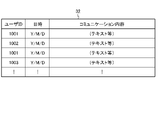
- FIG. 6 is a table showing an example of a communication log database stored in a storage unit included in the online communication system according to the embodiment;
- FIG. 7 is a flowchart showing an example of user registration processing of the online communication system according to the embodiment.
- FIG. 8 is a flowchart showing an example of log display processing of the online communication system according to the embodiment.
- FIG. 9 is a schematic diagram showing a specific example of use of the online communication system according
- the online communication system 1 provides communication means such as bulletin boards and SNSs that can be used for online communication among many users. Details of the online communication system 1 according to the embodiment will be described below.
- real name corresponds to a user's name in the real world, such as a real name.
- a "pseudonym (alias)” corresponds to a name created by a user, such as a handle name.
- “Anonymous” corresponds to a name common to all users set so that it is not possible to know which user has posted, or a state in which the name is hidden.
- FIG. 1 is a schematic diagram showing a usage example of an online communication system 1 according to an embodiment.
- the online communication system 1 includes, for example, a server device 10 and at least one terminal device 20.
- the server device 10 and at least one terminal device 20 are configured to be communicable via a network NW.
- three terminal devices 20A, 20B, and 20C are connected to the network NW.
- terminal devices 20A, 20B, and 20C are mobile terminals managed and owned by users U1, U2, and U3, respectively.
- the online communication system 1 provides means of communication between multiple users U1 to U3, for example, using a communication application CA.
- users U1 to U3 can exchange text-format messages among a plurality of users like bulletin boards and SNS.
- the communication application CA displays each message on the terminal device 20 in association with the name of the user who posted the message.
- the user name displayed on the terminal device 20 at this time is changed according to the disclosure setting for each user. Details of this operation will be described later.
- the communication application CA may cause the terminal device 20 to display an icon together with the user name.
- FIG. 2 is a block diagram showing an example of the hardware configuration of the server apparatus 10 according to the embodiment.
- the server device 10 includes, for example, a CPU (Central Processing Unit) 11, a ROM (Read Only Memory) 12, a RAM (Random Access Memory) 13, a communication device 14, and a storage device 15.
- a CPU Central Processing Unit
- ROM Read Only Memory
- RAM Random Access Memory
- the CPU 11 is an integrated circuit capable of executing various programs.
- the CPU 11 implements a part of the functions of the online communication system 1 by executing a program developed in the RAM 13, for example.
- the ROM 12 is a non-volatile semiconductor memory.
- the ROM 12 stores programs and control data for controlling the server device 10 .
- the RAM 13 is, for example, a volatile semiconductor memory. RAM 13 is used as a work area for CPU 11 .
- the communication device 14 is a communication circuit configured to be connectable to the network NW.
- the server device 10 transfers message data and the like received via the communication device 14 to the storage device 15 .
- the storage device 15 is a nonvolatile storage device.
- the storage device 15 stores, for example, user data and communication logs related to the communication application CA.
- FIG. 3 is a block diagram showing an example of the hardware configuration of the terminal device 20 according to the embodiment.
- the terminal device 20 includes, for example, a CPU 21, a ROM 22, a RAM 23, an input interface (input IF) 24, a communication device 25, a storage device 26, and a display device 27.
- the CPU 21 is an integrated circuit capable of executing various programs.
- the CPU 21 implements a part of the functions of the online communication system 1 by executing a program developed in the RAM 23, for example.
- the ROM 22 is a non-volatile semiconductor memory.
- the ROM 22 stores programs and control data for controlling the terminal device 20 .
- the RAM 23 is, for example, a volatile semiconductor memory.
- a RAM 23 is used as a work area for the CPU 21 .
- the input interface 24 is an input device used for inputting various information to the communication application CA and inputting messages.
- the communication device 25 is a communication circuit configured to be connectable to the network NW wirelessly or by wire.
- the communication device 25 transmits message data and the like to the server device 10 and receives communication logs and the like from the server device 10 via the network NW.
- the storage device 26 is a nonvolatile storage device.
- the storage device 26 stores, for example, cache data of communication logs related to the communication application CA.
- the display device 27 is a display capable of displaying information of the communication application CA. Various types of displays can be used as the display device 27 .
- the display device 27 may be used as the input interface 24 when it has a touch panel function.
- FIG. 4 is a block diagram showing an example of the functional configuration of the online communication system 1 according to the embodiment.
- the online communication system 1 includes, for example, a storage unit 30, a control unit 40, an input unit 41, a display unit 42, a user management unit 43, a pseudonym generation unit 44, a log management unit 45, and a disclosure control unit. 46.
- the storage unit 30 corresponds to, for example, the storage device 15 of the server device 10 and stores data managed by the communication application CA. Specifically, the storage unit 30 stores a user database 31 and a communication log database 32 .
- the user database 31 contains information on users who use the communication application CA.
- the communication log database 32 contains information such as messages posted via the communication application CA, and records communication contents such as bulletin boards and individual chats.
- the control unit 40 corresponds to, for example, the CPU 21 of the terminal device 20 and controls the overall operation of the online communication system 1 .
- the control unit 40 executes the communication application CA and causes the display unit 42 to display the user interface of the communication application CA.
- the control unit 40 also controls the user management unit 43 and the log management unit 45 based on instructions received from the input unit 41 .
- the input unit 41 corresponds to the input interface 24 of the terminal device 20 and transfers signals based on user's operations to the control unit 40 . Specifically, the input unit 41 transfers personal information and messages input by the user to the control unit 40 .
- the display unit 42 corresponds to the display device 27 of the terminal device 20 and can be viewed by the user.
- the display unit 42 displays images based on instructions from the control unit 40 and the log management unit 45 .
- the user management unit 43 corresponds to the CPU 11 of the server device 10 or the CPU 21 of the terminal device 20 and manages information on users who use the online communication system 1 .
- the user management unit 43 can update the user database 31 based on a user registration process described later and a user's request.
- the pseudonym generation unit 44 corresponds to the CPU 11 of the server device 10 or the CPU 21 of the terminal device 20, and generates a pseudonym associated with the new user when a new user is registered in the online communication system 1.
- a pseudonym is a unique name on the online communication system 1 . Then, the generated pseudonym is registered in the user database 31 in association with the new user.
- the log management unit 45 corresponds to the CPU 11 of the server device 10 or the CPU 21 of the terminal device 20, and manages processing related to the communication log of the online communication system 1.
- the log management unit 45 can update the communication log database 32 based on posts such as messages from users.
- the log management unit 45 can cause the display unit 42 to display the user name associated with the communication log in a desired state by log display processing, which will be described later.
- the disclosure control unit 46 corresponds to the CPU 11 of the server device 10 or the CPU 21 of the terminal device 20 and refers to the user database 31 based on instructions from the log management unit 45 .
- the disclosure control unit 46 instructs the log management unit 45 to display the user name according to the disclosure state set for the browsing user and the disclosure state set for other users.
- FIG. 5 is a table showing an example of the user database 31 stored in the storage unit 30 included in the online communication system 1 according to the embodiment.
- the user database 31 includes user information and disclosure settings.
- User information includes, for example, "user ID (Identifier)", “registered name”, “pseudonym”, and "pre-disclosure information”.
- a user ID is an identifier assigned to each user of the online communication system 1.
- "1001", “1002”, “1003”, and "1004" are assigned as user IDs.
- the user ID other formats may be used as long as each user can be identified.
- the registered name is the name entered by the user at the time of user registration for the online communication system 1.
- a real name or a pseudonym is used as the registered name.
- the user IDs "1001", “1002”, “1003”, and "1004" are registered with "XXX”, “YYY”, “ZZZ”, and "WWW”, respectively, as the registered names input for each user. ” is associated and registered.
- a pseudonym is a name that is automatically generated by the online communication system 1 at the time of user registration, and is generated without the user's intention.
- user IDs "1001", “1002”, “1003”, and “1004" are associated with “cat”, “rabbit”, “bear”, and “dog”, respectively. is registered.
- Pre-disclosure information is personal information entered by the user at the time of user registration.
- the pre-disclosure information can be referred to by other users even when disclosure is not permitted, which will be described later.
- pre-disclosure information may be omitted, or multiple types of pre-disclosure information may be provided.
- the disclosure settings store disclosure settings for other user IDs registered in the user database 31 for each user ID.
- “0" is assigned to the disclosure non-permission setting and "1" is assigned to the disclosure permission setting.
- the online communication system 1 may use other methods as the disclosure setting registration method as long as the user's disclosure setting can be identified.
- FIG. 6 is a table showing an example of the communication log database 32 stored in the storage unit 30 included in the online communication system 1 according to the embodiment. As shown in FIG. 6, the communication log database 32 includes, for example, "user ID”, "date and time”, and "communication content" for each created community.
- “User ID” in the communication log database 32 corresponds to the ID of the user who posted the message. “Date and time” indicates, for example, the date and time (Y/M/D) when communication content posted by a certain user was registered in the communication log database 32 . "Communication content” corresponds to a text or the like (message or the like) posted by a certain user. In this way, the communication log database 32 can record pairs of communication content and user IDs in chronological order.
- the online communication system 1 basically displays user names associated with communication logs as "pseudonyms" or “anonymous”, and only interested users ” or “real name”. Details of the operation of the online communication system 1 according to the embodiment will be described below.
- FIG. 7 is a flowchart showing an example of user registration processing of the online communication system 1 according to the embodiment. The flow of user registration processing of the online communication system 1 according to the embodiment will be described below with reference to FIG.
- the user management unit 43 starts user registration processing (start) in response to the user's user registration operation for the online communication system 1 .
- the user management unit 43 assigns a new user ID to this user registration process (step S10).
- a new user ID is set so as not to duplicate an existing user ID already used in the online communication system 1 .
- the user management unit 43 causes the pseudonym generation unit 44 to generate a unique pseudonym within the user database 31 (step S11).
- the pseudonym generating unit 44 may generate a pseudonym by combining specific words or phrases, or may change the type of pseudonym that can be used for each community.
- An example of a pseudonym is "Blue Bear”.
- the kana generation unit 44 adds a modifier that indicates a color (eg, "blue") to the name generated as the base name (eg, "Kuma-san”), thereby creating a name on the online communication system 1. Generate a unique pseudonym.
- the user management unit 43 associates the input user information and the generated pseudonym with the new user ID and registers them in the user database 31 (step S12). Specifically, the user management unit registers a new user ID in the user database 31, associates the new user ID with the “registered name” input by the user, and the “registered name” generated by the pseudonym generation unit 44. Register the "pseudonym" and the disclosure setting between the existing user ID.
- the initial setting of the disclosure setting with the existing user ID is, for example, "0 (disclosure not permitted)".
- the initial setting of the disclosure setting may be configured to be changeable according to the user's desire.
- step S12 the user management unit 43 ends the series of processes in FIG. 7 (end).
- FIG. 8 is a flowchart showing an example of log display processing of the online communication system 1 according to the embodiment. The flow of log display processing of the online communication system 1 according to the embodiment will be described below with reference to FIG.
- the log management unit 45 starts display processing (start) in response to detecting access to the communication log by the user.
- the log management unit 45 reads the communication log specified by the user from the communication log database 32, and causes the display unit 42 to display the communication content of the read communication log (step S20).
- the log management unit 45 confirms the user ID associated with the read communication log (step S21). In other words, the log management unit 45 confirms the user ID that posted the message to the communication log. If the communication log is in the form of a community in which multiple user IDs participate, the log management unit 45 may check all user IDs belonging to the community.
- the log management unit 45 causes the disclosure control unit 46 to confirm disclosure settings for the confirmed user ID and the viewer's user ID (step S22).
- the disclosure control unit 46 refers to the user database 31 and compares the disclosure setting associated with the user ID of the viewer and the disclosure setting associated with the confirmed user ID. Then, it is confirmed whether or not the disclosure setting is the disclosure permission setting between the user ID of the viewer and each of the confirmed user IDs.
- the log management unit 45 causes the display unit 42 to display the registered name in the user database 31 as the user name of the user ID whose disclosure is permitted mutually (step S23). For example, the log management unit 45 displays the registered name associated with the user ID on the display unit 42 in association with the message posted by the user ID whose disclosure permission setting has been mutually confirmed by the disclosure control unit 46. display.
- the log management unit 45 causes the display unit 42 to display the registered name in the user database 31 as the user name of the user ID for which mutual disclosure is permitted (step S24). For example, the log management unit 45 causes the display unit 42 to display the pseudonym associated with the user ID in association with the message posted by the user ID for which the disclosure control unit 46 mutually confirms that disclosure is not permitted. .
- step S24 the log management unit 45 terminates the series of processes in FIG. 8 (end).
- FIG. 9 is a schematic diagram showing a specific example of use of the online communication system 1 according to the embodiment. Below, with reference to (A), (B), (C), (D) and (E) of FIG. 9 arranged in chronological order, a specific example of use of the online communication system 1 according to the embodiment will be described. explain.
- FIG. 9 expresses an overview of user registration processing by user U1.
- the user U1 has registered as a user in the online communication system 1 using the registered name "XXX”.
- the registered name “XXX” is registered in the user database (user DB) 31 in association with the new user ID.
- the pseudonym generation unit 44 generates a pseudonym “cat” that does not exist in the user database 31 in association with the new user ID, and registers it in the user database 31 .
- illustration is omitted, in this example, users U2 and U3 also perform user registration in the same way. ” is registered in the user database 31.
- (B) of FIG. 9 expresses the state of exchange between users U1 and U2 before mutual disclosure is permitted.
- the user name (disclosed state) displayed between the users U1 and U2 is a pseudonym (initial state).
- the disclosure control unit 46 confirms that the disclosure state between the users U1 and U2 is "not permitted to be disclosed.”
- the pseudonym "rabbit" is displayed as the user name of user U2 on the terminal device 20 of user U1
- the pseudonym "cat” is displayed as the user name of user U1 on the terminal device 20 of user U2.
- users communicate using pseudonyms.
- Each user can distinguish between each other by the pseudonym assigned to each user. It should be noted that each user can optionally post a message or the like using anonymity (anonymous).
- (C) of FIG. 9 expresses the situation when user U1 permits the disclosure of personal information to pseudonym "Rabbit" (user U2) (U1 ⁇ U2 disclosure permission).
- user U2 when user U1 registers disclosure permission for the pseudonym "Usagi" (U2 disclosure permission), user U2 does not register disclosure permission for user U1 (U1 disclosure disapproval).
- the user names displayed in the exchanges between the users U1 and U2 are kept as pseudonyms.
- each user can also register disclosure permission for a specific message posted anonymously. User U2 may or may not be notified that user U1 has permitted user U2 to disclose personal information.
- (D) of FIG. 9 expresses the situation when user U2 permits disclosure of personal information to pseudonym "cat" (user U1) (U2 ⁇ U1 disclosure permission). Since the user U1 has registered the disclosure permission for the pseudonym "Rabbit", the disclosure setting between the user U1 and the user U2 becomes the disclosure permission setting (disclosure permission established/matching established). Then, the display of each other's user name between users U1 and U2 is changed to a registered name (real name, etc.). Specifically, when each of the users U1 and U2 posts a message, the disclosure control unit 46 confirms that the disclosure state between the users U1 and U2 is "disclosure permitted".
- the terminal device 20 of the user U1 displays the registered name "YYY” as the user name of the user U2, and the terminal device 20 of the user U2 displays the registered name "XXX" as the user name of the user U1.
- the personal information registered for each user after disclosure is permitted can be browsed between the users U1 and U2.
- (E) of FIG. 9 expresses a situation in which user U3, who is in a relationship of disapproval of disclosure with both users U1 and U2, browses the exchanges after the disclosure of (C) and (D) of FIG. 9 is permitted. doing.
- the user name displayed between the users U1 and U2 is the registered name as described with reference to FIG. 9D.
- user U3 can view the messages of users U1 and U2, but has a relationship (U1, U2 Disclosure not permitted). Therefore, the username of user U1 seen by user U3 is the pseudonym "Neko", and the username of user U2 seen by user U3 is the pseudonym "rabbit".
- the user name of user U3 seen by each of users U1 and U2 is the pseudonym "Kuma".
- registered names are displayed between users for whom matching is established, and pseudonyms or anonymous names are displayed for users for whom matching is not established.
- the online communication system 1 can also handle anonymous (anonymous) postings and reactions. In other words, users can see reactions from other users by posting anonymously (anonymously) to the online communication system 1 .
- the user can also set disclosure permission for users who have posted anonymously (unnamed). As a result, the user can use a specific hobby or interest in a topic as a starting point for communication, and can lead to building a new human relationship.
- the data processing method used in the online communication system 1 does not disclose personal information to the entire community, and discloses personal information to specific others. communication can be realized.
- the online communication system 1 can prevent users from notifying that disclosure permission has been registered. If the registration of disclosure permission is not notified, for example, the user who grants the disclosure permission may be under psychological stress that "it may appear that the other party is also requesting disclosure permission". It is possible to reduce the psychological stress of the user who has received the message that "it may be rude to the other party if I do not give permission to disclose it because it has been registered for disclosure.”
- the online communication system 1 may set three or more types of disclosure permission levels for specifying the other party. Specifically, a plurality of types of disclosure levels such as “others (initial state)”, “acquaintances”, and “friends” may be provided in the disclosure settings so that human relationships have levels.
- the user registers personal information to be disclosed for each disclosure level in the user database 31 .
- the online communication system 1 displays or hides the personal information according to the disclosure permission level.
- the disclosure permission level of one is higher than the disclosure permission level of the other, the online communication system 1 displays personal information according to the lower disclosure permission level between the users.
- the online communication system 1 may have a function of recording communication history and relationships with other users for use that is not shown to others.
- the online communication system 1 may have a function of displaying communication implementation history in addition to displaying user information.
- the user can check the communication history for each pseudonym, and it becomes easier to deepen the human relationship with the pseudonymous partner.
- a pseudonym may be written together with the registered name. This allows the user to communicate with an unspecified number of people without inconvenience even if the user whose registered name is displayed is called by a pseudonym.
- the online communication system 1 is used as an example to exchange messages, but the online communication system 1 may be used to exchange illustration images and various data files.
- the online communication system 1 is not limited to use in environments such as threads on communities or bulletin boards, where information can be viewed by multiple people, and may be used for one-to-one exchanges.
- the case where the user uses the communication application CA is exemplified, but the operation described in the embodiment may be provided as a Web service such as a bulletin board or SNS.
- FIGS. 7 and 8 the order of processing may be changed within a possible range, and other processing may be added as long as the same results as in the embodiment are obtained. .
- the hardware configurations of the server device 10 and the terminal device 20 described in the embodiment may be other configurations as long as the operations described in the embodiment can be realized.
- the classification of the functional configuration of the online communication system 1 described in the embodiment is merely an example.
- Each of the CPU 11 provided in the server device 10 and the CPU 21 provided in the terminal device 20 may be other circuits.
- an MPU Micro Processing Unit
- an ASIC Application Specific Integrated Circuit
- an FPGA field-programmable gate array
- the operations described in the embodiments may be implemented by dedicated hardware, or may be a mixture of software-executed processing and hardware-executed processing, or only one of them.
- server device 10 may also be referred to as a "data processing device,” “data processing server,” “server,” or the like.
- CPUs 11 and 21 may be referred to as “processors”.
- Each of the ROMs 12 and 22, the RAMs 13 and 23, and the storage devices 15 and 26 may be called “storage circuits”.
- the present invention is not limited to the above-described embodiments, and can be variously modified in the implementation stage without departing from the gist of the present invention.
- each embodiment may be implemented in combination as appropriate, in which case the combined effect can be obtained.
- various inventions are included in the above embodiments, and various inventions can be extracted by combinations selected from a plurality of disclosed constituent elements. For example, even if some constituent elements are deleted from all the constituent elements shown in the embodiments, if the problem can be solved and effects can be obtained, the configuration with the constituent elements deleted can be extracted as an invention.
Landscapes
- Engineering & Computer Science (AREA)
- Theoretical Computer Science (AREA)
- Physics & Mathematics (AREA)
- General Health & Medical Sciences (AREA)
- Health & Medical Sciences (AREA)
- General Engineering & Computer Science (AREA)
- General Physics & Mathematics (AREA)
- Bioethics (AREA)
- Databases & Information Systems (AREA)
- Computer Hardware Design (AREA)
- Computer Security & Cryptography (AREA)
- Software Systems (AREA)
- Medical Informatics (AREA)
- Management, Administration, Business Operations System, And Electronic Commerce (AREA)
Priority Applications (3)
| Application Number | Priority Date | Filing Date | Title |
|---|---|---|---|
| JP2023529236A JP7632626B2 (ja) | 2021-06-21 | 2021-06-21 | データ処理方法、データ処理装置、及びデータ処理プログラム |
| US18/570,840 US12481775B2 (en) | 2021-06-21 | 2021-06-21 | Data processing method, data processing apparatus, and data processing program |
| PCT/JP2021/023459 WO2022269710A1 (ja) | 2021-06-21 | 2021-06-21 | データ処理方法、データ処理装置、及びデータ処理プログラム |
Applications Claiming Priority (1)
| Application Number | Priority Date | Filing Date | Title |
|---|---|---|---|
| PCT/JP2021/023459 WO2022269710A1 (ja) | 2021-06-21 | 2021-06-21 | データ処理方法、データ処理装置、及びデータ処理プログラム |
Publications (1)
| Publication Number | Publication Date |
|---|---|
| WO2022269710A1 true WO2022269710A1 (ja) | 2022-12-29 |
Family
ID=84545295
Family Applications (1)
| Application Number | Title | Priority Date | Filing Date |
|---|---|---|---|
| PCT/JP2021/023459 Ceased WO2022269710A1 (ja) | 2021-06-21 | 2021-06-21 | データ処理方法、データ処理装置、及びデータ処理プログラム |
Country Status (3)
| Country | Link |
|---|---|
| US (1) | US12481775B2 (https=) |
| JP (1) | JP7632626B2 (https=) |
| WO (1) | WO2022269710A1 (https=) |
Citations (3)
| Publication number | Priority date | Publication date | Assignee | Title |
|---|---|---|---|---|
| JP2003509775A (ja) * | 1999-09-16 | 2003-03-11 | インディヴォス コーポレイション | 電子的ルールモジュールクリアリングハウスを用いて、バイオメトリック送信の処理をトークンを用いずに行うシステムおよび方法 |
| JP2007293747A (ja) * | 2006-04-27 | 2007-11-08 | Matsushita Electric Ind Co Ltd | プロフィール処理装置、プロフィール処理システム、プロフィール処理方法、プロフィール処理プログラムおよび集積回路 |
| WO2016136626A1 (ja) * | 2015-02-27 | 2016-09-01 | ソニー株式会社 | ユーザ管理サーバ、端末、情報表示システム、ユーザ管理方法、情報表示方法、プログラム及び情報記憶媒体 |
Family Cites Families (2)
| Publication number | Priority date | Publication date | Assignee | Title |
|---|---|---|---|---|
| US5615277A (en) | 1994-11-28 | 1997-03-25 | Hoffman; Ned | Tokenless security system for authorizing access to a secured computer system |
| JP2006236264A (ja) * | 2005-02-28 | 2006-09-07 | Toshiba Corp | コミュニケーション管理装置 |
-
2021
- 2021-06-21 JP JP2023529236A patent/JP7632626B2/ja active Active
- 2021-06-21 WO PCT/JP2021/023459 patent/WO2022269710A1/ja not_active Ceased
- 2021-06-21 US US18/570,840 patent/US12481775B2/en active Active
Patent Citations (3)
| Publication number | Priority date | Publication date | Assignee | Title |
|---|---|---|---|---|
| JP2003509775A (ja) * | 1999-09-16 | 2003-03-11 | インディヴォス コーポレイション | 電子的ルールモジュールクリアリングハウスを用いて、バイオメトリック送信の処理をトークンを用いずに行うシステムおよび方法 |
| JP2007293747A (ja) * | 2006-04-27 | 2007-11-08 | Matsushita Electric Ind Co Ltd | プロフィール処理装置、プロフィール処理システム、プロフィール処理方法、プロフィール処理プログラムおよび集積回路 |
| WO2016136626A1 (ja) * | 2015-02-27 | 2016-09-01 | ソニー株式会社 | ユーザ管理サーバ、端末、情報表示システム、ユーザ管理方法、情報表示方法、プログラム及び情報記憶媒体 |
Also Published As
| Publication number | Publication date |
|---|---|
| JPWO2022269710A1 (https=) | 2022-12-29 |
| US12481775B2 (en) | 2025-11-25 |
| JP7632626B2 (ja) | 2025-02-19 |
| US20240281550A1 (en) | 2024-08-22 |
Similar Documents
| Publication | Publication Date | Title |
|---|---|---|
| JP5324567B2 (ja) | 個人化された社交ネットワーク用アプリケーションコンテンツ | |
| US8200819B2 (en) | Method and apparatuses for network society associating | |
| US8584258B2 (en) | Control for inviting an unauthenticated user to gain access to display of content that is otherwise accessible with an authentication mechanism | |
| US7639672B2 (en) | System and method for peer-to-peer internet communication | |
| US20080021958A1 (en) | System and method for peer-to-peer internet communication | |
| US20030220980A1 (en) | Method and system for providing a computer network-based community-building function through user-to-user ally association | |
| CN101253757B (zh) | 通信系统和通信终端 | |
| US9269079B2 (en) | Social network stealth and counter messaging | |
| TWI537763B (zh) | 適合個人及組織之訊息傳遞系統與方法 | |
| WO2009074037A1 (fr) | Procédé, dispositif et système de communication instantanée | |
| WO2010061847A1 (ja) | 利用者関係情報提供サーバ | |
| KR20210046082A (ko) | 외부에서 공유되는 통신 채널들을 생성하기 위한 방법, 장치, 및 컴퓨터 프로그램 제품 | |
| KR20010065051A (ko) | 인터넷을 이용한 커뮤니티 서비스 제공방법 | |
| JP2012113440A (ja) | Sns統括サイト管理装置、及びsns統括サイトを利用した情報開示方法 | |
| KR101776057B1 (ko) | 인맥구성도 정보들을 융합 및 공유하는 인맥구성도 정보 서비스 방법 및 시스템 | |
| JP2011070305A (ja) | アクセス制御を伴うデータの送信を行うためのサーバ装置、プログラム、および方法 | |
| KR100908613B1 (ko) | 지능형 대인 연결 서비스 시스템 | |
| WO2022269710A1 (ja) | データ処理方法、データ処理装置、及びデータ処理プログラム | |
| JP3480716B2 (ja) | 個人情報管理方法及びシステム | |
| JP2021022251A (ja) | 通報管理システム及び通報管理方法 | |
| KR20120053446A (ko) | 이동통신 단말기의 메시지 중개방법 및 메시지 중개시스템 | |
| KR20050059380A (ko) | 네트워크를 통한 커뮤니티 연결 시스템 및 그 방법 | |
| Shunmugam et al. | Use of smartphones for social and sexual networking among transgender women in South India: Implications for developing smartphone-based online hiv prevention interventions | |
| KR20020069895A (ko) | 웹공간에서 제공되는 홈페이지 시스템 | |
| KR102940151B1 (ko) | 토큰 기반 채팅방의 개설, 참여 또는 가치구매가 가능한 정보 공유 시스템 |
Legal Events
| Date | Code | Title | Description |
|---|---|---|---|
| 121 | Ep: the epo has been informed by wipo that ep was designated in this application |
Ref document number: 21946999 Country of ref document: EP Kind code of ref document: A1 |
|
| WWE | Wipo information: entry into national phase |
Ref document number: 2023529236 Country of ref document: JP |
|
| WWE | Wipo information: entry into national phase |
Ref document number: 18570840 Country of ref document: US |
|
| NENP | Non-entry into the national phase |
Ref country code: DE |
|
| 122 | Ep: pct application non-entry in european phase |
Ref document number: 21946999 Country of ref document: EP Kind code of ref document: A1 |
|
| WWG | Wipo information: grant in national office |
Ref document number: 18570840 Country of ref document: US |