WO2022269656A1 - 機械学習装置、深刻度予知装置、および機械学習方法 - Google Patents
機械学習装置、深刻度予知装置、および機械学習方法 Download PDFInfo
- Publication number
- WO2022269656A1 WO2022269656A1 PCT/JP2021/023298 JP2021023298W WO2022269656A1 WO 2022269656 A1 WO2022269656 A1 WO 2022269656A1 JP 2021023298 W JP2021023298 W JP 2021023298W WO 2022269656 A1 WO2022269656 A1 WO 2022269656A1
- Authority
- WO
- WIPO (PCT)
- Prior art keywords
- severity
- machine learning
- information
- risk
- learning device
- Prior art date
- Legal status (The legal status is an assumption and is not a legal conclusion. Google has not performed a legal analysis and makes no representation as to the accuracy of the status listed.)
- Ceased
Links
Images






Classifications
-
- G—PHYSICS
- G06—COMPUTING OR CALCULATING; COUNTING
- G06F—ELECTRIC DIGITAL DATA PROCESSING
- G06F8/00—Arrangements for software engineering
- G06F8/20—Software design
-
- G—PHYSICS
- G06—COMPUTING OR CALCULATING; COUNTING
- G06F—ELECTRIC DIGITAL DATA PROCESSING
- G06F8/00—Arrangements for software engineering
- G06F8/70—Software maintenance or management
- G06F8/77—Software metrics
-
- G—PHYSICS
- G06—COMPUTING OR CALCULATING; COUNTING
- G06N—COMPUTING ARRANGEMENTS BASED ON SPECIFIC COMPUTATIONAL MODELS
- G06N20/00—Machine learning
-
- G—PHYSICS
- G06—COMPUTING OR CALCULATING; COUNTING
- G06N—COMPUTING ARRANGEMENTS BASED ON SPECIFIC COMPUTATIONAL MODELS
- G06N3/00—Computing arrangements based on biological models
- G06N3/02—Neural networks
- G06N3/08—Learning methods
- G06N3/09—Supervised learning
-
- G—PHYSICS
- G06—COMPUTING OR CALCULATING; COUNTING
- G06Q—INFORMATION AND COMMUNICATION TECHNOLOGY [ICT] SPECIALLY ADAPTED FOR ADMINISTRATIVE, COMMERCIAL, FINANCIAL, MANAGERIAL OR SUPERVISORY PURPOSES; SYSTEMS OR METHODS SPECIALLY ADAPTED FOR ADMINISTRATIVE, COMMERCIAL, FINANCIAL, MANAGERIAL OR SUPERVISORY PURPOSES, NOT OTHERWISE PROVIDED FOR
- G06Q10/00—Administration; Management
- G06Q10/06—Resources, workflows, human or project management; Enterprise or organisation planning; Enterprise or organisation modelling
-
- G—PHYSICS
- G06—COMPUTING OR CALCULATING; COUNTING
- G06Q—INFORMATION AND COMMUNICATION TECHNOLOGY [ICT] SPECIALLY ADAPTED FOR ADMINISTRATIVE, COMMERCIAL, FINANCIAL, MANAGERIAL OR SUPERVISORY PURPOSES; SYSTEMS OR METHODS SPECIALLY ADAPTED FOR ADMINISTRATIVE, COMMERCIAL, FINANCIAL, MANAGERIAL OR SUPERVISORY PURPOSES, NOT OTHERWISE PROVIDED FOR
- G06Q10/00—Administration; Management
- G06Q10/06—Resources, workflows, human or project management; Enterprise or organisation planning; Enterprise or organisation modelling
- G06Q10/063—Operations research, analysis or management
- G06Q10/0639—Performance analysis of employees; Performance analysis of enterprise or organisation operations
-
- G—PHYSICS
- G06—COMPUTING OR CALCULATING; COUNTING
- G06Q—INFORMATION AND COMMUNICATION TECHNOLOGY [ICT] SPECIALLY ADAPTED FOR ADMINISTRATIVE, COMMERCIAL, FINANCIAL, MANAGERIAL OR SUPERVISORY PURPOSES; SYSTEMS OR METHODS SPECIALLY ADAPTED FOR ADMINISTRATIVE, COMMERCIAL, FINANCIAL, MANAGERIAL OR SUPERVISORY PURPOSES, NOT OTHERWISE PROVIDED FOR
- G06Q50/00—Information and communication technology [ICT] specially adapted for implementation of business processes of specific business sectors, e.g. utilities or tourism
- G06Q50/04—Manufacturing
Definitions
- the present disclosure relates to a machine learning device and a machine learning method for learning the severity of risks in software development, and a severity prediction device provided with the machine learning device.
- Methods of progress meetings include, for example, inspections, walkthroughs, team reviews, round-robin reviews, pass-arounds, and peer reviews. Project stakeholders (stakeholders) adopt these methods to conduct progress meetings.
- Patent Document 1 Conventionally, techniques related to traceability management have been disclosed (see Patent Document 1, for example).
- a management ID is assigned to a product.
- the management ID is accompanied by trace information. Trace information is registered in the traceability ID recording terminal.
- Patent Literature 2 discloses a method of learning state variables, judgment data, and teaching data by supervised learning.
- Automotive SPICE (registered trademark, hereinafter the same) is a standard for process improvement for vehicle system development. Automotive SPICE requires stakeholders to prepare a WBS for the project, a list of components, a list of change requests, a list of problem information, and a list of risk information. Automotive SPICE also requires stakeholders to link multiple WBS, configuration items, change requests, problem information, and risk information to ensure bidirectional traceability.
- Automotive SPICE requires activities to review the affected WBS, configuration items, change requests, problem information, and risk information in the event that a project progress meeting causes a problem.
- the method of reviewing such information by an expert has many elements that depend on the skill of the expert.
- it is necessary to set the severity level by analyzing the severity, impact, and urgency of the risks generated by solving the problem, but this depends on the skills of the experts. doing.
- the present disclosure is made to solve such problems, and aims to provide a machine learning device, a severity prediction device, and a machine learning method capable of accurately predicting severity according to the situation. aim.
- a machine learning device provides a target configuration based on a data set that associates risk-related decision data and risk-related state variables of a target configuration item of a problem that occurred in software development.
- a learning unit that learns the severity of problem solving for an item is provided.
- FIG. 1 is a block diagram showing an example of the configuration of a severity prediction system according to Embodiment 1;
- FIG. 4 is a flow chart showing an example of the operation of the machine learning device according to Embodiment 1;
- FIG. 4 is a diagram for explaining an example of a pattern in which the severity prediction system according to Embodiment 1 applies the severity of each component;
- FIG. 4 is a diagram for explaining an example of a pattern in which the severity prediction system according to Embodiment 1 applies the severity of each component;
- FIG. 4 is a diagram for explaining an example of a pattern in which the severity prediction system according to Embodiment 1 applies the severity of each component; It is a figure which shows an example of a structure of a neural network.
- FIG. 4 shows an example of a structure of a neural network.
- FIG. 11 is a block diagram showing an example of the configuration of a severity prediction system according to Embodiment 2; FIG. It is a figure which shows an example of the data table of progress meeting agreement information. It is a figure for demonstrating an example of the calculation method of severity. It is a figure which shows an example of the hardware constitutions of the machine-learning apparatus by embodiment. It is a figure which shows an example of the hardware constitutions of the machine-learning apparatus by embodiment.
- FIG. 1 is a block diagram showing an example of the configuration of the severity level prediction system according to Embodiment 1, showing only the essential parts.
- the severity prediction system comprises a management component registration terminal 101, an engineering component registration terminal 201, a traceability registration terminal 301, and a machine learning device 401.
- the management system component registration terminal 101, the technical system component registration terminal 201, and the traceability registration terminal 301 may be combined arbitrarily and integrally configured.
- the severity prediction system uses a machine learning device 401 having a machine learning function to determine the work package information 105 registered in the development plan information section 102 of the management system configuration item registration terminal 101 and the work package information 105 registered in the risk management information section 103. and the problem management information 107 registered in the problem management information section 104, the requirement information section 202, the design information section 203, the program information section 204, and the test information section of the engineering component registration terminal 201 205 is associated with the configuration item information 206 registered in each of the traceability registration terminals 301 by the traceability information 303 and the relevance information 304 registered in the traceability information section 302 of the traceability registration terminal 301. Acquire a predictive model by learning. Further, the severity prediction system creates risk analysis information 404 that indicates whether the registered risk manifestation results are acceptable or not, or the severity of problem solving, based on the results of learning by the machine learning device 401 .
- the risk analysis information 404 indicates the severity of problem solving of the risk information 106 registered in the risk management information section 103 of the management system configuration item registration terminal 101 or the problem management information 107 registered in the problem management information section 104. Contains information that indicates Note that the risk analysis information 404 may include information indicating the severity of problem solving of the risk information 106 and the problem management information 107 .
- the risk analysis information 404 may include a construction method that indicates that the risk manifestation result is in a normal state.
- the risk analysis information 404 indicates the possibility of risk manifestation due to implementation of problem solving, and for example, either the maximum value or the minimum value may be limited.
- Risk analysis information 404 may be a continuous quantity or a discrete quantity.
- the management system configuration item registration terminal 101 has a development plan information unit 102 .
- Work package information 105 is registered in the development plan information section 102 .
- the work package information 105 includes WBS work packages including technical process activities, management process activities, and support process activities.
- the engineering component registration terminal 201 includes a requirement information section 202, a design information section 203, a program information section 204, and a test information section 205.
- Configuration item information 206 is registered in each information section.
- the configuration item information 206 includes trace identifiers (hereinafter referred to as “trace IDs”) assigned to each of a plurality of configuration items, and trace information associated with the trace IDs.
- the configuration item information 206 includes the requirements specifications presented by the customer, the deliverables created in each process of software development, and the like.
- the process of software development includes system design, software design, software detailed design, program production, unit test, software test, system test, and the like.
- Deliverables include design documents, source codes, test specifications, test reports, and the like.
- configuration item information 206 including requirement specifications is registered in the requirement information section 202 .
- the design information section 203 registers configuration item information 206 including design documents created in each of system design, software design, and software detailed design.
- component item information 206 including source codes created in program production is registered.
- the test information section 205 registers configuration item information 206 including test specifications and test reports prepared for each of the unit test, software test, and system test.
- the trace IDs included in the configuration item information 206 include request IDs assigned to requirement specifications, design IDs assigned to design documents, test IDs assigned to test specifications and test reports, and the like. A trace ID is given to identify a configuration item.
- the traceability registration terminal 301 has a traceability information section 302 .
- Traceability information 303 and relevance information 304 are registered in the traceability information section 302 .
- Traceability information 303 includes trace information.
- Trace information is information for tracing between other configuration items created in the software development process. It is information for performing Other configuration items desirably include configuration items made in at least one of an upstream process and a downstream process. However, other configuration items need not include configuration items created by upstream and downstream processes. Further, among the plurality of trace IDs, a trace ID with no accompanying trace information may be included.
- the relevance information 304 includes the number of trace changes and the relevance of the trace.
- the machine learning device 401 includes a risk analysis unit 402 and a learning unit 403.
- the risk analysis unit 402 extracts the risk information 106 including the degree of urgency and the problem management information 107 from the risk management information unit 103 and the problem management information unit 104 of the management component registration terminal 101 . Also, the risk analysis unit 402 extracts the work package information 105 including change information of urgency, impact, and importance from the development plan information unit 102 . If the risk information 106 and the problem management information 107 are insufficient, the relevant risk items or problem management items may be manually registered.
- the risk analysis unit 402 analyzes the requirements information unit 202, the design information unit 203, the program information unit 204, and the test information unit 205 of the engineering component registration terminal 201 based on the extracted risk information 106 and problem management information 107. , the configuration item information 206 including the degree of impact is extracted.
- the risk analysis unit 402 analyzes the configuration item information 206 held by the engineering configuration item registration terminal 201, the traceability information 303 registered in the traceability information unit 302 of the traceability registration terminal 301, and the degree of relevance information 304. Based on this, the importance derived from the trace information of each configuration item is extracted.
- the risk analysis unit 402 acquires determination data indicating urgency, impact, and severity.
- the risk analysis unit 402 acquires state variables, which are information on changes in values of urgency, impact, and severity over time. Note that the machine learning device 401 may acquire some of the state variables without acquiring all of the functional elements, or may acquire new state variables.
- the judgment data includes the critical path of the target configuration item.
- the learning unit 403 learns the severity of problem solving according to a data set created based on the combination of the urgency, impact, and severity input from the risk analysis unit 402 and their state variables, and prepares a prediction model. to get
- a data set is data in which state variables and judgment data are associated with each other.
- the urgency, impact, and severity of the target configuration item and other configuration items related to the target configuration item are enormous. It is difficult to confirm within a limited time that all configuration items involved in a change have achieved their urgency, impact, and severity.
- the severity prediction system according to the first embodiment uses machine learning, for example, to set the degree of severity of functional elements related to changes by using traceability. This makes it possible to quantify the seriousness of problem solving and to predict the seriousness of problem solving more accurately.
- Machine learning is used to learn the prediction of the severity of problem solving in software development.
- a digital computer separate from the technical component registration terminal 201 may be used.
- the machine learning device 401 may be built into the traceability registration terminal 301. In this case, the machine learning device 401 uses the processor of the traceability registration terminal 301 to perform machine learning. Machine learning device 401 may reside on a cloud server.
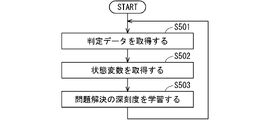
- FIG. 2 is a flowchart showing an example of the operation (learning process) of the machine learning device 401.
- FIG. When the machine learning process starts, the machine learning device 401 executes steps S501 to S503. Note that the processing order of steps S501 and S502 may be reversed.
- step S501 the risk analysis unit 402 acquires determination data from the WBS work package corresponding to the target configuration item in the progress meeting.
- step S502 the risk analysis unit 402 acquires, for example, state variables such as urgency, impact, and severity regarding changes in the target configuration item at the progress meeting.
- step S503 the learning unit 403 learns the severity of problem solving according to the data set created based on the combination of the determination data acquired in step S501 and the state variables acquired in step S502, and creates a prediction model. Earn.
- steps S501 to S503 is repeatedly executed until, for example, the machine learning device 401 sufficiently learns the severity of problem solving for the target configuration item. In this case, it is desirable to execute all patterns in which the urgency, impact, and severity of the target configuration item are changed multiple times.
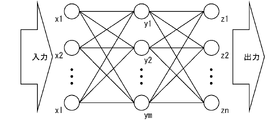
- FIG. 6 is a diagram showing an example of the configuration of a neural network.
- the risk analysis unit 402 in the machine learning device 401 may, for example, learn to predict the severity of problem solving according to a neural network model.
- the neural network consists of an input layer containing l neurons x1, x2, x3, . It contains a layer (hidden layer) and an output layer containing n neurons z1, z2, z3, . . . , zn.
- the machine learning device 401 may use a general-purpose computer or processor, but applying a large-scale PC (Personal Computer) cluster or the like enables faster processing.
- PC Personal Computer
- the neural network includes a requirement information section 202, a design information section 203, a program information section 204, and test information, which are associated with the severity of problem solving based on the urgency, impact, and severity of the administrative component registration terminal 101. Learn the severity of problem solving in part 205 .
- the neural network determines the degree of urgency, degree of impact, and degree of severity by so-called "supervised learning” according to the degree of urgency, degree of impact, and degree of severity created based on the combination of judgment data acquired by the risk analysis unit 402. , that is, prediction of the severity of problem solving in the requirement information section 202, the design information section 203, the program information section 204, and the test information section 205 is learned.
- "supervised learning” means that by giving a large number of pairs of certain inputs and results (labels) to the machine learning device 401, the characteristics of their urgency, impact, and severity are learned. , is a model that estimates the result from the input, that is, the relationship can be acquired inductively.
- the neural network determines whether the urgency, impact, and severity of the requirement information section 202, the design information section 203, the program information section 204, and the test information section 205 of the engineering component registration terminal 201 normally satisfy the verification criteria. It is also possible to learn predictions of the seriousness of problem solving in the requirement information section 202, the design information section 203, the program information section 204, and the test information section 205 by accumulating only when they are present and by so-called "unsupervised learning".
- unsupervised learning refers to learning the distribution of input data by giving only a large amount of input data to the machine learning device 401, and learning the distribution of the input data without giving the corresponding supervised output data.
- it is a technique for learning a device that performs compression, classification, shaping, etc. on input data.
- the output layer determines whether the severity of problem solving has been achieved. or the severity of the problem resolution.
- the possible values of the "severity of problem solving" may be any of a value with a limited maximum value or minimum value, a continuous amount, or a discrete amount.
- the machine learning device 401 and the machine learning method relating to the degree of urgency, degree of impact, and degree of severity described above it is possible to obtain a prediction model by learning an accurate progress management result according to the actual operational situation. can be done. In other words, even if the factors leading to the achievement of urgency, impact, and severity are complex and it is difficult to predict the severity of problem solving in advance, the severity of problem solving can be calculated with high accuracy. can be predicted.
- the risk analysis unit 402 acquires the judgment data indicating the urgency, impact, and severity from the management system configuration item registration terminal 101
- the judgment data is converted to each of the occurrences of the urgency, impact, and severity.
- the prediction of the seriousness of problem solving may be updated by weighting them according to the length of time that goes back to obtaining determination data. It is presumed that the shorter the time from the acquisition of judgment data to the result that satisfies the urgency, impact, and severity, the closer the risk or problem is to completion. Therefore, by weighting the judgment data according to the degree of urgency, the degree of impact, and the elapsed time from the occurrence of the severity, it is possible to effectively learn the prediction of the degree of seriousness of problem solving described above.
- the risk analysis unit 402 analyzes the requirement information unit 202, the design information unit 203, the program information unit 204, and the test information according to the degree of urgency, the degree of impact, and the degree of severity created for the plurality of engineering component registration terminals 201. You may make it learn the prediction of the seriousness of problem solution of the part 205.
- FIG. the risk analysis unit 402 may acquire the urgency, impact, and severity from a plurality of engineering configuration item registration terminals 201 used at the same software development site, and independently at different software development sites. Prediction of the severity of problem solving may be learned by using the urgency, impact, and severity collected from a plurality of technical system configuration item registration terminals 201 that operate in the same manner.
- the engineering component registration terminal 201 for collecting urgency, impact, and severity may be added to the targets during software development, or conversely removed from the targets during software development. That is, the learning unit 403 may relearn the severity according to additional data sets based on the combination of the current judgment data and state variables.
- the first example is a method of sharing the same neural network model. For example, for each weighting factor of the neural network, the difference between each engineering component registration terminal 201 is transmitted using communication means and reflected. That is, the learning unit 403 learns the severity by weighting the determination data and comparing the normal state and the abnormal state of the determination data.
- a second example is a method of sharing machine learning weights, etc. by sharing the verification results of the input and output of a neural network.
- a third example is to prepare a database, access the database, and load a more appropriate neural network model to share the state (same model).
- FIG. 7 is a block diagram showing an example of the configuration of the severity prediction system according to the second embodiment.
- the severity prediction system according to Embodiment 2 is characterized by comprising a progress meeting analysis device 601 and a risk analysis result display device 801, and a machine learning device 401 comprising a meeting result output unit 405. . Since other configurations and basic operations are the same as those of the severity prediction system of FIG. 1, detailed description thereof is omitted here.
- the machine learning device 401, the progress meeting analysis device 601, and the risk analysis result display device 801 constitute a severity prediction device.
- the meeting result output unit 405 in the machine learning device 401 uses the results learned by the machine learning device 401 to output risks and problems that may occur due to changes in progress meeting activities.
- the progress meeting analysis device 601 inputs the risks and problems of the progress meeting to the meeting result output unit 405 of the machine learning device 401 in real time.
- the progress meeting analysis device 601 includes a voice detection unit 602 that categorizes voices collected in the progress meeting 701 .
- the risk analysis result display device 801 outputs progress meeting agreement information 406 created by the meeting result output unit 405 of the machine learning device 401 .
- the risk analysis result display device 801 includes a risk analysis result display section 802 that displays the progress meeting agreement information 406 .
- the sound of the progress meeting 701 held at the progress meeting 701 is collected by the sound collection device 702 and input to the sound detection unit 602 of the progress meeting analysis device 601 .
- the voice detection unit 602 analyzes the voice in the progress meeting 701 to create progress meeting minutes information 603 and outputs the progress meeting minutes information 603 to the meeting result output unit 405 of the machine learning device 401 .
- the meeting result output unit 405 of the machine learning device 401 acquires from the risk analysis unit 402 the urgency, impact, and severity of the risks and problems of the target configuration item and other related configuration items.
- the meeting result output unit 405 of the machine learning device 401 is based on the urgency, impact, and severity related to risks and problems, and the prediction model that learned the severity of problem solving from the progress meeting minutes information 603.
- the progress meeting agreement information 406 is output to the risk analysis result display device 801 .
- the progress meeting 701 receives the urgency, impact, and severity related to risks and problems from the prediction model that has learned the severity of problem solving from the risk analysis result display device 801 in real time, thereby solving the problem of the target configuration item. You can check the severity of
- FIG. 8 is a diagram showing an example of the data table of the progress meeting agreement information 406 created by the meeting result output unit 405. As shown in FIG.
- the progress meeting agreement information 406 includes the urgency, impact, and severity of risks and problems of the target configuration item and other related configuration items in the progress meeting 701 .
- FIG. 9 are an example of a method of calculating the seriousness of problem solving.
- a reasonable problem resolution severity threshold for a progress meeting's agreed critical path is derived from the number of risks manifested and the number of problems occurring in lower processes.
- Each function of risk analysis unit 402 and learning unit 403 in machine learning device 401 described in Embodiment 1 is implemented by a processing circuit. That is, the machine learning device 401 acquires determination data indicating the degree of urgency, degree of impact, and severity, acquires state variables that are information on changes in values due to time transition of the degree of urgency, degree of impact, and severity, A processing circuit is provided for learning the severity of problem solving and obtaining a prediction model according to a data set created based on combinations of urgency, impact, severity, and state variables.
- the processing circuit may be dedicated hardware, a processor that executes a program stored in memory (CPU, central processing unit, processing unit, arithmetic unit, microprocessor, microcomputer, DSP (Digital Signal Processor) may be called).
- the processing circuit 901 can be, for example, a single circuit, a composite circuit, a programmed processor, a parallel programmed processor, an ASIC (Application Specific Integrated Circuit) , FPGA (Field Programmable Gate Array), or a combination thereof.
- ASIC Application Specific Integrated Circuit
- FPGA Field Programmable Gate Array
- each function of the risk analysis unit 402 and the learning unit 403 is implemented by software, firmware, or a combination of software and firmware.
- Software or firmware is written as a program and stored in memory 903 .
- the processor 902 implements each function by reading and executing the program recorded in the memory 903 . That is, the machine learning device 401 acquires the determination data indicating the urgency level, the impact level, and the severity level, and acquires the state variable, which is the change information of the value due to the time transition of the urgency level, the impact level, and the severity level.
- a memory 903 is provided for storing programs to be changed. It can also be said that these programs cause a computer to execute the procedures or methods of the risk analysis unit 402 and the learning unit 403 .
- memory means non-volatile or volatile memories such as RAM (Random Access Memory), ROM (Read Only Memory), flash memory, EPROM (Erasable Programmable Read Only Memory), EEPROM (Electrically Erasable Programmable Read Only Memory), etc. a flexible semiconductor memory, a magnetic disk, a flexible disk, an optical disk, a compact disk, a DVD (Digital Versatile Disc), etc., or any storage medium that will be used in the future.
- the processing circuit can implement each of the functions described above by means of hardware, software, firmware, or a combination thereof.
- 101 Administrative component registration terminal 102 Development plan information department, 103 Risk management information department, 104 Problem management information department, 105 Work package information, 106 Risk information, 107 Problem management information, 201 Engineering component registration terminal, 202 Requirement Information part, 203 Design information part, 204 Program information part, 205 Test information part, 206 Configuration item information, 301 Traceability registration terminal, 302 Traceability information part, 303 Traceability information, 304 Relevance information, 401 Machine learning device, 402 Risk analysis Section, 403 Learning section, 404 Risk analysis information, 405 Meeting result output section, 406 Progress meeting agreement information, 601 Progress meeting analysis device, 602 Voice detection section, 603 Progress meeting minutes information, 701 Progress meeting, 702 Sound collecting device, 801 Risk analysis result display device, 802 Risk analysis result display unit, 901 Processing circuit, 902 Processor, 903 Memory.
Landscapes
- Engineering & Computer Science (AREA)
- Theoretical Computer Science (AREA)
- Business, Economics & Management (AREA)
- Software Systems (AREA)
- Physics & Mathematics (AREA)
- General Physics & Mathematics (AREA)
- General Engineering & Computer Science (AREA)
- Human Resources & Organizations (AREA)
- Strategic Management (AREA)
- Economics (AREA)
- Entrepreneurship & Innovation (AREA)
- Evolutionary Computation (AREA)
- Mathematical Physics (AREA)
- Data Mining & Analysis (AREA)
- Computing Systems (AREA)
- Artificial Intelligence (AREA)
- Development Economics (AREA)
- General Business, Economics & Management (AREA)
- Tourism & Hospitality (AREA)
- Marketing (AREA)
- Educational Administration (AREA)
- Computer Vision & Pattern Recognition (AREA)
- Medical Informatics (AREA)
- General Health & Medical Sciences (AREA)
- Quality & Reliability (AREA)
- Game Theory and Decision Science (AREA)
- Operations Research (AREA)
- Health & Medical Sciences (AREA)
- Computational Linguistics (AREA)
- Life Sciences & Earth Sciences (AREA)
- Biophysics (AREA)
- Biomedical Technology (AREA)
- Molecular Biology (AREA)
- Manufacturing & Machinery (AREA)
- Primary Health Care (AREA)
- Stored Programmes (AREA)
- Debugging And Monitoring (AREA)
Priority Applications (4)
| Application Number | Priority Date | Filing Date | Title |
|---|---|---|---|
| DE112021007856.9T DE112021007856T5 (de) | 2021-06-21 | 2021-06-21 | Vorrichtung für maschinelles Lernen, Vorrichtung zum Vorhersagen eines Schweregrades und Verfahren für maschinelles Lernen |
| JP2023529190A JP7499965B2 (ja) | 2021-06-21 | 2021-06-21 | 機械学習装置、深刻度予知装置、機械学習方法、および深刻度予知方法 |
| PCT/JP2021/023298 WO2022269656A1 (ja) | 2021-06-21 | 2021-06-21 | 機械学習装置、深刻度予知装置、および機械学習方法 |
| US18/551,201 US20240177065A1 (en) | 2021-06-21 | 2021-06-21 | Machine learning device, degree of severity prediction device, machine learning method, and degree of severity prediction method |
Applications Claiming Priority (1)
| Application Number | Priority Date | Filing Date | Title |
|---|---|---|---|
| PCT/JP2021/023298 WO2022269656A1 (ja) | 2021-06-21 | 2021-06-21 | 機械学習装置、深刻度予知装置、および機械学習方法 |
Publications (1)
| Publication Number | Publication Date |
|---|---|
| WO2022269656A1 true WO2022269656A1 (ja) | 2022-12-29 |
Family
ID=84544273
Family Applications (1)
| Application Number | Title | Priority Date | Filing Date |
|---|---|---|---|
| PCT/JP2021/023298 Ceased WO2022269656A1 (ja) | 2021-06-21 | 2021-06-21 | 機械学習装置、深刻度予知装置、および機械学習方法 |
Country Status (4)
| Country | Link |
|---|---|
| US (1) | US20240177065A1 (https=) |
| JP (1) | JP7499965B2 (https=) |
| DE (1) | DE112021007856T5 (https=) |
| WO (1) | WO2022269656A1 (https=) |
Families Citing this family (1)
| Publication number | Priority date | Publication date | Assignee | Title |
|---|---|---|---|---|
| US20240289441A1 (en) * | 2023-02-23 | 2024-08-29 | Dell Products L.P. | Service impairment isolation in information processing system environment |
Citations (4)
| Publication number | Priority date | Publication date | Assignee | Title |
|---|---|---|---|---|
| JP2008210367A (ja) * | 2007-01-29 | 2008-09-11 | Nec Corp | リスク検知システム、リスク検知方法及びそのプログラム |
| JP2019028871A (ja) * | 2017-08-02 | 2019-02-21 | Tis株式会社 | プロジェクト管理支援装置、プロジェクト管理支援方法およびプログラム |
| JP2021061055A (ja) * | 2018-03-29 | 2021-04-15 | 日本電気株式会社 | データ処理方法および電子機器 |
| WO2021079496A1 (ja) * | 2019-10-25 | 2021-04-29 | 日本電気株式会社 | 評価装置、評価方法及びプログラム |
Family Cites Families (2)
| Publication number | Priority date | Publication date | Assignee | Title |
|---|---|---|---|---|
| JP6140331B1 (ja) | 2016-04-08 | 2017-05-31 | ファナック株式会社 | 主軸または主軸を駆動するモータの故障予知を学習する機械学習装置および機械学習方法、並びに、機械学習装置を備えた故障予知装置および故障予知システム |
| JP2018005802A (ja) | 2016-07-08 | 2018-01-11 | 日立オートモティブシステムズ株式会社 | トレーサビリティid記録装置 |
-
2021
- 2021-06-21 WO PCT/JP2021/023298 patent/WO2022269656A1/ja not_active Ceased
- 2021-06-21 DE DE112021007856.9T patent/DE112021007856T5/de active Pending
- 2021-06-21 US US18/551,201 patent/US20240177065A1/en active Pending
- 2021-06-21 JP JP2023529190A patent/JP7499965B2/ja active Active
Patent Citations (4)
| Publication number | Priority date | Publication date | Assignee | Title |
|---|---|---|---|---|
| JP2008210367A (ja) * | 2007-01-29 | 2008-09-11 | Nec Corp | リスク検知システム、リスク検知方法及びそのプログラム |
| JP2019028871A (ja) * | 2017-08-02 | 2019-02-21 | Tis株式会社 | プロジェクト管理支援装置、プロジェクト管理支援方法およびプログラム |
| JP2021061055A (ja) * | 2018-03-29 | 2021-04-15 | 日本電気株式会社 | データ処理方法および電子機器 |
| WO2021079496A1 (ja) * | 2019-10-25 | 2021-04-29 | 日本電気株式会社 | 評価装置、評価方法及びプログラム |
Also Published As
| Publication number | Publication date |
|---|---|
| JP7499965B2 (ja) | 2024-06-14 |
| DE112021007856T5 (de) | 2024-04-25 |
| US20240177065A1 (en) | 2024-05-30 |
| JPWO2022269656A1 (https=) | 2022-12-29 |
Similar Documents
| Publication | Publication Date | Title |
|---|---|---|
| Zhou et al. | How far we have progressed in the journey? An examination of cross-project defect prediction | |
| US11314616B2 (en) | Machine learning models applied to interaction data for facilitating modifications to online environments | |
| JP2019527434A (ja) | 評価モデルのためのモデリング方法及び装置 | |
| Liparas et al. | Applying the Mahalanobis-Taguchi strategy for software defect diagnosis | |
| CN113010389A (zh) | 一种训练方法、故障预测方法、相关装置及设备 | |
| CN110888625A (zh) | 基于需求变更和项目风险对代码质量进行控制的方法 | |
| CN112561320A (zh) | 机构风险预测模型的训练方法、机构风险预测方法和装置 | |
| CN119003375A (zh) | 基于aigc模型的软件测试方法、系统及装置 | |
| CN117421311A (zh) | 基于人工智能的数据校验方法、装置、设备及存储介质 | |
| CN115952081A (zh) | 一种软件测试方法、装置、存储介质及设备 | |
| Hayat et al. | The evolving role of artificial intelligence in software testing: Prospects and challenges | |
| Bharani | Complexity study of software engineering phases and software quality | |
| Cai et al. | A decision-support system approach to economics-driven modularity evaluation | |
| CN113362179A (zh) | 交易数据的预测方法、装置、设备、存储介质及程序产品 | |
| JP7499965B2 (ja) | 機械学習装置、深刻度予知装置、機械学習方法、および深刻度予知方法 | |
| Ozakinci et al. | The role of process in early software defect prediction: Methods, attributes and metrics | |
| Ramler et al. | Requirements for integrating defect prediction and risk-based testing | |
| US11710145B2 (en) | Training a machine learning algorithm to create survey questions | |
| Theis et al. | Improving predictive process monitoring through reachability graph-based masking of neural networks | |
| CN106096635B (zh) | 基于阈值操作的代价敏感神经网络的警告分类方法 | |
| Rosli et al. | The design of a software fault prone application using evolutionary algorithm | |
| Cao et al. | Mental workload modeling in an integrated cognitive architecture | |
| JP7718421B2 (ja) | 情報処理装置、情報処理方法、およびプログラム | |
| CN106055483B (zh) | 基于欠采样操作的代价敏感神经网络的警告分类方法 | |
| Gary Teng et al. | Enhancing supply chain operations through effective classification of warranty returns |
Legal Events
| Date | Code | Title | Description |
|---|---|---|---|
| 121 | Ep: the epo has been informed by wipo that ep was designated in this application |
Ref document number: 21946947 Country of ref document: EP Kind code of ref document: A1 |
|
| ENP | Entry into the national phase |
Ref document number: 2023529190 Country of ref document: JP Kind code of ref document: A |
|
| WWE | Wipo information: entry into national phase |
Ref document number: 18551201 Country of ref document: US |
|
| WWE | Wipo information: entry into national phase |
Ref document number: 112021007856 Country of ref document: DE |
|
| 122 | Ep: pct application non-entry in european phase |
Ref document number: 21946947 Country of ref document: EP Kind code of ref document: A1 |