WO2022259466A1 - 画像処理装置およびマテリアル情報取得方法 - Google Patents
画像処理装置およびマテリアル情報取得方法 Download PDFInfo
- Publication number
- WO2022259466A1 WO2022259466A1 PCT/JP2021/022129 JP2021022129W WO2022259466A1 WO 2022259466 A1 WO2022259466 A1 WO 2022259466A1 JP 2021022129 W JP2021022129 W JP 2021022129W WO 2022259466 A1 WO2022259466 A1 WO 2022259466A1
- Authority
- WO
- WIPO (PCT)
- Prior art keywords
- image
- polarization
- material information
- degree
- estimation
- Prior art date
- Legal status (The legal status is an assumption and is not a legal conclusion. Google has not performed a legal analysis and makes no representation as to the accuracy of the status listed.)
- Ceased
Links
Images







Classifications
-
- G—PHYSICS
- G06—COMPUTING OR CALCULATING; COUNTING
- G06V—IMAGE OR VIDEO RECOGNITION OR UNDERSTANDING
- G06V10/00—Arrangements for image or video recognition or understanding
- G06V10/70—Arrangements for image or video recognition or understanding using pattern recognition or machine learning
- G06V10/87—Arrangements for image or video recognition or understanding using pattern recognition or machine learning using selection of the recognition techniques, e.g. of a classifier in a multiple classifier system
-
- G—PHYSICS
- G01—MEASURING; TESTING
- G01J—MEASUREMENT OF INTENSITY, VELOCITY, SPECTRAL CONTENT, POLARISATION, PHASE OR PULSE CHARACTERISTICS OF INFRARED, VISIBLE OR ULTRAVIOLET LIGHT; COLORIMETRY; RADIATION PYROMETRY
- G01J4/00—Measuring polarisation of light
- G01J4/04—Polarimeters using electric detection means
-
- G—PHYSICS
- G06—COMPUTING OR CALCULATING; COUNTING
- G06V—IMAGE OR VIDEO RECOGNITION OR UNDERSTANDING
- G06V10/00—Arrangements for image or video recognition or understanding
- G06V10/10—Image acquisition
- G06V10/12—Details of acquisition arrangements; Constructional details thereof
- G06V10/14—Optical characteristics of the device performing the acquisition or on the illumination arrangements
-
- G—PHYSICS
- G06—COMPUTING OR CALCULATING; COUNTING
- G06V—IMAGE OR VIDEO RECOGNITION OR UNDERSTANDING
- G06V10/00—Arrangements for image or video recognition or understanding
- G06V10/40—Extraction of image or video features
- G06V10/60—Extraction of image or video features relating to illumination properties, e.g. using a reflectance or lighting model
-
- G—PHYSICS
- G06—COMPUTING OR CALCULATING; COUNTING
- G06V—IMAGE OR VIDEO RECOGNITION OR UNDERSTANDING
- G06V10/00—Arrangements for image or video recognition or understanding
- G06V10/70—Arrangements for image or video recognition or understanding using pattern recognition or machine learning
- G06V10/82—Arrangements for image or video recognition or understanding using pattern recognition or machine learning using neural networks
-
- G—PHYSICS
- G06—COMPUTING OR CALCULATING; COUNTING
- G06V—IMAGE OR VIDEO RECOGNITION OR UNDERSTANDING
- G06V10/00—Arrangements for image or video recognition or understanding
- G06V10/94—Hardware or software architectures specially adapted for image or video understanding
- G06V10/945—User interactive design; Environments; Toolboxes
Definitions
- a color filter layer 116 is provided between the wire grid polarizer layer 114 and the photodetection layer 118 .
- the color filter layer 116 includes, for example, an array of filters that transmit red, green, and blue light respectively corresponding to each pixel.
- polarization information can be obtained for each color according to the combination of the main axis angle of the polarizer in the wire grid polarizer layer 114 positioned above and below and the color of the filter in the color filter layer 116 . That is, since the polarization information of the same direction and the same color is discretely obtained on the image plane, by appropriately interpolating the information, a polarization image for each direction and for each color can be obtained.
- Non-polarized light It is also possible to reproduce a color image of natural light (non-polarized light) by calculating polarized images of the same color.
- An image acquisition technique using a wire grid polarizer is disclosed, for example, in Japanese Unexamined Patent Application Publication No. 2012-80065.
- the element structure of the imaging device 12 in this embodiment is not limited to that illustrated.
- the polarizer is not limited to the wire grid type, and may be any of those that have been put into practical use, such as a linear dichroic polarizer.
- a structure in which a polarizing plate is arranged on the front surface of a general camera may be used, and polarized images in multiple directions may be obtained by photographing while rotating the polarizing plate so that the principal axis angle is changed.
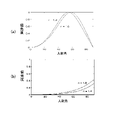
- Equation 3 the degree of polarization ⁇ can be obtained as follows.
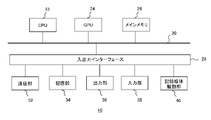
- the CPU 23 controls the entire image processing apparatus 10 by executing the operating system stored in the storage unit 34 .
- the CPU 23 also executes various programs read from a removable recording medium and loaded into the main memory 26 or downloaded via the communication section 32 .
- the GPU 24 has a function of a geometry engine and a function of a rendering processor, performs drawing processing according to a drawing command from the CPU 23, and stores display image data in a frame buffer (not shown). Then, the display image stored in the frame buffer is converted into a video signal and output to the output section 36 .
- the main memory 26 is composed of a RAM (Random Access Memory) and stores programs and data necessary for processing.
- the configuration of the illustrated image processing apparatus 10 does not have to be integrally provided.
- the degree-of-polarization acquisition unit 54 may be part of the imaging device 12 .
- the function of estimating material information from a captured image and the function of generating a display image using the material information may be realized by different devices, and the timing of operating these functions is may be independent.
- the output data generating section 60 as a function of generating an image to be displayed on the display device 16 may be configured by another device.
- part of the functions of the material information estimation unit 56 may be implemented by a server or the like connected to the image processing apparatus 10 via a network.
- material information may be estimated using deep learning functions provided by cloud computing.
- the image selection unit 62 may select any one of them as an input image.
- the number of input images may be increased as the width of change in the degree of polarization increases.
- the input image selected in 1 above does not have to be the polarization image set itself used for selection.
- a predetermined type of image among various types of images obtained from the polarization image set such as a natural light color image obtained from the polarization image set, an image of only the specular reflection component separated using the polarization image, an image of only the diffuse reflection component, etc.
- An image is fine.
- 1 above can be said to select the imaging state of the input image using the degree of polarization.
- the image selection unit 62 may further select an area to be used for estimating material information from the image in the selected shooting state.
- the image selection unit 62 refers to the distribution of the degree of polarization in the image of the object, and selects, for example, areas with a high degree of polarization and areas with a low degree of polarization based on a predetermined criterion.
- the selection principle at this time is the same as in 1 above.
- the image selection unit 62 may first select an image having a different degree of polarization depending on the region, and then further select regions with a high degree of polarization and regions with a low degree of polarization.
- the image selection unit 62 may select the photographing state as in 1 above, and further select the type of input image as in 3 above based on the degree of polarization.
- the image selection unit 62 selects one or a plurality of images of a type suitable for estimating material information from polarized images, natural light images, specular reflection images, diffuse reflection images, and the like.
- a specular reflection image obtained by separating only the specular reflection components, the metallicity and surface It has been found that the roughness can be estimated with high accuracy.
- the image selection unit 62 After selecting the type of input image according to the degree of polarization, the image selection unit 62 generates an image of that type (for example, a specular reflection image) as necessary. Different types of images may be selected depending on the area of the image in one shooting state, such as an area with many specular reflection components and an area with many diffuse reflection components. If there is information about the object to be obtained other than the degree of polarization, the image selection unit 62 may use the information to select the input image and determine the selection policy. For example, if the rough material of the object, such as wood, metal, pottery, plastic, paper, or cloth, is known in advance, it is used to select the input image.
- the rough material of the object such as wood, metal, pottery, plastic, paper, or cloth
- the degree of polarization is low regardless of the shooting conditions.
- the input image may be selected after estimating the degree of metalness and surface roughness by combining the degree of polarization and rough material.
- the image selection unit 62 may accept registration from the user by displaying a registration screen for additional information on the display device 16 via the output data generation unit 60 .
- the image selection unit 62 may acquire the additional information by itself based on the measured values of various sensors, the captured image acquired separately, and the like.
- the algorithm switching unit 64 uses the image acquired by the captured image acquisition unit 50 or the image selected by the image selection unit 62 to accurately obtain material information. Algorithms are selected based on the degree of polarization.
- the algorithm switching unit 64 for example, a table is set in advance that associates the range of the degree of polarization with an estimation algorithm that tends to achieve accuracy for images in that range.
- the estimation algorithm is either the network that constitutes it, the database that is the learning result, or a combination thereof.
- a calculation formula for calculating material information may be prepared.
- the tendency of the estimation accuracy of material information varies depending on the network configuration, the images to be learned, and the database used.
- the network or database that tends to have high accuracy for images with a lot of specular reflection components and a network or database that tends to have high accuracy for images with a lot of diffuse reflection components, an image with a high degree of polarization can be obtained. If so, the former is used, and if an image with a low degree of polarization is obtained, the latter is selected.
- the algorithm switching unit 64 may switch the algorithm according to the characteristics of the image selected by the image selecting unit 62, the selection policy, the type of image, and the like.
- the estimation unit 66 may weight and average a plurality of results using a weighting factor determined based on a combination of the degree of polarization of the image used for estimation and the estimation algorithm. For example, the higher the degree of polarization, the more weight is given to the estimation result by an algorithm that provides high estimation accuracy for specular reflection. Conversely, the lower the degree of polarization, the greater the weight of the estimation result by the algorithm that provides higher estimation accuracy for diffuse reflection. If the rough material of the object is known, the results are selected according to compatibility with the algorithm. Alternatively, the weight assigned to each algorithm is adjusted by additional information, and then the weighted average of the estimation results is calculated. In these cases, the estimating unit 66 associates the degree of polarization range, the range/content of the additional information with the easiness of obtaining accuracy for each algorithm, etc., and uses them to calculate the weighting factors.
- the estimation unit 66 may visualize multiple estimation results and allow the user to select the optimum one.
- the estimating unit 66 causes the display device 16 to display the result of drawing an object with a plurality of pieces of material information, which are the estimation results, on the display device 16 via the output data generating unit 60, and selects an image that is close to the actual object. accept the operation.
- a weighted average may be calculated after determining the weight for the result by having the user evaluate how close each image is to the actual object in five grades or the like.
- a comprehensive evaluation for all material information may be received, or an evaluation may be received for each parameter such as object color, metallicity, and surface roughness.
- the estimation unit 66 stores the finally determined material information in the material information storage unit 58 .
- the output data generation unit 60 uses the material information read out from the material information storage unit 58 to draw an object reflecting the information and a display image including the object, and causes the display device 16 to display them. As described above, various objects can be considered, and model data other than material information is stored in the output data generation unit 60 .
- the output data generation unit 60 also sends an image for receiving a request to start photographing, various specifications for image processing, registration of additional information, evaluation of material information, etc., and an instruction for changing the photographing state to the user. An image to be provided may be generated as appropriate and displayed on the display device 16 .
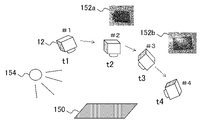
- FIG. 10 is a diagram for explaining the photographed image obtained in this embodiment.
- the imaging device 12 takes polarized images of the object 150 at times t1, t2, t3, and t4 while changing its position and orientation as indicated by the arrows under the control of the image processing device 10 or the like.
- Identification numbers #1, #2, #3, and #4 are given to the images shot at each time, and to the shooting state.
- a difference in the angle of at least one of the object 150 and the light source 154 with respect to the imaging plane changes the magnitude of the specular reflection component in the captured image.
- the image 152a of #2 has little specular reflection, but the image 152b of #3 has strong specular reflection.
- the position and orientation of the imaging device 12 are changed, but similar shot images can be obtained by changing the position and orientation of the object 150 and the state of the light source 154 in addition to the imaging device 12 .
- the image processing device 10 or the user changes at least one of the imaging device 12, the object 150, and the light source 154 so as to obtain different shooting conditions.
- a mechanism such as a robot for remote control is attached to the target device or object.
- control may be performed so that an image is captured with the illumination as the light source 154 turned on and off.
- FIG. 11 illustrates an instruction screen for the user to change the angle of the object.
- the captured image acquisition unit 50 of the image processing apparatus 10 displays the instruction screen 160 via the output data generation unit 60 .
- the illustrated instruction screen 160 displays a real-time image including an object image 162 captured by the imaging device 12 and an instruction text 164 such as "Please change the angle of the object.”
- the imaging device 12 photographs the object from various angles as shown in FIG. can.
- the captured image acquisition unit 50 may similarly display an instruction screen for changing the position, posture, and angle of the imaging device 12 and lighting.
- the user can move to change the angle of the object with respect to the imaging plane.
- the user may be instructed to move the light or turn the light on/off.
- the imaging device 12 has a flash photography function, the user or the image processing device 10 may control the flash to turn the flash on or off.
- the photographed image acquisition unit 50 may acquire images of the same object photographed at different times of the day.
- the intensity of light and the type of light source change depending on the time of day, such as morning, noon, and night. Taking advantage of this, it is possible to acquire images with different reflection characteristics by photographing in different time zones. Only one of the state changes of the imaging device 12, the object, and the light source described above may be performed, or a plurality of them may be combined.
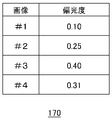
- the image selection unit 62 further selects, for example, the image with the smallest average value of the degree of polarization. In the illustrated example, image #1 is selected.
- the image selection unit 62 may select images with a degree of polarization lower than a threshold value t_l (where t_l ⁇ t_h) set for selecting images with a low degree of polarization regardless of the number of images.
- the "image with a high degree of polarization" mentioned in the above description means an image having the maximum degree of polarization among the obtained images, an image having a degree of polarization higher than the threshold value t_h, and an image having a degree of polarization higher than the threshold value t_h.
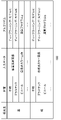
- the input image is set to "specular reflection image” and the estimation algorithm is set to "deep learning (model A)". It is on the other hand, even if the degree of polarization is the same “high”, if the material is registered as “plastic”, it is set to use “deep learning (model B)" as the estimation algorithm.
- the material is "vinyl”
- the data used for the material information is set to "natural light color image”
- the estimation algorithm is set to use "calculation program a”.
- the "calculation program” is a program that defines calculation formulas for estimating each material information.
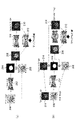
- (b) is a network that obtains material information by using specular reflection images as input data as well as color images of natural light.
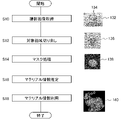
- a mask net 202 is used to generate a mask image 204 from a color image (RGB image) 200, thereby generating an image 206 in which only the image of the object in the original color image 200 is validated. Same as (a).
- the specular net 208 for estimating it is not used.
- an image 206 obtained by validating only the image of the object in the original color image and a specular reflection image 214 are used as input data, and an Albedo Net 212 is used to convert the object color, metallicity, Predetermined material information such as surface roughness is output.
- the material information estimating unit 56 of the present embodiment switches between the networks (a) and (b) based on the degree of polarization and additional information of the actually obtained captured image, for example, to obtain a more accurate network. use. For this reason, for example, experiments are conducted on objects with various surface characteristics to obtain trends in accuracy, and then an appropriate network is set in the processing content switching setting table 180 as shown in FIG. .
- the illustrated deep learning network is an example, and the gist of this embodiment is not to limit it.
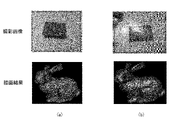
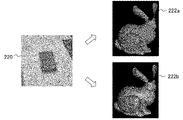
- FIG. 15 compares the results of estimating material information using the networks of (a) and (b) in FIG.
- a non-glossy sponge is used as an object, and material information is estimated from the photographed image 220 of the sponge using the networks (a) and (b).
- Image 222a and image 222b are the result of rendering the rabbit object using the estimation results of the networks of (a) and (b), respectively.
- the accuracy of the network (a), which gives the result of the image 222a is high.
- FIG. 16 compares another result of estimating material information using the networks of (a) and (b) in FIG.
- a glossy plastic plate is used as an object, and material information is estimated from the photographed image 224 of the object by the network of (a) and (b).
- Image 226a and image 226b are the results of rendering the rabbit object using the estimation results of the networks of (a) and (b), respectively.
- the object is a glossy plastic plate, it can be seen that the accuracy of the network in (b), which yields the result of image 226b, is high.
- the network (a), which estimates the specular reflection image by deep learning is advantageous if the object is a matte material that makes it difficult to obtain specular reflection.
- the network (b), in which a specular reflection image is generated in advance from a polarization image is advantageous for an object made of a glossy material that easily obtains specular reflection.
- FIG. 17A and 17B are diagrams for explaining an example of a method of estimating material information by calculation by the estimation unit 66 of the material information estimation unit 56.
- FIG. a low polarization degree image 230a and a high polarization degree image 230b are used.
- p l is the number of pixels forming the area of the object image 232a, and the pixel values thereof are (C l [1], C l [2], . . . , C l [p l ]).
- p h is the number of pixels forming the region 234 in which the degree of polarization is higher than the threshold in the image 232b of the object, and the pixel values thereof are (C h [1], C h [ 2], . . . , C h [p h ).
- the following formulas are prepared.
- the pixel value C l [p1] used to calculate the object color C is a color value having elements of (R, G, B). Average value.
- the pixel values C l [p1] and C h [p2] used to calculate the metallicity M may be color values or luminance values Y that can be derived from RGB values by a general conversion formula. That is, in Equation 5, the average of the color values of pixels with a low degree of polarization is taken as the color value of the object itself, and the difference between the color values (or luminance values) of the pixels with a high degree of polarization and the pixels with a low degree of polarization is normalized. , the metal degree.
- pixels with a low degree of polarization may also exist in regions other than the region 234 where the degree of polarization is higher than the threshold in the image 232b of the object in the high degree of polarization image 230b.
- the above calculation may be performed only from
- the surface roughness R means the degree of spread of specular reflection
- the area of the region 234 with a degree of polarization higher than the threshold value in the high degree of polarization image 230b and the number of pixels ph constituting the region 234 is used as an index. available as For example, by preparing in advance a table or formula that associates the number of pixels ph with the surface roughness R, the surface roughness R can be obtained directly from the actual number of pixels ph .
- the ratio of the number of pixels of the high polarization degree region 234 to the total number of pixels constituting the image 232b of the object, or the area ratio, is used to obtain the surface roughness R. You may make it possible.
- the above formula for deriving the material information is an example, and the present embodiment is not intended to be limited to this.
- FIG. 18 exemplifies setting information for obtaining final material information by the estimation unit 66 integrating multiple sets of material information when multiple sets are estimated.
- the case where multiple sets of material information are estimated can occur at least either when multiple algorithms are used for estimation or when multiple images are used for estimation.
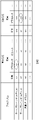
- the algorithm score table 240 is data representing the degree of accuracy with which each algorithm can estimate a combination of the degree of polarization of the input image and the additional information.
- k1, k2, k3, . . . are actually numerical values representing scores.
- a score is set for a combination of whether the input image is "high degree of polarization” or "low degree of polarization” and the rough material of the object (including cases where it is unknown) obtained as additional information.
- the unit for setting the score is not limited to this, and the type of input image, the type of light source, the state, etc. may be introduced.
- the estimating unit 66 extracts the scores of each algorithm used for estimation based on applicable conditions such as the degree of polarization, normalizes the scores so that the sum is 1, and determines weighting factors for multiple estimation results. .
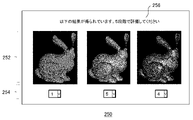
- FIG. 19 exemplifies a user evaluation screen that is displayed in order to obtain final material information by integrating the estimation unit 66 when multiple sets of material information are estimated.
- the evaluation screen 250 includes a result image display field 252 and a score input box field 254.
- FIG. The result image display column 252 shows the result of drawing a predetermined object by the estimation unit 66 using each material information of the estimation result. In the example shown, three resulting images are shown using three sets of material information.
- the score input box field 254 is a field in which the user inputs the result of evaluating the accuracy of appearance of each result image as a score.
- the setting is such that evaluation is performed using a five-level score. Therefore, in the score input box column 254, a score input box from which a numerical value from 1 to 5 can be selected by a pull-down operation or the like is displayed in association with each result image.
- the user basically evaluates how well the resulting image matches the actual appearance of the object, indicated by a score.
- the evaluation criteria are not limited to this, and the user may subjectively evaluate the desirability of the material information.
- the estimation unit 66 normalizes the scores input by the user so that the sum of the scores becomes 1, thereby determining the weighting factor of the estimation result.
- the illustrated evaluation screen 250 is merely an example, and the result image to be displayed and means for evaluation are not limited.
- score input box fields 254 may be provided for each type of material information, such as object color, metallicity, and surface roughness.
- the result image display column 252 the result image is arranged at the corresponding position in the coordinate space whose axis is the value of a plurality of types of material information as shown in FIG. The information value may be selectable.
- the image selection unit 62 may select an input image after creating the table. At this time, the image selection unit 62 selects an image with the highest degree of polarization or an image with a degree of polarization higher than the threshold value t_h for detecting a high degree of polarization image as the high degree of polarization image. In addition, the image selector 62 may select, as the low-polarization image, the image with the lowest degree of polarization or the image with the degree of polarization lower than the threshold value t_l for detecting the low-polarization image.
- the image selection unit 62 selects an image having a degree of polarization higher than the reference value by a predetermined value D or more and an image having a degree of polarization lower than the reference value by a predetermined value D′ or two images having a difference in degree of polarization of a predetermined value D′′ or more. may be selected.
- the image selection criteria may be adaptively switched according to the additional information or the degree of polarization itself, as described above.
- the algorithm switching unit 64 selects an image based on the degree of polarization of the input image. , selects an algorithm to be used for estimating material information (S34). That is, based on the number of specular reflection components estimated from the degree of polarization, an algorithm that is expected to provide the highest accuracy is selected.
- the image selection unit 62 may select the type of input image in cooperation with the algorithm switching unit 64 based on the amount of specular reflection components estimated from the degree of polarization. Options here include natural-light color images, specular images that can be generated from polarized images, and diffuse images, as described above. As shown in FIG. 13, as shown in FIG. 13, additional information such as the rough material of the object may be used as the criteria for selecting the type of input image and the algorithm.
- an appropriate algorithm is selected for each image (N of S36, S34).
- the estimation unit 66 estimates material information using the selected algorithm (S38).
- the estimating unit 66 integrates them by weighted averaging or the like according to the probability of the algorithms, and the final result is derived (S42).
- a polarization image is used in the technique of estimating material information of an object by photographing. Specifically, based on the reflection characteristics of the image of the object included in the polarization image, the content of the processing for estimating material information is adaptively changed. For example, an image with strong specular reflection is identified based on the degree of polarization and used to estimate material information. This makes it possible to accurately estimate material information representing surface gloss such as metallicity and surface roughness. Also, since the specular and diffuse reflections can be separated, it is less likely that the color of the image due to specular reflection will be confused with the color of the object itself.
- the estimation processing means can be optimized according to the state of various objects and their images, and material information can be estimated with stable accuracy in any environment.
- estimation using deep learning by adaptively using networks and databases with different characteristics, it is possible to estimate material information with high accuracy in a wide range of environments, even if each has a simple configuration.
- the present invention can be used in various information processing devices such as game devices, content generation devices, mobile terminals, monitoring systems, in-vehicle camera systems, inspection devices, and autonomous robots.
Landscapes
- Engineering & Computer Science (AREA)
- Theoretical Computer Science (AREA)
- General Physics & Mathematics (AREA)
- Physics & Mathematics (AREA)
- Multimedia (AREA)
- Software Systems (AREA)
- Evolutionary Computation (AREA)
- Computer Vision & Pattern Recognition (AREA)
- Medical Informatics (AREA)
- General Health & Medical Sciences (AREA)
- Databases & Information Systems (AREA)
- Computing Systems (AREA)
- Artificial Intelligence (AREA)
- Health & Medical Sciences (AREA)
- Spectroscopy & Molecular Physics (AREA)
- Investigating Or Analysing Materials By Optical Means (AREA)
Priority Applications (3)
| Application Number | Priority Date | Filing Date | Title |
|---|---|---|---|
| JP2023526757A JP7724855B2 (ja) | 2021-06-10 | 2021-06-10 | 画像処理装置およびマテリアル情報取得方法 |
| US18/565,516 US12608927B2 (en) | 2021-06-10 | 2021-06-10 | Image processing apparatus and material information obtainment method |
| PCT/JP2021/022129 WO2022259466A1 (ja) | 2021-06-10 | 2021-06-10 | 画像処理装置およびマテリアル情報取得方法 |
Applications Claiming Priority (1)
| Application Number | Priority Date | Filing Date | Title |
|---|---|---|---|
| PCT/JP2021/022129 WO2022259466A1 (ja) | 2021-06-10 | 2021-06-10 | 画像処理装置およびマテリアル情報取得方法 |
Publications (1)
| Publication Number | Publication Date |
|---|---|
| WO2022259466A1 true WO2022259466A1 (ja) | 2022-12-15 |
Family
ID=84426038
Family Applications (1)
| Application Number | Title | Priority Date | Filing Date |
|---|---|---|---|
| PCT/JP2021/022129 Ceased WO2022259466A1 (ja) | 2021-06-10 | 2021-06-10 | 画像処理装置およびマテリアル情報取得方法 |
Country Status (3)
| Country | Link |
|---|---|
| US (1) | US12608927B2 (cg-RX-API-DMAC7.html) |
| JP (1) | JP7724855B2 (cg-RX-API-DMAC7.html) |
| WO (1) | WO2022259466A1 (cg-RX-API-DMAC7.html) |
Cited By (2)
| Publication number | Priority date | Publication date | Assignee | Title |
|---|---|---|---|---|
| WO2024228328A1 (ja) | 2023-05-01 | 2024-11-07 | ソニーグループ株式会社 | 情報処理装置および方法 |
| WO2024237051A1 (ja) | 2023-05-17 | 2024-11-21 | ソニーグループ株式会社 | 情報処理装置および方法 |
Families Citing this family (1)
| Publication number | Priority date | Publication date | Assignee | Title |
|---|---|---|---|---|
| US20250095331A1 (en) * | 2022-02-15 | 2025-03-20 | Trinamix Gmbh | System and method for determining a material of an object |
Citations (7)
| Publication number | Priority date | Publication date | Assignee | Title |
|---|---|---|---|---|
| JPH0981889A (ja) * | 1995-09-19 | 1997-03-28 | Toshiba Corp | 車両検出装置 |
| JP2002360521A (ja) * | 2001-06-07 | 2002-12-17 | Hitachi Medical Corp | 画像処理装置 |
| US20150077569A1 (en) * | 2013-09-15 | 2015-03-19 | Mediatek Inc. | Method and apparatus for performing image processing operation based on frame/algorithm selection |
| JP2016109443A (ja) * | 2014-12-02 | 2016-06-20 | 日本電信電話株式会社 | 形状推定装置、形状推定方法および形状推定プログラム |
| WO2017145249A1 (ja) * | 2016-02-22 | 2017-08-31 | 富士機械製造株式会社 | 画像処理システム及び画像処理方法 |
| WO2018092540A1 (ja) * | 2016-11-15 | 2018-05-24 | ソニー株式会社 | 画像処理装置、および画像処理方法、並びにプログラム |
| WO2019003383A1 (ja) * | 2017-06-29 | 2019-01-03 | 株式会社ソニー・インタラクティブエンタテインメント | 情報処理装置および材質特定方法 |
Family Cites Families (8)
| Publication number | Priority date | Publication date | Assignee | Title |
|---|---|---|---|---|
| CN101044507B (zh) | 2005-09-01 | 2010-08-18 | 松下电器产业株式会社 | 图像处理方法以及图像处理装置 |
| JP5682437B2 (ja) | 2010-09-07 | 2015-03-11 | ソニー株式会社 | 固体撮像素子、固体撮像装置、撮像機器、及び、偏光素子の製造方法 |
| JP6617124B2 (ja) | 2017-07-20 | 2019-12-11 | セコム株式会社 | 物体検出装置 |
| US12070684B2 (en) * | 2018-09-04 | 2024-08-27 | Sony Interactive Entertainment Inc. | Information processing apparatus and play field deviation detecting method |
| WO2020054076A1 (ja) | 2018-09-14 | 2020-03-19 | 株式会社ソニー・インタラクティブエンタテインメント | 情報処理装置および物体検出方法 |
| JP7424272B2 (ja) * | 2020-11-04 | 2024-01-30 | ソニーグループ株式会社 | 情報処理装置と情報処理方法およびプログラム |
| CN112785491B (zh) * | 2021-01-20 | 2022-10-04 | 北京航空航天大学 | 一种基于偏振指导的图像高光反射分离计算方法 |
| WO2022251159A1 (en) * | 2021-05-24 | 2022-12-01 | Arizona Board Of Regents On Behalf Of The University Of Arizona | Devices and methods for determining polarization characteristics from partial polarimetry |
-
2021
- 2021-06-10 JP JP2023526757A patent/JP7724855B2/ja active Active
- 2021-06-10 US US18/565,516 patent/US12608927B2/en active Active
- 2021-06-10 WO PCT/JP2021/022129 patent/WO2022259466A1/ja not_active Ceased
Patent Citations (7)
| Publication number | Priority date | Publication date | Assignee | Title |
|---|---|---|---|---|
| JPH0981889A (ja) * | 1995-09-19 | 1997-03-28 | Toshiba Corp | 車両検出装置 |
| JP2002360521A (ja) * | 2001-06-07 | 2002-12-17 | Hitachi Medical Corp | 画像処理装置 |
| US20150077569A1 (en) * | 2013-09-15 | 2015-03-19 | Mediatek Inc. | Method and apparatus for performing image processing operation based on frame/algorithm selection |
| JP2016109443A (ja) * | 2014-12-02 | 2016-06-20 | 日本電信電話株式会社 | 形状推定装置、形状推定方法および形状推定プログラム |
| WO2017145249A1 (ja) * | 2016-02-22 | 2017-08-31 | 富士機械製造株式会社 | 画像処理システム及び画像処理方法 |
| WO2018092540A1 (ja) * | 2016-11-15 | 2018-05-24 | ソニー株式会社 | 画像処理装置、および画像処理方法、並びにプログラム |
| WO2019003383A1 (ja) * | 2017-06-29 | 2019-01-03 | 株式会社ソニー・インタラクティブエンタテインメント | 情報処理装置および材質特定方法 |
Cited By (4)
| Publication number | Priority date | Publication date | Assignee | Title |
|---|---|---|---|---|
| WO2024228328A1 (ja) | 2023-05-01 | 2024-11-07 | ソニーグループ株式会社 | 情報処理装置および方法 |
| EP4708892A1 (en) | 2023-05-01 | 2026-03-11 | Sony Group Corporation | Information processing device and method |
| WO2024237051A1 (ja) | 2023-05-17 | 2024-11-21 | ソニーグループ株式会社 | 情報処理装置および方法 |
| EP4715368A4 (en) * | 2023-05-17 | 2026-08-12 | Sony Group Corp | INFORMATION PROCESSING DEVICE AND METHOD |
Also Published As
| Publication number | Publication date |
|---|---|
| US12608927B2 (en) | 2026-04-21 |
| JPWO2022259466A1 (cg-RX-API-DMAC7.html) | 2022-12-15 |
| US20240257514A1 (en) | 2024-08-01 |
| JP7724855B2 (ja) | 2025-08-18 |
Similar Documents
| Publication | Publication Date | Title |
|---|---|---|
| US11869139B2 (en) | System and method for three-dimensional scanning and for capturing a bidirectional reflectance distribution function | |
| JP6697986B2 (ja) | 情報処理装置および画像領域分割方法 | |
| JP6615723B2 (ja) | 情報処理装置および対象物認識方法 | |
| JP6799155B2 (ja) | 情報処理装置、情報処理システム、および被写体情報特定方法 | |
| CN109583285B (zh) | 对象识别方法 | |
| CN103905733B (zh) | 一种单目摄像头对人脸实时跟踪的方法及系统 | |
| CN106133796B (zh) | 用于在真实环境的视图中表示虚拟对象的方法和系统 | |
| JP6799154B2 (ja) | 情報処理装置および材質特定方法 | |
| JP7724855B2 (ja) | 画像処理装置およびマテリアル情報取得方法 | |
| JPWO2007139070A1 (ja) | 光源推定装置、光源推定システムおよび光源推定方法、並びに、画像高解像度化装置および画像高解像度化方法 | |
| JP7039616B2 (ja) | 情報処理装置および表面粗さ取得方法 | |
| CN108810406B (zh) | 人像光效处理方法、装置、终端及计算机可读存储介质 | |
| TWM364920U (en) | 3D human face identification device with infrared light source | |
| JP6851475B2 (ja) | 情報処理装置および情報処理方法 | |
| JP6934565B2 (ja) | 情報処理装置および被写体情報取得方法 | |
| JP6934575B2 (ja) | 情報処理装置および物体検出方法 | |
| JP6650848B2 (ja) | 情報処理装置、情報処理システム、および情報処理方法 | |
| TW201916669A (zh) | 一種注視識別及互動方法與裝置 | |
| JP6783928B2 (ja) | 情報処理装置および法線情報取得方法 | |
| WO2023244488A1 (en) | Methods and systems for view synthesis with image relighting | |
| Sudheendra et al. | Genre linked automated assessment and feedback of photographs based on visual aesthetics | |
| CN118675207A (zh) | 一种掌静脉图像的采集和处理方法及装置、介质和电子设备 | |
| Jiang et al. | Project report: Light source estimation using kinect | |
| Jouppi et al. | CS294-26 Final Project: Quadcopter Building Reconstruction |
Legal Events
| Date | Code | Title | Description |
|---|---|---|---|
| 121 | Ep: the epo has been informed by wipo that ep was designated in this application |
Ref document number: 21945140 Country of ref document: EP Kind code of ref document: A1 |
|
| WWE | Wipo information: entry into national phase |
Ref document number: 18565516 Country of ref document: US |
|
| WWE | Wipo information: entry into national phase |
Ref document number: 2023526757 Country of ref document: JP |
|
| NENP | Non-entry into the national phase |
Ref country code: DE |
|
| 122 | Ep: pct application non-entry in european phase |
Ref document number: 21945140 Country of ref document: EP Kind code of ref document: A1 |
|
| WWG | Wipo information: grant in national office |
Ref document number: 18565516 Country of ref document: US |