WO2022259413A1 - 流体状態推定システム、学習装置、学習プログラム、推定装置、及び推定プログラム - Google Patents
流体状態推定システム、学習装置、学習プログラム、推定装置、及び推定プログラム Download PDFInfo
- Publication number
- WO2022259413A1 WO2022259413A1 PCT/JP2021/021900 JP2021021900W WO2022259413A1 WO 2022259413 A1 WO2022259413 A1 WO 2022259413A1 JP 2021021900 W JP2021021900 W JP 2021021900W WO 2022259413 A1 WO2022259413 A1 WO 2022259413A1
- Authority
- WO
- WIPO (PCT)
- Prior art keywords
- fluid
- state
- plant
- value
- learning
- Prior art date
- Legal status (The legal status is an assumption and is not a legal conclusion. Google has not performed a legal analysis and makes no representation as to the accuracy of the status listed.)
- Ceased
Links
Images



Classifications
-
- G—PHYSICS
- G06—COMPUTING OR CALCULATING; COUNTING
- G06F—ELECTRIC DIGITAL DATA PROCESSING
- G06F30/00—Computer-aided design [CAD]
- G06F30/20—Design optimisation, verification or simulation
- G06F30/28—Design optimisation, verification or simulation using fluid dynamics, e.g. using Navier-Stokes equations or computational fluid dynamics [CFD]
-
- G—PHYSICS
- G01—MEASURING; TESTING
- G01M—TESTING STATIC OR DYNAMIC BALANCE OF MACHINES OR STRUCTURES; TESTING OF STRUCTURES OR APPARATUS, NOT OTHERWISE PROVIDED FOR
- G01M99/00—Subject matter not provided for in other groups of this subclass
-
- G—PHYSICS
- G05—CONTROLLING; REGULATING
- G05B—CONTROL OR REGULATING SYSTEMS IN GENERAL; FUNCTIONAL ELEMENTS OF SUCH SYSTEMS; MONITORING OR TESTING ARRANGEMENTS FOR SUCH SYSTEMS OR ELEMENTS
- G05B23/00—Testing or monitoring of control systems or parts thereof
-
- G—PHYSICS
- G06—COMPUTING OR CALCULATING; COUNTING
- G06F—ELECTRIC DIGITAL DATA PROCESSING
- G06F30/00—Computer-aided design [CAD]
- G06F30/20—Design optimisation, verification or simulation
- G06F30/27—Design optimisation, verification or simulation using machine learning, e.g. artificial intelligence, neural networks, support vector machines [SVM] or training a model
-
- G—PHYSICS
- G06—COMPUTING OR CALCULATING; COUNTING
- G06F—ELECTRIC DIGITAL DATA PROCESSING
- G06F2113/00—Details relating to the application field
- G06F2113/08—Fluids
Definitions
- the present disclosure relates to technology for estimating the state of fluid.
- Fluids such as gases and liquids are handled in refineries and chemical plants. If it is possible to grasp the state of the fluid inside the equipment, devices, pipes, etc. that make up the plant, it will be possible to detect abnormalities during plant operation, and to improve the efficiency of operation by accurately controlling equipment. can do. In addition, when constructing a new plant, it is possible to design a plant that is less prone to abnormalities and has high operational efficiency by referring to the state of the fluid obtained during the operation of the existing plant.
- CFD computational fluid dynamics
- the purpose of the present disclosure is to improve technology for estimating the state of fluid in a plant.
- a fluid state estimation system uses a learning device for learning an estimation model for estimating the state of a fluid in a plant, and the estimation model learned by the learning device.
- an estimating device for estimating the state of the fluid in the plant.
- the estimation model inputs the values of the input variables and outputs the values of the fluid state information representing the state of the fluid in the plant.
- a learning data acquisition unit that acquires learning data, and a learning unit that learns an estimation model based on the learning data.
- the estimating device includes a fluid state estimator that estimates the state of the fluid in the plant when the input variable has the specific value by inputting the specific value of the input variable into the estimation model.
- This apparatus includes a learning data acquisition unit that acquires, as learning data, a set of values of input variables that can affect the state of the fluid in the plant and values of fluid state information that represents the state of the fluid in the plant; a learning unit that learns an estimation model for estimating the state of the fluid in the plant based on the learning unit.
- Yet another aspect of the present disclosure is an estimating device.
- This device inputs input variable values that have been learned using pairs of values of input variables that can affect the state of the fluid in the plant and values of fluid state information representing the state of the fluid in the plant as learning data.
- a fluid state estimating unit for estimating the state of the fluid in the plant when the input variable is the specific value by inputting the specific value of the input variable to the estimation model that outputs the value of the fluid state information.
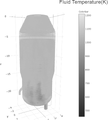
- FIG. 3 is a diagram showing an example of a three-dimensional distribution of temperatures of fluids such as feedstock oil and steam inside a reactor.
- 1 is a diagram showing the configuration of a fluid state estimation system according to an embodiment
- FIG. 1 is a diagram showing a configuration of a learning device according to an embodiment
- FIG. It is a figure which shows the structure of the estimation apparatus which concerns on embodiment.
- 4 is a flow chart showing a procedure of a learning method according to an embodiment
- 4 is a flow chart showing the procedure of an estimation method according to the embodiment;
- a surrogate model that substitutes for CFD is constructed by machine learning, and the constructed surrogate model to estimate the state of the fluid.
- the state of the fluid inside the component can be estimated much faster than CFD, so the state of the fluid in the plant can be grasped in real time during plant operation.
- a surrogate model is learned by a Generative Adversarial Network (GAN). As a result, the accuracy of the surrogate model can be improved, so that the state of the fluid in the plant can be accurately grasped during the operation of the plant.
- GAN Generative Adversarial Network
- Fig. 1 schematically shows the configuration of a fluidized catalytic cracking unit.
- the fluidized catalytic cracking unit 10 comprises a reactor 11 and a regenerator 14 .
- Reactor 11 comprises riser 12 and stripper 13 .
- the riser 12 is a reaction tower for contacting the raw material oil with a catalyst to obtain a product.
- feedstock oil, steam, and catalyst are introduced.
- the feedstock may be, for example, a wide range of fractions and residuums from kerosene, gas oil to atmospheric residuum, with a boiling point higher than kerosene (approximately 170° C.).
- the catalyst may be particles including, for example, zeolites, silica, clay minerals, and the like.
- the riser 12 cracks the feedstock oil at a temperature of about 500° C., for example, and supplies the cracked product to the stripper 13 from the top.
- the stripper 13 introduces steam into the cracked product supplied from the riser 12 to remove cracked oil vapor adhering to the catalyst (stripping), and separates only the catalyst downward and supplies it to the regenerator 14 .
- the cracked oil withdrawn from the top of stripper 13 is further processed and upgraded in downstream equipment.
- the regenerator 14 regenerates the catalyst used in the riser 12.
- carbon (coke) adheres to the surface of the catalyst, deactivating the catalyst.
- the regenerator 14 regenerates the coke adhering to the surface of the catalyst by burning it at a high temperature, and supplies the regenerated catalyst to the bottom of the riser 12 .
- a catalyst with coke on its surface and air are introduced into the regenerator 14 . From the top of the regenerator 14 exhaust gas containing carbon dioxide is discharged.
- regenerator 14 if there is a local decrease in the amount of air, the coke will be incompletely burned due to lack of oxygen, the concentration of carbon monoxide in the exhaust gas will increase, and afterburning will occur. When afterburning occurs, the regenerator 14 may be damaged due to a temperature rise due to local heat generation, or the operation of the fluidized catalytic cracking apparatus 10 may not be continued. Therefore, it is important to suppress the occurrence of afterburn in the regenerator 14 when operating the fluidized catalytic cracking unit 10 .
- the learning device creates an estimation model for estimating the value of the fluid state information representing the state of the fluid inside the fluid catalytic cracking unit 10 from the information that can be acquired during the operation of the fluid catalytic cracking unit 10. , learned by machine learning. Then, the estimating device estimates the value of the fluid state information inside the fluid catalytic cracking unit 10 using the learned estimation model while the fluid catalytic cracking unit 10 is in operation. As a result, the operator can control the fluid catalytic cracking unit 10 while accurately grasping the state of the fluid inside the fluid catalytic cracking unit 10, so that the occurrence of afterburn in the regenerator 14 can be suppressed. .
- FIG. 2 shows an example of the three-dimensional distribution of the temperature of fluids such as raw oil and steam inside the reactor 11 .
- the fluid state estimation system of the present embodiment estimates the three-dimensional distribution of fluid temperature as fluid state information.
- FIG. 3 shows the configuration of the fluid state estimation system according to the embodiment.
- the fluid state estimation system 1 learns an estimation model for estimating the state of the fluid inside the refinery 3 for refining crude oil to produce petroleum products and the fluid catalytic cracking unit 10 of the refinery 3. and a learning device 100 of.
- the refinery 3 and the learning device 100 are connected by an arbitrary communication network 2 such as the Internet or an internal connection system, and are operated in an arbitrary operation mode such as on-premises, cloud, edge computing, or the like.
- the refinery 3 includes a control target device 5 such as an atmospheric distillation unit or a fluidized catalytic cracking device 10 installed in the refinery 3, and a control device 20 that sets a control amount for controlling the operating conditions of the control target device 5. and an estimating device 200 for estimating the state of the fluid inside the fluid catalytic cracking apparatus 10 using the estimating model learned by the learning device 100 .
- a control target device 5 such as an atmospheric distillation unit or a fluidized catalytic cracking device 10 installed in the refinery 3
- a control device 20 that sets a control amount for controlling the operating conditions of the control target device 5.
- an estimating device 200 for estimating the state of the fluid inside the fluid catalytic cracking apparatus 10 using the estimating model learned by the learning device 100 .
- FIG. 4 shows the configuration of the learning device 100 according to the embodiment.
- the learning device 100 includes a communication device 101 , a processing device 120 and a storage device 140 .
- the communication device 101 controls wireless or wired communication. Communication device 101 transmits and receives data to and from refinery 3 and the like via communication network 2 .
- the storage device 140 stores data and computer programs used by the processing device 120 .
- the storage device 140 has a learning data holding unit 141 .
- the learning data storage unit 141 stores a set of values of input variables that can affect the state of the fluid inside the fluid catalytic cracking apparatus 10 and values of fluid state information representing the state of the fluid inside the fluid catalytic cracking apparatus 10. are stored as training data.
- the processing device 120 includes a computational fluid dynamics simulator 121 , a measured value acquisition unit 122 , a data assimilation unit 123 , a learning data acquisition unit 124 , a provision unit 125 and a learning unit 130 .
- the learning unit 130 includes a fluid state information generator 131 , a discriminator 132 and an adversarial learning unit 133 .
- these configurations are implemented by the CPU, memory, and programs loaded into the memory of any computer, and functional blocks implemented by their cooperation are depicted here. Therefore, those skilled in the art should understand that these functional blocks can be realized in various forms by hardware alone, software alone, or a combination thereof.
- the computational fluid dynamics simulator 121 simulates the state of the fluid inside the fluidized catalytic cracking apparatus 10 by computational fluid dynamics.
- the numerical fluid dynamics simulator 121 inputs necessary for simulating the state of the fluid inside the fluidized catalytic cracking apparatus 10, such as the amount of coke combustion, the amount of catalyst circulation, the amount of catalyst refrigerant circulation, and the opening of each valve. Based on the values of the variables, the two-dimensional distribution or three-dimensional distribution of physical quantities such as the temperature and pressure of the fluid inside the fluidized catalytic cracking apparatus 10 is simulated.
- the input variable may be any variable that can affect the state of the fluid in the refinery 3, may be a controlled variable set by the control device 20, or may be a state variable representing the state of the refinery 3.
- the computational fluid dynamics simulator 121 may simulate changes in the state of the fluid over time after the value of the input variable is set to a particular value, or may simulate the state of the fluid after the value of the input variable is set to a particular value. may simulate the state of the fluid when reaches steady state.
- the measured value acquisition unit 122 acquires measured values of input variables and fluid state information when the fluidized catalytic cracking apparatus 10 is in operation.
- the measured value acquisition unit 122 obtains the values of the input variables when the fluid catalytic cracking apparatus 10 is in operation, and the values of the input variables when the fluid catalytic cracking apparatus 10 is operated and the internal fluid reaches a steady state.
- An actual measurement value of the temperature inside the fluid catalytic cracking unit 10 detected by the temperature sensor installed in the fluid catalytic cracking unit 10 is acquired from the refinery 3 .
- the data assimilation unit 123 assimilates the calculated values of the fluid state information simulated by the computational fluid dynamics simulator 121 and the measured values of the fluid state information acquired by the measured value acquisition unit 122 .
- the data assimilation unit 123 directly inserts the measured value at the installation position of the sensor into the calculation point of the simulation, nudges the difference between the measured value and the calculated value by a coefficient and adds it as a forced term, and minimizes the error standard deviation.
- Optimal interpolation method that interpolates statistically 3D variational method that interpolates while considering hydrodynamic balance, Kalman filter assuming normal distribution, linear system and linear observation, nonlinear system and nonlinear observation Calculation by any method, such as an ensemble Kalman filter that accepts, a particle filter that does not require assumptions about systems, observations, and probability distributions, and a four-dimensional variational method that considers the fluid dynamics of the model and interpolates temporally and spatially. Values and measured values may be assimilated.
- the data assimilation unit 123 may assimilate the calculated values and the measured values using an algorithm configured by a neural network or the like.
- the calculated values of the fluid state information simulated by the numerical fluid dynamics simulator 121 and the measured values of the fluid state information acquired by the measured value acquisition unit 122 are input to the input layer, and they are assimilated into the fluid
- the value of state information may be output from the output layer.
- the data assimilation unit 123 may learn an algorithm by machine learning. In this way, by assimilating the calculated values of the fluid state information simulated by the computational fluid dynamics simulator 121 and the actually measured values, it is possible to improve the accuracy of the simulation of the fluid state information.
- the learning data acquisition unit 124 acquires pairs of input variable values and fluid state information values as learning data, and stores the acquired learning data in the learning data holding unit 141 .
- the learning data may be generated by the computational fluid dynamics simulator 121 or obtained from the refinery 3 while the fluid catalytic cracking unit 10 is in operation. When the calculated value and the measured value of the fluid state information corresponding to the value of the same input variable are obtained, both of them may be used as learning data, or they may be assimilated by the data assimilation unit 123 and used as learning data.
- the learning data acquiring unit 124 sets the values of the input variables and inputs them to the computational fluid dynamics simulator 121, acquires the values of the fluid state information corresponding to the values of the input variables, and stores them in the learning data holding unit 141. good too.
- the learning data acquisition unit 124 may input to the computational fluid dynamics simulator 121 combinations of values that can be taken by multiple types of input variables during operation of the refinery 3 .
- the learning data acquisition unit 124 may set the values of the input variables according to the design of experiments. For example, the learning data acquisition unit 124 may set the value of the input variable according to the Latin hypercube method (LHS), which samples the calculation points so that the appearance frequency is equal to the given probability density distribution. .
- LHS Latin hypercube method
- the fluid state information generator 131 generates values of fluid state information from input data.
- the fluid state information generator 131 may be an algorithm configured by a neural network or the like. In this algorithm, the value of the input variable or the value of input data generated from the input variable is input to the input layer, the fluid catalytic cracking unit 10 is operated with the value of the input variable, and the internal fluid reaches a steady state. The estimated value of the fluid state information at the time may be output from the output layer.
- the discriminator 132 discriminates between the value of the fluid state information generated by the fluid state information generator 131 and the value of the fluid state information acquired by the learning data acquisition unit 124 .
- the discriminator 132 includes the information representing the temperature distribution of the fluid inside the fluid catalytic cracking apparatus 10 generated by the fluid state information generator 131 and the fluid catalytic cracking Information representing the temperature distribution of the fluid inside the device 10 is identified, and the identification result is output.
- the hostile learning unit 133 learns the fluid state information generator 131 and the discriminator 132 based on the discrimination results of the discriminator 132 using the hostile generation network technology.
- the adversarial learning unit 133 determines the probability that the discriminator 132 identifies the value of the fluid state information generated by the fluid state information generator 131 as not the value of the fluid state information acquired by the learning data acquisition unit 124. In order to minimize it, parameters of the fluid state information generator 131 and the like are adjusted.
- the hostile learning unit 133 maximizes the probability that the discriminator 132 correctly discriminates whether the value of the fluid state information input to the discriminator 132 is the value of the fluid state information acquired by the learning data acquisition unit 124. parameters of the discriminator 132 and the like are adjusted.
- the accuracy of the fluid state information generator 131 can be improved.
- random numbers are input to the generator to advance learning, but in this embodiment, instead of inputting randomly generated random numbers to the fluid state information generator 131, Since a combination of values that can be taken by a plurality of types of input variables during operation of the refinery 3 is input to the fluid state information generator 131, learning can proceed more efficiently, and the accuracy of the fluid state information generator 131 can be improved. can be improved.
- the providing unit 125 provides the learned fluid state information generator 131 to the estimating device 200 as an estimating model.
- FIG. 5 shows the configuration of the estimation device 200 according to the embodiment.
- the estimation device 200 includes a communication device 201 , a display device 202 , an input device 203 , a processing device 220 and a storage device 230 .
- the communication device 201 controls wireless or wired communication. Communication device 201 transmits and receives data to and from learning device 100 and the like via communication network 2 .
- the display device 202 displays the display image generated by the processing device 220 .
- the input device 203 inputs instructions to the processing device 220 .
- the storage device 230 stores data and computer programs used by the processing device 220 .
- the storage device 230 includes an operating data storage unit 231 and a fluid state information generator 233 .
- the operating data storage unit 231 stores information acquired while the fluidized catalytic cracking apparatus 10 is operating.
- the fluid state information generator 233 is learned by the learning device 100 and provided by the learning device 100 .
- the processing device 220 includes an operation data acquisition section 221 , an input data generation section 222 , a fluid state information generation section 223 , a fluid state information display section 224 and an evaluation section 225 . These configurations can be implemented in various forms by hardware only, software only, or a combination thereof.
- the operating data acquisition unit 221 acquires a plurality of types of information that can be acquired while the fluid catalytic cracking unit 10 is operating, from various sensors, devices, devices, facilities, fluid catalytic cracking units, and the like provided in the refinery 3. 10, acquired from the control device 20 or the like, and stored in the operation data holding unit 231.
- the input data generation unit 222 generates input data to be input to the fluid state information generator 131 from the values of the input variables acquired by the operation data acquisition unit 221 . If the values of the input variables are directly input to the fluid state information generator 131, the input data generator 222 may not be provided.
- the fluid state information generator 223 uses the fluid state information generator 233 to generate fluid state information from the input data generated by the input data generator 222 .
- the fluid state information generator 223 functions as a fluid state estimator that estimates the steady state of the fluid when a plurality of types of input variables have specific values.
- the estimation apparatus 200 can generate fluid state information with an accuracy equivalent to that of a computational fluid dynamics simulator without using a computational fluid dynamics simulator, so highly accurate fluid state information can be visualized in real time. can be done.
- the fluid state information generator 223 assimilates the calculated value of the fluid state information calculated by the fluid state information generator 233 and the actual value of the fluid state information measured when the fluidized catalytic cracking apparatus 10 was operated.
- the actual measurement value of the fluid state information may be acquired by the operation data acquisition unit 221 from various sensors, devices, devices, facilities, the fluidized catalytic cracking apparatus 10, the control device 20, and the like. This can further improve the accuracy of the fluid state information.
- the fluid state information display unit 224 displays the fluid state information generated by the fluid state information generation unit 223 on the display device 202 .
- the fluid state information display unit 224 displays the two-dimensional distribution or three-dimensional distribution of physical quantities such as fluid temperature and pressure on the display device 202 .
- the evaluation unit 225 Based on the fluid state information generated by the fluid state information generation unit 223, the evaluation unit 225 evaluates whether a specific value of the input variable is good or bad. The evaluation unit 225 may generate the value of the fluid state information when the input variable is changed to a specific value by the fluid state information generation unit 223 and display the generated fluid state information on the display device 202 . Further, based on the value of the generated fluid status information, whether or not the input variable should be changed to a specific value may be evaluated and presented to the operator.
- FIG. 6 is a flow chart showing the procedure of the learning method according to the embodiment.
- the learning data acquisition unit 124 of the learning device 100 sets, in the computational fluid dynamics simulator 121, a combination of values that a plurality of types of input variables can take during operation of the refinery 3 (S10).
- the computational fluid dynamics simulator 121 simulates the state of the fluid inside the fluidized catalytic cracking apparatus 10 by computational fluid dynamics, and calculates fluid state information (S12).
- the measured value acquisition unit 122 acquires measured values of input variables and fluid state information when the fluidized catalytic cracking apparatus 10 is in operation (S14).
- the data assimilation unit 123 assimilates the calculated value of the fluid state information simulated by the computational fluid dynamics simulator 121 and the measured value of the fluid state information acquired by the measured value acquisition unit 122 (S15).
- the hostile learning unit 133 learns the fluid state information generator 131 and the discriminator 132 based on the discrimination result of the discriminator 132 (S16).
- the provision unit 125 provides the learned fluid state information generator 131 as an estimation model to the estimation device 200 (S18).
- FIG. 7 is a flowchart showing the procedure of the estimation method according to the embodiment.
- the operating data acquisition unit 221 of the estimating device 200 acquires values of a plurality of types of input variables while the fluidized catalytic cracking apparatus 10 is operating (S20).
- the input data generation unit 222 generates input data to be input to the fluid state information generator 131 from the values of the input variables acquired by the operation data acquisition unit 221 (S22).
- the fluid state information generator 223 uses the fluid state information generator 233 to generate fluid state information from the input data generated by the input data generator 222 (S24).
- the fluid state information generator 223 assimilates the calculated value of the fluid state information calculated by the fluid state information generator 233 and the actual value of the fluid state information measured when the fluidized catalytic cracking apparatus 10 was operated. (S25).
- the fluid state information display unit 224 displays the fluid state information generated by the fluid state information generation unit 223 on the display device 202 (S26).
- the evaluation unit 225 evaluates the quality of the specific value of the input variable based on the fluid state information generated by the fluid state information generation unit 223 (S28).
- the technology for estimating the steady state of the fluid inside the fluidized catalytic cracking apparatus 10 has been described.
- the technique of the present embodiment can also be used to estimate the state of fluid inside or outside any device or device, or the state of fluid in the entire plant.
- the technique of the present embodiment can be used not only for estimating the steady state of the fluid, but also for estimating changes in the state of the fluid over time, unsteady states, and the like.
- the present invention can be used for a fluid state estimation system that estimates the state of a fluid.
- 1 fluid state estimation system 1 fluid state estimation system, 2 communication network, 3 refinery, 5 controlled device, 10 fluid catalytic cracking unit, 11 reactor, 12 riser, 13 stripper, 14 playback device, 20 control device, 100 learning device, 121 computational fluid dynamics simulator, 122 measured value acquisition unit, 123 data assimilation unit, 124 learning data acquiring unit, 125 providing unit, 130 learning unit, 131 fluid state information generator, 132 discriminator, 133 hostile learning unit, 141 learning data storage unit, 200 estimation device, 221 driving data acquisition unit, 222 input data generator, 223 fluid state information generator, 224 fluid state information display unit, 225 evaluation unit, 231 operation data storage unit, 233 fluid state information generator.
Landscapes
- Engineering & Computer Science (AREA)
- Physics & Mathematics (AREA)
- Theoretical Computer Science (AREA)
- General Physics & Mathematics (AREA)
- Evolutionary Computation (AREA)
- Geometry (AREA)
- General Engineering & Computer Science (AREA)
- Computer Hardware Design (AREA)
- Software Systems (AREA)
- Mathematical Physics (AREA)
- Computer Vision & Pattern Recognition (AREA)
- Artificial Intelligence (AREA)
- Pure & Applied Mathematics (AREA)
- Algebra (AREA)
- Computing Systems (AREA)
- Fluid Mechanics (AREA)
- Mathematical Analysis (AREA)
- Mathematical Optimization (AREA)
- Medical Informatics (AREA)
- Automation & Control Theory (AREA)
- Testing And Monitoring For Control Systems (AREA)
- Testing Of Devices, Machine Parts, Or Other Structures Thereof (AREA)
Priority Applications (7)
| Application Number | Priority Date | Filing Date | Title |
|---|---|---|---|
| PCT/JP2021/021900 WO2022259413A1 (ja) | 2021-06-09 | 2021-06-09 | 流体状態推定システム、学習装置、学習プログラム、推定装置、及び推定プログラム |
| JP2021569241A JP7248823B1 (ja) | 2021-06-09 | 2021-06-09 | 流体状態推定システム、学習装置、学習プログラム、推定装置、及び推定プログラム |
| MYPI2023007477A MY206533A (en) | 2021-06-09 | 2022-06-08 | Fluid state estimation system, learning device, learning program, estimation device, and estimation program |
| PCT/JP2022/023180 WO2022260099A1 (ja) | 2021-06-09 | 2022-06-08 | 流体状態推定システム、学習装置、学習プログラム、推定装置、及び推定プログラム |
| JP2023527907A JP7611383B2 (ja) | 2021-06-09 | 2022-06-08 | 流体状態推定システム、学習装置、学習プログラム、推定装置、及び推定プログラム |
| US18/533,614 US12282720B2 (en) | 2021-06-09 | 2023-12-08 | Fluid state estimation system, learning device, learning program, estimation device, and estimation program |
| US19/081,525 US20250232099A1 (en) | 2021-06-09 | 2025-03-17 | Fluid state estimation system |
Applications Claiming Priority (1)
| Application Number | Priority Date | Filing Date | Title |
|---|---|---|---|
| PCT/JP2021/021900 WO2022259413A1 (ja) | 2021-06-09 | 2021-06-09 | 流体状態推定システム、学習装置、学習プログラム、推定装置、及び推定プログラム |
Publications (1)
| Publication Number | Publication Date |
|---|---|
| WO2022259413A1 true WO2022259413A1 (ja) | 2022-12-15 |
Family
ID=84425991
Family Applications (2)
| Application Number | Title | Priority Date | Filing Date |
|---|---|---|---|
| PCT/JP2021/021900 Ceased WO2022259413A1 (ja) | 2021-06-09 | 2021-06-09 | 流体状態推定システム、学習装置、学習プログラム、推定装置、及び推定プログラム |
| PCT/JP2022/023180 Ceased WO2022260099A1 (ja) | 2021-06-09 | 2022-06-08 | 流体状態推定システム、学習装置、学習プログラム、推定装置、及び推定プログラム |
Family Applications After (1)
| Application Number | Title | Priority Date | Filing Date |
|---|---|---|---|
| PCT/JP2022/023180 Ceased WO2022260099A1 (ja) | 2021-06-09 | 2022-06-08 | 流体状態推定システム、学習装置、学習プログラム、推定装置、及び推定プログラム |
Country Status (4)
| Country | Link |
|---|---|
| US (2) | US12282720B2 (https=) |
| JP (2) | JP7248823B1 (https=) |
| MY (1) | MY206533A (https=) |
| WO (2) | WO2022259413A1 (https=) |
Cited By (1)
| Publication number | Priority date | Publication date | Assignee | Title |
|---|---|---|---|---|
| JP7686212B1 (ja) | 2024-07-05 | 2025-06-02 | 中国計量大学 | 物理知識敵対的生成ネットワークに基づく工業ボイラの故障診断方法 |
Families Citing this family (2)
| Publication number | Priority date | Publication date | Assignee | Title |
|---|---|---|---|---|
| WO2021245910A1 (ja) * | 2020-06-05 | 2021-12-09 | 千代田化工建設株式会社 | 運転状態推定システム、学習装置、推定装置、状態推定器の生成方法、及び推定方法 |
| JP7835481B1 (ja) * | 2025-10-27 | 2026-03-25 | 株式会社MQue | 情報処理方法、プログラムおよび情報処理装置 |
Citations (3)
| Publication number | Priority date | Publication date | Assignee | Title |
|---|---|---|---|---|
| US20200082041A1 (en) * | 2018-09-06 | 2020-03-12 | Terrafuse, Inc. | Estimating physical parameters of a physical system based on a spatial-temporal emulator |
| JP2020121241A (ja) * | 2019-01-29 | 2020-08-13 | 三菱日立パワーシステムズ株式会社 | 発電プラントの水質監視システム、及びその水質監視方法並びに水質監視プログラム、発電プラント |
| JP2020173701A (ja) * | 2019-04-12 | 2020-10-22 | 株式会社Ihi | 形状生成装置および形状生成方法 |
Family Cites Families (6)
| Publication number | Priority date | Publication date | Assignee | Title |
|---|---|---|---|---|
| ITUA20162280A1 (it) * | 2016-04-04 | 2017-10-04 | Eni Spa | Metodo per la simulazione del comportamento termo-fluidodinamico di fluidi multifase in un impianto di produzione e trasporto di idrocarburi. |
| JP6847606B2 (ja) * | 2016-09-05 | 2021-03-24 | 株式会社東芝 | 配水ポンプ制御装置、配水ポンプ制御方法、配水ポンプ制御システム及びコンピュータプログラム |
| JP7232610B2 (ja) | 2018-10-16 | 2023-03-03 | 千代田化工建設株式会社 | 流体漏洩検知システム、流体漏洩検知装置、設計支援システム、設計支援装置、及び学習装置 |
| JP7220083B2 (ja) * | 2019-01-23 | 2023-02-09 | 大成建設株式会社 | 風速分布推定装置及び風速分布推定方法 |
| US11373026B2 (en) * | 2019-06-10 | 2022-06-28 | General Electric Company | Deep learning surrogate for turbulent flow |
| US20210319312A1 (en) * | 2020-04-13 | 2021-10-14 | Advanced Micro Devices, Inc. | Deep learning acceleration of physics-based modeling |
-
2021
- 2021-06-09 JP JP2021569241A patent/JP7248823B1/ja active Active
- 2021-06-09 WO PCT/JP2021/021900 patent/WO2022259413A1/ja not_active Ceased
-
2022
- 2022-06-08 MY MYPI2023007477A patent/MY206533A/en unknown
- 2022-06-08 JP JP2023527907A patent/JP7611383B2/ja active Active
- 2022-06-08 WO PCT/JP2022/023180 patent/WO2022260099A1/ja not_active Ceased
-
2023
- 2023-12-08 US US18/533,614 patent/US12282720B2/en active Active
-
2025
- 2025-03-17 US US19/081,525 patent/US20250232099A1/en active Pending
Patent Citations (3)
| Publication number | Priority date | Publication date | Assignee | Title |
|---|---|---|---|---|
| US20200082041A1 (en) * | 2018-09-06 | 2020-03-12 | Terrafuse, Inc. | Estimating physical parameters of a physical system based on a spatial-temporal emulator |
| JP2020121241A (ja) * | 2019-01-29 | 2020-08-13 | 三菱日立パワーシステムズ株式会社 | 発電プラントの水質監視システム、及びその水質監視方法並びに水質監視プログラム、発電プラント |
| JP2020173701A (ja) * | 2019-04-12 | 2020-10-22 | 株式会社Ihi | 形状生成装置および形状生成方法 |
Cited By (2)
| Publication number | Priority date | Publication date | Assignee | Title |
|---|---|---|---|---|
| JP7686212B1 (ja) | 2024-07-05 | 2025-06-02 | 中国計量大学 | 物理知識敵対的生成ネットワークに基づく工業ボイラの故障診断方法 |
| JP2026008604A (ja) * | 2024-07-05 | 2026-01-19 | 中国計量大学 | 物理知識敵対的生成ネットワークに基づく工業ボイラの故障診断方法 |
Also Published As
| Publication number | Publication date |
|---|---|
| JPWO2022259413A1 (https=) | 2022-12-15 |
| MY206533A (en) | 2024-12-20 |
| JP7611383B2 (ja) | 2025-01-09 |
| JP7248823B1 (ja) | 2023-03-29 |
| WO2022260099A1 (ja) | 2022-12-15 |
| US20240273267A1 (en) | 2024-08-15 |
| US12282720B2 (en) | 2025-04-22 |
| US20250232099A1 (en) | 2025-07-17 |
| JPWO2022260099A1 (https=) | 2022-12-15 |
Similar Documents
| Publication | Publication Date | Title |
|---|---|---|
| JP7460657B2 (ja) | 機械学習を専門知識及び第一原理と組み合わせて行うプロセス産業のモデリング | |
| JP7248823B1 (ja) | 流体状態推定システム、学習装置、学習プログラム、推定装置、及び推定プログラム | |
| US20200103838A1 (en) | Plant state operating analysis and control | |
| Costa et al. | Adaptive digital twin for pressure swing adsorption systems: Integrating a novel feedback tracking system, online learning and uncertainty assessment for enhanced performance | |
| CN104463343A (zh) | 一种预测催化裂化轻质油产率的方法 | |
| CN113420500B (zh) | 智能常减压系统 | |
| US20220220394A1 (en) | Operation state estimation system, training device, estimation device, state estimator generation method, and estimation method | |
| TWI833666B (zh) | 支援方法、支援裝置以及支援程式 | |
| JP2013181138A (ja) | 炉内温度分布の推定方法および推定装置 | |
| Alhajree et al. | Modeling and optimization of an industrial hydrocracker plant | |
| CN115081301A (zh) | 一种基于混合pso-mkpls的碳排放量动态演化方法 | |
| Xu et al. | An adaptive soft sensor based on nonlinear differential-algebraic observer for chemical processes | |
| TWI829479B (zh) | 資訊處理程式、資訊處理裝置、及資訊處理方法 | |
| Bidar et al. | Soft Sensor Development for Monitoring ASTM-D86 Index: Effect of Feed Flow Rate Change | |
| CN119758924B (zh) | 一种炼化装置参数控制方法、装置和设备 | |
| Doicin et al. | ARTIFICIAL NEURAL NETWORK VS. LINEAR REGRESSION FOR MODELING REACTOR OF THE CATALYTIC CRACKING PROCESS | |
| Miheţ et al. | FCCU simulation based on first principle and artificial neural network models | |
| Kim et al. | Adaptive prediction model for fluidized catalytic cracking processes based on the PLS method | |
| Cristina | Neural Network Model Predictive Control System for Fluid Catalytic Cracking Unit | |
| Boranbayeva et al. | FORECASTING AND OPTIMIZATION OF CATALYTIC CRACKING UNIT OPERATION UNDER CONDITIONS OF FUZZY INFORMATION. | |
| Medianu et al. | Supervisory control for ethylene production in petrochemical installations | |
| Reyes et al. | Data analysis and modelling of a fluid catalytic cracking unit (FCCU) for an implementation of real time optimization | |
| CN121317736A (zh) | 一种氢燃烧水蒸气活化炉的活性炭活化方法 | |
| Cristea et al. | SIMULATION OF THE REACTOR-REGENERATOR-MAIN FRACTIONATOR FLUID CATALYTIC CRACKING UNIT USING ARTIFICIAL NEURAL NETWORKS. | |
| Cimpoeşu et al. | Hierarchical control for ethylene production in petrochemical installations |
Legal Events
| Date | Code | Title | Description |
|---|---|---|---|
| ENP | Entry into the national phase |
Ref document number: 2021569241 Country of ref document: JP Kind code of ref document: A |
|
| 121 | Ep: the epo has been informed by wipo that ep was designated in this application |
Ref document number: 21945090 Country of ref document: EP Kind code of ref document: A1 |
|
| NENP | Non-entry into the national phase |
Ref country code: DE |
|
| 122 | Ep: pct application non-entry in european phase |
Ref document number: 21945090 Country of ref document: EP Kind code of ref document: A1 |