WO2022250098A1 - 情報処理装置、電子機器、情報処理システム、情報処理方法及びプログラム - Google Patents
情報処理装置、電子機器、情報処理システム、情報処理方法及びプログラム Download PDFInfo
- Publication number
- WO2022250098A1 WO2022250098A1 PCT/JP2022/021461 JP2022021461W WO2022250098A1 WO 2022250098 A1 WO2022250098 A1 WO 2022250098A1 JP 2022021461 W JP2022021461 W JP 2022021461W WO 2022250098 A1 WO2022250098 A1 WO 2022250098A1
- Authority
- WO
- WIPO (PCT)
- Prior art keywords
- user
- knee joint
- angular velocity
- data
- control unit
- Prior art date
- Legal status (The legal status is an assumption and is not a legal conclusion. Google has not performed a legal analysis and makes no representation as to the accuracy of the status listed.)
- Ceased
Links
Images








Classifications
-
- A—HUMAN NECESSITIES
- A61—MEDICAL OR VETERINARY SCIENCE; HYGIENE
- A61B—DIAGNOSIS; SURGERY; IDENTIFICATION
- A61B5/00—Measuring for diagnostic purposes; Identification of persons
- A61B5/103—Measuring devices for testing the shape, pattern, colour, size or movement of the body or parts thereof, for diagnostic purposes
- A61B5/11—Measuring movement of the entire body or parts thereof, e.g. head or hand tremor or mobility of a limb
Definitions
- the present disclosure relates to an information processing device, an electronic device, an information processing system, an information processing method, and a program.
- the joint load visualization system described in Patent Literature 1 includes a distance camera that measures the three-dimensional posture of a person, a force sensor, and computing means.
- a force sensor detects the magnitude and direction of a force and moment applied to an instrument with which a person's hand is in contact.
- the calculating means calculates joint loads of a multi-joint link model that simulates a human based on information on the posture of the person acquired by the range camera and information on forces and moments acquired by the force sensor.
- the system described in Patent Document 2 includes a first sensing assembly that senses properties related to joint physiology, a second sensing assembly that senses properties related to joint structure, and a health evaluation unit.
- a health assessment component provides an assessment of joint health by interpreting the characteristics from the first sensing assembly and the second sensing assembly.
- JP 2016-179048 A Japanese Patent Publication No. 2018-521722
- An information processing device obtaining first data about movement of the user's thigh from a first sensor device;
- a control unit is provided for estimating landing timing of the user's foot and obtaining an estimated load applied to the user's knee joint based on at least the first data.
- An information processing device obtaining third data about movement of the user's ankle from a third sensor device; obtaining a reference angular velocity of the user based on at least the third data, wherein the reference angular velocity is an ankle angular velocity during a ground contact period in which at least part of the foot is in contact with the ground;
- a control unit that acquires an estimated value of the load applied to the knee joint of the user calculated based on the correlation between the reference angular velocity and the load applied to the knee joint and the reference angular velocity of the user.
- An electronic device includes a notification unit that notifies information of the estimated value acquired by the information processing device.
- An information processing system includes: a first sensor device; an information processing device that acquires first data related to the movement of the user's thigh from the first sensor device; The information processing device estimates a landing timing of the user's foot based on at least the first data, and acquires an estimated value of the load applied to the user's knee joint.
- An information processing method includes obtaining first data about movement of the user's thigh from a first sensor device; estimating landing timing of the user's foot and obtaining an estimated load on the user's knee joint based on at least the first data.
- a program according to an embodiment of the present disclosure is to the computer, obtaining first data about movement of the user's thigh from a first sensor device; estimating landing timing of the user's foot based on at least the first data, and obtaining an estimated value of the load applied to the user's knee joint.
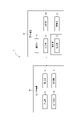
- FIG. 1 is a diagram showing a schematic configuration of an information processing system according to an embodiment of the present disclosure
- FIG. 2 is a functional block diagram showing the configuration of the information processing system shown in FIG. 1
- FIG. FIG. 4 is a diagram schematically showing the configuration of a leg
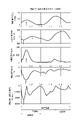
- It is a figure for demonstrating a walking cycle. It is a graph of the angle of the knee joint etc. of the test subject with a large load applied to the knee joint. It is a graph of the angle of the knee joint etc. of the test subject with a small load applied to the knee joint. It is a graph of the angular velocity of the thigh of a subject with a large load applied to the knee joint.
- FIG. 4 is a diagram showing the distribution of load applied to the knee joint with respect to the angular velocity of the thigh; 4 is a graph of the angular velocity of the knee joint of a subject with a large load applied to the knee joint. 4 is a graph of the angular velocity of the knee joint of a subject with a small load applied to the knee joint.
- FIG. 4 is a diagram showing the distribution of load applied to the knee joint with respect to the angular velocity of the ankle; 2 is a flowchart showing operations of evaluation processing executed by the electronic device shown in FIG. 1; FIG.
- FIG. 3 is a functional block diagram showing the configuration of an information processing system according to another embodiment of the present disclosure
- FIG. FIG. 15 is a sequence diagram showing operations of evaluation processing executed by the information processing system shown in FIG. 14
- FIG. 15 is a sequence diagram showing operations of evaluation processing executed by the information processing system shown in FIG. 14;
- the "local coordinate system” is a coordinate system based on the position of the sensor device.
- the local coordinate system is composed of, for example, three mutually orthogonal axes.
- the three axes forming the local coordinate system are parallel to the front-back direction, the left-right direction, and the up-down direction as viewed from the sensor device.
- the "global coordinate system” is a coordinate system based on the position in the space where the user walks.
- the global coordinate system is composed of, for example, three mutually orthogonal axes.
- the three axes forming the global coordinate system are parallel to the front-rear direction, the left-right direction, and the up-down direction as seen from the user.
- An information processing system 1 as shown in FIG. 1 can evaluate the load applied to the user's knee joints during walking.
- the information processing system 1 includes a first sensor device 10A, a second sensor device 10B, and an electronic device 20.
- the information processing system 1 may not include the second sensor device 10B.
- the information processing system 1 replaces either the first sensor device A and the second sensor device 10B, replaces the first sensor device A and the second sensor device 10B, or replaces the first sensor device A and the second sensor device 10B.
- a third sensor device 10C may be included.
- the first sensor device 10A, the second sensor device 10B, and the third sensor device 10C are also collectively referred to as the "sensor device 10".
- the sensor device 10 and the electronic device 20 can communicate via a communication line.
- the communication line includes at least one of wired and wireless.
- the first sensor device 10A is located at a location where data indicating the movement of the user's thigh can be detected. In this embodiment, the first sensor device 10A is positioned at a location where data indicating the movement of the left thigh of the user's two thighs can be detected. However, of the two thighs of the user, the first sensor device 10A may be located at a location where data indicating movement of the right thigh can be detected, or the movement of both thighs can be detected. It may be located where the indicated data can be detected.
- the first sensor device 10A is worn, for example, on the user's thigh. In this embodiment, the first sensor device 10A is worn on the left thigh of the user's two thighs. However, the first sensor device 10A may be worn on the right thigh or both thighs of the user's two thighs.
- the first sensor device 10A may be a wearable device.
- the first sensor device 10A may be worn on the user's thigh by any method.
- the first sensor device 10A may be worn on the user's thigh by a belt.
- the first sensor device 10A may be worn on the thigh by being placed in a pocket of pants worn by the user near the thigh.
- the first sensor device 10A may be worn on the user's thigh by being installed on pants, underwear, shorts, a supporter, an artificial leg, an implant, or the like.
- the first sensor device 10A detects first data regarding the movement of the user's thighs.
- the first data may be data indicating the movement of the user's thighs.
- the first data includes, for example, data indicating at least one of velocity, acceleration, angle, and angular velocity of the user's thigh.
- the first data is, for example, data of a local coordinate system based on the position of the first sensor device 10A.
- a local coordinate system based on the position of the first sensor device 10A is composed of, for example, an axis A1, an axis A2, and an axis A3 as shown in FIG. 3 described later.
- the position of the first sensor device 10A is indicated by a dashed line.
- Axis A1, axis A2, and axis A3 are orthogonal to each other.
- Axis A1 and axis A2 are included, for example, in the sagittal plane.
- the sagittal plane is, for example, a plane that symmetrically divides the user's body or a plane that is parallel to a plane that symmetrically divides the user's body.
- the second sensor device 10B is positioned at a location where data indicating the movement of the user's foot can be detected.
- the foot is the portion from the user's ankle to the toe.
- the second sensor device 10B is positioned at a location where data indicating the movement of the left foot of the user's two feet can be detected.
- the second sensor device 10B may be located at a location where it can detect the data indicating the movement of the right foot of the user's two feet, or may detect the data indicating the movement of both feet. It may be located at a detectable location.
- the second sensor device 10B is worn, for example, on the foot of the user.
- the second sensor device 10B is worn on the left foot of the user's two feet.
- the second sensor device 10B may be worn on the right foot or both of the user's two feet.
- the second sensor device 10B may be a shoe last wearable device.
- the second sensor device 10B may be worn on the user's foot by any method.
- the second sensor device 10B may be provided on the shoe.
- the second sensor device 10B may be attached to the user's foot by being installed on an anklet, band, misanga, false nail, tattoo sticker, supporter, cast, sock, insole, artificial leg, ring, implant, or the like. .
- the second sensor device 10B detects second data regarding the movement of the user's foot.
- the second data may be data indicating the movement of the user's foot.
- the second data includes, for example, data indicating at least one of velocity, acceleration, angle, and angular velocity of the user's foot.
- the second data is, for example, data of a local coordinate system based on the position of the second sensor device 10B.
- the local coordinate system based on the position of the second sensor device 10B is composed of, for example, an axis B1, an axis B2 and an axis B3 as shown in FIG. 3 described later.
- the position of the second sensor device 10B is indicated by dashed lines.
- Axis B1, axis B2, and axis B3 are orthogonal to each other.
- Axis B1 and axis B2 are included, for example, in the sagittal plane.
- the axis B3 intersects the sagittal plane perpendicularly, for example.
- the third sensor device 10C is located at a location where data indicating the movement of the user's ankle can be detected.
- the third sensor device 10C is positioned at a location where data indicating the movement of the left ankle of the user's two ankles can be detected.
- the third sensor device 10C may be located at a location where data indicating movement of the right ankle can be detected, or data indicating movement of both ankles can be detected. can be located in place.
- the third sensor device 10C is worn, for example, on the user's ankle.
- the third sensor device 10C is worn on the left ankle of the user's two ankles.
- the third sensor device 10C may be worn on the right ankle or both ankles of the user's two ankles.
- the third sensor device 10C may be a wearable device.
- the third sensor device 10C may be worn on the user's ankle by a belt.
- the third sensor device 10C may be worn on the user's ankle by any method.
- the third sensor device 10C may be worn on the user's ankle by being placed on an anklet, band, misanga, tattoo sticker, supporter, cast, sock, artificial leg or implant, or the like.
- the third sensor device 10C detects third data regarding the movement of the user's ankle.
- the third data may be data indicating movement of the user's ankle.
- the third data includes, for example, data indicating at least one of velocity, acceleration, angle and angular velocity of the user's ankle.
- the third data is, for example, data of a local coordinate system based on the position of the third sensor device 10C.
- the local coordinate system based on the position of the third sensor device 10C is composed of, for example, axes C1, C2, and C3 as shown in FIG. 3, which will be described later.
- the position of the third sensor device 10C is indicated by a dashed line.
- Axis C1, axis C2, and axis C3 are orthogonal to each other.
- Axis C1 and axis C2 are included in, for example, the sagittal plane.
- Axis C3 intersects the sagittal plane perpendicularly, for example.
- first data detected by the first sensor device 10A the second data detected by the second sensor device 10B, and the third data detected by the third sensor device 10C are not particularly distinguished, they are collectively Also referred to as “data”.
- the electronic device 20 is carried by the user while walking.
- the electronic device 20 functions as an information processing device, and acquires an estimated value of the load applied to the user's knee joint based on the data detected by the sensor device 10 .
- the electronic device 20 is, for example, a mobile device such as a mobile phone, a smart phone, or a tablet.
- the sensor device 10 includes a communication section 11, a sensor section 12, a storage section 13, and a control section .
- the communication unit 11 includes at least one communication module capable of communicating with the electronic device 20 via a communication line.
- the communication module is a communication module conforming to the communication line standard.
- Standards for communication lines are short-range wireless communication standards including, for example, Bluetooth (registered trademark), Wi-Fi (registered trademark), infrared rays, and NFC (Near Field Communication).
- the sensor unit 12 includes arbitrary sensors corresponding to data to be detected by the sensor device 10 .
- the sensor unit 12 includes, for example, at least one of a 3-axis motion sensor, a 3-axis acceleration sensor, a 3-axis velocity sensor, a 3-axis gyro sensor, a 3-axis geomagnetic sensor, and a camera.
- the sensor unit 12 includes a camera, the data indicating the movement of the part of the user's body can be detected by analyzing the image generated by the camera capturing the part of the user's body.
- the storage unit 13 includes at least one semiconductor memory, at least one magnetic memory, at least one optical memory, or a combination of at least two of them.
- the semiconductor memory is, for example, RAM (Random Access Memory) or ROM (Read Only Memory).
- the RAM is, for example, SRAM (Static Random Access Memory) or DRAM (Dynamic Random Access Memory).
- the ROM is, for example, EEPROM (Electrically Erasable Programmable Read Only Memory) or the like.
- the storage unit 13 may function as a main storage device, an auxiliary storage device, or a cache memory.
- the storage unit 13 stores data used for the operation of the sensor device 10 and data obtained by the operation of the sensor device 10 .
- the storage unit 13 stores system programs, application programs, embedded software, and the like.
- the control unit 14 includes at least one processor, at least one dedicated circuit, or a combination thereof.
- the processor is a general-purpose processor such as a CPU (Central Processing Unit) or a GPU (Graphics Processing Unit), or a dedicated processor specialized for specific processing.
- the dedicated circuit is, for example, FPGA (Field-Programmable Gate Array) or ASIC (Application Specific Integrated Circuit).
- the control unit 14 executes processing related to the operation of the sensor device 10 while controlling each unit of the sensor device 10 .
- the control unit 14 receives a signal instructing the start of data detection from the electronic device 20 by the communication unit 11 . When the control unit 14 receives this signal, it starts data detection. For example, the control unit 14 acquires data detected by the sensor unit 12 from the sensor unit 12 . The control unit 14 transmits the acquired data to the electronic device 20 through the communication unit 11 .
- the control unit 14 acquires data from the sensor unit 12 at preset time intervals, and transmits the acquired data through the communication unit 11 .
- This time interval may be set based on a typical user's walking speed or the like. This time interval may be the same for the first sensor device 10A and the second sensor device 10B when the information processing system 1 includes the first sensor device 10A and the second sensor device 10B. Since the time interval is the same between the first sensor device 10A and the second sensor device 10B, the timings of detecting data by the first sensor device 10A and the second sensor device 10B can be synchronized.
- the information processing system 1 includes the third sensor device 10C in addition to the first sensor device 10A and the like, this time interval may be the same for the first sensor device 10A and the third sensor device 10C. That is, this time interval may be the same for all sensor devices 10 included in the information processing system 1 .
- the electronic device 20 includes a communication unit 21, an input unit 22, a notification unit that notifies information, a storage unit 24, and a control unit 25.
- the notification unit is the output unit 23 .
- the notification unit is not limited to the output unit 23 .
- the communication unit 21 includes at least one communication module capable of communicating with the sensor device 10 via a communication line.
- the communication module is a communication module conforming to the communication line standard.
- the communication line standard is, for example, a short-range wireless communication standard including Bluetooth (registered trademark), Wi-Fi (registered trademark), infrared rays, NFC, and the like.
- the communication unit 21 may further include at least one communication module connectable to the network 2 as shown in FIG. 14 which will be described later.
- the communication module is, for example, a communication module compatible with mobile communication standards such as LTE (Long Term Evolution), 4G (4th Generation), or 5G (5th Generation).
- the input unit 22 can accept input from the user.
- the input unit 22 includes at least one input interface capable of accepting input from the user.
- the input interface is, for example, a physical key, a capacitive key, a pointing device, a touch screen provided integrally with the display, or a microphone.
- the output unit 23 can output data.
- the output unit 23 includes at least one output interface capable of outputting data.
- the output interface is, for example, a display or speaker.
- the display is, for example, an LCD or an organic EL display.
- the storage unit 24 includes at least one semiconductor memory, at least one magnetic memory, at least one optical memory, or a combination of at least two of them.
- a semiconductor memory is, for example, a RAM or a ROM.
- RAM is, for example, SRAM or DRAM.
- ROM is, for example, EEPROM or the like.
- the storage unit 24 may function as a main storage device, an auxiliary storage device, or a cache memory.
- the storage unit 24 stores data used for the operation of the electronic device 20 and data obtained by the operation of the electronic device 20 .
- the storage unit 24 stores system programs, application programs, embedded software, and the like.
- the control unit 25 includes at least one processor, at least one dedicated circuit, or a combination thereof.
- a processor may be a general-purpose processor such as a CPU or GPU, or a dedicated processor specialized for a particular process.
- the dedicated circuit is, for example, FPGA or ASIC.
- the control unit 25 executes processing related to the operation of the electronic device 20 while controlling each unit of the electronic device 20 .
- the control unit 25 receives an input instructing execution of the evaluation process through the input unit 22 .
- This input is an input that causes the electronic device 20 to execute processing for evaluating the load applied to the knee joint.
- This input is input from the input unit 22 by a user wearing the sensor device 10, for example. The user inputs this input from the input unit 22, for example, before starting walking.
- the control unit 25 transmits a signal instructing the start of data detection to the sensor device 10 through the communication unit 21 .
- the control unit 25 sends a signal instructing the start of data detection to the first sensor device 10A and the second sensor device 10B as a broadcast signal. You may transmit by the communication part 21.
- FIG. By transmitting a signal instructing the start of data detection as a broadcast signal to the first sensor device 10A and the second sensor device 10B, the plurality of sensor devices 10 can simultaneously start data detection.
- the control unit 14 broadcasts a signal instructing the start of data detection to the first sensor device 10A and the like as a broadcast signal. You may transmit by the communication part 21 to 3 sensor apparatus 10C. That is, the control unit 14 may transmit, as a broadcast signal, a signal instructing start of data detection to all the sensor devices 10 included in the information processing system 1 by the communication unit 21 .
- the control unit 25 receives data detected by the sensor device 10 via the communication unit 21 from the sensor device 10 .
- the control unit 25 acquires data from the sensor device 10 by receiving data from the sensor device 10 .
- the control unit 25 estimates the landing timing of the user's foot, which will be described later, and obtains an estimated value of the load applied to the user's knee joint.
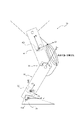
- FIG. 3 schematically shows the structure of the foot.
- the foot 30 is the user's left foot of the user's two feet.
- Foot 30 includes a foot portion 31 , a shin portion 32 , a knee joint 33 and a thigh portion 34 .
- Knee joint 33 is located between shin 32 and thigh 34 .
- the shin 32 and thigh 34 are each considered an axis.
- the load applied to the knee joint 33 is calculated by multiplying the reaction force Fy of the knee joint 33 by the angular velocity ⁇ z of the knee joint 33 .
- the reaction force Fy of the knee joint 33 is force along the axial direction of the shin 32, for example.
- the positive direction of the reaction force Fy of the knee joint 33 is, for example, the direction from the foot 31 toward the knee joint 33 in the axial direction of the shin 32 .
- the reaction force Fy of the knee joint 33 is composed of the force that the knee joint 33 presses against the shin 32 due to the weight of the thigh 34 and the upper body above the waist, and the floor reaction that the shin 32 receives from the ground through the foot 31. It is the sum of the reaction force pressed against the thigh 34 and the tension of the muscle that moves the knee joint 33 . Since these forces act in the negative direction of the reaction force Fy, the direction of these forces becomes the negative direction of the reaction force Fy.
- the muscles that move the knee joint 33 include, for example, the vastus lateralis muscle and the vastus intermedius muscle.
- the angle of the knee joint 33 is expressed as the relative angle of the shin 32 with respect to the thigh 34, with the knee joint 33 being stretched at zero degrees.
- the positive direction of the angle of the knee joint 33 is, for example, the rotational direction from the thigh 34 toward the rear of the user, among the rotational directions about the knee joint 33 in the sagittal plane.
- the angular velocity ⁇ z of the knee joint 33 is the angular velocity of the knee joint 33 in the sagittal plane.
- the positive direction of the angular velocity ⁇ z of the knee joint 33 is the same as the angle of the knee joint 33, for example, among the rotation directions about the knee joint 33 in the sagittal plane, the rotation direction from the thigh 34 toward the rear of the user. is.
- FIG. 4 shows how the user walks.
- the user's left foot is labeled with the letter L.
- the right leg is marked with the letter R.
- FIG. 4 shows how the user walks, from when the left foot lands on the ground to when the left foot lands on the ground again.
- a gait cycle is the period from when one of the user's two feet touches the ground until it touches the ground again.
- the starting point and ending point of the walking cycle are the landing timings of one of the user's two feet.
- the landing timing is the timing at which the foot lands on the ground.
- the gait cycle is the period from when the left foot of the user's two feet lands on the ground to when it lands again.
- a gait cycle includes a stance phase and a swing phase.
- the stance phase is the period from when one of the user's two feet touches the ground until it leaves the ground.
- the starting point of the stance phase is the landing timing of one of the user's two feet.
- the stance phase is the period from when the user's left foot touches the ground to when it leaves the ground.
- the contact period is a period during which at least part of one of the user's two feet is in contact with the ground.
- a contact phase may be a period during which any portion of one of the user's two feet is in contact with the ground.
- the grounding phase is part of the stance phase.
- the contact period is a period from when one of the user's two feet touches the ground until the heel of the one foot leaves the ground.
- the contact period may include a heel contact period.
- the heel contact period is a period during which the heel of one of the user's two feet is in contact with the ground. In FIG. 4, the contact period is the period from when the left foot touches the ground until the heel of the left foot leaves the ground.
- the swing period is the period from when one of the user's two feet leaves the ground until it lands on the ground.
- the starting point of the swing phase is the end point of the stance phase.
- the swing phase is the period from when the left foot of the user leaves the ground until it lands on the ground.
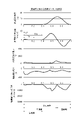
- Figure 5 shows the knee joint angle [deg], knee joint angular velocity [deg/s], vastus lateralis muscle tension [N], knee joint reaction force [N], and knee A graph of the load [N ⁇ deg/s] applied to the joint is shown.
- Figure 6 shows the knee joint angle [deg], knee joint angular velocity [deg/s], vastus lateralis muscle tension [N], knee joint reaction force [N], and knee A graph of the load [N ⁇ deg/s] applied to the joint is shown.
- the horizontal axis in FIGS. 5 and 6 corresponds to the walking cycle.
- the horizontal axis of FIGS. 5 and 6 indicates the walking cycle as a normalized numerical value from 0 to 1.
- FIG. The stance phase corresponds to the period from 0 to 0.75 on the horizontal axis.
- the contact period corresponds to the period from 0 to 0.4 on the horizontal axis.
- the swing phase corresponds to the period from 0.75 to 1 on the horizontal axis.
- the data of the angular velocity of the knee joint, the tension of the vastus lateralis muscle, and the load applied to the knee joint shown in FIGS. 5 and 6 were obtained by inverse dynamics calculation.
- the knee joint angles and knee joint reaction forces shown in FIGS. 5 and 6 were used for inverse dynamics calculations.
- Inverse dynamics calculation is a method of calculating joint angular velocities, muscle strengths, and the like that are required to realize the movement of a subject obtained by measurement.
- the data such as the angle of the knee joint of the subject used for the inverse dynamics calculation is "Yoshiyuki Kobayashi, Naoto Hida, Kanako Nakajima, Masahiro Fujimoto, Masaaki Mochimaru, "2019: AIST Gait Database 2019", [Online], [ Retrieved May 24, 2021], obtained from data provided on the Internet ⁇ https://unit.aist.go.jp/harc/ExPART/GDB2019_e.html>.
- the gait data of a plurality of subjects are registered in this gait database. This subject's walking data was detected by a motion capture system and a floor reaction force meter.
- ⁇ Scott L As a method of inverse dynamics calculation.
- the angle of the knee joint is 0 [deg] or more during the ground contact period from 0 to 0.4 on the horizontal axis.
- the knee joint in the test subject with a large load applied to the knee joint, the knee joint is in a bent state during the contact period.
- the angle of the knee joint has a positive peak value near 0.1 on the horizontal axis during the contact period.
- the angle of the knee joint is maintained at approximately 0 [deg], that is, at a constant value during the contact period from 0 to 0.4 on the horizontal axis.
- the knee joint is maintained in a substantially extended state during the contact period.
- the angular velocity of the knee joint varies from 0 to 0.4 on the horizontal axis during the contact period.
- the angular velocity of the knee joint has a positive peak value near 0.04 on the horizontal axis.
- This positive peak value is the first positive peak value from the landing timing in the angular velocity of the knee joint.
- the angular velocity of the knee joint decreases from around 0.04 to around 0.2 on the horizontal axis.
- the angular velocity of the knee joint has a negative peak value near 0.2 on the horizontal axis. This negative peak value is the first negative peak value from the landing timing in the angular velocity of the knee joint.
- the angular velocity of the knee joint is maintained at approximately 0 [deg/s], ie, a constant value, during the contact period from 0 to 0.4 on the horizontal axis. be.
- the knee joint is in a substantially extended state during the ground contact period, so the angular velocity of the knee joint is maintained at substantially 0 [deg/s].
- the tension of the vastus lateralis muscle exceeds 0 [N] during the ground contact period from 0 to 0.4 on the horizontal axis.
- the knee joint In subjects with a large load applied to the knee joint, the knee joint is in a bent state during the ground contact period, so the tension of the vastus lateralis muscle that moves the knee joint exceeds 0 [N].
- the tension of the vastus lateralis muscle has a positive peak value near 0.1 on the horizontal axis.
- the reaction force of the knee joint varies from 0 to 0.4 on the horizontal axis during the contact period, and the load applied to the knee joint is small as shown in FIG. Shows greater variability than subjects.
- the reaction force of the knee joint varies from the ground reaction force that the knee joint receives from the ground through the foot, etc., to the muscles that move the knee joint, such as the vastus lateralis and vastus intermedius. minus the tension.
- the reaction force of the knee joint has a negative peak value near 0.1 on the horizontal axis where the tension of the vastus lateralis muscle has a positive peak value.
- the reaction force of the knee joint varies from 0 to 0.4 on the horizontal axis during the ground contact period, and the load applied to the knee joint is large as shown in FIG. Shows less variation than subjects.
- the reaction force of the knee joint varies from the ground reaction force that the knee joint receives from the ground through the foot, etc., to the muscles that move the knee joint, such as the vastus lateralis and vastus intermedius. minus the tension.
- the tension of the vastus lateralis muscle is maintained at approximately 0 [N] during the contact period.
- the reaction force of the knee joint is mainly It is affected by the floor reaction force received.
- the load applied to the knee joint is from 0 to 0.4 on the horizontal axis, and the load applied to the knee joint is small as shown in FIG. Shows greater variability than subjects.
- the load applied to the knee joint is calculated by multiplying the reaction force of the knee joint by the angular velocity of the knee joint.
- the load applied to the knee joint has a negative peak value near 0.04 on the horizontal axis where the angular velocity of the knee joint has a positive peak value during the contact period.
- the load applied to the knee joint is maintained at approximately 0 [N deg/s] during the ground contact period from 0 to 0.4 on the horizontal axis. .
- the load applied to the knee joint is calculated by multiplying the reaction force of the knee joint by the angular velocity of the knee joint.
- the angular velocity of the knee joint is maintained at approximately 0 [deg/s] during the ground contact period, so the load applied to the joint is also maintained at approximately 0 [N ⁇ deg/s].
- the load applied to the knee joint has a negative peak value near 0.04 on the horizontal axis where the angular velocity of the knee joint has a positive peak value.
- the load applied to the knee joint is maintained at approximately 0 [deg/s] in the angular velocity of the knee joint, so the load applied to the joint is almost It is maintained at 0 [N ⁇ deg/s].
- the load applied to the knee joint of the user is obtained based on the correlation between the angular velocity of the knee joint during the contact period and the load applied to the knee joint. be able to.
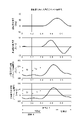
- FIG. 7 shows a graph of the angular velocity [deg/s] of the thigh of a subject with a large load applied to the knee joint.
- FIG. 7 shows a graph of the angular velocity [deg/s] of the subject's thigh in each of the local coordinate system and the global coordinate system.
- FIG. 7 also shows a graph of the knee joint angle [deg] and the knee joint angular velocity [deg/s] shown in FIG.
- FIG. 8 shows a graph of the angular velocity [deg/s] of the thigh of a subject with a small load applied to the knee joint.
- FIG. 8 shows graphs of the angular velocity [deg/s] of the subject's thigh in each of the local coordinate system and the global coordinate system.
- FIG. 8 also shows a graph of the knee joint angle [deg] and the knee joint angular velocity [deg/s] shown in FIG.
- FIGS. 7 and 8 correspond to the walking cycle, like the horizontal axes of FIGS. 5 and 6.
- the thigh angular velocity data shown in FIGS. 7 and 8 are obtained by inverse dynamics calculations in the same or similar manner as the knee joint angular velocity data shown in FIGS.
- the angular velocity of the thigh in the global coordinate system is almost the same as the angular velocity of the thigh in the local coordinate system. That is, the angular velocity of the thigh in the local coordinate system detected by the first sensor device 10A may be used as the angular velocity of the thigh in the global coordinate system.
- the thigh angular velocities in the global coordinate system and the thigh angular velocities in the local coordinate system, they are collectively also described as "thigh angular velocities”.
- the angular velocity of the thigh shows similar fluctuations to the angular velocity of the knee joint.
- the angular velocity of the knee joint decreases from around 0.04 to around 0.2 on the horizontal axis.
- the angular velocity of the thigh decreases from 0 on the horizontal axis, that is, the landing timing, toward 0.2 on the horizontal axis.
- the angular velocity of the thigh has a negative peak value near 0.2 on the horizontal axis, similar to the angular velocity of the knee joint.
- the angular velocity of the thigh shows similar fluctuations to the angular velocity of the knee joint.
- the angular velocity of the knee joint is maintained at approximately 0 [deg/s], that is, at a constant value during the contact period from 0 to 4 on the horizontal axis.
- the angular velocity of the thigh is maintained at a constant negative value during the contact phases from 0 to 4 on the horizontal axis.
- the angular velocity of the thigh shows similar fluctuations to the angular velocity of the knee joint during the contact period.
- the thigh and knee joints move together.
- the angular velocity of the thigh shows similar fluctuations to the angular velocity of the knee joint during the ground contact period
- the angular velocity of the thigh during the ground contact period and the load applied to the knee joint are similar to the angular velocity of the knee joint. , a correlation exists.
- Fig. 9 shows a diagram showing the distribution of the load applied to the knee joint with respect to the angular velocity of the thigh.
- the horizontal axis of FIG. 9 is the negative peak value of the angular velocity of the thigh during the contact period.
- the vertical axis in FIG. 9 is the negative peak value of the load applied to the knee joint during the contact period.
- the correlation coefficient was 0.8. It can be seen that there is a strong correlation between the angular velocity of the thigh during the contact period and the load applied to the knee joint.
- FIG. 10 shows the knee joint angle [deg], ankle angular velocity [deg/s], vastus lateralis muscle tension [N], knee joint reaction force [N], and knee joint angle [deg], ankle angular velocity [deg/s], and knee joint Shows a graph of the load [N deg/s] applied to Among these graphs, the graphs other than the graph of the ankle angular velocity [deg/s] are the same as the graph shown in FIG.
- Fig. 11 shows the knee joint angle [deg], ankle angular velocity [deg/s], vastus lateralis muscle tension [N], knee joint reaction force [N], and knee joint angle [deg], ankle angular velocity [deg/s], and knee joint Shows a graph of the load [N deg/s] applied to Among these graphs, the graphs other than the graph of the ankle angular velocity [deg/s] are the same as the graph shown in FIG.
- FIGS. 10 and 11 correspond to the walking cycle, like the horizontal axes in FIGS.
- the ankle angular velocity data shown in FIGS. 10 and 11 are the same as or similar to the knee joint angular velocity data shown in FIGS. 5 and 6, and are obtained by inverse dynamics calculation.
- the angular velocity of the ankle is the angular velocity of the ankle in the sagittal plane.
- the angular velocity of the ankle fluctuates from 0 to 0.4 on the horizontal axis.
- the angular velocity of the ankle has a negative peak value near 0.04 on the horizontal axis. This negative peak value is the first negative peak value from the landing timing in the angular velocity of the ankle.
- the angular velocity of the ankle increases from around 0.04 to around 0.2 on the horizontal axis.
- the angular velocity of the ankle has a positive peak value near 0.2 on the horizontal axis. This positive peak value is the first positive peak value from the landing timing in the angular velocity of the ankle.
- This change in angular velocity of the ankle is similar to the change in angular velocity of the knee joint shown in FIG.
- the angular velocity of the ankle is maintained at approximately 0 [deg/s], that is, a constant value, during the ground contact period from 0 to 0.4 on the horizontal axis. .
- the knee joint is almost stretched during the contact period. Therefore, the angular velocity of the ankle is maintained at approximately 0 [deg/s]. This change in angular velocity of the ankle is similar to the change in angular velocity of the knee joint shown in FIG.
- the angular velocity of the ankle during the contact period exhibits fluctuations similar to the angular velocity of the knee joint shown in FIGS.
- One reason for this is that the ankle and knee joints move together.
- the angular velocity of the knee joint during the contact period there is a correlation between the angular velocity of the knee joint during the contact period and the load applied to the knee joint. Since the angular velocity of the ankle exhibits similar fluctuations to the angular velocity of the knee joint during the contact period, there is a correlation between the angular velocity of the ankle during the contact period and the load applied to the knee joint, similar to the angular velocity of the knee joint. exist.
- FIG. 12 shows a diagram showing the distribution of the load applied to the knee joint with respect to the angular velocity of the ankle.
- the horizontal axis of FIG. 12 is the negative peak value of the ankle angular velocity during the contact period.
- the vertical axis of FIG. 12 is the negative peak value of the load applied to the knee joint during the contact period.
- the correlation coefficient was 0.6456. It can be seen that there is a strong correlation between the angular velocity of the ankle during the contact period and the load applied to the knee joint.
- the control unit 25 estimates the landing timing of the user's foot and acquires the user's reference angular velocity based on at least the first data.
- the reference angular velocity is the angular velocity of the thigh or the angular velocity of the knee joint during the contact period. As described above, the angular velocity of the thigh or the angular velocity of the knee joint during the contact period has a correlation with the load applied to the knee joint. Therefore, the reference angular velocity has a correlation with the load applied to the knee joint.
- the control unit 25 acquires an estimated value of the load applied to the user's knee joint calculated based on the correlation between the reference angular velocity and the load applied to the knee joint and the user's reference angular velocity.
- the control unit 25 may use, as the correlation, a regression equation obtained from the distribution shown in FIG. good.
- the control unit 25 obtains the estimated value by calculating the estimated value of the load applied to the knee joint based on the obtained reference angular velocity of the user and the regression equation.
- the learning model is, for example, a neural network learning model.
- the learning model may calculate and output a score indicating an estimated value of the load applied to the knee joint when information on the reference angular velocity is input.
- the control unit 25 inputs the acquired information of the user's reference angular velocity into the learning model, and acquires the score indicating the estimated value of the load applied to the knee joint calculated by the learning model.
- the regression equation or learning model is, for example, acquired in advance and stored in the storage unit 24 .
- the reference angular velocity is the angular velocity of the thigh and an example in which the reference angular velocity is the angular velocity of the knee joint will be described below.
- the reference angular velocity may be the angular velocity of the thigh during the contact period. That is, the control unit 25 controls the user's knee joint based on the correlation between the angular velocity of the thigh during the contact period and the load applied to the knee joint, and the angular velocity of the user's thigh during the contact period. You may obtain an estimate of the load on the . In this case, the control unit 25 estimates the landing timing of the user based on at least the first data, and acquires the angular velocity of the user's thigh during the ground contact period. The control unit 25 may acquire the angular velocity of the user's thigh according to the correlation.
- control unit 25 may use the correlation between the negative peak value of the angular velocity of the thigh during the contact period and the load applied to the knee joint. In this case, the control unit 25 acquires the negative peak value of the angular velocity of the user's thigh during the contact period as the angular velocity of the user's thigh according to the correlation. For example, the control unit 25 estimates the landing timing based on the first data or the second data, as will be described later. After estimating the landing timing, the control unit 25 acquires the first negative peak value of the angular velocity of the thigh of the user from the landing timing only by the first data. As can be seen from FIG.
- the first negative peak value of the thigh angular velocity from the landing timing becomes the negative peak value of the thigh angular velocity in the ground contact period.
- the negative peak value of the angular velocity of the thigh may not appear in the ground contact period. In this case, it is expected that the negative peak value of the thigh angular velocity cannot be obtained during the contact period. Therefore, if the negative peak value of the angular velocity of the thigh cannot be acquired within the first time T1a from the landing timing as shown in FIG. The angular velocity of the thigh may be obtained with the first data.
- the first time T1a may be set based on, for example, the average value of the length of the contact period.
- the second time T2 may be set based on, for example, the average value of the time from the landing timing to the appearance of a negative peak value in the angular velocity of the thigh.
- control unit 25 may use the correlation between the angular velocity of the thigh at the landing timing and the load applied to the knee joint. In this case, the control unit 25 acquires the angular velocity of the user's thigh at the landing timing as the angular velocity of the user's thigh according to the correlation. For example, the control unit 25 estimates the landing timing based on the first data or the second data, as will be described later. After estimating the landing timing, the control unit 25 obtains the angular velocity of the user's thigh at the landing timing based only on the first data.
- the control unit 25 may estimate the landing timing based only on the first data.
- the control unit 25 may estimate the landing timing by estimating the floor reaction force based on at least one of the thigh acceleration and the thigh angular velocity included in the first data.
- a user's thigh receives a floor reaction force from the ground via the foot or the like.
- the acceleration of the thighs and the angular velocity of the thighs fluctuate as the floor reaction force fluctuates.
- the variation in the floor reaction force can be estimated from the variation in at least one of the acceleration of the thigh and the angular velocity of the thigh.
- the floor reaction force varies as the user's foot lands on the ground. That is, the landing timing can be estimated by estimating the variation in the floor reaction force based on at least one of the acceleration of the thigh and the angular velocity of the thigh.
- the control unit 25 may estimate the landing timing based on the second data. Since the second data is data indicating the movement of the foot, it is possible to estimate the landing timing, which is the timing at which the foot touches the ground, based on the second data. By using the second data indicating the movement of the foot, it is possible to accurately estimate the landing timing.
- the control unit 25 Upon acquiring the angular velocity of the user's thigh, the control unit 25 acquires an estimated value of the load applied to the user's knee joint based on the correlation and the acquired angular velocity of the user's thigh.
- the control unit 25 may use, as the correlation, a regression formula obtained from the distribution of the load applied to the knee joint with respect to the angular velocity of the thigh as shown in FIG. In this case, the control unit 25 obtains the estimated value by calculating the estimated value of the load applied to the knee joint based on the obtained angular velocity of the thigh of the user and the regression equation.
- control unit 25 may use a learning model that has learned the correlation between the angular velocity of the thigh and the load applied to the knee joint as the correlation.
- the learning model may calculate and output a score indicating an estimated value of the load applied to the knee joint when information on the angular velocity of the thigh is input.
- the control unit 25 inputs the obtained information on the angular velocity of the user's thigh to the learning model, and obtains the score indicating the estimated value of the load applied to the knee joint calculated by the learning model.
- the reference angular velocity may be the angular velocity of the knee joint during the contact period. That is, the control unit 25 controls the load applied to the knee joint of the user based on the correlation between the angular velocity of the knee joint during the contact period and the load applied to the knee joint, and the angular velocity of the knee joint during the contact period of the user. An estimate of the load may be obtained. In this case, the control unit 25 estimates the landing timing of the user based on at least the first data, and acquires the angular velocity of the knee joint during the ground contact period of the user. The control unit 25 may acquire the angular velocity of the user's knee joint according to the correlation.
- control unit 25 may use the correlation between the positive or negative peak value of the angular velocity of the knee joint in the contact period and the load applied to the knee joint. In this case, the control unit 25 acquires the positive or negative peak value of the angular velocity of the user's knee joint in the contact period as the angular velocity of the user's knee joint according to the correlation. For example, the control unit 25 estimates the landing timing based on the first data or the second data, as described above. After estimating the landing timing, the control unit 25 obtains the first positive or negative peak value of the angular velocity of the user's knee joint from the landing timing based on the data detected by the sensor device 10 . As can be seen from FIG.
- the first positive or negative peak value of the knee joint angular velocity from the landing timing becomes the positive or negative peak value of the knee joint angular velocity in the ground contact period.
- the control unit 25 may acquire the angular velocity of the user's knee joint from the first data and the second data, as will be described later.
- the positive and negative peak values of the angular velocity of the knee joint may not appear during the ground contact period. In this case, it is expected that the positive and negative peak values of the angular velocity of the knee joint cannot be obtained during the contact period.
- the control unit 25 cannot acquire the positive peak value of the angular velocity of the knee joint within the first time T1b from the landing timing as shown in FIG.
- the angular velocity of the user's knee joint when the third time T3 has elapsed from the landing timing may be acquired from the first data or the second data.
- the first time T1b may be set based on, for example, the average length of the contact period.
- the first time T1b may be the same as the first time T1a as shown in FIG. 8, or may be different from the first time T1a as shown in FIG.
- the third time T3 may be set based on, for example, the average value of the time from the landing timing to the appearance of a positive peak value in the angular velocity of the knee joint. Further, when the negative peak value of the angular velocity of the knee joint is adopted, the control unit 25 cannot acquire the negative peak value of the angular velocity of the knee joint within the first time T1b from the landing timing as shown in FIG. In this case, the angular velocity of the user's knee joint when the fourth time T4 has elapsed from the landing timing may be acquired from the first data or the second data.
- the fourth time T4 may be set based on, for example, the average value of the time from the landing timing until the negative peak value appears in the angular velocity of the knee joint.
- control unit 25 may use the correlation between the angular velocity of the knee joint at the landing timing and the load applied to the knee joint. In this case, the control unit 25 acquires the angular velocity of the user's knee joint at the landing timing as the angular velocity of the user's knee joint according to the correlation. For example, the control unit 25 estimates the landing timing based on the first data or the second data, as described above. After estimating the landing timing, the control unit 25 acquires the angular velocity of the user's knee joint at the landing timing based on the data detected by the sensor device 10 . The control unit 25 may acquire the angular velocity of the user's knee joint from the first data and the second data, as will be described later.
- control unit 25 may estimate and acquire the angular velocity of the user's knee joint based on the first data and the second data. As shown in FIG. 3, the knee joint is located between the thigh and the foot. Since the knee joint is positioned between the thigh and the foot, the angular velocity of the knee joint can be estimated from the first data indicating the movement of the thigh and the second data indicating the movement of the foot. can.
- the control unit 25 After acquiring the angular velocity of the knee joint, acquires an estimated value of the load applied to the user's knee joint based on the correlation and the acquired angular velocity of the user's knee joint.
- the control unit 25 may use, as the correlation, a regression equation obtained from the distribution of the load applied to the knee joint with respect to the angular velocity of the knee joint. In this case, the control unit 25 acquires the estimated value by calculating the estimated value of the load applied to the knee joint based on the acquired angular velocity of the user's knee joint and the regression equation.
- the control unit 25 may use, as the correlation, a learning model that learns the correlation between the angular velocity of the knee joint and the load applied to the knee joint.
- the learning model may calculate and output a score indicating an estimated value of the load applied to the knee joint when information on the angular velocity of the knee joint is input.
- the control unit 25 inputs the obtained information on the angular velocity of the user's knee joint to the learning model, and obtains the score indicating the estimated value of the load applied to the knee joint calculated by the learning model.
- the reference angular velocity may be the angular velocity of the ankle within the contact period.
- the reference angular velocity is the angular velocity of the ankle during the contact period.
- the control unit 25 estimates the landing timing of the user's foot and acquires the angular velocity of the user's ankle based on at least the third data.
- the control unit 25 estimates the load applied to the knee joint of the user based on the correlation between the angular velocity of the ankle during the contact period and the load applied to the knee joint, and the angular velocity of the ankle during the contact period of the user. to get The control unit 25 may acquire the angular velocity of the user's ankle according to the correlation.
- control unit 25 may use the correlation between the positive or negative peak value of the angular velocity of the ankle during the contact period and the load applied to the knee joint. In this case, the control unit 25 acquires the positive or negative peak value of the angular velocity of the user's ankle in the contact period as the angular velocity of the user's ankle according to the correlation. For example, the control unit 25 estimates the landing timing based on the first data or the second data, as described above. After estimating the landing timing, the control unit 25 acquires the first positive or negative peak value of the angular velocity of the user's knee joint from the landing timing based on the third data detected by the third sensor device 10C. As can be seen from FIG.
- the initial positive or negative peak value of the ankle angular velocity from the landing timing becomes the positive or negative peak value of the ankle angular velocity in the contact period.
- the positive and negative peak values of the ankle angular velocity may not appear in the ground contact period. In this case, it is expected that the positive and negative peak values of the ankle angular velocity cannot be obtained during the contact period. Therefore, when the negative peak value of the angular velocity of the ankle is adopted, the control unit 25 can obtain the positive peak value of the angular velocity of the knee joint within the first time T1c from the landing timing as shown in FIG.
- the angular velocity of the user's ankle when the fifth time T5 has elapsed from the landing timing may be acquired from the third data.
- the first time T1c may be set based on, for example, the average length of the contact period.
- the first time T1c may be the same as the first time T1a as shown in FIG. 8, or may be different from the first time T1a as shown in FIG.
- the fifth time T5 may be set based on, for example, the average value of the time from the landing timing until the negative peak value appears in the angular velocity of the ankle. Further, when the positive peak value of the ankle angular velocity is adopted, the control unit 25 cannot obtain the positive peak value of the ankle angular velocity within the first time T1c from the landing timing as shown in FIG.
- the angular velocity of the user's ankle when the sixth time T6 has elapsed from the landing timing may be acquired from the third data.
- the sixth time T6 may be set based on, for example, the average value of the time from the landing timing to the appearance of a positive peak value in the angular velocity of the ankle.
- control unit 25 may use the correlation between the angular velocity of the ankle at landing timing and the load applied to the knee joint. In this case, the control unit 25 acquires the angular velocity of the user's ankle at the landing timing as the angular velocity of the user's ankle according to the correlation. For example, the control unit 25 estimates the landing timing based on the first data or the second data, as described above. After estimating the landing timing, the control unit 25 acquires the angular velocity of the user's ankle at the landing timing based on the third data detected by the third sensor device 10C.
- control unit 25 may estimate the landing timing based on the third data. Since the third data is data indicating the movement of the ankle, it is possible to estimate the landing timing, which is the timing at which the foot touches the ground, based on the third data. By using the third data indicating the movement of the ankle, it is possible to accurately estimate the landing timing.
- the control unit 25 Upon acquiring the angular velocity of the ankle, acquires an estimated value of the load applied to the user's knee joint based on the correlation and the acquired angular velocity of the user's ankle.
- the control unit 25 may use, as the correlation, a regression equation obtained from the distribution of the load applied to the knee joint with respect to the angular velocity of the ankle. In this case, the control unit 25 acquires the estimated value by calculating the estimated value of the load applied to the knee joint based on the acquired angular velocity of the user's ankle and the regression equation.
- the control unit 25 may use, as the correlation, a learning model that learns the correlation between the angular velocity of the ankle and the load applied to the knee joint.
- the learning model may calculate and output a score indicating an estimated value of the load applied to the knee joint when information on the angular velocity of the ankle is input.
- the control unit 25 inputs the obtained information on the angular velocity of the user's ankle to the learning model, and obtains the score indicating the estimated value of the load applied to the knee joint calculated by the learning model.
- the control unit 25 may cause the output unit 23 as a notification unit to notify information indicating the estimated value of the load applied to the user's knee joint.
- the control unit 25 may cause the output unit 23 as the notification unit to notify information indicating the score.
- the control unit 25 may cause the output unit 23 to output information indicating the estimated value or score of the load applied to the knee joint.
- control unit 25 may cause the speaker of the output unit 23 to output information indicating the estimated value of the load applied to the knee joint of the user or information indicating the score as voice.
- the control unit 25 may cause the speaker of the output unit 23 to output information indicating the estimated value of the load applied to the knee joint of the user or information indicating the score as voice.
- the control unit 25 may transmit a signal indicating the estimated value or score of the load applied to the user's knee joint to the external device via the communication unit 21 .
- the control unit 25 transmits a signal indicating the estimated value or score of the load applied to the knee joint to the earphone as an external device through the communication unit 21 .
- information indicating the estimated value or score of the load applied to the knee joint is output as voice from the earphone worn by the user.
- the control unit 25 may cause the storage unit 24, for example, to accumulate the estimated value of the load applied to the user's knee joint for a preset period of time. The set period may be set based on, for example, the frequency with which the user walks.
- the control unit 25 may determine whether the accumulated estimated value exceeds the threshold. If the control unit 25 determines that the accumulated estimated value exceeds the threshold value, the control unit 25 may cause the output unit 23 as the notification unit to notify information indicating a warning. As an example of notification, the control unit 25 may cause the output unit 23 to output information indicating a warning.
- the threshold may be set based on the amount of load that can accumulate in the knee joint, thereby causing knee joint ailments. The information indicating the warning is notified by the output unit 23 as the notification unit, so that the user can recognize that the load accumulated in the knee joint is to some extent large.
- the communication unit 21 may transmit a warning signal to the external device.
- the control unit 25 causes the communication unit 21 to transmit a signal indicating a warning to the earphone as an external device.
- the information indicating the warning is output as sound from the earphone worn by the user.
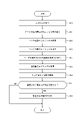
- FIG. 13 is a flowchart showing operations of evaluation processing executed by the electronic device 20 shown in FIG. This operation corresponds to an example of the information processing method according to this embodiment.
- the control unit 25 starts the evaluation process from step S10.
- the reference angular velocity is assumed to be the angular velocity of the thigh during the contact period.
- the control unit 25 obtains an estimated value of the load applied to the user's knee joint using a learning model that has learned the correlation between the angular velocity of the thigh during the contact period and the load applied to the knee joint. do.
- the control unit 25 receives an input instructing execution of the evaluation process through the input unit 22 (step S10). This input is input from the input unit 22 by the user wearing the sensor device 10 .
- the control unit 25 transmits a signal instructing the start of data detection to the first sensor device 10A through the communication unit 21 (step S11).
- the control unit 25 sends a signal instructing the start of data detection to the first sensor device 10A and the second sensor device 10B as a broadcast signal. You may transmit by the communication part 21.
- FIG. After the process of step S ⁇ b>11 is executed, data detected by the sensor device 10 is transmitted from the sensor device 10 to the electronic device 20 .
- the control unit 25 receives the data detected by the sensor device 10 through the communication unit 21 (step S12).
- the control unit 25 estimates the landing timing of the user based on the data received in the process of step S12 (step S13).
- the control unit 25 acquires the angular velocity of the user's thigh during the contact period (step S14).
- control unit 25 By inputting the angular velocity of the user's thigh obtained in step S14 into the learning model, the control unit 25 obtains a score indicating an estimated value of the load applied to the user's knee joint (step S15). In the process of step S15, the control unit 25 causes the storage unit 24 to store the estimated value indicated by the score.
- the control unit 25 causes the output unit 23 as a notification unit to notify the information indicating the score acquired in the process of step S15 (step S16).
- the control unit 25 determines whether or not the accumulated estimated value exceeds the threshold (step S17). If the controller 25 determines that the accumulated estimated value exceeds the threshold (step S17: YES), the process proceeds to step S18. On the other hand, if the controller 25 does not determine that the accumulated estimated value exceeds the threshold (step S17: NO), it ends the evaluation process.
- control unit 25 causes the output unit 23 as a notification unit to notify information indicating a warning. After executing the process of step S18, the control unit 25 ends the evaluation process.
- control unit 25 may re-execute the evaluation process at any time interval. This time interval may be set based on a typical user's walking speed or the like.
- the control unit 25 may start from the process of step S11. The control unit 25 may repeatedly execute the evaluation process until an input instructing termination of the evaluation process is received from the input unit 22 . This input is input from the input unit 22 by the user, for example. The user inputs this input from the input unit 22, for example, after finishing walking.
- the control unit 25 estimates the landing timing of the user based on at least the first data, and acquires the estimated value of the load applied to the knee joint of the user.
- the control unit 25 estimates the landing timing of the user based on at least the first data, and acquires the estimated value of the load applied to the knee joint of the user.
- the reference angular velocity may be the angular velocity of the thigh during the contact period. That is, the control unit 25 controls the user's knee joint based on the correlation between the angular velocity of the thigh during the contact period and the load applied to the knee joint, and the angular velocity of the user's thigh during the contact period. You may obtain an estimate of the load on the . In this case, the control unit 25 may estimate the landing timing based only on the first data detected by the first sensor device 10A. The control unit 25 may acquire the angular velocity of the thigh of the user based only on the first data detected by the first sensor device 10A.
- the reference angular velocity may be the angular velocity of the knee joint during the contact period. That is, the control unit 25 controls the load applied to the knee joint of the user based on the correlation between the angular velocity of the knee joint during the contact period and the load applied to the knee joint, and the angular velocity of the knee joint during the contact period of the user. An estimate of the load may be obtained. As described above with reference to FIG. 3, the load applied to the knee joint is calculated by multiplying the reaction force of the knee joint by the angular velocity of the knee joint. There is a stronger correlation between the angular velocity of the knee joint and the load on the knee joint than, for example, between the angular velocity of the thigh and the load on the knee joint. Therefore, by using the correlation between the angular velocity of the knee joint in the contact period and the load applied to the knee joint, the estimated value of the load applied to the user's knee joint can be obtained with higher accuracy.
- walking has attracted attention as a simple form of exercise.
- a walking user is required to pay attention to obstacles in front of or nearby.
- a walking user may not be able to pay attention to their posture by requiring them to pay attention to obstacles in front of them or nearby. If the user cannot pay attention to his or her posture while walking, the user may walk in an incorrect posture without realizing it. If the user walks in an incorrect posture, an excessive load may be applied to the user's knee joints. If the user continues to walk while the load applied to the knee joint is excessive, the user's knee joint may develop a disease such as osteoarthritis of the knee.
- the control unit 25 can cause the output unit 23 or the like to output information indicating the estimated value or score of the load applied to the user's knee joint.
- the user can grasp whether or not the load applied to the knee joint of the user is large. Since the user can grasp whether or not the load applied to his/her own knee joint is large, the possibility of the user continuing walking in a state where the load applied to the knee joint is excessive is reduced. By reducing the possibility of the user continuing to walk with an excessive load applied to the knee joint, the possibility of developing a disease such as knee osteoarthritis in the user's knee joint is reduced.
- FIG. 14 is a functional block diagram showing the configuration of an information processing system 101 according to another embodiment of the present disclosure.
- the information processing system 101 includes a sensor device 10, an electronic device 20, and a server 40.
- the server 40 functions as an information processing device and evaluates the load applied to the user's knee joints.
- the electronic device 20 and the server 40 can communicate via the network 2.
- the network 2 may be any network including mobile communication networks, the Internet, and the like.
- the control unit 25 of the electronic device 20 receives data detected by the sensor device 10 from the sensor device 10 via the communication unit 21 in the same or similar manner as the information processing system 1 .
- the control unit 25 transmits data detected by the sensor device 10 to the server 40 via the network 2 using the communication unit 21 .
- the server 40 is, for example, a server belonging to a cloud computing system or other computing system.
- the server 40 has a communication section 41 , a storage section 42 and a control section 43 .
- the communication unit 41 includes at least one communication module connectable to the network 2.
- the communication module is, for example, a communication module conforming to a standard such as wired LAN (Local Area Network) or wireless LAN.
- the communication unit 41 is connected to the network 2 via a wired LAN or wireless LAN by a communication module.
- the storage unit 42 includes at least one semiconductor memory, at least one magnetic memory, at least one optical memory, or a combination of at least two of them.
- a semiconductor memory is, for example, a RAM or a ROM.
- RAM is, for example, SRAM or DRAM.
- ROM is, for example, EEPROM or the like.
- the storage unit 42 may function as a main storage device, an auxiliary storage device, or a cache memory.
- the storage unit 42 stores data used for the operation of the server 40 and data obtained by the operation of the server 40 .
- the storage unit 42 stores system programs, application programs, embedded software, and the like.
- the control unit 43 includes at least one processor, at least one dedicated circuit, or a combination thereof.
- a processor may be a general-purpose processor such as a CPU or GPU, or a dedicated processor specialized for a particular process.
- the dedicated circuit is, for example, FPGA or ASIC.
- the control unit 43 executes processing related to the operation of the server 40 while controlling each unit of the server 40 .
- the control unit 43 uses the communication unit 41 to receive data detected by the sensor device 10 from the electronic device 20 via the network 2 .
- the control unit 43 acquires the data detected by the sensor device 10 by receiving the data detected by the sensor device 10 via the electronic device 20 .
- the control unit 43 acquires an estimated value of the load applied to the user's knee joint by executing the same or similar processing as the processing by the control unit 25 of the electronic device 20 described above. For example, based on at least the first data, the control unit 43 estimates the landing timing of the user and obtains an estimated value of the load applied to the knee joint of the user.
- the control unit 43 uses the communication unit 41 to transmit a signal indicating the estimated value of the load applied to the user's knee joint to the electronic device 20 via the network 2 .
- the control unit 43 may transmit a signal indicating the score to the electronic device 20 via the network 2 by the communication unit 41 .
- the control unit 25 receives the signal indicating the estimated value or the signal indicating the score from the server 40 via the network 2 by the communication unit 21 .
- the control unit 25 causes the output unit 23 as a notification unit to notify the information indicating the estimated value or the information indicating the score.
- the control unit 25 causes the output unit 23 to output information indicating the estimated value or information indicating the score.
- the control unit 43 may cause the storage unit 42, for example, to accumulate the estimated value of the load applied to the user's knee joint for the above set period.
- the control unit 43 may transmit a warning signal to the electronic device 20 via the network 2 by the communication unit 41 .
- the controller 25 receives a warning signal from the server 40 via the network 2 by the communication unit 21 .
- the control unit 25 causes the output unit 23 as a notification unit to notify information indicating a warning. As an example of notification, the control unit 25 causes the output unit 23 to output information indicating a warning.
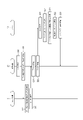
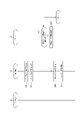
- FIG. 15 and 16 are sequence diagrams showing operations of evaluation processing executed by the information processing system 101 shown in FIG. This operation corresponds to an example of the information processing method according to this embodiment.
- the information processing system 101 starts evaluation processing from step S20 as shown in FIG.
- the reference angular velocity is assumed to be the angular velocity of the thigh during the contact period.
- the control unit 43 obtains an estimated value of the load applied to the knee joint of the user by a learning model that has learned the correlation between the angular velocity of the thigh during the contact period and the load applied to the knee joint. do.
- the control unit 25 receives an input instructing execution of the evaluation process through the input unit 22 (step S20).
- the control unit 25 transmits a signal instructing the start of data detection to the sensor device 10 through the communication unit 21 (step S21).
- the control unit 25 sends a signal instructing the start of data detection as a broadcast signal to the first sensor device 10A and the second sensor device 10B. You may transmit by the communication part 21.
- control unit 14 receives the signal instructing the start of data detection from the electronic device 20 by the communication unit 11 (step S22). When the control unit 14 receives this signal, it starts data detection. The control unit 14 acquires data detected by the sensor unit 12 from the sensor unit 12, and transmits the acquired data to the electronic device 20 through the communication unit 11 (step S23).
- control unit 25 receives data from the sensor device 10 through the communication unit 21 (step S24).
- the control unit 25 transmits the data detected by the sensor device 10 to the server 40 via the network 2 using the communication unit 21 (step S25).
- the control unit 43 receives the data detected by the sensor device 10 from the electronic device 20 via the network 2 by the communication unit 41 (step S26).
- the control unit 43 estimates the landing timing of the user based on the data received in the process of step S26 (step S27).
- the control unit 43 acquires the angular velocity of the user's thigh during the contact period (step S28).
- the control unit 43 acquires a score indicating an estimated value of the load applied to the knee joint of the user by inputting the angular velocity of the user's thigh acquired in the process of step S28 to the learning model (step S29).
- the control unit 43 causes the storage unit 42 to store the estimated value indicated by the score.
- the control unit 43 causes the communication unit 41 to transmit a signal indicating the score to the electronic device 20 via the network 2 (step S30).
- step S30 After executing the process of step S30, the information processing system 101 proceeds to the process of step S31 as shown in FIG.
- control unit 25 receives the signal indicating the score from the server 40 via the network 2 by the communication unit 21 (step S31).
- the control unit 25 causes the output unit 23 as a notification unit to notify the information indicating the score (step S32).
- the control unit 43 determines whether the accumulated estimated value exceeds the threshold (step S33).
- the communication unit 41 transmits a warning signal to the electronic device 20 via the network 2 (step S34). ).
- the information processing system 101 proceeds to the process of step S35.
- the control unit 43 does not determine that the accumulated estimated value exceeds the threshold (step S33: NO)
- the information processing system 101 terminates the evaluation process.
- step S35 the control unit 25 of the electronic device 20 receives a warning signal from the server 40 via the network 2 by the communication unit 21 (step S35).
- the control unit 25 causes the output unit 23 as the notification unit to notify the information indicating the warning (step S36).
- step S36 the information processing system 101 terminates the evaluation process.
- the information processing system 101 may re-execute the evaluation process at any time interval as described above.
- the information processing system 101 may start from the process of step S23.
- the information processing system 101 may repeatedly execute the evaluation process until the electronic device 20 receives from the input unit 22 an input instructing the end of the evaluation process.
- the information processing system 101 can achieve the same or similar effects as the information processing system 1 .
- the communication unit 11 of the sensor device 10 may further include at least one communication module connectable to the network 2 as shown in FIG.
- the communication module is, for example, a communication module compatible with mobile communication standards such as LTE, 4G, or 5G.
- the control unit 15 of the sensor device 10 may transmit data detected by the sensor device 10 to the server 40 via the network 2 using the communication unit 11 .
- a general-purpose computer functions as the electronic device 20 according to this embodiment.
- a program describing processing details for realizing each function of the electronic device 20 according to this embodiment is stored in the memory of a general-purpose computer, and the program is read and executed by the processor. Therefore, the configuration according to this embodiment can also be implemented as a program executable by a processor or a non-transitory computer-readable medium that stores the program.
- Descriptions such as “first” and “second” in this disclosure are identifiers for distinguishing the configurations. Configurations that are differentiated in descriptions such as “first” and “second” in this disclosure may interchange the numbers in that configuration. For example, a first sensor device may exchange the identifiers “first” and “second” with a second sensor device. The exchange of identifiers is done simultaneously. After the exchange of identifiers, the configurations are still distinct. Identifiers may be deleted. Configurations from which identifiers have been deleted are distinguished by codes. The description of identifiers such as “first” and “second” in this disclosure should not be used as a basis for interpreting the ordering of such configurations and the existence of lower numbered identifiers.
- Reference Signs List 1 101 information processing system 2 network 10 sensor device 10A first sensor device 10B second sensor device 10C third sensor device 11 communication unit 12 sensor unit 13 storage unit 14 control unit 20 electronic device 21 communication unit 22 input unit 23 output unit 24 storage section 25 control section 30 foot 31 foot section 32 shin section 33 knee joint 34 thigh section 40 server 41 communication section 42 storage section 43 control section
Landscapes
- Health & Medical Sciences (AREA)
- Life Sciences & Earth Sciences (AREA)
- Engineering & Computer Science (AREA)
- Medical Informatics (AREA)
- Physics & Mathematics (AREA)
- Dentistry (AREA)
- Biophysics (AREA)
- Pathology (AREA)
- Physiology (AREA)
- Biomedical Technology (AREA)
- Heart & Thoracic Surgery (AREA)
- Oral & Maxillofacial Surgery (AREA)
- Molecular Biology (AREA)
- Surgery (AREA)
- Animal Behavior & Ethology (AREA)
- General Health & Medical Sciences (AREA)
- Public Health (AREA)
- Veterinary Medicine (AREA)
- Measurement Of The Respiration, Hearing Ability, Form, And Blood Characteristics Of Living Organisms (AREA)
Priority Applications (1)
| Application Number | Priority Date | Filing Date | Title |
|---|---|---|---|
| JP2023524218A JP7847134B2 (ja) | 2021-05-28 | 2022-05-25 | 情報処理装置、電子機器、情報処理システム、情報処理方法及びプログラム |
Applications Claiming Priority (2)
| Application Number | Priority Date | Filing Date | Title |
|---|---|---|---|
| JP2021090694 | 2021-05-28 | ||
| JP2021-090694 | 2021-05-28 |
Publications (1)
| Publication Number | Publication Date |
|---|---|
| WO2022250098A1 true WO2022250098A1 (ja) | 2022-12-01 |
Family
ID=84229889
Family Applications (1)
| Application Number | Title | Priority Date | Filing Date |
|---|---|---|---|
| PCT/JP2022/021461 Ceased WO2022250098A1 (ja) | 2021-05-28 | 2022-05-25 | 情報処理装置、電子機器、情報処理システム、情報処理方法及びプログラム |
Country Status (2)
| Country | Link |
|---|---|
| JP (1) | JP7847134B2 (https=) |
| WO (1) | WO2022250098A1 (https=) |
Cited By (1)
| Publication number | Priority date | Publication date | Assignee | Title |
|---|---|---|---|---|
| JP7541777B1 (ja) | 2023-08-29 | 2024-08-29 | 国立清華大学 | 歩行モニタリング及び健康管理システム |
Citations (3)
| Publication number | Priority date | Publication date | Assignee | Title |
|---|---|---|---|---|
| JP2017202236A (ja) * | 2016-05-13 | 2017-11-16 | 花王株式会社 | 歩行分析方法及び歩行分析装置 |
| WO2020031253A1 (ja) * | 2018-08-07 | 2020-02-13 | 日本電気株式会社 | 関節障害リスク評価装置、システム、方法およびプログラム |
| WO2020226183A1 (ja) * | 2019-05-08 | 2020-11-12 | 学校法人慶應義塾 | 変形性膝関節症の診断支援指標取得方法、指標、診断支援プログラム及びウェアラブルデバイス |
-
2022
- 2022-05-25 WO PCT/JP2022/021461 patent/WO2022250098A1/ja not_active Ceased
- 2022-05-25 JP JP2023524218A patent/JP7847134B2/ja active Active
Patent Citations (3)
| Publication number | Priority date | Publication date | Assignee | Title |
|---|---|---|---|---|
| JP2017202236A (ja) * | 2016-05-13 | 2017-11-16 | 花王株式会社 | 歩行分析方法及び歩行分析装置 |
| WO2020031253A1 (ja) * | 2018-08-07 | 2020-02-13 | 日本電気株式会社 | 関節障害リスク評価装置、システム、方法およびプログラム |
| WO2020226183A1 (ja) * | 2019-05-08 | 2020-11-12 | 学校法人慶應義塾 | 変形性膝関節症の診断支援指標取得方法、指標、診断支援プログラム及びウェアラブルデバイス |
Cited By (2)
| Publication number | Priority date | Publication date | Assignee | Title |
|---|---|---|---|---|
| JP7541777B1 (ja) | 2023-08-29 | 2024-08-29 | 国立清華大学 | 歩行モニタリング及び健康管理システム |
| JP2025035962A (ja) * | 2023-08-29 | 2025-03-14 | 国立清華大学 | 歩行モニタリング及び健康管理システム |
Also Published As
| Publication number | Publication date |
|---|---|
| JP7847134B2 (ja) | 2026-04-16 |
| JPWO2022250098A1 (https=) | 2022-12-01 |
Similar Documents
| Publication | Publication Date | Title |
|---|---|---|
| JP6387425B2 (ja) | 歩行分析システム及び方法 | |
| JP6881451B2 (ja) | 歩行状態判定装置、歩行状態判定システム、歩行状態判定方法及びプログラム | |
| US20240130691A1 (en) | Measurement device, measurement system, measurement method, and recording medium | |
| JP2009125506A (ja) | 歩容改善支援システム | |
| JP7807576B2 (ja) | マルチモーダルセンサフュージョンプラットフォーム | |
| US20240108249A1 (en) | Detection device, detection method, and program recording medium | |
| US20260088176A1 (en) | Estimation device, estimation system, estimation method, and recording medium | |
| US20240108251A1 (en) | Calculation device, calculation method, and program recording medium | |
| JP6365031B2 (ja) | 活動量測定装置、活動量の測定方法、活動量の測定プログラム | |
| WO2022250098A1 (ja) | 情報処理装置、電子機器、情報処理システム、情報処理方法及びプログラム | |
| JP7370795B2 (ja) | 歩行特徴量検出装置 | |
| WO2022250099A1 (ja) | 情報処理装置、電子機器、情報処理システム、情報処理方法及びプログラム | |
| JP7791450B2 (ja) | 身体状態推定システム及びシューズ | |
| US20230397879A1 (en) | Pelvic inclination estimation device, estimation system, pelvic inclination estimation method, and recording medium | |
| WO2025057641A1 (ja) | 転倒リスク判定装置、転倒リスク判定方法、および、プログラム | |
| WO2023042868A1 (ja) | 情報処理装置、電子機器、情報処理システム、情報処理方法及びプログラム | |
| WO2023163104A1 (ja) | 関節角度学習推測システム、関節角度学習システム、関節角度推測装置、関節角度学習方法、およびコンピュータプログラム | |
| CN117769745A (zh) | 用于向用户提供锻炼程序的方法和系统 | |
| WO2023127013A1 (ja) | 静的バランス推定装置、静的バランス推定システム、静的バランス推定方法、および記録媒体 | |
| JP2016220805A (ja) | 身体特性検出方法、身体特性検出装置、並びにそのプログラム |
Legal Events
| Date | Code | Title | Description |
|---|---|---|---|
| 121 | Ep: the epo has been informed by wipo that ep was designated in this application |
Ref document number: 22811368 Country of ref document: EP Kind code of ref document: A1 |
|
| WWE | Wipo information: entry into national phase |
Ref document number: 2023524218 Country of ref document: JP |
|
| NENP | Non-entry into the national phase |
Ref country code: DE |
|
| 122 | Ep: pct application non-entry in european phase |
Ref document number: 22811368 Country of ref document: EP Kind code of ref document: A1 |