WO2022244767A1 - 光輝性顔料を含む化粧料 - Google Patents
光輝性顔料を含む化粧料 Download PDFInfo
- Publication number
- WO2022244767A1 WO2022244767A1 PCT/JP2022/020519 JP2022020519W WO2022244767A1 WO 2022244767 A1 WO2022244767 A1 WO 2022244767A1 JP 2022020519 W JP2022020519 W JP 2022020519W WO 2022244767 A1 WO2022244767 A1 WO 2022244767A1
- Authority
- WO
- WIPO (PCT)
- Prior art keywords
- pigment
- flake
- cosmetic
- zirconium oxide
- film
- Prior art date
- Legal status (The legal status is an assumption and is not a legal conclusion. Google has not performed a legal analysis and makes no representation as to the accuracy of the status listed.)
- Ceased
Links
Images

Classifications
-
- A—HUMAN NECESSITIES
- A61—MEDICAL OR VETERINARY SCIENCE; HYGIENE
- A61K—PREPARATIONS FOR MEDICAL, DENTAL OR TOILETRY PURPOSES
- A61K8/00—Cosmetics or similar toiletry preparations
- A61K8/18—Cosmetics or similar toiletry preparations characterised by the composition
- A61K8/19—Cosmetics or similar toiletry preparations characterised by the composition containing inorganic ingredients
- A61K8/28—Zirconium; Compounds thereof
-
- A—HUMAN NECESSITIES
- A61—MEDICAL OR VETERINARY SCIENCE; HYGIENE
- A61Q—SPECIFIC USE OF COSMETICS OR SIMILAR TOILETRY PREPARATIONS
- A61Q1/00—Make-up preparations; Body powders; Preparations for removing make-up
- A61Q1/02—Preparations containing skin colorants, e.g. pigments
-
- A—HUMAN NECESSITIES
- A61—MEDICAL OR VETERINARY SCIENCE; HYGIENE
- A61Q—SPECIFIC USE OF COSMETICS OR SIMILAR TOILETRY PREPARATIONS
- A61Q1/00—Make-up preparations; Body powders; Preparations for removing make-up
- A61Q1/12—Face or body powders for grooming, adorning or absorbing
-
- C—CHEMISTRY; METALLURGY
- C09—DYES; PAINTS; POLISHES; NATURAL RESINS; ADHESIVES; COMPOSITIONS NOT OTHERWISE PROVIDED FOR; APPLICATIONS OF MATERIALS NOT OTHERWISE PROVIDED FOR
- C09C—TREATMENT OF INORGANIC MATERIALS, OTHER THAN FIBROUS FILLERS, TO ENHANCE THEIR PIGMENTING OR FILLING PROPERTIES ; PREPARATION OF CARBON BLACK ; PREPARATION OF INORGANIC MATERIALS WHICH ARE NO SINGLE CHEMICAL COMPOUNDS AND WHICH ARE MAINLY USED AS PIGMENTS OR FILLERS
- C09C3/00—Treatment in general of inorganic materials, other than fibrous fillers, to enhance their pigmenting or filling properties
- C09C3/06—Treatment with inorganic compounds
Definitions
- the present invention relates to cosmetics containing pigments, particularly makeup cosmetics containing pigments.
- Appropriate pigments are added to cosmetics according to their type.
- base makeup cosmetics typified by foundations contain extender pigments, color pigments, white pigments, pearlescent pigments, and the like.
- Extender pigments are used to impart spreadability, depositability, and even gloss, and are also used as extenders.
- Color pigments are used to impart basic shades.
- White pigments are used to impart hiding power and whiteness.
- Pearlescent pigments are used to give pearl luster (pearl effect).
- a typical pearlescent pigment is a flake-like substrate having an optical interference film on its surface. Glass, mica, etc. are used as the flake substrate. A titanium oxide film is usually used as the optical interference film.
- Patent Document 1 proposes obtaining strong color development by using a light interference film and metal fine particles.
- red coloration is enhanced by adhering fine gold particles onto a titanium oxide film.
- the enhanced color development is highly useful in imparting local conspicuous bright spots to cosmetics.
- the amount of the pearlescent pigment to be blended varies depending on the application of the cosmetic, but for base makeup cosmetics, it is at most about 8% by mass of the entire cosmetic.
- the glossiness of the entire base makeup cosmetic is adjusted with extender pigments.
- extender pigments there is a limit to how much gloss can be improved only by adjusting with extender pigments.
- conventional pearlescent pigments although they can locally improve gloss on the basis of their high brightness, are not designed to suit the purpose of adjusting the properties of the cosmetic as a whole.
- an object of the present invention is to provide new cosmetics containing improved pigments.
- Luminescent pigments are pigments that can provide brightness enhancement, with or without pearl luster.
- a cosmetic containing a glitter pigment comprises a flake-shaped substrate and a coating containing zirconium oxide on the flake-shaped substrate, Provided is a cosmetic, wherein the thickness of the film is 40 nm or more and 120 nm or less.
- a cosmetic containing a glitter pigment comprises a flake-shaped substrate and a coating containing zirconium oxide on the flake-shaped substrate, further comprising an extender pigment different from the luster pigment,
- a cosmetic containing the luster pigment in a range of 15 to 60% by mass based on the total amount of the luster pigment and the extender pigment.
- a cosmetic that can provide a bright and natural appearance when applied to the skin is provided by an improved luster pigment.
- MMD is an abbreviation for mean deviation of mean friction coefficient (MIU). MMD is an index corresponding to the smoothness of skin feel. The lower the MMD, the better the smoothness of feel. The details of the method for measuring MMD will be described in the Examples section.
- the bright pigment of this embodiment comprises a flake-shaped substrate and a coating containing zirconium oxide on the flake-shaped substrate.
- the film thickness of the coating is 40 nm or more and 120 nm or less.
- Titanium oxide is known as a film-forming material that can achieve vivid colors due to its high refractive index.
- pigments having a film containing titanium oxide may give an unnatural appearance due to excessive brightness and its characteristic interference color when a considerable amount is blended in cosmetics.
- the titanium oxide-containing film is highly colored, making its complementary color easily visible, and the cosmetic may appear slightly dull.
- Coatings containing zirconium oxide are inferior to titanium oxide-containing films in color development and brightness, but are suitable for providing a bright appearance while alleviating the above-described unnaturalness.
- the zirconium oxide-containing film is also suitable for imparting “natural” coloring, specifically, coloring close to human skin, in base makeup cosmetics such as foundation.
- the bright pigment according to the present embodiment has an L* of 30 or more and less than 70, further 35 or more and 68 or less, particularly 40 or more and 65 or less when the reflected color is displayed based on the L * a * b * color system .
- can have The L * of the color reflected by the titanium oxide film is usually above 70.
- the zirconium oxide-containing film can achieve a desired color development particularly for base makeup cosmetics, specifically a color development ranging from silver to yellow to orange. A method for measuring the reflected color will be described in the Examples section.
- a bright pigment having a zirconium oxide-containing film can provide cosmetics with better properties than a bright pigment having a titanium oxide-containing film in terms of feeling on the skin.
- Skin feel is a property that is emphasized in base makeup cosmetics. This favorable property provides a particularly advantageous effect when the bright pigment is blended into the base makeup cosmetic in a substantial amount, for example, at a content of 10% by mass or more.
- the effect of the bright pigment according to the present embodiment is, for example, 1.5 or less, preferably 1.2 or less, more preferably 1.0 or less, still more preferably 0.8 or less, particularly preferably 0.6 or less, and in some cases 0 May have an MMD of 0.5 or less.
- the lower limit of MMD is not particularly limited, it is, for example, 0.01 or more.
- Effect pigments according to this embodiment may have, for example, an MIU of 2.1 or less, preferably 2.0 or less, more preferably 1.5 or less, and in some cases 1.0 or less.
- the lower limit of MIU is not particularly limited, it is, for example, 0.01 or more.
- the amount of the bright pigment to be blended can be, for example, 10% by mass or more, 12% by mass or more in some cases, and 14% by mass or more if necessary, based on the total amount of the cosmetic.
- the bright pigment of the present embodiment may be blended in the cosmetic in a blending amount outside the above range, for example, 3% by mass or more, further 5% by mass or more, particularly 7% by mass or more.
- the upper limit of the compounding amount is not particularly limited, but is, for example, 30% by mass or less, and further 35% by mass or less.
- the flake-like substrate and the coating that constitute the bright pigment will be described below.
- the flake-like substrate is a minute plate-like thin piece, which is also called a scale-like substrate or the like.
- the flaky substrate is, for example, at least one selected from the group consisting of flaky glass, flaky alumina, flaky graphite, flaky iron oxide, flaky titania, bismuth oxychloride, mica, talc, and sericite.
- the flake substrate is preferably flake glass, flake alumina or mica. Mica may be natural mica or synthetic mica. Glass flakes, which are particularly preferred flake substrates, are described below.
- the glass composition that constitutes the glass flakes contains silicon oxide and a metal oxide other than silicon oxide, and is specifically selected from the group consisting of silicon oxide, aluminum oxide, calcium oxide and sodium oxide. At least one may be included. Silicon oxide may be the main component in the glass composition.
- the content of silicon oxide in the glass composition is not particularly limited, but is, for example, 40% by mass or more, 45% by mass or more, and may be 75% by mass or less.
- the glass composition may have a transmission of greater than 60%, or even greater than 70% over the wavelength range of 400-800 nm when converted to a thickness of 100 ⁇ m.
- the glass composition may correspond to at least one selected from the group consisting of soda lime glass, A glass, C glass, E glass, borosilicate glass and aluminosilicate glass. Glass flakes composed of these multi-component glass compositions are suitable for production by a melting method with excellent mass productivity.
- the preferred average particle size of the glass flakes is 1-160 ⁇ m, 2-120 ⁇ m, further 3-100 ⁇ m, and in some cases 5-90 ⁇ m.
- the average particle size of the glass flakes is determined by the particle size (D50) corresponding to 50% of the volume accumulated from the smaller particle size side in the particle size distribution of the light scattering equivalent diameter measured by the laser diffraction method. do.
- a preferred thickness of the glass flakes is 0.1 to 10 ⁇ m, further 0.2 to 3 ⁇ m, and sometimes 0.25 to 2 ⁇ m. If the average particle size and thickness are too large, it will be difficult to obtain a photovolatile pigment with a sufficiently good tactile feel.
- a very good tactile sensation may be obtained from flake-like glass having a thickness of 1 to 2 ⁇ m.
- These numerical ranges are also preferred average particle diameters and thicknesses of flake-shaped substrates other than flake-shaped substrates.
- Glass flakes can be produced, for example, by a blow method.
- the blow method melts the raw material cullet, continuously extracts the molten glass from a circular slit, and inflate the molten glass by blowing gas such as air from the blow nozzle provided inside the circular slit.
- the glass is formed into a balloon shape, and the expanded and thinned glass is pulverized into flakes (scales).
- the glass flakes it is possible to use, for example, commercially available products sold as Glass Flakes (registered trademark) series by Nippon Sheet Glass Co., Ltd.
- glass flakes are superior in smoothness compared to crystalline particles such as mica. For this reason, glass flakes are particularly suitable for achieving a sufficiently low MMD.
- the bright pigment comprises glass flakes and a single-layer zirconium oxide-containing film directly formed on the surface thereof.
- a base film may be formed on the surface of the flake-shaped substrate.
- a coating containing zirconium oxide is formed on the surface of the underlying film.
- the underlayer may be a single layer or multiple layers.
- the underlying film may be a film containing an oxide.
- the zirconium oxide-containing film contains at least zirconium oxide.
- the zirconium oxide-containing film may contain zirconium oxide as a main component.
- a preferred thickness of the zirconium oxide-containing film is 40 to 120 nm, more preferably 60 to 110 nm, especially 80 to 100 nm. If the film thickness is too thin, the brightness will decrease. Color development by the zirconium oxide-containing film can be appropriately adjusted by controlling the film thickness, but as the film thickness increases, it usually shifts from silver to yellow, orange, red, and purple. Color development from silver to orange via yellow is suitable for base makeup cosmetics such as foundations. From this point of view, the film thickness is preferably 120 nm or less. In one preferred form, the surface of the zirconium oxide-containing film is exposed.
- a liquid phase deposition method is suitable for forming a zirconium oxide-containing film on a flake-shaped substrate.
- This liquid phase film forming method is usually carried out by dispersing the flaky substrates in a liquid containing a zirconium-containing salt and stirring the liquid.
- the liquid may be an aqueous solution in which a zirconium-containing salt is dissolved.
- Zirconium-containing salts are, for example, zirconium sulfate, zirconium oxychloride, zirconium ammonium carbonate.
- a pH adjuster such as an acid may be added to the liquid, if necessary. The pH can be adjusted, for example, in the range of 1.9-4.0, further 2.0-3.5.
- the surface on which the film is to be deposited may be pretreated.
- This pretreatment is preferably contact with a liquid containing a tin-containing salt.
- This pretreatment facilitates obtaining a sufficiently low MMD from the zirconium oxide-containing film.
- the liquid containing the tin-containing salt may be an aqueous solution in which the tin-containing salt is dissolved.
- Tin-containing salts are, for example, tin chloride, more particularly tin(II) chloride, tin(IV) chloride, tin(II) chloride dihydrate, tin(IV) chloride pentahydrate.
- Cosmetics The cosmetic of this embodiment contains the bright pigment of this embodiment.
- Cosmetics are not particularly limited, and include basic cosmetics such as skin lotions, milky lotions, and creams, hair care cosmetics such as hair styling agents, body care products such as body creams, body powders, antiperspirants, and sunscreens, bath salts, and the like. but preferably makeup cosmetics such as foundation, mascara, eyeshadow, eyeliner, lipstick, gloss, blush, and manicure.
- Makeup cosmetics may be point makeup cosmetics such as lipsticks and blushes, or may be base makeup cosmetics such as concealers, foundations, and finishing powders.
- the form of cosmetics is not particularly limited, and examples include powders, sticks, pencils, creams, emulsions, dispersions, oils, tablets, capsules, liners, paints, gels, and others.
- the foundation may be cake type, powder type, cream type or liquid type.
- Cosmetics may contain conventionally used components as components other than bright pigments. Components other than the bright pigment are appropriately selected according to the type of cosmetic. Cosmetics may contain pigments other than luster pigments.
- foundations contain extender pigments, coloring pigments, white pigments, and pearlescent pigments.
- the amount of the pearl luster pigment, which only needs to locally impart luster, to the foundation is at most about less than 8% by mass of the total amount of the foundation.
- an extender pigment is usually blended in an amount larger than the above in order to adjust the characteristics of the foundation as a whole.
- Cosmetics may contain the bright pigment of the present embodiment in a small amount, in other words, to the extent that the bright pigment functions as a pearlescent pigment, or in a substantial amount, in other words, the bright pigment is substantially an extender pigment or It may be contained to the extent that it functions as a pigment similar to it.
- the content of the luster pigment may be, for example, 10% by mass or more, particularly 12 to 18% by mass, based on the total amount of the cosmetic.
- the cosmetic may further contain an extender pigment that is different from the bright pigment of the present embodiment.
- the bright pigment may be contained in an amount of 15 to 60%, preferably 20 to 35% by mass, based on the total amount of the bright pigment and the extender pigment.
- the extender pigment is, for example, at least one selected from talc, sericite, mica, calcium carbonate, barium sulfate, magnesium silicate, cerium oxide, magnesium oxide, zeolite, and bentonite.
- the luster pigment of the present embodiment can compensate for the luster that is lacking with these extender pigments alone, while avoiding unnecessary coloring. Blending of the bright pigment of the present embodiment within the above range is suitable for realizing cosmetics capable of providing a bright and natural appearance.
- the luminance L * of reflected light was measured using a colorimeter "CR-400" manufactured by Konica Minolta.
- the sample to be measured is a composition in which a bright pigment is added to a transparent acrylic resin (Nippe Acrylic "Autoclear Super” manufactured by Nippon Paint Co., Ltd. so that it becomes 10% by mass and mixed).
- the composition was applied so that the thickness of the coating film was 9 mil (about 228.6 ⁇ m), and the thickness of the coating film after drying was 70 to 80 ⁇ m.
- the light source used was D65.
- the light source and the measurement surface are black-coated surfaces, and the reflected light measured is vertical reflected light, which is observed using the CIE 2° visual field color matching function.
- the film thickness of the coating and the thickness of the substrate were measured by observing the cross section of the luster pigment using a scanning electron microscope (SEM).
- Average particle size D50 The average particle size of the flake-like substrate was obtained by dispersing the flake-like substrate to be measured in water and measuring the diameter corresponding to cumulative 50% volume (D50) with "MT3300" manufactured by Microtrac.
- Example 1 Pretreatment of Flake-shaped Substrate
- glass flakes having an average particle size (D50) of 80 ⁇ m and a thickness of 1.3 ⁇ m were used as the flake-shaped substrate.
- the glass flakes used in this example and the following examples are glass flakes (registered trademark) manufactured by Nippon Sheet Glass Co., Ltd., and are composed of multi-component glass.
- This multi-component glass contains SiO2 , Al2O3 , MgO and CaO, and further contains an alkali component (at least one selected from Li2O, Na2O and K2O ).
- 150 g of flaky substrates were mixed with 1.5 L of water and stirred.
- zirconium oxide-containing film 150 g of the pretreated flake-like substrate and 1.5 L of water were mixed, and the temperature was raised to 75 ⁇ 3°C. Hydrochloric acid and sodium hydroxide were then added thereto to adjust the pH to 2.0-3.5. Subsequently, an aqueous zirconium sulfate solution with a concentration of 20% by mass and an aqueous sodium hydroxide solution with a concentration of 10% by mass were simultaneously added dropwise for 3.5 hours while maintaining the above pH to coat the zirconia oxide film. The powder and liquid were then separated by filtration.
- the separated powder is dispersed in an aqueous solution adjusted to pH 2.0 to 3.5 with hydrochloric acid, stirred, and then filtered twice, and then dispersed in water, stirred, and then filtered twice. Carried out. Finally, the powder was dried in an atmosphere of 180°C for 12 hours and calcined at 600°C for 2 hours. Thus, a flaky substrate having a zirconium oxide-containing film formed on the surface was obtained.
- Example 2 A zirconium oxide-containing film was formed on the surface in the same manner as in Example 1, except that glass flakes having an average particle size (D50) of 18 ⁇ m and a thickness of 1.3 ⁇ m were used as the flake substrates. A flaky substrate was obtained.
- D50 average particle size
- Example 3 A zirconium oxide-containing film was formed on the surface in the same manner as in Example 1, except that glass flakes having an average particle size (D50) of 8 ⁇ m and a thickness of 0.3 ⁇ m were used as the flake substrates. A flaky substrate was obtained.
- D50 average particle size
- Example 4 A zirconium oxide-containing film was formed on the surface in the same manner as in Example 1, except that glass flakes having an average particle size (D50) of 120 ⁇ m and a thickness of 1.3 ⁇ m were used as the flake substrates. A flaky substrate was obtained.
- D50 average particle size
- Example 5 A zirconium oxide-containing film was formed on the surface in the same manner as in Example 1, except that glass flakes having an average particle size (D50) of 160 ⁇ m and a thickness of 1.3 ⁇ m were used as the flake substrates. A flaky substrate was obtained.
- D50 average particle size
- Example 6 A flaky substrate having a zirconium oxide-containing film formed on its surface was obtained in the same manner as in Example 1, except that the dropping time was set to 4 hours and 30 minutes in the step of forming the zirconium oxide-containing film.
- Example 7 A zirconium oxide-containing film was formed as follows without performing pretreatment of the flake-shaped substrate.
- the flake-like substrate used is the same as in Example 1. Formation of Zirconium Oxide-Containing Film Hydrochloric acid was added to 150 mL of water to adjust the pH to 2.0 to 3.5. 0.5 g of urea and 21 g of zirconium sulfate were sequentially added thereto. Subsequently, 6 g of flaky substrate was added thereto and stirred for another 10 minutes. The powder and liquid were then separated by filtration. After that, the obtained powder was washed with water, dried at 90° C. for 1.5 hours, and further calcined at 800° C. for 1 hour. Thus, a flaky substrate having a zirconium oxide-containing film formed on the surface was obtained.
- Example 1 A flaky substrate having a zirconium oxide-containing film formed on its surface was obtained in the same manner as in Example 1, except that the dropping time in the step of forming the zirconium oxide-containing film was 4 hours and 45 minutes.
- Example 2 A flaky substrate having a zirconium oxide-containing film formed on its surface was obtained in the same manner as in Example 1, except that the dropping time was changed to 6 hours in the step of forming the zirconium oxide-containing film.
- a foundation was prepared based on the recipe in Table 1 using a bright pigment.
- a foundation was applied to the skin, and its appearance was evaluated based on the following indices. 4 points: The skin looks naturally bright. No glare. 3 points: The skin looks bright but has a little glare. 2 points: The color of the skin is slightly unnatural. 1 point: Unnatural glare is observed on the skin. The evaluation results are shown in Table 2 together with the properties of the bright pigment.
- L * of the bright pigment of each example was in the range of 40 or more and 65 or less.
- L * of the bright pigment of Comparative Example 3 exceeded 70.
- Example 8 Flakes having a zirconium oxide-containing film formed on the surface in the same manner as Sample 1, except that synthetic mica manufactured by Nihon Koken Kogyo Co., Ltd. having an average particle diameter (D50) of 10 ⁇ m was used as the flake-shaped substrate. A similar substrate was obtained. The thickness of the synthetic mica was several ⁇ m or less.
- Table 3 shows the properties of the bright pigment.
- the zirconium oxide-containing film formed in each example is superior to the titanium oxide-containing film not only in appearance but also in terms of smoothness provided by the luster pigment.
- the improvement in smoothness was remarkable when glass flakes were used as the flake substrates and when tin pretreatment was performed on the flake substrates.
- Reflected light and brightness by the zirconium oxide-containing film are suitable for cosmetic pigments, especially pigments for adjusting the overall cosmetic properties.
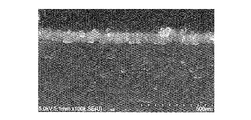
- FIGS. 1 and 2 show the results of observing the flake-shaped substrates on which the zirconium oxide-containing films were formed using SEM.
- the section shown in FIG. 1 shows a zirconium oxide-containing film with a thickness of 90 nm.
- the zirconium oxide-containing film was densely composed of particles with a size of about several tens of nanometers.
Landscapes
- Health & Medical Sciences (AREA)
- Life Sciences & Earth Sciences (AREA)
- Animal Behavior & Ethology (AREA)
- General Health & Medical Sciences (AREA)
- Public Health (AREA)
- Veterinary Medicine (AREA)
- Chemical & Material Sciences (AREA)
- Inorganic Chemistry (AREA)
- Birds (AREA)
- Epidemiology (AREA)
- Organic Chemistry (AREA)
- Cosmetics (AREA)
- Pigments, Carbon Blacks, Or Wood Stains (AREA)
Priority Applications (1)
| Application Number | Priority Date | Filing Date | Title |
|---|---|---|---|
| JP2023522671A JP7730896B2 (ja) | 2021-05-17 | 2022-05-17 | 光輝性顔料を含む化粧料 |
Applications Claiming Priority (2)
| Application Number | Priority Date | Filing Date | Title |
|---|---|---|---|
| JP2021083521 | 2021-05-17 | ||
| JP2021-083521 | 2021-05-17 |
Publications (1)
| Publication Number | Publication Date |
|---|---|
| WO2022244767A1 true WO2022244767A1 (ja) | 2022-11-24 |
Family
ID=84141584
Family Applications (1)
| Application Number | Title | Priority Date | Filing Date |
|---|---|---|---|
| PCT/JP2022/020519 Ceased WO2022244767A1 (ja) | 2021-05-17 | 2022-05-17 | 光輝性顔料を含む化粧料 |
Country Status (2)
| Country | Link |
|---|---|
| JP (1) | JP7730896B2 (https=) |
| WO (1) | WO2022244767A1 (https=) |
Citations (4)
| Publication number | Priority date | Publication date | Assignee | Title |
|---|---|---|---|---|
| JPH06116507A (ja) * | 1992-10-06 | 1994-04-26 | Nippon Sheet Glass Co Ltd | 真珠光沢顔料 |
| JP2002038051A (ja) * | 2000-07-31 | 2002-02-06 | Nippon Sheet Glass Co Ltd | ガラスフレーク、およびそれを配合した化粧料 |
| WO2003011235A1 (en) * | 2001-08-01 | 2003-02-13 | Nippon Sheet Glass Co., Ltd. | Cosmetic |
| WO2011013654A1 (ja) * | 2009-07-30 | 2011-02-03 | 富士フイルム株式会社 | 化粧料 |
Family Cites Families (1)
| Publication number | Priority date | Publication date | Assignee | Title |
|---|---|---|---|---|
| WO2010113899A1 (ja) * | 2009-03-31 | 2010-10-07 | 富士フイルム株式会社 | 化粧料 |
-
2022
- 2022-05-17 JP JP2023522671A patent/JP7730896B2/ja active Active
- 2022-05-17 WO PCT/JP2022/020519 patent/WO2022244767A1/ja not_active Ceased
Patent Citations (4)
| Publication number | Priority date | Publication date | Assignee | Title |
|---|---|---|---|---|
| JPH06116507A (ja) * | 1992-10-06 | 1994-04-26 | Nippon Sheet Glass Co Ltd | 真珠光沢顔料 |
| JP2002038051A (ja) * | 2000-07-31 | 2002-02-06 | Nippon Sheet Glass Co Ltd | ガラスフレーク、およびそれを配合した化粧料 |
| WO2003011235A1 (en) * | 2001-08-01 | 2003-02-13 | Nippon Sheet Glass Co., Ltd. | Cosmetic |
| WO2011013654A1 (ja) * | 2009-07-30 | 2011-02-03 | 富士フイルム株式会社 | 化粧料 |
Also Published As
| Publication number | Publication date |
|---|---|
| JP7730896B2 (ja) | 2025-08-28 |
| JPWO2022244767A1 (https=) | 2022-11-24 |
Similar Documents
| Publication | Publication Date | Title |
|---|---|---|
| JP4647494B2 (ja) | 黒色系光輝顔料およびそれを配合した化粧料、塗料組成物、樹脂組成物およびインキ組成物 | |
| US8153163B2 (en) | Pearlescent pigment | |
| JP4960229B2 (ja) | 大粒径のカラートラベル効果顔料を有する化粧用粉末組成物 | |
| EP2008641B1 (en) | Cosmetic preparation containing flaky glass | |
| JP2001011340A (ja) | 真珠光沢顔料およびそれを配合した化粧料 | |
| JP7000420B2 (ja) | 光輝性顔料、顔料含有組成物、及び顔料含有塗装体 | |
| EP1935946B1 (en) | Filler, process for producing the same, and cosmetic | |
| US20040213820A1 (en) | Cosmetic | |
| JP2019502733A (ja) | 光学的に拡散する粒子 | |
| WO2016194902A1 (ja) | 干渉顔料、ならびにこれを含む化粧料、塗料、インク、および樹脂組成物 | |
| JP2006299051A (ja) | 着色複合粉末及びこれを配合した化粧料 | |
| EP0191292B1 (en) | Cosmetics comprising a titanium oxide pigment | |
| JP2006522165A (ja) | 色彩効果顔料 | |
| JP7730896B2 (ja) | 光輝性顔料を含む化粧料 | |
| JP2009280542A (ja) | 複合粉末及びその製造方法並びに該複合粉末を含有する化粧料 | |
| JP7708850B2 (ja) | 酸化ジルコニウムを含む被膜を有する光揮性顔料 | |
| JP2004123681A (ja) | メイクアップ化粧料 | |
| JPS61293906A (ja) | 仕上げ化粧料 | |
| JP7227376B2 (ja) | 近赤外線遮蔽材 | |
| JPH07103007B2 (ja) | 化粧料 | |
| JP2001278743A (ja) | 化粧料 | |
| WO2024237253A1 (ja) | 光輝性顔料、顔料含有組成物、及び顔料含有塗装体 | |
| JPH0791174B2 (ja) | メ−クアツプ化粧料 |
Legal Events
| Date | Code | Title | Description |
|---|---|---|---|
| 121 | Ep: the epo has been informed by wipo that ep was designated in this application |
Ref document number: 22804678 Country of ref document: EP Kind code of ref document: A1 |
|
| WWE | Wipo information: entry into national phase |
Ref document number: 2023522671 Country of ref document: JP |
|
| NENP | Non-entry into the national phase |
Ref country code: DE |
|
| 122 | Ep: pct application non-entry in european phase |
Ref document number: 22804678 Country of ref document: EP Kind code of ref document: A1 |