WO2022233441A1 - Novel bacterial ferment of lactobacillus species - Google Patents
Novel bacterial ferment of lactobacillus species Download PDFInfo
- Publication number
- WO2022233441A1 WO2022233441A1 PCT/EP2021/072613 EP2021072613W WO2022233441A1 WO 2022233441 A1 WO2022233441 A1 WO 2022233441A1 EP 2021072613 W EP2021072613 W EP 2021072613W WO 2022233441 A1 WO2022233441 A1 WO 2022233441A1
- Authority
- WO
- WIPO (PCT)
- Prior art keywords
- skin
- lactobacillus
- mixture
- bacterial
- ferment
- Prior art date
- Legal status (The legal status is an assumption and is not a legal conclusion. Google has not performed a legal analysis and makes no representation as to the accuracy of the status listed.)
- Ceased
Links
Classifications
-
- C—CHEMISTRY; METALLURGY
- C12—BIOCHEMISTRY; BEER; SPIRITS; WINE; VINEGAR; MICROBIOLOGY; ENZYMOLOGY; MUTATION OR GENETIC ENGINEERING
- C12N—MICROORGANISMS OR ENZYMES; COMPOSITIONS THEREOF; PROPAGATING, PRESERVING, OR MAINTAINING MICROORGANISMS; MUTATION OR GENETIC ENGINEERING; CULTURE MEDIA
- C12N1/00—Microorganisms; Compositions thereof; Processes of propagating, maintaining or preserving microorganisms or compositions thereof; Processes of preparing or isolating a composition containing a microorganism; Culture media therefor
- C12N1/20—Bacteria; Culture media therefor
-
- A—HUMAN NECESSITIES
- A61—MEDICAL OR VETERINARY SCIENCE; HYGIENE
- A61K—PREPARATIONS FOR MEDICAL, DENTAL OR TOILETRY PURPOSES
- A61K8/00—Cosmetics or similar toiletry preparations
- A61K8/18—Cosmetics or similar toiletry preparations characterised by the composition
- A61K8/96—Cosmetics or similar toiletry preparations characterised by the composition containing materials, or derivatives thereof of undetermined constitution
- A61K8/99—Cosmetics or similar toiletry preparations characterised by the composition containing materials, or derivatives thereof of undetermined constitution from microorganisms other than algae or fungi, e.g. protozoa or bacteria
-
- A—HUMAN NECESSITIES
- A61—MEDICAL OR VETERINARY SCIENCE; HYGIENE
- A61Q—SPECIFIC USE OF COSMETICS OR SIMILAR TOILETRY PREPARATIONS
- A61Q15/00—Anti-perspirants or body deodorants
-
- A—HUMAN NECESSITIES
- A61—MEDICAL OR VETERINARY SCIENCE; HYGIENE
- A61Q—SPECIFIC USE OF COSMETICS OR SIMILAR TOILETRY PREPARATIONS
- A61Q19/00—Preparations for care of the skin
-
- A—HUMAN NECESSITIES
- A61—MEDICAL OR VETERINARY SCIENCE; HYGIENE
- A61Q—SPECIFIC USE OF COSMETICS OR SIMILAR TOILETRY PREPARATIONS
- A61Q19/00—Preparations for care of the skin
- A61Q19/007—Preparations for dry skin
-
- A—HUMAN NECESSITIES
- A61—MEDICAL OR VETERINARY SCIENCE; HYGIENE
- A61Q—SPECIFIC USE OF COSMETICS OR SIMILAR TOILETRY PREPARATIONS
- A61Q19/00—Preparations for care of the skin
- A61Q19/08—Anti-ageing preparations
-
- C—CHEMISTRY; METALLURGY
- C12—BIOCHEMISTRY; BEER; SPIRITS; WINE; VINEGAR; MICROBIOLOGY; ENZYMOLOGY; MUTATION OR GENETIC ENGINEERING
- C12N—MICROORGANISMS OR ENZYMES; COMPOSITIONS THEREOF; PROPAGATING, PRESERVING, OR MAINTAINING MICROORGANISMS; MUTATION OR GENETIC ENGINEERING; CULTURE MEDIA
- C12N1/00—Microorganisms; Compositions thereof; Processes of propagating, maintaining or preserving microorganisms or compositions thereof; Processes of preparing or isolating a composition containing a microorganism; Culture media therefor
- C12N1/06—Lysis of microorganisms
-
- C—CHEMISTRY; METALLURGY
- C12—BIOCHEMISTRY; BEER; SPIRITS; WINE; VINEGAR; MICROBIOLOGY; ENZYMOLOGY; MUTATION OR GENETIC ENGINEERING
- C12N—MICROORGANISMS OR ENZYMES; COMPOSITIONS THEREOF; PROPAGATING, PRESERVING, OR MAINTAINING MICROORGANISMS; MUTATION OR GENETIC ENGINEERING; CULTURE MEDIA
- C12N1/00—Microorganisms; Compositions thereof; Processes of propagating, maintaining or preserving microorganisms or compositions thereof; Processes of preparing or isolating a composition containing a microorganism; Culture media therefor
- C12N1/06—Lysis of microorganisms
- C12N1/066—Lysis of microorganisms by physical processes
-
- C—CHEMISTRY; METALLURGY
- C12—BIOCHEMISTRY; BEER; SPIRITS; WINE; VINEGAR; MICROBIOLOGY; ENZYMOLOGY; MUTATION OR GENETIC ENGINEERING
- C12P—FERMENTATION OR ENZYME-USING PROCESSES TO SYNTHESISE A DESIRED CHEMICAL COMPOUND OR COMPOSITION OR TO SEPARATE OPTICAL ISOMERS FROM A RACEMIC MIXTURE
- C12P1/00—Preparation of compounds or compositions, not provided for in groups C12P3/00 - C12P39/00, by using microorganisms or enzymes
- C12P1/04—Preparation of compounds or compositions, not provided for in groups C12P3/00 - C12P39/00, by using microorganisms or enzymes by using bacteria
-
- A—HUMAN NECESSITIES
- A61—MEDICAL OR VETERINARY SCIENCE; HYGIENE
- A61Q—SPECIFIC USE OF COSMETICS OR SIMILAR TOILETRY PREPARATIONS
- A61Q17/00—Barrier preparations; Preparations brought into direct contact with the skin for affording protection against external influences, e.g. sunlight, X-rays or other harmful rays, corrosive materials, bacteria or insect stings
- A61Q17/04—Topical preparations for affording protection against sunlight or other radiation; Topical sun tanning preparations
-
- A—HUMAN NECESSITIES
- A61—MEDICAL OR VETERINARY SCIENCE; HYGIENE
- A61Q—SPECIFIC USE OF COSMETICS OR SIMILAR TOILETRY PREPARATIONS
- A61Q19/00—Preparations for care of the skin
- A61Q19/005—Preparations for sensitive skin
-
- A—HUMAN NECESSITIES
- A61—MEDICAL OR VETERINARY SCIENCE; HYGIENE
- A61Q—SPECIFIC USE OF COSMETICS OR SIMILAR TOILETRY PREPARATIONS
- A61Q19/00—Preparations for care of the skin
- A61Q19/10—Washing or bathing preparations
-
- A—HUMAN NECESSITIES
- A61—MEDICAL OR VETERINARY SCIENCE; HYGIENE
- A61Q—SPECIFIC USE OF COSMETICS OR SIMILAR TOILETRY PREPARATIONS
- A61Q5/00—Preparations for care of the hair
- A61Q5/02—Preparations for cleaning the hair
-
- A—HUMAN NECESSITIES
- A61—MEDICAL OR VETERINARY SCIENCE; HYGIENE
- A61Q—SPECIFIC USE OF COSMETICS OR SIMILAR TOILETRY PREPARATIONS
- A61Q5/00—Preparations for care of the hair
- A61Q5/12—Preparations containing hair conditioners
-
- C—CHEMISTRY; METALLURGY
- C12—BIOCHEMISTRY; BEER; SPIRITS; WINE; VINEGAR; MICROBIOLOGY; ENZYMOLOGY; MUTATION OR GENETIC ENGINEERING
- C12R—INDEXING SCHEME ASSOCIATED WITH SUBCLASSES C12C - C12Q, RELATING TO MICROORGANISMS
- C12R2001/00—Microorganisms ; Processes using microorganisms
- C12R2001/01—Bacteria or Actinomycetales ; using bacteria or Actinomycetales
- C12R2001/225—Lactobacillus
-
- C—CHEMISTRY; METALLURGY
- C12—BIOCHEMISTRY; BEER; SPIRITS; WINE; VINEGAR; MICROBIOLOGY; ENZYMOLOGY; MUTATION OR GENETIC ENGINEERING
- C12R—INDEXING SCHEME ASSOCIATED WITH SUBCLASSES C12C - C12Q, RELATING TO MICROORGANISMS
- C12R2001/00—Microorganisms ; Processes using microorganisms
- C12R2001/01—Bacteria or Actinomycetales ; using bacteria or Actinomycetales
- C12R2001/225—Lactobacillus
- C12R2001/245—Lactobacillus casei
-
- C—CHEMISTRY; METALLURGY
- C12—BIOCHEMISTRY; BEER; SPIRITS; WINE; VINEGAR; MICROBIOLOGY; ENZYMOLOGY; MUTATION OR GENETIC ENGINEERING
- C12R—INDEXING SCHEME ASSOCIATED WITH SUBCLASSES C12C - C12Q, RELATING TO MICROORGANISMS
- C12R2001/00—Microorganisms ; Processes using microorganisms
- C12R2001/01—Bacteria or Actinomycetales ; using bacteria or Actinomycetales
- C12R2001/225—Lactobacillus
- C12R2001/25—Lactobacillus plantarum
Definitions
- the invention relates to a bacterial ferment of Lactobacillus species, methods to obtain the bacterial ferment and its use in cosmetic and pharmaceutical applications.
- Lactic acid generating bacteria as well as a large ecosystem of related organisms, are commercially important for food, human health care and industrial applications. Some of the best understood examples of the commercial value of lactic acid bacteria are related to their ability to preserve foods and milk products such as sauerkraut, yoghurt and cheese. Other applications include the fermentation of grasses to produce silage, a long-lasting and critical animal feedstuff for winters.
- probiotic supplementation is a newer approach to improving human health and affecting specific symptoms.
- the strategy being to influence the microbiome of the host, rather than intervening directly in host cell biochemistry with conventional drugs. This approach is coincident with the growing understanding that the commensal microbiome within humans (and indeed likely all organisms on earth) is a critical factor that influences the health of the host.
- the impact of the microbiome and the interaction of the microbiome with its host is not only limited to areas of the body with very high bacterial counts, such as the gut, but is also very important in any area where the human body encounters its environment such as the skin.
- probiotics have an exceedingly long history of safe use, are not synthetic chemicals, and are themselves already components of the commensal microbiome they are viewed favorably by consumers.
- Bacteria that generate simple acids can acidify their surrounding environment by converting simple sugars into acids and lowering the pH to around 4. This is the simplest mechanism by which bacteria can control their environment, as a rapid drop in pH makes it harder for other organisms to compete, and hence 'spoil', the surrounding environment, or foodstuff. Lactic acid bacteria also have ability to control their environment by producing various types of compounds that act directly on the host organism or other bacteria by directly releasing biologically active molecules into the surrounding environment. These can be proteins, peptides, glycol-peptides, large complex polysaccharides, or other small molecules that exert their effects by mechanisms distinct to pH alteration.
- secreted factors released into extracellular environment can also be generally described as a secretome and the functions of the secretome are generally thought to be related to 1) interacting with other organisms in the environment, (2) recognition, binding, degradation and uptake of extracellular complex nutrients, (3) signal transduction, (4) communication with the environment and (5) attachment of the bacterial cell to specific sites or surfaces, e.g. to intestinal mucosa cells of the host.
- the growth media is usually discarded as the probiotic is separated from the growth media in a centrifugation process.
- the solid material separated by centrifugation is usually referred to as the probiotic, or a probiotic lysate if it is lyzed, a process commonly done for cosmetic applications.
- the growth media can be converted to a product usually known as a ferment within the art.
- Lactobacillus ferment is an established ingredient, recognized by the under the International Nomenclature of Cosmetic Ingredients (INCI).
- ICI International Nomenclature of Cosmetic Ingredients
- Another example is the Pitera product sold under the SK-II brand, a yeast ferment product. The marketing of the Pitera product highlight the safety, natural role in the fermentation process and the lack of preservatives.
- the challenges in the production of any microbiological ferment are threefold: Firstly, the ferment is derived from growth media that supports the growth of a wide range of microorganisms. Therefore, the product is intrinsically microbially unstable unless specific processes are applied to prevent further growth of microorganisms and rapid spoilage of the ferment. During production spoilage is prevented and controlled by ensuring complete sterility of the growth media and using only precisely defined microbial inoculum that contains only the probiotic organisms and is free of contaminating micro-organisms.
- the final ferment product is desired to be used in a wide range of commercial applications the bacterial growth media has to undergo additional processing to ensure that it is stable for its intended use and that the aesthetic characteristics of the product meet market needs.
- the aesthetic properties of the ferment need to be adjusted without the use of harsh chemicals. Adjustment of the color and the odor of the bacterial growth medium is important for commercial viability as bacterial growth medium that has supported the growth of probiotics is often brown or dark brown and can have unpleasant or sulfurous odors. For cosmetic ingredient applications a lighter color is desirable and for nearly any application in human use it is important to avoid unpleasant product odors.
- the regulatory environment that governs the use of cosmetic ingredients generally requires that a product have a total bacterial count of 100 organisms per gram or less. At the time of production, a bacterial ferment typically has a bacterial count of over a trillion bacteria per gram.
- the present invention describes a bacterial ferment of Lactobacillus species obtained by a method comprising the steps of a) Culturing Lactobacillus species in at least one growth medium for at least 24 hours; b) Separating the mixture via centrifugation; c) Adding lactic acid to the supernatant obtained from step b) in an amount sufficient to lower the pH value of the supernatant; d) Stabilizing the resulting mixture with the addition of at least one preservative and/or at least one multifunctional; e) Optionally filtering the mixture to remove any final precipitation.
- the inventors have surprisingly found that it is possible with the method according to the present invention to obtain a bacterial ferment with minimal or not residual microbial count which retains biological activity of commercial value for cosmetic and human health applications.
- the bacterial ferment obtained by the method of the present invention can be sterilized very effectively due to a short pH shock with lactic acid, which leads to an at least 9-order reduction in bacterial count (step c).
- step c For comparison, with conventional methods like heating or sterilization a 5 to 6-order reduction can be usually contained.
- Lactobacilli are expected to be resistant to lactic acid. Therefore, the bacterial ferment according to the present invention is still active, has desirable color and a very low bacterial count.
- the present invention further relates to a method for producing a bacterial ferment of Lactobacillus species, comprising the steps of a) Culturing Lactobacillus species in at least one growth medium for at least 24 hours; b) Separating the mixture via centrifugation; c) Adding lactic acid to the supernatant obtained from step b) in an amount sufficient to lower the pH value of the supernatant; d) Stabilizing the resulting mixture with the addition of at least one preservative and/or at least one multifunctional; e) Optionally filtering the mixture to remove any final precipitation.
- the growth medium comprises a blend of yeast extract, yeast peptone, sodium acetate, dextrose, sucrose, ammonium citrate, potassium phosphate, ascorbic acid, L-cysteine, magnesium sulfate, tween-80 and/or water.
- the mixture is combined with at least one other mixture of a different Lactobacillus species prepared with the same method of culturing, separating via centrifugation and adding of lactic acid before stabilizing the resulting mixture with the addition of at least one preservative, to produce a mixture of materials from different Lactobacillus species.
- This additional preferred step can be beneficial, since due to the combination different actives of different Lactobacilli strains are included in the bacterial ferment.
- the resulting mixture is stabilized with the addition of at least one multifunctional or multifunctional compound.
- Multifunctionals or multifunctional compounds are compounds or substances that enhance the performance of active ingredients, improves formula aesthetics including dispensability of pigments, stabilizes emulsions, act as solubilizer or moisturizer and also provide product protection. These multitaskers help to eliminate the overall number of ingredients while maximizing formula benefits and optimizing consumer experience.
- Multifunctionals or multifunctional compounds in the context of the present invention are preferably polyols respective glycols, such as 1,2-propanediol (propylene glycol), 1,3-propanediol, 1,2-butanediol, 1,3-butanediol (butylene glycol), 1,2-pentanediol (pentylene glycol; Hydrolite® 5; green version or any grade), 1,2-hexanediol (Hydrolite® 6), 1,2-heptanediol, 1,2-octanediol (caprylyl glycol; Hydrolite® 8), 1,2-nonanediol, 1,2-decanediol (decylene glycol), or glycerol, phenoxyethanol, ethylhexylglycerin, glyceryl caprylate, hydroxyacetophenone, methylbenzyl alcohol, o-cymen-5-ol,
- glycols that for example boosts the performance of active ingredients, improves the sensorial profile of formulas and enhances product protection, are particularly preferred.
- the multifunctional or the multifunctional compound according to the present invention is a polyol selected from the group consisting of 1,2-pentanediol (pentylene glycol; Hydrolite® 5; green version or any grade), 1,2-hexanediol (Hydrolite® 6), 1,2-heptanediol and 1,2-octanediol (caprylyl glycol; Hydrolite® 8).
- a cosmetic or pharmaceutical preparation, according to the present invention can also contain active compounds for preservative purposes, wherein any preservatives may be used which are suitable or customary in cosmetic or pharmaceutical, in particular dermatological, applications.
- the resulting mixture is stabilized with the addition of at least one preservative.
- the preservatives are advantageously selected from the group consisting of preservatives such as inter alia benzoic acid, its esters and salts; propionic acid and its salts; salicylic acid and its salts; 2,4-hexanoic acid (sorbic acid) and its salts; formaldehyde and paraformaldehyde; 2 -hydroxybi phenyl ether and its salts; 2- zincsulphidopyridine N-oxide; inorganic sulphites and bisulphites; sodium iodate; chlorobutanol; 4-hydroxybenzoic acid and its salts and esters; dehydroacetic acid; formic acid; 1,6-bis(4-amidino-2-bromophenoxy)-n-hexane and its salts; the sodium salt of ethylmercu ry-(l l)-thiosalicylic acid;
- the invention refers also to any of the follow genera: Lactobacillus, Lactobacillus delbrueckii group, Paralactobacillus, Holzapfelia, Amylolactobacillus, Bombilactobacillus, Companilactobacillus, Lapidilactobacillus, Agrilactobacillus, Schleiferilactobacillus, Loigolactobacilus, Lacticaseibacillus, Latilactobacillus, Dellaglioa, Liquorilactobacillus, Ligilactobacillus, Lactiplantibacillus, Furfurilactobacillus, Paucilactobacillus, Limosilactobacillus, Fructilactobacillus, Acetilactobacillus,
- the Lactobacillus species is selected from the group consisting of Lactobacillus acidophilus, Lactobacillus casei, Lactobacillus fermentum, Lactobacillus gasseri, Lactobacillus helveticus, Lactobacillus paracasei, Lactobacillus plantarum, Lactobacillus reuteri, Lactobacillus rhamnosus, Lactobacillus sakei and Lactobacillus salivarius.
- lactic acid is added in an amount of from 2 to 10 percent by weight, based on the total amount of the mixture. More preferably, lactic acid is added in an amount of from 4 to 7 percent by weight, based on the total amount of the mixture.
- the method according to the present invention comprises the following steps: a) Culturing Lactobacillus species in at least one growth medium for at least 24 hours; b) Separating the mixture via centrifugation; c) Adding lactic acid to the supernatant obtained from step b) in an amount sufficient to lower the pH value of the supernatant; d) Adding solid and/or aqueous sodium benzoate to the resulting mixture; e) Incubating the mixture for at least 12 hours; f) Stabilizing the resulting mixture with the addition of at least one preservative and/or at least one multifunctional; g) Optionally filtering the mixture to remove any final precipitation.
- the method according to the present invention comprises the following steps: a) Culturing Lactobacillus species in at least one growth medium for at least 24 hours; b) Separating the mixture via centrifugation; c) Adding lactic acid to the supernatant obtained from step b) in an amount sufficient to lower the pH value of the supernatant; d) Adding solid and/or aqueous sodium benzoate to the resulting mixture; e) Incubating the mixture for at least 12 hours; f) Passing the mixture through a carbon filter: g) Stabilizing the resulting mixture with the addition of at least one preservative and/or at least one multifunctional; h) Optionally filtering the mixture to remove any final precipitation.
- the carbon filter is an activated and/or catalytic carbon filter.
- the method according to the present invention comprises or consists of the following steps: a) Culturing Lactobacillus species in at least one growth medium for at least 24 hours; b) Separating the mixture via centrifugation; c) Adding lactic acid to the supernatant obtained from step b) in an amount sufficient to lower the pH value of the supernatant; d) Adding solid and/or aqueous sodium benzoate to the resulting mixture; e) Optionally combining the mixture with at least one other mixture of a different Lactobacillus species prepared with the same method of culturing, separating via centrifugation and adding of lactic acid and/or solid and/or aqueous sodium benzoate; f) Analyzing the mixture to measure bacterial counts and the pH value; g) Incubating the mixture for at least 12 hours; h) Passing the mixture through a carbon filter: i) Stabilizing the resulting mixture with the addition of at least one preservative and/or at
- adding of lactic acid to the mixture results in a pH shock which produces a 9-order reduction in bacterial count.
- a pH shock in the sense of the invention is a rapid change of the pH of mixture within a short period of time.
- the pH value is lowered by 0.5 to 4.5, more preferably by 1 to 4, most preferably by 2 to 3.5.
- the initial pH value before adding lactic acid is about 5 to 7, preferably about 5.5 to 6.5.
- Another embodiment according to the invention relates to the cosmetic use of the bacterial ferment or the bacterial ferment produced by the method according to the present invention for improving the appearance of the skin and/or for preventing body odor, wherein the bacterial ferment is administered by topical application.
- the bacterial ferment is used as agent to
- the term “skin” refers to skin that is non- mucosal skin.
- the mucosa found in cavities of the body such as e.g. the oral cavity, the gastric, intestinal, bronchial, anal or vaginal mucosa is not covered by the term "skin".
- the term “topical application” refers to the application of an agent and/or formulation on the skin and excludes any applications in the inside of body cavities, which are covered with mucosa.
- the skin still retains a protective function which has not been significantly compromised, e.g. by severe injury or burns.
- Skin barrier in the context of the present invention refers on the one hand to the physical and chemical barrier of the stratum corneum, which prevents substances from entering the body and protects against drying out, but on the other hand also the inductive AMP barrier, that together with other chemical properties like pH provides defense against colonization or invasion of microbial pathogens.
- a "loss of skin barrier function” which also comprises a “reduction of skin barrier function” implies that the normal or healthy skin structure and/or function is disrupted so that it can no longer provide the above mentioned protection or defense to a satisfactory degree.
- a disruption is not an injury such as cut or a severe burn.
- a "cosmetic use” is a non-therapeutic use, i.e. a use on skin, the appearance of the skin, which is affected by e.g. irritation, redness, dryness, flaking, rash, signs of ageing or light cases of acne, which represent a cosmetic issue or a slight discomfort but would not be characterized as pathologic.
- a further “cosmetic use” is the prevention or reduction of body odor, which is associated with the growth of certain microorganism on the skin, which cause bad smell but do not represent an imminent danger to the affected person's health.
- the present invention relates to a non-therapeutical method for improving the appearance of the skin and/or for preventing body odor, wherein the bacterial ferment produced by the method according to the present invention is administered by topical application.
- the bacterial ferment has been shown to increase components related to the natural moisturizing factor. Due to the various but interconnected effects described above, the bacterial ferment according to the present invention is useful for improvement of the skin appearance and other cosmetic aspects such as body odor, but also for the prevention and/or treatment of a number of medical conditions. [0037] Therefore, in one embodiment, the invention relates to the bacterial ferment for use in the treatment and/or prevention of skin conditions, wherein the bacterial ferment is administered by topical application.
- Skin condition in the context of the present invention refers to any state of the skin that is associated with medical conditions of the skin, preferably other than injury or burns.
- Skin condition preferably relates to a status characterized by discomfort such as itching or represents a cosmetic problem such as flaking, dryness, redness, rashes, acne, oilyness or body odor due to bacterial growth.
- the skin conditions are loss of skin barrier function, inflammatory skin conditions and/or growth of pathogenic microorganisms.
- the skin condition is selected from the group consisting of atopic dermatitis microbial infection, dry skin, itchy skin, sensitive skin, atopic skin, inflammation of the skin, microbial dysbiosis, rosacea, psoriasis, rash and acne.
- the bacterial ferment is used as an agent to
- Inflammatory skin conditions are conditions that are caused by the biological response of the skin to harmful stimuli such as irritants or pathogenic microorganisms and usually lead to redness, swelling, heat and/or pain in the affected area.
- Inflammatory mediators such as inflammatory cytokines or chemokines, e.g. Interleukin 8 (IL-8), can be measured in the affected tissue to assess the inflammatory status.
- IL-8 Interleukin 8
- “Growth of pathogenic microorganisms” such as bacteria or fungi on or in the skin can lead to infection and/or inflammation but also cause cosmetic issues such as rashes, acne or body odor.
- growth of pathogenic microorganisms refers to an increase of the amount of pathogenic microorganisms so that it exceeds a level, which is associated with a healthy microbiome, on the skin or in the skin. Especially it refers to microbial infections.
- the present invention relates to a therapeutical method for treating and/or preventing skin conditions, wherein the bacterial ferment produced by the method according to the invention is administered by topical application.
- the invention also relates to a pharmaceutical or cosmetic composition or pharmaceutical or cosmetic product comprising the bacterial ferment.
- the pharmaceutical or cosmetic composition or product as described above is selected from the group consisting of oil in water or water in oil emulsion, ointment, creme, lotion and gel.
- the pharmaceutical or cosmetic composition or product is selected from a soap, facial cleanser, exfolia nt, mouthwash, hair wash, body wash, hand wash, essence, serum, toner, moisturizer, face mask, multipurpose cleaner, skin cream, lotion, deodorant, solvent, disinfectant, anti-bacterial, antioxidant, anti-inflammatory, flavoring, fragrance, fragrance masking agent, colorant, antimicrobial, antifungal, micellar or fertilizer.
- compositions and products may comprise further ingredients that provide suitable properties for application on the skin.
- a pharmaceutical or cosmetic composition or product further comprising one or more component(s) selected from the group consisting of carriers, excipients and further active ingredients, preferably selected from Maltodextrin, Inulin, emollients and plant oils.
- the plant oils may be selected from the group consisting of Argan oil, Chokeberry (seed) oil, Avocado oil, Peach (pits) oil, Canola oil, Nigella oil, Pumpkin (pumpkin seed) oil, Wild rose (seeds) oil, Pomegranate seeds oil, Jojoba (liquid wax) oil, Cocoa/cocoa butter, Wheat sprout oil, coconut/coconut butter, Safflower oil, Corn oil, Camelina oil, Flax seed oil, Macadamia oil, Raspberries seeds oil, Meadowfoam seeds oil, Passiflora seeds oil, Almond oil, Neem oil, Moringa oil, Borago oil, Olive oil, Peanuts oil, Hazelnuts oil, Walnut oil, Palm oil, Papaya seeds oil, Parsley seeds oil, Seabuckthorn oil, Castor oil, Rice oil, Sesame oil, Shea butter/ karite butter, Sunflower oil, Soybean oil, Tamanu oil, Evening primrose oil, Grape seeds
- further suitable oil bodies may be selected from the group consisting of Guerbet alcohols based on fatty alcohols having 6 to 18, preferably 8 to 10, carbon atoms, esters of linear C6-C22-fatty acids with linear or branched C6-C22-fatty alcohols or esters of branched C6-C 13-carboxylic acids with linear or branched C6-C 22-fatty alcohols, such as, for example, myristyl myristate, myristyl palmitate, myristyl stearate, myristyl isostearate, myristyl oleate, myristyl behenate, myristyl erucate, cetyl myristate, cetyl palmitate, cetyl stearate, cetyl isostearate, cetyl oleate, cetyl behenate, cetyl erucate, stearyl myristate, stearyl palmitate, ste
- esters of linear C6-C22-fatty acids with branched alcohols in particular 2-ethylhexanol
- esters of C18-C38- alkylhydroxy carboxylic acids with linear or branched C6-C 22-fatty alcohols in particular Dioctyl Malate
- esters of linear and/or branched fatty acids with polyhydric alcohols such as, for example, propylene glycol, dimerdiol or trimertriol
- Guerbet alcohols triglycerides based on Ob -Cio-fatty acids, liquid mono-/di-/triglyc-eride mixtures based on C6-Cis-fatty acids
- esters of Ce- C22-fatty alcohols and/or Guerbet alcohols with aromatic carboxylic acids in particular benzoic acid
- Finsolv® TN linear or branched, symmetrical or asymmetrical dialkyl ethers having 6 to 22 carbon atoms per alkyl group, such as, for ex-ample, dicaprylyl ether (Cetiol® OE), ring-opening products of epoxidized fatty acid esters with polyols, silicone oils (cyclomethicones, silicone methicone grades, etc.), aliphatic or naphthenic hydrocarbons, such as, for example, squalane, squalene or dialkylcyclohexanes, and/or mineral oils.
- dicaprylyl ether such as, for ex-ample, dicaprylyl ether (Cetiol® OE), ring-opening products of epoxidized fatty acid esters with polyols, silicone oils (cyclomethicones, silicone methicone grades, etc.), aliphatic or naphthenic hydrocarbons, such as, for example, squa
- the bacterial ferment can be used in combination with one or more (further) substances for preventing, reducing or alleviating dry and/or itchy skin condition(s) and/or one or more skin irritation-reducing agents, in particular one or more substances selected from the group consisting of anti-inflammatory agents, physiological cooling agents and compounds that alleviate reddening, preferably wherein the one or more additional substances is/are selected from the group consisting of:
- steroidal anti-inflammatory substances of the corticosteroid type in particular hydrocortisone, hydrocortisone derivatives such as hydrocortisone 17- butyrate, dexamethasone, dexamethasone phosphate, methylprednisolone or cortisone,
- non-steroidal anti-inflammatory substances in particular oxicams such as piroxicam or tenoxicam, salicylates such as aspirin, disalcid, solprin or fendosal, acetic acid derivatives such as diclofenac, fenclofenac, indomethacin, sulindac, tolmetin or clindanac, fenamates such as mefenamic, meclofenamic, flufenamic or niflumic, propionic acid derivatives such as ibuprofen, naproxen or benoxaprofen, pyrazoles such as phenylbutazone, oxyphenylbutazone, febrazone or azapropazone,
- oxicams such as piroxicam or tenoxicam
- salicylates such as aspirin, disalcid, solprin or fendosal
- acetic acid derivatives such as diclofenac, fenclofenac, indom
- skin care agents preferably skin moisture retention regulators or skin repair agents, preferably selected from the group consisting of sodium lactate, urea and derivatives, glycerol, propylene glycol, 1 ,2-pentanediol, 1 ,2-hexanediol and 1 ,2-octanediol, collagen, elastin or hyaluronic acid, diacyl adipates, petrolatum, urocanic acid, lecithin, allantoin, panthenol, phytantriol, lycopene, (pseudo-)ceramides (preferably Ceramide 2, hydroxypropyl bispalmitamide MEA, cetyl oxy propyl glyceryl methoxypropyl myristamide, N-(1 - hexadecanoyl)-4-hydroxy-L-proline (1 -hexadecyl) ester, hydroxyethyl palmityl oxyhydroxyhydroxyhydroxy
- physiological cooling agents preferably selected from the group consisting of menthone glycerol acetal, menthyl lactate preferably l-menthyl lactate, in particular I- menthyl l-lactate), menthyl ethyl oxamate, substituted menthyl-3- carboxylic acid amides (e.g.
- menthyl-3-carboxylic acid N-ethylamide, Na-(L- menthanecarbony glycine ethyl ester, 2-isopropyl-N-2,3- trimethylbutanamide, substituted cyclohexanecarboxylic acid amides, 3- menthoxypropane-1 ,2-diol, 2- hydroxyethyl menthyl carbonate, 2- hydroxypropyl menthyl carbonate, N-acetylglycine menthyl ester, isopulegol, menthyl hydro xycarboxylic acid esters (e.g.
- menthyl 3- hydroxybutyrate monomenthyl succinate, monomenthyl glutarate, 2- mercaptocyclodecanone, menthyl 2-pyrrolidin-5-onecarboxylate, 2,3-dihydroxy-p- menthane, 3,3,5- trimethylcyclohexanone glycerol ketal, 3-menthyl 3,6-di- and trioxaalkanoates, 3-menthyl methoxyacetate and icilin, and
- Fig.1 shows a possible process flow according to the invention.
- Fig. 2 a and 2 b show the viability vs. lactid acid addition of the bacterial ferment.
- Fig. 3 shows the pH reflex response and time.
- Lactobacillus plantarum was inoculated from a 1 ml frozen seed stock and grown under sterile, aseptic conditions at 37 centigrade in 1 liter growth medium, then transferred to 400 liter intermediate growth medium after 24 hours and then transferred to a 5000 liter culture vessel after a subsequent phase of growth at 24 hours.
- the bacterial growth medium consisted of a blend of yeast extract, yeast peptone, sodium acetate, dextrose, sucrose, ammonium citrate, potassium phosphate, ascorbic acid, L-cysteine, magnesium sulfate, tween-80 and water.
- the ferment was then blended with ferment derived from Lactobacillus casei prepared with the same process of centrifugation, addition of sodium benzoate and pH shock to produce a mixture of materials from different probiotic species.
- This mixture was then passed through an activated carbon filter, this carbon treated mixture was then passed through a catalytic carbon filter and the resulting treated mixture collected in a stilling tank.
- an aqueous mixture of 2% pentylene glycol was added to the mixture in the stilling tank and mixed then 30% ammonium hydroxide is added in a stepwise fashion until the pH reached 4.6.
- the mixture was centrifuged through a high g-force clarifying centrifuge to remove any final precipitation.
- the decanted supernatant was filtered through a 0.2 micron filter before being filled into 25L screw cap containers.
- Lactobacillus gasseri was inoculated from a 1 ml frozen seed stock and grown under sterile, aseptic conditions at 37 centigrade in 1 liter growth medium, then transferred to 400 liter intermediate growth medium after 24 hours and then transferred to a 5000 liter culture vessel after a subsequent phase of growth at 24 hours.
- the bacterial growth medium consisted of a blend of yeast extract, yeast peptone, sodium acetate, dextrose, sucrose, ammonium citrate, potassium phosphate, ascorbic acid, L-cysteine, magnesium sulfate, tween-80 and water.
- the material was passed through an additional filter containing granulated manganese dioxide to remove excess tannins and the resulting treated mixture collected in a stilling tank.
- an aqueous mixture of 2% pentylene glycol was added to the mixture in the stilling tank and mixed then 30% ammonium hydroxide is added in a stepwise fashion until the pH reached 4.6.
- the clarified mixture was centrifuged through a high g-force clarifying centrifuge and the resulting supernatant clarified by diatomaceous earth filtration to remove any final precipitation.
- the decanted supernatant was filtered through a 0.2 micron filter before being filled into 25L screw cap containers.
- Example 3 The following bacterial strains were prepared under sterile conditions and grown individually each at a scale of 5000 liter fermentation: Lactobacillus acidophilus, Lactobacillus casei, Lactobacillus fermentum, Lactobacillus gasseri, Lactobacillus helveticus, Lactobacillus paracasei, Lactobacillus plantarum, Lactobacillus reuteri, Lactobacillus rhamnosus, Lactobacillus sakei and Lactobacillus salivarius.
- Each strain was harvested individually by sterile centrifugation and the supernatant was treated with 0.5% sodium benzoate and 'shocked' with 5-8% lactic acid addition, followed by incubation at room temperature for 24 hours.
- the treated culture supernatant mixtures were then blended together to reach a specific color hue specification of yellow.
- This mixture was then passed through an activated carbon filter, this carbon treated mixture was then passed through a catalytic carbon filter.
- An aqueous mixture of pentylene glycol was added to the mixture to reach a final concentration of 2% in the stilling tank and an ammonium hydroxide stock was added in a stepwise fashion until the pH reached 4.6.
- the clarified mixture was clarified by diatomaceous earth filtration to remove any final precipitation.
- the decanted supernatant was filtered through a 0.2 micron filter before being filled into 25L screw cap containers.
- the following bacterial strains were prepared under sterile conditions and grown individually each at a scale of 5000 liter fermentation: Lactobacillus acidophilus, Lactobacillus casei, Lactobacillus fermentum, Lactobacillus gasseri, Lactobacillus helveticus, Lactobacillus paracasei, Lactobacillus plantarum, Lactobacillus reuteri, Lactobacillus rhamnosus, Lactobacillus sakei and Lactobacillus salivarius. Each strain was harvested individually by sterile centrifugation and the supernatant was treated with 0.5% sodium benzoate and treated with 3-5% lactic acid addition, followed by passing through a 20kV electric field.
- the treated culture supernatant mixtures were then blended together to reach a specific color hue specification of yellow. This mixture was then passed through an activated carbon filter, this carbon treated mixture was then passed through a catalytic carbon filter. An aqueous mixture of pentylene glycol was added to the mixture to reach a final concentration of 2% in the stilling tank and an ammonium hydroxide stock was added in a stepwise fashion until the pH reached 4.6. After a stilling period of 48 hours the clarified mixture was clarified by diatomaceous earth filtration to remove any final precipitation. The decanted supernatant was filtered through a 0.2 micron filter before being filled into 25L screw cap containers.
- Filaggrins play a key role in the cornification process of the human epidermis by cross-linking keratins. Additionally, they can incorporate into the lipid envelope of keratinocytes, supporting its role as skin barrier to prevent moisture loss. Filaggrin can therefore be used as a marker for skin barrier function and terminal keratinocyte differentiation in the epidermis.
- Test samples were applied topically to the tissue explants by first cleaning the skin surface with a cotton pad and subsequently applying 4 pi of test sample on top of the biopsies. Finally, the explant was covered with a delivery membrane (6 mm diameter). Application was performed daily from DO to D5 (day 0 to day 5) of the organ culture.
- Table 1 Semi-quantitative evaluation of fillagrin modulation by the samples indicated in the table. Values shown are averages from 12 sections ⁇ standard deviation. Statistical significance was tested using a t-test.
- lnterleukin-8 is an important intermediate signaling molecule in the response of tissues to insults, resulting in an inflammation reaction. As the phenomenon of irritated skin is tightly correlated to mild inflammatory conditions, levels of IL8 are being routinely used as biomarkers for irritation. IL8 is secreted by keratinocytes in the epidermis upon treatment with stresses such as UV light, chemical compounds or bacterial infection. IL8 is a chemoattractant which recruits other inflammatory cell types upon secretion.
- Table 2 IL8 concentrations in the supernatants treatment with test compounds and subsequent averages from triplicates ⁇ SEM.
- P-value is base MTT assay, values are normalized to stimulated
- the bacterial ferment according to the invention exhibits a clear soothing effect by statistically significantly reducing the IL8 concentration in the supernatant by 39% compared to the stimulated control.
- the Raw Media Control (Culture broth prior to Lactobad us fermentation) shows a pronounced irritating effect on the 3 models, whereas the Preservative Control as well as the Competitor Benchmark product both exhibit no modulation of IL8 concentration.
- CM 825 corneometer probe connected to a MDD4 (Multidisplay Device, Courage + Khazaka electronic GmbH)) in the treated area at the beginning (day 0) and the end (day 13) of the application period.
- the measurement principle is based on a non- invasive capacity determination of the skin, which is quantitatively correlated to the water content.
- Results are displayed as the means over subjects in difference of corneometer units (- d 13 — dO) ⁇ standard error. Statistical significance of difference of treatments was calculated vs untreated control using ANOVA (Tukey test).
- the bacterial ferment according to the invention causes a significant increase in C.U., and thus in skin moisture content, over the 13d study duration.
Landscapes
- Life Sciences & Earth Sciences (AREA)
- Health & Medical Sciences (AREA)
- Engineering & Computer Science (AREA)
- Chemical & Material Sciences (AREA)
- Organic Chemistry (AREA)
- General Health & Medical Sciences (AREA)
- Zoology (AREA)
- Biotechnology (AREA)
- Wood Science & Technology (AREA)
- Bioinformatics & Cheminformatics (AREA)
- Genetics & Genomics (AREA)
- Veterinary Medicine (AREA)
- Public Health (AREA)
- Animal Behavior & Ethology (AREA)
- General Engineering & Computer Science (AREA)
- Biochemistry (AREA)
- Microbiology (AREA)
- Tropical Medicine & Parasitology (AREA)
- Virology (AREA)
- Mycology (AREA)
- Medicinal Chemistry (AREA)
- Biomedical Technology (AREA)
- Dermatology (AREA)
- Epidemiology (AREA)
- Birds (AREA)
- Chemical Kinetics & Catalysis (AREA)
- General Chemical & Material Sciences (AREA)
- Gerontology & Geriatric Medicine (AREA)
- Cosmetics (AREA)
Abstract
Suggested is a bacterial ferment obtained by a method comprising the steps of a) Culturing Lactobacillus species in at least one growth medium for at least 24 hours; b) Separating the mixture via centrifugation; c) Adding lactic acid to the supernatant obtained from step b) in an amount sufficient to lower the pH value of the supernatant; d) Stabilizing the resulting mixture with the addition of at least one preservative and/or at least one multifunctional; e) Optionally filtering the mixture to remove any final precipitation.
Description
Novel bacterial ferment of Lactobacillus species
AREA OF INVENTION
[0001] The invention relates to a bacterial ferment of Lactobacillus species, methods to obtain the bacterial ferment and its use in cosmetic and pharmaceutical applications.
BACKGROUND OF THE INVENTION
[0002] Lactic acid generating bacteria, as well as a large ecosystem of related organisms, are commercially important for food, human health care and industrial applications. Some of the best understood examples of the commercial value of lactic acid bacteria are related to their ability to preserve foods and milk products such as sauerkraut, yoghurt and cheese. Other applications include the fermentation of grasses to produce silage, a long-lasting and critical animal feedstuff for winters.
[0003] More recently specific mixtures of defined lactic acid bacteria have been consumed directly at high concentrations as probiotics. The use of probiotic supplementation is a newer approach to improving human health and affecting specific symptoms. The strategy being to influence the microbiome of the host, rather than intervening directly in host cell biochemistry with conventional drugs. This approach is coincident with the growing understanding that the commensal microbiome within humans (and indeed likely all organisms on earth) is a critical factor that influences the health of the host. The impact of the microbiome and the interaction of the microbiome with its host is not only limited to areas of the body with very high bacterial counts, such as the gut, but is also very important in any area where the human body encounters its environment such as the skin. With the growing trend toward less artificial or 'drug-like' chemistries for skin applications, the commercial potential for biotic approaches to cosmetics with products derived from probiotics is significant. As probiotics have an exceedingly long history of safe use, are not synthetic chemicals,
and are themselves already components of the commensal microbiome they are viewed favorably by consumers.
[0004] Bacteria that generate simple acids, such as lactic acid, (hence lactic acid bacteria and the bacterial genus Lactobacilli) can acidify their surrounding environment by converting simple sugars into acids and lowering the pH to around 4. This is the simplest mechanism by which bacteria can control their environment, as a rapid drop in pH makes it harder for other organisms to compete, and hence 'spoil', the surrounding environment, or foodstuff. Lactic acid bacteria also have ability to control their environment by producing various types of compounds that act directly on the host organism or other bacteria by directly releasing biologically active molecules into the surrounding environment. These can be proteins, peptides, glycol-peptides, large complex polysaccharides, or other small molecules that exert their effects by mechanisms distinct to pH alteration. These secreted factors released into extracellular environment can also be generally described as a secretome and the functions of the secretome are generally thought to be related to 1) interacting with other organisms in the environment, (2) recognition, binding, degradation and uptake of extracellular complex nutrients, (3) signal transduction, (4) communication with the environment and (5) attachment of the bacterial cell to specific sites or surfaces, e.g. to intestinal mucosa cells of the host.
[0005] During the manufacturing process of any probiotic over 90% the growth media is usually discarded as the probiotic is separated from the growth media in a centrifugation process. The solid material separated by centrifugation is usually referred to as the probiotic, or a probiotic lysate if it is lyzed, a process commonly done for cosmetic applications. The growth media can be converted to a product usually known as a ferment within the art. Clearly the production of useful products from the growth media reflects an opportunity to increase the efficiency of manufacturing and limit waste production during manufacturing by converting the culture media that surrounds the trillions of live probiotics into products and hence reduce the overall cost of goods, even if subsequent downstream processing steps may add some additional cost.
[0006] This approach is not without commercial precedent as products that are based on the growth media from both lactic acid bacteria ferments as well as fermented yeasts exist or have been commercialized previously. Lactobacillus ferment is an established ingredient, recognized by the under the International Nomenclature of Cosmetic Ingredients (INCI). Another example is the Pitera product sold under the SK-II brand, a yeast ferment product. The marketing of the Pitera product highlight the safety, natural role in the fermentation process and the lack of preservatives.
[0007] There is a vast ecosystem of potential bacteria and other microorganisms such as yeast and fungi that could be used as the starting material to generate various types of ferments. Each of these microorganisms can generate ferments of very different specifications and each of these ferments may need to be produced in a specific manner to retain desired biological activities and ensure that the ferment is stable for its intended application.
[0008] However, the challenges in the production of any microbiological ferment are threefold: Firstly, the ferment is derived from growth media that supports the growth of a wide range of microorganisms. Therefore, the product is intrinsically microbially unstable unless specific processes are applied to prevent further growth of microorganisms and rapid spoilage of the ferment. During production spoilage is prevented and controlled by ensuring complete sterility of the growth media and using only precisely defined microbial inoculum that contains only the probiotic organisms and is free of contaminating micro-organisms. However, as the final ferment product is desired to be used in a wide range of commercial applications the bacterial growth media has to undergo additional processing to ensure that it is stable for its intended use and that the aesthetic characteristics of the product meet market needs.
[0009] Secondly, the aesthetic properties of the ferment need to be adjusted without the use of harsh chemicals. Adjustment of the color and the odor of the bacterial growth medium is important for commercial viability as bacterial growth medium that has supported the growth of probiotics is often brown or dark brown and can have unpleasant or sulfurous odors. For cosmetic ingredient applications a lighter color is desirable and for nearly any application in human use it is important to avoid unpleasant product odors.
[0010] Thirdly, the regulatory environment that governs the use of cosmetic ingredients generally requires that a product have a total bacterial count of 100 organisms per gram or less. At the time of production, a bacterial ferment typically has a bacterial count of over a trillion bacteria per gram. Therefore, to convert this material to a product that meets regulatory requirements for live bacteria requires a log fold reduction of viable count exceeding nine orders of magnitude. This is a major technical hurdle as nearly all sterilization techniques within the art commonly reduce bacterial counts by only fix to six orders of magnitude and most of the sterilization techniques employ chemical or physical processes that would damage the compounds released by the bacteria into their environment.
[0011] Accordingly, it is the object of the present invention to address the problems of product stability with bacterial ferment production whilst retaining maximum biological activity and avoiding the use of harsh chemicals or additives that may adversely affect product characteristics.
DESCRIPTION OF THE INVENTION
[0012] This object is solved by the claims according to the present invention. The present invention describes a bacterial ferment of Lactobacillus species obtained by a method comprising the steps of a) Culturing Lactobacillus species in at least one growth medium for at least 24 hours; b) Separating the mixture via centrifugation; c) Adding lactic acid to the supernatant obtained from step b) in an amount sufficient to lower the pH value of the supernatant; d) Stabilizing the resulting mixture with the addition of at least one preservative and/or at least one multifunctional; e) Optionally filtering the mixture to remove any final precipitation.
[0013] The inventors have surprisingly found that it is possible with the method according to the present invention to obtain a bacterial ferment with minimal or not
residual microbial count which retains biological activity of commercial value for cosmetic and human health applications.
[0014] Furthermore, it was found that the bacterial ferment obtained by the method of the present invention can be sterilized very effectively due to a short pH shock with lactic acid, which leads to an at least 9-order reduction in bacterial count (step c). For comparison, with conventional methods like heating or sterilization a 5 to 6-order reduction can be usually contained. However, this was very surprising, since Lactobacilli are expected to be resistant to lactic acid. Therefore, the bacterial ferment according to the present invention is still active, has desirable color and a very low bacterial count.
[0015] The present invention further relates to a method for producing a bacterial ferment of Lactobacillus species, comprising the steps of a) Culturing Lactobacillus species in at least one growth medium for at least 24 hours; b) Separating the mixture via centrifugation; c) Adding lactic acid to the supernatant obtained from step b) in an amount sufficient to lower the pH value of the supernatant; d) Stabilizing the resulting mixture with the addition of at least one preservative and/or at least one multifunctional; e) Optionally filtering the mixture to remove any final precipitation.
[0016] In a preferred embodiment according to the invention, the growth medium comprises a blend of yeast extract, yeast peptone, sodium acetate, dextrose, sucrose, ammonium citrate, potassium phosphate, ascorbic acid, L-cysteine, magnesium sulfate, tween-80 and/or water.
[0017] In a further preferred embodiment according to the invention, the mixture is combined with at least one other mixture of a different Lactobacillus species prepared with the same method of culturing, separating via centrifugation and adding of lactic acid before stabilizing the resulting mixture with the addition of at least one preservative, to produce a mixture of materials from different Lactobacillus species. This additional preferred step can be beneficial, since due to the combination different actives of different Lactobacilli strains are included in the bacterial ferment.
[0018] In a further preferred embodiment of the invention, the resulting mixture is stabilized with the addition of at least one multifunctional or multifunctional compound. Multifunctionals or multifunctional compounds are compounds or substances that enhance the performance of active ingredients, improves formula aesthetics including dispensability of pigments, stabilizes emulsions, act as solubilizer or moisturizer and also provide product protection. These multitaskers help to eliminate the overall number of ingredients while maximizing formula benefits and optimizing consumer experience. Multifunctionals or multifunctional compounds in the context of the present invention are preferably polyols respective glycols, such as 1,2-propanediol (propylene glycol), 1,3-propanediol, 1,2-butanediol, 1,3-butanediol (butylene glycol), 1,2-pentanediol (pentylene glycol; Hydrolite® 5; green version or any grade), 1,2-hexanediol (Hydrolite® 6), 1,2-heptanediol, 1,2-octanediol (caprylyl glycol; Hydrolite® 8), 1,2-nonanediol, 1,2-decanediol (decylene glycol), or glycerol, phenoxyethanol, ethylhexylglycerin, glyceryl caprylate, hydroxyacetophenone, methylbenzyl alcohol, o-cymen-5-ol, benzyl alcohol, tropolone, or mixtures of two or more of said multifunctionals, which are known compounds commonly used as ingredient in cosmetics or pharmaceutical preparations.
[0019] From the above multifunctional ingredients, glycols that for example boosts the performance of active ingredients, improves the sensorial profile of formulas and enhances product protection, are particularly preferred.
[0020] Preferably, the multifunctional or the multifunctional compound according to the present invention is a polyol selected from the group consisting of 1,2-pentanediol (pentylene glycol; Hydrolite® 5; green version or any grade), 1,2-hexanediol (Hydrolite® 6), 1,2-heptanediol and 1,2-octanediol (caprylyl glycol; Hydrolite® 8). [0021] Preferably a cosmetic or pharmaceutical preparation, according to the present invention can also contain active compounds for preservative purposes, wherein any preservatives may be used which are suitable or customary in cosmetic or pharmaceutical, in particular dermatological, applications. In a further preferred embodiment of the invention, the resulting mixture is stabilized with the addition of at least one preservative. The preservatives are advantageously selected from the group consisting of preservatives such as inter alia benzoic acid, its esters and salts; propionic acid and its salts; salicylic acid and its salts; 2,4-hexanoic acid (sorbic acid) and its salts;
formaldehyde and paraformaldehyde; 2 -hydroxybi phenyl ether and its salts; 2- zincsulphidopyridine N-oxide; inorganic sulphites and bisulphites; sodium iodate; chlorobutanol; 4-hydroxybenzoic acid and its salts and esters; dehydroacetic acid; formic acid; 1,6-bis(4-amidino-2-bromophenoxy)-n-hexane and its salts; the sodium salt of ethylmercu ry-(l l)-thiosalicylic acid; phenylmercury and its salts; 10-undecylenic acid and its salts; 5-amino-1,3-bis(2-ethylhexyl)-5-methylhexahydropyrimidine; 5- bromo-5-nitro-1,3-dioxane; 2-bromo-2-nitro-1,3-propanediol; 2,4-dichlorobenzyl alcohol; N-(4-chlorophenyl)-N'-(3,4-dichlorophenyl)urea; 4-chloro-m-cresol; 2,4,4'- trichloro-2'-hydroxy-diphenyl ether; 4-chloro-3,5-dimethylphenol; 1,1'-methylene- bis(3-(1-hydroxymethyl-2,4-dioximidazolidin-5-yl)urea); polyfhexamethylene biguanide) hydrochloride; 2-phenoxyethanol; hexamethylenetetramine; 1-(3- chloroallyl)-3,5,7-triaza-1 -azoniaadamantane chloride; 1 -(4-chloro-phenoxy)-1 (1 H- imidazol-1-yl)-3,3-dimethyl-2-butanone; 1,3-bis(hydroxymethyl)-5,5-dimethyl-2,4- imidazolidinedione; benzyl alcohol; Octopirox®; 1,2-dibromo-2,4-dicyanobutane; 2,2'- methylene-bis(6-bromo-4-chloro-phenol); bromochlorophene; mixture of 5-chloro-2- methyl-3(2H)-isothiazolinone and 2-methyl-3(2H)isothiazolinone with magnesium chloride and magnesium nitrate; 2-benzyl-4-chlorophenol; 2-chloroacetamide; chlorhexidine; chlorhexidine acetate; chlorhexidine gluconate; chlorhexidine hydrochloride; 1-phenoxy-propan-2-ol; N-alkyl(C12-C22)trimethylammonium bromide and chloride; 4,4-dimethyl-1,3-oxazolidine; N-hydroxymethyl-N-(1,3- di(hydroxymethyl)-2,5-dioxoimidazolidin-4-yl)-N'-hydroxymethylurea; 1,6-bis(4- amidinophenoxy)-n-hexane and its salts; glutaraldehyde 5-ethyl-1-aza-3,7- dioxabicyclo(3.3.0)octane; 3-(4-chlorophenoxy)-1, 2-propanediol; hyamine; alkyl(C8- C18)dimethylbenzylammonium chloride; alkyl(C8-C18)dimethylbenzylammonium bromide; alkyl(C8-C18)dimethylbenzylammonium saccharinate; benzylhemiformal; 3- iodo-2-propynyl butylcarbamate; sodium ((hydroxymethyl)amino)acetate.
[0022] As the taxonomy of this genus (Lactobacillus) has recently been altered by the Taxonomic Subcommittee, (the scientific organization responsible for the nomenclature of Lactobacilli) the invention refers also to any of the follow genera: Lactobacillus, Lactobacillus delbrueckii group, Paralactobacillus, Holzapfelia, Amylolactobacillus, Bombilactobacillus, Companilactobacillus, Lapidilactobacillus, Agrilactobacillus, Schleiferilactobacillus, Loigolactobacilus, Lacticaseibacillus,
Latilactobacillus, Dellaglioa, Liquorilactobacillus, Ligilactobacillus, Lactiplantibacillus, Furfurilactobacillus, Paucilactobacillus, Limosilactobacillus, Fructilactobacillus, Acetilactobacillus, Apilactobacillus, Levilactobacillus, Secundilactobacillus and Lentilactobacillus.
[0023] In a further preferred embodiment according to the invention, the Lactobacillus species is selected from the group consisting of Lactobacillus acidophilus, Lactobacillus casei, Lactobacillus fermentum, Lactobacillus gasseri, Lactobacillus helveticus, Lactobacillus paracasei, Lactobacillus plantarum, Lactobacillus reuteri, Lactobacillus rhamnosus, Lactobacillus sakei and Lactobacillus salivarius.
[0024] Preferably, lactic acid is added in an amount of from 2 to 10 percent by weight, based on the total amount of the mixture. More preferably, lactic acid is added in an amount of from 4 to 7 percent by weight, based on the total amount of the mixture.
[0025] Preferably, the method according to the present invention comprises the following steps: a) Culturing Lactobacillus species in at least one growth medium for at least 24 hours; b) Separating the mixture via centrifugation; c) Adding lactic acid to the supernatant obtained from step b) in an amount sufficient to lower the pH value of the supernatant; d) Adding solid and/or aqueous sodium benzoate to the resulting mixture; e) Incubating the mixture for at least 12 hours; f) Stabilizing the resulting mixture with the addition of at least one preservative and/or at least one multifunctional; g) Optionally filtering the mixture to remove any final precipitation.
[0026] More preferably, the method according to the present invention comprises the following steps: a) Culturing Lactobacillus species in at least one growth medium for at least 24 hours; b) Separating the mixture via centrifugation;
c) Adding lactic acid to the supernatant obtained from step b) in an amount sufficient to lower the pH value of the supernatant; d) Adding solid and/or aqueous sodium benzoate to the resulting mixture; e) Incubating the mixture for at least 12 hours; f) Passing the mixture through a carbon filter: g) Stabilizing the resulting mixture with the addition of at least one preservative and/or at least one multifunctional; h) Optionally filtering the mixture to remove any final precipitation.
[0027] In a preferred embodiment according to the invention, the carbon filter is an activated and/or catalytic carbon filter.
[0028] More preferably, the method according to the present invention comprises or consists of the following steps: a) Culturing Lactobacillus species in at least one growth medium for at least 24 hours; b) Separating the mixture via centrifugation; c) Adding lactic acid to the supernatant obtained from step b) in an amount sufficient to lower the pH value of the supernatant; d) Adding solid and/or aqueous sodium benzoate to the resulting mixture; e) Optionally combining the mixture with at least one other mixture of a different Lactobacillus species prepared with the same method of culturing, separating via centrifugation and adding of lactic acid and/or solid and/or aqueous sodium benzoate; f) Analyzing the mixture to measure bacterial counts and the pH value; g) Incubating the mixture for at least 12 hours; h) Passing the mixture through a carbon filter: i) Stabilizing the resulting mixture with the addition of at least one preservative and/or at least one multifunctional; j) Adjusting the pH value with the addition of a suitable amount of Ammonium Hydroxide
h) Optionally filtering and/or separating the mixture via centrifugation to remove any final precipitation.
[0029] In a preferred embodiment according to the invention, adding of lactic acid to the mixture results in a pH shock which produces a 9-order reduction in bacterial count. A pH shock in the sense of the invention is a rapid change of the pH of mixture within a short period of time. Preferably, the pH value is lowered by 0.5 to 4.5, more preferably by 1 to 4, most preferably by 2 to 3.5. In a preferred embodiment according to the invention, the initial pH value before adding lactic acid is about 5 to 7, preferably about 5.5 to 6.5.
[0030] Another embodiment according to the invention relates to the cosmetic use of the bacterial ferment or the bacterial ferment produced by the method according to the present invention for improving the appearance of the skin and/or for preventing body odor, wherein the bacterial ferment is administered by topical application.
[0031] In a preferred embodiment according to the invention, the bacterial ferment is used as agent to
(a) strengthen the skin barrier function, and/or
(b) reduce transepidermal water loss, and/or
(c) induce the expression of filaggrin, and/or
(d) increase components related to the natural moisturizing factor.
[0032] In the context of the present invention the term "skin" refers to skin that is non- mucosal skin. In particular, the mucosa found in cavities of the body such as e.g. the oral cavity, the gastric, intestinal, bronchial, anal or vaginal mucosa is not covered by the term "skin". Accordingly, the term "topical application" refers to the application of an agent and/or formulation on the skin and excludes any applications in the inside of body cavities, which are covered with mucosa. Preferably, the skin still retains a protective function which has not been significantly compromised, e.g. by severe injury or burns.
[0033] "Skin barrier" in the context of the present invention refers on the one hand to the physical and chemical barrier of the stratum corneum, which prevents substances
from entering the body and protects against drying out, but on the other hand also the inductive AMP barrier, that together with other chemical properties like pH provides defense against colonization or invasion of microbial pathogens. Accordingly, a "loss of skin barrier function", which also comprises a "reduction of skin barrier function", implies that the normal or healthy skin structure and/or function is disrupted so that it can no longer provide the above mentioned protection or defense to a satisfactory degree. Preferably, however, such a disruption is not an injury such as cut or a severe burn.
[0034] A "cosmetic use" is a non-therapeutic use, i.e. a use on skin, the appearance of the skin, which is affected by e.g. irritation, redness, dryness, flaking, rash, signs of ageing or light cases of acne, which represent a cosmetic issue or a slight discomfort but would not be characterized as pathologic. A further "cosmetic use" is the prevention or reduction of body odor, which is associated with the growth of certain microorganism on the skin, which cause bad smell but do not represent an imminent danger to the affected person's health.
The effects described under items (a) to (d) also represent a suitable combination to address a number of solely cosmetic issues. For example, loss of skin barrier function may lead to increased transepidermal water loss, which results in dry skin that shown signs of irritation such as redness or flaking and thus affects the appearance of the skin. Upregulation of filaggrin and increase of components related to the natural moisturizing factor prevent or alleviate such issues.
[0035] In a further aspect, the present invention relates to a non-therapeutical method for improving the appearance of the skin and/or for preventing body odor, wherein the bacterial ferment produced by the method according to the present invention is administered by topical application.
[0036] As described above, the bacterial ferment has been shown to increase components related to the natural moisturizing factor. Due to the various but interconnected effects described above, the bacterial ferment according to the present invention is useful for improvement of the skin appearance and other cosmetic aspects such as body odor, but also for the prevention and/or treatment of a number of medical conditions.
[0037] Therefore, in one embodiment, the invention relates to the bacterial ferment for use in the treatment and/or prevention of skin conditions, wherein the bacterial ferment is administered by topical application.
[0038] "Skin condition" in the context of the present invention refers to any state of the skin that is associated with medical conditions of the skin, preferably other than injury or burns. "Skin condition" preferably relates to a status characterized by discomfort such as itching or represents a cosmetic problem such as flaking, dryness, redness, rashes, acne, oilyness or body odor due to bacterial growth.
[0039] In a preferred embodiment according to the invention, the skin conditions are loss of skin barrier function, inflammatory skin conditions and/or growth of pathogenic microorganisms.
[0040] In a further preferred embodiment according to the invention, the skin condition is selected from the group consisting of atopic dermatitis microbial infection, dry skin, itchy skin, sensitive skin, atopic skin, inflammation of the skin, microbial dysbiosis, rosacea, psoriasis, rash and acne.
[0041] Preferably, the bacterial ferment is used as an agent to
(a) provide anti-inflammatory activity, in particular reduce and/or inhibit inflammatory parameters, and/or
(b) inhibit growth of and/or invasion and/or infection by pathogenic microorganisms, and/or
(c) maintain and/or establish and/or restore a healthy state of the skin microbiome, and/or
(d) improve the immune response of the skin.
[0042] "Inflammatory skin conditions" are conditions that are caused by the biological response of the skin to harmful stimuli such as irritants or pathogenic microorganisms and usually lead to redness, swelling, heat and/or pain in the affected area. Inflammatory mediators such as inflammatory cytokines or chemokines, e.g. Interleukin 8 (IL-8), can be measured in the affected tissue to assess the inflammatory status.
[0043] "Growth of pathogenic microorganisms" such as bacteria or fungi on or in the skin can lead to infection and/or inflammation but also cause cosmetic issues such as rashes, acne or body odor. In particular, "growth of pathogenic microorganisms" refers to an increase of the amount of pathogenic microorganisms so that it exceeds a level, which is associated with a healthy microbiome, on the skin or in the skin. Especially it refers to microbial infections.
[0044] According to a further aspect, the present invention relates to a therapeutical method for treating and/or preventing skin conditions, wherein the bacterial ferment produced by the method according to the invention is administered by topical application.
[0045] According to a further aspect, the invention also relates to a pharmaceutical or cosmetic composition or pharmaceutical or cosmetic product comprising the bacterial ferment.
[0046] In a further preferred embodiment, the pharmaceutical or cosmetic composition or product as described above is selected from the group consisting of oil in water or water in oil emulsion, ointment, creme, lotion and gel. Preferably, the pharmaceutical or cosmetic composition or product is selected from a soap, facial cleanser, exfolia nt, mouthwash, hair wash, body wash, hand wash, essence, serum, toner, moisturizer, face mask, multipurpose cleaner, skin cream, lotion, deodorant, solvent, disinfectant, anti-bacterial, antioxidant, anti-inflammatory, flavoring, fragrance, fragrance masking agent, colorant, antimicrobial, antifungal, micellar or fertilizer.
[0047] The compositions and products may comprise further ingredients that provide suitable properties for application on the skin. Preferred is therefore a pharmaceutical or cosmetic composition or product further comprising one or more component(s) selected from the group consisting of carriers, excipients and further active ingredients, preferably selected from Maltodextrin, Inulin, emollients and plant oils.
[0048] According to the present invention, the plant oils may be selected from the group consisting of Argan oil, Chokeberry (seed) oil, Avocado oil, Peach (pits) oil, Canola oil, Nigella oil, Pumpkin (pumpkin seed) oil, Wild rose (seeds) oil, Pomegranate seeds oil, Jojoba (liquid wax) oil, Cocoa/cocoa butter, Wheat sprout oil,
Coconut/coconut butter, Safflower oil, Corn oil, Camelina oil, Flax seed oil, Macadamia oil, Raspberries seeds oil, Meadowfoam seeds oil, Passiflora seeds oil, Almond oil, Neem oil, Moringa oil, Borago oil, Olive oil, Peanuts oil, Hazelnuts oil, Walnut oil, Palm oil, Papaya seeds oil, Parsley seeds oil, Seabuckthorn oil, Castor oil, Rice oil, Sesame oil, Shea butter/ karite butter, Sunflower oil, Soybean oil, Tamanu oil, Evening primrose oil, Grape seeds oil, Cranberry seeds oil.
[0049] According to the present invention, further suitable oil bodies may be selected from the group consisting of Guerbet alcohols based on fatty alcohols having 6 to 18, preferably 8 to 10, carbon atoms, esters of linear C6-C22-fatty acids with linear or branched C6-C22-fatty alcohols or esters of branched C6-C 13-carboxylic acids with linear or branched C6-C 22-fatty alcohols, such as, for example, myristyl myristate, myristyl palmitate, myristyl stearate, myristyl isostearate, myristyl oleate, myristyl behenate, myristyl erucate, cetyl myristate, cetyl palmitate, cetyl stearate, cetyl isostearate, cetyl oleate, cetyl behenate, cetyl erucate, stearyl myristate, stearyl palmitate, stearyl stearate, stearyl isostearate, stearyl oleate, stearyl behenate, stearyl erucate, isostearyl myristate, isostearyl palmitate, isostearyl stea-rate, isostearyl isostearate, isostearyl oleate, isostearyl behenate, isostearyl oleate, oleyl myristate, oleyl palmitate, oleyl stearate, oleyl isostearate, oleyl oleate, oleyl behenate, oleyl erucate, behenyl myristate, behenyl palmitate, behenyl stearate, behenyl isostearate, behenyl oleate, behenyl behenate, behenyl erucate, erucyl myristate, erucyl palmitate, erucyl stearate, erucyl isostearate, erucyl oleate, erucyl behenate and erucyl erucate. Also suitable are esters of linear C6-C22-fatty acids with branched alcohols, in particular 2-ethylhexanol, esters of C18-C38- alkylhydroxy carboxylic acids with linear or branched C6-C 22-fatty alcohols, in particular Dioctyl Malate, esters of linear and/or branched fatty acids with polyhydric alcohols (such as, for example, propylene glycol, dimerdiol or trimertriol) and/or Guerbet alcohols, triglycerides based on Ob -Cio-fatty acids, liquid mono-/di-/triglyc-eride mixtures based on C6-Cis-fatty acids, esters of Ce- C22-fatty alcohols and/or Guerbet alcohols with aromatic carboxylic acids, in particular benzoic acid, esters of C2- C-12-dicar-boxylic acids with linear or branched alcohols having 1 to 22 carbon atoms or polyols having 2 to 10 carbon atoms and 2 to 6 hydroxyl groups, vegetable oils, branched primary alcohols, substituted cyclohexanes, linear and
branched C6-C22-fatty alcohol carbonates, such as, for example, Dicaprylyl Carbonate (Cetiol® CC), Guerbet carbonates, based on fatty alcohols having 6 to 18, preferably 8 to 10, carbon atoms, esters of benzoic acid with linear and/or branched C6-C22- alcohols (e.g. Finsolv® TN), linear or branched, symmetrical or asymmetrical dialkyl ethers having 6 to 22 carbon atoms per alkyl group, such as, for ex-ample, dicaprylyl ether (Cetiol® OE), ring-opening products of epoxidized fatty acid esters with polyols, silicone oils (cyclomethicones, silicone methicone grades, etc.), aliphatic or naphthenic hydrocarbons, such as, for example, squalane, squalene or dialkylcyclohexanes, and/or mineral oils.
[0050] In the compositions and products according to the invention, the bacterial ferment can be used in combination with one or more (further) substances for preventing, reducing or alleviating dry and/or itchy skin condition(s) and/or one or more skin irritation-reducing agents, in particular one or more substances selected from the group consisting of anti-inflammatory agents, physiological cooling agents and compounds that alleviate reddening, preferably wherein the one or more additional substances is/are selected from the group consisting of:
(i) anti-itch compounds,
(ii) steroidal anti-inflammatory substances of the corticosteroid type, in particular hydrocortisone, hydrocortisone derivatives such as hydrocortisone 17- butyrate, dexamethasone, dexamethasone phosphate, methylprednisolone or cortisone,
(iii) non-steroidal anti-inflammatory substances, in particular oxicams such as piroxicam or tenoxicam, salicylates such as aspirin, disalcid, solprin or fendosal, acetic acid derivatives such as diclofenac, fenclofenac, indomethacin, sulindac, tolmetin or clindanac, fenamates such as mefenamic, meclofenamic, flufenamic or niflumic, propionic acid derivatives such as ibuprofen, naproxen or benoxaprofen, pyrazoles such as phenylbutazone, oxyphenylbutazone, febrazone or azapropazone,
(iv) natural or naturally occuring anti-inflammatory substances or substances that alleviate reddening and/or itching, in particular extracts or fractions from camomile, Aloe vera, Commiphora species, Rubia species, willow, willow- herb, oats, calendula,
arnica, St John's wort, honeysuckle, rosemary, Passiflora incarnata, witch hazel, ginger or Echinacea, or single active compounds thereof,
(v) alpha-bisabolol, apigenin, apigenin-7-glucoside, gingerols, shogaols, gingerdiols, dehydrogingerdiones, paradols, natural avenanthramides, nonnatural avenanthramides, preferably dihydroavenanthramide D, boswellic acid, phytosterols, glycyrrhizin, glabridin and licochalcone A, preferably in the form of pure substances,
(vi) skin care agents, preferably skin moisture retention regulators or skin repair agents, preferably selected from the group consisting of sodium lactate, urea and derivatives, glycerol, propylene glycol, 1 ,2-pentanediol, 1 ,2-hexanediol and 1 ,2-octanediol, collagen, elastin or hyaluronic acid, diacyl adipates, petrolatum, urocanic acid, lecithin, allantoin, panthenol, phytantriol, lycopene, (pseudo-)ceramides (preferably Ceramide 2, hydroxypropyl bispalmitamide MEA, cetyl oxy propyl glyceryl methoxypropyl myristamide, N-(1 - hexadecanoyl)-4-hydroxy-L-proline (1 -hexadecyl) ester, hydroxyethyl palmityl oxyhydroxy propyl palmitamide), glycosphingolipids, cholesterol, phytosterols, chitosan, chondroitin sulfate, lanolin, lanolin esters, amino acids, vitamin E and derivatives (preferably tocopherol, tocopheryl acetate), alpha-hydroxy acids (preferably citric acid, lactic acid, malic acid) and derivatives thereof, mono-, di- and oligosaccharides, preferably glucose, galactose, fructose, mannose, laevulose and lactose, polysugars, such as b-glucans, in particular 1 ,3-1 ,4- -glucan from oats, alpha- hydroxy-fatty acids, triterpenic acids, such as betulic acid or ursolic acid, and algae extracts or single active compounds thereof,
(vii) physiological cooling agents, preferably selected from the group consisting of menthone glycerol acetal, menthyl lactate preferably l-menthyl lactate, in particular I- menthyl l-lactate), menthyl ethyl oxamate, substituted menthyl-3- carboxylic acid amides (e.g. menthyl-3-carboxylic acid N-ethylamide, Na-(L- menthanecarbony glycine ethyl ester, 2-isopropyl-N-2,3- trimethylbutanamide, substituted cyclohexanecarboxylic acid amides, 3- menthoxypropane-1 ,2-diol, 2- hydroxyethyl menthyl carbonate, 2- hydroxypropyl menthyl carbonate, N-acetylglycine menthyl ester, isopulegol, menthyl hydro xycarboxylic acid esters (e.g. menthyl 3- hydroxybutyrate), monomenthyl succinate, monomenthyl glutarate, 2- mercaptocyclodecanone, menthyl 2-pyrrolidin-5-onecarboxylate, 2,3-dihydroxy-p-
menthane, 3,3,5- trimethylcyclohexanone glycerol ketal, 3-menthyl 3,6-di- and trioxaalkanoates, 3-menthyl methoxyacetate and icilin, and
(viii) histamine receptor antagonists, serine protease inhibitors, TRPV1 antagonists, NK1 antagonsists, cannabinoid receptor agonists and TRPV3 antagonists.
[0051] Short description of figures:
Fig.1 shows a possible process flow according to the invention.
Fig. 2 a and 2 b show the viability vs. lactid acid addition of the bacterial ferment. Fig. 3 shows the pH reflex response and time.
EXAMPLES
[0052] The examples which follow are intended to illustrate the present invention without limiting the invention. Unless indicated otherwise all amounts, parts and percentages are based on the weight and the total amount or on the total weight and the total amount of the preparations.
[0053] Processes and characteristics of lactic acid bacteria ferments [0054] Example 1
[0055] Lactobacillus plantarum was inoculated from a 1 ml frozen seed stock and grown under sterile, aseptic conditions at 37 centigrade in 1 liter growth medium, then transferred to 400 liter intermediate growth medium after 24 hours and then transferred to a 5000 liter culture vessel after a subsequent phase of growth at 24 hours. The bacterial growth medium consisted of a blend of yeast extract, yeast peptone, sodium acetate, dextrose, sucrose, ammonium citrate, potassium phosphate, ascorbic acid, L-cysteine, magnesium sulfate, tween-80 and water. 5000 liters of a light brown, pungent smelling, growth media containing Lactobacillus plantarum that had just reached the stationary growth phase was separated by centrifugation in a sterile disc stack centrifuge. The supernatant from the centrifugation step was depleted of bacteria, however it still contained 3,500,000 lactobacilli per ml. Sodium benzoate was added during the collection process to a final concentration of 0.5%. Then, 70 liters of 88% aqueous lactic acid was mixed into to the supernatant and the mixture allowed to incubate at room temperature for 48 hours. The ferment was then blended with ferment derived from Lactobacillus casei prepared with the same process of centrifugation, addition of sodium benzoate and pH shock to produce a mixture of materials from different probiotic species. This mixture was then passed through an activated carbon filter, this carbon treated mixture was then passed through a catalytic carbon filter and the resulting treated mixture collected in a stilling tank. After 8 hours an aqueous mixture of 2% pentylene glycol was added to the mixture in the stilling tank and mixed then 30% ammonium hydroxide is added in a stepwise fashion until
the pH reached 4.6. The mixture was centrifuged through a high g-force clarifying centrifuge to remove any final precipitation. The decanted supernatant was filtered through a 0.2 micron filter before being filled into 25L screw cap containers.
[0056] Example 2
[0057] Lactobacillus gasseri was inoculated from a 1 ml frozen seed stock and grown under sterile, aseptic conditions at 37 centigrade in 1 liter growth medium, then transferred to 400 liter intermediate growth medium after 24 hours and then transferred to a 5000 liter culture vessel after a subsequent phase of growth at 24 hours. The bacterial growth medium consisted of a blend of yeast extract, yeast peptone, sodium acetate, dextrose, sucrose, ammonium citrate, potassium phosphate, ascorbic acid, L-cysteine, magnesium sulfate, tween-80 and water. 5000 liters of a dark brown, pungent smelling, growth media containing Lactobacillus gasseri that had just reached the stationary growth phase was separated by centrifugation in a sterile disc stack centrifuge. The supernatant from the centrifugation step was depleted of bacteria, however it still contained 1,500,000 lactobacilli per ml. Sodium benzoate was added during the collection process to a final concentration of 0.5%. Then, 70 liters of 88% aqueous lactic acid was mixed into to the supernatant and the mixture allowed to incubate at room temperature for 48 hours. This mixture was then passed through an activated carbon filter, this carbon treated mixture was then passed through a catalytic carbon filter. To further decolor the material was passed through an additional filter containing granulated manganese dioxide to remove excess tannins and the resulting treated mixture collected in a stilling tank. After 8 hours an aqueous mixture of 2% pentylene glycol was added to the mixture in the stilling tank and mixed then 30% ammonium hydroxide is added in a stepwise fashion until the pH reached 4.6. After a stilling period of 48 hours the clarified mixture was centrifuged through a high g-force clarifying centrifuge and the resulting supernatant clarified by diatomaceous earth filtration to remove any final precipitation. The decanted supernatant was filtered through a 0.2 micron filter before being filled into 25L screw cap containers.
[0058] Example 3
[0059] The following bacterial strains were prepared under sterile conditions and grown individually each at a scale of 5000 liter fermentation: Lactobacillus acidophilus, Lactobacillus casei, Lactobacillus fermentum, Lactobacillus gasseri, Lactobacillus helveticus, Lactobacillus paracasei, Lactobacillus plantarum, Lactobacillus reuteri, Lactobacillus rhamnosus, Lactobacillus sakei and Lactobacillus salivarius. Each strain was harvested individually by sterile centrifugation and the supernatant was treated with 0.5% sodium benzoate and 'shocked' with 5-8% lactic acid addition, followed by incubation at room temperature for 24 hours. The treated culture supernatant mixtures were then blended together to reach a specific color hue specification of yellow. This mixture was then passed through an activated carbon filter, this carbon treated mixture was then passed through a catalytic carbon filter. An aqueous mixture of pentylene glycol was added to the mixture to reach a final concentration of 2% in the stilling tank and an ammonium hydroxide stock was added in a stepwise fashion until the pH reached 4.6. After a stilling period of 48 hours the clarified mixture was clarified by diatomaceous earth filtration to remove any final precipitation. The decanted supernatant was filtered through a 0.2 micron filter before being filled into 25L screw cap containers.
[0060] Example 4
[0061] The following bacterial strains were prepared under sterile conditions and grown individually each at a scale of 5000 liter fermentation: Lactobacillus acidophilus, Lactobacillus casei, Lactobacillus fermentum, Lactobacillus gasseri, Lactobacillus helveticus, Lactobacillus paracasei, Lactobacillus plantarum, Lactobacillus reuteri, Lactobacillus rhamnosus, Lactobacillus sakei and Lactobacillus salivarius. Each strain was harvested individually by sterile centrifugation and the supernatant was treated with 0.5% sodium benzoate and treated with 3-5% lactic acid addition, followed by passing through a 20kV electric field. The treated culture supernatant mixtures were then blended together to reach a specific color hue specification of yellow. This mixture was then passed through an activated carbon filter, this carbon treated mixture was then passed through a catalytic carbon filter. An aqueous mixture of pentylene glycol was added to the mixture to reach a final concentration of 2% in the stilling tank and an ammonium hydroxide stock was added in a stepwise fashion until the pH reached
4.6. After a stilling period of 48 hours the clarified mixture was clarified by diatomaceous earth filtration to remove any final precipitation. The decanted supernatant was filtered through a 0.2 micron filter before being filled into 25L screw cap containers.
[0062] Modulation of Filaggrin levels in skin explants by the bacterial ferment according to the invention 0
[0063] Filaggrins play a key role in the cornification process of the human epidermis by cross-linking keratins. Additionally, they can incorporate into the lipid envelope of keratinocytes, supporting its role as skin barrier to prevent moisture loss. Filaggrin can therefore be used as a marker for skin barrier function and terminal keratinocyte differentiation in the epidermis.
[0064] To test for potential modulation of filaggrin levels by the bacterial ferment according to the invention (), abdominal skin samples (from plastic surgery) from a female donor (born in 1993) were used after obtaining informed consent. The skin samples were characterized in terms of phototype and classified as "Light" (ITA° = 43°). Skin samples were cut into pieces of approx. 8x3 mm (diameter x thickness) and placed on a perforated stainless steel rings. Cultivation was carried out at an air-liquid interface using modified William's E medium. Six skin samples were used per treatment.
[0065] Test samples were applied topically to the tissue explants by first cleaning the skin surface with a cotton pad and subsequently applying 4 pi of test sample on top of the biopsies. Finally, the explant was covered with a delivery membrane (6 mm diameter). Application was performed daily from DO to D5 (day 0 to day 5) of the organ culture.
[0066] On D6 of the experiment, the skin explants were harvested, fixated and sectioned (2 sections per explant) prior to immuno-staining with a specific antibody (Rabbit polyclonal anti-filaggrin, Santa Cruz, cat# sc30229). Detection was carried out using Dako REAL™ Detection System, Alkaline Phosphatase/RED, Rabbit/Mouse (Agilent, cat# K5005). The images of the slides were acquired and the signal was quantified by estimating the intensity and distribution of the pink/red staining within
the epidermis using ImageJ (NIH, USA). Data were normalized to the dimension of the analysed skin surface (expressed in pixels).
[0067] In the experiment, the performance of the bacterial ferment according to the invention was evaluated vs PBS as vehicle control, as well as a sample of the culture broth prior to fermentation with Lactobacilli (Raw), a sample of raw medium containing the preservative system employed in the bacterial ferment according to the invention (2% Hydrolite-5), as well as a competitor benchmark product. Data for these treatments are summarized in table 1:
Table 1: Semi-quantitative evaluation of fillagrin modulation by the samples indicated in the table. Values shown are averages from 12 sections ± standard deviation. Statistical significance was tested using a t-test.
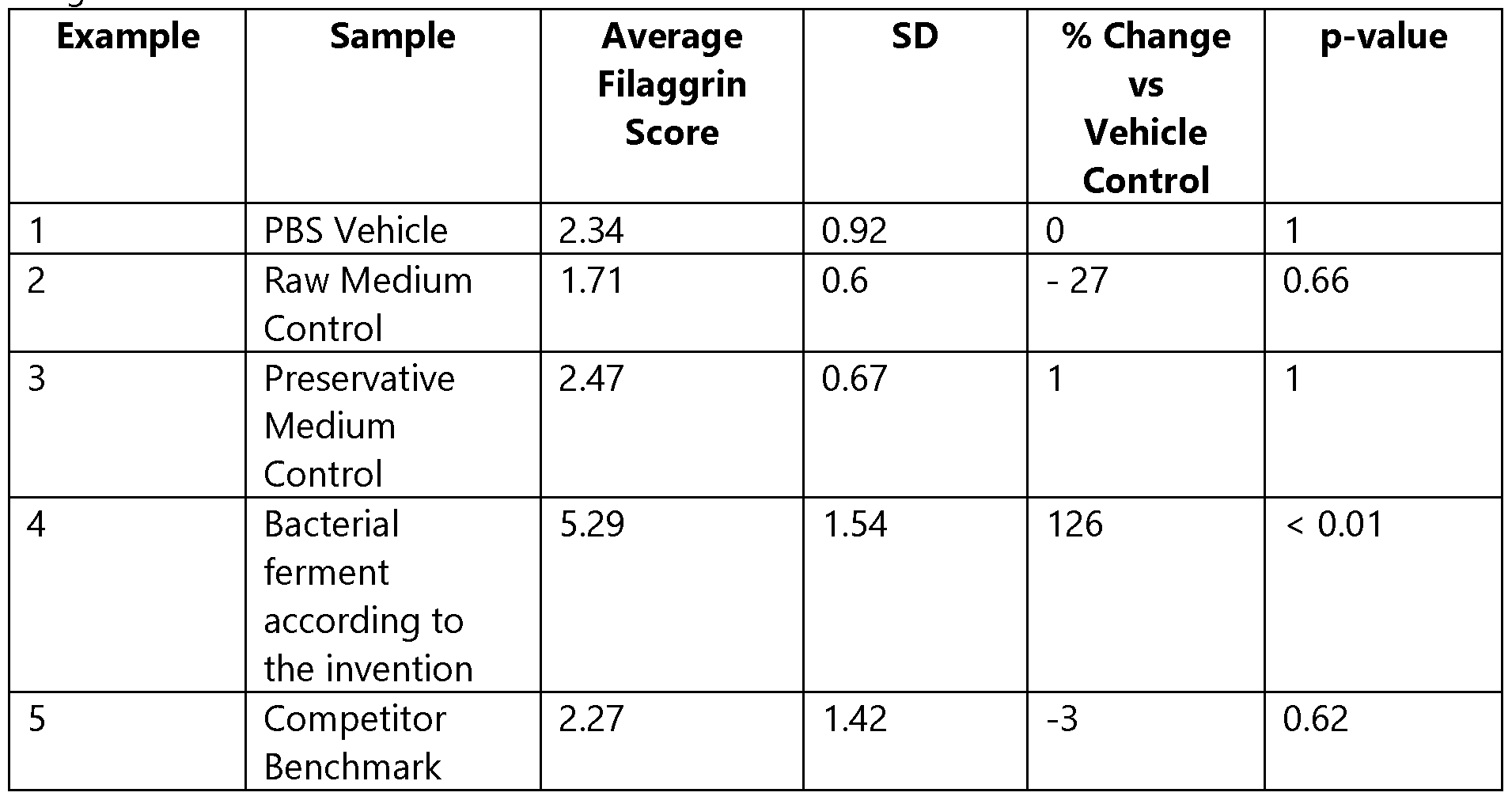
[0068] Skin samples treated with the bacterial ferment according to the invention (Example 4) exhibited a clear and significant increase in fillaggrin levels (+126% vs vehicle control), whereas the controls and the competitor benchmark lowered filaggrin levels in skin explants or did not modulate them at all.
[0069] Modulation of lnterleukin-8 levels by the bacterial ferment according to the invention ()
[0070] lnterleukin-8 (IL8) is an important intermediate signaling molecule in the response of tissues to insults, resulting in an inflammation reaction. As the phenomenon of irritated skin is tightly correlated to mild inflammatory conditions, levels of IL8 are being routinely used as biomarkers for irritation. IL8 is secreted by keratinocytes in the epidermis upon treatment with stresses such as UV light, chemical compounds or bacterial infection. IL8 is a chemoattractant which recruits other inflammatory cell types upon secretion.
[0071] To assess the effect of the bacterial ferment according to the invention on the secretion levels of IL8, reconstituted 3D skin models (EpiDerm™, MatTek) were used. After a short acclimation phase (daily medium changes), the models were switched to hydrocortisone-free medium, and test compounds were added topically to the reconstituted models. 50 mM dexamethasone was used as positive control, PBS served as negative control in the experiment. After 72h incubation at 37°C 5% C02, the 3D models were washed with PBS and subsequently, an inflammatory response was stimulated by addition of 1 pg/ml I LI a in the medium for approx. 24h. Supernatants were collected after this phase and the IL8 concentration in these supernatants was determined using an ELISA kit (Human IL8/CXCL1 DuoSet ELISA, R&D Systems).
[0072] To assess potential toxic effects of the test compounds on the 3D models, a standard MTT assay was carried out to assess viability of the 3D models at the end of the experiment.
Table 2: IL8 concentrations in the supernatants treatment with test compounds and subsequent averages from triplicates ± SEM. P-value is base MTT assay, values are normalized to stimulated


[0073] The bacterial ferment according to the invention exhibits a clear soothing effect by statistically significantly reducing the IL8 concentration in the supernatant by 39% compared to the stimulated control. Interestingly, the Raw Media Control (Culture broth prior to Lactobad us fermentation) shows a pronounced irritating effect on the 3 models, whereas the Preservative Control as well as the Competitor Benchmark product both exhibit no modulation of IL8 concentration.
[0074] Modulation of Skin Moisture by the bacterial ferment according to the invention ()
[0075] The ability of the bacterial ferment according to the invention to influence and improve skin moisture was assessed in a clinical trial with water as the placebo. The study was conducted over a period of two weeks in a randomized, comparative design using blinded test samples. 22 female study subjects (age range 26 - 65 weeks) were selected in adherence to the Helsinki declaration. Subjects with skin conditions, as well as pregnant and lactating women were excluded from the study. The subjects applied the test samples twice daily on the volar forearms after thorough washing of the forearms with 10% sodium lauryl ether sulphate, 4% NaCI in water. [0076] Skin moisture was assessed doing corneometer measurements (using a
CM 825 corneometer probe connected to a MDD4 (Multidisplay Device, Courage + Khazaka electronic GmbH)) in the treated area at the beginning (day 0) and the end (day 13) of the application period. The measurement principle is based on a non- invasive capacity determination of the skin, which is quantitatively correlated to the water content.
[0077] Results are displayed as the means over subjects in difference of corneometer units (- d 13 — dO) ± standard error. Statistical significance of difference of treatments was calculated vs untreated control using ANOVA (Tukey test).
Table 3: Results skin moisture

[0078] As shown in the table 3, the bacterial ferment according to the invention causes a significant increase in C.U., and thus in skin moisture content, over the 13d study duration.
[0079] Formulation examples
[0080] In the following, some formulation examples with the bacterial ferment according to the invention () are illustrated. The amounts are indicated as % by weight for all formulations.
[0081] Deodorant Spray with ACH


[0082] Deodorant Roll-on

[0083] Flash SOS Face Gelee


[0084] Intimate Sensi-Gel
 Lactic acid 90% Nat. Lactic Acid, Aqua 0.3
[0085] Cleansing Micellar Gel

[0086] Aloe Shower Cream


[0087] Fresh Hair shampoo


[0088] Hair conditioner with UV protection

[0089] Low Cost-Refreshing Body Lotion


[0090] Anti-aging Face Cream, soft touch

[0091] Erythema Cotton Cream


[0092] Natural Night Cream


[0093] Anti-Wrinkle Day Emulsion exp. SPF 15


[0094] Perfect Hand with exp. SPF 15, UVA/UVB Balanced


Claims
1. A bacterial ferment obtained by a method comprising the steps of a) Culturing Lactobacillus species in at least one growth medium for at least 24 hours; b) Separating the mixture via centrifugation; c) Adding lactic acid to the supernatant obtained from step b) in an amount sufficient to lower the pH value of the supernatant; d) Stabilizing the resulting mixture with the addition of at least one preservative and/or at least one multifunctional; e) Optionally filtering the mixture to remove any final precipitation.
2. A method for producing a bacterial ferment, comprising the steps of a) Culturing Lactobacillus species in at least one growth medium for at least 24 hours; b) Separating the mixture via centrifugation; c) Adding lactic acid to the supernatant obtained from step b) in an amount sufficient to lower the pH value of the supernatant; d) Stabilizing the resulting mixture with the addition of at least one preservative and/or at least one multifunctional; e) Optionally filtering the mixture to remove any final precipitation.
3. The method according to claim 1, wherein the growth medium comprises a blend of yeast extract, yeast peptone, sodium acetate, dextrose, sucrose, ammonium citrate, potassium phosphate, ascorbic acid, L-cysteine, magnesium sulfate, tween-80 and/or water.
4. The method according to claim 2 and/or 3, wherein the mixture is combined with at least one another mixture of a different Lactobacillus species prepared with the same method of culturing, separating via centrifugation and adding of lactic acid
before stabilizing the resulting mixture with the addition of at least one preservative, to produce a mixture of materials from different Lactobacillus species.
5. The method according to at least one of claims 2 to 4, wherein the at least one multifunctional is a polyol selected from the group consisting of 1,2-pentanediol, 1,2-hexanediol, 1,2-heptanediol and 1,2-octanediol.
6. The method according to at least one of claims 2 to 5, wherein Lactobacillus species is selected from the group consisting of Lactobacillus acidophilus, Lactobacillus casei, Lactobacillus fermentum, Lactobacillus gasseri, Lactobacillus helveticus, Lactobacillus paracasei, Lactobacillus plantarum, Lactobacillus reuteri, Lactobacillus rhamnosus, Lactobacillus sakei and Lactobacillus salivarius.
7. The method according to at least one of claims 2 to 6, wherein lactic acid is added in an amount of from 2 to 10 percent by weight, based on the total amount of the mixture.
8. Cosmetic use of the bacterial ferment according to claim 1 or the bacterial ferment produced by the method according any of claims 2 to 7 for improving the appearance of the skin and/or for preventing body odor, wherein the bacterial ferment is administered by topical application.
9. The cosmetic use according to claim 8, wherein the bacterial ferment is used as agent to
(a) strengthen the skin barrier function, and/or
(b) reduce transepidermal water loss, and/or
(c) induce the expression of filaggrin, and/or
(d) increase components related to the natural moisturizing factor.
10. The bacterial ferment according to claim 1 or the bacterial ferment produced by the method according any of claims 2 to 7 for use in the treatment and/or prevention of skin conditions, wherein the bacterial ferment is administered by topical application.
11. The bacterial ferment for use according to claim 10, wherein the skin conditions are loss of skin barrier function, inflammatory skin conditions and/or growth of pathogenic microorganisms.
12. The bacterial ferment for use according to claim 11, wherein the skin condition is selected from the group consisting of atopic dermatitis microbial infection, dry skin, itchy skin, sensitive skin, atopic skin, inflammation of the skin, microbial dysbiosis, rosacea, psoriasis, rash and acne.
13. The bacterial ferment for use according to any of claims 10 to 12, wherein the bacterial ferment is used as an agent to
(a) provide anti-inflammatory activity, in particular reduce and/or inhibit inflammatory parameters, and/or
(b) inhibit growth of and/or invasion and/or infection by pathogenic microorganisms, and/or
(c) maintain and/or establish and/or restore a healthy state of the skin microbiome, and/or
(d) improve the immune response of the skin.
14. Pharmaceutical or cosmetic composition or pharmaceutical or cosmetic product comprising the bacterial ferment according to claim 1 or the bacterial ferment produced by the method according any of claims 2 to 7.
15. The pharmaceutical or cosmetic composition or pharmaceutical or cosmetic product according to claim 14, wherein the composition or product is selected from the group consisting of oil in water emulsion, water in oil emulsion, creme, lotion and ointment.
Priority Applications (6)
| Application Number | Priority Date | Filing Date | Title |
|---|---|---|---|
| EP22170284.8A EP4134426A1 (en) | 2021-08-13 | 2022-04-27 | Novel bacterial ferment of lactobacillus species |
| KR1020220055178A KR20220152156A (en) | 2021-05-07 | 2022-05-04 | Novel bacterial ferment of lactobacillus species |
| US17/737,206 US12076436B2 (en) | 2021-05-07 | 2022-05-05 | Bacterial ferment of Lactobacillus species |
| BR102022008827-6A BR102022008827A2 (en) | 2021-05-07 | 2022-05-06 | BACTERIAL YEAST OF LACTOBACILLUS SPECIES |
| CN202210500041.1A CN115305215A (en) | 2021-05-07 | 2022-05-06 | Novel bacterial starter of the genus lactobacillus |
| AU2022203101A AU2022203101A1 (en) | 2021-05-07 | 2022-05-09 | Novel bacterial ferment of Lactobacillus species |
Applications Claiming Priority (2)
| Application Number | Priority Date | Filing Date | Title |
|---|---|---|---|
| US202163185489P | 2021-05-07 | 2021-05-07 | |
| US63/185,489 | 2021-05-07 |
Publications (1)
| Publication Number | Publication Date |
|---|---|
| WO2022233441A1 true WO2022233441A1 (en) | 2022-11-10 |
Family
ID=77666472
Family Applications (1)
| Application Number | Title | Priority Date | Filing Date |
|---|---|---|---|
| PCT/EP2021/072613 Ceased WO2022233441A1 (en) | 2021-05-07 | 2021-08-13 | Novel bacterial ferment of lactobacillus species |
Country Status (1)
| Country | Link |
|---|---|
| WO (1) | WO2022233441A1 (en) |
Cited By (3)
| Publication number | Priority date | Publication date | Assignee | Title |
|---|---|---|---|---|
| CN117298032A (en) * | 2023-11-17 | 2023-12-29 | 天津中耀博研生物医药有限公司 | Metaplasia mask for changing skin microecology and preparation method thereof |
| CN118773047A (en) * | 2024-06-14 | 2024-10-15 | 中南大学湘雅医院 | A probiotic combination and a product thereof for intervening rosacea |
| KR102734174B1 (en) * | 2023-12-27 | 2024-11-27 | (주)360 퍼스펙티브 | Lacticaseibacillus rhamnosus ICL-46 strain derived from oat and its use for anti-inflammation, anti-allergy, skin immunity enhancement, atopic dermatitis improvement, skin soothing, and skin microorganism regulation |
Citations (4)
| Publication number | Priority date | Publication date | Assignee | Title |
|---|---|---|---|---|
| JPS62100298A (en) * | 1985-10-24 | 1987-05-09 | Sanraku Inc | Production method of protein A |
| CN1156481A (en) * | 1994-06-22 | 1997-08-06 | 先灵公司 | Extraction of heterologous insoluble proteins from bacteria |
| WO2013153358A1 (en) * | 2012-04-13 | 2013-10-17 | The University Of Manchester | Probiotic bacteria |
| WO2020182970A1 (en) * | 2019-03-14 | 2020-09-17 | Om Pharma Sa | Process for making stable bacterial extracts and their use as pharmaceuticals |
-
2021
- 2021-08-13 WO PCT/EP2021/072613 patent/WO2022233441A1/en not_active Ceased
Patent Citations (4)
| Publication number | Priority date | Publication date | Assignee | Title |
|---|---|---|---|---|
| JPS62100298A (en) * | 1985-10-24 | 1987-05-09 | Sanraku Inc | Production method of protein A |
| CN1156481A (en) * | 1994-06-22 | 1997-08-06 | 先灵公司 | Extraction of heterologous insoluble proteins from bacteria |
| WO2013153358A1 (en) * | 2012-04-13 | 2013-10-17 | The University Of Manchester | Probiotic bacteria |
| WO2020182970A1 (en) * | 2019-03-14 | 2020-09-17 | Om Pharma Sa | Process for making stable bacterial extracts and their use as pharmaceuticals |
Non-Patent Citations (4)
| Title |
|---|
| BOOMSMA B. ET AL: "L-Lactic Acid - A Safe Antimicrobial for Home-and Personal Care Formulations", SOFW JOURNAL, vol. 141, 12 October 2015 (2015-10-12), pages 1 - 5, XP055878391 * |
| ISLAM M. S. ET AL: "A Review on Macroscale and Microscale Cell Lysis Methods", MICROMACHINES, vol. 8, 83, 8 March 2017 (2017-03-08), pages 1 - 27, XP055555969, DOI: 10.3390/mi8030083 * |
| KIM B. S. ET AL: "Inhibitory Effect of Lipoteichoic Acid Derived from Three Lactobacilli on Flagellin-Induced IL-8 Production in Porcine Peripheral Blood Mononuclear Cells", PROBIOTICS AND ANTIMICROBIAL PROTEINS, vol. 13, 30 June 2020 (2020-06-30), pages 72 - 79, XP037381204, ISSN: 1867-1306, DOI: 10.1007/S12602-020-09682-3 * |
| KIM H. ET AL: "Effect of paraprobiotic prepared from Kimchi-derived Lactobacillus plantarum K8 on skin moisturizing activity in human keratinocyte", JOURNAL OF FUNCTIONAL FOODS, vol. 75, 104244, 19 October 2020 (2020-10-19), pages 1 - 7, XP086395130, ISSN: 1756-4646, [retrieved on 20201019], DOI: 10.1016/J.JFF.2020.104244 * |
Cited By (3)
| Publication number | Priority date | Publication date | Assignee | Title |
|---|---|---|---|---|
| CN117298032A (en) * | 2023-11-17 | 2023-12-29 | 天津中耀博研生物医药有限公司 | Metaplasia mask for changing skin microecology and preparation method thereof |
| KR102734174B1 (en) * | 2023-12-27 | 2024-11-27 | (주)360 퍼스펙티브 | Lacticaseibacillus rhamnosus ICL-46 strain derived from oat and its use for anti-inflammation, anti-allergy, skin immunity enhancement, atopic dermatitis improvement, skin soothing, and skin microorganism regulation |
| CN118773047A (en) * | 2024-06-14 | 2024-10-15 | 中南大学湘雅医院 | A probiotic combination and a product thereof for intervening rosacea |
Similar Documents
| Publication | Publication Date | Title |
|---|---|---|
| AU2019295067B2 (en) | Lactobacillus plantarum for skin care | |
| JP2023171950A (en) | Anti-aging agents, antioxidants, anti-inflammatory agents, whitening agents, and cosmetics | |
| KR101634668B1 (en) | Cosmetic composition comprising fermented extract of mistletoe for anti-oxidation or whitening | |
| KR20220004328A (en) | Composition for maintaining the balance of microbiome in the skin comprising hampseed oil | |
| KR101825704B1 (en) | A cosmetic composition comprising coffee silver skin extract | |
| CN103494737B (en) | Cosmetic preparation using ginger flower as anti-ageing and skin-protecting factor and preparation method of cosmetic preparation | |
| KR102400179B1 (en) | Cosmetic composition antimicroboal, antioxidation, whitening or anti-inflammation comprising artemisia capillaris thunberg and olive extract | |
| KR101996732B1 (en) | Cosmetic composition comprising concentrate of Omegiju fermented using magma seawater for improving wrinkles, elasticity or moisturizing the skin | |
| JP5517119B2 (en) | Cosmetics | |
| JP2012162487A (en) | Whitening agent, anti-aging agent and skin cosmetic | |
| KR20190021114A (en) | Composition for anti-inflammation, inhibiting secretion of sebum, or treating acne on the skin comprising plant extract | |
| CA3239527A1 (en) | Skin care compositions and methods for regulating sebum production | |
| JP2022534154A (en) | Functional food composition and cosmetic composition for improving immune function and improving skin condition containing galacto-oligosaccharide, or galacto-oligosaccharide and collagen tripeptide | |
| KR102076656B1 (en) | A cosmetic composition for improving skin aging comprising an extract of femented barley using lactobacillus sp. complex strain as an active ingredient | |
| KR20110139878A (en) | Cosmetic composition containing Yunni extract as an active ingredient | |
| KR20250009896A (en) | Cosmetic composition for reducing skin pore comprising extract of euscaphis japonica or alnus firma as active ingredient | |
| KR20100067700A (en) | Cosmetic compositions for skin care containing extract of tussilago farfara linne flower | |
| KR20090075281A (en) | Cosmetic composition for improving atopic dermatitis | |
| KR102333132B1 (en) | Cosmetic Composition containing Frangipani Oil or Fermented Frangipani Oil | |
| US20230277613A1 (en) | Polysaccharide-Rich Bombax Costatum Flower Extract | |
| KR20240007373A (en) | Composition for Skin Moisturizing, Skin Barrier, Elasticity and Improving Skin Itching Comprising Lactobacillus Complex Strain as Active Ingredient | |
| KR101363028B1 (en) | A cosmetic composition for the prevention, improvement or treatment of acne vulgaris comprising the mixture of extract of Melissa officinalis, Citrus bergamia, leaves of Mentha arvensis, Eclipta prostrata and Hovenia dulcis Thunb | |
| KR20160000318A (en) | Cosmetic composition containing Fir tree oil | |
| WO2024052756A1 (en) | Use of an extract of sichuan pepper for a skin treatment and a composition suitable for this use. | |
| KR101597505B1 (en) | Cosmetic composition for prevention or improvement of sensitive skin comprising mixture oil extracted of Euryale ferox, Euphorbia lathyris L. and Rosa multiflora fruit |
Legal Events
| Date | Code | Title | Description |
|---|---|---|---|
| 121 | Ep: the epo has been informed by wipo that ep was designated in this application |
Ref document number: 21766399 Country of ref document: EP Kind code of ref document: A1 |
|
| NENP | Non-entry into the national phase |
Ref country code: DE |
|
| 122 | Ep: pct application non-entry in european phase |
Ref document number: 21766399 Country of ref document: EP Kind code of ref document: A1 |