WO2022215559A1 - ハイブリッドモデル作成方法、ハイブリッドモデル作成装置、及び、プログラム - Google Patents
ハイブリッドモデル作成方法、ハイブリッドモデル作成装置、及び、プログラム Download PDFInfo
- Publication number
- WO2022215559A1 WO2022215559A1 PCT/JP2022/014692 JP2022014692W WO2022215559A1 WO 2022215559 A1 WO2022215559 A1 WO 2022215559A1 JP 2022014692 W JP2022014692 W JP 2022014692W WO 2022215559 A1 WO2022215559 A1 WO 2022215559A1
- Authority
- WO
- WIPO (PCT)
- Prior art keywords
- models
- hybrid model
- model
- hybrid
- candidates
- Prior art date
- Legal status (The legal status is an assumption and is not a legal conclusion. Google has not performed a legal analysis and makes no representation as to the accuracy of the status listed.)
- Ceased
Links
Images











Classifications
-
- G—PHYSICS
- G05—CONTROLLING; REGULATING
- G05B—CONTROL OR REGULATING SYSTEMS IN GENERAL; FUNCTIONAL ELEMENTS OF SUCH SYSTEMS; MONITORING OR TESTING ARRANGEMENTS FOR SUCH SYSTEMS OR ELEMENTS
- G05B13/00—Adaptive control systems, i.e. systems automatically adjusting themselves to have a performance which is optimum according to some preassigned criterion
- G05B13/02—Adaptive control systems, i.e. systems automatically adjusting themselves to have a performance which is optimum according to some preassigned criterion electric
- G05B13/0265—Adaptive control systems, i.e. systems automatically adjusting themselves to have a performance which is optimum according to some preassigned criterion electric the criterion being a learning criterion
-
- G—PHYSICS
- G05—CONTROLLING; REGULATING
- G05B—CONTROL OR REGULATING SYSTEMS IN GENERAL; FUNCTIONAL ELEMENTS OF SUCH SYSTEMS; MONITORING OR TESTING ARRANGEMENTS FOR SUCH SYSTEMS OR ELEMENTS
- G05B19/00—Program-control systems
- G05B19/02—Program-control systems electric
- G05B19/418—Total factory control, i.e. centrally controlling a plurality of machines, e.g. direct or distributed numerical control [DNC], flexible manufacturing systems [FMS], integrated manufacturing systems [IMS] or computer integrated manufacturing [CIM]
- G05B19/41875—Total factory control, i.e. centrally controlling a plurality of machines, e.g. direct or distributed numerical control [DNC], flexible manufacturing systems [FMS], integrated manufacturing systems [IMS] or computer integrated manufacturing [CIM] characterised by quality surveillance of production
-
- G—PHYSICS
- G06—COMPUTING OR CALCULATING; COUNTING
- G06N—COMPUTING ARRANGEMENTS BASED ON SPECIFIC COMPUTATIONAL MODELS
- G06N20/00—Machine learning
-
- G—PHYSICS
- G06—COMPUTING OR CALCULATING; COUNTING
- G06T—IMAGE DATA PROCESSING OR GENERATION, IN GENERAL
- G06T7/00—Image analysis
-
- G—PHYSICS
- G05—CONTROLLING; REGULATING
- G05B—CONTROL OR REGULATING SYSTEMS IN GENERAL; FUNCTIONAL ELEMENTS OF SUCH SYSTEMS; MONITORING OR TESTING ARRANGEMENTS FOR SUCH SYSTEMS OR ELEMENTS
- G05B2219/00—Program-control systems
- G05B2219/30—Nc systems
- G05B2219/32—Operator till task planning
- G05B2219/32368—Quality control
Definitions
- the present disclosure relates to a hybrid model creation method, a hybrid model creation device, and a program.
- Patent Literature 1 discloses obtaining a final judgment result by integrating the results obtained by using all of the multiple models possessed by the device.
- Patent Document 1 uses all of the multiple models that the device has, so there is a problem that redundant models that are not complementary to other models are used in combination.
- the present disclosure has been made in view of the circumstances described above, and aims to provide a hybrid model creation method and the like capable of creating a hybrid model with higher accuracy.
- a hybrid model creation method pools a plurality of models for estimating categories of input data, and at least one of the plurality of models is a machine learning By selecting and combining two or more models from a plurality of pooled models, a plurality of hybrid model candidates for determining the category are created, and the plurality of hybrid model candidates are compared. , one of the plurality of hybrid model candidates is selected as the hybrid model.
- FIG. 1 is a block diagram showing the functional configuration of the hybrid model creation device according to the embodiment.
- FIG. 2 is a diagram for conceptually explaining the processing when the hybrid model creation method according to the embodiment is executed.
- FIG. 3 is a flow chart showing an outline of the operation of the hybrid model creation device according to the embodiment.
- FIG. 4 is a flowchart illustrating an example of detailed processing of step S1 according to the first embodiment.
- FIG. 5 is a flowchart illustrating an example of detailed processing of step S1 according to the second embodiment.
- FIG. 6 is a flowchart illustrating an example of detailed processing of step S3 according to the third embodiment.
- FIG. 7A is a diagram for explaining the accuracy of a hybrid model candidate when three highly correlated models are combined according to the third embodiment.
- FIG. 7A is a diagram for explaining the accuracy of a hybrid model candidate when three highly correlated models are combined according to the third embodiment.
- FIG. 7B is a diagram for explaining the accuracy of a hybrid model candidate when three weakly correlated models are combined according to the third embodiment.
- FIG. 8 is a diagram for conceptually explaining an example of the details of the hybrid model candidate creation process according to the fourth embodiment.
- FIG. 9 is a flowchart illustrating an example of processing of the hybrid model creation device according to the fourth embodiment.
- FIG. 10 is a flowchart illustrating an example of detailed processing of step S3 according to the fifth embodiment.
- FIG. 11 is a diagram conceptually showing an example of a hybrid model candidate created by combining model 1 and model 2 according to the sixth embodiment.
- FIG. 12 is a flowchart illustrating an example of detailed processing of step S3 according to the sixth embodiment.
- FIG. 13 is a diagram conceptually showing the outputs of the models 1 and 2 according to the seventh embodiment and the convex hull of the distribution of the outputs corresponding to the defective product image.
- FIG. 14 is a diagram conceptually showing an example of a hybrid model candidate created from the outputs of models 1 and 2 in which the output corresponding to the defective product image excluding the vertices of the convex hull shown in FIG. 13 is removed.
- FIG. 15 is a flowchart illustrating an example of detailed processing of step S3 according to the seventh embodiment.
- FIG. 16 is a diagram conceptually showing outputs and exclusion regions of models 1 and 2 according to the seventh embodiment.
- FIG. 17 is a diagram conceptually showing an example of a hybrid model candidate created from outputs of models 1 and 2 from which outputs corresponding to defective product images included in the exclusion area shown in FIG. 16 are removed.
- FIG. 18 is a diagram for explaining a method of calculating a FAR curve for model 1 according to the eighth embodiment.
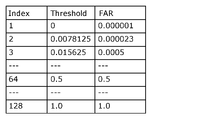
- FIG. 19 is a diagram illustrating an example of a FAR table of model 1 according to the eighth embodiment.
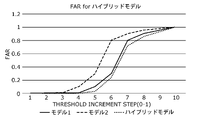
- FIG. 20 is a diagram conceptually showing first FAR values of two models and second FAR values of hybrid model candidates created by combining the two models according to the eighth embodiment.
- FIG. 21 is a diagram showing an example of a hybrid model creation method according to another embodiment.
- FIG. 22 is a diagram showing another example of a hybrid model creation method according to another embodiment.
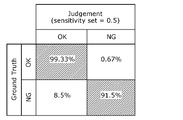
- FIG. 23A is a diagram showing an example of a confusion matrix table according to another embodiment.
- FIG. 23B is a diagram showing an example of a confusion matrix table according to another embodiment.
- FIG. 1 is a block diagram showing the functional configuration of a hybrid model creation device 10 according to this embodiment.
- FIG. 2 is a diagram for conceptually explaining the processing when the hybrid model creation method according to the present embodiment is executed.
- the hybrid model creation device 10 is implemented by a computer or the like, and is a device that can create a hybrid model with higher accuracy using a plurality of models.
- the hybrid model generation device 10 includes a model pool section 11, a model selection section 12, a hybrid model candidate generation section 13, a hybrid model selection section 14, a determination threshold value and a determination unit 15 .
- the determination threshold determination unit 15 may be provided in a device other than the hybrid model generation device 10 .
- the model pool unit 11 is composed of a HDD (Hard Disk Drive), a memory, or the like, and pools (stores) a plurality of models for estimating the category of input data.
- the model pool unit 11 pools a plurality of pre-created models 11a such as model 1, model 2, model 3 and model 4, as shown in FIG.
- at least one model of the plurality of models 11a is a machine-learned model.
- Each of the multiple models 11a can also be referred to as an AI model.
- input data is an inspection image of a manufactured product.
- At least one model among the plurality of models 11a is an AI model learned by deep learning.
- the plurality of models 11a may include AI models whose feature values are designed manually. For example, each of the plurality of models 11a receives an inspection image of a manufactured product as an input, estimates the probability that the manufactured product shown in the inspection image is defective, and outputs the estimated probability. Note that each of the plurality of models 11a may output a binary estimation result indicating whether or not the manufactured product shown in the inspection image is defective.
- Model selection unit 12 A model selection unit 12 selects two or more models from a plurality of models pooled in the model pool unit 11 .
- the model selection unit 12 selects two or more models after excluding a predetermined model from the plurality of models pooled in the model pool unit 11 .
- the model selection unit 12 selects two or more models after excluding model 4 as a predetermined model from among model 1, model 2, model 3, and model 4, for example. Processing 12a is performed.
- the model selection unit 12 may select two or more models after excluding a predetermined model from the plurality of models pooled in the model pool unit 11, or may select two or more models. Of the plurality of models, two or more models may be selected after excluding a predetermined model.
- the predetermined model may be, for example, a model with low estimation accuracy or a model with strong correlation with other models.
- the details of the method for excluding such a predetermined model will be explained in Examples 1 and 2 to be described later, so explanations thereof will be omitted here.
- the hybrid model candidate creation unit 13 creates a plurality of hybrid model candidates for category determination by combining two or more models selected by the model selection unit 12 .
- the hybrid model candidate creation unit 13 creates a plurality of hybrid model candidates by combining two or more models selected by the model selection unit 12 so as not to include a combination of models having a correlation stronger than a threshold.
- Hybrid model candidates may be combined by simply connecting (cascading) two or more models selected by the model selection unit 12, or may be combined using logistic regression or the like as described later.
- the hybrid model candidate creation unit 13 performs hybrid model candidate creation processing 13a for creating hybrid model candidates by combining the models 1, 2, and 3 selected by the model selection unit 12. More specifically, the hybrid model candidate creating unit 13 creates a hybrid model candidate 1 that combines model 1 and model 2, for example, and a hybrid model candidate 2 that combines model 2 and model 3, for example. Further, the hybrid model candidate creating unit 13 creates a hybrid model candidate 3 that combines the model 1 and the model 3, for example, and a hybrid model candidate 4 that combines the model 1, the model 2, and the model 3, for example.
- the category to be determined is whether the manufactured product shown in the inspection image is a non-defective product or a defective product.
- the hybrid model candidate 3 determines whether the manufactured product shown in the inspection image is a non-defective product or a defective product.
- the hybrid model candidates 1 to 3 may output determination results obtained by determining (estimating) whether or not the manufactured product shown in the inspection image is defective by probability.
- the hybrid model candidate creation unit 13 compares the created hybrid model candidates.
- the hybrid model candidate creation unit 13 performs comparison processing for comparing the created hybrid model candidates 1 to 4.
- a method for comparing the hybrid model candidates 1 to 4 for example, a method of comparing the accuracy of the determination result of each of the hybrid model candidates 1 to 4, and a method of comparing each of the two or more models that can be calculated from the respective determination results.
- a method of comparing degrees of importance also referred to as degrees of contribution
- degrees of contribution can be used.
- Hybrid model selection unit 14 A hybrid model selection unit 14 selects one of the plurality of hybrid model candidates as a hybrid model based on the comparison results of the plurality of hybrid model candidates.
- the hybrid model selection unit 14 performs a hybrid model selection process 14a for selecting one of the hybrid model candidates 1 to 4 as the hybrid model from the comparison result of the hybrid model candidates 1 to 4.
- the hybrid model candidate having the highest accuracy among the accuracy of the determination result or the combination of the models having the highest importance is selected as the hybrid model. is selected as
- the determination threshold determination unit 15 adjusts the sensitivity of the hybrid model selected by the hybrid model selection unit 14 using, for example, a verification data set such as an inspection image of a manufactured product, and determines an allowable excess for suppressing erroneous determination. Determine the detection rate threshold.
- the determination threshold determination unit 15 receives a verification data set such as an inspection image of a manufactured product, for example, and obtains a determination result obtained by determining whether the manufactured product is a non-defective product or a defective product.
- the determination threshold determination unit 15 generates a confusion matrix from the acquired determination results, and determines an allowable overdetection rate threshold (determination threshold) for suppressing erroneous determination.
- the Cascading Model shown in the determination threshold determination process 15a shown in FIG. 2 means the hybrid model selected by the hybrid model selection unit 14, and the determination threshold is optimized.
- FIG. 3 is a flow chart showing an overview of the operation of the hybrid model creation device 10 according to this embodiment.
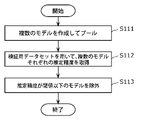
- the hybrid model creation device 10 pools a plurality of models for estimating the category of input data (S1).
- at least one model of the plurality of models is a machine-learned model.
- each of the plurality of models receives an inspection image of a manufactured product as an input, estimates the probability that the manufactured product reflected in the inspection image is defective, and outputs the estimated probability.
- the hybrid model creation device 10 selects two or more models from a plurality of pooled models (S2).
- the hybrid model generating apparatus 10 selects two or more models from a plurality of pooled models, excluding some (predetermined models).
- the hybrid model creation device 10 creates multiple hybrid model candidates for category determination by combining the two or more models selected in step S2 (S3).
- the hybrid model generating device 10 may combine two or more models selected in step S2 by sequentially cascading them, or may combine them using logistic regression.
- the hybrid model creation device 10 compares the multiple hybrid model candidates created in step S3 (S4).
- the hybrid model generation device 10 compares the accuracy of the determination result of each of the hybrid model candidates, for example, and compares two or more models that can be calculated from the determination results of each of the hybrid model candidates. You can compare the importance of
- step S5 determines whether all hybrid model candidates have been compared (S5). If all the hybrid model candidates have not been compared (No in S5), the process returns to step S4.
- step S5 if all hybrid model candidates have been compared (Yes in S5), one of the plurality of hybrid model candidates is selected as the hybrid model (S6).
- the hybrid model generating apparatus 10 selects a hybrid model candidate consisting of a combination of models with the highest accuracy or highest importance among the judgment results of each of the hybrid model candidates as the hybrid model. be able to.
- a plurality of hybrid model candidates are created without using all of the pooled models, and a plurality of hybrid model candidates are created using, for example, determination accuracy. Compare model candidates.
- the hybrid model candidate with the highest accuracy among the determination results can be selected as the hybrid model.
- a hybrid model with higher accuracy can be created using a plurality of models.
- a model with low estimation accuracy may be excluded as a predetermined model from the plurality of pooled models. That is, among a plurality of pooled models, models with low estimation accuracy may be excluded from the hybrid model candidates.
- the estimation accuracy is not limited to the accuracy rate, but also the precision rate, the recall rate, the F value calculated by the harmonic average of the precision rate and the recall rate, the AUC (Area Under Curve) of the ROC (Receiver Operating Characteristic) curve, and the accuracy rate. Any combination of at least one of the rates may be used.
- FIG. 4 is a flowchart showing an example of detailed processing of step S1 according to the first embodiment.
- step S1 the hybrid model creation device 10 first pools a plurality of models for estimating the category of input data (S111).
- the hybrid model creation device 10 acquires the estimation accuracy of each of the multiple models using the verification data set (S112). More specifically, before selecting two or more models, the model selection unit 12 inputs a plurality of verification data sets to each of the plurality of models pooled in the model pool unit 11 to select categories. By estimating, the estimation accuracy of each of the plurality of models is obtained.
- the estimation accuracy of each of the pooled models may be calculated using all of the verification datasets prepared in advance, but this is not the only option.
- a verification data set with different estimation results depending on the model may be used. For example, when the pooled models are model 1, model 2, model 3 and model 4, the estimation result of model 1 and the estimation results of model 2, model 3 and model 4 are different validation data sets Use
- the hybrid model creation device 10 excludes models whose estimation accuracy is equal to or less than the threshold (S113). More specifically, the model selection unit 12 excludes models whose estimation accuracy is equal to or less than a threshold from the plurality of models pooled in the model pool unit 11 . Then, the model selection unit 12 selects two or more models from a plurality of models from which the models below the threshold are excluded. Note that the threshold is set in advance by the user.
- the model selection unit 12 Exclude model 4 from models 1-4 that are present. Then, the model selection unit 12 selects two or more models from the model 1, the model 2, and the model 3 pooled in the model pool unit 11.
- the hybrid model creation device 10 can exclude models whose estimation accuracy is equal to or less than the threshold from the hybrid model candidates among the plurality of pooled models.
- a model having a strong correlation with all other models may be excluded from the pooled models as a predetermined model. That is, among a plurality of pooled models, a model that has a strong correlation with all other models may be excluded from the hybrid model candidates. A specific example of this case will be described below as a second embodiment.
- FIG. 5 is a flowchart showing an example of detailed processing of step S1 according to the second embodiment.
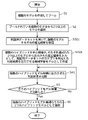
- step S1 first, the hybrid model creation device 10 pools a plurality of models for estimating the category of input data (S121).
- the hybrid model creation device 10 uses the verification data set to obtain estimation results for each of the multiple models (S122). More specifically, before selecting two or more models, the model selection unit 12 inputs a plurality of verification data sets to each of the plurality of models pooled in the model pool unit 11 to select categories. By estimating, the estimation result of each of the plurality of models is acquired.
- the estimation result may be the final output result of the model or an intermediate quantity of the model.
- the estimation result is the intermediate or final layer output result of the deep-learned model.
- the hybrid model creation device 10 uses the estimation results obtained in step S122 to calculate the correlations of all of the pooled models (S123). More specifically, the model selection unit 12 calculates the correlation between two models for all of the models pooled in the model pool unit 11 .
- c j be the estimation result of the j-th (j is a natural number) model for the verification data set.
- cj,i be the estimation result for the i-th (i is a natural number) verification data in the verification data set. It is also assumed that the estimation result is the final output result of the model or a scalar intermediate quantity.
- Equation 1 is an equation for calculating the matching rate (Jcacard coefficient) of the estimation result, and can be used when the estimation result is a binary value of 0 or 1.
- Equation 1 ⁇ is Kronecker's ⁇ .
- (Formula 2) to (Formula 4) can be used not only when the estimation result is binary but also when it is a continuous value.
- (Formula 2) is a formula for calculating the covariance, and E[X] indicates the average of X.
- V[X] in (Formula 3) indicates the variance of X.
- (Formula 3) is a formula for calculating a correlation coefficient
- (Formula 4) is a formula for calculating a cosine similarity
- c j is a vector created by arranging c j and k with respect to i. .
- the correlation between the j-th model and the k-th model can be calculated by using (Equation 5) or (Equation 6) to calculate the intermediate degree of similarity sim i for each verification data.
- fj,i is an intermediate quantity of a vector consisting of multiple values.
- a statistic such as the median value or the average value represented by (Equation 7) is calculated. This allows the calculated correlations to be compared even if the estimation result is an intermediate quantity of vectors.
- the hybrid model creation device 10 excludes models whose correlations with all other models are stronger than a threshold (S124). More specifically, the model selection unit 12 excludes a model whose average or median correlation coefficient with all other models is stronger than a threshold from among the models pooled in the model pool unit 11. do. Then, the model selection unit 12 selects two or more models from a plurality of models from which the models below the threshold are excluded. Note that the threshold is set in advance by the user.
- the model selection unit 12 selects the model Model 4 is excluded from models 1 to 4 pooled in pool unit 11 . Then, the model selection unit 12 selects two or more models from the model 1, the model 2, and the model 3 pooled in the model pool unit 11.
- the hybrid model creation device 10 can exclude from the hybrid model candidates those models that have stronger correlations than the threshold with all other models among the pooled models.
- step S1 shown in FIG. 3 a model having a strong correlation with all other models is excluded from a plurality of pooled models as a predetermined model.
- the present invention is not limited to this.
- step 3 shown in FIG. 3 a hybrid model candidate may be created by not including a combination of models with a strong correlation. A specific example of this case will be described below as a third embodiment.
- FIG. 6 is a flowchart showing an example of detailed processing of step S3 according to the third embodiment.
- the hybrid model creation device 10 uses the verification data set to acquire the estimation results of each of the multiple models (S311). More specifically, before creating a plurality of hybrid model candidates, the hybrid model candidate creating unit 13 inputs a plurality of verification data sets to each of the plurality of models pooled in the model pooling unit 11 to classify them into categories. is obtained by estimating the estimation result of each of the plurality of models. In addition, the hybrid model candidate creation unit 13 inputs a plurality of verification data sets to each of the plurality of models selected by the model selection unit 12 to estimate the category, thereby obtaining estimation results for each of the plurality of models. You may Here, the estimation result may be the final output result of the model or the intermediate quantity of the model, as described in the second embodiment. For example, in a deep-learned model, the estimation result is the intermediate or final layer output result of the deep-learned model.
- the hybrid model creation device 10 uses the estimation results obtained in step S311 to calculate the correlations of all of the pooled or selected models (S312). More specifically, the hybrid model candidate creation unit 13 calculates the correlation between two models for all of the multiple models pooled in the model pool unit 11 or selected by the model selection unit 12 . Since the method of calculating the correlation has been described in the second embodiment, the description thereof will be omitted here.
- the hybrid model creation device 10 selects two or more models from the pooled models so as not to include a combination of two models having a correlation stronger than a threshold (S313). More specifically, the hybrid model candidate creation unit 13 combines the two or more models selected by the model selection unit 12 so as not to include a combination of two models having a correlation stronger than a threshold, so that the hybrid model candidate creation unit 13 Create multiple model candidates.
- the hybrid model creation device 10 can create hybrid model candidates by combining weakly correlated models from a plurality of selected models.
- FIG. 7A is a diagram for explaining the accuracy of a hybrid model candidate when combining three models with a strong correlation according to the third embodiment.
- FIG. 7B is a diagram for explaining the accuracy of a hybrid model candidate when three weakly correlated models are combined according to the third embodiment.
- the hybrid model candidate shown in FIGS. 7A and 7B combines the estimated results of the three models using logistic regression or the like. In order to simplify the explanation, it is assumed that the hybrid model candidates in FIGS. 7A and 7B output the majority of the estimation results of the three models.
- FIG. 7A shows binary estimation results and determinations when 10 verification data out of the verification data set are used for each of models 1, 2, and 3, which have strong correlations, and a hybrid model candidate. The results and the true values of 10 validation data are shown.
- the accuracies (estimated accuracies) of model 1, model 2 and model 3 are 80%, 70% and 80%, and the hybrid model combining model 1, model 2 and model 3
- the candidate accuracy (determination accuracy) is 80%.
- FIG. 7B shows binary estimation results and determinations when using 10 validation data out of the validation data set for each of models 1, 2, and 3 with weak correlations, and a hybrid model candidate. The results and the true values of 10 validation data are shown.
- the accuracies (estimated accuracies) of model 1, model 2 and model 3 are 80%, 60% and 50%, and the hybrid model candidate combining model 1, model 2 and model 3
- the accuracy (determination accuracy) of is 90%.
- the hybrid model creation device 10 can create hybrid model candidates by combining models with weak correlations. Since the hybrid model creation device 10 can select one hybrid model from such hybrid model candidates, it is possible to create a hybrid model with higher accuracy.
- Example 4 In a fourth embodiment, a specific example of generating hybrid model candidates using logistic regression or the like will be described.
- the hybrid model candidate creation unit 13 creates multiple hybrid model candidates for category determination by combining two or more models selected by the model selection unit 12 using logistic regression or the like. Although the maximum number of models to be combined is set in advance, it may be set each time a hybrid model candidate is created.
- the hybrid model candidate creating unit 13 creates each of the plurality of hybrid model candidates as a machine learning model.
- the machine learning model is input with two or more output results obtained by inputting a verification data set into each of two or more models selected to configure the hybrid model candidate and estimating the category. , is a model for outputting the judgment result of judging the category of the verification data set.
- the hybrid model candidate creation unit 13 compares the judgment results output to the plurality of created hybrid model candidates. More specifically, the hybrid model candidate creation unit 13 compares the determination results output after performing machine learning on the plurality of created hybrid model candidates.
- FIG. 8 is a diagram for conceptually explaining an example of the details of the hybrid model candidate creation process 13a according to the fourth embodiment.
- the hybrid model candidate creation process 13a shown in FIG. 8 is an example of details of the hybrid model candidate creation process 13a shown in FIG.
- the hybrid model candidate creation unit 13 performs hybrid model candidate creation processing 13a for creating hybrid model candidates by combining the models 1, 2, and 3 selected by the model selection unit 12. More specifically, the hybrid model candidate creating unit 13 creates machine learning models 1 & 2 (hybrid model candidate 1) by combining the model 1 and the model 2 using logistic regression, for example. Further, the hybrid model candidate creating unit 13 creates machine learning models 2 & 3 (hybrid model candidate 2) by combining the model 2 and the model 3 using logistic regression, for example. Further, the hybrid model candidate creating unit 13 creates machine learning models 1 & 3 (hybrid model candidate 3) by combining the model 1 and the model 3 using logistic regression, for example. In the example shown in FIG. 8, the maximum number of models to be combined is two, and machine learning models are created by combining them in a round-robin manner.
- the hybrid model candidate creation unit 13 uses the verification data set to learn the machine learning models 1 & 2, the machine learning models 2 & 3, and the machine learning models 1 & 3, and then the output result (determination result) obtained. to get The hybrid model candidate creation unit 13 performs comparison processing for comparing the output results of the machine learning models 1&2, the machine learning models 2&3, and the machine learning models 1&3.
- the hybrid model candidate creating unit 13 ranks the results of the comparison processing, for example, in descending order of accuracy. In the example shown in FIG. 8, the ranking is in the order of machine learning models 2&3, machine learning models 1&3, and machine learning models 1&2.
- a machine learning model obtained by combining using logistic regression can be expressed using a logistic function (sigmoid function) as shown in (Formula 8) below. Although two models are combined in (Equation 8), the same applies when three or more models are combined.
- function S b ( ⁇ 0 + ⁇ 1 x 1 + ⁇ 2 x 2 ) is a sigmoid function with outputs from 0 to 1, ⁇ 0 is a constant, ⁇ 1 and ⁇ 2 are x 1 and x2 coefficients. Also, x 1 and x 2 denote the outputs of the two models.
- x 1 and x 2 correspond to outputs (estimation results) obtained after learning two models, respectively, and are expressed by probabilities.
- the output of the function S b ( ⁇ 0 + ⁇ 1 x 1 + ⁇ 2 x 2 ) is the output (judgment result) obtained after learning the coefficient using the verification data set for the machine learning model that combines the two models. and is expressed with a probability of 0 to 1.
- machine learning models 1 & 2 which are obtained by combining using logistic regression, use the output of model 1 and the output of model 2 as inputs, and make a decision by applying a logistic function whose coefficients are learned using a verification data set. It is a hybrid model candidate that outputs results.
- machine learning models 2 & 3 which are obtained by combining using logistic regression, use the output of model 2 and the output of model 3 as inputs and apply a logistic function that has learned coefficients using the verification data set. It is a hybrid model candidate that outputs the determination result.
- Machine learning models 1 & 3 which are obtained by combining using logistic regression, use the output of model 1 and the output of model 3 as inputs, and apply the logistic function whose coefficients are learned using the verification data set to obtain the judgment result. It is a hybrid model candidate to be output.
- the method of combining multiple models is not limited to the method using logistic regression. If machine learning can be performed using the output (estimation results) obtained after training multiple models as input, it is possible to appropriately select machine learning methods such as support vector machines, random forests, gradient boosting methods, and neural networks.
- FIG. 9 is a flowchart showing an example of processing of the hybrid model creation device 10 according to the fourth embodiment. Note that steps S1, S2, S5, and S6 shown in FIG. 9 are the same as steps S1, S2, S5, and S6 described with reference to FIG. 3, and description thereof will be omitted.
- step S321 the hybrid model creation device 10 acquires estimation results for each of the multiple models using the verification data set. More specifically, the hybrid model candidate creation unit 13 inputs a plurality of verification data sets to each of a plurality of models pooled in the model pool unit 11 or selected by the model selection unit 12, and selects categories. By estimating, the estimation result of each of the plurality of models is acquired. The estimation result may be the final output result of the model, or an intermediate quantity of the model, as described above. It should be noted that step S321 may be executed before step S2 when obtaining estimation results for each of a plurality of models pooled in the model pool unit 11 .
- the hybrid model creation device 10 creates a plurality of hybrid model candidates by combining two or more models selected in step S2 as machine learning models (S322).
- each of the plurality of hybrid model candidates is a machine learning model that outputs the judgment result of judging the category of the verification data set by inputting the estimation results output from two or more models selected as a combination.
- This machine learning model is typically a model obtained by combining two or more models selected as a combination using logistic regression.
- the machine learning model is created by the hybrid model candidate creating unit 13 according to the user's instruction.
- the hybrid model creation device 10 compares the determination results output to each of the plurality of hybrid model candidates created in step S322 (S41). More specifically, the hybrid model candidate creation unit 13 inputs, for example, a verification data set to each of the hybrid model candidates, and compares the accuracy of the output judgment results.
- the hybrid model candidate creation unit 13 may compare the importance of two or more configured models that can be calculated from the determination results of each of the hybrid model candidates. More specifically, when comparing a plurality of hybrid model candidates, the hybrid model candidate creation unit 13 selects the candidate hybrid model selected for constructing the hybrid model candidate based on the determination results output to each of the plurality of hybrid model candidates. The respective importance of two or more models may be calculated. Then, the hybrid model candidate creation unit 13 may perform the comparison processing in step S41 by notifying the models with the calculated importance levels below a preset threshold value.
- the hybrid model candidate creation unit 13 may make the above notification to the hybrid model selection unit 14, or may make the above notification by displaying on a display or the like the models with importance levels below the threshold. good too.
- the hybrid model selection unit 14 selects one of the plurality of hybrid model candidates as a hybrid model, excluding hybrid model candidates having a model with a degree of importance below a preset threshold. can be selected.
- the output of the function S b ( ⁇ 0 + ⁇ 1 x 1 + ⁇ 2 x 2 ) is the machine learning model that combines the two models, and the coefficients using the validation data set. This is an output (judgment result) obtained after learning.
- the coefficient ⁇ 1 indicates the importance of the model that outputs x 1 in this machine learning model
- the coefficient ⁇ 2 indicates the importance of the model that outputs x 2 in this machine learning model. That is, the coefficient ⁇ i indicates the importance of model i that outputs x i in a machine learning model that combines a plurality of models.
- the model i has an influence (contribution) on the decision result in the machine learning model ) is small, it can be analyzed.
- the coefficient ⁇ i is a negative value
- the model i may cause overfitting of the machine learning model. This is because it is considered that the judgment result of the machine learning model and each of the plurality of models constituting the machine learning model should have a positive correlation.
- a machine learning model that combines multiple models learns the coefficients using the verification dataset, and by analyzing the coefficients, it is possible to analyze the importance of each of the multiple combined models.
- the model is a model that constitutes a machine learning model. i should not be used.
- Example 5 processing speed is taken into consideration when creating hybrid model candidates by machine learning using logistic regression. A specific example thereof will be described below.
- the hybrid model candidate creating unit 13 receives a verification data set and selects a category of the verification data set. Measure (acquire) the processing time required for estimation.
- the verification data set contains X pieces of sample data.
- the hybrid model candidate creation unit 13 calculates the average processing time, which is the processing time per piece of sample data, for each of the plurality of models from the measured processing time.
- the hybrid model candidate creation unit 13 creates a plurality of hybrid model candidates only from among the two or more models selected by the model selection unit 12, with only the combination that satisfies the execution time requirement for the total average processing time. do. Note that the method of creating a hybrid model candidate by machine learning using logistic regression is as described in Example 4, so description thereof will be omitted here.
- the hybrid model candidate creating unit 13 receives a verification data set and selects a category of the verification data set. Get the processing time required for estimation.
- the verification data set contains X pieces of sample data.
- the hybrid model candidate creation unit 13 calculates the average processing time, which is the processing time per piece of sample data, for each of the plurality of models from the acquired processing time.
- the hybrid model candidate creating unit 13 defines the value of the average processing time of each of the multiple models with respect to the sum of the average processing times of all of the multiple models as the hardware cost.
- the hardware cost Cm can be defined as in (Equation 9) below.
- c m avg(processing speed of model)/sum(processing speed of avg_all_models) (Formula 9)
- the hybrid model candidate creation unit 13 adds the hardware cost of each of the two or more models selected to form the hybrid model candidate to the loss function of the machine learning model of each of the plurality of hybrid model candidates. Add a weighted regularization term.
- the regularization term that takes into account the hardware cost is, for example, a regularization term such as Lasso (L1 norm or L1 regularization) multiplied by the parameter ⁇ and the hardware cost C m ⁇ ⁇ C m ⁇ L1 regularization term can be expressed as
- the parameter ⁇ is a hyperparameter that can change the weight of the hardware cost. Details will be described later.
- the hybrid model candidate creation unit 13 adds a regularization term that takes into account the hardware cost, and then executes logistic regression machine learning. As a result, it is possible to reduce the coefficient (weight) of a model that contributes little to the hybrid model candidate despite the high calculation cost, so that the model that contributes little to the hybrid model candidate can be excluded.
- the logistic regression loss function E(w) is expressed as (Equation 10).
- learning is performed so as to obtain a combination of weights (coefficients) that minimizes the loss function E(w).
- Equation 11 a loss function E ′ (w) obtained by adding an L1 regularization term to the loss function E(w), for example, is expressed as (Equation 11).
- Equation 11 the parameter ⁇ is a hyperparameter.
- explanatory variables are the output values of each model. Therefore, using the hardware cost Cm of the corresponding model, the loss function E ′ (w) with the hardware cost added can be expressed as in (Equation 12).
- the L1 regularization term As the regularization term has been described, but the L2 regularization term may be used. Also in this case, a loss function can be similarly defined in consideration of the hardware cost Cm . Note that the L1 regularization term can be expected to have the effect of not only reducing the value of the weight (coefficient) but also making it zero. Therefore, the L1 regularization term is better than the L2 regularization term for the purpose of creating hybrid model candidates by excluding models with long processing times.
- FIG. 10 is a flowchart showing an example of detailed processing of step S3 according to the fifth embodiment. 10 corresponds to another example of the processing of steps S321 and S322 shown in FIG.
- step S3 the hybrid model creation device 10 uses the verification data set to obtain the processing time and estimation results for each of the multiple models (S331). More specifically, the hybrid model candidate creation unit 13 inputs a plurality of verification data sets to each of the plurality of models selected by the model selection unit 12 to estimate the category. The hybrid model candidate creation unit 13 calculates the processing time and the estimation result required from inputting the verification data set to estimating the category of the verification data set for each of the plurality of models selected by the model selection unit 12. get.
- the estimation result may be the final output result of the model, or an intermediate quantity of the model, as described above. Note that the processing time and estimation result may be obtained from each of a plurality of models pooled in the model pool unit 11 . In this case, step S331 may be performed before step S2.
- the hybrid model generation device 10 defines the value of the time required for each of the plurality of models with respect to the sum of all the processing times of the plurality of models as the hardware cost. (S332).
- the processing time used to define the hardware cost is the average processing time.
- the hybrid model creation device 10 creates a plurality of hybrid model candidates by combining two or more models selected in step S2 as machine learning models.
- the hybrid model creation device 10 adds a regularization term that takes into consideration the hardware cost to the loss function of each of the plurality of hybrid model candidates during machine learning (S333). More specifically, the loss function of each of the plurality of hybrid model candidates is regularized by adding (multiplying) the hardware cost of each of the two or more models selected to construct the hybrid model candidate. term is added.
- the hybrid model candidate creation unit 13 Before comparing a plurality of hybrid model candidates in subsequent step S4, the hybrid model candidate creation unit 13 performs coefficient analysis from the output (determination result) obtained after learning using the verification data set. As a result, the hybrid model candidate creation unit 13 can exclude hybrid model candidates including models requiring a long processing time. Therefore, in the subsequent step S4, the hybrid model candidate creation unit 13 may perform comparison processing of a plurality of hybrid model candidates after excluding hybrid model candidates including models requiring a long processing time.
- Example 6 A hybrid model candidate is created and machine-learned as a machine learning model that takes as input the estimation results output from two or more models selected as a combination and outputs the judgment result of judging the category of the verification data set. .
- the estimation results output from two or more models reliably indicate NG, and the true value (label) is also NG. is excluded and machine learning is performed.
- FIG. 11 is a diagram conceptually showing an example of a hybrid model candidate created by combining model 1 and model 2 according to the sixth embodiment.
- the hybrid model candidate shown in FIG. 11 is a logistic regression model (boundary) created by machine learning.
- the vertical axis is the output value that is output (estimated) when the verification data set is input to model 2, and is expressed in terms of probability.
- the horizontal axis is the output value that is output (estimated) when the verification data set is input to model 1, and is expressed in terms of probability.
- the sample data included in the verification data set is an inspection image of a manufactured product
- the black circles are inspection images in which the true value of the sample data is a non-defective product, and are called non-defective product images.
- a white circle is an inspection image in which the true value of the sample data is a defective product, and is called a defective product image.
- the output of the defective product image with large output values (probability) for both model 1 and model 2 (referred to as the output showing clear NG) is machine-learned so as to become the logistic regression model (boundary) shown in FIG. In some cases, it can be seen that the importance is relatively low.
- the output in the area surrounded by the circle is the output indicating a clear NG.
- the number of clear NGs contained in the circled area is large. For this reason, when creating a hybrid model candidate by machine learning using the output of model 1 and model 2 as shown in FIG. 11 and the true value (label) of the verification data set, It is strongly affected by such an output that clearly shows NG, and there is a possibility that the boundary shown in FIG. 11 cannot be obtained.
- machine learning is performed by excluding the output that clearly shows NG, which is the output in the area surrounded by the circle.
- the hybrid model candidate creation unit 13 inputs a verification data set to each of the two or more models selected to configure the hybrid model candidate, and causes the category to be estimated. output values that are higher than the threshold value and are estimated to be defective are excluded from the output values of .
- the hybrid model candidate creation unit 13 uses as inputs a plurality of output values from which output values higher than the threshold are excluded, and uses the true values of the verification data set corresponding to the plurality of output values. Create multiple hybrid model candidates by performing machine learning.
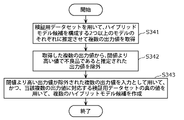
- FIG. 12 is a flowchart showing an example of detailed processing of step S3 according to the sixth embodiment. 12 corresponds to another example of the processing of steps S321 and S322 shown in FIG.
- step S3 the hybrid model creation device 10 obtains a plurality of output values by estimating each of the two or more models that constitute the hybrid model candidate using the verification data set (S341).
- the hybrid model creation device 10 excludes output values that are higher than a threshold value and are estimated to be defective from the plurality of output values acquired in step S341 (S342).
- an output value that is higher than the threshold value and is estimated to be a defective product is an output value that clearly indicates NG as described with reference to FIG. 11 .
- the hybrid model generating apparatus 10 uses as inputs a plurality of output values from which output values higher than the threshold are excluded in step S342, and the true values of the verification data set corresponding to the plurality of output values.
- a plurality of hybrid model candidates are created by performing machine learning using (S342).
- the hybrid model creation device 10 can create a plurality of hybrid model candidates with high determination accuracy by performing machine learning while excluding outputs included in areas where clear NGs are gathered.
- Example 7 In the sixth embodiment, a case has been described in which machine learning is performed by excluding outputs included in a region where clear NGs are gathered among the outputs of two or more models constituting a hybrid model candidate, but the present invention is not limited to this.
- a method using a convex hull will be described as another method of excluding outputs clearly indicating NG.
- the convex hull means the smallest convex polygon (convex polyhedron) that includes all given points.
- FIG. 13 is a diagram conceptually showing the outputs of the models 1 and 2 according to the seventh embodiment and the convex hull of the output distribution corresponding to the defective product image.
- FIG. 14 is a diagram conceptually showing an example of a hybrid model candidate created from the outputs of models 1 and 2, in which outputs corresponding to defective product images excluding the vertices of the convex hull shown in FIG. 13 are removed. .
- FIG. 14(a) conceptually shows the outputs of model 1 and model 2 from which outputs indicating NG other than the vertices of the convex hull shown in FIG. 13 are removed.
- an example of a logistic regression model (boundary) as a hybrid model candidate created by machine learning from the outputs of model 1 and model 2 shown in (a) of FIG. 14 is conceptually shown. It is shown.
- the hybrid model candidate creation unit 13 inputs a verification data set to each of the two or more models selected to configure the hybrid model candidate, and causes the category to be estimated. Among the output values of , the convex hull is calculated when the output values estimated to be defective are plotted. Next, the hybrid model candidate creation unit 13 excludes the output values included in the convex hull except for the vertices of the convex hull from the plurality of output values. Then, the hybrid model candidate creation unit 13 inputs and uses a plurality of output values obtained by excluding the output values included in the convex hull except for the vertices of the convex hull, and uses the plurality of output values for verification corresponding to the plurality of output values. Create multiple hybrid model candidates by performing machine learning using the true values of the dataset.
- miss-miss determination 0.
- FIG. 15 is a flowchart showing an example of detailed processing of step S3 according to the seventh embodiment. 15 corresponds to another example of the processing of steps S321 and S322 shown in FIG.
- step S3 the hybrid model creation device 10 obtains a plurality of output values by estimating each of the two or more models that constitute the hybrid model candidate using the verification data set (S351).
- the hybrid model creation device 10 calculates a convex hull when plotting the output values estimated to be defective among the plurality of output values acquired in step S351 (S352).
- the hybrid model creation device 10 excludes the output values included in the convex hull excluding the vertices of the convex hull from the plurality of output values acquired in step S351 (S353).
- the hybrid model generating apparatus 10 uses as input a plurality of output values obtained by excluding the output values included in the convex hull excluding the vertices of the convex hull, and verifies data corresponding to the plurality of output values.
- Machine learning is performed using the set of true values to create a plurality of hybrid model candidates (S354).
- the hybrid model creation device 10 creates a plurality of hybrid model candidates with high judgment accuracy such that the oversight (oversight judgment) is 0. can do.
- the number of models (number of dimensions) selected to construct a hybrid model candidate is large, such as 10 or more, the number of vertices of the convex hull becomes enormous, and the calculation cost of the convex hull increases. becomes large, the method using the convex hull may not be adopted.
- FIG. 16 is a diagram conceptually showing outputs and exclusion regions of models 1 and 2 according to the seventh embodiment.
- FIG. 17 is a diagram conceptually showing an example of a hybrid model candidate created from outputs of models 1 and 2 from which outputs corresponding to defective product images included in the exclusion area shown in FIG. 16 are removed.
- (a) of FIG. 17 conceptually shows the outputs of the model 1 and the model 2 from which the output indicating NG included in the exclusion area shown in FIG. 16 is removed.
- FIG. 17(b) shows an example of a conceptual logistic regression model (boundary) as a hybrid model candidate created by machine learning from the outputs of model 1 and model 2 shown in FIG. 17(a). It is shown.
- the output value (probability) indicating NG is large, and the output indicating definite NG where the true value is also NG gathers. It can be calculated as an exclusion area. Such a calculation method can be used as an approximate method for calculating the convex hull. Then, machine learning may be performed by excluding outputs that clearly indicate NG in the exclusion area.
- Example 8 As a comparison method for comparing a plurality of hybrid model candidates, there is a method for comparing the judgment results of each of the hybrid model candidates.
- the results of machine learning decisions are usually output as probabilities.
- the probability output as the determination result does not represent the actual probability of the category indicated as the determination result. That is, for example, even if the determination result of determining whether or not the manufactured product shown in the inspection image input as sample data is defective is 0.9, the probability that the manufactured product is defective is 90. %, and it is known that there is a difference between the actual probability and the judgment result.
- the miss rate of the hybrid model candidate is used as the judgment result output by each of the plurality of hybrid model candidates.
- FAR tables of a plurality of models selected to create a hybrid model candidate are calculated and used as parameters for adjusting the overlook rate of the hybrid model candidate.
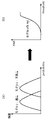
- FIG. 18 is a diagram for explaining a method of calculating the FAR curve for the model 1 according to the eighth embodiment.
- FIG. 19 is a diagram illustrating an example of a FAR table of model 1 according to the eighth embodiment.
- Model 1 is one of multiple models selected to create a hybrid model candidate.
- FAR is an abbreviation for False Acceptance Rate, which is the probability of erroneously determining NG as OK.
- the FAR value is called a miss rate.
- FA is an abbreviation for False Accept, which means to erroneously determine NG as OK.
- FA is referred to as miss or miss determination.
- the FAR table is a table of miss rates (FAR values) when the threshold is varied with a predetermined step size.
- the hybrid model candidate creation unit 13 creates a FAR table for each of the multiple models selected to create the hybrid model candidate using the verification data set during machine learning.
- the output value and frequency obtained by inputting the verification data set into model 1 and estimating the category are obtained.
- the distribution of output values (probabilities) indicating defective products shown in FIG. A FAR curve shown in (b) can be obtained. Note that the area ratio when the area of the entire distribution is 1 corresponds to the overlook rate (FAR value).
- the oversight rate (FAR value) is obtained by obtaining the oversight rate (FAR value) at a predetermined step size in the distribution of output values (probabilities) indicating defective products shown in (a) of FIG. can.
- the step size is set to 0.0078125, and the FAR values from 0 to 1 are described for the index assigned to each step size.
- the hybrid model candidate creation unit 13 inputs a plurality of data indicating defective products in the verification data set for each of the plurality of selected models, and outputs the output value obtained by estimating the category.
- a FAR table can be created from the distribution.
- the hybrid model candidate creation unit 13 can obtain the miss rate by varying the threshold value in the distribution of the acquired output values, and thus can create the FAR table, which is a table of the miss rate.
- the hybrid model candidate creation unit 13 inputs the data samples included in the verification data set to each of the two or more models selected to form the hybrid model candidate, and causes the category to be estimated. Get results.
- the hybrid model candidate creation unit 13 compares the acquired estimation result (output value) with a FAR table created in advance to obtain a first FAR value of each of the two or more models for the data sample. Get the 1FAR value.
- the probability that an inspection image is defective can be estimated (adjusted) based on the distribution of output values (probabilities) indicating defective products when the FAR table is created.
- the hybrid model candidate creation unit 13 multiplies the first FAR values of each of the two or more acquired models. Thereby, the hybrid model candidate creation unit 13 can acquire the second FAR value, which is the FAR value of the hybrid model candidate combined with the two or more models.
- FIG. 20 is a diagram conceptually showing the first FAR values of each of the two models according to Example 8 and the second FAR values of the hybrid model candidate created by combining the two models. As shown in FIG. 20, by multiplying the respective first FAR values of two or more models, a second FAR value that is improved over the respective first FAR values of the two or more models can be obtained.
- the FAR distributions of the multiple models that make up the hybrid model candidate are independent. Therefore, by the law of probability for independent events, the first FAR value of each of the two or more models can be multiplied to obtain the second FAR value of the hybrid model candidate combined with the two or more models.
- the method of calculating the correlation coefficient is as follows. That is, first, the hybrid model candidate creation unit 13 inputs a plurality of verification data sets for each of a plurality of models selected to create a plurality of hybrid model candidates, and causes the categories to be estimated, thereby estimating the plurality of models. Get the estimation results for each of the models in . Next, the hybrid model candidate creation unit 13 may calculate correlation coefficients of all combinations of two models out of the plurality of models using the obtained estimation result. As a result, the hybrid model candidate creation unit 13 multiplies the first FAR values of the two or more acquired models, and further multiplies by a coefficient that decreases as the correlation coefficient increases, thereby obtaining the corrected second FAR value. value can be obtained.
- the hybrid model candidate creation unit 13 determines that the data sample is non-defective.
- the hybrid model candidate creation unit 13 can acquire this determination result as the determination result when the hybrid model candidate is caused to input the data sample.
- the hybrid model candidate creation unit 13 can acquire the determination result adjusted using the second FAR value and the preset threshold value as the determination result when data samples are input to a plurality of hybrid model candidates. Then, the hybrid model candidate creation unit 13 can compare a plurality of hybrid model candidates using the adjusted determination result.
- the FAR threshold should be determined in advance based on what degree of miss rate the user using the hybrid model can tolerate.
- Model 1 and model 2 are a plurality of models constituting hybrid model candidates.
- the second FAR value can be obtained as a value obtained by multiplying them. If the second FAR value is smaller than the FAR threshold value of 1/1,000,000, the sample data can be judged as NG (indicating a defective product), and if it is larger, it can be judged as OK (indicating a non-defective product).
- the hybrid model creation apparatus 10 and the hybrid model creation method according to the present disclosure can create a hybrid model that does not use all of a plurality of models prepared and pooled in advance.
- the hybrid model creation device 10 and the hybrid model creation method according to the present disclosure can create hybrid model candidates excluding models that have high calculation costs and do not contribute much. can be created in
- the hybrid model creation device 10 and the hybrid model creation method according to the present disclosure can create hybrid model candidates by excluding models that do not contribute to accuracy improvement using the importance, so that hybrid models can be created lightly and effectively. .
- the hybrid model creation device 10 and the like according to the present disclosure have been described above based on the embodiment and each example, the present disclosure is not limited to these embodiments and the like. As long as it does not deviate from the gist of the present disclosure, various modifications that a person skilled in the art can think of are applied to the embodiments and each example, and other modifications constructed by combining some components of the embodiments and each example Forms are also included within the scope of this disclosure.
- the hybrid model creation device 10 creates hybrid model candidates by combining a plurality of models selected from a plurality of pooled models using logistic regression or the like, and compares them. Although one hybrid model was selected in , it is not limited to this. Combine multiple models selected from multiple pooled models, create hybrid model candidates that perform estimation processing with logical formulas in the order of combination, and select one hybrid model by comparing accuracy You may
- FIG. 21 is a diagram showing an example of a hybrid model creation method according to another embodiment.
- FIG. 21 shows a hybrid model creation method when model 1, model 2, and model 3 are selected from a plurality of pooled models.
- three different models connected by arrows are combined in this order to create a hybrid model candidate.
- the hybrid model candidates are compared with accuracies obtained by ORing or ANDing the accuracies of Model 1, Model 2, and Model 3 in the order in which they were combined.
- the example shown in FIG. 21 indicates that the hybrid model candidate combining the order of model 3-model 1-model 2 has the highest accuracy of 93%, and thus is selected as the hybrid model.
- FIG. 22 is a diagram showing another example of a hybrid model creation method according to another embodiment.
- model 1, model 2 and model 3 are selected from a plurality of pooled models
- a hybrid model candidate is created by combining at least two of model 1, model 2 and model 3. It shows how to do it.
- the hybrid model candidate in which model 2 and model 1 are combined in this order has the highest accuracy of 93%, so it is selected as the hybrid model.
- the determination threshold determination unit 15 that configures the hybrid model generation device 10 determines the determination threshold using the confusion matrix. may be used to determine the determination threshold in the following two steps.
- FIGS. 23A and 23B are diagrams showing examples of tables of confusion matrices according to other embodiments.
- the judgment threshold determination unit 15 acquires the judgment result (binary prediction value of OK or NG) of the hybrid model selected by the hybrid model selection unit 14 using the verification data set.
- the determination threshold determination unit 15 sets the threshold to 0.5, and creates a confusion matrix table shown in FIG. 23A, for example, from combinations of determination results and true values (binary values of OK or NG).
- step 2 the desired accuracy, such as an overdetection rate of 0.86%, is input, and the above judgment result (binary prediction value of OK or NG) is converted to the true value (OK or NG). ) to create a confusion matrix table shown in FIG. 23B.
- the threshold of 0.42 shown in FIG. 23B can be selected as the optimal threshold (decision threshold).
- Some of the components that make up the hybrid model creation device 10 may be a computer system made up of a microprocessor, ROM, RAM, hard disk unit, display unit, keyboard, mouse, and the like.
- a computer program is stored in the RAM or hard disk unit. The function is achieved by the microprocessor operating according to the computer program.
- the computer program is constructed by combining a plurality of instruction codes indicating instructions to the computer in order to achieve a predetermined function.
- a system LSI is an ultra-multifunctional LSI manufactured by integrating multiple components on a single chip. Specifically, it is a computer system that includes a microprocessor, ROM, RAM, etc. . A computer program is stored in the RAM. The system LSI achieves its functions by the microprocessor operating according to the computer program.
- Some of the components that make up the hybrid model creation device 10 may be made up of an IC card or a single module that can be attached to and detached from each device.
- the IC card or module is a computer system composed of a microprocessor, ROM, RAM and the like.
- the IC card or the module may include the super multifunctional LSI.
- the IC card or the module achieves its function by the microprocessor operating according to the computer program. This IC card or this module may have tamper resistance.
- some of the components that make up the above-described hybrid model creation device 10 include a computer-readable recording medium for the computer program or the digital signal, such as a flexible disk, hard disk, CD-ROM, MO , DVD, DVD-ROM, DVD-RAM, BD (Blu-ray (registered trademark) Disc), semiconductor memory, or the like. Moreover, it may be the digital signal recorded on these recording media.
- a computer-readable recording medium for the computer program or the digital signal such as a flexible disk, hard disk, CD-ROM, MO , DVD, DVD-ROM, DVD-RAM, BD (Blu-ray (registered trademark) Disc), semiconductor memory, or the like.
- BD Blu-ray (registered trademark) Disc
- some of the components that make up the above-described hybrid model creation apparatus 10 transmit the computer program or the digital signal via an electric communication line, a wireless or wired communication line, a network represented by the Internet, data broadcasting, or the like. may be transmitted as
- the present disclosure may be the method shown above. Moreover, it may be a computer program for realizing these methods by a computer, or it may be a digital signal composed of the computer program.
- the present disclosure may also be a computer system comprising a microprocessor and memory, the memory storing the computer program, and the microprocessor operating according to the computer program. .
- the present disclosure can be used for a method, a hybrid model method, a hybrid model creation apparatus, a program, and the like for creating a hybrid model that combines machine learning models for performing non-defective product determination in an inspection process.
Landscapes
- Engineering & Computer Science (AREA)
- Physics & Mathematics (AREA)
- General Physics & Mathematics (AREA)
- Artificial Intelligence (AREA)
- Automation & Control Theory (AREA)
- Software Systems (AREA)
- Computer Vision & Pattern Recognition (AREA)
- Evolutionary Computation (AREA)
- Medical Informatics (AREA)
- General Engineering & Computer Science (AREA)
- Theoretical Computer Science (AREA)
- Health & Medical Sciences (AREA)
- Quality & Reliability (AREA)
- Manufacturing & Machinery (AREA)
- Data Mining & Analysis (AREA)
- Computing Systems (AREA)
- Mathematical Physics (AREA)
- Management, Administration, Business Operations System, And Electronic Commerce (AREA)
- Information Retrieval, Db Structures And Fs Structures Therefor (AREA)
- Image Analysis (AREA)
Priority Applications (3)
| Application Number | Priority Date | Filing Date | Title |
|---|---|---|---|
| US18/283,411 US20240160196A1 (en) | 2021-04-05 | 2022-03-25 | Hybrid model creation method, hybrid model creation device, and recording medium |
| CN202280019081.2A CN116917910A (zh) | 2021-04-05 | 2022-03-25 | 混合模型制作方法、混合模型制作装置以及程序 |
| JP2023512942A JP7611506B2 (ja) | 2021-04-05 | 2022-03-25 | ハイブリッドモデル作成方法、ハイブリッドモデル作成装置、及び、プログラム |
Applications Claiming Priority (2)
| Application Number | Priority Date | Filing Date | Title |
|---|---|---|---|
| US202163171016P | 2021-04-05 | 2021-04-05 | |
| US63/171,016 | 2021-04-05 |
Publications (1)
| Publication Number | Publication Date |
|---|---|
| WO2022215559A1 true WO2022215559A1 (ja) | 2022-10-13 |
Family
ID=83545406
Family Applications (1)
| Application Number | Title | Priority Date | Filing Date |
|---|---|---|---|
| PCT/JP2022/014692 Ceased WO2022215559A1 (ja) | 2021-04-05 | 2022-03-25 | ハイブリッドモデル作成方法、ハイブリッドモデル作成装置、及び、プログラム |
Country Status (4)
| Country | Link |
|---|---|
| US (1) | US20240160196A1 (https=) |
| JP (1) | JP7611506B2 (https=) |
| CN (1) | CN116917910A (https=) |
| WO (1) | WO2022215559A1 (https=) |
Cited By (3)
| Publication number | Priority date | Publication date | Assignee | Title |
|---|---|---|---|---|
| CN116822253A (zh) * | 2023-08-29 | 2023-09-29 | 山东省计算中心(国家超级计算济南中心) | 适用于masnum海浪模式的混合精度实现方法及系统 |
| JP2025536402A (ja) * | 2022-10-28 | 2025-11-05 | 華為技術有限公司 | 垂直連合学習を実行するためのシステム及び方法 |
| DE112023006417T5 (de) | 2023-07-26 | 2026-04-02 | Mitsubishi Electric Corporation | Lernvorrichtung und Lernverfahren |
Families Citing this family (2)
| Publication number | Priority date | Publication date | Assignee | Title |
|---|---|---|---|---|
| JP7439157B2 (ja) * | 2022-03-30 | 2024-02-27 | 本田技研工業株式会社 | 検査装置 |
| EP4705837A1 (en) * | 2023-04-25 | 2026-03-11 | Agbotic, Inc. | Artificially intelligent control system agent |
Citations (5)
| Publication number | Priority date | Publication date | Assignee | Title |
|---|---|---|---|---|
| JP2019015654A (ja) * | 2017-07-10 | 2019-01-31 | ファナック株式会社 | 機械学習装置、検査装置及び機械学習方法 |
| CN112085205A (zh) * | 2019-06-14 | 2020-12-15 | 第四范式(北京)技术有限公司 | 用于自动训练机器学习模型的方法和系统 |
| JP6801149B1 (ja) * | 2020-01-20 | 2020-12-16 | 楽天株式会社 | 情報処理装置、情報処理方法およびプログラム |
| KR102211852B1 (ko) * | 2020-03-20 | 2021-02-03 | 주식회사 루닛 | 데이터의 특징점을 취합하여 기계 학습하는 방법 및 장치 |
| US20210081725A1 (en) * | 2018-08-07 | 2021-03-18 | Advanced New Technologies Co., Ltd. | Method, apparatus, server, and user terminal for constructing data processing model |
Family Cites Families (5)
| Publication number | Priority date | Publication date | Assignee | Title |
|---|---|---|---|---|
| WO2019198408A1 (ja) * | 2018-04-11 | 2019-10-17 | 富士フイルム株式会社 | 学習装置、学習方法、及び学習プログラム |
| JP7269122B2 (ja) * | 2019-07-18 | 2023-05-08 | 株式会社日立ハイテク | データ分析装置、データ分析方法及びデータ分析プログラム |
| US20210056425A1 (en) * | 2019-08-23 | 2021-02-25 | Samsung Electronics Co., Ltd. | Method and system for hybrid model including machine learning model and rule-based model |
| CN114556382B (zh) * | 2019-09-18 | 2026-04-07 | 哈佛蒸汽锅炉检验和保险公司 | 用于物理系统参数的偏倚减少的预测系统及实现方法 |
| CN111723949A (zh) * | 2020-06-24 | 2020-09-29 | 中国石油大学(华东) | 基于选择性集成学习的孔隙度预测方法 |
-
2022
- 2022-03-25 US US18/283,411 patent/US20240160196A1/en active Pending
- 2022-03-25 CN CN202280019081.2A patent/CN116917910A/zh active Pending
- 2022-03-25 WO PCT/JP2022/014692 patent/WO2022215559A1/ja not_active Ceased
- 2022-03-25 JP JP2023512942A patent/JP7611506B2/ja active Active
Patent Citations (5)
| Publication number | Priority date | Publication date | Assignee | Title |
|---|---|---|---|---|
| JP2019015654A (ja) * | 2017-07-10 | 2019-01-31 | ファナック株式会社 | 機械学習装置、検査装置及び機械学習方法 |
| US20210081725A1 (en) * | 2018-08-07 | 2021-03-18 | Advanced New Technologies Co., Ltd. | Method, apparatus, server, and user terminal for constructing data processing model |
| CN112085205A (zh) * | 2019-06-14 | 2020-12-15 | 第四范式(北京)技术有限公司 | 用于自动训练机器学习模型的方法和系统 |
| JP6801149B1 (ja) * | 2020-01-20 | 2020-12-16 | 楽天株式会社 | 情報処理装置、情報処理方法およびプログラム |
| KR102211852B1 (ko) * | 2020-03-20 | 2021-02-03 | 주식회사 루닛 | 데이터의 특징점을 취합하여 기계 학습하는 방법 및 장치 |
Cited By (4)
| Publication number | Priority date | Publication date | Assignee | Title |
|---|---|---|---|---|
| JP2025536402A (ja) * | 2022-10-28 | 2025-11-05 | 華為技術有限公司 | 垂直連合学習を実行するためのシステム及び方法 |
| DE112023006417T5 (de) | 2023-07-26 | 2026-04-02 | Mitsubishi Electric Corporation | Lernvorrichtung und Lernverfahren |
| CN116822253A (zh) * | 2023-08-29 | 2023-09-29 | 山东省计算中心(国家超级计算济南中心) | 适用于masnum海浪模式的混合精度实现方法及系统 |
| CN116822253B (zh) * | 2023-08-29 | 2023-12-08 | 山东省计算中心(国家超级计算济南中心) | 适用于masnum海浪模式的混合精度实现方法及系统 |
Also Published As
| Publication number | Publication date |
|---|---|
| CN116917910A (zh) | 2023-10-20 |
| JP7611506B2 (ja) | 2025-01-10 |
| JPWO2022215559A1 (https=) | 2022-10-13 |
| US20240160196A1 (en) | 2024-05-16 |
Similar Documents
| Publication | Publication Date | Title |
|---|---|---|
| WO2022215559A1 (ja) | ハイブリッドモデル作成方法、ハイブリッドモデル作成装置、及び、プログラム | |
| US6636862B2 (en) | Method and system for the dynamic analysis of data | |
| US11748600B2 (en) | Quantization parameter optimization method and quantization parameter optimization device | |
| US20190087737A1 (en) | Anomaly detection and automated analysis in systems based on fully masked weighted directed | |
| US20200334557A1 (en) | Chained influence scores for improving synthetic data generation | |
| US20190311258A1 (en) | Data dependent model initialization | |
| CN114912497A (zh) | 用于模型更新的方法、设备和程序产品 | |
| US12217189B2 (en) | Hyperparameter adjustment device, non-transitory recording medium in which hyperparameter adjustment program is recorded, and hyperparameter adjustment program | |
| CN111834010A (zh) | 一种基于属性约简和XGBoost的COVID-19检测假阴性识别方法 | |
| US20230206054A1 (en) | Expedited Assessment and Ranking of Model Quality in Machine Learning | |
| US10394631B2 (en) | Anomaly detection and automated analysis using weighted directed graphs | |
| Kisamori et al. | Simulator calibration under covariate shift with kernels | |
| CN109934352B (zh) | 智能模型的自动进化方法 | |
| CN114830137A (zh) | 用于生成预测模型的方法和系统 | |
| US20240070536A1 (en) | Computer-readable recording medium storing determination program, determination apparatus, and determination method | |
| CN111026661B (zh) | 一种软件易用性全面测试方法及系统 | |
| Bourdache et al. | Active preference elicitation by bayesian updating on optimality polyhedra | |
| CN119274516A (zh) | 一种屏幕亮度调节方法、装置、存储介质及电子设备 | |
| CN119005087A (zh) | 基于机器学习的pcb分板路径自动优化方法及系统 | |
| US20220215272A1 (en) | Deterioration detection method, computer-readable recording medium storing deterioration detection program, and information processing apparatus | |
| WO2022216590A1 (en) | Cell nuclei classification with artifact area avoidance | |
| US20220284300A1 (en) | Techniques to tune scale parameter for activations in binary neural networks | |
| CN118429003B (zh) | 商户决策的预测方法、装置、设备及存储介质 | |
| US12321839B1 (en) | Systems and methods for intelligent generation and assessment of candidate less discriminatory alternative machine learning models | |
| US20250181920A1 (en) | Classification tasks for enhancing fairness-utility trade-off using aleatoric uncertainty |
Legal Events
| Date | Code | Title | Description |
|---|---|---|---|
| 121 | Ep: the epo has been informed by wipo that ep was designated in this application |
Ref document number: 22784544 Country of ref document: EP Kind code of ref document: A1 |
|
| ENP | Entry into the national phase |
Ref document number: 2023512942 Country of ref document: JP Kind code of ref document: A |
|
| WWE | Wipo information: entry into national phase |
Ref document number: 202280019081.2 Country of ref document: CN |
|
| WWE | Wipo information: entry into national phase |
Ref document number: 18283411 Country of ref document: US |
|
| NENP | Non-entry into the national phase |
Ref country code: DE |
|
| 122 | Ep: pct application non-entry in european phase |
Ref document number: 22784544 Country of ref document: EP Kind code of ref document: A1 |