WO2022211012A1 - 生体内温度制御システム - Google Patents
生体内温度制御システム Download PDFInfo
- Publication number
- WO2022211012A1 WO2022211012A1 PCT/JP2022/016468 JP2022016468W WO2022211012A1 WO 2022211012 A1 WO2022211012 A1 WO 2022211012A1 JP 2022016468 W JP2022016468 W JP 2022016468W WO 2022211012 A1 WO2022211012 A1 WO 2022211012A1
- Authority
- WO
- WIPO (PCT)
- Prior art keywords
- liquid
- catheter
- pump
- temperature
- suction
- Prior art date
- Legal status (The legal status is an assumption and is not a legal conclusion. Google has not performed a legal analysis and makes no representation as to the accuracy of the status listed.)
- Ceased
Links
Images


Classifications
-
- A—HUMAN NECESSITIES
- A61—MEDICAL OR VETERINARY SCIENCE; HYGIENE
- A61M—DEVICES FOR INTRODUCING MEDIA INTO, OR ONTO, THE BODY; DEVICES FOR TRANSDUCING BODY MEDIA OR FOR TAKING MEDIA FROM THE BODY; DEVICES FOR PRODUCING OR ENDING SLEEP OR STUPOR
- A61M1/00—Suction or pumping devices for medical purposes; Devices for carrying-off, for treatment of, or for carrying-over, body-liquids; Drainage systems
- A61M1/71—Suction drainage systems
- A61M1/77—Suction-irrigation systems
- A61M1/772—Suction-irrigation systems operating alternately
-
- A—HUMAN NECESSITIES
- A61—MEDICAL OR VETERINARY SCIENCE; HYGIENE
- A61B—DIAGNOSIS; SURGERY; IDENTIFICATION
- A61B5/00—Measuring for diagnostic purposes; Identification of persons
- A61B5/01—Measuring temperature of body parts ; Diagnostic temperature sensing, e.g. for malignant or inflamed tissue
-
- A—HUMAN NECESSITIES
- A61—MEDICAL OR VETERINARY SCIENCE; HYGIENE
- A61B—DIAGNOSIS; SURGERY; IDENTIFICATION
- A61B5/00—Measuring for diagnostic purposes; Identification of persons
- A61B5/42—Detecting, measuring or recording for evaluating the gastrointestinal, the endocrine or the exocrine systems
- A61B5/4222—Evaluating particular parts, e.g. particular organs
- A61B5/4233—Evaluating particular parts, e.g. particular organs oesophagus
-
- A—HUMAN NECESSITIES
- A61—MEDICAL OR VETERINARY SCIENCE; HYGIENE
- A61B—DIAGNOSIS; SURGERY; IDENTIFICATION
- A61B5/00—Measuring for diagnostic purposes; Identification of persons
- A61B5/68—Arrangements of detecting, measuring or recording means, e.g. sensors, in relation to patient
- A61B5/6846—Arrangements of detecting, measuring or recording means, e.g. sensors, in relation to patient specially adapted to be brought in contact with an internal body part, i.e. invasive
- A61B5/6847—Arrangements of detecting, measuring or recording means, e.g. sensors, in relation to patient specially adapted to be brought in contact with an internal body part, i.e. invasive mounted on an invasive device
- A61B5/6852—Catheters
-
- A—HUMAN NECESSITIES
- A61—MEDICAL OR VETERINARY SCIENCE; HYGIENE
- A61F—FILTERS IMPLANTABLE INTO BLOOD VESSELS; PROSTHESES; DEVICES PROVIDING PATENCY TO, OR PREVENTING COLLAPSING OF, TUBULAR STRUCTURES OF THE BODY, e.g. STENTS; ORTHOPAEDIC, NURSING OR CONTRACEPTIVE DEVICES; FOMENTATION; TREATMENT OR PROTECTION OF EYES OR EARS; BANDAGES, DRESSINGS OR ABSORBENT PADS; FIRST-AID KITS
- A61F7/00—Heating or cooling appliances for medical or therapeutic treatment of the human body
- A61F7/12—Devices for heating or cooling internal body cavities
-
- A—HUMAN NECESSITIES
- A61—MEDICAL OR VETERINARY SCIENCE; HYGIENE
- A61M—DEVICES FOR INTRODUCING MEDIA INTO, OR ONTO, THE BODY; DEVICES FOR TRANSDUCING BODY MEDIA OR FOR TAKING MEDIA FROM THE BODY; DEVICES FOR PRODUCING OR ENDING SLEEP OR STUPOR
- A61M1/00—Suction or pumping devices for medical purposes; Devices for carrying-off, for treatment of, or for carrying-over, body-liquids; Drainage systems
- A61M1/71—Suction drainage systems
- A61M1/74—Suction control
-
- A—HUMAN NECESSITIES
- A61—MEDICAL OR VETERINARY SCIENCE; HYGIENE
- A61B—DIAGNOSIS; SURGERY; IDENTIFICATION
- A61B18/00—Surgical instruments, devices or methods for transferring non-mechanical forms of energy to or from the body
- A61B18/04—Surgical instruments, devices or methods for transferring non-mechanical forms of energy to or from the body by heating
- A61B18/12—Surgical instruments, devices or methods for transferring non-mechanical forms of energy to or from the body by heating by passing a current through the tissue to be heated, e.g. high-frequency current
- A61B18/14—Probes or electrodes therefor
- A61B18/1492—Probes or electrodes therefor having a flexible, catheter-like structure, e.g. for heart ablation
-
- A—HUMAN NECESSITIES
- A61—MEDICAL OR VETERINARY SCIENCE; HYGIENE
- A61B—DIAGNOSIS; SURGERY; IDENTIFICATION
- A61B18/00—Surgical instruments, devices or methods for transferring non-mechanical forms of energy to or from the body
- A61B2018/00636—Sensing and controlling the application of energy
- A61B2018/00773—Sensed parameters
- A61B2018/00791—Temperature
-
- A—HUMAN NECESSITIES
- A61—MEDICAL OR VETERINARY SCIENCE; HYGIENE
- A61B—DIAGNOSIS; SURGERY; IDENTIFICATION
- A61B90/00—Instruments, implements or accessories specially adapted for surgery or diagnosis and not covered by any of the groups A61B1/00 - A61B50/00, e.g. for luxation treatment or for protecting wound edges
- A61B90/04—Protection of tissue around surgical sites against effects of non-mechanical surgery, e.g. laser surgery
- A61B2090/0409—Specification of type of protection measures
- A61B2090/0418—Compensation
-
- A—HUMAN NECESSITIES
- A61—MEDICAL OR VETERINARY SCIENCE; HYGIENE
- A61B—DIAGNOSIS; SURGERY; IDENTIFICATION
- A61B90/00—Instruments, implements or accessories specially adapted for surgery or diagnosis and not covered by any of the groups A61B1/00 - A61B50/00, e.g. for luxation treatment or for protecting wound edges
- A61B90/04—Protection of tissue around surgical sites against effects of non-mechanical surgery, e.g. laser surgery
- A61B2090/0481—Protection of tissue around surgical sites against effects of non-mechanical surgery, e.g. laser surgery against EM radiation, e.g. microwave
-
- A—HUMAN NECESSITIES
- A61—MEDICAL OR VETERINARY SCIENCE; HYGIENE
- A61B—DIAGNOSIS; SURGERY; IDENTIFICATION
- A61B90/00—Instruments, implements or accessories specially adapted for surgery or diagnosis and not covered by any of the groups A61B1/00 - A61B50/00, e.g. for luxation treatment or for protecting wound edges
- A61B90/06—Measuring instruments not otherwise provided for
- A61B2090/064—Measuring instruments not otherwise provided for for measuring force, pressure or mechanical tension
-
- A—HUMAN NECESSITIES
- A61—MEDICAL OR VETERINARY SCIENCE; HYGIENE
- A61B—DIAGNOSIS; SURGERY; IDENTIFICATION
- A61B2218/00—Details of surgical instruments, devices or methods for transferring non-mechanical forms of energy to or from the body
- A61B2218/001—Details of surgical instruments, devices or methods for transferring non-mechanical forms of energy to or from the body having means for irrigation and/or aspiration of substances to and/or from the surgical site
- A61B2218/002—Irrigation
-
- A—HUMAN NECESSITIES
- A61—MEDICAL OR VETERINARY SCIENCE; HYGIENE
- A61B—DIAGNOSIS; SURGERY; IDENTIFICATION
- A61B2218/00—Details of surgical instruments, devices or methods for transferring non-mechanical forms of energy to or from the body
- A61B2218/001—Details of surgical instruments, devices or methods for transferring non-mechanical forms of energy to or from the body having means for irrigation and/or aspiration of substances to and/or from the surgical site
- A61B2218/007—Aspiration
-
- A—HUMAN NECESSITIES
- A61—MEDICAL OR VETERINARY SCIENCE; HYGIENE
- A61B—DIAGNOSIS; SURGERY; IDENTIFICATION
- A61B2505/00—Evaluating, monitoring or diagnosing in the context of a particular type of medical care
- A61B2505/05—Surgical care
-
- A—HUMAN NECESSITIES
- A61—MEDICAL OR VETERINARY SCIENCE; HYGIENE
- A61B—DIAGNOSIS; SURGERY; IDENTIFICATION
- A61B5/00—Measuring for diagnostic purposes; Identification of persons
- A61B5/72—Signal processing specially adapted for physiological signals or for diagnostic purposes
- A61B5/7271—Specific aspects of physiological measurement analysis
- A61B5/7275—Determining trends in physiological measurement data; Predicting development of a medical condition based on physiological measurements, e.g. determining a risk factor
-
- A—HUMAN NECESSITIES
- A61—MEDICAL OR VETERINARY SCIENCE; HYGIENE
- A61B—DIAGNOSIS; SURGERY; IDENTIFICATION
- A61B5/00—Measuring for diagnostic purposes; Identification of persons
- A61B5/72—Signal processing specially adapted for physiological signals or for diagnostic purposes
- A61B5/7271—Specific aspects of physiological measurement analysis
- A61B5/7282—Event detection, e.g. detecting unique waveforms indicative of a medical condition
-
- A—HUMAN NECESSITIES
- A61—MEDICAL OR VETERINARY SCIENCE; HYGIENE
- A61B—DIAGNOSIS; SURGERY; IDENTIFICATION
- A61B5/00—Measuring for diagnostic purposes; Identification of persons
- A61B5/74—Details of notification to user or communication with user or patient; User input means
- A61B5/746—Alarms related to a physiological condition, e.g. details of setting alarm thresholds or avoiding false alarms
-
- A—HUMAN NECESSITIES
- A61—MEDICAL OR VETERINARY SCIENCE; HYGIENE
- A61F—FILTERS IMPLANTABLE INTO BLOOD VESSELS; PROSTHESES; DEVICES PROVIDING PATENCY TO, OR PREVENTING COLLAPSING OF, TUBULAR STRUCTURES OF THE BODY, e.g. STENTS; ORTHOPAEDIC, NURSING OR CONTRACEPTIVE DEVICES; FOMENTATION; TREATMENT OR PROTECTION OF EYES OR EARS; BANDAGES, DRESSINGS OR ABSORBENT PADS; FIRST-AID KITS
- A61F7/00—Heating or cooling appliances for medical or therapeutic treatment of the human body
- A61F2007/0059—Heating or cooling appliances for medical or therapeutic treatment of the human body with an open fluid circuit
-
- A—HUMAN NECESSITIES
- A61—MEDICAL OR VETERINARY SCIENCE; HYGIENE
- A61M—DEVICES FOR INTRODUCING MEDIA INTO, OR ONTO, THE BODY; DEVICES FOR TRANSDUCING BODY MEDIA OR FOR TAKING MEDIA FROM THE BODY; DEVICES FOR PRODUCING OR ENDING SLEEP OR STUPOR
- A61M2205/00—General characteristics of the apparatus
- A61M2205/10—General characteristics of the apparatus with powered movement mechanisms
-
- A—HUMAN NECESSITIES
- A61—MEDICAL OR VETERINARY SCIENCE; HYGIENE
- A61M—DEVICES FOR INTRODUCING MEDIA INTO, OR ONTO, THE BODY; DEVICES FOR TRANSDUCING BODY MEDIA OR FOR TAKING MEDIA FROM THE BODY; DEVICES FOR PRODUCING OR ENDING SLEEP OR STUPOR
- A61M2205/00—General characteristics of the apparatus
- A61M2205/33—Controlling, regulating or measuring
- A61M2205/3327—Measuring
-
- A—HUMAN NECESSITIES
- A61—MEDICAL OR VETERINARY SCIENCE; HYGIENE
- A61M—DEVICES FOR INTRODUCING MEDIA INTO, OR ONTO, THE BODY; DEVICES FOR TRANSDUCING BODY MEDIA OR FOR TAKING MEDIA FROM THE BODY; DEVICES FOR PRODUCING OR ENDING SLEEP OR STUPOR
- A61M2205/00—General characteristics of the apparatus
- A61M2205/33—Controlling, regulating or measuring
- A61M2205/3331—Pressure; Flow
-
- A—HUMAN NECESSITIES
- A61—MEDICAL OR VETERINARY SCIENCE; HYGIENE
- A61M—DEVICES FOR INTRODUCING MEDIA INTO, OR ONTO, THE BODY; DEVICES FOR TRANSDUCING BODY MEDIA OR FOR TAKING MEDIA FROM THE BODY; DEVICES FOR PRODUCING OR ENDING SLEEP OR STUPOR
- A61M2205/00—General characteristics of the apparatus
- A61M2205/33—Controlling, regulating or measuring
- A61M2205/3368—Temperature
-
- A—HUMAN NECESSITIES
- A61—MEDICAL OR VETERINARY SCIENCE; HYGIENE
- A61M—DEVICES FOR INTRODUCING MEDIA INTO, OR ONTO, THE BODY; DEVICES FOR TRANSDUCING BODY MEDIA OR FOR TAKING MEDIA FROM THE BODY; DEVICES FOR PRODUCING OR ENDING SLEEP OR STUPOR
- A61M2230/00—Measuring parameters of the user
- A61M2230/005—Parameter used as control input for the apparatus
-
- A—HUMAN NECESSITIES
- A61—MEDICAL OR VETERINARY SCIENCE; HYGIENE
- A61M—DEVICES FOR INTRODUCING MEDIA INTO, OR ONTO, THE BODY; DEVICES FOR TRANSDUCING BODY MEDIA OR FOR TAKING MEDIA FROM THE BODY; DEVICES FOR PRODUCING OR ENDING SLEEP OR STUPOR
- A61M2230/00—Measuring parameters of the user
- A61M2230/50—Temperature
Definitions
- the present invention relates to an in-vivo temperature control system capable of judging liquid aspiration based on liquid volume difference information.
- Atrial fibrillation is a type of arrhythmia, and it is known that repeated irregular contraction of the atria impairs blood circulation and causes discomfort and fatigue. Therefore, catheter ablation (pulmonary vein isolation), which ablates the myocardial tissue such as the pulmonary vein, which is the main source of atrial fibrillation, and the surrounding myocardial tissue, such as the posterior wall of the left atrium, is widely used to treat atrial fibrillation. It is
- a catheter equipped with a temperature sensor is inserted into the esophagus through the patient's nose (transnasal) or the patient's mouth (oral), and the temperature sensor detects the esophagus.
- a temperature measuring device that measures the internal temperature of the device and outputs an alarm to the outside when it is determined that the internal temperature has reached a threshold value (Patent Document 1).
- Patent Document 2 a device has been reported that calculates the remaining time until the temperature inside the esophagus reaches the temperature limit value from the fluctuation speed of the temperature inside the esophagus and outputs it to the outside.
- the temperature measuring device described in Patent Document 1 monitors the internal temperature of the esophagus during ablation treatment, and outputs an alarm to the outside when it is determined that the internal temperature has reached a threshold value, thereby heating or cooling the esophagus. Preemptive measures can be taken, such as suspending ablation before damage is done. However, in ablation therapy, esophageal temperature can fluctuate rapidly, and delays in acknowledging alarms can delay necessary interventions.
- the device described in Patent Document 2 can calculate the time from the rate of temperature change inside the esophagus until it reaches a dangerous temperature at which the esophagus is damaged, and output it to the outside, so rapid changes in the esophagus temperature can be predicted. and provide a grace period to take necessary action.
- the risk of esophageal damage cannot be reduced if treatment is delayed.
- the present invention has a means for monitoring the internal temperature of the esophagus and the like, directly adjusting the temperature of the organ by injecting liquid, and measuring the integrated value of the amount of liquid discharged to the outside of the catheter. Calculate the difference obtained by subtracting the integrated value of the liquid volume of the liquid sucked inside the catheter, and when the difference exceeds a preset threshold value, drive the pump to suck the liquid inside the catheter,
- An object of the present invention is to provide an in-vivo temperature control system that stops driving a pump when the difference reaches a preset threshold value or less.
- a catheter that can be inserted into a living body, a temperature sensor that can measure the temperature inside the living body, a liquid reservoir that stores liquid, a pump that supplies the liquid from the liquid reservoir to the catheter, and a control unit for controlling driving of the pump, wherein the control unit determines the integrated value of the amount of liquid sucked into the catheter from the integrated value of the amount of liquid released to the outside of the catheter.
- a difference obtained by subtraction is calculated, and when the difference exceeds a preset threshold, the pump is driven to aspirate the liquid into the catheter, and when the difference reaches the preset threshold or less.
- An in-vivo temperature control system that deactivates the pump.
- a pressure sensor is provided to detect the internal pressure of the catheter, and when the pressure value obtained from the pressure sensor reaches a set threshold value or less when aspirating liquid into the catheter, the control unit (1)
- the in-vivo temperature control system according to (1) wherein the integrated value of the volume of the liquid discharged outside the catheter and the integrated value of the volume of the liquid sucked into the catheter are set to zero.
- the in-vivo temperature control system selects whether to discharge or suck the liquid in the liquid reservoir based on the signal detected from the temperature sensor or a preset time, and drives the pump.
- the in vivo temperature control system according to any one of 1) to (3).
- the temperature sensor can measure the internal temperature of the living body and automatically determine liquid aspiration when adjusting to a predetermined temperature using liquid.
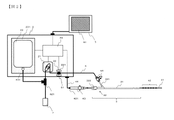
- FIG. 1 is an external view of an in-vivo temperature control system according to a first embodiment of the present invention
- FIG. 2 is a schematic diagram showing the internal structure of the in-vivo temperature control system shown in FIG. 1
- FIG. 4 is a flow chart showing the operation procedure of the controller in the first control operation of the in-vivo temperature control system of the present invention
- FIG. 1 is an external view of an in-vivo temperature control system 1 according to the first embodiment.
- the in-vivo temperature control system 1 monitors the internal temperature of the esophagus adjacent to the heart to be ablated, for example, when performing ablation using a balloon ablation catheter that heats the inside of the balloon with a high-frequency current, and measures the internal temperature of the esophagus using a liquid.
- the body organ to which the in-vivo temperature control system 1 can be applied is not particularly limited, and may be applied to the pharynx, larynx, lungs, esophagus, stomach, etc., but it is particularly preferably used for cooling the inside of the esophagus.
- the in-vivo temperature control system 1 includes an in-vivo temperature control device 2 for sending or aspirating a temperature-controlled liquid to a catheter 3, and a hole capable of sending and aspirating a liquid to the outside.
- An insertable catheter 3, a temperature probe 4 having a temperature sensor 42 and insertable into the catheter 3, a monitor 5 capable of displaying a signal from the temperature probe 4, a pump 21 and a pressure center 22 are connected to generate It is provided with a liquid feeding/suction tube 6 that connects the body temperature control device 2 and the catheter 3, and a liquid drainage section 7.
- FIG. 2 is a schematic diagram showing the internal structure of the in-vivo temperature control device 2 shown in FIG.
- the in-vivo temperature control device 2 includes a pump 21 for feeding or aspirating liquid to the catheter 3, a pressure sensor 22 for detecting the internal pressure of the catheter 3, a liquid reservoir 23 for storing temperature-controlled liquid, and a pump.
- a control unit 24 for controlling driving is provided.
- the pump 21 included in the in-vivo temperature control device 2 is a roller-type tube pump. By rotating the rollers of the pump 21 forward, the liquid can be sent from the liquid reservoir 23 to the catheter 3. By rotating the roller 21 in the reverse direction, liquid can be sucked from the distal end portion or the hole of the catheter 3 .
- the catheter in another embodiment different from the first embodiment, includes a liquid-feeding catheter having a hole capable of feeding a liquid to the outside and a suction catheter having a hole capable of sucking a liquid from the outside.
- a liquid-sending pump for sending liquid from the liquid storage part 23 to the liquid-sending catheter and a suction pump for sucking the liquid from the tip or hole of the suction catheter may be provided.
- the liquid feeding pump by driving the liquid feeding pump, the liquid can be discharged from the liquid reservoir to the outside of the liquid feeding catheter, and by driving the suction pump, the discharged liquid can be discharged to the inside of the suction catheter. Since the liquid can be sucked into the body, the temperature in the living body can be efficiently controlled.
- the pressure sensor 22 provided in the in-vivo temperature control device 2 consists of a contact-type position-displacement gauge 221 and an enlarged portion 61 of the liquid-supply/suction-cum-tube 6 that is in contact with the contact-type position-displacement gauge 221 .
- the enlarged portion 61 of the tube 6 for feeding and suctioning liquid is a bag-shaped part of the tube 6 for feeding and suctioning liquid, and is designed to expand or contract due to the pressure inside the tube.
- the internal pressure of the catheter 3 connected to the liquid-feeding/suction-cum-tube 6 via the liquid-feeding/suction-cum-tube 6 is measured. can do.
- the detection method of the pressure sensor 22 is not limited, and any detection method may be used as long as it can detect the internal pressure of the catheter 3 during liquid feeding or suction operation and send it to the control unit 24 as a signal.
- any detection method may be used as long as it can detect the internal pressure of the catheter 3 during liquid feeding or suction operation and send it to the control unit 24 as a signal.
- a method of adding a diaphragm-type in-line pressure sensor or a method of branching a thin tube from the liquid feeding/suction tube 6 and measuring the pressure of the thin tube may be used.
- the in-vivo temperature control device 2 may be equipped with a flow meter capable of measuring the flow rate of liquid flowing inside the catheter 3 instead of the pressure sensor 22 .
- a flow meter capable of measuring the flow rate of liquid flowing inside the catheter 3 instead of the pressure sensor 22 .
- the flowmeter for example, an ultrasonic flowmeter can be used, which is connected to the catheter 3 or the liquid feeding/suction tube 6 and detects the difference in the transmission time of the ultrasonic signal to detect the inside of the catheter 3. The flow rate of the flowing liquid can be measured.
- the detection method of the flow meter is not limited, and any detection method may be used as long as it can detect the flow rate flowing through the catheter 3 during liquid feeding or suction operation and send it to the control unit 24 as a signal. Also, a current meter capable of detecting the flow velocity of the catheter 3 may be provided and transmitted as a signal to the controller 24 .
- the liquid reservoir 23 of the in-vivo temperature control system 1 of the first embodiment is an infusion bag containing commercially available physiological saline solution, glucose solution, or the like, which can be contained in the in-vivo temperature control device 2. structure.
- a Peltier device 231 and a temperature sensor (not shown) for measuring the temperature inside the liquid reservoir 23 are arranged so as to be in contact with the liquid reservoir 23.
- the temperature of the liquid stored in the liquid storage section 23 can be controlled.
- the temperature of the liquid inside the liquid reservoir 23 is preferably controlled to 0°C to 15°C, more preferably 0°C to 10°C.
- the liquid storage part 23 may be of any form as long as it can store a liquid such as physiological saline. good.
- the temperature of the liquid in the liquid reservoir 23 can be controlled as described above.
- the infusion bag may be cooled with a cooling agent such as ice instead of the Peltier element 231, or a previously frozen infusion bag may be used while being thawed.
- purified water and tap water may be used as liquids other than the physiological saline solution and the glucose solution.
- a heating resistor may be used to heat the temperature of the liquid stored in the liquid storage section 23 to 30.degree. C. to 45.degree.
- the control unit 24 provided in the in vivo temperature control device 2 controls the pump 21, and the liquid released to the outside of the catheter 3, i.e., The amount of liquid released into the living body (injection amount) and the amount of liquid sucked into the catheter 3, that is, the amount of liquid sucked from the living body (suction amount) are measured, and the liquid amount is measured.
- injection amount The amount of liquid released into the living body
- suction amount the amount of liquid sucked from the living body
- control unit 24 preferably includes a circuit that controls driving of the pump 21 based on the signal detected from the temperature probe 4 or the passage of time. Thereby, for example, based on the signal detected from the temperature probe 4 or the passage of time, the control unit 24 selects whether to discharge or suck the liquid in the liquid storage unit 23, and controls the driving of the pump 21. By doing so, it is possible to automatically control whether the external liquid is sucked through the catheter 3 or discharged to the outside.
- the controller 24 preferably has a circuit for controlling driving of the pump 21 based on the signal detected by the pressure sensor 22 .
- the control unit 24 of the in-vivo temperature control system 1 can be provided with a mechanism capable of numerically converting information on the amount of displacement from the liquid feeding/suction tube 6 into pressure information.
- the control unit 24 of the in-vivo temperature control system 1 can be provided with a mechanism capable of numerically converting information on the amount of displacement from the liquid feeding/suction tube 6 into pressure information.
- the control unit 24 of the in-vivo temperature control system 1 can be provided with a mechanism capable of numerically converting information on the amount of displacement from the liquid feeding/suction tube 6 into pressure information.
- the control unit 24 of the in-vivo temperature control system 1 can be provided with a mechanism capable of numerically converting information on the amount of displacement from the liquid feeding/suction tube 6 into pressure information.
- the control unit 24 of the in-vivo temperature control system 1 can be provided with a mechanism capable of numerically converting information on the amount of displacement from the liquid feeding/suction tube 6 into pressure information.
- a suction stop pressure can be set in advance in the control unit 24, and when it is determined that the tube internal pressure is equal to or lower than the suction stop pressure that is a preset threshold value, the control unit 24 stops driving the pump 21. Stop. At this time, it is preferable that the controller 24 performs calculation so that the difference ( ⁇ ) becomes 0 by setting the integrated value of the injection amount and the integrated value of the suction amount to 0.
- the catheter 3 is a cylindrical member that can be inserted into the living body through a nasal or oral approach, and can send or aspirate liquid through the lumen through the tip of the catheter or through a hole opened on the surface.
- the catheter 3 has a tube portion 31 that can be inserted into the living body, and a valved connector 32 fixed to the proximal end side of the tube portion 31 in the longitudinal direction.
- any material may be used as the material of the tube portion 31 as long as it is flexible and can be inserted nasally or orally into the living body.
- Examples thereof include polyvinyl chloride, polyurethane, and silicone.
- Thermoplastic resins can be used.
- a material with X-ray contrast is blended in order to confirm the indwelling site in the living body.
- the length of the tube portion 31 is preferably about 200 mm to 1000 mm, the outer diameter is about ⁇ 1.7 mm to 6.0 mm, and the inner diameter is ⁇ 1. About 0 mm to 5.0 mm is preferable.
- the valved connector 32 is fixed to the proximal end side of the tube portion 31 , is connectable to the liquid feeding/suction tube 6 , and is connected to a port 321 for feeding or sucking liquid from the distal end side of the tube portion 31 .
- a valve 322 for fixing the temperature probe 4 when the temperature probe 4 is inserted into the catheter 3 It is more preferable that the valve 322 can be opened and closed by rotational movement or the like. With the above configuration, the temperature probe 4 can be operated when the valve 322 is open, and the temperature probe 4 can be fixed when the valve 322 is closed.
- the catheter includes a liquid delivery catheter for discharging liquid to the outside, an aspiration catheter for aspirating liquid from the outside, and a liquid delivery catheter from the distal end side of the liquid delivery catheter.
- a first port for aspiration and a second port for aspiration of fluid from the distal side of the aspiration catheter may be provided.
- a liquid feeding catheter and a suction catheter are provided separately instead of the liquid feeding and suction tube 6, the liquid storage section 23 and the liquid feeding tube connected to the liquid feeding pump are connected to the first port, and the suction pump and the liquid waste section are connected to the first port.
- the temperature probe 4 is a member that is inserted nasally or orally into a living body and is used to measure the internal temperature inside the living body. It consists of a temperature sensor 42 and a handle portion 43 .
- the material of the shaft portion 41 may be any flexible material that can be inserted nasally or orally into the living body, such as polyether block amide, polyurethane, nylon, polyolefin, Thermoplastic resins such as polyamides and polyether polyamides can be used.
- the outer diameter of the shaft portion 41 is preferably about ⁇ 1.0 mm to 4.0 mm, and is even better as long as it can be inserted into the lumen of the catheter 3 .
- the length is preferably about 300 mm to 1100 mm, and when the catheter 3 is inserted into the lumen for use, the temperature sensor 42 on the shaft portion 41 is arranged at a position protruding from the distal end side of the catheter 3. preferably.
- the shaft portion 41 may have a function that allows the distal end side to be deflected by operating the handle portion 43 .
- a function that allows the distal end side to be deflected by operating the handle portion 43 As a result, particularly when applied to the esophagus, it is possible to reduce the risk of intrusion into the respiratory tract when the temperature probe 4 is nasally or orally inserted into the esophagus.
- the esophagus is not linear but meanders from the pharynx to the cardia of the stomach, it is possible to place the temperature sensor 42 at the target esophageal site by the deflection operation.
- One or more temperature sensors 42 are attached to the distal end side of the shaft portion 41. In order to be able to measure the internal temperature in a wider range in vivo, a plurality of temperature sensors 42 may be provided. preferable.
- any material having good thermal conductivity may be used. good.
- the handle portion 43 includes a connector 431 for connecting with the in-vivo temperature control device 2 , and the in-vivo temperature control system 1 according to the first embodiment connects to the in-vivo temperature control device 2 via a connection cable 44 . and the temperature probe 4 are connected.
- the catheter 3 for discharging the liquid to the outside and the temperature probe 4 having the temperature sensor 42 are independent, and the temperature probe 4 is inserted through the catheter 3.
- a temperature sensor may be arranged on the tube portion of the catheter 3 .
- it is preferable that a hole through which the liquid can be fed into the living body is arranged on the base end side in the longitudinal direction of the temperature sensor arranged in the catheter 3 .
- the monitor 5 can display the internal temperature information inside the living body detected by the temperature probe 4 in digital numbers, bar graphs, or trend graphs. Further, the monitor 5 has a function of changing the display color and presenting the change in temperature to the operator as visual information when the temperature in the living body exceeds a preset threshold value. For example, it may be set to go from cool to warm as the temperature rises from cold to hot. As a result, the temperature detected by the temperature probes 4 arranged in the longitudinal direction of the living body can be confirmed in response to the position in the living body, so that the operator can check which part of the living body has a higher temperature than the other parts.
- the monitor 5 is provided with operation information of liquid feeding/suction, warning information such as errors and alarms occurring in the system, operation time, number of times of liquid feeding/suction, liquid feeding amount, liquid suction amount, and other operational information. to the operator. This makes it possible to visually or audibly notify the operator of the operational status, malfunction status, and dangerous status.
- the monitor 5 preferably has a touch panel display 51 so that various parameters related to system operation can be input, and the input parameters can be transmitted to the control unit 24 of the in-vivo temperature control device 2 . This allows the operator to start/stop the operation of the in-vivo temperature control device 2 and set/change various parameters from a remote location.
- the liquid feeding/suction tube 6 delivers the liquid from the liquid reservoir 23 to the catheter 3 via the pump 21 when the liquid is fed, and delivers the liquid from the catheter 3 to the waste liquid section 7 when the liquid is suctioned. It is a tube for Here, the waste liquid part 7 is a part for storing liquid that is no longer needed after the liquid is sucked from the body.
- the liquid feeding/suction tube 6 of the in vivo temperature control system 1 includes an enlarged portion 61, a flow path switching portion 62, a liquid supply port 63 for connecting to the liquid storing portion 23, and a connection port 64 for connecting to the catheter 3. Prepare.
- the enlarged portion 61 is a bag-shaped tube, and is designed to expand and contract due to the pressure inside the tube. As a result, by detecting the amount of displacement of the enlarged portion 61 with the contact-type position-displacement meter 221, the internal pressure of the catheter 3 connected to the combined liquid-feeding/suction tube 6 via the combined liquid-feeding/suction tube 6 can be measured. can.
- the flow path switching section 62 in the first embodiment is a three-way check valve 621 and is connected to the primary side of the pump 21 .
- the pump 21 rotates forward, so that the flow path of the three-way check valve 621 switches to connect the liquid reservoir 23 and the pump 21 , and the liquid flows out of the catheter 3 .
- the pump 21 rotates in the reverse direction, so that the flow path of the three-way check valve 621 is switched to connect the pump 21 and the waste liquid section 7, and the sucked liquid is discharged as the waste liquid. It is discharged to the section 7.
- the liquid supply port 63 may take any form as long as it can supply the liquid from the liquid storage section 23 into the liquid feeding/suction tube 6 . Since the liquid reservoir 23 is an infusion bag, the liquid supply port 63 of the first embodiment is preferably a needle 631 that can pierce the infusion bag.
- connection port 64 may be of any form as long as it can be connected to the catheter 3, but is preferably a three-way stopcock. As a result, when the in-vivo temperature control system malfunctions, it is possible to manually feed and aspirate the liquid by connecting a syringe or the like.
- FIG. 3 is a flow chart showing an example of the operation procedure of the control unit 24 for judging whether to aspirate liquid based on the information about the difference in the amount of the liquid (injection liquid) applied to the outside and the amount of liquid aspirated from the outside (aspirated liquid). will be used for explanation.
- the control unit 24 integrates the integrated value of the liquid volume (injection volume) released to the outside of the catheter 3 and the integrated value of the liquid volume (aspirated volume) of the liquid sucked into the catheter 3. get the value.
- the control unit 24 has a function of calculating and storing an integrated value of the injection amount and the suction amount from the driving history of the pump 21 (for example, the rotation speed and driving time of the pump).
- the control unit 24 determines whether or not the difference ( ⁇ ) obtained by subtracting the integrated value of the suction amount from the acquired integrated value of the injection amount has reached a preset difference threshold value, that is, the liquid suction start condition. Whether or not the conditions are satisfied is determined by comparing the numerical values.
- the control unit 24 determines that the preset difference threshold is exceeded, the control unit 24 drives the pump 21 to start sucking liquid from the living body at a preset suction flow rate.
- the control unit 24 calculates the suction amount from the driving history of the pump 21 and calculates the difference ( ⁇ ).
- the difference ( ⁇ ) reaches a preset threshold value or less
- the control unit 24 stops driving the pump 21, that is, stops suction from inside the living body.
- the control unit 24 calculates the internal pressure of the catheter 3 and determines whether the internal pressure of the catheter 3 is equal to or less than the suction stop pressure, which is the preset threshold value. That is, it is determined whether or not the second suction stop condition is satisfied.
- the control unit 24 sets the integrated value of the injection amount and the integrated value of the suction amount to 0, and stops driving the pump 21. .
- the in-vivo temperature control device 2 is provided with a flow meter capable of measuring the flow rate through the catheter 3, it is determined whether or not the flow rate through the catheter 3 is equal to or lower than a predetermined threshold value for stopping suction. .
- the control unit 24 sets the integrated value of the injection amount and the integrated value of the suction amount to 0, and stops driving the pump 21. do.
- the control unit 24 controls the amount of liquid released to the outside of the liquid-feeding catheter. (injection amount) and the integrated value of the liquid amount (aspirated amount) of the liquid aspirated into the suction catheter are acquired.
- the control unit 24 determines whether or not the difference ( ⁇ ) obtained by subtracting the integrated value of the suction amount from the acquired integrated value of the injection amount has reached a preset difference threshold value, that is, the liquid suction start condition. Whether or not the conditions are satisfied is determined by comparing the numerical values.
- the control unit 24 drives the aspiration pump to start aspirating liquid from the living body at a preset aspiration flow rate.
- the control unit 24 calculates the suction amount from the drive history of the suction pump, and calculates the difference ( ⁇ ).
- the control unit 24 stops driving the suction pump, that is, stops suction from inside the living body.
- the control unit 24 calculates the internal pressure of the suction catheter, and determines whether the internal pressure of the suction catheter is equal to or less than the suction stop pressure, which is the preset threshold value. That is, it is determined whether or not the second suction stop condition is satisfied.
- the control unit 24 sets the integrated value of the injection amount and the integrated value of the suction amount to 0, and stops driving the suction pump. .
- the in-vivo temperature control device 2 is equipped with a flow meter capable of measuring the flow rate through the catheter 3, whether or not the flow rate through the suction catheter is equal to or lower than a preset threshold value for stopping suction to judge.
- the control unit 24 sets the integrated value of the injection amount and the integrated value of the suction amount to 0, and stops driving the suction pump. do.
- Step 1 temperature information and threshold comparison processing
- the operator inserts the catheter 3 and temperature probe 4 nasally or orally into the esophagus.
- a catheter ablation operation for cauterizing cardiac tissue near the left atrium is started, the temperature inside the adjacent esophagus gradually rises, and the temperature inside the esophagus measured by each temperature sensor 42 of the temperature probe 4 also gradually increases.
- Step 2 liquid (cooling water) feeding operation
- the controller 24 When the temperature information of at least one of the plurality of temperature sensors 42 reaches the threshold value, the controller 24 outputs a driving command for the liquid feeding speed and the liquid feeding time to the pump 21 , and the liquid feeding/suction tube 6 is output from the liquid storage section 23 .
- a liquid (cooling water) is sent to the catheter 3 through the .
- the liquid (cooling water) reaches the temperature-increased portion in the esophagus, and the inside of the esophagus can be cooled by heat exchange with the liquid (cooling water).
- the amount of liquid (cooling water) to be fed is managed by the liquid feeding speed and the liquid feeding time, and can be set in the control section 24 in advance.
- the liquid (cooling water) is desirably delivered in a short period of time. Specifically, it is preferable to deliver the liquid at a liquid delivery speed of 1 mL/min to 300 mL/min.
- Step 3 Action to retain liquid (cooling water) in the esophagus
- the operation time of step 3 can be set in the control unit 24 in advance, and the process proceeds to step 4 after the set time has elapsed.
- a method of monitoring the internal temperature of the esophagus and moving to step 4 at the timing when the internal temperature of the esophagus reaches a preset temperature may be used.
- Step 4 Difference calculation
- the control unit 24 determines the amount of liquid released to the outside of the catheter 3, that is, the injection amount released into the esophagus, and the amount of liquid that is sucked into the catheter 3, that is, into the esophagus.
- Step 5 Suction operation of liquid remaining in the esophagus
- the control unit 24 outputs a drive command to the pump 21 according to a preset suction flow rate to start liquid suction. Start.
- the control unit 24 integrates the suction amount from the drive history of the pump 21, and continues driving (sucking) the pump 21 until the difference ( ⁇ ) reaches a preset threshold value.
- a suction rate 1 mL/min to 100 mL/min is preferred.
- the controller 24 determines that the difference ( ⁇ ) is 0 by setting the integrated value of the injection amount and the integrated value of the suction amount to 0, and drives the pump 21. to stop.
- the controller 24 determines that the difference ( ⁇ ) is 0 by setting the integrated value of the injection amount and the integrated value of the suction amount to 0, and drives the pump 21. to stop.
- the driving (suction) of the pump 21 can be stopped when the esophagus runs out of liquid. It is preferable that the control unit 24 determines that the difference ( ⁇ ) is 0 when the internal pressure in the liquid feeding/suction tube 6 falls within the range of ⁇ 10 kPaG to ⁇ 90 kPaG.
- the in-vivo temperature control device 2 is provided with a flow meter 25 capable of measuring the flow rate of the liquid flowing inside the liquid feeding/suction tube 6, it is determined that the liquid to be sucked has run out during suction.
- the flow rate of the liquid flowing in the liquid feeding and suction tube 6 is measured by the flow meter 25, and when the obtained flow rate reaches a preset threshold value or less, that is, there is no liquid that can be aspirated from the esophagus.
- the control unit 24 sets the integrated value of the injection amount and the integrated value of the suction amount to 0, so that the difference ( ⁇ ) is 0, and the driving of the pump 21 may be stopped.
- the control unit 24 sends a signal to the pump 21 in order to prioritize cooling for preventing heating and damage to the esophagus. It is preferable that a liquid driving command is output and the liquid (cooling water) is sent from the liquid storage part 23 to the catheter 3 via the liquid sending/suction tube 6 .
- the controller 24 preferably switches the drive command to the pump 21 from suction to liquid feeding.
- suction even if the difference ( ⁇ ) does not exceed the preset threshold value, if the temperature detected by the temperature sensor 42 is equal to or higher than the preset threshold value, or if the preset time elapses after the injection, suction is started. may start. In this case, the suction may be performed until the difference ( ⁇ ) becomes equal to or less than a preset threshold value, or a predetermined amount of liquid may be aspirated.
- the first control operation is a control operation when the internal temperature of the esophagus rises due to thermal cauterization of the myocardium by high-frequency ablation or the like. 24 is making a circuit to determine.
- the liquid to be fed is changed to heated water, and when the esophagus temperature falls below the threshold, the threshold is set.
- the internal temperature of the esophagus can be controlled by creating a circuit so that the control unit 24 determines that the temperature has been reached.
- the present invention can be applied to fields that require control of heating or cooling in vivo, and is particularly applicable when performing cooling after heating during catheter ablation.
Landscapes
- Health & Medical Sciences (AREA)
- Life Sciences & Earth Sciences (AREA)
- Heart & Thoracic Surgery (AREA)
- Veterinary Medicine (AREA)
- Engineering & Computer Science (AREA)
- Biomedical Technology (AREA)
- Animal Behavior & Ethology (AREA)
- General Health & Medical Sciences (AREA)
- Public Health (AREA)
- Physics & Mathematics (AREA)
- Vascular Medicine (AREA)
- Biophysics (AREA)
- Surgery (AREA)
- Pathology (AREA)
- Medical Informatics (AREA)
- Molecular Biology (AREA)
- Anesthesiology (AREA)
- Hematology (AREA)
- Pulmonology (AREA)
- Endocrinology (AREA)
- Gastroenterology & Hepatology (AREA)
- Physiology (AREA)
- Thermal Sciences (AREA)
- Media Introduction/Drainage Providing Device (AREA)
- Measuring And Recording Apparatus For Diagnosis (AREA)
Priority Applications (4)
| Application Number | Priority Date | Filing Date | Title |
|---|---|---|---|
| EP22781222.9A EP4316574A4 (en) | 2021-03-31 | 2022-03-31 | IN-VIVO TEMPERATURE CONTROL SYSTEM |
| US18/551,895 US20240173467A1 (en) | 2021-03-31 | 2022-03-31 | In vivo temperature control system |
| JP2022520435A JPWO2022211012A1 (https=) | 2021-03-31 | 2022-03-31 | |
| CN202280026027.0A CN117098494A (zh) | 2021-03-31 | 2022-03-31 | 生物体内温度控制系统 |
Applications Claiming Priority (2)
| Application Number | Priority Date | Filing Date | Title |
|---|---|---|---|
| JP2021-059751 | 2021-03-31 | ||
| JP2021059751 | 2021-03-31 |
Publications (1)
| Publication Number | Publication Date |
|---|---|
| WO2022211012A1 true WO2022211012A1 (ja) | 2022-10-06 |
Family
ID=83456592
Family Applications (1)
| Application Number | Title | Priority Date | Filing Date |
|---|---|---|---|
| PCT/JP2022/016468 Ceased WO2022211012A1 (ja) | 2021-03-31 | 2022-03-31 | 生体内温度制御システム |
Country Status (5)
| Country | Link |
|---|---|
| US (1) | US20240173467A1 (https=) |
| EP (1) | EP4316574A4 (https=) |
| JP (1) | JPWO2022211012A1 (https=) |
| CN (1) | CN117098494A (https=) |
| WO (1) | WO2022211012A1 (https=) |
Citations (8)
| Publication number | Priority date | Publication date | Assignee | Title |
|---|---|---|---|---|
| JPH0318254B2 (https=) | 1980-08-13 | 1991-03-12 | Sekisui Chemical Co Ltd | |
| JPH054910B2 (https=) | 1984-07-28 | 1993-01-21 | Emu Aa Enu Rooranto Dorutsukumashiinen Ag | |
| US20110092896A1 (en) * | 2008-05-30 | 2011-04-21 | Carl Zeiss Surgical Gmbh | Surgical system |
| WO2012124653A1 (ja) * | 2011-03-17 | 2012-09-20 | オリンパスメディカルシステムズ株式会社 | 医療用送液装置及び医療用処置装置 |
| US20140163455A1 (en) * | 2012-12-11 | 2014-06-12 | Alcon Research, Ltd. | Phacoemulsification hand piece with integrated aspiration and irrigation pump |
| JP2017113568A (ja) * | 2015-12-24 | 2017-06-29 | バイオセンス・ウエブスター・(イスラエル)・リミテッドBiosense Webster (Israel), Ltd. | アブレーション中の温度の推定 |
| JP2018166725A (ja) * | 2017-03-29 | 2018-11-01 | 株式会社ニデック | 灌流吸引装置 |
| JP2019510531A (ja) * | 2016-03-24 | 2019-04-18 | ボストン サイエンティフィック サイムド,インコーポレイテッドBoston Scientific Scimed,Inc. | 心臓カテーテルの局所フローセンサ |
Family Cites Families (3)
| Publication number | Priority date | Publication date | Assignee | Title |
|---|---|---|---|---|
| WO2010091364A1 (en) * | 2009-02-06 | 2010-08-12 | Velomedix, Inc. | Method and apparatus for inducing therapeutic hypothermia |
| WO2016187456A1 (en) * | 2015-05-20 | 2016-11-24 | Gravitas Medical, Inc. | Methods and apparatus for guiding medical care based on sensor data from the gastrointestinal tract |
| EP4049602A4 (en) * | 2019-10-24 | 2023-11-22 | Toray Industries, Inc. | IN-VIVO TEMPERATURE CONTROL SYSTEM |
-
2022
- 2022-03-31 JP JP2022520435A patent/JPWO2022211012A1/ja not_active Withdrawn
- 2022-03-31 EP EP22781222.9A patent/EP4316574A4/en not_active Withdrawn
- 2022-03-31 WO PCT/JP2022/016468 patent/WO2022211012A1/ja not_active Ceased
- 2022-03-31 CN CN202280026027.0A patent/CN117098494A/zh not_active Withdrawn
- 2022-03-31 US US18/551,895 patent/US20240173467A1/en active Pending
Patent Citations (8)
| Publication number | Priority date | Publication date | Assignee | Title |
|---|---|---|---|---|
| JPH0318254B2 (https=) | 1980-08-13 | 1991-03-12 | Sekisui Chemical Co Ltd | |
| JPH054910B2 (https=) | 1984-07-28 | 1993-01-21 | Emu Aa Enu Rooranto Dorutsukumashiinen Ag | |
| US20110092896A1 (en) * | 2008-05-30 | 2011-04-21 | Carl Zeiss Surgical Gmbh | Surgical system |
| WO2012124653A1 (ja) * | 2011-03-17 | 2012-09-20 | オリンパスメディカルシステムズ株式会社 | 医療用送液装置及び医療用処置装置 |
| US20140163455A1 (en) * | 2012-12-11 | 2014-06-12 | Alcon Research, Ltd. | Phacoemulsification hand piece with integrated aspiration and irrigation pump |
| JP2017113568A (ja) * | 2015-12-24 | 2017-06-29 | バイオセンス・ウエブスター・(イスラエル)・リミテッドBiosense Webster (Israel), Ltd. | アブレーション中の温度の推定 |
| JP2019510531A (ja) * | 2016-03-24 | 2019-04-18 | ボストン サイエンティフィック サイムド,インコーポレイテッドBoston Scientific Scimed,Inc. | 心臓カテーテルの局所フローセンサ |
| JP2018166725A (ja) * | 2017-03-29 | 2018-11-01 | 株式会社ニデック | 灌流吸引装置 |
Non-Patent Citations (1)
| Title |
|---|
| See also references of EP4316574A4 |
Also Published As
| Publication number | Publication date |
|---|---|
| EP4316574A1 (en) | 2024-02-07 |
| US20240173467A1 (en) | 2024-05-30 |
| EP4316574A4 (en) | 2025-04-02 |
| CN117098494A (zh) | 2023-11-21 |
| JPWO2022211012A1 (https=) | 2022-10-06 |
Similar Documents
| Publication | Publication Date | Title |
|---|---|---|
| JP7663834B2 (ja) | 生体内温度制御システム | |
| JP7446817B2 (ja) | カテーテル | |
| US5437673A (en) | Closed circulation tissue warming apparatus and method of using the same in prostate surgery | |
| JP2024116126A5 (https=) | ||
| CN105764404A (zh) | 用于冲注和吹注的具有血压相关压力控制的装置 | |
| CN104968290B (zh) | 热化学反应消融导管 | |
| WO2004058061A1 (en) | Catheter based sensing for intraluminal procedures | |
| CN102395338A (zh) | 用于诱发治疗性低体温的方法和设备 | |
| KR102865494B1 (ko) | 레이저 섬유 냉각이 통합된 유체 관리 시스템 | |
| US20230346451A1 (en) | Tissue treatment system with fluid delivery console | |
| CN115297795B (zh) | 球囊导管系统 | |
| JPWO2016147699A1 (ja) | 輸液状態検出システム | |
| JP4409731B2 (ja) | 静脈注射用流体の加熱システム | |
| JP7206036B2 (ja) | 食道カテーテル及び食道温制御システム | |
| EP3053617A1 (en) | Pressure-driven irrigation pump | |
| WO2022211012A1 (ja) | 生体内温度制御システム | |
| JP7779258B2 (ja) | 生体内温度制御システム | |
| WO2023080148A1 (ja) | 生体内温度制御システム | |
| CN115297766A (zh) | 导管 |
Legal Events
| Date | Code | Title | Description |
|---|---|---|---|
| ENP | Entry into the national phase |
Ref document number: 2022520435 Country of ref document: JP Kind code of ref document: A |
|
| 121 | Ep: the epo has been informed by wipo that ep was designated in this application |
Ref document number: 22781222 Country of ref document: EP Kind code of ref document: A1 |
|
| WWE | Wipo information: entry into national phase |
Ref document number: 18551895 Country of ref document: US |
|
| WWE | Wipo information: entry into national phase |
Ref document number: 202280026027.0 Country of ref document: CN |
|
| WWE | Wipo information: entry into national phase |
Ref document number: 2022781222 Country of ref document: EP |
|
| ENP | Entry into the national phase |
Ref document number: 2022781222 Country of ref document: EP Effective date: 20231031 |
|
| NENP | Non-entry into the national phase |
Ref country code: DE |
|
| WWW | Wipo information: withdrawn in national office |
Ref document number: 2022781222 Country of ref document: EP |