WO2022202523A1 - ガスセンサ - Google Patents
ガスセンサ Download PDFInfo
- Publication number
- WO2022202523A1 WO2022202523A1 PCT/JP2022/011857 JP2022011857W WO2022202523A1 WO 2022202523 A1 WO2022202523 A1 WO 2022202523A1 JP 2022011857 W JP2022011857 W JP 2022011857W WO 2022202523 A1 WO2022202523 A1 WO 2022202523A1
- Authority
- WO
- WIPO (PCT)
- Prior art keywords
- gas
- gas sensor
- ionic liquid
- sensor according
- anion
- Prior art date
- Legal status (The legal status is an assumption and is not a legal conclusion. Google has not performed a legal analysis and makes no representation as to the accuracy of the status listed.)
- Ceased
Links
Images



Classifications
-
- G—PHYSICS
- G01—MEASURING; TESTING
- G01N—INVESTIGATING OR ANALYSING MATERIALS BY DETERMINING THEIR CHEMICAL OR PHYSICAL PROPERTIES
- G01N27/00—Investigating or analysing materials by the use of electric, electrochemical, or magnetic means
- G01N27/02—Investigating or analysing materials by the use of electric, electrochemical, or magnetic means by investigating impedance
- G01N27/04—Investigating or analysing materials by the use of electric, electrochemical, or magnetic means by investigating impedance by investigating resistance
- G01N27/12—Investigating or analysing materials by the use of electric, electrochemical, or magnetic means by investigating impedance by investigating resistance of a solid body in dependence upon absorption of a fluid; of a solid body in dependence upon reaction with a fluid, for detecting components in the fluid
- G01N27/125—Composition of the body, e.g. the composition of its sensitive layer
-
- G—PHYSICS
- G01—MEASURING; TESTING
- G01N—INVESTIGATING OR ANALYSING MATERIALS BY DETERMINING THEIR CHEMICAL OR PHYSICAL PROPERTIES
- G01N27/00—Investigating or analysing materials by the use of electric, electrochemical, or magnetic means
- G01N27/02—Investigating or analysing materials by the use of electric, electrochemical, or magnetic means by investigating impedance
- G01N27/04—Investigating or analysing materials by the use of electric, electrochemical, or magnetic means by investigating impedance by investigating resistance
- G01N27/12—Investigating or analysing materials by the use of electric, electrochemical, or magnetic means by investigating impedance by investigating resistance of a solid body in dependence upon absorption of a fluid; of a solid body in dependence upon reaction with a fluid, for detecting components in the fluid
-
- G—PHYSICS
- G01—MEASURING; TESTING
- G01N—INVESTIGATING OR ANALYSING MATERIALS BY DETERMINING THEIR CHEMICAL OR PHYSICAL PROPERTIES
- G01N27/00—Investigating or analysing materials by the use of electric, electrochemical, or magnetic means
- G01N27/02—Investigating or analysing materials by the use of electric, electrochemical, or magnetic means by investigating impedance
- G01N27/04—Investigating or analysing materials by the use of electric, electrochemical, or magnetic means by investigating impedance by investigating resistance
- G01N27/12—Investigating or analysing materials by the use of electric, electrochemical, or magnetic means by investigating impedance by investigating resistance of a solid body in dependence upon absorption of a fluid; of a solid body in dependence upon reaction with a fluid, for detecting components in the fluid
- G01N27/125—Composition of the body, e.g. the composition of its sensitive layer
- G01N27/126—Composition of the body, e.g. the composition of its sensitive layer comprising organic polymers
-
- G—PHYSICS
- G01—MEASURING; TESTING
- G01N—INVESTIGATING OR ANALYSING MATERIALS BY DETERMINING THEIR CHEMICAL OR PHYSICAL PROPERTIES
- G01N33/00—Investigating or analysing materials by specific methods not covered by groups G01N1/00 - G01N31/00
- G01N33/0004—Gaseous mixtures, e.g. polluted air
- G01N33/0009—General constructional details of gas analysers, e.g. portable test equipment
- G01N33/0027—General constructional details of gas analysers, e.g. portable test equipment concerning the detector
-
- Y—GENERAL TAGGING OF NEW TECHNOLOGICAL DEVELOPMENTS; GENERAL TAGGING OF CROSS-SECTIONAL TECHNOLOGIES SPANNING OVER SEVERAL SECTIONS OF THE IPC; TECHNICAL SUBJECTS COVERED BY FORMER USPC CROSS-REFERENCE ART COLLECTIONS [XRACs] AND DIGESTS
- Y02—TECHNOLOGIES OR APPLICATIONS FOR MITIGATION OR ADAPTATION AGAINST CLIMATE CHANGE
- Y02A—TECHNOLOGIES FOR ADAPTATION TO CLIMATE CHANGE
- Y02A50/00—TECHNOLOGIES FOR ADAPTATION TO CLIMATE CHANGE in human health protection, e.g. against extreme weather
- Y02A50/20—Air quality improvement or preservation, e.g. vehicle emission control or emission reduction by using catalytic converters
Definitions
- the present disclosure relates to gas sensors. More particularly, the present invention relates to a gas sensor including a sensitive portion and a plurality of electrodes arranged via the sensitive portion.
- Patent Document 1 describes a sensor.
- the sensor includes a region of conductive organic material and a region of conductive material that is compositionally different from the conductive organic material.
- the sensor also provides an electrical path through a region of conductive organic material and a region of conductive material.
- the conductive organic material is selected from the group consisting of polyanilines, emeraldine salts of polyanilines, polypyrroles, polythiophenes, polyEDOTs, and derivatives thereof.
- Patent Document 1 has a slow response speed, and it may take several minutes for one measurement.
- An object of the present disclosure is to provide a gas sensor with a fast response speed.
- a gas sensor includes a sensitive section and a plurality of electrodes arranged via the sensitive section.
- the sensitive part contains an ionic liquid, and is configured to change its electrical resistance by the adsorption of gas molecules.
- FIG. 1A is a plan view showing the gas sensor according to this embodiment.
- FIG. 1B is a perspective view showing the sensing part of the gas sensor according to this embodiment.
- 2A and 2B are explanatory diagrams showing the operation of the sensitive film of the same.
- FIG. 2C is a graph showing an example of change in resistance value with respect to time obtained by the operation of the same sensitive film.
- FIG. 3 is a schematic plan view showing the test gas sensor of the same.
- FIG. 4 is a graph showing response waveforms in Example 1 of the same.
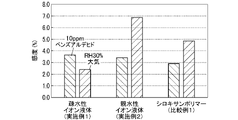
- FIG. 5 is a graph showing the sensitivity of Examples 1 and 2 and Comparative Example 1 of the same.
- FIG. 6 is a graph showing the sensitivity of Examples 1 to 3 and Comparative Example 1 of the same.
- the gas sensor 1 is, for example, an artificial olfactory sensor, and is used to detect, for example, molecules of odor components as gas molecules to be detected. Odor component molecules include volatile organic compounds (VOCs), ammonia, and the like, and the gas sensor 1 is used to detect these VOCs and the like.
- VOC volatile organic compounds
- the gas sensor 1 detects VOC, which is gas molecules of odor components contained in sample gas such as gas collected from food, breath collected from a human body, or air collected from a room in a building.
- the gas molecules to be detected by the gas sensor 1 are not limited to VOCs, and may be molecules of multiple types of odor components including VOCs, or molecules other than odor components, such as combustible gases and toxic gases such as carbon monoxide. It may be a molecule such as
- FIG. 1A shows a gas sensor 1 according to this embodiment.
- This gas sensor 1 has a sensing portion 20 and a plurality of electrodes 21 on a substrate 120 . Further, the gas sensor 1 includes a plurality of sensing portions 20, and a plurality (for example, a pair) of electrodes 21 are arranged in each sensing portion 20 with the sensing portions 20 interposed therebetween.
- a plurality of sensitive parts 20 (four in this embodiment) are arranged in an array in the vertical and horizontal directions. Further, each sensitive part 20 is formed in a circular shape in plan view. Note that the number, arrangement, and shape of the sensing portions 20 in the gas sensor 1 are not limited to those shown in FIG.
- the sensitive part 20 includes a gas adsorbent 201 and conductive particles 202.
- the sensitive part 20 is formed by dispersing a plurality of conductive particles 202 in the matrix of the gas adsorbent 201 .
- Each electrode 21 is electrically connected to the conductive particles 202 in the gas adsorbent 201 .
- the pair of electrodes 21 are electrically connected to the detection section of the processing section 13 .
- the gas adsorbent 201 is formed so as to be able to adsorb gas molecules G to be detected.
- the gas adsorbent 201 is electrically insulating and made of a gas adsorbing material and is formed in the form of a film, a plate or a sheet.
- the gas adsorption material forming the gas adsorbent 201 contains an ionic liquid.
- the type of ionic liquid is selected according to the type of chemical substance (gas) to be adsorbed by the gas adsorbent 201, the type of the conductive particles 202, and the like.
- the conductive particles 202 are conductive particles.
- the sensitive part 20 has conductivity by including a plurality of conductive particles 202 .
- the conductive particles 202 may contain, for example, at least one material selected from the group consisting of carbon materials, conductive polymers, metals, metal oxides, semiconductors, superconductors and complex compounds.
- the thickness of the gas adsorbent 201 is small before the gas molecules G are adsorbed, and the plurality of conductive particles 202 dispersed in the gas adsorbent 201 are It is in a tight state.
- the gas adsorbent 201 expands and becomes thicker, and as shown in FIG. becomes sparse.
- the intervals between the plurality of conductive particles 202 dispersed in the gas adsorbent 201 are widened, and the resistance value of the sensing part 20 increases at the time t1 when the gas molecules G are adsorbed, as shown in FIG. 2C.
- the gas adsorbent 201 shrinks from a thick state (state shown in FIG. 2B) and becomes thinner (state shown in FIG. 2A) due to the detachment of the gas molecules G. resistance value decreases. Then, by detecting this change in resistance value with the detection section of the processing section 13 electrically connected to the electrode 21, the gas sensor 1 detects whether gas molecules G are present in the supplied gas such as the atmosphere. It is possible to detect whether or not
- the sensitive part 20 of the gas sensor 1 includes the gas adsorbent 201 .
- Gas adsorbent 201 contains an ionic liquid.
- the ionic liquid is a salt (low molecular weight) that is liquid at room temperature, and has less steric hindrance than the polymers conventionally used for the sensitive parts of gas sensors. Therefore, the gas molecules G to be detected are likely to be adsorbed on the gas adsorbent 201, and the gas molecules G adsorbed by the gas adsorbent 201 are considered to diffuse rapidly in the gas adsorbent 201. Therefore, the response speed of the gas sensor 1 can be increased.
- the gas adsorbent 201 containing the ionic liquid desorbs the gas molecules G at high speed. Therefore, in the gas sensor 1 of the present embodiment, the ionic liquid, which is the gas adsorption material of the sensing part 20, adsorbs and desorbs the gas molecules G at high speed, thereby reversibly causing a large structural change in the conductive particles.
- the ionic liquid since the ionic liquid has a low vapor pressure, it hardly volatilizes, and the shape of the sensitive part 20 can be easily maintained. In addition, since ionic liquids are highly stable, their chemical structures are less likely to change and deterioration is less likely to occur. Further, the properties of ionic liquids can be changed by combining various cations and various anions and modifying the cations and anions. Therefore, multiple kinds of ionic liquids can be theoretically composed of 10 16 combinations of cations and anions.
- each gas adsorbent 201 is likely to adsorb different types of gas molecules G, and the gas sensor 1 can be multi-channeled. It is advantageous to That is, the selectivity of the types of gas molecules G to be detected by the gas sensor 1 can be enhanced, and the types of gas molecules G can be highly discriminated.
- the cation (seed) of the ionic liquid includes imidazolium (5-membered ring, conjugated), piperidinium (6-membered ring, single bond), pyrrolidinium (5-membered ring, single bond), pyridinium (6-membered ring , conjugated), ammonium, sulfonium, phosphonium, and the like.
- the anion (seed) of the ionic liquid includes carboxylate ion, phosphate ion, sulfonate ion, tetrafluoroboronate ion, trifluoromethyl group ([Tf2N] ⁇ , hydrophobic), hexafluoro Phosphate ion, trifluoromethanesulfonate ([TfO] ⁇ , hydrophobic) and the like.
- the anion of the ionic liquid is preferably a hydrophobic anion.
- moisture is less likely to be adsorbed to the gas adsorbent 201 of the sensing section 20, and the sensitivity of the gas sensor 1 to the gas molecules G to be detected can be enhanced.
- the air contains many water molecules (moisture) in addition to the gas molecules G. Absorbs easily in large quantities. Therefore, moisture affects the detection result of the gas sensor 1, and it is difficult to obtain a response of the gas sensor 1 to the gas molecules G to be detected.
- hydrophobicity is considered to be almost synonymous with low hydrogen bond acceptability. Therefore, since the reactivity between water and the ionic liquid largely depends on the hydrogen bond, it is considered that the reactivity could be suppressed by making the anion of the ionic liquid have a low hydrogen bond acceptability.
- the polarized —OH of water is the hydrogen bond donor and the polarized N, O, F, etc. of the anion is the hydrogen bond acceptor.
- Hydrophobic anions preferably have, for example, a hydrogen bond acceptability parameter ( ⁇ value) of less than 0.3, and the smaller the ⁇ value, the more difficult it is for the anion to form hydrogen bonds with water.
- the lower limit of the ⁇ value is not particularly set, as long as it is greater than 0.
- the hydrophobic anion It is preferable to use an organic fluorine compound as the hydrophobic anion. As a result, the hydrogen bond acceptability of the hydrophobic anion is lowered, and adsorption of water to the gas adsorbent 201 tends to be reduced. Further, the organic fluorine compound used as the hydrophobic anion is preferably a compound having a trifluoromethyl group. As a result, the hydrogen bond acceptability of the hydrophobic anion is further lowered, and the adsorption of water to the gas adsorbent 201 is more likely to be reduced. More specifically, the compound having a trifluoromethyl group includes bis(trifluoromethanesulfonyl)amide ion (see [Formula 1]). In addition, it is preferable that the hydrophobic anion does not have a carboxyl group. This makes it easier to obtain the hydrophobicity of the hydrophobic anion.
- imidazolium is preferably used as the cation of the ionic liquid. Moreover, it is preferable to use a highly hydrophobic cation, for example, imidazolium having an alkyl chain with 7 or more carbon atoms is preferable.
- the imidazolium used in this embodiment is shown in [Chemical 2].
- the ionic liquid that constitutes the gas adsorbent 201 can contain cations and anions at a constant ratio.
- an ionic liquid contains monovalent anions and cations in an equal ratio in terms of valence.
- the sensitive part 20 of the gas sensor 1 includes a plurality of conductive particles 202.
- a plurality of conductive particles 202 are dispersed in gas adsorbent 201 .
- the electrical resistance value of the sensitive part 20 is particularly likely to change.
- the conductive particles 202 preferably contain an oxide semiconductor, and the oxide semiconductor is preferably antimony tin oxide. In this case, when the gas sensor 1 is exposed to gas, the electrical resistance value of the sensitive part 20 is particularly likely to change.
- the average particle diameter of the conductive particles 202 is preferably, for example, 10 nm or more and 300 nm or less.In this case, the dispersibility in the gas adsorbent 201 can be improved.
- the average particle size of the conductive particles 202 is a number-based arithmetic average value of the particle sizes obtained from the electron micrograph of the conductive particles 202 .
- the ratio of the conductive particles 202 contained in the sensitive part 20 is not particularly limited, but for example, the ratio of 200 parts by mass of the conductive particles 202 to 100 parts by mass of the gas adsorbent (ionic liquid) 201 (conductive It is preferable that the mass ratio of the ionic particles to the ionic liquid is 2:1). In this case, when the gas sensor 1 is exposed to gas, the electrical resistance value of the sensitive part 20 is particularly likely to change.
- the gas sensor 1 is formed by providing a plurality of sensitive portions 20 and a plurality of electrodes 21 on a substrate 120 .
- a pair of electrodes 21 are in contact with and electrically connected to each sensitive portion 20 .
- a plurality of sensitive parts 20 are formed on a substrate 120 on which a plurality of electrodes 21 are formed.
- Each sensitive part 20 can be formed by applying a molding material containing an ionic liquid and conductive particles by a method such as an inkjet method or a dispensing method.
- the sensitive part 20 includes an ionic liquid having electrical insulation and conductive particles, and the conductive particles make the sensitive part 20 conductive, but the present invention is not limited to this.
- the sensitive part 20 may not contain conductive particles, in which case the ionic liquid contained in the gas adsorbent 201 has conductivity.
- the conductive ionic liquid for example, ionic liquids having various modifying groups can be used.
- the gas sensor 1 according to this embodiment differs from the gas sensor 1 according to the first embodiment in the configuration of the ionic liquid.
- Embodiment 2 can be applied in appropriate combination with the configuration described in Embodiment 1 (including modifications).
- the anion of the ionic liquid of the gas adsorbent 201 is a hydrophobic anion in order to reduce the influence of moisture on the gas sensor 1 .
- the anion of the ionic liquid of the gas adsorbent 201 is formed to contain a hydrophilic anion so that the sensitivity of the gas sensor 1 is improved with respect to a specific gas molecule G.
- the hydrophilic anion may be an anion that has a higher hydrogen bond acceptability and is more hydrophilic than the hydrophobic anion used in the first embodiment. That is, the hydrophilic anion is preferably an anion having a hydrogen bond acceptability parameter ( ⁇ value) of 0.3 or more.
- the upper limit of the ⁇ value is not particularly set, it is, for example, 0.8 or less.
- hydrophilic anion anions other than organic fluorine compounds can be used.
- anions without trifluoromethyl groups can be used as hydrophilic anions.
- hydrophilic anions include halogen ion, nitrate ion, tetrafluoroborate ion, hexafluorophosphate ion, thiocyanate ion, alkyl sulfate ion, p-toluenesulfonate ion, tetrafluoroacetate ion, and the like. can do.
- hexafluorophosphate ion (PF 6 ⁇ ), which is a weakly hydrophilic anion
- tetrafluoroborate ion BF 4 ⁇
- PF 6 ⁇ hexafluorophosphate ion
- BF 4 ⁇ tetrafluoroborate ion
- the gas sensor 1 When a hydrophilic anion is used as the anion of the ionic liquid of the gas adsorbent 201, the adsorption of gas molecules G, which are hydrogen bond donors, to the gas adsorbent 201 is improved. Therefore, the gas sensor 1 has improved sensitivity to the gas molecules G, which are hydrogen bond donors. Specifically, when the gas molecule G is pyrrole, the adsorption to the gas adsorbent 201 is improved, and the detection sensitivity of the gas sensor 1 to pyrrole is improved. Therefore, the gas sensor 1 can use a hydrophilic anion as the anion of the ionic liquid of the gas adsorbent 201 in order to increase the detection sensitivity of the gas molecules G, which are hydrogen bond donors.
- the same cation as in Embodiment 1, such as imidazolium, can be used.
- ionic liquids with different properties can be easily produced.
- the gas sensor 1 according to this embodiment differs from the gas sensor 1 according to the first and second embodiments in the structure of the ionic liquid contained in the gas adsorbent 201 of each sensing part 20 when a plurality of sensing parts 20 are provided.
- Embodiment 3 can be applied in appropriate combination with the configuration described in Embodiments 1 and 2 (including modifications).
- the gas adsorbent 201 of each sensing part 20 can be formed using different ionic liquids.
- the types of gas molecules G adsorbed by the gas adsorbents 201 of the respective sensing parts 20 can be made different, and the detection sensitivity of the gas sensor 1 for a plurality of types of gas molecules G can be improved, resulting in a multi-channel configuration. becomes easier to plan.
- a body 201 can be formed.
- the sensitive part 20 provided with the gas adsorbent 201 containing hydrophilic anions can easily selectively detect hydrogen bond donor gas molecules G such as pyrrole, and the gas adsorbent 201 containing hydrophobic anions can be easily detected.
- the provided sensing part 20 makes it easier to selectively detect gas molecules G other than hydrogen bond donors.
- Fig. 3 shows an outline of the structure of the gas sensor 1 for testing.
- a first electrode 211 and a second electrode 212 were provided on an electrically insulating substrate 120 so as to constitute a comb-shaped electrode system.
- the comb electrode system has a dimension L1 of 520 ⁇ m in the direction along the teeth of the comb, and a dimension L2 of 500 ⁇ m in the direction orthogonal to the teeth of the comb.
- an electrically insulating film (insulating film 9 ) was provided on the substrate 120 so as to cover the first electrode 211 and the second electrode 212 .
- the insulating film 9 was provided with a strip-shaped opening 7 having a width of 5 ⁇ m shown in FIG.
- the center-to-center dimension L3 of the openings 7 shown in FIG. 3 is 60 ⁇ m.
- the sensitive part 20 having the gas adsorbent 201 and the conductive particles 202 was provided on the substrate 120 so as to have a thickness of 1 ⁇ m so as to cover the insulating film 9 . Therefore, the sensitive part 20 contacts the first electrode 211 and the second electrode 212 through the opening 7 .
- the diameter D1 of the sensitive part 20 shown in FIG. 3 is 900 ⁇ m.
- the gas sensor 1 also has a first terminal 81 extending from one end of the first electrode 211 and protruding outside the sensing section 20 , and a second terminal extending from one end of the second electrode 212 and protruding outside the sensing section 20 . 82 were provided.
- the gas sensor 1 With a constant voltage applied between the first terminal 81 and the second terminal 82, the gas sensor 1 was placed in a nitrogen stream, and then gas molecules G to be detected were mixed into the stream for about 15 seconds. During this process, the current flowing between the first terminal 81 and the second terminal 82 was measured, and the electrical resistance value of the sensitive part 20 was calculated from the result.
- Example 1 As the ionic liquid constituting the gas adsorbent 201 of the test gas sensor 1, imidazolium represented by the above [Chemical 2] was used as the cation, and the hydrophobic anion represented by the above [Chemical 1] was used as the anion.
- the conductive particles 202 carbon black with an average particle size of 44 nm was used.
- test gas sensor 1 was formed in the same manner as in Example 1 except that the gas adsorbent 201 of the test gas sensor 1 was made of a polysiloxane polymer (manufactured by Sigma-Aldrich, trade name SP-2330).
- FIG. 4 shows changes in the electrical resistance value of the sensitive part 20 (the electrical resistance value between the first electrode 211 and the second electrode 212) for Example 1 and Comparative Example 1.
- FIG. Benzaldehyde was used as the gas molecule G to be detected, and the concentration was set to 10 ppm.
- Example 1 Comparing the change in electrical resistance value (response waveform) between Example 1 and Comparative Example 1, the waveform of Example 1 rises sharply and the waveform falls sharply as compared to Comparative Example 1. .
- the rising slope of each waveform was calculated by the Ramer-Douglas-Peuckeralgorithm, it was 0.89 in Example 1 and 0.31 in Comparative Example 1.
- the slope of the falling edge of each waveform was calculated by the same algorithm, it was 0.85 in Example 1 and 0.29 in Comparative Example 1. Therefore, it can be said that Example 1, which uses the ionic liquid in the sensitive part 20, has a rising and falling slope twice or more that of Comparative Example 1, which uses a polymer, and has a high response speed.
- Example 2 As the ionic liquid constituting the gas adsorbent 201, imidazolium whose cation is shown in [Formula 2] above is used, and weakly hydrophilic hexafluorophosphate ion (PF 6 ⁇ ) is used as an anion. Other than that, it was formed in the same manner as in Example 1.
- the evaluation gas containing benzaldehyde at a concentration of 10 ppm was used as the gas molecule G to be detected, and the atmosphere with a humidity of 30% was used as the evaluation gas.
- the sensitivity of gas sensor 1 was measured.
- the sensitivity is defined as Rs/R, where Rs is the resistance value measured at the sensitive part 20 when the gas sensor 1 is introduced into the gas sensor 1, and R0 is the resistance value measured at the sensitive part 20 when the gas sensor 1 is introduced with an odorless gas (nitrogen). Defined by R0.
- Example 1 the sensitivity to benzaldehyde is higher than the sensitivity to moisture.
- Example 2 and Comparative Example 1 the sensitivity to moisture is higher than the sensitivity to benzaldehyde. Therefore, by using a hydrophobic ionic liquid containing a hydrophobic anion as the ionic liquid contained in the gas adsorbent 201, it is possible to suppress reactivity to moisture while maintaining sensitivity to VOC (benzaldehyde). I can say
- Example 3 As the ionic liquid constituting the gas adsorbent 201, the imidazolium represented by [Chem. 2] was used as the cation, and the hydrophilic tetrafluoroborate ion (BF 4 ⁇ ) was used as the anion. Other than that, it was formed in the same manner as in Example 1.
- Example 1-3 and Comparative Example 1 the evaluation gas containing nonanal at a concentration of 2 ppm as the gas molecule G to be detected was used, the evaluation gas containing benzaldehyde at a concentration of 2 ppm was used, and the pyrrole concentration was 2 ppm.
- the sensitivity of the test gas sensor 1 was measured in the case of using the evaluation gas contained in . Sensitivity was determined in the same manner as above.
- Example 3 the sensitivity to pyrrole is higher than that of Examples 1 and 2 and Comparative Example 1. was expensive. Therefore, it can be said that pyrrole can be detected with high sensitivity by using a hydrophilic ionic liquid containing BF 4 ⁇ with high hydrophilicity as the ionic liquid contained in the gas adsorbent 201 .
- the gas sensor (1) includes a sensitive portion (20) and a plurality of electrodes (21) arranged via the sensitive portion (20).
- the sensitive part (20) contains an ionic liquid, and is configured to change electrical resistance when gas molecules (G) are adsorbed.
- a second aspect is the gas sensor (1) according to the first aspect, wherein the sensitive part (20) contains conductive particles (202) and has conductivity due to the conductive particles (202).
- the adsorption and desorption of the gas molecules (G) in the sensing part (20) become faster, and accordingly the change in the electric resistance value of the sensing part (20) due to the conductive particles (202) becomes faster. and the response speed of the gas sensor (1) is increased.
- a third aspect is the gas sensor (1) according to the first or second aspect, wherein the ionic liquid contains a hydrophobic anion.
- the responsiveness of the sensitive part (20) to moisture is suppressed, and the detection sensitivity of the gas molecules (G) to be detected is increased.
- a fourth aspect is the gas sensor (1) according to the third aspect, wherein the hydrophobic anion contains an organic fluorine compound.
- the responsiveness of the sensitive part (20) to moisture is further suppressed, and the detection sensitivity of the gas molecules (G) to be detected is further enhanced.
- a fifth aspect is the gas sensor (1) according to the fourth aspect, wherein the organic fluorine compound has a trifluoromethyl group.
- the responsiveness of the sensitive part (20) to moisture is further suppressed, and the detection sensitivity of the gas molecules (G) to be detected is further enhanced.
- a sixth aspect is the gas sensor (1) according to the first aspect, wherein the ionic liquid contains a hydrogen bond-accepting anion.
- the adsorption of the hydrogen bond donating gas molecules G to the sensitive part (20) increases, and the detection sensitivity of the hydrogen bond donating gas molecules (G) increases.
- a seventh aspect is the gas sensor (1) according to any one of the first to sixth aspects, wherein the cation of the ionic liquid contains imidazolium.
- the characteristics of the sensitive part (20) are stabilized, and the detection sensitivity of gas molecules (G) is increased.
- An eighth aspect is the gas sensor (1) according to any one of the first to seventh aspects, comprising a plurality of sensing parts (20) different in type of the ionic liquid. A plurality of sensitive parts (20) are arrayed.
- a multi-channel gas sensor (1) capable of detecting a wide variety of gas molecules (G) with different types of gas molecules (G) to which each of the plurality of sensitive parts (20) responds easily is provided. can get.
- a ninth aspect is the gas sensor (1) according to the eighth aspect, wherein the plurality of sensing parts (20) are respectively composed of an ionic liquid containing a hydrophobic anion and an ionic liquid containing a hydrophilic anion. be.
- a tenth aspect is the gas sensor (1) according to any one of the second to ninth aspects, wherein the conductive particles (202) are carbon black.
- the characteristics of the sensitive part (20) are stabilized, and the detection sensitivity of gas molecules (G) is increased.
- An eleventh aspect is the gas sensor (1) according to any one of the second to tenth aspects, wherein the conductive particles (202) are an oxide semiconductor.
- the characteristics of the sensitive part (20) are stabilized, and the detection sensitivity of gas molecules (G) is increased.
- a twelfth aspect is the gas sensor (1) according to the eleventh aspect, wherein the oxide semiconductor is antimony tin oxide.
- the characteristics of the sensitive part (20) are stabilized, and the detection sensitivity of gas molecules (G) is increased.
- a thirteenth aspect is the gas sensor (1) according to the first aspect, wherein the ionic liquid has conductivity.
Landscapes
- Chemical & Material Sciences (AREA)
- Health & Medical Sciences (AREA)
- Life Sciences & Earth Sciences (AREA)
- General Health & Medical Sciences (AREA)
- Immunology (AREA)
- Pathology (AREA)
- Analytical Chemistry (AREA)
- Biochemistry (AREA)
- Physics & Mathematics (AREA)
- General Physics & Mathematics (AREA)
- Engineering & Computer Science (AREA)
- Chemical Kinetics & Catalysis (AREA)
- Electrochemistry (AREA)
- Combustion & Propulsion (AREA)
- Food Science & Technology (AREA)
- Medicinal Chemistry (AREA)
- Investigating Or Analyzing Materials By The Use Of Fluid Adsorption Or Reactions (AREA)
Priority Applications (3)
| Application Number | Priority Date | Filing Date | Title |
|---|---|---|---|
| CN202280021712.4A CN117043590A (zh) | 2021-03-24 | 2022-03-16 | 气体传感器 |
| US18/551,325 US20240183814A1 (en) | 2021-03-24 | 2022-03-16 | Gas sensor |
| JP2023509062A JPWO2022202523A1 (https=) | 2021-03-24 | 2022-03-16 |
Applications Claiming Priority (2)
| Application Number | Priority Date | Filing Date | Title |
|---|---|---|---|
| JP2021-050522 | 2021-03-24 | ||
| JP2021050522 | 2021-03-24 |
Publications (1)
| Publication Number | Publication Date |
|---|---|
| WO2022202523A1 true WO2022202523A1 (ja) | 2022-09-29 |
Family
ID=83397179
Family Applications (1)
| Application Number | Title | Priority Date | Filing Date |
|---|---|---|---|
| PCT/JP2022/011857 Ceased WO2022202523A1 (ja) | 2021-03-24 | 2022-03-16 | ガスセンサ |
Country Status (4)
| Country | Link |
|---|---|
| US (1) | US20240183814A1 (https=) |
| JP (1) | JPWO2022202523A1 (https=) |
| CN (1) | CN117043590A (https=) |
| WO (1) | WO2022202523A1 (https=) |
Cited By (1)
| Publication number | Priority date | Publication date | Assignee | Title |
|---|---|---|---|---|
| JP2024110940A (ja) * | 2023-02-03 | 2024-08-16 | ハネウェル・インターナショナル・インコーポレーテッド | 蒸気を検出するためのシステム、装置、及び方法 |
Citations (4)
| Publication number | Priority date | Publication date | Assignee | Title |
|---|---|---|---|---|
| JP2010175428A (ja) * | 2009-01-30 | 2010-08-12 | Konica Minolta Holdings Inc | 有機溶媒ガス濃度の検出方法、有機溶媒ガス濃度の調整方法、有機溶媒ガス濃度検出装置及び有機デバイスの製造方法 |
| JP2014006128A (ja) * | 2012-06-22 | 2014-01-16 | Omron Corp | ガスセンサおよびガスセンシング方法 |
| JP2017521685A (ja) * | 2014-07-15 | 2017-08-03 | シー2センス, インコーポレイテッド | 増強した化学レジスタセンシングのための調製物 |
| JP2018112510A (ja) * | 2017-01-13 | 2018-07-19 | 株式会社フジクラ | 二酸化炭素センサ |
Family Cites Families (3)
| Publication number | Priority date | Publication date | Assignee | Title |
|---|---|---|---|---|
| JP5138579B2 (ja) * | 2005-04-06 | 2013-02-06 | ダウ コーニング コーポレーション | オルガノシロキサン組成物 |
| US8840775B2 (en) * | 2011-12-16 | 2014-09-23 | Utc Fire & Security Corporation | Regenerative gas sensor |
| US11567031B2 (en) * | 2017-09-08 | 2023-01-31 | Oakland University | Selective real-time gas sensing |
-
2022
- 2022-03-16 JP JP2023509062A patent/JPWO2022202523A1/ja active Pending
- 2022-03-16 US US18/551,325 patent/US20240183814A1/en active Pending
- 2022-03-16 WO PCT/JP2022/011857 patent/WO2022202523A1/ja not_active Ceased
- 2022-03-16 CN CN202280021712.4A patent/CN117043590A/zh active Pending
Patent Citations (4)
| Publication number | Priority date | Publication date | Assignee | Title |
|---|---|---|---|---|
| JP2010175428A (ja) * | 2009-01-30 | 2010-08-12 | Konica Minolta Holdings Inc | 有機溶媒ガス濃度の検出方法、有機溶媒ガス濃度の調整方法、有機溶媒ガス濃度検出装置及び有機デバイスの製造方法 |
| JP2014006128A (ja) * | 2012-06-22 | 2014-01-16 | Omron Corp | ガスセンサおよびガスセンシング方法 |
| JP2017521685A (ja) * | 2014-07-15 | 2017-08-03 | シー2センス, インコーポレイテッド | 増強した化学レジスタセンシングのための調製物 |
| JP2018112510A (ja) * | 2017-01-13 | 2018-07-19 | 株式会社フジクラ | 二酸化炭素センサ |
Non-Patent Citations (5)
| Title |
|---|
| ABU-HANI AYAH F.S.; AWWAD FALAH; GREISH YASER E.; AYESH AHMAD I.; MAHMOUD SALEH T.: "Design, fabrication, and characterization of low-power gas sensors based on organic-inorganic nano-composite", ORGANIC ELECTRONICS, ELSEVIER, AMSTERDAM, NL, vol. 42, 28 December 2016 (2016-12-28), AMSTERDAM, NL, pages 284 - 292, XP029887489, ISSN: 1566-1199, DOI: 10.1016/j.orgel.2016.12.050 * |
| LI YAN, SUN JIE,CHENG TING,WANG JIA-LI,FENG YI-LING,DENG WEI-QING,CAO XIAO-WEI,WANG RONG: "Carbon black-ionic liquid gel for gas sensing", HUAXUE YANJIU YU YINGYONG - CHEMICAL RESEARCH AND APPLICATION, GAI-KAN BIAN-WEI-HUI, CHENGDU, CN, vol. 22, no. 5, 31 May 2010 (2010-05-31), CN , pages 625 - 628, XP055970874, ISSN: 1004-1656 * |
| NETTO MARIANA M.O., GONÇALVES WELLINGTON B., LI ROSAMARIA W.C., GRUBER JONAS: "Biopolymer based ionogels as active layers in low-cost gas sensors for electronic noses", SENSORS AND ACTUATORS B: CHEMICAL, ELSEVIER BV, NL, vol. 315, 1 July 2020 (2020-07-01), NL , pages 128025, XP055970870, ISSN: 0925-4005, DOI: 10.1016/j.snb.2020.128025 * |
| PARK CHAN HO, SCHROEDER VERA, KIM BUMJOON J., SWAGER TIMOTHY M.: "Ionic Liquid-Carbon Nanotube Sensor Arrays for Human Breath Related Volatile Organic Compounds", ACS SENSORS, AMERICAN CHEMICAL SOCIETY, US, vol. 3, no. 11, 26 November 2018 (2018-11-26), US, pages 2432 - 2437, XP055970869, ISSN: 2379-3694, DOI: 10.1021/acssensors.8b00987 * |
| ZHU X., D. LIU, Q. CHEN, L. LIN, S. JIANG, H. ZHOU, J. ZHAO, J. WU: "A paper-supported graphene ionic liquid array for e-nose application", CHEM. COMMUN., vol. 52, no. 14, 12 January 2016 (2016-01-12), pages 3042 - 3045, XP055970865, DOI: 10.1039/c5cc08652c * |
Cited By (2)
| Publication number | Priority date | Publication date | Assignee | Title |
|---|---|---|---|---|
| JP2024110940A (ja) * | 2023-02-03 | 2024-08-16 | ハネウェル・インターナショナル・インコーポレーテッド | 蒸気を検出するためのシステム、装置、及び方法 |
| JP7715855B2 (ja) | 2023-02-03 | 2025-08-04 | ハネウェル・インターナショナル・インコーポレーテッド | 蒸気を検出するためのシステム、装置、及び方法 |
Also Published As
| Publication number | Publication date |
|---|---|
| JPWO2022202523A1 (https=) | 2022-09-29 |
| US20240183814A1 (en) | 2024-06-06 |
| CN117043590A (zh) | 2023-11-10 |
Similar Documents
| Publication | Publication Date | Title |
|---|---|---|
| Raible et al. | V2O5 nanofibres: novel gas sensors with extremely high sensitivity and selectivity to amines | |
| Zhang et al. | Electrochemically functionalized single‐walled carbon nanotube gas sensor | |
| Duc et al. | Hydrogen sulfide detection by sensors based on conductive polymers: A review | |
| Roy et al. | Polyaniline-multiwalled carbon nanotube (PANI-MWCNT): Room temperature resistive carbon monoxide (CO) sensor | |
| Salikhov et al. | Nanocomposite thin-film structures based on a polyelectrolyte complex of chitosan and chitosan succinamide with SWCNT | |
| Lee et al. | Highly sensitive, transparent, and flexible gas sensors based on gold nanoparticle decorated carbon nanotubes | |
| Van Hieu et al. | Highly sensitive thin film NH3 gas sensor operating at room temperature based on SnO2/MWCNTs composite | |
| Li et al. | Poly (ionic liquid)-wrapped single-walled carbon nanotubes for sub-ppb detection of CO 2 | |
| Kuberský et al. | Towards a fully printed electrochemical NO2 sensor on a flexible substrate using ionic liquid based polymer electrolyte | |
| Travlou et al. | Nanoporous carbon-composites as gas sensors: Importance of the specific adsorption forces for ammonia sensing mechanism | |
| US20090148690A1 (en) | Method of producing a nanoparticle film on a substrate | |
| Jeon et al. | Wearable nitrogen oxide gas sensors based on hydrophobic polymerized ionogels for the detection of biomarkers in exhaled breath | |
| Li et al. | Polyaniline–chitosan nanocomposite: high performance hydrogen sensor from new principle | |
| JP7696085B2 (ja) | ガスセンサ、ガスセンサ集合体、検出方法及び化学物質識別方法 | |
| Rozemarie et al. | Electrospun based polyaniline sensors–a review | |
| Garg et al. | Polypyrrole microwires as toxic gas sensors for ammonia and hydrogen sulphide | |
| Nguyet et al. | Novel Synthesis of a PANI/ZnO Nanohybrid for Enhanced NO2 Gas Sensing Performance at Low Temperatures: TT Nguyet et al. | |
| WO2022202523A1 (ja) | ガスセンサ | |
| Khan et al. | Ammonia vapor sensing properties of polyaniline–titanium (IV) phosphate cation exchange nanocomposite | |
| Grate et al. | Langmuir-Blodgett films of a nickel dithiolene complex on chemical microsensors for the detection of hydrazine | |
| Casanova-Cháfer et al. | Hydrophilicity and carbon chain length effects on the gas sensing properties of chemoresistive, self-assembled monolayer carbon nanotube sensors | |
| Alizadeh et al. | A new strategy for low temperature gas sensing by nano-sized metal oxides: Development a new nerve agent simulant sensor | |
| Wiederoder et al. | Impact of graphene nanoplatelet concentration and film thickness on vapor detection for polymer based chemiresistive sensors | |
| Faridbod et al. | All solid sate potentiometric sensors for the measurement of paroxetine in pharmaceutical formulation | |
| JP2019040896A (ja) | 半導体材料、ガスセンサ、ガス測定装置、半導体材料の製造方法および硫化水素濃度測定方法 |
Legal Events
| Date | Code | Title | Description |
|---|---|---|---|
| 121 | Ep: the epo has been informed by wipo that ep was designated in this application |
Ref document number: 22775312 Country of ref document: EP Kind code of ref document: A1 |
|
| WWE | Wipo information: entry into national phase |
Ref document number: 2023509062 Country of ref document: JP |
|
| WWE | Wipo information: entry into national phase |
Ref document number: 202280021712.4 Country of ref document: CN |
|
| WWE | Wipo information: entry into national phase |
Ref document number: 18551325 Country of ref document: US |
|
| NENP | Non-entry into the national phase |
Ref country code: DE |
|
| 122 | Ep: pct application non-entry in european phase |
Ref document number: 22775312 Country of ref document: EP Kind code of ref document: A1 |