WO2022202341A1 - 音編集装置、音編集方法および音編集プログラム - Google Patents
音編集装置、音編集方法および音編集プログラム Download PDFInfo
- Publication number
- WO2022202341A1 WO2022202341A1 PCT/JP2022/010400 JP2022010400W WO2022202341A1 WO 2022202341 A1 WO2022202341 A1 WO 2022202341A1 JP 2022010400 W JP2022010400 W JP 2022010400W WO 2022202341 A1 WO2022202341 A1 WO 2022202341A1
- Authority
- WO
- WIPO (PCT)
- Prior art keywords
- acoustic signal
- sound
- input
- effect
- sound editing
- Prior art date
- Legal status (The legal status is an assumption and is not a legal conclusion. Google has not performed a legal analysis and makes no representation as to the accuracy of the status listed.)
- Ceased
Links
Images



Classifications
-
- G—PHYSICS
- G10—MUSICAL INSTRUMENTS; ACOUSTICS
- G10H—ELECTROPHONIC MUSICAL INSTRUMENTS; INSTRUMENTS IN WHICH THE TONES ARE GENERATED BY ELECTROMECHANICAL MEANS OR ELECTRONIC GENERATORS, OR IN WHICH THE TONES ARE SYNTHESISED FROM A DATA STORE
- G10H1/00—Details of electrophonic musical instruments
- G10H1/02—Means for controlling the tone frequencies, e.g. attack or decay; Means for producing special musical effects, e.g. vibratos or glissandos
- G10H1/06—Circuits for establishing the harmonic content of tones, or other arrangements for changing the tone colour
- G10H1/12—Circuits for establishing the harmonic content of tones, or other arrangements for changing the tone colour by filtering complex waveforms
- G10H1/125—Circuits for establishing the harmonic content of tones, or other arrangements for changing the tone colour by filtering complex waveforms using a digital filter
-
- G—PHYSICS
- G10—MUSICAL INSTRUMENTS; ACOUSTICS
- G10H—ELECTROPHONIC MUSICAL INSTRUMENTS; INSTRUMENTS IN WHICH THE TONES ARE GENERATED BY ELECTROMECHANICAL MEANS OR ELECTRONIC GENERATORS, OR IN WHICH THE TONES ARE SYNTHESISED FROM A DATA STORE
- G10H1/00—Details of electrophonic musical instruments
- G10H1/0091—Means for obtaining special acoustic effects
-
- G—PHYSICS
- G10—MUSICAL INSTRUMENTS; ACOUSTICS
- G10H—ELECTROPHONIC MUSICAL INSTRUMENTS; INSTRUMENTS IN WHICH THE TONES ARE GENERATED BY ELECTROMECHANICAL MEANS OR ELECTRONIC GENERATORS, OR IN WHICH THE TONES ARE SYNTHESISED FROM A DATA STORE
- G10H1/00—Details of electrophonic musical instruments
- G10H1/0008—Associated control or indicating means
-
- G—PHYSICS
- G10—MUSICAL INSTRUMENTS; ACOUSTICS
- G10H—ELECTROPHONIC MUSICAL INSTRUMENTS; INSTRUMENTS IN WHICH THE TONES ARE GENERATED BY ELECTROMECHANICAL MEANS OR ELECTRONIC GENERATORS, OR IN WHICH THE TONES ARE SYNTHESISED FROM A DATA STORE
- G10H2210/00—Aspects or methods of musical processing having intrinsic musical character, i.e. involving musical theory or musical parameters or relying on musical knowledge, as applied in electrophonic musical tools or instruments
- G10H2210/155—Musical effects
- G10H2210/315—Dynamic effects for musical purposes, i.e. musical sound effects controlled by the amplitude of the time domain audio envelope, e.g. loudness-dependent tone colour or musically desired dynamic range compression or expansion
-
- G—PHYSICS
- G10—MUSICAL INSTRUMENTS; ACOUSTICS
- G10H—ELECTROPHONIC MUSICAL INSTRUMENTS; INSTRUMENTS IN WHICH THE TONES ARE GENERATED BY ELECTROMECHANICAL MEANS OR ELECTRONIC GENERATORS, OR IN WHICH THE TONES ARE SYNTHESISED FROM A DATA STORE
- G10H2250/00—Aspects of algorithms or signal processing methods without intrinsic musical character, yet specifically adapted for or used in electrophonic musical processing
- G10H2250/311—Neural networks for electrophonic musical instruments or musical processing, e.g. for musical recognition or control, automatic composition or improvisation
Definitions
- the present invention relates to a sound editing device, sound editing method, and sound editing program for editing sound.
- each performer preferably adjusts his/her own volume so as to maintain balance with the volume of the instrument played by surrounding performers.
- it is difficult for players to hear their own sounds they tend to increase their volume.
- it is not easy to maintain the volume balance because the other performers also increase their own volume.
- the sound becomes saturated and travels around the venue, making it more difficult to maintain the volume balance.
- Patent Literature 1 describes an effect adding device that adds various effects to an audio signal.
- the clarity of the sound produced by each performer changes according to the sound produced by surrounding performers, it is not easy to add an effect to the acoustic signal so as to increase the clarity of the sound.
- An object of the present invention is to provide a sound editing device, a sound editing method, and a sound editing program that can easily increase the clarity of sound.
- a sound editing apparatus includes a first receiving section that receives a first acoustic signal, a second receiving section that receives a second acoustic signal, a first input acoustic signal and a second input. From the first acoustic signal and the second acoustic signal using a trained model indicating the input/output relationship between the acoustic signal and the output effect information reflecting the effect to be imparted to the first input acoustic signal an estimating unit for estimating effect information reflecting an effect to be applied to the first acoustic signal;
- a sound editing method receives a first sound signal, receives a second sound signal, receives the first input sound signal and the second input sound signal, and Effect to be imparted to the first acoustic signal from the first acoustic signal and the second acoustic signal using a trained model indicating the input/output relationship between output effect information reflecting the effect to be imparted is estimated and executed by the computer.
- a sound editing program is a program for causing a computer to execute a sound editing method, comprising: processing for receiving a first sound signal; processing for receiving a second sound signal; a first acoustic signal using a trained model indicating an input/output relationship between the acoustic signal, the second input acoustic signal, and output effect information reflecting an effect to be applied to the first input acoustic signal; and a process of estimating effect information reflecting the effect to be applied to the first acoustic signal from the second acoustic signal.
- FIG. 1 is a block diagram showing the configuration of a processing system including a sound editing apparatus according to the first embodiment of the invention.
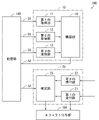
- FIG. 2 is a block diagram showing the configuration of the sound learning device and sound editing device of FIG.
- FIG. 3 is a diagram showing an example of the first acoustic signal and the third acoustic signal.
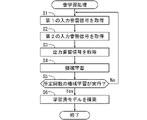
- FIG. 4 is a flow chart showing an example of sound learning processing by the sound learning device of FIG.
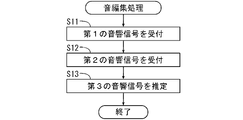
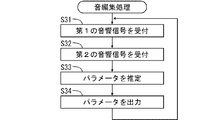
- FIG. 5 is a flow chart showing an example of sound editing processing by the sound editing apparatus of FIG.
- FIG. 6 is a block diagram showing the configuration of a processing system including a sound editing apparatus according to the second embodiment of the invention.
- FIG. 7 is a block diagram showing the configuration of the sound learning device and sound editing device of FIG. FIG.
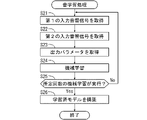
- FIG. 8 is a flow chart showing an example of sound learning processing by the sound learning device of FIG.
- FIG. 9 is a flow chart showing an example of sound editing processing by the sound editing apparatus of FIG.
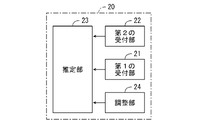
- FIG. 10 is a block diagram showing the configuration of a sound editing device according to another embodiment.
- FIG. 1 is a block diagram showing the configuration of a processing system including a sound editing device according to the first embodiment of the invention.
- the processing system 100 includes a RAM (random access memory) 110 , a ROM (read only memory) 120 , a CPU (central processing unit) 130 and a storage section 140 .
- the processing system 100 is provided, for example, in an effector or speaker. Further, the processing system 100 may be realized by an information processing device such as a personal computer, or may be realized by an electronic musical instrument having performance functions.
- RAM 110 , ROM 120 , CPU 130 and storage unit 140 are connected to bus 150 .
- RAM 110 , ROM 120 and CPU 130 constitute sound learning device 10 and sound editing device 20 .
- sound learning device 10 and sound editing device 20 are configured by common processing system 100, but may be configured by separate processing systems.
- the RAM 110 consists of, for example, a volatile memory, is used as a work area for the CPU 130, and temporarily stores various data.
- the ROM 120 is, for example, a non-volatile memory and stores a sound learning program and a sound editing program.
- CPU 130 performs sound learning processing by executing a sound learning program stored in ROM 120 on RAM 110 . Further, the CPU 130 performs sound editing processing by executing a sound editing program stored in the ROM 120 on the RAM 110 . Details of the sound learning process and the sound editing process will be described later.
- the sound learning program or sound editing program may be stored in the storage unit 140 instead of the ROM 120.
- the sound learning program or sound editing program may be provided in a form stored in a computer-readable storage medium and installed in ROM 120 or storage unit 140 .
- a sound learning program or sound editing program distributed from a server (including a cloud server) on the network is installed in the ROM 120 or the storage unit 140.
- the storage unit 140 includes a storage medium such as a hard disk, an optical disk, a magnetic disk, or a memory card, and stores the learned model M and a plurality of learning data D1.
- the trained model M or the plurality of learning data D1 may not be stored in the storage unit 140, but may be stored in a computer-readable storage medium.
- the processing system 100 is connected to a network, the trained model M or the plurality of learning data D1 may be stored in a server on the network.
- a trained model M is constructed based on a plurality of learning data D1. Details of the trained model M will be described later.
- each piece of learning data D1 includes multiple (multi-track) waveform data respectively indicating the first input acoustic signal, the second input acoustic signal, and the output acoustic signal.
- the first input acoustic signal corresponds to a sound hypothesized to be played by the first user, such as a sound played with an instrument of the same type as that used by the first user.
- the second input acoustic signal corresponds to a sound hypothesized to be played by the second user, such as a sound played using the same type of instrument as the instrument used by the second user.
- the output sound signal is an example of output effect information in the present embodiment, and effects to be applied are applied to the first input sound signal based on the first input sound signal and the second input sound signal.
- the waveform data representing the output acoustic signal may be generated from the waveform data representing the first input acoustic signal by adjusting parameters of the effect.
- FIG. 2 is a block diagram showing the configuration of the sound learning device 10 and the sound editing device 20 of FIG.
- the sound learning device 10 includes a first acquisition unit 11, a second acquisition unit 12, a third acquisition unit 13, and a construction unit 14 as functional units.
- the functional units of the sound learning device 10 are implemented by the CPU 130 of FIG. 1 executing the sound learning program. At least part of the functional units of the sound learning device 10 may be realized by hardware such as an electronic circuit.
- the first acquisition unit 11 acquires the first input acoustic signal from each learning data D1 stored in the storage unit 140 or the like.
- the second acquisition unit 12 acquires a second input acoustic signal from each learning data D1.
- the third acquisition unit 13 acquires an output acoustic signal from each learning data D1.
- the construction unit 14 Based on the first input acoustic signal and the second input acoustic signal respectively acquired by the first acquisition unit 11 and the second acquisition unit 12, the construction unit 14 performs third acquisition Machine learning is performed on the output acoustic signal acquired by the unit 13 . By repeating machine learning for a plurality of learning data D1, the construction unit 14 creates a trained model M that indicates the input/output relationship between the first input acoustic signal, the second input acoustic signal, and the output acoustic signal. To construct.
- the construction unit 14 performs machine learning using, for example, U-Net, but the embodiment is not limited to this.
- the construction unit 14 may perform machine learning using other methods such as CNN (Convolutional Neural Network) or FCN (Fully Convolutional Network).
- the learned model M constructed by the construction unit 14 is stored in the storage unit 140, for example.
- the learned model M constructed by the construction unit 14 may be stored in a server or the like on the network.
- the sound editing device 20 includes a first receiving section 21, a second receiving section 22 and an estimating section 23 as functional sections.
- the functional units of the sound editing device 20 are implemented by the CPU 130 of FIG. 1 executing the sound editing program. At least part of the functional units of the sound editing device 20 may be realized by hardware such as an electronic circuit.
- the first receiving section 21 and the second receiving section 22 acquire the music data D2.
- the music data D2 includes a plurality of waveform data respectively representing the first acoustic signal and the second acoustic signal, and is generated, for example, by a plurality of performers including the user performing together.
- the first acoustic signal corresponds to a sound played by the user.
- the second acoustic signal corresponds to sounds played by other players or generated around the user.
- the first reception unit 21 receives the first acoustic signal from the music data D2.
- the second reception unit 22 receives the second acoustic signal from the music data D2.
- the estimating unit 23 uses the learned model M stored in the storage unit 140 or the like to extract the third sound signal obtained by adding the effect to be applied to the first sound signal to the first sound signal included in the music data D2. and the second acoustic signal.
- the estimation unit 23 also outputs the estimated third acoustic signal.
- the third acoustic signal is an example of effect information.
- FIG. 3 is a diagram showing an example of the first acoustic signal and the third acoustic signal.
- the left column of FIG. 3 shows the first acoustic signal included in the music data D2 and the spectrum obtained by frequency-analyzing the first acoustic signal.
- the right column of FIG. 3 shows the third acoustic signal output by the estimator 23 and the spectrum obtained by frequency-analyzing the third acoustic signal.
- the strength of the third acoustic signal is lower than the strength of the first acoustic signal in the relatively low frequency band.
- the intensity of the third acoustic signal is enhanced more than the intensity of the first acoustic signal in the relatively high frequency band.
- the user can easily recognize the output sound of the user without increasing the volume of the musical instrument. Therefore, in an ensemble, the user can play his/her own instrument at an appropriate volume so as to maintain a balance with the volume of the instruments played by surrounding players. Alternatively, the mixing engineer can easily mix so that the volume balance of multiple instruments is maintained.
- FIG. 4 is a flowchart showing an example of sound learning processing by the sound learning device 10 of FIG.
- the sound learning process in FIG. 4 is performed by CPU 130 in FIG. 1 executing a sound learning program.
- the first acquisition unit 11 acquires the first input acoustic signal from any learning data D1 stored in the storage unit 140 or the like (step S1).
- the second acquisition unit 12 acquires the second input acoustic signal from the learning data D1 of step S1 (step S2).
- the third acquisition unit 13 acquires an output acoustic signal from the learning data D1 of step S1 (step S3). Any of steps S1 to S3 may be executed first, or may be executed simultaneously.
- the constructing unit 14 performs input/output between the first input acoustic signal obtained in step S1, the second input acoustic signal obtained in step S2, and the output acoustic signal obtained in step S3.
- the relationship is machine-learned (step S4).
- the construction unit 14 determines whether or not machine learning has been performed a predetermined number of times (step S5). If machine learning has not been performed the predetermined number of times, the construction unit 14 returns to step S1.
- Steps S1 to S5 are repeated while learning data D1 or learning parameters are changed until machine learning is performed a predetermined number of times.
- the number of iterations of machine learning is set in advance according to the accuracy of the constructed learned model.
- the constructing unit 14 determines the input/output relationship between the first input acoustic signal, the second input acoustic signal, and the output acoustic signal based on the results of the machine learning.
- a trained model M shown is constructed (step S6), and the sound learning process ends.
- FIG. 5 is a flowchart showing an example of sound editing processing by the sound editing device 20 of FIG.
- the sound editing process in FIG. 5 is performed by CPU 130 in FIG. 1 executing a sound editing program.
- the first receiving unit 21 receives the first acoustic signal from the music data D2 (step S11).
- the second reception unit 22 receives the second acoustic signal from the music data D2 of step S11 (step S12). Either of steps S11 and S12 may be performed first, or may be performed simultaneously.
- the estimating unit 23 uses the trained model M constructed in step S6 of the sound learning process to derive the third acoustic signal from the first acoustic signal and the second acoustic signal received in steps S11 and S12, respectively. It is estimated (step S13), and the sound editing process ends.
- the sound editing device 20 includes the first receiving section 21 that receives the first acoustic signal and the second receiving section 21 that receives the second acoustic signal.
- a learned input/output relationship indicating an input/output relationship between the reception unit 22 of, the first input acoustic signal, the second input acoustic signal, and the output effect information reflecting the effect to be applied to the first input acoustic signal an estimating unit 23 for estimating effect information reflecting an effect to be applied to the first acoustic signal from the first acoustic signal and the second acoustic signal using the model M;
- the learned model M is used to reflect the effect to be applied to the first acoustic signal so as to increase the clarity of the sound. can be obtained. This makes it possible to easily increase the clarity of sound.
- the effect information may include the first acoustic signal (third acoustic signal) to which the effect to be imparted has been imparted.
- the estimated third acoustic signal it is possible to easily obtain a sound with increased intelligibility.
- the trained model M learns the first input sound signal (output sound signal) to which the effect to be applied is given as the output effect information based on the first input sound signal and the second input sound signal. may be generated by In this case, it is possible to easily generate the trained model M for estimating the third acoustic signal from the first acoustic signal and the second acoustic signal.
- FIG. 6 is a block diagram showing the configuration of a processing system 100 including a sound editing device 20 according to the second embodiment of the invention.
- the processing system 100 further includes an effect imparting section 160 .
- the effect applying section 160 includes, for example, an equalizer or a compressor, and is connected to the bus 150 .
- the effect imparting section 160 imparts an effect to the acoustic signal based on the input parameters.
- each piece of learning data D1 stored in the storage unit 140 or the like includes a plurality of waveform data respectively representing the first input acoustic signal and the second input acoustic signal.
- each learning data D1 is a parameter reflecting an effect to be applied to the first input acoustic signal to generate the output acoustic signal (hereinafter referred to as an output parameter) instead of the waveform data representing the output acoustic signal. .)including.
- the output parameter is an example of output effect information in this embodiment.
- FIG. 7 is a block diagram showing the configuration of the sound learning device 10 and the sound editing device 20 of FIG.
- the third acquisition unit 13 of the sound learning device 10 acquires output parameters from each learning data D1.
- the operations of the first acquisition unit 11 and the second acquisition unit 12 are the same as the operations of the first acquisition unit 11 and the second acquisition unit 12 in the first embodiment, respectively.
- the construction unit 14 Based on the first input acoustic signal and the second input acoustic signal respectively acquired by the first acquisition unit 11 and the second acquisition unit 12, the construction unit 14 performs third acquisition Machine learning is performed on the output parameters acquired by the unit 13 . By repeating machine learning for a plurality of learning data D1, the building unit 14 builds a trained model M that indicates the input/output relationship between the first input acoustic signal, the second input acoustic signal, and the output parameters. do.
- the construction unit 14 performs machine learning using, for example, CNN, but the embodiment is not limited to this.
- the construction unit 14 may perform machine learning using other methods such as RNN (Recurrent Neural Network) or attention.
- the learned model M constructed by the construction unit 14 is stored in the storage unit 140, for example.
- the learned model M constructed by the construction unit 14 may be stored in a server or the like on the network.
- the first reception unit 21 and the second reception unit 22 respectively acquire the first acoustic signal and the second acoustic signal generated by the ensemble in real time.
- the estimation unit 23 sets parameters for generating the first sound signal to which the effect to be applied is applied to the first sound signal and the second sound signal. are sequentially estimated from the acoustic signals of Also, the estimation unit 23 sequentially outputs the estimated parameters.
- a parameter is an example of effect information.
- the effect imparting unit 160 imparts an effect to the first acoustic signal acquired by the first receiving unit 21 based on the parameters output by the estimating unit 23 .
- a fourth acoustic signal similar to the third acoustic signal shown in the right column of FIG. 3 is generated. Therefore, in a situation where the second acoustic signal occurs simultaneously, the intelligibility of the sound corresponding to the fourth acoustic signal is greater than the intelligibility of the sound corresponding to the first acoustic signal.
- FIG. 8 is a flowchart showing an example of sound learning processing by the sound learning device 10 of FIG.
- the sound learning process includes steps S21 to S26.
- Steps S21 and S22 are the same as steps S1 and S2 of the sound learning process in FIG. 4, respectively.
- the third acquisition unit 13 acquires output parameters from the learning data D1 (step S23). Any of steps S21 to S23 may be executed first, or may be executed simultaneously.
- the constructing unit 14 performs machine learning on the input/output relationship between the first input acoustic signal acquired in step S21, the second input acoustic signal acquired in step S22, and the output parameter acquired in step S23. (step S24).
- Steps S25 and S26 are the same as steps S5 and S6 of the sound learning process in FIG. 4, respectively.
- a trained model M representing the input/output relationship between the first input acoustic signal, the second input acoustic signal, and the output parameters is constructed.
- FIG. 9 is a flowchart showing an example of sound editing processing by the sound editing device 20 of FIG.
- the first reception unit 21 receives the first acoustic signal generated by the ensemble (step S31).
- the second reception unit 22 receives the second acoustic signal generated by the ensemble (step S32). Steps S31 and S32 are executed substantially simultaneously.
- the estimation unit 23 uses the trained model M constructed in step S26 of the sound learning process to estimate parameters from the first acoustic signal and the second acoustic signal received in steps S31 and S32 (step S33). Thereafter, the estimation unit 23 outputs the parameters estimated in step S33 to the effect imparting unit 160 in FIG. 7 (step S34), and returns to step S31. Steps S31 to S34 are repeated until the ensemble ends.
- the effect information may include parameters for generating the first acoustic signal to which the effect to be applied is applied. In this case, effect information can be obtained at high speed. Also, by using the fourth acoustic signal in which the parameter is added to the first acoustic signal based on the effect information, it is possible to easily obtain a sound with increased intelligibility.
- the trained model M Based on the first input sound signal and the second input sound signal, the trained model M has an output parameter for generating the first input sound signal to which the effect to be applied is given as output effect information. It may be generated by being learned. In this case, it is possible to easily generate the trained model M for estimating parameters from the first acoustic signal and the second acoustic signal.
- a trained model M indicating the input/output relationship between the first input acoustic signal, the second input acoustic signal, and the output acoustic signal is constructed by the sound learning device 10, but the embodiment is not limited to this.
- the trained model M representing the input/output relationship between the first input acoustic signal, the second input acoustic signal, and the output parameters may be constructed by the sound learning device 10. good.
- the parameters for generating the first acoustic signal to which the effect to be applied is given are obtained from the first acoustic signal and the second acoustic signal. estimated by 20.
- the processing speed of CPU 130 for realizing sound learning device 10 or sound editing device 20 may be relatively low.
- the processing system 100 may also include an effect applying section 160 .
- a fourth acoustic signal is generated by outputting the parameters estimated by the sound editing device 20 to the effect imparting section 160 .
- the sound learning device 10 constructs a trained model M that indicates the input/output relationship between the first input acoustic signal, the second input acoustic signal, and the output parameters.
- the sound learning device 10 constructs a trained model M indicating the input/output relationship between the first input acoustic signal, the second input acoustic signal, and the output acoustic signal. good too.
- the processing system 100 does not have to include the effect imparting section 160 .
- the processing speed of CPU 130 for realizing sound learning device 10 or sound editing device 20 is relatively high.
- effect information is estimated from the first acoustic signal and the second acoustic signal using the trained model M, but the embodiment is not limited to this.
- correspondence information such as a table indicating the correspondence relationship between the first acoustic signal and the second acoustic signal and the effect information is stored in the storage unit 140 or the like, the correspondence information is used to generate the first acoustic signal. and effect information may be estimated from the second acoustic signal.
- FIG. 10 is a block diagram showing the configuration of a sound editing device 20 according to another embodiment.
- a sound editing device 20 according to another embodiment further includes an adjusting section 24 as a functional section.
- the adjustment unit 24 is, for example, a GUI (Graphical User Interface) displayed on a display device (not shown), and is operated by the user.
- the adjustment unit 24 may be a physical dial, switch or button instead of a GUI.
- the adjuster 24 adjusts the degree of effect to be applied to the first acoustic signal based on the user's operation. Based on the learned model M, the estimation unit 23 estimates effect information that reflects the effect to be applied to the first acoustic signal to the degree adjusted by the adjustment unit 24 .
- a plurality of learning data D1 are prepared corresponding to the degree of effect. Further, the construction unit 14 of the sound learning device 10 generates a plurality of trained models M corresponding to the degree of effects to be applied to the first input acoustic signal.
Landscapes
- Physics & Mathematics (AREA)
- Engineering & Computer Science (AREA)
- Acoustics & Sound (AREA)
- Multimedia (AREA)
- Circuit For Audible Band Transducer (AREA)
- Electrophonic Musical Instruments (AREA)
Priority Applications (3)
| Application Number | Priority Date | Filing Date | Title |
|---|---|---|---|
| CN202280022900.9A CN117043848A (zh) | 2021-03-24 | 2022-03-09 | 声音编辑装置、声音编辑方法以及声音编辑程序 |
| JP2023508972A JP7568062B2 (ja) | 2021-03-24 | 2022-03-09 | 音編集装置、音編集方法および音編集プログラム |
| US18/468,525 US20240005897A1 (en) | 2021-03-24 | 2023-09-15 | Sound editing device, sound editing method, and sound editing program |
Applications Claiming Priority (2)
| Application Number | Priority Date | Filing Date | Title |
|---|---|---|---|
| JP2021-050384 | 2021-03-24 | ||
| JP2021050384 | 2021-03-24 |
Related Child Applications (1)
| Application Number | Title | Priority Date | Filing Date |
|---|---|---|---|
| US18/468,525 Continuation US20240005897A1 (en) | 2021-03-24 | 2023-09-15 | Sound editing device, sound editing method, and sound editing program |
Publications (1)
| Publication Number | Publication Date |
|---|---|
| WO2022202341A1 true WO2022202341A1 (ja) | 2022-09-29 |
Family
ID=83395714
Family Applications (1)
| Application Number | Title | Priority Date | Filing Date |
|---|---|---|---|
| PCT/JP2022/010400 Ceased WO2022202341A1 (ja) | 2021-03-24 | 2022-03-09 | 音編集装置、音編集方法および音編集プログラム |
Country Status (4)
| Country | Link |
|---|---|
| US (1) | US20240005897A1 (https=) |
| JP (1) | JP7568062B2 (https=) |
| CN (1) | CN117043848A (https=) |
| WO (1) | WO2022202341A1 (https=) |
Families Citing this family (1)
| Publication number | Priority date | Publication date | Assignee | Title |
|---|---|---|---|---|
| EP4396810A1 (en) * | 2021-09-03 | 2024-07-10 | Dolby Laboratories Licensing Corporation | Music synthesizer with spatial metadata output |
Citations (1)
| Publication number | Priority date | Publication date | Assignee | Title |
|---|---|---|---|---|
| JP2020013170A (ja) * | 2019-10-30 | 2020-01-23 | カシオ計算機株式会社 | 電子楽器、電子楽器の制御方法、及びプログラム |
-
2022
- 2022-03-09 CN CN202280022900.9A patent/CN117043848A/zh active Pending
- 2022-03-09 WO PCT/JP2022/010400 patent/WO2022202341A1/ja not_active Ceased
- 2022-03-09 JP JP2023508972A patent/JP7568062B2/ja active Active
-
2023
- 2023-09-15 US US18/468,525 patent/US20240005897A1/en active Pending
Patent Citations (1)
| Publication number | Priority date | Publication date | Assignee | Title |
|---|---|---|---|---|
| JP2020013170A (ja) * | 2019-10-30 | 2020-01-23 | カシオ計算機株式会社 | 電子楽器、電子楽器の制御方法、及びプログラム |
Also Published As
| Publication number | Publication date |
|---|---|
| US20240005897A1 (en) | 2024-01-04 |
| JP7568062B2 (ja) | 2024-10-16 |
| JPWO2022202341A1 (https=) | 2022-09-29 |
| CN117043848A (zh) | 2023-11-10 |
Similar Documents
| Publication | Publication Date | Title |
|---|---|---|
| CN112205006B (zh) | 音频内容的自适应再混合 | |
| WO2020095950A1 (ja) | 情報処理方法および情報処理システム | |
| EP3026666B1 (en) | Reverberant sound adding apparatus, reverberant sound adding method, and reverberant sound adding program | |
| CN114067827A (zh) | 一种音频处理方法、装置及存储介质 | |
| CN105957515A (zh) | 声音合成方法、声音合成装置和存储声音合成程序的介质 | |
| WO2020029382A1 (zh) | 一种作曲模型的建立方法、系统、设备和存储介质 | |
| CN114242025A (zh) | 一种伴奏的生成方法、设备及存储介质 | |
| JP2024169668A (ja) | 音信号発生方法、音信号発生装置、音信号発生プログラムおよび電子音楽装置 | |
| CN116982322A (zh) | 信息处理装置、信息处理方法和程序 | |
| JP7359164B2 (ja) | 音信号合成方法およびニューラルネットワークの訓練方法 | |
| JP7568062B2 (ja) | 音編集装置、音編集方法および音編集プログラム | |
| Lee et al. | Real-time sound synthesis of audience applause | |
| US11875777B2 (en) | Information processing method, estimation model construction method, information processing device, and estimation model constructing device | |
| US20250220375A1 (en) | Generating spatialized audio signals based on modal interpolation of impulse responses | |
| CN120343485A (zh) | 一种基于头部追踪的自适应空间音频渲染方法 | |
| CN114667563B (zh) | 声学空间的模态混响效果 | |
| JP6670259B2 (ja) | 音響再生装置 | |
| WO2022018864A1 (ja) | 音データ処理装置、音データ処理方法及び音データ処理プログラム | |
| JP2003157090A (ja) | 残響音生成方法及び残響音シミュレータ | |
| JP7613154B2 (ja) | 音響解析方法、音響解析システムおよびプログラム | |
| Verma et al. | One-Shot Acoustic Matching Of Audio Signals--Learning to Hear Music In Any Room/Concert Hall | |
| Numminen | NEURAL MODELING OF AUDIO EFFECTS | |
| Gupta et al. | Comparative Analysis of Sound Synthesis Methods and Development of a Compact Analog Synthesizer | |
| McLeran | Advances in Real Time Audio Rendering-Part 1 | |
| Zicarelli | Advances in Real Time Audio Rendering-Part 2 |
Legal Events
| Date | Code | Title | Description |
|---|---|---|---|
| 121 | Ep: the epo has been informed by wipo that ep was designated in this application |
Ref document number: 22775133 Country of ref document: EP Kind code of ref document: A1 |
|
| WWE | Wipo information: entry into national phase |
Ref document number: 2023508972 Country of ref document: JP |
|
| WWE | Wipo information: entry into national phase |
Ref document number: 202280022900.9 Country of ref document: CN |
|
| NENP | Non-entry into the national phase |
Ref country code: DE |
|
| 122 | Ep: pct application non-entry in european phase |
Ref document number: 22775133 Country of ref document: EP Kind code of ref document: A1 |