WO2022201942A1 - 投射装置および投射方法 - Google Patents
投射装置および投射方法 Download PDFInfo
- Publication number
- WO2022201942A1 WO2022201942A1 PCT/JP2022/005240 JP2022005240W WO2022201942A1 WO 2022201942 A1 WO2022201942 A1 WO 2022201942A1 JP 2022005240 W JP2022005240 W JP 2022005240W WO 2022201942 A1 WO2022201942 A1 WO 2022201942A1
- Authority
- WO
- WIPO (PCT)
- Prior art keywords
- projection
- light
- lens
- liquid crystal
- modulation
- Prior art date
- Legal status (The legal status is an assumption and is not a legal conclusion. Google has not performed a legal analysis and makes no representation as to the accuracy of the status listed.)
- Ceased
Links
Images

















Classifications
-
- G—PHYSICS
- G02—OPTICS
- G02F—OPTICAL DEVICES OR ARRANGEMENTS FOR THE CONTROL OF LIGHT BY MODIFICATION OF THE OPTICAL PROPERTIES OF THE MEDIA OF THE ELEMENTS INVOLVED THEREIN; NON-LINEAR OPTICS; FREQUENCY-CHANGING OF LIGHT; OPTICAL LOGIC ELEMENTS; OPTICAL ANALOGUE/DIGITAL CONVERTERS
- G02F1/00—Devices or arrangements for the control of the intensity, colour, phase, polarisation or direction of light arriving from an independent light source, e.g. switching, gating or modulating; Non-linear optics
- G02F1/29—Devices or arrangements for the control of the intensity, colour, phase, polarisation or direction of light arriving from an independent light source, e.g. switching, gating or modulating; Non-linear optics for the control of the position or the direction of light beams, i.e. deflection
-
- G—PHYSICS
- G02—OPTICS
- G02F—OPTICAL DEVICES OR ARRANGEMENTS FOR THE CONTROL OF LIGHT BY MODIFICATION OF THE OPTICAL PROPERTIES OF THE MEDIA OF THE ELEMENTS INVOLVED THEREIN; NON-LINEAR OPTICS; FREQUENCY-CHANGING OF LIGHT; OPTICAL LOGIC ELEMENTS; OPTICAL ANALOGUE/DIGITAL CONVERTERS
- G02F1/00—Devices or arrangements for the control of the intensity, colour, phase, polarisation or direction of light arriving from an independent light source, e.g. switching, gating or modulating; Non-linear optics
- G02F1/01—Devices or arrangements for the control of the intensity, colour, phase, polarisation or direction of light arriving from an independent light source, e.g. switching, gating or modulating; Non-linear optics for the control of the intensity, phase, polarisation or colour
-
- G—PHYSICS
- G02—OPTICS
- G02F—OPTICAL DEVICES OR ARRANGEMENTS FOR THE CONTROL OF LIGHT BY MODIFICATION OF THE OPTICAL PROPERTIES OF THE MEDIA OF THE ELEMENTS INVOLVED THEREIN; NON-LINEAR OPTICS; FREQUENCY-CHANGING OF LIGHT; OPTICAL LOGIC ELEMENTS; OPTICAL ANALOGUE/DIGITAL CONVERTERS
- G02F1/00—Devices or arrangements for the control of the intensity, colour, phase, polarisation or direction of light arriving from an independent light source, e.g. switching, gating or modulating; Non-linear optics
- G02F1/01—Devices or arrangements for the control of the intensity, colour, phase, polarisation or direction of light arriving from an independent light source, e.g. switching, gating or modulating; Non-linear optics for the control of the intensity, phase, polarisation or colour
- G02F1/13—Devices or arrangements for the control of the intensity, colour, phase, polarisation or direction of light arriving from an independent light source, e.g. switching, gating or modulating; Non-linear optics for the control of the intensity, phase, polarisation or colour based on liquid crystals, e.g. single liquid crystal display cells
-
- G—PHYSICS
- G03—PHOTOGRAPHY; CINEMATOGRAPHY; ANALOGOUS TECHNIQUES USING WAVES OTHER THAN OPTICAL WAVES; ELECTROGRAPHY; HOLOGRAPHY
- G03B—APPARATUS OR ARRANGEMENTS FOR TAKING PHOTOGRAPHS OR FOR PROJECTING OR VIEWING THEM; APPARATUS OR ARRANGEMENTS EMPLOYING ANALOGOUS TECHNIQUES USING WAVES OTHER THAN OPTICAL WAVES; ACCESSORIES THEREFOR
- G03B21/00—Projectors or projection-type viewers; Accessories therefor
- G03B21/005—Projectors using an electronic spatial light modulator but not peculiar thereto
-
- H—ELECTRICITY
- H04—ELECTRIC COMMUNICATION TECHNIQUE
- H04B—TRANSMISSION
- H04B10/00—Transmission systems employing electromagnetic waves other than radio-waves, e.g. infrared, visible or ultraviolet light, or employing corpuscular radiation, e.g. quantum communication
- H04B10/11—Arrangements specific to free-space transmission, i.e. transmission through air or vacuum
-
- G—PHYSICS
- G02—OPTICS
- G02F—OPTICAL DEVICES OR ARRANGEMENTS FOR THE CONTROL OF LIGHT BY MODIFICATION OF THE OPTICAL PROPERTIES OF THE MEDIA OF THE ELEMENTS INVOLVED THEREIN; NON-LINEAR OPTICS; FREQUENCY-CHANGING OF LIGHT; OPTICAL LOGIC ELEMENTS; OPTICAL ANALOGUE/DIGITAL CONVERTERS
- G02F1/00—Devices or arrangements for the control of the intensity, colour, phase, polarisation or direction of light arriving from an independent light source, e.g. switching, gating or modulating; Non-linear optics
- G02F1/01—Devices or arrangements for the control of the intensity, colour, phase, polarisation or direction of light arriving from an independent light source, e.g. switching, gating or modulating; Non-linear optics for the control of the intensity, phase, polarisation or colour
- G02F1/13—Devices or arrangements for the control of the intensity, colour, phase, polarisation or direction of light arriving from an independent light source, e.g. switching, gating or modulating; Non-linear optics for the control of the intensity, phase, polarisation or colour based on liquid crystals, e.g. single liquid crystal display cells
- G02F1/133—Constructional arrangements; Operation of liquid crystal cells; Circuit arrangements
- G02F1/1333—Constructional arrangements; Manufacturing methods
- G02F1/1335—Structural association of cells with optical devices, e.g. polarisers or reflectors
- G02F1/1336—Illuminating devices
Definitions
- the present disclosure relates to projection devices and the like that project spatial light signals.
- the projection angle of the projection light projected from the projection device When the projection angle of the projection light projected from the projection device is increased in order to expand the projection range, the energy density of the projection light is reduced and the reaching distance is limited. If the projection range is too wide, the displayed image will be grainy. On the other hand, if the projection angle of the projection light is made small in order to lengthen the reaching distance, the projection range will be narrowed. If the projection range becomes too narrow, the resolution of the displayed image will be reduced and the image will be blurred. There is a need for a projection apparatus that eliminates such a trade-off and can display a high-definition image over a wide range.
- Patent Document 1 discloses a projection device including a light source, a spatial light modulator, a control section, and a projection optical system.
- the control section tiles the modulation section of the spatial light modulator with a plurality of regions having long axes in the first direction.
- the controller sets a phase image corresponding to the image set according to the aspect ratio of the tiling of the modulator in each of the plurality of regions tiled by the modulator.
- the control unit controls the light source so that parallel light is emitted toward the modulation unit on which the phase image is set.
- the projection optical system includes a projection lens that projects according to the aspect ratio of the tiling of the modulation section.
- the projection light projected by the device of Patent Document 1 is projected in a projection range that matches the tiling of the modulation section, so a high energy density can be maintained even at a longer distance.
- the projection range of the projection light projected from the apparatus of Patent Document 1 is compressed according to the tiling set in the modulation section of the spatial light modulator, the image formed by the projection light is not distorted. do not have. Therefore, according to the apparatus of Patent Document 1, projection light with high energy density can be projected onto a distant object without distortion.
- Patent Document 1 does not clearly disclose a technique for projecting an image in an arbitrary projection direction.
- An object of the present disclosure is to provide a projection device or the like capable of projecting a high-definition image in any projection direction.
- a projection device includes a light source that emits parallel light, a spatial light modulator having a modulator that modulates the phase of the parallel light emitted from the light source, and modulated light modulated by the spatial light modulator.
- a liquid crystal projection lens for projecting the modulated light as projection light through a lens area dynamically formed in the liquid crystal area, and a lens area formed at a desired position in the liquid crystal area of the liquid crystal lens for projection.
- a control in which a phase image corresponding to the projection light projected toward the target is set in the modulation section of the spatial light modulator, and the light source is controlled so that parallel light is emitted toward the modulation section where the phase image is set.
- a lens region is formed at a desired position in the liquid crystal region of the liquid crystal lens, and a phase image corresponding to the projection light projected toward the projection target is generated by the modulation unit of the spatial light modulator. , and controls the light source so that parallel light is emitted toward the modulation unit in which the phase image is set.
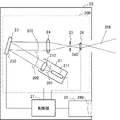
- FIG. 1 is a conceptual diagram showing an example of the configuration of a projection device according to a first embodiment
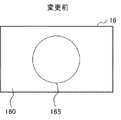
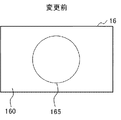
- FIG. FIG. 7 is a conceptual diagram for explaining a lens region formed in a liquid crystal region of a liquid crystal projection lens in Control Example 1 of the projection device according to the first embodiment
- FIG. 7 is a conceptual diagram for explaining a lens region formed in a liquid crystal region of a liquid crystal projection lens in Control Example 1 of the projection device according to the first embodiment
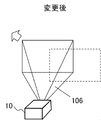
- FIG. 5 is a conceptual diagram for explaining control of the projection direction of projection light in Control Example 1 of the projection device according to the first embodiment
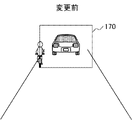
- FIG. 5 is a conceptual diagram for explaining control of the projection direction of projection light in Control Example 1 of the projection device according to the first embodiment; 4 is a conceptual diagram for explaining a projection range of projection light in Control Example 1 of the projection device according to the first embodiment;
- FIG. 4 is a conceptual diagram for explaining a projection range of projection light in Control Example 1 of the projection device according to the first embodiment;
- FIG. 10 is a conceptual diagram for explaining a lens region formed in a liquid crystal region of a liquid crystal projection lens in Control Example 2 of the projection device according to the first embodiment;
- FIG. 10 is a conceptual diagram for explaining a lens region formed in a liquid crystal region of a liquid crystal projection lens in Control Example 2 of the projection device according to the first embodiment;
- FIG. 11 is a conceptual diagram for explaining control of the projection direction of projection light in Control Example 2 of the projection device according to the first embodiment;
- FIG. 11 is a conceptual diagram for explaining control of the projection direction of projection light in Control Example 2 of the projection device according to the first embodiment;
- FIG. 10 is a conceptual diagram for explaining a projection range of projection light in Control Example 2 of the projection device according to the first embodiment;
- FIG. 10 is a conceptual diagram for explaining a projection range of projection light in Control Example 2 of the projection device according to the first embodiment;
- FIG. 11 is a conceptual diagram for explaining control of a projection angle of projection light in Control Example 3 of the projection device according to the first embodiment;
- FIG. 11 is a conceptual diagram for explaining control of a projection angle of projection light in Control Example 3 of the projection device according to the first embodiment;
- FIG. 11 is a conceptual diagram for explaining control of a projection angle of projection light in Control Example 3 of the projection device according to the first embodiment;
- FIG. 11 is a conceptual diagram for explaining a projection range of projection light in Control Example 3 of the projection device according to the first embodiment;
- FIG. 11 is a conceptual diagram for explaining a projection range of projection light in Control Example 3 of the projection device according to the first embodiment;
- FIG. 11 is a conceptual diagram for explaining a lens region formed in a liquid crystal region of a liquid crystal projection lens in Control Example 4 of the projection device according to the first embodiment;
- FIG. 11 is a conceptual diagram for explaining a lens region formed in a liquid crystal region of a liquid crystal projection lens in Control Example 4 of the projection device according to the first embodiment;
- FIG. 11 is a conceptual diagram for explaining an example of an optical path in Control Example 4 of the projection device according to the first embodiment;
- FIG. 11 is a conceptual diagram for explaining a projection range of projection light in Control Example 3 of the projection device according to the first embodiment;
- FIG. 11 is a conceptual diagram for explaining a projection range of projection light in Control Example 3 of the projection device according to the first embodiment;
- FIG. 11 is a conceptual diagram for explaining another example of the optical path in Control Example 4 of the projection device according to the first embodiment;
- FIG. 11 is a conceptual diagram for explaining control of the projection direction and the projection angle of projection light in Control Example 4 of the projection device according to the first embodiment;
- FIG. 11 is a conceptual diagram for explaining control of the projection direction and the projection angle of projection light in Control Example 4 of the projection device according to the first embodiment;
- FIG. 11 is a conceptual diagram for explaining a projection range of projection light in Control Example 4 of the projection device according to the first embodiment;
- FIG. 11 is a conceptual diagram for explaining a projection range of projection light in Control Example 4 of the projection device according to the first embodiment;
- FIG. 11 is a conceptual diagram for explaining a projection range of projection light in Control Example 4 of the projection device according to the first embodiment;
- FIG. 11 is a conceptual diagram for explaining another example of the optical path in Control Example 4 of the projection device according to the first embodiment;
- FIG. 11 is a conceptual diagram for explaining control of the projection direction
- FIG. 5 is a conceptual diagram showing an example of a configuration of a projection device according to modification 1 of the first embodiment
- FIG. 7 is a conceptual diagram for explaining an example of an optical path in a projection device according to Modification 1 of the first embodiment
- It is a conceptual diagram showing an example of a configuration of a projection device according to a second embodiment.
- FIG. 10 is a conceptual diagram showing an example of the configuration of an imaging unit of a projection device according to a second embodiment
- FIG. 10 is a conceptual diagram for explaining application example 1 of the projection apparatus according to the second embodiment
- FIG. 11 is a conceptual diagram showing an example of the configuration of a projection device according to a third embodiment;
- FIG. 11 is a conceptual diagram for explaining an example of an optical path of parallel light emitted from a light source of a projection device according to a third embodiment;
- FIG. 11 is a conceptual diagram for explaining an example of an optical path of modulated light modulated by a modulation section of a spatial light modulator of a projection device according to a third embodiment;
- FIG. 11 is a conceptual diagram for explaining application example 2 of the projection apparatus according to the third embodiment;
- FIG. 11 is a conceptual diagram for explaining application example 2 of the projection apparatus according to the third embodiment;
- FIG. 11 is a conceptual diagram for explaining application example 3 of the projection apparatus according to the third embodiment;
- It is a conceptual diagram which shows an example of a structure of the projection apparatus which concerns on 4th Embodiment.
- It is a conceptual diagram which shows an example of a hardware configuration which implement
- the directions of arrows in the drawings show examples, and do not limit the directions of light and signals.
- the lines indicating the trajectory of light in the drawing are conceptual and do not accurately represent the actual traveling direction or state of light.
- changes in the traveling direction and state of light due to refraction, reflection, and diffusion at the interface between air and matter may be omitted, or a luminous flux may be represented by a single line.
- the projection apparatus of the present embodiment is used for optical space communication and distance measurement in which optical signals propagating in space (hereinafter also referred to as spatial optical signals) are transmitted and received without using a medium such as an optical fiber.
- the projection device of the present embodiment may be used for applications other than optical space communication and distance measurement as long as it is used for projecting spatial light.
- FIG. 1 is a conceptual diagram showing an example of the configuration of the projection device 10 of this embodiment.
- the projection device 10 has a light source 11 , a spatial light modulator 13 , a Fourier transform lens 14 , an aperture 15 , a liquid crystal projection lens 16 and a controller 17 .
- Light source 11 , spatial light modulator 13 , Fourier transform lens 14 , aperture 15 , and liquid crystal projection lens 16 constitute projection section 100 .
- Fourier transform lens 14, aperture 15, and liquid crystal projection lens 16 constitute a projection optical system.
- FIG. 1 is a lateral view of the internal configuration of the projection device 10. As shown in FIG. FIG. 1 is conceptual, and does not accurately represent the positional relationship between components, the traveling direction of light, and the like.
- the light source 11 includes an emitter 111 and a collimator 112.
- the emitter 111 emits laser light 101 in a predetermined wavelength band under the control of the controller 17 .
- the wavelength of laser light 101 emitted from light source 11 is not particularly limited.
- the emitter 111 emits laser light 101 in the visible or infrared wavelength band.
- near-infrared rays of 800 to 900 nanometers (nm) can raise the laser class, so the sensitivity can be improved by about an order of magnitude compared to other wavelength bands.
- GaN gallium arsenide
- infrared laser light 101 in a wavelength band of 1.55 micrometers ( ⁇ m) can be emitted.
- a high output laser light source of about 100 milliwatts (mW) can be used.
- mW milliwatts
- the collimator 112 converts the laser light 101 emitted from the emitter 111 into parallel light 102 .
- Laser light 101 emitted from emitter 111 is converted into parallel light 102 by collimator 112 and emitted from light source 11 .
- the parallel light 102 emitted from the light source 11 travels toward the modulation section 130 of the spatial light modulator 13 .
- the incident angle of the parallel light 102 is set non-perpendicular to the modulating section 130 of the spatial light modulator 13 .
- the emission axis of the parallel light 102 emitted from the light source 11 is oblique to the modulation section 130 of the spatial light modulator 13 . If the output axis of the parallel light 102 is oblique to the modulation section 130 of the spatial light modulator 13, the parallel light 102 can be incident without using a beam splitter. Therefore, it is possible to improve the light utilization efficiency. Further, by setting the emission axis of the parallel light 102 obliquely with respect to the modulation section 130 of the spatial light modulator 13, the size of the projection section 100 can be made compact.
- the spatial light modulator 13 has a modulating section 130 irradiated with the parallel light 102 .
- a pattern also referred to as a phase image
- the modulated light 103 modulated by the modulation section 130 of the spatial light modulator 13 travels toward the incident surface of the Fourier transform lens 14 .
- the spatial light modulator 13 is realized by a spatial light modulator using ferroelectric liquid crystal, homogeneous liquid crystal, vertically aligned liquid crystal, or the like.
- the spatial light modulator 13 can be realized by LCOS (Liquid Crystal on Silicon).
- the spatial light modulator 13 may be realized by a MEMS (Micro Electro Mechanical System).
- the phase modulation type spatial light modulator 13 the energy can be concentrated on the image portion by sequentially switching the location where the projection light 106 is projected. Therefore, when the phase modulation type spatial light modulator 13 is used, if the output of the light source 11 is the same, the image can be displayed brighter than other methods.
- the modulation section 130 of the spatial light modulator 13 is divided into a plurality of regions (also called tiling).
- the modulator 130 is divided into rectangular regions (also called tiles) of the desired aspect ratio.
- a phase image generated by iterative Fourier transform is assigned to each of the plurality of tiles set in the modulation unit 130 .
- Each of the multiple tiles is composed of multiple pixels.
- a phase image corresponding to the image to be projected is set in each of the plurality of tiles.
- the phase images set for each of the plurality of tiles may be the same or different.
- each of the tiles is composed of 256 ⁇ 256 pixels or 512 ⁇ 512 pixels.
- the number of pixels forming a tile is set to the n-th power of 2 resolution (n is a natural number) in order to improve the calculation speed of the phase image.
- a phase image generated by iterative Fourier transform is tiled on each of the plurality of tiles assigned to the modulation unit 130 .
- each of the plurality of tiles is set with a pre-generated phase image.
- modulated light 103 forming an image corresponding to the phase image of each tile is emitted.
- the size and number of tiles set in the modulation section 130 are set according to the application. For example, if the number of tiles is less than 6, the projected image may be disturbed, so the number of tiles is preferably set to 6 or more.
- the Fourier transform lens 14 Fourier-transforms the modulated light 103 modulated by the spatial light modulator 13, and forms an image formed when the modulated light 103 is projected at infinity at a focal position near the aperture 15. It is an optical lens that allows A virtual lens may be used instead of the Fourier transform lens 14 . If a virtual lens is used, the Fourier transform lens 14 can be omitted. For example, a phase image corresponding to an image formed by the projection light 106 projected from the projection device 10 and a virtual lens image that converges the modulated light 103 at a focal position near the aperture 15 are combined into an image by the modulation unit. It should be set to 130. The light condensed by the Fourier transform lens 14 passes through the opening of the aperture 15 and enters the liquid crystal projection lens 16 .
- the aperture 15 is a frame that blocks high-order light contained in the light converged by the Fourier transform lens 14 and limits the outer edge of the display area.
- the opening of the aperture 15 is set to be smaller than the periphery of the display area at the position of the aperture 15 so as to block the peripheral area of the image at the position of the aperture 15 .
- the opening of the aperture 15 is formed in a rectangular shape or a circular shape.
- Aperture 15 is preferably installed at the focal position of Fourier transform lens 14 . It should be noted that the aperture 15 may be displaced from the focal position of the Fourier transform lens 14 as long as high-order light can be blocked and the display area can be limited.
- a zero-order light shielding member (not shown) that shields zero-order light may be provided at the position of the aperture 15 .
- the zero-order light shielding member is a member having a portion that absorbs/reflects light.
- the zero-order light shielding member is arranged on the optical path of the zero-order light.
- a transparent member such as glass having a portion painted black so that light cannot pass through can be used as the zero-order light removing member.
- a portion for shielding the zero-order light contained in the modulated light 103 may be provided inside the opening of the aperture 15 .
- the liquid crystal projection lens 16 is a lens that magnifies the light converged by the Fourier transform lens 14 so as to correspond to the displayed image.
- Liquid crystal projection lens 16 includes at least one liquid crystal lens.
- a liquid crystal lens is a lens that can dynamically change the projection direction and projection angle.
- the liquid crystal projection lens 16 may be composed of a single lens or a combination of multiple lenses.
- the liquid crystal projection lens 16 has a configuration in which one liquid crystal lens and at least one optical lens are combined.
- the type and number of lenses that constitute the liquid crystal projection lens 16 are not particularly limited. An example in which the liquid crystal projection lens 16 is composed of one liquid crystal lens will be described below, but the liquid crystal projection lens 16 is not limited to be composed of one liquid crystal lens.
- the liquid crystal projection lens 16 is a lens that includes a liquid crystal region 160 that can form a lens region at any location.
- the liquid crystal region 160 of the liquid crystal projection lens 16 includes a structure in which a liquid crystal lens body in which liquid crystal is sealed between two layers of alignment films is sandwiched between two layers of transparent conductive films.
- the refractive index of the liquid crystal region 160 changes according to the voltage applied between the two layers of transparent conductive films.
- the focal length range of the liquid crystal projection lens 16 is set according to the refractive index of the material forming the liquid crystal projection lens 16 .
- a lens area is formed at an arbitrary location in the liquid crystal area 160 of the liquid crystal projection lens 16 according to the control of the control unit 17 .
- a lens area can be formed at any position in the liquid crystal area 160 of the liquid crystal projection lens 16 by adjusting the portion to which the voltage is applied.
- the projection direction, projection distance, and projection angle of the lens area formed in the liquid crystal projection lens 16 can be set according to the applied voltage.
- a plurality of lens regions can be formed in the liquid crystal region 160 of the liquid crystal projection lens 16 .
- a plurality of lens areas formed in the liquid crystal area 160 of the liquid crystal projection lens 16 can individually set the projection direction, the projection distance, and the projection angle by adjusting the applied voltage.
- a lens area corresponding to a free-form surface lens can be formed in the liquid crystal area 160 . Forming a lens region corresponding to a free-form surface lens allows more flexible control of the projection direction and projection angle.
- the liquid crystal region 160 of the liquid crystal projection lens 16 diffracts the modulated light 103 incident on the lens region from the incident surface according to the control of the control unit 17, and projects the projection light 106 in the set projection direction and projection angle. . That is, the light signal incident on the liquid crystal projection lens 16 is projected toward an arbitrary projection target with its projection direction and projection angle controlled according to control by the control unit 17 .
- the projection light 106 projected by the liquid crystal projection lens 16 forms an image corresponding to the phase image set in the modulation section 130 of the spatial light modulator 13 on the projected surface.
- the control unit 17 controls the light source 11, the spatial light modulator 13, and the liquid crystal projection lens 16.
- the control unit 17 is implemented by a microcomputer including a processor and memory.
- the control unit 17 sets the phase image corresponding to the image to be projected in the modulation unit 130 according to the tiling aspect ratio set in the modulation unit 130 of the spatial light modulator 13 .
- the control unit 17 sets, in the modulation unit 130, a phase image corresponding to an image suitable for use such as image display, communication, and distance measurement.
- the phase image of the image to be projected may be stored in advance in a storage unit (not shown).
- the shape and size of the projected image are not particularly limited.
- the controller 17 adjusts the spatial light so that the parameter that determines the difference between the phase of the parallel light 102 irradiated to the modulator 130 of the spatial light modulator 13 and the phase of the modulated light 103 reflected by the modulator 130 is changed. Drives the modulator 13 .
- a parameter that determines the difference between the phase of the parallel light 102 irradiated to the modulating section 130 of the spatial light modulator 13 and the phase of the modulated light 103 reflected by the modulating section 130 is an optical parameter such as a refractive index or an optical path length. It is a parameter related to physical characteristics.
- the control section 17 adjusts the refractive index of the modulation section 130 by changing the voltage applied to the modulation section 130 of the spatial light modulator 13 .
- the parallel light 102 irradiated to the modulating section 130 is appropriately diffracted based on the refractive index of each section of the modulating section 130 . That is, the phase distribution of the parallel light 102 applied to the modulating section 130 of the phase modulation type spatial light modulator 13 is modulated according to the optical characteristics of the modulating section 130 .
- the method of driving the spatial light modulator 13 by the controller 17 is determined according to the modulation method of the spatial light modulator 13 .
- the control unit 17 forms a lens area for projecting the projection light 106 in the liquid crystal area 160 of the liquid crystal projection lens 16 .
- the control unit 17 controls the projection direction of the projection light 106 by adjusting the position of the lens area in the liquid crystal area 160 of the liquid crystal projection lens 16 .
- the control unit 17 forms a lens area at a desired position in the liquid crystal area 160 of the liquid crystal projection lens 16 by controlling the voltage applied to the liquid crystal area 160 of the liquid crystal projection lens 16 .
- the control unit 17 controls the projection distance and projection angle of the projection light 106 by increasing or decreasing the refractive index of the lens area in the liquid crystal area 160 of the liquid crystal projection lens 16 .
- the control unit 17 adjusts the refractive index of the lens area by adjusting the voltage applied to the liquid crystal area 160 of the liquid crystal projection lens 16 .
- the spatial light signal incident on the liquid crystal projection lens 16 is appropriately diffracted according to the refractive index of the lens area. That is, the spatial light signal incident on the liquid crystal projection lens 16 is diffracted according to the optical characteristics of the lens area.
- the method of driving the liquid crystal projection lens 16 by the control unit 17 is not limited to the above.
- the control unit 17 drives the emitter 111 of the light source 11 while the phase image corresponding to the displayed image is set in the modulation unit 130 .
- the modulator 130 of the spatial light modulator 13 is irradiated with the parallel light 102 emitted from the light source 11 in accordance with the timing at which the phase image is set in the modulator 130 of the spatial light modulator 13 .
- the parallel light 102 applied to the modulating section 130 of the spatial light modulator 13 is modulated by the modulating section 130 of the spatial light modulator 13 .
- Modulated light 103 modulated by the modulation section 130 of the spatial light modulator 13 is projected from the liquid crystal projection lens 16 as projection light 106 corresponding to the phase image set in the modulation section 130 of the spatial light modulator 13 .
- FIGS. 2A to 4B are conceptual diagrams for explaining an example of projection direction control of the liquid crystal projection lens 16 by the controller 17.
- FIG. FIGS. 2A and 2B are examples of changing the lens area 165 one-dimensionally from the position before change in FIG. 2A to the position after change in FIG. 2B in the liquid crystal area 160 of the liquid crystal projection lens 16 .
- the examples of FIGS. 2A and 2B are views of the liquid crystal projection lens 16 viewed from the perspective of the spatial light modulator 13 toward the projection direction.
- the lens region 165 is moved leftward from the central portion (the portion surrounded by the broken line circle).
- the control unit 17 changes the lens area 165 by adjusting the formation range of the lens area 165 in the liquid crystal area 160 of the liquid crystal projection lens 16 .
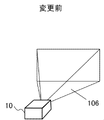
- FIGS. 3A and 3B are conceptual diagrams for explaining changes in the projection direction of projection light 106 by moving lens region 165 in liquid crystal region 160 of liquid crystal projection lens 16 as shown in FIGS. 2A and 2B.
- the examples of FIGS. 3A and 3B are views of projection device 10 from a top perspective. 3A and 3B, in the liquid crystal region 160 of the liquid crystal projection lens 16, by changing the lens region 165 one-dimensionally from the position before the change in FIG. 3A to the position after the change in FIG. 3B, Projection direction is changed to the left.
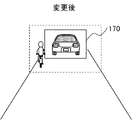
- FIGS. 4A and 4B are conceptual diagrams for explaining changes in the projection range 170 of the projection light 106 by moving the lens region 165 in the liquid crystal region 160 of the liquid crystal projection lens 16 as shown in FIGS. 2A and 2B. be.
- FIGS. 4A and 4B show an example in which projection light is projected forward from an automobile equipped with the projection device 10.
- the interior of the projection range 170 before modification in FIG. 4A includes the entire automobile traveling ahead and part of the bicycle traveling ahead.
- the interior of the modified projection range 170 of FIG. 4B includes the entire automobile and bicycle traveling ahead. For example, if all objects located in front of the automobile are included in the projection range 170, as in the changed projection range 170 in FIG. 4B, it is easier to respond when some event occurs.
- FIGS. 5A to 7D are conceptual diagrams for explaining an example of projection direction control of the liquid crystal projection lens 16 by the controller 17.
- FIG. FIGS. 5A and 5B are examples of two-dimensionally changing the lens area 165 in the liquid crystal area 160 of the liquid crystal projection lens 16 from the position before the change in FIG. 5A to the position after the change in FIG. 5B.
- the examples of FIGS. 5A and 5B are views of the liquid crystal projection lens 16 viewed from the perspective of the spatial light modulator 13 toward the projection direction.
- the lens region 165 is moved from the central portion (the portion surrounded by the dashed circle) toward the upper left.
- the control unit 17 two-dimensionally changes the lens area 165 by adjusting the formation range of the lens area 165 in the liquid crystal area 160 of the liquid crystal projection lens 16 .
- FIGS. 6A and 6B are conceptual diagrams for explaining changes in the projection direction of projection light 106 by moving lens region 165 in liquid crystal region 160 of liquid crystal projection lens 16 as shown in FIGS. 5A and 5B.
- the examples of FIGS. 6A and 6B are views of projection device 10 from a top perspective. 6A and 6B, in the liquid crystal region 160 of the liquid crystal projection lens 16, by two-dimensionally changing the lens region 165 from the position before the change in FIG. 6A to the position after the change in FIG. 6B, Projection direction is changed to upper left.
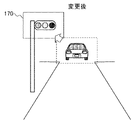
- FIGS. 7A and 7B are conceptual diagrams for explaining changes in the projection range 170 of the projection light 106 by moving the lens region 165 in the liquid crystal region 160 of the liquid crystal projection lens 16 as shown in FIGS. 5A and 5B. be.
- FIGS. 7 and 7B show an example in which projection light is projected forward from an automobile equipped with the projection device 10.
- the interior of the projection range 170 before modification in FIG. 7A includes the entire vehicle traveling ahead.
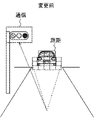
- the interior of the modified projection range 170 of FIG. 7B includes the entire light-emitting surface of the traffic signal located in front. For example, when controlling the running of a car on a normal road, it is necessary to make the car run according to the color of light emitted from traffic lights. Therefore, if the entire light-emitting surface of the traffic signal is included in the projection range 170, it is easier to safely control the traveling of the automobile.
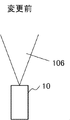
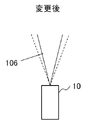
- FIG. 8A and 8B are examples of changing the projection angle in the liquid crystal region 160 of the liquid crystal projection lens 16 from the angle before the change in FIG. 8A to the angle after the change in FIG. 8B.
- the control unit 17 changes the projection angle by adjusting the refractive index of the lens area 165 in the liquid crystal area 160 of the liquid crystal projection lens 16 .
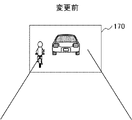
- FIGS. 9A and 9B are for explaining an example in which the projection angle of the projection light 106 is reduced by increasing the refractive index of the lens region 165 in the liquid crystal region 160 of the liquid crystal projection lens 16 as in FIGS. 8A and 8B.
- FIGS. 8A and 8B It is a conceptual diagram of. 9A and 9B show an example in which projection light is projected forward from an automobile equipped with the projection device 10.
- the interior of the projection range 170 before modification in FIG. 9A includes the entire automobile and bicycle traveling ahead.
- the interior of the modified projection range 170 in FIG. 9B includes the entire automobile traveling in front and does not include the bicycle traveling in front.
- the intensity of the spatial optical signal can be increased by narrowing the projection range 170 to only the automobile without including the bicycle in the projection range 170.
- FIG. 10A and 10B are conceptual diagrams for explaining an example of projection angle control of the liquid crystal projection lens 16 by the controller 17.
- FIG. 10A and 10B are examples of forming two lens regions 165 (165A and 165B) after the change in FIG. 10B in place of the lens region 165 before the change in FIG. 10A in the liquid crystal region 160 of the liquid crystal projection lens 16. is.
- FIG. 11 is an example in which two identical lens regions 165 (165A, 165B) are formed in the liquid crystal projection lens 16.
- FIG. 11 it is assumed that parallel light 102 from the light source 11 is applied to the modulating section 130 of the spatial light modulator 13 .
- lens regions 165 A and 165 B having different projection directions and the same refractive index are formed in the liquid crystal region 160 of the liquid crystal projection lens 16 .
- the control unit 17 sets the phase distribution that causes the modulation unit 130 of the spatial light modulator 13 to form a single image.
- control unit 17 irradiates the modulation unit 130 with the parallel light 102 from the light source 11 while setting the phase distribution for forming a single projection image in the modulation unit 130 .
- projection light 106A and projection light 106B forming an image corresponding to the phase distribution set in modulation section 130 are projected in different projection directions.
- FIG. 12 is an example in which two different lens regions 165 (165A, 165B) are formed in the liquid crystal projection lens 16.
- FIG. 12 it is assumed that parallel light 102 from the light source 11 is applied to the modulating section 130 of the spatial light modulator 13 .
- a lens region 165A and a lens region 165B having different projection directions and refractive indices are formed in the liquid crystal region 160 of the liquid crystal projection lens 16.
- a modulation area 135A corresponding to the lens area 165A and a modulation area 135B corresponding to the lens area 165B are assigned to the modulation section 130 of the spatial light modulator 13.
- the phase distribution of the image projected using the lens area 165A is set in the modulation area 135A.
- the phase distribution of the image projected using the lens area 165B is set in the modulation area 135B.
- the control unit 17 sets the phase distribution for forming the image projected using each of the lens regions 165A and 165B in each of the modulation regions 135A and 135B of the modulation unit 130. .
- the control unit 17 irradiates the modulation unit 130 with the parallel light 102 from the light source 11 in a state where the phase distribution is set for each of the modulation regions 135A and 135B.
- projection light 106A forming an image corresponding to the phase distribution set in modulation region 135A and projection light 106B forming an image corresponding to the phase distribution set in modulation region 135B are projected.
- the projection light 106A and the projection light 106B are projected at different projection angles toward different projection directions.
- the light source 11 may have two emitters 111 and may be configured to irradiate the modulation regions 135A and 135B with parallel light 102 based on laser light 101 emitted from different emitters 111.
- FIG. When configured in this manner, projection light 106A and projection light 106B forming different images can be projected in different projection directions. If the light source 11 has two emitters 111 , it is also possible to have different intensities of parallel light 102 emitted from the light source 11 .
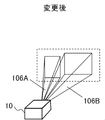
- FIGS. 13A and 13B illustrate changes in the projection direction and projection angle of projection light 106 by forming lens regions 165A and 165B with different projection directions and refractive indices in the liquid crystal region 160 of the liquid crystal projection lens 16.
- FIG. 13B It is a conceptual diagram for doing.
- the examples of FIGS. 13A and 13B are diagrams of the projection device 10 viewed from the oblique rear right perspective. In the example of FIG. 13B, by forming a lens region 165A and a lens region 165B in the liquid crystal region 160 of the liquid crystal projection lens 16, projection light 106A and projection light 106B with different projection directions and projection angles are projected.
- FIGS. 14A and 14B are conceptual diagrams for explaining changes in the projection range 170 by forming the lens areas 165A and 165B in the liquid crystal area 160 of the liquid crystal projection lens 16.
- FIG. FIGS. 14A and 14B are examples in which projection light is projected forward from an automobile equipped with the projection device 10.
- FIG. The interior of the projection range 170 before modification in FIG. 14A includes the car and bicycle traveling ahead.
- the interior of the modified projection range 170A in FIG. 14B includes the vehicle traveling ahead.
- the bicycle traveling ahead is included in the changed projection range 170B in FIG. 14B.
- the projection light 106 can be individually projected onto the moving object running in front, it is easier to reliably control the running of the automobile.
- FIG. 15 is a conceptual diagram showing an example of the configuration of a projection device 10-1 according to Modification 1 of the present embodiment.
- the projection device 10-1 has a light source 11, a spatial light modulator 13, a Fourier transform lens 14, an aperture 15, a first liquid crystal projection lens 16-1, a second liquid crystal projection lens 16-2, and a controller 17.
- Light source 11 , spatial light modulator 13 , Fourier transform lens 14 , aperture 15 , first liquid crystal projection lens 16 - 1 and second liquid crystal projection lens 16 - 2 constitute projection section 100 .
- Fourier transform lens 14, aperture 15, first liquid crystal projection lens 16-1, and second liquid crystal projection lens 16-2 constitute a projection optical system.
- FIG. 15 is a lateral view of the internal configuration of the projection device 10. As shown in FIG. FIG. 15 is conceptual and does not accurately represent the positional relationship between each component, the traveling direction of light, and the like.
- the projection device 10-1 of this modified example differs from the projection device 10 of FIG. 1 in that it includes a first liquid crystal projection lens 16-1 and a second liquid crystal projection lens 16-2.
- the projection device 10-1 of this modified example has the same configuration as the projection device 10 of FIG. 1 except for the first liquid crystal projection lens 16-1 and the second liquid crystal projection lens 16-2.
- FIG. 15 shows an example in which two liquid crystal projection lenses 16 are combined, three or more liquid crystal projection lenses 16 may be combined.
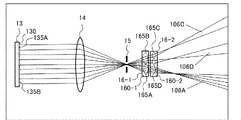
- FIG. 16 is a conceptual diagram showing an example of projecting the projection light 106 using the first liquid crystal projection lens 16-1 and the second liquid crystal projection lens 16-2.
- a lens region 165A and a lens region 165B having different projection directions and refractive indices are formed in the liquid crystal region 160-1 of the second liquid crystal projection lens 16-2.
- a lens region 165C and a lens region 165D having different projection directions and refractive indices are formed in the liquid crystal region 160-2 of the second liquid crystal projection lens 16-2.
- the number of lens regions 165 formed in the first liquid crystal projection lens 16-1 and the second liquid crystal projection lens 16-2 is not particularly limited.
- one of the first liquid crystal projection lens 16-1 and the second liquid crystal projection lens 16-2 may be formed with the lens area 165, and the other may not be formed with the lens area 165.
- the control unit 17 assigns the modulation area 135A corresponding to the lens area 165A and the modulation area 135B corresponding to the lens area 165B to the modulation unit 130 of the spatial light modulator 13 .
- the phase distribution of the image projected using the lens area 165A is set in the modulation area 135A.
- the phase distribution of the image projected using the lens area 165B is set in the modulation area 135B.
- the control unit 17 irradiates the modulation unit 130 with the parallel light 102 from the light source 11 in a state where the phase distribution is set in each of the modulation regions 135A and 135B of the modulation unit 130 .
- the light diffracted by the lens area 165A of the first liquid crystal projection lens 16-1 is transmitted through the liquid crystal area 160-2 of the second liquid crystal projection lens 16-2 and projected as projection light 106A.
- the light diffracted by the lens area 165B of the first liquid crystal projection lens 16-1 is diffracted by each of the lens areas 165C and 165D of the second liquid crystal projection lens 16-2, and projected as projection light 106C and projection light 106D. be done.
- projection light 106A forming an image corresponding to the phase distribution set in modulation region 135A
- projection light 106C and projection light 106D forming an image corresponding to the phase distribution set in modulation region 135B, It is projected at different projection angles toward different projection directions.
- an image displayed by the projected light 106A (also referred to as a first image) and an image displayed by the projected lights 106C and 106D (also referred to as a second image) are displayed.
- the projection light for forming a plurality of images can be projected in different projection directions at different projection angles.
- the projection device of this embodiment includes a light source, a spatial light modulator, a Fourier transform lens, an aperture, and a liquid crystal projection lens.
- the light source emits parallel light.
- the spatial light modulator has a modulation section that modulates the phase of parallel light emitted from the light source.
- the Fourier transform lens Fourier transforms the modulated light modulated by the modulating section and forms an image.
- the aperture is arranged near the focal position of the Fourier transform lens.
- the aperture is a frame that blocks high-order light contained in the light converged by the Fourier transform lens and limits the outer edge of the display area.
- a liquid crystal projection lens also called a liquid crystal lens
- the liquid crystal lens projects, as projection light, modulated light incident on a lens area dynamically formed in the liquid crystal area.
- the controller forms a lens area at a desired position in the liquid crystal area of the liquid crystal lens.
- the control unit sets a phase image corresponding to the projection light projected toward the projection target in the modulation unit of the spatial light modulator.
- the control unit controls the light source so that parallel light is emitted toward the modulation unit on which the phase image is set.
- a high-definition image can be projected in an arbitrary projection direction by using a liquid crystal lens including a liquid crystal region in which a lens region is formed at an arbitrary position as a projection lens.
- control unit controls the projection direction of the projection light by two-dimensionally moving the position where the lens area is formed in the liquid crystal area of the liquid crystal projection lens.
- the projection direction of the projection light can be controlled by changing the position of the lens area in the liquid crystal area of the liquid crystal projection lens.
- control unit controls the projection angle of the projection light by adjusting the refractive index of the lens area formed in the liquid crystal area of the liquid crystal projection lens.
- the projection angle of projection light can be controlled by changing the refractive index of the lens area in the liquid crystal area of the liquid crystal projection lens.
- the controller causes the liquid crystal region of the liquid crystal projection lens to form a plurality of lens regions.
- the projection light can be projected in a plurality of projection directions by forming a plurality of lens regions in the liquid crystal region of the liquid crystal projection lens.
- the control unit causes the liquid crystal area of the liquid crystal lens to form a plurality of lens areas in which at least one of the projection direction and the projection angle of the projection light is different.
- the control unit individually associates a plurality of phase images corresponding to projection light projected toward different projection targets with a plurality of modulation regions set in the modulation unit of the spatial light modulator and with a plurality of lens regions. set to The control unit controls the light source so that parallel light is emitted toward the modulation unit in which different phase images are set in the plurality of modulation regions.
- different projection light is projected toward the plurality of projection targets. Can project.
- the projection device of this embodiment includes an imaging unit that captures an image of the projection direction of projection light.
- the projection device of the present embodiment projects projection light based on the image in the projection direction captured by the imaging section.
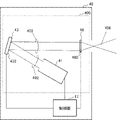
- FIG. 17 is a conceptual diagram showing an example of the configuration of the projection device 20 of this embodiment.
- the projection device 20 has a light source 21 , a spatial light modulator 23 , a Fourier transform lens 24 , an aperture 25 , a liquid crystal projection lens 26 , a control section 27 and an imaging section 28 .
- Light source 21 , spatial light modulator 23 , Fourier transform lens 24 , aperture 25 , and liquid crystal projection lens 26 constitute projection section 200 .
- Fourier transform lens 24, aperture 25, and liquid crystal projection lens 26 constitute a projection optical system.
- FIG. 17 is a lateral view of the internal configuration of the projection device 20. As shown in FIG. FIG. 17 is conceptual and does not accurately represent the positional relationship between components, the traveling direction of light, and the like.
- the light source 21 includes an emitter 211 and a collimator 212.
- the emitter 211 emits laser light 201 in a predetermined wavelength band under the control of the controller 27 .
- the collimator 212 converts the laser light 201 emitted from the emitter 211 into parallel light 202 .
- the emitter 211 has the same configuration as the emitter 111 of the first embodiment.
- the collimator 212 has the same configuration as the collimator 112 of the first embodiment.
- Laser light 201 emitted from emitter 211 is converted into parallel light 202 by collimator 212 and emitted from light source 21 .
- the parallel light 202 emitted from the light source 21 travels toward the modulation section 230 of the spatial light modulator 23 .
- the spatial light modulator 23 has a modulating section 230 irradiated with the parallel light 202 .
- a pattern also referred to as a phase image
- the spatial light modulator 23 has the same configuration as the spatial light modulator 13 of the first embodiment.
- the modulated light 203 modulated by the modulation section 230 of the spatial light modulator 23 travels toward the incident surface of the Fourier transform lens 24 .
- the Fourier transform lens 24 is an optical lens that forms an image at a focal position near the aperture 25 when the modulated light 203 modulated by the spatial light modulator 23 is projected at infinity.
- the Fourier transform lens 24 has the same configuration as the Fourier transform lens 14 of the first embodiment.
- a virtual lens may be used instead of the Fourier transform lens 24 . If a virtual lens is used, the Fourier transform lens 24 can be omitted. Light collected by Fourier transform lens 24 travels toward aperture 25 .
- the aperture 25 is a frame that blocks high-order light contained in the light converged by the Fourier transform lens 24 and limits the outer edge of the display area.
- the aperture 25 has the same configuration as the aperture 15 of the first embodiment. Light passing through the opening of aperture 25 is incident on liquid crystal projection lens 26 .
- the liquid crystal projection lens 26 (also called a liquid crystal lens) is an optical lens that magnifies the light converged by the Fourier transform lens 24 in correspondence with the displayed image.
- the liquid crystal projection lens 26 has the same configuration as the liquid crystal projection lens 16 of the first embodiment.
- the liquid crystal projection lens 26 may be composed of a single lens, or may be composed of a combination of a plurality of lenses.
- the control unit 27 controls the light source 21, the spatial light modulator 23, the liquid crystal projection lens 26, and the imaging unit 28.
- the control unit 27 is implemented by a microcomputer including a processor and memory.
- the control unit 27 has the same configuration as the control unit 17 of the first embodiment except for controlling the imaging unit 28 .
- the control unit 27 causes the imaging unit 28 to image the projection direction of the projection light 206 .
- the control unit 27 sets the projection direction and projection angle of the projection light 206 based on the image data captured by the imaging unit 28 .
- the control section 27 sets the phase image corresponding to the image to be projected in the modulation section 230 .
- the control unit 27 adjusts the spatial light so that the parameter that determines the difference between the phase of the parallel light 202 applied to the modulating unit 230 of the spatial light modulator 23 and the phase of the modulated light 203 reflected by the modulating unit 230 is changed. Drives the modulator 23 .
- the control unit 27 forms a lens area for projecting the projection light 206 in the liquid crystal area 260 of the liquid crystal projection lens 26 .
- the control unit 27 drives the emitter 211 of the light source 21 with the phase image corresponding to the displayed image set in the modulation unit 230 .
- the modulator 230 of the spatial light modulator 23 is irradiated with the parallel light 202 emitted from the light source 21 in accordance with the timing at which the phase image is set in the modulator 230 of the spatial light modulator 23 .
- the parallel light 202 applied to the modulating section 230 of the spatial light modulator 23 is modulated by the modulating section 230 of the spatial light modulator 23 .
- Modulated light 203 modulated by the modulation section 230 of the spatial light modulator 23 is projected from the liquid crystal projection lens 26 as projection light 206 corresponding to the phase image set in the modulation section 230 of the spatial light modulator 23 .
- the imaging unit 28 images the projection direction of the projection light 206 under the control of the control unit 27 .
- the imaging unit 28 has the function of a digital camera.
- the imaging unit 28 includes a lens 280 for imaging the projection direction of the projection light 206 .
- the imaging unit 28 is arranged so that the lens 280 faces the imaging direction.
- the imaging unit 28 outputs image data captured under the control of the control unit 27 to the control unit 27 .
- the imaging unit 28 may output image data captured under the control of the control unit 27 to an external system (not shown).
- the image data captured by the imaging unit 28 can be used for any purpose.
- FIG. 18 is a conceptual diagram showing an example of the configuration of the imaging section 28. As shown in FIG.
- the imaging section 28 has a lens 280 , an imaging element 281 , an image processor 283 , an internal memory 285 and a data output circuit 287 .
- the lens 280 is an optical element for imaging the projection direction of the projection light 206 .
- Lens 280 can be constructed of materials such as glass or plastic.
- lens 280 is implemented in a material such as quartz.
- the material of the lens 280 is not particularly limited.
- the imaging element 281 is an element for imaging the projection direction of the projection light 206 and for imaging the projection range formed in the projection direction.
- the imaging element 281 is a photoelectric conversion element in which semiconductor components are integrated.
- the imaging device 281 can be realized by a solid-state imaging device such as a CCD (Charge-Coupled Device) or a CMOS (Complementary Metal-Oxide-Semiconductor).
- the imaging device 281 has pixels that can detect an object within the projection range of the projection light 206 .
- the imaging device 281 normally captures light in the visible region.
- the imaging element 281 may be configured by an element capable of imaging infrared rays, ultraviolet rays, or the like.
- the image processor 283 is an integrated circuit that performs image processing on image data captured by the image sensor 281 and converts it into image data. For example, the image processor 283 executes image processing such as dark current correction, interpolation calculation, color space conversion, gamma correction, aberration correction, noise reduction, and image compression. Note that the image processor 283 may be omitted if the image information is not processed.
- the internal memory 285 is a storage element that temporarily stores image information that cannot be processed by the image processor 283 and processed image information. Also, the internal memory 285 may be configured to temporarily store image information captured by the imaging device 281 .
- the internal memory 285 may be composed of a general memory.
- the data output circuit 287 outputs image data processed by the image processor 283 to the control unit 27 .
- the image data output to the control unit 27 is used for detection of objects in the projection range of the projection light 206, and the like.
- FIG. 19 is a conceptual diagram for explaining application example 1 of the present embodiment.
- the projection device 20 is arranged on the ceiling near the door of the elevator.
- the projection device 20 captures an imaging range in front of an elevator door.
- the projection device 20 detects a person's hand from the image of the imaging range.
- the projection device 20 projects the candidate image of the destination floor of the elevator toward the hand of the detected person.
- the projection device 20 outputs an image of the person's hand with the destination floor of the elevator displayed to the elevator control system (not shown).
- the elevator control system identifies the selected destination floor and controls the elevator based on the images transmitted from the projection device 20 .
- projection device 20 may be configured to change the color of projected light 106 by changing emitter 211 included in light source 21 .
- the color of the projection light 106 is changed according to the situation, such as displaying the image of the number string for selecting the floor with green projection light and displaying the image of the number of the selected floor with red projection light. do it.
- the projection device of this embodiment includes a light source, a spatial light modulator, a Fourier transform lens, an aperture, an imaging section, and a liquid crystal projection lens.
- the light source emits parallel light.
- the spatial light modulator has a modulation section that modulates the phase of parallel light emitted from the light source.
- the Fourier transform lens Fourier transforms the modulated light modulated by the modulating section and forms an image.
- the aperture is arranged near the focal position of the Fourier transform lens.
- the aperture is a frame that blocks high-order light contained in the light converged by the Fourier transform lens and limits the outer edge of the display area.
- a liquid crystal projection lens also called a liquid crystal lens
- the liquid crystal lens projects, as projection light, modulated light incident on a lens area dynamically formed in the liquid crystal area.
- the imaging unit captures an image of the projection direction of the projection light.
- the controller forms a lens area at a desired position in the liquid crystal area of the liquid crystal lens.
- the control unit sets a phase image corresponding to the projection light projected toward the projection target in the modulation unit of the spatial light modulator.
- the control unit controls the light source so that parallel light is emitted toward the modulation unit on which the phase image is set.
- the control unit controls at least one of the projection direction and the projection angle of the projection light according to the position of the projection target included in the image captured by the imaging unit.
- a high-definition image can be obtained according to the position of the projection target by controlling the projection direction or the projection angle of the projection light according to the position of the projection target included in the image captured by the imaging unit. Can project.
- the projection device of this embodiment includes a light-receiving element that receives light coming from the projection direction of the projection light.
- the projection device of this embodiment may include the imaging unit of the second embodiment.
- FIG. 20 is a conceptual diagram showing an example of the configuration of the projection device 30 of this embodiment.
- the projection device 30 has a light source 31 , a spatial light modulator 33 , a Fourier transform lens 34 , an aperture 35 , a liquid crystal projection lens 36 , a controller 37 and a light receiving element 39 .
- Light source 31 , spatial light modulator 33 , Fourier transform lens 34 , aperture 35 , and liquid crystal projection lens 36 constitute projection section 300 .
- Fourier transform lens 34, aperture 35, and liquid crystal projection lens 36 constitute a projection optical system.
- Projection device 30 may include a plurality of light receiving elements 39 .
- FIG. 20 is a lateral view of the internal configuration of the projection device 30. As shown in FIG. FIG. 20 is conceptual, and does not accurately represent the positional relationship between each component, the traveling direction of light, and the like.
- the light source 31 includes an emitter 311 and a collimator 312.
- the emitter 311 emits laser light 301 in a predetermined wavelength band under the control of the controller 37 .
- the collimator 312 converts the laser light 301 emitted from the emitter 311 into parallel light 302 .
- the emitter 311 has the same configuration as the emitter 111 of the first embodiment.
- the collimator 312 has the same configuration as the collimator 112 of the first embodiment.
- Laser light 301 emitted from emitter 311 is converted into parallel light 302 by collimator 312 and emitted from light source 31 .
- a parallel light 302 emitted from the light source 31 travels toward the modulation section 330 of the spatial light modulator 33 .
- the spatial light modulator 33 has a modulating section 330 irradiated with parallel light 302 .
- a pattern also referred to as a phase image
- the spatial light modulator 33 has the same configuration as the spatial light modulator 13 of the first embodiment.
- the modulated light 303 modulated by the modulation section 330 of the spatial light modulator 33 travels toward the incident surface of the Fourier transform lens 34 .
- the Fourier transform lens 34 is an optical lens that forms an image at a focal position near the aperture 35 when the modulated light 303 modulated by the spatial light modulator 33 is projected at infinity.
- the Fourier transform lens 34 has the same configuration as the Fourier transform lens 14 of the first embodiment.
- a virtual lens may be used instead of the Fourier transform lens 34 . If a virtual lens is used, the Fourier transform lens 34 can be omitted. Light collected by Fourier transform lens 34 travels toward aperture 35 .
- the aperture 35 is a frame that blocks high-order light contained in the light converged by the Fourier transform lens 34 and limits the outer edge of the display area.
- the aperture 35 has the same configuration as the aperture 15 of the first embodiment. Light passing through the opening of the aperture 35 is incident on the liquid crystal projection lens 36 .
- the liquid crystal projection lens 36 (also called a liquid crystal lens) is an optical lens that magnifies the light converged by the Fourier transform lens 34 in correspondence with the displayed image.
- the liquid crystal projection lens 36 has the same configuration as the liquid crystal projection lens 16 of the first embodiment.
- the liquid crystal projection lens 36 may be composed of a single lens, or may be composed of a combination of a plurality of lenses.
- the control unit 37 controls the light source 31, the spatial light modulator 33, the liquid crystal projection lens 36, and the imaging unit 38.
- the control unit 37 is implemented by a microcomputer including a processor and memory.
- the controller 37 has the same configuration as the controller 17 of the first embodiment except for receiving the optical signal received by the light receiving element 39 .
- the control unit 37 sets the projection direction and projection angle of the projection light 306 .
- the controller 37 sets the phase image corresponding to the image to be projected in the modulator 330 .
- the control unit 37 adjusts the spatial light so that the parameter that determines the difference between the phase of the parallel light 302 applied to the modulating unit 330 of the spatial light modulator 33 and the phase of the modulated light 303 reflected by the modulating unit 330 is changed. Drives the modulator 33 .
- the control unit 37 forms a lens area for projecting the projection light 306 in the liquid crystal area 360 of the liquid crystal projection lens 36 .
- the control unit 37 drives the emitter 311 of the light source 31 while the phase image corresponding to the displayed image is set in the modulation unit 330 .
- the modulator 330 of the spatial light modulator 33 is irradiated with the parallel light 302 emitted from the light source 31 at the timing when the phase image is set in the modulator 330 of the spatial light modulator 33 .
- the parallel light 302 applied to the modulating section 330 of the spatial light modulator 33 is modulated by the modulating section 330 of the spatial light modulator 33 .
- Modulated light 303 modulated by the modulation section 330 of the spatial light modulator 33 is projected from the liquid crystal projection lens 36 as projection light 306 corresponding to the phase image set in the modulation section 330 of the spatial light modulator 33 .
- the control unit 37 receives a signal based on the light received by the light receiving element 39 .
- the control unit 37 sets the projection direction and projection angle of the projection light 206 according to a signal based on light received by the light receiving element 39 .
- the control unit 37 uses a signal based on the light received by the light receiving element 39 to measure the distance to the object.
- the controller 37 decodes the spatial light signal received by the light receiving element 39 .
- the controller 37 outputs the decoded signal to another system or device (not shown).
- the light receiving element 39 has a light receiving portion 390 that receives light.
- a light-receiving portion 390 of the light-receiving element 39 is directed toward an object to be communicated or distance-measured.
- the light receiving portion 390 of the light receiving element 39 is oriented in the same direction as the projection direction of the projection light 306 .
- the light receiving element 39 receives light in the wavelength band to be received.
- the light receiving element 39 receives light in the visible range.
- the light receiving element 39 receives light in the infrared region.
- the light-receiving element 39 receives light with a wavelength in the 1.5 ⁇ m (micrometer) band, for example.
- the wavelength band of light received by the light receiving element 39 is not limited to the 1.5 ⁇ m band.
- the wavelength band of light received by the light receiving element 39 can be arbitrarily set according to the wavelength of the light to be received.
- the wavelength band of light received by the light receiving element 39 may be set to, for example, 0.8 ⁇ m band, 1.55 ⁇ m band, or 2.2 ⁇ m band.
- the wavelength band of light received by the light receiving element 39 may be, for example, the 0.8 to 1 ⁇ m band.
- the shorter the wavelength band of light the smaller the absorption by moisture in the atmosphere, which is advantageous for light reception during rainfall.
- the light receiving element 39 cannot read light when it is saturated with intense sunlight. Therefore, a color filter for selectively passing the light in the wavelength band to be received may be provided before the light receiving element 39 .
- the light receiving element 39 converts the received light into an electrical signal.
- the light receiving element 39 can be realized by an element such as a photodiode or a phototransistor.
- the light receiving element 39 is realized by an avalanche photodiode.
- the light-receiving element 39 realized by an avalanche photodiode can handle high-speed communication.
- the light receiving element 39 may be realized by an element other than a photodiode, a phototransistor, or an avalanche photodiode as long as it can convert light into an electric signal.
- the light receiving portion 390 of the light receiving element 39 is as small as possible.
- the light receiving portion 390 of the light receiving element 39 has a light receiving area with a diameter of about 0.1 to 0.3 mm (millimeters).
- the light receiving section 390 may be provided with a condensing lens for condensing the light.
- the condensing lens is preferably configured to efficiently guide light arriving from any direction to the light receiving section 390 of the light receiving element 39 .
- control unit 37 measures the distance to the projection target according to the time it takes for the light projected from the projection device 30 to return after being reflected by the projection target. For example, when the imaging unit 28 of the second embodiment is provided in the projection device 30, the control unit 37 calculates the distance from the projection target based on the image data captured by the imaging unit 28 based on the principle of triangulation. may be measured. Also, the distance between the projection device 30 and the projection target may be measured by an external system (not shown).
- Modification 2 of the present embodiment will now be described with reference to the drawings.
- This modification is an example including a plurality of light sources 31 .
- An example in which two light sources 31 are included will be described below.
- the light sources 31 may be composed of three or more.
- the projection device 10 of the first embodiment and the projection device 20 of the second embodiment may also include a plurality of light sources as in the present modification.
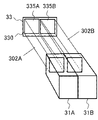
- FIG. 21 is a conceptual diagram showing an example of irradiating the parallel light 302A and the parallel light 302B emitted from the light source 31A and the light source 31B respectively toward the modulation section 330 of the spatial light modulator 33.
- FIG. FIG. 21 is a diagram of the modulation section 330 of the spatial light modulator 33 viewed from a viewpoint obliquely rear left of the light sources 31A and 31B.
- the light sources 31A and 31B may emit parallel light 302A and parallel light 302B in the same wavelength band, or may emit parallel light 302A and parallel light 302B in different wavelength bands.
- the intensity of parallel light 302A and parallel light 302B emitted from light source 31A and light source 31B can be adjusted independently.
- a modulation area 335A and a modulation area 335B are set in the modulation section 330 of the spatial light modulator 33 .
- the parallel light 302A emitted from the light source 31A is applied to the modulation area 335A of the modulation section 330 of the spatial light modulator 33.
- the parallel light 302A irradiated to the modulation area 335A is modulated by the modulation area 335A.
- the parallel light 302B emitted from the light source 31B irradiates the modulation area 335B of the modulation section 330 of the spatial light modulator 33 .
- the parallel light 302B irradiated to the modulation area 335B is modulated by the modulation area 335B.
- FIG. 22 is a conceptual diagram for explaining optical paths of modulated light 303A and modulated light 303B modulated in each of the modulation regions 335A and 335B.
- FIG. 22 shows the spatial light modulator 33, Fourier transform lens 34, aperture 35, and liquid crystal projection lens 36 viewed from above. Note that the positional relationship and optical path of the spatial light modulator 33, the Fourier transform lens 34, the aperture 35, and the liquid crystal projection lens 36 in FIG. not a thing
- the modulated light 303A modulated by the modulation region 335A and the modulated light 303B modulated by the modulation region 335B are condensed by the Fourier transform lens 34, pass through the opening of the aperture 35, and reach the liquid crystal projection lens 36.
- a lens region 365A corresponding to the modulation region 335A and a lens region 365B corresponding to the modulation region 335B are formed.
- Modulated light 303A is expanded by lens area 365A and projected as projection light 306A.
- Modulated light 303B is expanded by lens area 365B and projected as projection light 306B. For example, projection light 306A and projection light 306B are projected in different projection directions.
- projected light 306A and projected light 306B are projected at different projection angles.
- projection light 306A and projection light 306B are projected in different projection directions at different projection angles.
- the projection light 306A and the projection light 306B may be projected in the same projection direction at the same projection angle.
- parallel light 302 can be emitted from a plurality of light sources 31 at different timings.
- phase distributions that form different images in the modulation regions 335A and 335B it is possible to project the projection light 306 that displays different images.
- the projection light 306A based on the phase distribution set in the modulation area 335A can be assigned to communication
- the projection light 306A based on the phase distribution set in the modulation area 335B can be assigned to ranging.
- the projection light 306A based on the phase distribution set in the modulation area 335A can be assigned to communication with a certain communication target, and the projection light 306A based on the phase distribution set in the modulation area 335B can be assigned to communication with another communication target. can be done.
- FIGS. 23A and 23B are conceptual diagrams for explaining application example 2 of the present embodiment.
- the example of FIGS. 23A and 23B is an example in which projection light corresponding to the application is projected forward from an automobile equipped with the projection device 30 of the present embodiment.
- the light source 31 can switch the modulation method of the emitted parallel light.
- the control unit 37 switches the modulation method of the parallel light emitted from the light source 31 according to applications such as communication and distance measurement.
- the projection light for communication is projected toward the light-emitting surface of the traffic signal located in front, and the projection light for distance measurement is projected onto the vehicle traveling ahead.
- the projection light for communication is projected toward the light-emitting surface of the traffic signal located ahead, and the projection light for communication is also projected on the vehicle traveling ahead.
- switching the phase distributions set in the modulation regions 335A and 335B in FIG. 22 it is possible to switch the application of the projection light derived from the modulated light modulated by the modulation regions 335A and 335B.
- switching of the use of projected light is performed before driving the automobile and is fixed during driving.
- the switching of the application of the projected light is performed while driving the automobile, and the switching may be performed in real time even while the vehicle is being driven.
- switching of the use of projected light may be automatically performed under the control of an automatic driving system (not shown).
- the timing of switching the application of projection light is not particularly limited.
- FIG. 24 is a conceptual diagram for explaining application example 3 of the present embodiment.
- the projection device 30 is arranged above a utility pole.
- the projection device 30 has a function of receiving projection light (also referred to as a spatial light signal) projected from another projection device 30 and decoding the spatial light signal.
- the projection device 30 may have a function of wireless communication.
- a spatial optical communication network can be constructed in which spatial optical signals are transmitted and received between the projection devices 30 .
- the projection device 30 located in the middle of the network relays a spatial optical signal transmitted from one projection device 30 to another projection device 30.
- the application of the projection light may be distinguished according to the projection target. For example, between a plurality of projection devices 30 whose positions are fixed, fixed communication whose projection direction is fixed is performed. For example, between a moving body such as an automobile or a drone and the projection device 30, tracking communication is performed in which the projection device 30 tracks the position of the moving body and tracks the projection direction of the projection light toward the moving body being tracked. . In tracking communication, the projection device 30 identifies the position of the moving object based on the image data captured by the imaging unit 28, and controls the projection device 30 to project light toward the identified position of the moving object. Realized.
- the projection angle of the projection light directed to the distant moving body should be decreased and the projection angle of the projection light directed to the near moving body should be increased.
- communication using spatial light signals becomes possible between a plurality of projection devices 30 installed on different utility poles.
- the projection device 30 tracks the moving body, and tracking communication is possible in which communication is performed between the projection device 30 and the moving body.
- tracking communication can be flexibly performed between a plurality of moving bodies having different distances and the projection device 30 .
- wireless communication may be performed between a wireless device installed in a moving object such as an automobile or a drone or in a house and the projection device 30 .
- the projection device of this embodiment includes a light source, a spatial light modulator, a Fourier transform lens, an aperture, an imaging device, and a liquid crystal projection lens.
- the light source emits parallel light.
- the spatial light modulator has a modulation section that modulates the phase of parallel light emitted from the light source.
- the Fourier transform lens Fourier transforms the modulated light modulated by the modulating section and forms an image.
- the aperture is arranged near the focal position of the Fourier transform lens.
- the aperture is a frame that blocks high-order light contained in the light converged by the Fourier transform lens and limits the outer edge of the display area.
- a liquid crystal projection lens also called a liquid crystal lens
- the liquid crystal projection lens projects, as projection light, modulated light incident on a lens area dynamically formed in the liquid crystal area.
- the imaging unit captures an image of the projection direction of the projection light.
- the controller forms a lens area at a desired position in the liquid crystal area of the liquid crystal projection lens.
- the control unit sets a phase image corresponding to the projection light projected toward the projection target in the modulation unit of the spatial light modulator.
- the control unit controls the light source so that parallel light is emitted toward the modulation unit on which the phase image is set.
- the controller controls at least one of a projection direction and a projection angle of projection light according to the light received by the light receiving element.
- a high-definition image can be projected according to the light receiving condition of the light receiving element. For example, when a light receiving element receives an optical signal from a communication target, the projection device projects an optical signal corresponding to the received optical signal. For example, when the light receiving element receives the light reflected by the object for distance measurement, the projection device may calculate the distance to the object for distance measurement based on the received light.
- the projection device includes a plurality of light sources arranged to emit parallel light toward each of the plurality of modulation areas set in the modulation section of the spatial light modulator.
- the control unit controls each of the plurality of light sources so that parallel light is emitted toward the modulation unit in which different phase images are set in the plurality of modulation regions. According to this aspect, different projection light can be projected according to the projection target.
- the light source can switch the modulation method of the emitted parallel light.
- the controller switches the modulation method of the parallel light emitted from the light source according to the application.
- appropriately modulated projection light can be projected according to the application such as communication or distance measurement.
- the projection device of this embodiment has a simplified configuration of the projection devices of the first to third embodiments.
- FIG. 25 is a block diagram showing an example of the configuration of the projection device 40 of this embodiment.
- Projection device 40 includes light source 41 , spatial light modulator 43 , and liquid crystal lens 46 .
- FIG. 25 is a view of the internal configuration of the projection device 40 as seen from a horizontal perspective.
- the light source 41 emits parallel light.
- the spatial light modulator 43 has a modulating section 430 that modulates the phase of the parallel light 402 emitted from the light source 41 .
- Liquid crystal lens 46 also called liquid crystal projection lens
- the liquid crystal lens 46 projects the modulated light 403 incident on the lens area dynamically formed in the liquid crystal area 460 as projection light 406 .
- the control unit 47 forms a lens area at a desired position in the liquid crystal area 460 of the liquid crystal lens 46 .
- the control unit 47 sets the phase image corresponding to the projection light 406 projected toward the projection target in the modulation unit 430 of the spatial light modulator 43 .
- the control unit 47 controls the light source 41 so that the parallel light 402 is emitted toward the modulation unit 430 in which the phase image is set.
- the Fourier transform lens is omitted in FIG.
- the modulated light 403 modulated by the modulation unit 430 is Fourier-transformed using a Fourier transform lens (not shown), a virtual lens image formed in the modulation unit 430 of the spatial light modulator 43, or the like. make an image
- a high-definition image is projected in an arbitrary projection direction by using, as a projection lens, a liquid crystal lens including a liquid crystal region in which a lens region is formed at an arbitrary position. can.
- control device 90 of FIG. 26 the hardware configuration for executing the processing of the control unit according to each embodiment of the present disclosure will be described by taking the control device 90 of FIG. 26 as an example.
- the control device 90 is implemented in the form of a microcomputer.
- the control device 90 of FIG. 26 is a configuration example for executing the processing of the control unit of each embodiment, and does not limit the scope of the present disclosure.
- the control device 90 includes a processor 91, a main storage device 92, an auxiliary storage device 93, an input/output interface 95, and a communication interface 96.
- the interface is abbreviated as I/F (Interface).
- Processor 91 , main storage device 92 , auxiliary storage device 93 , input/output interface 95 , and communication interface 96 are connected to each other via bus 98 so as to enable data communication.
- the processor 91 , the main storage device 92 , the auxiliary storage device 93 and the input/output interface 95 are connected to a network such as the Internet or an intranet via a communication interface 96 .
- the processor 91 loads the program stored in the auxiliary storage device 93 or the like into the main storage device 92 .
- the processor 91 executes programs developed in the main memory device 92 .
- a configuration using a software program installed in the control device 90 may be used.
- the processor 91 executes processing by the control unit according to this embodiment.
- the main storage device 92 has an area in which programs are expanded.
- a program stored in the auxiliary storage device 93 or the like is developed in the main storage device 92 by the processor 91 .
- the main memory device 92 is realized by a volatile memory such as a DRAM (Dynamic Random Access Memory). Further, as the main storage device 92, a non-volatile memory such as MRAM (Magnetoresistive Random Access Memory) may be configured/added.
- the auxiliary storage device 93 stores various data such as programs.
- the auxiliary storage device 93 is implemented by a local disk such as a hard disk or flash memory. It should be noted that it is possible to store various data in the main storage device 92 and omit the auxiliary storage device 93 .
- the input/output interface 95 is an interface for connecting the control device 90 and peripheral devices based on standards and specifications.
- a communication interface 96 is an interface for connecting to an external system or device through a network such as the Internet or an intranet based on standards and specifications.
- the input/output interface 95 and the communication interface 96 may be shared as an interface for connecting with external devices.
- Input devices such as a keyboard, mouse, and touch panel may be connected to the control device 90 as necessary. These input devices are used to enter information and settings.
- touch panel When a touch panel is used as an input device, the display screen of the display device may also serve as an interface of the input device. Data communication between the processor 91 and the input device may be mediated by the input/output interface 95 .
- control device 90 may be equipped with a display device for displaying information.
- control device 90 is preferably provided with a display control device (not shown) for controlling the display of the display device.
- the display device may be connected to the control device 90 via the input/output interface 95 .
- control device 90 may be equipped with a drive device. Between the processor 91 and a recording medium (program recording medium), the drive device mediates reading of data and programs from the recording medium, writing of processing results of the control device 90 to the recording medium, and the like.
- the drive device may be connected to the control device 90 via the input/output interface 95 .
- the above is an example of the hardware configuration for enabling the control unit according to each embodiment of the present invention.
- the hardware configuration of FIG. 26 is an example of the hardware configuration for executing arithmetic processing of the control unit according to each embodiment, and does not limit the scope of the present invention.
- the scope of the present invention also includes a program that causes a computer to execute processing related to the control unit according to each embodiment. Further, the scope of the present invention also includes a program recording medium on which the program according to each embodiment is recorded.
- the recording medium can be implemented as an optical recording medium such as a CD (Compact Disc) or a DVD (Digital Versatile Disc).
- the recording medium may be implemented by a semiconductor recording medium such as a USB (Universal Serial Bus) memory or an SD (Secure Digital) card. Also, the recording medium may be realized by a magnetic recording medium such as a flexible disk, or other recording medium. When a program executed by a processor is recorded on a recording medium, the recording medium corresponds to a program recording medium.
- a semiconductor recording medium such as a USB (Universal Serial Bus) memory or an SD (Secure Digital) card.
- SD Secure Digital
- the recording medium may be realized by a magnetic recording medium such as a flexible disk, or other recording medium.
- the constituent elements of the control unit of each embodiment may be combined arbitrarily. Also, the constituent elements of the control unit of each embodiment may be realized by software or by a circuit.
- Reference Signs List 10 20, 30, 40 Projection Device 11, 21, 31, 41 Light Source 13, 23, 33, 43 Spatial Light Modulator 14, 24, 34 Fourier Transform Lens 15, 25, 35 Aperture 16, 26, 36 Liquid Crystal Projection Lens 17, 27, 37, 47 control unit 28 imaging unit 39 light receiving element 46 liquid crystal lens 111 emitter 112 collimator 280 lens 281 imaging element 283 image processor 285 internal memory 287 data output circuit
Landscapes
- Physics & Mathematics (AREA)
- Nonlinear Science (AREA)
- General Physics & Mathematics (AREA)
- Optics & Photonics (AREA)
- Chemical & Material Sciences (AREA)
- Crystallography & Structural Chemistry (AREA)
- Electromagnetism (AREA)
- Engineering & Computer Science (AREA)
- Computer Networks & Wireless Communication (AREA)
- Signal Processing (AREA)
- Liquid Crystal (AREA)
Priority Applications (2)
| Application Number | Priority Date | Filing Date | Title |
|---|---|---|---|
| JP2023508762A JP7613557B2 (ja) | 2021-03-22 | 2022-02-10 | 投射装置および投射方法 |
| US18/282,045 US12216378B2 (en) | 2021-03-22 | 2022-02-10 | Projection device and projection method |
Applications Claiming Priority (2)
| Application Number | Priority Date | Filing Date | Title |
|---|---|---|---|
| JP2021047566 | 2021-03-22 | ||
| JP2021-047566 | 2021-03-22 |
Publications (1)
| Publication Number | Publication Date |
|---|---|
| WO2022201942A1 true WO2022201942A1 (ja) | 2022-09-29 |
Family
ID=83395564
Family Applications (1)
| Application Number | Title | Priority Date | Filing Date |
|---|---|---|---|
| PCT/JP2022/005240 Ceased WO2022201942A1 (ja) | 2021-03-22 | 2022-02-10 | 投射装置および投射方法 |
Country Status (3)
| Country | Link |
|---|---|
| US (1) | US12216378B2 (https=) |
| JP (1) | JP7613557B2 (https=) |
| WO (1) | WO2022201942A1 (https=) |
Families Citing this family (1)
| Publication number | Priority date | Publication date | Assignee | Title |
|---|---|---|---|---|
| CN121232507A (zh) * | 2024-06-28 | 2025-12-30 | 青岛海信激光显示股份有限公司 | 一种投影设备 |
Citations (3)
| Publication number | Priority date | Publication date | Assignee | Title |
|---|---|---|---|---|
| US20090207466A1 (en) * | 2006-03-28 | 2009-08-20 | Edward Bucklay | Holographic display devices |
| WO2018056199A1 (ja) * | 2016-09-21 | 2018-03-29 | 日本電気株式会社 | 距離測定システム、距離測定方法およびプログラム記録媒体 |
| WO2019116526A1 (ja) * | 2017-12-15 | 2019-06-20 | 日本電気株式会社 | 投射装置、インターフェース装置および投射方法 |
Family Cites Families (3)
| Publication number | Priority date | Publication date | Assignee | Title |
|---|---|---|---|---|
| KR20150045135A (ko) * | 2013-10-18 | 2015-04-28 | 삼성디스플레이 주식회사 | 입체영상 표시장치와 그 구동방법 |
| US9946070B2 (en) * | 2016-03-08 | 2018-04-17 | Sharp Kabushiki Kaisha | Automotive head up display |
| WO2022137777A1 (ja) | 2020-12-21 | 2022-06-30 | 日本電気株式会社 | 投射装置および投射方法 |
-
2022
- 2022-02-10 WO PCT/JP2022/005240 patent/WO2022201942A1/ja not_active Ceased
- 2022-02-10 US US18/282,045 patent/US12216378B2/en active Active
- 2022-02-10 JP JP2023508762A patent/JP7613557B2/ja active Active
Patent Citations (3)
| Publication number | Priority date | Publication date | Assignee | Title |
|---|---|---|---|---|
| US20090207466A1 (en) * | 2006-03-28 | 2009-08-20 | Edward Bucklay | Holographic display devices |
| WO2018056199A1 (ja) * | 2016-09-21 | 2018-03-29 | 日本電気株式会社 | 距離測定システム、距離測定方法およびプログラム記録媒体 |
| WO2019116526A1 (ja) * | 2017-12-15 | 2019-06-20 | 日本電気株式会社 | 投射装置、インターフェース装置および投射方法 |
Also Published As
| Publication number | Publication date |
|---|---|
| US20240045303A1 (en) | 2024-02-08 |
| JP7613557B2 (ja) | 2025-01-15 |
| US12216378B2 (en) | 2025-02-04 |
| JPWO2022201942A1 (https=) | 2022-09-29 |
Similar Documents
| Publication | Publication Date | Title |
|---|---|---|
| JP6740538B2 (ja) | 投射システム | |
| WO2012014690A1 (ja) | プロジェクタ | |
| JP7613557B2 (ja) | 投射装置および投射方法 | |
| US20240168363A1 (en) | Projection device and projection method | |
| JP7431429B2 (ja) | 分光画像生成装置 | |
| US12353054B2 (en) | Imaging apparatus | |
| JP7687418B2 (ja) | 通信制御装置、通信装置、通信制御方法、およびプログラム | |
| JP7683704B2 (ja) | 受信装置、通信装置、および通信システム | |
| JP7355218B2 (ja) | 管理システム | |
| JP6645588B2 (ja) | 表示システム | |
| JP7673794B2 (ja) | 受光装置、受信装置、および通信装置 | |
| JP7673815B2 (ja) | 受信制御装置、受光装置、通信装置、受信制御方法、およびプログラム | |
| JP7622858B2 (ja) | 送光装置、通信装置、制御方法、およびプログラム | |
| JP7559961B2 (ja) | 送光装置および通信装置 | |
| US20240283537A1 (en) | Transmitter, transmission device, communication device, and communication system | |
| JP7582450B2 (ja) | 受光装置、受信装置、および通信装置 | |
| US20250076595A1 (en) | Light receiver, communication device, and communication system | |
| US12212370B2 (en) | Light receiving device and communication device | |
| JP7574943B2 (ja) | 通信制御装置、通信装置、通信制御方法、およびプログラム | |
| JP2025034368A (ja) | 通信装置および通信システム | |
| JP2024117218A (ja) | 受信装置、通信装置、および通信システム | |
| WO2023047446A1 (ja) | 受信装置および通信装置 | |
| CN118671739A (zh) | 光电探测器测试系统及其测试方法、激光雷达 | |
| JP2024057783A (ja) | 受信装置、通信装置、および通信システム | |
| JP2024013025A (ja) | 受光装置、受信装置、通信装置、および通信システム |
Legal Events
| Date | Code | Title | Description |
|---|---|---|---|
| 121 | Ep: the epo has been informed by wipo that ep was designated in this application |
Ref document number: 22774743 Country of ref document: EP Kind code of ref document: A1 |
|
| WWE | Wipo information: entry into national phase |
Ref document number: 2023508762 Country of ref document: JP |
|
| WWE | Wipo information: entry into national phase |
Ref document number: 18282045 Country of ref document: US |
|
| NENP | Non-entry into the national phase |
Ref country code: DE |
|
| 122 | Ep: pct application non-entry in european phase |
Ref document number: 22774743 Country of ref document: EP Kind code of ref document: A1 |