WO2022196302A1 - 易接着性ポリエステルフィルム - Google Patents
易接着性ポリエステルフィルム Download PDFInfo
- Publication number
- WO2022196302A1 WO2022196302A1 PCT/JP2022/008029 JP2022008029W WO2022196302A1 WO 2022196302 A1 WO2022196302 A1 WO 2022196302A1 JP 2022008029 W JP2022008029 W JP 2022008029W WO 2022196302 A1 WO2022196302 A1 WO 2022196302A1
- Authority
- WO
- WIPO (PCT)
- Prior art keywords
- mass
- polyester film
- coating layer
- parts
- film
- Prior art date
- Legal status (The legal status is an assumption and is not a legal conclusion. Google has not performed a legal analysis and makes no representation as to the accuracy of the status listed.)
- Ceased
Links
Images

Classifications
-
- B—PERFORMING OPERATIONS; TRANSPORTING
- B32—LAYERED PRODUCTS
- B32B—LAYERED PRODUCTS, i.e. PRODUCTS BUILT-UP OF STRATA OF FLAT OR NON-FLAT, e.g. CELLULAR OR HONEYCOMB, FORM
- B32B27/00—Layered products comprising a layer of synthetic resin
- B32B27/36—Layered products comprising a layer of synthetic resin comprising polyesters
-
- C—CHEMISTRY; METALLURGY
- C08—ORGANIC MACROMOLECULAR COMPOUNDS; THEIR PREPARATION OR CHEMICAL WORKING-UP; COMPOSITIONS BASED THEREON
- C08J—WORKING-UP; GENERAL PROCESSES OF COMPOUNDING; AFTER-TREATMENT NOT COVERED BY SUBCLASSES C08B, C08C, C08F, C08G or C08H
- C08J5/00—Manufacture of articles or shaped materials containing macromolecular substances
- C08J5/18—Manufacture of films or sheets
-
- C—CHEMISTRY; METALLURGY
- C08—ORGANIC MACROMOLECULAR COMPOUNDS; THEIR PREPARATION OR CHEMICAL WORKING-UP; COMPOSITIONS BASED THEREON
- C08J—WORKING-UP; GENERAL PROCESSES OF COMPOUNDING; AFTER-TREATMENT NOT COVERED BY SUBCLASSES C08B, C08C, C08F, C08G or C08H
- C08J7/00—Chemical treatment or coating of shaped articles made of macromolecular substances
- C08J7/04—Coating
- C08J7/042—Coating with two or more layers, where at least one layer of a composition contains a polymer binder
-
- C—CHEMISTRY; METALLURGY
- C08—ORGANIC MACROMOLECULAR COMPOUNDS; THEIR PREPARATION OR CHEMICAL WORKING-UP; COMPOSITIONS BASED THEREON
- C08J—WORKING-UP; GENERAL PROCESSES OF COMPOUNDING; AFTER-TREATMENT NOT COVERED BY SUBCLASSES C08B, C08C, C08F, C08G or C08H
- C08J7/00—Chemical treatment or coating of shaped articles made of macromolecular substances
- C08J7/04—Coating
- C08J7/043—Improving the adhesiveness of the coatings per se, e.g. forming primers
-
- C—CHEMISTRY; METALLURGY
- C08—ORGANIC MACROMOLECULAR COMPOUNDS; THEIR PREPARATION OR CHEMICAL WORKING-UP; COMPOSITIONS BASED THEREON
- C08J—WORKING-UP; GENERAL PROCESSES OF COMPOUNDING; AFTER-TREATMENT NOT COVERED BY SUBCLASSES C08B, C08C, C08F, C08G or C08H
- C08J7/00—Chemical treatment or coating of shaped articles made of macromolecular substances
- C08J7/04—Coating
- C08J7/046—Forming abrasion-resistant coatings; Forming surface-hardening coatings
-
- C—CHEMISTRY; METALLURGY
- C09—DYES; PAINTS; POLISHES; NATURAL RESINS; ADHESIVES; COMPOSITIONS NOT OTHERWISE PROVIDED FOR; APPLICATIONS OF MATERIALS NOT OTHERWISE PROVIDED FOR
- C09D—COATING COMPOSITIONS, e.g. PAINTS, VARNISHES OR LACQUERS; FILLING PASTES; CHEMICAL PAINT OR INK REMOVERS; INKS; CORRECTING FLUIDS; WOODSTAINS; PASTES OR SOLIDS FOR COLOURING OR PRINTING; USE OF MATERIALS THEREFOR
- C09D167/00—Coating compositions based on polyesters obtained by reactions forming a carboxylic ester link in the main chain; Coating compositions based on derivatives of such polymers
-
- C—CHEMISTRY; METALLURGY
- C09—DYES; PAINTS; POLISHES; NATURAL RESINS; ADHESIVES; COMPOSITIONS NOT OTHERWISE PROVIDED FOR; APPLICATIONS OF MATERIALS NOT OTHERWISE PROVIDED FOR
- C09D—COATING COMPOSITIONS, e.g. PAINTS, VARNISHES OR LACQUERS; FILLING PASTES; CHEMICAL PAINT OR INK REMOVERS; INKS; CORRECTING FLUIDS; WOODSTAINS; PASTES OR SOLIDS FOR COLOURING OR PRINTING; USE OF MATERIALS THEREFOR
- C09D5/00—Coating compositions, e.g. paints, varnishes or lacquers, characterised by their physical nature or the effects produced; Filling pastes
-
- C—CHEMISTRY; METALLURGY
- C09—DYES; PAINTS; POLISHES; NATURAL RESINS; ADHESIVES; COMPOSITIONS NOT OTHERWISE PROVIDED FOR; APPLICATIONS OF MATERIALS NOT OTHERWISE PROVIDED FOR
- C09D—COATING COMPOSITIONS, e.g. PAINTS, VARNISHES OR LACQUERS; FILLING PASTES; CHEMICAL PAINT OR INK REMOVERS; INKS; CORRECTING FLUIDS; WOODSTAINS; PASTES OR SOLIDS FOR COLOURING OR PRINTING; USE OF MATERIALS THEREFOR
- C09D7/00—Features of coating compositions, not provided for in group C09D5/00; Processes for incorporating ingredients in coating compositions
- C09D7/40—Additives
- C09D7/60—Additives non-macromolecular
- C09D7/63—Additives non-macromolecular organic
-
- C—CHEMISTRY; METALLURGY
- C08—ORGANIC MACROMOLECULAR COMPOUNDS; THEIR PREPARATION OR CHEMICAL WORKING-UP; COMPOSITIONS BASED THEREON
- C08J—WORKING-UP; GENERAL PROCESSES OF COMPOUNDING; AFTER-TREATMENT NOT COVERED BY SUBCLASSES C08B, C08C, C08F, C08G or C08H
- C08J2367/00—Characterised by the use of polyesters obtained by reactions forming a carboxylic ester link in the main chain; Derivatives of such polymers
Definitions
- the present invention relates to an easily adhesive polyester film that is excellent in adhesion to various functional layers, blocking resistance, and transparency. More particularly, it relates to an easy-adhesive polyester film suitable for optical applications.
- a hard coat film with a transparent hard coat layer laminated is used on the front surface of displays such as touch panels, computers, televisions, liquid crystal display devices, and decorative materials.
- a transparent polyester film is generally used as the transparent plastic film of the substrate.
- a coating layer having easy adhesion is often provided.
- the above hard coat film is required to have durability against temperature, humidity, and light, transparency, chemical resistance, scratch resistance, antifouling properties, and the like.
- a multi-layered anti-reflection structure in which a high refractive index layer and a low refractive index layer are laminated on top of the hard coat layer Layering is also common practice.
- an object of the present invention is to provide an easy-adhesive polyester film having improved reliability of adhesion to a functional layer such as a hard coat layer, and an easy-adhesive polyester film that is suitably used for optical applications and the like. is to provide
- a coating layer obtained by curing a composition containing a polyester having a polycyclic aromatic skeleton and a cross-linking agent having at least one skeleton selected from aliphatic, alicyclic and heterocyclic groups on at least one side of a polyester film.
- An easily adhesive polyester film having The thickness (d: nm) of the coating layer satisfies the following formula (1)
- the surface free energy ( ⁇ s: mN / m) of the coating layer surface not in contact with the polyester film of the coating layer satisfies the following formula (2)
- the nitrogen atomic ratio (A N : at%) on the surface of the coating layer by X-ray photoelectron spectroscopy (ESCA) satisfies the following formula (3)
- the maximum value of the nitrogen atomic ratio (A N X : at %) and the time t 2 (seconds) at which the intermediate value (A N Z : at%) is reached t 2 /t 1 ) satisfies the following formula (4).
- the cross-linking agent having at least one skeleton selected from aliphatic, alicyclic and heterocyclic groups is an isocyanate cross-linking agent having at least one skeleton selected from aliphatic, alicyclic and heterocyclic groups.
- the present invention it is possible to provide an easily adhesive polyester film that ensures adhesion reliability after long-term storage with a functional layer such as a hard coat layer, making it possible to widely apply it to optical applications.
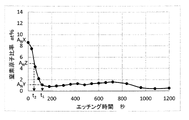
- 1 is an example of a nitrogen element distribution curve based on element distribution measurement of the easy-adhesive polyester film of Example 1, which is etched in the depth direction from the coating layer surface by ESCA.
- the polyester film used as a substrate in the present invention is a film mainly composed of a polyester resin.
- a film mainly composed of a polyester resin means a film formed from a resin composition containing 50% by mass or more of a polyester resin.
- other polymers e.g., polycarbonate resins, polyimide resins, etc.
- the polyester resin contains 50% by mass or more, and when copolymerized with other monomers, the polyester structural unit is 50. It means to contain mol% or more.
- the polyester film contains 90% by mass or more, more preferably 95% by mass or more, and still more preferably 100% by mass of the polyester resin.
- the material of the polyester resin is not particularly limited, but a copolymer formed by polycondensation of a dicarboxylic acid component and a diol component, or a blend resin thereof can be used.
- dicarboxylic acid components include terephthalic acid, isophthalic acid, orthophthalic acid, 2,5-naphthalenedicarboxylic acid, 2,6-naphthalenedicarboxylic acid, 1,4-naphthalenedicarboxylic acid, 1,5-naphthalenedicarboxylic acid, diphenyl Carboxylic acid, diphenoxyethanedicarboxylic acid, diphenylsulfonecarboxylic acid, anthracenedicarboxylic acid, 1,3-cyclopentanedicarboxylic acid, 1,3-cyclohexanedicarboxylic acid, 1,4-cyclohexanedicarboxylic acid, hexahydroterephthalic acid, hexahydro isophthalic acid
- diol component constituting the polyester resin examples include ethylene glycol, propylene glycol, hexamethylene glycol, neopentyl glycol, 1,2-cyclohexanedimethanol, 1,4-cyclohexanedimethanol, decamethylene glycol, 1,3- propanediol, 1,4-butanediol, 1,5-pentanediol, 1,6-hexadiol, 2,2-bis(4-hydroxyphenyl)propane, bis(4-hydroxyphenyl)sulfone and the like.
- the dicarboxylic acid component and the diol component that constitute the polyester resin may be used alone or in combination of two or more. Further, other acid components such as trimellitic acid and other hydroxyl group components such as trimethylolpropane may be appropriately added.
- polyester resins include polyethylene terephthalate, polypropylene terephthalate, polybutylene terephthalate, and polyethylene naphthalate.
- polyethylene terephthalate is preferred from the viewpoint of the balance between physical properties and cost.
- preferable copolymerization components include diethylene glycol and copolymerization components having norbornene in side chains.
- inert particles are contained in the polyester film in order to improve handling properties such as slipperiness and winding properties. It is preferable that the content is as small as possible. Therefore, it is necessary to have a multilayer structure in which particles are contained only in the surface layer of the film, or to contain particles only in the coating layer laminated on at least one side of the polyester film without substantially containing particles in the film. is preferred.
- not containing substantially particles means, for example, in the case of inorganic particles, when an element derived from the particles is quantitatively analyzed by fluorescent X-ray analysis, 50 ppm or less, preferably 10 ppm or less, most preferably detected It means the content below the limit. Even if the particles are not actively added to the base film, contaminants derived from foreign substances and dirt adhering to the lines and equipment in the raw material resin or film manufacturing process will peel off and become unavoidable in the film. This is because the
- the inner layer does not substantially contain inert particles, and the two-kind three-layer structure containing inert particles only in the outermost layer achieves both transparency and workability. is possible and preferable.
- the polyester film that serves as the base material may be a single layer or a laminate of two or more layers.
- various additives can be incorporated into the film as long as the effects of the present invention are achieved.
- additives include antioxidants, light stabilizers, anti-gelling agents, organic wetting agents, antistatic agents, ultraviolet absorbers, and surfactants.
- the film has a laminated structure, it is also preferable to contain additives depending on the function of each layer, if necessary. For example, in order to prevent photodegradation of the polarizer, it is also a preferred embodiment to add an ultraviolet absorber or the like to the inner layer.
- Polyester film can be manufactured according to a conventional method. For example, it can be obtained by a method of melt-extruding the above polyester resin into a film and cooling and solidifying it with a casting drum to form a film.
- a non-stretched film and a stretched film can be used, but a stretched film is preferable from the viewpoint of durability such as mechanical strength and chemical resistance.
- the stretching method is not particularly limited, and a vertical uniaxial stretching method, a horizontal uniaxial stretching method, a vertical and horizontal successive biaxial stretching method, a vertical and horizontal simultaneous biaxial stretching method, etc. can be employed.
- the stretching may be performed before laminating the easy-adhesive coating layer to be described later, or after laminating the easy-adhesive coating layer. It is also possible to uniaxially stretch the film in the vertical or horizontal direction before laminating the easy-adhesive coating layer, and stretch the film in the other direction after laminating the coating layer.
- the easily-adhesive polyester film of the present invention is obtained by laminating an easily-adhesive coating layer on the polyester base film as described above.
- the coating layer contains a binder resin and additives.
- the binder resin constituting the coating layer it is a resin having easy adhesion, and polyester is suitable from the viewpoint of particle retention and adhesion.
- polyester having a polycyclic aromatic skeleton is most suitable. is. This is compatible with the composition of the hard coat layer, which will be described later, and is also suitable from the viewpoint of conjugate interaction when the composition of the hard coat layer has an aromatic skeleton.
- polyesters having a polycyclic aromatic skeleton include polyesters having a naphthalene skeleton, polyesters having a fluorene skeleton, polyesters having an anthracene skeleton, and polyesters having a phenanthrene skeleton.
- the binder resin constituting the coating layer does not contain urethane resin.
- Urethane resin is sometimes used from the viewpoint of elasticity and easy moldability of the coating film, but it is obvious that the urethane resin contains urea compounds as impurities, and the amount of urea compounds present in the coating layer is If the amount is too large, it is preferable not to include the urethane resin from the viewpoint of maintaining the stability of adhesion over time.
- the polyester is preferably contained in an amount of 10% by mass or more and 90% by mass or less based on the solid content of the total resin and the cross-linking agent contained in the composition for forming the coating layer. More preferably, it is 15% by mass or more and 85% by mass or less.
- the content of the polyester resin is 90% by mass or less, the adhesiveness to the functional layer such as the hard coat layer is maintained under high temperature and high humidity conditions, which is preferable.
- the content is 10% by mass or more, the adhesiveness to the polyester base film is likely to be maintained at room temperature and under high temperature and high humidity conditions, which is preferable.
- the cross-linking agent is preferably a cross-linking agent having at least one skeleton selected from aliphatic, alicyclic and heterocyclic groups.
- a cross-linking agent capable of generating a urea group through a side reaction of cross-linking is also suitable, and specific cross-linking agents include isocyanate-based cross-linking agents and carbodiimide-based cross-linking agents.
- an isocyanate cross-linking agent is preferable from the viewpoint of the stability of the coating liquid over time and the effect of improving adhesion under high-temperature and high-humidity treatment.
- isocyanates having at least one skeleton selected from aliphatic, alicyclic and heterocyclic groups are most suitable.
- a catalyst or the like can be appropriately used in the coating layer-forming composition, if necessary.
- aliphatic isocyanates include 1,4-diisocyanatobutane, 1,5-pentamethylene diisocyanate, 2-methyl-1,5-pentamethylene diisocyanate, 1,6-hexamethylene diisocyanate, 1,12- Dodecane diisocyanate, 2,2,4-trimethyl-1,6-hexamethylene diisocyanate, 2,4,4-trimethyl-1,6-hexamethylene diisocyanate, 3,5,5-trimethyl-1,6-hexamethylene diisocyanate etc.
- alicyclic isocyanates include cyclohexane diisocyanate, isophorone diisocyanate, 4,4-dicyclohexylmethane diisocyanate, 1,3-bis(isocyanatomethyl)cyclohexane, 1,4-bis(isocyanatomethyl)cyclohexane, cyclohexyl 1,4 -diisocyanate, 1,1-bis(isocyanatomethyl)cyclohexane, 2,4-hexahydrotoluylene diisocyanate, 2,6-hexahydrotoluylene diisocyanate and the like.
- heterocyclic isocyanates include 2,5-diisocyanatothiophene, 2,5-bis(isocyanatomethyl)thiophene, 2,5-diisocyanatotetrahydrothiophene, 2,5-bis(isocyanatomethyl) ) tetrahydrothiophene, 3,4-bis(isocyanatomethyl)tetrahydrothiophene, 2,5-diisocyanato-1,4-dithiane, 2,5-bis(isocyanatomethyl)-1,4-dithiane, 4,5- Diisocyanato-1,3-dithiolane, 4,5-bis(isocyanatomethyl)-1,3-dithiolane, 4,5-bis(isocyanatomethyl)-2-methyl-1,3-dithiolane, 2,6- Di(isocyanatemethyl)furan, 5,5'-methylenebisfurfuryl isocyanate, 5,5'-isopropylid
- an isocyanate having an aromatic skeleton is not included in the composition for forming a coating layer because of its high reactivity, it easily reacts with moisture in the air and promotes the formation of a urea compound more than necessary. is preferred. Furthermore, from the viewpoint of weather resistance, isocyanates having at least one skeleton of aliphatic, alicyclic, and heterocyclic groups are preferred. In the present application, blocked isocyanate can also be used in the same manner, and is particularly preferred from the viewpoint of suppressing the production of urea compounds when the coating agent is water-based.
- blocking agents include bisulfite compounds such as sodium bisulfite, 3,5-dimethylpyrazole, 3-methylpyrazole, 4-bromo-3,5-dimethylpyrazole, 4-nitro-3,5-dimethylpyrazole, and the like.
- Pyrazole compounds phenols such as phenol and cresol, aliphatic alcohols such as methanol and ethanol, active methylene compounds such as dimethyl malonate and acetylacetone, mercaptan compounds such as butyl mercaptan and dodecyl mercaptan, acids such as acetanilide and acetic acid amide.
- lactams such as ⁇ - caprolactam and ⁇ - valerolactam
- acid imides such as succinimide and maleic imide
- oximes such as acetaldoxime, acetone oxime, and methyl ethyl ketoxime
- diphenylaniline, aniline, and ethyleneimine blocking agents such as amines such as
- hydrophilic group into the blocked isocyanate-based cross-linking agent from the viewpoint of imparting water dispersibility in an aqueous solvent.
- hydrophilicity it is preferable to introduce an anionic group such as a carboxyl group or a sulfonic acid group, or a nonionic group such as an oxyalkyl group.
- anionic group such as a carboxyl group or a sulfonic acid group
- a nonionic group such as an oxyalkyl group.
- These hydrophilic groups can be prepared by pre-reacting a polyisocyanate as a base of the blocked isocyanate with a compound having a hydrophilic group and a reactive group such as a hydroxyl group.
- the cross-linking agent is preferably contained in an amount of 5% by mass or more and 50% by mass or less in the solid content of the total resin and the cross-linking agent contained in the composition for forming the coating layer. More preferably, it is 10% by mass or more and 45% by mass or less. It is more preferably 10% by mass or more and 30% by mass or less, and most preferably 10% by mass or more and 20% by mass or less. When it is 5% by mass or more, the strength of the resin in the coating layer is maintained, and the adhesion under high temperature and high humidity is good. It is preferable because the adhesiveness is maintained at room temperature and under high temperature and high humidity.
- the coating layer in the easily adhesive polyester film of the present invention is a composition containing a polyester having a polycyclic aromatic skeleton and a cross-linking agent having at least one skeleton selected from aliphatic, alicyclic and heterocyclic groups. It is preferable to be The expression that this composition has been cured is used because it is difficult to appropriately express the chemical composition after reaction curing with a cross-linking agent.
- additives such as surfactants, antioxidants, heat stabilizers, weather stabilizers, ultraviolet absorbers, organic lubricants, and pigments may be added as long as they do not impede the effects of the present invention.
- dyes, organic or inorganic particles, antistatic agents, nucleating agents and the like may be added. However, it is preferable not to use substances that are undesirable in the environment or the like.
- particles contained in the coating layer in the present invention include, for example, titanium oxide, barium sulfate, calcium carbonate, calcium sulfate, silica, alumina, talc, kaolin, clay, and mixtures thereof.
- Inorganic particles such as calcium phosphate, mica, hectorite, zirconia, tungsten oxide, lithium fluoride, calcium fluoride, etc., and organic particles such as styrene, acrylic, melamine, benzoguanamine, and silicone Examples include polymer-based particles.
- the average particle size of the inert particles in the coating layer is preferably 0.04 to 2.0 ⁇ m, more preferably 0.1 to 1.0 ⁇ m.
- the average particle diameter of the inert particles is 0.04 ⁇ m or more, it becomes easy to form unevenness on the film surface, so that the handling properties such as the slipperiness and windability of the film are improved, and the film can be easily laminated. It is preferable because of its good workability.
- the average particle size of the inert particles is 2.0 ⁇ m or less, the particles are less likely to fall off, which is preferable.
- the particle concentration in the coating layer is preferably 1 to 20% by mass based on the resin content.
- the thickness (d: nm) of the coating layer is preferably represented by the following formula (1). 30 ⁇ d ⁇ 200 Expression (1) If it is prepared within this range, it is preferable because it is easy to achieve both workability and adhesion. More preferably, it is 50 nm or more and 150 nm or less, and still more preferably 70 nm or more and 100 nm or less. It is preferable that the thickness of the coating layer is 30 nm or more because the adhesion becomes good. When the thickness of the coating layer is 200 nm or less, blocking is less likely to occur, which is preferable.
- the thickness of the coating layer the cross section of the cut film was observed with a transmission electron microscope (TEM), and the thickness of the coating layer was randomly measured at 10 points, and the average value was taken as the thickness of the coating layer.
- TEM transmission electron microscope
- the surface free energy ( ⁇ s: mN/m) of the coating layer present on the surface of the easy-adhesive polyester film of the present invention is preferably within the range of the following formula (2). 43 ⁇ ⁇ s ⁇ 49 Expression (2) If it is adjusted within this range, the adhesion reliability can be secured and the requirements of the present invention can be satisfied. It is more preferably 44 mN/m or more and 48 mN/m or less, still more preferably 45 mN/m or more and 47 mN/m or less.
- the ratio of segregation components unevenly distributed on the surface of the coating layer is small, and the adhesion with the hard coat layer to be applied later is good, and in particular, the stability of adhesion over time and reliability are ensured. is possible and preferable. Further, when it is 49 mN/m or less, the initial adhesion to the hard coat layer is kept high, which is preferable.
- the present invention focuses on the ratio of segregation components (mainly cross-linking agent components) existing inside from the surface of the coating layer.
- the term "segregated component” as used herein refers to a urea compound or urethane compound in which the cross-linking agent component present in the coating layer-forming composition is deformed by reaction with moisture in the air, and these compounds are unevenly distributed on the surface. This is considered to be a factor in lowering the adhesion to the hard coat layer or the like.
- the ratio of the amount of nitrogen atoms to the total amount of all elements is preferably within the range of the following formula (3). 3.0 ⁇ A N ⁇ 9.5 Expression (3) Adjustment within this range is preferable because adhesion reliability can be ensured. It is more preferably 5.0 at % or more and 9.3 at % or less, still more preferably 7.0 at % or more and 9.0 at % or less. A content of 3.0 at % or more is preferable because the initial adhesion to the hard coat layer is good. When it is 9.5 at % or less, the adhesion to the hard coat layer is stable even after the passage of time, and adhesion reliability can be maintained, which is preferable.
- the surface of the coating layer of the easy-adhesive polyester film of the present invention is etched in the depth direction, and the nitrogen element distribution curve based on the element distribution measurement at each depth direction position is drawn.
- a spectrum is obtained as shown (horizontal axis: etching time (seconds), vertical axis: nitrogen atom ratio (at %)).
- Time (t 2 ) in A N Z means the midpoint between the maximum value (A N X) and the lower limit (A N Y), and (t 2 ) with respect to (t 1 ).
- the ratio means the spread of the nitrogen atomic ratio in the depth direction. That is, the larger the ratio of (t 2 ) to the spread (t 1 ) in the depth direction, the more gradual the change in the amount of unevenly distributed segregation components from the coating layer surface. It is more preferably 47 or more, still more preferably 55 or more. If it is 40 or more, the uneven distribution of the segregation component is reduced, and from this influence, it is possible to maintain the adhesion reliability, which is preferable.
- the method for satisfying the formulas (2), (3), and (4) is not particularly limited, but is preferably adjusted by controlling the types and ratios of the resin and the cross-linking agent in the coating layer-forming composition. can do.
- the coating layer-forming composition may contain a surfactant for the purpose of improving leveling properties during coating and defoaming the coating liquid.
- the surfactant may be cationic, anionic, or nonionic, but silicone, acetylene glycol, or fluorine-based surfactants are preferred. These surfactants are preferably contained in the coating layer-forming composition within a range that does not impair the effect of suppressing the iridescent coloration under a fluorescent lamp and the adhesion.
- both a so-called in-line coating method in which coating is performed simultaneously with the formation of the polyester base film, and a so-called off-line coating method in which coating is performed with a separate coater after forming the polyester base film can be applied.
- In-line coating methods are efficient and more preferred.
- any known method can be used for coating a polyethylene terephthalate (hereinafter abbreviated as PET) film with a coating liquid.
- PET polyethylene terephthalate
- reverse roll coating method gravure coating method, kiss coating method, die coater method, roll brush method, spray coating method, air knife coating method, wire bar coating method, pipe doctor method, impregnation coating method, curtain coating method, etc. be done. These methods are used singly or in combination for coating.
- the method of providing a coating layer on a polyester film includes a method of coating a polyester film with a coating liquid containing a solvent, particles, and a resin, followed by drying.
- the solvent include water and a mixed system of water and an organic solvent. From the viewpoint of environmental problems, water alone or a mixture of water and a water-soluble organic solvent is preferred.
- water-soluble organic solvents include alcohols such as isopropyl alcohol and ethanol, ketones such as methyl ethyl ketone, ethers such as butyl cellosolve, amines such as triethanolamine, and amides such as N-methylpyrrolidone. mentioned.
- the solid content concentration of the coating liquid depends on the type of binder resin and the type of solvent, it is preferably 2% by mass or more, more preferably 4% by mass or more.
- the solid content concentration of the coating liquid is preferably 35% by mass or less, more preferably 15% by mass or less.
- the drying temperature after coating also depends on the type of binder resin, the type of solvent, the presence or absence of a cross-linking agent, the solid content concentration, etc., but is preferably 80°C or higher and preferably 250°C or lower.
- the polyester film which is the base material of the easily adhesive polyester film of the present invention, can be produced according to a general method for producing a polyester film. For example, a polyester resin is melted and a non-oriented polyester extruded into a sheet is stretched in the longitudinal direction using the speed difference between rolls at a temperature equal to or higher than the glass transition temperature, and then stretched in the transverse direction with a tenter, A method of applying a heat treatment can be mentioned.
- the polyester film in the present invention may be a uniaxially stretched film or a biaxially stretched film, but when the biaxially stretched film is used as a protective film in front of the liquid crystal panel, the film is observed from directly above the film surface. Although rainbow-like color spots are not observed even when observed from an oblique direction, it is necessary to pay attention to the fact that rainbow-like color spots may be observed in some cases.
- the biaxially stretched film consists of a refractive index ellipsoid having different refractive indices in the running direction, the width direction, and the thickness direction, and the retardation becomes zero depending on the direction of light transmission inside the film (refractive index ellipsoid This is because there is a direction in which the body looks like a perfect circle. Therefore, when the liquid crystal display screen is observed from a specific oblique direction, there may be a point where the retardation becomes zero, and rainbow-like color spots appear concentrically around that point.
- this angle ⁇ increases as the birefringence in the film plane increases, and the rainbow-like colors The spots become less visible. Since the angle ⁇ tends to be small in a biaxially stretched film, a uniaxially stretched film is preferable because rainbow-like color spots are less visible.
- the present invention has biaxiality (biaxial symmetry) in a range in which rainbow-like color spots are not substantially generated, or in a range in which rainbow-like color spots are not generated in the viewing angle range required for liquid crystal display screens. preferably.
- a functional layer such as a hard coat layer may be laminated on the coating layer of the easy-adhesive polyester film of the present invention, so that the laminated polyester film can be preferably used mainly for optical applications.
- a hard coat layer or the like made of an electron beam or ultraviolet curable acrylic resin, a siloxane-based thermosetting resin, or the like can be provided on the coating layer.
- Functional layers include anti-glare layers, anti-glare anti-reflection layers, anti-reflection layers, low-reflection layers and A functional layer such as an antistatic layer.
- a functional layer such as an antistatic layer.
- Various functional layers known in the art can be used, and the type is not particularly limited. Each functional layer will be described below.
- a known hard coat layer material can be used without particular limitation.
- Resin compounds that polymerize and/or react can be used.
- curable resins include melamine-based, acrylic-based, silicone-based, and polyvinyl alcohol-based curable resins. Resins are preferred.
- Polyfunctional (meth)acrylate-based monomers and acrylate-based oligomers can be used as such acrylic curable resins. Examples of acrylate-based oligomers include polyester acrylate, epoxy acrylate, urethane acrylate, poly Examples include ether acrylate, polybutadiene acrylate, and silicone acrylate.
- a coating composition for forming the optical function layer can be obtained by mixing a reactive diluent, a photopolymerization initiator, a sensitizer, and the like with these acrylic curable resins.
- the above hard coat layer may have an anti-glare function (anti-glare function) that scatters external light.
- An anti-glare function (anti-glare function) is obtained by forming unevenness on the surface of the hard coat layer.
- the haze of the film is ideally preferably 0 to 50%, more preferably 0 to 40%, and particularly preferably 0 to 30%.
- 0% is ideal, and it may be 0.2% or more, or 0.5% or more.
- the refractive index of the hard coat layer and functional layer is adjusted in order to apply a low-reflection process (anti-reflection process) that suppresses the reflection of light by adding layers with different refractive indices and changing the light transmission characteristics.
- a low-reflection process anti-reflection process
- 0% is ideal, and it may be 0.05% or more, or 0.1% or more.
- the aromatic component in order to adjust the refractive index, is 5 mol % or more and 20 mol % or less with respect to the total number of moles of the monomers and oligomers constituting the resin. It is common to use a resin containing a ratio of
- the easy-adhesive polyester film of the present invention and the laminated polyester film obtained by laminating a functional layer on the coated layer are mainly used in general optical films, such as prism lens sheets, AR (anti-reflection) films, hard coat films, diffusion Base films for optical members such as LCDs, flat TVs and CRTs such as plates and anti-shatter films, near-infrared absorption filters that are members for the front plates of plasma displays, and transparent conductive films such as touch panels and electroluminescence. It can be used preferably.
- the acrylic resin that is cured by electron beams or ultraviolet rays for forming the hard coat layer has an acrylate-based or methacrylate-based functional group, such as a relatively low molecular weight polyester resin or polyether resin.
- acrylic resins, epoxy resins, urethane resins, alkyd resins, spiroacetal resins, polybutadiene resins, polythiol polyene resins, polyhydric alcohols, etc. as oligomers or prepolymers such as (meth)acrylates of polyfunctional compounds and reactive diluents
- Monofunctional monomers such as ethyl (meth) acrylate and ethylhexyl (meth) acrylate and multifunctional monomers such as trimethylolpropane tri (meth) acrylate, hexanediol (meth) acrylate, tripropylene glycol di (meth) acrylate, diethylene glycol di Those containing (meth)acrylate,
- acetophenones, benzophenones, Michler benzoyl benzoate, ⁇ -amyloxime ester, tetramethylthirium monosulfide, and thioxanthone are added to the aforementioned resin as photopolymerization initiators. or a mixture of n-butylamine, triethylamine, tri-n-butylphosphine and the like as a photosensitizer.
- silicone-based (siloxane-based) thermosetting resins can be produced by hydrolyzing and condensing organosilane compounds singly or in a mixture of two or more in the presence of an acid or base catalyst.
- organosilane compounds singly or in a mixture of two or more in the presence of an acid or base catalyst.
- the electron beam- or UV-curable acrylic resin, oligomer, monomer, or siloxane-based thermosetting resin is applied to the coating layer surface of the easy-adhesive polyester film.
- the coating layer is provided on both sides, it is applied to at least one of the coating layer surfaces. It is not necessary to dilute the coating liquid, but there is no particular problem if it is diluted with an organic solvent depending on the viscosity, wettability, coating thickness, etc. of the coating liquid.
- the coating layer is formed by applying the coating liquid to the above-mentioned film, drying it if necessary, and then curing the coating layer by irradiating electron beams or ultraviolet rays and heating according to the curing conditions of the coating liquid. , to form a hard coat layer.
- the thickness of the hard coat layer is preferably 1-15 ⁇ m.
- the thickness of the hard coat layer is 1 ⁇ m or more, the effect of the hard coat layer on chemical resistance, scratch resistance, antifouling property, etc. is efficiently exhibited, which is preferable.
- the thickness is 15 ⁇ m or less, the flexibility of the hard coat layer is maintained, and cracks and the like are not likely to occur, which is preferable.
- scratch resistance when the coated surface is worn with a black backing paper, it is preferable that the scratches are not noticeable visually. If no scratches are conspicuous in the above evaluation, it is less likely to be scratched when passing through the guide rolls, which is preferable from the viewpoint of handling.
- the easy-adhesive polyester film and laminated polyester film of the present invention are mainly used for optical purposes, and therefore preferably have high transparency.
- the lower limit of haze is ideally 0%, and the closer to 0%, the more preferable.
- the upper limit of the haze is preferably 2%, and when it is 2% or less, the light transmittance is good and a clear image can be obtained in the liquid crystal display device, which is preferable.
- the haze of the polyester film can be measured, for example, according to the method described below.
- the coating solution for forming a hard coat layer having the composition described above is applied using a suitable wire bar or the like, and dried at, for example, 70° C. for 1 minute. , the solvent can be removed. Then, the film coated with the hard coat layer is irradiated with ultraviolet rays of, for example, 300 mJ/cm 2 using a high-pressure mercury lamp to obtain a laminated polyester film having a hard coat layer.
- the adhesion between the easy-adhesive coating layer and the hard coat layer is obtained by evaluation using the measurement method described below.
- the adhesion X after film formation is preferably 95% or more. It is more preferably 98% or more, and still more preferably 100%. When it is 95% or more, it can be said that the adhesion between the coating layer and the hard coat layer is sufficiently maintained.
- "after film formation” means that the film has been kept in a temperature environment of 40°C or less, and that it has been within 6 months since the film formation.
- the adhesion Y between the easy-adhesive coating layer and the hard coat layer evaluated according to the method described later under high temperature and high humidity conditions of 80° C., 95% RH is the same as described above, and the adhesion is 95% or more. is preferred. It is more preferably 98% or more, and still more preferably 100%. When it is 95% or more, the adhesiveness between the easily adhesive coating layer and the hard coat layer is generally satisfied under high temperature and high humidity conditions, and the passability in post-processing steps is generally satisfied.
- the easy-adhesive polyester film of the present invention is a film with high adhesion reliability, and exhibits an effect of having high adhesion even after being exposed to a high-temperature and high-humidity environment. Therefore, the above X(%) and Y(%) satisfy the following formula (5). XY (%) ⁇ 5 Formula (5)
- the value of formula (5) is preferably 5% or less. More preferably 2% or less, still more preferably 0%. When it is 5% or less, the difference between the adhesion after film formation and the adhesion after wet heat treatment is small, and it can be said that the adhesion is sufficient after film formation and after wet heat treatment. It is considered that this is related to the property that the adhesion to the hard coat layer does not deteriorate even after long-term storage.
- the easy-adhesive polyester film of the present invention can be used for various purposes, and is preferably used in the manufacturing process of polarizing plates used in liquid crystal display devices, and is particularly preferably used as a protective film for a polarizer constituting a polarizing plate. It is something that can be done.
- Most polarizers are usually made of polyvinyl alcohol, and the easily adhesive polyester film of the present invention is adhered to the polarizer using an adhesive made of polyvinyl alcohol or an adhesive obtained by adding a cross-linking agent or the like to the polarizer, if necessary.
- the coating layer of the easy-adhesive polyester film of the present invention is more preferably applied not to the side to be adhered to the polarizer but to the opposite side.
- the surface of the easy-adhesive polyester film of the present invention to be adhered to a polarizer contains, for example, a polyester-based resin, a polyvinyl alcohol-based resin, and a cross-linking agent as described in International Publication No. 2012/105607.
- a polyester-based resin for example, a polyester-based resin, a polyvinyl alcohol-based resin, and a cross-linking agent as described in International Publication No. 2012/105607.
- the layers are laminated.
- Average particle size [measurement method using a scanning electron microscope]
- the average particle size of the above particles can be measured by the following method. The particles are photographed with a scanning electron microscope (SEM) and the largest diameter of 300-500 particles (between the two furthest Distance) is measured, and the average value is taken as the average particle size.
- the average particle diameter of particles present in the coating layer in the present invention can be measured by the measuring method.
- the average particle diameter of particles can also be determined by a dynamic scattering method during the production of particles and films.
- the sol was diluted with a dispersion medium, measured with a submicron particle analyzer N4 PLUS (manufactured by Beckman Coulter) using the parameters of the dispersion medium, and calculated by the cumulant method to obtain an average particle size.
- the dynamic light scattering method the average particle size of particles in the sol is observed, and when particles are aggregated, the average particle size of the aggregated particles is observed.
- Refractive index of particles can be performed by the following method. After drying the inorganic particles at 150 ° C., the powder ground in a mortar is immersed in solvent 1 (with a lower refractive index than the particles), and then solvent 2 (with a higher refractive index than the particles) is added little by little until the fine particles are almost transparent. was added until The refractive index of this liquid was measured using an Abbe refractometer (Abbe refractometer manufactured by Atago Co., Ltd.). Measurements were made at 23° C. and D-line (wavelength 589 nm). The above solvent 1 and solvent 2 are selected from those that can be mixed with each other, and depending on the refractive index, Solvents such as carbon, toluene, glycerin and the like are included.
- Adhesion X after film formation A hard coat layer was formed on the easily adhesive coating layer of the polyester film obtained in the example. Adhesion between the hard coat layer and the substrate film was determined according to the description of JIS-K5400-1990, 8.5.1, for the easily adhesive polyester film having the hard coat layer formed thereon.
- the coating liquid used for forming the hard coat layer was prepared as follows.
- the easy-adhesive polyester film produced in Examples described later is stored at a temperature and humidity of 20° C. and 65% RH, and 12 hours after film formation, a hard coat layer having the above composition is formed on the easy-adhesive coating layer. was applied using a #14 wire bar and dried at 70° C. for 1 minute to remove the solvent. Next, the film coated with the hard coat layer was irradiated with ultraviolet rays of 300 mJ/cm 2 using a high-pressure mercury lamp to obtain a hard coat film having a hard coat layer with a thickness of 7 ⁇ m.
- a specific method for measuring adhesion is as follows. Using a cutter guide with a clearance of 2 mm, 100 grid-like cuts that penetrate the hard coat layer and reach the substrate film are made on the surface of the hard coat layer. Next, a cellophane adhesive tape (No. 405, 24 mm width, manufactured by Nichiban Co., Ltd.) is attached to the square-shaped cut surface and completely adhered by rubbing with an eraser. After that, the cellophane adhesive tape is vertically peeled off from the hard coat layer surface of the polyester film for easy adhesion on which the hard coat layer is formed, and the squares peeled off from the hard coat layer surface of the polyester film for easy adhesion on which the hard coat layer is formed.
- Adhesion (%) ⁇ 1-(number of peeled squares/100) ⁇ x 100
- Hard coat adhesion Z after leaving the easy-adhesive polyester film roll for 6 months A film roll of an easy-adhesive polyester film is left in an environment of temperature: 0 ° C. to 30 ° C. and humidity: 10% RH to 80% RH for 6 months, and a sample is taken from the film roll after leaving, and the same as above.
- a hard coat layer was formed on the easily adhesive coating layer, and adhesion was evaluated.
- As the adhesion reliability based on such adhesion Z 99% or more was evaluated as ⁇ , 95% or more and less than 99% as O, and less than 95% as X.
- Adhesion reliability ⁇ and ⁇ where the adhesion Z is 95% or more are regarded as acceptable.
- the contact angle data of water and diiodomethane obtained by the above method were calculated from the "Kitazaki-Hata” theory, and the dispersion component ⁇ sd and the hydrogen bond component ⁇ sh of the surface free energy of the easily adhesive polyester film were obtained. was taken as the surface free energy ⁇ s . This calculation was performed using the calculation software in this contact angle meter software (FAMAS).
- Mn mole
- the etching time (t 1 ) (seconds) when no significant change was observed (became the lower limit) was read, and the maximum value of the nitrogen atomic ratio (A N X: at % ) and the lower limit (A N Y: at %), read the etching time (t 2 ) at which it becomes an intermediate value (A N Z: at %), and take the ratio according to the above formula (4). was used as a measure indicating the amount of uneven distribution of the segregation component.
- the reading of t1 is determined as follows. In FIG.
- etching times are t 1-1 (seconds) , t 1-2 (seconds) , and t 1-3 (seconds) in order from the left.
- the nitrogen atomic ratio value at the etching time (t 1-1 ) is n 1 (at%)
- the nitrogen atomic ratio value at the next (after 30 seconds, 60 seconds, or 120 seconds) etching time (t 1-2 ) is n 2 (at%)
- the nitrogen atomic ratio value at the next etching time (t 1-3 ) (after 30 seconds, 60 seconds, or 120 seconds) is n 3 (at%).
- a transesterification reaction was carried out over a period of time. Further, 60.7 parts by mass of sebacic acid was added to carry out an esterification reaction. Then, the temperature was raised to 255° C., and the pressure in the reaction system was gradually reduced, followed by reaction under a reduced pressure of 30 Pa for 1 hour and 30 minutes to obtain a copolymerized polyester resin (A).
- the obtained copolymer polyester resin (A) was pale yellow and transparent. When the reduced viscosity of the copolymer polyester resin (A) was measured, it was 0.72 dl/g.
- the glass transition temperature by DSC was 40° C., and the number average molecular weight was 20,000.
- the transesterification reaction was carried out at a temperature of 220° C. over 4 hours. Then, the temperature was raised to 255° C., and the pressure in the reaction system was gradually reduced, followed by reaction under a reduced pressure of 30 Pa for 1 hour and 30 minutes to obtain a copolymerized polyester resin (B).
- the obtained copolymerized polyester resin (B) was pale yellow and transparent. When the reduced viscosity of the copolymer polyester resin (B) was measured, it was 0.69 dl/g.
- the glass transition temperature by DSC was 30° C., and the number average molecular weight was 21,000.
- polyester resin (B) aqueous dispersion Bw (resin B solution) was prepared by dissolving the copolymer polyester resin (B).
- a polyester resin (C) aqueous dispersion Cw (resin C solution) was prepared by dissolving the copolymer polyester resin (C).
- a polyester resin (D) aqueous dispersion Dw (resin D solution) was prepared by dissolving the copolymer polyester resin (D).
- cross-linking agent S solution a carbodiimide-based cross-linking agent having a solid content of 40 mass %.
- zirconia particles 2283.6 g of pure water and 403.4 g of oxalic acid dihydrate were placed in a 3-liter glass container and heated to 40° C. to prepare a 10.72 mass % oxalic acid aqueous solution. While stirring this aqueous solution, 495.8 g of zirconium oxycarbonate powder (ZrOCO 3 , manufactured by AMR International Corp., containing 39.76% by mass in terms of ZrO 2 ) was gradually added and mixed for 30 minutes. , 90° C. for 30 minutes.
- ZrOCO 3 zirconium oxycarbonate powder
- the transmittance measured by adjusting the sol to a ZrO 2 concentration of 2.0% by mass with pure water was 88%.
- Observation of the particles with a transmission electron microscope revealed that most of the particles were agglomerates of primary ZrO 2 particles of about 7 nm.
- 4000 g of zirconia sol having a ZrO concentration of 4.0 mass% obtained by the above hydrothermal treatment was washed and concentrated while gradually adding pure water to obtain a ZrO concentration of 953 g of a zirconia sol with a transmittance of 76% at a ZrO 2 concentration of 13.1% by weight, pH 4.9 and a ZrO 2 concentration of 13.1% by weight was obtained.
- the obtained zirconia-based fine particles had a refractive index of 1.75.
- zirconia sol After adding 3.93 g of a 20% by mass citric acid aqueous solution and 11.0 g of a 25% by mass tetramethylammonium hydroxide aqueous solution to 300 g of a zirconia sol having a ZrO 2 concentration of 13.1% by mass obtained by the above washing and concentration. Further, when concentration was carried out using an ultrafiltration device, 129 g of high-concentration zirconia sol having a ZrO 2 concentration of 30.5% by mass was obtained. The obtained high-concentration zirconia sol had a pH of 9.3 and an average particle size of 19 nm as determined by the dynamic light scattering method. Moreover, this zirconia sol had no sediment and was stable at 50° C. for more than one month.
- titanium tetrachloride aqueous solution containing 7.75% by mass of titanium tetrachloride manufactured by Osaka Titanium Technologies Co., Ltd.
- ammonia water containing 15% by mass of ammonia manufactured by Ube Industries, Ltd.
- titanium-based fine particles having a solid content of 10% by mass ( Hereafter, 9.90 kg of a water-dispersed sol containing "P-1") was obtained.
- the solid matter contained in the sol thus obtained was measured by the above method, it was found to be titanium-based fine particles (primary particles) composed of a composite oxide containing titanium and tin, having a rutile crystal structure. rice field.
- the content of the metal components contained in the titanium-based fine particles was measured, it was found that TiO 2 was 87.2% by mass, SnO 2 was 11.0% by mass, and K 2 O was obtained in terms of oxide conversion of each metal component. It was 1.8% by mass.
- the pH of the mixed aqueous solution was 10.0.
- the water-dispersed sol containing the titanium-based fine particles is transparent and milky white, and the titanium-based fine particles contained in the water-dispersed sol have an average particle size of 35 nm, and furthermore, there are coarse particles having a particle size of 100 nm or more.
- the distribution frequency was 0%.
- the obtained titanium-based fine particles had a refractive index of 2.42.
- zirconia/titania mixed sol A zirconia/titania mixed sol having a solid content concentration of 13% by mass was prepared by mixing the zirconia particles and titania particles obtained above in respective ratios.
- Example 1 (Adjustment of coating solution) A coating liquid having the following composition was prepared. Water 36.47 parts by mass Isopropyl alcohol 37.42 parts by mass Silica sol 1.21 parts by mass (silica sol with an average particle diameter of 40 nm, solid content concentration of 40% by mass) Silica sol 1.11 parts by mass (silica sol with an average particle size of 450 nm, solid content concentration of 4% by mass) Resin A solution 20.06 parts by mass (solid concentration 25% by mass) Crosslinking agent P solution 3.14 parts by mass (solid content concentration 40% by mass) Surfactant 0.25 parts by mass (fluorine-based, solid content concentration 10% by mass) High boiling point solvent 0.34 parts by mass
- This unstretched PET sheet was heated to 100°C by a group of heated rolls and an infrared heater, and then stretched 3.5 times in the longitudinal direction by a group of rolls with a difference in circumferential speed to obtain a uniaxially stretched PET film.
- the above coating solution was applied to one side of a PET film by a roll coating method, dried at 80° C., and adjusted so that the coating amount after drying after final stretching was 0.12 g/m 2 .
- the film was stretched 4.0 times in the width direction at 150°C with a tenter, heated at 230°C while fixing the length of the film in the width direction, and then subjected to relaxation treatment in the width direction at 230°C. , a film roll of an easily adhesive polyester film having a thickness of 38 ⁇ m was taken up.
- the thickness of the easy-adhesive coating layer of the obtained easy-adhesive polyester film was 80 nm, and the surface free energy was 46.3 mN/m.
- a laminated polyester film was obtained by using the hard coat layer forming coating solution L described above on the easy-adhesive coating layer of the easy-adhesive polyester film according to the above-described formation method.
- the adhesion X was 100%.
- the obtained easily adhesive polyester film was left in a high-temperature and high-humidity bath under an environment of 80°C and 90 RH% for 24 hours, and then left at room temperature for 12 hours. After that, a hard coat layer was formed on the easy-adhesive coating layer of the easy-adhesive polyester film after the treatment using the hard-coat layer-forming coating liquid L to obtain a laminated polyester film.
- the adhesion Y was 100%.
- the film roll of the easy-adhesive polyester film is left in an environment of temperature: 0 ° C. to 30 ° C. and humidity: 10% RH to 80% RH for 6 months, and a sample is taken from the film roll after the standing. Similarly, a hard coat layer was formed on the easy-adhesive coating layer, and the adhesion Z was evaluated and shown in Table 1.
- the adhesion Z was 100%, and the adhesion reliability was evaluated as ⁇ , which was preferable in terms of adhesion reliability.
- Example 2 An easily adhesive polyester film was obtained in the same manner as in Example 1, except that the thickness of the applied resin layer was adjusted as shown in Table 1. The results are shown in Table 1.
- Example 4 An easily adhesive polyester film was obtained in the same manner as in Example 1, except that a coating liquid having the following composition was prepared.
- Water 35.62 parts by mass Isopropyl alcohol 37.42 parts by mass Silica sol 1.21 parts by mass (silica sol with an average particle diameter of 40 nm, solid content concentration of 40% by mass)
- Silica sol 1.11 parts by mass sica sol with an average particle size of 450 nm, solid content concentration of 4% by mass
- Surfactant 0.25 parts by mass (fluorine-based, solid content concentration 10% by mass)
- the easily adhesive polyester film obtained was evaluated in the same manner as in Example 1, and the results are shown in Table 1.
- Example 5 An easily adhesive polyester film was obtained in the same manner as in Example 1, except that a coating liquid having the following composition was prepared.
- Water 37.41 parts by mass Isopropyl alcohol 37.42 parts by mass Silica sol 1.21 parts by mass (silica sol with an average particle diameter of 40 nm, solid content concentration of 40% by mass)
- Silica sol 1.11 parts by mass sica sol with an average particle size of 450 nm, solid content concentration of 4% by mass
- the easily adhesive polyester film obtained was evaluated in the same manner as in Example 1, and the results are shown in Table 1.
- Example 6 An easily adhesive polyester film was obtained in the same manner as in Example 1, except that the coating liquid was prepared using the cross-linking agent Q solution. The easily adhesive polyester film thus obtained was evaluated in the same manner as in Example 1, and the results are shown in Table 1.
- Example 7 An easily adhesive polyester film was obtained in the same manner as in Example 1, except that the coating solution was prepared using the cross-linking agent R solution. The easily adhesive polyester film thus obtained was evaluated in the same manner as in Example 1, and the results are shown in Table 1.
- Example 8 An easily adhesive polyester film was obtained in the same manner as in Example 1, except that the coating liquid was prepared using the cross-linking agent S solution. The easily adhesive polyester film thus obtained was evaluated in the same manner as in Example 1, and the results are shown in Table 1.
- Example 9 An easily adhesive polyester film was obtained in the same manner as in Example 1, except that the coating liquid was prepared using the resin B solution.
- the easily adhesive polyester film thus obtained was evaluated in the same manner as in Example 1, and the results are shown in Table 1.
- Example 10 An easily adhesive polyester film was obtained in the same manner as in Example 1, except that the resin C solution was used to prepare the coating liquid.
- the easily adhesive polyester film thus obtained was evaluated in the same manner as in Example 1, and the results are shown in Table 1.
- Example 11 An easily adhesive polyester film was obtained in the same manner as in Example 1, except that a coating liquid having the following composition was prepared.
- Surfactant 0.25 parts by mass (fluorine-based, solid content concentration 10% by mass)
- the easily adhesive polyester film obtained was evaluated in the same manner as in Example 1, and the results are shown in Table 1.
- Example 12 An easily adhesive polyester film was obtained in the same manner as in Example 1, except that a coating liquid having the following composition was prepared.
- Surfactant 0.25 parts by mass (fluorine-based, solid content concentration 10% by mass)
- the easily adhesive polyester film obtained was evaluated in the same manner as in Example 1, and the results are shown in Table 1.
- Example 13 An easily adhesive polyester film was obtained in the same manner as in Example 1, except that a coating liquid having the following composition was prepared.
- the easily adhesive polyester film obtained was evaluated in the same manner as in Example 1, and the results are shown in Table 1.
- the easily adhesive polyester film obtained was evaluated in the same manner as in Example 1, and the results are shown in Table 1.
- Example 4 An easily adhesive polyester film was obtained in the same manner as in Example 1, except that a coating liquid having the following composition was prepared.
- Crosslinking agent P solution 0.78 parts by mass (solid content concentration 40% by mass)
- the easily adhesive polyester film obtained was evaluated in the same manner as in Example 1, and the results are shown in Table 1.
- the easily adhesive polyester film obtained was evaluated in the same manner as in Example 1, and the results are shown in Table 1.
- the present invention it is possible to provide an easy-adhesive polyester film that ensures adhesion reliability after being left in a high-temperature, high-humidity environment for a long time, making it easier to apply to optical applications.
- a N X Maximum nitrogen atom ratio (at%)
- a N Y Lower limit of nitrogen atom ratio (at%)
- ANZ Middle value of nitrogen atom ratio (at%) between ANX and ANY t 1 : Etching time (seconds) when the nitrogen atomic ratio reaches the lower limit t 2 : Etching time (seconds) corresponding to ANZ t 1-1 , t 1-2 , t 1-3 : Etching time at three consecutive points (seconds)
Landscapes
- Chemical & Material Sciences (AREA)
- Organic Chemistry (AREA)
- Chemical Kinetics & Catalysis (AREA)
- Health & Medical Sciences (AREA)
- Medicinal Chemistry (AREA)
- Polymers & Plastics (AREA)
- Engineering & Computer Science (AREA)
- Materials Engineering (AREA)
- Life Sciences & Earth Sciences (AREA)
- Wood Science & Technology (AREA)
- Manufacturing & Machinery (AREA)
- Laminated Bodies (AREA)
- Coating Of Shaped Articles Made Of Macromolecular Substances (AREA)
- Adhesives Or Adhesive Processes (AREA)
Abstract
Description
しかしながら、いずれも密着性は確認されているものの、長期保管後の密着性を担保した易接着性ポリエステルフィルムは得られていなかった。
すなわち、本発明は、以下の構成によりなる。
1. ポリエステルフィルムの少なくとも片面に、多環芳香族骨格を有するポリエステルと、脂肪族、脂環族、複素環族から選ばれる少なくとも一つの骨格を有する架橋剤を含む組成物が硬化されてなる塗布層を有する易接着性ポリエステルフィルムであって、
前記塗布層の厚み(d:nm)が、下記式(1)を満たし、
前記塗布層のポリエステルフィルムと接していない塗布層表面の表面自由エネルギー(γs:mN/m)が、下記式(2)を満たし、
X線光電子分光法(ESCA)による、塗布層表面の窒素原子比率(AN:at%)が、下記式(3)を満たし、
深さ方向の元素分布測定に基づく窒素元素の分布曲線において、窒素原子比率が下限値(ANY:at%)になる時間t1(秒)に対する、窒素原子比率の最大値(ANX:at%)と前記ANYとの中間値(ANZ:at%)になる時間t2(秒)の比(t2/t1)が、下記式(4)を満たす、易接着性ポリエステルフィルム。
30 ≦ d ≦ 200 ・・・式(1)
43 ≦ γs ≦ 49 ・・・式(2)
3.0 ≦ AN ≦ 9.5 ・・・式(3)
(t2/t1)×100 ≧ 40 ・・・式(4)
2. 製膜後に前記塗布層上にハードコート層を設けた時の密着性X(%)が95%以上であり、
前記密着性Xと、80℃90%RH環境で24時間放置した後に、塗布層上にハードコート層を設けた時の密着性Y(%)が、下記式(5)を満たす上記第1に記載の易接着性ポリエステルフィルム。
X - Y(%) ≦ 5 ・・・式(5)
3. 前記多環芳香族骨格を有するポリエステルが、ナフタレン骨格を有するポリエステルである上記第1又は第2に記載の易接着性ポリエステルフィルム。
4. 前記脂肪族、脂環族、複素環族から選ばれる少なくとも一つの骨格を有する架橋剤が、脂肪族、脂環族、複素環族から選ばれる少なくとも一つの骨格を有するイソシアネート架橋剤である上記第1~第3のいずれかに記載の易接着性ポリエステルフィルム。
本発明で基材として用いるポリエステルフィルムは、主としてポリエステル樹脂より構成されるフィルムである。ここで、「主としてポリエステル樹脂より構成されるフィルム」とは、ポリエステル樹脂を50質量%以上含有する樹脂組成物から形成されるフィルムであることを意味する。他のポリマー(例えば、ポリカーボネート樹脂やポリイミド樹脂など)とブレンドする場合は、ポリエステル樹脂が50質量%以上含有していることを意味し、他のモノマーと共重合する場合は、ポリエステル構造単位を50モル%以上含有することを意味する。好ましくは、ポリエステルフィルムは、ポリエステル樹脂を90質量%以上、より好ましくは95質量%以上、更に好ましくは100質量%含有する。
以上を用いても良い。また、トリメリット酸などのその他の酸成分やトリメチロールプロ
パンなどのその他の水酸基成分を適宜添加しても良い。
本発明の易接着性ポリエステルフィルムは、上記のようなポリエステル製の基材フィルム上に、易接着性の塗布層が積層されているものである。塗布層中は、バインダー樹脂および添加剤を含んでいる。
塗布層を構成するバインダー樹脂としては易接着性を有する樹脂であり、粒子の保持、密着性の観点から、ポリエステルが適しており、さらに本発明においては、多環芳香族骨格を有するポリエステルが最適である。これは、後述するハードコート層の組成との相性もあるが、ハードコート層の組成が、芳香族骨格を有している場合に、共役相互作用の観点からも好適である。
本発明における塗布層中には、本発明の効果を阻害しない範囲において公知の添加剤、例えば界面活性剤、酸化防止剤、耐熱安定剤、耐候安定剤、紫外線吸収剤、有機の易滑剤、顔料、染料、有機または無機の粒子、帯電防止剤、核剤等を添加してもよい。しかしながら、環境等において好ましくない物質は使用しない方が好ましい。
30 ≦ d ≦ 200 ・・・式(1)
この範囲内に調製したものであれば、加工性と密着性とを両立し易いため好ましい。
より好ましくは、50nm以上150nm以下であり、さらに好ましくは70nm以上100nm以下である。塗布層の厚みが30nm以上であると、密着性が良好となり好ましい。塗布層の厚みが200nm以下であると、ブロッキングを生じ難く好ましい。
43 ≦ γs ≦49 ・・・式(2)
この範囲内に調整したものであれば、接着信頼性が確保でき、本発明の要件を満たすことができる。
より好ましくは44mN/m以上48mN/m以下、さらに好ましくは45mN/m以上47mN/m以下である。43mN/m以上になると、塗布層表面に偏在する偏析成分の割合が少なく、のちに塗布するハードコート層等との密着性が良く、特に、密着性の経時安定性、信頼性を確保することができ好ましい。また、49mN/m以下になると、初期のハードコート層との密着性が高く保持され好ましい。
3.0 ≦ AN ≦ 9.5 ・・・式(3)
この範囲内に調整したものであれば、接着信頼性が確保できるため好ましい。
より好ましくは、5.0at%以上9.3at%以下、さらに好ましくは、7.0at%以上9.0at%以下である。3.0at%以上にすることで、初期のハードコート層との密着性が良く好ましい。9.5at%以下になると、ハードコート層との密着性が経時後も安定であり、密着信頼性を保持することができ好ましい。
得られた分布曲線において、窒素原子比率が下限値となる時間(t1)(秒)と、窒素原子比率の最大値(ANX)と下限値(ANY)との中間値(ANZ)となる時間(t2)(秒)とした際、下記式(4)の範囲内であることが好ましい。
(t2/t1)×100 ≧ 40 ・・・式(4)
ANZにおける時間(t2)が意味するところは、最大値(ANX)と下限値(ANY)との中間値になる地点であり、(t1)に対する(t2)の比は、深さ方向への窒素原子比率の広がりを意味する。
すなわち、深さ方向全体の広がり(t1)に対する(t2)の比は、値が大きいほど、塗布層表面からの偏析成分の偏在量の変化が緩やかであることを示す。
より好ましくは47以上、さらに好ましくは、55以上である。40以上になると、偏析成分の偏在量が少なくなるため、この影響から、密着信頼性を保持することができ好ましい。
例えば、水溶性の有機溶剤の例としては、イソプロピルアルコール、エタノール等のアルコール系、メチルエチルケトン等のケトン系、ブチルセロソルブ等のエーテル系、トリエタノールアミン等のアミン系、N-メチルピロリドン等のアミド系が挙げられる。
本発明の易接着性ポリエステルフィルムの基材となるポリエステルフィルムは、一般的なポリエステルフィルムの製造方法に従って製造することができる。例えば、ポリエステル樹脂を溶融し、シート状に押出し成形された無配向ポリエステルをガラス転移温度以上の温度において、ロールの速度差を利用して縦方向に延伸した後、テンターにより横方向に延伸し、熱処理を施す方法が挙げられる。
本発明の易接着性ポリエステルフィルムの塗布層上には、ハードコート層等の機能層を積層して、積層ポリエステルフィルムとして主に光学用途に好ましく用いられることができる。前記塗布層上には、電子線または紫外線硬化型アクリル樹脂またはシロキサン系熱硬化性樹脂等からなるハードコート層等を設けることができる。
本発明における易接着性ポリエステルフィルムを用いた積層ポリエステルフィルムの製造方法について説明するが、説明した具体例に限定されるものではない。
X-Y(%) ≦ 5 ・・・式(5)
〔走査型電子顕微鏡による測定法〕
上記の粒子の平均粒径の測定は下記の方法により行うことができる。粒子を走査型電子顕微鏡(SEM)で写真を撮り、最も小さい粒子1個の大きさが2~5mmとなるような倍率で、300~500個の粒子の最大径(最も離れた2点間の距離)を測定し、その平均値を平均粒径とする。本発明における塗布層中に存在する粒子の平均粒径は当該測定方法により測定できる。
粒子の平均粒径は、粒子やフィルムの製造時においては動的散乱法により求めることもできる。ゾルを分散媒で希釈し、分散媒のパラメーターを用いてサブミクロン粒子アナライザーN4 PLUS(ベックマン・コールター社製)にて測定し、キュムラント法にて演算することで平均粒子径を得た。動的光散乱法ではゾル中の粒子の平均粒子径が観測され、粒子同士の凝集があるときは、それらの凝集粒子の平均粒子径が観測される。
粒子の屈折率測定は下記の方法により行うことができる。無機粒子を150℃で乾燥後、乳鉢で粉砕した粉末を、溶媒1(粒子より低屈折率のもの)に浸漬した後、溶媒2(粒子より高屈折率のもの)を少量ずつ微粒子がほぼ透明になるまで添加した。この液の屈折率をアッベの屈折計(株式会社アタゴ製アッベ屈折率計)を用いて測定した。測定は23℃、D線(波長589nm)で行われた。上記溶媒1と溶媒2は互いに混合可能なものを選定し、屈折率に応じて、例えば1,1,1,3,3,3-ヘキサフルオロ-2-プロパノール、2-プロパノール、クロロホルム、四塩化炭素、トルエン、グリセリン等の溶媒が挙げられる。
易接着性ポリエステルフィルムのヘイズはJIS K 7136:2000に準拠し、濁度計(日本電色製、NDH2000)を用いて測定した。
実施例で得られたポリエステルフィルムの易接着性の塗布層上にハードコート層を形成した。ハードコート層を形成した易接着用ポリエステルフィルムをJIS-K5400-1990の8.5.1の記載に準拠し、ハードコート層と基材フィルムとの密着性を求めた。
メチルエチルケトン 64.40質量%
ジペンタエリスリトールヘキサアクリレート 27.20質量%
(新中村化学製A-DPH)
ポリエチレングリコールジアクリレート 3.40質量%
(共栄社化学製ライトアクリレート9EG-A)
ビスフェノールAジアクリレート 4.00質量%
(共栄社化学製ライトアクリレートBP-4PA)
光重合開始剤 1.00質量%
(IGM Resins B.V.製Omnirad184)
調製したハードコート塗布液L中の全樹脂中の芳香族成分は、モル比で13.3%であった。
後述する実施例で製造した易接着性ポリエステルフィルムを、20℃、65%RHの温湿度に保管し、製膜から12時間後に、易接着性の塗布層上に、上記組成のハードコート層形成用塗布液を#14ワイヤーバーを用いて塗布し、70℃で1分間乾燥し、溶剤を除去した。次いで、ハードコート層を塗布したフィルムに高圧水銀灯を用いて300mJ/cm2の紫外線を照射し、厚み7μmのハードコート層を有するハードコートフィルムを得た。
密着性(%)={1-(剥がれたマス目の数/100)}×100
得られた易接着性ポリエステルフィルムを、高温高湿槽中で80℃、90%RHの環境下24時間放置し、次いで、室温(20℃、65%RH)で12時間放置した。その後、前述と同様の方法でハードコート層を形成し、密着性を求めた。
易接着性ポリエステルフィルムのフィルムロールを、温度:0℃~30℃、湿度:10%RH~80%RHの環境下に6か月間放置し、その放置後のフィルムロールからサンプル採取し、上記同様に易接着性の塗布層上にハードコート層を形成して密着性を評価した。
かかる密着性Zに基づく密着信頼性として、99%以上は◎、95%以上99%未満は〇、95%未満は×とした。かかる密着性Zが95%以上の密着信頼性◎及び〇を合格としている。
樹脂0.03gをテトラヒドロフラン 10ml に溶かし、GPC-LALLS装置低角度光散乱光度計 LS-8000(東ソー株式会社製、テトラヒドロフラン溶媒、リファレンス:ポリスチレン)を用い、カラム温度30℃、流量1ml/分、カラム(昭和電工社製shodex KF-802、804、806)を用い、数平均分子量を測定した。
得られた易接着性ポリエステルフィルムを1mm×10mmに切り出してエポキシ樹脂に包埋した後、ウルトラミクロトームを用いて包埋したサンプル片の短辺に対し平行な断面薄切片を作製した。次いで、この切片薄膜を四酸化ルテニウムを用いて染色したものの中から著しく損傷のない部位において、透過型電子顕微鏡(日本電子製 JEM2100)を用いて、加速電圧200kV、20000倍で観察した。観察した塗布層の画像から、塗布層の厚みを各水準10点計測し、その平均値を塗布層の厚みとした。
25℃、50%RHの条件下で接触角計(協和界面科学株式会社製:全自動接触角計 DM-701)を用いて得られた易接着性ポリエステルフィルムの塗布層面に水(液適量1.8μL)、ジヨードメタン(液適量0.9μL)の液滴を作製し、その接触角を測定した。接触角は、各液を易接着性ポリエステルフィルムに滴下後10秒後の接触角を採用した。前記方法で得られた、水、ジヨードメタンの接触角データを「北崎-畑」理論より計算し、易接着性ポリエステルフィルムの表面自由エネルギーの分散成分γsd、水素結合成分γshを求め、各成分を合計したものを表面自由エネルギーγsとした。本計算には、本接触角計ソフトウェア(FAMAS)内の計算ソフトを用いて行った。
表面領域の全元素の合計量に対する窒素原子の量の比率(窒素原子比率(AN:at%))は、X線光電子分光法(ESCA)(Thermo Fisher Scientific社製 K-Alpha+)にて評価した。測定条件を以下に示す。なお、解析の際、バックグラウンドの除去はshirley法にて行った。また、ANの算出は3箇所の測定結果の平均値とした。
測定条件
励起X線:モノクロ化Al Kα線
X線出力:12kV、6mA
光電子脱出角度:90°
スポットサイズ:400μmφ
パスエネルギー:50eV
ステップ:0.1eV
塗布層の深さ方向の元素分布測定はX線光電子分光法(ESCA)(Thermo Fisher Scientific社製 K-Alpha+)にて行った。エッチングを行うイオン源には有機材料に関して低損傷性が期待できるArクラスターを用いた。また、均一なエッチングができるようエッチング時は試料を回転させた。X線照射によるダメージを極力小さくするため、各エッチング時間でのスペクトル収集は短時間での評価が可能なsnapshotモードにて行った。また、スペクトル収集は評価の都合上、エッチング時間120秒までは30秒ごとに、以降は720秒までは60秒ごと、さらに1200秒までは120秒ごとに行った。測定条件の詳細は以下に示した。なお、解析の際、バックグラウンドの除去はshirley法にて行った。
測定条件
励起X線:モノクロ化Al Kα線
X線出力:12kV、2.5mA
光電子脱出角度:90°
スポットサイズ:200μmφ
パスエネルギー:150eV(Snapshotモード)
イオン銃の加速電圧:6kV
クラスターサイズ:small
エッチングレート:15nm/min(ポリスチレン換算)※
エッチング時の試料回転:有
エッチングレートの算出には、分子量(Mn:91000;Mw/Mn=1.05)の単分散ポリスチレンをトルエン中に溶解させた後、スピンコート法によりシリコンウェハー上に作製した膜厚155nmのもの用いた。
ここで、t1の読み取りについては、次のように定めた。
図1横軸左端から順に、3点ずつのプロットを取り、左からそのエッチング時間を順にt1-1(秒)、t1-2(秒)、t1-3(秒)としたとき、エッチング時間(t1-1)の窒素原子比率値をn1(at%)とし、次の(30秒、60秒、又は120秒後)エッチング時間(t1-2)での窒素原子比率値をn2(at%)、更に次の(30秒、60秒、又は120秒後)エッチング時間(t1-3)での窒素原子比率値をn3(at%)とした場合、これらの3点(n1、n2、n3)の平均値と、n1との差を取ったとき、次の関係式(6)を満たすかどうかを確認し、満たすまで連続する3点を順に選び続け(次の3点のt1-1(秒)は上記のt1-2(秒)に対応する)、初めて関係式(6)を満足した時のt1-1(秒)をエッチング時間t1(秒)とした。
|n1-(n1+n2+n3)/3)| ≦ 0.010(at%) ・・・式(6)
下限値(ANY)については、t1(秒)における窒素原子比率値とした。
この下限値から、ANZを下記式(7)より求め、
ANZ = (ANX-ANY)/2 ・・・式(7)
その時のエッチング時間をt2(秒)とした。
攪拌機、温度計、および部分還流式冷却器を具備するステンレススチール製オートクレーブに、2,6-ナフタレンジカルボン酸ジメチル342.0質量部、ジメチルテレフタレート35.0質量部、ジメチル-5-ナトリウムスルホイソフタレート35.5質量部、エチレングリコール198.6質量部、1,6-ヘキサンジオール118.2質量部、およびテトラーnーブチルチタネート0.4質量部を仕込み、160℃から220℃の温度で4時間かけてエステル交換反応を行なった。さらに、セバシン酸60.7質量部を加え、エステル化反応を行った。次いで255℃まで昇温し、反応系を徐々に減圧した後、30Paの減圧下で1時間30分反応させ、共重合ポリエステル樹脂(A)を得た。得られた共重合ポリエステル樹脂(A)は、淡黄色透明であった。共重合ポリエステル樹脂(A)の還元粘度を測定したところ,0.72dl/gであった。DSCによるガラス転移温度は40℃、数平均分子量は20000であった。
攪拌機、温度計、および部分還流式冷却器を具備するステンレススチール製オートクレーブに、2,6-ナフタレンジカルボン酸ジメチル293.0質量部、ジメチルテレフタレート128.0質量部、ジメチル-5-ナトリウムスルホイソフタレート41.6質量部、エチレングリコール125.0質量部、ジエチレングリコール105.0質量部、1,6-ヘキサンジオール142.0質量部、およびテトラーnーブチルチタネート0.4質量部を仕込み、160℃から220℃の温度で4時間かけてエステル交換反応を行なった。次いで255℃まで昇温し、反応系を徐々に減圧した後、30Paの減圧下で1時間30分反応させ、共重合ポリエステル樹脂(B)を得た。得られた共重合ポリエステル樹脂(B)は、淡黄色透明であった。共重合ポリエステル樹脂(B)の還元粘度を測定したところ、0.69dl/gであった。DSCによるガラス転移温度は30℃、数平均分子量は21000であった。
攪拌機、温度計、および部分還流式冷却器を具備するステンレススチール製オートクレーブに、ジメチルテレフタレート145.6質量部、ジメチル-5-ナトリウムスルホイソフタレート14.8質量部、アゼライン酸ジメチル43.3質量部、エチレングリコール80.7質量部、9,9-ビス[4-(2-ヒドロキシエトキシ)フェニル]フルオレン131.6質量部、3-メチル-1,5-ペンタンジオール70.9質量部、およびテトラ-n-ブチルチタネート0.4質量部を仕込み、160℃から220℃の温度で4時間かけてエステル交換反応を行なった。次いで255℃まで昇温し、反応系を徐々に減圧した後、30Paの減圧下で1時間30分反応させ、共重合ポリエステル樹脂(C)を得た。得られた共重合ポリエステル樹脂(C)は、淡黄色透明であった。共重合ポリエステル樹脂(C)の還元粘度を測定したところ、0.65dl/gであった。DSCによるガラス転移温度は40℃、数平均分子量は19000であった。
ジメチルテレフタレート194.2質量部、ジメチルイソフタレート184.5質量部、ジメチル-5-ナトリウムスルホイソフタレート14.8質量部、ジエチレングリコール233.5質量部、エチレングリコール136.6質量部、およびテトラーnーブチルチタネート0.2質量部とした以外は、樹脂(A)の重合と同様にして、共重合ポリエステル樹脂(D)を得た。得られた共重合ポリエステル樹脂(D)の還元粘度を測定したところ、0.70dl/gであった。DSCによるガラス転移温度は40℃であった。
攪拌機、温度計と還流装置を備えた反応器に、共重合ポリエステル樹脂(A)30質量部、エチレングリコール-n-ブチルエーテル15質量部を入れ、110℃で加熱、攪拌し樹脂を溶解した。樹脂が完全に溶解した後、水55質量部をポリエステル溶液に攪拌しつつ徐々に添加した。添加後、液を攪拌しつつ室温まで冷却して、固形分25.0質量%の乳白色のポリエステル樹脂(A)水分散体Aw(樹脂A溶液)を作製した。
[脂肪族系ポリカーボネートポリオールを構成成分とする水分散性ポリウレタン樹脂の重合]
攪拌機、ジムロート冷却器、窒素導入管、シリカゲル乾燥管および温度計を備えた4つ口フラスコに、4,4-ジフェニルメタンジイソシアネート43.75質量部、ジメチロールブタン酸12.85質量部、数平均分子量2000のポリヘキサメチレンカーボネートジオール153.41質量部、ジブチルスズジラウレート0.03質量部および溶剤としてアセトン84.00質量部を投入し、窒素雰囲気下、75℃において3時間攪拌し、反応液が所定のアミン当量に達したことを確認した。次に、この反応液を40℃にまで降温した後、トリエチルアミン8.77質量部を添加し、ポリウレタンプレポリマー溶液を得た。次に、高速攪拌可能なホモディスパーを備えた反応容器に、水450gを添加して、25℃に調整して、2000min-1で攪拌混合しながら、ポリウレタンプレポリマー溶液を添加して水分散した。その後、減圧下で、アセトンおよび水の一部を除去することにより、固形分37質量%の水溶性ポリウレタン樹脂溶液(樹脂E溶液)を調製した。得られたポリウレタン樹脂のガラス転移温度は-30℃であった。
撹拌機、温度計、還流冷却管を備えたフラスコに、既存の方法により1,6-ヘキサメチレンジイソシアネートから作製したイソシアヌレート構造を有するポリイソシアネート化合物(NCO濃度23.1%)100質量部、N-メチルピロリドン17.5質量部に、3,5-ジメチルピラゾール35.00質量部を滴下し、窒素雰囲気下、70℃で1時間保持した。その後、ジメチロールプロピオン酸12.50質量部を滴下した。反応液の赤外スペクトルを測定し、イソシアネート基の吸収が消失したことを確認後、N,N-ジメチルエタノールアミン8.72質量部を加えた。そのまま、1時間攪拌後、水を適量添加して、固形分40質量%のブロックイソシアネート系水分散液(架橋剤P溶液)を得た。
撹拌機、温度計、還流冷却管を備えたフラスコに、既存の方法によりシクロヘキサンジイソシアネートから作成したイソシアヌレート構造を有するポリイソシアネート化合物(NCO濃度23.3%)100質量部、N-メチルピロリドン17.5質量部に、3,5-ジメチルピラゾール35.00質量部を滴下し、窒素雰囲気下、70℃で1時間保持した。
その後、ジメチロールプロピオン酸12.50質量部を滴下した。反応液の赤外スペクトルを測定し、イソシアネート基の吸収が消失したことを確認後、N,N-ジメチルエタノールアミン8.72質量部を加えた。そのまま、1時間攪拌後、水を適量添加して、固形分40質量%のブロックイソシアネート系水分散液(架橋剤Q溶液)を得た。
撹拌機、温度計、還流冷却管を備えたフラスコに、既存の方法により2,5-ジイソシアナトチオフェンから作成したイソシアヌレート構造を有するポリイソシアネート化合物(NCO濃度23.1%)100質量部、N-メチルピロリドン17.5質量部に、3,5-ジメチルピラゾール35.00質量部を滴下し、窒素雰囲気下、70℃で1時間保持した。
その後、ジメチロールプロピオン酸12.50質量部を滴下した。反応液の赤外スペクトルを測定し、イソシアネート基の吸収が消失したことを確認後、N,N-ジメチルエタノールアミン8.72質量部を加えた。そのまま、1時間攪拌後、水を適量添加して、固形分40質量%のブロックイソシアネート系水分散液(架橋剤R溶液)を得た。
撹拌機、温度計、還流冷却管を備えたフラスコに、ヘキサメチレンジイソシアネート168質量部とポリエチレングリコールモノメチルエーテル(平均分子量400)220質量部を仕込み、120℃で1時間、撹拌し、更に4,4’-ジシクロヘキシルメタンジイソシアネート26質量部とカルボジイミド化触媒として3-メチル-1-フェニル-2-フォスフォレン-1-オキシド3.8質量部(全イソシイアネートに対し2質量%)を加え、窒素気流下185℃で更に5時間撹拌した。反応液の赤外スペクトルを測定し、イソシアネート基の吸収が消失したことを確認した。60℃まで放冷し、イオン交換水を567質量部加え、固形分40質量%のカルボジイミド系架橋剤(架橋剤S溶液)を得た。
撹拌機、温度計、還流冷却管を備えたフラスコに、既存の方法により2,4-トリレンジイソシアネートから作成したイソシアヌレート構造を有するポリイソシアネート化合物(NCO濃度22.3%)100質量部、N-メチルピロリドン17.5質量部に、3,5-ジメチルピラゾール35.00質量部を滴下し、窒素雰囲気下、70℃で1時間保持した。
その後、ジメチロールプロピオン酸12.50質量部を滴下した。反応液の赤外スペクトルを測定し、イソシアネート基の吸収が消失したことを確認後、N,N-ジメチルエタノールアミン8.72質量部を加えた。そのまま、1時間攪拌後、水を適量添加して、固形分40質量%のブロックイソシアネート系水分散液(架橋剤T溶液)を得た。
3リットルのガラス製容器に、純水2283.6gとシュウ酸二水和物403.4gとを投入し、40℃に加熱して10.72質量%シュウ酸水溶液を調製した。この水溶液を撹拌しながら、オキシ炭酸ジルコニウム粉末(ZrOCO3、AMR International Corp.製、ZrO2に換算して39.76質量%を含有する。)495.8gを徐々に添加し30分間混合した後、90℃で30分の加熱を行った。次いで、25.0質量%水酸化テトラメチルアンモニウム水溶液(多摩化学工業(株)製)1747.2gを1時間かけて徐々に添加した。この時点で混合液はスラリー状であり、ZrO2換算で4.0質量%含有した。このスラリーをステンレス製オートクレーブ容器に移し替え、145℃で5時間の水熱処理を行った。この水熱処理後の生成物は、未解膠物がなく完全にゾル化した。得られたゾルは、ZrO2として4.0質量%含有し、pH6.8、動的光散乱法による平均粒子径は19nmであった。また、ゾルをZrO2濃度2.0質量%に純水で調整して測定した透過率は88%であった。透過型電子顕微鏡により粒子を観察したところ、7nm前後のZrO2一次粒子の凝集粒子がほとんどであった。上記の水熱処理を行って得られたZrO2濃度4.0質量%のジルコニアゾル4000gを限外濾過装置を使用して、純水を徐々に添加しながら洗浄及び濃縮を行って、ZrO2濃度13.1質量%、pH4.9、ZrO2濃度13.1質量%のときの透過率76%のジルコニアゾル953gが得られた。得られたジルコニア系微粒子の屈折率は1.75であった。
上記の洗浄及び濃縮を行って得られたZrO2濃度13.1質量%のジルコニアゾル300gに20質量%クエン酸水溶液3.93g及び25質量%水酸化テトラメチルアンモニウム水溶液11.0gを添加した後、更に限外濾過装置で濃縮を行ったところ、ZrO2濃度30.5質量%の高濃度のジルコニアゾル129gが得られた。この得られた高濃度のジルコニアゾルは、pH9.3、動的光散乱法による平均粒子径19nmであった。また、このジルコニアゾルは沈降物がなく、50℃の条件下で1ヶ月以上安定であった。
四塩化チタン(大阪チタニウムテクノロジ-ズ(株)製)をTiO2換算基準で7.75質量%含む四塩化チタン水溶液12.09kgと、アンモニアを15質量%含むアンモニア水(宇部興産(株)製)4.69kgとを混合し、pH9.5の白色スラリー液を調製した。次いで、このスラリーを濾過した後、純水で洗浄して、固形分含有量が10質量%の含水チタン酸ケーキ9.87kgを得た。次に、このケーキに、過酸化水素を35質量%含む過酸化水素水(三菱瓦斯化学(株)製)11.28kgと純水20.00kgとを加えた後、80℃の温度で1時間、撹拌下で加熱し、さらに純水57.52kgを加えて、過酸化チタン酸をTiO2換算基準で1質量%含む過酸化チタン酸水溶液を98.67kg得た。この過酸化チタン酸水溶液は、透明な黄褐色でpHは8.5であった。
次に、得られた混合水溶液を室温まで冷却した後、限外濾過膜装置(旭化成(株)製、ACV-3010)で濃縮して、固形分含有量が10質量%の、チタン系微粒子(以下、「P-1」という)を含む水分散ゾル9.90kgを得た。このようにして得られたゾル中に含まれる固形物を上記の方法で測定したところ、ルチル型の結晶構造を有する、チタニウムおよびスズを含む複合酸化物からなるチタン系微粒子(一次粒子)であった。さらに、このチタン系微粒子中に含まれる金属成分の含有量を測定したところ、各金属成分の酸化物換算基準で、TiO2 87.2質量%、SnO2 11.0質量%、およびK2O 1.8質量%であった。また、該混合水溶液のpHは10.0であった。さらに、前記チタン系微粒子を含む水分散ゾルは透明な乳白色であり、この水分散ゾル中に含まれる前記チタン系微粒子の平均粒子径は35nmであり、さらに100nm以上の粒子径を有する粗大粒子の分布頻度は0%であった。さらに、得られたチタン系微粒子の屈折率は2.42であった。
上記で得られたジルコニア粒子とチタニア粒子をそれぞれの比率で混合することで固形分濃度13質量%のジルコニア/チタニア混合ゾルを作製した。
(塗布液の調整)
下記の組成の塗布液を調整した。
水 36.47質量部
イソプロピルアルコール 37.42質量部
シリカゾル 1.21質量部
(平均粒径40nmのシリカゾル、固形分濃度40質量%)
シリカゾル 1.11質量部
(平均粒径450nmのシリカゾル、固形分濃度4質量%)
樹脂A溶液 20.06質量部
(固形分濃度25質量%)
架橋剤P溶液 3.14質量部
(固形分濃度40質量%)
界面活性剤 0.25質量部
(フッソ系、固形分濃度10質量%)
高沸点溶媒 0.34質量部
フィルム原料ポリマーとして、固有粘度(溶媒:フェノール/テトラクロロエタン=60/40)が0.62dl/gで、かつ粒子を実質上含有していないPET樹脂ペレットを、133Paの減圧下、135℃で6時間乾燥した。その後、押し出し機に供給し、約280℃でシート状に溶融押し出しして、表面温度20℃に保った回転冷却金属ロール上で急冷密着固化させ、未延伸PETシートを得た。
塗布した樹脂層の厚みを、表1記載の通りに調整したこと以外は、実施例1と同様にして、易接着性ポリエステルフィルムを得た。その結果は、表1に記載の通りである。
下記の組成の塗布液を調整した以外は、実施例1と同様にして、易接着性ポリエステルフィルムを得た。
水 35.62質量部
イソプロピルアルコール 37.42質量部
シリカゾル 1.21質量部
(平均粒径40nmのシリカゾル、固形分濃度40質量%)
シリカゾル 1.11質量部
(平均粒径450nmのシリカゾル、固形分濃度4質量%)
樹脂A溶液 22.32質量部
(固形分濃度25質量%)
架橋剤P溶液 1.72質量部
(固形分濃度40質量%)
界面活性剤 0.25質量部
(フッソ系、固形分濃度10質量%)
高沸点溶媒 0.34質量部
下記の組成の塗布液を調整した以外は、実施例1と同様にして、易接着性ポリエステルフィルムを得た。
水 37.41質量部
イソプロピルアルコール 37.42質量部
シリカゾル 1.21質量部
(平均粒径40nmのシリカゾル、固形分濃度40質量%)
シリカゾル 1.11質量部
(平均粒径450nmのシリカゾル、固形分濃度4質量%)
樹脂A溶液 17.56質量部
(固形分濃度25質量%)
架橋剤P溶液 4.70質量部
(固形分濃度40質量%)
界面活性剤 0.25質量部
(フッソ系、固形分濃度10質量%)
高沸点溶媒 0.34質量部
架橋剤Q溶液を用いて塗布液を調整した以外は、実施例1と同様にして、易接着性ポリエステルフィルムを得た。得られた易接着性ポリエステルフィルムの評価については、実施例1と同様にして行い、その結果は、表1に記載の通りである。
架橋剤R溶液を用いて塗布液を調整した以外は、実施例1と同様にして、易接着性ポリエステルフィルムを得た。得られた易接着性ポリエステルフィルムの評価については、実施例1と同様にして行い、その結果は、表1に記載の通りである。
架橋剤S溶液を用いて塗布液を調整した以外は、実施例1と同様にして、易接着性ポリエステルフィルムを得た。得られた易接着性ポリエステルフィルムの評価については、実施例1と同様にして行い、その結果は、表1に記載の通りである。
樹脂B溶液を用いて塗布液を調整した以外は、実施例1と同様にして、易接着性ポリエステルフィルムを得た。得られた易接着性ポリエステルフィルムの評価については、実施例1と同様にして行い、その結果は、表1に記載の通りである。
樹脂C溶液を用いて塗布液を調整した以外は、実施例1と同様にして、易接着性ポリエステルフィルムを得た。得られた易接着性ポリエステルフィルムの評価については、実施例1と同様にして行い、その結果は、表1に記載の通りである。
下記の組成の塗布液を調整した以外は、実施例1と同様にして、易接着性ポリエステルフィルムを得た。
水 36.47質量部
イソプロピルアルコール 37.42質量部
ジルコニアゾル 1.21質量部
シリカゾル 1.11質量部
(平均粒径450nmのシリカゾル、固形分濃度4質量%)
樹脂A溶液 20.06質量部
(固形分濃度25質量%)
架橋剤P溶液 3.14質量部
(固形分濃度40質量%)
界面活性剤 0.25質量部
(フッソ系、固形分濃度10質量%)
高沸点溶媒 0.34質量部
下記の組成の塗布液を調整した以外は、実施例1と同様にして、易接着性ポリエステルフィルムを得た。
水 36.47質量部
イソプロピルアルコール 37.42質量部
チタニアゾル 1.21質量部
シリカゾル 1.11質量部
(平均粒径450nmのシリカゾル、固形分濃度4質量%)
樹脂A溶液 20.06質量部
(固形分濃度25質量%)
架橋剤P溶液 3.14質量部
(固形分濃度40質量%)
界面活性剤 0.25質量部
(フッソ系、固形分濃度10質量%)
高沸点溶媒 0.34質量部
下記の組成の塗布液を調整した以外は、実施例1と同様にして、易接着性ポリエステルフィルムを得た。
水 36.47質量部
イソプロピルアルコール 37.42質量部
ジルコニア/チタニア混合ゾル 1.21質量部
(ジルコニア/チタニア合計質量に対するジルコニア質量75質量%、
固形分濃度13質量%)
シリカゾル 1.11質量部
(平均粒径450nmのシリカゾル、固形分濃度4質量%)
樹脂A溶液 20.06質量部
(固形分濃度25質量%)
架橋剤P溶液 3.14質量部
(固形分濃度40質量%)
界面活性剤 0.25質量部
(フッソ系、固形分濃度10質量%)
高沸点溶媒 0.34質量部
塗布した樹脂層の厚みを、表1記載の通りに調整したこと以外は、実施例1と同様にして、易接着性ポリエステルフィルムを得た。その結果は、表1に記載の通りである。
下記の組成の塗布液を調整した以外は、実施例1と同様にして、易接着性ポリエステルフィルムを得た。
水 38.63質量部
イソプロピルアルコール 37.42質量部
シリカゾル 1.21質量部
(平均粒径40nmのシリカゾル、固形分濃度40質量%)
シリカゾル 1.11質量部
(平均粒径450nmのシリカゾル、固形分濃度4質量%)
樹脂A溶液 14.30質量部
(固形分濃度25質量%)
架橋剤P溶液 6.74質量部
(固形分濃度40質量%)
界面活性剤 0.25質量部
(フッソ系、固形分濃度10質量%)
高沸点溶媒 0.34質量部
下記の組成の塗布液を調整した以外は、実施例1と同様にして、易接着性ポリエステルフィルムを得た。
水 35.06質量部
イソプロピルアルコール 37.42質量部
シリカゾル 1.21質量部
(平均粒径40nmのシリカゾル、固形分濃度40質量%)
シリカゾル 1.11質量部
(平均粒径450nmのシリカゾル、固形分濃度4質量%)
樹脂A溶液 23.83質量部
(固形分濃度25質量%)
架橋剤P溶液 0.78質量部
(固形分濃度40質量%)
界面活性剤 0.25質量部
(フッソ系、固形分濃度10質量%)
高沸点溶媒 0.34質量部
樹脂D溶液を用いて塗布液を調整した以外は、実施例1と同様にして、易接着性ポリエステルフィルムを得た。得られた易接着性ポリエステルフィルムの評価については、実施例1と同様にして行い、その結果は、表1に記載の通りである。
下記の組成の塗布液を調整した以外は、実施例1と同様にして、易接着性ポリエステルフィルムを得た。
水 36.80質量部
イソプロピルアルコール 37.29質量部
シリカゾル 1.33質量部
(平均粒径40nmのシリカゾル、固形分濃度40質量%)
シリカゾル 1.23質量部
(平均粒径450nmのシリカゾル、固形分濃度4質量%)
樹脂A溶液 13.31質量部
(固形分濃度25質量%)
樹脂E溶液 5.99質量部
(固形分濃度37質量%)
架橋剤P溶液 3.47質量部
(固形分濃度40質量%)
界面活性剤 0.25質量部
(フッソ系、固形分濃度10質量%)
高沸点溶媒 0.34質量部
架橋剤T溶液を用いて塗布液を調整した以外は、実施例1と同様にして、易接着性ポリエステルフィルムを得た。得られた易接着性ポリエステルフィルムの評価については、実施例1と同様にして行い、その結果は、表1に記載の通りである。

ANY : 窒素原子比率の下限値(at%)
ANZ : ANXとANYの中間にあたる窒素原子比率の中間値(at%)
t1 : 窒素原子比率が下限値に到達した時のエッチング時間(秒)
t2 : ANZに対応するエッチング時間(秒)
t1-1、t1-2、t1-3 : 連続する3点のエッチング時間(秒)
Claims (4)
- ポリエステルフィルムの少なくとも片面に、多環芳香族骨格を有するポリエステルと、脂肪族、脂環族、複素環族から選ばれる少なくとも一つの骨格を有する架橋剤を含む組成物が硬化されてなる塗布層を有する易接着性ポリエステルフィルムであって、
前記塗布層の厚み(d:nm)が、下記式(1)を満たし、
前記塗布層のポリエステルフィルムと接していない塗布層表面の表面自由エネルギー(γs:mN/m)が、下記式(2)を満たし、
X線光電子分光法(ESCA)による、塗布層表面の窒素原子比率(AN:at%)が、下記式(3)を満たし、
深さ方向の元素分布測定に基づく窒素元素の分布曲線において、窒素原子比率が下限値(ANY:at%)になる時間t1(秒)に対する、窒素原子比率の最大値(ANX:at%)と前記ANYとの中間値(ANZ:at%)になる時間t2(秒)の比(t2/t1)が、下記式(4)を満たす、易接着性ポリエステルフィルム。
30 ≦ d ≦ 200 ・・・式(1)
43 ≦ γs ≦ 49 ・・・式(2)
3.0 ≦ AN ≦ 9.5 ・・・式(3)
(t2/t1)×100 ≧ 40 ・・・式(4) - 製膜後に前記塗布層上にハードコート層を設けた時の密着性X(%)が95%以上であり、
前記密着性Xと、80℃90%RH環境で24時間放置した後に、塗布層上にハードコート層を設けた時の密着性Y(%)が、下記式(5)を満たす請求項1に記載の易接着性ポリエステルフィルム。
X - Y(%) ≦ 5 ・・・式(5) - 前記多環芳香族骨格を有するポリエステルが、ナフタレン骨格を有するポリエステルである請求項1又は2に記載の易接着性ポリエステルフィルム。
- 前記脂肪族、脂環族、複素環族から選ばれる少なくとも一つの骨格を有する架橋剤が、脂肪族、脂環族、複素環族から選ばれる少なくとも一つの骨格を有するイソシアネート架橋剤である請求項1~3のいずれかに記載の易接着性ポリエステルフィルム。
Priority Applications (3)
| Application Number | Priority Date | Filing Date | Title |
|---|---|---|---|
| JP2023506919A JPWO2022196302A1 (ja) | 2021-03-16 | 2022-02-25 | |
| CN202280021532.6A CN116997468B (zh) | 2021-03-16 | 2022-02-25 | 易粘接性聚酯薄膜 |
| KR1020237029487A KR20230157319A (ko) | 2021-03-16 | 2022-02-25 | 이접착성 폴리에스테르 필름 |
Applications Claiming Priority (2)
| Application Number | Priority Date | Filing Date | Title |
|---|---|---|---|
| JP2021042377 | 2021-03-16 | ||
| JP2021-042377 | 2021-03-16 |
Publications (1)
| Publication Number | Publication Date |
|---|---|
| WO2022196302A1 true WO2022196302A1 (ja) | 2022-09-22 |
Family
ID=83321255
Family Applications (1)
| Application Number | Title | Priority Date | Filing Date |
|---|---|---|---|
| PCT/JP2022/008029 Ceased WO2022196302A1 (ja) | 2021-03-16 | 2022-02-25 | 易接着性ポリエステルフィルム |
Country Status (4)
| Country | Link |
|---|---|
| JP (1) | JPWO2022196302A1 (ja) |
| KR (1) | KR20230157319A (ja) |
| CN (1) | CN116997468B (ja) |
| WO (1) | WO2022196302A1 (ja) |
Cited By (1)
| Publication number | Priority date | Publication date | Assignee | Title |
|---|---|---|---|---|
| WO2026079333A1 (ja) * | 2024-10-07 | 2026-04-16 | 東洋紡株式会社 | 易接着性ポリエステルフィルム |
Citations (7)
| Publication number | Priority date | Publication date | Assignee | Title |
|---|---|---|---|---|
| JP2009143226A (ja) * | 2007-11-22 | 2009-07-02 | Toyobo Co Ltd | 光学用易接着性ポリエステルフィルム及び光学用積層ポリエステルフィルム |
| JP2011126158A (ja) * | 2009-12-18 | 2011-06-30 | Toyobo Co Ltd | 成型用ポリエステルフィルムおよび成型用ハードコートフィルム |
| JP2011246663A (ja) * | 2010-05-29 | 2011-12-08 | Mitsubishi Plastics Inc | 積層ポリエステルフィルム |
| WO2012121042A1 (ja) * | 2011-03-09 | 2012-09-13 | 東洋紡績株式会社 | 易接着性ポリエステルフィルム |
| WO2015098477A1 (ja) * | 2013-12-27 | 2015-07-02 | 東レ株式会社 | 積層ポリエステルフィルム |
| JP2020063457A (ja) * | 2017-09-22 | 2020-04-23 | 東洋紡株式会社 | 易接着性ポリエステルフィルムの製造方法 |
| WO2021014922A1 (ja) * | 2019-07-23 | 2021-01-28 | 東洋紡株式会社 | 易接着性ポリエステルフィルム |
Family Cites Families (3)
| Publication number | Priority date | Publication date | Assignee | Title |
|---|---|---|---|---|
| JP4184178B2 (ja) * | 2002-07-09 | 2008-11-19 | 株式会社クラレ | 熱可塑性重合体組成物 |
| JP4771021B2 (ja) | 2011-03-25 | 2011-09-14 | 東洋紡績株式会社 | 光学用易接着性ポリエステルフィルム |
| JP6326789B2 (ja) * | 2013-12-03 | 2018-05-23 | 日立化成株式会社 | 剥離フィルム、それを用いた粘着フィルム構造体 |
-
2022
- 2022-02-25 JP JP2023506919A patent/JPWO2022196302A1/ja active Pending
- 2022-02-25 CN CN202280021532.6A patent/CN116997468B/zh active Active
- 2022-02-25 KR KR1020237029487A patent/KR20230157319A/ko active Pending
- 2022-02-25 WO PCT/JP2022/008029 patent/WO2022196302A1/ja not_active Ceased
Patent Citations (7)
| Publication number | Priority date | Publication date | Assignee | Title |
|---|---|---|---|---|
| JP2009143226A (ja) * | 2007-11-22 | 2009-07-02 | Toyobo Co Ltd | 光学用易接着性ポリエステルフィルム及び光学用積層ポリエステルフィルム |
| JP2011126158A (ja) * | 2009-12-18 | 2011-06-30 | Toyobo Co Ltd | 成型用ポリエステルフィルムおよび成型用ハードコートフィルム |
| JP2011246663A (ja) * | 2010-05-29 | 2011-12-08 | Mitsubishi Plastics Inc | 積層ポリエステルフィルム |
| WO2012121042A1 (ja) * | 2011-03-09 | 2012-09-13 | 東洋紡績株式会社 | 易接着性ポリエステルフィルム |
| WO2015098477A1 (ja) * | 2013-12-27 | 2015-07-02 | 東レ株式会社 | 積層ポリエステルフィルム |
| JP2020063457A (ja) * | 2017-09-22 | 2020-04-23 | 東洋紡株式会社 | 易接着性ポリエステルフィルムの製造方法 |
| WO2021014922A1 (ja) * | 2019-07-23 | 2021-01-28 | 東洋紡株式会社 | 易接着性ポリエステルフィルム |
Cited By (1)
| Publication number | Priority date | Publication date | Assignee | Title |
|---|---|---|---|---|
| WO2026079333A1 (ja) * | 2024-10-07 | 2026-04-16 | 東洋紡株式会社 | 易接着性ポリエステルフィルム |
Also Published As
| Publication number | Publication date |
|---|---|
| KR20230157319A (ko) | 2023-11-16 |
| TW202248320A (zh) | 2022-12-16 |
| CN116997468A (zh) | 2023-11-03 |
| CN116997468B (zh) | 2026-04-24 |
| JPWO2022196302A1 (ja) | 2022-09-22 |
Similar Documents
| Publication | Publication Date | Title |
|---|---|---|
| JP7230994B2 (ja) | 易接着性ポリエステルフィルム | |
| KR102924817B1 (ko) | 이접착성 폴리에스테르 필름 | |
| JP7597267B1 (ja) | 易接着性ポリエステルフィルム | |
| CN116997468B (zh) | 易粘接性聚酯薄膜 | |
| KR20250133921A (ko) | 접착 용이성 폴리에스테르 필름 | |
| WO2024058011A1 (ja) | 易接着性ポリエステルフィルム | |
| TWI917578B (zh) | 易接著性聚酯薄膜 | |
| JP7861821B2 (ja) | 易接着性ポリエステルフィルム | |
| WO2025192505A1 (ja) | 易接着性ポリエステルフィルム | |
| WO2025192506A1 (ja) | 易接着性ポリエステルフィルム | |
| WO2025198024A1 (ja) | ポリエステルフィルム | |
| WO2026079334A1 (ja) | 易接着性ポリエステルフィルム | |
| WO2026079333A1 (ja) | 易接着性ポリエステルフィルム |
Legal Events
| Date | Code | Title | Description |
|---|---|---|---|
| 121 | Ep: the epo has been informed by wipo that ep was designated in this application |
Ref document number: 22771058 Country of ref document: EP Kind code of ref document: A1 |
|
| ENP | Entry into the national phase |
Ref document number: 2023506919 Country of ref document: JP Kind code of ref document: A |
|
| WWE | Wipo information: entry into national phase |
Ref document number: 202280021532.6 Country of ref document: CN |
|
| NENP | Non-entry into the national phase |
Ref country code: DE |
|
| 122 | Ep: pct application non-entry in european phase |
Ref document number: 22771058 Country of ref document: EP Kind code of ref document: A1 |