WO2022189646A1 - Triazine silane compound and its usage as adhesion promotor - Google Patents
Triazine silane compound and its usage as adhesion promotor Download PDFInfo
- Publication number
- WO2022189646A1 WO2022189646A1 PCT/EP2022/056367 EP2022056367W WO2022189646A1 WO 2022189646 A1 WO2022189646 A1 WO 2022189646A1 EP 2022056367 W EP2022056367 W EP 2022056367W WO 2022189646 A1 WO2022189646 A1 WO 2022189646A1
- Authority
- WO
- WIPO (PCT)
- Prior art keywords
- range
- group
- triazine
- present
- formula
- Prior art date
- Legal status (The legal status is an assumption and is not a legal conclusion. Google has not performed a legal analysis and makes no representation as to the accuracy of the status listed.)
- Ceased
Links
Classifications
-
- C—CHEMISTRY; METALLURGY
- C07—ORGANIC CHEMISTRY
- C07F—ACYCLIC, CARBOCYCLIC OR HETEROCYCLIC COMPOUNDS CONTAINING ELEMENTS OTHER THAN CARBON, HYDROGEN, HALOGEN, OXYGEN, NITROGEN, SULFUR, SELENIUM OR TELLURIUM
- C07F7/00—Compounds containing elements of Groups 4 or 14 of the Periodic Table
- C07F7/02—Silicon compounds
- C07F7/08—Compounds having one or more C—Si linkages
- C07F7/18—Compounds having one or more C—Si linkages as well as one or more C—O—Si linkages
- C07F7/1804—Compounds having Si-O-C linkages
-
- C—CHEMISTRY; METALLURGY
- C07—ORGANIC CHEMISTRY
- C07F—ACYCLIC, CARBOCYCLIC OR HETEROCYCLIC COMPOUNDS CONTAINING ELEMENTS OTHER THAN CARBON, HYDROGEN, HALOGEN, OXYGEN, NITROGEN, SULFUR, SELENIUM OR TELLURIUM
- C07F7/00—Compounds containing elements of Groups 4 or 14 of the Periodic Table
- C07F7/02—Silicon compounds
- C07F7/08—Compounds having one or more C—Si linkages
- C07F7/0834—Compounds having one or more O-Si linkage
-
- B—PERFORMING OPERATIONS; TRANSPORTING
- B05—SPRAYING OR ATOMISING IN GENERAL; APPLYING FLUENT MATERIALS TO SURFACES, IN GENERAL
- B05D—PROCESSES FOR APPLYING FLUENT MATERIALS TO SURFACES, IN GENERAL
- B05D3/00—Pretreatment of surfaces to which liquids or other fluent materials are to be applied; After-treatment of applied coatings, e.g. intermediate treating of an applied coating preparatory to subsequent applications of liquids or other fluent materials
- B05D3/10—Pretreatment of surfaces to which liquids or other fluent materials are to be applied; After-treatment of applied coatings, e.g. intermediate treating of an applied coating preparatory to subsequent applications of liquids or other fluent materials by other chemical means
- B05D3/102—Pretreatment of metallic substrates
-
- B—PERFORMING OPERATIONS; TRANSPORTING
- B05—SPRAYING OR ATOMISING IN GENERAL; APPLYING FLUENT MATERIALS TO SURFACES, IN GENERAL
- B05D—PROCESSES FOR APPLYING FLUENT MATERIALS TO SURFACES, IN GENERAL
- B05D5/00—Processes for applying liquids or other fluent materials to surfaces to obtain special surface effects, finishes or structures
- B05D5/10—Processes for applying liquids or other fluent materials to surfaces to obtain special surface effects, finishes or structures to obtain an adhesive surface
-
- C—CHEMISTRY; METALLURGY
- C07—ORGANIC CHEMISTRY
- C07F—ACYCLIC, CARBOCYCLIC OR HETEROCYCLIC COMPOUNDS CONTAINING ELEMENTS OTHER THAN CARBON, HYDROGEN, HALOGEN, OXYGEN, NITROGEN, SULFUR, SELENIUM OR TELLURIUM
- C07F7/00—Compounds containing elements of Groups 4 or 14 of the Periodic Table
- C07F7/02—Silicon compounds
- C07F7/08—Compounds having one or more C—Si linkages
- C07F7/18—Compounds having one or more C—Si linkages as well as one or more C—O—Si linkages
- C07F7/1804—Compounds having Si-O-C linkages
- C07F7/1872—Preparation; Treatments not provided for in C07F7/20
- C07F7/1892—Preparation; Treatments not provided for in C07F7/20 by reactions not provided for in C07F7/1876 - C07F7/1888
-
- C—CHEMISTRY; METALLURGY
- C09—DYES; PAINTS; POLISHES; NATURAL RESINS; ADHESIVES; COMPOSITIONS NOT OTHERWISE PROVIDED FOR; APPLICATIONS OF MATERIALS NOT OTHERWISE PROVIDED FOR
- C09D—COATING COMPOSITIONS, e.g. PAINTS, VARNISHES OR LACQUERS; FILLING PASTES; CHEMICAL PAINT OR INK REMOVERS; INKS; CORRECTING FLUIDS; WOODSTAINS; PASTES OR SOLIDS FOR COLOURING OR PRINTING; USE OF MATERIALS THEREFOR
- C09D183/00—Coating compositions based on macromolecular compounds obtained by reactions forming in the main chain of the macromolecule a linkage containing silicon, with or without sulfur, nitrogen, oxygen, or carbon only; Coating compositions based on derivatives of such polymers
- C09D183/04—Polysiloxanes
- C09D183/08—Polysiloxanes containing silicon bound to organic groups containing atoms other than carbon, hydrogen, and oxygen
-
- C—CHEMISTRY; METALLURGY
- C09—DYES; PAINTS; POLISHES; NATURAL RESINS; ADHESIVES; COMPOSITIONS NOT OTHERWISE PROVIDED FOR; APPLICATIONS OF MATERIALS NOT OTHERWISE PROVIDED FOR
- C09J—ADHESIVES; NON-MECHANICAL ASPECTS OF ADHESIVE PROCESSES IN GENERAL; ADHESIVE PROCESSES NOT PROVIDED FOR ELSEWHERE; USE OF MATERIALS AS ADHESIVES
- C09J5/00—Adhesive processes in general; Adhesive processes not provided for elsewhere, e.g. relating to primers
- C09J5/02—Adhesive processes in general; Adhesive processes not provided for elsewhere, e.g. relating to primers involving pretreatment of the surfaces to be joined
-
- H—ELECTRICITY
- H05—ELECTRIC TECHNIQUES NOT OTHERWISE PROVIDED FOR
- H05K—PRINTED CIRCUITS; CASINGS OR CONSTRUCTIONAL DETAILS OF ELECTRIC APPARATUS; MANUFACTURE OF ASSEMBLAGES OF ELECTRICAL COMPONENTS
- H05K3/00—Apparatus or processes for manufacturing printed circuits
- H05K3/38—Improvement of the adhesion between the insulating substrate and the metal
- H05K3/389—Improvement of the adhesion between the insulating substrate and the metal by the use of a coupling agent, e.g. silane
-
- B—PERFORMING OPERATIONS; TRANSPORTING
- B05—SPRAYING OR ATOMISING IN GENERAL; APPLYING FLUENT MATERIALS TO SURFACES, IN GENERAL
- B05D—PROCESSES FOR APPLYING FLUENT MATERIALS TO SURFACES, IN GENERAL
- B05D1/00—Processes for applying liquids or other fluent materials
- B05D1/18—Processes for applying liquids or other fluent materials performed by dipping
-
- B—PERFORMING OPERATIONS; TRANSPORTING
- B05—SPRAYING OR ATOMISING IN GENERAL; APPLYING FLUENT MATERIALS TO SURFACES, IN GENERAL
- B05D—PROCESSES FOR APPLYING FLUENT MATERIALS TO SURFACES, IN GENERAL
- B05D2202/00—Metallic substrate
- B05D2202/40—Metallic substrate based on other transition elements
- B05D2202/45—Metallic substrate based on other transition elements based on Cu
-
- B—PERFORMING OPERATIONS; TRANSPORTING
- B05—SPRAYING OR ATOMISING IN GENERAL; APPLYING FLUENT MATERIALS TO SURFACES, IN GENERAL
- B05D—PROCESSES FOR APPLYING FLUENT MATERIALS TO SURFACES, IN GENERAL
- B05D2518/00—Other type of polymers
- B05D2518/10—Silicon-containing polymers
-
- B—PERFORMING OPERATIONS; TRANSPORTING
- B05—SPRAYING OR ATOMISING IN GENERAL; APPLYING FLUENT MATERIALS TO SURFACES, IN GENERAL
- B05D—PROCESSES FOR APPLYING FLUENT MATERIALS TO SURFACES, IN GENERAL
- B05D3/00—Pretreatment of surfaces to which liquids or other fluent materials are to be applied; After-treatment of applied coatings, e.g. intermediate treating of an applied coating preparatory to subsequent applications of liquids or other fluent materials
- B05D3/02—Pretreatment of surfaces to which liquids or other fluent materials are to be applied; After-treatment of applied coatings, e.g. intermediate treating of an applied coating preparatory to subsequent applications of liquids or other fluent materials by baking
- B05D3/0254—After-treatment
-
- C—CHEMISTRY; METALLURGY
- C08—ORGANIC MACROMOLECULAR COMPOUNDS; THEIR PREPARATION OR CHEMICAL WORKING-UP; COMPOSITIONS BASED THEREON
- C08G—MACROMOLECULAR COMPOUNDS OBTAINED OTHERWISE THAN BY REACTIONS ONLY INVOLVING UNSATURATED CARBON-TO-CARBON BONDS
- C08G77/00—Macromolecular compounds obtained by reactions forming a linkage containing silicon with or without sulfur, nitrogen, oxygen or carbon in the main chain of the macromolecule
- C08G77/04—Polysiloxanes
- C08G77/045—Polysiloxanes containing less than 25 silicon atoms
-
- C—CHEMISTRY; METALLURGY
- C08—ORGANIC MACROMOLECULAR COMPOUNDS; THEIR PREPARATION OR CHEMICAL WORKING-UP; COMPOSITIONS BASED THEREON
- C08G—MACROMOLECULAR COMPOUNDS OBTAINED OTHERWISE THAN BY REACTIONS ONLY INVOLVING UNSATURATED CARBON-TO-CARBON BONDS
- C08G77/00—Macromolecular compounds obtained by reactions forming a linkage containing silicon with or without sulfur, nitrogen, oxygen or carbon in the main chain of the macromolecule
- C08G77/04—Polysiloxanes
- C08G77/22—Polysiloxanes containing silicon bound to organic groups containing atoms other than carbon, hydrogen and oxygen
- C08G77/26—Polysiloxanes containing silicon bound to organic groups containing atoms other than carbon, hydrogen and oxygen nitrogen-containing groups
-
- C—CHEMISTRY; METALLURGY
- C09—DYES; PAINTS; POLISHES; NATURAL RESINS; ADHESIVES; COMPOSITIONS NOT OTHERWISE PROVIDED FOR; APPLICATIONS OF MATERIALS NOT OTHERWISE PROVIDED FOR
- C09J—ADHESIVES; NON-MECHANICAL ASPECTS OF ADHESIVE PROCESSES IN GENERAL; ADHESIVE PROCESSES NOT PROVIDED FOR ELSEWHERE; USE OF MATERIALS AS ADHESIVES
- C09J2400/00—Presence of inorganic and organic materials
- C09J2400/10—Presence of inorganic materials
- C09J2400/16—Metal
-
- C—CHEMISTRY; METALLURGY
- C09—DYES; PAINTS; POLISHES; NATURAL RESINS; ADHESIVES; COMPOSITIONS NOT OTHERWISE PROVIDED FOR; APPLICATIONS OF MATERIALS NOT OTHERWISE PROVIDED FOR
- C09J—ADHESIVES; NON-MECHANICAL ASPECTS OF ADHESIVE PROCESSES IN GENERAL; ADHESIVE PROCESSES NOT PROVIDED FOR ELSEWHERE; USE OF MATERIALS AS ADHESIVES
- C09J2400/00—Presence of inorganic and organic materials
- C09J2400/10—Presence of inorganic materials
- C09J2400/16—Metal
- C09J2400/166—Metal in the pretreated surface to be joined
-
- C—CHEMISTRY; METALLURGY
- C09—DYES; PAINTS; POLISHES; NATURAL RESINS; ADHESIVES; COMPOSITIONS NOT OTHERWISE PROVIDED FOR; APPLICATIONS OF MATERIALS NOT OTHERWISE PROVIDED FOR
- C09J—ADHESIVES; NON-MECHANICAL ASPECTS OF ADHESIVE PROCESSES IN GENERAL; ADHESIVE PROCESSES NOT PROVIDED FOR ELSEWHERE; USE OF MATERIALS AS ADHESIVES
- C09J2400/00—Presence of inorganic and organic materials
- C09J2400/20—Presence of organic materials
- C09J2400/22—Presence of unspecified polymer
- C09J2400/228—Presence of unspecified polymer in the pretreated surface to be joined
-
- C—CHEMISTRY; METALLURGY
- C09—DYES; PAINTS; POLISHES; NATURAL RESINS; ADHESIVES; COMPOSITIONS NOT OTHERWISE PROVIDED FOR; APPLICATIONS OF MATERIALS NOT OTHERWISE PROVIDED FOR
- C09J—ADHESIVES; NON-MECHANICAL ASPECTS OF ADHESIVE PROCESSES IN GENERAL; ADHESIVE PROCESSES NOT PROVIDED FOR ELSEWHERE; USE OF MATERIALS AS ADHESIVES
- C09J2483/00—Presence of polysiloxane
- C09J2483/003—Presence of polysiloxane in the primer coating
Definitions
- the present invention relates to a specific triazine silane compound, an oligomer thereof, a mixture comprising said compound and/or said oligomer, as well as a respective storage and working solution. Furthermore, the present invention relates to a synthesis method for said specific triazine silane compound, and the use of said working solution as a surface treatment solution.
- the present invention relates to a method for increasing adhesion strength between a surface of a metal, a metal alloy or a metal oxide and a surface of an organic material comprising as a main step contacting of at least one section of said metal, metal alloy or metal oxide with a specific triazine silane compound, a specific triazine silane oli- gomer, or a mixture comprising said compound and/or said oligomer.
- the present invention relates to a use of said specific triazine silane compound, said specific triazine silane oligomer, or said mixture in a method for increasing adhesion strength and wedge void reduction between a surface of a metal, a metal alloy or a metal oxide and a surface of an organic material.
- the wedge voids also seen in a form of halo, typically form at the interface between substrate and laminate after desmear process of structured sam ples.
- Heteroaromatic silane compounds are frequently utilized in the manufacturing of electronic components, in particular in surface treatment solutions, e.g. for the treatment of metal surfaces and surfaces of organic materials as a preparation for further processing steps.
- US 2016/0368935 A1 relates to an azole silane compound, and a surface treatment solu tion using the azole silane compound, a surface treatment method and use thereof.
- JR 2018016865 A discloses a tri azole surface treatment agent containing a silane com- pound.
- JPH 06279461 A refers to a surface treating agent for improving rust prevention on a metal surface, particularly a surface treating agent for copper foils used for copper clad laminate boards for printed circuits.
- the agent is an azole silane obtained by reacting 1H-1, 2,4- triazole- 3-thiol with 3-glycidoxypropyltrimethoxysilane at 80-200 °C.
- WO2019/243180 discloses azole silane compounds, the synthesis thereof as well as re spective solution and the use in surface treatment.
- W02020/178146 discloses the use of azole silane compounds in a method for increasing adhesion strength between a surface of a metal, a metal alloy or a metal oxide and a surface of an organic material.
- JP2016169300A JP6436819B2 discloses 2,4-Diamine-substituted triazines which do not comprise silicon.
- 2,4,6-T riamine-substituted triazines are disclosed in Chem. Eur.J. 2009, 15, 6279-6288 and JP 2017002402 A (JP6370836B2).
- the use thereof in epoxy resins is disclosed in JP6392273.
- triazine silane compounds easily polymerize in the presence of water by forming silicon-oxygen-silicon bonds. This is in many cases not desired right after the synthesis of the compound. Although a polymerization might be desired for a final application, usually there is a demand to solubilize freshly synthesized compounds in a solvent such that on the one hand too much and/or too early polymerization of the monomer is prevented but on the other hand allows further processing of the compounds. Furthermore, it is desired to have a sufficiently high concentration of the respective triazine silane compound in such a solvent in order to economically ship them to another manufacturing site. As a matter of fact, solubility of known triazine silane compounds in typically utilized/desired solvents is often not sufficient.
- heteroaromatic silane compounds in many cases includes educts comprising halides such as chloride, bromide, and iodide. During the synthesis such halides are often released, contaminating the resulting synthesis product. This typi cally means that in additional purification steps halides and their respective salts need to be removed. However, such additional steps significantly increase the risk of water con tamination leading to premature polymerization. Furthermore, such purification steps often negatively affect the over-all yield of the final heteroaromatic silane compounds. If tolera- ble, such compounds are not purified and as a result halides and their respective salts remain together with the heteroaromatic silane compounds.
- halides such as chloride, bromide, and iodide
- Adhesion strength is related to the physical and chemical strength by which the adhesion layer is bound to the metallic substrate.
- wedge void formation Another aspect related to adhesion strength is the avoidance of wedge void formation. This means that during the typical follow-up steps such as lamination and curing, lasering, desmearing and reducing, wedge-like structures are formed at the interface between sub- strate and laminate. These so-called wedge voids are unwanted since they facilitate the peel off of the laminate. The wedge voids are often already seen as halo around the drilled hole indicating the chemical propagation to the substrate.
- X and Y are independently selected from the group consisting of NH 2 , NH(NH 2 ), NH(CH 2 ) O NH 2 , SH, SCH S , and OCH 3 ;
- E is selected from the group consisting of -S- and -NH-(CH 2 ) m -NH-;
- Z is selected from the group consisting of m is an integer in the range from 2 to 12, n is an integer in the range from 1 to 12, o is an integer in the range from 2 to 12,
- R independently denotes (CH 2 -CH 2 -0) P -T, wherein independently p is 0, 1, 2, 3, or 4, and T denotes H or C1 to C5 alkyl.
- X and Y are independently selected from the group consisting of NH 2 , NH(NH 2 ), NH(CH 2 ) O NH 2 , SH, SCHs, and OCH 3 ;
- Z is selected from the group consisting of m is an integer in the range from 2 to 12, n is an integer in the range from 1 to 12, o is an integer in the range from 2 to 12,
- R independently denotes (CH 2 -CH 2 -O) P -T, wherein independently p is 0, 1, 2, 3, or 4, and T denotes H or C1 to C5 alkyl.
- X and Y are independently selected from the group consisting of NH2, NH(NH 2 ), NH(CH 2 ) O NH 2 , SH, SCHS, and OCH 3 ; and m is an integer in the range from 2 to 12, o is an integer in the range from 2 to 12,
- R denotes (CH 2 -CH 2 -0) p -T, wherein independently p is 0, 1, 2, 3, or 4, and
- T denotes C1 to C5 alkyl
- n is an integer in the range from 1 to 12
- the present invention in particular refers to a specific triazine silane compound as defined above.
- a triazine silane compound of the present invention is preferred, wherein Y denotes NH and N(NH 2 ), preferably NH.
- a triazine silane com pound of the present invention is preferred, wherein Y denotes S.
- a Y com prising a nitrogen is preferred compared to a Y being S.
- a triazine silane compound of the present invention is preferred, wherein X denotes NH 2 , NH(NH 2 ), NH(CH 2 ) O NH 2 , SH, SCH3, or OCH3, wherein o is an integer in the range from 2 to 12; preferably NH 2 , NH(NH 2 ), NH(CH 2 ) 0 NH 2 , SH, orSCHs, wherein o is an integer in the range from 2 to 12; more preferably NH 2 .
- a triazine silane compound of the present invention being a compound of formula (VI) wherein m is an integer in the range from 2 to 10, n is an integer in the range from 1 to 10, o is an integer in the range from 2 to 12,
- R independently denotes (CH 2 -CH 2 -O) P -T, wherein independently p is 0, 1, 2, 3, or 4, and T denotes H or C1 to C5 alkyl.
- a triazine silane compound of the present invention being a compound of formula (VII) wherein m is an integer in the range from 2 to 10, n is an integer in the range from 1 to 10,
- R independently denotes (CH 2 -CH 2 -O) P -T, wherein independently p is 0, 1, 2, 3, or 4, and T denotes H or C1 to C5 alkyl. Particularly preferred is a compound of formula (Vila).
- the term “independently being” (or similar expres- sions) in combination with a certain variable denotes that a selected feature for such a variable in a first compound is independent from a selected feature of the same variable in a second compound and, if one compound contains the same variable at least twice, it is independently selected from each other, and thus can be different. This principle likewise applies to other “independently” terms.
- the present invention also refers to oligomers of the triazine silane compounds of the present invention.
- this invention refers to a triazine silane oligomer obtained by re acting in the presence of water triazine silane compounds according to formula (II) wherein
- X and Y are independently selected from the group consisting of NH2, NH(NH2), NH(CH 2 ) O NH 2 , SH, SCH S , and OCH 3 ;
- Z is selected from the group consisting of m is an integer in the range from 2 to 12, n is an integer in the range from 1 to 12, o is an integer in the range from 2 to 12,
- R independently denotes (CH 2 -CH 2 -O) P -T, wherein independently p is 0, 1, 2, 3, or 4, and T denotes H or C1 to C5 alkyl
- triazine silane oligomer comprises at least one silicon-oxygen-silicon moiety.
- This reaction can be also called oligomerization.
- the triazine silane oligomer is obtained by reacting said triazine silane compounds with each other in the presence of at least 2 wt.-% of water, based on the total weight of a respective reaction composition.
- triazine silane oligomer includes the combination of at least two monomers, i.e. the reaction of at least two triazine silane com pounds of the present invention with each other. Furthermore, this term includes three, four, five, six, seven, eight, nine, ten, eleven and up to twelve monomers.
- a triazine silane oligomer of the present invention wherein the oligomer is selected from the group consisting of a triazine silane dimer, an triazine silane trimer, an triazine silane te- tramer, an triazine silane pentamer, an triazine silane hexamer, an triazine silane hep- tamer, and an triazine silane octamer.
- a triazine silane oligomer of the present invention wherein the oligomer is selected from the group consisting of a triazine silane dimer, a triazine silane trimer, and a triazine silane tetramer.
- the latter alternatively means that a triazine silane oligomer of the present invention is preferred, wherein the oligomer comprises one, two, or three silicon-oxygen-silicon moieties, respectively.
- oligomers of the present invention are best and fittingly described by their reacting with each other.
- the term “at least” in combination with a particular value denotes (and is exchangeable with) this value or more than this value.
- at least one silicon-oxygen-silicon moiety denotes (and is exchangea ble with) “one or more than one silicon-oxygen-silicon moiety”.
- at least one denotes (and is exchangeable with) “one, two, three or more than three”.
- oligomer of the present invention wherein the oligomer is a compound of formula (VIII)
- R independently denotes (CH 2 -CH 2 -0) P -T, wherein p is 0, 1, 2, 3, or 4, preferably 0, 1, or 2, and
- T denotes H or C1 to 05 alkyl
- k is 1, 2 or 3, preferably 1 or 2
- M independently denotes a moiety of formula (ll-l) (ll-l), wherein in formula (ll-l)
- X and Y are independently selected from the group consisting of NH 2 , NH(NH 2 ), NH(CH 2 ) O NH 2 , SH, SCH S , and OCH 3 , preferably NH 2 ;
- Z is selected from the group consisting of m is an integer in the range from 2 to 12, preferably in the range from 2 to 8, more preferably in the range from 2 to 6, even more preferably in the range from 3 to 4, most preferably n is 3 n is an integer in the range from 1 to 12, preferably in the range from 1 to 8, more preferably in the range from 2 to 6, even more preferably in the range from 3 to 4, most preferably n is 3, o is an integer in the range from 2 to 12,.
- the dashed line denotes the covalent bond connecting the whole moiety with a silicon atom depicted in formula (VIII).
- a triazine silane oligomer of the present invention is even preferred, wherein k is an integer in the range from 1 to 7, preferably in the range from 1 to 5. How ever, most preferably k is 1, 2 or 3, preferably 1 or 2.
- the oligomer of the present invention is a homooligomer. This means that pref erably identical monomers are combined with each to form the oligomer.
- an oligomer of the present invention at least all those moi eties not forming the silicon-oxygen-silicon backbone (i.e. the triazine moieties and the ether moieties which are linking the triazine moieties to the silicon atom) are identical in their chemical formulas.
- M preferably is not independently defined.
- the triazine silane compound of the present invention and the triazine silane oligomer of the present invention can be present as a mixture.
- more than one compound or more than one oligomer can be present as a mixture.
- an organic solvent fa cilitates solubility.
- the present invention also refers to a mixture comprising, prefer ably consisting of,
- the mixture of the present invention is substantially free of, preferably does not comprise, halide ions.
- the term “substantially free” of a subject-matter denotes that said subject-matter is not present at all or is present only in (to) a very little and undisturbing amount (extent) without affecting the in tended purpose of the invention.
- a subject-matter e.g. a compound, a material, etc.
- such a subject-matter might be added or utilized unintentionally, e.g. as unavoidable impurity.
- “Substantially free” preferably de notes 0 (zero) ppm to 50 ppm, based on the total weight of the mixture (if defined for said mixture), preferably 0 ppm to 25 ppm, more preferably 0 ppm to 10 ppm, even more pref erably 0 ppm to 5 ppm, most preferably 0 ppm to 1 ppm.
- Zero ppm denotes that a respec tive subject-matter is not comprised at all, which is most preferred. This principle applies likewise to other aspects of the present invention, e.g. the storage solution of the present invention (see text below) and the working solution of the present invention (see also text below).
- the mixture is substantially free of, preferably does not comprise, any other triazine silane compounds and triazine silane oligomers, respectively, not being according to the present invention.
- a mixture of the present invention wherein said mixture is substantially free of, preferably does not comprise, water.
- the one or more than one triazine silane compound according to the present invention is substantially free of, preferably does not comprise, -SiOH groups.
- the one or more than one organic solvent comprises a solvent selected from the group consisting of acetone, 1,3-dioxolane, acetonitrile, 1 ,4-dioxane, methanol, ethanol, 1 -propanol, 2-propanol, f-butanol, prop-2-en- 1-ol, ethyl lactate, ethylene glycol monomethyl ether acetate, N,N-dimethylformamide, 2- butoxyethanol, di(propylene glycol) methyl ether, tetrahydrofurfuryl alcohol, N-methyl-2- pyrrolidone, 2-(2-methoxyethoxy)ethanol, gamma- butyrolactone, ethylene glycol, propyl ene glycol, dipropylene glycol, eps//on-caprolactone, diethylene glycol monobutyl ether, ethylene glycol monobutyl ether, ethylene glycol monobutyl ether, ethylene
- the one or more than one organic solvent comprises a solvent selected from the group consisting of methanol, eth anol, 1 -propanol, 2-propanol, f-butanol, di(propylene glycol) methyl ether, ethylene glycol, propylene glycol, dipropylene glycol, diethylene glycol monobutyl ether, ethylene glycol monobutyl ether, and mixtures thereof.
- the one or more than one organic solvent comprises a solvent selected from the group consisting of glycol ethers, preferably selected from the group consisting of di(propylene glycol) methyl ether, diethylene glycol monobutyl ether, ethylene glycol monobutyl ether, and mixtures thereof.
- above defined mixture of the present invention is preferably a direct result of a respective synthesis procedure such as the synthesis method of the present invention (for more details see below).
- a mixture according to the present invention (as described throughout the present text, preferably as described as being preferred), wherein all tria zine silane compounds according to the present invention (as described throughout the present text, preferably as described as being preferred) and all triazine silane oligomers according to the present invention (as described throughout the present text, preferably as described as being preferred) represent at least 51 mol-% of all compounds comprising at least one silicon atom in said mixture, preferably represent at least 60 mol-%, more pref erably represent at least 70 mol-%, most preferably represent at least 80 mol-%, even most preferably represent at least 90 mol-%.
- the aforementioned preferably applies like wise to the storage solution of the present invention (see text below) and the working so lution of the present invention (see text below), respectively.
- the present invention also refers to a storage solution comprising
- the storage solution of the present invention is substantially free of, preferably does not comprise, halide ions. Only in a few cases it is preferred that halide ions are present by intentionally adding halide ions, preferably by intentionally adding chloride ions.
- Above described storage solution optionally contains water.
- a storage solution of the present invention wherein in the storage solution is alkaline and water is present in a total amount in the range from 10 wt.-% to 80 wt.-%, based on the total weight of the storage solution, preferably in the range from 15 wt.-% to 78 wt.-%, more preferably in the range from 20 wt.-% to 76 wt.-%, even more preferably in the range from 33 wt.-% to 74 wt.-%, most preferably in the range from 38.6 wt.-% to 70 wt.-%.
- the storage solution contains one or more than one water miscible organic solvent.
- Such an organic solvent facilitates the needed solubility of the respective triazine silane com- pounds and its oligomers, particular if they are present at comparatively higher concentra tions (e.g. up to and around 15 wt.-%, see text above).
- a storage solution of the present invention wherein in said solution the one or more than one water miscible organic solvent is present in a total amount in the range from 5 wt.-% to 89.5 wt.-%, based on the total weight of the storage solution, preferably in the range from 10 wt.-% to 84.2 wt.-%, more preferably in the range from 14 wt.-% to 79 wt.-%, even more preferably in the range from 18 wt.-% to 65.5 wt.-%, most preferably in the range from 24 wt.-% to 59 wt.-%.
- a storage solution of the present invention is preferred, wherein the total weight of water is lower than the total weight of all water miscible organic solvents.
- said storage solution is alkaline, if water is present.
- the instant triazine silanes solutions exhibit a good stability, i.e. no phase sep aration and no degradation, in a broad temperature window.
- such solutions are stable from -5°C to 50°C.
- the pH is referenced to a temperature of 25 °C.
- the alkaline pH is obtained by pref erably utilizing at least one alkaline hydroxide, most preferably by utilizing sodium hydrox ide.
- An alkaline pH does not only allow comparatively high concentrations of said triazine silane compounds and its oligomers, respectively, in the storage solution. It furthermore strongly maintains the triazine silane compounds of the present invention in its monomeric state and significantly reduces the formation of triazine silane oligomers of the present invention. However, if such an oligomer is formed in the alkaline storage solution of the present in vention, it is typically quickly hydrolyzed to form its monomeric forms due to the alkaline pH. In the storage solution of the present invention this is desired.
- a storage solution of the present invention is preferred, wherein for at least 80 wt.-% of the total weight of all triazine silane compounds according to the present in vention Z is H and p is zero, preferably for at least 90 wt.-%, most preferably for at least 95 wt.-%. This means that in the storage solution the triazine silane compound is mostly present in its hydrolyzed form comprising SiOH-groups.
- storage solution is in particular suitable in order to transport and/or stor age the one or more than one triazine silane compound of the present invention.
- a respective working solution is preferred.
- the present invention further relates to a working solution having a pH in the range from 2 to 14, the solution comprising
- 10 wt.-% or less does not include zero wt.-%. This means that said total amount is always > 0 wt.-%, preferably at least 0.1 wt.-%.
- the handling of the working solution of the present invention also affects the total weights of said compounds and oligomers, respectively.
- a significant drag out during utilizing the working solution and a corresponding replenish ment with fresh working solution typically leads to a steady state condition in terms of triazine silane compound(s) vs. triazine silane oligomer(s).
- the working solution of the present invention comprises
- a respective working solution comprising at least one compound and at least one oligomer is most preferred.
- the working solution of the present invention has a pH in the range from 2 to 14.
- Preferred is a working solution of the present invention, wherein the pH is in the range from 3 to 14, more preferably in the range from 4.0 to 13.5.
- a working solution of the present invention wherein in said solution water is present in a total amount in the range from 5 wt.-% to 90 wt.-%, based on the total weight of the working solution, preferably in a total amount in the range from 10 wt.-% to 85 wt- %, more preferably in a total amount in the range from 15 wt.-% to 80 wt.-%.
- one or more than one water miscible organic solvent is present in the working solution of the present invention.
- a working solution of the present invention wherein in said solution the one or more than one water miscible organic solvent is present in a total amount in the range from 5 wt.-% to 90 wt.-%, based on the total weight of the working solution, preferably in a total amount in the range from 10 wt.-% to 85 wt.-%, more preferably in a total amount in the range from 15 wt.-% to 80 wt.-%.
- triazine silane compounds of the present invention as well as triazine silane oligomers of the present invention are ini tially free of halides.
- said compounds and oligomers, respectively are in itself free of halide atoms because no educts containing halogen atoms are utilized, and on the other hand no halide ions are present in the immediate synthesis environment.
- the working solution of the pre sent invention comprises a precisely defined amount of halide ions. Therefore, in some cases a working solution of the present invention is preferred further comprising
- the working solution of the present invention is substantially free of, preferably does not comprise, chloride ions, more preferably is sub stantially free of, preferably does not comprise, halide ions.
- One or more than one water miscible organic solvent is present in both the storage solution of the present invention and the working solution of the present invention.
- Preferred is an storage solution according to the present invention (as described throughout the present text, preferably as described as being preferred), or a working solution according to the present invention (as described throughout the present text, preferably as described as being preferred), wherein the one or more than one water miscible organic solvent com prises a water-miscible organic solvent selected from the group consisting of C1 to C4 alcohols, ethers, glycol ethers, and mixtures thereof, preferably selected from the group consisting of
- - cyclic and non-cyclic ethers such as diethyl ether, tetrahydrofuran, 1 ,4-dioxane, and mixtures thereof, preferably 1 ,4-dioxane, tetrahydrofuran and mixtures thereof,
- T denotes C1 to C5 alkyl, preferably C3 to C5 alkyl, and mixtures thereof, more preferably selected from the group consisting of methanol, diethylene glycol monobutyl ether, ethylene glycol monobutyl ether, and mixtures thereof, even more preferably selected from the group consisting of diethylene glycol monobutyl ether, ethylene glycol monobutyl ether, and mixtures thereof.
- glycol ethers are more preferred than alcohols. Glycol ethers typically pro vide an improved stabilization compared to said alcohols. Furthermore, alcohols in general exhibit a low flash point compared to glycol ethers, which makes alcohols potentially dan gerous in terms of fire hazard. A comparatively high flash point is usually desired in order to prevent an ignition. Thus, glycol ethers typically provide the desired solubility, stability and security. This principle preferably applies likewise to the mixture of the present inven tion, the storage solution of the present invention, and the synthesis method of the present invention (see text below).
- a storage solution according to the present invention (as de scribed throughout the present text, preferably as described as being preferred), or a working solution according to the present invention (as described throughout the present text, preferably as described as being preferred), wherein all triazine silane compounds according to the present invention (as described throughout the present text, preferably as described as being preferred) and all triazine silane oligomers according to the present invention (as described throughout the present text, preferably as described as being pre- ferred) represent at least 51 mol-% of all compounds comprising at least one silicon atom in said storage solution and said working solution, respectively, preferably represent at least 60 mol-%, more preferably represent at least 70 mol-%, most preferably represent at least 80 mol-%, even most preferably represent at least 90 mol-%.
- the present invention also relates to a synthesis method for a triazine silane compound of formula (II)
- Z is selected from the group consisting of m is an integer in the range from 2 to 12, n is an integer in the range from 1 to 12, o is an integer in the range from 2 to 12,
- R independently denotes (CH 2 -CH 2 -0) P -T, wherein independently p is 0, 1, 2, 3, or 4, and T denotes H or C1 to C5 alkyl the synthesis method comprising the steps of (i) providing a compound of formula (III)
- R denotes (CH 2 -CH 2 -0) p -T, wherein independently p is 0, 1, 2, 3, or 4, and T denotes C1 to C5 alkyl, and n is an integer in the range from 1 to 12, o is an integer in the range from 2 to 12,
- triazine silane compound of the present invention preferably as described as being preferred
- synthesis method of the present invention e.g. regarding very preferred triazine silane compounds of the present invention.
- step (i) The synthesis of compounds of formula (III) that are provided in step (i) is known in the literature.
- the synthesis of compounds of formula (III) preferably comprises the steps of
- Hal is selected from Cl, Br,and I; preferably, Hal is Cl,
- Step (iv) is optional and includes the presence of at least some water in order to hydrolyze the compound obtained in step (iii) of the method of the present invention.
- step (iii) the sol vent comprises an organic solvent, more preferably is one or more than one organic sol vent, most preferably is one or more than one water miscible organic solvent.
- the solvent is one or more than one solvent selected from the group consisting of C1 to C4 alcohols, glycol ethers, and mixtures thereof, preferably selected from the group consisting of
- T denotes C1 to C5 alkyl, preferably C3 to C5 alkyl, and mixtures thereof, more preferably selected from the group consisting of methanol, diethylene glycol monobutyl ether, ethylene glycol monobutyl ether, and mixtures thereof, even more preferably selected from the group consisting of diethylene glycol monobutyl ether, ethylene glycol monobutyl ether, and mixtures thereof.
- glycol ethers are more preferred than above defined alcohols (for reasons see text above).
- a respective synthesis method of the present invention is preferred.
- Preferred is a synthesis method of the present invention (in particular as described before), wherein the solvent in step (iii) is substantially free of, preferably does not comprise, water.
- the solvent in step (iii) is one or more than one organic solvent and after step (iii) of the method of the present invention a mixture according to the present invention is obtained (for the mixture see text above).
- a mixture according to the present invention is obtained (for the mixture see text above).
- the aforementioned regarding the mixture of the present invention applies likewise to the synthesis method of the present invention.
- step (iii) is a synthesis method of the present invention, wherein in step (iii) the tempera ture is in the range from 50°C to 90°C, preferably in the range from 60°C to 85°C.
- step (i) the triazine compound of formula (III) is provided as a suspension.
- the triazine compound of formula (III) is suspended in at least one solvent such that said triazine compound and said at least one solvent form said suspension.
- the at least one solvent is one or more than one organic solvent, preferably is one or more than one water miscible organic solvent.
- the at least one solvent utilized to form said suspension is identical to the solvent utilized in step (iii).
- the triazine compound of formula (III) is suspended in one or more than one solvent selected from the group consisting of C1 to C4 alcohols, glycol ethers, and mixtures thereof, pref erably selected from the group consisting of
- - cyclic and non-cyclic ethers such as diethyl ether, tetrahydrofuran, 1 ,4-dioxane, and mixtures thereof, preferably 1 ,4-dioxane, tetrahydrofuran and mixtures thereof,
- step (iii) the reacting is carried out for 1 hour to 48 hours, preferably for 3 hours to 30 hours, more preferably for 5 hours to 24 hours.
- the present invention also relates to the specific use of above mentioned working solution of the present invention (as described throughout the present text, preferably as described as being preferred) as a surface treatment solution, preferably for treating a metal surface and/or a surface of an organic material.
- a surface treatment solution preferably for treating a metal surface and/or a surface of an organic material.
- the metal surface and the organic material are included in the manufacturing of electronic components. Due to the method according to the invention the adhesion strength (e.g. peel strength) between a metal and an organic material can be increased without using any etch-cleaning steps. But some cases - especially cases where a surface roughness of the metal surface does not affect the quality of the circuits - a further etch-cleaning step can be performed. In this case the adhesion strength between a metal and an organic material can be in- creased even further.
- the contacting in step (ii) can be applied as dip application.
- Dip application means that the solution is provided in form of a bath into which the copper, copper alloy or copper oxide are dipped.
- step (ii) can be applied as spray application.
- Spray application means that the solution is transferred into a spray dispenser and then sprayed onto the copper, copper alloy or copper oxide.
- step (ii) can be applied as coating application such as bar coating, spin coating and curtain coating.
- the method according to the invention is preferably performed at temperatures of from 5°C to 60°C, more preferably from 10°C to 40°C, even more preferably from 20°C to 30°C
- the method according to the invention is preferred, additionally comprising the following step before conducting step (ii): (i-a) contacting the at least one section of said metal, metal alloy or metal oxide with an etch-cleaning solution, preferably an etch-cleaning so lution containing one or more than one acid and/or one or more than one oxidizing agent, more preferably an etch-cleaning solution containing a mixture of an inorganic acid and a peroxide (preferably a mixture of sulfuric acid and hydrogen peroxide).
- an etch-cleaning solution preferably an etch-cleaning so lution containing one or more than one acid and/or one or more than one oxidizing agent, more preferably an etch-cleaning solution containing a mixture of an inorganic acid and a peroxide (preferably a mixture of sulfuric acid and hydrogen peroxide).
- the oxidizing agent is a peroxide, more preferably when the peroxide is hydrogen peroxide.
- the etch-cleaning solution com prises in addition to the acid and/or to the one or more than one oxidizing agent a corrosion inhibitor.
- the method according to the invention is preferred, additionally comprising the following step before conducting step (ii): (i-b) contacting the at least one section of said metal, metal alloy or metal oxide with a (preferably second) etch-cleaning solution.
- step (i-b) is carried out after step (i-a) the used etch-cleaning solution is the second etch-clean ing solution.
- step i-b is carried out without a previous etch-cleaning step, the used etch-cleaning solution is the first etch-cleaning solution.
- the second etch-cleaning solution comprises an iron (III) salt or an iron (III) complex, more preferably the second etch-cleaning solution com prises ferric sulfate (Fe2(SC>4)3), ferric chloride (FeCh), bromide, ferric (FeBrs), ferric nitrate (Fe(NC>3)3), ferric acetate (Fe(0C(0)CH3)3), (Fe(OH)3), or mixtures thereof, even more preferably the second etch-cleaning solution comprises ferric sulfate (Fe2(SC>4)3).
- the Fer ric ion is preferably contained at a concentration in the range of 1 to 100 g/l, preferably from 1 to 50 g/l, and more preferably from 1 to 30 g/l.
- the second etch-cleaning solution comprises an inorganic acid, more preferably the second etch-cleaning solution comprises sulfuric acid, hydrochloric acid or mixtures thereof, even more preferably the second etch cleaning solution comprises sulfuric acid.
- the second etch-cleaning solution preferably comprises in addition to the iron (III) salt or an iron (III) complex an acid, preferably sulfuric acid.
- a typical metal, metal alloy or metal oxide removal during step i-a is less than 2 pm, preferably, the removal is of from 0.1 pm to 1.5 pm, more preferably, the removal is of from 0.2 pm to 1.2 pm, even more preferably, the removal is of from 0.4 pm to 1.1 pm, most preferably, the removal is of from 0.5 pm to 1.0 pm; and resulting average surface roughness Ra is a maximum of 100 nm.
- a typical metal, metal alloy or metal oxide removal during step i-b is less than 20 nm and resulting average surface roughness Ra is a maxi mum of 10 nm, preferably, a maximum of 5 nm.
- the method according to the invention is preferred, additionally comprising the following step before conducting step (ii): (i-c) contacting the at least one section of said metal, metal alloy or metal oxide with a solution, preferably a sodium hydroxide solution. It is preferred if the solution contain metal complexing agents. In some embodiments of the present invention it is preferred if the solution used in step i- c additionally contains sodium chlorite. The use of sodium chlorite in the solution used in step i-c is especially preferred if in step i-b no iron (III) salt or an iron (III) complex is used or if step i-b is not performed during the method according to the present invention.
- the order of the steps (i-a), (i-b), and (i-c) may vary.
- the method according to the invention can be carried out in the following order: (i-a), (i-b), (i-c), or (i-a), (i-c), (i-b), or (i-b), (i-a), (i-c), or (i-b), (i-c), (i-a), or (i-c), (i-a), (i-b), or (i-c), (i-b), (i-a).
- the order (i-a), (i-b), (i-c) is preferred. It is also possible that none, one or two of the steps (i-a), (i-b), (i-c) are performed in the method according to the invention.
- step (iii) is an organic polymer.
- step (iii) by laminating the organic material onto at least the contacted section of the metal, metal alloy or metal oxide.
- the method according to the invention is preferred, comprising after step (iii) the additional step: (iv) subjecting the substrate and the organic material to a heat treatment with a tem perature in the range from 142°C to 420°C, preferably in the range from 145°C to 300°C, more preferably in the range from 150°C to 220°C.
- the method according to the invention is preferred, wherein after step (ii), after step (i-a), after step (i-b) and/or after step (i-c), a rinsing of the at least one section of the metal, metal alloy or metal oxide is performed, wherein the metal, metal alloy or metal oxide is prefera bly rinsed with water. It is preferred if the water that is used during rinsing after step (ii) has a pH-value in the range from 4 to 10, preferably in the range from 5 to 9, more preferably in the range from 6 to 8, most preferably in the range from 6.5 to 7.5.
- the method according to the invention is preferred, wherein the metal, metal alloy or metal oxide is copper, aluminum, titanium, nickel, tin, iron, silver, gold, an alloy comprising at least one of the aforementioned metals (or an alloy comprising just the aforementioned metals), or a metal oxide of at least one of the aforementioned metals.
- the method ac cording to the invention is especially preferred wherein the metal is copper, the metal alloy contains copper and the metal oxide is or contains a copper oxide.
- a method according to the present invention is especially preferred comprising the follow ing steps in this order:
- etch-cleaning solution preferably an etch-cleaning solution containing one or more than one acid and/or one or more than one oxidizing agent, more preferably an etch-cleaning solution containing a mixture of an inorganic acid and a peroxide, and optionally followed by rinsing of the at least one section of the metal, metal alloy or metal oxide,
- X and Y are independently selected from the group consisting of NH 2 , NH(NH 2 ), NH(CH 2 ) O NH 2 , SH, SCH S , and OCH 3 ;
- E is selected from the group consisting of -S- and -NH-(CH 2 ) m -NH-;
- Z is selected from the group consisting of m is an integer in the range from 2 to 12, n is an integer in the range from 1 to 12, o is an integer in the range from 2 to 12,
- R independently denotes (CH 2 -CH 2 -O) P -T, wherein independently p is 0, 1, 2, 3, or 4, and T denotes H or C1 to C5 alkyl, and/or
- a triazine silane oligomer obtained by reacting the triazine silane compounds of formula (I) with each other in the presence of water such that the triazine silane oligomer comprises at least one silicon-oxygen-silicon moiety, wherein in the compounds of formula (I) used for the reaction to form the tria zine silane oligomer
- X denotes H, CH 3 , NH 2 , NH(NH 2 ), NH(CH 2 ) 0 NH 2 , NH(NHU), SH, SCH 3 , OCH 3 , NHU, or SU, wherein o is an integer in the range from 2 to 12, and
- Y and U have the meanings given above, and optionally followed by rinsing of the at least one section of the metal, metal alloy or metal oxide (preferably with water), (iii) applying the organic material such that the at least one section of the metal, metal alloy or metal oxide contacted with the triazine silane compound and/or the triazine silane oligomer during step (ii) is in contact with the applied organic material, and
- a method according to the present invention is preferred, wherein the substrate is a non- conductive substrate and/or the organic material is a non-conductive organic material, preferably a non-conductive organic polymer.
- X and Y are independently selected from the group consisting of NH 2 , NH(NH 2 ), NH(CH 2 ) O NH 2 , SH, SCHS, and OCH 3 ;
- E is selected from the group consisting of -S- and -NH-(CH 2 ) m -NH-;
- Z is selected from the group consisting of m is an integer in the range from 2 to 12, n is an integer in the range from 1 to 12, o is an integer in the range from 2 to 12,
- R independently denotes (CH 2 -CH 2 -0) P -T, wherein independently p is 0, 1, 2, 3, or 4, and T denotes H or C1 to C5 alkyl.
- X and Y are independently selected from the group consisting of NH 2 , NH(NH 2 ), NH(CH 2 ) O NH 2 , SH, SCH S , and OCH 3 ;
- Z is selected from the group consisting of m is an integer in the range from 2 to 12, n is an integer in the range from 1 to 12, o is an integer in the range from 2 to 12,
- R independently denotes (CH 2 -CH 2 -0) P -T, wherein independently p is 0, 1 , 2, 3, or 4, and T denotes H or C1 to C5 alkyl.
- a storage solution comprising
- the storage solution according to embodiment F wherein in the solution the total amount of all triazine silane compounds according to any one of embodiments A to C and all triazine silane oligomers according to embodiment 4 together is in the range from 0.2 wt.-% to 40 wt.-%, based on the total weight of the storage solution, p ref- erably is in the range from 0.5 wt.-% to 35 wt.-%, more preferably is in the range from 0.7 wt.-% to 30 wt.-%, even more preferably is in the range from 0.8 wt.-% to 30 wt.-%, most preferably is in the range from 0.9 wt.-% to 25 wt.-%.
- T denotes C1 to C5 alkyl, preferably C3 to C5 alkyl, and mixtures thereof, more preferably selected from the group consisting of methanol, diethylene glycol monobutyl ether, ethylene glycol monobutyl ether, and mixtures thereof, even more preferably selected from the group consisting of diethylene glycol monobutyl ether, ethylene glycol monobutyl ether, and mixtures thereof.
- Z is selected from the group consisting of m is an integer in the range from 2 to 12, n is an integer in the range from 1 to 12,
- R independently denotes (CH 2 -CH 2 -0) P -T, wherein independently p is 0, 1, 2, 3, or 4, and T denotes H or C1 to C5 alkyl the synthesis method comprising the steps of (i) providing a compound of formula (III)
- R denotes (CH 2 -CH 2 -0) p -T, wherein independently p is 0, 1 , 2, 3, or 4, and T denotes C1 to C5 alkyl, and n is an integer in the range from 1 to 12,
- X and Y are independently selected from the group consisting of NH 2 , NH(NH 2 ), NH(CH 2 ) O NH 2 , SH, SCHS, and OCH 3 ;
- E is selected from the group consisting of -S- and -NH-(CH 2 ) m -NH-;
- Z is selected from the group consisting of m is an integer in the range from 2 to 12, n is an integer in the range from 1 to 12, o is an integer in the range from 2 to 12,
- R independently denotes (CH 2 -CH 2 -0) P -Z, wherein independently p is 0, 1 , 2, 3, or 4, and T denotes H or C1 to C5 alkyl and/or B) a triazine silane oligomer obtained by reacting the triazine silane com pounds of formula (II) with each other in the presence of water such that the triazine silane oligomer comprises at least one silicon-oxygen-silicon moiety, and
- step (iii) applying the organic material such that the at least one section of the metal, metal alloy or metal oxide contacted with the triazine silane compound and/or the triazine silane oligomer during step (ii) is in contact with the applied organic material.
- the solution further comprises one or more than one water miscible organic solvent.
- the one or more than one water miscible organic solvent comprises a water-miscible organic solvent selected from the group consisting of C1 to C4 alcohols, ethers, glycol ethers, and mixtures thereof, preferably selected from the group consisting of
- T denotes C1 to C5 alkyl, preferably C3 to C5 alkyl, and mixtures thereof, more preferably selected from the group consisting of methanol, diethylene glycol monobutyl ether, ethylene glycol monobutyl ether, and mixtures thereof, even more preferably selected from the group consisting of diethylene glycol monobutyl ether, ethylene glycol monobutyl ether, and mixtures thereof.
- O The method according to embodiment M or N, wherein a solution of the triazine silane compound of formula (II) and/or the triazine silane oligomer is used in step (ii), and wherein the solution preferably comprises 5 to 90 wt.-% water, based on the total weight of the solution.
- P The method according to any one of the embodiments M to O, wherein the total amount of the triazine silane compounds and the triazine silane oligomers together is 5 wt.-% or less, based on the total weight of the
- etch-cleaning solution preferably an etch-cleaning solution containing one or more than one acid and/or one or more than one oxidizing agent, more preferably an etch-cleaning solution containing a mixture of an inorganic acid and a peroxide.
- step (iii) is an organic polymer.
- V The method according to any of the embodiments L to U, wherein the organic mate rial is applied in step (iii) by laminating the organic material onto at least the con tacted section of the metal, metal alloy or metal oxide.
- step (iii) comprising after step (iii) the additional step: (iv) subjecting the substrate and the organic material to a heat treatment with a temperature in the range from 142°C to 420°C, preferably in the range from 145°C to 300°C, more preferably in the range from 150°C to 220°C.
- X The method according to any of the embodiments L to W, wherein after step (ii), after step (i-a), after step (i-b) and/or after step (i-c), a rinsing of the at least one section of the metal, metal alloy or metal oxide is performed, wherein the metal, metal alloy or metal oxide is preferably rinsed with water.
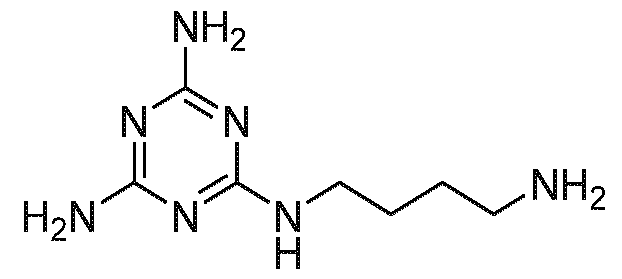
- ESI-MS confirms the formation of a compound comprising three methoxy groups con- nected to the silicon atom.
- compounds comprising one, two, or three DEGBE moieties instead of respective methoxy groups also have been identified.
- ESI-MS confirms the formation of a compound comprising three methoxy groups con nected to the silicon atom.
- compounds comprising one, two, or three DEGBE moieties instead of respective methoxy groups also have been identified.
- Samples 1 to 12 (each comprising several identical specimens) were prepared as follows.
- a comparison example C1 has been prepared according to the same method but without step (ii), i.e. no silane has been applied.
- Table 1 gives an overview on the reaction steps which are then described in more detail thereafter.
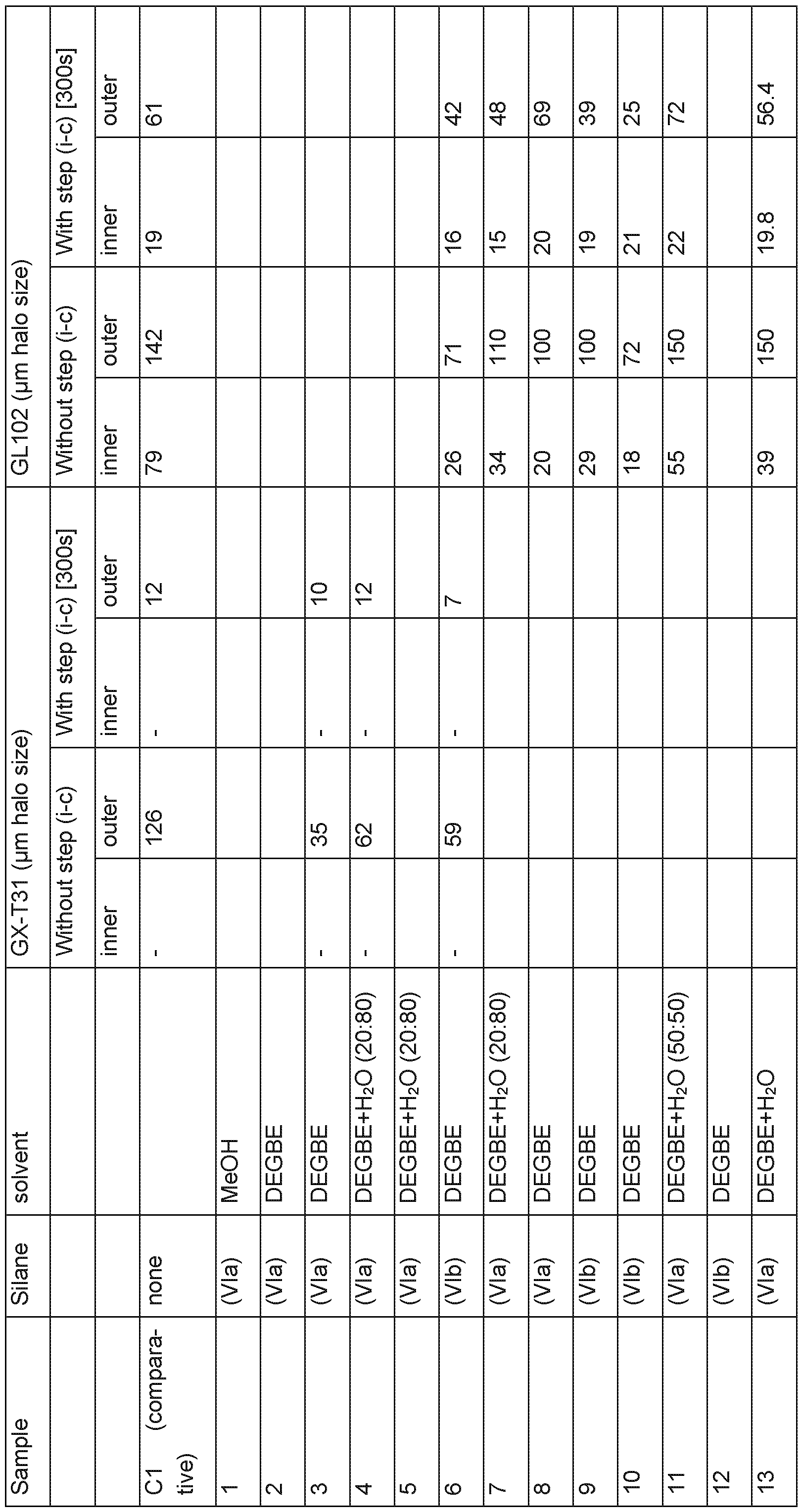
- Table 2 provides an additional summary.
- Copper foils having a copper surface were used. Under simplified laboratory conditions, copper foils without substrates are used for the examples.
- the preparation conditions are as follows:
- Electrolytically plated copper type foil (adhesion test) panels (wedge void)
- the copper surfaces of the copper foils were treated by 25ml/l Hyperflash 25, 50ml/l H2SO4 50% and 65ml/l H2O235% at 30°C to achieve 0.5 or 1 pm etch depth. After the etch-clean ing the etch-cleaned copper surfaces were rinsed with water for approximately 30 seconds and optionally dried. As a result, etch-cleaned and rinsed copper surfaces were obtained.
- the copper foils for samples 1 to 12 containing the silanized copper surfaces were then annealed for 30 minutes at 130°C to remove remaining moisture from the surface. These substrates containing copper surfaces were subsequently subjected to laminating a build up film (see text below).
- an insulating film (see Table 2) was vacuum laminated onto the cop- per foils of all samples in a clean room with a room temperature in the range from 20 to 25°C and with a relative humidity of 50 to 60% by using a vacuum laminator.
- HAST HAST conditions: 130°C, 85 % rh, HAST chamber: EHS-221M.
- the obtained copper surfaces with structurally enforced insulating films were then cured in an oven: copper surfaces with GL102 material at 200°C for 90 minutes and copper sur faces with GX-T31 material at 190 C for 90 min.
- each copper surfaces with structurally enforced insulating films was sliced into said strip-type fragments (10x100 mm, Bugard drilling/routing).
- the strip-type fragments were subjected to a peel force measuring machine (Roell Zwick Z010) to individually evaluate the peel strength (angle: 90°, speed: 50 mm/min) which is needed to delaminate the copper surface from its respective structurally enforced insulat ing films.
- the peel strength angle: 90°, speed: 50 mm/min
- the copper samples have been prepared by adhering the respective insulating films to copper panels. As a result, copper surfaces with structurally enforced insulating films were obtained.
- the obtained copper surfaces with structurally enforced insulating films were then semi- cured in two steps in the ovens: copper surfaces with GL102 material at 130°C for 30 minutes followed by 175°C for 30 minutes; and copper surfaces with GX-T31 material at 100°C for 30 minutes followed by 170°C for 30 minutes.
- the copper panels were lasered with UV-laser to drill the blind micro vias (BMV). Thereafter, the substrates were subjected to the desmear and reduction condition steps. In particular, these included a sweller treat ment under alkaline conditions with Securiganth MV Sweller (Atotech); a permanganate treatment under alkaline conditions with Securiganth MV Etch P (Atotech) and a reduction conditioner treatment under acidic conditions with Securiganth MV Reduction Conditioner (Atotech). After each step the sample were rinsed with water. The lamination material exhibits a thickness of ca. 10 pm for wedge void and halo and 35 pm in case of adhesion investigations, respectively.
- the investigated test Blind Micro Via ' s are manufactured as a test grid on surface treated and Ajinomoto Buildup Film (ABF) laminated test vehicles by utilizing Laser Drilling technology.
- the halo data is obtainable after sending the prepared test vehicles through entire Desmear process (Sweller, Permanganate, Reduction Conditioner) as described above.
- Halo measurement is performed by camera (CCD) supported light microscopy.
- CCD camera
- DF Darkfield
- the fully processed test vehicles are firmly installed on the measurement table and the BMV capture pad must be set as optical focus.
- CCD exposure time must be adjusted to the maximum possible contrast of halo boundaries.
- the capture pad should appear as bright as possible.
- Inner Halo( j um) (Inner Diameter of Halo( j um) - Diameter of Via Hole(jum))/2
- this process is iterated at least 3 times at random test vias to enable minimal statistical statements.
- FIB Focused Ion Beam
- SEM Scanning Electron Microscopy
Landscapes
- Chemical & Material Sciences (AREA)
- Organic Chemistry (AREA)
- Chemical Kinetics & Catalysis (AREA)
- Engineering & Computer Science (AREA)
- Manufacturing & Machinery (AREA)
- Materials Engineering (AREA)
- Wood Science & Technology (AREA)
- General Chemical & Material Sciences (AREA)
- Life Sciences & Earth Sciences (AREA)
- Microelectronics & Electronic Packaging (AREA)
- Health & Medical Sciences (AREA)
- Medicinal Chemistry (AREA)
- Polymers & Plastics (AREA)
- Paints Or Removers (AREA)
- Other Surface Treatments For Metallic Materials (AREA)
- Non-Metallic Protective Coatings For Printed Circuits (AREA)
- Adhesives Or Adhesive Processes (AREA)
Abstract
Description




Claims


Priority Applications (4)
| Application Number | Priority Date | Filing Date | Title |
|---|---|---|---|
| CN202280027314.3A CN117136106A (en) | 2021-03-12 | 2022-03-11 | Triazinesilane compounds and their use as adhesion promoters |
| US18/550,148 US20240247009A1 (en) | 2021-03-12 | 2022-03-11 | Triazine silane compound and its usage as adhesion promotor |
| JP2023555631A JP7804690B2 (en) | 2021-03-12 | 2022-03-11 | Triazine silane compounds and their use as adhesion promoters |
| KR1020237034582A KR20230156930A (en) | 2021-03-12 | 2022-03-11 | Triazine silane compounds and their use as adhesion promoters |
Applications Claiming Priority (2)
| Application Number | Priority Date | Filing Date | Title |
|---|---|---|---|
| EP21162411.9 | 2021-03-12 | ||
| EP21162411.9A EP4056285A1 (en) | 2021-03-12 | 2021-03-12 | Triazine silane compound and its usage as adhesion promotor |
Publications (1)
| Publication Number | Publication Date |
|---|---|
| WO2022189646A1 true WO2022189646A1 (en) | 2022-09-15 |
Family
ID=74873653
Family Applications (1)
| Application Number | Title | Priority Date | Filing Date |
|---|---|---|---|
| PCT/EP2022/056367 Ceased WO2022189646A1 (en) | 2021-03-12 | 2022-03-11 | Triazine silane compound and its usage as adhesion promotor |
Country Status (6)
| Country | Link |
|---|---|
| US (1) | US20240247009A1 (en) |
| EP (1) | EP4056285A1 (en) |
| JP (1) | JP7804690B2 (en) |
| KR (1) | KR20230156930A (en) |
| CN (1) | CN117136106A (en) |
| WO (1) | WO2022189646A1 (en) |
Citations (10)
| Publication number | Priority date | Publication date | Assignee | Title |
|---|---|---|---|---|
| JPH0136819B2 (en) | 1982-12-27 | 1989-08-02 | Eisai Co Ltd | |
| US4876344A (en) * | 1987-12-09 | 1989-10-24 | Shin-Etsu Chemical Co., Ltd. | Novel organosilicon compounds |
| JP2007131556A (en) * | 2005-11-09 | 2007-05-31 | Iwate Univ | Functional triazine dithiol and method for producing the same |
| WO2007073756A1 (en) * | 2005-12-23 | 2007-07-05 | Fraunhofer-Gesellschaft Zur Foerderung Der Angewandten Forschung E.V. | Easy-to-clean, mechanically stable coating composition for metallic surfaces and process for coating a substrate using said composition |
| JP2016169300A (en) | 2015-03-12 | 2016-09-23 | 四国化成工業株式会社 | Surface treatment agent, resin composition and use thereof |
| US20160368935A1 (en) | 2013-07-02 | 2016-12-22 | Shikoku Chemicals Corporation | Azole silane compound, surface treatment solution, surface treatment method, and use thereof |
| JP2017002402A (en) | 2015-06-04 | 2017-01-05 | 四国化成工業株式会社 | Surface preparation agent, resin composition, and utilization of them |
| JP2018016865A (en) | 2016-07-29 | 2018-02-01 | 四国化成工業株式会社 | Surface treatment agent, resin composition, and utilization of them |
| WO2019243180A1 (en) | 2018-06-18 | 2019-12-26 | Atotech Deutschland Gmbh | Azole silane compound |
| WO2020178146A1 (en) | 2019-03-01 | 2020-09-10 | Atotech Deutschland Gmbh | Method for increasing adhesion strength between a metal and an organic material |
Family Cites Families (8)
| Publication number | Priority date | Publication date | Assignee | Title |
|---|---|---|---|---|
| US4874858A (en) * | 1988-03-28 | 1989-10-17 | The B. F. Goodrich Company | Triazine-containing multisilane coupling agents for coating glass fibers, for adhesives, and for protective coatings |
| DE10017654A1 (en) * | 2000-04-08 | 2001-10-18 | Degussa | Organosilicon compounds |
| JP5034036B2 (en) * | 2005-11-10 | 2012-09-26 | 国立大学法人岩手大学 | Surface reactive solid, manufacturing method of surface reactive solid, shape transfer mold, manufacturing method of shape transfer mold |
| CN102952158A (en) * | 2012-10-26 | 2013-03-06 | 大连理工大学 | Triazine type siloxane surface modifier and preparation method thereof |
| CN108176386B (en) * | 2018-01-16 | 2020-11-06 | 武汉轻工大学 | A kind of melamine bonded chromatographic stationary phase and preparation method thereof, and metal ion modified melamine bonded chromatographic stationary phase |
| KR102506583B1 (en) * | 2019-02-20 | 2023-03-03 | 주식회사 엘지화학 | Resin composition for semiconductor package, insulating layer for semiconductor package, and semiconductor package comprising the same |
| CN111961075B (en) * | 2020-08-24 | 2022-09-16 | 万华化学集团股份有限公司 | Silicon-nitrogen flame-retardant precursor and preparation method thereof, silicon-nitrogen hybridized flame-retardant sol and preparation method thereof |
| EP4057782A1 (en) * | 2021-03-12 | 2022-09-14 | Atotech Deutschland GmbH & Co. KG | Method for increasing adhesion strength between copper and an organic material and reducing halo and wedge void formation by modifying the copper surface and/or by using heteroaromatic silane compounds |
-
2021
- 2021-03-12 EP EP21162411.9A patent/EP4056285A1/en active Pending
-
2022
- 2022-03-11 US US18/550,148 patent/US20240247009A1/en active Pending
- 2022-03-11 KR KR1020237034582A patent/KR20230156930A/en active Pending
- 2022-03-11 CN CN202280027314.3A patent/CN117136106A/en active Pending
- 2022-03-11 WO PCT/EP2022/056367 patent/WO2022189646A1/en not_active Ceased
- 2022-03-11 JP JP2023555631A patent/JP7804690B2/en active Active
Patent Citations (12)
| Publication number | Priority date | Publication date | Assignee | Title |
|---|---|---|---|---|
| JPH0136819B2 (en) | 1982-12-27 | 1989-08-02 | Eisai Co Ltd | |
| US4876344A (en) * | 1987-12-09 | 1989-10-24 | Shin-Etsu Chemical Co., Ltd. | Novel organosilicon compounds |
| JP2007131556A (en) * | 2005-11-09 | 2007-05-31 | Iwate Univ | Functional triazine dithiol and method for producing the same |
| WO2007073756A1 (en) * | 2005-12-23 | 2007-07-05 | Fraunhofer-Gesellschaft Zur Foerderung Der Angewandten Forschung E.V. | Easy-to-clean, mechanically stable coating composition for metallic surfaces and process for coating a substrate using said composition |
| US20160368935A1 (en) | 2013-07-02 | 2016-12-22 | Shikoku Chemicals Corporation | Azole silane compound, surface treatment solution, surface treatment method, and use thereof |
| JP2016169300A (en) | 2015-03-12 | 2016-09-23 | 四国化成工業株式会社 | Surface treatment agent, resin composition and use thereof |
| JP2017002402A (en) | 2015-06-04 | 2017-01-05 | 四国化成工業株式会社 | Surface preparation agent, resin composition, and utilization of them |
| JP6370836B2 (en) | 2015-06-04 | 2018-08-08 | 四国化成工業株式会社 | Surface treatment agent, resin composition and use thereof |
| JP6392273B2 (en) | 2015-06-04 | 2018-09-19 | 四国化成工業株式会社 | Epoxy resin composition and use thereof |
| JP2018016865A (en) | 2016-07-29 | 2018-02-01 | 四国化成工業株式会社 | Surface treatment agent, resin composition, and utilization of them |
| WO2019243180A1 (en) | 2018-06-18 | 2019-12-26 | Atotech Deutschland Gmbh | Azole silane compound |
| WO2020178146A1 (en) | 2019-03-01 | 2020-09-10 | Atotech Deutschland Gmbh | Method for increasing adhesion strength between a metal and an organic material |
Non-Patent Citations (4)
| Title |
|---|
| "Corrosion protection of copper with 3-glycidoxypropyltrimethoxysilane-based sol-gel coating through 3-amino-5-mercapto-1,2,4-triazole doping", JOURNAL OF RESEARCH ON CHEMICAL INTERMEDIATES, vol. 42, 2015, pages 1315 - 1328 |
| "Recovery of rhodium-containing catalysts by silica-based chelating ion exchangers containing N and S donor atoms", JOURNAL OF INORGANICA CHIMICA ACTA, vol. 315, 2001, pages 183 - 190 |
| CHEM. EUR.J., vol. 15, 2009, pages 6279 - 6288 |
| MORI K: "One-step preparation of functional triazinedithiols", JP2007131556 A, vol. 0646, 1 January 2007 (2007-01-01), pages 1 - 1, XP055825735 * |
Also Published As
| Publication number | Publication date |
|---|---|
| EP4056285A1 (en) | 2022-09-14 |
| KR20230156930A (en) | 2023-11-15 |
| US20240247009A1 (en) | 2024-07-25 |
| JP7804690B2 (en) | 2026-01-22 |
| JP2024510987A (en) | 2024-03-12 |
| TW202248204A (en) | 2022-12-16 |
| CN117136106A (en) | 2023-11-28 |
Similar Documents
| Publication | Publication Date | Title |
|---|---|---|
| KR101632450B1 (en) | Adhesion promotion of metal to laminate with a multi-functional compound | |
| JP7421559B2 (en) | Metal surface treatment liquid and its concentrate, metal surface treatment liquid set and surface treatment method, and printed wiring board manufacturing method | |
| CN101137768B (en) | Surface treatment method for copper and copper | |
| US5022968A (en) | Method and composition for depositing a chromium-zinc anti-tarnish coating on copper foil | |
| US5098796A (en) | Chromium-zinc anti-tarnish coating on copper foil | |
| JP3072839B2 (en) | Improved zinc-chromium stabilizer containing hydrogen suppression additive | |
| US5230932A (en) | Chromium-zinc anti-tarnish coating for copper foil | |
| KR102820130B1 (en) | Method for increasing the bond strength between metal and organic material | |
| US5356527A (en) | Method for rinsing copper or copper base alloy foil after an anti-tarnish treatment | |
| WO2022189646A1 (en) | Triazine silane compound and its usage as adhesion promotor | |
| US20240179851A1 (en) | Modified copper surface, heteroaromatic silane compounds and their usage for increasing adhesion strength between copper and an organic material and reducing halo and wedge void formation | |
| WO2023127679A1 (en) | Surface treatment liquid for metal | |
| JP2018145475A (en) | Rust-prevention treatment liquid and its application | |
| TWI913437B (en) | Triazine silane compound and its usage as adhesion promotor | |
| EP4459007A1 (en) | Organic coating and method for producing same | |
| CN112088584B (en) | Method for increasing the adhesion strength between a copper or copper alloy surface and an organic layer | |
| CA1045909A (en) | Processes and products of sensitizing substrates | |
| KR20260057414A (en) | Tetrazole compounds, methods for synthesizing said tetrazole compounds, and uses thereof |
Legal Events
| Date | Code | Title | Description |
|---|---|---|---|
| 121 | Ep: the epo has been informed by wipo that ep was designated in this application |
Ref document number: 22712582 Country of ref document: EP Kind code of ref document: A1 |
|
| WWE | Wipo information: entry into national phase |
Ref document number: 2023555631 Country of ref document: JP |
|
| WWE | Wipo information: entry into national phase |
Ref document number: 18550148 Country of ref document: US |
|
| ENP | Entry into the national phase |
Ref document number: 20237034582 Country of ref document: KR Kind code of ref document: A |
|
| WWE | Wipo information: entry into national phase |
Ref document number: 1020237034582 Country of ref document: KR |
|
| NENP | Non-entry into the national phase |
Ref country code: DE |
|
| 122 | Ep: pct application non-entry in european phase |
Ref document number: 22712582 Country of ref document: EP Kind code of ref document: A1 |