WO2022185877A1 - ナノ粒子触媒とルイス酸とを含む触媒組成物、および水素化化合物の製造方法 - Google Patents
ナノ粒子触媒とルイス酸とを含む触媒組成物、および水素化化合物の製造方法 Download PDFInfo
- Publication number
- WO2022185877A1 WO2022185877A1 PCT/JP2022/005404 JP2022005404W WO2022185877A1 WO 2022185877 A1 WO2022185877 A1 WO 2022185877A1 JP 2022005404 W JP2022005404 W JP 2022005404W WO 2022185877 A1 WO2022185877 A1 WO 2022185877A1
- Authority
- WO
- WIPO (PCT)
- Prior art keywords
- catalyst
- lewis acid
- metal
- catalyst composition
- rhodium
- Prior art date
- Legal status (The legal status is an assumption and is not a legal conclusion. Google has not performed a legal analysis and makes no representation as to the accuracy of the status listed.)
- Ceased
Links
Images

Classifications
-
- B—PERFORMING OPERATIONS; TRANSPORTING
- B01—PHYSICAL OR CHEMICAL PROCESSES OR APPARATUS IN GENERAL
- B01J—CHEMICAL OR PHYSICAL PROCESSES, e.g. CATALYSIS OR COLLOID CHEMISTRY; THEIR RELEVANT APPARATUS
- B01J31/00—Catalysts comprising hydrides, coordination complexes or organic compounds
- B01J31/26—Catalysts comprising hydrides, coordination complexes or organic compounds containing in addition, inorganic metal compounds not provided for in groups B01J31/02 - B01J31/24
- B01J31/28—Catalysts comprising hydrides, coordination complexes or organic compounds containing in addition, inorganic metal compounds not provided for in groups B01J31/02 - B01J31/24 of the platinum group metals, iron group metals or copper
-
- C—CHEMISTRY; METALLURGY
- C07—ORGANIC CHEMISTRY
- C07B—GENERAL METHODS OF ORGANIC CHEMISTRY; APPARATUS THEREFOR
- C07B61/00—Other general methods
-
- C—CHEMISTRY; METALLURGY
- C07—ORGANIC CHEMISTRY
- C07C—ACYCLIC OR CARBOCYCLIC COMPOUNDS
- C07C13/00—Cyclic hydrocarbons containing rings other than, or in addition to, six-membered aromatic rings
- C07C13/02—Monocyclic hydrocarbons or acyclic hydrocarbon derivatives thereof
- C07C13/16—Monocyclic hydrocarbons or acyclic hydrocarbon derivatives thereof with a six-membered ring
- C07C13/18—Monocyclic hydrocarbons or acyclic hydrocarbon derivatives thereof with a six-membered ring with a cyclohexane ring
-
- C—CHEMISTRY; METALLURGY
- C07—ORGANIC CHEMISTRY
- C07C—ACYCLIC OR CARBOCYCLIC COMPOUNDS
- C07C209/00—Preparation of compounds containing amino groups bound to a carbon skeleton
- C07C209/68—Preparation of compounds containing amino groups bound to a carbon skeleton from amines, by reactions not involving amino groups, e.g. reduction of unsaturated amines, aromatisation, or substitution of the carbon skeleton
- C07C209/70—Preparation of compounds containing amino groups bound to a carbon skeleton from amines, by reactions not involving amino groups, e.g. reduction of unsaturated amines, aromatisation, or substitution of the carbon skeleton by reduction of unsaturated amines
- C07C209/72—Preparation of compounds containing amino groups bound to a carbon skeleton from amines, by reactions not involving amino groups, e.g. reduction of unsaturated amines, aromatisation, or substitution of the carbon skeleton by reduction of unsaturated amines by reduction of six-membered aromatic rings
-
- C—CHEMISTRY; METALLURGY
- C07—ORGANIC CHEMISTRY
- C07C—ACYCLIC OR CARBOCYCLIC COMPOUNDS
- C07C211/00—Compounds containing amino groups bound to a carbon skeleton
- C07C211/33—Compounds containing amino groups bound to a carbon skeleton having amino groups bound to carbon atoms of rings other than six-membered aromatic rings
- C07C211/34—Compounds containing amino groups bound to a carbon skeleton having amino groups bound to carbon atoms of rings other than six-membered aromatic rings of a saturated carbon skeleton
- C07C211/35—Compounds containing amino groups bound to a carbon skeleton having amino groups bound to carbon atoms of rings other than six-membered aromatic rings of a saturated carbon skeleton containing only non-condensed rings
-
- C—CHEMISTRY; METALLURGY
- C07—ORGANIC CHEMISTRY
- C07C—ACYCLIC OR CARBOCYCLIC COMPOUNDS
- C07C213/00—Preparation of compounds containing amino and hydroxy, amino and etherified hydroxy or amino and esterified hydroxy groups bound to the same carbon skeleton
- C07C213/08—Preparation of compounds containing amino and hydroxy, amino and etherified hydroxy or amino and esterified hydroxy groups bound to the same carbon skeleton by reactions not involving the formation of amino groups, hydroxy groups or etherified or esterified hydroxy groups
-
- C—CHEMISTRY; METALLURGY
- C07—ORGANIC CHEMISTRY
- C07C—ACYCLIC OR CARBOCYCLIC COMPOUNDS
- C07C217/00—Compounds containing amino and etherified hydroxy groups bound to the same carbon skeleton
- C07C217/52—Compounds containing amino and etherified hydroxy groups bound to the same carbon skeleton having etherified hydroxy groups or amino groups bound to carbon atoms of rings other than six-membered aromatic rings of the same carbon skeleton
-
- C—CHEMISTRY; METALLURGY
- C07—ORGANIC CHEMISTRY
- C07C—ACYCLIC OR CARBOCYCLIC COMPOUNDS
- C07C227/00—Preparation of compounds containing amino and carboxyl groups bound to the same carbon skeleton
- C07C227/14—Preparation of compounds containing amino and carboxyl groups bound to the same carbon skeleton from compounds containing already amino and carboxyl groups or derivatives thereof
- C07C227/16—Preparation of compounds containing amino and carboxyl groups bound to the same carbon skeleton from compounds containing already amino and carboxyl groups or derivatives thereof by reactions not involving the amino or carboxyl groups
-
- C—CHEMISTRY; METALLURGY
- C07—ORGANIC CHEMISTRY
- C07C—ACYCLIC OR CARBOCYCLIC COMPOUNDS
- C07C229/00—Compounds containing amino and carboxyl groups bound to the same carbon skeleton
- C07C229/02—Compounds containing amino and carboxyl groups bound to the same carbon skeleton having amino and carboxyl groups bound to acyclic carbon atoms of the same carbon skeleton
- C07C229/04—Compounds containing amino and carboxyl groups bound to the same carbon skeleton having amino and carboxyl groups bound to acyclic carbon atoms of the same carbon skeleton the carbon skeleton being acyclic and saturated
- C07C229/06—Compounds containing amino and carboxyl groups bound to the same carbon skeleton having amino and carboxyl groups bound to acyclic carbon atoms of the same carbon skeleton the carbon skeleton being acyclic and saturated having only one amino and one carboxyl group bound to the carbon skeleton
- C07C229/10—Compounds containing amino and carboxyl groups bound to the same carbon skeleton having amino and carboxyl groups bound to acyclic carbon atoms of the same carbon skeleton the carbon skeleton being acyclic and saturated having only one amino and one carboxyl group bound to the carbon skeleton the nitrogen atom of the amino group being further bound to acyclic carbon atoms or to carbon atoms of rings other than six-membered aromatic rings
- C07C229/14—Compounds containing amino and carboxyl groups bound to the same carbon skeleton having amino and carboxyl groups bound to acyclic carbon atoms of the same carbon skeleton the carbon skeleton being acyclic and saturated having only one amino and one carboxyl group bound to the carbon skeleton the nitrogen atom of the amino group being further bound to acyclic carbon atoms or to carbon atoms of rings other than six-membered aromatic rings to carbon atoms of carbon skeletons containing rings
-
- C—CHEMISTRY; METALLURGY
- C07—ORGANIC CHEMISTRY
- C07C—ACYCLIC OR CARBOCYCLIC COMPOUNDS
- C07C41/00—Preparation of ethers; Preparation of compounds having groups, groups or groups
- C07C41/01—Preparation of ethers
- C07C41/18—Preparation of ethers by reactions not forming ether-oxygen bonds
- C07C41/20—Preparation of ethers by reactions not forming ether-oxygen bonds by hydrogenation of carbon-to-carbon double or triple bonds
-
- C—CHEMISTRY; METALLURGY
- C07—ORGANIC CHEMISTRY
- C07C—ACYCLIC OR CARBOCYCLIC COMPOUNDS
- C07C43/00—Ethers; Compounds having groups, groups or groups
- C07C43/02—Ethers
- C07C43/18—Ethers having an ether-oxygen atom bound to a carbon atom of a ring other than a six-membered aromatic ring
- C07C43/184—Ethers having an ether-oxygen atom bound to a carbon atom of a ring other than a six-membered aromatic ring to a carbon atom of a non-condensed ring
-
- C—CHEMISTRY; METALLURGY
- C07—ORGANIC CHEMISTRY
- C07C—ACYCLIC OR CARBOCYCLIC COMPOUNDS
- C07C5/00—Preparation of hydrocarbons from hydrocarbons containing the same number of carbon atoms
- C07C5/02—Preparation of hydrocarbons from hydrocarbons containing the same number of carbon atoms by hydrogenation
- C07C5/10—Preparation of hydrocarbons from hydrocarbons containing the same number of carbon atoms by hydrogenation of aromatic six-membered rings
-
- C—CHEMISTRY; METALLURGY
- C07—ORGANIC CHEMISTRY
- C07D—HETEROCYCLIC COMPOUNDS
- C07D215/00—Heterocyclic compounds containing quinoline or hydrogenated quinoline ring systems
- C07D215/02—Heterocyclic compounds containing quinoline or hydrogenated quinoline ring systems having no bond between the ring nitrogen atom and a non-ring member or having only hydrogen atoms or carbon atoms directly attached to the ring nitrogen atom
- C07D215/04—Heterocyclic compounds containing quinoline or hydrogenated quinoline ring systems having no bond between the ring nitrogen atom and a non-ring member or having only hydrogen atoms or carbon atoms directly attached to the ring nitrogen atom with only hydrogen atoms or radicals containing only hydrogen and carbon atoms, directly attached to the ring carbon atoms
-
- C—CHEMISTRY; METALLURGY
- C07—ORGANIC CHEMISTRY
- C07D—HETEROCYCLIC COMPOUNDS
- C07D215/00—Heterocyclic compounds containing quinoline or hydrogenated quinoline ring systems
- C07D215/02—Heterocyclic compounds containing quinoline or hydrogenated quinoline ring systems having no bond between the ring nitrogen atom and a non-ring member or having only hydrogen atoms or carbon atoms directly attached to the ring nitrogen atom
- C07D215/04—Heterocyclic compounds containing quinoline or hydrogenated quinoline ring systems having no bond between the ring nitrogen atom and a non-ring member or having only hydrogen atoms or carbon atoms directly attached to the ring nitrogen atom with only hydrogen atoms or radicals containing only hydrogen and carbon atoms, directly attached to the ring carbon atoms
- C07D215/06—Heterocyclic compounds containing quinoline or hydrogenated quinoline ring systems having no bond between the ring nitrogen atom and a non-ring member or having only hydrogen atoms or carbon atoms directly attached to the ring nitrogen atom with only hydrogen atoms or radicals containing only hydrogen and carbon atoms, directly attached to the ring carbon atoms having only hydrogen atoms, hydrocarbon or substituted hydrocarbon radicals, attached to the ring nitrogen atom
-
- C—CHEMISTRY; METALLURGY
- C07—ORGANIC CHEMISTRY
- C07D—HETEROCYCLIC COMPOUNDS
- C07D265/00—Heterocyclic compounds containing six-membered rings having one nitrogen atom and one oxygen atom as the only ring hetero atoms
- C07D265/28—1,4-Oxazines; Hydrogenated 1,4-oxazines
- C07D265/34—1,4-Oxazines; Hydrogenated 1,4-oxazines condensed with carbocyclic rings
- C07D265/38—[b, e]-condensed with two six-membered rings
Definitions
- the present invention relates to a catalyst composition containing a metal nanoparticle catalyst supporting two or more metals on a carrier and a Lewis acid, and a method for producing a hydrogenated compound using the catalyst composition.
- Non-Patent Document 1 discloses a high pressure of 10 atmospheres.
- the Rh-Pt/DMPSi-Al 2 O 3 catalyst which is a rhodium-platinum alloy nanoparticle catalyst in which rhodium-platinum alloy nanoparticles are supported on a polysilane/alumina composite support, is an aromatic compound with low steric hindrance such as toluene.
- Non-Patent Document 2 This is because the hydrogenation reaction is promoted by simultaneously adsorbing the aromatic compound and hydrogen on the surface of the alloy nanoparticles.
- the aromatic compound contains multiple substituents, bulky substituents, or electron-donating groups such as amino groups, hydroxyl groups, alkoxy groups, and alkyl groups that increase the electron density of the aromatic ring, the reactivity decreases.
- it has the problem of requiring severe reaction conditions such as high temperature and high pressure and a long reaction time.
- An object of the present invention is to provide a method for efficiently producing hydrogenated compounds corresponding to unsaturated compounds having multiple substituents, bulky substituents, etc. under relatively mild conditions in a short period of time. be.
- the present inventors found that by adding a catalytic amount of a Lewis acid to a metal nanoparticle catalyst in which two or more specific metals are supported on a carrier, the Lewis acid is a metal
- the hydrogenation reaction is promoted by interacting with the unsaturated compound adsorbed on the nanoparticle catalyst and reducing the electron density thereof, thereby completing the present invention.
- a catalyst composition comprising a metal nanoparticle catalyst in which two or more metals selected from platinum, rhodium, gold, nickel and ruthenium are supported on a carrier, and a Lewis acid.
- the support is (i) a polysilane support, or (ii) a composite support composed of polysilane and alumina or a metal oxide of zirconia, titania, or silicon dioxide. .
- the metal nanoparticle catalyst is a rhodium-platinum catalyst in which rhodium and platinum are supported on a composite support of polyphenylmethylsilane (MPPSi) and alumina, or rhodium and platinum are polydimethylsilane (DMPSi) and alumina , or a rhodium-platinum catalyst supported on a composite support with a metal oxide of zirconia, titania or silicon dioxide.
- MPPSi polyphenylmethylsilane
- DMPSi polydimethylsilane
- DMPSi polydimethylsilane
- the Lewis acid is a cation of a metal selected from lanthanide metals, titanium, zirconium, zinc, and silver, triflate ion (CF 3 SO 3 ⁇ ), perchlorate ion (ClO 4 ⁇ ), sulfonate;
- the catalyst composition according to (1) formed from ions (SO 3 ⁇ ), bis(trifluoromethanesulfonyl)imide ions (NTf 2 ⁇ ), and anions selected from halide ions.
- the Lewis acid comprises a metal cation selected from scandium, yttrium, ytterbium, hafnium, lanthanum, titanium, zirconium, zinc, and silver, triflate ion (CF 3 SO 3 ⁇ ), perchlorate ion ( ClO 4 ⁇ ), C 1-12 alkylsulfonate ion (C 1-12 alkyl-SO 3 ⁇ ), C 1-12 alkylbenzenesulfonate ion (C 1-12 alkyl-C 6 H 4 —SO 3 ⁇ ), bis( A catalyst composition according to (1) or (4), formed from a trifluoromethanesulfonyl)imide ion (NTf 2 ⁇ ) and an anion selected from halide ions.
- a metal cation selected from scandium, yttrium, ytterbium, hafnium, lanthanum, titanium, zirconium, zinc, and silver, triflate ion (
- the Lewis acid is scandium (III) triflate (Sc(OTf) 3 ), ytterbium (III) triflate (Yb(OTf) 3 ), or a combination thereof, (1), (4) or ( 5) The catalyst composition described in 5).
- the metal nanoparticle catalyst is Rh—Pt/DMPSi—Al 2 O 3 and the Lewis acid is Sc(OTf) 3 or Yb(OTf) 3
- a catalyst composition according to claim 1. A method for hydrogenating an unsaturated compound, using hydrogen gas as a hydrogen source and carrying out in the presence of the catalyst composition according to any one of (1) to (7).
- (9) A method for producing a hydrogenated compound, comprising contacting an unsaturated compound with hydrogen gas in the presence of the catalyst composition according to any one of (1) to (7).
- (10) The production method according to (9), wherein the unsaturated compound is an aromatic compound or an aromatic heterocyclic compound.
- (12) The production method according to any one of (9) to (11), wherein the Lewis acid is used in an amount of 1 to 100 times the total amount of metal in the metal nanoparticle catalyst.
- (13) The production method according to any one of (9) to (12), which is carried out under normal pressure.
- (14) The production method according to any one of (9) to (13), which is carried out at a temperature range of room temperature to 80°C.
- the catalyst composition of the present invention By using the catalyst composition of the present invention, unsaturated compounds can be efficiently converted to the corresponding hydrogenated compounds under mild conditions.
- the catalyst composition of the present invention promotes the hydrogenation reaction of unsaturated compounds having multiple substituents or bulky substituents under mild conditions.
- FIG. 1 is a graph showing changes over time in the hydrogenation reaction when the amount of scandium triflate (Sc(OTf) 3 ) added is varied.
- FIG. 2 is a graph showing the correlation between the amount of Sc(OTf) 3 added and the reaction rate of the hydrogenation reaction.
- the catalyst composition of the present invention contains a metal nanoparticle catalyst in which two or more specific metals are supported on a carrier, and a Lewis acid.
- a metal nanoparticle catalyst in which two or more specific metals are supported on a carrier, and a Lewis acid.
- the Lewis acid interacts with the unsaturated compound adsorbed on the metal nanoparticle catalyst to reduce its electron density, resulting in a metal nanoparticle
- the catalyst and Lewis acid can cooperatively activate the unsaturated compound and greatly increase the rate of the hydrogenation reaction.
- Metals include, for example, titanium, zirconium, vanadium, tantalum, chromium, molybdenum, tungsten, manganese, rhenium, iron, ruthenium, osmium, cobalt, rhodium, iridium, nickel, palladium, gold, platinum, copper, tin, and selenium. and preferably selected from the group consisting of platinum, rhodium, gold, nickel and ruthenium.
- Rh--Pt rhodium and platinum
- Rh--Pd rhodium and palladium
- Rh--Pt--Pd rhodium, platinum and palladium
- the amount of Rh supported on the Rh—Pt alloy nanoparticle catalyst is, for example, 0.01% by mass or more based on the total weight of the Rh—Pt alloy nanoparticle catalyst. It may be present, preferably 0.03% by mass or more, more preferably 0.05% by mass or more.
- the amount of Rh carried in the Rh—Pt alloy nanoparticle catalyst may be, for example, 1.0% by mass or less, preferably 0.8% by mass or less, based on the total weight of the Rh—Pt alloy nanoparticle catalyst. More preferably, it is 0.6% by mass or less.
- the amount of Pt supported in the Rh—Pt alloy nanoparticle catalyst may be, for example, 0.01% by mass or more, preferably 0.03% by mass or more, more preferably 0.03% by mass or more, based on the total weight of the Rh—Pt alloy nanoparticle catalyst. is 0.05% by mass or more.
- the amount of Pt supported in the Rh—Pt alloy nanoparticle catalyst may be, for example, 1.5% by mass or less, preferably 1.2% by mass or less, based on the total weight of the Rh—Pt alloy nanoparticle catalyst. More preferably, it is 1.0% by mass or less.
- the molar ratio of Rh to Pt may be, for example, 0.2 or more, preferably 0.5 or more, 1.0 or more, more preferably 1.5. That's it. With such a molar ratio, Pt is arranged more efficiently around Rh, and as a result, the reaction activity due to the Rh-Pt interaction is improved, and catalyst deterioration is suppressed. Also, the molar ratio (Rh/Pt) may be, for example, 20 or less, preferably 10 or less, and more preferably 6.0 or less. By setting such a molar ratio, it is possible to avoid reduction of active sites due to excessive Pt coating, and more efficiently obtain reaction activity with a small amount of metal.
- the average particle size of the metal nanoparticles contained in the catalyst is preferably about 0.1 to about 1000 nm, preferably about 1 to about 800 nm, preferably about 1 to about 500 nm, preferably about 1 to about 300 nm, preferably About 1 to about 100 nm, preferably about 2 to about 50 nm, preferably about 2 to about 10 nm, more preferably about 2 to 5 nm.
- the carrier may be an inorganic carrier such as a metal oxide selected from polysilane; alumina, zirconia, titania, silicon dioxide, etc., or an organic carrier such as carbon, carbon black, carbon fiber, carbon nanotube, polystyrene.
- the carrier may also be a composite carrier of two or more kinds, for example, a composite carrier of polysilane and alumina, or a composite carrier of polysilane and a metal oxide such as zirconia, titania, or silicon dioxide.
- TON catalyst turnover number
- polysilane is preferable because it can stabilize metal nanoparticles with relatively weak multipoint interactions.
- silicon-silicon bonds in polysilane are believed to contribute to the stabilization of nanoparticles.
- the carrier in the present invention includes polyphenylmethylsilane (MPPSi)/alumina composite carrier, polydimethylsilane (DMPSi)/alumina composite carrier, polydimethylsilane (DMPSi)/zirconia composite carrier, and polydimethylsilane (DMPSi)/titania composite carrier.
- a carrier is preferably used.
- the metal nanoparticle catalyst supported on a carrier in the present invention includes a rhodium-platinum nanoparticle catalyst supported on a MPPSi/alumina composite support (Rh—Pt/MPPSi—Al 2 O 3 ), or a DMPSi/alumina composite support.
- a rhodium-platinum nanoparticle catalyst (Rh--Pt/DMPSi--Al 2 O 3 ) is preferably used.
- the ratio of the metal nanoparticles in the carrier supporting the metal nanoparticles is preferably 0.01 to 10.00% by mass, more preferably 0.05 to 10.00% by mass. is preferably 0.1 to 10.00% by mass, preferably 0.1 to 8.00% by mass, more preferably 0.1 to 5.00% by mass preferable.
- Alloy nanoparticles and methods of supporting alloy nanoparticles on carriers are well known in the art.
- it can be prepared by suspending polydimethylsilane in a solvent in which a reducing agent is dissolved, adding a solution in which two kinds of metal salts are dissolved, and then adding alumina.
- the metal salt reacts with the reducing agent to form alloy nanoparticles, which are immediately supported on the support.
- the Lewis acid is not particularly limited as long as it is a Lewis acid commonly used in the field, but examples include triflate ion (CF 3 SO 3 ⁇ ), perchlorate ion (ClO 4 ⁇ ), sulfonate ion (SO 3 ⁇ ) (for example, C 1-12 alkylsulfonate ion (C 1-12 alkyl-SO 3 ⁇ ), C 1-12 alkylbenzenesulfonate ion (C 1-12 alkyl-C 6 H 4 —SO 3 ⁇ )), bis Those having an anion selected from (trifluoromethanesulfonyl)imide ion (NTf 2 ⁇ ) and halide ion are mentioned.
- metal elements constituting the Lewis acid include group 3 elements such as scandium, yttrium, and lanthanides (e.g., lanthanum and ytterbium); group 4 elements such as hafnium, titanium, and zirconium; and group 11 elements such as copper, silver, and gold.
- group 13 elements such as boron, aluminum, gallium, indium, thallium; calcium, iron, zinc and the like.
- metal ions selected from scandium, yttrium, ytterbium, hafnium, lanthanum, titanium, zirconium, zinc, and silver, triflate ions (CF 3 SO 3 ⁇ ), and perchlorate ions (ClO 4 ⁇ ).
- CF 3 SO 3 ⁇ triflate ions
- ClO 4 ⁇ perchlorate ions
- SO 3 ⁇ sulfonate ions
- NTf 2 ⁇ bis(trifluoromethanesulfonyl)imide ions
- anions selected from halogen ions selected from halogen ions.
- metal triflates such as scandium (III) triflate (Sc(OTf) 3 ), ytterbium (III) triflate (Yb(OTf) 3 ), indium triflate (In(OTf) 3 ); metal triflimides such as bis(trifluoromethanesulfonyl)imide (Yb( NTf2 ) 3 ); metal fluorides, metal chlorides, metal bromides, metal iodides (e.g., titanium chloride, titanium bromide, zirconium chloride, zirconium bromide); , copper chloride, copper bromide, etc., silver chloride, silver bromide, gold chloride, gold bromide, boron trifluoride, boron trichloride, boron tribromide, aluminum chloride, aluminum bromide, gallium chloride, gallium bromide , indium chloride, indium bromide, thallium chloride, thallium bromide,
- metal triflates are strong Lewis acids because they have a trifluoromethanesulfonyl group, which is a strong electron-withdrawing group. Since it does not decompose even if it is present, it is applicable to solvent systems containing alcohols, hydrous reactions, reactions in water, and substrates containing hydroxyl groups and carboxyl groups, which is preferable.
- metal triflates scandium (III) triflate (Sc(OTf) 3 ), ytterbium (III) triflate (Yb(OTf) 3 ), or combinations thereof are preferred.
- the metal nanoparticle catalyst is 0.01 to 5 mol%, preferably 0.05 to 5 mol%, preferably 0.1 in total metal amount of the metal nanoparticle catalyst with respect to the unsaturated compound. ⁇ 5 mol%, preferably 0.1 to 4 mol%, preferably 0.1 to 3 mol%, preferably 0.1 to 2 mol%, preferably 0.1 to 1 mol%, preferably 0.1 ⁇ 0.9 mol%, preferably 0.1 to 0.8 mol%, preferably 0.1 to 0.7 mol%, preferably 0.1 to 0.6 mol%, preferably 0.1 to 0 .5 mol %, preferably 0.1 to 0.4 mol %, preferably 0.1 to 0.3 mol %, preferably 0.1 to 0.2 mol %.
- the Lewis acid is 1-100 times, preferably 1-fold, 2-fold, 3-fold, 4-fold, 5-fold, 6-fold, 7-fold, 8-fold, 9-fold the total metal molar amount of the metal nanoparticle catalyst. , 10-fold, 15-fold, 20-fold, 50-fold, 70-fold, 90-fold.
- the substrate is not particularly limited as long as it is an organic compound having an unsaturated bond, and may be a cyclic compound or an aliphatic compound.
- cyclic compounds include benzene-based aromatic compounds, aromatic heterocyclic compounds, and non-benzene-based aromatic compounds.
- Benzene-based aromatic compound means a monocyclic or polycyclic (condensed) hydrocarbon compound exhibiting aromaticity, specifically, for example, benzene, toluene, xylene, cresol, catechol, anisole, styrene , aniline, naphthalene, anthracene, phenanthrene, and the like.
- the aromatic heterocyclic compound is an aromatic monocyclic or polycyclic compound containing 1 to 4 heteroatoms selected from oxygen atoms, sulfur atoms and nitrogen atoms in addition to carbon atoms as ring-constituting atoms. means a (fused) heterocyclic compound.
- Monocyclic aromatic heterocycles include, for example, furan, thiophene, pyridine, pyrimidine, pyridazine, pyrazinel, pyrrole, imidazone, pyrazine, triazine, pyrazole, thiazoline, isothiazoline, oxazoline, isoxazoline, oxadiazoline, thiadiazoline, triazoline , tetrazoline, triazine, and the like.
- the polycyclic (condensed) aromatic heterocycle means a ring in which the above monocyclic aromatic heterocycle is condensed with a monocyclic aromatic ring (preferably a benzene ring or a monocyclic aromatic heterocycle).
- quinoline isoquinoline, quinazoline, quinoxaline, benzofuran, benzothiophene, benzoxazole, benzisoxazole, benzothiazole, benzisothiazole, benzimidazole, benzotriazole, indole, indazole, pyrrolopyridine, pyrazolopyridine, imidazopyridine , thienopyridine, pyrrolopyrazinine, pyrazolopyrazinine, imidazopyrazinine, thienopyrazinine, pyrrolopyrimidine, pyrazolopyrimidine, imidazopyrimidine, thienopyrimidine, pyrazolothiophene, fluorene, carbazole, dibenzofuran, acridine, phenazine, phenoxazine, phenothiazine, phenoxatin, etc. is mentioned.
- the unsaturated compound which is a substrate, may have a plurality of substituents, and the number of substituents and the bulkiness of the substituents do not matter.
- Substituents include C 1-6 alkyl, C 1-6 alkoxy, carboxy, hydroxy, halogen, nitro, cyano, carbamoyl and the like.
- benzene-based aromatic compounds having such substituents include ethylbenzene, n-propylbenzene, iso-propylbenzene, n-butylbenzene, iso-butylbenzene, tert-butylbenzene, n-heptylbenzene, n -hexylbenzene, n-heptylbenzene, n-octylbenzene, pn-propyltoluene, p-iso-propyltoluene, pn-butyltoluene, p-iso-butylbenzene, p-tert-butylbenzene, etc.
- the hydrogen atom of the amino group of aniline may be further substituted with C 1-6 alkyl, C 1-6 alkoxycarbonylmethyl or the like.
- aniline derivatives include N-methylaniline, Nn-propylaniline, N-iso-propylaniline, Nn-butylaniline, N,N-dimethylaniline, N,N-dimethyl-m -methylaniline, N,N-dimethyl-p-methyl-aniline, N,N-dimethyl-m-methoxycarbonylmethylaniline, N-methyl-N-ethoxycarbonylmethylaniline and the like.
- Bulky substituents include, for example, optionally substituted secondary or tertiary alkyl groups (e.g., secondary alkyl groups having 3 to 8 carbon atoms, tertiary alkyl groups having 4 to 8 carbon atoms, Alkyl groups, specifically isopropyl group, t-butyl group, 1,1-diethylpropyl group, 1,1-dimethylpentyl group, t-amyl group, etc.), optionally substituted cycloalkyl groups ⁇ for example, C 3-10 cycloalkyl group optionally substituted by a C 1-6 alkyl group, etc.), optionally substituted cycloalkenyl group (e.g., C 3-10 cycloalkenyl optionally substituted by an alkyl group) groups, etc.), optionally substituted aryl groups (e.g., halogen atoms, nitro groups, C 1-6 alkyl groups, C 6-10 aryl groups optionally substituted by alk
- the catalyst composition of the present invention may be used as a premixed metal nanoparticle catalyst and a Lewis acid, or may be added at the same time or in any order at the time of use.
- the catalyst composition of the present invention is particularly useful for hydrogenation reactions of aromatic compounds and aromatic heterocyclic compounds having a plurality of substituents and bulky substituents, and amino groups and hydroxyl groups that increase the electron density of aromatic rings. , an alkoxy group, an alkyl group, and other electron-donating groups.
- the hydrogen source is, for example, hydrogen gas.
- a mixed gas of hydrogen, nitrogen, argon, or the like may also be used. Such a mixed gas may be preferable from the point of view of safety.
- formic acid or formate, hydrazine can be used.
- the solvent is not particularly limited, and a polar solvent can also be used.
- a polar solvent can also be used.
- water alcoholic solvents such as ethanol and isopropanol; mixed solvents of water and alcoholic solvents; aliphatic hydrocarbon solvents such as hexane, methylcyclohexane, heptane, octane, nonane, and decane; diethyl ether, tetrahydrofuran, cyclopentyl
- ether solvents such as methyl ether and diisopropyl ether, dimethylformamide, dimethylsulfoxide, and ethyl acetate.
- the reaction system may be a normal batch synthesis system or a continuous flow synthesis system in which a metal nanoparticle catalyst is packed in a column and a substrate and a hydrogen source are circulated.
- a metal nanoparticle catalyst is packed in a column and a substrate and a hydrogen source are circulated.
- Lewis acids are usually dissolved in a substrate solution before use.
- hydrogenation catalysts have a high catalyst turnover frequency (TOF) that completes the reaction and a high catalyst turnover number (TON) that allows the reaction to proceed continuously without a decrease in activity over a long period of time. requested.
- TOF catalyst turnover frequency
- TON catalyst turnover number
- the catalyst turnover speed was significantly improved, and no decrease in catalytic activity was observed even after continuous reaction exceeding several tens of days.
- an aromatic compound having a bulky substituent is used as a substrate, it is preferable to use a continuous flow synthesis system.
- the temperature of the hydrogenation reaction of the present invention may be in the range of 0 to 100°C, preferably in the range of room temperature to 80°C, preferably in the range of room temperature to 50°C, and more preferably in the range of room temperature to 40°C.
- the reaction time may be 1 hour to 50 hours, and the reaction is usually completed in 1 hour to 20 hours.
- the reaction usually proceeds at normal pressure, but the pressure may be in the range from lower than normal pressure, for example, 0.1 atm, to higher than normal pressure, for example, 9.9 atm.
- the pH of the reaction system is not particularly limited, but is usually in the range of 2 to 13 from the viewpoint of the stability of the metal nanoparticles and carrier.
- N,N-dimethyl-4-methylaniline 111.9 mg, 0.83 mmol, Tokyo Kasei
- ethanol 500 mg, Tokyo Kasei
- Rh-Pt/DMPSi-Al 2 O 3 48.8 mg, Rh: 0. 5 mol%; Pt: 0.2 mol%)
- scandium triflate 60.0 mg, 0.12 mmol, Tokyo Kasei, 10 mol%) were placed in a 10 mL thin flask equipped with a three-way stopcock.
- the inside of the flask was replaced with hydrogen at 1 atm, connected to a Schlenk line through which hydrogen at 1 atm was passed at 18.0 mL/min, and stirred at 50°C for 18 hours.
- the obtained oily substance was subjected to 1 H NMR analysis using 1 H nuclear magnetic resonance spectroscopy ( 1 H NMR) JNM-ECX-600 (manufactured by JEOL Ltd.) to identify N,N-dimethyl-4-methylaniline, cis-
- 1 H NMR nuclear magnetic resonance spectroscopy
- JNM-ECX-600 manufactured by JEOL Ltd.
- a mixture of N,N-dimethylamino-4-methylcyclohexane and trans-N,N-dimethylamino-4-methylcyclohexane was determined, and the respective ratios were determined.
- the composition ratio (mol) was determined using the 1 HNMR integration ratio of the 4-methyl group in each compound.
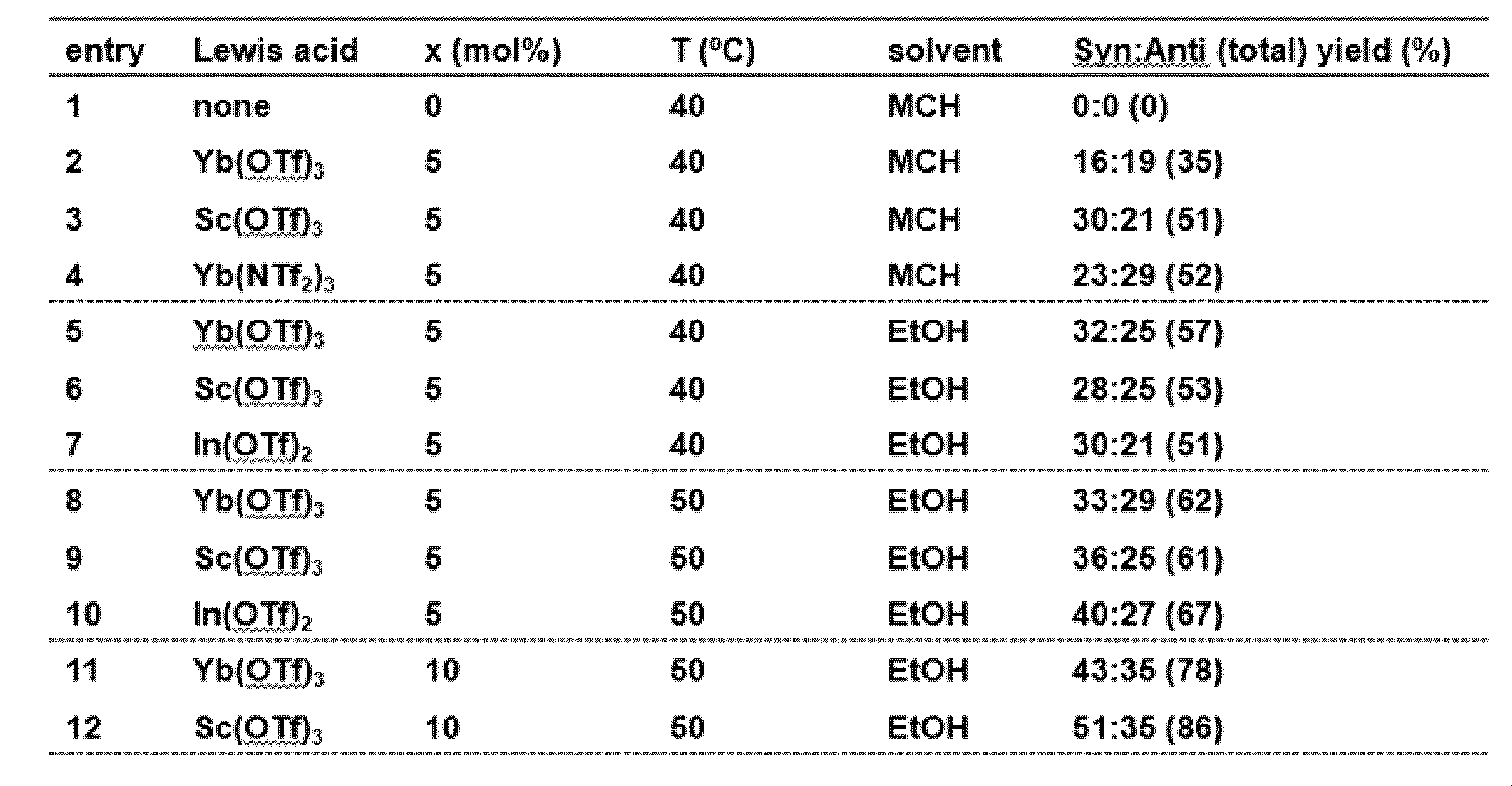
- N, N-dimethyl-4-methylaniline (4-Me: 2.25 ppm): cis-N, N-dimethylamino-4-methylcyclohexane (4-Me: 0.96 ppm): trans-N, N-dimethyl Amino-4-methylcyclohexane (4-Me: 0.91 ppm) 1:3.68:2.49. Therefore, cis-N,N-dimethylamino-4-methylcyclohexane: 51%, trans-N,N-dimethylamino-4-methylcyclohexane: 35%, the hydrogenated product was obtained with a total yield of 86%.
- the desired hydride was obtained under each condition in the same manner as the above method, except for changing the type of Lewis acid, amount added, reaction temperature, and solvent. The results are shown in the table below together with the above results.
- N,N-dimethylaniline (69.6 mg, 0.575 mmol, Tokyo Kasei), ethanol (500 mg, Tokyo Kasei), Rh-Pt/DMPSi-Al 2 O 3 (69.1 mg, Rh: 0.56 mol%; Pt : 0.2 mol%), and scandium triflate (6.4 mg, 0.013 mmol, Tokyo Kasei Co., Ltd., 2.5 mol%) were placed in a 10 mL thin flask equipped with a three-way stopcock. The inside of the flask was replaced with hydrogen at 1 atm, connected to a Schlenk line through which hydrogen at 1 atm was passed at 18.0 mL/min, and stirred at 50°C for 18 hours.
- Rh--Pt/DMPSi--Al 2 O 3 was removed by filtration, the catalyst was washed with methylcyclohexane and mixed with the filtrate. 1,4-Dimethoxybenzene (13.2 mg, GC internal standard) was added to the mixture, quantitative analysis was performed by GC by the internal standard method, and N,N-dimethylaminocyclohexane (72.9 mg, yield 99% )was gotten.
- GC analysis conditions and results are shown.
- Apparatus GC-2030 (Shimadzu Corporation), column SH-Rtx-5Amine (Shimadzu Corporation; film thickness 0.25 ⁇ m; length 30.0 m; inner diameter 0.25 mm), injection mode: split, vaporization chamber temperature 280° C., carrier Gas: nitrogen, pressure: 274.1 kPa, total flow rate: 222.6 mL/min, column flow rate: 4.67 mL/min, linear velocity: 76.3 cm/sec, purge flow rate: 3.0 mL/min, split ratio: 46 .0.
- Column oven 100° C. hold 0 min, heating rate 10° C./min, 200° C. hold 0 min, heating rate 20° C./min, 300° C.
- N,N-dimethylaminocyclohexane retention time 1.440 minutes
- N,N-dimethylaniline retention time 2.019 minutes
- 1,4-dimethoxybenzene retention time 2.496 minutes.
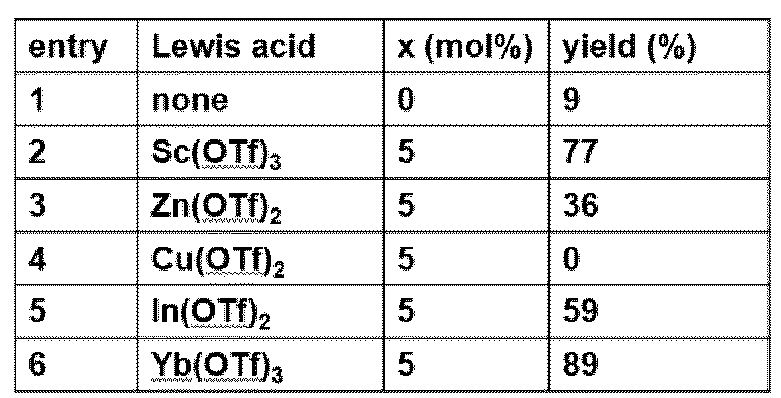
- the desired hydride was obtained under each condition in the same manner as the above method except for changing the type and amount of Lewis acid added. The results are shown in the table below together with the above results.
- the inside of the flask was replaced with hydrogen at 1 atm, connected to a Schlenk line through which hydrogen at 1 atm was passed at 18.0 ml/min, and stirred at 50°C for 18 hours.
- a small amount 25-50 ⁇ l was collected from the reaction solution with a syringe through a three-way stopcock fitted with a septum, and Rh-Pt/DMPSi-Al 2 O 3 was filtered through a cotton plug using a Pasteur pipette.
- the catalyst was washed with ethanol and mixed with the filtrate.
- the mixed solution was subjected to quantitative analysis by GC using an internal standard method, and changes over time in the yield of cis and trans-1,2-dimethylcyclohexane were observed.
- GC analysis conditions and results are shown.
- Apparatus GC-2030 (Shimadzu Corporation), column SH-stabilwax (Shimadzu Corporation; film thickness 0.25 ⁇ m; length 60.0 m; inner diameter 0.25 mm), injection mode: split, vaporization chamber temperature 250° C., carrier gas: Nitrogen, pressure: 274.1 kPa, total flow: 144.3 ml/min, column flow: 3.01 ml/min, linear velocity: 42.5 cm/sec, purge flow: 3.0 ml/min, split ratio: 46.0 .
- Column oven 50°C hold 15 minutes, heating rate 20°C/min, 250°C hold 2 minutes, total time 27 minutes.
- FID detector temperature 380.0° C.
- make-up gas nitrogen
- make-up gas flow rate 30 ml/min
- hydrogen flow rate 40 ml/min
- air flow rate 400 ml/min.
- trans-1,2-dimethylcyclohexane retention time 3.279 minutes
- cis-1,2-dimethylcyclohexane retention time 3.681 minutes
- ortho-xylene retention time 14.571 minutes
- dodecane retention time 15.901 minutes .
- each graph shows: - ⁇ -: Rh0.28 Pt0.1 without Sc, - ⁇ -: x4223 150 cat Rh0.28 Pt0.1 Sc (0.25), - ⁇ -: x4223 150 cat Rh0. 28 Pt0.1 Sc (0.5), - ⁇ -: x4223 150 cat Rh0.28 Pt0.1 Sc (0.9), - ⁇ -: x4223 150 cat Rh0.28 Pt0.1 Sc (1.25) , -O-: x4223 150 cat Rh0.28 Pt0.1 Sc(3), - ⁇ -: x4223 150 cat Rh0.28 Pt0.1 Sc(5).
- a hydrogen reaction was carried out in the same manner as in Example 3, except that the reaction temperature was changed to 40°C.
- Example 4 Hydrogenation Reaction of Para-xylene In the same manner as in Example 3, a hydrogenated para-xylene was obtained.
- Example 5 Hydrogenation Reaction of Aniline Derivative A hydride was obtained in the same manner as in Example 1 using an aniline derivative as a reaction substrate.
- Example 6 Hydrogenation Reaction of Aniline Derivative A hydride was obtained in the same manner as in Example 1 using an aniline derivative as a reaction substrate.
- Example 7 Hydrogenation Reaction of Aniline Derivative A hydride was obtained in the same manner as in Example 1 using an aniline derivative as a reaction substrate.
- Example 8 Hydrogenation Reaction of Aniline Derivative A hydride was obtained in the same manner as in Example 1 using an aniline derivative as a reaction substrate.
- Example 9 Hydrogenation Reaction of Aniline Derivative A hydride was obtained in the same manner as in Example 1 using an aniline derivative as a reaction substrate.
- Example 10 Hydrogenation Reaction of Phenoxazine A hydride was obtained in the same manner as in Example 1 using phenoxazine as a reaction substrate.
- Example 11 Hydrogenation Reaction of Aniline Derivative A hydride was obtained in the same manner as in Example 1 using an aniline derivative as a reaction substrate.
- Example 12 Hydrogenation of p-dimethoxybenzene A hydrogenation product was obtained in the same manner as in Example 1 using p-dimethoxybenzene as a reaction substrate.
- Example 13 Hydrogenation Reaction of Quinoline Derivative A hydride was obtained in the same manner as in Example 1 using a quinoline derivative as a reaction substrate.
- Example 14 Hydrogenation Reaction of Other Benzene-Based Aromatic Compounds
- a hydrogenation reaction was carried out basically in the same manner as in Example 1, except that the reaction substrate was changed.
- Example 15 Hydrogenation Reaction of Aromatic Heterocyclic Compound A hydrogenation reaction was carried out basically in the same manner as in Example 1, except that the reaction substrate was changed.
- the catalyst composition of the present invention is industrially useful as a hydrogenation catalyst for unsaturated compounds having multiple substituents or bulky substituents.
Landscapes
- Chemical & Material Sciences (AREA)
- Organic Chemistry (AREA)
- Chemical Kinetics & Catalysis (AREA)
- Inorganic Chemistry (AREA)
- Engineering & Computer Science (AREA)
- Materials Engineering (AREA)
- Organic Low-Molecular-Weight Compounds And Preparation Thereof (AREA)
Abstract
温和な条件下で、効率よく水素化化合物を製造する方法を提供すること。 白金、ロジウム、金、ニッケルおよびルテニウムから選ばれる2種以上の金属を担体に担持した金属ナノ粒子触媒と、ルイス酸とを含む触媒組成物、および当該触媒組成物を用いる水素化化合物の製造方法。
Description
本発明は、2種以上の金属を担体に担持した金属ナノ粒子触媒とルイス酸とを含む触媒組成物、およびそれを用いる水素化化合物の製造方法に関する。
水素貯蔵技術や医薬品等の高付加価値製品の製造において、不飽和化合物、特に芳香族化合物、芳香族ヘテロ環化合物の水素化(核水添)反応に有効な触媒の開発は重要である。
しかしながら、これまでの水素化反応は、高温、高圧などの過酷な条件を必要とするものが多かった
例えば、パラジウムを担持したアルミナまたは二酸化ケイ素と、ルイス酸である塩化アルミニウムとの存在下、ベンゼンをシクロヘキサンに変換する方法が報告されているが、10気圧という高圧を必要としていた(非特許文献1)。
しかしながら、これまでの水素化反応は、高温、高圧などの過酷な条件を必要とするものが多かった
例えば、パラジウムを担持したアルミナまたは二酸化ケイ素と、ルイス酸である塩化アルミニウムとの存在下、ベンゼンをシクロヘキサンに変換する方法が報告されているが、10気圧という高圧を必要としていた(非特許文献1)。
一方、ロジウム-白金合金ナノ粒子をポリシラン/アルミナ複合担体に担持したロジウム-白金合金ナノ粒子触媒であるRh-Pt/DMPSi-Al2O3触媒は、トルエンのような立体障害の小さい芳香族化合物において、常圧、50℃と温和な条件下で、高い水素化反応効率を示すことが報告されている(非特許文献2)。これは、芳香族化合物と水素を合金ナノ粒子表面に同時に吸着することで、水素化反応が促進されるためである。
しかしながら,芳香族化合物に複数の置換基や嵩高い置換基、または芳香環の電子密度を上昇させるようなアミノ基、水酸基、アルコキシ基、アルキル基等の電子供与基が存在すると、反応性が低下し、高温・高圧といった過酷な反応条件や長い反応時間を必要とするとの問題点があった。
ケム・キャット・ケム(ChemCatChem)、第6巻、第3323~3327頁、2014年
ジャーナル・オブ・アメリカン・ケミカル・ソサイティー(Journal of the American Chemical Society)、第140巻、第11325~11334頁、2018年
本発明の課題は、複数の置換基、嵩高い置換基等を有する不飽和化合物について、比較的温和な条件下かつ短時間で、対応する水素化化合物を効率よく製造する方法を提供することである。
本発明者らは、前記課題を解決するために鋭意検討した結果、特定の2種以上の金属を担体に担持した金属ナノ粒子触媒に触媒量のルイス酸を添加することによって、ルイス酸が金属ナノ粒子触媒上に吸着された不飽和化合物と相互作用し、その電子密度を低下させることにより、水素化反応が促進されることを見出し、本発明を完成させた。
すなわち、本発明は以下のものを提供する。
(1)白金、ロジウム、金、ニッケルおよびルテニウムから選ばれる2種以上の金属を担体に担持した金属ナノ粒子触媒と、ルイス酸とを含む触媒組成物。
(2)前記担体が、(i)ポリシラン担体、または(ii)ポリシランと、アルミナ、またはジルコニア、チタニアもしくは二酸化ケイ素の金属酸化物とからなる複合担体である、(1)に記載の触媒組成物。
(3)前記金属ナノ粒子触媒が、ロジウムおよび白金をポリフェニルメチルシラン(MPPSi)とアルミナとの複合担体に担持したロジウム-白金触媒、または、ロジウムおよび白金をポリジメチルシラン(DMPSi)と、アルミナ、またはジルコニア、チタニアもしくは二酸化ケイ素の金属酸化物との複合担体に担持したロジウム-白金触媒である、(1)または(2)に記載の触媒組成物。
(4)前記ルイス酸が、ランタノイド系金属、チタン、ジルコニウム、亜鉛、および銀から選ばれる金属の陽イオンと、トリフラートイオン(CF3SO3 -)、パークロレイトイオン(ClO4 -)、スルホネートイオン(SO3 -)、ビス(トリフルオロメタンスルホニル)イミドイオン(NTf2 -)、およびハロゲン化物イオンから選ばれる陰イオンとから形成される、(1)に記載の触媒組成物。
(5)前記ルイス酸が、スカンジウム、イットリウム、イッテルビウム、ハフニウム、ランタン、チタン、ジルコニウム、亜鉛、および銀から選ばれる金属の陽イオンと、トリフラートイオン(CF3SO3 -)、パークロレイトイオン(ClO4 -)、C1-12アルキルスルホネートイオン(C1-12アルキル-SO3 -)、C1-12アルキルベンゼンスルホネートイオン(C1-12アルキル-C6H4-SO3 -)、ビス(トリフルオロメタンスルホニル)イミドイオン(NTf2 -)、およびハロゲン化物イオンから選ばれる陰イオンとから形成される、(1)または(4)に記載の触媒組成物。
(6)前記ルイス酸が、スカンジウム(III)トリフラート(Sc(OTf)3)、イッテルビウム(III)トリフラート(Yb(OTf)3)、またはそれらの組み合わせである、(1)、(4)または(5)に記載の触媒組成物。
(7)前記金属ナノ粒子触媒がRh-Pt/DMPSi-Al2O3であって、前記ルイス酸がSc(OTf)3またはYb(OTf)3である、(1)~(6)のいずれか1つに記載の触媒組成物。
(8)水素ガスを水素源とし、(1)~(7)のいずれか1つに記載の触媒組成物の存在下で行う、不飽和化合物の水素化方法。
(9)(1)~(7)のいずれか1つに記載の触媒組成物の存在下で、不飽和化合物に水素ガスを接触させることを特徴とする、水素化化合物の製造方法。
(10)前記不飽和化合物が芳香族化合物または芳香族ヘテロ環化合物である、(9)に記載の製造方法。
(11)前記金属ナノ粒子触媒が、前記不飽和化合物に対して、前記金属ナノ粒子触媒の合計金属量で0.01~5モル%の量で使用される、(9)または(10)に記載の製造方法。
(12)前記ルイス酸が、前記金属ナノ粒子触媒の合計金属量に対して、1~100倍の量で使用される、(9)~(11)のいずれか1つに記載の製造方法。
(13)常圧で行われる、(9)~(12)のいずれか1つに記載の製造方法。
(14)室温~80℃の温度範囲で行われる、(9)~(13)のいずれか1つに記載の製造方法。
(1)白金、ロジウム、金、ニッケルおよびルテニウムから選ばれる2種以上の金属を担体に担持した金属ナノ粒子触媒と、ルイス酸とを含む触媒組成物。
(2)前記担体が、(i)ポリシラン担体、または(ii)ポリシランと、アルミナ、またはジルコニア、チタニアもしくは二酸化ケイ素の金属酸化物とからなる複合担体である、(1)に記載の触媒組成物。
(3)前記金属ナノ粒子触媒が、ロジウムおよび白金をポリフェニルメチルシラン(MPPSi)とアルミナとの複合担体に担持したロジウム-白金触媒、または、ロジウムおよび白金をポリジメチルシラン(DMPSi)と、アルミナ、またはジルコニア、チタニアもしくは二酸化ケイ素の金属酸化物との複合担体に担持したロジウム-白金触媒である、(1)または(2)に記載の触媒組成物。
(4)前記ルイス酸が、ランタノイド系金属、チタン、ジルコニウム、亜鉛、および銀から選ばれる金属の陽イオンと、トリフラートイオン(CF3SO3 -)、パークロレイトイオン(ClO4 -)、スルホネートイオン(SO3 -)、ビス(トリフルオロメタンスルホニル)イミドイオン(NTf2 -)、およびハロゲン化物イオンから選ばれる陰イオンとから形成される、(1)に記載の触媒組成物。
(5)前記ルイス酸が、スカンジウム、イットリウム、イッテルビウム、ハフニウム、ランタン、チタン、ジルコニウム、亜鉛、および銀から選ばれる金属の陽イオンと、トリフラートイオン(CF3SO3 -)、パークロレイトイオン(ClO4 -)、C1-12アルキルスルホネートイオン(C1-12アルキル-SO3 -)、C1-12アルキルベンゼンスルホネートイオン(C1-12アルキル-C6H4-SO3 -)、ビス(トリフルオロメタンスルホニル)イミドイオン(NTf2 -)、およびハロゲン化物イオンから選ばれる陰イオンとから形成される、(1)または(4)に記載の触媒組成物。
(6)前記ルイス酸が、スカンジウム(III)トリフラート(Sc(OTf)3)、イッテルビウム(III)トリフラート(Yb(OTf)3)、またはそれらの組み合わせである、(1)、(4)または(5)に記載の触媒組成物。
(7)前記金属ナノ粒子触媒がRh-Pt/DMPSi-Al2O3であって、前記ルイス酸がSc(OTf)3またはYb(OTf)3である、(1)~(6)のいずれか1つに記載の触媒組成物。
(8)水素ガスを水素源とし、(1)~(7)のいずれか1つに記載の触媒組成物の存在下で行う、不飽和化合物の水素化方法。
(9)(1)~(7)のいずれか1つに記載の触媒組成物の存在下で、不飽和化合物に水素ガスを接触させることを特徴とする、水素化化合物の製造方法。
(10)前記不飽和化合物が芳香族化合物または芳香族ヘテロ環化合物である、(9)に記載の製造方法。
(11)前記金属ナノ粒子触媒が、前記不飽和化合物に対して、前記金属ナノ粒子触媒の合計金属量で0.01~5モル%の量で使用される、(9)または(10)に記載の製造方法。
(12)前記ルイス酸が、前記金属ナノ粒子触媒の合計金属量に対して、1~100倍の量で使用される、(9)~(11)のいずれか1つに記載の製造方法。
(13)常圧で行われる、(9)~(12)のいずれか1つに記載の製造方法。
(14)室温~80℃の温度範囲で行われる、(9)~(13)のいずれか1つに記載の製造方法。
本発明の触媒組成物を用いることにより、不飽和化合物を温和な条件下に効率よく対応する水素化化合物に変換することができる。特に、本発明の触媒組成物は、複数の置換基や嵩高い置換基を有する不飽和化合物の、温和な条件下での水素化反応を促進する。
以下、本発明を詳細に説明する。
本発明の触媒組成物は、担体に特定の2種類以上の金属を担持した金属ナノ粒子触媒とルイス酸とを含む。当該金属ナノ粒子触媒に触媒量のルイス酸を添加することにより、ルイス酸が金属ナノ粒子触媒上に吸着された不飽和化合物と相互作用し、その電子密度を低下させ、その結果、金属ナノ粒子触媒とルイス酸とが協働的に不飽和化合物を活性化し、水素化反応の速度を大幅に上昇させることができる。
2種類以上の金属は、合金を形成していても、または均一には混合していないコアーシェル構造、クラスターインクラスター構造等を形成していてもよい。
金属は、例えば、チタン、ジルコニウム、バナジウム、タンタル、クロム、モリブデン、タングステン、マンガン、レニウム、鉄、ルテニウム、オスミウム、コバルト、ロジウム、イリジウム、ニッケル、パラジウム、金、白金、銅、錫、およびセレンからなる群から選ばれ、白金、ロジウム、金、ニッケルおよびルテニウムからなる群から選ばれることが好ましい。
具体的には、ロジウムと白金との組み合わせ(Rh-Pt)、ロジウムとパラジウムとの組み合わせ(Rh-Pd)、ロジウムと白金とパラジウムとの組み合わせ(Rh-Pt-Pd)が挙げられる。
金属は、例えば、チタン、ジルコニウム、バナジウム、タンタル、クロム、モリブデン、タングステン、マンガン、レニウム、鉄、ルテニウム、オスミウム、コバルト、ロジウム、イリジウム、ニッケル、パラジウム、金、白金、銅、錫、およびセレンからなる群から選ばれ、白金、ロジウム、金、ニッケルおよびルテニウムからなる群から選ばれることが好ましい。
具体的には、ロジウムと白金との組み合わせ(Rh-Pt)、ロジウムとパラジウムとの組み合わせ(Rh-Pd)、ロジウムと白金とパラジウムとの組み合わせ(Rh-Pt-Pd)が挙げられる。
金属ナノ粒子触媒がRh-Pt合金ナノ粒子である場合、Rh-Pt合金ナノ粒子触媒におけるRhの担持量は、Rh-Pt合金ナノ粒子触媒の全重量基準で、例えば0.01質量%以上であってよく、好ましくは0.03質量%以上、より好ましくは0.05質量%以上である。また、Rh-Pt合金ナノ粒子触媒におけるRhの担持量は、Rh-Pt合金ナノ粒子触媒の全重量基準で、例えば1.0質量%以下であってよく、好ましくは0.8質量%以下、より好ましくは0.6質量%以下である。
Rh-Pt合金ナノ粒子触媒におけるPtの担持量は、Rh-Pt合金ナノ粒子触媒の全重量基準で、例えば0.01質量%以上であってよく、好ましくは0.03質量%以上、より好ましくは0.05質量%以上である。また、Rh-Pt合金ナノ粒子触媒におけるPtの担持量は、Rh-Pt合金ナノ粒子触媒の全重量基準で、例えば1.5質量%以下であってよく、好ましくは1.2質量%以下、より好ましくは1.0質量%以下である。
Rh-Pt合金ナノ粒子触媒におけるPtの担持量は、Rh-Pt合金ナノ粒子触媒の全重量基準で、例えば0.01質量%以上であってよく、好ましくは0.03質量%以上、より好ましくは0.05質量%以上である。また、Rh-Pt合金ナノ粒子触媒におけるPtの担持量は、Rh-Pt合金ナノ粒子触媒の全重量基準で、例えば1.5質量%以下であってよく、好ましくは1.2質量%以下、より好ましくは1.0質量%以下である。
Rh-Pt合金ナノ粒子触媒において、Ptに対するRhのモル比(Rh/Pt)は、例えば0.2以上であってよく、好ましくは0.5以上、1.0以上、より好ましくは1.5以上である。このようなモル比であると、Rh周囲により効率的にPtが配置され、その結果、Rh-Ptの相互作用による反応活性が向上し、触媒劣化が抑制される。また、上記モル比(Rh/Pt)は、例えば20以下であってよく、好ましくは10以下、より好ましくは6.0以下である。このようなモル比とすることで、Ptの過剰被覆による活性点の減少が避けられ、少ない金属量でより効率的に反応活性を得ることができる。
触媒中に含まれる金属ナノ粒子の平均粒径は、好ましくは約0.1~約1000nm、好ましくは約1~約800nm、好ましくは約1~約500nm、好ましくは約1~約300nm、好ましくは約1~約100nm、好ましくは約2~約50nm、好ましくは約2~約10nm、より好ましくは約2~5nmである。
担体は、ポリシラン;アルミナ、ジルコニア、チタニア、二酸化ケイ素等から選ばれる金属酸化物などの無機担体でも、炭素、カーボンブラック、炭素繊維、カーボンナノチューブ、ポリスチレンなどの有機担体でもよい。また、担体は2種以上の複合担体、例えば、ポリシランとアルミナとの複合担体、ポリシランと、ジルコニア、チタニア、二酸化ケイ素等の金属酸化物との複合担体でもよい。
ただし、高分子を担体として用いる場合、高分子残基と金属ナノ粒子との相互作用が強すぎると、反応基質のナノ粒子表面への相互作用が阻害され、高い触媒回転数(TON)が期待できない。上記の担体の中で、ポリシランは、比較的弱い多点での相互作用で金属ナノ粒子を安定化できるため、好ましい。特に、ポリシラン中のケイ素-ケイ素結合は、ナノ粒子の安定化に寄与していると考えられる。
ただし、高分子を担体として用いる場合、高分子残基と金属ナノ粒子との相互作用が強すぎると、反応基質のナノ粒子表面への相互作用が阻害され、高い触媒回転数(TON)が期待できない。上記の担体の中で、ポリシランは、比較的弱い多点での相互作用で金属ナノ粒子を安定化できるため、好ましい。特に、ポリシラン中のケイ素-ケイ素結合は、ナノ粒子の安定化に寄与していると考えられる。
本発明における担体としては、ポリフェニルメチルシラン(MPPSi)/アルミナ複合担体、ポリジメチルシラン(DMPSi)/アルミナ複合担体、ポリジメチルシラン(DMPSi)/ジルコニア複合担体、ポリジメチルシラン(DMPSi)/チタニア複合担体が好ましく用いられる。
本発明における担体に担持した金属ナノ粒子触媒としては、MPPSi/アルミナ複合担体に担持したロジウム-白金ナノ粒子触媒(Rh-Pt/MPPSi-Al2O3)、またはDMPSi/アルミナ複合担体に担持したロジウム-白金ナノ粒子触媒(Rh-Pt/DMPSi-Al2O3)が好ましく用いられる。
金属ナノ粒子を担持した担体(金属ナノ粒子が担持された担体)中の金属ナノ粒子の割合は、0.01~10.00質量%であることが好ましく、0.05~10.00質量%であることが好ましく、0.1~10.00質量%であることが好ましく、0.1~8.00質量%であることが好ましく、0.1~5.00質量%であることがより好ましい。
合金ナノ粒子および合金ナノ粒子の担体への担持方法は、当該分野で周知である。例えば、還元剤を溶解させた溶媒にポリジメチルシランを懸濁させ、二種類の金属塩を溶解させた溶液を添加した後、アルミナを添加することによって調製することができる。担体存在下、金属塩と還元剤との反応によって合金ナノ粒子が生じ、すぐさま担体に担持される。合金ナノ粒子の担持方法については、例えばジャーナル・オブ・アメリカン・ケミカル・ソサイティー(Journal of the American Chemical Society)、第140巻、第11325~11334頁、2018年を参照されたい。
ルイス酸は、当該分野で一般的に使用されるルイス酸であれば特に制限されないが、例えば、トリフラートイオン(CF3SO3
-)、パークロレイトイオン(ClO4
-)、スルホネートイオン(SO3
-)(例えば、C1-12アルキルスルホネートイオン(C1-12アルキル-SO3
-)、C1-12アルキルベンゼンスルホネートイオン(C1-12アルキル-C6H4-SO3
-))、ビス(トリフルオロメタンスルホニル)イミドイオン(NTf2
-)、およびハロゲン化物イオンから選ばれる陰イオンを有するものが挙がられる。
ルイス酸を構成する金属元素としては、例えば、スカンジウム、イットリウム、ランタノイド(例えば、ランタン、イッテルビウム等)の3族元素;ハフニウム、チタン、ジルコニウム等の4族元素、銅、銀、金等の11族元素;ホウ素、アルミニウム、ガリウム、インジウム、タリウム等の13族元素;カルシウム、鉄、亜鉛等が挙げられる。
具体的には、スカンジウム、イットリウム、イッテルビウム、ハフニウム、ランタン、チタン、ジルコニウム、亜鉛、および銀から選ばれる金属のイオンと、トリフラートイオン(CF3SO3
-)、パークロレイトイオン(ClO4
-)、スルホネートイオン(SO3
-)、ビス(トリフルオロメタンスルホニル)イミドイオン(NTf2
-)、およびハロゲンイオンから選ばれる陰イオンとから形成されるルイス酸が挙げられる。
より具体的には、スカンジウム(III)トリフラート(Sc(OTf)3)、イッテルビウム(III)トリフラート(Yb(OTf)3)、インジウムトリフラート(In(OTf)3)等の金属トリフラート;イッテルビウム(III)ビス(トリフルオロメタンスルホニル)イミド(Yb(NTf2)3)等の金属トリフルイミド;金属フッ化物、金属塩化物、金属臭化物、金属ヨウ化物(例えば、塩化チタン、臭化チタン、塩化ジルコニウム、臭化ジルコニウム、塩化銅、臭化銅等、塩化銀、臭化銀、塩化金、臭化金、三フッ化ホウ素、三塩化ホウ素、三臭化ホウ素、塩化アルミニウム、臭化アルミニウム、塩化ガリウム、臭化ガリウム、塩化インジウム、臭化インジウム、塩化タリウム、臭化タリウム、塩化カルシウム、臭化カルシウム、塩化鉄、臭化鉄、塩化亜鉛、臭化亜鉛など)、水素化アルミニウム、トリメチルアルミニウムなどが挙げられる。これらの中で、金属トリフラートは、強力な電子吸引性基であるトリフルオロメタンスルホニル基を持っているため、強いルイス酸であるが、反応系に水(湿気)、アルコール、カルボキシル基を有する化合物があっても分解しないため、アルコールを含む溶媒系、含水反応、水中での反応、また、水酸基やカルボキシル基を含む基質に適用できるため、好ましい。金属トリフラートの中で、スカンジウム(III)トリフラート(Sc(OTf)3)、イッテルビウム(III)トリフラート(Yb(OTf)3)、またはこれらの組み合わせが好ましい。
より具体的には、スカンジウム(III)トリフラート(Sc(OTf)3)、イッテルビウム(III)トリフラート(Yb(OTf)3)、インジウムトリフラート(In(OTf)3)等の金属トリフラート;イッテルビウム(III)ビス(トリフルオロメタンスルホニル)イミド(Yb(NTf2)3)等の金属トリフルイミド;金属フッ化物、金属塩化物、金属臭化物、金属ヨウ化物(例えば、塩化チタン、臭化チタン、塩化ジルコニウム、臭化ジルコニウム、塩化銅、臭化銅等、塩化銀、臭化銀、塩化金、臭化金、三フッ化ホウ素、三塩化ホウ素、三臭化ホウ素、塩化アルミニウム、臭化アルミニウム、塩化ガリウム、臭化ガリウム、塩化インジウム、臭化インジウム、塩化タリウム、臭化タリウム、塩化カルシウム、臭化カルシウム、塩化鉄、臭化鉄、塩化亜鉛、臭化亜鉛など)、水素化アルミニウム、トリメチルアルミニウムなどが挙げられる。これらの中で、金属トリフラートは、強力な電子吸引性基であるトリフルオロメタンスルホニル基を持っているため、強いルイス酸であるが、反応系に水(湿気)、アルコール、カルボキシル基を有する化合物があっても分解しないため、アルコールを含む溶媒系、含水反応、水中での反応、また、水酸基やカルボキシル基を含む基質に適用できるため、好ましい。金属トリフラートの中で、スカンジウム(III)トリフラート(Sc(OTf)3)、イッテルビウム(III)トリフラート(Yb(OTf)3)、またはこれらの組み合わせが好ましい。
本発明において、金属ナノ粒子触媒は、不飽和化合物に対して、金属ナノ粒子触媒の合計金属量で、0.01~5モル%、好ましくは0.05~5モル%、好ましくは0.1~5モル%、好ましくは0.1~4モル%、好ましくは0.1~3モル%、好ましくは0.1~2モル%、好ましくは0.1~1モル%、好ましくは0.1~0.9モル%、好ましくは0.1~0.8モル%、好ましくは0.1~0.7モル%、好ましくは0.1~0.6モル%、好ましくは0.1~0.5モル%、好ましくは0.1~0.4モル%、好ましくは0.1~0.3モル%、好ましくは0.1~0.2モル%の量で使用される。
ルイス酸は、金属ナノ粒子触媒の合計金属モル量に対して、1~100倍、好ましくは1倍、2倍、3倍、4倍、5倍、6倍、7倍、8倍、9倍、10倍、15倍、20倍、50倍、70倍、90倍の量で使用される。
基質は不飽和結合を有する有機化合物であれば特に制限されず、環状化合物でも、脂肪族化合物でもよい。環状化合物としては、ベンゼン系芳香族化合物、芳香族ヘテロ環化合物、非ベンゼン系芳香族化合物等が挙げられる。
ベンゼン系芳香族化合物は、芳香族性を示す単環式または多環式(縮合)の炭化水素化合物を意味し、具体的には、例えば、ベンゼン、トルエン、キシレン、クレゾール、カテコール、アニソール、スチレン、アニリン、ナフタレン、アントラセン、フェナントレン等が挙げられる。
芳香族ヘテロ環化合物とは、環構成原子として炭素原子に加えて、酸素原子、硫黄原子および窒素原子から選ばれるヘテロ原子を1~4個含有する、芳香族性を示す単環式または多環式(縮合)ヘテロ環化合物を意味する。単環式芳香族複素環としては、例えば、フラン、チオフェン、ピリジン、ピリミジン、ピリダジン、ピラジンル、ピロール、イミダゾン、ピラジン、トリアジン、ピラゾール、チアゾリン、イソチアゾリン、オキサゾリン、イソオキサゾリン、オキサジアゾリン、チアジアゾリン、トリアゾリン、テトラゾリン、トリアジン等が挙げられる。多環式(縮合)芳香族複素環とは、上記単環式芳香族複素環が、単環式芳香族環(好ましくは、ベンゼン環または単環式芳香族複素環)と縮合した環を意味し、例えば、キノリン、イソキノリン、キナゾリン、キノキサリン、ベンゾフラン、ベンゾチオフェン、ベンズオキサゾール、ベンズイソオキサゾール、ベンゾチアゾール、ベンゾイソチアゾール、ベンズイミダゾール、ベンゾトリアゾール、インドール、インダゾール、ピロロピリジン、ピラゾロピリジン、イミダゾピリジン、チエノピリジン、ピロロピラジニン、ピラゾロピラジニン、イミダゾピラジニン、チエノピラジニン、ピロロピリミジン、ピラゾロピリミジン、イミダゾピリミジン、チエノピリミジン、ピラゾロチオフェン、フルオレン、カルバゾール、ジベンゾフラン、アクリジン、フェナジン、フェノキサジン、フェノチアジン、フェノキサチン等が挙げられる。
非ベンゼン系芳香族化合物としては、例えば、アズレン、トロポロンの他にシクロペンタジエニルアニオン、シクロヘプタトリエニルカチオン等のイオン種が挙げられる。
ベンゼン系芳香族化合物は、芳香族性を示す単環式または多環式(縮合)の炭化水素化合物を意味し、具体的には、例えば、ベンゼン、トルエン、キシレン、クレゾール、カテコール、アニソール、スチレン、アニリン、ナフタレン、アントラセン、フェナントレン等が挙げられる。
芳香族ヘテロ環化合物とは、環構成原子として炭素原子に加えて、酸素原子、硫黄原子および窒素原子から選ばれるヘテロ原子を1~4個含有する、芳香族性を示す単環式または多環式(縮合)ヘテロ環化合物を意味する。単環式芳香族複素環としては、例えば、フラン、チオフェン、ピリジン、ピリミジン、ピリダジン、ピラジンル、ピロール、イミダゾン、ピラジン、トリアジン、ピラゾール、チアゾリン、イソチアゾリン、オキサゾリン、イソオキサゾリン、オキサジアゾリン、チアジアゾリン、トリアゾリン、テトラゾリン、トリアジン等が挙げられる。多環式(縮合)芳香族複素環とは、上記単環式芳香族複素環が、単環式芳香族環(好ましくは、ベンゼン環または単環式芳香族複素環)と縮合した環を意味し、例えば、キノリン、イソキノリン、キナゾリン、キノキサリン、ベンゾフラン、ベンゾチオフェン、ベンズオキサゾール、ベンズイソオキサゾール、ベンゾチアゾール、ベンゾイソチアゾール、ベンズイミダゾール、ベンゾトリアゾール、インドール、インダゾール、ピロロピリジン、ピラゾロピリジン、イミダゾピリジン、チエノピリジン、ピロロピラジニン、ピラゾロピラジニン、イミダゾピラジニン、チエノピラジニン、ピロロピリミジン、ピラゾロピリミジン、イミダゾピリミジン、チエノピリミジン、ピラゾロチオフェン、フルオレン、カルバゾール、ジベンゾフラン、アクリジン、フェナジン、フェノキサジン、フェノチアジン、フェノキサチン等が挙げられる。
非ベンゼン系芳香族化合物としては、例えば、アズレン、トロポロンの他にシクロペンタジエニルアニオン、シクロヘプタトリエニルカチオン等のイオン種が挙げられる。
基質である不飽和化合物は複数の置換基を有していてもよく、置換基の数や置換基の嵩高さを問わない。置換基としては、C1-6のアルキル、C1-6のアルコキシ、カルボキシ、ヒドロキシ、ハロゲン、ニトロ、シアノ、カルバモイル等が挙げられる。
したがって、このような置換基を有するベンゼン系芳香族化合物としては、エチルベンゼン、n-プロピルベンゼン、iso-プロピルベンゼン、n-ブチルベンゼン、iso-ブチルベンゼン、tert-ブチルベンゼン、n-ヘプチルベンゼン、n-ヘキシルベンゼン、n-ヘプチルベンゼン、n-オクチルベンゼン、p-n-プロピルトルエン、p-iso-プロピルトルエン、p-n-ブチルトルエン、p-iso-ブチルベンゼン、p-tert-ブチルベンゼン等が挙げられる。
また、アニリンのアミノ基の水素原子はC1-6のアルキル、C1-6のアルコキシカルボニルメチル等でさらに置換されていてもよい。このようなアニリン誘導体としては、例えば、N-メチルアニリン、N-n-プロピルアニリン、N-iso-プロピルアニリン、N-n-ブチルアニリン、N,N-ジメチルアニリン、N,N-ジメチル-m-メチルアニリン、N,N-ジメチル-p-メチル-ニリン、N,N-ジメチル-m-メトキシカルボニルメチルアニリン、N-メチル-N-エトキシカルボニルメチルアニリン等が挙げられる。
嵩高い置換基としては、例えば、置換されていてもよい第2級または第3級アルキル基(例えば、炭素原子数が3~8の第2級アルキル基、炭素数4~8の第3級アルキル基、具体的にはイソプロピル基、t-ブチル基、1,1-ジエチルプロピル基、1,1-ジメチルペンチル基、t-アミル基等)、置換されていてもよいシクロアルキル基〈例えば、C1-6アルキル基により置換されていてもよいC3-10シクロアルキル基等)、置換されていてもよいシクロアルケニル基(例えば、アルキル基により置換されていてもよいC3-10シクロアルケニル基等)、置換されていてもよいアリール基(例えば、ハロゲン原子、ニトロ基、C1-6アルキル基、アルコキシ基等により置換されていてもよいC6-10アリール基等)などが挙げられる。
したがって、このような置換基を有するベンゼン系芳香族化合物としては、エチルベンゼン、n-プロピルベンゼン、iso-プロピルベンゼン、n-ブチルベンゼン、iso-ブチルベンゼン、tert-ブチルベンゼン、n-ヘプチルベンゼン、n-ヘキシルベンゼン、n-ヘプチルベンゼン、n-オクチルベンゼン、p-n-プロピルトルエン、p-iso-プロピルトルエン、p-n-ブチルトルエン、p-iso-ブチルベンゼン、p-tert-ブチルベンゼン等が挙げられる。
また、アニリンのアミノ基の水素原子はC1-6のアルキル、C1-6のアルコキシカルボニルメチル等でさらに置換されていてもよい。このようなアニリン誘導体としては、例えば、N-メチルアニリン、N-n-プロピルアニリン、N-iso-プロピルアニリン、N-n-ブチルアニリン、N,N-ジメチルアニリン、N,N-ジメチル-m-メチルアニリン、N,N-ジメチル-p-メチル-ニリン、N,N-ジメチル-m-メトキシカルボニルメチルアニリン、N-メチル-N-エトキシカルボニルメチルアニリン等が挙げられる。
嵩高い置換基としては、例えば、置換されていてもよい第2級または第3級アルキル基(例えば、炭素原子数が3~8の第2級アルキル基、炭素数4~8の第3級アルキル基、具体的にはイソプロピル基、t-ブチル基、1,1-ジエチルプロピル基、1,1-ジメチルペンチル基、t-アミル基等)、置換されていてもよいシクロアルキル基〈例えば、C1-6アルキル基により置換されていてもよいC3-10シクロアルキル基等)、置換されていてもよいシクロアルケニル基(例えば、アルキル基により置換されていてもよいC3-10シクロアルケニル基等)、置換されていてもよいアリール基(例えば、ハロゲン原子、ニトロ基、C1-6アルキル基、アルコキシ基等により置換されていてもよいC6-10アリール基等)などが挙げられる。
本発明の触媒組成物は、金属ナノ粒子触媒とルイス酸とが予め混合されたものを用いてもよく、または使用時に同時もしくは任意の順で添加して使用してもよい。
本発明の触媒組成物は、特に、複数の置換基や嵩高い置換基を有する、芳香族化合物や芳香族ヘテロ環化合物の水素化反応、芳香環の電子密度を上昇させるようなアミノ基、水酸基、アルコキシ基、アルキル基等の電子供与基が存在する芳香族化合物や芳香族ヘテロ環化合物の水素化反応に好適である。
水素源は、例えば水素ガスである。水素と、窒素、アルゴン等との混合気体でもよい。かかる混合気体の方が安全性の点から好ましい場合もある。他に、ギ酸またはギ酸塩、ヒドラジンを使用することもできる。
水素化反応に溶媒を必要とする場合には、溶媒は特に制限されず、極性溶媒も使用できる。例えば、水;エタノール、イソプロパノール等のアルコール系溶媒;水とアルコール系溶媒との混合溶媒;ヘキサン、メチルシクロヘキサン、ヘプタン、オクタン、ノナン、デカン等の脂肪族炭化水素系溶媒;ジエチルエーテル、テトラヒドロフラン、シクロペンチルメチルエーテル、ジイソプロピルエーテル等のエーテル系溶媒、ジメチルホルムアミド、ジメチルスルホキシド、酢酸エチルなどが挙げられる。
反応系としては、通常のバッチ合成系でも、金属ナノ粒子触媒をカラムに充填して基質および水素源を流通させる連続フロー合成系でもよい。連続フロー合成系では、ルイス酸は、通常、基質溶液に溶解させて用いる。
一般に、水素化触媒には、反応を完結させる高い触媒回転頻度(TOF)、および長時間の反応において活性が低下することなく反応を連続的に進行させることができる高い触媒回転数(TON)が要求される。本発明の金属ナノ粒子触媒を用いる連続フロー合成系では、触媒回転速度が大幅に向上し、数十日を超える連続反応でも触媒活性の低下は見られなかった。特に、嵩高い置換基を有する芳香族化合物を基質とする場合には、連続フロー合成系を用いることが好ましい。
一般に、水素化触媒には、反応を完結させる高い触媒回転頻度(TOF)、および長時間の反応において活性が低下することなく反応を連続的に進行させることができる高い触媒回転数(TON)が要求される。本発明の金属ナノ粒子触媒を用いる連続フロー合成系では、触媒回転速度が大幅に向上し、数十日を超える連続反応でも触媒活性の低下は見られなかった。特に、嵩高い置換基を有する芳香族化合物を基質とする場合には、連続フロー合成系を用いることが好ましい。
本発明の水素化反応の温度は、0~100℃の範囲であればよく、室温~80℃の範囲が好ましく、室温~50℃範囲が好ましく、室温~40℃の範囲がより好ましい。反応時間は、1時間~50時間であればよく、通常、1時間~20時間で反応が完了する。
また、反応は、通常、常圧で進行するが、常圧より低い例えば0.1気圧から常圧を超える例えば9.9気圧の範囲の圧力でもよい。
さらに、反応系のpHは、特に限定されないが、金属ナノ粒子や担体の安定性の点から、通常、2~13の範囲である。
また、反応は、通常、常圧で進行するが、常圧より低い例えば0.1気圧から常圧を超える例えば9.9気圧の範囲の圧力でもよい。
さらに、反応系のpHは、特に限定されないが、金属ナノ粒子や担体の安定性の点から、通常、2~13の範囲である。
本発明の触媒組成物を用いることにより、Rh-Pt/DMPSi-Al2O3のような金属ナノ粒子触媒単体ではこれまで水素化が困難であった複数の嵩高い置換基を有する芳香族化合物の水素化が可能となった。
次に、実施例を挙げて本発明の製造方法を具体的に説明するが、本発明は、これら実施例によって何ら限定されるものではない。
NMRスペクトルは、JEOL JMN-LA 600分光計により、600 MHz (1H)及び150 MHz (13C)で測定した。化学シフトは、CDCl3の内部標準に対してppmで記録した。内部標準は断らない限り、7.24 ppm (1H NMR)及び77.0 ppm (13C NMR)であった。
高分解能マススペクトル(HRMS)は、JEOL JMS-T100TD(DART)分光計により測定した。
高分解能マススペクトル(HRMS)は、JEOL JMS-T100TD(DART)分光計により測定した。
実施例1 N,N-ジメチル-4-メチルアニリンの水素化反応

N,N-ジメチル-4-メチルアニリン(111.9mg、0.83mmol、東京化成)、エタノール(500mg、東京化成)、Rh-Pt/DMPSi-Al2O3(48.8mg、Rh:0.5mol%;Pt:0.2mol%)、およびスカンジウムトリフラート(60.0mg,0.12mmol、東京化成、10mol%)を、三方活栓を装着した10mL細型フラスコにいれた。フラスコ内を一気圧水素に置換し、一気圧水素を18.0mL/分で流通させたシュレンクラインに接続し、50℃で18時間攪拌した。ジエチルエーテル(5mL)を加え、Rh-Pt/DMPSi-Al2O3と無機塩を濾過にて除去し、ジエチルエーテルで触媒を洗浄し、濾液と混合した。溶媒を減圧下留去し油状物質(114.9mg)を得た。得られた油状物質を1H核磁気共鳴スペクトル(1HNMR)JNM-ECX-600(日本電子株式会社製)を使用した1HNMR解析にて、N,N-ジメチル-4-メチルアニリン、cis-N,N-ジメチルアミノ-4-メチルシクロヘキサン、trans-N,N-ジメチルアミノ-4-メチルシクロヘキサンからなる混合物であると決定し、それぞれの比率を求めた。測定は、CDCl3を溶媒とし、テトラメチルシラン(δ=0)およびCDCl3(δ=7.24)を内部標準物質として行った。それぞれの化合物における4-メチル基の1HNMRの積分比を用いて、組成比(mol)を決定した。N,N-ジメチル-4-メチルアニリン(4-Me:2.25ppm):cis-N,N-ジメチルアミノ-4-メチルシクロヘキサン(4-Me:0.96ppm):trans-N,N-ジメチルアミノ-4-メチルシクロヘキサン(4-Me:0.91ppm)=1:3.68:2.49であった。したがって、cis-N,N-ジメチルアミノ-4-メチルシクロヘキサン:51%、trans-N,N-ジメチルアミノ-4-メチルシクロヘキサン:35%、合計86%収率で水素化体が得られた。
ルイス酸の種類、添加量、反応温度、溶媒を変える以外は上記の手法と同様にして、各条件下で所望の水素化体を得た。上記の結果とあわせて下記表に示す。
実施例2:N,N-ジメチルアニリンの水素化反応

N,N-ジメチルアニリン(69.6mg、0.575mmol、東京化成)、エタノール(500mg、東京化成)、Rh-Pt/DMPSi-Al2O3(69.1mg、Rh:0.56mol%;Pt:0.2mol%)、およびスカンジウムトリフラート(6.4mg,0.013mmol、東京化成、2.5mol%)を、三方活栓を装着した10mL細型フラスコに入れた。フラスコ内を一気圧水素に置換し、一気圧水素を18.0mL/分で流通させたシュレンクラインに接続し、50℃で18時間攪拌した。Rh-Pt/DMPSi-Al2O3を濾過にて除去し、メチルシクロヘキサンで触媒を洗浄し、濾液と混合した。混合液に1,4-ジメトキシベンゼン(13.2mg、GCの内部標準)を添加し、GCで内部標準法による定量分析を行い、N,N-ジメチルアミノシクロヘキサン(72.9mg、収率99%)が得られた。
GCの分析条件と結果を示す。
装置:GC-2030(島津製作所)、カラムSH-Rtx-5Amine(島津製作所;膜厚0.25μm;長さ30.0m;内径0.25mm)、注入モード:スプリット、気化室温度280℃、キャリアガス:窒素、圧力:274.1kPa、全流量:222.6mL/分、カラム流量:4.67mL/分、線速度:76.3cm/秒、パージ流量:3.0mL/分、スプリット比:46.0。
カラムオーブン:100℃ホールド0分、昇温レート10℃/分、200℃ホールド0分、昇温レート20℃/分、300℃ホールド0分、合計時間15分。
FID検出器温度:320.0℃、メイクアップガス:窒素、メイクアップガス流量24mL/分、水素流量:32mL/分、空気流量:200mL/分。
N,N-ジメチルアミノシクロヘキサン保持時間:1.440分、N,N-ジメチルアニリン保持時間:2.019分、1,4-ジメトキシベンゼン保持時間:2.496分。
装置:GC-2030(島津製作所)、カラムSH-Rtx-5Amine(島津製作所;膜厚0.25μm;長さ30.0m;内径0.25mm)、注入モード:スプリット、気化室温度280℃、キャリアガス:窒素、圧力:274.1kPa、全流量:222.6mL/分、カラム流量:4.67mL/分、線速度:76.3cm/秒、パージ流量:3.0mL/分、スプリット比:46.0。
カラムオーブン:100℃ホールド0分、昇温レート10℃/分、200℃ホールド0分、昇温レート20℃/分、300℃ホールド0分、合計時間15分。
FID検出器温度:320.0℃、メイクアップガス:窒素、メイクアップガス流量24mL/分、水素流量:32mL/分、空気流量:200mL/分。
N,N-ジメチルアミノシクロヘキサン保持時間:1.440分、N,N-ジメチルアニリン保持時間:2.019分、1,4-ジメトキシベンゼン保持時間:2.496分。
ルイス酸の種類、添加量を変える以外は上記の手法と同様にして、各条件下で所望の水素化体を得た。上記の結果とあわせて下記表に示す。
実施例2-1:N,N-ジメチルアニリンの水素化反応


[a]: Rh/Pt=2.8:1
[b]: Rh/Pt=2.8:1, 50℃
実施例3:オルトキシレンの水素化反応

オルトキシレン(114.2mg、1.08mmol、東京化成)、エタノール(1.0g、東京化成)、Rh-Pt/DMPSi-Al2O3(69.0mg、Rh:0.28mol%;Pt:0.1mol%)、およびスカンジウムトリフラート(6.1mg、0.012mmol、東京化成、1.25mol%)、ドデカン(32.9mg、GCの内部標準)を、三方活栓を装着した10ml細型フラスコに入れた。フラスコ内を一気圧水素に置換し、一気圧水素を18.0ml/分で流通させたシュレンクラインに接続し、50℃で18時間攪拌した。一定時間毎に、反応溶液からセプタムを装着した三方活栓を介してシリンジで微量(25~50μl)を採取し、Rh-Pt/DMPSi-Al2O3をパスツールピペットを用いた綿栓濾過にて除去し、エタノールで触媒を洗浄し、濾液と混合した。混合液を、GCで内部標準法による定量分析を行い、cisおよびtrans-1,2-ジメチルシクロヘキサンの収率の経時変化を観測した。
GCの分析条件と結果を示す。
装置:GC-2030(島津製作所)、カラムSH-stabilwax(島津製作所;膜厚0.25μm;長さ60.0m;内径0.25mm)、注入モード:スプリット、気化室温度250℃、キャリアガス:窒素、圧力:274.1kPa、全流量:144.3ml/分、カラム流量:3.01ml/分、線速度:42.5cm/秒、パージ流量:3.0ml/分、スプリット比:46.0。
カラムオーブン:50℃ホールド15分、昇温レート20℃/分、250℃ホールド2分、合計時間27分。
FID検出器温度:380.0℃、メイクアップガス:窒素、メイクアップガス流量30ml/分、水素流量:40ml/分、空気流量:400ml/分。
trans-1,2-ジメチルシクロヘキサン保持時間:3.279分、cis-1,2-ジメチルシクロヘキサン保持時間:3.681分、オルトキシレン保持時間:14.571分、ドデカン保持時間:15.901分。
装置:GC-2030(島津製作所)、カラムSH-stabilwax(島津製作所;膜厚0.25μm;長さ60.0m;内径0.25mm)、注入モード:スプリット、気化室温度250℃、キャリアガス:窒素、圧力:274.1kPa、全流量:144.3ml/分、カラム流量:3.01ml/分、線速度:42.5cm/秒、パージ流量:3.0ml/分、スプリット比:46.0。
カラムオーブン:50℃ホールド15分、昇温レート20℃/分、250℃ホールド2分、合計時間27分。
FID検出器温度:380.0℃、メイクアップガス:窒素、メイクアップガス流量30ml/分、水素流量:40ml/分、空気流量:400ml/分。
trans-1,2-ジメチルシクロヘキサン保持時間:3.279分、cis-1,2-ジメチルシクロヘキサン保持時間:3.681分、オルトキシレン保持時間:14.571分、ドデカン保持時間:15.901分。
また、スカンジウムトリフラートの添加量を変えることによって水素化体への変換の経時変化を観測した。上記の結果と併せて図1に示す。
図1において、「Sc」はSc(OTf)3を、「Sc」の後の括弧内の数値はSc(OTf)3の添加量を示す。したがって、例えば、「ex4223 150 cat Rh0.28 Pt0.1 Sc(1.25)」は、Rh:0.28モル%、Pt:0.1モル%のRh-Pt/DMPSi-Al2O3触媒とSc(OTf)3(1.25モル%)を使用する水素化反応の反応条件を示す。図1において、各グラフは、-■-:ScなしRh0.28 Pt0.1、-▽-:x4223 150 cat Rh0.28 Pt0.1 Sc(0.25)、-◇-:x4223 150 cat Rh0.28 Pt0.1 Sc(0.5)、-△-:x4223 150 cat Rh0.28 Pt0.1 Sc(0.9)、-●-:x4223 150 cat Rh0.28 Pt0.1 Sc(1.25)、-〇-:x4223 150 cat Rh0.28 Pt0.1 Sc(3)、-□-:x4223 150 cat Rh0.28 Pt0.1 Sc(5)、を示す。
図1において、「Sc」はSc(OTf)3を、「Sc」の後の括弧内の数値はSc(OTf)3の添加量を示す。したがって、例えば、「ex4223 150 cat Rh0.28 Pt0.1 Sc(1.25)」は、Rh:0.28モル%、Pt:0.1モル%のRh-Pt/DMPSi-Al2O3触媒とSc(OTf)3(1.25モル%)を使用する水素化反応の反応条件を示す。図1において、各グラフは、-■-:ScなしRh0.28 Pt0.1、-▽-:x4223 150 cat Rh0.28 Pt0.1 Sc(0.25)、-◇-:x4223 150 cat Rh0.28 Pt0.1 Sc(0.5)、-△-:x4223 150 cat Rh0.28 Pt0.1 Sc(0.9)、-●-:x4223 150 cat Rh0.28 Pt0.1 Sc(1.25)、-〇-:x4223 150 cat Rh0.28 Pt0.1 Sc(3)、-□-:x4223 150 cat Rh0.28 Pt0.1 Sc(5)、を示す。
図2は、Sc(OTf)3の添加量と水素化反応の反応速度との相関関係を示す。
本水素化反応の反応速度は、転化率が約50%未満では、基質に対して一次であるとみなせるため、基質濃度の経時変化は一次反応定数kを用いて次式のように表わされる。-d[C]/dt=k[C]([C]:基質濃度;k:反応速度定数)。
図2より、スカンジウムトリフラートを添加しない場合と比べて、0.9mol%以上のスカンジウムトリフラートを添加した場合には、約25倍の水素化反応速度を示し、5mol%のスカンジウムトリフラートでは、約30倍の水素化反応速度を示すことがわかった。
本水素化反応の反応速度は、転化率が約50%未満では、基質に対して一次であるとみなせるため、基質濃度の経時変化は一次反応定数kを用いて次式のように表わされる。-d[C]/dt=k[C]([C]:基質濃度;k:反応速度定数)。
図2より、スカンジウムトリフラートを添加しない場合と比べて、0.9mol%以上のスカンジウムトリフラートを添加した場合には、約25倍の水素化反応速度を示し、5mol%のスカンジウムトリフラートでは、約30倍の水素化反応速度を示すことがわかった。
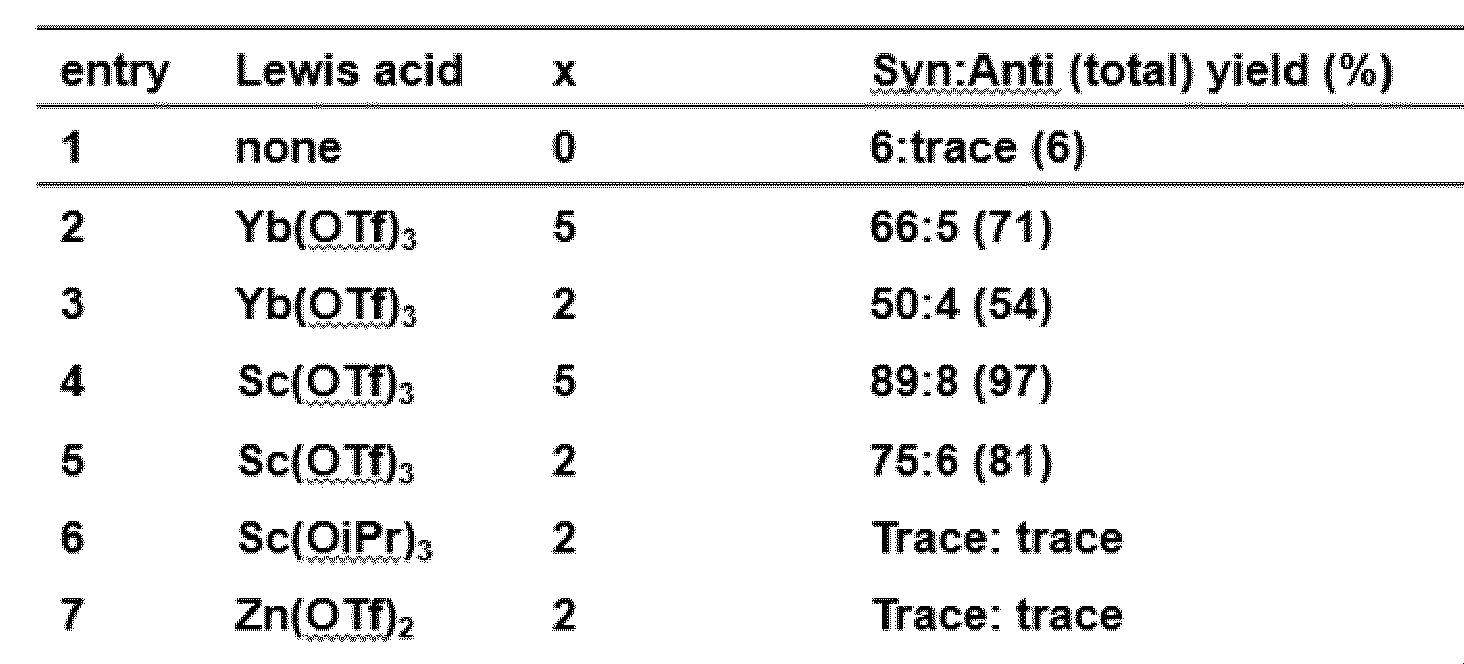
ルイス酸の種類、添加量を変える以外は上記の手法と同様にして、反応開始後18時間の時点で、各条件下で所望の水素化体を得た。上記の結果とあわせて下記表に示す。
実施例3-1:オルトキシレンの水素化反応
反応温度を40℃に変える以外は実施例3と同様にして水素反応を行った。


[a]:Rh/Pt=2.81
[b]:Rh 0.4moll%、Pt 0.15mol%
実施例4:パラキシレンの水素化反応
実施例3と同様にしてパラキシレンの水素化体を得た。
実施例3と同様にしてパラキシレンの水素化体を得た。

実施例5:アニリン誘導体の水素化反応
アニリン誘導体を反応基質として、実施例1と同様にして水素化体を得た。
アニリン誘導体を反応基質として、実施例1と同様にして水素化体を得た。

1H NMR (600 MHz, CDCl3) δ 4.01 (q, 2H, J = 7.1 Hz), 3.19 (s, 2H), 2.38-2.35 (m, 1H), 2.26 (s, 3H), 1.72-1.60 (m, 4H), 1.45 (d, 1H, J = 13.7 Hz), 1.12-1.00 (m, 7H), 0.93-0.90 (m, 1H).
13C NMR (150 MHz, CDCl3) δ 171.0, 62.5, 60.5, 54.7, 38.8, 28.8, 28.7, 25.8, 25.5, 14.0.
HRMS 計算値: 200.16505, 実測値 200.16471 (-1.73 ppm).
13C NMR (150 MHz, CDCl3) δ 171.0, 62.5, 60.5, 54.7, 38.8, 28.8, 28.7, 25.8, 25.5, 14.0.
HRMS 計算値: 200.16505, 実測値 200.16471 (-1.73 ppm).
実施例6:アニリン誘導体の水素化反応
アニリン誘導体を反応基質として、実施例1と同様にして水素化体を得た。
アニリン誘導体を反応基質として、実施例1と同様にして水素化体を得た。
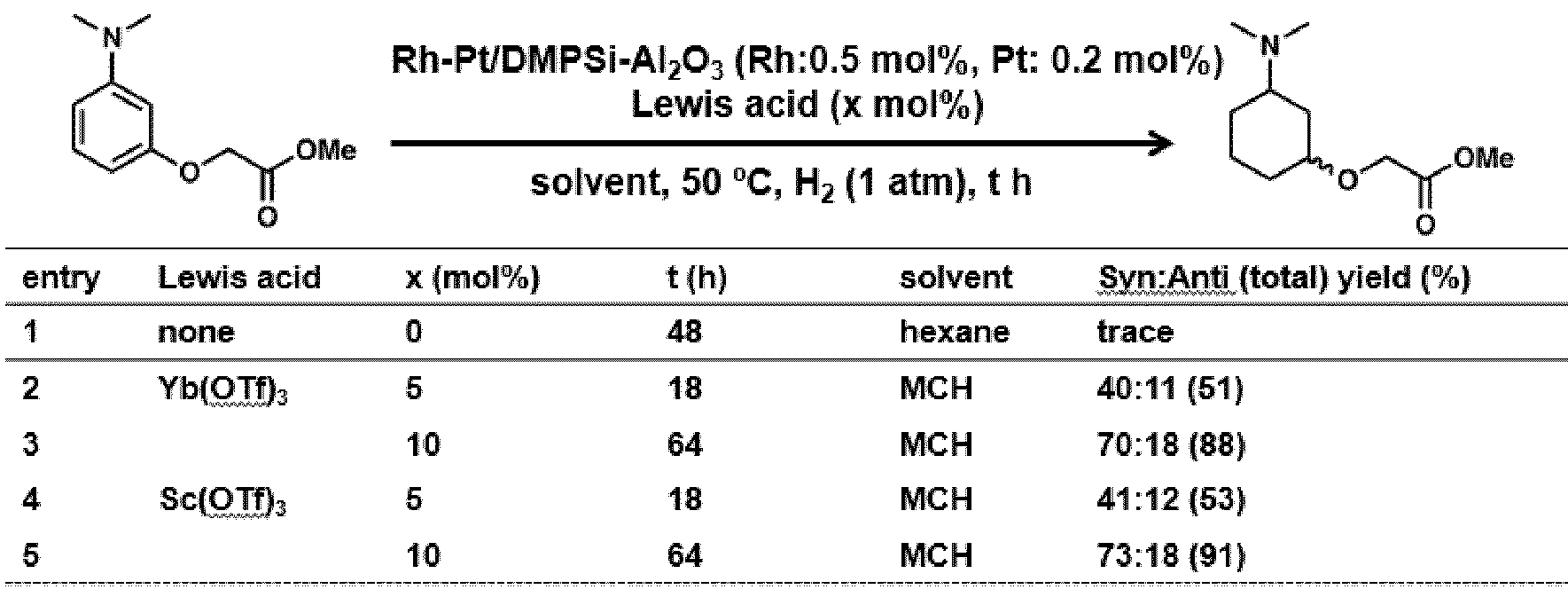
実施例7:アニリン誘導体の水素化反応
アニリン誘導体を反応基質として、実施例1と同様にして水素化体を得た。
アニリン誘導体を反応基質として、実施例1と同様にして水素化体を得た。

実施例8:アニリン誘導体の水素化反応
アニリン誘導体を反応基質として、実施例1と同様にして水素化体を得た。
アニリン誘導体を反応基質として、実施例1と同様にして水素化体を得た。
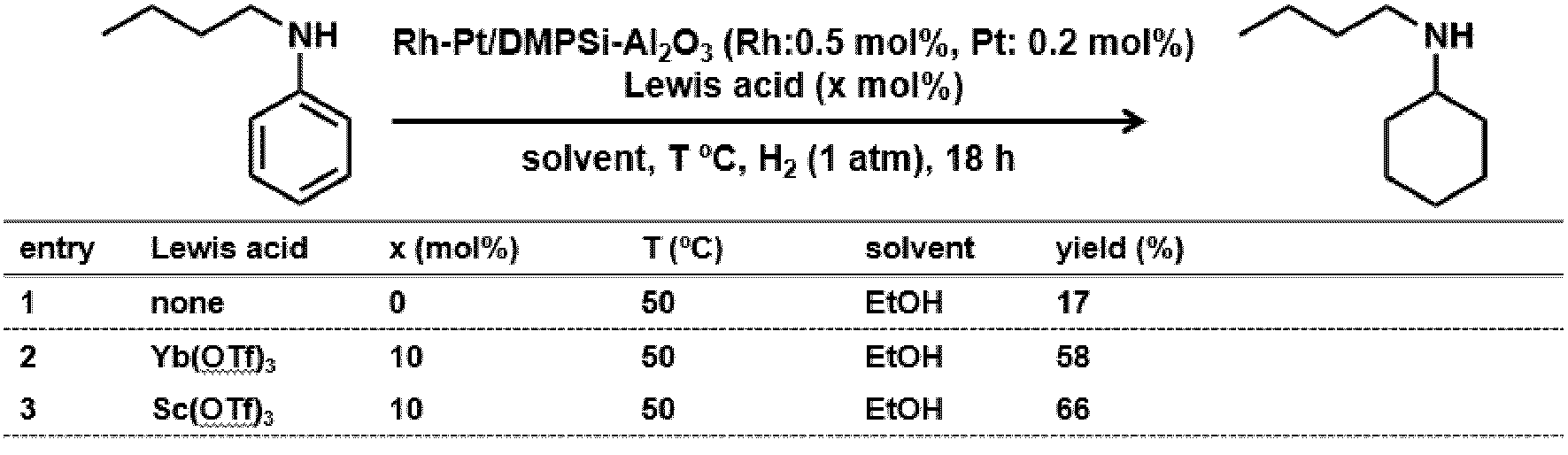
実施例9:アニリン誘導体の水素化反応
アニリン誘導体を反応基質として、実施例1と同様にして水素化体を得た。
アニリン誘導体を反応基質として、実施例1と同様にして水素化体を得た。
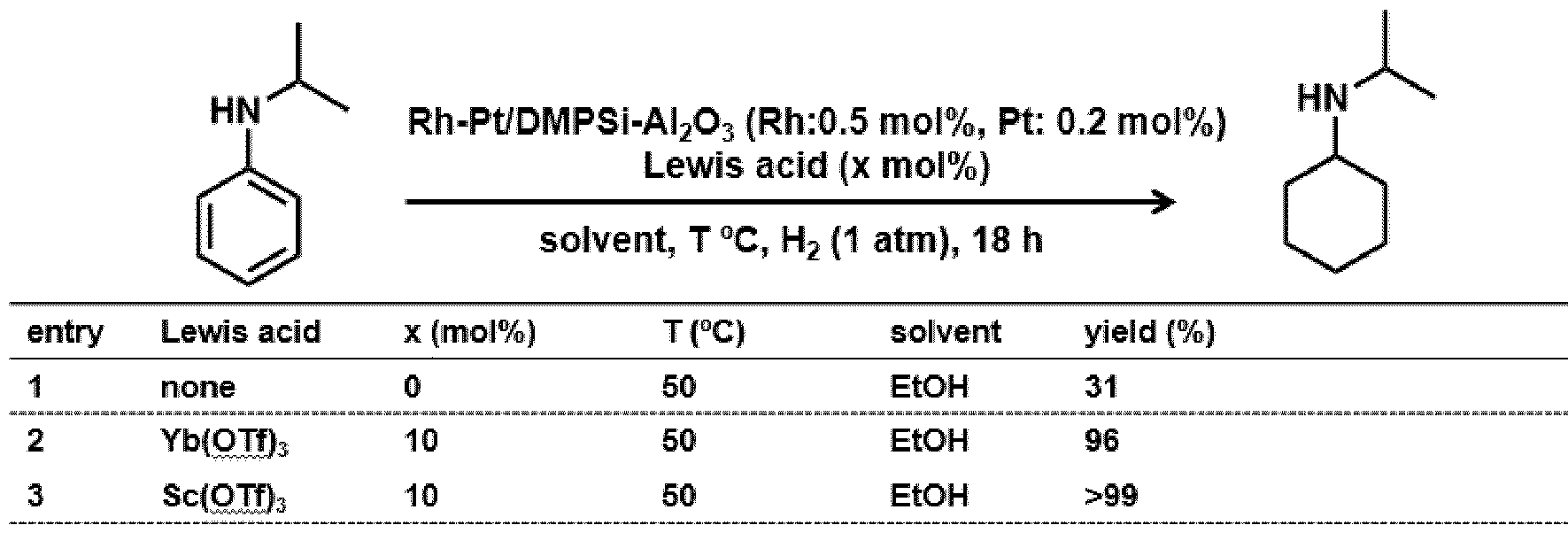
実施例10:フェノキサジンの水素化反応
フェノキサジンを反応基質として、実施例1と同様にして水素化体を得た。
フェノキサジンを反応基質として、実施例1と同様にして水素化体を得た。

y:Rh、Ptの添加量
実施例11:アニリン誘導体の水素化反応
アニリン誘導体を反応基質として、実施例1と同様にして水素化体を得た。
アニリン誘導体を反応基質として、実施例1と同様にして水素化体を得た。

実施例12:p-ジメトキシベンゼンの水素化反応
p-ジメトキシベンゼンを反応基質として、実施例1と同様にして水素化体を得た。
p-ジメトキシベンゼンを反応基質として、実施例1と同様にして水素化体を得た。
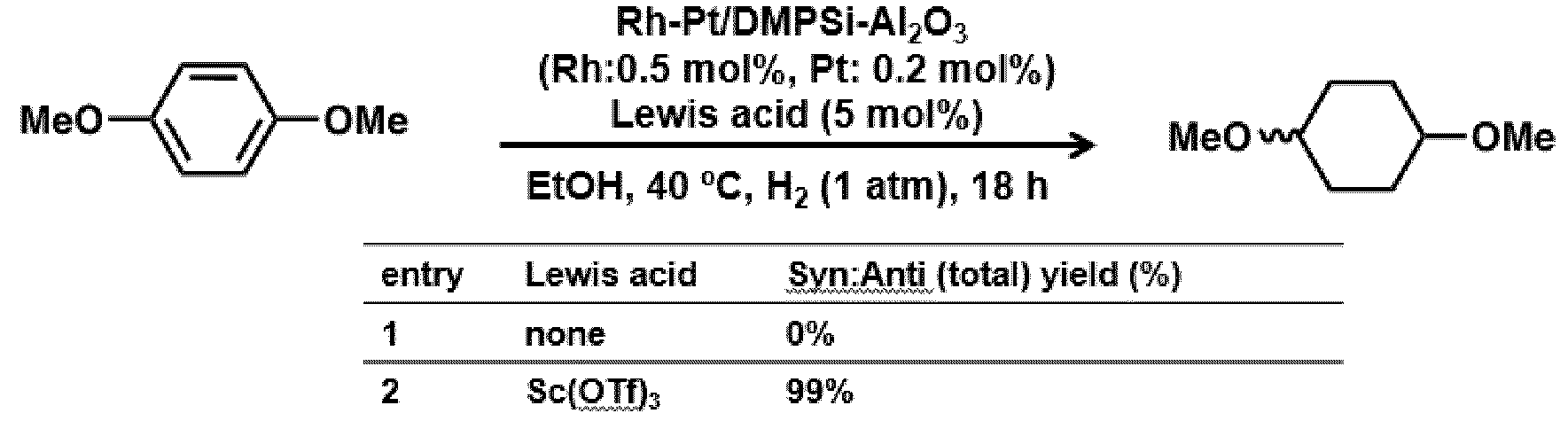
実施例13:キノリン誘導体の水素化反応
キノリン誘導体を反応基質として、実施例1と同様にして水素化体を得た。
キノリン誘導体を反応基質として、実施例1と同様にして水素化体を得た。
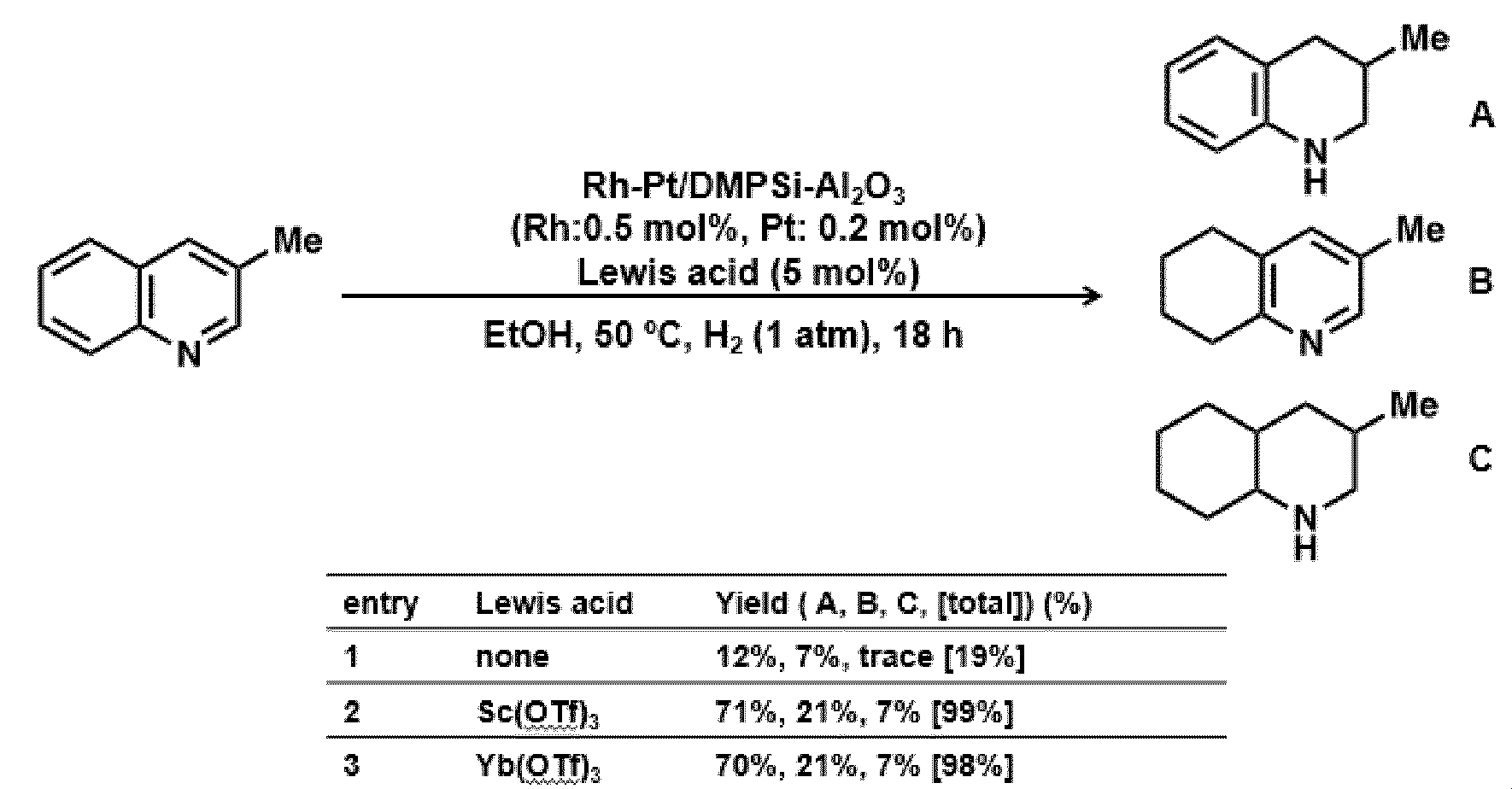
実施例14:他のベンゼン系芳香族化合物の水素化反応
反応基質を変える以外は、基本的に実施例1と同様にして水素化反応を行った。
反応基質を変える以外は、基本的に実施例1と同様にして水素化反応を行った。


[a]:Rh/Pt=2.81
実施例15:芳香族ヘテロ環化合物の水素化反応
反応基質を変える以外は、基本的に実施例1と同様にして水素化反応を行った。
反応基質を変える以外は、基本的に実施例1と同様にして水素化反応を行った。
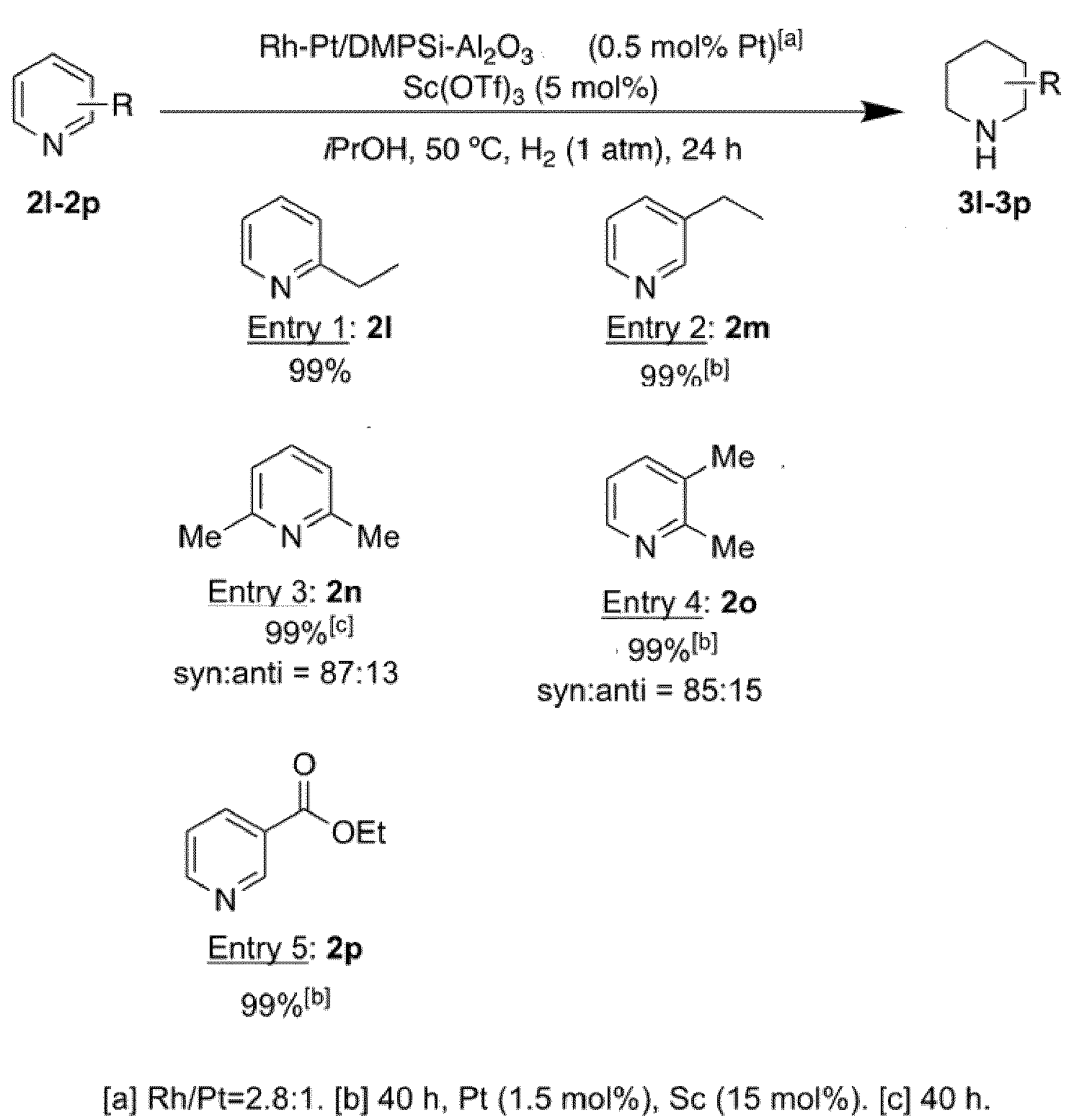
化合物3l:
1H NMR (600 MHz, CDCl3) δ 3.22 (d, J = 12.4 Hz, 1H), 2.70-2.75 (m, 1H), 2.56-2.60 (m, 1H), 1.76-1.79 (m, 2H), 1.65-1.68 (m, 1H), 1.53-1.59 (m, 2H), 1.43-1.48 (m, 1H), 1.29-1.37 (m, 1H), 1.18-1.26 (m, 1H), 0.89 (t, J = 7.6 Hz, 3H).
13C NMR (125 MHz, CDCl3) δ 58.9, 46.2, 29.9, 28.1, 24.1, 23.3, 9.8.
1H NMR (600 MHz, CDCl3) δ 3.22 (d, J = 12.4 Hz, 1H), 2.70-2.75 (m, 1H), 2.56-2.60 (m, 1H), 1.76-1.79 (m, 2H), 1.65-1.68 (m, 1H), 1.53-1.59 (m, 2H), 1.43-1.48 (m, 1H), 1.29-1.37 (m, 1H), 1.18-1.26 (m, 1H), 0.89 (t, J = 7.6 Hz, 3H).
13C NMR (125 MHz, CDCl3) δ 58.9, 46.2, 29.9, 28.1, 24.1, 23.3, 9.8.
化合物3m:
1H NMR (600 MHz, CDCl3) δ 3.10-3.13 (m, 2H), 2.52-2.58 (m, 1H), 2.25 (t, J = 12.4 Hz, 1H), 1.73-1.76 (m, 1H), 1.46-1.54 (m, 1H), 1.06-1.16 (m, 2H), 0.88-0.95 (m, 2H), 0.75 (t, J = 7.6 Hz, 3H).
13C NMR (125 MHz, CDCl3) δ 50.4, 45.4, 36.4, 29.3, 26.6, 23.7, 10.8.
1H NMR (600 MHz, CDCl3) δ 3.10-3.13 (m, 2H), 2.52-2.58 (m, 1H), 2.25 (t, J = 12.4 Hz, 1H), 1.73-1.76 (m, 1H), 1.46-1.54 (m, 1H), 1.06-1.16 (m, 2H), 0.88-0.95 (m, 2H), 0.75 (t, J = 7.6 Hz, 3H).
13C NMR (125 MHz, CDCl3) δ 50.4, 45.4, 36.4, 29.3, 26.6, 23.7, 10.8.
化合物3n(cisシス/transの混合物):
1H NMR (cis) (600 MHz, CDCl3) δ 2.68-2.73 (m, 2H), 1.62-1.66 (m, 1H), 1.52-1.56 (m, 2H), 1.21-1.27 (m, 1H), 1.06-1.10 (m, 2H), 1.05 (d, J = 6.2 Hz, 6H).
13C NMR (cis) (125 MHz, CDCl3) δ 53.3, 32.0, 23.8, 21.1.
1H NMR (cis) (600 MHz, CDCl3) δ 2.68-2.73 (m, 2H), 1.62-1.66 (m, 1H), 1.52-1.56 (m, 2H), 1.21-1.27 (m, 1H), 1.06-1.10 (m, 2H), 1.05 (d, J = 6.2 Hz, 6H).
13C NMR (cis) (125 MHz, CDCl3) δ 53.3, 32.0, 23.8, 21.1.
化合物3o(cisシス/transの混合物):
1H NMR (cis) (600 MHz, CDCl3) δ 3.36-3.41 (m, 1H), 3.09-3.13 (m, 1H), 2.98-3.02 (m, 1H), 2.98-3.02 (m, 1H), 1.96-2.01 (m, 1H), 1.75-1.81 (m, 1H), 1.64-1.69 (m, 1H), 1.55-1.60 (m, 1H), 1.44-1.61 (m, 1H), 1.29 (d, J = 6.2 Hz, 3H), 0.91 (d, J = 6.8 Hz, 3H); 13C NMR (cis) (125 MHz, CDCl3) δ 54.3, 41.7, 31.2, 26.9, 19.9, 17.2, 12.7.
13C NMR (trans) (125 MHz, CDCl3) δ 59.1, 45.5, 35.5, 31.5, 22.6, 18.2, 14.5.
1H NMR (cis) (600 MHz, CDCl3) δ 3.36-3.41 (m, 1H), 3.09-3.13 (m, 1H), 2.98-3.02 (m, 1H), 2.98-3.02 (m, 1H), 1.96-2.01 (m, 1H), 1.75-1.81 (m, 1H), 1.64-1.69 (m, 1H), 1.55-1.60 (m, 1H), 1.44-1.61 (m, 1H), 1.29 (d, J = 6.2 Hz, 3H), 0.91 (d, J = 6.8 Hz, 3H); 13C NMR (cis) (125 MHz, CDCl3) δ 54.3, 41.7, 31.2, 26.9, 19.9, 17.2, 12.7.
13C NMR (trans) (125 MHz, CDCl3) δ 59.1, 45.5, 35.5, 31.5, 22.6, 18.2, 14.5.
化合物3p:
1H NMR (600 MHz, CDCl3) δ 4.09 (q, J = 7 Hz, 2H), 3.27-3.30 (m, 1H), 3.08-3.12 (m, 1H), 2.91-2.96 (m, 1H), 2.76-2.81 (m, 1H), 2.60-2.57 (m, 1H), 2.58-2.36 (m, 1H), 1.99-2.01 (m, 1H), 1.71-1.75 (m, 1H), 1.60-1.68 (m, 2H), 1.1-1.21 (m, 3H).
13C NMR (125 MHz, CDCl3) δ 172.8, 60.9, 46.4, 45.2, 39.9, 26.1, 22.9, 14.0.
1H NMR (600 MHz, CDCl3) δ 4.09 (q, J = 7 Hz, 2H), 3.27-3.30 (m, 1H), 3.08-3.12 (m, 1H), 2.91-2.96 (m, 1H), 2.76-2.81 (m, 1H), 2.60-2.57 (m, 1H), 2.58-2.36 (m, 1H), 1.99-2.01 (m, 1H), 1.71-1.75 (m, 1H), 1.60-1.68 (m, 2H), 1.1-1.21 (m, 3H).
13C NMR (125 MHz, CDCl3) δ 172.8, 60.9, 46.4, 45.2, 39.9, 26.1, 22.9, 14.0.
本発明の触媒組成物は、複数の置換基や嵩高い置換基を有する不飽和化合物の水素化反応の触媒として工業的に有用である。
Claims (14)
- 白金、ロジウム、金、ニッケルおよびルテニウムから選ばれる2種以上の金属を担体に担持した金属ナノ粒子触媒と、ルイス酸とを含む触媒組成物。
- 前記担体が、(i)ポリシラン担体、または(ii)ポリシランと、アルミナ、またはジルコニア、チタニアもしくは二酸化ケイ素の金属酸化物とからなる複合担体である、請求項1に記載の触媒組成物。
- 前記金属ナノ粒子触媒が、ロジウムおよび白金をポリフェニルメチルシラン(MPPSi)とアルミナとの複合担体に担持したロジウム-白金触媒、または、ロジウムおよび白金をポリジメチルシラン(DMPSi)と、アルミナ、またはジルコニア、チタニアもしくは二酸化ケイ素の金属酸化物との複合担体に担持したロジウム-白金触媒である、請求項1または2に記載の触媒組成物。
- 前記ルイス酸が、ランタノイド系金属、チタン、ジルコニウム、亜鉛、および銀から選ばれる金属の陽イオンと、トリフラートイオン(CF3SO3 -)、パークロレイトイオン(ClO4 -)、スルホネートイオン(SO3 -)、ビス(トリフルオロメタンスルホニル)イミドイオン(NTf2 -)、およびハロゲン化物イオンから選ばれる陰イオンとから形成される、請求項1に記載の触媒組成物。
- 前記ルイス酸が、スカンジウム、イットリウム、イッテルビウム、ハフニウム、ランタン、チタン、ジルコニウム、亜鉛、および銀から選ばれる金属の陽イオンと、トリフラートイオン(CF3SO3 -)、パークロレイトイオン(ClO4 -)、C1-12アルキルスルホネートイオン(C1-12アルキル-SO3 -)、C1-12アルキルベンゼンスルホネートイオン(C1-12アルキル-C6H4-SO3 -)、ビス(トリフルオロメタンスルホニル)イミドイオン(NTf2 -)、およびハロゲン化物イオンから選ばれる陰イオンとから形成される、請求項1または4に記載の触媒組成物。
- 前記ルイス酸が、スカンジウム(III)トリフラート(Sc(OTf)3)、イッテルビウム(III)トリフラート(Yb(OTf)3)、またはそれらの組み合わせである、請求項1、4または5に記載の触媒組成物。
- 前記金属ナノ粒子触媒がRh-Pt/DMPSi-Al2O3であって、前記ルイス酸がSc(OTf)3またはYb(OTf)3である、請求項1~6のいずれか1項に記載の触媒組成物。
- 水素ガスを水素源とし、請求項1~7のいずれか1項に記載の触媒組成物の存在下で行う、不飽和化合物の水素化方法。
- 請求項1~7のいずれか1項に記載の触媒組成物の存在下で、不飽和化合物に水素ガスを接触させることを特徴とする、水素化化合物の製造方法。
- 前記不飽和化合物が芳香族化合物または芳香族ヘテロ環化合物である、請求項9に記載の製造方法。
- 前記金属ナノ粒子触媒が、前記不飽和化合物に対して、前記金属ナノ粒子触媒の合計金属量で0.01~5モル%の量で使用される、請求項9または10に記載の製造方法。
- 前記ルイス酸が、前記金属ナノ粒子触媒の合計金属量に対して、1~100倍の量で使用される、請求項9~11のいずれか1項に記載の製造方法。
- 常圧で行われる、請求項9~12のいずれか1項に記載の製造方法。
- 室温~80℃の温度範囲で行われる、請求項9~13のいずれか1項に記載の製造方法。
Priority Applications (1)
| Application Number | Priority Date | Filing Date | Title |
|---|---|---|---|
| JP2023503676A JPWO2022185877A1 (ja) | 2021-03-02 | 2022-02-10 |
Applications Claiming Priority (2)
| Application Number | Priority Date | Filing Date | Title |
|---|---|---|---|
| JP2021-032620 | 2021-03-02 | ||
| JP2021032620 | 2021-03-02 |
Publications (1)
| Publication Number | Publication Date |
|---|---|
| WO2022185877A1 true WO2022185877A1 (ja) | 2022-09-09 |
Family
ID=83154041
Family Applications (1)
| Application Number | Title | Priority Date | Filing Date |
|---|---|---|---|
| PCT/JP2022/005404 Ceased WO2022185877A1 (ja) | 2021-03-02 | 2022-02-10 | ナノ粒子触媒とルイス酸とを含む触媒組成物、および水素化化合物の製造方法 |
Country Status (2)
| Country | Link |
|---|---|
| JP (1) | JPWO2022185877A1 (ja) |
| WO (1) | WO2022185877A1 (ja) |
Citations (5)
| Publication number | Priority date | Publication date | Assignee | Title |
|---|---|---|---|---|
| JPH09265994A (ja) * | 1996-01-26 | 1997-10-07 | Asahi Glass Co Ltd | メタノール燃料電池 |
| JPH10255831A (ja) * | 1997-03-12 | 1998-09-25 | Asahi Glass Co Ltd | メタノール燃料電池 |
| JP2002134123A (ja) * | 2000-10-20 | 2002-05-10 | Shin Etsu Chem Co Ltd | 燃料電池用触媒及びその製造方法並びに燃料電池用電極 |
| JP2007260659A (ja) * | 2006-03-02 | 2007-10-11 | Japan Science & Technology Agency | ポリシラン担持遷移金属触媒 |
| KR20090058239A (ko) * | 2007-12-04 | 2009-06-09 | 성균관대학교산학협력단 | 방향족 화합물의 수소화 방법 |
-
2022
- 2022-02-10 JP JP2023503676A patent/JPWO2022185877A1/ja active Pending
- 2022-02-10 WO PCT/JP2022/005404 patent/WO2022185877A1/ja not_active Ceased
Patent Citations (5)
| Publication number | Priority date | Publication date | Assignee | Title |
|---|---|---|---|---|
| JPH09265994A (ja) * | 1996-01-26 | 1997-10-07 | Asahi Glass Co Ltd | メタノール燃料電池 |
| JPH10255831A (ja) * | 1997-03-12 | 1998-09-25 | Asahi Glass Co Ltd | メタノール燃料電池 |
| JP2002134123A (ja) * | 2000-10-20 | 2002-05-10 | Shin Etsu Chem Co Ltd | 燃料電池用触媒及びその製造方法並びに燃料電池用電極 |
| JP2007260659A (ja) * | 2006-03-02 | 2007-10-11 | Japan Science & Technology Agency | ポリシラン担持遷移金属触媒 |
| KR20090058239A (ko) * | 2007-12-04 | 2009-06-09 | 성균관대학교산학협력단 | 방향족 화합물의 수소화 방법 |
Non-Patent Citations (3)
| Title |
|---|
| MIYAMURA HIROYUKI, SUZUKI AYA, YASUKAWA TOMOHIRO, KOBAYASHI SHU̅: "Polysilane-Immobilized Rh–Pt Bimetallic Nanoparticles as Powerful Arene Hydrogenation Catalysts: Synthesis, Reactions under Batch and Flow Conditions and Reaction Mechanism", JOURNAL OF THE AMERICAN CHEMICAL SOCIETY, AMERICAN CHEMICAL SOCIETY, vol. 140, no. 36, 12 September 2018 (2018-09-12), pages 11325 - 11334, XP055964331, ISSN: 0002-7863, DOI: 10.1021/jacs.8b06015 * |
| MIYAMURA, HIROYUKI ET AL.: "A20-1am-06 Hydrogenation reaction of aromatic compounds by a coordinated catalytic system of heterogeneous rhodium-platinum binary metal nanoparticles and Lewis acid", PROCEEDINGS OF THE 101ST ANNUAL SPRING MEETING OF THE CHEMICAL SOCIETY OF JAPAN (CSJ); [ONLINE]; MARCH 19-22, 2021, vol. 101, 4 March 2021 (2021-03-04) - 22 March 2021 (2021-03-22), pages A20 - 1am, XP009539824 * |
| ZHANG PENG, TIANBIN WU, MINQIANG HOU, JUN MA, HUIZHEN LIU, TAO JIANG, WEITAO WANG,CONGYI WU, BUXING HAN: "The Hydrogenation of Aromatic compounds under Mild Conditions by Using a Solid Lewis Acid and Supported Palladium Catalyst", CHEMCATCHEM., vol. 6, 1 January 2014 (2014-01-01), pages 3323 - 3327, XP055964334, DOI: 10.1002/cctc.201402671 * |
Also Published As
| Publication number | Publication date |
|---|---|
| JPWO2022185877A1 (ja) | 2022-09-09 |
Similar Documents
| Publication | Publication Date | Title |
|---|---|---|
| Burrows et al. | Scalable Birch reduction with lithium and ethylenediamine in tetrahydrofuran | |
| Zhang et al. | Multifunctional Ag (I)/CAAA-amidphos complex-catalyzed asymmetric [3+ 2] cycloaddition of α-substituted acrylamides | |
| Liu et al. | Transition-metal-free: A highly efficient catalytic aerobic alcohol oxidation process | |
| Matousek et al. | One-pot synthesis of hypervalent iodine reagents for electrophilic trifluoromethylation | |
| Das et al. | Catalytic Hunsdiecker reaction of α, β-unsaturated carboxylic acids: how efficient is the catalyst? | |
| Chuprakov et al. | Stereoselective 1, 3-insertions of rhodium (II) azavinyl carbenes | |
| Wang et al. | Direct β-alkylation of ketones and aldehydes via Pd-catalyzed redox cascade | |
| Yang et al. | Metal–Organic‐Framework‐Derived Co3S4 Hollow Nanoboxes for the Selective Reduction of Nitroarenes | |
| JPH0662483B2 (ja) | 1―オキソ―1,2,3,4―テトラハイドロナフタレンの製造方法 | |
| Yao et al. | Enantioselective [1, 3] O-to-C rearrangement: dearomatization of alkyl 2-allyloxy/benzyloxy-1/3-naphthoates catalyzed by a chiral π–Cu (ii) complex | |
| Galkin et al. | Alkynes as a versatile platform for construction of chemical molecular complexity and realization of molecular 3D printing | |
| Bunz et al. | Synthesis and structural characterization of novel organometallic dehydroannulenes with fused CpCo-cyclobutadiene and ferrocene units including a cyclic fullerenyne segment | |
| Liu et al. | Continuous-flow electro-oxidative coupling of sulfides with activated methylene compounds leading to sulfur ylides | |
| Jia et al. | Reductive Coupling of N-Heteroarenes and 1, 2-Dicarbonyls for Direct Access to γ-Amino Acids, Esters, and Ketones Using a Heterogeneous Single-Atom Iridium Catalyst | |
| Mao et al. | Silicon-enriched nickel nanoparticles for hydrogenation of N-heterocycles in aqueous media | |
| Wu et al. | Rh (iii)-Catalyzed switchable C–H functionalization of 2-(1 H-pyrazol-1-yl) pyridine with internal alkynes | |
| Gu et al. | Pd (II)-catalyzed asymmetric annulation toward the synthesis of 2, 3-disubstituted chiral indenols | |
| Xu et al. | Iridium-catalyzed highly chemoselective and efficient reduction of nitroalkenes to nitroalkanes in water | |
| WO2020080165A1 (ja) | 化合物、及びその製造方法 | |
| Sayahi et al. | Electrochemical synthesis of three‐dimensional flower‐like Ni/Co–BTC bimetallic organic framework as heterogeneous catalyst for solvent‐free and green synthesis of substituted chromeno [4, 3–b] quinolones | |
| Dağalan et al. | Highly efficient hydrogenation and dehydrogenation of N-Heteroarenes catalyzed by mesoporous graphitic carbon nitride supported CoPd alloy nanoparticles | |
| Chen et al. | Three-component reaction of cyclopropanols, DABSO, and N-(sulfonyl) acrylamides: Preparation of sulfone-bridged 1, 7-dicarbonyl compounds | |
| CN119859808A (zh) | 一种以d2o为氘源钯膜催化氘代烯烃的合成方法 | |
| Marti et al. | Chemoselective Reductive Heterocyclization by Controlling the Binomial Architecture of Metal Particles and Acid–Base Properties of the Support | |
| JP2013133293A (ja) | インダンおよび/またはインデンの製造方法 |
Legal Events
| Date | Code | Title | Description |
|---|---|---|---|
| 121 | Ep: the epo has been informed by wipo that ep was designated in this application |
Ref document number: 22762934 Country of ref document: EP Kind code of ref document: A1 |
|
| WWE | Wipo information: entry into national phase |
Ref document number: 2023503676 Country of ref document: JP |
|
| NENP | Non-entry into the national phase |
Ref country code: DE |
|
| 122 | Ep: pct application non-entry in european phase |
Ref document number: 22762934 Country of ref document: EP Kind code of ref document: A1 |