WO2022181678A1 - 音響システム - Google Patents
音響システム Download PDFInfo
- Publication number
- WO2022181678A1 WO2022181678A1 PCT/JP2022/007568 JP2022007568W WO2022181678A1 WO 2022181678 A1 WO2022181678 A1 WO 2022181678A1 JP 2022007568 W JP2022007568 W JP 2022007568W WO 2022181678 A1 WO2022181678 A1 WO 2022181678A1
- Authority
- WO
- WIPO (PCT)
- Prior art keywords
- speaker
- listener
- super
- electrodynamic
- distance
- Prior art date
- Legal status (The legal status is an assumption and is not a legal conclusion. Google has not performed a legal analysis and makes no representation as to the accuracy of the status listed.)
- Ceased
Links
Images





Classifications
-
- H—ELECTRICITY
- H04—ELECTRIC COMMUNICATION TECHNIQUE
- H04R—LOUDSPEAKERS, MICROPHONES, GRAMOPHONE PICK-UPS OR LIKE ACOUSTIC ELECTROMECHANICAL TRANSDUCERS; ELECTRIC HEARING AIDS; PUBLIC ADDRESS SYSTEMS
- H04R1/00—Details of transducers, loudspeakers or microphones
- H04R1/20—Arrangements for obtaining desired frequency or directional characteristics
-
- H—ELECTRICITY
- H04—ELECTRIC COMMUNICATION TECHNIQUE
- H04R—LOUDSPEAKERS, MICROPHONES, GRAMOPHONE PICK-UPS OR LIKE ACOUSTIC ELECTROMECHANICAL TRANSDUCERS; ELECTRIC HEARING AIDS; PUBLIC ADDRESS SYSTEMS
- H04R3/00—Circuits for transducers
-
- H—ELECTRICITY
- H04—ELECTRIC COMMUNICATION TECHNIQUE
- H04S—STEREOPHONIC SYSTEMS
- H04S7/00—Indicating arrangements; Control arrangements, e.g. balance control
Definitions
- the present invention relates to an acoustic system that uses an electrodynamic speaker and a super-directional speaker to control the position of a virtual sound source from the listener.
- Non-Patent Document 1 In the object-based method in a multi-channel stereophonic system, in order to construct a virtual sound source between speakers, sound pressure is controlled based on vector synthesis (Non-Patent Document 1). It was extremely difficult to build. However, in order to realize virtual reality of sound, it is very important to control not only the direction of arrival of sound to the listener but also the distance from the listener to the virtual sound source. A binaural method (Non-Patent Document 2) that provides a virtual sound source using a head-related transfer function is useful for sound source localization near the head, but it is difficult to construct a virtual sound source in the distance.
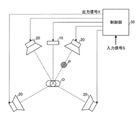
- FIG. 9 is a configuration diagram of the acoustic system disclosed in Patent Document 1. As shown in FIG. The acoustic system shown in FIG. 9 includes one parametric speaker 10, four electrodynamic speakers 20, and a control section 30. In FIG. The parametric speaker 10 is placed in front of the listener O.
- the four electrodynamic loudspeakers 20 are arranged on the front left, front right, rear left, and rear right sides of the listener O, respectively.
- the control unit 30 controls the parametric speaker 10 and the four electrodynamic speakers 20 so as to output sounds corresponding to the input signal S, which is an audio signal.
- Patent Document 2 the audible sound radiated from the electrodynamic speaker and the super-directional speaker is heard most loudly when the listener is positioned at a predetermined distance dk in the sound axis direction from the position where each speaker is installed. , becomes smaller when the listener is out of a given distance dk. Therefore, in Patent Document 2, only an electrodynamic speaker and a super-directional speaker installed in the same direction with respect to the listener are used for reception without arranging many electrodynamic speakers around the listener. The maximum sound pressure of audible sound is created in the vicinity of the listener to realize a three-dimensional sound field that makes the listener feel surrounded by sound.
- the present invention uses a parametric-array loudspeaker (PAL), which is a super-directional speaker using ultrasonic waves, to control both the azimuth and distance between a listener and a virtual sound source in a small-scale sound system.
- PAL parametric-array loudspeaker
- Figures 8(a) and 8(b) show the room impulse response of the electro-dynamic loudspeaker (EDL) and the super-directional speaker under the condition that the distance between the speaker and the sound receiving point is 2 m. 2 shows the room impulse response of the parametric loudspeaker.
- EDL electro-dynamic loudspeaker
- PAL parametric loudspeaker
- DRR direct-to-reverberant ratio
- ILD interaural level difference
- Patent Document 2 an electrodynamic speaker and a super-directional speaker are placed side by side, and it realizes a three-dimensional sound field that makes the listener feel surrounded by sound. It doesn't change the distance.
- the inventor of the present invention has proposed an electrodynamic speaker and a superdirectivity speaker so that the output direction of sound from the electrodynamic speaker and the output direction of sound from the superdirectivity speaker match. by arranging a dynamic speaker and changing the energy ratio between the impulse response from the electrodynamic speaker to the listener and the impulse response from the super-directional speaker to the listener to control the direct ratio.
- an object of the present invention is to provide an acoustic system capable of presenting moving sound that penetrates the listener.
- the acoustic system of the present invention uses an electrodynamic speaker 20 and a super-directional speaker 10, and is an acoustic system in which the position of a virtual sound source P from a listener O is controlled by a control unit 30,
- the electrodynamic speaker 20 includes at least a first electrodynamic speaker 20FL and a second electrodynamic speaker 20BR
- the superdirective speaker 10 includes at least a first superdirective speaker 10FL and a second superdirective speaker 10FL.
- the first electrodynamic speaker 10BR so that the output direction of sound from the first electrodynamic speaker 20FL and the output direction of sound from the first superdirective speaker 10FL match.
- the second electrodynamic speaker 20BR and the second super-directional speaker 10BR are arranged so that the sound from the first electro-dynamic speaker 20FL and the first super-directional speaker 10FL is first
- the output direction and the second output direction of the sound from the second electrodynamic loudspeaker 20BR and the second super-directional loudspeaker 10BR are directed to the position of the listener O, and the first electrodynamic loudspeaker
- a first virtual boundary point Q1 is set between the speaker 20FL and the first superdirective speaker 10FL and the listener O
- the first electrodynamic speaker 20FL and the first superdirective speaker 10FL and the A first long distance X1 is defined between the first imaginary boundary point Q1
- a first short distance Y1 is defined between the first imaginary boundary point Q1 and the listener O
- a second virtual boundary point Q2 is set
- the control unit 30 sets the first far distance X1 to the imaginary
- the energy ratio between the impulse response from the first electrodynamic speaker 20FL to the listener O and the impulse response from the first super-directional speaker 10FL to the listener O is changed.
- the impulse response from the second electrodynamic speaker 20BR to the listener O Directional speaker 10BR to the listener O by changing the energy ratio of the impulse response from The first short-range level difference and the second short-range level difference are controlled by changing the energy ratio between the first super-directive speaker 10FL and the second super-directive speaker 10BR.
- the present invention according to claim 2 is the acoustic system according to claim 1, in which the first electrodynamic speaker 20FL and the first superdirective speaker 10FL are arranged in a first housing 40, and the second The electrodynamic loudspeaker 20BR and the second super-directional loudspeaker 10BR are arranged in the second housing 40.
- the acoustic system of the present invention is an acoustic system that uses the electrodynamic speaker 20 and the super-directional speaker 10 and controls the position of the virtual sound source P from the listener O by the control unit 30,
- the electrodynamic speaker 20 includes at least a first electrodynamic speaker 20FL, a second electrodynamic speaker 20BR, a third electrodynamic speaker 20FR, and a fourth electrodynamic speaker 20BL
- the super-directional speaker 10 includes at least a first superdirective speaker 10FL, a second superdirective speaker 10BR, a third superdirective speaker 10FR, and a fourth superdirective speaker 10BL, and a signal from the first electrodynamic speaker 20FL
- the first electrodynamic speaker 20FL and the first superdirective speaker 10FL are arranged so that the output direction of sound and the output direction of sound from the first superdirective speaker 10FL are aligned
- the second electrodynamic speaker 20BR and the second superdirective speaker 20BR are arranged so that the output direction of sound from the second electrodynamic speaker 20BR and the output direction of sound from the
- the third electrodynamic speaker 10BR is arranged so that the output direction of sound from the third electrodynamic speaker 20FR and the output direction of sound from the third super-directional speaker 10FR match.
- type speaker 20FR and the third super-directional speaker 10FR are arranged, and the output direction of sound from the fourth electrodynamic speaker 20BL and the output direction of sound from the fourth super-directional speaker 10BL match.
- the fourth electrodynamic speaker 20BL and the fourth super-directional speaker 10BL are arranged so that the sound from the first electro-dynamic speaker 20FL and the first super-directional speaker 10FL is first
- the output direction and the second output direction of the sound from the second electrodynamic speaker 20BR and the second super-directional speaker 10BR are directed to the position of the listener O, and the third electrodynamic a third output direction of the sound from the type speaker 20FR and the third super-directional speaker 10FR, and a fourth output direction of the sound from the fourth electrodynamic speaker 20BL and the fourth super-directional speaker 10BL.
- a second quadrant R is defined as a second quadrant R, and the second electrodynamic loudspeaker 20BR and the second super-directional loudspeaker 20BR are arranged around the listener O.
- a third quadrant B is defined between the directional speaker 10BR and the fourth electrodynamic speaker 20BL and the fourth super-directional speaker 10BL.
- a fourth quadrant L is defined between the fourth super-directional speaker 10BL and the first electrodynamic speaker 20FL and the first super-directional speaker 10FL, and a virtual boundary line centered on the listener O is set.
- the control unit 30 controls the distance from the first electrodynamic speaker 20FL to the listener O. and the energy ratio of the impulse response from the first super-directional speaker 10FL to the listener O is changed to control the first long-distance direct ratio, and from the third electrodynamic speaker 20FR to the The energy ratio between the impulse response up to the listener O and the impulse response from the third super-directional speaker 10FR to the listener O is changed to control the third far direct ratio, and the first far direct direct ratio is controlled.
- the virtual By controlling the first far-distance output sound set by the inter-direct ratio and the third far-distance output sound set by the third far-distance direct ratio by amplitude panning, the virtual When the azimuth and distance of the sound source P are changed and the virtual sound source P is outside the listener from the virtual boundary line in the second quadrant R, the third electrodynamic loudspeaker 20FR is connected to the listener.
- the second electrodynamic speaker 20BR to the listener O and the energy ratio of the impulse response from the second super-directional speaker 10BR to the listener O is changed to control the second long-distance direct ratio
- the second electrodynamic speaker 20BR to the listener O and the energy ratio of the impulse response from the second super-directional speaker 10BR to the listener O is changed to control the second long-distance direct ratio
- the second short-range level difference by changing the energy ratio of the third short-range output sound set by the third short-range level difference and the second short-range output sound set by the second short-range level difference
- the azimuth and distance of the virtual sound source P from the listener O are changed, and in the third quadrant B, the sound source P is moved inward of the listener from the virtual boundary line.
- the energy ratio between the second super-directive speaker 10BR and the first super-directive speaker 10FL is changed to control the second short-range level difference, and the fourth super-directive speaker 10BL and the third super-directional speaker 10FR to control the fourth short-range level difference, and the second short-range output sound set by the second short-range level difference and the fourth
- the azimuth and distance of the virtual sound source P from the listener O are changed, and in the fourth quadrant L.
- the acoustic system of the present invention uses a plurality of electrodynamic speakers 20 and a plurality of super-directional speakers 10, and controls the position of the virtual sound source P from the listener O by the control unit 30.
- the control unit 30 controls the electrodynamic speaker when the virtual sound source P is outside the listener from the virtual boundary line.
- the direct ratio of the impulse response is controlled by amplitude panning between 20 and the super-directional speaker 10 to express the perspective of sound, and when the virtual sound source P is inside the listener from the virtual boundary line 2.
- the inter-aural level difference is controlled by amplitude panning of the super-directional speaker 10 to express intra-head localization.
- the present invention according to claim 5 is the acoustic system according to claim 3 or 4, wherein the electrodynamic speaker 20 and the superdirective speaker 10 are arranged in one housing 40. do.
- a parametric speaker is used as the superdirective speaker 10 .
- the present invention by changing the distance between the listener and the virtual sound source, it is possible to give the listener a sense of remote presence and to give the listener a moving sound that penetrates the listener. .
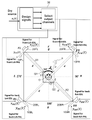
- FIG. 1 is a conceptual diagram showing an acoustic system according to an embodiment of the present invention
- FIG. Flowchart of signal generation for controlling a virtual sound source P at a long distance from the listener Flowchart for signal generation to control virtual sound sources at listener's close range (a) a table showing signal output destinations at a long distance from the listener, (b) a table showing signal output destinations at a short distance from the listener FIG.
- the acoustic system according to the first embodiment of the present invention has at least a first electrodynamic speaker and a second electrodynamic speaker as electrodynamic speakers, and at least a first superdirectivity speaker as superdirectivity speakers. and a second super-directional speaker, wherein the first dynamic speaker is arranged such that the direction of output of sound from the first electro-dynamic speaker matches the direction of output of sound from the first super-directional speaker.
- An electrodynamic speaker and a first superdirective speaker are arranged, and a second superdirective speaker is arranged so that the output direction of sound from the second electrodynamic speaker matches the output direction of sound from the second superdirective speaker.
- An electrodynamic speaker and a second superdirective speaker are arranged, and a first output direction of sound from the first electrodynamic speaker and the first superdirective speaker, a second electrodynamic speaker and the second superdirectivity
- a first virtual boundary point is set between the first electrodynamic loudspeaker and the first super-directional loudspeaker and the listener by making the second output direction of the sound from the dynamic loudspeaker face the listener's position.
- the distance between the first electrodynamic speaker and the first superdirective speaker and the first virtual boundary point is defined as a first long distance
- the distance between the first virtual boundary point and the listener is defined as a first short distance
- the second A second virtual boundary point is set between the electrodynamic speaker and the second superdirective speaker and the listener
- the second virtual boundary point is set between the second electrodynamic speaker and the second superdirective speaker and the second virtual boundary point.
- the control unit when there is a virtual sound source in the first far distance, and the energy ratio of the impulse response from the first super-directional speaker to the listener is changed to control the first far-distance direct ratio, and when there is a virtual sound source at the second far-distance, the second changing the energy ratio between the impulse response from the second electrodynamic speaker to the listener and the impulse response from the second super-directional speaker to the listener to control the second long-distance direct ratio;
- the energy ratio between the first super-directive speaker and the second super-directive speaker is changed to control the first short-distance level difference and the second short-distance level difference.
- the sense of distance to the virtual sound source can be zoomed in or out, and the listener can be given a sense of remote presence. At the same time, it is possible to give the listener a moving sound that penetrates the listener.
- the first electrodynamic speaker and the first superdirective speaker are arranged in the first housing, and the second electrodynamic speaker is arranged in the first housing.
- a speaker and a second super-directional speaker are arranged in the second housing.
- a sound system includes, as electrodynamic speakers, at least a first electrodynamic speaker, a second electrodynamic speaker, a third electrodynamic speaker, and a fourth electrodynamic speaker.
- the first electrodynamic speaker and the first superdirective speaker are arranged so that the output direction of sound and the output direction of sound from the first superdirective speaker match, and the second electrodynamic speaker
- the second electrodynamic speaker and the second superdirective speaker are arranged so that the output direction of the sound and the output direction of the sound from the second superdirectional speaker match, and the third electrodynamic speaker
- the third electrodynamic speaker and the third superdirective speaker are arranged so that the output direction of sound from the superdirective speaker and the output direction of sound from the third superdirective speaker match, and the fourth electrodynamic speaker
- the fourth electrodynamic speaker and the fourth superdirective speaker are arranged so that the output direction of sound from
- a second virtual line connecting the type speaker and the third super-directional speaker with the fourth electro-dynamic speaker and the fourth super-directional speaker is intersected, and the first electro-dynamic speaker and the first electro-dynamic speaker are arranged around the listener.
- a first quadrant is defined between the superdirective speaker and the third electrodynamic speaker and the third superdirective speaker.
- the area between the second electrodynamic speaker and the second super-directional speaker is defined as a second quadrant.
- the area between the 4 super-directional speakers is defined as the third quadrant, and centering on the listener, the 4th electrodynamic-type speaker and the 4th super-directional speaker, and the 1st electro-dynamic-type speaker and the 1st super-directional speaker A virtual
- the control unit When the boundary line is set, the control unit generates an impulse response from the first electrodynamic loudspeaker to the listener and the first superimpulse
- the energy ratio of the impulse response from the directional speaker to the listener is changed to control the first long-distance direct ratio, and the impulse response from the third electrodynamic speaker to the listener and the impulse response from the third super-directional speaker changing the energy ratio with the impulse response to the listener to control the third far distance direct ratio, and the first far distance output sound set by the first far distance direct ratio and the third far distance direct ratio
- the azimuth and distance of the virtual sound source from the listener are changed by controlling the amplitude
- the virtual By controlling the third far-distance output sound set by the 3 far-distance direct ratio and the second far-distance output sound set by the second far-distance direct ratio by amplitude panning, the virtual When the azimuth and distance of the sound source are changed and the virtual sound source is outside the listener from the virtual boundary in the third quadrant, the impulse response from the second electrodynamic loudspeaker to the listener and the second The energy ratio of the impulse response from the directional speaker to the listener is changed to control the second long-distance direct ratio, and the impulse response from the fourth electrodynamic speaker to the listener and from the fourth super-directional speaker changing the energy ratio with the impulse response to the listener to control the fourth far distance direct ratio, and the second far distance output sound set by the second far distance direct ratio and the fourth far distance direct ratio
- the impulse response from the first electrodynamic loudspeaker to the listener and the impulse response from the first super-directional loudspeaker to the listener Varying the energy ratio with the Luth response to control the first far-direct ratio, the fourth far-field output sound set by the fourth far-direct ratio, and the fourth far-field output sound set by the first far-direct ratio
- the azimuth and distance of the virtual sound source from the listener are changed, and in the first quadrant, the virtual sound source is inside the listener from the virtual boundary line.
- the energy ratio between the first super-directive speaker and the second super-directive speaker is changed to control the first short-range level difference
- the third super-directive speaker and the fourth super-directive speaker The energy ratio is changed to control the third short-range level difference, and the first short-range output sound set by the one short-range level difference and the third short-range output sound set by the third short-range level difference are generated.
- a third short-range level difference is controlled by changing the energy ratio between the speaker and the fourth super-directional speaker, and a second near-range level difference is controlled by changing the energy ratio between the second super-directional speaker and the first super-directional speaker.
- a virtual sound source from a listener is controlled by amplitude panning of a second near-field output sound set by a second near-field level difference and a fourth near-field output sound set by a fourth near-field level difference.
- the energy ratio between the 4th super-directional speaker and the 3rd super-directional speaker is controlling the fourth short-range level difference by changing the energy ratio between the first super-directional speaker and the second super-directional speaker to control the first short-range level difference;
- the virtual It changes the direction and distance of the sound source.
- the sense of distance to the virtual sound source can be zoomed in and out in all directions of 360 degrees centered on the listener, and can be controlled by amplitude panning.
- a sense of realism can be given, and a moving sound that penetrates the listener can be given to the listener in any direction.
- the control unit controls the movement of the virtual sound source when there is a virtual sound source outside the listener from the virtual boundary line.
- the direct-to-direct ratio of the impulse response is controlled by amplitude panning between the electronic speaker and the super-directional speaker to express the perspective of the sound.
- the intra-head localization is expressed by controlling the interaural level difference by amplitude panning of the loudspeaker.
- an electrodynamic speaker and a superdirective speaker are arranged in one housing. According to the present embodiment, by integrating the electrodynamic speaker and the superdirective speaker into an integrated speaker, the output direction of sound from the electrodynamic speaker and the output direction of sound from the superdirective speaker easy to match.
- a sixth embodiment of the present invention uses a parametric speaker as a super-directional speaker in the acoustic system according to any one of the first to fifth embodiments.
- amplitude panning can be performed by combining an electrodynamic speaker with a low direct-to-direct ratio of impulse responses and a parametric speaker with a high direct-to-direct ratio of impulse responses. It is possible to control the direct ratio of the impulse response at the listener's position, which is a clue of the sense of hearing, more precisely.
- FIG. 1 is a conceptual diagram showing an acoustic system according to one embodiment of the present invention.
- the sound system according to this embodiment uses the electrodynamic speaker 20 and the super-directional speaker 10, and controls the position of the virtual sound source P from the listener O by the control unit 30.
- the super-directional speaker 10 is a parametric speaker using, for example, ultrasonic waves as carrier waves.
- the electrodynamic speaker 20 is generally used as an audio device, is a dynamic drive system speaker using a permanent magnet and a moving coil, and generally has a low direct-to-direct ratio (reverberation is large with respect to direct sound).
- the electrodynamic speaker 20 and the superdirective speaker 10 are arranged so that the output direction of sound from the electrodynamic speaker 20 and the output direction of sound from the superdirective speaker 10 match.
- a clue (index) for the sense of distance of the virtual sound source P is the direct ratio of the impulse response.
- the control unit 30 controls the super-directional speaker 10 and the electrodynamic speaker 20 so as to output sound corresponding to the input signal.
- the acoustic system has, as electrodynamic speakers 20, a first electrodynamic speaker 20FL, a second electrodynamic speaker 20BR, a third electrodynamic speaker 20FR, and a fourth electrodynamic speaker 20BL.
- the super-directive speaker 10 includes a first super-directive speaker 10FL, a second super-directive speaker 10BR, a third super-directive speaker 10FR and a fourth super-directive speaker 10BL.
- the first electrodynamic speaker 20FL and the first superdirective speaker 10FL are arranged so that the output direction of sound from the first electrodynamic speaker 20FL and the output direction of sound from the first superdirective speaker 10FL match. to place.
- the second electrodynamic speaker 20BR and the second superdirective speaker 10BR are arranged so that the output direction of sound from the second electrodynamic speaker 20BR and the output direction of sound from the second superdirective speaker 10BR match. to place.
- the third electrodynamic speaker 20FR and the third superdirective speaker 10FR are arranged so that the output direction of sound from the third electrodynamic speaker 20FR and the output direction of sound from the third superdirective speaker 10FR match. to place.
- the fourth electrodynamic speaker 20BL and the fourth superdirective speaker 10BL are arranged so that the output direction of sound from the fourth electrodynamic speaker 20BL and the output direction of sound from the fourth superdirective speaker 10BL match. to place.
- a first quadrant F is defined between the first electrodynamic speaker 20FL and the first superdirective speaker 10FL, and the third electrodynamic speaker 20FR and the third superdirective speaker 10FR. do.
- a second quadrant R is defined between the third electrodynamic speaker 20FR and the third super-directional speaker 10FR and the second electro-dynamic speaker 20BR and the second super-directional speaker 10BR with the listener O at the center. do.
- a third quadrant B is defined between the second electrodynamic speaker 20BR and the second super-directional speaker 10BR and the fourth electro-dynamic speaker 20BL and the fourth super-directional speaker 10BL. do.
- a fourth quadrant L is defined between the fourth electrodynamic speaker 20BL and the fourth superdirective speaker 10BL, and the first electrodynamic speaker 20FL and the first superdirective speaker 10FL, with the listener O at the center. do.
- a distance d is set from the listener O to the speakers 10 and 20
- a distance r (0 ⁇ r ⁇ d) is set from the listener O to the virtual sound source P
- a virtual boundary line is set centering on the listener O, and this virtual boundary line
- the virtual sound source is azimuth ⁇ (-45° ⁇ ⁇ ⁇ 315° ).
- si(t) is the signal of the i-th normalized material sound (object), t is time, FL is -45° direction, FR is 45° direction, BL is 225° direction, BR is 135° ° direction, F is 0 ° direction, L is 270 ° direction, R is 90 ° direction, B is 180 ° direction.
- xFL(t) is the output signal from the first electrodynamic speaker 20FL
- xFR(t) is the output signal from the third electrodynamic speaker 20FR
- xBL(t) is the output signal from the fourth electrodynamic speaker 20BL.
- xBR(t) is the output signal from the second electrodynamic speaker 20BR
- yFL(t) is the output signal from the first super-directional speaker 10FL
- yFR(t) is the output signal from the third super-directional speaker 10FR.
- the output signal, yBL(t), is the output signal from the fourth superdirective speaker 10BL
- yBR(t) is the output signal from the second superdirective speaker 10BR.
- the output signal is created by projecting the azimuth ⁇ of the virtual sound source P forward (-45° ⁇ 45°).
- ⁇ F be the direction of the virtual sound source P when the direction of the virtual sound source P is projected forward.
- ⁇ F can be calculated by the following equation.
- FIG. 2 shows a flow chart of signal generation for controlling the virtual sound source P located far from the listener O.
- ⁇ yD1(t) and ⁇ yD2(t) are the signals of the super-directional speaker 10 installed at each position
- ⁇ xD1(t) and ⁇ xD2(t) are the signals of the electrodynamic speaker 20 installed at each position. is a signal.
- ⁇ yD1(t), ⁇ yD2(t), ⁇ xD1(t), and ⁇ xD2(t) can be calculated by the following equations.
- the weighting coefficients ⁇ F, ⁇ F, gL, and gR can be calculated by the following equations.
- FIG. 3 shows a flow chart of signal generation for controlling the virtual sound source P at a short distance of the listener O.
- ⁇ yC1(t), ⁇ yC2(t), ⁇ yC3(t), and ⁇ yC4(t) indicate the signals of the super-directive speaker 10 installed at each position.
- ⁇ yC1(t), ⁇ yC2(t), ⁇ yC3(t), and ⁇ yC4(t) can be calculated by the following equations.
- the weighting coefficients ⁇ F and ⁇ B can be calculated by the following equations.
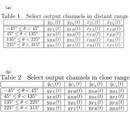
- FIG. 4A is a table showing signal output destinations at a long distance from the listener O
- FIG. 4B is a table showing signal output destinations at a short distance from the listener O.
- FIG. No output is made from the speakers 10 and 20 that have no selection destination.
- different processing is performed depending on whether the listener O is at a short distance or a long distance.
- a virtual sound source P that moves through the listener O is constructed by using the super-directive speaker 10 facing the listener O.
- - ⁇ Rendering of the moving virtual sound source P can be realized by calculating a weighting factor from the position (moving speed and time) of the virtual sound source P and changing it.
- FIG. 5 is a diagram showing an integrated loudspeaker suitable for the sound system according to this embodiment.
- the electrodynamic loudspeaker 20 and the super-directional loudspeaker 10 are arranged in one housing 40 .
- the electrodynamic speaker 20 and the super-directional speaker 10 are formed into an integrated speaker in this way, the output direction of the sound from the electro-dynamic speaker 20 and the output direction of the sound from the super-directive speaker 10 are different. easy to match.
- FIG. 5 shows the configuration in which the super-directional speaker 10 and the electrodynamic speaker 20 are arranged in the vertical direction, they may be arranged in the horizontal direction.
- a plurality of ultrasonic wave generating elements are arranged in an array vertically and horizontally.
- An audible range can be set by arranging a plurality of ultrasonic wave generating elements in an array.
- the first electrodynamic speaker 20FL and the first superdirective speaker 10FL are arranged in one housing 40 (first housing) to form an integrated speaker, and the second electrodynamic speaker 20BR and the second superdirective speaker are arranged.
- the dynamic speaker 10BR is arranged in one housing 40 (second housing) as an integrated speaker, and the third electrodynamic speaker 20FR and the third super-directional speaker 10FR are arranged in one housing 40 (second housing).
- the fourth electrodynamic speaker 20BL and the fourth super-directional speaker 10BL are arranged in one housing (second housing) as an integrated speaker. preferably.
- the output direction of sound from the first electro-dynamic speaker 20FL and the first super-directional speaker 10FL It is easy to match the output direction of the sound from 10FL
- the second electrodynamic speaker 20BR and the second super-directional speaker 10BR into an integrated speaker
- the output of the sound from the second electrodynamic speaker 20BR It is easy to match the output direction of the sound from the second super-directional speaker 10BR with the output direction of the sound from the second super-directional speaker 10BR.
- the output direction of sound from the electrodynamic speaker 20FR and the output direction of sound from the third super-directional speaker 10FR are easily matched, and the fourth electrodynamic speaker 20BL and the fourth super-directional speaker 10BL are integrated.
- the control unit 30 when the virtual sound source P is outside the listener (distant) from the virtual boundary line, the control unit 30 generates an impulse response from the first electrodynamic speaker 20FL to the listener O, changing the energy ratio of the impulse response from the first super-directional speaker 10FL to the listener O to control the first far-distance direct ratio, and the impulse response from the third electrodynamic speaker 20FR to the listener O;
- the first far-field output sound set by the first far-field direct ratio is controlled by changing the energy ratio with the impulse response from the third super-directional speaker 10FR to the listener O and the third far-field output sound set by the third far-field direct ratio by amplitude panning to change the azimuth and distance of the virtual sound source P from the listener O.
- the control unit 30 controls the first super-directional speaker 10FL and the second super-directional speaker 10FL.
- the first short-range level difference is controlled by changing the energy ratio with 10BR
- the third short-range level difference is controlled by changing the energy ratio between the third super-directional speaker 10FR and the fourth super-directional speaker 10BL.
- the first short-distance output sound set by the first near-distance level difference and the third near-distance output sound set by the third near-distance level difference are controlled by amplitude panning, so that the listener O The azimuth and distance of the virtual sound source P are changed.
- the control unit 30 controls the impulse response from the third electrodynamic speaker 20FR to the listener O and the energy ratio of the impulse response from the third super-directional speaker 10FR to the listener O is changed to control the third far-distance direct ratio, and the impulse response from the second electrodynamic speaker 20BR to the listener O and the impulse response from the second super-directional speaker 10BR to the listener O to control the second long-distance direct ratio, and the third far-distance direct ratio set by the third far-distance direct ratio
- the azimuth and distance of the virtual sound source P from the listener O are changed by controlling the output sound and the second far-distance output sound set by the second far-distance direct ratio by amplitude panning.
- the control unit 30 controls the third super-directional speaker 10FR and the fourth super-directional speaker 10BL is changed to control the third short-range level difference, and the energy ratio of the second super-directional speaker 10BR and the first super-directional speaker 10FL is changed to control the second short-range level difference.
- the third short-distance output sound set by the third near-distance level difference and the second near-distance output sound set by the second near-distance level difference are controlled by amplitude panning, so that the listener O The azimuth and distance of the virtual sound source P are changed.
- the control unit 30 controls the impulse response from the second electrodynamic speaker 20BR to the listener O , the energy ratio of the impulse response from the second super-directional speaker 10BR to the listener O is changed to control the second long-distance direct ratio, and the impulse response from the fourth electrodynamic speaker 20BL to the listener O and the impulse response from the fourth super-directional speaker 10BL to the listener O to control the fourth long-distance direct ratio, and the second long-distance direct ratio set by the second far-distance direct ratio
- the azimuth and distance of the virtual sound source P from the listener O are changed by controlling the output sound and the fourth far-distance output sound set by the fourth far-distance direct ratio by amplitude panning.
- the control unit 30 controls the second super-directional speaker 10BR and the first super-directional speaker 10BR. 10FL to control the second short-range level difference, and by changing the energy ratios of the fourth super-directional speaker 10BL and the third super-directional speaker 10FR to control the fourth short-range level difference.
- the second short-distance output sound set by the second near-distance level difference and the fourth near-distance output sound set by the fourth near-distance level difference are controlled by amplitude panning, so that the listener O The azimuth and distance of the virtual sound source P are changed.
- the control unit 30 controls the impulse response from the fourth electrodynamic speaker 20BL to the listener O. and the impulse response from the fourth super-directional speaker 10BL to the listener O is changed to control the fourth long-distance direct ratio, and the impulse response from the first electrodynamic speaker 20FL to the listener O and the impulse response from the first super-directional speaker 10FL to the listener O to control the first far distance direct ratio, and the fourth far distance set by the fourth far distance direct ratio
- the azimuth and distance of the virtual sound source P from the listener O are changed by controlling the output sound and the first far-distance output sound set by the first far-distance direct ratio by amplitude panning.
- the control unit 30 controls the fourth super-directional speaker 10BL and the third super-directional speaker 10BL.
- the fourth short-range level difference is controlled by changing the energy ratio with 10FR
- the first short-range level difference is controlled by changing the energy ratio between the first super-directional speaker 10FL and the second super-directional speaker 10BR.
- the fourth near-field output sound set by the fourth near-field level difference and the first near-field output sound set by the first near-field level difference are controlled by amplitude panning, so that The azimuth and distance of the virtual sound source P are changed.
- the sense of distance to the virtual sound source P can be zoomed in and out in all directions of 360 degrees centered on the listener O, and can be controlled by amplitude panning.
- a sense of remote presence can be given to the listener O, and a moving sound that penetrates the listener O can be given to the listener O in any direction.
- the control unit 30 determines that when the virtual sound source P is outside the listener from the virtual boundary line, the electrodynamic speaker 20 and the super-directional speaker 10 to control the direct ratio of the impulse response to express the perspective of the sound, and when the virtual sound source P is inside the listener from the virtual boundary line, the amplitude panning of the super-directional speaker 10
- the control unit 30 determines that when the virtual sound source P is outside the listener from the virtual boundary line, the electrodynamic speaker 20 and the super-directional speaker 10 to control the direct ratio of the impulse response to express the perspective of the sound, and when the virtual sound source P is inside the listener from the virtual boundary line, the amplitude panning of the super-directional speaker 10
- amplitude panning is performed by combining the electrodynamic speaker 20 with a low direct-to-direct ratio of the impulse response and the parametric speaker with a high direct-to-direct ratio of the impulse response. be able to. Therefore, the direct ratio of the impulse response at the position of the listener O, which is a clue for the sense of distance of the virtual sound source P, can be controlled with higher accuracy.
- the electrodynamic speaker 20 includes the first electrodynamic speaker 20FL, the second electrodynamic speaker 20BR, the third electrodynamic speaker 20FR, and the fourth electrodynamic speaker 20BL.
- the directional speaker 10 includes the first super-directional speaker 10FL, the second super-directional speaker 10BR, the third super-directional speaker 10FR, and the fourth super-directional speaker 10BL
- the electrodynamic speaker 20 includes a first electrodynamic speaker 20FL and a second electrodynamic speaker 20BR
- the superdirective speaker 10 includes a first superdirective speaker 10FL and a second superdirective speaker 10BR.
- a first virtual boundary point Q1 is set between the first electrodynamic speaker 20FL and the first superdirective speaker 10FL and the listener O, and the first electrodynamic speaker 20FL and the first superdirective speaker
- a first far distance X1 is defined between the dynamic speaker 10FL and the first imaginary boundary point Q1
- a first short distance Y1 is defined between the first imaginary boundary point Q1 and the listener O
- a second virtual boundary point Q2 is set between the super-directional speaker 10BR and the listener O, and the second electrodynamic speaker 20BR and the second super-directional speaker 10BR are separated from the second virtual boundary point Q2.
- the controller 30 performs the following control. That is, when there is a virtual sound source P at the first long distance X1, the control unit 30 generates an impulse response from the first electrodynamic speaker 20FL to the listener O, and an impulse response from the first super-directional speaker 10FL to the listener O.
- the energy ratio with the impulse response is changed to control the first far distance direct ratio, and when there is a virtual sound source P in the first short distance Y1, the first super directional speaker 10FL and the second super directional speaker 10BR
- the energy ratio of the impulse response from the super-directional speaker 10BR to the listener O is changed to control the second long-distance direct ratio, and when the virtual sound source P is in the second short-distance Y2, the second super-directivity
- the second close-range level difference is controlled by changing the energy ratio between the speaker 10BR and the first super-directional speaker 10FL.
- the sense of distance to the virtual sound source P can be zoomed in or out, giving the listener O a sense of remote presence.
- the listener O can be given a moving sound that is transmitted through the listener O.
- the electrodynamic speaker 20 includes the first electrodynamic speaker 20FL and the second electrodynamic speaker 20BR
- the superdirective speaker 10 includes the first superdirective speaker 10FL and the superdirective speaker 10FL.
- the electro-dynamic speaker 20 has the third electro-dynamic speaker 20FR and the fourth electro-dynamic speaker 20BL, and the super-directional speaker 10 , a third super-directional speaker 10FR and a fourth super-directional speaker 10BL.
- FIG. 6 is a graph showing a correspondence table of the moving direction of the moving sound image and the front direction of the head direction.
- the MOS Komori et al., Theory of IEICE (A), J99-A(11), 426-429, 2016] with a 5-point scale was used to evaluate the sense of movement and localization in the head.
- the evaluation of the feeling of movement is as follows: (5: Moving smoothly, 4: Moving with some discomfort, 3: Moving with discomfort, 2: Not moving much, 1: Moving ), and the feeling of localization in the head was evaluated as follows: (5: Clearly localized in the head; 2: not very localized in the head; 1: not localized in the head).
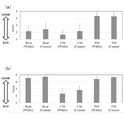
- FIG. 7 is a graph showing experimental results.
- Real(White) is the result of manually moving the speaker (white noise)
- Real(Canon) is the result of manually moving the speaker (canon)
- CM(White) is the result of a comparative example (white noise)
- CM (Canon) indicates the result of the comparative example (Canon)
- PM(White) indicates the result of the example (white noise)
- PM(Canon) indicates the result of the example (Canon).
- FIG. 7(a) shows the score of the sense of movement
- FIG. 7(b) shows the score of the sense of localization in the head.
- both Real and PM had a smooth movement feeling compared to CM.
- FIG. 7(a) both Real and PM had a smooth movement feeling compared to CM.
Landscapes
- Physics & Mathematics (AREA)
- Engineering & Computer Science (AREA)
- Acoustics & Sound (AREA)
- Signal Processing (AREA)
- Circuit For Audible Band Transducer (AREA)
- Stereophonic System (AREA)
Priority Applications (1)
| Application Number | Priority Date | Filing Date | Title |
|---|---|---|---|
| JP2023502477A JPWO2022181678A1 (https=) | 2021-02-25 | 2022-02-24 |
Applications Claiming Priority (2)
| Application Number | Priority Date | Filing Date | Title |
|---|---|---|---|
| JP2021028892 | 2021-02-25 | ||
| JP2021-028892 | 2021-02-25 |
Publications (1)
| Publication Number | Publication Date |
|---|---|
| WO2022181678A1 true WO2022181678A1 (ja) | 2022-09-01 |
Family
ID=83049014
Family Applications (1)
| Application Number | Title | Priority Date | Filing Date |
|---|---|---|---|
| PCT/JP2022/007568 Ceased WO2022181678A1 (ja) | 2021-02-25 | 2022-02-24 | 音響システム |
Country Status (2)
| Country | Link |
|---|---|
| JP (1) | JPWO2022181678A1 (https=) |
| WO (1) | WO2022181678A1 (https=) |
Citations (3)
| Publication number | Priority date | Publication date | Assignee | Title |
|---|---|---|---|---|
| JP2004527968A (ja) * | 2001-05-07 | 2004-09-09 | アメリカン・テクノロジー・コーポレーション | パラメトリックバーチャルスピーカー及びサラウンド音響システム |
| JP2020014079A (ja) * | 2018-07-17 | 2020-01-23 | 学校法人大阪産業大学 | 音響システム |
| WO2021149453A1 (ja) * | 2020-01-23 | 2021-07-29 | 学校法人大阪産業大学 | 音響システム |
-
2022
- 2022-02-24 JP JP2023502477A patent/JPWO2022181678A1/ja active Pending
- 2022-02-24 WO PCT/JP2022/007568 patent/WO2022181678A1/ja not_active Ceased
Patent Citations (3)
| Publication number | Priority date | Publication date | Assignee | Title |
|---|---|---|---|---|
| JP2004527968A (ja) * | 2001-05-07 | 2004-09-09 | アメリカン・テクノロジー・コーポレーション | パラメトリックバーチャルスピーカー及びサラウンド音響システム |
| JP2020014079A (ja) * | 2018-07-17 | 2020-01-23 | 学校法人大阪産業大学 | 音響システム |
| WO2021149453A1 (ja) * | 2020-01-23 | 2021-07-29 | 学校法人大阪産業大学 | 音響システム |
Non-Patent Citations (1)
| Title |
|---|
| EKAWA, TAKUMA; NAKAYAMA, MASATO; TAKAHASHI, TORU: "Moving Sound-image Construction Passing Listener in Surround System Using Parametric/Electrodynamic Loudspeakers", PROCEEDINGS OF THE SPRING MEETING OF THE ACOUSTICAL SOCIETY OF JAPAN, 24 February 2021 (2021-02-24) - 12 March 2021 (2021-03-12), JP , pages 375 - 376, XP009539472, ISSN: 1880-7658 * |
Also Published As
| Publication number | Publication date |
|---|---|
| JPWO2022181678A1 (https=) | 2022-09-01 |
Similar Documents
| Publication | Publication Date | Title |
|---|---|---|
| JP4633870B2 (ja) | オーディオ信号処理方法 | |
| US9014404B2 (en) | Directional electroacoustical transducing | |
| US8437485B2 (en) | Method and device for improved sound field rendering accuracy within a preferred listening area | |
| AU713105B2 (en) | A four dimensional acoustical audio system | |
| KR101405646B1 (ko) | 휴대용 통신 디바이스 및 지향된 사운드 출력을 이용한 통신 가능화 | |
| JP5439602B2 (ja) | 仮想音源に関連するオーディオ信号についてスピーカ設備のスピーカの駆動係数を計算する装置および方法 | |
| EP2777301B1 (en) | Method for practical implementations of sound field reproduction based on surface integrals in three dimensions | |
| JP2008543143A (ja) | 音響変換器のアセンブリ、システムおよび方法 | |
| US9066173B2 (en) | Method for producing optimum sound field of loudspeaker | |
| Chung et al. | Sound reproduction method by front loudspeaker array for home theater applications | |
| WO2022181678A1 (ja) | 音響システム | |
| WO2021149453A1 (ja) | 音響システム | |
| Omoto et al. | Hypotheses for constructing a precise, straightforward, robust and versatile sound field reproduction system | |
| Sayama et al. | Virtual sound source construction based on wave field synthesis using multiple parametric array loudspeakers | |
| Samarasinghe et al. | Room reflections assisted spatial sound field reproduction | |
| KR102921613B1 (ko) | 다채널 오디오 스테이션 청취 공간을 제공하는 음원의 공간적 위치 출력 조절 시스템 | |
| Kimura | Theoretical Study and Numerical Analysis of 3-D Sound Field Reproduction System Based on Directional Microphones and Boundary Surface Control | |
| Masiero et al. | EUROPEAN SYMPOSIUM ON ENVIRONMENTAL ACOUSTICS AND ON BUILDINGS ACOUSTICALLY SUSTAINABLE | |
| HK1013782A (en) | An acoustical audio system for producing three dimensional sound image |
Legal Events
| Date | Code | Title | Description |
|---|---|---|---|
| 121 | Ep: the epo has been informed by wipo that ep was designated in this application |
Ref document number: 22759713 Country of ref document: EP Kind code of ref document: A1 |
|
| ENP | Entry into the national phase |
Ref document number: 2023502477 Country of ref document: JP Kind code of ref document: A |
|
| NENP | Non-entry into the national phase |
Ref country code: DE |
|
| 122 | Ep: pct application non-entry in european phase |
Ref document number: 22759713 Country of ref document: EP Kind code of ref document: A1 |