WO2022158362A1 - 藍藻類の培養方法 - Google Patents
藍藻類の培養方法 Download PDFInfo
- Publication number
- WO2022158362A1 WO2022158362A1 PCT/JP2022/000814 JP2022000814W WO2022158362A1 WO 2022158362 A1 WO2022158362 A1 WO 2022158362A1 JP 2022000814 W JP2022000814 W JP 2022000814W WO 2022158362 A1 WO2022158362 A1 WO 2022158362A1
- Authority
- WO
- WIPO (PCT)
- Prior art keywords
- culture
- blue
- green algae
- culturing
- present
- Prior art date
- Legal status (The legal status is an assumption and is not a legal conclusion. Google has not performed a legal analysis and makes no representation as to the accuracy of the status listed.)
- Ceased
Links
Classifications
-
- C—CHEMISTRY; METALLURGY
- C12—BIOCHEMISTRY; BEER; SPIRITS; WINE; VINEGAR; MICROBIOLOGY; ENZYMOLOGY; MUTATION OR GENETIC ENGINEERING
- C12N—MICROORGANISMS OR ENZYMES; COMPOSITIONS THEREOF; PROPAGATING, PRESERVING, OR MAINTAINING MICROORGANISMS; MUTATION OR GENETIC ENGINEERING; CULTURE MEDIA
- C12N1/00—Microorganisms; Compositions thereof; Processes of propagating, maintaining or preserving microorganisms or compositions thereof; Processes of preparing or isolating a composition containing a microorganism; Culture media therefor
- C12N1/12—Unicellular algae; Culture media therefor
Definitions
- the present invention relates to a high-speed, large-scale continuous culture method for cyanobacteria, and particularly to a method for high-speed, large-scale continuous culture of freshwater cyanobacteria that form colonies in an agar substrate secreted by cells, such as Amphitheatre nori, Noshi jellyfish, and Asatsuki.
- the object of the present invention is to enable the cultivation of blue-green algae with high efficiency.
- a method for culturing blue-green algae wherein a liquid medium containing one or more salts selected from carbonates, bicarbonates, phosphates, and citrates is maintained at pH 10 or less and cultured.
- a culture method characterized by: [2] The culture method according to [1], wherein the cyanobacteria are freshwater cyanobacteria. [3] The culture method according to any one of [1] or [2], wherein the pH during the culture is maintained in the range of 7.5 to 10. [4] The culture method according to any one of [1] to [3], wherein the liquid medium contains carbonate and bicarbonate. [5] The culture method according to any one of [1] to [4], wherein the pH is adjusted by adding carbon dioxide. [6] Blue-green algae cultured by the culture method according to any one of [1] to [5] above.
- Blue-green algae such as Suizenjinori, which grow only in highly transparent and mineral-rich water, are preferably grown in oligotrophic media. It does not grow in competition with other algae that are mixed with it.
- the present inventors have confirmed that freshwater blue-green algae such as Aphanothece sacrum efficiently utilize specific ions such as bicarbonate ions for photosynthesis, and a specific ion source such as bicarbonate ions is added in advance to the medium. And by culturing while maintaining a pH range in which these ions can exist in the medium, it was found that blue-green algae can be cultured at high speed and continuous mass using a salt concentration-reduced medium that can suppress the growth of other algae.
- the cyanobacteria cultured by the culture method according to the present invention are algae classified as prokaryotes, and are a group of eubacteria called cyanobacteria (cyanobacteria) having photosynthetic ability.
- examples of the blue-green algae include Aphanothece sacrum (scientific name: Aphanothece sacrum) belonging to the order Blackococcus, Nostid jellyfish, and reedwood.
- the blue-green algae used in the present invention are not particularly limited as long as the effects of the present invention can be obtained, but freshwater blue-green algae that live in colonies in freshwater areas such as Aphanothece sacrum, Noshi jellyfish, and Ashitsuki are used. It is preferable because the culture efficiency is high when it is used, and it is more preferable to be Aphanophyllum japonicum or Ashitsuki.
- the Suizenjinori is a freshwater blue-green algae that grows naturally in a specific area of Kyushu and forms a flat-shaped colony of multiple cells.
- the outer surface of the colony is covered with a gel-like secretion formed by polysaccharides, etc., and the diameter of the colony grows to a size of about 50 mm.
- a liquid medium containing one or more salts selected from carbonates, bicarbonates, phosphates, and citrates is maintained at a pH of 10 or less for culturing. characterized by performing
- the liquid medium used in the culture method of the present invention may be a liquid medium containing one or more salts selected from carbonates, bicarbonates, phosphates, and citrates, and the effects of the present invention can be obtained.
- Water, other minerals, etc. may be added within the range obtained, and are described in patent documents (Patent No. 6590144) and non-patent documents (J. Gen Appl Microbiol., 65, 39-46, 2019 Mar.). You may use well-known culture media, such as.
- the liquid medium may be appropriately replaced or components may be supplemented.
- the liquid medium of the present invention is characterized by containing one or more salts selected from carbonates, bicarbonates, phosphates and citrates. These salts can improve the efficiency of culturing cyanobacteria, and are preferably used as a carbon source in the photosynthesis of cyanobacteria. Therefore, one or more salts selected from carbonates and bicarbonates are added. is particularly preferred, and specifically sodium bicarbonate and calcium bicarbonate are most preferred.
- the amount of one or more salts selected from these carbonates, bicarbonates, phosphates, and citrates to be added is preferably 1 ppm or more and 500 ppm or less in the liquid medium, and the growth of blue-green algae is improved. 20 ppm or more and 200 ppm or less is particularly preferable in order to keep the
- the bicarbonate is consumed as a carbon source when algae perform photosynthesis, but when carbon dioxide is added to the liquid medium by an operation such as bubbling, it is regenerated as bicarbonate ion and reused as a carbon source for algae. and efficient culture can be performed.
- the pH of the liquid medium used in the culture method of the present invention is preferably maintained and adjusted in the range of pH 10 or less during culture, more preferably in the range of pH 7.5 or more and 10 or less, and pH 8 or more and 9.
- the following range is most preferable because the culture efficiency is significantly improved.
- pH adjustment may be performed during the entire culture period, but it is preferable to perform pH adjustment during light irradiation because the culture efficiency is particularly improved.
- the method for adjusting the pH of the liquid medium is not particularly limited within the range in which the effects of the present invention can be obtained.
- the process of adding carbon dioxide to the medium and lowering the pH may be repeated.
- the addition of carbon dioxide replenishes the bicarbonate ions consumed by the growth of the cyanobacteria and improves the photosynthetic efficiency of the cyanobacteria, which is particularly preferable.
- an operation may be performed to maintain a constant pH so that the pH does not rise.
- the carbon dioxide added for the purpose of adjusting the pH may be obtained by adding carbon dioxide to ordinary air. good too.
- the liquid medium may be cultured by filling various containers.
- These containers are not particularly limited, and may be either an open-system container or a closed-system container.
- a vessel having a stirring blade, various light sources for irradiating light, a temperature control device for adjusting the temperature during culture, and the like may be used.
- these containers are not particularly limited as described above, it is preferable to use containers with high light transmittance such as glass, acrylic, polycarbonate, etc., since algae can efficiently perform photosynthesis.
- the aeration treatment may include a step of aerating air and a step of adding carbon dioxide for aeration.
- the amount of air added by the aeration treatment is preferably 0.3 L/min/Volume or more as a unit volume flow rate (VVM, L/min/Volume), and if it is 0.5 L/min/Volume or more, It is preferable because the agitation of the blue-green algae is suitably performed and the culture efficiency is improved. In addition, it is preferable to efficiently stir the algae by adjusting the amount of air to be added according to the size of the container.
- the culture method according to the present invention provides a light period in which the culture apparatus is irradiated with light from various light sources for the purpose of improving the efficiency of culturing blue-green algae.
- the light source for irradiation known light sources such as sunlight, incandescent lamps, fluorescent lamps, arc lamps, and light emitting diodes can be used. These lights may be applied continuously or intermittently.
- the amount of light to be irradiated is not particularly limited as long as the effects of the present invention can be obtained, and may be adjusted as appropriate after confirming the progress of the culture. s or more, and more preferably 100 ⁇ mol/m 2 /s or more because the culture rate is good.
- the culture may be performed in a mode in which light is applied all the time.
- the temperature setting of the medium during culture can be appropriately set according to the blue-green algae to be cultured, but when culturing Suisenjinori, it is preferably performed at 15 to 30 ° C., and in the range of 20 to 25 ° C. Culturing at 23 to 25° C. is most preferable.
- the culturing time is not particularly limited, and a person skilled in the art can appropriately confirm and set the amount of cyanobacterial growth.
- the blue-green algae used in the culture method of the present invention may be subjected to an acclimation treatment or the like before the main culture treatment.
- acclimation treatments are not particularly limited as long as the blue-green algae obtained as wild strains are cultured in a preliminary environment before the main culture and the culture can be suitably performed during the main culture. can be carried out using the method of Alternatively, the wild type may be directly subjected to culture.
- the cyanobacteria increased by the culture may be cultured as culture seeds in the next culture cycle.
- Example 1 Put 1 L of the sodium bicarbonate-added medium described in Table 1 in a 1 L glass container, and culture Suisenjinori (1 strain of FPU: Ohki, K et al. J Gen Appl Microbiol. 2019 Mar 8;65(1):39-46.). 20 g by weight was added and cultured in an atmosphere of 23° C. with an air flow rate of 0.5/min, a photosynthetically active light quantum flux of 130 ⁇ mol/m 2 /s, and a 14-hour light/10-hour dark cycle. In the light period, pH control was performed by blowing carbon dioxide gas to lower the pH to around 8 when the pH rose to around 9. The medium was exchanged one week after the initiation of culture, and after two weeks of culture, the laver was collected and its wet weight was measured, and 214 g of wet weight of laver was collected.
- [Comparative example 2] Put 1 L of the same medium as the medium composition described in Table 1 except that sodium bicarbonate was not added into a 1 L glass container, add 20 g of cultured Suizenjinori (FPU1 strain) in wet weight, and add 20 g of wet weight. Cultivation was initiated at 0.5 L/min, photosynthetically active light quantum flux of 130 ⁇ mol/m 2 /s, and a 14-hour light/10-hour dark cycle. The composition of the medium was the same as in Example 1 except that sodium was omitted. Cultivation was performed without pH control in the light period. The medium was exchanged one week after the start of the culture, and two weeks after the culture, the laver was collected and the wet weight was measured.
- Suizenjinori FPU1 strain
- [Comparative example 3] Put 1 L of the same medium as the medium composition described in Table 1 except that sodium bicarbonate was not added into a 1 L glass container, add 20 g of cultured Suizenjinori (FPU1 strain) in wet weight, and add 20 g of wet weight. Cultivation was initiated at 0.5 L/min, photosynthetically active light quantum flux of 130 ⁇ mol/m 2 /s, and a 14-hour light/10-hour dark cycle. Cultivation was performed without pH control in the light period. The medium was exchanged one week after the start of culture, and after two weeks of culture, the laver was collected and its wet weight was measured.
- Suizenjinori FPU1 strain
Landscapes
- Engineering & Computer Science (AREA)
- Life Sciences & Earth Sciences (AREA)
- Health & Medical Sciences (AREA)
- Biotechnology (AREA)
- Chemical & Material Sciences (AREA)
- Bioinformatics & Cheminformatics (AREA)
- Genetics & Genomics (AREA)
- Organic Chemistry (AREA)
- Zoology (AREA)
- Wood Science & Technology (AREA)
- Botany (AREA)
- Biomedical Technology (AREA)
- Cell Biology (AREA)
- Microbiology (AREA)
- Virology (AREA)
- Tropical Medicine & Parasitology (AREA)
- Biochemistry (AREA)
- General Engineering & Computer Science (AREA)
- General Health & Medical Sciences (AREA)
- Medicinal Chemistry (AREA)
- Micro-Organisms Or Cultivation Processes Thereof (AREA)
- Preparation Of Compounds By Using Micro-Organisms (AREA)
Abstract
本発明は様々な有用物質が発見され、医薬品、食品、化粧料など幅広い分野で活用されている藍藻類を高効率で培養可能とすることを課題とする。本発明者らは、藍藻類を炭酸塩、重炭酸塩、リン酸塩、クエン酸塩から選ばれる1種以上の塩を含有する液体培地の中で、培養期間中の培地をpH10以下に維持して培養を行うことを特徴とする培養方法により高効率で藍藻類を培養することが可能となることを見い出し、前記課題を解決することができた。
Description
本発明は、藍藻類の高速大量連続培養方法に関し、特にスイゼンジノリ、イシクラゲ、アサツキなど、細胞が分泌した寒天質の基質の中に群体を形成する淡水性の藍藻類の高速大量連続培養方法に関する。
近年、様々な動植物、藻類、菌類等から有効成分を探索する試みが広く行われている。この結果、様々な有用物質が発見され、医薬品、食品、化粧料など幅広い分野で活用されている。今般、藍藻類であるスイゼンジノリから分子量1000万を超える高分子多糖類が発見され、その高い保湿力に起因する美容効果、やけど治療等への活用が期待されている。
しかしながらスイゼンジノリを始めとする淡水藍藻類は透明度が高くミネラル豊富な湧水の中でしか繁殖することができず、また気象条件等に影響を受けやすく露面で培養、養殖を行う場合にも安定に供給を行うことが出来ていなかった。そのため、高い有効性が期待されるにも関わらず用途展開が十分に出来ていないという課題が存在した。これに対し、静置培養工程と通気培養工程を組み合わせ藍藻類の大量生産を行う試みが行われている(特許文献1参照)が、工程が煩雑であり、効率良く培養を行うことは出来ていなかった。
本発明は藍藻類を高効率での培養を可能とすることを課題とする。
[1]藍藻類の培養方法であって、炭酸塩、重炭酸塩、リン酸塩、クエン酸塩から選ばれる1種以上の塩を含有する液体培地を、pH10以下に維持して培養を行うことを特徴とする培養方法。
[2]前記藍藻類が淡水性藍藻類であることを特徴とする[1]に記載の培養方法。
[3]培養中のpHを7.5以上10以下の範囲に維持することを特徴とする[1]または[2]のいずれかに記載の培養方法。
[4]前記液体培地が炭酸塩、重炭酸塩を含むことを特徴とする[1]~[3]のいずれかに記載の培養方法。
[5]二酸化炭素の添加によりpH調整を行うことを特徴とする[1]~[4]のいずれかに記載の培養方法。
[6]前記[1]~[5]のいずれかに記載の培養方法により培養された藍藻類。
[2]前記藍藻類が淡水性藍藻類であることを特徴とする[1]に記載の培養方法。
[3]培養中のpHを7.5以上10以下の範囲に維持することを特徴とする[1]または[2]のいずれかに記載の培養方法。
[4]前記液体培地が炭酸塩、重炭酸塩を含むことを特徴とする[1]~[3]のいずれかに記載の培養方法。
[5]二酸化炭素の添加によりpH調整を行うことを特徴とする[1]~[4]のいずれかに記載の培養方法。
[6]前記[1]~[5]のいずれかに記載の培養方法により培養された藍藻類。
スイゼンジノリなどの透明度が高くミネラルが豊富な水でしか生育されていない藍藻類は貧栄養の培地が好ましく、通常の藻類を培養する際に用いられる富栄養化培地を用いた場合には培養不良を起こし、混在するその他藻類との生育競争に負け生育しない。
本発明者はスイゼンジノリなどの淡水域の藍藻類が重炭酸イオンなどの特定イオンを効率的に利用して光合成をおこなうことを確認し、また重炭酸イオンなどの特定イオン源を予め培地中に添加し、かつこれらイオンが培地中に存在できるpH領域を維持して培養することにより、他の藻類の生育を抑制可能な塩濃度低減培地を用いて藍藻類を高速連続大量培養できることを見出した。
本発明によれば藍藻類を高効率で培養することが可能となる。
本発明に係る培養方法により培養される藍藻類とは、原核生物に分類される藻類で、シアノバクテリア(藍色細菌)と称される光合成能を有する真性細菌の一群である。前記藍藻類としてはクロオコッカス目のスイゼンジノリ(学名:Aphanothece sacrum)や、ネンジュモ目のイシクラゲ、アシツキなどが含まれる。
本発明において用いられる藍藻類としては本発明の効果が得られる範囲において特に制限されるものではないが、スイゼンジノリ、イシクラゲ、アシツキなどの淡水域に群体を形成して生息する淡水性藍藻類を用いた場合に培養効率が高くなることから好ましく、スイゼンジノリ、アシツキであることがより好ましく、スイゼンジノリが最も好ましい。
前記スイゼンジノリは九州の特定地域に自生し、複数の細胞が平らな形状の群体を形成する淡水性藍藻類である。また、その群体の外面は多糖類などにより形成されるゲル状の分泌物に覆われており、群体の直径は50mm程度の大きさにまで成長する。
本発明に係る藍藻類の培養方法は、炭酸塩、重炭酸塩、リン酸塩、クエン酸塩から選ばれる1種以上の塩を含有する液体培地を、pH10以下の範囲に維持して培養を行うことを特徴とする。
本発明の培養方法で用いられる液体培地としては、炭酸塩、重炭酸塩、リン酸塩、クエン酸塩から選ばれる1種以上の塩を含有する液体培地であればよく、本発明の効果が得られる範囲において水、その他ミネラルなどを添加してもよく、特許文献(特許6590144号公報)や非特許文献(J. Gen Appl Microbiol.,65,39-46, 2019 Mar. )に記載されるような公知の培地を用いてもよい。本発明の培養方法においては、液体培地を適宜交換や成分の補充を行ってもよい。
本発明の液体培地としては前記のように炭酸塩、重炭酸塩、リン酸塩、クエン酸塩から選ばれる1種以上の塩を含有することを特徴とする。これらの塩類は藍藻類の培養効率を向上させることができる、中でも藍藻類の光合成における炭素源として好適に利用されることから炭酸塩、重炭酸塩から選ばれる1種以上の塩を添加することが特に好ましく、具体的には重炭酸ナトリウム、重炭酸カルシウムを用いることが最も好ましい。
これら炭酸塩、重炭酸塩、リン酸塩、クエン酸塩から選ばれる1種以上の塩の添加量としては、液体培地中1ppm以上、500ppm以下であることが好ましく、藍藻類の生育をより良好に保つためには20ppm以上、200ppm以下であることが特に好ましい。
前記重炭酸塩は、藻類が光合成を行う際に炭素源として消費されるが、バブリング等の操作により液体培地中に二酸化炭素を添加すると、重炭酸イオンとして再生し、再度藻類の炭素源として利用することができ、効率的な培養を行うことができる。
本発明の培養方法において用いる液体培地は、培養を行う間のpHがpH10以下の範囲で維持調整されることが好ましく、更にpH7.5以上10以下の範囲であることが更に好ましく、pH8以上9以下の範囲であると培養効率が顕著に向上するため最も好ましい。また、pH調整を行うのは培養期間全体であっても良いが、特に培養効率が向上することから光照射時にpH調整を行うことが好ましい。
液体培地のpH調整方法としては、本発明の効果が得られる範囲において特に制限されるものではないが、藍藻類の培養に伴うpHの上昇を観測し、pHが10前後に上昇した際に液体培地に二酸化炭素を添加し、pHを降下させる工程を繰り返せばよい。二酸化炭素の添加により藍藻類の増殖により消費された重炭酸イオンが補充され、藍藻類の光合成効率が向上することから特に好ましい。また、本発明はpHが上昇しないよう一定のpHに維持する操作を行うものであってもよい。pHの調整を目的として添加する二酸化炭素は、通常の空気に二酸化炭素を添加したものであればよく、空気にさらに二酸化炭素を加えたもの、または二酸化炭素単独を後述の曝気処理により添加してもよい。
本発明の培養方法において、液体培地は各種容器に充填して培養を行ってよい。これらの容器としては特に限定されるものではなく、開放系の容器、及び閉鎖系の容器のいずれを用いてもよく、曝気処理を行うための送気装置、培養時に培養液の撹拌を行うための撹拌羽、光の照射を行うための各種光源、培養時の温度を調整するための温度調整装置等を有する容器を用いてもよい。これら容器としては前記のように特に限定されるものではないが藻類が光合成を効率よく行えることから、ガラス、アクリル、ポリカーボネート等の光透過率の高い容器を用いることが好ましい。
本発明に係る培養方法により藍藻類を培養する場合、効率的に光合成をさせるため、培養中にバブリングなどにより曝気処理を行うことが好ましい。曝気処理としては空気を曝気させる工程、二酸化炭素を添加して曝気させる工程を含んでもよく、pHの上昇をモニタリング等で確認して適宜設定することができる。前記曝気処理による空気添加量は単位体積流量(VVM、L/min/Volume)として0.3L/min/Volume以上であることが好ましく、0.5L/min/Volume以上であると培養装置内での藍藻類の撹拌が好適に行われ培養効率が向上するため好ましい。また、容器サイズに応じて空気の添加量を調節し、藻類を効率よく撹拌することが好ましい。
本発明に係る培養方法は、藍藻類の培養効率を向上させる目的で培養装置に各種光源による光を照射する明期を設けるものである。照射する光の光源としては太陽光、白熱電球、蛍光灯、アーク灯、発光ダイオードなど公知の光源を用いることができる。これらの光は継続的に照射してもよく、断続的な照射を行ってもよい。照射する光の光量については本発明の効果が得られる範囲において特に限定されるものではなく、培養の進捗を確認して適宜調整してよいが、光合成有効光量量子束密度として30μmol/m2/s以上であることが好ましく、培養速度が良好なものとなることから100μmol/m2/s以上であることがより好ましい。
本発明に係る培養方法は、光の照射を行わない暗期を設けることが好ましいが、常時光を照射する態様で培養を行ってもよい。
また、培養時の培地の温度設定は培養対象とする藍藻類に応じて適宜設定することができるが、スイゼンジノリを培養する場合15~30℃の間で行うことが好ましく、20~25℃の範囲で培養することがさらに好ましく、23~25℃の範囲で培養することが最も好ましい。
本発明の培養方法は、その培養時間について特に限定されるものではなく、当業者が適宜藍藻類の増加量を確認して設定することができる。
本発明の培養方法で用いる藍藻類は、本培養処理前に順化処理などを行ってもよい。これら順化処理としては、野生株として得られた藍藻類を本培養前に予備的な環境で培養し本培養の際に培養が好適に行える処理であれば特に制限されるものではなく、公知の方法を用いて行なうことができる。また、野生種をそのまま培養に供してもよい。また、培養により増加した藍藻類を次の培養サイクル時に培養の種として培養を行ってもよい。
[実施例1]
1Lのガラス容器に表1に記載の重炭酸ナトリウム添加培地を1L入れ、培養スイゼンジノリ(FPU1株:Ohki, KらJ Gen Appl Microbiol . 2019 Mar 8;65(1):39-46.)を湿重量で20g添加し、23℃雰囲気下、通気量0.5/min、光合成有効光量量子束130μmol/m2/s、14時間明・10時間暗サイクルで培養を行った。明期ではpH9付近までpHが上昇した時に炭酸ガスを吹込んでpHを8付近まで低下させるpHコントロールを実施した。培地は培養開始1週間後に交換し、培養2週間後にスイゼンジノリを回収し湿重量を測定し、湿重量でスイゼンジノリ214gを回収した。
1Lのガラス容器に表1に記載の重炭酸ナトリウム添加培地を1L入れ、培養スイゼンジノリ(FPU1株:Ohki, KらJ Gen Appl Microbiol . 2019 Mar 8;65(1):39-46.)を湿重量で20g添加し、23℃雰囲気下、通気量0.5/min、光合成有効光量量子束130μmol/m2/s、14時間明・10時間暗サイクルで培養を行った。明期ではpH9付近までpHが上昇した時に炭酸ガスを吹込んでpHを8付近まで低下させるpHコントロールを実施した。培地は培養開始1週間後に交換し、培養2週間後にスイゼンジノリを回収し湿重量を測定し、湿重量でスイゼンジノリ214gを回収した。

[比較例1]
1Lのガラス容器に表1に記載の重炭酸ナトリウム添加培地を1L入れ、培養スイゼンジノリ(FPU1株)を湿重量で20g添加し、23℃雰囲気下、通気量0.5L/min、光合成有効光量量子束130μmol/m2/s、14時間明・10時間暗サイクルで培養を開始した。明期でのpHコントロールは実施せずに培養を実施した。培地は培養開始1週間後に交換し、培養2週間後にスイゼンジノリを回収し湿重量を測定し、湿重量でスイゼンジノリ114gを回収した。
1Lのガラス容器に表1に記載の重炭酸ナトリウム添加培地を1L入れ、培養スイゼンジノリ(FPU1株)を湿重量で20g添加し、23℃雰囲気下、通気量0.5L/min、光合成有効光量量子束130μmol/m2/s、14時間明・10時間暗サイクルで培養を開始した。明期でのpHコントロールは実施せずに培養を実施した。培地は培養開始1週間後に交換し、培養2週間後にスイゼンジノリを回収し湿重量を測定し、湿重量でスイゼンジノリ114gを回収した。
[比較例2]
1Lのガラス容器に重炭酸ナトリウムを添加していない以外は表1に記載の培地組成と同じ培地を1L入れ培養スイゼンジノリ(FPU1株)を湿重量で20g添加し、23℃雰囲気下、通気量0.5L/min、光合成有効光量量子束130μmol/m2/s、14時間明・10時間暗サイクルで培養を開始した。培地組成はナトリウムを抜いた以外実施例1と同じ組成にした。明期でのpHコントロールは実施せずに培養を実施した。培地は培養開始1週間後に交換し、培養2週間後にスイゼンジノリを回収し湿重量を測定し、湿重量でスイゼンジノリ82gを回収した。
1Lのガラス容器に重炭酸ナトリウムを添加していない以外は表1に記載の培地組成と同じ培地を1L入れ培養スイゼンジノリ(FPU1株)を湿重量で20g添加し、23℃雰囲気下、通気量0.5L/min、光合成有効光量量子束130μmol/m2/s、14時間明・10時間暗サイクルで培養を開始した。培地組成はナトリウムを抜いた以外実施例1と同じ組成にした。明期でのpHコントロールは実施せずに培養を実施した。培地は培養開始1週間後に交換し、培養2週間後にスイゼンジノリを回収し湿重量を測定し、湿重量でスイゼンジノリ82gを回収した。
[比較例3]
1Lのガラス容器に重炭酸ナトリウムを添加していない以外は表1に記載の培地組成と同じ培地を1L入れ培養スイゼンジノリ(FPU1株)を湿重量で20g添加し、23℃雰囲気下、通気量0.5L/min、光合成有効光量量子束130μmol/m2/s、14時間明・10時間暗サイクルで培養を開始した。明期でのpHコントロールは実施せずに培養を実施した。培地は培養開始1週間後に交換し、培養2週間後にスイゼンジノリを回収し湿重量を測定し、湿重量でスイゼンジノリ92gを回収した。
1Lのガラス容器に重炭酸ナトリウムを添加していない以外は表1に記載の培地組成と同じ培地を1L入れ培養スイゼンジノリ(FPU1株)を湿重量で20g添加し、23℃雰囲気下、通気量0.5L/min、光合成有効光量量子束130μmol/m2/s、14時間明・10時間暗サイクルで培養を開始した。明期でのpHコントロールは実施せずに培養を実施した。培地は培養開始1週間後に交換し、培養2週間後にスイゼンジノリを回収し湿重量を測定し、湿重量でスイゼンジノリ92gを回収した。
[比較例4]
2Lのガラス容器に表1に記載の重炭酸ナトリウム添加培地を1L入れ、培養スイゼンジノリ(FPU1株)を湿重量で20g添加し、23℃雰囲気下、光合成有効光量量子束130μmol/m2/s、14時間明・10時間暗サイクルで静置培養を開始した(通気はせず)。培養開始1週間後、目視でスイゼンジノリの色が退色を確認し藻体が死滅したと判断したため実験を中止した
2Lのガラス容器に表1に記載の重炭酸ナトリウム添加培地を1L入れ、培養スイゼンジノリ(FPU1株)を湿重量で20g添加し、23℃雰囲気下、光合成有効光量量子束130μmol/m2/s、14時間明・10時間暗サイクルで静置培養を開始した(通気はせず)。培養開始1週間後、目視でスイゼンジノリの色が退色を確認し藻体が死滅したと判断したため実験を中止した
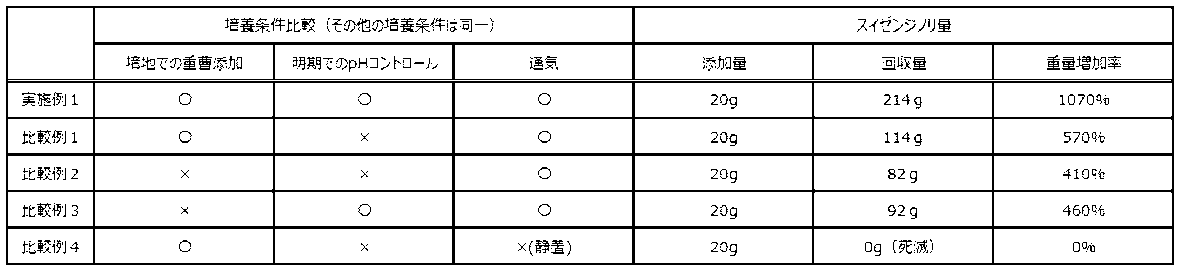
上記表2のように、重炭酸ナトリウムの添加及びpHコントロールを行った実施例は、これらの処理を行わなかった比較例に比して顕著な培養効率の向上が確認された。
Claims (6)
- 藍藻類の培養方法であって、炭酸塩、重炭酸塩、リン酸塩、クエン酸塩から選ばれる1種以上の塩を含有する液体培地を、pH10以下に維持して培養を行うことを特徴とする培養方法。
- 前記藍藻類が淡水性藍藻類であることを特徴とする請求項1に記載の培養方法。
- 培養中のpHを7.5以上10以下の範囲に維持することを特徴とする請求項1または2のいずれかに記載の培養方法。
- 前記液体培地が炭酸塩、重炭酸塩を含むことを特徴とする請求項1~3のいずれか一項記載の培養方法。
- 二酸化炭素の添加によりpH調整を行うことを特徴とする請求項1~4のいずれか一項記載の培養方法。
- 請求項1~5のいずれか一項記載の培養方法により培養された藍藻類。
Priority Applications (1)
| Application Number | Priority Date | Filing Date | Title |
|---|---|---|---|
| JP2022576628A JP7539013B2 (ja) | 2021-01-19 | 2022-01-13 | 藍藻類の培養方法 |
Applications Claiming Priority (2)
| Application Number | Priority Date | Filing Date | Title |
|---|---|---|---|
| JP2021-006390 | 2021-01-19 | ||
| JP2021006390 | 2021-01-19 |
Publications (1)
| Publication Number | Publication Date |
|---|---|
| WO2022158362A1 true WO2022158362A1 (ja) | 2022-07-28 |
Family
ID=82548953
Family Applications (1)
| Application Number | Title | Priority Date | Filing Date |
|---|---|---|---|
| PCT/JP2022/000814 Ceased WO2022158362A1 (ja) | 2021-01-19 | 2022-01-13 | 藍藻類の培養方法 |
Country Status (2)
| Country | Link |
|---|---|
| JP (1) | JP7539013B2 (ja) |
| WO (1) | WO2022158362A1 (ja) |
Citations (1)
| Publication number | Priority date | Publication date | Assignee | Title |
|---|---|---|---|---|
| JPS6261588A (ja) * | 1985-09-11 | 1987-03-18 | Onoda Cement Co Ltd | 藍藻によるγ−リノレン酸の生産方法 |
Family Cites Families (3)
| Publication number | Priority date | Publication date | Assignee | Title |
|---|---|---|---|---|
| JP2015122991A (ja) | 2013-12-26 | 2015-07-06 | 学校法人君が淵学園 | スイゼンジノリの高効率培養方法 |
| JP6542569B2 (ja) | 2015-04-21 | 2019-07-10 | 鹿島建設株式会社 | ラン藻類大量生産方法 |
| JP6590144B2 (ja) | 2015-08-12 | 2019-10-16 | 公立大学法人福井県立大学 | スイゼンジノリのクローン単藻株を用いた静置培養法による室内閉鎖養殖系 |
-
2022
- 2022-01-13 JP JP2022576628A patent/JP7539013B2/ja active Active
- 2022-01-13 WO PCT/JP2022/000814 patent/WO2022158362A1/ja not_active Ceased
Patent Citations (1)
| Publication number | Priority date | Publication date | Assignee | Title |
|---|---|---|---|---|
| JPS6261588A (ja) * | 1985-09-11 | 1987-03-18 | Onoda Cement Co Ltd | 藍藻によるγ−リノレン酸の生産方法 |
Non-Patent Citations (1)
| Title |
|---|
| KAZUKI KOBAYASHI: "Cultivation of Spirulina platensis and its Growth Behavior Controlling Cultivation Medium", KAGAKU KOGAKU RONBUNSHU, KAGAKU KOGAKKAI, TOKYO, JP, vol. 22, no. 1, 1 January 1996 (1996-01-01), JP , pages 56 - 59, XP055954086, ISSN: 0386-216X * |
Also Published As
| Publication number | Publication date |
|---|---|
| JP7539013B2 (ja) | 2024-08-23 |
| JPWO2022158362A1 (ja) | 2022-07-28 |
Similar Documents
| Publication | Publication Date | Title |
|---|---|---|
| Matsudo et al. | Repeated fed-batch cultivation of Arthrospira (Spirulina) platensis using urea as nitrogen source | |
| JP5378368B2 (ja) | 金黄色の藻類及びその製造方法 | |
| McLachlan | Some considerations of the growth of marine algae in artificial media | |
| CN102649936A (zh) | 一种用于养殖水体水质改良的复合微生物菌剂及制备方法 | |
| Sánchez-Luna et al. | Continuous and pulse feedings of urea as a nitrogen source in fed-batch cultivation of Spirulina platensis | |
| Sassano et al. | Kinetics and bioenergetics of Spirulina platensis cultivation by fed-batch addition of urea as nitrogen source | |
| CN106973794A (zh) | 一种光触媒抗菌助生长植物组织培养基及其制备方法 | |
| CN103255073B (zh) | 一种光合细菌快速繁殖的方法 | |
| JP7539013B2 (ja) | 藍藻類の培養方法 | |
| CN115141755A (zh) | 一种气生微藻的分离培养方法 | |
| KR101168140B1 (ko) | 천연 섭취가 가능한 생 클로렐라의 제조 방법 | |
| CN1930949B (zh) | 一种培养海洋绿藻的方法 | |
| Pongpadung et al. | Stimulation of Hydrogen Photoproduction in Chlorella sorokiniana Subjected to Simultaneous Nitrogen Limitation and Sulfur-and/or Phosphorus-Deprivation. | |
| CN103184157A (zh) | 一种治理原生动物并实现稳定高产的藻类养殖工艺 | |
| Ragueneau et al. | Influence of seawater treatment by ultrafiltration and culture conditions on the biochemical composition of the diatom Odontella aurita | |
| Uddin et al. | Comparative growth analysis of Spirulina platensis using urea as a nitrogen substitute for NaNO3 | |
| Imamoglu et al. | Semi-continuous cultivation of Haematococcus pluvialis for commercial production | |
| CN104962549B (zh) | 一种沼泽红假单胞菌同步化浓缩的方法及应用 | |
| CN1657444A (zh) | 超浓缩藻菌微生态平衡悬浮型水质改良剂及制备方法 | |
| WO2022234788A1 (ja) | 藻類の培養方法 | |
| JP2026013063A (ja) | 藍藻類の培養方法及び藍藻類 | |
| JP2026018237A (ja) | 藍藻類の脱色方法、脱色された藍藻類の製造方法、藍藻類由来多糖体の製造方法、化粧料、保湿剤、抗炎症剤、バリア剤、繊維処理剤、食品及び医薬品 | |
| CN106635801A (zh) | 一种金藻保藏技术 | |
| JP2001309778A (ja) | 高効率光合成微生物培養方法 | |
| CN1807572A (zh) | 一种适合于普通小球藻高密度高品质培养的培养基组合物 |
Legal Events
| Date | Code | Title | Description |
|---|---|---|---|
| 121 | Ep: the epo has been informed by wipo that ep was designated in this application |
Ref document number: 22742484 Country of ref document: EP Kind code of ref document: A1 |
|
| ENP | Entry into the national phase |
Ref document number: 2022576628 Country of ref document: JP Kind code of ref document: A |
|
| NENP | Non-entry into the national phase |
Ref country code: DE |
|
| 122 | Ep: pct application non-entry in european phase |
Ref document number: 22742484 Country of ref document: EP Kind code of ref document: A1 |