WO2022158241A1 - 情報処理装置、認証器、それら方法およびプログラム - Google Patents
情報処理装置、認証器、それら方法およびプログラム Download PDFInfo
- Publication number
- WO2022158241A1 WO2022158241A1 PCT/JP2021/047909 JP2021047909W WO2022158241A1 WO 2022158241 A1 WO2022158241 A1 WO 2022158241A1 JP 2021047909 W JP2021047909 W JP 2021047909W WO 2022158241 A1 WO2022158241 A1 WO 2022158241A1
- Authority
- WO
- WIPO (PCT)
- Prior art keywords
- authenticator
- authentication
- user
- information processing
- information
- Prior art date
- Legal status (The legal status is an assumption and is not a legal conclusion. Google has not performed a legal analysis and makes no representation as to the accuracy of the status listed.)
- Ceased
Links
Images














Classifications
-
- H—ELECTRICITY
- H04—ELECTRIC COMMUNICATION TECHNIQUE
- H04L—TRANSMISSION OF DIGITAL INFORMATION, e.g. TELEGRAPHIC COMMUNICATION
- H04L63/00—Network architectures or network communication protocols for network security
- H04L63/08—Network architectures or network communication protocols for network security for authentication of entities
- H04L63/0861—Network architectures or network communication protocols for network security for authentication of entities using biometrical features, e.g. fingerprint, retina-scan
-
- G—PHYSICS
- G06—COMPUTING OR CALCULATING; COUNTING
- G06F—ELECTRIC DIGITAL DATA PROCESSING
- G06F21/00—Security arrangements for protecting computers, components thereof, programs or data against unauthorised activity
- G06F21/30—Authentication, i.e. establishing the identity or authorisation of security principals
- G06F21/31—User authentication
- G06F21/32—User authentication using biometric data, e.g. fingerprints, iris scans or voiceprints
-
- G—PHYSICS
- G06—COMPUTING OR CALCULATING; COUNTING
- G06F—ELECTRIC DIGITAL DATA PROCESSING
- G06F21/00—Security arrangements for protecting computers, components thereof, programs or data against unauthorised activity
- G06F21/30—Authentication, i.e. establishing the identity or authorisation of security principals
- G06F21/31—User authentication
- G06F21/33—User authentication using certificates
-
- G—PHYSICS
- G06—COMPUTING OR CALCULATING; COUNTING
- G06F—ELECTRIC DIGITAL DATA PROCESSING
- G06F3/00—Input arrangements for transferring data to be processed into a form capable of being handled by the computer; Output arrangements for transferring data from processing unit to output unit, e.g. interface arrangements
- G06F3/01—Input arrangements or combined input and output arrangements for interaction between user and computer
-
- H—ELECTRICITY
- H04—ELECTRIC COMMUNICATION TECHNIQUE
- H04L—TRANSMISSION OF DIGITAL INFORMATION, e.g. TELEGRAPHIC COMMUNICATION
- H04L63/00—Network architectures or network communication protocols for network security
- H04L63/04—Network architectures or network communication protocols for network security for providing a confidential data exchange among entities communicating through data packet networks
- H04L63/0428—Network architectures or network communication protocols for network security for providing a confidential data exchange among entities communicating through data packet networks wherein the data content is protected, e.g. by encrypting or encapsulating the payload
- H04L63/0435—Network architectures or network communication protocols for network security for providing a confidential data exchange among entities communicating through data packet networks wherein the data content is protected, e.g. by encrypting or encapsulating the payload wherein the sending and receiving network entities apply symmetric encryption, i.e. same key used for encryption and decryption
-
- H—ELECTRICITY
- H04—ELECTRIC COMMUNICATION TECHNIQUE
- H04L—TRANSMISSION OF DIGITAL INFORMATION, e.g. TELEGRAPHIC COMMUNICATION
- H04L63/00—Network architectures or network communication protocols for network security
- H04L63/08—Network architectures or network communication protocols for network security for authentication of entities
- H04L63/0876—Network architectures or network communication protocols for network security for authentication of entities based on the identity of the terminal or configuration, e.g. MAC address, hardware or software configuration or device fingerprint
Definitions
- the present invention relates to authentication technology using an authenticator.
- FIDO Fast Identity Online
- Fingerprint authentication using a fingerprint reader and face authentication using a camera are widely used as biometric information input methods.
- a smartphone is used as an external authenticator (authentication device) for FIDO authentication.
- wearable devices such as smart watches, smart rings, and earphones are equipped with sensors that read biometric information. Even such a wearable terminal can be used as an authenticator in an authentication method such as FIDO.
- a wearable device As an external authenticator and adopting authentication methods such as vein authentication, skin authentication, and ear acoustic authentication, authentication is smooth without specific input such as holding a finger over a predetermined position on a smartphone. It is possible to go to
- the purpose of the present invention is to provide a mechanism that can appropriately notify the user of authentication processing even when a wearable terminal is used as an authenticator.
- An information processing device for executing an application capable of controlling authentication processing using an external authenticator, comprising: first transmission means for transmitting a request to a system communicating via a network; and verification data transmitted from the system. a first receiving means for receiving; a requesting means for transmitting an authentication request including the verification data to an external authenticator; and a second receiving means for receiving signature data generated by the external authenticator from the external authenticator.
- a second transmitting means for transmitting the signature data to the system; a third receiving means for receiving data based on a result of verification processing of the signature data using a public key registered in the system; and the external authenticator is worn by a user of the information processing device, and receives a result of biometric authentication in response to the authentication request and data from the information processing device in response to reception of data by the third receiving means. The user is notified by the external authenticator in response to at least one of the requests sent to the external authenticator.
- FIG. 1 shows an example of a hardware configuration of an information processing device that constructs a server system; Diagram showing an example of the hardware configuration of a wearable terminal Diagram showing an example of the hardware configuration of a client terminal Diagram showing an example of the module configuration of the client terminal software A diagram showing an example of a software module configuration for a wearable terminal Diagram showing an example of the software module configuration of the server system Diagram showing an example sequence when registering an authenticator A diagram showing an example of the data structure of the registration parameter 510 A diagram showing an example of the data structure of the registration request data 520 A diagram showing an example of the data structure of a credential 530 A diagram showing an example of the data structure of registration data 540 Diagram showing an example of the authentication setting screen provided by the application Diagram showing an example of the registration screen displayed on the client terminal Figure showing an example of a screen showing that the client terminal is searching for an authenticator A diagram showing an example of a screen for confirming registration of an authenticator displayed on the client terminal 102.
- a diagram showing an example of authentication parameters 810 A diagram showing an example of an authorization request parameter 820
- a diagram showing an example of assertion information 830 A diagram showing an example of a screen provided by a web service
- a diagram showing an example of a screen indicating acceptance of service use A diagram showing an example of a sequence when using a service including authentication in the third embodiment
- biometric authentication is performed with a wearable terminal owned and worn by a user when using a service on the web. It relates to a mechanism for providing data (signature data) that can prove that the authentication was successful to a service on the web, and providing the service by successfully verifying the data in the service.
- signature data signature data
- FIDO technique other than FIDO as long as it is a similar authentication mechanism.
- FIG. 1 is a diagram showing a network configuration example of this embodiment.
- This system comprises a wearable terminal 101 , a client terminal 102 and a server system 103 .
- the client terminal 102 and server system 103 are connected via a network 105.
- the network 105 may be, for example, a LAN such as the Internet, a WAN, a telephone line, a dedicated digital line, an ATM, a frame relay line, a cable television line, a radio line for data broadcasting, or the like. Or a so-called communication network realized by a combination of these.
- the wearable terminal 101 is also connected to the client terminal 102 via the network 106 .
- the network 106 is realized by, for example, short-range wireless communication such as NFC (Near Field Communication) or BlueTooth, or communication by USB cable connection.
- Network 106 may be realized by Wi-Fi communication.
- the wearable terminal 101 may be connected to the network 105 .
- FIG. 2A is a diagram showing a configuration example of hardware having an information processing function of the server system 103.
- the server system 103 is constructed by at least one or more information processing devices, and provides websites, web services, and authentication services using the hardware of these devices, which will be described below.
- a CPU 201 executes programs read from the RAM 202, ROM 203, storage device 210, and the like.
- a keyboard controller 204 controls operation inputs from a keyboard 208 and pointing devices (not shown) (mouse, touch pad, touch panel, trackball, etc.).
- a display controller 205 controls the display of the display 209 .
- a disk controller 206 controls data access to a storage device 210 such as a hard disk drive (HD) or solid state drive (SSD) that stores various data.
- a network interface 207 is connected to a network such as a LAN and communicates with other devices connected to the network. Each unit constituting the hardware such as 201 to 207 is connected via an internal bus 211 .
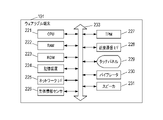
- FIG. 2B is a diagram showing the internal configuration of wearable terminal 101. As shown in FIG.
- the CPU 221 has programs stored in the ROM 223 (including programs for realizing each process described later), and comprehensively controls each device via the internal bus 233 .
- the RAM 222 functions as a memory and work area for the CPU 221 .
- the storage device 224 is a hard disk drive (HD), solid state drive (SSD), or the like that stores various data.
- the network I/F 225 exchanges data unidirectionally or bidirectionally with external network equipment.
- the biometric information sensor 226 is a sensor that reads biometric information such as vein authentication, skin authentication, and ear acoustic authentication.
- the Trusted Platform Module (TPM) 227 is storage means with tamper resistance that prevents the stored data from being read from the outside for the purpose of processing or storing confidential information.
- the TPM 227 stores the biometric information input by the biometric information sensor 226 and the private key generated in the wearable terminal 101, and has a function of verifying the stored biometric information and the input biometric information.
- a tamper-resistant storage means it is possible to substitute a securely constructed trust environment uniquely defined by a platform such as the OS of the wearable terminal 101 .
- a proximity communication I/F 228 is a network I/F for proximity communication such as NFC and BlueTooth.
- the proximity communication I/F 228, data can be exchanged with the client terminal 102 or the like, and an authentication instruction can be issued from the client terminal 102 or the like to the wearable terminal 101.
- the touch panel 229 is a device having both a display function and a pointing function, and the user can operate an object displayed on the display with a finger or a touch pen.
- the vibrator 230 is a device for vibrating the wearable terminal 101, and vibrates in response to a user's operation, an external event, or the like.
- the speaker 231 is a device for outputting sounds such as voice messages and melodies.
- the wearable terminal 101 in the present invention is assumed to be a smart watch, an earphone, a smart ring, etc., which have functions such as vein authentication, skin authentication, ear acoustic authentication, etc. that can be authenticated while the user is wearing it, but it is limited to a specific device. I am not.
- a display output device such as the touch panel 229 is provided in FIG. 2B, it is not necessarily required in the present invention.
- the vibrator 230 and the speaker 231 of the wearable terminal 101 are used to notify the user of the completion of processing in this embodiment, the device for notifying is not limited to this.
- a smartwatch could have a device for tightening a belt, and a smart ring could have a flashing light.
- FIG. 2C is a diagram illustrating a hardware configuration example of an information processing apparatus that is the client terminal 102. As illustrated in FIG.
- the internal bus 241 , CPU 242 , RAM 243 and ROM 244 have the same functions as the internal bus 211 , CPU 201 , RAM 202 and ROM 203 .
- the storage device 245 is a storage device such as a solid state drive (SSD) or an SD memory card, and stores various data similarly to the storage device 210 .
- a network interface 247 is a communication module having a wireless communication function for communicating with other devices connected to the network.
- the touch panel 249 is a device having both a display function and a pointing function, and the user can operate objects displayed on the display with a finger or a touch pen.
- the proximity communication IF 250, vibrator 251, and speaker 252 have functions similar to those of the proximity communication I/F 228, vibrator 230, and speaker 231, respectively.
- the client terminal 102 in the present invention is assumed to be an information processing terminal such as a smartphone, PC, tablet computer, etc., but is not limited to any specific device.
- devices such as smart speakers and smart glasses that do not have a display or touch panel may be used.
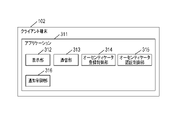
- FIG. 3A is a diagram showing a configuration example of software of the client terminal 102. As shown in FIG.
- the application 311 is an application for using services provided by the web service 341 of the server system 103 .
- the application 311 comprises a display unit (UI) 312 , a communication unit 313 , an authenticator registration control unit 314 , an authenticator authentication control unit 315 and a notification control unit 316 .
- the application 311 is a native application specialized for using a web browser or web service 341.
- a display unit 312 is a software module that executes and displays web contents obtained from the web service 341 .
- a communication unit 313 is a software module for communicating with the server system 103 and the wearable terminal 101 .
- the authenticator registration control unit 314 requests the authenticator (authentication device) 331 to create a credential, which will be described later, and generates a request to be sent to the web service 341 when the authenticator is registered. It is a software module.
- the authenticator authentication control unit 315 requests authentication processing from the authenticator 331 and generates a request to be sent to the web service 341 at the time of authentication.
- the notification control unit 316 is a software module for notifying and controlling the authentication result to the user at the time of authentication, which is a feature of the present invention.
- the condition, timing, and pattern for notification by the notification control unit 316 will be described later.
- the service provided by the web service 341 can be used by the user operating the display unit 312 and the communication unit 313 communicating with the server system 103 .
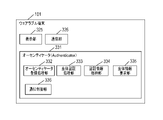
- FIG. 3B is a diagram showing a configuration example of software of the wearable terminal 101. As shown in FIG.
- the display unit 325 is a software module for providing a GUI to the user via the touch panel 229.
- a communication unit 326 is a software module for communicating with an external device such as the client terminal 102 via the network interface 225 .
- the authenticator 331 is a group of authentication modules that execute processing related to biometric authentication using the biometric information sensor 226 .
- the wearable terminal 101 in this embodiment can function as an external authenticator (external authenticator) for the client terminal 102 by executing the authenticator 331 .
- the authenticator registration processing unit 332 is a software module that receives a credential creation request from the authenticator registration control unit 314 or the like, creates a pair of keys (secret key and public key), and creates credentials.
- the biometric authentication processing unit 333 is a software module that receives a biometric authentication request from the authenticator authentication control unit 315 and performs biometric authentication using the biometric information sensor 226 .
- the authentication information storage unit 334 is a software module that stores authentication information and the like shown in the authentication information management table (Table 1) in the TPM 227 .
- the biometric information requesting unit 335 is a software module that displays on the touch panel 229 a UI for accepting input of biometric information from the user.
- the notification control unit 336 is a software module for notifying and controlling the authentication result to the user at the time of authentication, which is a feature of the present invention. The timing and pattern of notification by the notification control unit 336 will be described later.
- the authentication information ID column is a column that stores unique identification information (ID) for each authentication information.
- the service ID column is a column of identification information (service ID) for identifying target services such as the Web service 341 .
- the authentication information management table stores the domain name of each web service as the service ID.
- the user ID column stores user identification information (user ID) for uniquely identifying a user by a web service used for legacy authentication or the like.
- Legacy authentication is authentication that verifies that a user ID matches a password, and is described as legacy authentication in distinction from biometric authentication.
- the private key string stores identifiers of private keys created by the authenticator registration processing unit 332 .
- a public key corresponding to each private key managed by each identifier in the private key string is registered and managed in a service on the network corresponding to the service ID indicated in the service ID string.
- the biometric information ID column stores identification information (ID) corresponding to the feature amount of biometric information.
- FIG. 3C is a diagram showing a configuration example of software of the server system 103. As shown in FIG.
- the web service 341 is a web service that requires user authentication to provide services using a communication protocol such as HTTP.
- a web service is prepared for each service to be provided.
- Web services provide social networking services, E-commerce (Electric Commerce) services, financial services, and websites for these services.
- a Web service is realized by the CPU 201 reading a program for providing the Web service stored in the ROM 203 of the server system 103 into the RAM 202 and executing it.
- the legacy authentication processing unit 342 is a software module that verifies whether the user ID and password included in the legacy authentication request received by the communication unit 348 match the user ID and password stored in the user information storage unit 344 .
- the authenticator information processing unit 343 is a software module that stores information about the authenticator in the authenticator information storage unit 345 using the credential received by the communication unit 348 . In addition, the authenticator information processing unit 343 verifies later-described assertion information (Assertion) received by the communication unit 348 .
- the user information storage unit 344 is a software module that stores user information described later using a user information management table.
- the authenticator information storage unit 345 is a software module that stores authenticator information, which will be described later, using an authenticator information management table.
- the presentation unit 346 is a software module that creates HTML, CSS, JavaScript, etc. in response to acquisition requests for various screens of the Web service 341 received by the communication unit 348 from the client terminal 102 or the like.
- the token management unit 347 is a software module that uses a token management table to issue and verify tokens, which will be described later.
- the communication unit 348 is a software module that communicates with the client terminal 102 and accepts requests.
- Table 2 is a user information management table managed by the user information storage unit 344 of the web service 341 .
- one record indicates account information of one registered user.
- the user ID column is a user identifier (user ID) for uniquely identifying the user of the web service 341.
- the password column stores passwords for authenticating users. This password is the password used for legacy authentication and is usually stored hashed.
- the email address column stores email addresses of users. In addition to the mail address, user attribute information such as the user's address and profile may be stored in the user information management table.
- Table 3 is an attestation challenge management table, which is managed by the user information storage unit 344 of the web service 341.
- the attestation challenge is data issued at the time of user credential registration, and is a parameter used as verification data for challenge-response authentication. The process of issuing the attestation challenge will be described later.
- the attestation challenge column stores the attestation challenge.
- the user ID column represents the user ID with which the issued attestation challenge is associated.
- the expiration column represents the expiration date of the attestation challenge.
- Table 4 is an authenticator information management table, which is managed by the authenticator information storage unit 345 of the web service 341.
- one record indicates one piece of authenticator information.
- the value of the authentication information ID column in the authentication information management table (Table 1) is stored in the authentication information ID column.
- the public key column manages information of public keys whose registration is requested as credentials from the authenticator. This public key is a public key paired with a private key associated with the authentication information ID. In other words, with a key pair managed with the same authentication information ID, data encrypted with the private key on the authenticator side can be decrypted with the public key managed in the authenticator information management table on the Web service 341 side. become.
- the user ID column stores user IDs for uniquely identifying users who use the web service 341 .
- the notification capability column is capability information indicating whether or not the wearable terminal 101 has the notification control unit 336 (whether or not the notification function according to the present embodiment is supported). This information is information used at the time of notification determination, which is a feature of the present invention.
- Table 5 is a token management table, which is managed by the token management unit 347 of the web service 341.
- the tokens managed in Table 5 are issued by the token management unit 347 of the web service 341 after completing various authentication processes.
- the application 311 can use the service provided by the web service 341 by giving the issued token and transmitting a request.
- one record indicates the information of one token.
- the token column stores token information.
- the user ID column stores user IDs for uniquely identifying users of the web service 341 .
- the expiry column indicates the expiry date of the token.
- the Web service 341 accepts the request if the token given to the request exists in the token column of the token management table and has not expired in the expiration date column.
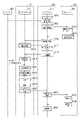
- the authenticator registration process shown in FIG. 4 will be described with reference to FIGS. 5A-D and 6A-F.
- the processing shown in FIG. 4 shows processing steps realized by executing corresponding programs in each device.
- FIG. 4 shows processing steps realized by executing corresponding programs in each device.
- an example of registering information created by the authenticator 331 of the wearable terminal 101 will be described.
- registration of information created by the authenticator 331 in the Web service 341 is simply referred to as registration of the authenticator (authentication device).
- FIGS. 6A to 6F are diagrams showing examples of UIs whose display is controlled by the display unit 312 of the application 311 during authenticator registration processing.
- FIG. 6A is an authentication setting screen provided by the application 311, and the user presses a button 611 when using an authentication method other than legacy authentication (password authentication) when using the Web service 341.
- FIG. Note that the authentication setting screen is provided when the user 401 has been authenticated with respect to the Web service 341 by legacy authentication or the like.
- the application 311 accepts a registration instruction according to the selection of the button 611 by the user.
- the authenticator registration control unit 314 of the application 311 requests the Web service 341 via the communication unit 313 to display an authenticator registration screen.
- the authenticator information processing unit 343 of the web service 341 creates the registration parameters 510.
- Registration parameters 510 consist of account information 511 , encryption parameters 512 , attestation challenge 513 , registration policy 514 and extension area 515 .
- the account information 511 represents attribute information such as a user ID specified at the time of authentication in the Web service 341 and an e-mail address associated with the user ID.
- the encryption parameter 512 indicates attribute information related to authentication information to be registered, such as an encryption algorithm supported by the web service 341 .
- the attestation challenge 513 is a parameter as verification data used for challenge-response authentication.
- the attestation challenge is created when the registration parameters are created in S413, and is stored in the attestation challenge management table (Table 3) in association with the user ID, expiration date, and the like.
- the registration policy 514 is an optional parameter for specifying the types of authenticators that can be registered with the web service 341 .
- the policy is, for example, whether the wearable terminal 101 serving as an authenticator supports the authentication method specified by the Web service 341, whether it has a specific capability, and the like.
- the extension area 515 stores extension parameters that can be specified by the web service 341 in order for the web service 341 to control the operation of the authenticator 331 and the application 311 .
- the authenticator information processing unit 343 of the Web service 341 transmits information on the authenticator registration screen to the application 311 as a response to the request at S412.
- the sent response also includes registration parameters 510 .
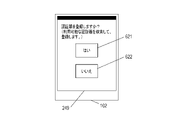
- FIG. 6B is an example of a registration screen whose display is controlled on the touch panel 249 of the client terminal 102 by the application 311 in response to the response in S414.
- search processing is executed in S415, and when the button 622 is operated, the screen returns to the screen in FIG. 6A.
- FIG. 6C is a screen displayed on the touch panel 249 when the processes of S415 and S416 are being executed.
- the authenticator registration control unit 314 searches whether a device that can be used as an authenticator (external authenticator) is connected to the client terminal 102. Specifically, it sends a request for acquiring authenticator information to the wearable terminal, which is a connected device. If the wearable terminal is running an authenticator program, it is possible to respond to this request. In this embodiment, the authenticator registration control unit 314 transmits this request to the communication unit 326 of the wearable terminal 101 via the communication unit 313 of the application 311 .
- the requested authenticator information also includes the authenticator's notification capability described in the authenticator information management table.
- the authenticator registration processing unit 332 receives the request via the communication unit 326 of the wearable terminal 101, and responds to the application 311 with the authenticator information.
- the authenticator registration control unit 314 determines whether the authenticator information acquired in S416 satisfies the conditions of the registration policy 514 included in the response in S414 and can be used as an authenticator for the Web service 341. to confirm.
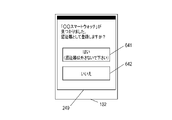
- FIG. 6D is a screen displayed on the touch panel 249 when it is confirmed that it can be used as an authenticator of the web service 341 in the process of S417.
- S418 is executed and the screen transitions to the screen shown in FIG. 6E. Also, when the button 642 is selected, the screen returns to the screen of FIG. 6A.
- the screen of FIG. 6D may be skipped and S418 may be executed. good.
- the authenticator registration control unit 314 of the application 311 requests the wearable terminal 101 to create a credential via the communication unit 313.
- This credential creation request is received by the communication unit 326 of the wearable terminal 101 and transmitted to the authenticator registration processing unit 332 .
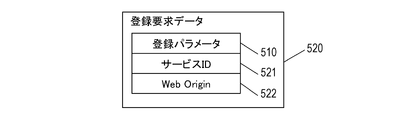
- the registration request data 520 is included in the credential creation request of S418.
- the registration request data 520 includes the registration parameter 510 received from the Web service 341, the service ID 521 of the Web service 341 described in the authentication information management table (Table 1), and the WebOrigin 522.
- WebOrigin 522 is information indicating the origin of the web service 341 .
- the authenticator registration processing unit 332 executes the user's biometric information acquisition process. Specifically, the biometric information sensor 226 is internally instructed to read the biometric information. In S ⁇ b>420 , biometric information of the user 401 wearing the wearable terminal 101 is detected via the biometric information sensor 226 . In the present invention, it is assumed that the user 401 only wears the wearable terminal 101 and biometric information is detected without operating the wearable terminal 101 .
- the authenticator registration processing unit 332 of the authenticator 331 creates a biometric information ID that uniquely identifies the biometric information and the feature amount of the biometric information that has been read.
- the authenticator registration processing unit 332 of the authenticator 331 creates a private key/public key pair and issues an authentication information ID. Then, the authenticator registration processing unit 332 stores the authentication information ID created in S421 and S422, the private key, the biometric information ID, the service ID 521 included in the registration request data 520, and the user ID included in the registration parameter 510 in the authentication information storage unit 334. Store the ID.
- the authenticator registration processing unit 332 of the authenticator 331 creates the credential 530 shown in FIG. 5C.
- the credential 530 is composed of an authentication information ID 531 , an algorithm 532 , a public key 533 , an attestation 534 and an authenticator name 535 .
- the authentication information ID 531 and public key 533 are public keys created in the process of S422.
- Algorithms 532 correspond to the algorithms used to generate the private key and public key pair in S422.
- the attestation 534 is obtained by encrypting the attestation challenge 513 using the private key created in S422.
- the notification control unit 336 uses at least one of the vibrator 230 and the speaker 231 provided in the wearable terminal 101 to notify the user 401 that the biometric information has been input.
- the user 401 can recognize the notification from the vibration transmitted from the wearable terminal 101 or the specific sound.
- the notification means used in the process of S424 differs depending on the type of the wearable terminal 101.
- a smart watch vibrates or tightens a belt
- an earphone sounds a sound
- a smart ring flashes a light, and the like. method can be used.
- the wearable terminal 101 does not have a device such as the notification control unit 329, the vibrator 230, or the speaker 231, the process of S424 is skipped, and in S429 described later, the application 311 becomes a substitute and input of biometric information is completed. It is also possible to notify the user 401 to that effect.
- the authenticator registration processing unit 332 of the authenticator 331 responds to the application 311 of the client terminal 102 with the credential 530 created at S423.
- the authenticator registration control unit 314 transmits a registration processing request including the registration data 540 to the web service 341 via the communication unit 313.
- Registration data 540 consists of credentials 530 and capability information 541 .
- a credential 530 is the credential created in S423.
- the capability information 541 is the authenticator information of the wearable terminal 101 acquired in S415-S416.
- the authenticator information processing unit 343 of the Web service 341 performs authenticator registration processing using the registration data 540 received in the registration processing request of S426.
- Registration processing includes verification processing by decrypting attestation 534 included in credential 530 of registration data 540 with public key 533 included in the same credential 530 .
- the authenticator information processing unit 343 of the Web service 341 identifies the same value of the attestation 534 decrypted with the public key 533 and the value of the attestation challenge column in the attestation challenge management table (Table 3). Then, the user ID of the record that has the same value as the specified attestation challenge string is specified as the ID that is associated with the credential 530 .
- the authenticator information processing unit 343 of the web service 341 registers the authentication information ID 531, the public key 533, and the specified user ID and capability information 541 included in the credential 530 in the authenticator information management table. In S428, the authenticator information processing unit 343 of the Web service 341 responds to the application 311 via the communication unit 348 that the authenticator registration processing has been completed normally.
- the authenticator registration control unit 314 of the Web service 341 makes notification determination according to the notification capability included in the authenticator information of the wearable terminal 101 acquired in S415-S416. If the authenticator registration control unit 314 determines that the wearable terminal 101 does not have the notification capability, it calls the notification control unit 316, instead of step S424, prompting the user 401 to complete the biometric information input and registration processing. We will notify you to that effect.
- FIG. 6F is a screen displayed when the authenticator registration control unit 314 executes the process shown in S429. If the client terminal 102 has an output device such as the touch panel 249 or the vibrator 251, the screen display as shown in FIG.
- the client terminal 102 is a device such as a smart speaker that performs input and output only by voice
- the display contents shown in FIGS. 6A to 6F are realized by voice.
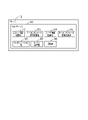
- FIG. 11A shows a modification of the screen shown in FIG. 6D. Specifically, this is an example of a case where a plurality of wearable terminals are found as devices that can be used as authenticators for the web service 341 .
- FIG. 11B is an example in which an internal authenticator provided in the client terminal 102 itself can be used as an authenticator for the web service 341 in addition to multiple wearable terminals.
- FIGS 11A and 11B exemplify “ ⁇ smart watch” and “ ⁇ wireless earphones” as multiple wearable terminals. If the user selects one of the buttons 1101 and 1102, a credential creation request is issued to the wearable terminal corresponding to the button, and the processes after S418 are executed.
- FIG. 11B when the button 1103 is selected, a credential creation request is issued to the internal authenticator implemented in the client terminal 102 .
- the processes from S419 to S425 are executed by the internal authenticator using the biometric information acquired using the biometric information sensor of the client terminal 102.
- FIG. 7 is a diagram showing a sequence when the user 401 uses the web service 341 requiring authentication from the application 311. As shown in FIG. The processing shown in FIG. 7 shows processing steps realized by executing a corresponding program in each device.
- Figs. 8A to 8C are diagrams showing examples of parameters used in authentication.
- 9A to 9D show examples of screens controlled by the display unit 312 of the application 311 in accordance with the processing shown in FIG.
- This embodiment provides a mechanism for notifying the user 401 that the authentication process has been completed after biometric information is entered in the authentication process, as in the authenticator registration process. 7, 8A to 8C, and 9A to 9D, an example of authentication processing when performing a product purchase procedure on the Web service 341 (e-commerce site) will be described.
- FIG. 9A is a screen when content provided by the presentation unit 346 of the web service 341 is displayed by the display unit 312 of the application 311.
- FIG. 9A is a screen when content provided by the presentation unit 346 of the web service 341 is displayed by the display unit 312 of the application 311.
- the application 311 accepts an instruction according to the selection operation on the button 911 by the user 401.
- the authenticator authentication control unit 315 of the application 311 transmits a product purchase request to the Web service 341 .
- the authenticator information processing unit 343 of the web service 341 creates an authentication parameter 810 for user authentication.
- the authenticator information processing unit 343 of the web service 341 transmits the authentication parameter 810 created in S ⁇ b>713 to the application 311 .
- FIG. 8A shows authentication parameters 810.
- the authentication parameter 810 consists of an Assertion challenge 811 and an Assertion extension area 812 .
- the assertion challenge 811 is a parameter as verification data used for challenge-response authentication.
- the assertion extension area 812 stores extension parameters that can be specified by the web service 341 in order for the web service 341 to control the operation of the authenticator 331 and the application 311 . This time, the assertion extension area 812 includes the authenticator capability information 541 given in S426.
- the authenticator authentication control unit 315 of the application 311 makes an authentication request to the biometric authentication processing unit 333 of the authenticator 331 using the authentication request parameter.
- the screen shown in FIG. 9B is displayed by the display unit 312 .
- FIG. 8B shows an authentication request parameter 820.
- the authentication request parameter 820 is composed of an authentication parameter 810 , service ID 821 and WebOrigin 822 .
- Service ID 821 and WebOrigin 822 are the same as those described in FIG. 5B.
- the biometric information requesting unit 335 of the authenticator 331 executes the biometric information acquisition process of the user.
- processing similar to the processing of S419 is executed.
- biometric information of the user 401 wearing the wearable terminal 101 is detected via the biometric information sensor 226 .
- the biometric authentication processing unit 333 of the authenticator 331 compares the biometric information detected via the biometric information sensor 226 with the biometric information stored in the TPM 227 to perform user authentication.
- a matching algorithm a feature point extraction method, a pattern matching method, and the like are generally known, but the matching algorithm is not particularly limited in the present invention.
- the authentication information storage unit 334 identifies the corresponding secret key from the authentication information management table based on the biometric information stored in the TPM 227 .
- signature (832) data is created from the attestation challenge 811 included in the authentication parameter 810 and the identified private key.
- the biometric authentication processing unit 333 creates assertion information 830 including an authentication information ID 831 and a signature 832 specified from the authentication information management table (Table 1).
- the notification control unit 336 of the authenticator 331 performs notification.
- the notification control unit 336 notifies the user 401 of the result of the biometric authentication performed in S718 using the vibrator 230, the speaker 231, or the like.
- the notification control unit 336 can change the notification pattern according to the authentication result of S718. For example, if the wearable terminal 101 used as an external authenticator is an earphone, if the authentication automatically performed while wearing the earphone is successful, a voice such as "Authentication succeeded" is output. It controls the flow of a voice such as "I've done it".
- the wearable terminal 101 may not be equipped with devices such as the notification control unit 329, the vibrator 230, and the speaker 231, as in the registration of the authenticator. In that case, the notification processing of S719 is similarly skipped, and the user 401 is notified in S728 to be described later that the application 311 has taken the place of the biometric information and the authentication has been completed.
- the biometric authentication processing unit 333 of the authenticator 331 returns the assertion information 830 created at S718 to the application 311.
- the authenticator authentication control unit 315 of the application 311 transmits the assertion information 830 received from the biometric authentication processing unit 333 to the web service 341.
- the authenticator information processing unit 343 of the web service 341 verifies the assertion information 830 received from the application 311.
- the authenticator information processing unit 343 decrypts the signature 832 of the assertion information 830 using the public key specified by the authentication information ID 831, and determines whether it matches the attestation challenge 811 included in the authentication parameter 810 created in S713. to verify the signature.
- An authenticator information management table is used to specify the public key. If the verification succeeds, in S723 the token management unit 347 of the web service 341 issues a token and manages information about the token in the token management table. In S ⁇ b>724 , the token management unit 347 of the web service 341 returns the token issued in S ⁇ b>723 to the application 311 .
- the authenticator authentication control unit 315 uses the token received at S724 to send a request for product purchase to the Web service 341.
- the token management unit 347 verifies the token given to the request at S725, and if the prefectural office succeeds, executes purchase processing according to the request.
- the Web service 341 returns to the application 311 a response indicating that the purchase process has been completed.
- the authenticator authentication control unit 315 of the Web service 341 determines whether to notify the authentication result based on the capability information 541 included in the assertion extension area 812 of the authentication parameter 810 returned in S714. do.
- the authenticator authentication control unit 315 calls the notification control unit 316 when it determines that the wearable terminal 101 does not have the notification capability. Then, instead of the process of S719, the user 401 is notified that the authentication process and the purchase process of S726 have been completed.
- FIG. 9C is a screen displayed when S728 is executed by the authenticator authentication control unit 315.
- the notification pattern in S728 is not particularly limited because the UI display, sound, vibration, etc. differ depending on the device provided in the client terminal 102 .
- the authenticator authentication control unit 315 determines in S728 that the notification capability of the wearable terminal 101 is “yes”, there is no need to notify that authentication has been completed as shown in FIG. Transition to the screen.
- the notification control unit 336 is provided in the authenticator 331 of the wearable terminal 101 so that the user 401 can notice that biometric information has been input and authenticator registration/authentication processing has been executed. was notified. Moreover, even if the wearable terminal 101 does not include the notification control unit 336, the method of notifying the user 401 by the notification control unit 316 on the client terminal 102 side as an alternative has also been described. With this system, even when a wearable device that does not require user operation for authentication was used as the authenticator, the user entered the biometric information, and the authenticator registration and authentication process were performed without fail. The user can grasp this at an appropriate timing.
- the authenticator registration processing unit 332 and the biometric authentication processing unit 333 of the authenticator 331 simply call the notification control unit 336 after completing the processing of S423 and S718 to notify the user 401. was in control. However, depending on the service provided by the Web service 341 used by the user 401, it may be desired to control the presence or absence of notification and the notification pattern.
- control information related to notification in the extension area 515 of the registration parameter 510 at the time of authenticator registration and in the assertion extension area 812 of the authentication parameter 810 at the time of authentication.
- This control information is information that can be interpreted by the notification control unit 336 of the wearable terminal 101, and in S424 and S719, the notification control unit 336 determines whether or not there is a notification according to the value of this control information. More specifically, it can be controlled to notify only when the value of the control information indicates that notification is required. It is also possible to implement such that the notification pattern (message content, LED lighting pattern, etc.) is changed depending on the value of the control information.
- processing shown in the first embodiment may be performed when the extension area 515 and the assertion extension area 812 do not contain control information.
- the notification control unit 336 notifies at timings such as S424 and S719 when the wearable terminal 101 successfully performs biometric authentication as an external authenticator.
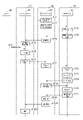
- FIG. 10 is a sequence diagram in which notification timing is changed in the authentication sequence of the first embodiment. As a difference, the processing of S1029 and S1030 is added instead of the notification processing of S719.
- the authenticator authentication control unit 315 requests the authenticator 311 to notify in S1029.
- the notification control unit 336 of the authenticator 311 that has received the notification request executes notification control intended to complete a series of processes including the authentication process.
- the notification control here may be the same process as the notification process in S719, or may be a notification that allows the user to directly grasp the completion of the process.
- the sequences shown in FIGS. 4 and 7 end abnormally when communication between the client terminal 102 and the server system 103 cannot be established in the processing after S426 or S721.
- the notification control unit 336 of the wearable terminal 101 notifies the user 401 of successful authentication in S424 and S719 even though the entire sequence did not end normally, and the purchase process is successful. There is a concern that it may be misunderstood that
- the timing of the notification is after the completion of the processing in the web service 341, so it may be possible to eliminate such misunderstandings.
- the present invention performs different notifications at the timings of both S719 of the first embodiment and S1030 of the third embodiment, and separately notifies the user of authentication success and processing completion. It is also possible to
- the present invention also includes an apparatus or system configured by appropriately combining the above-described embodiments, and a method therefor.
- the present invention is a main device or system that executes one or more software (programs) that implement the functions of the above-described embodiments.
- a method for implementing the above-described embodiments executed by the device or system is also one aspect of the present invention.
- the program is supplied to a system or device via a network or various storage media, and is read into one or more memories and executed by one or more computers (CPU, MPU, etc.) of the system or device. be done.
- one aspect of the present invention includes the program itself or various computer-readable storage media storing the program.
- the present invention can also be implemented by a circuit (for example, ASIC) that implements the functions of the above-described embodiments.
Landscapes
- Engineering & Computer Science (AREA)
- Computer Security & Cryptography (AREA)
- General Engineering & Computer Science (AREA)
- Computer Hardware Design (AREA)
- Computing Systems (AREA)
- Signal Processing (AREA)
- Computer Networks & Wireless Communication (AREA)
- Theoretical Computer Science (AREA)
- Physics & Mathematics (AREA)
- General Physics & Mathematics (AREA)
- Health & Medical Sciences (AREA)
- Biomedical Technology (AREA)
- General Health & Medical Sciences (AREA)
- Power Engineering (AREA)
- Software Systems (AREA)
- Human Computer Interaction (AREA)
- Storage Device Security (AREA)
- User Interface Of Digital Computer (AREA)
- Collating Specific Patterns (AREA)
Abstract
ユーザに装着された外部認証器を用いた認証処理を制御できるアプリケーションを実行する情報処理装置が前記外部認証器で認証に成功した場合に受信する署名データをシステムに対して送信して検証する仕組みにおいて、前記外部認証器が、前記生体認証の結果、および、前記情報処理装置から前記外部認証器に対して送信される要求、のすくなくとも何れかに応答して、前記外部認証器により前記ユーザに対して通知が行われることを特徴とする。
Description
本発明は、認証器を利用した認証技術に関する。
ウェブ上のサービスにログインしたり、サービス利用の承認をしたり、するための認証方法が多数存在する。例えば、近年、FIDO(Fast Identity Online)と呼ばれる認証方法が注目されている。FIDOでは、生体情報などの認証情報がネットワーク上を流れることがないため、情報漏洩のリスクが少ない認証方法と言われている。
生体情報の入力方法として、指紋認証リーダを利用した指紋認証や、カメラを利用した顔認証などが広く普及している。特許文献1では、スマートフォンをFIDO認証の外部オーセンティケータ(認証器)として利用している。近年では、スマートウォッチやスマートリング、イヤホンなどのウェアラブル端末に生体情報を読み取るセンサが備えられ、静脈認証や皮膚認証、耳音響認証などで個人認証を実現している。このようなウェアラブル端末であっても、FIDOなどの認証方法における、認証器としても利用されることが可能である。
ウェアラブル端末を、外部認証器として利用して、静脈認証や皮膚認証、耳音響認証などの認証方法を採用した場合、指をスマートフォンの所定位置にかざすなど、といった特定の操作入力なしに認証がスムーズに行える可能性がある。
その一方で、装着しているだけでユーザの操作なしに認証が行えるがゆえに、ユーザからすると認証処理の結果や、成功したタイミングが把握しづらくなる懸念がある。イヤホンなどウェアラブル端末は、スマートフォンなどとは異なり、ディスプレイをもっていない場合もあり、その場合はそのような懸念が顕著になる。とくに、前述のFIDOでサービス利用(商品購入など)の承認を行う際に、外部認証器としてウェアラブル端末を利用している場合には、ユーザが認証処理の結果などをリアルタイムに把握したいと考えるかもしれない。
本発明は、ウェアラブル端末を認証器として利用する場合においても、認証処理に伴う通知をユーザに適切に行うことができる仕組みの提供を目的とする。
外部認証器を用いた認証処理を制御できるアプリケーションを実行する情報処理装置であって、ネットワークを介して通信するシステムに対してリクエストを送信する第1送信手段と、検証用のデータを前記システムから受信する第1受信手段と、前記検証用のデータを含む認証要求を外部認証器に送信する要求手段と、前記外部認証器から、前記外部認証器が生成した署名データを受信する第2受信手段と、前記署名データを前記システムに対して送信する第2送信手段と、前記システムに登録済みの公開鍵を用いた前記署名データの検証処理の結果に基づくデータを受信する第3受信手段と、を有し、前記外部認証器は、前記情報処理装置のユーザに装着され、前記認証要求に応じた生体認証の結果、および、前記第3受信手段によるデータの受信に応じて前記情報処理装置から前記外部認証器に対して送信される要求、のすくなくとも何れかに応答して、前記外部認証器により前記ユーザに対して通知が行われることを特徴とする。
本発明によれば、ウェアラブル端末を認証器として利用する場合においても、認証処理に伴う通知をユーザに適切に行うことができる仕組みを提供できる。
以下、本発明を実施するための最良の形態について図面を用いて説明する。以降の説明では、ウェブ上のサービス利用に際して、ユーザが所有し、装着するウェアラブル端末で生体認証を行っている。その認証が成功したことを証明できるデータ(署名データ)をウェブ上のサービスに提供し、サービスにおいてそのデータの検証に成功することでサービスを提供する仕組みに関するものである。なお、以降の実施例では、その仕組みとしてFIDOを利用する例を説明しているが、同様の認証の仕組みであれば、FIDO以外の技術を採用することも可能である。
(実施例1)
<ネットワーク構成>
図1は、本実施例のネットワーク構成例を示す図である。本システムは、ウェアラブル端末101と、クライアント端末102、サーバシステム103から構成される。
<ネットワーク構成>
図1は、本実施例のネットワーク構成例を示す図である。本システムは、ウェアラブル端末101と、クライアント端末102、サーバシステム103から構成される。
クライアント端末102、サーバシステム103はネットワーク105を介して接続される。ネットワーク105は、例えば、インターネット等のLAN、WAN、電話回線、専用デジタル回線、ATMやフレームリレー回線、ケーブルテレビ回線、データ放送用無線回線等のいずれであり。またはこれらの組み合わせにより実現される、いわゆる通信ネットワークである。また、ウェアラブル端末101は、クライアント端末102ともネットワーク106を介して接続される。ネットワーク106は、例えば、NFC(Near Field Communication)やBlueTooth等の近距離の無線通信や、USBケーブル接続による通信などによって実現される。ネットワーク106はWi-Fiでの通信によって実現されてもよい。また、ウェアラブル端末101は、ネットワーク105に接続されてもよい。
<サーバシステム103の内部構成>
図2Aは、サーバシステム103の情報処理機能を有するハードウェアの構成例を示す図である。サーバシステム103は、少なくとも1以上の情報処理装置により構築され、以下で説明する、それら装置が具備するハードウェアを用いて、ウェブサイトやウェブサービス、認証サービスを提供する。
図2Aは、サーバシステム103の情報処理機能を有するハードウェアの構成例を示す図である。サーバシステム103は、少なくとも1以上の情報処理装置により構築され、以下で説明する、それら装置が具備するハードウェアを用いて、ウェブサイトやウェブサービス、認証サービスを提供する。
201はCPUであり、RAM202、ROM203、記憶装置210などから読み込んだプログラムを実行する。キーボードコントローラ204は、キーボード208や図示しないポインティングデバイス(マウス、タッチパッド、タッチパネル、トラックボールなど)からの操作入力を制御する。ディスプレイコントローラ205は、ディスプレイ209の表示を制御する。ディスクコントローラ206は、各種データを記憶するハードディスクドライブ(HD)、ソリッドステートドライブ(SSD)等の記憶装置210へのデータアクセスを制御する。ネットワークインターフェース207は、LANなどのネットワークに接続されて、ネットワークに接続された他の機器と通信する。201~207などハードウェアを構成する各部は内部バス211を介して接続されている。
<ウェアラブル端末101の内部構成>
図2Bは、ウェアラブル端末101の内部構成を示す図である。
図2Bは、ウェアラブル端末101の内部構成を示す図である。
CPU221はROM223に格納されているプログラム(後述する各処理を実現するプログラムも含む)を備え、内部バス233を介して各デバイスを総括的に制御する。RAM222は、CPU221のメモリやワークエリアとして機能する。記憶装置224は、各種データを記憶するハードディスクドライブ(HD)、ソリッドステートドライブ(SSD)などである。ネットワークI/F225は、外部のネットワーク機器と片方向または双方向にデータをやり取りする。生体情報センサ226は、静脈認証や皮膚認証、耳音響認証などの生体情報を読み取るセンサである。Trusted Platform Module(TPM)227は、機密情報を処理したり格納したりする目的で、格納したデータを外部から読み取られることを防ぐ耐タンパー性を備えた記憶手段である。TPM227は、生体情報センサ226で入力した生体情報やウェアラブル端末101内で生成した秘密鍵を記憶すると共に、記憶している生体情報と入力された生体情報とを検証する機能を有する。耐タンパー性を備えた記憶手段としては、ウェアラブル端末101のOSなどのプラットフォームが独自に定義するセキュアに構築された信頼環境を代用することが可能である。
近接通信I/F228はNFCやBlueToothなどの近接通信用のネットワークI/Fである。近接通信I/F228を利用することでクライアント端末102等とデータのやり取りや、クライアント端末102等からウェアラブル端末101に対して認証指示を出すことが可能である。タッチパネル229はディスプレイ機能とポインティング機能の両方を備えた装置であり、ディスプレイに表示されたオブジェクトをユーザが指やタッチペンなどで操作することができる。バイブレータ230は、ウェアラブル端末101を振動させるための装置であり、ユーザの操作や外部からのイベント等に呼応して振動する。スピーカ231は、音声メッセージやメロディなどの音を出力するための装置である。
本発明におけるウェアラブル端末101は、ユーザが装着したまま認証可能な静脈認証や皮膚認証、耳音響認証などの機能を有するスマートウォッチやイヤホン、スマートリングなどを想定しているが、特定のデバイスに限定しているわけではない。また、図2Bではタッチパネル229のような表示出力装置を備えているが、本発明では必ずしも必要ではない。さらに、ウェアラブル端末101のバイブレータ230やスピーカ231は、本実施例においてはユーザへ処理の完了を通知するために用いるが、通知するための装置はこれに限らない。例えば、スマートウォッチであればベルトを締め付けるための装置を、スマートリングであれば点滅するライトを有することも可能である。
<クライアント端末の内部構成>
図2Cは、クライアント端末102である情報処理装置のハードウェアの構成例を示す図である。
図2Cは、クライアント端末102である情報処理装置のハードウェアの構成例を示す図である。
内部バス241、CPU242、RAM243、ROM244は、内部バス211、CPU201、RAM202、ROM203と同様の機能を有する。記憶装置245は、ソリッドステートドライブ(SSD)やSDメモリカードなどの記憶装置であり、記憶装置210と同様に各種データを記憶する。ネットワークインターフェース247はネットワークに接続された他の機器と通信する無線通信機能を備えた通信モジュールである。タッチパネル249はタッチパネル229と同様に、ディスプレイ機能とポインティング機能の両方を備えた装置であり、ディスプレイに表示されたオブジェクトをユーザが指やタッチペンなどで操作することができる。近接通信IF250、バイブレータ251、スピーカ252は、それぞれ近接通信I/F228、バイブレータ230、スピーカ231と同様の機能を有する。
本発明におけるクライアント端末102は、スマートフォンやPC、タブレットコンピュータなどの情報処理端末を想定しているが、特定のデバイスに限定しているわけではない。例えば、ディスプレイやタッチパネルを持たないスマートスピーカや、スマートグラスなどのデバイスであってもよい。
<クライアント端末102のソフトウェア構成>
図3Aは、クライアント端末102のソフトウェアの構成例を示す図である。
図3Aは、クライアント端末102のソフトウェアの構成例を示す図である。
アプリケーション311は、サーバシステム103のWebサービス341が提供するサービスを利用するためのアプリケーションである。アプリケーション311は、表示部(UI)312と通信部313、オーセンティケータ登録制御部314、オーセンティケータ認証制御部315、通知制御部316から成る。
アプリケーション311は、WebブラウザあるいはWebサービス341の使用に特化したネイティブアプリケーションである。312は表示部であり、Webサービス341から取得したWebコンテンツ等を実行・表示するソフトウェアモジュールである。通信部313は、サーバシステム103やウェアラブル端末101と通信するためのソフトウェアモジュールである。オーセンティケータ登録制御部314は、オーセンティケータ(認証器)331に対して後述するクレデンシャルの作成要求を行ったり、オーセンティケータの登録時にWebサービス341に対して送信するリクエストを生成したりするソフトウェアモジュールである。オーセンティケータ認証制御部315はオーセンティケータ331に対して認証処理を要求したり、認証時にWebサービス341に対して送信するリクエストを生成したりする。通知制御部316は、本発明の特徴である認証時にユーザに認証結果を通知・制御するためのソフトウェアモジュールである。通知制御部316が通知する条件またはタイミング、パターンについては後述する。ユーザが表示部312を操作し、通信部313がサーバシステム103と通信を行うことで、Webサービス341が提供するサービスを利用することができる。
なお、オーセンティケータの登録やユーザの認証などの具体的な処理シーケンスに関しては後述する。
<ウェアラブル端末101のソフトウェア構成>
図3Bは、ウェアラブル端末101のソフトウェアの構成例を示す図である。
図3Bは、ウェアラブル端末101のソフトウェアの構成例を示す図である。
表示部325はタッチパネル229を介してユーザにGUIを提供するためのソフトウェアモジュールである。通信部326はネットワークインターフェース225を介してクライアント端末102などの外部の機器と通信するためのソフトウェアモジュールである。
オーセンティケータ331は、生体情報センサ226を用いた生体認証に係る処理を実行する認証モジュール群である。本実施例におけるウェアラブル端末101は、オーセンティケータ331が実行されることで、クライアント端末102の外部オーセンティケータ(外部認証器)として機能することが可能となる。
オーセンティケータ登録処理部332はオーセンティケータ登録制御部314などからクレデンシャルの作成要求を受け付け、ペアの鍵(秘密鍵および公開鍵)の作成やクレデンシャルの作成を行うソフトウェアモジュールである。生体認証処理部333は、オーセンティケータ認証制御部315から生体認証要求を受け付けて、生体情報センサ226を用いて、生体認証を行うソフトウェアモジュールである。認証情報格納部334は、認証情報管理テーブル(表1)に示す認証情報などを、TPM227に対して格納するソフトウェアモジュールである。生体情報要求部335は、ユーザに生体情報の入力を受け付けるためのUIをタッチパネル229に表示するソフトウェアモジュールである。なお、ウェアラブル端末101の種類によってはタッチパネル229などのUIを表示するための表示出力装置を備えていないデバイスも存在するため、タッチパネル229と同様に表示部325は本発明の必要構成要素ではない。通知制御部336は、本発明の特徴である認証時にユーザに認証結果を通知・制御するためのソフトウェアモジュールである。通知制御部336が通知するタイミングやパターンについては後述する。
<ウェアラブル端末101のオーセンティケータ331が管理するテーブルの例>
表1の認証情報管理テーブルでは、1つのレコードが1つの認証情報のエントリを示している。
表1の認証情報管理テーブルでは、1つのレコードが1つの認証情報のエントリを示している。

認証情報ID列は、各認証情報に対して一意な識別情報(ID)を格納する列である。サービスID列は、Webサービス341など、対象となるサービスを識別するための識別情報(サービスID)の列である。認証情報管理テーブルでは、サービスIDとして各Webサービスのドメイン名が格納されている。ユーザID列には、レガシー認証などで使用するWebサービスがユーザを一意に識別するためのユーザ識別情報(ユーザID)が格納されている。レガシー認証とは、ユーザIDとパスワードの一致を検証する認証のことであり、生体認証と区別してレガシー認証と記載する。秘密鍵列は、オーセンティケータ登録処理部332が作成した秘密鍵の識別子を格納している。なお、秘密鍵列の各識別子で管理されるそれぞれの秘密鍵に対応する公開鍵は、サービスID列で示されるサービスIDに対応するネットワーク上のサービスに登録、管理されることになる。生体情報ID列は、生体情報の特徴量に対応する識別情報(ID)を格納する。
認証情報管理テーブルの各列で管理されるデータを格納する手順、および公開鍵をWebサービス341に送信、格納する手順については後述する。
<サーバのソフトウェア構成>
図3Cは、サーバシステム103のソフトウェアの構成例を示す図である。
図3Cは、サーバシステム103のソフトウェアの構成例を示す図である。
Webサービス341は、HTTPなどの通信プロトコルを利用してサービスを提供するユーザ認証を必要とするWebサービスである。Webサービスは、提供するサービスごとに用意される。具体例として、Webサービスは、ソーシャル・ネットワーキング・サービス(social networking service)やEコマース(Electric Commerce)サービス、金融サービスと、それらのサービスのためのウェブサイトを提供する。
サーバシステム103が有するROM203に記憶されているWebサービスを提供するためのプログラムを、CPU201がRAM202に読み出して実行することでWebサービスを実現している。レガシー認証処理部342は、通信部348が受信したレガシー認証要求に含まれるユーザID、パスワードとユーザ情報格納部344に格納されているユーザID、パスワードが一致するかを検証するソフトウェアモジュールである。オーセンティケータ情報処理部343は、通信部348が受信したクレデンシャルを用いて、オーセンティケータに関する情報をオーセンティケータ情報格納部345に格納するソフトウェアモジュールである。また、オーセンティケータ情報処理部343は、通信部348が受信した後述するアサーション情報(Assertion)を検証する。ユーザ情報格納部344は、ユーザ情報管理テーブルを用いて後述するユーザ情報を格納するソフトウェアモジュールである。オーセンティケータ情報格納部345は、オーセンティケータ情報管理テーブルを用いて後述するオーセンティケータ情報を格納するソフトウェアモジュールである。プレゼンテーション部346は、通信部348がクライアント端末102などから受信したWebサービス341の各種画面の取得要求に応じて、HTMLやCSS、JavaScriptなどを作成するソフトウェアモジュールである。トークン管理部347は、トークン管理テーブルを用いて後述するトークンの発行や検証を行うソフトウェアモジュールである。通信部348は、クライアント端末102と通信して、要求を受け付けるソフトウェアモジュールである。
<サーバシステム103が管理するテーブルの例>
表2は、ユーザ情報管理テーブルであり、Webサービス341のユーザ情報格納部344が管理する。ユーザ情報管理テーブルは、1つのレコードが登録済みの1ユーザのアカウント情報を示している。
表2は、ユーザ情報管理テーブルであり、Webサービス341のユーザ情報格納部344が管理する。ユーザ情報管理テーブルは、1つのレコードが登録済みの1ユーザのアカウント情報を示している。
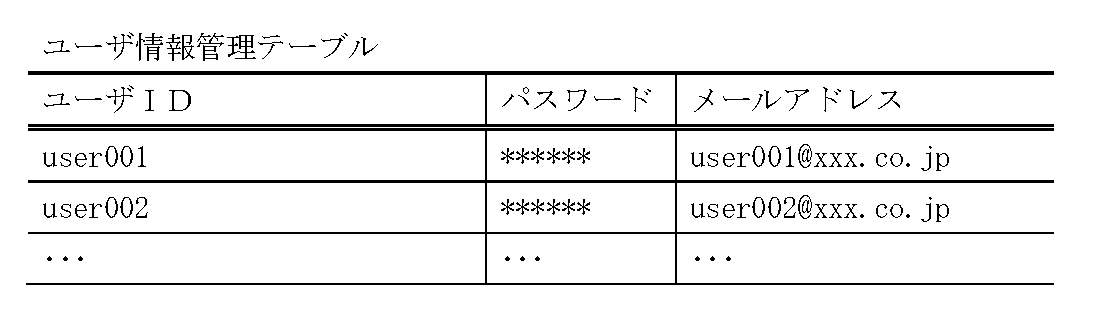
ユーザID列は、Webサービス341のユーザを一意に識別するためのユーザ識別子(ユーザID)である。パスワード列は、ユーザを認証するためのパスワードを格納する。このパスワードはレガシー認証で使用するパスワードであり、通常ハッシュ化されて格納されている。メールアドレス列は、ユーザのメールアドレスを格納する。メールアドレス以外にもユーザの住所、プロフィールなど、ユーザに関する属性情報をユーザ情報管理テーブルのテーブルに格納するようにしてもよい。
表3は、attestationチャレンジ管理テーブルであり、Webサービス341のユーザ情報格納部344が管理する。
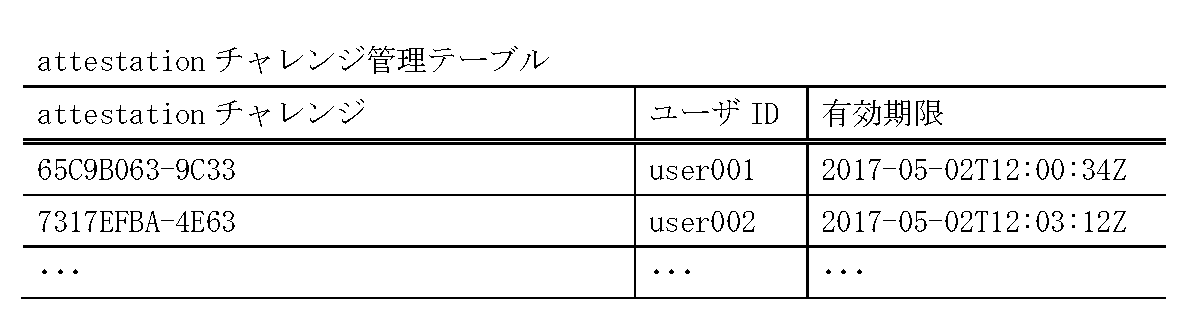
表3で示すattestationチャレンジ管理テーブルは、1つのレコードが1つのattestationチャレンジの情報を示している。attestationチャレンジは、ユーザのクレデンシャル登録の際に発行されるデータで、チャレンジレスポンス認証のための検証用データとして利用するパラメータである。attestationチャレンジの発行処理については後述する。attestationチャレンジ列は、attestationチャレンジを格納する。ユーザID列は、発行されたattestationチャレンジが紐づけられたユーザIDを表す。有効期限列は、attestationチャレンジの有効期限を表す。
表4は、オーセンティケータ情報管理テーブルであり、Webサービス341のオーセンティケータ情報格納部345が管理する。

表4で示すオーセンティケータ情報管理テーブルは、1つのレコードが1つのオーセンティケータ情報を示している。認証情報ID列は、認証情報管理テーブル(表1)における認証情報ID列の値が格納される。公開鍵列は、オーセンティケータからクレデンシャルとして登録要求された公開鍵の情報を管理する。この公開鍵は、認証情報IDに紐づく秘密鍵のペアとなる公開鍵となる。すなわち、同一認証情報IDで管理される鍵ペアでは、オーセンティケータ側の秘密鍵で暗号化したデータは、Webサービス341側のオーセンティケータ情報管理テーブルで管理される公開鍵で復号できるということになる。
ユーザID列は、Webサービス341を利用するユーザを一意に識別するためのユーザIDを格納する。通知能力列は、ウェアラブル端末101に通知制御部336が備わっているかどうか(本実施例に係る通知機能をサポートしているかどうか)を示す能力情報である。この情報は、本発明の特徴でもある通知判断時に用いられる情報である。
表5は、トークン管理テーブルであり、Webサービス341のトークン管理部347が管理する。
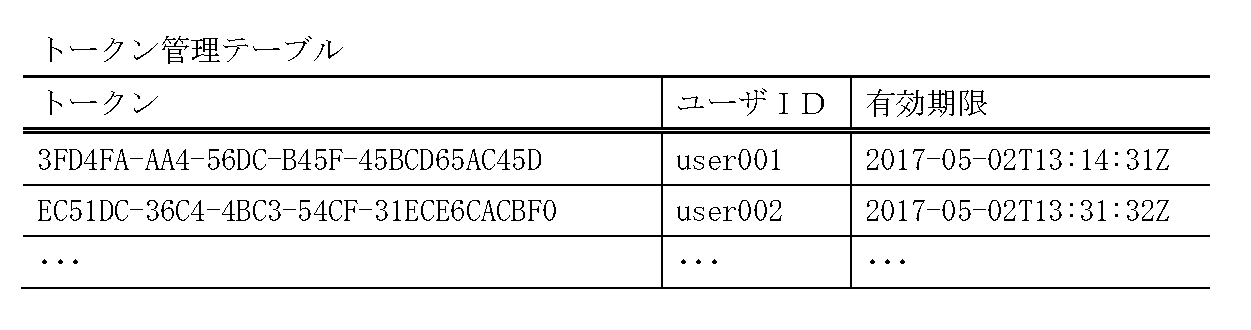
表5で管理されるトークンは、各種認証処理を終えた後に、Webサービス341のトークン管理部347が発行する。アプリケーション311は、Webサービス341を利用する際に、発行されたトークンを付与してリクエストを送信することで、Webサービス341が提供するサービスを利用することができる。
トークン管理テーブルは、1つのレコードが1つのトークンの情報を示している。トークン列は、トークンの情報を格納する。ユーザID列は、Webサービス341のユーザを一意に識別するためのユーザIDを格納する。有効期限列は、トークンの有効期限を示す。
Webサービス341は、リクエストに付与されたトークンが、トークン管理テーブルのトークン列に存在し、有効期限列の有効期限を過ぎていない場合に、リクエストを受け付ける。
<オーセンティケータ登録処理>
図4で示すオーセンティケータ登録処理について、図5A~D、図6A~Fも用いて説明する。図4で示す処理は、各装置で対応するプログラムを実行することで実現される処理ステップを示している。ここでは、ウェアラブル端末101のオーセンティケータ331が作成する情報を登録する例について説明する。以降、オーセンティケータ331が作成する情報をWebサービス341に登録することを、単にオーセンティケータ(認証器)の登録と呼ぶ。
図4で示すオーセンティケータ登録処理について、図5A~D、図6A~Fも用いて説明する。図4で示す処理は、各装置で対応するプログラムを実行することで実現される処理ステップを示している。ここでは、ウェアラブル端末101のオーセンティケータ331が作成する情報を登録する例について説明する。以降、オーセンティケータ331が作成する情報をWebサービス341に登録することを、単にオーセンティケータ(認証器)の登録と呼ぶ。
図5A~Dは、ウェアラブル端末101、クライアント端末102、サーバシステム103間での通信に含まれるパラメータの例を示す図である。図6A~Fは、オーセンティケータの登録処理中にアプリケーション311の表示部312で表示制御されるUIの例を示した図である。
まず、図6Aは、アプリケーション311が提供する認証設定画面であり、ユーザは、Webサービス341の利用時にレガシー認証(パスワード認証)以外の認証方法を利用したい場合にボタン611を押下する。なお、認証設定画面は、レガシー認証などでWebサービス341に対してユーザ401を認証済み場合に提供される。
S411では、アプリケーション311が、ユーザによるボタン611の選択に応じた登録指示を受け付ける。
S412では、アプリケーション311のオーセンティケータ登録制御部314が、通信部313を介して、Webサービス341に対してオーセンティケータ登録画面の要求を行う。
S413では、Webサービス341のオーセンティケータ情報処理部343が、登録パラメータ510の作成を行う。
ここで、図5Aを用いて登録パラメータ510について説明する。登録パラメータ510は、アカウント情報511、暗号化パラメータ512、attestationチャレンジ513、登録ポリシ514、拡張領域515から構成される。アカウント情報511は、Webサービス341における、認証時に特定したユーザIDと、そのユーザIDと紐付くメールアドレスなどの属性情報を表す。暗号化パラメータ512は、Webサービス341がサポートしている暗号化アルゴリズムなど、登録する認証情報に関する属性情報を示す。attestationチャレンジ513はチャレンジレスポンス認証をするために利用する検証用データとしてのパラメータである。attestationチャレンジは、S413の登録パラメータ作成時に作成して、attestationチャレンジ管理テーブル(表3)にユーザIDや有効期限などと紐付けて格納される。登録ポリシ514は、Webサービス341に登録できるオーセンティケータの種別を指定するためのオプションパラメータである。ポリシとは、例えば、認証器となるウェアラブル端末101がWebサービス341の指定する認証方法に対応しているか、特定の能力を有しているか、などである。拡張領域515は、Webサービス341がオーセンティケータ331やアプリケーション311の動作を制御するために、Webサービス341が指定可能な拡張パラメータが格納される。
S414で、Webサービス341のオーセンティケータ情報処理部343は、S412の要求に対するレスポンスとして、オーセンティケータ登録画面の情報をアプリケーション311に送信する。送信されるレスポンスには、登録パラメータ510も含まれている。
図6Bは、S414でのレスポンスに応じてアプリケーション311により、クライアント端末102のタッチパネル249に対して表示制御される登録画面の例である。ボタン621がユーザに操作されるとS415で検索処理を実行し、ボタン622が操作されると図6Aの画面に戻る。
図6Cは、S415~S416の処理が実行されている際に、タッチパネル249で表示される画面である。
S415で、オーセンティケータ登録制御部314は、クライアント端末102にオーセンティケータ(外部認証器)として利用できるデバイスが接続されているかを検索する。具体的には接続デバイスであるウェアラブル端末にオーセンティケータ情報を取得するためのリクエストを送信する。ウェアラブル端末でオーセンティケータのプログラムが実行されている場合には、このリクエストに応答することが可能である。本実施例では、オーセンティケータ登録制御部314がアプリケーション311の通信部313を介して、ウェアラブル端末101の通信部326に対してこのリクエストを送信することになる。
なお、リクエストされるオーセンティケータ情報には、オーセンティケータ情報管理テーブルで説明したオーセンティケータの通知能力も含まれている。
S416では、ウェアラブル端末101の通信部326を介してオーセンティケータ登録処理部332がリクエストを受信して、さらに、オーセンティケータ情報をアプリケーション311に応答する。
S417で、オーセンティケータ登録制御部314は、S416で取得したオーセンティケータ情報が、S414でのレスポンスに含まれる登録ポリシ514の条件を満たし、Webサービス341のオーセンティケータとして使用できるか否かを確認する。
図6Dは、S417の処理でWebサービス341のオーセンティケータとして使用できることが確認できた場合に、タッチパネル249に対して表示される画面である。ユーザによりボタン641が選択操作されると、S418を実行すると共に、図6Eで示す画面に遷移する。また、ボタン642が選択されると、図6Aの画面に戻る。
なお、図4のシーケンスには示していないが、固定の外部認証器を常に利用するなどユーザに登録確認を要求しない設定の場合には、図6Dの画面をスキップし、S418を実行してもよい。また、使用できるオーセンティケータが見つからない、外部認証器を利用しない設定などであった場合には、S417以降の処理を実行しないといった実装も可能である。
S418で、アプリケーション311のオーセンティケータ登録制御部314は通信部313を介して、ウェアラブル端末101に対してクレデンシャルの作成要求を行う。そして、このクレデンシャル作成要求はウェアラブル端末101の通信部326が受信し、オーセンティケータ登録処理部332に送信される。このS418のクレデンシャル作成要求には登録要求データ520を含める。
ここで図5Bを用いて、登録要求データ520について説明する。登録要求データ520は、Webサービス341から受信した登録パラメータ510と、認証情報管理テーブル(表1)で説明したWebサービス341のサービスID521と、WebOrigin522を含む。WebOrigin522はWebサービス341のオリジンを示す情報である。
S419で、オーセンティケータ登録処理部332は、ユーザの生体情報の取得処理を実行する。具体的には、内部的に生体情報センサ226に生体情報の読み取りを指示する。S420では、ウェアラブル端末101を装着するユーザ401の生体情報が、生体情報センサ226を介して検出される。本発明においては、ユーザ401はウェアラブル端末101を装着しているだけで、ウェアラブル端末101に対する操作なしに生体情報の検出が実行されることを想定している。
S421で、オーセンティケータ331のオーセンティケータ登録処理部332は読み取った生体情報の特徴量と生体情報を一意に識別する生体情報IDを作成する。S422で、オーセンティケータ331のオーセンティケータ登録処理部332は、秘密鍵と公開鍵のペアを作成し、認証情報IDを発行する。そして、オーセンティケータ登録処理部332は認証情報格納部334にS421、S422で作成した認証情報ID、秘密鍵、生体情報IDおよび登録要求データ520に含まれるサービスID521と登録パラメータ510に含まれるユーザIDを格納する。
S423で、オーセンティケータ331のオーセンティケータ登録処理部332は、図5Cで示すクレデンシャル530を作成する。クレデンシャル530は、認証情報ID531とアルゴリズム532と公開鍵533とattestation534とオーセンティケータ名535から構成される。
認証情報ID531、公開鍵533はS422の処理で作成した公開鍵である。アルゴリズム532はS422における秘密鍵と公開鍵のペアの作成に利用したアルゴリズムにそれぞれ対応する。また、attestation534はattestationチャレンジ513を、S422にて作成した秘密鍵を用いて暗号化したものである。
S424では、通知制御部336が、ウェアラブル端末101が備えるバイブレータ230やスピーカ231の少なくとも何れかを利用して、生体情報の入力が完了した旨をユーザ401に通知する。ユーザ401は、ウェアラブル端末101から伝わる振動や、特定の音で通知を認識できる。
なお、S424の処理で利用される通知手段は、ウェアラブル端末101の種類によって異なり、例えば、スマートウォッチであれば振動やベルトの締め付け、イヤホンであれば音、スマートリングであればライトを点滅させる等の方法を用いることができる。
また、ウェアラブル端末101が通知制御部329やバイブレータ230やスピーカ231などの装置を備えていない場合は、S424の処理をスキップし、後述するS429で、アプリケーション311が代替となり生体情報の入力が完了した旨をユーザ401に通知することも可能である。
S425で、オーセンティケータ331のオーセンティケータ登録処理部332は、クライアント端末102のアプリケーション311に対して、S423で作成したクレデンシャル530を応答する。
S426で、オーセンティケータ登録制御部314は、通信部313を介して、Webサービス341に対して、登録データ540を含む登録処理要求を送信する。
ここで、図5Dを用いて登録データ540について説明する。540は登録データであり、クレデンシャル530と能力情報541から構成される。クレデンシャル530はS423で作成したクレデンシャルである。能力情報541は、S415~S416で取得したウェアラブル端末101のオーセンティケータ情報である。
S427では、Webサービス341のオーセンティケータ情報処理部343は、S426の登録処理要求で受信した登録データ540を用いて、オーセンティケータの登録処理を行う。登録処理には、登録データ540のクレデンシャル530に含まれるattestation534を、同じクレデンシャル530に含まれる公開鍵533で復号することによる検証処理が含まれる。さらに、Webサービス341のオーセンティケータ情報処理部343は、attestation534を公開鍵533で復号した値と、attestationチャレンジ管理テーブル(表3)におけるattestationチャレンジ列の値とが同一のものを特定する。そして、特定したattestationチャレンジ列の値と同一のレコードのユーザIDをクレデンシャル530と紐付けるIDとして特定する。Webサービス341のオーセンティケータ情報処理部343は、クレデンシャル530に含まれる認証情報ID531、公開鍵533と、特定されたユーザIDと能力情報541を、オーセンティケータ情報管理テーブルに登録する。S428で、Webサービス341のオーセンティケータ情報処理部343は、通信部348を介して、アプリケーション311に対して正常にオーセンティケータの登録処理が完了した旨を応答する。
S429では、Webサービス341のオーセンティケータ登録制御部314がS415~S416で取得したウェアラブル端末101のオーセンティケータ情報に含まれている通知能力に応じて通知判断を行う。オーセンティケータ登録制御部314は、ウェアラブル端末101が通知能力“無”であると判断した場合に通知制御部316を呼び出し、S424のステップに代わり、ユーザ401に生体情報の入力および登録処理が完了した旨の通知を行う。
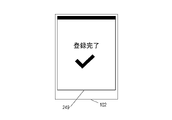
例えば、図6Fは、オーセンティケータ登録制御部314によりS429で示す処理が実行された際に表示される画面である。クライアント端末102がタッチパネル249やバイブレータ251のような出力装置を有する場合は、図6Fのような画面表示やクライアント端末102を振動させることで登録処理が完了したことが分かる通知を行う。
なお、クライアント端末102がスマートスピーカのように音声のみで入出力を行うデバイスの場合は、図6A~Fで示した表示内容を音声によって実現することになる。
<図6Dに関する処理の変形例>
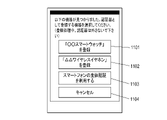
図11Aは、図6Dに示す画面の変形例を示している。具体的には、Webサービス341のオーセンティケータとして使用できる機器として複数のウェアラブル端末が見つかった場合の例である。図11Bは、さらに、複数のウェアラブル端末に加え、クライアント端末102自身が備える内部オーセンティケータがWebサービス341のオーセンティケータとして使用できる場合の例である。
図11Aは、図6Dに示す画面の変形例を示している。具体的には、Webサービス341のオーセンティケータとして使用できる機器として複数のウェアラブル端末が見つかった場合の例である。図11Bは、さらに、複数のウェアラブル端末に加え、クライアント端末102自身が備える内部オーセンティケータがWebサービス341のオーセンティケータとして使用できる場合の例である。
図11Aと図11Bでは、複数のウェアラブル端末として、「〇〇スマートウォッチ」と「△△ワイヤレスイヤホン」とを例示している。ユーザによってボタン1101、1102の何れかが選択された場合には、ボタンに対応するウェアラブル端末に対してクレデンシャルの作成要求を実行して、S418以降の処理が実行されることになる。
図11Aと図11Bで、キャンセルボタン1104が選択された場合には、図6Aの画面に戻る。
図11Bで、ボタン1103が選択操作された場合には、クライアント端末102に実装された内部オーセンティケータに対して、クレデンシャルの作成要求が実行される。その場合には、S419~S425までの処理が、クライアント端末102が有する生体情報センサを用いて取得された生体情報を用いて内部オーセンティケータにより実行されることになる。
<認証処理>
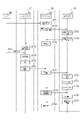
図7は、ユーザ401がアプリケーション311から、認証を必要とするWebサービス341を利用する際のシーケンスを示す図である。図7で示す処理は、各装置で対応するプログラムを実行することで実現される処理ステップを示している。
図7は、ユーザ401がアプリケーション311から、認証を必要とするWebサービス341を利用する際のシーケンスを示す図である。図7で示す処理は、各装置で対応するプログラムを実行することで実現される処理ステップを示している。
図8A~Cは、認証で使用するパラメータの例を示す図である。図9A~Dは、図7で示す処理に伴って、アプリケーション311の表示部312が表示制御する画面例を示している。
本実施例では、オーセンティケータの登録処理と同様に認証処理においても生体情報の入力後に、ユーザ401に完了を示す旨を通知する仕組みを提供する。ここでは、図7、図8A~C、図9A~Dを用いて、Webサービス341(Eコマースサイト)で、商品の購入手続きを行う際の認証処理の例を説明する。
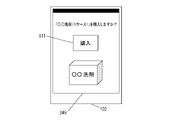
まず、図9Aは、Webサービス341のプレゼンテーション部346が提供するコンテンツをアプリケーション311の表示部312によって表示した際の画面である。
S711で、アプリケーション311は、ユーザ401によるボタン911への選択操作に応じた指示を受け付ける。S712では、アプリケーション311のオーセンティケータ認証制御部315がWebサービス341に対して商品購入に係るリクエストを送信する。
S713で、Webサービス341のオーセンティケータ情報処理部343は、利用者の認証のために、認証パラメータ810を作成する。S714で、Webサービス341のオーセンティケータ情報処理部343は、S713で作成した認証パラメータ810をアプリケーション311に対して送信する。
図8Aは、認証パラメータ810を示す。認証パラメータ810は、Assertionチャレンジ811、Assertion拡張領域812で構成される。Assertionチャレンジ811は、チャレンジレスポンス認証をするために利用する検証用データとしてのパラメータである。Assertion拡張領域812は、Webサービス341がオーセンティケータ331やアプリケーション311の動作を制御するために、Webサービス341が指定可能な拡張パラメータが格納される。今回、このAssertion拡張領域812に、S426で付与したオーセンティケータの能力情報541を含める。
S715で、アプリケーション311のオーセンティケータ認証制御部315は、オーセンティケータ331の生体認証処理部333に対して、認証要求パラメータを用いて認証要求を行う。このとき、表示部312により、図9Bに示す画面が表示される。
図8Bは、認証要求パラメータ820を示す。認証要求パラメータ820は、認証パラメータ810、サービスID821、WebOrigin822で構成される。サービスID821とWebOrigin822は図5Bで説明したものと同じである。
S716で、オーセンティケータ331の生体情報要求部335は、ユーザの生体情報の取得処理を実行する。ここでは、S419の処理と同様の処理が実行される。S717で、ウェアラブル端末101を装着するユーザ401の生体情報が、生体情報センサ226を介して検出される。本発明においては、ユーザ401はウェアラブル端末101を装着しているだけで、ウェアラブル端末101に対する操作なしに生体情報の検出が実行されることを想定している。
S718で、オーセンティケータ331の生体認証処理部333が、生体情報センサ226を介して検出した生体情報と、TPM227に格納された生体情報との照合を行い、ユーザ認証を行う。照合アルゴリズムとして、特徴点抽出法やパターンマッチング法などが一般的に知られているが、本発明において照合アルゴリズムは特に限定しない。その後、認証情報格納部334がTPM227に格納された生体情報をもとに認証情報管理テーブルから、対応する秘密鍵を特定する。そして、認証パラメータ810に含まれるattestationチャレンジ811と、特定した秘密鍵とから、署名(832)データを作成する。さらに、生体認証処理部333は、認証情報管理テーブル(表1)から特定した認証情報ID831と署名832を含んだアサーション情報830を作成する。
S719で、オーセンティケータ331の通知制御部336が通知を行う処理である。S718で生体認証が行われた結果を通知制御部336がバイブレータ230やスピーカ231などによりユーザ401に通知を行う。S719において、通知制御部336はS718の認証結果に応じて通知パターンを変えることができる。例えば、外部認証器として利用するウェアラブル端末101がイヤホンの場合、装着したまま自動で行われた認証に成功した場合は「認証に成功しました」等の音声を、失敗した場合は「認証に失敗しました」等の音声を流す制御を行う。また、S719において、オーセンティケータの登録時同様、ウェアラブル端末101が通知制御部329やバイブレータ230やスピーカ231などの装置を備えていないこともある。その場合は、同様にS719の通知処理をスキップし、後述するS728でアプリケーション311が代替となり生体情報の入力および認証が完了した旨をユーザ401に通知する。
S720で、オーセンティケータ331の生体認証処理部333は、S718で作成したアサーション情報830を、アプリケーション311に返却する。
S721で、アプリケーション311のオーセンティケータ認証制御部315は、生体認証処理部333から受け取ったアサーション情報830をWebサービス341に送信する。
S722では、Webサービス341のオーセンティケータ情報処理部343は、アプリケーション311から受け取ったアサーション情報830の検証を行う。オーセンティケータ情報処理部343はアサーション情報830の署名832を認証情報ID831で特定される公開鍵を用いて復号し、S713で作成した認証パラメータ810に含まれるattestationチャレンジ811と一致するか判定することで署名を検証する。公開鍵の特定にはオーセンティケータ情報管理テーブルを用いる。検証が成功した場合には、S723で、Webサービス341のトークン管理部347は、トークンを発行して、そのトークンに関する情報をトークン管理テーブルで管理する。S724で、Webサービス341のトークン管理部347が、S723で発行したトークンを、アプリケーション311に返却する。
S725で、オーセンティケータ認証制御部315は、S724で受信したトークンを用いて、商品購入のためのリクエストをWebサービス341に送信する。
S726で、トークン管理部347は、S725のリクエストに付与されたトークンを検証し、県庁が成功した場合に、リクエストに応じた購入処理を実行する。S727で、Webサービス341は、購入処理が完了した旨のレスポンスをアプリケーション311に返却する。
S728では、Webサービス341のオーセンティケータ認証制御部315が、S714で返却された認証パラメータ810のAssertion拡張領域812に含まれていた能力情報541をもとに認証結果を通知するかどうかを判断する。
オーセンティケータの登録時と同様に、オーセンティケータ認証制御部315はウェアラブル端末101が通知能力“無”であると判断した場合に、通知制御部316を呼び出す。そして、S719の処理に代わりユーザ401に認証処理およびS726の購入処理が完了した旨の通知を行う。
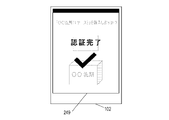
例えば、図9Cは、オーセンティケータ認証制御部315によりS728が実行された際に表示される画面である。S728での通知パターンもオーセンティケータの登録時同様、UI表示や音声、振動など、クライアント端末102が備える装置によって異なるため、特に限定しない。S728でオーセンティケータ認証制御部315が、ウェアラブル端末101の通知能力が“有”であると判断した場合は、図9Cのように認証が完了した旨の通知を行う必要は無く、図9Dの画面に遷移する。
以上、実施例1では、ウェアラブル端末101のオーセンティケータ331に通知制御部336を備えることで、生体情報を入力されオーセンティケータの登録・認証処理が実行されたことをユーザ401が気付けるように、通知を行った。また、ウェアラブル端末101が通知制御部336を備えない場合であってもクライアント端末102側の通知制御部316が代替としてユーザ401に通知する方法に関しても説明した。このシステムにより、認証のためにユーザによる操作を必要としないウェアラブル端末をオーセンティケータとして使用した場合でも、ユーザが生体情報を入力し、オーセンティケータの登録や認証処理が確かに実行されたということを、ユーザが適切なタイミングで把握することができる。
(実施例2)
実施例1では、オーセンティケータ331のオーセンティケータ登録処理部332と生体認証処理部333が、単にS423、S718の処理を終えた後に通知制御部336を呼び出すことでユーザ401に通知を行うように制御していた。しかし、ユーザ401が利用するWebサービス341の提供サービスによっては、通知の有無や通知パターンを制御したい場合がある。
実施例1では、オーセンティケータ331のオーセンティケータ登録処理部332と生体認証処理部333が、単にS423、S718の処理を終えた後に通知制御部336を呼び出すことでユーザ401に通知を行うように制御していた。しかし、ユーザ401が利用するWebサービス341の提供サービスによっては、通知の有無や通知パターンを制御したい場合がある。
例えば、サービスの利用中に頻繁に認証を要求されるようなシステムにおいて、その都度、認証が完了したことを通知されると煩わしいと感じるユーザもいる。また、同じ認証処理でも、Webサービス341上の操作に応じて通知パターンを変化させたい場合もある。
上記のケースを鑑み、オーセンティケータの登録時には登録パラメータ510の拡張領域515に、認証時には認証パラメータ810のAssertion拡張領域812に、それぞれ通知に関する制御情報を追加で格納するよう実装可能である。この制御情報は、ウェアラブル端末101の通知制御部336が解釈可能な情報であり、S424およびS719において、通知制御部336はこの制御情報の値に応じた通知の有無を判断する。より具体的には、制御情報の値が、通知が必要なことを示す場合にのみ通知するよう制御することができる。また、制御情報の値によって、通知パターン(メッセージの内容、LED点灯パターンなど)を変化させるように実装することも可能である。
なお、拡張領域515、Assertion拡張領域812に制御情報が含まれない場合に、実施例1に示す処理を行ってもよい。
本実施例による拡張により、Webサービス341側から、ウェアラブル端末101の通知の制御を行うことが可能となる。
(実施例3)
実施例1では、通知制御部336が、S424、S719など、ウェアラブル端末101での外部認証器としての生体認証が成功したタイミングで通知を行っていた。
実施例1では、通知制御部336が、S424、S719など、ウェアラブル端末101での外部認証器としての生体認証が成功したタイミングで通知を行っていた。
実施例3では、Webサービス341の処理が完了したことを以て、通知する方法について説明する。本実施例では、上述した実施例1、2との重複となる説明を避け、差分について詳細に説明する。
図10は、実施例1の認証時のシーケンスにおいて、通知タイミングを変えたシーケンス図である。差分としては、S719の通知処理が無い代わりに、S1029、S1030の処理が追加されている。
S728では、ウェアラブル端末101の通知能力の有無と、通知の要否と、が同時に確認される。ウェアラブル端末101での通知が必要と判断した場合、S1029で、オーセンティケータ認証制御部315はオーセンティケータ311に対して通知要求を行う。
S1030で、通知要求を受信したオーセンティケータ311の通知制御部336は、認証処理を含む一連の処理が完了したことを意図した通知制御を実行する。ここでの通知制御は、S719の通知処理と同じ処理でもよいし、処理完了を直接的に把握できるような通知であってもよい。
実施例1、2においては、S426やS721以降の処理でクライアント端末102とサーバシステム103との間の通信ができない場合などにおいては、図4、7に示すシーケンスは異常終了する。このとき、シーケンス全体が正常終了しなかったにも関わらず、S424、S719でウェアラブル端末101の通知制御部336はユーザ401に対して認証成功を通知してしまったことになり、購入処理に成功したとの誤解を与える懸念がある。
一方で、本実施例によれば、通知のタイミングがWebサービス341での処理が完了の後になるため、そのような誤解を解消できるかもしれない。
なお、本発明は、実施例1と実施例3を組み合わせることで、実施例1のS719と実施例3のS1030の両方のタイミングで異なる通知を行い、認証成功と処理完了を別々にユーザに通知することも可能である。
(他の実施例)
本発明は、上述した実施形態を適宜組み合わせることにより構成された装置あるいはシステムやその方法も含まれるものとする。
本発明は、上述した実施形態を適宜組み合わせることにより構成された装置あるいはシステムやその方法も含まれるものとする。
ここで、本発明は、上述した実施形態の機能を実現する1以上のソフトウェア(プログラム)を実行する主体となる装置あるいはシステムである。また、その装置あるいはシステムで実行される上述した実施形態を実現するための方法も本発明の一つである。また、そのプログラムは、ネットワーク又は各種記憶媒体を介してシステム或いは装置に供給され、そのシステム或いは装置の1以上のコンピュータ(CPUやMPU等)によりそのプログラムが1以上のメモリーに読み出され、実行される。つまり、本発明の一つとして、さらにそのプログラム自体、あるいは該プログラムを格納したコンピュータにより読み取り可能な各種記憶媒体も含むものとする。また、上述した実施形態の機能を実現する回路(例えば、ASIC)によっても、本発明は実現可能である。
本発明は上記実施の形態に制限されるものではなく、本発明の精神及び範囲から離脱することなく、様々な変更及び変形が可能である。従って、本発明の範囲を公にするために以下の請求項を添付する。
本願は、2021年1月22日提出の日本国特許出願特願2021-009130を基礎として優先権を主張するものであり、その記載内容の全てをここに援用する。
Claims (13)
- 情報処理装置に接続される外部認証器を用いた認証処理を制御できるアプリケーションを実行する情報処理装置であって、
ネットワークを介して通信するシステムに対してリクエストを送信する第1送信手段と、
検証用のデータを前記システムから受信する第1受信手段と、
前記検証用のデータを含む認証要求を外部認証器に送信する要求手段と、
前記外部認証器から、前記外部認証器が生成した署名データを受信する第2受信手段と、
前記署名データを前記システムに対して送信する第2送信手段と、
前記システムに登録済みの公開鍵を用いた前記署名データの検証処理の結果に基づくデータを受信する第3受信手段と、を有し、
前記外部認証器は、前記情報処理装置のユーザに装着され、
前記認証要求に応じた生体認証の結果、および、前記第3受信手段によるデータの受信に応じて前記情報処理装置から前記外部認証器に対して送信される要求、のすくなくとも何れかに応答して、前記外部認証器により前記ユーザに対して通知が行われることを特徴とする情報処理装置。 - さらに、前記認証要求に応じた生体認証の結果、および、前記第3受信手段によるデータの受信、のすくなくとも何れかに応答した、前記外部認証器を装着する前記ユーザのための表示を制御する制御手段を、有することを特徴とする請求項1に記載の情報処理装置。
- 前記制御手段は、前記外部認証器が前記通知のための機能をサポートしていない場合、前記表示の制御を行うことを特徴とする請求項2に記載の情報処理装置。
- 前記外部認証器による前記ユーザに対して通知は、前記認証要求に含まれる通知に関する制御情報に従い行われることを特徴とする請求項1乃至3の何れか1項に記載の情報処理装置。
- 前記外部認証器は、前記ユーザに装着されたままで生体認証が可能な、スマートウォッチ、イヤホン、およびスマートリングの何れかであることを特徴とする請求項1乃至4の何れか1項に記載の情報処理装置。
- 情報処理装置に接続される外部認証器を用いた認証処理を制御するための該情報処理装置における方法であって、
ネットワークを介して通信するシステムに対してリクエストを送信する第1送信工程と、
検証用のデータを前記システムから受信する第1受信工程と、
前記検証用のデータを含む認証要求を外部認証器に送信する要求工程と、
前記外部認証器から、前記外部認証器が生成した署名データを受信する第2受信工程と、
前記署名データを前記システムに対して送信する第2送信工程と、
前記システムに登録済みの公開鍵を用いた前記署名データの検証処理の結果に基づくデータを受信する第3受信工程と、を有し、
前記外部認証器は、前記情報処理装置のユーザに装着され、
前記認証要求に応じた生体認証の結果、および、前記第3受信工程でデータの受信に応じて前記情報処理装置から前記外部認証器に対して送信される要求、のすくなくとも何れかに応答して、前記外部認証器により前記ユーザに対して通知が行われることを特徴とする方法。 - 請求項1乃至5の何れか1項に記載の手段としてコンピュータを機能させるためのプログラム。
- 外部認証器を用いた認証処理を制御できるアプリケーションを実行する情報処理装置に対して外部認証器として接続でき、前記情報処理装置のユーザに装着される認証器であって、
前記情報処理装置から認証要求を受け付けたことに応じて、前記ユーザの生体情報を検出する検出手段と、
前記生体情報を用いた生体認証を実行する認証手段と、
前記生体認証が成功した場合に、前記認証要求に含まれる検証用のデータと前記生体情報に対応する秘密鍵を用いて、署名データを生成する生成手段と、
前記署名データを前記情報処理装置に送信する送信手段と、
通知手段と、を有し、
前記通知手段は、前記認証要求に応じた生体認証の結果、および、前記情報処理装置から前記外部認証器に対して送信される要求、のすくなくとも何れかに応答して、前記ユーザに対して通知を行うことを特徴とする認証器。 - 前記認証器による前記ユーザに対して通知は、前記認証要求に含まれる通知に関する制御情報に従い行われることを特徴とする請求項8に記載の認証器。
- 前記認証器は、前記ユーザに装着されたままで生体認証が可能な、スマートウォッチ、イヤホン、およびスマートリングの何れかであることを特徴とする請求項8または9に記載の認証器。
- 前記通知は、音、または振動による通知であることを特徴とする請求項8乃至10の何れか1項に記載の認証器。
- 外部認証器を用いた認証処理を制御できるアプリケーションを実行する情報処理装置に対して外部認証器として接続でき、前記情報処理装置のユーザに装着され、通知手段を備える認証器における方法であって、
前記情報処理装置から認証要求を受け付けたことに応じて、前記ユーザの生体情報を検出する検出工程と、
前記生体情報を用いた生体認証を実行する認証工程と、
前記生体認証が成功した場合に、前記認証要求に含まれる検証用のデータと前記生体情報に対応する秘密鍵を用いて、署名データを生成する生成工程と、
前記署名データを前記情報処理装置に送信する送信工程と、を有し、
前記通知手段は、前記認証要求に応じた生体認証の結果、および、前記情報処理装置から前記外部認証器に対して送信される要求、のすくなくとも何れかに応答して、前記ユーザに対して通知を行うことを特徴とする方法。 - 請求項8乃至11の何れか1項に記載の手段としてコンピュータを機能させるためのプログラム。
Priority Applications (2)
| Application Number | Priority Date | Filing Date | Title |
|---|---|---|---|
| CN202180091457.6A CN116868190A (zh) | 2021-01-22 | 2021-12-23 | 信息处理装置、认证器、及其方法和程序 |
| US18/356,709 US20230362158A1 (en) | 2021-01-22 | 2023-07-21 | Information processing apparatus, authenticator, method therefor, and storage medium |
Applications Claiming Priority (2)
| Application Number | Priority Date | Filing Date | Title |
|---|---|---|---|
| JP2021009130A JP2022113035A (ja) | 2021-01-22 | 2021-01-22 | 情報処理装置、認証器、それら方法およびプログラム |
| JP2021-009130 | 2021-01-22 |
Related Child Applications (1)
| Application Number | Title | Priority Date | Filing Date |
|---|---|---|---|
| US18/356,709 Continuation US20230362158A1 (en) | 2021-01-22 | 2023-07-21 | Information processing apparatus, authenticator, method therefor, and storage medium |
Publications (1)
| Publication Number | Publication Date |
|---|---|
| WO2022158241A1 true WO2022158241A1 (ja) | 2022-07-28 |
Family
ID=82548266
Family Applications (1)
| Application Number | Title | Priority Date | Filing Date |
|---|---|---|---|
| PCT/JP2021/047909 Ceased WO2022158241A1 (ja) | 2021-01-22 | 2021-12-23 | 情報処理装置、認証器、それら方法およびプログラム |
Country Status (4)
| Country | Link |
|---|---|
| US (1) | US20230362158A1 (ja) |
| JP (1) | JP2022113035A (ja) |
| CN (1) | CN116868190A (ja) |
| WO (1) | WO2022158241A1 (ja) |
Cited By (2)
| Publication number | Priority date | Publication date | Assignee | Title |
|---|---|---|---|---|
| WO2024195573A1 (ja) * | 2023-03-17 | 2024-09-26 | 日本電気株式会社 | 情報処理システム、情報処理方法、及び記録媒体 |
| WO2025205376A1 (ja) * | 2024-03-29 | 2025-10-02 | キヤノン株式会社 | 情報処理装置、認証端末、それらにおける方法、およびプログラム |
Families Citing this family (1)
| Publication number | Priority date | Publication date | Assignee | Title |
|---|---|---|---|---|
| JP7834631B2 (ja) * | 2022-11-21 | 2026-03-24 | 株式会社東芝 | 暗号鍵管理システム |
Citations (3)
| Publication number | Priority date | Publication date | Assignee | Title |
|---|---|---|---|---|
| JP2017050810A (ja) * | 2015-09-04 | 2017-03-09 | パナソニック インテレクチュアル プロパティ コーポレーション オブ アメリカPanasonic Intellectual Property Corporation of America | 制御方法、通信端末、通信システムおよびプログラム |
| JP2019101504A (ja) * | 2017-11-28 | 2019-06-24 | キヤノン株式会社 | システム、およびシステムにおける方法 |
| JP2019151997A (ja) * | 2018-03-01 | 2019-09-12 | 株式会社デンソー | ウェアラブルキーデバイス、及び電子キーシステム |
Family Cites Families (12)
| Publication number | Priority date | Publication date | Assignee | Title |
|---|---|---|---|---|
| JP2007149066A (ja) * | 2005-10-25 | 2007-06-14 | Toshiba Corp | 認証システム、装置及びプログラム |
| US7623659B2 (en) * | 2005-11-04 | 2009-11-24 | Cisco Technology, Inc. | Biometric non-repudiation network security systems and methods |
| US20130238488A1 (en) * | 2012-03-07 | 2013-09-12 | Clearxchange, Llc | System and method for transferring funds |
| US9098991B2 (en) * | 2013-01-15 | 2015-08-04 | Fitbit, Inc. | Portable monitoring devices and methods of operating the same |
| US20140279528A1 (en) * | 2013-03-15 | 2014-09-18 | Motorola Mobility Llc | Wearable Authentication Device |
| US9558336B2 (en) * | 2013-10-04 | 2017-01-31 | Salutron Inc. | Persistent authentication using sensors of a user-wearable device |
| US9684778B2 (en) * | 2013-12-28 | 2017-06-20 | Intel Corporation | Extending user authentication across a trust group of smart devices |
| US10187364B2 (en) * | 2015-02-27 | 2019-01-22 | Plantronics, Inc. | Wearable user device for use in a user authentication system |
| CN110417797B (zh) * | 2015-04-02 | 2021-07-30 | 创新先进技术有限公司 | 认证用户的方法及装置 |
| US10122719B1 (en) * | 2015-12-31 | 2018-11-06 | Wells Fargo Bank, N.A. | Wearable device-based user authentication |
| JP6621678B2 (ja) * | 2016-02-15 | 2019-12-18 | ルネサスエレクトロニクス株式会社 | 認証装置、認証システム及び認証方法 |
| JP6507115B2 (ja) * | 2016-03-22 | 2019-04-24 | 株式会社日立製作所 | 1:n生体認証・暗号・署名システム |
-
2021
- 2021-01-22 JP JP2021009130A patent/JP2022113035A/ja active Pending
- 2021-12-23 WO PCT/JP2021/047909 patent/WO2022158241A1/ja not_active Ceased
- 2021-12-23 CN CN202180091457.6A patent/CN116868190A/zh active Pending
-
2023
- 2023-07-21 US US18/356,709 patent/US20230362158A1/en active Pending
Patent Citations (3)
| Publication number | Priority date | Publication date | Assignee | Title |
|---|---|---|---|---|
| JP2017050810A (ja) * | 2015-09-04 | 2017-03-09 | パナソニック インテレクチュアル プロパティ コーポレーション オブ アメリカPanasonic Intellectual Property Corporation of America | 制御方法、通信端末、通信システムおよびプログラム |
| JP2019101504A (ja) * | 2017-11-28 | 2019-06-24 | キヤノン株式会社 | システム、およびシステムにおける方法 |
| JP2019151997A (ja) * | 2018-03-01 | 2019-09-12 | 株式会社デンソー | ウェアラブルキーデバイス、及び電子キーシステム |
Cited By (2)
| Publication number | Priority date | Publication date | Assignee | Title |
|---|---|---|---|---|
| WO2024195573A1 (ja) * | 2023-03-17 | 2024-09-26 | 日本電気株式会社 | 情報処理システム、情報処理方法、及び記録媒体 |
| WO2025205376A1 (ja) * | 2024-03-29 | 2025-10-02 | キヤノン株式会社 | 情報処理装置、認証端末、それらにおける方法、およびプログラム |
Also Published As
| Publication number | Publication date |
|---|---|
| JP2022113035A (ja) | 2022-08-03 |
| CN116868190A (zh) | 2023-10-10 |
| US20230362158A1 (en) | 2023-11-09 |
Similar Documents
| Publication | Publication Date | Title |
|---|---|---|
| JP6703151B2 (ja) | ブルートゥースインタフェースを備える認証装置 | |
| US20200280446A1 (en) | Service usage apparatus, method therefor, and non-transitory computer-readable storage medium | |
| US10268809B2 (en) | Multi-factor user authentication framework using asymmetric key | |
| US10348715B2 (en) | Computer-implemented systems and methods of device based, internet-centric, authentication | |
| US12132831B2 (en) | Method employed in user authentication system and information processing apparatus included in user authentication system | |
| US10021113B2 (en) | System and method for an integrity focused authentication service | |
| CN111079103B (zh) | 一种身份认证方法和设备 | |
| JP7066380B2 (ja) | システム、システムにおける方法、情報処理装置、情報処理装置における方法、およびプログラム | |
| US10853477B2 (en) | Information processing apparatus, control method, and storage medium | |
| WO2022158241A1 (ja) | 情報処理装置、認証器、それら方法およびプログラム | |
| JP2015130633A (ja) | 認証システム | |
| JPWO2019239591A1 (ja) | 認証システム、認証方法、アプリケーション提供装置、認証装置、及び認証用プログラム | |
| JP2019086937A (ja) | 画像処理装置、画像処理装置の制御方法、プログラム、システム、およびシステムの制御方法 | |
| WO2018108062A1 (zh) | 身份验证方法、装置及存储介质 | |
| US10389913B2 (en) | Information management control apparatus, image processing apparatus, and information management control system | |
| WO2017029708A1 (ja) | 個人認証システム | |
| JP2017021736A (ja) | 認証情報出力装置、認証情報出力プログラム、および認証システム | |
| KR20250025415A (ko) | 인증 모드 요청을 위해 구성된 구강내 스캐닝 디바이스 | |
| JP5793593B2 (ja) | ユーザ識別情報を安全に検証するためのネットワーク認証方法 | |
| TW201826119A (zh) | 資料輸出方法及系統 | |
| JP2016072930A (ja) | メンテナンス機能認証システム |
Legal Events
| Date | Code | Title | Description |
|---|---|---|---|
| 121 | Ep: the epo has been informed by wipo that ep was designated in this application |
Ref document number: 21921342 Country of ref document: EP Kind code of ref document: A1 |
|
| WWE | Wipo information: entry into national phase |
Ref document number: 202180091457.6 Country of ref document: CN |
|
| NENP | Non-entry into the national phase |
Ref country code: DE |
|
| 122 | Ep: pct application non-entry in european phase |
Ref document number: 21921342 Country of ref document: EP Kind code of ref document: A1 |