WO2022138648A1 - レジスト組成物及びレジストパターン形成方法 - Google Patents
レジスト組成物及びレジストパターン形成方法 Download PDFInfo
- Publication number
- WO2022138648A1 WO2022138648A1 PCT/JP2021/047337 JP2021047337W WO2022138648A1 WO 2022138648 A1 WO2022138648 A1 WO 2022138648A1 JP 2021047337 W JP2021047337 W JP 2021047337W WO 2022138648 A1 WO2022138648 A1 WO 2022138648A1
- Authority
- WO
- WIPO (PCT)
- Prior art keywords
- group
- component
- resist
- preferable
- mass
- Prior art date
- Legal status (The legal status is an assumption and is not a legal conclusion. Google has not performed a legal analysis and makes no representation as to the accuracy of the status listed.)
- Ceased
Links
Classifications
-
- G—PHYSICS
- G03—PHOTOGRAPHY; CINEMATOGRAPHY; ANALOGOUS TECHNIQUES USING WAVES OTHER THAN OPTICAL WAVES; ELECTROGRAPHY; HOLOGRAPHY
- G03F—PHOTOMECHANICAL PRODUCTION OF TEXTURED OR PATTERNED SURFACES, e.g. FOR PRINTING, FOR PROCESSING OF SEMICONDUCTOR DEVICES; MATERIALS THEREFOR; ORIGINALS THEREFOR; APPARATUS SPECIALLY ADAPTED THEREFOR
- G03F7/00—Photomechanical, e.g. photolithographic, production of textured or patterned surfaces, e.g. printing surfaces; Materials therefor, e.g. comprising photoresists; Apparatus specially adapted therefor
- G03F7/004—Photosensitive materials
- G03F7/038—Macromolecular compounds which are rendered insoluble or differentially wettable
-
- G—PHYSICS
- G03—PHOTOGRAPHY; CINEMATOGRAPHY; ANALOGOUS TECHNIQUES USING WAVES OTHER THAN OPTICAL WAVES; ELECTROGRAPHY; HOLOGRAPHY
- G03F—PHOTOMECHANICAL PRODUCTION OF TEXTURED OR PATTERNED SURFACES, e.g. FOR PRINTING, FOR PROCESSING OF SEMICONDUCTOR DEVICES; MATERIALS THEREFOR; ORIGINALS THEREFOR; APPARATUS SPECIALLY ADAPTED THEREFOR
- G03F7/00—Photomechanical, e.g. photolithographic, production of textured or patterned surfaces, e.g. printing surfaces; Materials therefor, e.g. comprising photoresists; Apparatus specially adapted therefor
- G03F7/004—Photosensitive materials
-
- G—PHYSICS
- G03—PHOTOGRAPHY; CINEMATOGRAPHY; ANALOGOUS TECHNIQUES USING WAVES OTHER THAN OPTICAL WAVES; ELECTROGRAPHY; HOLOGRAPHY
- G03F—PHOTOMECHANICAL PRODUCTION OF TEXTURED OR PATTERNED SURFACES, e.g. FOR PRINTING, FOR PROCESSING OF SEMICONDUCTOR DEVICES; MATERIALS THEREFOR; ORIGINALS THEREFOR; APPARATUS SPECIALLY ADAPTED THEREFOR
- G03F7/00—Photomechanical, e.g. photolithographic, production of textured or patterned surfaces, e.g. printing surfaces; Materials therefor, e.g. comprising photoresists; Apparatus specially adapted therefor
- G03F7/004—Photosensitive materials
- G03F7/039—Macromolecular compounds which are photodegradable, e.g. positive electron resists
-
- G—PHYSICS
- G03—PHOTOGRAPHY; CINEMATOGRAPHY; ANALOGOUS TECHNIQUES USING WAVES OTHER THAN OPTICAL WAVES; ELECTROGRAPHY; HOLOGRAPHY
- G03F—PHOTOMECHANICAL PRODUCTION OF TEXTURED OR PATTERNED SURFACES, e.g. FOR PRINTING, FOR PROCESSING OF SEMICONDUCTOR DEVICES; MATERIALS THEREFOR; ORIGINALS THEREFOR; APPARATUS SPECIALLY ADAPTED THEREFOR
- G03F7/00—Photomechanical, e.g. photolithographic, production of textured or patterned surfaces, e.g. printing surfaces; Materials therefor, e.g. comprising photoresists; Apparatus specially adapted therefor
- G03F7/20—Exposure; Apparatus therefor
Definitions
- the present invention relates to a resist composition and a resist pattern forming method.
- This application claims priority based on Japanese Patent Application No. 2020-21169 filed in Japan on December 21, 2020, the contents of which are incorporated herein by reference.
- the resist material is required to have lithography characteristics such as sensitivity to these exposure light sources and resolution capable of reproducing fine dimensional patterns.
- a chemically amplified resist composition containing a base material component whose solubility in a developing solution is changed by the action of an acid and an acid generator component that generates an acid by exposure. Is used.
- the resist material is required to have lithography characteristics such as sensitivity to these exposure light sources and resolution capable of reproducing fine dimensional patterns.
- a chemically amplified resist composition containing a base material component whose solubility in a developing solution is changed by the action of an acid and an acid generator component that generates an acid by exposure.
- the positive chemically amplified resist composition includes a resin component (base resin) whose solubility in an alkaline developer is increased by the action of an acid and acid generation.
- base resin base resin
- Those containing an agent component are generally used.
- a chemically amplified resist conventionally containing a base component (alkali-soluble base component) soluble in an alkaline developer, an acid generator component that generates an acid by exposure, and a cross-linking agent component.
- Compositions have also been used.
- the acid acts to cause cross-linking between the alkali-soluble substrate component and the cross-linking agent component, and as a result, the result is Solubility in alkaline developer is reduced.
- Patent Document 1 describes a negative chemically amplified resist composition containing an alkali-soluble polyhydroxystyrene resin, an acid crosslinkable substance, a specific photoacid generator, and a dissolution accelerator.
- a micron-order thick resist film was formed using a resist composition using an alkali-soluble polyhydroxystyrene resin as a base material component, a resist pattern was formed, and wet etching was performed. In some cases, the wet etching resistance was insufficient. On the other hand, when a resist composition using a novolak resin as a base material component is used to form a micron-order thick resist film to form a resist pattern, the resolution may be insufficient.
- the present invention has been made in view of the above circumstances, and provides a resist composition capable of forming a resist pattern having good resolution and wet etching resistance, and a resist pattern forming method using the resist composition. That is the issue.
- the first aspect of the present invention is a polymer compound (A1) having a structural unit (a10) represented by the following general formula (a10-1), an acid generator (B), and a melamine-based cross-linking agent. , At least one cross-linking agent (C) selected from the group consisting of a urea-based cross-linking agent, an alkylene urea-based cross-linking agent, a glycoluril-based cross-linking agent, and an epoxy-based cross-linking agent, and a polyether compound (Z).
- the resist composition has a content of the polyether compound (Z) of less than 50 parts by mass with respect to 100 parts by mass of the polymer compound (A1).
- R is a hydrogen atom, an alkyl group having 1 to 5 carbon atoms or an alkyl halide group having 1 to 5 carbon atoms.
- Ya x1 is a single bond or divalent linking group.
- Wa x1 is an aromatic hydrocarbon group which may have a substituent.
- n ax1 is an integer of 1 or more.
- a second aspect of the present invention is a step of forming a resist film on a support using the resist composition according to the first aspect, a step of exposing the resist film, and a step of exposing the resist film after exposure. It is a resist pattern forming method including a step of developing and forming a resist pattern.
- the present invention it is possible to provide a resist composition capable of forming a resist pattern having good resolution and wet etching resistance, and a resist pattern forming method using the resist composition.
- aliphatic is defined as a relative concept to aromatics, meaning groups, compounds, etc. that do not have aromaticity.
- the "alkyl group” shall include linear, branched and cyclic monovalent saturated hydrocarbon groups. The same applies to the alkyl group in the alkoxy group.
- the "alkylene group” includes linear, branched and cyclic divalent saturated hydrocarbon groups. Examples of the "halogen atom” include a fluorine atom, a chlorine atom, a bromine atom and an iodine atom.
- the "constituent unit” means a monomer unit (monomer unit) constituting a polymer compound (resin, polymer, copolymer).
- a polymer compound resin, polymer, copolymer.
- the hydrogen atom (-H) is replaced with a monovalent group
- the methylene group ( -CH2- ) is replaced with a divalent group. Including both.
- "Exposure” is a concept that includes general irradiation of radiation.
- an “acid-degradable group” is a group having an acid-degradable property in which at least a part of the bonds in the structure of the acid-degradable group can be cleaved by the action of an acid.
- Examples of the acid-degradable group whose polarity is increased by the action of an acid include a group which is decomposed by the action of an acid to form a polar group.
- Examples of the polar group include a carboxy group, a hydroxyl group, an amino group, a sulfo group (-SO 3H ) and the like.
- the acid-degradable group includes a group in which the polar group is protected by an acid-dissociable group (for example, a group in which a hydrogen atom of an OH-containing polar group is protected by an acid-dissociable group).
- the "acid dissociative group” is (i) a group having acid dissociation that allows the bond between the acid dissociative group and an atom adjacent to the acid dissociative group to be cleaved by the action of an acid, or a group having acid dissociation. (Ii) A group capable of cleaving the bond between the acid dissociative group and an atom adjacent to the acid dissociative group by further decarbonation reaction after the partial bond is cleaved by the action of the acid. , Both.
- the acid dissociative group constituting the acid-degradable group needs to be a group having a lower polarity than the polar group produced by the dissociation of the acid dissociative group, whereby the acid dissociative group is affected by the action of the acid.
- the “base component” is an organic compound having a film-forming ability.
- Organic compounds used as base material components are roughly classified into non-polymers and polymers.
- the non-polymer one having a molecular weight of 500 or more and less than 4000 is usually used.
- small molecule compound means a non-polymer having a molecular weight of 500 or more and less than 4000.
- the polymer a polymer having a molecular weight of 1000 or more is usually used.
- the term "resin”, “polymer compound” or “polymer” means a polymer having a molecular weight of 1000 or more.
- the molecular weight of the polymer the mass average molecular weight in terms of polystyrene by GPC (gel permeation chromatography) shall be used.
- the "derived structural unit” means a structural unit composed of cleaved multiple bonds between carbon atoms, for example, an ethylenic double bond.
- a hydrogen atom bonded to a carbon atom at the ⁇ -position may be substituted with a substituent.
- the substituent (R ⁇ x ) that replaces the hydrogen atom bonded to the carbon atom at the ⁇ -position is an atom or group other than the hydrogen atom.
- an itaconic acid diester in which the substituent (R ⁇ x ) is substituted with a substituent containing an ester bond
- an ⁇ -hydroxyacrylic ester in which the substituent (R ⁇ x ) is substituted with a hydroxyalkyl group or a group modified with a hydroxyl group thereof
- the carbon atom at the ⁇ -position of the acrylic acid ester is a carbon atom to which the carbonyl group of acrylic acid is bonded, unless otherwise specified.
- an acrylic acid ester in which a hydrogen atom bonded to a carbon atom at the ⁇ -position is substituted with a substituent may be referred to as an ⁇ -substituted acrylic acid ester.
- the term "derivative" is a concept including a hydrogen atom at the ⁇ -position of the target compound substituted with another substituent such as an alkyl group or an alkyl halide group, and derivatives thereof.
- the hydrogen atom at the ⁇ -position may be substituted with a substituent.
- the hydrogen atom of the hydroxyl group of the target compound is substituted with an organic group; even if the hydrogen atom at the ⁇ -position is substituted with a substituent.
- Examples of a good target compound include those to which a substituent other than a hydroxyl group is bonded.
- the ⁇ -position refers to the first carbon atom adjacent to the functional group unless otherwise specified.
- Examples of the substituent that replaces the hydrogen atom at the ⁇ -position of hydroxystyrene include those similar to R ⁇ x .
- an asymmetric carbon may be present, and an enantiomer or a diastereomer may be present. In that case, those isomers are represented by one chemical formula. These isomers may be used alone or as a mixture.
- the resist composition according to the first aspect of the present invention is referred to as a polymer compound (A1) having a structural unit (a10) represented by the general formula (a10-1) (hereinafter, also referred to as “component (A1)”).
- component (A1) a structural unit represented by the general formula (a10-1)
- Acid generator (B) hereinafter also referred to as “component (B)”
- melamine-based cross-linking agent melamine-based cross-linking agent
- urea-based cross-linking agent alkylene urea-based cross-linking agent
- glycoluril-based cross-linking agent glycoluril-based cross-linking agent
- epoxy-based cross-linking agent It contains at least one cross-linking agent (C) (hereinafter, also referred to as “component (C)”) selected from the above, and a polyether compound (Z).
- the content of the component (Z) is less than 50 parts by mass with respect to 100 parts by mass of the component (A1).
- a thick-film resist film for example, a film thickness of 1 ⁇ m or more
- a resist composition in which a resist film exposed portion is melted and removed to form a positive resist pattern is referred to as a positive resist composition, and a resist film unexposed portion is melted and removed to form a negative resist pattern.
- the resist composition to be used is called a negative resist composition.
- the resist composition of this embodiment may be a positive resist composition or a negative resist composition.
- the resist composition of the present embodiment may be used for an alkaline developing process in which an alkaline developing solution is used for the developing process at the time of forming a resist pattern, or a developing solution (organic developing solution) containing an organic solvent in the developing process. ) May be used for a solvent developing process.
- the component (A) is a base material component whose solubility in a developing solution changes due to the action of an acid.
- the "base material component” is an organic compound having a film-forming ability, and an organic compound having a molecular weight of 500 or more is preferably used. When the molecular weight of the organic compound is 500 or more, the film forming ability is improved, and in addition, it becomes easy to form a nano-level resist pattern.
- Organic compounds used as base material components are roughly classified into non-polymers and polymers. As the non-polymer, one having a molecular weight of 500 or more and less than 4000 is usually used.
- small molecule compound means a non-polymer having a molecular weight of 500 or more and less than 4000.
- a polymer having a molecular weight of 1000 or more is usually used.
- the term "resin”, “polymer compound” or “polymer” means a polymer having a molecular weight of 1000 or more.
- a polystyrene-equivalent weight average molecular weight by GPC gel permeation chromatography
- the polymer compound (A1) having the structural unit (a10) represented by the general formula (a0-1) is used as the component (A), and further, the (A1) is used.
- High molecular weight compounds and / or low molecular weight compounds other than the components may be used in combination.
- the resist composition is (B) in the exposed portion of the resist film.
- an acid is generated from the component (B), and the action of the acid causes cross-linking between the components (A1) via the structural unit (a10) having a cross-linking property, and as a result, the result is The solubility of the resist film exposed portion in the alkaline developing solution is reduced. Therefore, in the formation of the resist pattern, when the resist film obtained by applying the resist composition of the present embodiment is selectively exposed on the support, the resist film exposed portion becomes sparingly soluble in the alkaline developing solution. Since the unexposed portion of the resist film remains soluble in the alkaline developing solution and does not change, a negative resist pattern is formed by developing with the alkaline developing solution.
- the component (A1) is a polymer compound having a structural unit (a10) represented by the general formula (a10-1).
- a copolymer having a structural unit (a11) containing an aromatic ring (excluding the aromatic ring to which a hydroxy group is bonded) in the side chain is preferable in addition to the structural unit (a10).
- the component (A1) may have other structural units other than the structural unit (a10) and the structural unit (a11).
- the structural unit (a10) is a structural unit represented by the following general formula (a10-1).
- R is a hydrogen atom, an alkyl group having 1 to 5 carbon atoms or an alkyl halide group having 1 to 5 carbon atoms.
- Ya x1 is a single bond or divalent linking group.
- Wa x1 is an aromatic hydrocarbon group which may have a substituent.
- n ax1 is an integer of 1 or more.
- R is a hydrogen atom, an alkyl group having 1 to 5 carbon atoms or an alkyl halide group having 1 to 5 carbon atoms.
- Ya x1 is a single bond or divalent linking group.
- Wa x1 is an aromatic hydrocarbon group which may have a substituent.
- n ax1 is an integer of 1 or more.
- R is a hydrogen atom, an alkyl group having 1 to 5 carbon atoms, or an alkyl halide group having 1 to 5 carbon atoms.
- the alkyl group having 1 to 5 carbon atoms in R is preferably a linear or branched alkyl group having 1 to 5 carbon atoms, and specifically, a methyl group, an ethyl group, a propyl group, an isopropyl group, or n-. Examples thereof include a butyl group, an isobutyl group, a tert-butyl group, a pentyl group, an isopentyl group, and a neopentyl group.
- the halogenated alkyl group having 1 to 5 carbon atoms in R is a group in which a part or all of the hydrogen atoms of the alkyl group having 1 to 5 carbon atoms are substituted with a halogen atom.
- a fluorine atom is particularly preferable.
- R a hydrogen atom, an alkyl group having 1 to 5 carbon atoms or a fluorinated alkyl group having 1 to 5 carbon atoms is preferable, and a hydrogen atom, a methyl group or a trifluoromethyl group is more preferable because of easy industrial availability.
- a hydrogen atom or a methyl group is more preferable, and a hydrogen atom is particularly preferable.
- Ya x1 is a single bond or a divalent linking group.
- the divalent linking group in Ya x1 is not particularly limited, but a divalent hydrocarbon group which may have a substituent, a divalent linking group containing a heteroatom and the like are suitable. Is mentioned as.
- a divalent hydrocarbon group that may have a substituent When Ya x1 is a divalent hydrocarbon group which may have a substituent, the hydrocarbon group may be an aliphatic hydrocarbon group or an aromatic hydrocarbon group.
- the aliphatic hydrocarbon group in Ya x1 means a hydrocarbon group having no aromaticity.
- the aliphatic hydrocarbon group may be saturated or unsaturated, and is usually preferably saturated.
- Examples of the aliphatic hydrocarbon group include a linear or branched aliphatic hydrocarbon group, an aliphatic hydrocarbon group containing a ring in the structure, and the like.
- linear or branched aliphatic hydrocarbon group The linear aliphatic hydrocarbon group preferably has 1 to 10 carbon atoms, more preferably 1 to 6 carbon atoms, and carbon. The number 1 to 4 is more preferable, and the number of carbons 1 to 3 is most preferable.
- a linear alkylene group is preferable, and specifically, a methylene group [-CH 2- ], an ethylene group [-(CH 2 ) 2- ], a trimethylene group [ -(CH 2 ) 3- ], tetramethylene group [-(CH 2 ) 4- ], pentamethylene group [-(CH 2 ) 5- ] and the like can be mentioned.
- the branched aliphatic hydrocarbon group preferably has 2 to 10 carbon atoms, more preferably 3 to 6 carbon atoms, further preferably 3 or 4 carbon atoms, and most preferably 3 carbon atoms.
- a branched alkylene group is preferable, and specifically, -CH (CH 3 )-, -CH (CH 2 CH 3 )-, and -C (CH 3 ).
- Alkyl methylene groups ;- CH (CH 3 ) CH 2- , -CH (CH 3 ) CH (CH 3 )-, -C (CH 3 ) 2 CH 2- , -CH (CH 2 CH 3 ) CH 2- , -C (CH 2 ) CH 3 ) 2 -CH 2 -etc.
- Alkylethylene groups -CH (CH 3 ) CH 2 CH 2- , -CH 2 CH (CH 3 ) CH 2 -etc.
- alkyl group in the alkylalkylene group a linear alkyl group having 1 to 5 carbon atoms is preferable.
- the linear or branched aliphatic hydrocarbon group may or may not have a substituent.
- substituents include a fluorine atom, a fluorinated alkyl group having 1 to 5 carbon atoms substituted with a fluorine atom, a carbonyl group and the like.
- a cyclic aliphatic hydrocarbon group may contain a substituent containing a hetero atom in the ring structure.
- a group obtained by removing two hydrogen atoms from an aliphatic hydrocarbon ring a group in which the cyclic aliphatic hydrocarbon group is bonded to the end of a linear or branched aliphatic hydrocarbon group, the cyclic fat. Examples thereof include a group in which a group hydrocarbon group is interposed in the middle of a linear or branched aliphatic hydrocarbon group.
- the linear or branched aliphatic hydrocarbon group examples include the same groups as described above.
- the cyclic aliphatic hydrocarbon group preferably has 3 to 20 carbon atoms, and more preferably 3 to 12 carbon atoms.
- the cyclic aliphatic hydrocarbon group may be a polycyclic group or a monocyclic group.
- As the monocyclic alicyclic hydrocarbon group a group obtained by removing two hydrogen atoms from a monocycloalkane is preferable.
- the monocycloalkane preferably has 3 to 6 carbon atoms, and specific examples thereof include cyclopentane and cyclohexane.
- the polycyclic alicyclic hydrocarbon group is preferably a group obtained by removing two hydrogen atoms from a polycycloalkane, and the polycycloalkane is preferably one having 7 to 12 carbon atoms, specifically. Examples thereof include adamantane, norbornane, isobornane, tricyclodecane, tetracyclododecane and the like.
- the cyclic aliphatic hydrocarbon group may or may not have a substituent.
- substituents include an alkyl group, an alkoxy group, a halogen atom, an alkyl halide group, a hydroxyl group, a carbonyl group and the like.
- alkyl group an alkyl group having 1 to 5 carbon atoms is preferable, and a methyl group, an ethyl group, a propyl group, an n-butyl group and a tert-butyl group are more preferable.
- an alkoxy group having 1 to 5 carbon atoms is preferable, and a methoxy group, an ethoxy group, an n-propoxy group, an iso-propoxy group, an n-butoxy group and a tert-butoxy group are more preferable.
- a methoxy group and an ethoxy group are more preferable.
- the halogen atom as the substituent a fluorine atom is preferable.
- the halogenated alkyl group as the substituent include a group in which a part or all of the hydrogen atom of the alkyl group is substituted with the halogen atom.
- the cyclic aliphatic hydrocarbon group may be substituted with a substituent containing a hetero atom as a part of the carbon atom constituting the ring structure.
- the aromatic hydrocarbon group is a hydrocarbon group having at least one aromatic ring.
- the aromatic ring is not particularly limited as long as it is a cyclic conjugated system having 4n + 2 ⁇ electrons, and may be a monocyclic type or a polycyclic type.
- the aromatic ring preferably has 5 to 30 carbon atoms, more preferably 5 to 20 carbon atoms, further preferably 6 to 15 carbon atoms, and particularly preferably 6 to 12 carbon atoms. However, the carbon number does not include the carbon number in the substituent.
- aromatic ring examples include aromatic hydrocarbon rings such as benzene, naphthalene, anthracene, and phenanthrene; aromatic heterocycles in which some of the carbon atoms constituting the aromatic hydrocarbon ring are substituted with heteroatoms.
- hetero atom in the aromatic heterocycle examples include an oxygen atom, a sulfur atom, a nitrogen atom and the like.
- aromatic heterocycle examples include a pyridine ring and a thiophene ring.
- the aromatic hydrocarbon group is a group obtained by removing two hydrogen atoms from the aromatic hydrocarbon ring or aromatic heterocycle (arylene group or heteroarylene group); an aromatic compound containing two or more aromatic rings.
- a group from which two hydrogen atoms have been removed from for example, biphenyl, fluorene, etc.
- one of the hydrogen atoms of the group (aryl group or heteroaryl group) from which one hydrogen atom has been removed from the aromatic hydrocarbon ring or aromatic heterocyclic ring Hydrogen from an aryl group in an arylalkyl group such as a group substituted with an alkylene group (for example, a benzyl group, a phenethyl group, a 1-naphthylmethyl group, a 2-naphthylmethyl group, a 1-naphthylethyl group, a 2-naphthylethyl group).
- the alkylene group bonded to the aryl group or the heteroaryl group preferably has 1 to 4 carbon atoms, more preferably 1 to 2 carbon atoms, and particularly preferably 1 carbon atom.
- the hydrogen atom of the aromatic hydrocarbon group may be substituted with a substituent.
- the hydrogen atom bonded to the aromatic ring in the aromatic hydrocarbon group may be substituted with a substituent.
- the substituent include an alkyl group, an alkoxy group, a halogen atom, an alkyl halide group, a hydroxyl group and the like.
- the alkyl group as the substituent an alkyl group having 1 to 5 carbon atoms is preferable, and a methyl group, an ethyl group, a propyl group, an n-butyl group and a tert-butyl group are more preferable.
- the alkoxy group, the halogen atom and the alkyl halide group as the substituent include those exemplified as the substituent for substituting the hydrogen atom of the cyclic aliphatic hydrocarbon group.
- the H may be substituted with a substituent such as an alkyl group or an acyl.
- the substituent alkyl group, acyl group, etc. preferably has 1 to 10 carbon atoms, more preferably 1 to 8 carbon atoms, and particularly preferably 1 to 5 carbon atoms.
- Y 21 and Y 22 are divalent hydrocarbon groups which may independently have a substituent.
- the divalent hydrocarbon group is described as a divalent linking group in Ya x1 . The same as those mentioned in (divalent hydrocarbon group which may have a substituent) can be mentioned.
- a linear aliphatic hydrocarbon group is preferable, a linear alkylene group is more preferable, a linear alkylene group having 1 to 5 carbon atoms is further preferable, and a methylene group or an ethylene group is particularly preferable.
- a linear or branched aliphatic hydrocarbon group is preferable, and a methylene group, an ethylene group or an alkyl methylene group is more preferable.
- the alkyl group in the alkylmethylene group is preferably a linear alkyl group having 1 to 5 carbon atoms, more preferably a linear alkyl group having 1 to 3 carbon atoms, and most preferably a methyl group.
- b' is an integer of 1 to 10 and 1 to 8. Is preferred, an integer of 1 to 5 is more preferred, 1 or 2 is even more preferred, and 1 is most preferred.
- Wa x1 is an aromatic hydrocarbon group which may have a substituent.
- the aromatic hydrocarbon group in Wa x1 include a group obtained by removing (n ax1 + 1) hydrogen atoms from an aromatic ring which may have a substituent.
- the aromatic ring here is not particularly limited as long as it is a cyclic conjugated system having 4n + 2 ⁇ electrons, and may be a monocyclic type or a polycyclic type.
- the aromatic ring preferably has 5 to 30 carbon atoms, more preferably 5 to 20 carbon atoms, further preferably 6 to 15 carbon atoms, and particularly preferably 6 to 12 carbon atoms.
- the aromatic ring is an aromatic hydrocarbon ring such as benzene, naphthalene, anthracene, or phenanthrene; an aromatic heterocycle in which a part of carbon atoms constituting the aromatic hydrocarbon ring is substituted with a hetero atom or the like.
- the hetero atom in the aromatic heterocycle include an oxygen atom, a sulfur atom, a nitrogen atom and the like.
- Specific examples of the aromatic heterocycle include a pyridine ring and a thiophene ring.
- Wa x1 is preferably a group obtained by removing (n ax1 + 1) hydrogen atoms from benzene, naphthalene, anthracene or biphenyl, and a group obtained by removing (n ax1 + 1) hydrogen atoms from benzene or naphthalene. Is more preferable, and a group obtained by removing (n ax1 + 1) hydrogen atoms from benzene is even more preferable.
- the aromatic hydrocarbon group in Wa x1 may or may not have a substituent.
- the substituent include an alkyl group, an alkoxy group, a halogen atom, an alkyl halide group and the like.
- the alkyl group, alkoxy group, halogen atom, and alkyl halide group as the substituent include those similar to those mentioned as the substituent of the cyclic aliphatic hydrocarbon group in Ya x1 .
- the substituent is preferably a linear or branched alkyl group having 1 to 5 carbon atoms, more preferably a linear or branched alkyl group having 1 to 3 carbon atoms, and an ethyl group or a methyl group. Further preferred, a methyl group is particularly preferred.
- the aromatic hydrocarbon group in Wa x1 preferably has no substituent.
- n ax1 is an integer of 1 or more, preferably an integer of 1 to 10, more preferably an integer of 1 to 5, further preferably 1, 2 or 3, and 1 or 2. Especially preferable.
- R ⁇ represents a hydrogen atom, a methyl group or a trifluoromethyl group.
- the structural unit (a10) contained in the component (A1) may be one kind or two or more kinds.
- the ratio of the constituent unit (a10) in the component (A1) is preferably 70 to 99 mol%, preferably 75 to 99 mol%, based on the total (100 mol%) of all the constituent units constituting the component (A1). More preferably, 80 to 99 mol% is further preferable, and 85 to 95 mol% is particularly preferable.
- the component (A1) has, in addition to the above-mentioned structural unit (a10), a copolymer (a11) derived from a compound having an aromatic ring (excluding the aromatic ring to which a hydroxy group is bonded) in the side chain. Polymers are preferred.
- a compound represented by the following general formula (a11-1) is preferably mentioned.
- Ra x2 is a polymerizable group-containing group.
- Wa x2 is a (n ax2 + 1) valent aromatic hydrocarbon group.
- a fused ring structure may be formed by Ra x2 and Wa x2 .
- Ra x02 is a substituent that replaces a hydrogen atom constituting Wa x2 (aromatic hydrocarbon group).
- n ax2 is an integer of 0 to 3.
- n ax 2 is 2 or more, a plurality of Ra x 02 may be bonded to each other to form a ring structure.
- Ra x2 is a polymerizable group-containing group.
- the "polymerizable group" in Ra x2 is a group capable of polymerizing a compound having a polymerizable group by radical polymerization or the like, and is a group containing multiple bonds between carbon atoms such as an ethylenic double bond. To say.
- Examples of the polymerizable group include a vinyl group, an allyl group, an acryloyl group, a methacryloyl group, a fluorovinyl group, a difluorovinyl group, a trifluorovinyl group, a difluorotrifluoromethylvinyl group, a trifluoroallyl group, a perfluoroallyl group and a tri.
- the polymerizable group-containing group may be a group composed of only a polymerizable group, or may be a group composed of a polymerizable group and a group other than the polymerizable group. Examples of the group other than the polymerizable group include a divalent hydrocarbon group which may have a substituent, a divalent linking group containing a heteroatom, and the like.
- R is a hydrogen atom, an alkyl group having 1 to 5 carbon atoms or an alkyl halide group having 1 to 5 carbon atoms
- Ya x0 is a divalent linking group.
- Wa x2 is an aromatic hydrocarbon group having a (n ax2 + 1) valence, and examples thereof include those similar to Wa x1 in the above (a10-1).
- a fused ring structure may be formed by Ra x2 and Wa x2 .
- the fused ring structure includes an aromatic ring derived from Wa x2 .
- the multiple bonds between the carbon atoms of the polymerizable group derived from Ra x2 are cleaved to form the main chain of the component (A1). That is, a part of the carbon atoms constituting the condensed ring constitutes the main chain of the component (A1).
- Ra x02 is a substituent that replaces a hydrogen atom constituting Wa x2 (aromatic hydrocarbon group).
- the substituent in Ra x02 include an alkyl group, an alkoxy group, an acyloxy group and the like.
- the alkyl group as the substituent in Ra x02 is preferably an alkyl group having 1 to 5 carbon atoms, and more preferably a methyl group, an ethyl group, a propyl group, an n-butyl group or a tert-butyl group.
- the alkoxy group as the substituent in Ra x02 is preferably an alkoxy group having 1 to 5 carbon atoms, and more preferably a methoxy group, an ethoxy group, an n-propoxy group, an iso-propoxy group, an n-butoxy group and a tert-butoxy group. , A methoxy group and an ethoxy group are particularly preferable.
- n ax2 is an integer of 0 to 3, preferably 0, 1 or 2, and more preferably 0 or 1.
- a plurality of Ra x 02 may be bonded to each other to form a ring structure.
- the ring structure formed here may be a hydrocarbon ring or a heterocycle.
- a ring structure formed by two Ra x02 bonded to the same aromatic ring in Wa x2 and one side (bond between carbon atoms) of the aromatic ring (Wa x2) to which the two Ra x02 are bonded can be mentioned. Be done.
- the structural unit (a11) for example, the structural units represented by the following general formulas (a11-u1-1) to (a11-u1-6) are preferably mentioned.
- R ⁇ is a hydrogen atom, a methyl group or a trifluoromethyl group.
- R ⁇ is an alkyl group, an alkoxy group or an acyloxy group.
- n ax2 is an integer of 0 to 3. When n ax2 is 2 or more, a plurality of R ⁇ s may be bonded to each other to form a ring structure.
- n 21 , n 22 , n 24 and n 25 are independently 0 or 1, respectively.
- n 23 and n 26 are independently 1 or 2, respectively.
- R ⁇ represents a hydrogen atom, a methyl group or a trifluoromethyl group.
- the constituent unit (a11) is preferably at least one selected from the group consisting of the constituent units represented by the general formulas (a11-u1-1) to (a11-u1-3), and is generally used.
- the structural unit represented by the formula (a11-u1-1) is more preferable.
- the structural unit (a11) is preferably a structural unit represented by any of the chemical formulas (a11-u1-11), (a11-u1-21) or (a11-u1-31).
- the structural unit (a11) contained in the component (A1) may be one kind or two or more kinds.
- the ratio of the constituent unit (a11) in the component (A1) is the total (100 mol%) of all the constituent units constituting the component (A1). It is preferably 1 to 30 mol%, more preferably 1 to 25 mol%, still more preferably 1 to 20 mol%, and particularly preferably 5 to 15 mol%.
- the component (A1) may have other constituent units other than the constituent unit (a10) and the constituent unit (a11).
- the compound that induces such other constituent units include monocarboxylic acids such as acrylic acid, methacrylic acid, and crotonic acid; dicarboxylic acids such as maleic acid, fumaric acid, and itaconic acid; 2-methacryloyloxyethyl succinic acid, 2-.
- Methacrylic acid derivatives having carboxy groups and ester bonds such as methacryloyloxyethyl maleic acid, 2-methacryloyloxyethylphthalic acid, 2-methacryloyloxyethyl hexahydrophthalic acid; methyl (meth) acrylate, ethyl (meth) acrylate, butyl (Meta) acrylic acid alkyl esters such as (meth) acrylate; (meth) acrylic acid hydroxyalkyl esters such as 2-hydroxyethyl (meth) acrylate and 2-hydroxypropyl (meth) acrylate; phenyl (meth) acrylate, (Meta) acrylic acid aryl esters such as benzyl (meth) acrylate; Dicarboxylic acid diesters such as diethyl maleate and dibutyl fumarate; Vinyl group-containing aliphatic compounds such as vinyl acetate; Conjugate diolefins such as butadiene and
- the component (A) contains a polymer compound (A1) (component (A1)) having a structural unit (a10).
- Preferred (A1) components include polymer compounds having at least the structural unit (a10). Specifically, a polymer compound having a repeating structure of a structural unit (a10) (a homopolymer composed of a structural unit (a10)); a polymer compound having a repeating structure of a structural unit (a10) and a structural unit (a11). Is preferably mentioned.
- the weight average molecular weight (Mw) (polystyrene conversion standard by gel permeation chromatography (GPC)) of the component (A1) is not particularly limited, and is preferably 500 to 50,000, more preferably 1000 to 30,000, and 2000 to 30,000. 20000 is even more preferred.
- Mw of the component (A1) is not more than a preferable upper limit value in this range, there is sufficient solubility in a resist solvent to be used as a resist, and when it is more than a preferable lower limit value in this range, dry etching resistance and dry etching resistance are obtained. The cross-sectional shape of the resist pattern becomes better.
- the dispersity (Mw / Mn) of the component (A1) is not particularly limited, and is preferably 1.0 to 4.0, more preferably 1.0 to 3.0, and particularly preferably 1.0 to 2.5. .. Mn indicates a number average molecular weight.
- a monomer inducing each structural unit is dissolved in a polymerization solvent, and radical polymerization of, for example, azobisisobutyronitrile (AIBN), dimethyl azobisisobutyrate (for example, V-601, etc.) is started. It can be produced by adding an agent and polymerizing.
- AIBN azobisisobutyronitrile
- dimethyl azobisisobutyrate for example, V-601, etc.
- a monomer for inducing a structural unit (a10) and, if necessary, a monomer for inducing a structural unit other than the structural unit (a10) are dissolved in a polymerization solvent, and the above-mentioned It can be produced by adding a radical polymerization initiator such as the above to polymerize, and then carrying out a deprotection reaction.
- a radical polymerization initiator such as the above to polymerize
- a deprotection reaction for example, by using a chain transfer agent such as HS-CH 2 -CH 2 -CH 2 -C (CF 3 ) 2 -OH in combination, -C (CF 3 ) is used at the end. 2 -OH groups may be introduced.
- the component (A1) includes n-butyllithium, s-butyllithium, t-butyllithium, ethyllithium, ethylsodium, 1,1-diphenylhexyllithium, 1,1-diphenyl-3-methylpentyllithium and the like. It can also be produced by an anionic polymerization method using an organic alkali metal as a polymerization initiator.
- the resist composition of the present embodiment has a base component (A2) whose solubility in a developing solution is changed by the action of an acid, which does not correspond to the component (A1). ) Ingredients ”) may be used in combination.
- the component (A2) is not particularly limited, and may be arbitrarily selected and used from a large number of conventionally known base material components for chemically amplified resist compositions.
- As the component (A2) one kind of a high molecular weight compound or a low molecular weight compound may be used alone, or two or more kinds may be used in combination.
- the ratio of the component (A1) to the component (A) is preferably 25% by mass or more, more preferably 50% by mass or more, further preferably 75% by mass or more, and 100% by mass with respect to the total mass of the component (A). May be.
- the ratio is 25% by mass or more, a resist pattern excellent in various lithography characteristics such as high sensitivity, resolution, and roughness improvement is likely to be formed.
- the content of the component (A) in the resist composition of the present embodiment may be adjusted according to the resist film thickness to be formed and the like.
- Acid generator component (B) is not particularly limited, and those previously proposed as an acid generator for a chemically amplified resist composition can be used.
- the component (B) preferably contains an acid generator (B0) represented by the following general formula (b0-1) (hereinafter referred to as “component (B0)”).
- the component (B0) is an acid generator represented by the following general formula (b0-1).
- Rb 1 is an organic group.
- Rb 2 is a group represented by the following general formula (b0-r-1) or the following general formula (b0-r-2). ]
- Rb 201 and Rb 202 are each independently an organic group. * Indicates a bond.
- the component (B0) is not particularly limited as long as it is a compound represented by the above formula (b0-1), and for example, the following general formulas (b0-1-1) to (b0-1-6). Examples thereof include at least one compound selected from the group consisting of.
- Rb 11 and Rb 21 are independently non-aromatic groups.
- Rb 12 is an alkyl group or an alkyl halide group.
- Rb 22 is an aromatic group.
- Rb 13 is a hydrocarbon group which may have a substitution.
- nb3 is 2 or 3.
- Ab is a divalent or trivalent organic group.
- Rb 14 is an aromatic polycyclic hydrocarbon group, a saturated or unsaturated non-aromatic polycyclic hydrocarbon group, or a group of a substituted derivative thereof.
- Rb 24 is an inert organic group.
- Rb 15 is a substituted or unsubstituted monovalent saturated hydrocarbon group, unsaturated hydrocarbon group or aromatic group.
- Rb 16 is an alkyl group which may have a substituent or an aromatic hydrocarbon group which may have a substituent.
- Rb 261 to Rb 263 are independently halogen atoms, alkyl groups having 1 to 6 carbon atoms, or alkoxy groups having 1 to 6 carbon atoms.
- nb6 is an integer of 0 to 5.
- the non-aromatic groups in Rb 11 and Rb 12 include an alkyl group, a halogenoalkyl group, an alkenyl group, a cycloalkyl group, a cycloalkenyl group, an alkoxy group and a cycloalkoxy group, respectively. And the adamantyl group and the like.
- the alkyl group in Rb 11 and Rb 12 is preferably a linear or branched alkyl group having 1 to 12 carbon atoms, for example, a methyl group, an ethyl group, an n-propyl group, an isopropyl group, or an n-butyl group. , Isobutyl group, sec-butyl group, tert-butyl group, n-pentyl group, n-octyl group, n-dodecyl group and the like.
- the number of halogenoalkyl groups in Rb 11 and Rb 12 is not particularly limited, and one may be introduced or a plurality of halogenoalkyl groups may be introduced.
- the halogen atom may be any of a fluorine atom, a chlorine atom, a bromine atom and an iodine atom.
- a halogenoalkyl group having 1 to 4 carbon atoms for example, a chloromethyl group, a trichloromethyl group, a trifluoromethyl group, a 2-bromopropyl group and the like is preferable.
- alkenyl group in Rb 11 and Rb 12 a linear or branched alkenyl group having 2 to 6 carbon atoms, for example, a vinyl group, a 1-propenyl group, an isopropenyl group, a 2-butenyl group and the like is preferable.
- the cycloalkyl group in Rb 11 and Rb 12 includes a cycloalkyl group having 5 to 12 carbon atoms, for example, a cyclopentyl group, a cyclohexyl group, a cyclooctyl group, a cyclododecyl group, and the cycloalkenyl group has 4 carbon atoms.
- cycloalkenyl groups such as 1-cyclobutenyl group, 1-cyclopentenyl group, 1-cyclohexenyl group, 1-cycloheptenyl group, 1-cyclooctenyl group and the like are preferable.
- alkoxy group in Rb 11 and Rb 12 an alkoxy group having 1 to 8 carbon atoms, for example, a methoxy group, an ethoxy group, a propoxy group, a butoxy group, a pentoxy group and the like is preferable.
- a cycloalkoxy group having 5 to 8 carbon atoms for example, a cyclopentoxy group or a cyclohexyloxy group is preferable.
- Rb 11 an alkyl group, a halogenoalkyl group and a cycloalkyl group, particularly an alkyl group are preferable.
- Rb 21 an alkyl group, a cycloalkyl group and a cycloalkenyl group, particularly a cycloalkenyl group are preferable.
- Rb 11 is an alkyl group having 1 to 4 carbon atoms and Rb 21 is a cyclopentenyl group.
- Specific examples of the compound represented by the above formula (b0-1-1) include ⁇ - (methylsulfonyloxyimino) -1-cyclopentenyl acetonitrile, ⁇ - (methylsulfonyloxyimino) -1-cyclohexenyl acetonitrile, ⁇ .
- the alkyl group in Rb 12 is a linear or branched alkyl group having 1 to 4 carbon atoms, for example, a methyl group, an ethyl group, an n-propyl group, and the like. Examples thereof include an isopropyl group, an n-butyl group, an isobutyl group, a sec-butyl group and a tert-butyl group.
- the alkyl halide group in Rb 12 include an alkyl halide group having 1 to 4 carbon atoms, for example, a chloromethyl group, a trichloromethyl group, a trifluoromethyl group, a 2-bromopropyl group and the like.
- the aromatic group in Rb 22 means a group exhibiting physical and chemical properties peculiar to an aromatic compound, for example, a phenyl group, a naphthyl group, a frill group, and the like. Examples include a thienyl group.
- the aromatic group in Rb 22 a part of the hydrogen atom of the aromatic ring constituting the aromatic group may be substituted with a substituent. Examples of the substituent include a halogen atom, an alkyl group, an alkoxy group, a nitro group and the like.
- Specific examples of the compound represented by the above formula (b0-1-2) include ⁇ - (methylsulfonyloxyimino) -phenylacetonitrile, ⁇ - (methylsulfonyloxyimino) -4-methoxyphenyl acetonitrile, ⁇ .
- examples of the hydrocarbon group in Rb 13 include an aromatic group and a non-aromatic hydrocarbon group.
- the aromatic group preferably has 6 to 14 carbon atoms, and for example, an aromatic hydrocarbon group such as a phenyl group, a trill group, a methoxyphenyl group, a xylyl group, a biphenyl group, a naphthyl group or an anthryl group.
- examples thereof include heterocyclic groups such as a furanyl group, a pyridyl group and a quinolyl group.
- non-aromatic hydrocarbon group includes a hydrocarbon group having no aromatic ring such as a benzene ring, a naphthalene ring, a furan ring, a thiophene ring and a pyridine ring, for example, an aliphatic hydrocarbon group or an alicyclic ring.
- hydrocarbon groups such as alkyl groups, alkenyl groups, cycloalkyl groups, cycloalkenyl groups and the like are included.
- the alkyl group and the alkenyl group may be linear or branched, but those having 1 to 12 carbon atoms are preferable, and the cycloalkyl group and the cycloalkenyl group are preferably those having 4 to 12 carbon atoms. ..
- Examples of this alkyl group include a methyl group, an ethyl group, a propyl group, an isopropyl group, an n-butyl group, a sec-butyl group, a tert-butyl group, an n-pentyl group, an n-octyl group and an n-dodecyl group.
- alkenyl group examples include an ethenyl group, a propenyl group, a butenyl group, a butazienyl group, a hexenyl group, an octadienyl group
- examples of the cycloalkyl group include a cyclopentyl group, a cyclohexyl group, a cyclooctyl group, and a cyclododecyl group.
- Examples of the cycloalkenyl group include 1-cyclobutenyl group, 1-cyclopentenyl group, 1-cyclohexenyl group, 1-cycloheptenyl group, 1-cyclooctenyl group and the like, respectively.
- the hydrocarbon group in Rb 13 may have a substituent.
- the substituent include a halogen atom, a hydroxyl group, an alkoxy group, an acyl group and the like.
- examples of the divalent or trivalent organic group in Ab include a divalent or trivalent aliphatic hydrocarbon group and an aromatic hydrocarbon group.
- examples of the aromatic polycyclic hydrocarbon group in Rb 14 include fragrances such as 2-indenyl group, 1-naphthyl group, 2-naphthyl group, and 2-anthryl group.
- examples thereof include aromatic non-condensed polycyclic hydrocarbon groups such as group condensed polycyclic hydrocarbon groups, biphenyl groups and terphenyl groups.
- the aromatic ring of these groups is a substituent such as a halogen atom such as a chlorine atom, a bromine atom or an iodine atom, a nitro group, an amino group, a hydroxyl group, an alkyl group or an alkoxyl group.
- Substituted ones include, for example, 5-hydroxy-1-naphthyl group, 4-amino-1-naphthyl group and the like.
- examples of the saturated or unsaturated non-aromatic polycyclic hydrocarbon group in Rb 14 include a polycyclic terpene residue and an adamantyl group, and the polycyclic group is used.
- Formula terpene residues are preferred.
- an appropriate substituent such as a halogen atom such as a chlorine atom, a bromine atom or an iodine atom, a nitro group, an amino group, a hydroxyl group, an oxo group, an alkyl group or an alkoxyl group is placed on the ring. What you have is mentioned.
- Examples of such groups include a campha-3-yl group, a campha-8-yl group, a campha-10-yl group, a 3-bromokanfa-10-yl group and the like.
- Rb 14 a naphthyl group and a camphor-10-yl group are preferable, and a 1-naphthyl group is particularly preferable in that the resolution is excellent.
- the inert organic group in Rb 24 is an organic group that is inactive with respect to coexisting components under the conditions of use, and is not particularly limited, but the excimer laser.
- Aromatic groups are preferable from the viewpoint of sensitivity to electron beams and X-rays. Examples of this aromatic group include a phenyl group, a naphthyl group, a frill group, a thienyl group and the like. Further, these aromatic groups may have an inert substituent such as a halogen atom such as a chlorine atom, a bromine atom or an iodine atom, an alkyl group, an alkoxyl group or a nitro group.
- Specific examples of the compound represented by the above formula (b0-1-4) include ⁇ - (1-naphthylsulfonyloxyimino) -4-methoxybenzylocyanide and ⁇ - (2-naphthylsulfonyloxyimino) -4.
- the substituted or unsubstituted monovalent saturated hydrocarbon group and unsaturated hydrocarbon group in Rb 15 are, for example, linear or branched saturated having 1 to 8 carbon atoms.
- an unsaturated hydrocarbon group and a group in which these are substituted with a halogen atom, a nitro group, an acetylamino group, a lower alkoxy group, a monocyclic aryl group or the like can be mentioned, and in particular, a substituent such as a halogen atom or a lower alkoxy group can be mentioned. It is preferable to have.
- Examples of the substituted or unsubstituted monovalent aromatic group in Rb 15 include monocyclic or bicyclic groups, and in particular, a vinyl group, an alkyl group, an alkoxy group, a halogen atom and the like are included in the benzene ring. Substituted ones are preferable.
- Specific examples of the compound represented by the above formula (b0-1-5) include N-methylsulfonyloxysuccinimide, N-isopropylsulfonyloxysuccinimide, N-chloroethylsulfonyloxysuccinimide, and N- (p-methoxyphenyl).
- the alkyl group in Rb 16 is preferably a linear, branched or cyclic alkyl group having 1 to 18 carbon atoms, and is preferably a methyl group, an ethyl group, a propyl group or an isopropyl group.
- Examples thereof include a group, an undecyl group, a dodecyl group, a tetradecyl group, a pentadecyl group, a hexadecyl group, a heptadecyl group, an octadecyl group, a cyclopentyl group, a cyclohexyl group, a cyclooctyl group and a cyclododecyl group.
- alkyl group in Rb 16 a linear or branched alkyl group having 1 to 10 carbon atoms is preferable, and a linear or branched alkyl group having 1 to 5 carbon atoms is more preferable.
- the alkyl group at Rb 16 may have a substituent.
- substituents include a halogen atom, an alkyl halide group, CN, NO 2 , a phenyl group, an alkoxy group, a carboxy group, a carbonyl group, a sulfonyl group, an amino group and the like.
- examples of the aromatic hydrocarbon group in Rb 16 include a phenyl group, a naphthyl group, a phenanthryl group, an anthracyl group, a heteroaryl group and the like.
- the aromatic hydrocarbon group in Rb 16 may have a substituent.
- examples of the substituent include a halogen atom, an alkyl halide group, CN, NO 2 , a phenyl group, an alkoxy group, a carboxy group, a carbonyl group, a sulfonyl group, an amino group and the like.
- Specific examples of the compound represented by the formula (b0-1-6) include compounds represented by the following chemical formula (b0-1-61), Examples 25 to 40 and 53 of JP-A-2002-508774. Compounds and the like can be mentioned.
- component (B0) include the compounds described in paragraphs [0056], [0058], [0060], and [0063] of Japanese Patent No. 4110392, paragraph [0053] of Japanese Patent No. 400,000. Examples thereof include the compounds described in [0054], [0056], [0058], [0060]-[0062].
- the component (B0) is a compound represented by the above formula (b0-1-2), a compound represented by the above formula (b0-1-3), and the above formula (b0-1-5). At least one selected from the group consisting of the compound represented by the above formula and the compound represented by the above formula (b0-1-6) is preferable, and the compound represented by the above formula (b0-1-2) and the above formula (b0) are preferable. At least one selected from the group consisting of the compound represented by -1-3) and the compound represented by the above formula (b0-1-6) is more preferable. Further, from the viewpoint of achieving both sensitivity and resolution, the compound represented by the above formula (b0-1-2) and / or the compound represented by the above formula (b0-1-3) and the above formula (b0). It is also preferable to use in combination with the compound represented by -1-6).
- component (B0) contained in the resist composition of the present embodiment one type may be used alone, or two or more types may be used in combination.
- the content of the component (B0) is preferably 50 parts by mass or less, more preferably 0.1 to 40 parts by mass, and 0.1 to 100 parts by mass with respect to 100 parts by mass of the component (A). 30 parts by mass is more preferable, and 0.1 to 20 parts by mass is particularly preferable.
- the resist composition of the present embodiment may contain an acid generator other than the component (B0) (hereinafter, referred to as "component (B1)") as the component (B).
- component (B1) is not particularly limited, and those previously proposed as an acid generator for a chemically amplified resist composition can be used.
- Examples of such an acid generator include onium salt-based acid generators such as iodonium salt and sulfonium salt, oxime sulfonate-based acid generators; bisalkyl or bisarylsulfonyldiazomethanes, and diazomethane-based poly (bissulfonyl) diazomethanes. Acid generators; nitrobenzyl sulfonate-based acid generators, disulfonic acid generators and the like.
- Examples of the onium salt-based acid generator include a compound represented by the following general formula (b-1) (hereinafter, also referred to as “(b-1) component”) and a general formula (b-2). Examples thereof include a compound (hereinafter, also referred to as “(b-2) component”) or a compound represented by the general formula (b-3) (hereinafter, also referred to as “(b-3) component”).
- R 101 and R 104 to R 108 each independently have a cyclic group which may have a substituent, a chain alkyl group which may have a substituent, or a substituent. It is also a good chain alkenyl group.
- R 104 and R 105 may be coupled to each other to form a ring.
- R 102 and R 103 are independently hydrogen atoms, alkyl groups having 1 to 5 carbon atoms, fluorine atoms, or fluorinated alkyl groups having 1 to 5 carbon atoms.
- nb is 0 or 1.
- Y 101 is a single bond or a divalent linking group containing an oxygen atom.
- V 101 to V 103 are independently single bonds, alkylene groups or fluorinated alkylene groups, respectively.
- L 101 to L 102 are independently single bonds or oxygen atoms, respectively.
- L 103 to L 105 are independently single bonds, -CO- or -SO 2- .
- m is an integer of 1 or more, and M'm + is an m-valent onium cation.
- R 101 is preferably a cyclic group which may have a substituent, and more preferably a cyclic hydrocarbon group which may have a substituent. More specifically, a phenyl group, a naphthyl group, a group obtained by removing one or more hydrogen atoms from a polycycloalkane; a group obtained by removing one or more hydrogen atoms from a camphor; the above general formula (a2-r-1). , (A2-r-3) to (a2-r-7), respectively; lactone-containing cyclic groups; represented by the general formulas (a5-r-1) to (a5-r-4), respectively.
- -SO 2 -containing cyclic group or the like is preferable (any group may have a substituent).
- Y 101 a single bond, a divalent linking group containing an ester bond, or a divalent linking group containing an ether bond is preferable.
- V 101 is preferably a single bond or a fluorinated alkylene group having 1 to 4 carbon atoms.
- R 102 is preferably a hydrogen atom, a fluorine atom, or a perfluoroalkyl group having 1 to 5 carbon atoms.
- R 104 and R 105 each independently have a cyclic group which may have a substituent, a chain alkyl group which may have a substituent, or a substituent.
- R 104 and R 105 may be coupled to each other to form a ring.
- R 104 and R 105 are preferably a chain-like alkyl group which may have a substituent, and are a linear or branched alkyl group or a linear or branched fluorinated alkyl group. Is more preferable.
- V 102 and V 103 are each independently a single bond, an alkylene group, or a fluorinated alkylene group, and each of them is the same as V 101 in formula (b-1). Can be mentioned.
- L 101 and L 102 are independently single bonds or oxygen atoms, respectively.
- R 106 to R 108 each independently have a cyclic group which may have a substituent, a chain alkyl group which may have a substituent, or a substituent. May be chain alkenyl groups, each of which is similar to R 101 in formula (b-1).
- L 103 to L 105 are each independently single-bonded, -CO- or -SO 2- .
- m is an integer of 1 or more
- M'm + is an m-valent onium cation
- sulfonium cations and iodonium cations are preferable. Listed in.
- the component (B1) may be used alone or in combination of two or more.
- the content of the component (B1) in the resist composition is preferably 50 parts by mass or less, preferably 0.1 to 40 parts by mass, based on 100 parts by mass of the component (A).
- the parts by mass are more preferable, 0.1 to 30 parts by mass are further preferable, and 0.1 to 20 parts by mass are particularly preferable.
- the component (B) may be used alone or in combination of two or more.
- the content of the component (B) is preferably less than 50 parts by mass, more preferably 0.1 to 40 parts by mass, and 0.3 by mass with respect to 100 parts by mass of the component (A). Up to 25 parts by mass is more preferable.
- the component (C) is at least one cross-linking agent selected from the group consisting of a melamine-based cross-linking agent, a urea-based cross-linking agent, an alkylene urea-based cross-linking agent, a glycoluril-based cross-linking agent, and an epoxy-based cross-linking agent.
- examples thereof include compounds substituted with a methyl group. Specific examples thereof include hexamethoxymethylmelamine, hexaethoxymethylmelamine, hexapropoxymethylmelamine, hexabutoxybutylmelamine and the like, with hexamethoxymethylmelamine being preferred.
- urea-based cross-linking agent a compound in which urea and formaldehyde are reacted to replace the hydrogen atom of the amino group with a hydroxymethyl group, and urea, formaldehyde and a lower alcohol are reacted to change the hydrogen atom of the amino group to a lower alkoxy.
- examples thereof include compounds substituted with a methyl group. Specific examples thereof include bismethoxymethylurea, bisethoxymethylurea, bispropoxymethylurea, and bisbutoxymethylurea, with bismethoxymethylurea being preferred.
- alkylene urea-based cross-linking agent examples include compounds represented by the following general formula (CA-1).
- Rc 1 and Rc 2 are independently hydroxyl groups or lower alkoxy groups
- Rc 3 and Rc 4 are independently hydrogen atoms, hydroxyl groups or lower alkoxy groups
- vc is 0 to 0 to. It is an integer of 2.
- Rc 1 and Rc 2 are lower alkoxy groups, they are preferably alkoxy groups having 1 to 4 carbon atoms, and may be linear or branched. Rc 1 and Rc 2 may be the same or different from each other. It is more preferable that they are the same.
- Rc 3 and Rc 4 are lower alkoxy groups, they are preferably alkoxy groups having 1 to 4 carbon atoms, and may be linear or branched. Rc 3 and Rc 4 may be the same or different from each other. It is more preferable that they are the same.
- vc is an integer of 0 to 2, preferably 0 or 1.
- alkylene urea-based cross-linking agent a compound having a vc of 0 (ethylene urea-based cross-linking agent) and / or a compound having a vc of 1 (propylene urea-based cross-linking agent) are particularly preferable.
- the compound represented by the above general formula (CA-1) can be obtained by subjecting alkyleneurea to formalin in a condensation reaction and by reacting this product with a lower alcohol.
- alkyleneurea-based cross-linking agent examples include, for example, mono and / or dihydroxymethylated ethylene urea, mono and / or dimethoxymethylated ethylene urea, mono and / or diethoxymethylated ethylene urea, mono and / or dipropoxy.
- Ethyleneurea-based cross-linking agents such as methylated ethyleneurea, mono and / or dibutoxymethylated ethyleneurea; mono and / or dihydroxymethylated propylene urea, mono and / or dimethoxymethylated propylene urea, mono and / or diethoxymethyl
- a propyleneurea-based cross-linking agent such as imidazolidinone, mono and / or dipropoxymethylated propyleneurea, mono and / or dibutoxymethylated propyleneurea; 1,3-di (methoxymethyl) 4,5-dihydroxy-2- Examples thereof include imidazolidinone, 1,3-di (methoxymethyl) -4,5-dimethoxy-2-imidazolidinone.
- glycoluril-based cross-linking agent examples include glycoluril derivatives in which the N-position is substituted with one or both of a hydroxyalkyl group and an alkoxyalkyl group having 1 to 4 carbon atoms. Such a glycoluril derivative can be obtained by subjecting glycoluril to formalin in a condensation reaction and by reacting the product with a lower alcohol.
- glycol uril-based cross-linking agents include, for example, mono, di, tri and / or tetrahydroxymethylated glycol uri; mono, di, tri and / or tetramethoxymethylated glycol uri; mono, di, tri and / or. Tetraethoxymethylated glycol uryl; mono, di, tri and / or tetrapropoxymethylated glycol uryl; mono, di, tri and / or tetrabutoxymethylated glycol uryl and the like.
- the epoxy-based cross-linking agent is not particularly limited as long as it has an epoxy group, and can be arbitrarily selected and used. Among them, those having two or more epoxy groups are preferable. Having two or more epoxy groups improves the cross-linking reactivity.
- the number of epoxy groups is preferably 2 or more, more preferably 2 to 4, and most preferably 2. Suitable epoxy-based cross-linking agents are shown below.
- a cross-linking agent having 3 -NCH 2 -OCH groups is preferable, and compounds represented by the following formula (c1-1) or (c1-2), as well as mono, di, tori and / Or a cross-linking agent selected from the group consisting of tetramethoxymethylated glycol uryl is more preferable, and a compound represented by the following formula (c1-1) or (c1-2) and having a melamine skeleton, mono, di, tri. And / or a cross-linking agent selected from the group consisting of tetramethoxymethylated glycol uryl is further preferred.
- nc1 and nc2 are each independently an integer of 1 to 3.
- the component (C) one type may be used alone, or two or more types may be used in combination.
- the content of the component (C) is preferably 1 to 50 parts by mass, more preferably 3 to 40 parts by mass, and 3 to 3 to 40 parts by mass with respect to 100 parts by mass of the component (A). 30 parts by mass is more preferable, and 5 to 25 parts by mass is most preferable.
- the content of the component (C) is at least the lower limit value, crosslink formation proceeds sufficiently, and the resolution performance and lithography characteristics are further improved. In addition, a good resist pattern with less swelling can be obtained.
- the storage stability of the resist composition is good, and the deterioration of the sensitivity with time is likely to be suppressed.
- the component (Z) is not particularly limited as long as it is a polyether compound, and examples thereof include compounds having a partial structure represented by the following general formula (z-1).
- Rz 11 is an alkylene group which may have a substituent.
- nz is an integer of 1 or more.
- Rz 11 represents an alkylene group which may have a substituent.
- the number of carbon atoms of the alkylene group is not particularly limited, but is preferably 1 to 15, more preferably 2 to 8, and even more preferably 2 to 4.
- the substituent is not particularly limited, but is preferably an alkyl group (preferably 1 to 10 carbon atoms).
- * represents a bond.
- the mass average molecular weight (Mw) (polystyrene conversion standard by gel permeation chromatography (GPC)) of the compound represented by the general formula (z-1) is preferably 200 to 25,000, more preferably Mw250 to 24000, and Mw300 to. 23000 is more preferable.
- the component (Z) is preferably a compound represented by the following general formula (z-1-1).
- Rz 11 is an alkylene group which may have a substituent.
- Rz 12 and Rz 13 are independently hydrogen atoms or alkyl groups, respectively.
- nz is an integer of 1 or more.
- Rz 11 in the general formula (z-1-1) are the same as those of Rz 11 in the general formula (1) described above.
- Rz 12 and Rz 13 independently represent a hydrogen atom or an alkyl group, respectively.
- the number of carbon atoms of the alkyl group is not particularly limited, but is preferably 1 to 15. Among them, hydrogen atoms are preferable as Rz 12 and Rz 13 .
- the mass average molecular weight (Mw) (polystyrene conversion standard by gel permeation chromatography (GPC)) of the compound represented by the general formula (z-1-1) is preferably 200 to 25,000, more preferably Mw 250 to 24,000. Mw300 to 23000 is more preferable.
- the component (Z) includes a compound represented by the following general formula (z-1-11), a compound represented by the following general formula (z1-1-12), and the following general formula (z-1-1-). It is more preferable that the compound is at least one selected from the group consisting of the compounds represented by 13).
- the mass average molecular weight (Mw) (polystyrene conversion standard by gel permeation chromatography (GPC)) of (Z) is preferably 200 to 25,000, preferably 250 to 24,000, and preferably 300 to 23,000. Is more preferable.
- Mw mass average molecular weight
- Mw mass average molecular weight
- Mw mass average molecular weight
- the mass average molecular weight (Mw) of (Z) is not more than the upper limit of the above-mentioned preferable range, the solubility of the resist film in the developing solution is likely to be good, and a pattern having good resolution is likely to be formed. ..
- the component (Z) contained in the resist composition of the present embodiment one type may be used alone, or two or more types may be used in combination.
- the content of the component (Z) is less than 50 parts by mass, preferably 40 parts by mass or less, and 35 parts by mass or less with respect to 100 parts by mass of the component (A1). It is more preferably 30 parts by mass or less, further preferably less than 20 parts by mass.
- the lower limit of the content of the component (Z) is not particularly limited, but it is preferably 0.1 part by mass or more, and more preferably 0.2 part by mass or more with respect to 100 parts by mass of the component (A1). , 0.5 parts by mass or more is more preferable.
- the content of the component (Z) is less than 50 parts by mass, a pattern having good resolution and wet etching resistance can be formed.
- the content of the component (Z) is not more than the upper limit of the above preferable range, it is easy to form a pattern having better resolution.
- the content of the component (Z) is at least the lower limit of the above-mentioned preferable range, it is easy to form a pattern having better wet etching resistance.
- the acid diffusion control agent component (hereinafter referred to as "component (D)"). May be contained.
- the component (D) acts as a quencher (acid diffusion control agent) that traps the acid generated by exposure in the resist composition.
- the component (D) includes, for example, a nitrogen-containing organic compound (D1) (hereinafter, “(D1) component”, a photodisintegrating base (D2) that is decomposed by exposure not corresponding to the component (D1) and loses acid diffusion controllability. ) (Hereinafter referred to as "(D2) component”)) and the like.
- the component (D1) is a basic component and is a nitrogen-containing organic compound component that acts as an acid diffusion control agent in the resist composition.
- the component (D1) is not particularly limited as long as it acts as an acid diffusion control agent, and examples thereof include aliphatic amines and aromatic amines.
- the aliphatic amine is an amine having one or more aliphatic groups, and the aliphatic group preferably has 1 to 12 carbon atoms.
- Examples of the aliphatic amine include an amine (alkylamine or alkylalcoholamine) in which at least one hydrogen atom of ammonia NH 3 is substituted with an alkyl group or a hydroxyalkyl group having 12 or less carbon atoms, or a cyclic amine.
- alkylamines and alkylalcohol amines include monoalkylamines such as n-hexylamine, n-heptylamine, n-octylamine, n-nonylamine, n-decylamine; diethylamine, di-n-propylamine, di.
- Dialkylamines such as -n-heptylamine, di-n-octylamine, dicyclohexylamine; trimethylamine, triethylamine, tri-n-propylamine, tri-n-butylamine, tri-n-pentylamine, tri-n-hexylamine , Tri-n-heptylamine, tri-n-octylamine, tri-n-nonylamine, tri-n-decylamine, tri-n-dodecylamine and other trialkylamines; diethanolamine, triethanolamine, diisopropanolamine, tri Alkyl alcohol amines such as isopropanolamine, di-n-octanolamine and tri-n-octanolamine can be mentioned. Among these, trialkylamines having 5 to 10 carbon atoms are more preferable, and tri-n-pentylamine or tri-n-octylamine is
- the cyclic amine examples include a heterocyclic compound containing a nitrogen atom as a heteroatom.
- the heterocyclic compound may be a monocyclic compound (aliphatic monocyclic amine) or a polycyclic compound (aliphatic polycyclic amine).
- Specific examples of the aliphatic monocyclic amine include piperidine, piperazine and the like.
- the aliphatic polycyclic amine preferably has 6 to 10 carbon atoms, and specifically, 1,5-diazabicyclo [4.3.0] -5-nonene and 1,8-diazabicyclo [5. 4.0] -7-undecene, hexamethylenetetramine, 1,4-diazabicyclo [2.2.2] octane and the like can be mentioned.
- Other aliphatic amines include tris (2-methoxymethoxyethyl) amine, tris ⁇ 2- (2-methoxyethoxy) ethyl ⁇ amine, tris ⁇ 2- (2-methoxyethoxymethoxy) ethyl ⁇ amine, and tris ⁇ 2- (1-methoxyethoxy) ethyl ⁇ amine, tris ⁇ 2- (1-ethoxyethoxy) ethyl ⁇ amine, tris ⁇ 2- (1-ethoxypropoxy) ethyl ⁇ amine, tris [2- ⁇ 2- (2-hydroxyethoxy) ethyl ⁇ amine ) Ethoxy ⁇ ethyl] amine, triethanolamine triacetate and the like, and triethanolamine triacetate is preferable.
- aromatic amine examples include 4-dimethylaminopyridine, pyrrole, indole, pyrazole, imidazole or derivatives thereof, tribenzylamine, aniline compound, N-tert-butoxycarbonylpyrrolidine and the like.
- the component (D1) one type may be used alone, or two or more types may be used in combination.
- the component (D1) is preferably an aromatic amine, and more preferably an aniline compound.
- the aniline compound include 2,6-diisopropylaniline, N, N-dimethylaniline, N, N-dibutylaniline, N, N-dihexylaniline and the like.
- the component (D2) is not particularly limited as long as it decomposes by exposure and loses acid diffusion controllability, and is a compound represented by the following general formula (d2-1) (hereinafter, "(D2) component".
- (D2) component One or more compounds selected from the group consisting of "d2-1) component" and a compound represented by the following general formula (d2-2) (hereinafter referred to as "(d2-2) component") are preferable.
- the components (d2-1) to (d2-2) do not act as a quencher because they decompose in the exposed part of the resist film and lose the acid diffusion controllability (basicity), and the quencher occurs in the unexposed part of the resist film. Acts as.
- Rd 1 , Rd 3 and Rd 4 each independently have a cyclic group which may have a substituent, a chain alkyl group which may have a substituent, or a substituent. It may be a chain alkenyl group.
- Yd 1 is a single bond or divalent linking group.
- m is an integer of 1 or more, and M'm + is an independently m-valent onium cation.
- Rd 1 may have an aromatic hydrocarbon group which may have a substituent, an aliphatic cyclic group which may have a substituent, or a substituent.
- a chain alkyl group is preferred.
- Rd 3 is preferably a cyclic group containing a fluorine atom, a chain alkyl group, or a chain alkenyl group.
- Rd 4 is preferably an alkyl group, an alkoxy group, an alkenyl group, or a cyclic group which may have a substituent.
- Yd 1 is preferably a carbonyl group, an ester bond, an amide bond, an alkylene group, or a combination thereof.
- m is an integer of 1 or more
- M'm + is an m-valent onium cation
- sulfonium cations and iodonium cations are preferably mentioned.
- the component (D2) only one of the above components (d2-1) to (d2-2) may be used, or two or more of them may be used in combination.
- the content of the component (D2) in the resist composition is preferably 0.5 to 35 parts by mass with respect to 100 parts by mass of the component (A), and 1 to 1 to 35 parts by mass. 25 parts by mass is more preferable, 2 to 20 parts by mass is further preferable, and 3 to 15 parts by mass is particularly preferable.
- the content of the component (D2) is at least a preferable lower limit value, particularly good lithography characteristics and a resist pattern shape can be easily obtained.
- it is not more than the upper limit value it is possible to balance with other components and various lithography characteristics are improved.
- the method for producing the component (d2-1) is not particularly limited, and the component (d2-1) can be produced by a known method. Further, the method for producing the component (d2-2) is not particularly limited, and for example, it is produced in the same manner as the method described in US2012-0149916.
- Component (E) At least one compound selected from the group consisting of an organic carboxylic acid, an oxo acid of phosphorus and a derivative thereof
- the resist composition of the present embodiment comprises an organic carboxylic acid, an oxo acid of phosphorus and a derivative thereof as arbitrary components for the purpose of preventing deterioration of sensitivity, improving the shape of the resist pattern, stability over time, and the like.
- At least one compound (E) selected from the group (hereinafter referred to as "component (E)" can be contained.
- the organic carboxylic acid for example, acetic acid, malonic acid, citric acid, malic acid, succinic acid, benzoic acid, salicylic acid and the like are suitable.
- Examples of the oxo acid of phosphorus include phosphoric acid, phosphonic acid, phosphinic acid and the like, and among these, phosphonic acid is particularly preferable.
- Examples of the derivative of phosphorus oxo acid include an ester in which the hydrogen atom of the oxo acid is replaced with a hydrocarbon group, and examples of the hydrocarbon group include an alkyl group having 1 to 5 carbon atoms and 6 to 6 carbon atoms. Examples include 15 aryl groups.
- Examples of the phosphoric acid derivative include phosphoric acid esters such as phosphoric acid di-n-butyl ester and phosphoric acid diphenyl ester.
- the phosphonic acid derivative examples include phosphonic acid esters such as phosphonic acid dimethyl ester, phosphonic acid-di-n-butyl ester, phenylphosphonic acid, phosphonic acid diphenyl ester, and phosphonic acid dibenzyl ester.
- Examples of the derivative of phosphinic acid include phosphinic acid ester and phenylphosphinic acid.
- the component (E) may be used alone or in combination of two or more. When the resist composition contains the component (E), the content of the component (E) is usually used in the range of 0.01 to 5 parts by mass with respect to 100 parts by mass of the component (A).
- the resist composition of the present embodiment can be produced by dissolving a resist material in an organic solvent component (hereinafter referred to as "(S) component").
- the component (S) may be any component as long as it can dissolve each component to be used to form a uniform solution, and any conventionally known solvent for the chemically amplified resist composition may be appropriately used. It can be selected and used.
- component (S) examples include lactones such as ⁇ -butyrolactone; ketones such as acetone, methyl ethyl ketone, cyclohexanone, methyl-n-pentyl ketone, methyl isopentyl ketone and 2-heptanone; ethylene glycol, diethylene glycol and propylene glycol.
- lactones such as ⁇ -butyrolactone
- ketones such as acetone, methyl ethyl ketone, cyclohexanone, methyl-n-pentyl ketone, methyl isopentyl ketone and 2-heptanone
- ethylene glycol diethylene glycol and propylene glycol.
- Polyhydric alcohols such as dipropylene glycol
- compounds having an ester bond such as ethylene glycol monoacetate, diethylene glycol monoacetate, propylene glycol monoacetate, or dipropylene glycol monoacetate, said polyhydric alcohols or said ester
- polyhydric alcohols such as monomethyl ethers, monoethyl ethers, monopropyl ethers, monoalkyl ethers such as monobutyl ethers, or compounds having an ether bond such as monophenyl ethers [among these, propylene glycol monomethyl ether acetate (PGMEA), propylene glycol monomethyl ether (PGME) is preferred]; cyclic ethers such as dioxane, methyl lactate, ethyl lactate (EL), methyl acetate, ethyl acetate, butyl acetate, methyl pyruvate, ethyl pyruvate.
- PMEA propylene glycol monomethyl ether acetate
- PGME propylene glycol monomethyl ether
- cyclic ethers such as dioxane, methyl lactate, ethyl lactate (EL), methyl acetate, ethyl acetate, butyl a
- Esters such as methyl methoxypropionate, ethyl ethoxypropionate; anisole, ethylbenzyl ether, cresylmethyl ether, diphenyl ether, dibenzyl ether, phenetol, butylphenyl ether, ethylbenzene, diethylbenzene, pentylbenzene, isopropylbenzene, toluene, Examples thereof include aromatic organic solvents such as xylene, simene and mesityrene, dimethylsulfoxide (DMSO) and the like.
- the component (S) may be used alone or as a mixed solvent of two or more kinds.
- PGMEA, PGME, ⁇ -butyrolactone, EL, and cyclohexanone are preferable.
- a mixed solvent in which PGMEA and a polar solvent are mixed is also preferable.
- the compounding ratio (mass ratio) may be appropriately determined in consideration of the compatibility between PGMEA and the polar solvent, but is preferably 1: 9 to 9: 1, more preferably 2: 8 to 8: 2. It is preferably within the range. More specifically, when EL or cyclohexanone is blended as the polar solvent, the mass ratio of PGMEA: EL or cyclohexanone is preferably 1: 9 to 9: 1, more preferably 2: 8 to 8: 2. ..
- the mass ratio of PGMEA: PGME is preferably 1: 9 to 9: 1, more preferably 2: 8 to 8: 2, and even more preferably 3: 7 to 7 :. It is 3. Further, a mixed solvent of PGMEA, PGME and cyclohexanone is also preferable.
- a mixed solvent of at least one selected from PGMEA and EL and ⁇ -butyrolactone is also preferable. In this case, the mass ratio of the former to the latter is preferably 70:30 to 95: 5 as the mixing ratio.
- the amount of the component (S) used is not particularly limited, and is appropriately set according to the coating film thickness at a concentration that can be applied to a substrate or the like.
- the component (S) is used so that the solid content concentration of the resist composition is in the range of 0.1 to 50% by mass, preferably 10 to 50% by mass.
- the resist composition of the present embodiment may further include, if desired, a miscible additive, such as an additional resin for improving the performance of the resist film, an ionic or nonionic fluorine-based and / or silicon-based surfactant.
- a miscible additive such as an additional resin for improving the performance of the resist film, an ionic or nonionic fluorine-based and / or silicon-based surfactant.
- Agents, dissolution inhibitors, plasticizers, stabilizers, colorants, antihalation agents, dyes and the like can be appropriately added and contained.
- impurities and the like may be removed by using a polyimide porous film, a polyamide-imide porous film, or the like.
- the resist composition may be filtered using a filter made of a polyimide porous membrane, a filter made of a polyamide-imide porous membrane, a filter made of a polyimide porous membrane, a polyamide-imide porous membrane, or the like.
- the polyimide porous film and the polyamide-imide porous film include those described in JP-A-2016-155121.
- the resist composition of the present embodiment contains a polymer compound (A1) having a structural unit (a10) represented by the general formula (a10-1), an acid generator (B), a melamine-based cross-linking agent, and a urea-based compound. It contains at least one cross-linking agent (C) selected from the group consisting of a cross-linking agent, an alkylene urea-based cross-linking agent, a glycoluril-based cross-linking agent, and an epoxy-based cross-linking agent, and a polyether compound (Z).
- a micron-order thick resist film was formed using a resist composition using an alkali-soluble polyhydroxystyrene resin as a base material component, and a resist pattern was formed and etching was performed.
- the wet etching resistance was insufficient. It is considered that this is because the resist film formed by using the resist composition has insufficient adhesion to the substrate interface.
- the component (Z) exerts an effect as a plasticizer in the resist film and improves the contact area between the resist film and the substrate interface.
- a second aspect of the present invention includes a step (i) of forming a resist film on a support using the resist composition according to the first aspect described above, a step (ii) of exposing the resist film, and a step of exposing the resist film.
- a resist pattern forming method performed as follows can be mentioned.
- a bake post-apply bake (PAB)
- the exposure baking (PEB) treatment is carried out, for example, under a temperature condition of 80 to 150 ° C. for 40 to 150 seconds, preferably 60 to 120 seconds.
- the developing process is performed using an alkaline developing solution, and in the case of the solvent developing process, a developing solution containing an organic solvent (organic developing solution) is used.
- a rinsing treatment is preferably performed.
- a water rinse using pure water is preferable in the case of an alkaline development process, and a rinsing liquid containing an organic solvent is preferably used in the case of a solvent development process.
- a treatment for removing the developing solution or the rinsing solution adhering to the pattern with a supercritical fluid may be performed.
- Drying is performed after the development treatment or the rinsing treatment.
- a baking process may be performed after the development process.
- the baking treatment here is performed, for example, under a temperature condition of 80 ° C. or higher, preferably 90 to 120 ° C. for 10 to 120 seconds, preferably 300 to 90 seconds. In this way, the resist pattern can be formed.
- the support is not particularly limited, and conventionally known ones can be used, and examples thereof include a substrate for electronic components and a support having a predetermined wiring pattern formed therein. More specifically, a silicon wafer, a metal substrate such as copper, chromium, iron, or aluminum, a glass substrate, or the like can be mentioned. As the material of the wiring pattern, for example, copper, aluminum, nickel, gold and the like can be used. Further, the support may be one in which an inorganic film and / or an organic film is provided on the substrate as described above. Examples of the inorganic film include an inorganic antireflection film (inorganic BARC).
- inorganic BARC inorganic antireflection film
- the organic film examples include an organic antireflection film (organic BARC) and an organic film such as a lower organic film in the multilayer resist method.
- organic BARC organic antireflection film
- an organic film such as a lower organic film in the multilayer resist method.
- the multilayer resist method at least one layer of an organic film (lower layer organic film) and at least one layer of a resist film (upper layer resist film) are provided on a substrate, and a resist pattern formed on the upper layer resist film is used as a mask. It is a method of patterning an lower organic film, and is said to be able to form a pattern with a high aspect ratio. That is, according to the multilayer resist method, since the required thickness can be secured by the lower organic film, the resist film can be thinned and a fine pattern having a high aspect ratio can be formed.
- the multilayer resist method basically includes a method of forming a two-layer structure of an upper resist film and a lower organic film (two-layer resist method), and one or more intermediate layers between the upper resist film and the lower organic film. It can be divided into a method of forming a multilayer structure having three or more layers provided with (metal thin film, etc.) (three-layer resist method).
- the resist pattern forming method of the embodiment is a useful method for forming a thick resist film. Even if the film thickness of the resist film formed in the step (i) is, for example, 1 to 10 ⁇ m, the resist pattern can be stably formed in a good shape.
- the wavelength used for exposure is not particularly limited, and is not particularly limited, and ultraviolet rays such as g-rays and i-rays, ArF excimer laser light, KrF excimer laser light, F2 excimer laser light, EUV ( extreme ultraviolet rays), VUV (vacuum ultraviolet rays), EB ( It can be performed by using radiation such as electron beam), X-ray, and soft X-ray.
- the resist composition according to the first aspect described above is highly useful for ultraviolet rays such as g-rays and i-rays, KrF excimer laser light, ArF excimer laser light, EB or EUV, and is highly useful for g-rays, i-rays and the like.
- the resist pattern forming method according to the second aspect is a particularly suitable method when the resist film is irradiated with ultraviolet rays such as g-rays and i-rays and KrF excimer laser light in the step (ii).
- the exposure method of the resist film may be normal exposure (dry exposure) performed in an inert gas such as air or nitrogen, or immersion exposure (Liquid Immersion Lithography).
- immersion exposure the space between the resist film and the lens at the lowest position of the exposure apparatus is previously filled with a solvent (immersion medium) having a refractive index larger than the refractive index of air, and exposure (immersion exposure) is performed in that state.
- a solvent having a refractive index larger than the refractive index of air and smaller than the refractive index of the resist film to be exposed is preferable.
- the refractive index of the solvent is not particularly limited as long as it is within the above range.
- Examples of the solvent having a refractive index larger than the refractive index of air and smaller than the refractive index of the resist film include water, a fluorine-based inert liquid, a silicon-based solvent, and a hydrocarbon-based solvent.
- As the immersion medium water is preferably used from the viewpoints of cost, safety, environmental problems, versatility and the like.
- Examples of the alkaline developer used in the developing process in the alkaline developing process include a 0.1 to 10 mass% tetramethylammonium hydroxide (TMAH) aqueous solution.
- the organic solvent contained in the organic developer used in the developing process in the solvent developing process may be any known organic solvent as long as it can dissolve the component (A) (component (A) before exposure). It can be selected as appropriate. Specific examples thereof include ketone solvents, ester solvents, alcohol solvents, nitrile solvents, amide solvents, polar solvents such as ether solvents, hydrocarbon solvents and the like.
- the alcohol solvent is an organic solvent containing an alcoholic hydroxyl group in its structure.
- the "alcoholic hydroxyl group” means a hydroxyl group bonded to a carbon atom of an aliphatic hydrocarbon group.
- the nitrile-based solvent is an organic solvent containing a nitrile group in its structure.
- the amide-based solvent is an organic solvent containing an amide group in its structure.
- the ether solvent is an organic solvent containing COC in its structure.
- the organic solvents there are organic solvents containing a plurality of functional groups that characterize each of the above solvents in the structure, but in that case, the organic solvent corresponds to any solvent type containing the functional groups of the organic solvent. It shall be.
- diethylene glycol monomethyl ether shall fall under any of the alcohol-based solvents and ether-based solvents in the above classification.
- the hydrocarbon solvent is a hydrocarbon solvent which is composed of a hydrocarbon which may be halogenated and has no substituent other than a halogen atom.
- the halogen atom include a fluorine atom, a chlorine atom, a bromine atom, an iodine atom and the like, and a fluorine atom is preferable.
- the polar solvent is preferable, and the ketone solvent, the ester solvent, the nitrile solvent and the like are preferable as the organic solvent contained in the organic developer.
- ketone solvent examples include 1-octanone, 2-octanone, 1-nonanone, 2-nonanone, acetone, 4-heptanone, 1-hexanone, 2-hexanone, diisobutylketone, cyclohexanone, methylcyclohexanone, phenylacetone and methylethylketone.
- methylamylketone (2-heptanone) is preferable as the ketone solvent.
- ester solvent examples include methyl acetate, butyl acetate, ethyl acetate, isopropyl acetate, amyl acetate, isoamyl acetate, ethyl methoxy acetate, ethyl ethoxyacetate, propylene glycol monomethyl ether acetate, ethylene glycol monoethyl ether acetate, and ethylene glycol mono.
- nitrile-based solvent examples include acetonitrile, propionitril, valeronitrile, butyronitril and the like.
- a known additive can be added to the organic developer, if necessary.
- the additive include a surfactant.
- the surfactant is not particularly limited, and for example, an ionic or nonionic fluorine-based and / or silicon-based surfactant can be used.
- a nonionic surfactant is preferable, and a nonionic fluorine-based surfactant or a nonionic silicon-based surfactant is more preferable.
- the blending amount is usually 0.001 to 5% by mass, preferably 0.005 to 2% by mass, and 0.01 to 0.% With respect to the total amount of the organic developer. 5% by mass is more preferable.
- the developing process can be carried out by a known developing method.
- a method of immersing a support in a developing solution for a certain period of time dip method
- a method of raising the developing solution on the surface of the support by surface tension and allowing it to stand still for a certain period of time spray method
- spray method spraying the developer on the surface of the support
- spreading the developer on the support rotating at a constant speed while scanning the developer spray nozzle examples include a method of continuing (dynamic dispense method).
- organic solvent contained in the rinse solution used for the rinse treatment after the development process in the solvent development process for example, among the organic solvents listed as the organic solvents used in the organic developer, those which are difficult to dissolve the resist pattern are appropriately selected.
- a solvent selected from a hydrocarbon solvent, a ketone solvent, an ester solvent, an alcohol solvent, an amide solvent and an ether solvent is used.
- at least one selected from a hydrocarbon solvent, a ketone solvent, an ester solvent, an alcohol solvent and an amide solvent is preferable, and at least one selected from an alcohol solvent and an ester solvent is more preferable.
- Alcohol-based solvents are preferred, and alcoholic solvents are particularly preferred.
- the alcohol solvent used in the rinsing solution is preferably a monohydric alcohol having 6 to 8 carbon atoms, and the monohydric alcohol may be linear, branched or cyclic. Specific examples thereof include 1-hexanol, 1-heptanol, 1-octanol, 2-hexanol, 2-heptanol, 2-octanol, 3-hexanol, 3-heptanol, 3-octanol, 4-octanol, benzyl alcohol and the like. Be done. Among these, 1-hexanol, 2-heptanol and 2-hexanol are preferable, and 1-hexanol and 2-hexanol are more preferable.
- any one of these organic solvents may be used alone, or two or more thereof may be used in combination. Further, it may be used by mixing with an organic solvent other than the above or water.
- the blending amount of water in the rinsing liquid is preferably 30% by mass or less, more preferably 10% by mass or less, still more preferably 5% by mass or less, and further preferably 3% by mass, based on the total amount of the rinsing liquid. The following are particularly preferred.
- a known additive can be added to the rinse solution, if necessary. Examples of the additive include a surfactant.
- the surfactant examples include the same as described above, and a nonionic surfactant is preferable, and a nonionic fluorine-based surfactant or a nonionic silicon-based surfactant is more preferable.
- the blending amount is usually 0.001 to 5% by mass, preferably 0.005 to 2% by mass, preferably 0.01 to 0.5% by mass, based on the total amount of the rinse liquid. % Is more preferable.
- the rinsing treatment (cleaning treatment) using the rinsing liquid can be carried out by a known rinsing method.
- the rinsing treatment method include a method of continuously spraying the rinsing liquid on a support rotating at a constant speed (rotary coating method), a method of immersing the support in the rinsing liquid for a certain period of time (dip method), and the like.
- Examples thereof include a method of spraying a rinse liquid on the surface of the support (spray method).
- (A) -1 A polymer compound represented by the following chemical formula (A-1). This polymer compound (A-1) was obtained by anionic polymerization using a monomer for inducing a constituent unit constituting the polymer compound at a predetermined molar ratio.
- Mw weight average molecular weight
- Mn molecular weight dispersion
- (A) -2 A polymer compound (homopolymer) represented by the following chemical formula (A-2). This polymer compound (A-2) was obtained by anionic polymerization of a monomer (hydroxystyrene) that induces a constituent unit constituting the polymer compound.
- Mw weight average molecular weight
- Mn molecular weight dispersion
- (B) -1 to (B) -3 An acid generator composed of compounds represented by the following chemical formulas (B-1) to (B-3), respectively.
- (C) -1 A cross-linking agent composed of a compound represented by the following chemical formula (C-1).
- C) -11 A cross-linking agent composed of a compound represented by the following chemical formula (C-11).
- D) -1 A nitrogen-containing organic compound composed of a compound represented by the following chemical formula (D-1).
- (Z) -1 Polypropylene glycol having a mass average molecular weight (Mw) of 400, which is represented by the following chemical formula (Z-1).
- (Z) -2 Polypropylene glycol having a mass average molecular weight (Mw) of 1000, which is represented by the following chemical formula (Z-1).
- (Z) -3 Polypropylene glycol having a mass average molecular weight (Mw) of 3000, which is represented by the following chemical formula (Z-1).
- (Z) -4 Polypropylene glycol having a mass average molecular weight (Mw) of 4000, which is represented by the following chemical formula (Z-1).
- (Z) -5 Polyethylene glycol having a mass average molecular weight (Mw) of 1000, which is represented by the following chemical formula (Z-2).
- (Z) -6 Polyethylene glycol having a mass average molecular weight (Mw) of 4000, which is represented by the following chemical formula (Z-2).
- (Z) -7 Polyethylene glycol having a mass average molecular weight (Mw) of 8000, which is represented by the following chemical formula (Z-2).
- (Z) -8 Polyethylene glycol having a mass average molecular weight (Mw) of 20000, which is represented by the following chemical formula (Z-2).
- (Z) -9 Polytetrahydrofuran having a mass average molecular weight (Mw) of 1000, which is represented by the following chemical formula (Z-3).
- (Z) -10 Polytetrahydrofuran having a mass average molecular weight (Mw) of 2000, which is represented by the following chemical formula (Z-3).
- HMDS hexamethyldisilazane
- PAB prebaked
- PEB post-exposure heating
- TMAH tetramethylammonium hydroxide
Landscapes
- Physics & Mathematics (AREA)
- General Physics & Mathematics (AREA)
- Spectroscopy & Molecular Physics (AREA)
- Materials For Photolithography (AREA)
- Exposure And Positioning Against Photoresist Photosensitive Materials (AREA)
Abstract
Description
本願は、2020年12月21日に日本に出願された、特願2020-211619号に基づき優先権主張し、その内容をここに援用する。
このような要求を満たすレジスト材料として、従来、酸の作用により現像液に対する溶解性が変化する基材成分と、露光により酸を発生する酸発生剤成分と、を含有する化学増幅型レジスト組成物が用いられている。
このような要求を満たすレジスト材料として、従来、酸の作用により現像液に対する溶解性が変化する基材成分と、露光により酸を発生する酸発生剤成分と、を含有する化学増幅型レジスト組成物が用いられている。
例えば上記現像液がアルカリ現像液(アルカリ現像プロセス)の場合、ポジ型の化学増幅型レジスト組成物としては、酸の作用によりアルカリ現像液に対する溶解性が増大する樹脂成分(ベース樹脂)と酸発生剤成分とを含有するものが一般的に用いられている。かかるレジスト組成物を用いて形成されるレジスト膜は、レジストパターン形成時に選択的露光を行うと、露光部において、酸発生剤成分から酸が発生し、該酸の作用によりベース樹脂の極性が増大して、レジスト膜の露光部がアルカリ現像液に対して可溶となる。そのためアルカリ現像することにより、レジスト膜の未露光部がパターンとして残るポジ型パターンが形成される。
例えば、特許文献1には、アルカリ可溶性ポリヒドロキシスチレン系樹脂、酸架橋性物質、特定の光酸発生剤及び溶解促進剤を含有するネガ型化学増幅型レジスト組成物が記載されている。
一方、基材成分としてノボラック樹脂を採用したレジスト組成物を用いてミクロンオーダーの厚膜レジスト膜を成膜し、レジストパターンを形成する場合、解像性が不十分な場合があった。
すなわち、本発明の第1の態様は、下記一般式(a10-1)で表される構成単位(a10)を有する高分子化合物(A1)と、酸発生剤(B)と、メラミン系架橋剤、尿素系架橋剤、アルキレン尿素系架橋剤、グリコールウリル系架橋剤、およびエポキシ系架橋剤からなる群から選ばれる少なくとも1種の架橋剤(C)と、ポリエーテル化合物(Z)と、を含有し、前記ポリエーテル化合物(Z)の含有量が、前記高分子化合物(A1)100質量部に対して50質量部未満であるレジスト組成物である。

「アルキル基」は、特に断りがない限り、直鎖状、分岐鎖状及び環状の1価の飽和炭化水素基を包含するものとする。アルコキシ基中のアルキル基も同様である。
「アルキレン基」は、特に断りがない限り、直鎖状、分岐鎖状及び環状の2価の飽和炭化水素基を包含するものとする。
「ハロゲン原子」は、フッ素原子、塩素原子、臭素原子、ヨウ素原子が挙げられる。 「構成単位」とは、高分子化合物(樹脂、重合体、共重合体)を構成するモノマー単位(単量体単位)を意味する。
「置換基を有してもよい」と記載する場合、水素原子(-H)を1価の基で置換する場合と、メチレン基(-CH2-)を2価の基で置換する場合との両方を含む。
「露光」は、放射線の照射全般を含む概念とする。
酸の作用により極性が増大する酸分解性基としては、例えば、酸の作用により分解して極性基を生じる基が挙げられる。
極性基としては、例えばカルボキシ基、水酸基、アミノ基、スルホ基(-SO3H)等が挙げられる。
酸分解性基としてより具体的には、前記極性基が酸解離性基で保護された基(例えばOH含有極性基の水素原子を、酸解離性基で保護した基)が挙げられる。
酸分解性基を構成する酸解離性基は、当該酸解離性基の解離により生成する極性基よりも極性の低い基であることが必要で、これにより、酸の作用により該酸解離性基が解離した際に、該酸解離性基よりも極性の高い極性基が生じて極性が増大する。その結果、(A1)成分全体の極性が増大する。極性が増大することにより、相対的に、現像液に対する溶解性が変化し、現像液がアルカリ現像液の場合には溶解性が増大し、現像液が有機系現像液の場合には溶解性が減少する。
「アクリル酸エステル」は、α位の炭素原子に結合した水素原子が置換基で置換されていてもよい。該α位の炭素原子に結合した水素原子を置換する置換基(Rαx)は、水素原子以外の原子又は基である。また、置換基(Rαx)がエステル結合を含む置換基で置換されたイタコン酸ジエステルや、置換基(Rαx)がヒドロキシアルキル基やその水酸基を修飾した基で置換されたαヒドロキシアクリルエステルも含むものとする。なお、アクリル酸エステルのα位の炭素原子とは、特に断りがない限り、アクリル酸のカルボニル基が結合している炭素原子のことである。
以下、α位の炭素原子に結合した水素原子が置換基で置換されたアクリル酸エステルを、α置換アクリル酸エステルということがある。
ヒドロキシスチレンのα位の水素原子を置換する置換基としては、Rαxと同様のものが挙げられる。
本発明の第1の態様に係るレジスト組成物は、一般式(a10-1)で表される構成単位(a10)を有する高分子化合物(A1)(以下「(A1)成分」ともいう)と、酸発生剤(B)(以下「(B)成分」ともいう)と、メラミン系架橋剤、尿素系架橋剤、アルキレン尿素系架橋剤、グリコールウリル系架橋剤、およびエポキシ系架橋剤からなる群から選ばれる少なくとも1種の架橋剤(C)(以下「(C)成分」ともいう)と、ポリエーテル化合物(Z)と、を含有する。本実施形態のレジスト組成物において、(Z)成分の含有量は、(A1)成分100質量部に対して50質量部未満である。
かかるレジスト組成物を用いてレジスト膜を形成すると、厚膜レジスト膜(例えば、膜厚1μm以上)を形成することができる。
(A)成分は、酸の作用により現像液に対する溶解性が変化する基材成分である。
本発明において「基材成分」とは、膜形成能を有する有機化合物であり、好ましくは分子量が500以上の有機化合物が用いられる。該有機化合物の分子量が500以上であることにより、膜形成能が向上し、加えて、ナノレベルのレジストパターンを形成しやすくなる。
基材成分として用いられる有機化合物は、非重合体と重合体とに大別される。
非重合体としては、通常、分子量が500以上4000未満のものが用いられる。以下「低分子化合物」という場合は、分子量が500以上4000未満の非重合体を示す。 重合体としては、通常、分子量が1000以上のものが用いられる。以下「樹脂」、「高分子化合物」又は「ポリマー」という場合は、分子量が1000以上の重合体を示す。 重合体の分子量としては、GPC(ゲルパーミエーションクロマトグラフィー)によるポリスチレン換算の重量平均分子量を用いるものとする。
(A1)成分を少なくとも含有するレジスト組成物を用いて、レジスト膜を形成し、該レジスト膜に対して選択的に露光を行うと、該レジスト膜の露光部では、例えばレジスト組成物が(B)成分を含有する場合には該(B)成分から酸が発生し、該酸の作用により、架橋性を有する構成単位(a10)を介して(A1)成分間で架橋が起こり、この結果、該レジスト膜露光部のアルカリ現像液に対する溶解性が減少する。そのため、レジストパターンの形成において、本実施形態のレジスト組成物を支持体上に塗布して得られるレジスト膜を選択的に露光すると、レジスト膜露光部はアルカリ現像液に対して難溶性へ転じる一方で、レジスト膜未露光部はアルカリ現像液に対して可溶性のまま変化しないため、アルカリ現像液で現像することにより、ネガ型レジストパターンが形成される。
(A1)成分は、一般式(a10-1)で表される構成単位(a10)を有する高分子化合物である。
(A1)成分としては、構成単位(a10)に加えて、さらに、芳香環(ヒドロキシ基が結合した芳香環を除く)を側鎖に含む構成単位(a11)を有する共重合体が好ましい。
また、(A1)成分は、構成単位(a10)、構成単位(a11)以外のその他構成単位を有するものでもよい。
構成単位(a10)は、下記一般式(a10-1)で表される構成単位である。
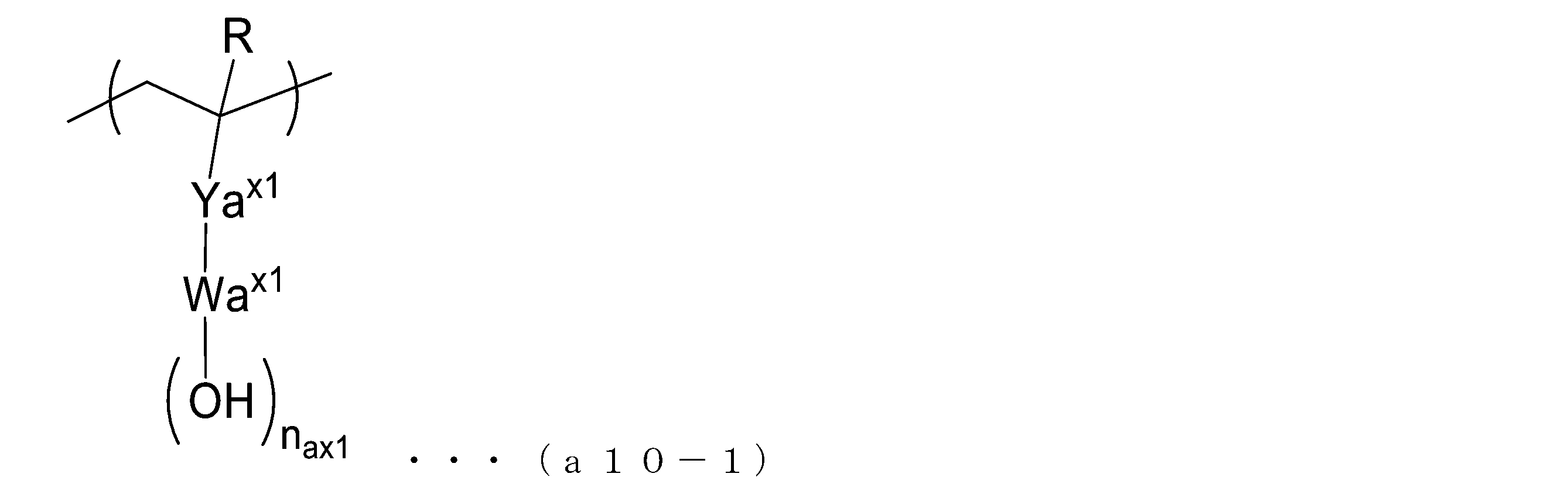
[式中、Rは、水素原子、炭素数1~5のアルキル基又は炭素数1~5のハロゲン化アルキル基である。Yax1は、単結合又は2価の連結基である。Wax1は、置換基を有してもよい芳香族炭化水素基である。nax1は、1以上の整数である。]
Rにおける炭素数1~5のアルキル基は、炭素数1~5の直鎖状又は分岐鎖状のアルキル基が好ましく、具体的には、メチル基、エチル基、プロピル基、イソプロピル基、n-ブチル基、イソブチル基、tert-ブチル基、ペンチル基、イソペンチル基、ネオペンチル基等が挙げられる。
Rにおける炭素数1~5のハロゲン化アルキル基は、前記炭素数1~5のアルキル基の水素原子の一部又は全部がハロゲン原子で置換された基である。該ハロゲン原子としては、特にフッ素原子が好ましい。
Rとしては、水素原子、炭素数1~5のアルキル基又は炭素数1~5のフッ素化アルキル基が好ましく、工業上の入手の容易さから、水素原子、メチル基又はトリフルオロメチル基がより好ましく、水素原子又はメチル基がさらに好ましく、水素原子が特に好ましい。
前記の化学式中、Yax1における2価の連結基としては、特に限定されないが、置換基を有してもよい2価の炭化水素基、ヘテロ原子を含む2価の連結基等が好適なものとして挙げられる。
Yax1が置換基を有してもよい2価の炭化水素基である場合、該炭化水素基は、脂肪族炭化水素基でもよいし、芳香族炭化水素基でもよい。
脂肪族炭化水素基は、芳香族性を持たない炭化水素基を意味する。該脂肪族炭化水素基は、飽和であってもよく、不飽和であってもよく、通常は飽和であることが好ましい。 前記脂肪族炭化水素基としては、直鎖状若しくは分岐鎖状の脂肪族炭化水素基、又は構造中に環を含む脂肪族炭化水素基等が挙げられる。
該直鎖状の脂肪族炭化水素基は、炭素数が1~10であることが好ましく、炭素数1~6がより好ましく、炭素数1~4がさらに好ましく、炭素数1~3が最も好ましい。
直鎖状の脂肪族炭化水素基としては、直鎖状のアルキレン基が好ましく、具体的には、メチレン基[-CH2-]、エチレン基[-(CH2)2-]、トリメチレン基[-(CH2)3-]、テトラメチレン基[-(CH2)4-]、ペンタメチレン基[-(CH2)5-]等が挙げられる。
該分岐鎖状の脂肪族炭化水素基は、炭素数が2~10であることが好ましく、炭素数3~6がより好ましく、炭素数3又は4がさらに好ましく、炭素数3が最も好ましい。
分岐鎖状の脂肪族炭化水素基としては、分岐鎖状のアルキレン基が好ましく、具体的には、-CH(CH3)-、-CH(CH2CH3)-、-C(CH3)2-、-C(CH3)(CH2CH3)-、-C(CH3)(CH2CH2CH3)-、-C(CH2CH3)2-等のアルキルメチレン基;-CH(CH3)CH2-、-CH(CH3)CH(CH3)-、-C(CH3)2CH2-、-CH(CH2CH3)CH2-、-C(CH2CH3)2-CH2-等のアルキルエチレン基;-CH(CH3)CH2CH2-、-CH2CH(CH3)CH2-等のアルキルトリメチレン基;-CH(CH3)CH2CH2CH2-、-CH2CH(CH3)CH2CH2-等のアルキルテトラメチレン基などのアルキルアルキレン基等が挙げられる。アルキルアルキレン基におけるアルキル基としては、炭素数1~5の直鎖状のアルキル基が好ましい。
該構造中に環を含む脂肪族炭化水素基としては、環構造中にヘテロ原子を含む置換基を含んでもよい環状の脂肪族炭化水素基(脂肪族炭化水素環から水素原子を2個除いた基)、前記環状の脂肪族炭化水素基が直鎖状または分岐鎖状の脂肪族炭化水素基の末端に結合した基、前記環状の脂肪族炭化水素基が直鎖状または分岐鎖状の脂肪族炭化水素基の途中に介在する基などが挙げられる。前記直鎖状または分岐鎖状の脂肪族炭化水素基としては前記と同様のものが挙げられる。
環状の脂肪族炭化水素基は、炭素数が3~20であることが好ましく、炭素数3~12であることがより好ましい。
環状の脂肪族炭化水素基は、多環式基であってもよく、単環式基であってもよい。単環式の脂環式炭化水素基としては、モノシクロアルカンから2個の水素原子を除いた基が好ましい。該モノシクロアルカンとしては、炭素数3~6のものが好ましく、具体的にはシクロペンタン、シクロヘキサン等が挙げられる。多環式の脂環式炭化水素基としては、ポリシクロアルカンから2個の水素原子を除いた基が好ましく、該ポリシクロアルカンとしては、炭素数7~12のものが好ましく、具体的にはアダマンタン、ノルボルナン、イソボルナン、トリシクロデカン、テトラシクロドデカン等が挙げられる。
前記置換基としてのアルキル基としては、炭素数1~5のアルキル基が好ましく、メチル基、エチル基、プロピル基、n-ブチル基、tert-ブチル基であることがより好ましい。
前記置換基としてのアルコキシ基としては、炭素数1~5のアルコキシ基が好ましく、メトキシ基、エトキシ基、n-プロポキシ基、iso-プロポキシ基、n-ブトキシ基、tert-ブトキシ基がより好ましく、メトキシ基、エトキシ基がさらに好ましい。
前記置換基としてのハロゲン原子としては、フッ素原子が好ましい。
前記置換基としてのハロゲン化アルキル基としては、前記アルキル基の水素原子の一部または全部が前記ハロゲン原子で置換された基が挙げられる。
環状の脂肪族炭化水素基は、その環構造を構成する炭素原子の一部がヘテロ原子を含む置換基で置換されてもよい。該ヘテロ原子を含む置換基としては、-O-、-C(=O)-O-、-S-、-S(=O)2-、-S(=O)2-O-が好ましい。
該芳香族炭化水素基は、芳香環を少なくとも1つ有する炭化水素基である。
この芳香環は、4n+2個のπ電子をもつ環状共役系であれば特に限定されず、単環式でもよいし、多環式でもよい。芳香環の炭素数は5~30であることが好ましく、炭素数5~20がより好ましく、炭素数6~15がさらに好ましく、炭素数6~12が特に好ましい。ただし、該炭素数には、置換基における炭素数を含まないものとする。
芳香環として具体的には、ベンゼン、ナフタレン、アントラセン、フェナントレン等の芳香族炭化水素環;前記芳香族炭化水素環を構成する炭素原子の一部がヘテロ原子で置換された芳香族複素環等が挙げられる。芳香族複素環におけるヘテロ原子としては、酸素原子、硫黄原子、窒素原子等が挙げられる。芳香族複素環として具体的には、ピリジン環、チオフェン環等が挙げられる。
芳香族炭化水素基として具体的には、前記芳香族炭化水素環または芳香族複素環から水素原子を2つ除いた基(アリーレン基またはヘテロアリーレン基);2以上の芳香環を含む芳香族化合物(例えばビフェニル、フルオレン等)から水素原子を2つ除いた基;前記芳香族炭化水素環または芳香族複素環から水素原子を1つ除いた基(アリール基またはヘテロアリール基)の水素原子の1つがアルキレン基で置換された基(例えば、ベンジル基、フェネチル基、1-ナフチルメチル基、2-ナフチルメチル基、1-ナフチルエチル基、2-ナフチルエチル基等のアリールアルキル基におけるアリール基から水素原子をさらに1つ除いた基)等が挙げられる。前記アリール基またはヘテロアリール基に結合するアルキレン基の炭素数は、1~4であることが好ましく、炭素数1~2であることがより好ましく、炭素数1であることが特に好ましい。
前記置換基としてのアルキル基としては、炭素数1~5のアルキル基が好ましく、メチル基、エチル基、プロピル基、n-ブチル基、tert-ブチル基であることがより好ましい。
前記置換基としてのアルコキシ基、ハロゲン原子およびハロゲン化アルキル基としては、前記環状の脂肪族炭化水素基が有する水素原子を置換する置換基として例示したものが挙げられる。
Yax1がヘテロ原子を含む2価の連結基である場合、該連結基として好ましいものとしては、-O-、-C(=O)-O-、-O-C(=O)-、-C(=O)-、-O-C(=O)-O-、-C(=O)-NH-、-NH-、-NH-C(=NH)-(Hはアルキル基、アシル基等の置換基で置換されていてもよい。)、-S-、-S(=O)2-、-S(=O)2-O-、一般式-Y21-O-Y22-、-Y21-O-、-Y21-C(=O)-O-、-C(=O)-O-Y21-、-[Y21-C(=O)-O]m”-Y22-、-Y21-O-C(=O)-Y22-または-Y21-S(=O)2-O-Y22-で表される基[式中、Y21およびY22はそれぞれ独立して置換基を有してもよい2価の炭化水素基であり、Oは酸素原子であり、m”は0~3の整数である。]等が挙げられる。
前記へテロ原子を含む2価の連結基が-C(=O)-NH-、-C(=O)-NH-C(=O)-、-NH-、-NH-C(=NH)-の場合、そのHはアルキル基、アシル等の置換基で置換されていてもよい。該置換基(アルキル基、アシル基等)は、炭素数が1~10であることが好ましく、1~8であることがさらに好ましく、1~5であることが特に好ましい。
一般式-Y21-O-Y22-、-Y21-O-、-Y21-C(=O)-O-、-C(=O)-O-Y21-、-[Y21-C(=O)-O]m”-Y22-、-Y21-O-C(=O)-Y22-または-Y21-S(=O)2-O-Y22-中、Y21およびY22は、それぞれ独立して、置換基を有してもよい2価の炭化水素基である。該2価の炭化水素基としては、前記Yax1における2価の連結基としての説明で挙げた(置換基を有してもよい2価の炭化水素基)と同様のものが挙げられる。
Y21としては、直鎖状の脂肪族炭化水素基が好ましく、直鎖状のアルキレン基がより好ましく、炭素数1~5の直鎖状のアルキレン基がさらに好ましく、メチレン基またはエチレン基が特に好ましい。
Y22としては、直鎖状または分岐鎖状の脂肪族炭化水素基が好ましく、メチレン基、エチレン基またはアルキルメチレン基がより好ましい。該アルキルメチレン基におけるアルキル基は、炭素数1~5の直鎖状のアルキル基が好ましく、炭素数1~3の直鎖状のアルキル基がより好ましく、メチル基が最も好ましい。
式-[Y21-C(=O)-O]m”-Y22-で表される基において、m”は0~3の整数であり、0~2の整数であることが好ましく、0または1がより好ましく、1が特に好ましい。つまり、式-[Y21-C(=O)-O]m”-Y22-で表される基としては、式-Y21-C(=O)-O-Y22-で表される基が特に好ましい。なかでも、式-(CH2)a’-C(=O)-O-(CH2)b’-で表される基が好ましい。該式中、a’は、1~10の整数であり、1~8の整数が好ましく、1~5の整数がより好ましく、1または2がさらに好ましく、1が最も好ましい。b’は、1~10の整数であり、1~8の整数が好ましく、1~5の整数がより好ましく、1または2がさらに好ましく、1が最も好ましい。
Wax1における芳香族炭化水素基としては、置換基を有してもよい芳香環から(nax1+1)個の水素原子を除いた基が挙げられる。ここでの芳香環は、4n+2個のπ電子をもつ環状共役系であれば特に限定されず、単環式でも多環式でもよい。芳香環の炭素数は5~30であることが好ましく、炭素数5~20がより好ましく、炭素数6~15がさらに好ましく、炭素数6~12が特に好ましい。該芳香環として具体的には、ベンゼン、ナフタレン、アントラセン、フェナントレン等の芳香族炭化水素環;前記芳香族炭化水素環を構成する炭素原子の一部がヘテロ原子で置換された芳香族複素環等が挙げられる。芳香族複素環におけるヘテロ原子としては、酸素原子、硫黄原子、窒素原子等が挙げられる。芳香族複素環として具体的には、ピリジン環、チオフェン環等が挙げられる。
また、Wax1における芳香族炭化水素基としては、2以上の置換基を有してもよい芳香環を含む芳香族化合物(例えばビフェニル、フルオレン等)から(nax1+1)個の水素原子を除いた基も挙げられる。
上記の中でも、Wax1としては、ベンゼン、ナフタレン、アントラセンまたはビフェニルから(nax1+1)個の水素原子を除いた基が好ましく、ベンゼン又はナフタレンから(nax1+1)個の水素原子を除いた基がより好ましく、ベンゼンから(nax1+1)個の水素原子を除いた基がさらに好ましい。
以下の各式中、Rαは、水素原子、メチル基又はトリフルオロメチル基を示す。

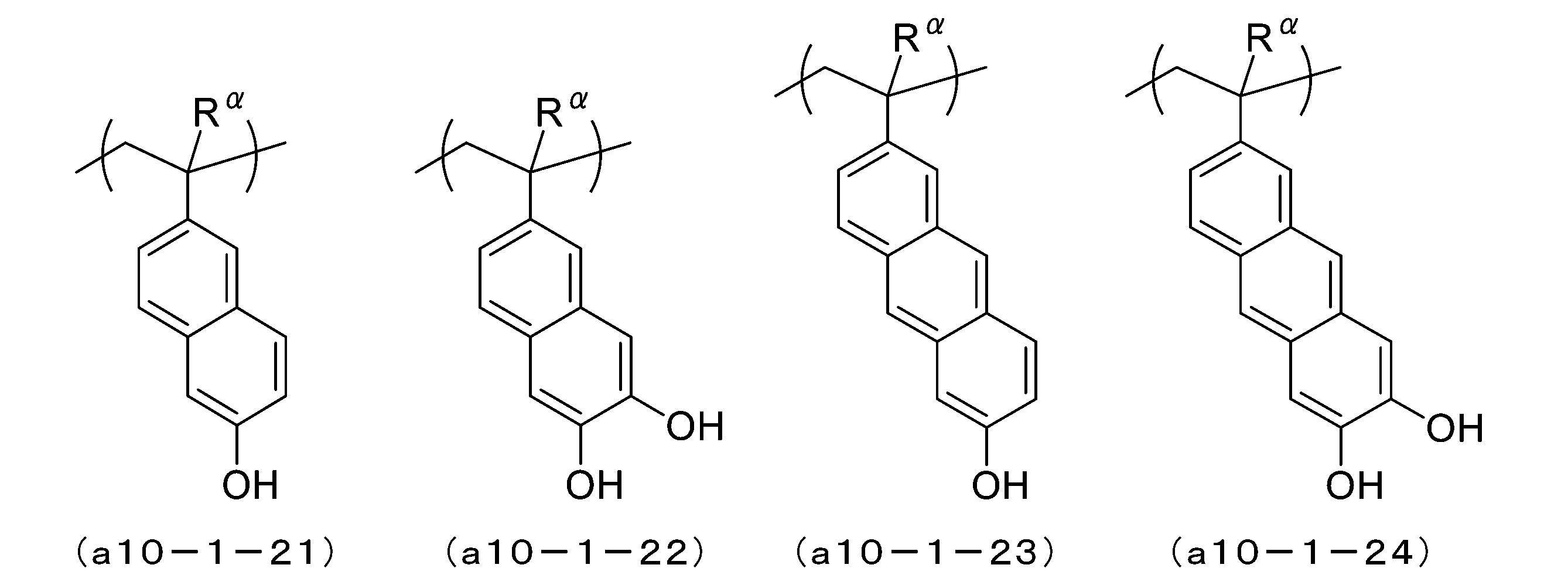
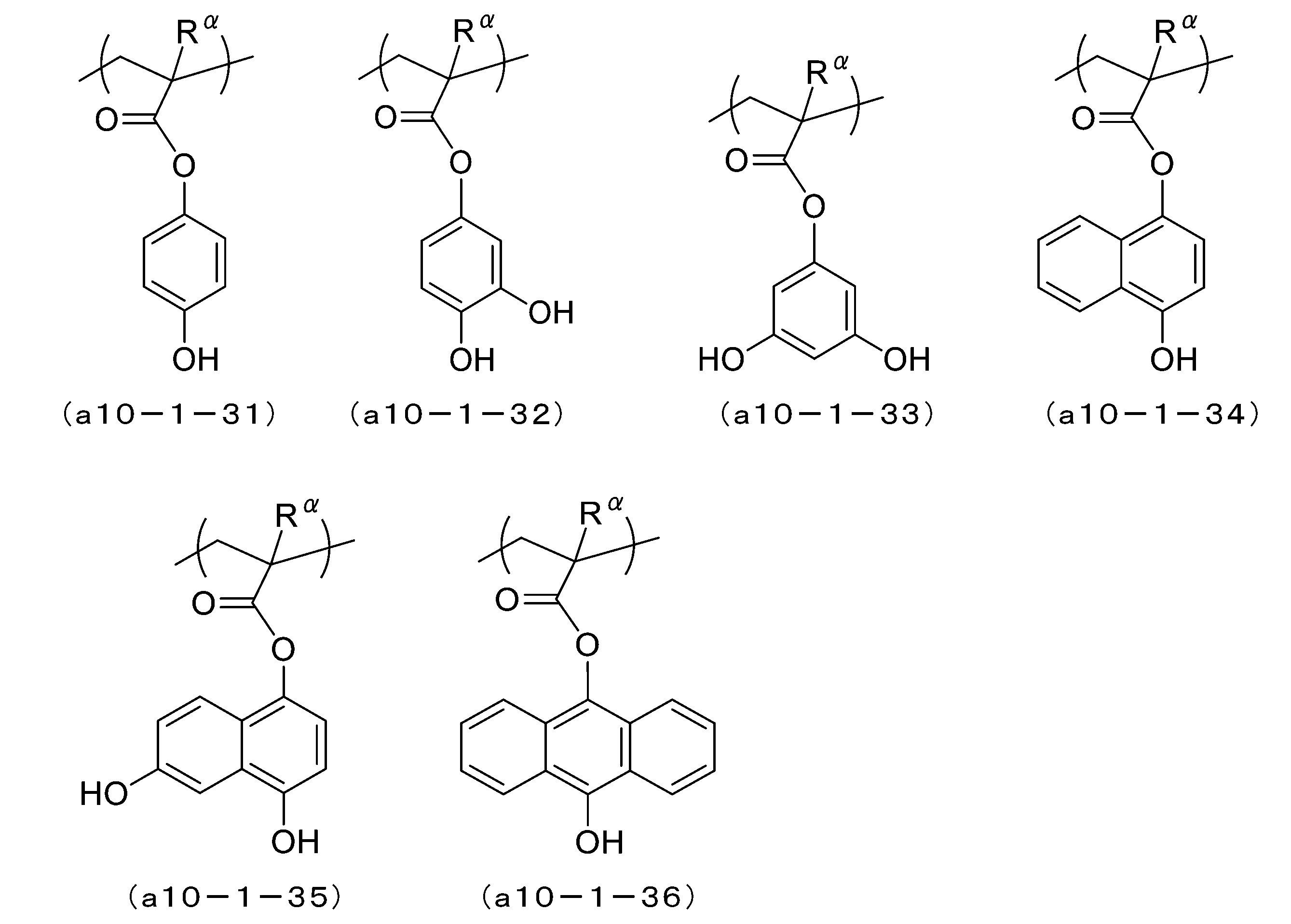

(A1)成分中の構成単位(a10)の割合は、(A1)成分を構成する全構成単位の合計(100モル%)に対して、70~99モル%が好ましく、75~99モル%がより好ましく、80~99モル%がさらに好ましく、85~95モル%が特に好ましい。
構成単位(a10)の割合を下限値以上とすることにより、現像特性やリソグラフィー特性がより向上する。一方、上限値以下とすることにより、他の構成単位とのバランスをとりやすくなる。
(A1)成分は、上述した構成単位(a10)に加えて、さらに、芳香環(ヒドロキシ基が結合した芳香環を除く)を側鎖に含む化合物から誘導される構成単位(a11)を有する共重合体が好ましい。
芳香環(ヒドロキシ基が結合した芳香環を除く)を側鎖に含む化合物、としては、例えば、下記一般式(a11-1)で表される化合物が好適に挙げられる。
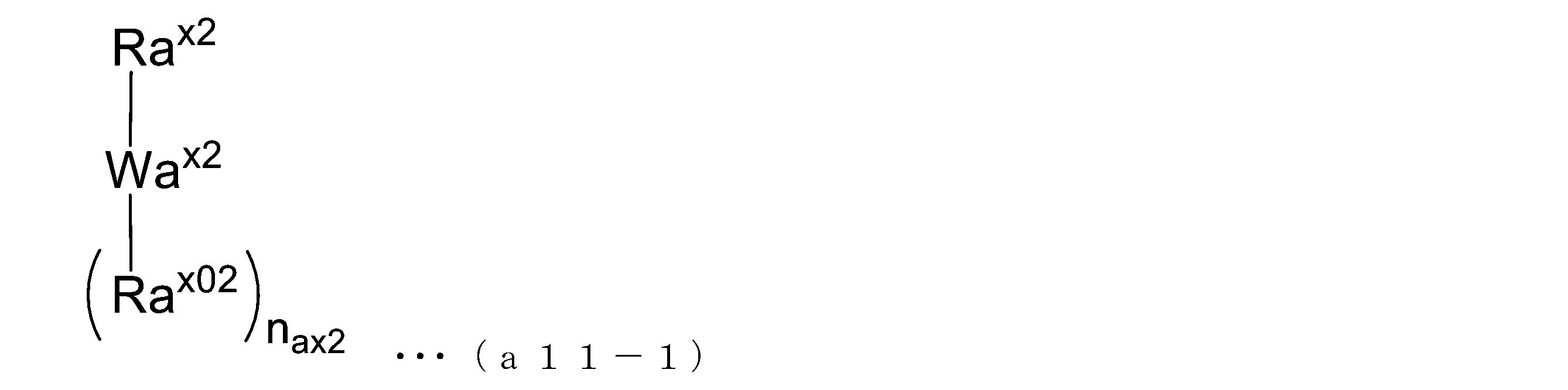
Rax2における「重合性基」とは、重合性基を有する化合物がラジカル重合等により重合することを可能とする基であり、例えばエチレン性二重結合などの炭素原子間の多重結合を含む基をいう。
重合性基としては、例えばビニル基、アリル基、アクリロイル基、メタクリロイル基、フルオロビニル基、ジフルオロビニル基、トリフルオロビニル基、ジフルオロトリフルオロメチルビニル基、トリフルオロアリル基、パーフルオロアリル基、トリフルオロメチルアクリロイル基、ノニルフルオロブチルアクリロイル基、ビニルエーテル基、含フッ素ビニルエーテル基、アリルエーテル基、含フッ素アリルエーテル基、スチリル基、ビニルナフチル基、含フッ素スチリル基、含フッ素ビニルナフチル基、ノルボルニル基、含フッ素ノルボルニル基、シリル基等が挙げられる。
重合性基含有基としては、重合性基のみから構成される基でもよいし、重合性基と該重合性基以外の他の基とから構成される基でもよい。該重合性基以外の他の基としては、置換基を有してもよい2価の炭化水素基、ヘテロ原子を含む2価の連結基等が挙げられる。
Rax2とWax2とで縮合環構造を形成する場合、その縮合環構造には、Wax2に由来する芳香環が含まれる。また、Rax2に由来する重合性基の、炭素原子間の多重結合が開裂して、(A1)成分の主鎖を形成する。すなわち、該縮合環を構成する炭素原子の一部が(A1)成分の主鎖を構成する。
Rax02における置換基としては、例えば、アルキル基、アルコキシ基、アシルオキシ基などが挙げられる。
Rax02における置換基としてのアルキル基は、炭素数1~5のアルキル基が好ましく、メチル基、エチル基、プロピル基、n-ブチル基、tert-ブチル基がより好ましい。
Rax02における置換基としてのアルコキシ基は、炭素数1~5のアルコキシ基が好ましく、メトキシ基、エトキシ基、n-プロポキシ基、iso-プロポキシ基、n-ブトキシ基、tert-ブトキシ基がより好ましく、メトキシ基、エトキシ基が特に好ましい。
Rax02における置換基としてのアシルオキシ基は、その炭素数が2~6であることが好ましく、CH3C(=O)-O-(アセトキシ基)、C2H5C(=O)-O-がより好ましく、CH3C(=O)-O-(アセトキシ基)が特に好ましい。
nax2が2以上の場合、複数のRax02が相互に結合して、環構造を形成してもよい。ここで形成する環構造は、炭化水素環であってもよいし複素環であってもよい。例えば、Wax2における同一の芳香環に結合する2つのRax02と、この2つのRax02が結合する芳香環(Wax2)の一辺(炭素原子間の結合)と、によって形成する環構造が挙げられる。

以下の各式中、Rαは、水素原子、メチル基又はトリフルオロメチル基を示す。
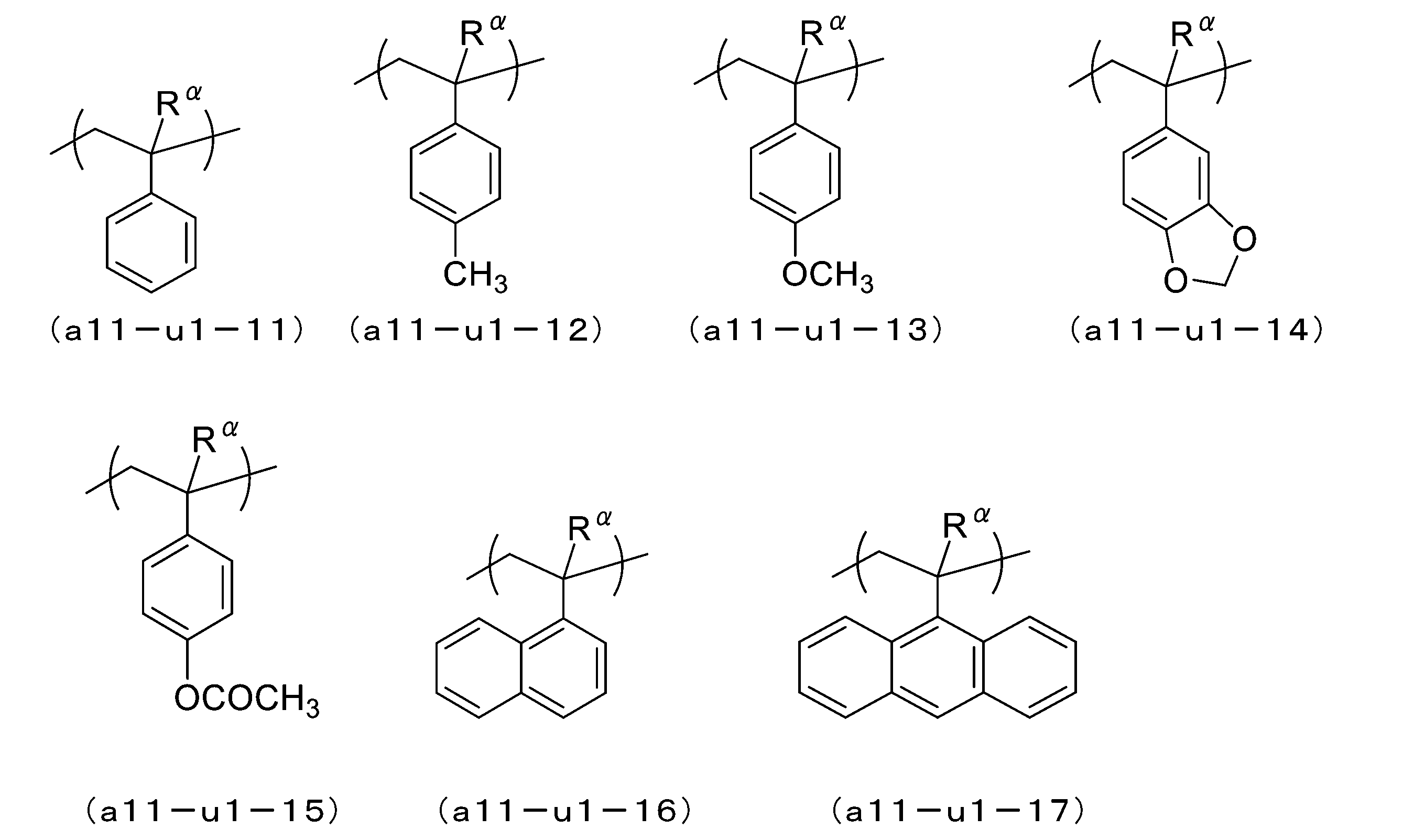

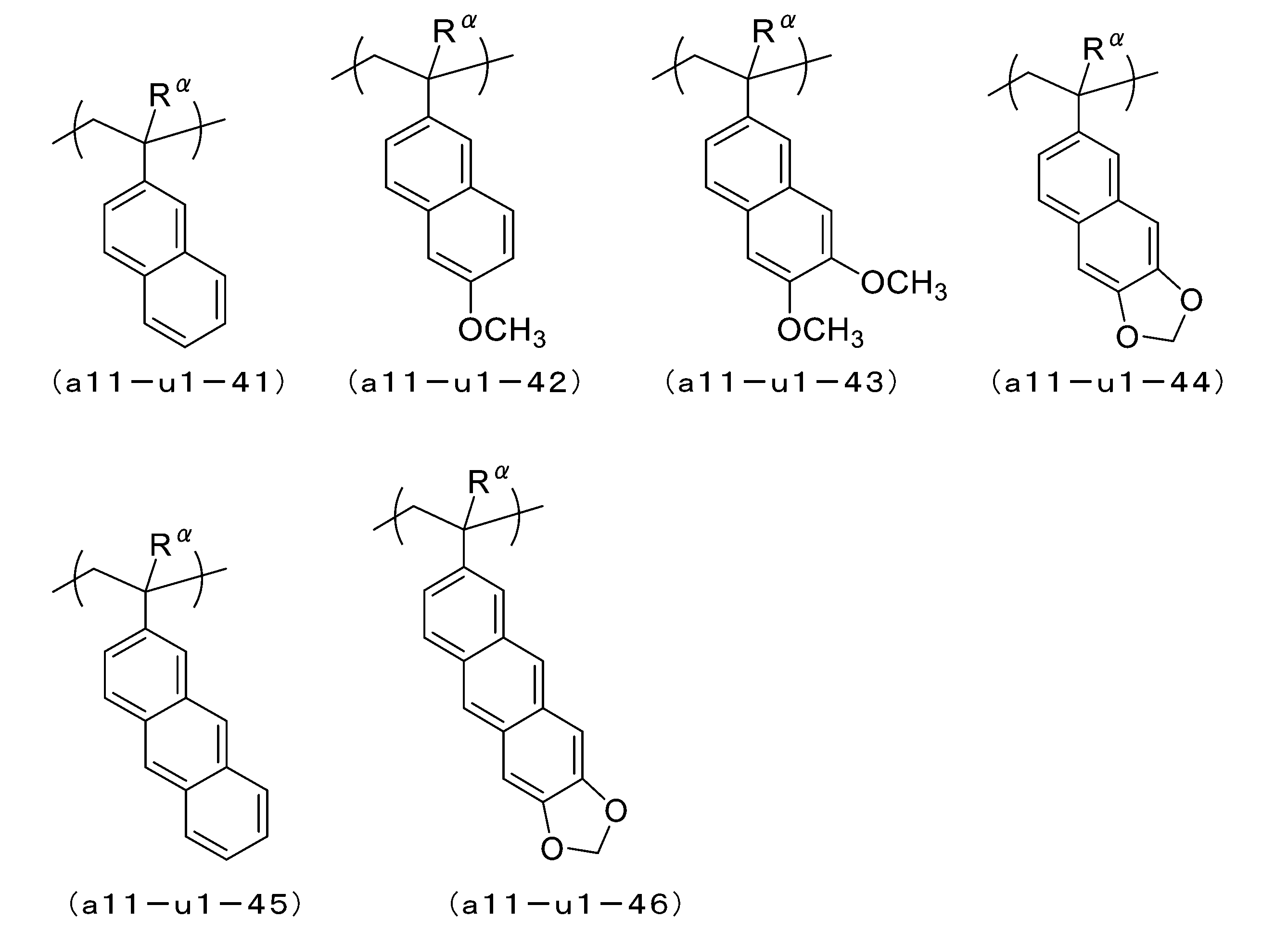


これらの中でも、構成単位(a11)は、化学式(a11-u1-11)、(a11-u1-21)又は(a11-u1-31)のいずれかで表される構成単位が好ましい。
(A1)成分が構成単位(a11)を有する場合、(A1)成分中の構成単位(a11)の割合は、(A1)成分を構成する全構成単位の合計(100モル%)に対して、1~30モル%であることが好ましく、1~25モル%がより好ましく、1~20モル%が更に好ましく、5~15モル%が特に好ましい。
構成単位(a11)の割合を下限値以上とすることにより、耐エッチング性やリソグラフィー特性がより向上する。一方、上限値以下とすることにより、他の構成単位とのバランスをとりやすくなる。
(A1)成分は、構成単位(a10)、構成単位(a11)以外のその他構成単位を有してもよい。
かかるその他構成単位を誘導する化合物としては、例えば、アクリル酸、メタクリル酸、クロトン酸等のモノカルボン酸類;マレイン酸、フマル酸、イタコン酸等のジカルボン酸類;2-メタクリロイルオキシエチルコハク酸、2-メタクリロイルオキシエチルマレイン酸、2-メタクリロイルオキシエチルフタル酸、2-メタクリロイルオキシエチルヘキサヒドロフタル酸等のカルボキシ基及びエステル結合を有するメタクリル酸誘導体類;メチル(メタ)アクリレート、エチル(メタ)アクリレート、ブチル(メタ)アクリレート等の(メタ)アクリル酸アルキルエステル類;2-ヒドロキシエチル(メタ)アクリレート、2-ヒドロキシプロピル(メタ)アクリレート等の(メタ)アクリル酸ヒドロキシアルキルエステル類;フェニル(メタ)アクリレート、ベンジル(メタ)アクリレート等の(メタ)アクリル酸アリールエステル類;マレイン酸ジエチル、フマル酸ジブチル等のジカルボン酸ジエステル類;酢酸ビニル等のビニル基含有脂肪族化合物類;ブタジエン、イソプレン等の共役ジオレフィン類;アクリロニトリル、メタクリロニトリル等のニトリル基含有重合性化合物類;塩化ビニル、塩化ビニリデン等の塩素含有重合性化合物;アクリルアミド、メタクリルアミド等のアミド結合含有重合性化合物類;エポキシ基含有重合性化合物類等が挙げられる。
好ましい(A1)成分としては、構成単位(a10)を少なくとも有する高分子化合物が挙げられる。具体的には、構成単位(a10)の繰り返し構造を有する高分子化合物(構成単位(a10)からなるホモポリマー);構成単位(a10)と構成単位(a11)との繰り返し構造を有する高分子化合物が好適に挙げられる。
(A1)成分のMwがこの範囲の好ましい上限値以下であると、レジストとして用いるのに充分なレジスト溶剤への溶解性があり、この範囲の好ましい下限値以上であると、耐ドライエッチング性やレジストパターン断面形状がより良好となる。
あるいは、かかる(A1)成分は、構成単位(a10)を誘導するモノマーと、必要に応じて構成単位(a10)以外の構成単位を誘導するモノマーと、を重合溶媒に溶解し、ここに、上記のようなラジカル重合開始剤を加えて重合し、その後、脱保護反応を行うことにより製造することができる。
なお、重合の際に、例えば、HS-CH2-CH2-CH2-C(CF3)2-OHのような連鎖移動剤を併用して用いることにより、末端に-C(CF3)2-OH基を導入してもよい。このように、アルキル基の水素原子の一部がフッ素原子で置換されたヒドロキシアルキル基が導入された共重合体は、現像欠陥の低減やLER(ラインエッジラフネス:ライン側壁の不均一な凹凸)の低減に有効である。
また、(A1)成分は、n-ブチルリチウム、s-ブチルリチウム、t-ブチルリチウム、エチルリチウム、エチルナトリウム、1,1-ジフェニルヘキシルリチウム、1,1-ジフェニル-3-メチルペンチルリチウム等の有機アルカリ金属を重合開始剤として用いてアニオン重合法により製造することもできる。
本実施形態のレジスト組成物は、(A)成分として、前記(A1)成分に該当しない、酸の作用により現像液に対する溶解性が変化する基材成分(以下「(A2)成分」という。)を併用してもよい。
(A2)成分としては、特に限定されず、化学増幅型レジスト組成物用の基材成分として従来から知られている多数のものから任意に選択して用いればよい。
(A2)成分は、高分子化合物又は低分子化合物の1種を単独で用いてもよく2種以上を組み合わせて用いてもよい。
(B)成分としては、特に限定されず、これまで化学増幅型レジスト組成物用の酸発生剤として提案されているものを用いることができる。
本実施形態において、(B)成分としては、下記一般式(b0-1)で表される酸発生剤(B0)(以下、「(B0)成分」という。)を含むことが好ましい。
(B0)成分は、下記一般式(b0-1)で表される酸発生剤である。







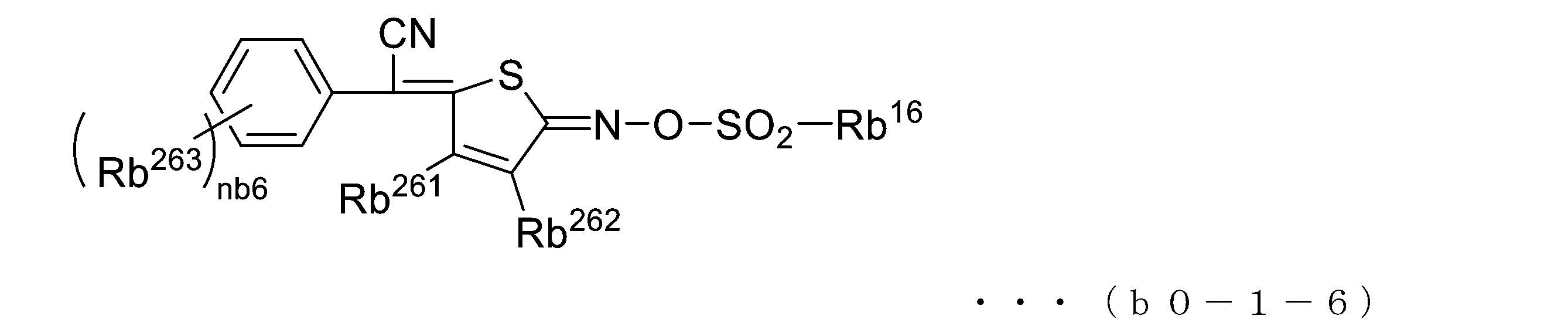
Rb11及びRb12におけるハロゲノアルキル基は、ハロゲン原子の数については特に制限はなく、1個導入されていてもよいし、複数個導入されていてもよい。またハロゲン原子としては、フッ素原子、塩素原子、臭素原子、ヨウ素原子のいずれでもよい。このハロゲノアルキル基として、好ましいのは炭素数1~4のハロゲノアルキル基、例えばクロロメチル基、トリクロロメチル基、トリフルオロメチル基、2-ブロモプロピル基などである。
Rb11及びRb12におけるアルケニル基としては、炭素数2~6の直鎖状又は分岐鎖状のアルケニル基、例えばビニル基、1-プロペニル基、イソプロペニル基、2-ブテニル基などが好ましい。
Rb11及びRb12におけるシクロアルキル基としては、炭素数5~12のシクロアルキル基、例えばシクロペンチル基、シクロヘキシル基、シクロオクチル基、シクロドデシル基などが、また、シクロアルケニル基としては、炭素数4~8のシクロアルケニル基、例えば1-シクロブテニル基、1-シクロペンテニル基、1-シクロヘキセニル基、1-シクロヘプテニル基、1-シクロオクテニル基などが好ましい。
Rb11及びRb12におけるアルコキシ基としては、炭素数1~8のアルコキシ基、例えばメトキシ基、エトキシ基、プロポキシ基、ブトキシ基、ペントキシ基などが好ましい。
Rb11及びRb12におけるシクロアルコキシ基としては、炭素数5~8のシクロアルコキシ基、例えばシクロペントキシ基、シクロヘキシルオキシ基などが好ましい。
Rb12におけるハロゲン化アルキル基としては、炭素数1~4のハロゲン化アルキル基、例えばクロロメチル基、トリクロロメチル基、トリフルオロメチル基、2-ブロモプロピル基などが挙げられる。

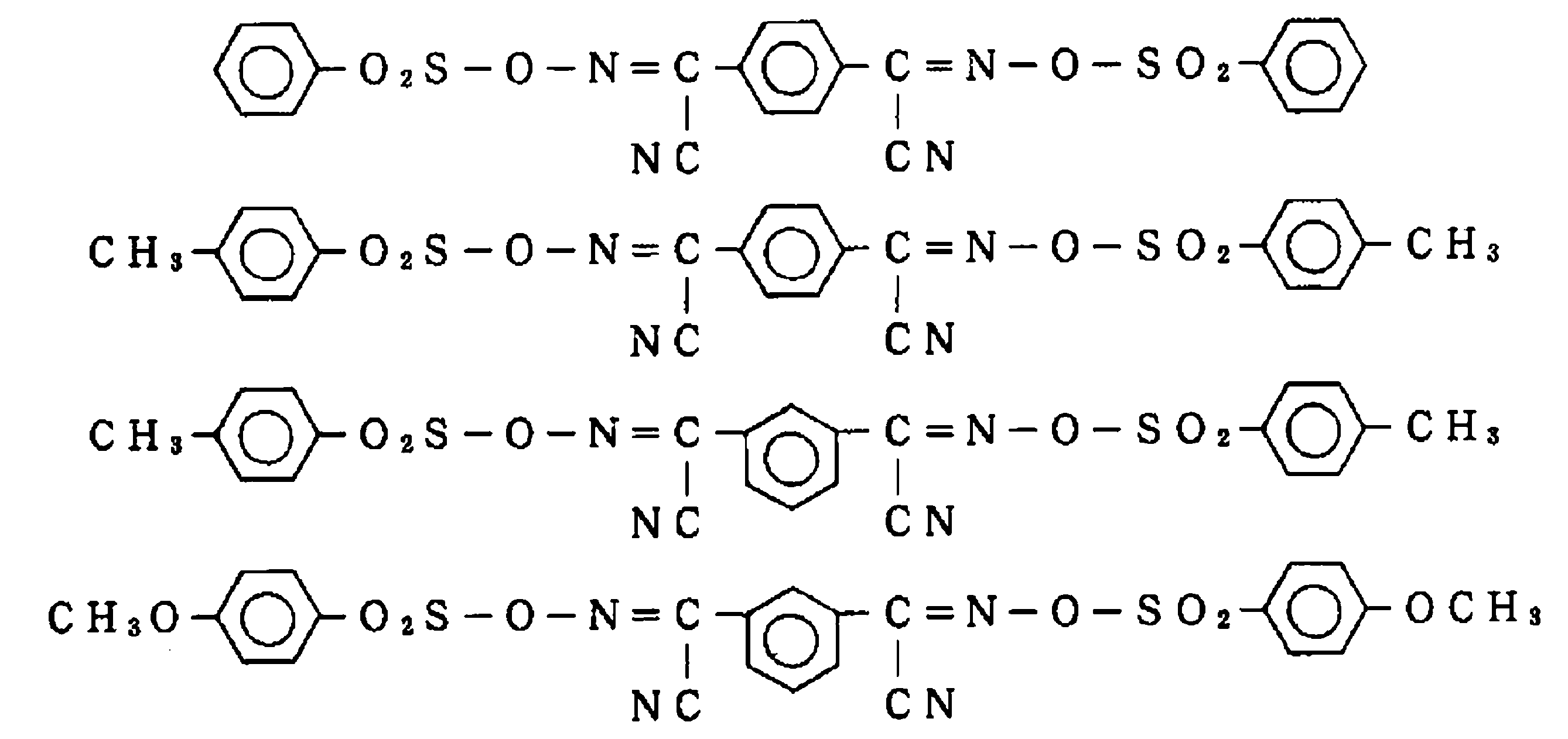
このRb14としては、ナフチル基及びカンファ-10-イル基が好ましく、特に1-ナフチル基が解像性に優れる点で好適である。
なかでも、Rb16におけるアルキル基としては、炭素数1~10の直鎖又は分岐鎖状のアルキル基が好ましく、炭素数1~5の直鎖又は分岐鎖状のアルキル基がより好ましい。

また、感度及び解像性を両立する観点から、前記式(b0-1-2)で表される化合物及び/又は前記式(b0-1-3)で表される化合物と、前記式(b0-1-6)で表される化合物とを併用することも好ましい。

(B0)成分の含有量を上記範囲とすることで、パターン形成が充分に行われる。
本実施形態のレジスト組成物は、(B)成分として、(B0)成分以外の酸発生剤(以下、「(B1)成分という」)を含んでもよい。
(B1)成分としては、特に限定されず、これまで化学増幅型レジスト組成物用の酸発生剤として提案されているものを用いることができる。
このような酸発生剤としては、ヨードニウム塩やスルホニウム塩などのオニウム塩系酸発生剤、オキシムスルホネート系酸発生剤;ビスアルキル又はビスアリールスルホニルジアゾメタン類、ポリ(ビススルホニル)ジアゾメタン類などのジアゾメタン系酸発生剤;ニトロベンジルスルホネート系酸発生剤、ジスルホン系酸発生剤など多種のものが挙げられる。

R104、R105は、置換基を有してもよい鎖状のアルキル基が好ましく、直鎖状若しくは分岐鎖状のアルキル基、又は直鎖状若しくは分岐鎖状のフッ素化アルキル基であることがより好ましい。
式(b-2)中、V102、V103は、それぞれ独立に、単結合、アルキレン基、またはフッ素化アルキレン基であり、それぞれ、式(b-1)中のV101と同様のものが挙げられる。
式(b-2)中、L101、L102は、それぞれ独立に単結合又は酸素原子である。
L103~L105は、それぞれ独立に、単結合、-CO-又は-SO2-である。
レジスト組成物が(B1)成分を含有する場合、レジスト組成物中、(B1)成分の含有量は、(A)成分100質量部に対して、50質量部以下が好ましく、0.1~40質量部がより好ましく、0.1~30質量部がさらに好ましく、0.1~20質量部が特に好ましい。
本実施形態のレジスト組成物中、(B)成分の含有量は、(A)成分100質量部に対して、50質量部未満が好ましく、0.1~40質量部がより好ましく、0.3~25質量部がさらに好ましい。
(B)成分の含有量を、前記の好ましい範囲とすることで、パターン形成が充分に行われる。また、レジスト組成物の各成分を有機溶剤に溶解した際、均一な溶液が得られやすく、レジスト組成物としての保存安定性が良好となるため好ましい。
(C)成分は、メラミン系架橋剤、尿素系架橋剤、アルキレン尿素系架橋剤、グリコールウリル系架橋剤、およびエポキシ系架橋剤からなる群から選ばれる少なくとも1種の架橋剤である。
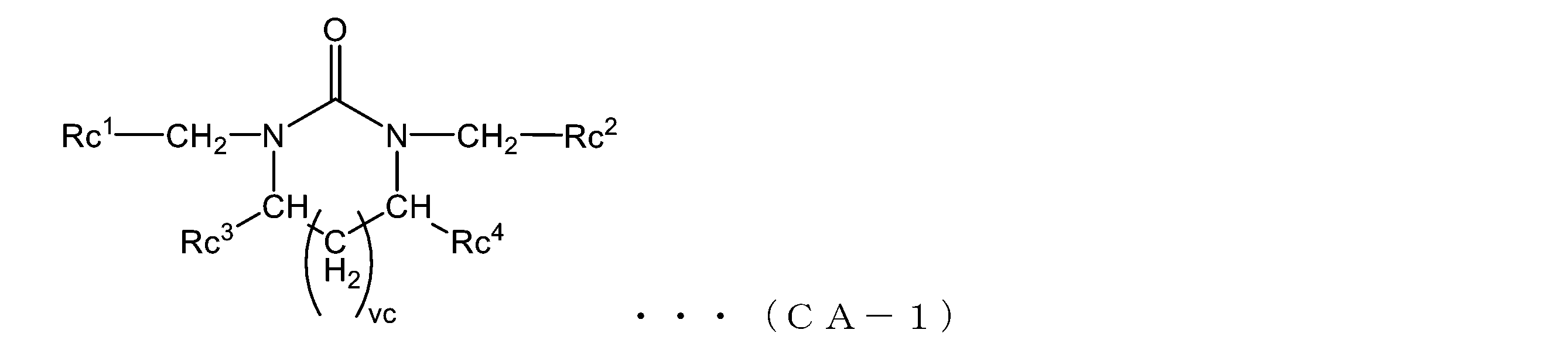
Rc3とRc4が低級アルコキシ基であるとき、好ましくは炭素数1~4のアルコキシ基であり、直鎖状でもよく分岐状でもよい。Rc3とRc4は同じであってもよく、互いに異なっていてもよい。同じであることがより好ましい。
vcは、0~2の整数であり、好ましくは0又は1である。
アルキレン尿素系架橋剤としては、特に、vcが0である化合物(エチレン尿素系架橋剤)および/またはvcが1である化合物(プロピレン尿素系架橋剤)が好ましい。
グリコールウリル系架橋剤の具体例としては、例えばモノ,ジ,トリ及び/又はテトラヒドロキシメチル化グリコールウリル;モノ,ジ,トリ及び/又はテトラメトキシメチル化グリコールウリル;モノ,ジ,トリ及び/又はテトラエトキシメチル化グリコールウリル;モノ,ジ,トリ及び/又はテトラプロポキシメチル化グリコールウリル;モノ,ジ,トリ及び/又はテトラブトキシメチル化グリコールウリルなどが挙げられる。
エポキシ基の数は、2つ以上であることが好ましく、より好ましくは2~4つであり、最も好ましくは2つである。
エポキシ系架橋剤として好適なものを以下に示す。
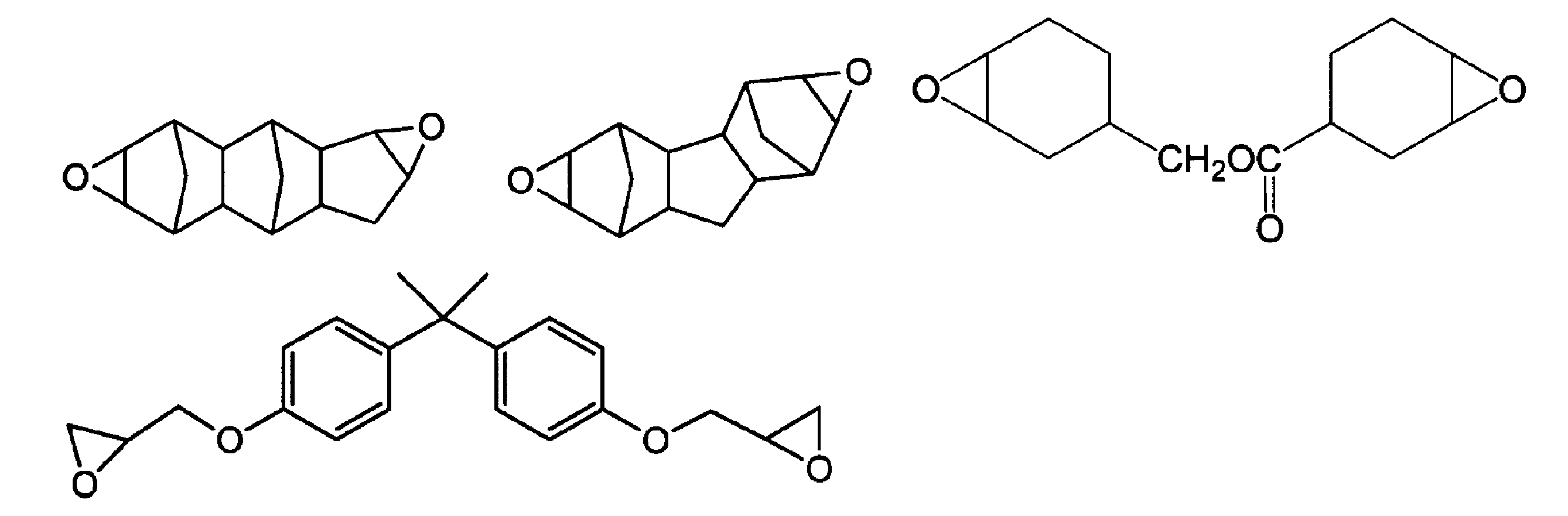

(C)成分の含有量が下限値以上であると、架橋形成が充分に進行し、解像性能、リソグラフィー特性がより向上する。また、膨潤の少ない良好なレジストパターンが得られる。また、この上限値以下であると、レジスト組成物の保存安定性が良好であり、感度の経時的劣化が抑制されやすくなる。
(Z)成分は、ポリエーテル化合物であれば特に限定されず、下記一般式(z-1)で表される部分構造を有する化合物等が挙げられる。

上記一般式(z-1)中、*は、結合手を表す。
一般式(z-1)で表される化合物の質量平均分子量(Mw)(ゲルパーミエーションクロマトグラフィー(GPC)によるポリスチレン換算基準)は、200~25000が好ましく、Mw250~24000がより好ましく、Mw300~23000がさらに好ましい。

上記一般式(z-1-1)中、Rz12およびRz13は、それぞれ独立に、水素原子又はアルキル基を表す。アルキル基の炭素数は特に制限されないが、1~15であることが好ましい。なかでも、Rz12およびRz13としては、水素原子が好ましい。
一般式(z-1-1)で表される化合物の質量平均分子量(Mw)(ゲルパーミエーションクロマトグラフィー(GPC)によるポリスチレン換算基準)は、200~25000が好ましく、Mw250~24000がより好ましく、Mw300~23000がさらに好ましい。



本実施形態のレジスト組成物中、(Z)成分の含有量は、(A1)成分100質量部に対し、50質量部未満であり、40質量部以下であることが好ましく、35質量部以下であることがより好ましく、30質量部以下であることが更に好ましく、20質量部未満であることが更に好ましい。
(Z)成分の含有量の下限値は特に制限されないが、(A1)成分100質量部に対し、0.1質量部以上であることが好ましく、0.2質量部以上であることがより好ましく、0.5質量部以上であることが更に好ましい。
(Z)成分の含有量が50質量部未満であることにより、解像性及びウェットエッチング耐性が良好なパターンを形成できる。
(Z)成分の含有量が上記の好ましい範囲の上限値以下であると、解像性がより良好なパターンを形成しやすい。
(Z)成分の含有量が上記の好ましい範囲の下限値以上であると、ウェットエッチング耐性がより良好なパターンを形成しやすい。
≪(D)成分≫
本実施形態におけるレジスト組成物は、(A)成分、(B)成分、(C)成分及び(Z)成分に加えて、さらに、酸拡散制御剤成分(以下「(D)成分」という。)を含有してもよい。(D)成分は、レジスト組成物において露光により発生する酸をトラップするクエンチャー(酸拡散制御剤)として作用するものである。
(D)成分としては、例えば、含窒素有機化合物(D1)(以下「(D1)成分」、該(D1)成分に該当しない露光により分解して酸拡散制御性を失う光崩壊性塩基(D2)(以下「(D2)成分」という。)という。)等が挙げられる。
(D)成分を含有するレジスト組成物とすることで、レジストパターンを形成する際に、レジスト膜の露光部と未露光部とのコントラストをより向上させることができる。
(D1)成分は、塩基成分であって、レジスト組成物中で酸拡散制御剤として作用する含窒素有機化合物成分である。
脂肪族アミンとは、1つ以上の脂肪族基を有するアミンであり、該脂肪族基は炭素数が1~12であることが好ましい。
脂肪族アミンとしては、アンモニアNH3の水素原子の少なくとも1つを、炭素数12以下のアルキル基もしくはヒドロキシアルキル基で置換したアミン(アルキルアミンもしくはアルキルアルコールアミン)又は環式アミンが挙げられる。
アルキルアミンおよびアルキルアルコールアミンの具体例としては、n-ヘキシルアミン、n-ヘプチルアミン、n-オクチルアミン、n-ノニルアミン、n-デシルアミン等のモノアルキルアミン;ジエチルアミン、ジ-n-プロピルアミン、ジ-n-ヘプチルアミン、ジ-n-オクチルアミン、ジシクロヘキシルアミン等のジアルキルアミン;トリメチルアミン、トリエチルアミン、トリ-n-プロピルアミン、トリ-n-ブチルアミン、トリ-n-ペンチルアミン、トリ-n-ヘキシルアミン、トリ-n-ヘプチルアミン、トリ-n-オクチルアミン、トリ-n-ノニルアミン、トリ-n-デシルアミン、トリ-n-ドデシルアミン等のトリアルキルアミン;ジエタノールアミン、トリエタノールアミン、ジイソプロパノールアミン、トリイソプロパノールアミン、ジ-n-オクタノールアミン、トリ-n-オクタノールアミン等のアルキルアルコールアミンが挙げられる。これらの中でも、炭素数5~10のトリアルキルアミンがさらに好ましく、トリ-n-ペンチルアミン又はトリ-n-オクチルアミンが特に好ましい。
脂肪族単環式アミンとして、具体的には、ピペリジン、ピペラジン等が挙げられる。 脂肪族多環式アミンとしては、炭素数が6~10のものが好ましく、具体的には、1,5-ジアザビシクロ[4.3.0]-5-ノネン、1,8-ジアザビシクロ[5.4.0]-7-ウンデセン、ヘキサメチレンテトラミン、1,4-ジアザビシクロ[2.2.2]オクタン等が挙げられる。
(D2)成分としては、露光により分解して酸拡散制御性を失うものであれば特に限定されず、下記一般式(d2-1)で表される化合物(以下「(d2-1)成分」という。)及び下記一般式(d2-2)で表される化合物(以下「(d2-2)成分」という。)からなる群より選ばれる1種以上の化合物が好ましい。
(d2-1)~(d2-2)成分は、レジスト膜の露光部において分解して酸拡散制御性(塩基性)を失うためクエンチャーとして作用せず、レジスト膜の未露光部においてクエンチャーとして作用する。
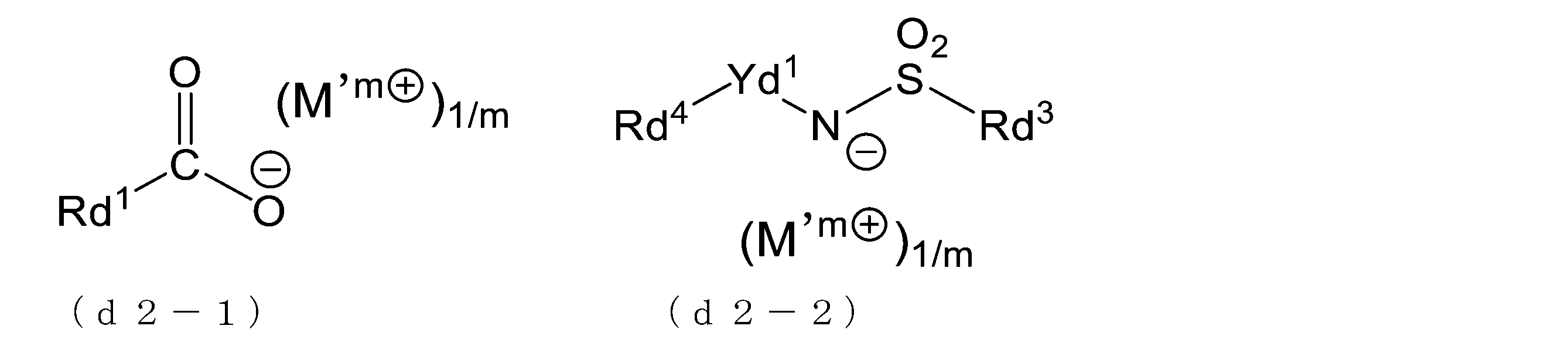
レジスト組成物が(D2)成分を含有する場合、レジスト組成物中、(D2)成分の含有量は、(A)成分100質量部に対して、0.5~35質量部が好ましく、1~25質量部がより好ましく、2~20質量部がさらに好ましく、3~15質量部が特に好ましい。
(D2)成分の含有量が好ましい下限値以上であると、特に良好なリソグラフィー特性及びレジストパターン形状が得られやすい。一方、上限値以下であると、他成分とのバランスをとることができ、種々のリソグラフィー特性が良好となる。
前記の(d2-1)成分の製造方法は、特に限定されず、公知の方法により製造することができる。
また、(d2-2)成分の製造方法は、特に限定されず、例えば、US2012-0149916号公報に記載の方法と同様にして製造される。
本実施形態のレジスト組成物には、感度劣化の防止や、レジストパターン形状、引き置き経時安定性等の向上の目的で、任意の成分として、有機カルボン酸並びにリンのオキソ酸及びその誘導体からなる群より選択される少なくとも1種の化合物(E)(以下「(E)成分」という)を含有させることができる。
有機カルボン酸としては、例えば、酢酸、マロン酸、クエン酸、リンゴ酸、コハク酸、安息香酸、サリチル酸などが好適である。
リンのオキソ酸としては、リン酸、ホスホン酸、ホスフィン酸等が挙げられ、これらの中でも特にホスホン酸が好ましい。
リンのオキソ酸の誘導体としては、例えば、上記オキソ酸の水素原子を炭化水素基で置換したエステル等が挙げられ、前記炭化水素基としては、炭素数1~5のアルキル基、炭素数6~15のアリール基等が挙げられる。
リン酸の誘導体としては、リン酸ジ-n-ブチルエステル、リン酸ジフェニルエステル等のリン酸エステルなどが挙げられる。
ホスホン酸の誘導体としては、ホスホン酸ジメチルエステル、ホスホン酸-ジ-n-ブチルエステル、フェニルホスホン酸、ホスホン酸ジフェニルエステル、ホスホン酸ジベンジルエステル等のホスホン酸エステルなどが挙げられる。
ホスフィン酸の誘導体としては、ホスフィン酸エステルやフェニルホスフィン酸などが挙げられる。
本実施形態のレジスト組成物において、(E)成分は、1種を単独で用いてもよく、2種以上を併用してもよい。
レジスト組成物が(E)成分を含有する場合、(E)成分の含有量は、(A)成分100質量部に対して、通常、0.01~5質量部の範囲で用いられる。
本実施形態のレジスト組成物は、レジスト材料を有機溶剤成分(以下「(S)成分」という)に溶解させて製造することができる。
(S)成分としては、使用する各成分を溶解し、均一な溶液とすることができるものであればよく、従来、化学増幅型レジスト組成物の溶剤として公知のものの中から任意のものを適宜選択して用いることができる。
(S)成分としては、例えば、γ-ブチロラクトン等のラクトン類;アセトン、メチルエチルケトン、シクロヘキサノン、メチル-n-ペンチルケトン、メチルイソペンチルケトン、2-ヘプタノンなどのケトン類;エチレングリコール、ジエチレングリコール、プロピレングリコール、ジプロピレングリコールなどの多価アルコール類;エチレングリコールモノアセテート、ジエチレングリコールモノアセテート、プロピレングリコールモノアセテート、またはジプロピレングリコールモノアセテート等のエステル結合を有する化合物、前記多価アルコール類または前記エステル結合を有する化合物のモノメチルエーテル、モノエチルエーテル、モノプロピルエーテル、モノブチルエーテル等のモノアルキルエーテルまたはモノフェニルエーテル等のエーテル結合を有する化合物等の多価アルコール類の誘導体[これらの中では、プロピレングリコールモノメチルエーテルアセテート(PGMEA)、プロピレングリコールモノメチルエーテル(PGME)が好ましい];ジオキサンのような環式エーテル類や、乳酸メチル、乳酸エチル(EL)、酢酸メチル、酢酸エチル、酢酸ブチル、ピルビン酸メチル、ピルビン酸エチル、メトキシプロピオン酸メチル、エトキシプロピオン酸エチルなどのエステル類;アニソール、エチルベンジルエーテル、クレジルメチルエーテル、ジフェニルエーテル、ジベンジルエーテル、フェネトール、ブチルフェニルエーテル、エチルベンゼン、ジエチルベンゼン、ペンチルベンゼン、イソプロピルベンゼン、トルエン、キシレン、シメン、メシチレン等の芳香族系有機溶剤、ジメチルスルホキシド(DMSO)等が挙げられる。
本実施形態のレジスト組成物において、(S)成分は、1種単独で用いてもよく、2種以上の混合溶剤として用いてもよい。
なかでも、PGMEA、PGME、γ-ブチロラクトン、EL、シクロヘキサノンが好ましい。
また、PGMEAと極性溶剤とを混合した混合溶剤も好ましい。その配合比(質量比)は、PGMEAと極性溶剤との相溶性等を考慮して適宜決定すればよいが、好ましくは1:9~9:1、より好ましくは2:8~8:2の範囲内とすることが好ましい。
より具体的には、極性溶剤としてEL又はシクロヘキサノンを配合する場合は、PGMEA:EL又はシクロヘキサノンの質量比は、好ましくは1:9~9:1、より好ましくは2:8~8:2である。また、極性溶剤としてPGMEを配合する場合は、PGMEA:PGMEの質量比は、好ましくは1:9~9:1、より好ましくは2:8~8:2、さらに好ましくは3:7~7:3である。さらに、PGMEAとPGMEとシクロヘキサノンとの混合溶剤も好ましい。
また、(S)成分として、その他には、PGMEA及びELの中から選ばれる少なくとも1種とγ-ブチロラクトンとの混合溶剤も好ましい。この場合、混合割合としては、前者と後者との質量比が、好ましくは70:30~95:5とされる。
(S)成分の使用量は、特に限定されず、基板等に塗布可能な濃度で、塗布膜厚に応じて適宜設定される。一般的にはレジスト組成物の固形分濃度が0.1~50質量%、好ましくは10~50質量%の範囲内となるように(S)成分は用いられる。
本発明らが検討した結果、基材成分としてアルカリ可溶性ポリヒドロキシスチレン系樹脂を採用したレジスト組成物を用いてミクロンオーダーの厚膜レジスト膜を成膜し、レジストパターンを形成してエッチングを行った場合、ウェットエッチング耐性が不十分な場合があった。これは、当該レジスト組成物を用いて形成したレジスト膜は、基板界面との密着性が不十分であるためであると考えられる。
上述した本実施形態のレジスト組成物においては、(Z)成分がレジスト膜内で可塑剤としての効果を発揮し、レジスト膜と基板界面との接触面積を向上させると推測される。そのため、(A1)成分と基板表面に存在する極性基とが結合しやすくなり、基板密着性の向上に寄与し、良好な解像性を維持しつつ、ウェットエッチング耐性が改善されると推測される。
本発明の第2の態様は、支持体上に、上述した第1の態様に係るレジスト組成物を用いてレジスト膜を形成する工程(i)、前記レジスト膜を露光する工程(ii)、及び前記露光後のレジスト膜を現像してレジストパターンを形成する工程(iii)を有するレジストパターン形成方法である。
かかるレジストパターン形成方法の一実施形態としては、例えば以下のようにして行うレジストパターン形成方法が挙げられる。
まず、支持体上に、上述した実施形態のレジスト組成物を、スピンナーなどで塗布し、ベーク(ポストアプライベーク(PAB))処理を、例えば80~160℃の温度条件にて40~200秒間、好ましくは60~150秒間施してレジスト膜を形成する。
次に、該レジスト膜に対し、例えばKrF露光装置等の露光装置を用いて、所定のパターンが形成されたマスク(マスクパターン)を介した露光等による選択的露光を行った後、ベーク(ポストエクスポージャーベーク(PEB))処理を、例えば80~150℃の温度条件にて40~150秒間、好ましくは60~120秒間施す。
次に、前記レジスト膜を現像処理する。現像処理は、アルカリ現像プロセスの場合は、アルカリ現像液を用い、溶剤現像プロセスの場合は、有機溶剤を含有する現像液(有機系現像液)を用いて行う。
現像処理後、好ましくはリンス処理を行う。リンス処理は、アルカリ現像プロセスの場合は、純水を用いた水リンスが好ましく、溶剤現像プロセスの場合は、有機溶剤を含有するリンス液を用いることが好ましい。
溶剤現像プロセスの場合、前記現像処理又はリンス処理の後に、パターン上に付着している現像液又はリンス液を、超臨界流体により除去する処理を行ってもよい。
このようにして、レジストパターンを形成することができる。
また、支持体としては、上述のような基板上に、無機系及び/又は有機系の膜が設けられたものであってもよい。無機系の膜としては、無機反射防止膜(無機BARC)が挙げられる。有機系の膜としては、有機反射防止膜(有機BARC)や、多層レジスト法における下層有機膜等の有機膜が挙げられる。
ここで、多層レジスト法とは、基板上に、少なくとも一層の有機膜(下層有機膜)と、少なくとも一層のレジスト膜(上層レジスト膜)とを設け、上層レジスト膜に形成したレジストパターンをマスクとして下層有機膜のパターニングを行う方法であり、高アスペクト比のパターンを形成できるとされている。すなわち、多層レジスト法によれば、下層有機膜により所要の厚みを確保できるため、レジスト膜を薄膜化でき、高アスペクト比の微細パターン形成が可能となる。
多層レジスト法には、基本的に、上層レジスト膜と、下層有機膜との二層構造とする方法(2層レジスト法)と、上層レジスト膜と下層有機膜との間に一層以上の中間層(金属薄膜等)を設けた三層以上の多層構造とする方法(3層レジスト法)と、に分けられる。
上述した第1の態様に係るレジスト組成物は、g線、i線等の紫外線、KrFエキシマレーザー光、ArFエキシマレーザー光、EB又はEUV用としての有用性が高く、g線、i線等の紫外線、KrFエキシマレーザー光、ArFエキシマレーザー光用としての有用性がより高く、g線、i線等の紫外線、KrFエキシマレーザー光用としての有用性が特に高い。第2の態様に係るレジストパターン形成方法は、前記工程(ii)において、前記レジスト膜に、g線、i線等の紫外線、KrFエキシマレーザー光を照射する場合に特に好適な方法である。
液浸露光は、予めレジスト膜と露光装置の最下位置のレンズ間を、空気の屈折率よりも大きい屈折率を有する溶媒(液浸媒体)で満たし、その状態で露光(浸漬露光)を行う露光方法である。
液浸媒体としては、空気の屈折率よりも大きく、かつ、露光されるレジスト膜の屈折率よりも小さい屈折率を有する溶媒が好ましい。かかる溶媒の屈折率としては、前記範囲内であれば特に制限されない。
空気の屈折率よりも大きく、かつ、前記レジスト膜の屈折率よりも小さい屈折率を有する溶媒としては、例えば、水、フッ素系不活性液体、シリコン系溶剤、炭化水素系溶剤等が挙げられる。
液浸媒体としては、コスト、安全性、環境問題、汎用性等の観点から、水が好ましく用いられる。
溶剤現像プロセスで現像処理に用いる有機系現像液が含有する有機溶剤としては、(A)成分(露光前の(A)成分)を溶解し得るものであればよく、公知の有機溶剤の中から適宜選択できる。具体的には、ケトン系溶剤、エステル系溶剤、アルコール系溶剤、ニトリル系溶剤、アミド系溶剤、エーテル系溶剤等の極性溶剤、炭化水素系溶剤等が挙げられる。
ケトン系溶剤は、構造中にC-C(=O)-Cを含む有機溶剤である。エステル系溶剤は、構造中にC-C(=O)-O-Cを含む有機溶剤である。アルコール系溶剤は、構造中にアルコール性水酸基を含む有機溶剤である。「アルコール性水酸基」は、脂肪族炭化水素基の炭素原子に結合した水酸基を意味する。ニトリル系溶剤は、構造中にニトリル基を含む有機溶剤である。アミド系溶剤は、構造中にアミド基を含む有機溶剤である。エーテル系溶剤は、構造中にC-O-Cを含む有機溶剤である。
有機溶剤の中には、構造中に上記各溶剤を特徴づける官能基を複数種含む有機溶剤も存在するが、その場合は、当該有機溶剤が有する官能基を含むいずれの溶剤種にも該当するものとする。例えば、ジエチレングリコールモノメチルエーテルは、上記分類中のアルコール系溶剤、エーテル系溶剤のいずれにも該当するものとする。
炭化水素系溶剤は、ハロゲン化されていてもよい炭化水素からなり、ハロゲン原子以外の置換基を有さない炭化水素溶剤である。ハロゲン原子としては、フッ素原子、塩素原子、臭素原子、ヨウ素原子等が挙げられ、フッ素原子が好ましい。
有機系現像液が含有する有機溶剤としては、上記の中でも、極性溶剤が好ましく、ケトン系溶剤、エステル系溶剤、ニトリル系溶剤等が好ましい。
界面活性剤を配合する場合、その配合量は、有機系現像液の全量に対して、通常0.001~5質量%であり、0.005~2質量%が好ましく、0.01~0.5質量%がより好ましい。
リンス液に用いるアルコール系溶剤は、炭素数6~8の1価アルコールが好ましく、該1価アルコールは直鎖状、分岐状又は環状のいずれであってもよい。具体的には、1-ヘキサノール、1-ヘプタノール、1-オクタノール、2-ヘキサノール、2-ヘプタノール、2-オクタノール、3-ヘキサノール、3-ヘプタノール、3-オクタノール、4-オクタノール、ベンジルアルコール等が挙げられる。これらの中でも、1-ヘキサノール、2-ヘプタノール、2-ヘキサノールが好ましく、1-ヘキサノール、2-ヘキサノールがより好ましい。
これらの有機溶剤は、いずれか1種を単独で用いてもよく、2種以上を併用してもよい。また、上記以外の有機溶剤や水と混合して用いてもよい。但し、現像特性を考慮すると、リンス液中の水の配合量は、リンス液の全量に対し、30質量%以下が好ましく、10質量%以下がより好ましく、5質量%以下さらに好ましく、3質量%以下が特に好ましい。
リンス液には、必要に応じて公知の添加剤を配合できる。該添加剤としては、例えば界面活性剤が挙げられる。界面活性剤は、前記と同様のものが挙げられ、非イオン性の界面活性剤が好ましく、非イオン性のフッ素系界面活性剤、又は非イオン性のシリコン系界面活性剤がより好ましい。
界面活性剤を配合する場合、その配合量は、リンス液の全量に対して、通常0.001~5質量%であり、0.005~2質量%が好ましく、0.01~0.5質量%がより好ましい。
(実施例1~21、比較例1~3)
表1~3に示す各成分を混合して溶解し、各例のレジスト組成物をそれぞれ調製した。

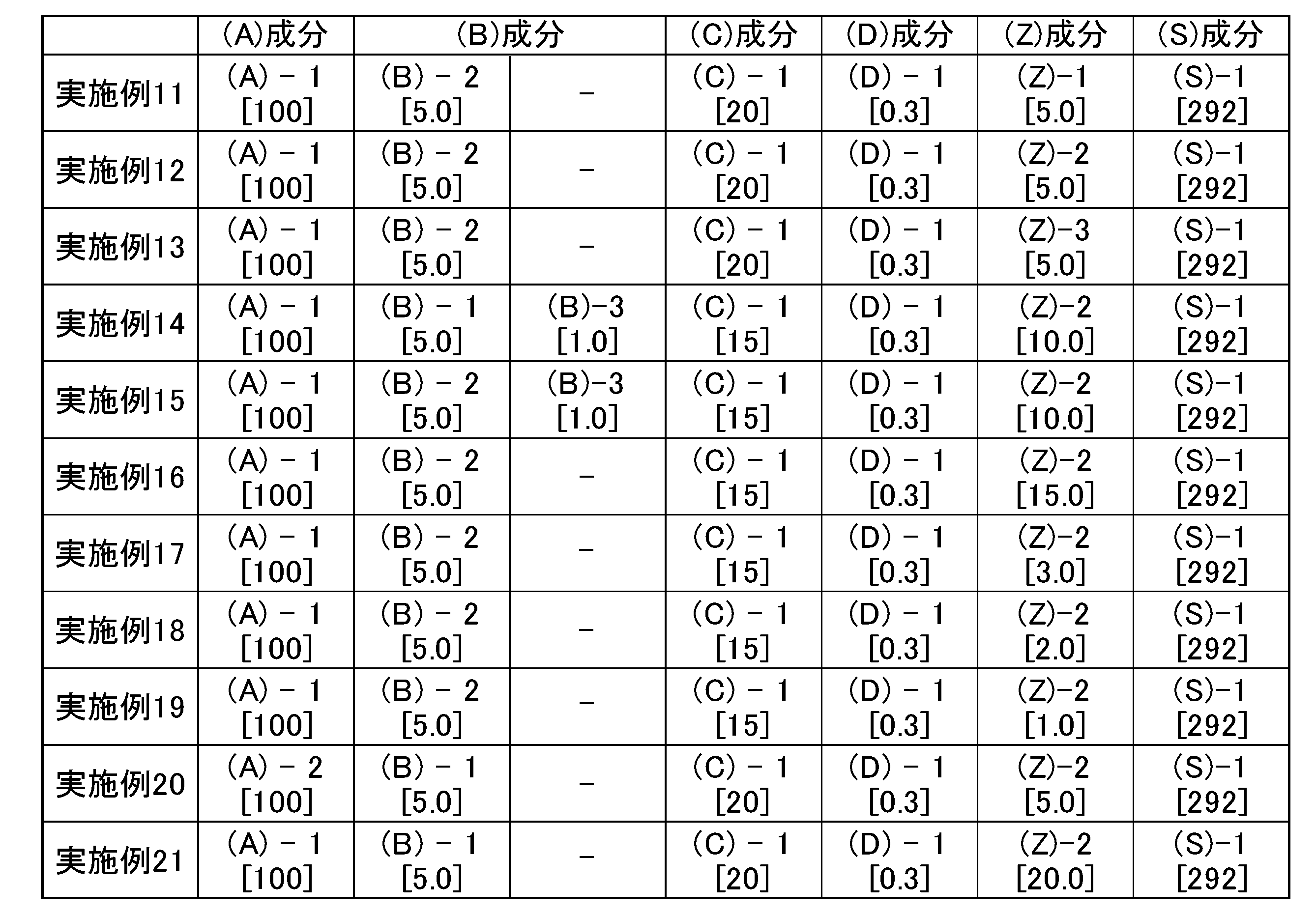

(A)-1:下記の化学式(A-1)で表される高分子化合物。この高分子化合物(A-1)は、該高分子化合物を構成する構成単位を誘導するモノマーを、所定のモル比で用いてアニオン重合させることによって得た。この高分子化合物(A-1)について、GPC測定により求めた標準ポリスチレン換算の重量平均分子量(Mw)は2500、分子量分散度(Mw/Mn)は1.2。13C-NMRにより求められた共重合組成比(構造式中の各構成単位の割合(モル比))はl/m=90/10。


(C)-11:下記化学式(C-11)で表される化合物からなる架橋剤。
(D)-1:下記化学式(D-1)で表される化合物からなる含窒素有機化合物。

(Z)-2:下記化学式(Z-1)で表される、質量平均分子量(Mw)が1000のポリプロピレングリコール。
(Z)-3:下記化学式(Z-1)で表される、質量平均分子量(Mw)が3000のポリプロピレングリコール。
(Z)-4:下記化学式(Z-1)で表される、質量平均分子量(Mw)が4000のポリプロピレングリコール。

(Z)-6:下記化学式(Z-2)で表される、質量平均分子量(Mw)が4000のポリエチレングリコール。
(Z)-7:下記化学式(Z-2)で表される、質量平均分子量(Mw)が8000のポリエチレングリコール。
(Z)-8:下記化学式(Z-2)で表される、質量平均分子量(Mw)が20000のポリエチレングリコール。

(Z)-10:下記化学式(Z-3)で表される、質量平均分子量(Mw)が2000のポリテトラヒドロフラン。

工程(i):
ヘキサメチルジシラザン(HMDS)処理を施したシリコン基板上に、各例のレジスト組成物をそれぞれ、スピンナーを用いて塗布し、ホットプレート上で、90℃で90秒間のプレベーク(PAB)処理を行い、乾燥することにより、膜厚3μmのレジスト膜を形成した。
次いで、前記レジスト膜に対し、i線ステッパー(縮小投影露光装置:NSR-2205i14E(ニコン社製;NA(開口数)=0.57,σ=0.67))により、高圧水銀灯(365nm)を、マスクパターンを介して選択的に照射した。
次いで、110℃で60秒間の露光後加熱(PEB)処理を行った。
次いで、現像液として2.38質量%テトラメチルアンモニウムヒドロキシド(TMAH)水溶液「NMD-3」(商品名、東京応化工業株式会社製)を用い、23℃で60秒間の条件によりアルカリ現像を行った。
その後、100℃で60秒間のベーク処理(ポストベーク)を行った。
その結果、スペース幅700nm、ピッチ3500nmの孤立ラインパターン(以下「ISパターン」という。)が形成された。
なお、比較例2及び3では、上記ISパターンが解像しなかった。
上記<レジストパターンの形成>においてスペース幅700nm、ピッチ3500nmのISパターンが形成される最適露光量Eop(mJ/cm2)を求めた。これを「Eop(mJ/cm2)」として表4~6に示す。
上記<レジストパターンの形成>によってターゲットサイズのISパターンが形成される最適露光量Eopから露光量を少しずつ増大させてLSパターンを形成していく際に、倒れずに解像するパターンの最小寸法を、走査型電子顕微鏡S-9380(日立ハイテクノロジーズ社製)を用いて求めた。これを「解像性(nm)」として表4~6に示す。
上述したレジストパターンの形成方法によってISパターンが形成された基板の一部を切り取り、23%バッファードフッ酸に12分間浸漬した。
浸漬後のISパターンの断面形状を、走査型電子顕微鏡(製品名:S4500;日立製作所社製)で観察し、サイドエッチング(レジスト膜と基板界面における、エッチングにより生じた切れ込み)(μm)を評価した。結果を表4~6に示す。
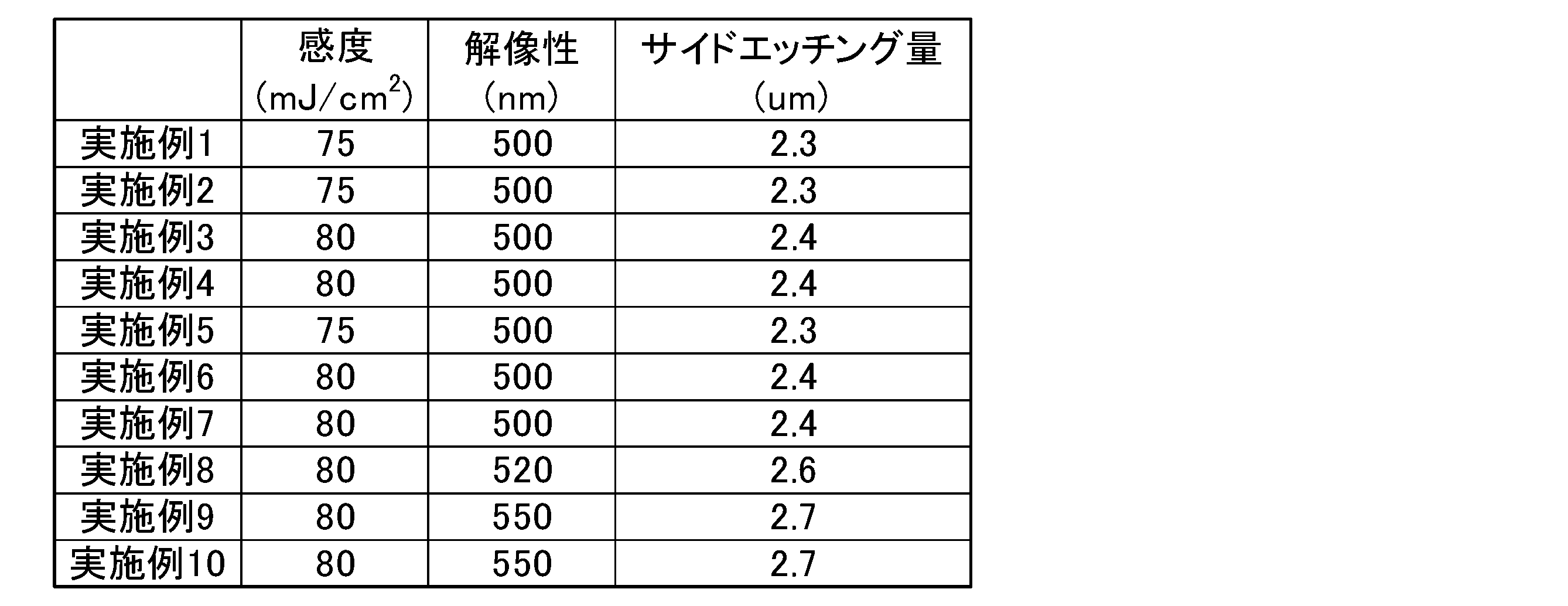
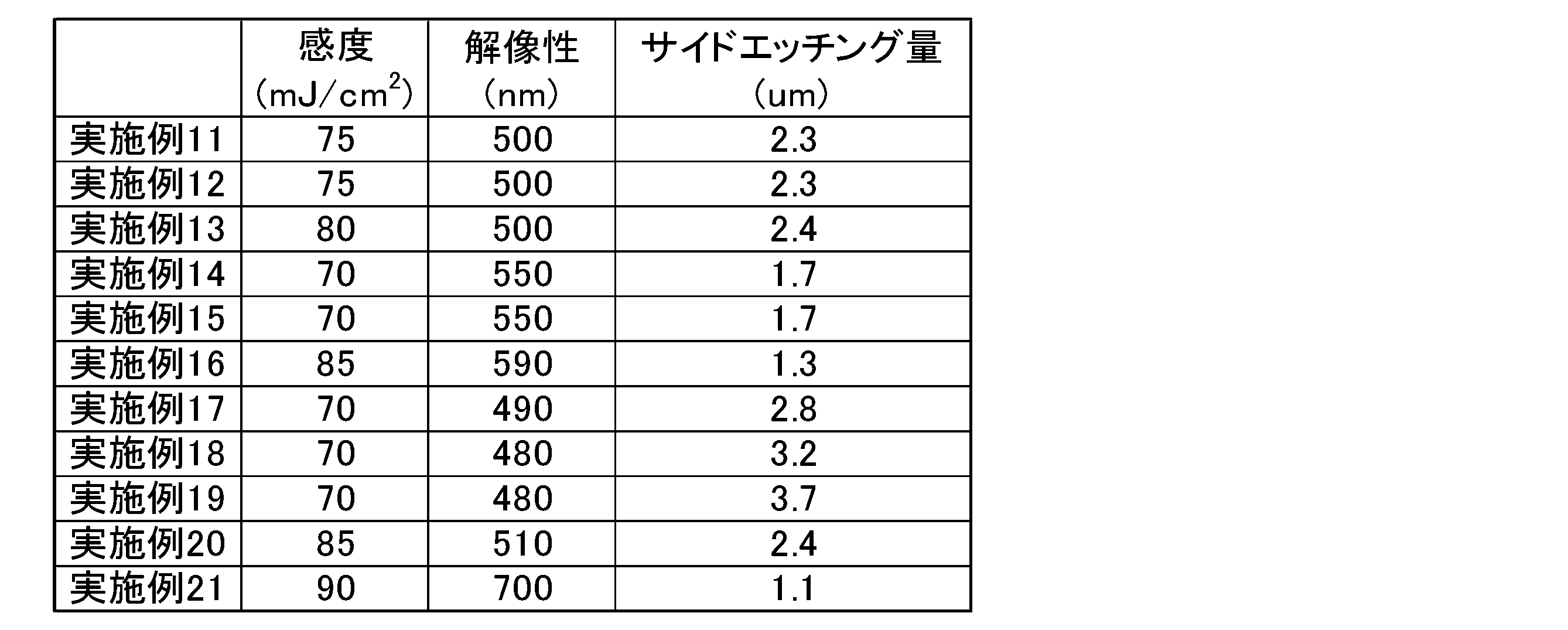

Claims (5)
- 下記一般式(a10-1)で表される構成単位(a10)を有する高分子化合物(A1)と、
酸発生剤(B)と、
メラミン系架橋剤、尿素系架橋剤、アルキレン尿素系架橋剤、グリコールウリル系架橋剤、およびエポキシ系架橋剤からなる群から選ばれる少なくとも1種の架橋剤(C)と、 ポリエーテル化合物(Z)と、
を含有し、
前記ポリエーテル化合物(Z)の含有量が、前記高分子化合物(A1)100質量部に対して50質量部未満であるレジスト組成物。

- 前記ポリエーテル化合物(Z)の含有量が、前記高分子化合物(A1)100質量部に対して20質量部未満である請求項1に記載のレジスト組成物。
- 前記ポリエーテル化合物(Z)の質量平均分子量(Mw)が、200~25000である、請求項1又は2に記載のレジスト組成物。
- 前記酸発生剤(B)が、下記一般式(b0-1)で表される酸発生剤(B0)を含有する、請求項1~3のいずれか一項に記載のレジスト組成物。


- 支持体上に、請求項1~4のいずれか一項に記載のレジスト組成物を用いてレジスト膜を形成する工程、前記レジスト膜を露光する工程、及び前記露光後のレジスト膜を現像してレジストパターンを形成する工程を有する、レジストパターン形成方法。
Priority Applications (4)
| Application Number | Priority Date | Filing Date | Title |
|---|---|---|---|
| KR1020237019927A KR102811141B1 (ko) | 2020-12-21 | 2021-12-21 | 레지스트 조성물 및 레지스트 패턴 형성 방법 |
| JP2022571505A JP7542653B2 (ja) | 2020-12-21 | 2021-12-21 | レジスト組成物及びレジストパターン形成方法 |
| US18/254,802 US20240302743A1 (en) | 2020-12-21 | 2021-12-21 | Resist composition and method for forming resist pattern |
| CN202180083315.5A CN116583784A (zh) | 2020-12-21 | 2021-12-21 | 抗蚀剂组合物及抗蚀剂图案形成方法 |
Applications Claiming Priority (2)
| Application Number | Priority Date | Filing Date | Title |
|---|---|---|---|
| JP2020211619 | 2020-12-21 | ||
| JP2020-211619 | 2020-12-21 |
Publications (1)
| Publication Number | Publication Date |
|---|---|
| WO2022138648A1 true WO2022138648A1 (ja) | 2022-06-30 |
Family
ID=82159762
Family Applications (1)
| Application Number | Title | Priority Date | Filing Date |
|---|---|---|---|
| PCT/JP2021/047337 Ceased WO2022138648A1 (ja) | 2020-12-21 | 2021-12-21 | レジスト組成物及びレジストパターン形成方法 |
Country Status (5)
| Country | Link |
|---|---|
| US (1) | US20240302743A1 (ja) |
| JP (1) | JP7542653B2 (ja) |
| KR (1) | KR102811141B1 (ja) |
| CN (1) | CN116583784A (ja) |
| WO (1) | WO2022138648A1 (ja) |
Citations (2)
| Publication number | Priority date | Publication date | Assignee | Title |
|---|---|---|---|---|
| JP2019070676A (ja) * | 2016-03-02 | 2019-05-09 | 富士フイルム株式会社 | 平坦化膜の製造方法、感活性光線性または感放射線性の平坦化膜形成用組成物、平坦化膜、および、電子デバイスの製造方法 |
| WO2020137921A1 (ja) * | 2018-12-28 | 2020-07-02 | 富士フイルム株式会社 | 感活性光線性又は感放射線性樹脂組成物、レジスト膜、パターン形成方法、及び、電子デバイスの製造方法 |
Family Cites Families (5)
| Publication number | Priority date | Publication date | Assignee | Title |
|---|---|---|---|---|
| JP3655030B2 (ja) | 1996-12-10 | 2005-06-02 | 東京応化工業株式会社 | ネガ型化学増幅型レジスト組成物 |
| JP4152810B2 (ja) * | 2003-06-13 | 2008-09-17 | 東京応化工業株式会社 | ポジ型レジスト組成物およびレジストパターン形成方法 |
| JP6159701B2 (ja) * | 2013-11-29 | 2017-07-05 | 富士フイルム株式会社 | 感活性光線性又は感放射線性樹脂組成物、及び、パターン形成方法 |
| KR102125252B1 (ko) * | 2015-12-25 | 2020-06-22 | 후지필름 가부시키가이샤 | 감활성광선성 또는 감방사선성 수지 조성물, 감활성광선성 또는 감방사선성막, 패턴 형성 방법, 및 전자 디바이스의 제조 방법 |
| JP7111031B2 (ja) * | 2018-03-23 | 2022-08-02 | 信越化学工業株式会社 | 感光性樹脂組成物、感光性樹脂積層体、及びパターン形成方法 |
-
2021
- 2021-12-21 CN CN202180083315.5A patent/CN116583784A/zh active Pending
- 2021-12-21 KR KR1020237019927A patent/KR102811141B1/ko active Active
- 2021-12-21 WO PCT/JP2021/047337 patent/WO2022138648A1/ja not_active Ceased
- 2021-12-21 US US18/254,802 patent/US20240302743A1/en active Pending
- 2021-12-21 JP JP2022571505A patent/JP7542653B2/ja active Active
Patent Citations (2)
| Publication number | Priority date | Publication date | Assignee | Title |
|---|---|---|---|---|
| JP2019070676A (ja) * | 2016-03-02 | 2019-05-09 | 富士フイルム株式会社 | 平坦化膜の製造方法、感活性光線性または感放射線性の平坦化膜形成用組成物、平坦化膜、および、電子デバイスの製造方法 |
| WO2020137921A1 (ja) * | 2018-12-28 | 2020-07-02 | 富士フイルム株式会社 | 感活性光線性又は感放射線性樹脂組成物、レジスト膜、パターン形成方法、及び、電子デバイスの製造方法 |
Also Published As
| Publication number | Publication date |
|---|---|
| CN116583784A (zh) | 2023-08-11 |
| JP7542653B2 (ja) | 2024-08-30 |
| JPWO2022138648A1 (ja) | 2022-06-30 |
| US20240302743A1 (en) | 2024-09-12 |
| KR102811141B1 (ko) | 2025-05-21 |
| KR20230098899A (ko) | 2023-07-04 |
Similar Documents
| Publication | Publication Date | Title |
|---|---|---|
| TWI830829B (zh) | 阻劑組成物及阻劑圖型形成方法 | |
| JP7250422B2 (ja) | レジスト組成物、及びレジストパターン形成方法 | |
| JP7061834B2 (ja) | レジスト組成物及びレジストパターン形成方法 | |
| JP7042551B2 (ja) | レジスト組成物及びレジストパターン形成方法 | |
| TWI814923B (zh) | 阻劑組成物及阻劑圖型形成方法 | |
| JP6706530B2 (ja) | レジスト組成物及びレジストパターン形成方法 | |
| JP6155013B2 (ja) | レジスト組成物及びレジストパターン形成方法 | |
| JP6986949B2 (ja) | レジスト組成物及びレジストパターン形成方法 | |
| TW201841954A (zh) | 阻劑組成物及阻劑圖型之形成方法 | |
| JP6986880B2 (ja) | レジスト組成物、及びレジストパターン形成方法 | |
| CN110275395B (zh) | 抗蚀剂组合物以及抗蚀剂图案形成方法 | |
| JP6850567B2 (ja) | レジスト組成物及びレジストパターン形成方法 | |
| JP7033849B2 (ja) | レジスト組成物及びレジストパターン形成方法 | |
| KR102707124B1 (ko) | 레지스트 조성물 및 레지스트 패턴 형성 방법 | |
| KR102847461B1 (ko) | 레지스트 조성물 및 레지스트 패턴 형성 방법 | |
| KR20200059157A (ko) | 레지스트 조성물 및 레지스트 패턴 형성 방법 | |
| JP2022190811A (ja) | レジスト組成物及びレジストパターン形成方法 | |
| JP7250450B2 (ja) | レジスト組成物及びレジストパターン形成方法 | |
| KR102811141B1 (ko) | 레지스트 조성물 및 레지스트 패턴 형성 방법 | |
| WO2023013592A1 (ja) | レジスト組成物及びレジストパターン形成方法 | |
| JP6937648B2 (ja) | レジスト組成物及びレジストパターン形成方法 | |
| JP7076207B2 (ja) | レジストパターン形成方法 | |
| JP7080049B2 (ja) | レジストパターン形成方法 | |
| JP2022093096A (ja) | レジスト組成物、及びレジストパターン形成方法 | |
| CN111198479B (zh) | 抗蚀剂组合物以及抗蚀剂图案形成方法 |
Legal Events
| Date | Code | Title | Description |
|---|---|---|---|
| 121 | Ep: the epo has been informed by wipo that ep was designated in this application |
Ref document number: 21910789 Country of ref document: EP Kind code of ref document: A1 |
|
| ENP | Entry into the national phase |
Ref document number: 2022571505 Country of ref document: JP Kind code of ref document: A |
|
| WWE | Wipo information: entry into national phase |
Ref document number: 18254802 Country of ref document: US |
|
| WWE | Wipo information: entry into national phase |
Ref document number: 202180083315.5 Country of ref document: CN |
|
| ENP | Entry into the national phase |
Ref document number: 20237019927 Country of ref document: KR Kind code of ref document: A |
|
| NENP | Non-entry into the national phase |
Ref country code: DE |
|
| 122 | Ep: pct application non-entry in european phase |
Ref document number: 21910789 Country of ref document: EP Kind code of ref document: A1 |