WO2022137386A1 - ルール更新プログラム、ルール更新方法およびルール更新装置 - Google Patents
ルール更新プログラム、ルール更新方法およびルール更新装置 Download PDFInfo
- Publication number
- WO2022137386A1 WO2022137386A1 PCT/JP2020/048158 JP2020048158W WO2022137386A1 WO 2022137386 A1 WO2022137386 A1 WO 2022137386A1 JP 2020048158 W JP2020048158 W JP 2020048158W WO 2022137386 A1 WO2022137386 A1 WO 2022137386A1
- Authority
- WO
- WIPO (PCT)
- Prior art keywords
- rule
- determination
- suitability
- label
- rules
- Prior art date
- Legal status (The legal status is an assumption and is not a legal conclusion. Google has not performed a legal analysis and makes no representation as to the accuracy of the status listed.)
- Ceased
Links
Images


Classifications
-
- G—PHYSICS
- G06—COMPUTING OR CALCULATING; COUNTING
- G06N—COMPUTING ARRANGEMENTS BASED ON SPECIFIC COMPUTATIONAL MODELS
- G06N5/00—Computing arrangements using knowledge-based models
- G06N5/02—Knowledge representation; Symbolic representation
- G06N5/022—Knowledge engineering; Knowledge acquisition
- G06N5/025—Extracting rules from data
-
- G—PHYSICS
- G06—COMPUTING OR CALCULATING; COUNTING
- G06N—COMPUTING ARRANGEMENTS BASED ON SPECIFIC COMPUTATIONAL MODELS
- G06N20/00—Machine learning
-
- G—PHYSICS
- G06—COMPUTING OR CALCULATING; COUNTING
- G06N—COMPUTING ARRANGEMENTS BASED ON SPECIFIC COMPUTATIONAL MODELS
- G06N5/00—Computing arrangements using knowledge-based models
- G06N5/04—Inference or reasoning models
- G06N5/045—Explanation of inference; Explainable artificial intelligence [XAI]; Interpretable artificial intelligence
Definitions
- the present invention relates to a rule update program or the like.
- an interface that can set AI parameters is prepared, and if the rule set output by AI is different from the rule set intended by the user, the parameters are reset using the interface and the rules are set again in AI.
- the conventional technique of resetting the parameters of AI using an interface interactively modifies the constraint conditions for the entire rule set output by AI, and is output in a form that more reflects the user's intention. It updates the set of rules.
- the user confirms each rule against the user's knowledge and experience, corrects the rule as necessary, and sets the rule so that the corrected rule is reflected. It is difficult to update. This is because it is difficult for the user to grasp and understand all the large number of rules output by AI, and to compare them with the user's own experience and knowledge to modify them.
- the first plan is to have the computer perform the following processing.
- the computer the rule updater, receives the first suitability determination for at least a part of the determination rules derived by machine learning using the training data.
- the computer executes a second suitability determination for the non-partial determination rule based on the result of the first suitability determination and the similarity between the partial determination rule and the non-partial determination rule.
- the computer updates the plurality of determination rules based on the result of the first suitability determination and the result of the second suitability determination.
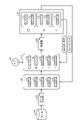
- FIG. 1 is a diagram for explaining the processing of the rule updating device according to the present embodiment.
- FIG. 2 is a functional block diagram showing a configuration of a rule updating device according to this embodiment.
- FIG. 3 is a diagram showing an example of the data structure of the rule set.
- FIG. 4 is a diagram showing an example of the data structure of the labeled rule.
- FIG. 5 is a diagram (1) showing an example of screen information generated by the display control unit.
- FIG. 6 is a diagram (2) showing an example of screen information generated by the display control unit.
- FIG. 7 is a diagram for explaining the processing of the determination unit.
- FIG. 8 is a diagram (1) showing an example of the classification result generated by the display control unit.
- FIG. 9 is a diagram (2) showing an example of the classification result generated by the display control unit.
- FIG. 8 is a diagram (1) showing an example of the classification result generated by the display control unit.
- FIG. 10 is a flowchart (1) showing a processing procedure of the rule updating device according to the present embodiment.
- FIG. 11 is a flowchart (2) showing a processing procedure of the rule updating device according to the present embodiment.
- FIG. 12 is a diagram showing an example of a hardware configuration of a computer that realizes the same function as the rule updating device of the embodiment.
- FIG. 1 is a diagram for explaining the processing of the rule updating device according to this embodiment.
- the rule generation unit 151 of the rule update device receives the input of the data 141, the rule group 20 is generated based on the data 141.
- the rule generation unit 151 derives the rule group 20 based on the learning model machine-learned by the training data.
- the rule group 20 includes rules 1a, 1b, 1c, 1d, and 1e.
- rules 1a-1e indicate whether a hypothesis (combination of explanatory variables) satisfies a specific condition.
- the rule group 20 may include rules other than the rules 1a to 1e.
- rules 1a to 1e and other rules are not particularly distinguished, they are simply referred to as rules.
- the rules correspond to "judgment rules".
- the rule update device displays the information of the rule group 20 on the display device, and provides the user 10 with an interface for assigning a label described later to the rules 1a to 1e.
- the user 10 refers to the rules 1a to 1e of the rule group 20 and assigns a label on the interface based on his / her own experience.
- the user 10 assigns a "first label” to a rule that is determined to be appropriate.
- the user 10 assigns a "second label” to the rule that is determined to be inappropriate.
- the user assigns an "unclassified label” to a rule for which it cannot be determined whether or not it is appropriate.
- the first label is illustrated by a "circle mark”
- the second label is illustrated by a "cross mark”
- the unclassified label is illustrated by "hatena” as appropriate.
- an unclassified label may be set for each rule of the rule group 20, and the user 10 may assign the first label and the second label.
- the rule update device generates a labeled rule 143 based on the result of assigning the appropriateness label from the user 10.
- the labeled rule 143 the first label is given to the rule 1a, the second label is given to the rule 1b, and the unclassified label is given to the rules 1c, 1d, 1e. There is.
- the determination unit 153 of the rule updater determines the similarity between the rules 1a and 1b to which the first label or the second label is attached among the rules 1a to 1e included in the labeled rule 143 and the remaining rules 1c to 1e. Based on the above, the suitability of the rules 1c to 1e is determined.
- the determination unit 153 assigns a first label to rule 1c when it can be probable that rule 1c is appropriate from the similarity between rules 1a and 1b and rule 1c.
- the determination unit 153 assigns a second label to the rule 1c when it can be probable that the rule 1d is not appropriate from the similarity between the rules 1a and 1b and the rule 1d.
- rule 1e is appropriate from the similarity between rules 1a and 1b and rule 1e, the label of rule 1e remains an unclassified label. And.
- the rule changing device notifies the user 10 by displaying the classification result 30 in which the rules 1a to 1e are classified according to the label type on the display device.
- rules 1a and 1c are classified into a group of the first label
- rules 1b and 1d are classified into a group of the second label
- rule 1e is classified into a group of unclassified labels.
- the user 10 refers to the classification result 30 and assigns a suitability label on the interface only to the rule that can newly determine the suitability.
- the user 10 refers to the classification result 30, and when it becomes possible to determine the suitability of the rule to which the unclassified label is attached, the user 10 applies the first label or the first label to the rule to which the unclassified label is attached. 2 Give a label.
- the suitability of the remaining rules is based on the similarity between the rule to which the first label or the second label is assigned and the remaining rules. Is judged and the classification result is displayed.
- the rule updater determines the suitability of the remaining rules based on the process of accepting the label assignment by the user 10, the similarity between the rule to which the first label or the second label is assigned and the remaining rules. Repeat the process of displaying the classification result.
- the rule updating device feeds back to the rule group 20 based on the result of label assignment obtained repeatedly. For example, the rule updater deletes the rule to which the second label is attached from the rule group 20. As mentioned above, the rule with the second label is an inappropriate rule.
- the rule updater accepts the assignment of labels to some of the rules of the rule group 20 from the user 10, and based on the similarity between the labeled rule and the remaining rules. , Determine the label to be given to the remaining rules.
- the rule update device executes a process of updating the rule group 20 based on the label given to the rule. In this way, by assigning a label to the rule for which the user 10 can judge the suitability, the rule group is updated, so that the rule set can be optimized without burdening the user. can.
- FIG. 2 is a functional block diagram showing a configuration of a rule updating device according to this embodiment.
- the rule updating device 100 includes a communication unit 110, an input unit 120, a display unit 130, a storage unit 140, and a control unit 150.
- the communication unit 110 is connected to an external device or the like by wire or wirelessly, and transmits / receives information to / from the external device or the like.
- the communication unit 110 is realized by a NIC (Network Interface Card) or the like.
- the control unit 150 may acquire the data 141 described later via the communication unit 110.
- the input unit 120 is an input device that inputs various information to the rule updating device 100.
- the input unit 120 corresponds to a keyboard, a mouse, a touch panel, and the like.
- the user 10 operates the input unit 120 to add a label to the rule.
- the display unit 130 is a display device that displays information output from the control unit 150.
- the display unit 130 corresponds to a liquid crystal display, an organic EL (Electro Luminescence) display, a touch panel, and the like.
- the display unit 130 displays information about the rule group 20, the classification result 30, and the like.
- the storage unit 140 has data 141, a rule set 142, and a labeled rule 143.
- the storage unit 140 is realized by, for example, a semiconductor memory element such as a RAM (Random Access Memory) or a flash memory (Flash Memory), or a storage device such as a hard disk or an optical disk.
- Data 141 includes data of a plurality of hypotheses.
- a hypothesis is a combination of objective variables and is labeled as to whether the hypothesis meets certain conditions. For example, based on a plurality of hypotheses contained in the data 141, a hypothesis that combines the plurality of hypotheses and a rule group (rule set 142) labeled as to whether or not the hypothesis satisfies a predetermined condition are rules. It is generated by the generation unit 151.
- the rule set 142 holds the data of the rule group generated by the rule generation unit 151 based on the data 141.
- FIG. 3 is a diagram showing an example of the data structure of the rule set. As shown in FIG. 3, the rule set 142 associates the identification information with the rule and the importance. The identification information is information that uniquely identifies the rule.
- the rule indicates whether or not the combination of explanatory variables satisfies a specific condition. “ ⁇ ” indicates an AND condition. “ ⁇ ” is the negation of the explanatory variable immediately after. "1" indicates that a specific condition is satisfied, and "0" indicates that a specific condition is not satisfied. Although the description is omitted in FIG. 3, the OR condition and the like may be included in the rule.
- the rule of the identification information "R1001" indicates that "A”, “B” and “denial of C” are “0 (does not satisfy a specific condition)". As an example, in the case of "A (carnivorous)", “B (with spine)”, and “ ⁇ C (without hair)", it is "(0) not a mammal”.
- the rule of the identification information "R1003" indicates that "A”, “B” and “D” are “1 (satisfying a specific condition)". As an example, in the case of "A (carnivorous)", “B (with spine)”, and “D (with teeth)", it becomes "(1) mammal”.
- Importance indicates how important the rule is to derive "0" or "1".
- the rule of the identification information "R1001” and the rule of the identification information "R1002" are both rules that lead to "0". Since the importance of the rule of the identification information "R1001” is higher than the importance of the rule of the identification information "R1002", the rule of the identification information "R1001” is set to "0" more than the rule of the identification information "R1001". It means that it is more important as a rule to guide.
- the labeled rule 143 is information indicating the label given to the rule.
- FIG. 4 is a diagram showing an example of the data structure of the labeled rule. As shown in FIG. 4, the labeled rule 143 associates the identification information with the rule and the label. The description of the identification information and the rule is the same as the description of the identification information and the rule described with reference to FIG.
- the label is a label indicating whether the corresponding rule is appropriate, not appropriate, or whether it is appropriate or not.
- a “first label” is set for the appropriate rule.
- a “second label” is set for inappropriate rules.
- An “unclassified label” is set for a rule for which it is unclear whether it is appropriate or not.
- the control unit 150 includes a rule generation unit 151, a display control unit 152, a determination unit 153, and an update unit 154.
- the control unit 150 is realized by, for example, a CPU (Central Processing Unit) or an MPU (Micro Processing Unit). Further, the control unit 150 may be executed by an integrated circuit such as an ASIC (Application Specific Integrated Circuit) or an FPGA (Field Programmable Gate Array).
- ASIC Application Specific Integrated Circuit
- FPGA Field Programmable Gate Array
- the rule generation unit 151 generates a rule set 142 by inputting data 141 into a learning model that has undergone machine learning based on training data. For example, in the process of generating the rule set 142 by the rule generation unit 151, the technique described in Patent Document (Japanese Patent Laid-Open No. 2020-46888) or the like may be used, or another technique may be used.
- the rule generation unit 151 stores the generated rule set 142 in the storage unit 140.
- the rule set 142 corresponds to the rule group 20 described with reference to FIG.
- the display control unit 152 generates screen information (interface) for assigning a label to the rule based on the rule set 142, and causes the display unit 130 to display the generated screen information.
- the user 10 who has referred to the screen information operates the input unit 120 to add a label to each rule.
- the display control unit 152 identifies the relationship between the rule and the label based on the input from the user 10, and sets the specified result in the labeled rule 143.
- FIG. 5 is a diagram (1) showing an example of screen information generated by the display control unit.
- the rules of the rule set 142 are displayed one by one, and the label designation from the user 10 is accepted.
- a rule is shown in the area 41.
- the user 10 determines that the rule is appropriate, the user 10 checks the area 41a.
- the user 10 determines that the rule is not appropriate, the user 10 checks the area 41b. If the user 10 cannot determine whether or not the rule is appropriate, the user 10 checks the area 41c. The user 10 presses the button 42 when confirming and confirming the next rule.
- the display control unit 152 sets the label given to the rule to be displayed in the area 41 (the rule of the identification information “R1001”) as an “uncategorized label”. And register it in the labeled rule 143.
- the display control unit 152 When the display control unit 152 accepts the pressing of the button 42, the display control unit 152 generates screen information corresponding to FIG. 5 for the next rule, and repeatedly executes the above process until labeling for all the rules is completed. do. When the display control unit 152 displays the screen information of the last rule, the display control unit 152 may display the fact that it is the last rule on the screen information.
- FIG. 6 is a diagram (2) showing an example of screen information generated by the display control unit.
- the rules included in the rule set 142 are displayed side by side in a row.
- the display control unit 152 displays each rule in descending order of importance.
- the display control unit 152 specifies the area in which the check is input for each rule, and specifies the relationship between the rule and the label.
- the display control unit 152 since the check for the rules of item numbers 1, 3 and 5 is set in the input area of "hatena", the labels of the rules of item numbers 1, 3 and 5 are set. Identifies that is an "uncategorized label".
- the check for the rule of item No. 2 is set in the input area of the "cross mark", so that the label of the rule of item No. 2 is "second label”. Identify that.
- the display control unit 152 specifies that the label of the rule of item No. 4 is the "first label” because the check for the rule of item No. 4 is set in the input area of the "circle mark".
- the determination unit 153 identifies a rule to which the first label or the second label is attached and a rule to which the unclassified label is attached based on the labeled rule 143.
- the determination unit 153 is unclassified when it is possible to derive a probable result based on the similarity between the rule with the first label or the second label and the rule with the unclassified label.
- the first label or the second label is given to the rule to which the label is given.
- FIG. 7 is a diagram for explaining the processing of the determination unit.
- the determination unit 153 determines the label of the identification information “R1001” will be described. Since the determination unit 153 has a second label (inappropriate) attached to the rule “B ⁇ C ⁇ 0" of the identification information "R1002", it is probable that it is "B ⁇ C ⁇ 1". Then, the determination unit 153 can probably derive the rules “ ⁇ B ⁇ C ⁇ 0” and “B ⁇ C ⁇ 0”. Here, the determination unit 153 determines that the rule “A ⁇ B ⁇ C ⁇ 0” of the identification information “R1001” is probably “appropriate” by using the rule “B ⁇ C ⁇ 0”. The determination unit 153 sets the label of the identification information "R1001” to the "first label”.
- the determination unit 153 determines the label of the identification information "R1003" since the determination unit 153 has the first label (appropriate) attached to the rule "C ⁇ D ⁇ 0" of the identification information "R1004", it is probable that it is "C ⁇ D ⁇ 0". Here, the determination unit 153 determines that the rule "A ⁇ C ⁇ D ⁇ 1" of the identification information "R1003” is probably "inappropriate” by using the rule "C ⁇ D ⁇ 0". The determination unit 153 sets the label of the identification information "R1003" to the "second label".
- the determination unit 153 determines the label of the identification information "R1005".
- the rule "A ⁇ D ⁇ E ⁇ 1" of the identification information "R1005" has low similarity to the rule to which the first label or the second label is given by the user 10. Therefore, the determination unit 153 cannot probably determine whether the "first label” or the "second label” is attached. Therefore, the determination unit 153 leaves the label of the identification information "R1005" as the "unclassified label”.
- the determination unit 153 When the above determination is completed, the determination unit 153 outputs information to the effect that the determination is completed to the display control unit 152.
- the display control unit 152 When the display control unit 152 receives the information that the determination is completed from the determination unit 153, the display control unit 152 generates the classification result information and displays the classification result information (screen information) on the display unit 130.
- the user 10 refers to the information of the classification result and operates the input unit 120 with respect to the rule that can be determined whether or not it is appropriate, and assigns the first label or the second label.
- FIG. 8 is a diagram (1) showing an example of the classification result generated by the display control unit.
- the areas 51a, 51b, and 51c are set in the screen information 50 of the classification result.
- the area 51a is an area for displaying the rule to which the first label is attached. For example, when the first label is added (updated) to the rule “A ⁇ B ⁇ C ⁇ 0” by the determination unit 153, the display control unit 152 highlights “A ⁇ B ⁇ C ⁇ 0”.
- the area 51b is an area for displaying the rule to which the second label is attached. For example, when the second label is added (updated) to the rule "A ⁇ C ⁇ D ⁇ 1" by the determination unit 153, the display control unit 152 highlights "A ⁇ C ⁇ D ⁇ 1".
- the area 51c is an area for displaying a rule to which an unclassified label is attached.
- the user 10 can determine the label of the rule of the area 51c based on the relationship between the rule of the area 51a and 52b and the label, the user 10 operates the input unit 120 to make the rule of the area 51c. Give the first label or the second label.
- the display control unit 152 accepts the input from the user 10 and updates the labeled rule 143.
- the user 10 presses the button 53a when continuing the process of assigning a label to the rule.
- the user 10 presses the button 53b.
- the display control unit 152 and the determination unit 153 repeatedly execute the above processing each time the user 10 presses the button 53a.
- the display control unit 152 and the determination unit 153 end the process of setting the label in the labeled rule 143.
- the display control unit 152 generates screen information again, the display control unit 152 selects only the rules to which the unclassified flag is attached based on the labeled rule 143, and transfers the selected rule to the display unit 130. It may be displayed and the label designation by the user 10 may be accepted.
- FIG. 9 is a diagram (2) showing an example of the classification result generated by the display control unit.
- the areas 56a and 56b are set in the screen information 55 of the classification result.
- the area 56a is a rule to which the first label is attached, and is an area for displaying only the rule updated this time.
- the area 56b is a rule to which the second label is attached, and is an area for displaying only the rule updated this time.
- the user 10 refers to the screen information 50 of the classification result shown in FIG. 9, operates the input unit 120, and is the first when it is possible to determine the suitability for the rule to which the unclassified label is attached. Give a label or a second label.
- the user 10 presses the button 57a when continuing the process of assigning a label to the rule.
- the user 10 presses the button 57b.
- the display control unit 152 and the determination unit 153 repeatedly execute the above processing each time the user 10 presses the button 57a.
- the display control unit 152 and the determination unit 153 end the process of setting the label in the labeled rule 143.
- the display control unit 152 generates screen information again, the display control unit 152 selects only the rules to which the unclassified flag is attached based on the labeled rule 143, and transfers the selected rule to the display unit 130. It may be displayed and the label designation by the user 10 may be accepted.
- the display control unit 152 and the determination unit 153 calculate the ratio of the rule to which the "unclassified label” is given among all the rules included in the labeled rule 143, and the calculated ratio is equal to or less than the threshold value ⁇ .
- the process of setting a label in the labeled rule 143 may be terminated.
- the determination unit 153 ends the process of setting the label, the determination unit 153 outputs an update request to the update unit 154.
- the update unit 154 updates the rule set 142 based on the labeled rule 143 when the update request is acquired from the determination unit 153. For example, the update unit 154 identifies the identification information of the rule to which the second label is attached in the labeled rule 143. The update unit 154 updates the rule set 142 by deleting the rule corresponding to the specified identification information from the rule set 142.
- FIG. 10 is a flowchart (1) showing a processing procedure of the rule updating device according to the present embodiment.
- FIG. 10 shows a procedure for continuing the process until the rule update device 100 receives the press of the end button by the user 10.
- the display control unit 152 of the rule update device 100 selects an unclassified label rule from the rule set 142 based on the labeled rule 143 (step S101).
- the display control unit 152 generates screen information based on the selected rule and displays it on the display unit 130 (step S102).
- the display control unit 152 accepts the selection of the label from the user 10 who operates the input unit 120, and registers the label in the labeled rule 143 (step S103).
- the determination unit 153 of the rule update device 100 determines the rule of the unclassified label as one of the first label, the second label, and the unclassified label based on the labeled rule 143 (step S104). If the end button is not pressed by the user 10, the rule update device 100 proceeds to step S101.
- the rule update device 100 proceeds to step S106.
- the update unit 154 of the rule update device 100 updates the rule set 142 based on the labeled rule 143.
- FIG. 11 is a flowchart (1) showing a processing procedure of the rule updating device according to this embodiment.
- FIG. 11 shows a procedure in which the rule updating device 100 continues the process until the ratio of the rules to which the unclassified label is attached becomes equal to or less than a predetermined threshold value ⁇ .
- the display control unit 152 of the rule update device 100 selects an unclassified label rule from the rule set 142 based on the labeled rule 143 (step S201).
- the display control unit 152 generates screen information based on the selected rule and displays it on the display unit 130 (step S202).
- the display control unit 152 accepts a label selection from the user 10 who operates the input unit 120, and registers the label in the labeled rule 143 (step S203).
- the determination unit 153 of the rule update device 100 determines the rule of the unclassified label as one of the first label, the second label, and the unclassified label based on the labeled rule 143 (step S204). When the ratio of the rules to which the unclassified label is attached is not equal to or less than the threshold value ⁇ among all the rules (step S205, No), the rule update device 100 shifts to step S201.
- the rule updating device 100 shifts to step S206 when the ratio of the rules to which the unclassified label is attached is equal to or less than the threshold value ⁇ among all the rules (steps S205, Yes).
- the update unit 154 of the rule update device 100 updates the rule set 142 based on the labeled rule 143.
- the rule updater 100 receives labels from the user 10 for some of the rules of the rule group 20, and the remaining rules are based on the similarity between the labeled rule and the remaining rules. Determine the label to be given to.
- the rule update device 100 executes a process of updating the rule group 20 based on the label given to the rule. In this way, by assigning a label to the rule for which the user 10 can judge the suitability, the rule group is updated, so that the rule set can be optimized without burdening the user. can.
- the rule update device 100 displays the rule in descending order of importance. This makes it easier for the user 10 to determine the suitability of a rule of greater importance.
- the rule updater 100 determines a rule that leads to a probable result when the rule to which the first label or the second label is attached and the rule included in the rule to which the unclassified label is attached are similar rules. Identify. Then, the rule updating device 100 determines the suitability for the rule of the unclassified label based on the specified rule. Thereby, the rule of the unclassified label can be automatically classified into the first label and the second label.
- the rule update device 100 deletes the rule to which the second label is attached from the rule set based on the labeled rule 143. As a result, an appropriate rule can be left in the rule set 142.
- the user confirms each rule for a huge set of rules generated by the rule generation unit 151, and corrects those that can be understood as necessary. can do.
- other rules can be automatically confirmed so as to be appropriate for the user's confirmation result by confirming as much as possible. By repeating this operation several times, most of the rule set can be confirmed and updated as needed.
- FIG. 12 is a diagram showing an example of a hardware configuration of a computer that realizes the same function as the rule updating device of the embodiment.
- the computer 200 has a CPU 201 that executes various arithmetic processes, an input device 202 that receives data input from a user, and a display 203. Further, the computer 200 has a reading device 204 for reading a program or the like from a storage medium, and a communication device 205 for exchanging data with another external device or the like via a wired or wireless network. Further, the computer 200 has a RAM 206 for temporarily storing various information and a hard disk device 207. Then, each of the devices 201 to 207 is connected to the bus 208.
- the hard disk device 207 has a rule generation program 207a, a display control program 207b, a determination program 207c, and an update program 207d. Further, the CPU 201 reads out the programs 207a to 207d and develops them in the RAM 206.
- the rule generation program 207a functions as the rule generation process 206a.
- the display control program 207b functions as the display control process 206b.
- the determination program 207c functions as the determination process 206c.
- Update 207d functions as update process 206d.
- the processing of the rule generation process 206a corresponds to the processing of the rule generation unit 151.
- the processing of the display control process 206b corresponds to the processing of the display control unit 152.
- the process of the determination process 206c corresponds to the process of the determination unit 153.
- the process of the update process 206d corresponds to the process of the update unit 154.
- each program 207a to 207d does not necessarily have to be stored in the hard disk device 207 from the beginning.
- each program is stored in a "portable physical medium" such as a flexible disk (FD), a CD-ROM, a DVD, a magneto-optical disk, or an IC card inserted in the computer 200. Then, the computer 200 may read and execute each of the programs 207a to 207d.
- Rule updater 110 Communication unit 120 Input unit 130 Display unit 140 Storage unit 141 Data 142 Rule set 143 Labeled rule 150 Control unit 151 Rule generation unit 152 Display control unit 153 Judgment unit 154 Update unit
Landscapes
- Engineering & Computer Science (AREA)
- General Engineering & Computer Science (AREA)
- Theoretical Computer Science (AREA)
- Physics & Mathematics (AREA)
- Data Mining & Analysis (AREA)
- Evolutionary Computation (AREA)
- Computational Linguistics (AREA)
- Computing Systems (AREA)
- General Physics & Mathematics (AREA)
- Mathematical Physics (AREA)
- Software Systems (AREA)
- Artificial Intelligence (AREA)
- Information Retrieval, Db Structures And Fs Structures Therefor (AREA)
Priority Applications (5)
| Application Number | Priority Date | Filing Date | Title |
|---|---|---|---|
| JP2022570854A JPWO2022137386A1 (https=) | 2020-12-23 | 2020-12-23 | |
| CN202080107995.5A CN116710934A (zh) | 2020-12-23 | 2020-12-23 | 规则更新程序、规则更新方法以及规则更新装置 |
| PCT/JP2020/048158 WO2022137386A1 (ja) | 2020-12-23 | 2020-12-23 | ルール更新プログラム、ルール更新方法およびルール更新装置 |
| EP20966877.1A EP4270258A4 (en) | 2020-12-23 | 2020-12-23 | Rule updating program, rule updating method, and rule updating device |
| US18/330,603 US20230316108A1 (en) | 2020-12-23 | 2023-06-07 | Non-transitory computer-readable recording medium storing rule update program, rule update method, and rule update device |
Applications Claiming Priority (1)
| Application Number | Priority Date | Filing Date | Title |
|---|---|---|---|
| PCT/JP2020/048158 WO2022137386A1 (ja) | 2020-12-23 | 2020-12-23 | ルール更新プログラム、ルール更新方法およびルール更新装置 |
Related Child Applications (1)
| Application Number | Title | Priority Date | Filing Date |
|---|---|---|---|
| US18/330,603 Continuation US20230316108A1 (en) | 2020-12-23 | 2023-06-07 | Non-transitory computer-readable recording medium storing rule update program, rule update method, and rule update device |
Publications (1)
| Publication Number | Publication Date |
|---|---|
| WO2022137386A1 true WO2022137386A1 (ja) | 2022-06-30 |
Family
ID=82158693
Family Applications (1)
| Application Number | Title | Priority Date | Filing Date |
|---|---|---|---|
| PCT/JP2020/048158 Ceased WO2022137386A1 (ja) | 2020-12-23 | 2020-12-23 | ルール更新プログラム、ルール更新方法およびルール更新装置 |
Country Status (5)
| Country | Link |
|---|---|
| US (1) | US20230316108A1 (https=) |
| EP (1) | EP4270258A4 (https=) |
| JP (1) | JPWO2022137386A1 (https=) |
| CN (1) | CN116710934A (https=) |
| WO (1) | WO2022137386A1 (https=) |
Citations (4)
| Publication number | Priority date | Publication date | Assignee | Title |
|---|---|---|---|---|
| JPH05241837A (ja) * | 1992-02-28 | 1993-09-21 | Toshiba Corp | 規則集合生成装置 |
| JPH1115842A (ja) | 1997-06-24 | 1999-01-22 | Mitsubishi Electric Corp | データマイニング装置 |
| JP2007034739A (ja) * | 2005-07-27 | 2007-02-08 | Nec Corp | 管理支援システム、管理支援方法、および管理支援プログラム |
| JP2020046888A (ja) | 2018-09-18 | 2020-03-26 | 富士通株式会社 | 学習プログラム、予測プログラム、学習方法、予測方法、学習装置および予測装置 |
Family Cites Families (1)
| Publication number | Priority date | Publication date | Assignee | Title |
|---|---|---|---|---|
| US11507863B2 (en) * | 2020-05-21 | 2022-11-22 | Apple Inc. | Feature determination for machine learning to suggest applications/recipients |
-
2020
- 2020-12-23 CN CN202080107995.5A patent/CN116710934A/zh active Pending
- 2020-12-23 JP JP2022570854A patent/JPWO2022137386A1/ja not_active Withdrawn
- 2020-12-23 EP EP20966877.1A patent/EP4270258A4/en not_active Withdrawn
- 2020-12-23 WO PCT/JP2020/048158 patent/WO2022137386A1/ja not_active Ceased
-
2023
- 2023-06-07 US US18/330,603 patent/US20230316108A1/en active Pending
Patent Citations (4)
| Publication number | Priority date | Publication date | Assignee | Title |
|---|---|---|---|---|
| JPH05241837A (ja) * | 1992-02-28 | 1993-09-21 | Toshiba Corp | 規則集合生成装置 |
| JPH1115842A (ja) | 1997-06-24 | 1999-01-22 | Mitsubishi Electric Corp | データマイニング装置 |
| JP2007034739A (ja) * | 2005-07-27 | 2007-02-08 | Nec Corp | 管理支援システム、管理支援方法、および管理支援プログラム |
| JP2020046888A (ja) | 2018-09-18 | 2020-03-26 | 富士通株式会社 | 学習プログラム、予測プログラム、学習方法、予測方法、学習装置および予測装置 |
Also Published As
| Publication number | Publication date |
|---|---|
| EP4270258A1 (en) | 2023-11-01 |
| CN116710934A (zh) | 2023-09-05 |
| JPWO2022137386A1 (https=) | 2022-06-30 |
| EP4270258A4 (en) | 2024-02-28 |
| US20230316108A1 (en) | 2023-10-05 |
Similar Documents
| Publication | Publication Date | Title |
|---|---|---|
| CN112639833B (zh) | 可自适应神经网络 | |
| US10909871B2 (en) | Method, apparatus, and computer program for operating machine-learning framework | |
| CN109509056A (zh) | 基于对抗网络的商品推荐方法、电子装置及存储介质 | |
| JP6973106B2 (ja) | 学習プログラム、学習方法および学習装置 | |
| CN113705092B (zh) | 基于机器学习的疾病预测方法及装置 | |
| US20210196428A1 (en) | Artificial Intelligence (AI) based Decision-Making Model for Orthodontic Diagnosis and Treatment Planning | |
| JP7554528B1 (ja) | 情報処理装置、推論装置、機械学習装置、情報処理方法、推論方法、及び、機械学習方法 | |
| Fu et al. | Survival trees for interval‐censored survival data | |
| JP2019125319A (ja) | 学習プログラム、学習方法および学習装置 | |
| CN113782163A (zh) | 信息推送方法、装置和计算机可读存储介质 | |
| JP2019040335A (ja) | 教師データを生成する方法、学習済みモデルを生成する方法、学習済みモデル、コンピュータおよびプログラム | |
| JP2020119101A (ja) | テンソル生成プログラム、テンソル生成方法およびテンソル生成装置 | |
| CN113297338B (zh) | 产品推荐路径生成方法、装置、设备及存储介质 | |
| WO2021090484A1 (ja) | 学習装置、情報統合システム、学習方法、及び、記録媒体 | |
| JP2018155871A (ja) | 学習支援端末、学習支援サーバ、学習支援システム、学習支援方法、および学習支援プログラム | |
| JP7400965B2 (ja) | 気分予測方法、気分予測装置及びプログラム | |
| US11475324B2 (en) | Dynamic recommendation system for correlated metrics and key performance indicators | |
| JP6925179B2 (ja) | 解探索処理装置 | |
| WO2022137386A1 (ja) | ルール更新プログラム、ルール更新方法およびルール更新装置 | |
| CN113723611A (zh) | 基于因果推断的业务因子生成方法、装置、设备及介质 | |
| JP6771014B2 (ja) | 情報処理装置、情報処理方法及びプログラム | |
| CN118096291A (zh) | 产品推荐方法、装置、设备及存储介质 | |
| EP2678790A1 (en) | Pattern recognition | |
| JP2017162386A (ja) | 表示制御プログラム、表示制御方法及び表示制御装置 | |
| CN114398985B (zh) | Ai模型的训练方法、装置、设备及存储介质 |
Legal Events
| Date | Code | Title | Description |
|---|---|---|---|
| 121 | Ep: the epo has been informed by wipo that ep was designated in this application |
Ref document number: 20966877 Country of ref document: EP Kind code of ref document: A1 |
|
| ENP | Entry into the national phase |
Ref document number: 2022570854 Country of ref document: JP Kind code of ref document: A |
|
| WWE | Wipo information: entry into national phase |
Ref document number: 202080107995.5 Country of ref document: CN |
|
| NENP | Non-entry into the national phase |
Ref country code: DE |
|
| ENP | Entry into the national phase |
Ref document number: 2020966877 Country of ref document: EP Effective date: 20230724 |