WO2022124361A1 - タバコ植物及びたばこ製品 - Google Patents
タバコ植物及びたばこ製品 Download PDFInfo
- Publication number
- WO2022124361A1 WO2022124361A1 PCT/JP2021/045295 JP2021045295W WO2022124361A1 WO 2022124361 A1 WO2022124361 A1 WO 2022124361A1 JP 2021045295 W JP2021045295 W JP 2021045295W WO 2022124361 A1 WO2022124361 A1 WO 2022124361A1
- Authority
- WO
- WIPO (PCT)
- Prior art keywords
- amino acid
- tobacco
- nitrate reductase
- seq
- tobacco plant
- Prior art date
- Legal status (The legal status is an assumption and is not a legal conclusion. Google has not performed a legal analysis and makes no representation as to the accuracy of the status listed.)
- Ceased
Links
Images







Classifications
-
- A—HUMAN NECESSITIES
- A24—TOBACCO; CIGARS; CIGARETTES; SIMULATED SMOKING DEVICES; SMOKERS' REQUISITES
- A24B—MANUFACTURE OR PREPARATION OF TOBACCO FOR SMOKING OR CHEWING; TOBACCO; SNUFF
- A24B13/00—Tobacco for pipes, for cigars, e.g. cigar inserts, or for cigarettes; Chewing tobacco; Snuff
-
- A—HUMAN NECESSITIES
- A01—AGRICULTURE; FORESTRY; ANIMAL HUSBANDRY; HUNTING; TRAPPING; FISHING
- A01H—NEW PLANTS OR NON-TRANSGENIC PROCESSES FOR OBTAINING THEM; PLANT REPRODUCTION BY TISSUE CULTURE TECHNIQUES
- A01H6/00—Angiosperms, i.e. flowering plants, characterised by their botanic taxonomy
- A01H6/82—Solanaceae, e.g. pepper, tobacco, potato, tomato or eggplant
- A01H6/823—Nicotiana, e.g. tobacco
-
- A—HUMAN NECESSITIES
- A01—AGRICULTURE; FORESTRY; ANIMAL HUSBANDRY; HUNTING; TRAPPING; FISHING
- A01H—NEW PLANTS OR NON-TRANSGENIC PROCESSES FOR OBTAINING THEM; PLANT REPRODUCTION BY TISSUE CULTURE TECHNIQUES
- A01H1/00—Processes for modifying genotypes ; Plants characterised by associated natural traits
- A01H1/10—Processes for modifying non-agronomic quality output traits, e.g. for industrial processing; Value added, non-agronomic traits
- A01H1/101—Processes for modifying non-agronomic quality output traits, e.g. for industrial processing; Value added, non-agronomic traits involving biosynthetic or metabolic pathways, i.e. metabolic engineering, e.g. nicotine or caffeine
-
- A—HUMAN NECESSITIES
- A01—AGRICULTURE; FORESTRY; ANIMAL HUSBANDRY; HUNTING; TRAPPING; FISHING
- A01H—NEW PLANTS OR NON-TRANSGENIC PROCESSES FOR OBTAINING THEM; PLANT REPRODUCTION BY TISSUE CULTURE TECHNIQUES
- A01H5/00—Angiosperms, i.e. flowering plants, characterised by their plant parts; Angiosperms characterised otherwise than by their botanic taxonomy
- A01H5/12—Leaves
-
- C—CHEMISTRY; METALLURGY
- C12—BIOCHEMISTRY; BEER; SPIRITS; WINE; VINEGAR; MICROBIOLOGY; ENZYMOLOGY; MUTATION OR GENETIC ENGINEERING
- C12N—MICROORGANISMS OR ENZYMES; COMPOSITIONS THEREOF; PROPAGATING, PRESERVING, OR MAINTAINING MICROORGANISMS; MUTATION OR GENETIC ENGINEERING; CULTURE MEDIA
- C12N15/00—Mutation or genetic engineering; DNA or RNA concerning genetic engineering, vectors, e.g. plasmids, or their isolation, preparation or purification; Use of hosts therefor
- C12N15/09—Recombinant DNA-technology
- C12N15/63—Introduction of foreign genetic material using vectors; Vectors; Use of hosts therefor; Regulation of expression
- C12N15/79—Vectors or expression systems specially adapted for eukaryotic hosts
- C12N15/82—Vectors or expression systems specially adapted for eukaryotic hosts for plant cells, e.g. plant artificial chromosomes (PACs)
- C12N15/8241—Phenotypically and genetically modified plants via recombinant DNA technology
- C12N15/8242—Phenotypically and genetically modified plants via recombinant DNA technology with non-agronomic quality (output) traits, e.g. for industrial processing; Value added, non-agronomic traits
- C12N15/8243—Phenotypically and genetically modified plants via recombinant DNA technology with non-agronomic quality (output) traits, e.g. for industrial processing; Value added, non-agronomic traits involving biosynthetic or metabolic pathways, i.e. metabolic engineering, e.g. nicotine, caffeine
-
- C—CHEMISTRY; METALLURGY
- C12—BIOCHEMISTRY; BEER; SPIRITS; WINE; VINEGAR; MICROBIOLOGY; ENZYMOLOGY; MUTATION OR GENETIC ENGINEERING
- C12N—MICROORGANISMS OR ENZYMES; COMPOSITIONS THEREOF; PROPAGATING, PRESERVING, OR MAINTAINING MICROORGANISMS; MUTATION OR GENETIC ENGINEERING; CULTURE MEDIA
- C12N9/00—Enzymes; Proenzymes; Compositions thereof; Processes for preparing, activating, inhibiting, separating or purifying enzymes
- C12N9/0004—Oxidoreductases (1.)
- C12N9/0012—Oxidoreductases (1.) acting on nitrogen containing compounds as donors (1.4, 1.5, 1.6, 1.7)
- C12N9/0044—Oxidoreductases (1.) acting on nitrogen containing compounds as donors (1.4, 1.5, 1.6, 1.7) acting on other nitrogen compounds as donors (1.7)
-
- C—CHEMISTRY; METALLURGY
- C12—BIOCHEMISTRY; BEER; SPIRITS; WINE; VINEGAR; MICROBIOLOGY; ENZYMOLOGY; MUTATION OR GENETIC ENGINEERING
- C12Y—ENZYMES
- C12Y107/00—Oxidoreductases acting on other nitrogenous compounds as donors (1.7)
- C12Y107/01—Oxidoreductases acting on other nitrogenous compounds as donors (1.7) with NAD+ or NADP+ as acceptor (1.7.1)
- C12Y107/01001—Nitrate reductase (NADH) (1.7.1.1)
Definitions
- the present invention relates to a tobacco plant, a method for producing the same, a tobacco product, and the like.
- Tobacco-specific nitrosamine is a nitroso product of tobacco alkaloids produced mainly during the drying of tobacco leaves. Tobacco plants accumulate high levels of free nitrate in their leaves, which are associated with the production of TSNA. The substance directly involved in TSNA production during the drying of tobacco leaves is said to be nitrite. Free nitrates accumulated in the leaves of tobacco plants are converted to nitrites by the nitrate-reducing enzyme (NR) of tobacco, but nitrites are cytotoxic and are rapidly metabolized, so they are generally plant tissues. The amount of endogenous nitrite contained in is very small.
- NR nitrate-reducing enzyme
- nitrites involved in TSNA production during drying of tobacco leaves are produced from nitrates by microorganisms that inhabit the leaf surface. That is, in the leaf drying step, as the leaf tissue is decomposed, the nitrate accumulated in the leaf is eluted and converted into nitrite by the nitrate reductase (NR) possessed by the microorganisms living on the leaf surface.
- NR nitrate reductase
- Nitrate reductase is an enzyme that catalyzes the first step of reducing nitrate nitrogen in plants to organic form and is regulated at transcriptional, translational and post-translational levels. The dark environment inactivates nitrate reductase by phosphorylation followed by binding of 14-3-3 proteins (Lillo et al. 2004).
- Non-Patent Document 1 discloses that Ser543, a nitrate reductase of spinach, is a phosphorylation site involved in post-translational regulation using a synthetic peptide. , We are investigating the effect of substitution of amino acid residues around it on the affinity with NR kinase. Among them, it has been shown that the change of arginine residue (R540) at the minus 3 position or leucine (L538) at the minus 5 position to alanine from Ser543 significantly impairs the affinity with NR kinase.
- FIG. 8 of Non-Patent Document 1 shows a highly conserved controlled phosphorylation site of nitrate reductase regardless of the plant species, and serine at position 523 corresponds to this in tobacco NIA2. ..
- Non-Patent Document 2 Plant physiology. , 140 (2006), 1085-1094 (Non-Patent Document 2) introduced a nitrate reductase (S521D-NR) gene in which serine at position 521 of NIA2 was converted to aspartic acid into a mutant of the tobacco plant Nicotiana plumbaginifolia E23.
- S521D-NR nitrate reductase
- S521D strain the plant into which the S521D-NR gene was introduced (S521D strain) constantly maintained high nitrate reductase activity day and night, and the nitrate content of the individual was day and night. It is stated that the level was almost constant and remained at a low level regardless of.
- Plant J. , 35 (2003), 566-573 Non-Patent Document 3
- Non-Patent Document 3 describes the production of the S521D-NR construct of tobacco and the S521D-NR-introduced tobacco.
- Non-Patent Document 1 Considering the description of Non-Patent Document 1, it is clear that "S521D" in Non-Patent Documents 2 and 3 is an error in "S523D".
- Patent Document 1 (corresponding to Japanese Patent Publication No. 2017-528850) describes tobacco products having reduced tobacco-specific nitrosamines (TSNA) produced from tobacco plants.
- the tobacco plant is (I) A polynucleotide consisting essentially of a sequence encoding a relaxed nitrate reductase enzyme or a sequence encoding a relaxed nitrate reductase enzyme, including a sequence encoding a relaxed nitrate reductase enzyme. (Ii) The polypeptide encoded by the polynucleotide described in (i).
- the expression or activity of the nitrate reductase is alleviated as compared with the control unmodified tobacco plant, and the alleviated nitrate reductase enzyme is used.
- Patent Document 1 regarding the S523D mutant of the nitrate reductase gene (Nia2) of tobacco, data on a decrease in the amount of nitrate in the leaves of the S523D mutant and data on a decrease in TSNA in dry leaves and smoke are disclosed. Has been done.
- the S523D mutant of the example of the document is a constitutive expression of the S523D mutant Nia2 with the 35S promoter.
- Patent Document 2 describes a variant in which the methionine residue at position 527 of the nitrate reductase protein of tobacco is replaced with another amino acid residue.
- the examples of Patent Document 2 describe that the amount of nitrate in leaves of the M527I mutant (homozygous type only) of the nitrate reductase gene (Nia2) of tobacco was reduced.
- Non-Patent Documents 2 and 3 and Patent Document 1 are those in which the Nia2 gene having an amino acid substitution mutation is constitutively expressed by the 35S promoter. As confirmed by the applicant, it was revealed that this genetically modified product is accompanied by severe growth failure. Further, Patent Document 2 describes that it is considered that the NR activity is lowered because M527 is easily phosphorylated by mutating to I. In spite of this, the reason why the amount of nitric acid contained decreases is not stated. Also, heterozygotes with mutations heterozygous are not disclosed. Further, regarding the Nia1 gene, no mutant, gene-modified variant, or gene recombinant has been obtained in any of the prior art documents.
- Proline 525 (P525), a nitrate reductase protein of tobacco plants, is located at the plus 2 position from serine 523 (S523) at the phosphorylation site. Although this proline is known to be widely conserved in plants (Fig. 8 of Non-Patent Document 1), it has been shown that the conversion of this proline to alanine does not significantly affect the recognition by NR kinase (Fig. 8 of Non-Patent Document 1). Table 3) of Non-Patent Document 1.
- the present inventors produced a large number of mutants in which two kinds of nitrate reductases NIA1 and NIA2 were mutated in tobacco plants, and among them, the amino acid residue corresponding to the 525th position of the amino acid sequence of the nitrate reductase protein.
- tobacco plants containing a nitrate reductase whose group is mutated from proline to an amino acid residue other than proline have (a) the activity of the nitrate reductase is unlikely to decrease even under dark conditions, and (b) the growth of the control and the individual.
- the present invention was conceived by finding that it is essentially equivalent and (c) has the excellent property of having reduced nitrate as compared to the control.
- a tobacco plant comprising a nitrate reductase in which the amino acid residue corresponding to position 525 in the amino acid sequence corresponding to SEQ ID NO: 2 or 4 is mutated from proline to an amino acid residue other than proline.
- Aspect 2 It has one or more properties among the following (a)-(c).
- A) The activity of nitrate reductase under dark conditions is 80% or more of the activity of nitrate reductase under light conditions;
- the growth of the individual is essentially equivalent to that of the control; and / or (c) the nitric acid is reduced compared to the control.
- the control is a tobacco plant comprising a nitrate reductase consisting of the amino acid sequence of SEQ ID NO: 2 or 4.
- [Aspect 3] The tobacco plant according to aspect 1 or 2, comprising a nitrate reductase in which the amino acid residue corresponding to position 525 in the amino acid sequence corresponding to SEQ ID NO: 2 or 4 is mutated from proline to leucine or serine.
- Aspect 4 The item according to any one of aspects 1-3, wherein in the amino acid sequence of the mutated nitrate reductase, the amino acid residue corresponding to position 523 in the amino acid sequence corresponding to SEQ ID NO: 2 or 4 is serine. Tobacco plant.
- [Aspect 11] Leaf tobacco harvested from the tobacco plant according to any one of aspects 1-9.
- [Aspect 12] Dried leaves produced from the leaf tobacco according to aspect 11.
- [Aspect 13] A cut filler, powder, sheet, middle bone, granule, or extract produced from the dried leaves according to aspect 12.
- [Aspect 14] A tobacco product comprising the dried leaves according to aspect 12 and / or the cut filler, powder, sheet, middle bone, granules, or extract according to aspect 13.
- the modified tobacco plant of the present invention has a reduced amount of nitrate accumulated in the leaves.
- the TSNA of tobacco raw materials and tobacco products can be reduced.
- the modified tobacco plant of the present invention not only the amount of nitric acid in the leaves was reduced, but also the growth of the plant body was preferably good. This is also an excellent and remarkable effect for use as a leaf tobacco material for manufacturing tobacco products.
- FIG. 1 is a diagram showing the amount of nitric acid in leaves (lamina) in which NIA2 (NIA2_S523D) having the S523D mutation and wild-type NIA2 (NIA2_WT) are constantly expressed.
- S523D-16 and S523-20 are two T1 generation strains derived from different T0 individuals.
- WT-4, WT-13, and WT-22 are three T1 generation strains derived from different T0 individuals.
- S523D-Null and WT-Null are recombinants transformed from NIA2_S523D and NIA2_WT, respectively, and are the result of leaves of the T1 generation line that do not express NIA2_S523D and NIA2_WT.
- FIG. 2 is a photograph of a plant about 3 weeks after transplantation.
- S523D-16 Plant constantly expressing NIA2 (NIA2_S523D) with S523D mutation, T1 generation
- S523D-20 Plant constantly expressing NIA2 (NIA2_S523D) with S523D mutation, T1 generation
- WT-13 Wild-type NIA2 (NIA2_WT) constitutively expressed plant, T1 generation
- WT-22 Wild-type NIA2 (NIA2_WT) constitutively expressed plant, T1 generation
- S523D-Null, WT-Null NIA2_S523D Plants that do not express NIA2_WT, T1 generation
- FIG. 1 is a photograph of a plant about 3 weeks after transplantation.
- S523D-16 Plant constantly expressing NIA2 (NIA2_S523D) with S523D mutation, T1 generation
- S523D-20 Plant constantly expressing NIA2 (NIA2_S523D) with
- FIG. 3 shows the initial growth (temporary planting 11 days) of the S523D-16 recombinant (a plant in which NIA2 (NIA2_S523D) having the S523D mutation was constantly expressed) and Null (an isolated line not expressing NIA2_S523D, T2 generation). It is a photograph of eyes).
- FIG. 4 shows the results of a dark nitrite elution test of NIA2_S523D constitutive expression recombinant, wild-type SR-1, and NIA2_WT constitutive expression recombinant (WT-13).
- S523D-16 and S523D-20 are two different strains of the T1 generation derived from different T0 individuals.
- FIG. 5 shows the light condition (L) (left) and the dark condition (D) of the NIA2_S523D constitutive expression recombinant, wild-type SR-1, WT-13 and NIA2_WT constitutive expression recombinant (WT-13). It is the result of analyzing the activation rate of the nitrate reductase activity (NR activity) test in (right). S523D-16 and S523D-20 are two different strains of the T1 generation derived from different T0 individuals. The number of iterations is 4, the error bar is the standard error FIG.
- FIG. 6 shows nitric acid in tobacco leaves (lamina) obtained by cultivating each line of M2 or M3 generation with liquid fertilizer for the EMS mutant having a missense substitution mutation in the hinge 1 region of NIA1 or NIA2 prepared in Example 1. This is the result of examining the amount. Individuals with homozygous mutations were analyzed using wild-type tobacco Tsukuba No. 1 as a control in each generation. The number of iterations is 3 or 4, and the error bar is the standard deviation.
- FIG. 7 shows nitric acid in tobacco leaves (lamina) obtained by cultivating each line of M2 or M3 generation with liquid fertilizer for the EMS mutant having a missense substitution mutation in the hinge 1 region of NIA1 or NIA2 prepared in Example 1.
- FIG. 7 shows nitric acid in tobacco leaves (lamina) obtained by cultivating each line of M2 or M3 generation with liquid fertilizer for the EMS mutant having a missense substitution mutation in the hinge 1 region of NIA1 or NIA2 prepared in Example 1. This is the result of examining the amount. Individuals whose mutations were homozygous or heterozygous were analyzed using WT individuals with no mutations separated from each other as controls.
- the number of iterations is 3 or 4, the error bar is the standard deviation, and * is a significant difference from the control.
- FIG. 8 for the EMS mutant having a missense substitution mutation in the hinge 1 region of NIA2 prepared in Example 1, each line of the M3 generation was cultivated with liquid fertilizer, and the amount of nitric acid in tobacco leaves (lamina) was examined. The result. Individuals with homozygous mutations were analyzed using wild-type tobacco Tsukuba No. 1 as a control in the M3 generation. The number of iterations is 4, and the error bar is the standard deviation.
- FIG. 8 for the EMS mutant having a missense substitution mutation in the hinge 1 region of NIA2 prepared in Example 1, each line of the M3 generation was cultivated with liquid fertilizer, and the amount of nitric acid in tobacco leaves (lamina) was examined. The result. Individuals with homozygous mutations were analyzed using wild-type tobacco Tsukuba No. 1 as a control in the M3 generation. The number of it
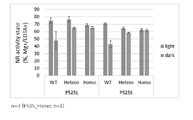
- FIG. 9 shows the results of a test in which the activation rates of NIA1_P525L and NIA1_P525S (M2 generation) nitrate reductase activity (NR activity) were analyzed under bright conditions (light) (left) and dark conditions (dark) (right). be. Individuals whose mutations were homozygous or heterozygous were analyzed using WT individuals with no mutations separated from each other in the M2 generation as controls. The number of iterations is 3 or 2, and the error bar is the standard error.
- FIG. 10 shows the results of a dark nitrite elution test of NIA1_P525L and NIA1_P525S (M3 generation).
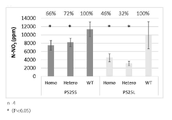
- FIG. 11 shows the results of cultivating each line of the M3 generation with liquid fertilizer for NIA1_P525L and NIA1_P525S, and examining the amount of nitric acid in tobacco leaves (lamina). Individuals whose mutations were homozygous or heterozygous were analyzed using WT individuals with no mutations separated from each other in the M3 generation as controls. The number of iterations is 4, the error bar is the standard deviation, and * is a significant difference from the control.
- FIG. 11 shows the results of cultivating each line of the M3 generation with liquid fertilizer for NIA1_P525L and NIA1_P525S, and examining the amount of nitric acid in tobacco leaves (lamina). Individuals whose mutations were homozygous or heterozygous were analyzed using WT individuals with no mutations separated from each other in the M3 generation as controls. The number of iterations is 4, the error bar is the standard deviation, and * is a significant difference from the control.
- FIG. 12 is a photograph of plants 16 days after transplantation for each M3 generation line of NIA1_P525L and NIA1_P525S. Individuals whose mutations are homozygous or heterozygous are shown as controls, with WT individuals having no mutations separated from each other in the M3 generation as controls.
- FIG. 13 shows the results of examining the nitrate nitrogen concentration in the dry leaves of the homozygous or heterozygous individual of the P525L mutation and the P525S mutation, and the WT individual having no control mutation. The number of repetitions is 6 for WT of P525L, 7 for hetero, 5 for homo, 4 for WT of P525S, 6 for hetero, and 2 for homo.
- the error bar is the standard error (SE).
- FIG. 14 is a photograph of plants of the T1 generation lines of S523D-OE, S523D-null, WT-OE, and WT-null of TN90 8 days after transplantation.
- FIG. 15 shows the results of examining the number of above-ground leaves in the T1 generation lines of S523D-OE, S523D-null, WT-OE, and WT-null of TN90. The number of iterations is 4, the significant difference by t-test: ** P ⁇ 0.01, and the error bar is the standard deviation (SD).
- SD standard deviation
- FIG. 16 shows the results of examining the stem length of the T1 generation strains of S523D-OE, S523D-null, WT-OE, and WT-null of TN90.
- the number of iterations is 4, the significant difference by t-test: ** P ⁇ 0.01, and the error bar is the standard deviation (SD).
- FIG. 17 shows the results of examining the above-ground leaf dry matter weight (biomass) of the T1 generation lines of S523D-OE, S523D-null, WT-OE, and WT-null of TN90.
- the number of iterations is 4, the significant difference by t-test: ** P ⁇ 0.01, and the error bar is the standard deviation (SD).
- FIG. 18 shows the results of examining the number of above-ground leaves in the T1 generation strains of S523D-OE, S523D-null, P525L-Homo, and P525S-Homo of Tsukuba No. 1.
- the number of iterations is 9 (S523D-OE, Null) or 6 (P525S, P525L), significant difference by t-test: ** P ⁇ 0.01, error bar is standard deviation (SD).
- FIG. 19 shows the results of examining the stem length of the T1 generation strains of S523D-OE, S523D-null, P525L-Homo, and P525S-Homo of Tsukuba No. 1.
- FIG. 20 shows the results of examining the above-ground leaf dry matter weight (biomass) of the T1 generation strains of S523D-OE, S523D-null, P525L-Homo, and P525S-Homo of Tsukuba No. 1.
- the number of iterations is 9 (S523D-OE, Null) or 6 (P525S, P525L), significant difference by t-test: ** P ⁇ 0.01, error bar is standard deviation (SD).
- FIG. 20 shows the results of examining the above-ground leaf dry matter weight (biomass) of the T1 generation strains of S523D-OE, S523D-null, P525L-Homo, and P525S-Homo of Tsukuba No. 1.
- the number of iterations is 9 (S523D-OE, Null) or 6 (P525S, P525L), significant difference by t-test: ** P ⁇ 0.01, error bar is standard
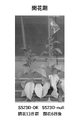
- FIG. 21 is a photograph showing the flowering period of the T1 generation lines of S523D-OE and S523D-null of Tsukuba No. 1 92 days after sowing. Both were sown at the same time. The left is S523D-OE in the state 13 days before flowering, and the right is S523D-null in the state 6 days after flowering.
- FIG. 22A shows the relative value (%) of the amount of nicotine in the dried leaves of the P525L mutant and the P525S mutant (BC2F3 generation) cultivated in the field. Each is a relative value when the average value of the nicotine concentration in the dry leaves of WT is 100%.
- FIG. 22B shows the relative value (%) of TSNAs in the dry leaves of the P525L mutant and the P525S mutant (BC2F3 generation) cultivated in the field. Each is a relative value when the average value of the TSNAs concentration in the dry leaves of WT is 100%.
- the number of iterations is 20 (Homo of P525L only 19), significant difference by t-test: ** P ⁇ 0.01, error bar is standard deviation.
- TSNAs is the total value of four types of TSNA (NNN, NAT, NAB, NNK).
- the present invention includes, but is not limited to, the following aspects. Unless otherwise noted herein, the technical and scientific terms used herein have the same meaning as commonly understood by one of ordinary skill in the art. The substances, materials and examples disclosed herein are merely exemplary and are not intended to be limiting. As used herein, the term "in one aspect” is meant to be, but not limited to, that aspect.
- the invention relates to a tobacco plant.
- the tobacco plant of the present invention is a nitrate reductase in which the amino acid residue corresponding to position 525 in the amino acid sequence corresponding to SEQ ID NO: 2 or 4 is mutated from proline to an amino acid residue other than proline (hereinafter, "mutated"). (Sometimes referred to as "nitrate reducing enzyme").
- the "tobacco plant” is a plant belonging to the genus Nicotina of the family Tobacco, for example, Nicotiana acaulis, Nicotiana acuminata, Nicotiana acuminata, Nicotiana variation, and Nicotiana.
- Nicotiana africana Nicotiana alata, Nicotiana amplexicaulis, Nicotiana arenzii, Nikotiana antasia Benavidisii), Nicotiana Bensamiana (Nicotiana benthamiana), Nicotiana bigellovii, Nicotiana bonariensis (Nicotiana bonariensis), Nicotiana bonaria cilanico (Nicotiana cordifolia), Nicotiana corymbosa, Nicotiana debneyi, Nicotiana excelsior (Nicotiana excelsior), Nicotiana excelsior, Nicotiana forge Nicotiana gluca, Nicotiana glutinosa, Nicotiana goodspeedii, Nicotiana gosei, Nicotiana gossei, Nicotiana gossei, Nicotiana gossei, Nicotiana gossei Nicotiana knighttiana), Nicotiana Langsdolfi (Nicotia) na Langsdorfi, Nicotiana
- the tobacco plant can include not only the adult tobacco plant, the whole, but also a part thereof. Not limited, the said part is a leaf (including leaf blade and peduncle), stem, root, seed, flower, pollen, anther, embryo bead, florets, meristem, leaflet, embryo axis, inner sheath, embryo, embryo milk. , Explants, callus, tissue culture, buds, cells, and protoplasts.
- Nitrate reductase (sometimes referred to as "NR") is a type of nitrogen reductase that means an enzyme that reduces nitric acid (NO 3- ) to nitrite (NO 2- ) . .. Nitrate reductase is widely distributed in plants, yeasts, fungi, algae and the like. In plants, nitrate reductase is known in tobacco, oilseed rape, green bean, barley, pumpkin, kabanoki, soybean, corn, rice, spinach and the like (Table 8 of Non-Patent Document 1).
- the nitrate reductase is derived from a plant, preferably from a plant of the genus Nicotiana. In one embodiment, the nitrate reductase is a nitrate reductase from Nicotiana tabacum. Nicotiana tabacum has two highly homologous nitrogen-metabolizing enzyme genes called Nia1 and Nia2.
- Nitrate reductase herein includes, in one embodiment, the NIA1 protein (the Nia1 gene is derived from the T genome) and variants thereof, and / or the NIA2 protein (the Nia2 gene is derived from the S genome) and variants thereof. In one aspect, the nitrate reductase herein comprises the NIA1 protein (the Nia1 gene is derived from the T genome) and variants thereof.
- the Nia1 gene and the Nia2 gene each have the base sequences of SEQ ID NOs: 1 and 3.
- the NIA1 protein and the NIA2 protein each have the amino acid sequences of SEQ ID NOs: 2 and 4 encoded by the base sequences of SEQ ID NOs: 1 and 3, respectively.
- the tobacco plant of the present invention contains a nitrate reductase in which the amino acid residue corresponding to position 525 in the amino acid sequence corresponding to SEQ ID NO: 2 or 4 is mutated from proline to an amino acid residue other than proline.
- containing nitrate reductase means containing a nitrate reductase protein or a nucleic acid encoding a nitrate reductase protein, unless otherwise specified.
- the amino acid sequence of 518-528 of the amino acid sequence corresponding to SEQ ID NO: 2 or 4 is "LKKSISTPFMN".
- Nitrate-reducing enzyme proteins of plants other than Nicothiana tabacam also contain a site having an amino acid sequence similar to that of the amino acid sequence "LKKSISTPFMN" of 518-528 of the amino acid sequence corresponding to SEQ ID NO: 2 or 4.
- the site may contain some variations, for example, in Table 8 of Non-Patent Document 1, in 518-528 of the amino acid sequence corresponding to SEQ ID NO: 2 or 4, the nitrate reductase protein "LK (K / K /) of each plant. It is described that it has an amino acid sequence of "R) (S / T) (I / V / T / A) S (T / S) PFMN".
- amino acid residue corresponding to position 525 in the amino acid sequence corresponding to SEQ ID NO: 2 or 4" is, for example, an amino acid residue following the wild-type S- (T / S) of the nitrate reductase protein. And the amino acid residue that leads to FM, which is proline in the wild-type nitrate reductase protein.
- proline at position 525 in the wild-type nitrate reductase protein is mutated to an amino acid residue other than proline. Mutations in the nitrate reductase gene may be heterozygous or homozygous. When there are two types of nitrate reductase proteins, NIA1 protein and NIA2 protein, the mutation may be either NIA1 protein or NIA2 protein.
- the tobacco plant comprises a nitrate reductase in which the amino acid residue corresponding to position 525 in the amino acid sequence corresponding to SEQ ID NO: 2 or 4 is mutated from proline to leucine or serine.
- the amino acid residue corresponding to position 523 in the amino acid sequence corresponding to SEQ ID NO: 2 or 4 is serine. This means that the amino acid residue at this position is not mutated (including unmodified) from the wild-type nitrate reductase.
- the amino acid residue corresponding to position 527 in the amino acid sequence corresponding to SEQ ID NO: 2 or 4 is methionine. This means that the amino acid residue at this position is not mutated (including unmodified) from the wild-type nitrate reductase.
- the amino acid residue corresponding to position 525 in the amino acid sequence corresponding to SEQ ID NO: 2 or 4 is mutated from proline to an amino acid residue other than proline. It is a reducing enzyme, and preferably, as long as the condition that the amino acid residue corresponding to position 523 in the amino acid sequence corresponding to SEQ ID NO: 2 or 4 is serine in the amino acid sequence of nitrate reducing enzyme is satisfied. It may be a variant having some diversity (variation) from No. 2 or 4.
- the mutated nitrate reductase has an amino acid sequence that is 80% or more identical to the amino acid sequence of SEQ ID NO: 2 or 4. Preferably, it is 82% or more identical, 85% or more identical, 88% or more identical, 90% or more identical, 92% or more identical, 95% or more identical, 97% or more identical, 98% or more identical to the amino acid sequence of SEQ ID NO: 2 or 4. Same, 99% or more identical. In either case, the condition is that the amino acid residue corresponding to position 525 in the amino acid sequence corresponding to SEQ ID NO: 2 or 4 is mutated from proline to an amino acid residue other than proline.
- the mutated nitrate reductase is encoded by a nucleic acid having a base sequence that is 80% or more identical to the base sequence corresponding to SEQ ID NO: 1 or 3. Preferably, it is 82% or more identical, 85% or more identical, 88% or more identical, 90% or more identical, 92% or more identical, 95% or more identical, 97% or more identical, 98% or more identical to the base sequence of SEQ ID NO: 1 or 3. It is encoded by a nucleic acid having the same base sequence of 99% or more. In either case, the condition is that the amino acid residue corresponding to position 525 in the amino acid sequence corresponding to SEQ ID NO: 2 or 4 is mutated from proline to an amino acid residue other than proline.
- the% identity of two amino acid sequences can be determined by visual inspection and mathematical calculation. It is also possible to determine the% identity using a computer program. Examples of such computer programs include BLAST and ClustalW. In particular, various conditions (parameters) for identity search by the BLAST program are described in Altschul et al. (Nucl. Acids. Res., 25, p. 3389-3402, 1997), and NCBI and DNA Data Bank of Japan. It can be publicly obtained from the website of (DDBJ) (BLAST Manual, Altschul et al. NCB / NLM / NIH Bethesda, MD20894; Altschul et al.). In addition, genetic information processing software GENETYX Ver. It can also be determined using a program such as 7 (Genetics), DNASIS Pro (Hitachi Software), Vector NTI (Infomax).
- the% identity of two base sequences can be determined by visual inspection and mathematical calculation. It is also possible to determine the% identity using a computer program.
- sequence comparison computer programs include, for example, the US National Medical Library website: https: // blast. ncbi. nlm. nih. gov / Blast.
- BLASTN programs available from cgi (Altschul et al. (1990) J. Mol. Biol. 215: p.403-10): version 2.2.7, WU-BLAST 2.0 algorithm and the like.
- the standard default parameter settings for WU-BLAST 2.0 can be found at the following Internet sites: http: // blast. Washington. Those described in edu can be used.
- the mutated nitrate reductase may have an amino acid sequence in which one or several amino acids have been deleted, substituted, inserted or added in the amino acid sequence of SEQ ID NO: 2 or 4. .
- the nitrate reductase satisfies the condition that the amino acid residue corresponding to position 525 in the amino acid sequence corresponding to SEQ ID NO: 2 or 4 is mutated from proline to an amino acid residue other than proline.
- amino acids are not limited to 200 or less, 100 or less, 50 or less, 30 or less, 20 or less, 15 or less, 12 or less, 10 or less, 8 or less, It means 6 or less, 4 or less, 3 or less, and 2 or less amino acids.
- the few amino acids mean 30%, preferably 25%, 20%, 15%, 10%, 5%, 3%, 2% or 1% amino acids with respect to the overall length of the amino acid sequence.
- substitution is preferably a conservative substitution.
- a conservative substitution is the replacement of a particular amino acid residue with a residue having similar physicochemical characteristics, but any substitution that does not substantially alter the structural characteristics of the original sequence. It may be any substitution, for example, as long as the substituted amino acid does not disrupt the spiral present in the original sequence or the other type of secondary structure that characterizes the original sequence.
- the following are examples of conservative substitutions of amino acid residues classified by substitutable residues, but the substitutable amino acid residues are not limited to those described below.
- Group A leucine, isoleucine, valine, alanine, methionine, glycine, cysteine, proline
- Group B aspartic acid, glutamic acid
- Group C aspartic acid
- D lysine
- Group E serine
- Group F phenylalanine, tyrosine
- tryptophan histidine non-conservative substitution
- the cysteine may be deleted or replaced with another amino acid to prevent folding into the protein in a tertiary structure.
- the amino acid hydropathy index (J) which is an index of hydrophobicity / hydrophilicity with respect to amino acids, so as to maintain a hydrophilic / hydrophobic balance or to increase the hydrophilicity for facilitating synthesis.
- Amino acids may be substituted in consideration of Kyte and R. Doolittle, J. Mol. Biol., Vol.157, p.105-132, 1982).
- substitution with an amino acid having less steric damage than the original amino acid for example, substitution from group F to groups A, B, C, D, E; substitution from a charged amino acid to an uncharged amino acid.
- substitution from group B to group C may be performed.
- the mutated nitrate reductase has an amino acid sequence corresponding to any one of SEQ ID NOs: 5-8.
- SEQ ID NOs: 5 and 6 are amino acid sequences in which the amino acid residue corresponding to position 525 in the amino acid sequence corresponding to SEQ ID NO: 2 or 4, respectively, is mutated from proline to leucine.
- SEQ ID NOs: 7 and 8 are amino acid sequences in which the amino acid residue corresponding to position 525 in the amino acid sequence corresponding to SEQ ID NO: 2 or 4, respectively, is mutated from proline to serine.
- the tobacco plant may be a mutant or a genetically modified product.
- a “mutant” is a variant of a tobacco plant due to a random mutation that occurs naturally or artificially.
- the method for producing a mutant is described in detail in "3. Method for producing a tobacco plant” below.
- the mutant is not limited, but is the amino acid residue corresponding to the 525th position in the amino acid sequence corresponding to SEQ ID NO: 2 or 4 from the progeny in which the mutant is crossed with a tobacco plant as one parent. It may be a tobacco plant selected that has a nucleic acid encoding a nitrate reductase protein whose group is mutated from proline to an amino acid residue other than proline, or a progeny thereof.
- the “gene variant” expresses a nitrate reductase protein in which the amino acid residue corresponding to position 525 in the amino acid sequence corresponding to SEQ ID NO: 2 or 4 is mutated from proline to an amino acid residue other than proline. It is a tobacco plant in which the endogenous gene encoding the protein is modified so as to be a proline.
- the “mutant” and “gene variant” can include not only the adult tobacco plant, the whole, but also a part thereof. Not limited, the said part is a leaf (including leaf blade and peduncle), stem, root, seed, flower, pollen, anther, embryo bead, florets, meristem, leaflet, embryo axis, inner sheath, embryo, embryo milk. , Explants, callus, tissue culture, buds, cells, and protoplasts.
- the tobacco plant comprises a nitrate reductase protein in which the amino acid residue corresponding to position 525 in the amino acid sequence corresponding to SEQ ID NO: 2 or 4 is mutated from proline to an amino acid residue other than proline. It may be a recombinant or a progeny in which the nucleic acid encoding the protein is externally introduced so as to be expressed. It is preferable, but not limited to, that the nucleic acid encoding the protein is stably integrated into the genome so as to be transmitted to progeny.
- the tobacco plant of the present invention has, without limitation, one or more of the following properties (a)-(c).
- B) The growth of the individual is essentially equivalent to that of the control; and / or (c) Nitric acid is reduced compared to the control.
- control is a tobacco plant containing a nitrate reductase consisting of the amino acid sequence of SEQ ID NO: 2 or 4.
- the nitrate reductase consisting of the amino acid sequence of SEQ ID NO: 2 or 4 is a nitrate reductase possessed by a wild-type tobacco plant and has not been modified at all.
- the control may be Nicotiana tabacam, preferably wild-type Nicotiana tabacam, comprising a nitrate reductase consisting of the amino acid sequence of SEQ ID NO: 2 or 4.
- the wild-type Nicotiana tabacum contains a nitrate reductase consisting of the amino acid sequence of SEQ ID NO: 2 or 4, and its expression and activity have not been modified in any way.
- the tobacco plant of the present invention has two or more properties or all three properties among (a)-(c).
- the "activity of nitrate reductase” can be measured without limitation, for example, by the method described in (5) "NR enzyme activity" of Comparative Example 2 of the present specification.
- tissue of the collected tobacco plant leaves (lamina) is freeze-dried to prepare a crude extract.
- An NR activity measurement buffer is added to this crude extract to react, and the amount of nitrite produced in the reaction solution is measured.
- Activity of nitrate reducing enzyme is also a method of measuring the absorbance at 340 nm using 0.5 mM potassium ferricyanide and 0.1 mM NADH instead of quantifying nitrite, using reduced methylviologen or bromophenol blue. It can be measured by a method for measuring the oxidation or the like.
- the "activity of nitrate reductase" in the present specification may be the activity measured by the above-mentioned method or method with respect to the tissue of the target tobacco plant.
- the dark condition is not limited to 30 minutes or more and 60 minutes or more, 90 minutes or more, and 120 minutes or more under a condition where light does not reach (for example, an illuminance of 1 lux or less, preferably 0.1 lux or less). Means.
- the bright condition means that the light reaches conditions (for example, 5000 lux or more, preferably 10,000 lux or more) for 30 minutes or more, 60 minutes or more, 90 minutes or more, and 120 minutes or more.
- the activity of nitrate reductase under dark conditions is 80% or more of the activity of nitrate reductase under light conditions
- the activity of nitrate reductase under dark conditions is the same except for light conditions. It means that it is 80% or more of the activity of nitrate reductase under bright conditions measured by the same method.
- the activity of nitrate reductase under dark conditions is 85% or more, 88% or more, 90% or more, 92% or more, 95% or more, 97 of the activity of nitrate reductase under light conditions. % Or more, 98% or more, 99% or more.
- the activity of nitrate reductase under dark conditions is not substantially reduced as compared to the activity of nitrate reductase under light conditions, i.e., substantially the same. In one embodiment, the activity of nitrate reductase under dark conditions is the same as the activity of nitrate reductase under light conditions.
- a tobacco plant (control) containing a nitrate reductase consisting of the amino acid sequence of SEQ ID NO: 2 or 4 the activity of nitrate reductase is suppressed in dark conditions as compared with light conditions.
- a tobacco plant containing a nitrate reductase in which the amino acid residue corresponding to position 525 in the amino acid sequence corresponding to SEQ ID NO: 2 or 4 is mutated from proline to an amino acid residue other than proline can be used even under dark conditions.
- the activity of the nitrate reductase is not suppressed or is difficult to be suppressed as in the bright condition.
- the activity of the nitrate reductase under dark conditions is unlikely to decrease not only in the mutant homozygotes but also in the mutant heterozygotes.
- the tobacco plant contains a nitrate reductase consisting of the amino acid sequence of SEQ ID NO: 2 or 4, and the growth of the individual is essentially equivalent to that of the control, which is a tobacco plant.
- the tobacco plant containing a nitrate reducing enzyme in which the amino acid residue corresponding to position 525 in the amino acid sequence corresponding to SEQ ID NO: 2 or 4 is mutated from proline to an amino acid residue other than proline has a SEQ ID NO:
- the growth of the individual was essentially equivalent to that of the control, which is a tobacco plant, containing a nitrate reductase consisting of 2 or 4 amino acid sequences.
- the control which is a tobacco plant, containing a nitrate reductase consisting of 2 or 4 amino acid sequences.
- no abnormal growth was observed in the strain in which the amino acid substitution mutations of P525L and P525S of NIA1 were homozygous.
- “Individual growth is essentially equivalent” means individual size (growth), mass (eg, above-ground leaf dry matter weight), such as plant height, number of leaves, leaf size, etc. Biomass)), and the time of flowering, etc. are substantially the same. Non-limitingly, for example, when comparing heights, it means that the difference is within 20%, within 15%, within 10%, within 5%.
- the tobacco plant contains a reduced amount of nitric acid as compared to the control.
- Nitric acid can be measured without limitation, for example, by the method described in (2) Nitric acid quantification of Comparative Example 2 of the present specification.
- a leaf collected from a tobacco plant may be dried, extracted with water, and then filtered, and the filtrate may be used as a measurement sample.
- the tobacco plant is preferably nitric acid compared to a control, preferably at least 10%, at least 15%, at least 20%, at least 25%, at least 30%, at least 35%, at least 40%, at least 45. %, At least 50% reduction.
- the present invention relates to a method for producing a tobacco plant. How to make a tobacco plant (I) The amino acid residue corresponding to position 525 in the amino acid sequence corresponding to SEQ ID NO: 2 or 4 of the nitrate reductase of tobacco plants is modified from proline to an amino acid residue other than proline, or (Ii) Select a tobacco plant in which the amino acid residue corresponding to the 525th position in the amino acid sequence corresponding to SEQ ID NO: 2 or 4 of the nitrate reductase is mutated from proline to an amino acid residue other than proline by mutation. Including that.
- the modification of the amino acid residue corresponding to position 525 in the amino acid sequence corresponding to SEQ ID NO: 2 or 4 from proline to an amino acid residue other than proline is carried out by the tobacco plant in SEQ ID NO: 2 or.
- the endogenous gene encoding the protein is modified so that the amino acid residue corresponding to position 525 in the amino acid sequence corresponding to 4 expresses a nitrate reductase protein in which the amino acid residue corresponding to position 525 is mutated from proline to an amino acid residue other than proline. Can be done by doing.
- Modification of the endogenous gene may be performed using, for example, a genome editing system.
- Genome editing systems can bind or cleave the endogenous nitrate reductase gene at specific positions to make a nitrate reductase protein with a mutation at position 525 in the amino acid sequence corresponding to SEQ ID NO: 2 or 4.
- the endogenous nitrate reductase gene can be modified by a genome editing system containing a site-specific nuclease that binds and cleaves the endogenous nitrate reductase gene.
- Genome editing systems can also utilize nuclease-mediated non-homologous end binding or homologous recombination repair. Site-specific nucleases can be modified.
- the modification site-specific nuclease may be a CRISPR / Cas9 system, ZFN or TALEN.
- Site-specific nucleases can bind and cleave the endogenous nitrate reductase gene.
- a modified CRISPR / Cas system such as a modified CRISPR / Cas-9 system, a modified transcriptional activator-like effector nuclease, a modified zinc finger nuclease or a modified meganuclease may be utilized.
- the amino acid residue corresponding to position 525 in the amino acid sequence corresponding to SEQ ID NO: 2 or 4 of the nitrate reductase protein was mutated from proline to an amino acid residue other than proline by mutation. It may include a step of selecting a tobacco plant.
- Techniques for causing mutations in plants are well known in the art and are predominantly point mutations and mutations that produce short deletions, insertions, base conversions, and / or metastases, including chemical mutagens or radiation.
- the raw material can be used to create mutations in the nitrate reductase gene of plants.
- Chemical mutagens are ethylmethane sulfonate, methylmethane sulfonate, N-ethyl-N-nitrosolea, triethylmelamine, N-methyl-N-nitrosolea, procarbazine, chlorambucil, cyclophosphamide, diethyl.
- Radiation also includes, but is not limited to, gamma rays, heavy ion beams, X-rays, neutron rays, or UV.
- the step of selecting a tobacco plant in which the amino acid residue corresponding to position 525 in the amino acid sequence corresponding to SEQ ID NO: 2 or 4 of the nitrate reductase protein is mutated from proline to an amino acid residue other than proline by mutation is It may include one or more crossing steps.
- the seeds are sown and cultivated to obtain a first-generation plant, which is then self-pollinated to obtain a mutant. May be screened.
- the advantage of screening for second generation plants is that the mutation is a germ cell-derived mutation.
- the target of mutagenesis may be, but is not limited to, seeds and pollen. When mutagenesis is performed on pollen, mutants may be screened for plants grown from seeds obtained by crossing the pollen with plants that have not been mutated. ..
- a nitrate reductase protein in which the amino acid residue corresponding to position 525 in the amino acid sequence corresponding to SEQ ID NO: 2 or 4 is mutated from proline to an amino acid residue other than proline is used as tobacco.
- the nucleic acid encoding the protein can also be artificially introduced into the tobacco plant so that it can be expressed in the plant.
- the method for introducing nucleic acid is not particularly limited, and a known method for introducing nucleic acid can be used.
- a physicochemical method such as a polyethylene glycol method (PEG method), an electroporation method, a particle gun method, a microinjection method, a whisker method, or a biological method such as an Agrobacterium method (agrobacterium method).
- the method of indirect introduction of DNA can be preferably used.
- the selection of the gene variant, mutant, or recombinant of interest for the amino acid residue corresponding to position 525 in the amino acid sequence corresponding to SEQ ID NO: 2 or 4 is not limited, for example, from tobacco plants. This is performed by extracting the genomic DNA, amplifying it by PCR or the like, and analyzing the base sequence of the DNA encoding the portion containing the amino acid residue corresponding to the 525th position in the amino acid sequence corresponding to SEQ ID NO: 2 or 4. be able to.
- a method of detecting the difference in sequence by the difference in the distance of electrophoresis using the SCSP (Single strand conformation Polymorphism) method a method of detecting the presence or absence of mutation by cutting the mismatched site using T7 Endonulease I, etc. You can select from such as.
- SCSP Single strand conformation Polymorphism
- the present invention comprises a nitrate reducing enzyme in which the amino acid residue corresponding to position 525 in the amino acid sequence corresponding to SEQ ID NO: 2 or 4 is mutated from proline to an amino acid residue other than proline. It may be a selection nucleic acid marker for use in order to select. Alternatively, it is a detection polynucleotide used for detection of a mutation of an amino acid residue corresponding to position 525 in the amino acid sequence corresponding to SEQ ID NO: 2 or 4 of a nitrate reductase from proline to an amino acid residue other than proline. It may be there.
- the selection nucleic acid marker or the detection polynucleotide amplifies the base sequence of the DNA encoding the portion containing the amino acid residue corresponding to the 525th position in the amino acid sequence corresponding to SEQ ID NO: 2 or 4.
- Those skilled in the art can appropriately select these selection nucleic acid markers or detection polynucleotides based on known techniques.
- the present invention comprises a nitrate reducing enzyme in which the amino acid residue corresponding to position 525 in the amino acid sequence corresponding to SEQ ID NO: 2 or 4 is mutated from proline to an amino acid residue other than proline.
- Nucleic acid marker for selection used for selection, or amino acid residue corresponding to position 525 in the amino acid sequence corresponding to SEQ ID NO: 2 or 4 of nitrate reductase protein from proline to amino acid residue other than proline It may be a kit containing a detection polynucleotide used to detect a mutation.
- the present invention comprises a tobacco plant in which the amino acid residue corresponding to position 525 in the amino acid sequence corresponding to SEQ ID NO: 2 or 4 is mutated from proline to an amino acid residue other than proline, and the tobacco of the present invention. It may be a tobacco plant and its proline crossed with a tobacco plant having a reduced nitrate content and / or TSNA by a mechanism different from that of the plant. Examples of such mating parents include mutants modified so that the major nicotine demethylase, CYP82E4, does not function and mutants of nitrate transporters.
- a tobacco plant containing a nitrate reductase in which the amino acid residue corresponding to position 525 in the amino acid sequence corresponding to SEQ ID NO: 2 or 4 is mutated from proline to leucine or serine was obtained.
- the mutation of the base sequence for causing the amino acid change from proline to leucine is CCA ⁇ CTA
- the mutation of the base sequence for causing the amino acid change from proline to serine is CCA ⁇ TCA, both of which are mutations of only one base. rice field.
- nitrate reductase a region with low conservability (hinge 1 region) that connects conservative domains is known. S523D described in Non-Patent Documents 2 and 3 exists in this hinge 1 region.
- 26 kinds of tobacco plants having nitrate reductase with mutated amino acids in the hinge 1 region were obtained, and the amount of nitrate in the leaves was examined. As a result, the reduction was observed in the two kinds of P525 mutations of the present invention. It was only the body.
- the present invention relates to leaf tobacco harvested from the tobacco plant of the present invention in one embodiment.
- the present invention also relates to dried leaves produced from the leaf tobacco of the present invention.
- tobacco leaf of the present invention The significance of the "tobacco leaf of the present invention” is as explained in "3. Method for producing a tobacco plant”.
- the step of producing dried leaves from leaf tobacco is not particularly limited, and a known method can be used.
- Tobacco plants can be harvested from their leaves and used as materials for the production of tobacco products and the like.
- Tobacco leaves may be air-dried, heat-dried, yellow-dried or sun-dried.
- Non-limitingly air-drying hang in a well-ventilated barn and expose to air to dry for 4-8 weeks.
- Thermally dried tobacco is suspended in a large barn and heat dried continuously or intermittently with thermal power for 3 days to 10 weeks depending on the process and tobacco.
- For yellow-dried tobacco the tobacco is lined up in a row, hung in a drying hut, and usually slowly raised in temperature for about a week to dry.
- Sun-dried tobacco is dried in the sun. This method is used to produce Orient leaf tobacco in Turkey, Greece, and other Mediterranean countries.
- the present invention relates to a dried leaf derived from the leaf tobacco of the present invention, a dried leaf of leaf tobacco.
- the leaf tobacco and dried leaves are nitrate reductase proteins in which the amino acid residue corresponding to position 525 in the amino acid sequence corresponding to SEQ ID NO: 2 or 4 is mutated from proline to an amino acid residue other than proline.
- it contains a nucleic acid encoding the protein.
- the dried leaves have reduced tobacco-specific nitrosamines (TSNA) as compared to the dried leaves produced from the tobacco leaves of the control tobacco plant described in "2. Properties of Tobacco Plants”. There is.
- TSNA tobacco-specific nitrosamines
- TSNA N-nitrosonornicotine N-nitroso anatabin (NAT) N-nitrosoanabasin (NAB) Nicotine-derived nitrosoketone (NNK)
- NNN N-nitrosonornicotine
- NAT N-nitroso anatabin
- NAB N-nitrosoanabasin
- NNK Nicotine-derived nitrosoketone
- the tobacco plant has at least one component of TSNA or a total of the components of TSNA reduced by at least 5%, 10%, 15%, 20%, 25%, 30% as compared to the control. ing.
- the present invention is a cut filler, powder, sheet, medium bone, granule, or extract produced from the dried leaves of the present invention. Regarding.
- Cut filler is a strip of dried tobacco leaves that is cut into strips and used for rolled tobacco.
- the “middle bone” is the thickest vein that runs in the center of the leaf.
- Powder is a crushed powder of dried tobacco leaves.
- Gram is a powder formed into granules.
- Extracts are materials such as leaves and stems derived from tobacco plants ("parts”, preferably “non-proliferation", for the purpose of improving the flavor of tobacco products and reducing the content of specific components in tobacco products. It is obtained by extracting (including the sex part).
- As the extraction method a known method for extracting essential oils, specific components and the like from plants can be used.
- the present invention is not limited, but relates to a composition containing the tobacco plant (including a portion) or dried leaves of the present invention, or a tobacco material derived from these (cut filler, etc.).
- the tobacco plant or a portion thereof may be used as it is, or may be cut, crushed or ground into fine pieces, slurry or fine powder.
- the tobacco plant or a part thereof may be used as it is harvested from a field or the like, or a one in which a part of water is dissipated indoors or outdoors for a predetermined period, or most of the water is removed by a dryer or the like. Dissipated ones may be used.
- composition may include cut fillers, powders, sheets, midbones, granules, or extracts made from the dried leaves of the present invention.
- the cut filler, powder, sheet, midbone, granule, or extract of the present invention, as well as the composition comprises a non-proliferative portion of a tobacco plant.
- the cut filler, powder, sheet, middle bone, granule, or extract of the present invention, and the composition have the amino acid residue corresponding to position 525 in the amino acid sequence corresponding to SEQ ID NO: 2 or 4 proline.
- the invention relates to a tobacco product comprising the dried leaves of the invention and / or the cut filler, powder, sheet, bone, granules, or extract of the invention.
- tobacco product is not particularly limited.
- tobacco product is not particularly limited.
- cigars, pipe tobacco, snuff (including snus and snuff), chewing tobacco, chopped (including chopped), hookah, etc. are included.
- non-combustion-heated tobacco products using an aerosol generated by heating tobacco as an aerosol source non-heated tobacco products that suck the flavor without heating the tobacco, and the like are also included.
- tobacco products include non-proliferative parts of tobacco plants.
- the present invention provides, in one aspect, the use of the tobacco plant, leaf tobacco, dried leaf of the present invention for producing a tobacco product.
- the present invention relates to, in one aspect, the use of the tobacco plant, leaf tobacco, and dried leaves of the present invention as a tobacco product.
- the present invention relates, in one aspect, to the tobacco plant, leaf tobacco, dried leaf, tobacco product of the invention for use as a tobacco product.
- the present invention includes, in one aspect, a method for producing a tobacco product.
- the method for producing a tobacco product is a nitrate reductase in which the amino acid residue corresponding to position 525 in the amino acid sequence corresponding to SEQ ID NO: 2 or 4 is mutated from proline to an amino acid residue other than proline.
- the production method may include a step of collecting leaves from the tobacco plant and preparing dried leaves.
- a method for producing a tobacco product a known method can be used.
- leaves (leaf tobacco) collected from modified tobacco plants can be used in raw material processes (rating, deboning, preparation / drying, storage / aging), raw material processing processes (sheets, extraction, granules, heating, fragrance), and products.
- Tobacco products can be manufactured through processes (blending, stamping, hoisting, packaging).
- the nucleotide sequence of the synthetic DNA encoding S523D of NIA2 is shown by SEQ ID NO: 24, and the nucleotide sequence of the synthetic DNA encoding wild-type NIA2 is shown by SEQ ID NO: 25.
- the NdeI / SalI digested fragment of the above DNA was introduced into pRI201-AN (Takara Bio) having a 35S promoter.
- the sequence of the entire insertion including the binding site with the vector was confirmed using the sequencing primer (Table 1).
- the plasmid whose sequence was confirmed was transformed into Agrobacterium (Agrobacterium tumefaciens LBA4404) by an electroporation method and used for tobacco transformation.
- Tobacco transformation Tobacco (cultivar: Petit Havana SR-1) was individually transformed with agrobacterium having the two constructs prepared in (1). Individuals with confirmed rooting were analyzed for transgene expression in shoot leaves. Individuals whose transgene expression was confirmed by the method described in "(3) Transgene expression confirmation" below were transplanted into a No. 3 pot filled with fertilizer. These T0 generation individuals were cultivated in a genetically modified greenhouse and self-fertilized T1 seeds were collected.
- Table 2 shows the primer and probe sequences.
- the elongation factor-1 ⁇ gene (Axon No. AF120093, elf) was used as a control and compared by the expression level (dCt) relative to the control.
- Comparative Example 2 Analysis of S523D and WT constitutive expression recombinants
- the S523D and WT constitutive expression recombinants obtained in Comparative Example 1 were analyzed. Also in the T1 generation, the expression of the transgene was confirmed by the method described in Comparative Example 1 (3), and the following test was carried out.
- Nitric acid quantification Leaves (3-8 leaves) were collected, and the lamina from which the middle bone had been removed was dried at 80 ° C. overnight or more. These dry powders were extracted by adding 1 ml of MQ water per 100 mg of the dry powder and shaking for 1 hour or more. Nitric acid was measured using the Ntrachek 404 Meter (KPG Products Ltd) using the filtrate as a measurement sample according to the attached manual.
- NIA2_WT regardless of the presence or absence of constitutive expression
- NIA2_S523D showed dwarfness in which the size of the individual decreased due to constitutive expression (Fig. 2). This dwarf trait was observed from the early stages of growth (Fig. 3).
- Non-Patent Document 4 A dark nitrite elution test was performed with reference to the method of Lea et al. (Non-Patent Document 4).
- a leaf disk of NIA2_S523D was immersed in an elution buffer (50 mM Hepes-NaOH pH 7, 50 mM KNO 3 ), shielded from light with aluminum foil, and shaken at 28 ° C. and 100 rpm for 5 hours.
- the elution buffer was collected, and nitrite was quantified by the method described in "(3) Nitrite quantification". 200 ⁇ l of elution buffer per leaf disc with a diameter of 4 mm was used.
- Control SR-1, NIA2_S523D constitutive expression recombinant, and NIA2_WT constitutive expression recombinant were transplanted into No. 4 pot, and 5 leaf discs (diameter 4 mm) were collected from tobacco 10 days after liquid fertilization cultivation and weighed. After the measurement, it was immersed in 1 ml of elution buffer. Nitrite eluted in the elution buffer is shown per weight of fresh leaves.
- NR enzyme activity The plant temporarily planted in (1) was placed under a light condition (L) or a dark condition (D).
- the room temperature was 25 ° C. and the humidity was 60% under both light and dark conditions.
- the bright condition was a brightness of 10000 lux to 15000 lux, and the dark condition was to turn off all the lamps in the Koitotron to block light.
- about 0.1 g of leaves (lamina) were collected in a 2 ml tube and immediately frozen in liquid nitrogen. The collected leaf tissue was frozen and crushed (1000 rpm, 30 seconds, twice) by Shakemaster Neo (Biomedical Science).
- the activity was measured as follows. A 5-fold diluted 20 ⁇ l crude extract was added to 80 ⁇ l of activity measurement buffer (final concentration; 50 mM Hepes pH 7.5, 10 mM KNO 3 , 10 mM MgCl 2 , 5 ⁇ M FAD, 0.15 mM NADH) and the reaction (30 ° C., 60 minutes). The reaction was carried out by two methods in which a final concentration of 10 mM MgCl 2 or a final concentration of 10 mM EDTA was added to the activity measurement buffer for one crude extract. The amount of nitrite produced in the reaction solution was measured according to the nitrite quantification method described in "(3) Nitrite quantification". The activity (NR activation rate) of nitrate reductase was obtained by taking the ratio of the values measured by the above two methods.
- the NR activation rate in the dark condition (D) is clearly lower than that in the light condition (L), whereas in the NIA2_S523D constitutive expression recombinant, the dark condition No reduction in the NR activation rate was observed in (Fig. 5).
- Example 1 Preparation and selection of ethyl methanesulfonate (EMS) mutant
- EMS ethyl methanesulfonate
- a mutant panel (TUM) was prepared by treating the seeds of tobacco (variety: Tsukuba No. 1) with ethyl methanesulfonate (EMS) (2011 Annual Meeting of the Phytopathological Society of Japan).
- EMS ethyl methanesulfonate
- the tube was centrifuged to remove the supernatant, 1 ml of water was added, and the cells were shaken and washed for 30 minutes. The centrifuged supernatant was removed, 1 ml of water was added, and the tube was turned upside down to rinse the seeds. This rinsing operation was repeated 3 times. After repeating this washing and rinsing operation two more times, the seeds were dried on a filter paper. Dried seeds were cultivated in fertilizer soil, and self-grown M2 seeds were collected. A part of each M2 seed was sown, and genomic DNA was extracted from 8 seedlings using Gentra Puregene Tissue Kit (Qiagen). The concentration of the extracted genomic DNA was adjusted to 10 ng / ⁇ l. The mutant panel consists of this M2 seed and a set of extracted bulk genomic DNA.
- TKS Gflex DNA Polymerase (Takara Bio), according to the manual attached to the kit (95 ° C; 1 minute, [98 ° C; 10 seconds, 55 ° C; 15 seconds, 68 ° C; 1 minute] ⁇ 35-40 cycles, 68 ° C .; 1 minute).
- the reaction time at 68 ° C. was increased or decreased to 1 minute per 1 kb according to the estimated size of the amplified fragment.
- NIA1 NIA1_hinge1_F2 (TTAGGTGAAAATAACCCTTACAC) (SEQ ID NO: 20) NIA1_hinge1_R2 (CCTAATTGGAGAGAATCAAGGTAT) (SEQ ID NO: 21) NIA2 NIA2_hinge1_F2 (ATTGTGCTATTGTTGCAATGTTCAG) (SEQ ID NO: 22) NIA2_hinge1_R1 (GGAAGAAGATCCGTGCACG) was used. (SEQ ID NO: 23) (3) Sequence analysis The DNA used as a template was subjected to Big Dye Terminator v.
- the primers shown in SEQ ID NOs: 20 and 22 were used as the primers for sequencing.
- Example 2 Selection of Nitric Acid Reduction Line
- the EMS mutant line selected in Example 1 was cultivated with liquid fertilizer in M2 generation or M3 generation, and nitric acid in tobacco leaves (lamina) was reduced as compared with the control. I analyzed whether to do it. Genomic DNA was extracted from the leaves of M2 and M3 individuals, and using it as a template, (2) PCR and (3) sequence analysis of Example 1 were carried out to contain mutant homozygotes, heterozygotes, and mutations. No isolated WT individuals were screened.
- the methods for cultivating tobacco plants and quantifying nitric acid were the same as in "(1) Liquid fertilizer cultivation” and "(2) Quantifying nitric acid” in Comparative Example 2.
- the subjects were 16 NIA1 mutants and 10 NIA2 mutants (Table 3) having a missense substitution mutation in the hinge 1 region detected in Example 1.
- NIA1_P525L and NIA1_P525S in which a substitution mutation was introduced into the 525th amino acid in the NIA1 gene, showed a significant reduction in nitric acid (FIGS. 6-8).
- Example 3 NR activity analysis of NIA1_P525L and NIA1_P525S
- NR activity analysis of NIA1_P525L and NIA1_P525S was performed.
- Example 2 the activation rates of NR enzyme activity were analyzed under light and dark conditions for P525L and P525S in which reduction of nitric acid in lamina was confirmed. The method was the same as in "(5) NR enzyme activity" of Comparative Example 2.
- Example 4 Reconfirmation of NIA1_P525L and NIA1_P525S in the M3 generation
- the nitric acid level of the M3 generation of NIA1_P525L and NIA1_P525S and the NR activity in the dark were analyzed.
- a reconfirmation test was conducted on the M3 generation for both the NIA1_P525L and NIA1_P525S mutant strains, which were confirmed to have a high NR activation rate and nitric acid reduction in the dark in the M2 generation.
- the method was the same as in Comparative Example 2 “(1) Liquid fertilizer cultivation”, “(2) Nitric acid quantification”, and “(4) Dark nitrite elution test”. However, the dark nitrite elution test was calculated from the amount of nitrite elution per number of leaf discs.
- both the NIA1_P525L and NIA1_P525S mutant lines did not show any abnormal growth depending on the presence or absence of the mutation, unlike the NIA2_S523D constitutive expression recombinant (FIG. 12).
- Example 5 Nitric acid amount of NIA1-P525L and NIA1 P525S field-cultivated individuals
- the nitric acid amount of the field-cultivated individuals of NIA1_P525L and NIA1_P525S was examined.
- a BC1F1 strain was obtained by mating TN90 (Burley species) with a mutant having an amino acid substitution mutation of P525L and P525S on the NIA1 gene.
- TN90 Burley species
- a mutant having an amino acid substitution mutation of P525L and P525S on the NIA1 gene was obtained by mating TN90 (Burley species) with a mutant having an amino acid substitution mutation of P525L and P525S on the NIA1 gene.
- homozygotes, heterozygotes, and isolated WT individuals containing no amino acid substitution mutations of NIA1 were cultivated in the field. It was cultivated by the standard cultivation method of Burley seeds, but 60% of the basal fertilizer amount was added to the ridges at the time of heartbreak.
- the top three leaves 36 days after the heartbeat were used as nitric acid analysis samples.
- Lamina of dried leaves was crushed, and nitrate nitrogen was analyzed using an auto-analyzer QuAAtro 2HR (BL-Tech Co., Ltd.) according to the instruction manual.
- the concentration of nitrate nitrogen in the dried leaves of the P525L mutant homozygotes or heterozygotes was about 1/2 that of the control (WT without mutation) (FIG. 13).
- the concentration of nitrate nitrogen in the dry leaves of an individual having the P525S mutation homozygous (homozygotes) or heterozygous (heterozygotes) is about half that of the control (WT without mutation). rice field.
- Example 6 Growth, Biomass, and Flowering of S523D Constant Expression Recombinant and P525 Mutant
- the growth, biomass, and flowering of S523D constitutive expression recombinant and P525 mutant were investigated.
- each of the three lines of the T1 generation (S523D-OE_1, 2, 3 and S523D-null_1, 2, 3) in which the T0 generation introduced with NIA2_S523D was self-fertilized, and the T1 in which the T0 generation introduced with NIA2_WT was self-fertilized.
- Two generational strains (WT-OE_1, 2 and WT-null_1, 2) and TN90, the host of transformation, were used in the test as wild type.
- S523D-OE-specific growth failure was already seen at the stage of seedlings. Twenty-three days after transplantation, the number of above-ground leaves, stem length, and dry weight of above-ground leaves were measured for four individuals of each line. The number of above-ground leaves was 2-3 less in S523D-OE than in S523D-null, but no significant difference was observed between WT-OE and WT-null (Fig. 15). Regarding the stem length and the dry weight (biomass) of the above-ground leaves, S523D-OE was significantly lower than that of S523D-null, and no significant difference was observed between WT-OE and WT-null (FIGS. 16 and 17). ).
- NIA2_S523D causes remarkable growth failure in TN90 (Burley species). Since no growth failure was observed in WT-OE, it was considered that the effect was not the effect of the high expression of the NR protein itself, but the effect of the high expression of the mutant (NIA2_S523D) NR protein whose activity was not suppressed in the dark.
- the strain (S523D-OE) that highly expresses NIA2_S523D had one less leaf above the ground than the control (S523D-null) (FIG. 18).
- the homozygotes of the amino acid substitution mutations of P525L and P525S of NIA1 were equivalent to those of the control (S523D-null).
- the stem length was significantly different only in the strain (S523D-OE) that highly expressed NIA2_S523D, and was lower than that of the control (FIG. 19).
- Example 7 Leaf components of P525L and P525S mutants cultivated in the field (nicotine, TSNAs)
- BC1F1 for the backcross line BC1F1 described in Example 5, a BC2F1 line backcrossed with TN90 was further isolated.
- BC2F3 generation which had been self-fertilized for 2 generations, was isolated from this line and cultivated in the field.
- P525L_Homo and P525S_Homo are homozygotes homozygous for the P525L or P525S mutations in the NIA1 gene, respectively.
- P525L_WT and P525S_WT are strains isolated as individuals having no mutation in the NIA1 gene in the BC2F2 generation, respectively.
- the genotype of each isolated line was obtained by amplifying the NIA1_hinge1 region of the NIA1 gene by PCR and sequence-analyzing the base sequence according to the method described in the selection of EMS mutants of Example 1.
- TSNA tobacco-specific nitrosamines
- TSNA TSNA
- NNN 0.1 M ammonium acetate
- NAT NAT
- NAB 0.1 M ammonium acetate
- MS graffiti-mass spectrometry / mass spectrometry
- Nicotine did not show a large difference between P525L_Homo, P525S_Homo and WT (Fig. 22A).
- the nicotine content of WT of P525L and P525S was 6.3% and 5.8%, respectively.
- TSNAs were compared with the total of the analytical values of NNN, NAT, NAB, and NNK as TSNAs, and both P525L and P525S were significantly reduced by 34-36% in homozygotes as compared with WT (FIG. 22B).
- the TSNAs of WT of P525L and P525S were 3.8ppm and 1.0ppm, respectively. From these results, it was confirmed that in the mutant having the P525L and P525S mutations in the NIA1 gene, the TSNAs level in the dry leaves was reduced by reducing the nitric acid level.
- the TSNA of tobacco raw materials and tobacco products can be reduced.
- the modified tobacco plant of the present invention not only the amount of nitric acid in the leaves was reduced, but also the growth of the plant body was preferably good. It can be used as a leaf tobacco material for the production of tobacco products.
Landscapes
- Life Sciences & Earth Sciences (AREA)
- Health & Medical Sciences (AREA)
- Genetics & Genomics (AREA)
- Engineering & Computer Science (AREA)
- Chemical & Material Sciences (AREA)
- Organic Chemistry (AREA)
- Developmental Biology & Embryology (AREA)
- Botany (AREA)
- Environmental Sciences (AREA)
- Zoology (AREA)
- Bioinformatics & Cheminformatics (AREA)
- Wood Science & Technology (AREA)
- Biotechnology (AREA)
- General Health & Medical Sciences (AREA)
- General Engineering & Computer Science (AREA)
- Physiology (AREA)
- Biochemistry (AREA)
- Molecular Biology (AREA)
- Biomedical Technology (AREA)
- Natural Medicines & Medicinal Plants (AREA)
- Microbiology (AREA)
- Plant Pathology (AREA)
- Biophysics (AREA)
- Physics & Mathematics (AREA)
- Cell Biology (AREA)
- Nutrition Science (AREA)
- Medicinal Chemistry (AREA)
- Breeding Of Plants And Reproduction By Means Of Culturing (AREA)
Priority Applications (4)
| Application Number | Priority Date | Filing Date | Title |
|---|---|---|---|
| EP21903460.0A EP4260685A4 (en) | 2020-12-09 | 2021-12-09 | TOBACCO PLANT AND TOBACCO PRODUCT |
| JP2022568325A JP7696368B2 (ja) | 2020-12-09 | 2021-12-09 | タバコ植物及びたばこ製品 |
| CN202180083198.2A CN116583176B (zh) | 2020-12-09 | 2021-12-09 | 烟草植物及烟草制品 |
| US18/331,646 US20230320309A1 (en) | 2020-12-09 | 2023-06-08 | Tobacco plant and tobacco product |
Applications Claiming Priority (2)
| Application Number | Priority Date | Filing Date | Title |
|---|---|---|---|
| JP2020-203916 | 2020-12-09 | ||
| JP2020203916 | 2020-12-09 |
Related Child Applications (1)
| Application Number | Title | Priority Date | Filing Date |
|---|---|---|---|
| US18/331,646 Continuation US20230320309A1 (en) | 2020-12-09 | 2023-06-08 | Tobacco plant and tobacco product |
Publications (1)
| Publication Number | Publication Date |
|---|---|
| WO2022124361A1 true WO2022124361A1 (ja) | 2022-06-16 |
Family
ID=81973308
Family Applications (1)
| Application Number | Title | Priority Date | Filing Date |
|---|---|---|---|
| PCT/JP2021/045295 Ceased WO2022124361A1 (ja) | 2020-12-09 | 2021-12-09 | タバコ植物及びたばこ製品 |
Country Status (5)
| Country | Link |
|---|---|
| US (1) | US20230320309A1 (https=) |
| EP (1) | EP4260685A4 (https=) |
| JP (1) | JP7696368B2 (https=) |
| CN (1) | CN116583176B (https=) |
| WO (1) | WO2022124361A1 (https=) |
Cited By (2)
| Publication number | Priority date | Publication date | Assignee | Title |
|---|---|---|---|---|
| WO2023127723A1 (ja) | 2021-12-27 | 2023-07-06 | 日本たばこ産業株式会社 | タバコ植物 |
| WO2026057635A1 (en) | 2024-09-12 | 2026-03-19 | Philip Morris Products S.A. | Modulation of nitrate levels in tobacco via mutation of nitrate reductase |
Citations (2)
| Publication number | Priority date | Publication date | Assignee | Title |
|---|---|---|---|---|
| WO2016046288A1 (en) | 2014-09-26 | 2016-03-31 | Philip Morris Products S.A | Reducing tobacco specific nitrosamines through alteration of the nitrate assimilation pathway |
| WO2020141062A1 (en) | 2018-12-30 | 2020-07-09 | Philip Morris Products S.A. | Modulation of nitrate levels in plants via mutation of nitrate reductase |
Family Cites Families (3)
| Publication number | Priority date | Publication date | Assignee | Title |
|---|---|---|---|---|
| WO2015197727A2 (en) * | 2014-06-25 | 2015-12-30 | Philip Morris Products S.A | Modulation of nitrate content in plants |
| CN108004242B (zh) * | 2017-12-21 | 2021-07-13 | 河南农业大学 | 烟草硝酸还原酶nia1启动子、其表达载体及其应用 |
| CN108004241B (zh) * | 2017-12-21 | 2021-07-09 | 河南农业大学 | 烟草硝酸还原酶nia2启动子、其表达载体及其应用 |
-
2021
- 2021-12-09 JP JP2022568325A patent/JP7696368B2/ja active Active
- 2021-12-09 WO PCT/JP2021/045295 patent/WO2022124361A1/ja not_active Ceased
- 2021-12-09 CN CN202180083198.2A patent/CN116583176B/zh active Active
- 2021-12-09 EP EP21903460.0A patent/EP4260685A4/en active Pending
-
2023
- 2023-06-08 US US18/331,646 patent/US20230320309A1/en active Pending
Patent Citations (3)
| Publication number | Priority date | Publication date | Assignee | Title |
|---|---|---|---|---|
| WO2016046288A1 (en) | 2014-09-26 | 2016-03-31 | Philip Morris Products S.A | Reducing tobacco specific nitrosamines through alteration of the nitrate assimilation pathway |
| JP2017529850A (ja) * | 2014-09-26 | 2017-10-12 | フィリップ・モーリス・プロダクツ・ソシエテ・アノニム | 硝酸同化経路の変化によるタバコ特異的ニトロソアミンの低減 |
| WO2020141062A1 (en) | 2018-12-30 | 2020-07-09 | Philip Morris Products S.A. | Modulation of nitrate levels in plants via mutation of nitrate reductase |
Non-Patent Citations (12)
| Title |
|---|
| ALTSCHUL ET AL., J. MOL. BIOL., vol. 215, 1990, pages 403 - 10 |
| ALTSCHUL ET AL., NCB/NLM/NIH BETHESDA, pages MD20894 |
| ALTSCHUL ET AL., NUCL. ACIDS. RES, vol. 25, 1997, pages 3389 - 3402 |
| HEISEI 23-NEN NIHONSHOKUBUTSUBYORIGAKKAI TAIKAI, vol. 226, pages 258 |
| J. KYTER. DOOLITTLE, J. MOL. BIOL., vol. 157, 1982, pages 105 - 132 |
| LILLO, THE PLANT CELL, vol. 8, 1996, pages 505 - 517 |
| PLANT J, vol. 35, 2003, pages 566 - 573 |
| PLANT PHYSIOLOGY, vol. 140, 2006, pages 1085 - 1094 |
| PLANTA, vol. 219, 2004, pages 59 - 65 |
| PRODUCTION OF TOBACCO MUTANT PANEL |
| See also references of EP4260685A4 |
| TABAKO HENITAI PANERU NO SAKUSHUTSU, THE CONVENTION OF THE PHYTOPATHOLOGICAL SOCIETY OF JAPAN, vol. 226, 2011, pages 258 |
Cited By (3)
| Publication number | Priority date | Publication date | Assignee | Title |
|---|---|---|---|---|
| WO2023127723A1 (ja) | 2021-12-27 | 2023-07-06 | 日本たばこ産業株式会社 | タバコ植物 |
| KR20240112979A (ko) | 2021-12-27 | 2024-07-19 | 니뽄 다바코 산교 가부시키가이샤 | 담배 식물 |
| WO2026057635A1 (en) | 2024-09-12 | 2026-03-19 | Philip Morris Products S.A. | Modulation of nitrate levels in tobacco via mutation of nitrate reductase |
Also Published As
| Publication number | Publication date |
|---|---|
| JP7696368B2 (ja) | 2025-06-20 |
| JPWO2022124361A1 (https=) | 2022-06-16 |
| EP4260685A1 (en) | 2023-10-18 |
| US20230320309A1 (en) | 2023-10-12 |
| CN116583176A (zh) | 2023-08-11 |
| CN116583176B (zh) | 2024-12-31 |
| EP4260685A4 (en) | 2024-11-20 |
Similar Documents
| Publication | Publication Date | Title |
|---|---|---|
| US20250064011A1 (en) | Tobacco plants having altered amounts of one or more alkaloids in leaf and methods of using such plants | |
| US20240376488A1 (en) | Tobacco plants comprising reduced nicotine and reduced tobacco specific nitrosamines | |
| US20250228204A1 (en) | Methods and compositions related to improved nitrogen utilization efficiency in tobacco | |
| JP2017529850A (ja) | 硝酸同化経路の変化によるタバコ特異的ニトロソアミンの低減 | |
| CN113271768B (zh) | 经由硝酸盐还原酶的突变来调节植物中的硝酸盐水平 | |
| US20230320309A1 (en) | Tobacco plant and tobacco product | |
| US20200010845A1 (en) | Tobacco plants exhibiting altered photosynthesis and methods of making and using | |
| JP7308870B2 (ja) | 乾燥たばこ材料の生産方法 | |
| EP4529560A1 (en) | Methods and compositions for regulating alkaloids in tobacco field | |
| US20240360463A1 (en) | Tobacco plant | |
| US20210230627A1 (en) | Methods and compositions related to improved nitrogen use efficiency |
Legal Events
| Date | Code | Title | Description |
|---|---|---|---|
| 121 | Ep: the epo has been informed by wipo that ep was designated in this application |
Ref document number: 21903460 Country of ref document: EP Kind code of ref document: A1 |
|
| REG | Reference to national code |
Ref country code: BR Ref legal event code: B01A Ref document number: 112023010395 Country of ref document: BR |
|
| ENP | Entry into the national phase |
Ref document number: 2022568325 Country of ref document: JP Kind code of ref document: A |
|
| WWE | Wipo information: entry into national phase |
Ref document number: 202180083198.2 Country of ref document: CN |
|
| ENP | Entry into the national phase |
Ref document number: 112023010395 Country of ref document: BR Kind code of ref document: A2 Effective date: 20230529 |
|
| NENP | Non-entry into the national phase |
Ref country code: DE |
|
| ENP | Entry into the national phase |
Ref document number: 2021903460 Country of ref document: EP Effective date: 20230710 |
|
| WWG | Wipo information: grant in national office |
Ref document number: 202180083198.2 Country of ref document: CN |