WO2022107222A1 - 情報処理方法、情報処理装置、及びプログラム - Google Patents
情報処理方法、情報処理装置、及びプログラム Download PDFInfo
- Publication number
- WO2022107222A1 WO2022107222A1 PCT/JP2020/042849 JP2020042849W WO2022107222A1 WO 2022107222 A1 WO2022107222 A1 WO 2022107222A1 JP 2020042849 W JP2020042849 W JP 2020042849W WO 2022107222 A1 WO2022107222 A1 WO 2022107222A1
- Authority
- WO
- WIPO (PCT)
- Prior art keywords
- user
- information processing
- question
- information
- time
- Prior art date
- Legal status (The legal status is an assumption and is not a legal conclusion. Google has not performed a legal analysis and makes no representation as to the accuracy of the status listed.)
- Ceased
Links
Images




Classifications
-
- G—PHYSICS
- G16—INFORMATION AND COMMUNICATION TECHNOLOGY [ICT] SPECIALLY ADAPTED FOR SPECIFIC APPLICATION FIELDS
- G16H—HEALTHCARE INFORMATICS, i.e. INFORMATION AND COMMUNICATION TECHNOLOGY [ICT] SPECIALLY ADAPTED FOR THE HANDLING OR PROCESSING OF MEDICAL OR HEALTHCARE DATA
- G16H10/00—ICT specially adapted for the handling or processing of patient-related medical or healthcare data
- G16H10/20—ICT specially adapted for the handling or processing of patient-related medical or healthcare data for electronic clinical trials or questionnaires
-
- G—PHYSICS
- G06—COMPUTING OR CALCULATING; COUNTING
- G06Q—INFORMATION AND COMMUNICATION TECHNOLOGY [ICT] SPECIALLY ADAPTED FOR ADMINISTRATIVE, COMMERCIAL, FINANCIAL, MANAGERIAL OR SUPERVISORY PURPOSES; SYSTEMS OR METHODS SPECIALLY ADAPTED FOR ADMINISTRATIVE, COMMERCIAL, FINANCIAL, MANAGERIAL OR SUPERVISORY PURPOSES, NOT OTHERWISE PROVIDED FOR
- G06Q30/00—Commerce
- G06Q30/02—Marketing; Price estimation or determination; Fundraising
-
- G—PHYSICS
- G16—INFORMATION AND COMMUNICATION TECHNOLOGY [ICT] SPECIALLY ADAPTED FOR SPECIFIC APPLICATION FIELDS
- G16H—HEALTHCARE INFORMATICS, i.e. INFORMATION AND COMMUNICATION TECHNOLOGY [ICT] SPECIALLY ADAPTED FOR THE HANDLING OR PROCESSING OF MEDICAL OR HEALTHCARE DATA
- G16H10/00—ICT specially adapted for the handling or processing of patient-related medical or healthcare data
- G16H10/60—ICT specially adapted for the handling or processing of patient-related medical or healthcare data for patient-specific data, e.g. for electronic patient records
-
- G—PHYSICS
- G16—INFORMATION AND COMMUNICATION TECHNOLOGY [ICT] SPECIALLY ADAPTED FOR SPECIFIC APPLICATION FIELDS
- G16H—HEALTHCARE INFORMATICS, i.e. INFORMATION AND COMMUNICATION TECHNOLOGY [ICT] SPECIALLY ADAPTED FOR THE HANDLING OR PROCESSING OF MEDICAL OR HEALTHCARE DATA
- G16H40/00—ICT specially adapted for the management or administration of healthcare resources or facilities; ICT specially adapted for the management or operation of medical equipment or devices
- G16H40/60—ICT specially adapted for the management or administration of healthcare resources or facilities; ICT specially adapted for the management or operation of medical equipment or devices for the operation of medical equipment or devices
- G16H40/67—ICT specially adapted for the management or administration of healthcare resources or facilities; ICT specially adapted for the management or operation of medical equipment or devices for the operation of medical equipment or devices for remote operation
-
- G—PHYSICS
- G16—INFORMATION AND COMMUNICATION TECHNOLOGY [ICT] SPECIALLY ADAPTED FOR SPECIFIC APPLICATION FIELDS
- G16H—HEALTHCARE INFORMATICS, i.e. INFORMATION AND COMMUNICATION TECHNOLOGY [ICT] SPECIALLY ADAPTED FOR THE HANDLING OR PROCESSING OF MEDICAL OR HEALTHCARE DATA
- G16H50/00—ICT specially adapted for medical diagnosis, medical simulation or medical data mining; ICT specially adapted for detecting, monitoring or modelling epidemics or pandemics
- G16H50/20—ICT specially adapted for medical diagnosis, medical simulation or medical data mining; ICT specially adapted for detecting, monitoring or modelling epidemics or pandemics for computer-aided diagnosis, e.g. based on medical expert systems
-
- G—PHYSICS
- G16—INFORMATION AND COMMUNICATION TECHNOLOGY [ICT] SPECIALLY ADAPTED FOR SPECIFIC APPLICATION FIELDS
- G16H—HEALTHCARE INFORMATICS, i.e. INFORMATION AND COMMUNICATION TECHNOLOGY [ICT] SPECIALLY ADAPTED FOR THE HANDLING OR PROCESSING OF MEDICAL OR HEALTHCARE DATA
- G16H50/00—ICT specially adapted for medical diagnosis, medical simulation or medical data mining; ICT specially adapted for detecting, monitoring or modelling epidemics or pandemics
- G16H50/70—ICT specially adapted for medical diagnosis, medical simulation or medical data mining; ICT specially adapted for detecting, monitoring or modelling epidemics or pandemics for mining of medical data, e.g. analysing previous cases of other patients
Definitions
- This disclosure relates to information processing methods, information processing devices, and programs.
- EMA Electronic Visual Assessment
- This EMA is a method of sampling the behavior and experience of a user (subject) in daily life by self-reporting over a certain period of time. This EMA is carried out by sending a question to a user through a mobile terminal or the like at a specific time zone and obtaining an answer from the user.
- maximizing the number of responses V in the EMA study means maximizing the response rate R_ (i, d, k).
- Non-Patent Document 1 Conventional EMA research employs a strategy of sending a predetermined number of EMA questionnaires to users at a specific time zone. Although it depends on the length of the experiment period, it is often carried out once to several times a day (see, for example, Non-Patent Document 1).
- the response rate may decrease.
- the purpose is to provide technology that can improve the response rate.
- the information processing apparatus sends information about a question to the user to the user at a timing according to information indicating the characteristics of the user, information indicating the experience of the user, and a history of responses by the user. Execute the process to send to the terminal.
- the response rate can be improved.
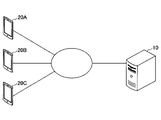
- FIG. 1 is a diagram illustrating a configuration of a communication system 1 according to an embodiment.
- the communication system 1 has an information processing device 10, a terminal 20A, a terminal 20B, and a terminal 20C.
- terminal 20 when it is not necessary to distinguish between the terminal 20A, the terminal 20B, and the terminal 20C, it is also simply referred to as "terminal 20".
- the number of the information processing apparatus 10 and the terminal 20 is not limited to the example of FIG.
- the information processing device 10 and the terminal 20 are, for example, 5G (5th Generation, 5th generation mobile communication system), 4G, LTE (LongTermEvolution), 3G and other mobile phone networks, wireless LAN (Local Area Network), and Communicates via network N such as the Internet.
- 5G 5th Generation, 5th generation mobile communication system
- 4G 4G
- LTE LongTermEvolution
- 3G and other mobile phone networks wireless LAN (Local Area Network)
- Communicates via network N such as the Internet.
- the information processing device 10 is, for example, an information processing device such as a server.
- the information processing apparatus 10 transmits an EMA questionnaire (an example of a "question") to the terminal 20. Further, the information processing apparatus 10 receives a response from the user to the EMA questionnaire from the terminal 20.
- EMA questionnaire an example of a "question”
- the terminal 20 is a terminal used by the user.
- the terminal 20 may be, for example, a terminal such as a smartphone, a tablet, a personal computer, or a wearable device.
- FIG. 2 is a diagram illustrating a hardware configuration example of the information processing apparatus 10 according to the embodiment.
- the information processing device 10 includes a drive device 1000, an auxiliary storage device 1002, a memory device 1003, a CPU 1004, an interface device 1005, and the like, which are connected to each other by a bus B, respectively.
- the information processing program that realizes the processing in the information processing apparatus 10 may be provided by the recording medium 1001.
- the recording medium 1001 on which the information processing program is recorded is set in the drive device 1000, the information processing program is installed in the auxiliary storage device 1002 from the recording medium 1001 via the drive device 1000.
- the information processing program does not necessarily have to be installed from the recording medium 1001, and may be downloaded from another computer via the network.
- the auxiliary storage device 1002 stores the installed information processing program and also stores necessary files, data, and the like.
- the memory device 1003 reads and stores the program from the auxiliary storage device 1002 when there is an instruction to start the program.
- the CPU 1004 executes the process according to the program stored in the memory device 1003.
- the interface device 1005 is used as an interface for connecting to a network.
- An example of the recording medium 1001 is a portable recording medium such as a CD-ROM, a DVD disc, or a USB memory. Further, as an example of the auxiliary storage device 1002, an HDD (Hard Disk Drive), a flash memory, or the like can be mentioned. Both the recording medium 1001 and the auxiliary storage device 1002 correspond to computer-readable recording media.
- the information processing apparatus 10 may be realized by an integrated circuit such as an ASIC (Application Specific Integrated Circuit) or an FPGA (Field-Programmable Gate Array).
- ASIC Application Specific Integrated Circuit
- FPGA Field-Programmable Gate Array
- FIG. 3 is a diagram showing an example of the configuration of the information processing apparatus 10 according to the embodiment.
- the information processing device 10 has a storage unit 11, an acquisition unit 12, a generation unit 13, an estimation unit 14, and a notification unit 15. Each of these parts may be realized by the cooperation of one or more programs installed in the information processing apparatus 10 and hardware such as the CPU 1004 of the information processing apparatus 10.
- the storage unit 11 stores various types of information.
- the storage unit 11 has, for example, a personal characteristic database 111 that stores personal characteristic data that is information indicating user characteristics, an experience database 112 that stores experience data that is information indicating user experience, and a question to be asked by the user. It has an answer history database 113 or the like that stores an answer history, which is an answer history.
- the acquisition unit 12 acquires various types of information and stores them in the storage unit 11.
- the acquisition unit 12 records, for example, the experience data received from the terminal 20 in the experience database 112. Further, the acquisition unit 12 records, for example, information about the answer received from the terminal 20 in the answer history database 113.
- the generation unit 13 generates a model for estimating the user response rate (response rate) based on the information stored in the storage unit 11.
- the estimation unit 14 estimates the user response rate based on the information stored in the storage unit 11 and the model generated by the generation unit 13.
- the notification unit 15 transmits a question to the terminal 20 of the user at the timing when the response rate of the user estimated by the estimation unit 14 satisfies a predetermined condition. Further, the notification unit 15 transmits a reminder of the answer to the question or the like to the terminal 20 of the user at the timing when the response rate of the user estimated by the estimation unit 14 satisfies a predetermined condition.
- FIG. 4 is a flowchart illustrating an example of a model generation process of the information processing apparatus 10 according to the embodiment.
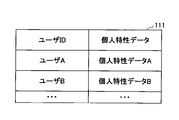
- FIG. 5A is a diagram illustrating an example of the personal characteristic database 111 according to the embodiment.
- FIG. 5B is a diagram illustrating an example of the experience database 112 according to the embodiment.
- FIG. 5C is a diagram illustrating an example of the response history database 113 according to the embodiment.
- the information processing apparatus 10 may execute the process shown in FIG. 4 at a predetermined cycle, for example.
- step S101 the acquisition unit 12 of the information processing apparatus 10 stores learning data for generating a model for estimating the response rate of each user in the personal characteristic database 111, the experience database 112, and the response history database 113 of the storage unit 11. Get from.
- Personal characteristic data is recorded in the personal characteristic database 111 in association with the user ID.
- the user ID is identification information of the user of the terminal 20.
- the personality data may include, for example, information indicating a user's personality (personality), mental state, preference, gender, age, occupation, and the like.
- the information recorded in the personal characteristics database 111 may be registered in advance based on, for example, a questionnaire or a questionnaire survey using a terminal 20 or the like.
- the acquisition unit 12 receives N-item personal characteristic data P i 1 , P i 2 , ..., P i included in the personal characteristic data of the user i (where i is an integer of 1 or more).
- N is acquired as a multi-step evaluation value.
- N is an integer of 1 or more.
- the number of stages of evaluation values of each item included in the personal characteristic data may be the same or different.
- the experience data is recorded in the experience database 112 in association with the set of the user ID and the experience date and time.
- the experience date and time is the date and time when the experience related to the experience data occurred.
- the experience date and time may be, for example, the date and time when the experience data is acquired by the information processing apparatus 10.
- the empirical data may include information acquired by the sensor of the user's terminal 20.
- the sensor may include, for example, a microphone sensor, a depth sensor, an optical sensor, an acceleration sensor, a temperature sensor, a GPS (Global Positioning System) sensor, a camera sensor, and the like. Further, the sensor may include, for example, various sensors mounted on a digital device.
- the empirical data may include, for example, the cumulative time of the user's conversation analyzed based on the voice collected by the microphone of the terminal 20. Thereby, for example, when the questionnaire is sent while the user is talking with someone, the response rate tends to decrease, and this tendency can be used.
- the empirical data may include, for example, the cumulative time of the user's motion analyzed based on the acceleration collected by the acceleration sensor of the terminal 20.
- the response rate tends to decrease, and this tendency can be used.
- the experience data may include the user's action history on the user's terminal 20.
- the action history may include, for example, a history of sending and receiving messages by SNS (Social Networking Service) and e-mail, a history of browsing a specific website, and the like.
- SNS Social Networking Service
- the response rate tends to decrease. Can be used. Further, for example, when a questionnaire is sent while a user is browsing a specific news site or the like, the response rate tends to improve, and this tendency can be used.
- the acquisition unit 12 has the experience log E i, d, t 1 , E i, d, t 2 , ..., E of the most recent (newest date and time) M item included in the experience log.
- E the most recent (newest date and time) M item included in the experience log.
- Acquire i, d, t M as a time-series log. Note that M is an integer of 1 or more.
- the experience log E i, d, tm of the m-th item is composed of the measurement data for n time points observed between the time th and the time t , and the measured value at a certain time t is used.
- e i, d, tm it is expressed as a vector as shown in the following equation (2).
- the number of vector elements (number of measurements) of each item included in the experience log may be the same or different.
- the unit (time, time, degree, bpm, etc.) of each item included in the experience log may be different.
- the answer history database 113 records the answer history data in association with the set of the user ID and the question ID.
- the question ID is identification information of a question (EMA questionnaire) transmitted by the information processing apparatus 10 to the terminal 20.
- the answer history data includes the time (sending time) when the question related to the question ID is transmitted to the terminal 20 of the user related to the user ID, whether or not the user has answered the question, and the user to the question.
- the time when the reply was received is included.
- step S101 the acquisition unit 12 sends the question k sent to the specific user i in the specific time zone [T 0 , T 1 ] at the delivery time ti , k s ⁇ [T 0 , T 1 ].
- Obtain the presence / absence of an answer to the question k, zi , k ⁇ 0,1 ⁇ , and the answer time ti , kr when the answer is present.
- the generation unit 13 of the information processing apparatus 10 generates a model for estimating the response rate of each user based on the learning data acquired by the acquisition unit 12 (step S102).
- the generation unit 13 may first define the estimated value Ri, d, k of the maximum value of the response rate in the time zone [T 0 , T 1 ] by the following equation (3).
- the personal characteristic data of the user is Pi
- the specific question to be asked on the date d is k
- the time zone in which the k is carried out is [T 0 , T 1 ]
- the latest from a certain time t to time t
- E i, d, t be the experience data of
- f be the function (response rate estimation function) that expresses (describes) the relationship between the response rate and the personal characteristics and the latest experience.
- ⁇ refers to a parameter set.
- the generation unit 13 uses the personal characteristic data P i and the latest experience data E i, d, t by ⁇ to change the response rate from time T 0 to T 1 over time R i, d, k (t). ) Can be estimated (derived).
- the generation unit 13 may determine the response rate estimation function f as a model for estimating the response rate of each user by the following processing.
- the generation unit 13 has the personal characteristic data, the latest experience data, the presence / absence of an answer to the question, the time when the question is sent, and the difference between the time when the question is sent and the time when the answer is received (elapsed from sending the question to receiving the answer).
- the correspondence with the time) is modeled by machine learning or the like.
- the generation unit 13 may determine (define), for example, the response rate to a certain EMA questionnaire k by the following equation (4).
- the generation unit 13 uses the following equation (for example) for the response rate R ⁇ i, d, k estimated based on the personal characteristic data P i , the latest experience log E i, d, t , and the parameter set ⁇ . It may be determined (defined) as in 5).
- the generation unit 13 may calculate (derive) the solution of the optimization problem of the following equation (6) based on the equations (4) and (5).
- the generation unit 13 generates (determines, configures) the response rate estimation function f, which is a model for estimating the response rate of each user, from the parameter set ⁇ calculated from the equation (6).
- FIG. 6 is a flowchart illustrating an example of processing at the time of estimation of the information processing apparatus 10 according to the embodiment.
- the information processing device 10 may execute the process shown in FIG. 6 in a predetermined cycle after the new question is registered by the operator of the information processing device 10, for example.
- step S201 the acquisition unit 12 of the information processing apparatus 10 acquires estimation data for estimating the response rate of each user from the personal characteristic database 111 and the experience database 112 of the storage unit 11.
- the acquisition unit 12 performs N-item personal characteristic data P i 1 , P i 2 , ..., P included in the personal characteristic data of the user i, as in the process of step S101.
- i N is acquired as a multi-step evaluation value.
- the acquisition unit 12 has the experience logs E i, d, t 1 , E i, d of the latest M item included in the experience log (in order of newest date and time), as in the process of step S101.
- T 2 , ..., E i, d, t M are acquired as a time-series log.
- the estimation unit 14 of the information processing apparatus 10 determines the response rate of each user based on the model generated by the generation unit 13 in the process of FIG. 4 described above and the estimation data acquired by the acquisition unit 12. Estimate (step S202).
- the estimation unit 14 substitutes the data acquired from the personal characteristics database 111 and the experience database 112 by the acquisition unit 12 into the response rate estimation function f of the following equation (7), so that the time T0 to TT The time s at which the response rate at 1 is maximized may be estimated.
- the time T 0 and the time T 1 in the processing at the time of estimation in FIG. 6 are the times after the time T 1 described in the processing at the time of model generation in FIG. 4, respectively. Therefore, the time T 0 and the time T 1 in the equations (2), (5), and the equation (7) in the processing at the time of estimation in FIG. 6 may be read as the time T 2 and the time T 3 , respectively. good.
- the notification unit 15 of the information processing apparatus 10 transmits information regarding the question to the terminal 20 at the timing when the response rate estimated by the estimation unit 14 satisfies a predetermined condition (step S203).
- the notification unit 15 may transmit information about the question to the terminal 20 at the time s when the response rate is maximized, which is estimated by the estimation unit 14, for example.
- the information about the question may be, for example, the data of the question itself, or the URL (Uniform Resource Locator) of a website or the like where the question can be viewed.
- the information regarding the question may be a reminder message or the like prompting an answer to the already sent question.
- the notification unit 15 may, for example, send an e-mail to a mobile terminal owned by the user, a notification using an application of the mobile terminal or a function of an OS (Operating System), a reminder, or the like.
- OS Operating System
- the generation unit 13 may generate a model for estimating the response rate of each user by, for example, a machine learning method such as a neural network (NN).
- a machine learning method such as a neural network (NN).
- each functional unit of the information processing apparatus 10 may be realized by cloud computing provided by, for example, one or more computers.
- the storage unit 11, the generation unit 13, and the like may be provided in an external information processing device.
- the response rate of the user during the experiment period depends on the reward amount and the difficulty level of the question, and the response rate is improved based on the idea that the response rate is constant with respect to the time.
- the response rate of a user over a certain period is not constant with respect to time. For example, it is considered that an event that an individual experiences in daily life may increase the motivation to respond and increase the response rate at a certain time, and decrease the motivation and decrease the response rate at a certain time.
- the response rate of the user is estimated, and the user is intervened at the timing when the response rate of the user is estimated to be high. Thereby, for example, the response rate can be improved.
Landscapes
- Engineering & Computer Science (AREA)
- Health & Medical Sciences (AREA)
- Public Health (AREA)
- Medical Informatics (AREA)
- Epidemiology (AREA)
- General Health & Medical Sciences (AREA)
- Primary Health Care (AREA)
- Business, Economics & Management (AREA)
- Biomedical Technology (AREA)
- Strategic Management (AREA)
- Finance (AREA)
- General Business, Economics & Management (AREA)
- Development Economics (AREA)
- Accounting & Taxation (AREA)
- Game Theory and Decision Science (AREA)
- Theoretical Computer Science (AREA)
- General Physics & Mathematics (AREA)
- Physics & Mathematics (AREA)
- Marketing (AREA)
- Economics (AREA)
- Entrepreneurship & Innovation (AREA)
- Data Mining & Analysis (AREA)
- Databases & Information Systems (AREA)
- Pathology (AREA)
- Management, Administration, Business Operations System, And Electronic Commerce (AREA)
Priority Applications (3)
| Application Number | Priority Date | Filing Date | Title |
|---|---|---|---|
| JP2022563287A JP7571794B2 (ja) | 2020-11-17 | 2020-11-17 | 情報処理方法、情報処理装置、及びプログラム |
| US18/247,663 US20230395206A1 (en) | 2020-11-17 | 2020-11-17 | Information processing method, information processing apparatus, and program |
| PCT/JP2020/042849 WO2022107222A1 (ja) | 2020-11-17 | 2020-11-17 | 情報処理方法、情報処理装置、及びプログラム |
Applications Claiming Priority (1)
| Application Number | Priority Date | Filing Date | Title |
|---|---|---|---|
| PCT/JP2020/042849 WO2022107222A1 (ja) | 2020-11-17 | 2020-11-17 | 情報処理方法、情報処理装置、及びプログラム |
Publications (1)
| Publication Number | Publication Date |
|---|---|
| WO2022107222A1 true WO2022107222A1 (ja) | 2022-05-27 |
Family
ID=81708512
Family Applications (1)
| Application Number | Title | Priority Date | Filing Date |
|---|---|---|---|
| PCT/JP2020/042849 Ceased WO2022107222A1 (ja) | 2020-11-17 | 2020-11-17 | 情報処理方法、情報処理装置、及びプログラム |
Country Status (3)
| Country | Link |
|---|---|
| US (1) | US20230395206A1 (https=) |
| JP (1) | JP7571794B2 (https=) |
| WO (1) | WO2022107222A1 (https=) |
Cited By (2)
| Publication number | Priority date | Publication date | Assignee | Title |
|---|---|---|---|---|
| JP2023183531A (ja) * | 2022-06-16 | 2023-12-28 | Lineヤフー株式会社 | 情報処理装置、情報処理方法および情報処理プログラム |
| JP2025083152A (ja) * | 2023-11-20 | 2025-05-30 | Lineヤフー株式会社 | 情報処理装置、情報処理方法及び情報処理プログラム |
Citations (2)
| Publication number | Priority date | Publication date | Assignee | Title |
|---|---|---|---|---|
| JP2002032552A (ja) * | 2000-07-17 | 2002-01-31 | Nec Eng Ltd | アンケート自動集計システム |
| WO2020195927A1 (ja) * | 2019-03-26 | 2020-10-01 | フェリカネットワークス株式会社 | 情報処理装置、情報処理方法およびプログラム |
-
2020
- 2020-11-17 US US18/247,663 patent/US20230395206A1/en not_active Abandoned
- 2020-11-17 WO PCT/JP2020/042849 patent/WO2022107222A1/ja not_active Ceased
- 2020-11-17 JP JP2022563287A patent/JP7571794B2/ja active Active
Patent Citations (2)
| Publication number | Priority date | Publication date | Assignee | Title |
|---|---|---|---|---|
| JP2002032552A (ja) * | 2000-07-17 | 2002-01-31 | Nec Eng Ltd | アンケート自動集計システム |
| WO2020195927A1 (ja) * | 2019-03-26 | 2020-10-01 | フェリカネットワークス株式会社 | 情報処理装置、情報処理方法およびプログラム |
Cited By (4)
| Publication number | Priority date | Publication date | Assignee | Title |
|---|---|---|---|---|
| JP2023183531A (ja) * | 2022-06-16 | 2023-12-28 | Lineヤフー株式会社 | 情報処理装置、情報処理方法および情報処理プログラム |
| JP7671715B2 (ja) | 2022-06-16 | 2025-05-02 | Lineヤフー株式会社 | 情報処理装置、情報処理方法および情報処理プログラム |
| JP2025083152A (ja) * | 2023-11-20 | 2025-05-30 | Lineヤフー株式会社 | 情報処理装置、情報処理方法及び情報処理プログラム |
| JP7794790B2 (ja) | 2023-11-20 | 2026-01-06 | Lineヤフー株式会社 | 情報処理装置、情報処理方法及び情報処理プログラム |
Also Published As
| Publication number | Publication date |
|---|---|
| US20230395206A1 (en) | 2023-12-07 |
| JP7571794B2 (ja) | 2024-10-23 |
| JPWO2022107222A1 (https=) | 2022-05-27 |
Similar Documents
| Publication | Publication Date | Title |
|---|---|---|
| US8560962B2 (en) | Promoting participation of low-activity users in social networking system | |
| US8874639B2 (en) | Determining advertising effectiveness outside of a social networking system | |
| Lane et al. | Bewell: Sensing sleep, physical activities and social interactions to promote wellbeing | |
| JP5976780B2 (ja) | 適応通知 | |
| CN111061956B (zh) | 用于生成信息的方法和装置 | |
| KR102138570B1 (ko) | 가치 모델에 기반한 pymk의 사용과 컨텐츠를 결정하는 방법 및 시스템 | |
| US10482506B2 (en) | Client caching identification tracking | |
| US12470620B2 (en) | Computerized system and method for automatically providing networked devices non-native functionality | |
| US10650412B2 (en) | Multi-profile tracking identification of a mobile user | |
| US11170393B1 (en) | System to calculate an engagement score of location based media content | |
| US20180101807A1 (en) | Health and productivity insight generation | |
| US20190188749A1 (en) | Object selection method and device | |
| KR20140094564A (ko) | 특징-추출-기반 이미지 점수화 | |
| US20150112706A1 (en) | System and Methods for Personal health Analytics Technical Field | |
| JP7571794B2 (ja) | 情報処理方法、情報処理装置、及びプログラム | |
| US20160292793A1 (en) | Selection and display of a featured professional profile chosen from a social networking service | |
| JP2015011690A (ja) | 効果測定プログラム、方法及び装置 | |
| US20180107665A1 (en) | Systems and methods for determining recommendations for pages in social networking systems | |
| JP6013229B2 (ja) | 通信端末、品質管理システムおよびコンピュータプログラム | |
| CN105432038A (zh) | 应用排名计算装置和使用信息收集装置 | |
| US20160086211A1 (en) | System and method for real-time, rules-based social media amplification | |
| US20220028546A1 (en) | Assessing the gait of parkinson's patients | |
| JP6725405B2 (ja) | 情報処理システム、情報処理装置、および情報処理方法 | |
| JP7059417B1 (ja) | 情報処理装置、情報処理方法および情報処理プログラム | |
| US20240347212A1 (en) | Methods and systems for performing contact tracing |
Legal Events
| Date | Code | Title | Description |
|---|---|---|---|
| 121 | Ep: the epo has been informed by wipo that ep was designated in this application |
Ref document number: 20962386 Country of ref document: EP Kind code of ref document: A1 |
|
| ENP | Entry into the national phase |
Ref document number: 2022563287 Country of ref document: JP Kind code of ref document: A |
|
| NENP | Non-entry into the national phase |
Ref country code: DE |
|
| 122 | Ep: pct application non-entry in european phase |
Ref document number: 20962386 Country of ref document: EP Kind code of ref document: A1 |