WO2022097641A1 - 合成単結晶ダイヤモンド及びその製造方法 - Google Patents
合成単結晶ダイヤモンド及びその製造方法 Download PDFInfo
- Publication number
- WO2022097641A1 WO2022097641A1 PCT/JP2021/040399 JP2021040399W WO2022097641A1 WO 2022097641 A1 WO2022097641 A1 WO 2022097641A1 JP 2021040399 W JP2021040399 W JP 2021040399W WO 2022097641 A1 WO2022097641 A1 WO 2022097641A1
- Authority
- WO
- WIPO (PCT)
- Prior art keywords
- single crystal
- diamond
- ppm
- less
- synthetic single
- Prior art date
- Legal status (The legal status is an assumption and is not a legal conclusion. Google has not performed a legal analysis and makes no representation as to the accuracy of the status listed.)
- Ceased
Links
Images


Classifications
-
- C—CHEMISTRY; METALLURGY
- C30—CRYSTAL GROWTH
- C30B—SINGLE-CRYSTAL GROWTH; UNIDIRECTIONAL SOLIDIFICATION OF EUTECTIC MATERIAL OR UNIDIRECTIONAL DEMIXING OF EUTECTOID MATERIAL; REFINING BY ZONE-MELTING OF MATERIAL; PRODUCTION OF A HOMOGENEOUS POLYCRYSTALLINE MATERIAL WITH DEFINED STRUCTURE; SINGLE CRYSTALS OR HOMOGENEOUS POLYCRYSTALLINE MATERIAL WITH DEFINED STRUCTURE; AFTER-TREATMENT OF SINGLE CRYSTALS OR A HOMOGENEOUS POLYCRYSTALLINE MATERIAL WITH DEFINED STRUCTURE; APPARATUS THEREFOR
- C30B29/00—Single crystals or homogeneous polycrystalline material with defined structure characterised by the material or by their shape
- C30B29/02—Elements
- C30B29/04—Diamond
-
- C—CHEMISTRY; METALLURGY
- C01—INORGANIC CHEMISTRY
- C01B—NON-METALLIC ELEMENTS; COMPOUNDS THEREOF; METALLOIDS OR COMPOUNDS THEREOF NOT COVERED BY SUBCLASS C01C
- C01B32/00—Carbon; Compounds thereof
- C01B32/25—Diamond
- C01B32/26—Preparation
-
- C—CHEMISTRY; METALLURGY
- C01—INORGANIC CHEMISTRY
- C01B—NON-METALLIC ELEMENTS; COMPOUNDS THEREOF; METALLOIDS OR COMPOUNDS THEREOF NOT COVERED BY SUBCLASS C01C
- C01B32/00—Carbon; Compounds thereof
- C01B32/25—Diamond
- C01B32/28—After-treatment, e.g. purification, irradiation, separation or recovery
-
- C—CHEMISTRY; METALLURGY
- C30—CRYSTAL GROWTH
- C30B—SINGLE-CRYSTAL GROWTH; UNIDIRECTIONAL SOLIDIFICATION OF EUTECTIC MATERIAL OR UNIDIRECTIONAL DEMIXING OF EUTECTOID MATERIAL; REFINING BY ZONE-MELTING OF MATERIAL; PRODUCTION OF A HOMOGENEOUS POLYCRYSTALLINE MATERIAL WITH DEFINED STRUCTURE; SINGLE CRYSTALS OR HOMOGENEOUS POLYCRYSTALLINE MATERIAL WITH DEFINED STRUCTURE; AFTER-TREATMENT OF SINGLE CRYSTALS OR A HOMOGENEOUS POLYCRYSTALLINE MATERIAL WITH DEFINED STRUCTURE; APPARATUS THEREFOR
- C30B33/00—After-treatment of single crystals or homogeneous polycrystalline material with defined structure
- C30B33/02—Heat treatment
-
- C—CHEMISTRY; METALLURGY
- C30—CRYSTAL GROWTH
- C30B—SINGLE-CRYSTAL GROWTH; UNIDIRECTIONAL SOLIDIFICATION OF EUTECTIC MATERIAL OR UNIDIRECTIONAL DEMIXING OF EUTECTOID MATERIAL; REFINING BY ZONE-MELTING OF MATERIAL; PRODUCTION OF A HOMOGENEOUS POLYCRYSTALLINE MATERIAL WITH DEFINED STRUCTURE; SINGLE CRYSTALS OR HOMOGENEOUS POLYCRYSTALLINE MATERIAL WITH DEFINED STRUCTURE; AFTER-TREATMENT OF SINGLE CRYSTALS OR A HOMOGENEOUS POLYCRYSTALLINE MATERIAL WITH DEFINED STRUCTURE; APPARATUS THEREFOR
- C30B33/00—After-treatment of single crystals or homogeneous polycrystalline material with defined structure
- C30B33/04—After-treatment of single crystals or homogeneous polycrystalline material with defined structure using electric or magnetic fields or particle radiation
-
- C—CHEMISTRY; METALLURGY
- C30—CRYSTAL GROWTH
- C30B—SINGLE-CRYSTAL GROWTH; UNIDIRECTIONAL SOLIDIFICATION OF EUTECTIC MATERIAL OR UNIDIRECTIONAL DEMIXING OF EUTECTOID MATERIAL; REFINING BY ZONE-MELTING OF MATERIAL; PRODUCTION OF A HOMOGENEOUS POLYCRYSTALLINE MATERIAL WITH DEFINED STRUCTURE; SINGLE CRYSTALS OR HOMOGENEOUS POLYCRYSTALLINE MATERIAL WITH DEFINED STRUCTURE; AFTER-TREATMENT OF SINGLE CRYSTALS OR A HOMOGENEOUS POLYCRYSTALLINE MATERIAL WITH DEFINED STRUCTURE; APPARATUS THEREFOR
- C30B9/00—Single-crystal growth from melt solutions using molten solvents
- C30B9/04—Single-crystal growth from melt solutions using molten solvents by cooling of the solution
- C30B9/08—Single-crystal growth from melt solutions using molten solvents by cooling of the solution using other solvents
- C30B9/10—Metal solvents
-
- C—CHEMISTRY; METALLURGY
- C01—INORGANIC CHEMISTRY
- C01P—INDEXING SCHEME RELATING TO STRUCTURAL AND PHYSICAL ASPECTS OF SOLID INORGANIC COMPOUNDS
- C01P2006/00—Physical properties of inorganic compounds
- C01P2006/21—Attrition-index or crushing strength of granulates
Definitions
- single crystal diamond Since single crystal diamond has high hardness, it is widely used in tools such as cutting tools, grinding tools, and abrasion resistant tools.
- Single crystal diamonds used in tools include natural diamonds and synthetic diamonds.
- Natural diamonds contain aggregated nitrogen atoms as impurities (Type Ia). Aggregate nitrogen atoms in diamond crystals can prevent plastic deformation and crack growth that occur when diamond is used in tools. Therefore, natural diamond has high mechanical strength. However, the quality of natural diamond varies widely and the supply is not stable, so its use for industrial applications is limited.
- Ordinary synthetic diamond contains isolated substitution nitrogen atoms as impurities (Ib type).
- Ib type isolated substitution nitrogen atoms as impurities
- type IIa synthetic diamond does not contain impurities or crystal defects that prevent the growth of cracks, it tends to cause chipping of the cutting edge when used in a tool.
- Patent Document 1 International Publication No. 2019/077888 discloses a synthetic single crystal diamond having high hardness and excellent fracture resistance.
- the synthetic single crystal diamond of the present disclosure is a synthetic single crystal diamond containing a bond of one pore and one boron atom. It is a synthetic single crystal diamond having a concentration based on the number of atoms of a boron atom of 0.1 ppm or more and 100 ppm or less.
- the method for producing synthetic single crystal diamond of the present disclosure is the above-mentioned method for producing synthetic single crystal diamond.
- a synthetic single crystal diamond comprising a third step of applying a temperature of 600 ° C. or higher and 1800 ° C. or lower for 1 minute or more and 3600 minutes or less to the diamond single crystal after the second step to obtain a synthetic single crystal diamond. It is a manufacturing method.
- FIG. 1 is a diagram for explaining a noup indentation.
- FIG. 2 is a schematic cross-sectional view showing an example of a sample chamber configuration used for producing synthetic single crystal diamond according to an embodiment of the present disclosure.
- an object of the present invention is to provide a synthetic single crystal diamond having high toughness and hardness, excellent fracture resistance and wear resistance, and a method for producing the same. [Effect of this disclosure]
- the synthetic single crystal diamond of the present disclosure has high toughness and hardness, and excellent fracture resistance and wear resistance.
- the synthetic single crystal diamond of the present disclosure is a synthetic single crystal diamond containing a bond of one pore and one boron atom. It is a synthetic single crystal diamond having a concentration based on the number of atoms of a boron atom of 0.1 ppm or more and 100 ppm or less.
- the synthetic single crystal diamond of the present disclosure has high toughness and hardness, and excellent fracture resistance and wear resistance.
- the synthetic single crystal diamond is formed when the Knoop hardness is measured under the conditions of a temperature of 23 ° C. ⁇ 5 ° C. and a test load of 4.9 N in accordance with JIS Z 2251: 2009 (001). It is preferable that the ratio b / a of the length b of the shorter diagonal line to the length a of the longer diagonal line of the Knoop indentation in the ⁇ 110> direction on the surface is 0.08 or less.
- synthetic single crystal diamond can have excellent toughness and fracture resistance.
- the Knoop hardness in the ⁇ 100> direction in the (001) plane of the synthetic single crystal diamond is preferably 110 GPa or more.
- synthetic single crystal diamond can have excellent wear resistance.
- the crack generation load is preferably 12 N or more.
- synthetic single crystal diamond can have excellent fracture resistance.
- the method for producing synthetic single crystal diamond of the present disclosure is the above-mentioned method for producing synthetic single crystal diamond.
- a synthetic single crystal diamond comprising a third step of applying a temperature of 600 ° C. or higher and 1800 ° C. or lower for 1 minute or more and 3600 minutes or less to the diamond single crystal after the second step to obtain a synthetic single crystal diamond. It is a manufacturing method.
- the notation in the form of "A to B” means the upper and lower limits of the range (that is, A or more and B or less), and when there is no description of the unit in A and the unit is described only in B, A.
- the unit of and the unit of B are the same.
- the present inventors assumed the influence of boron atoms existing as impurities in the crystal as one of the factors for improving the toughness and hardness of diamond crystals, that is, the fracture resistance and wear resistance when used as a tool. ..
- An isolated substitution type boron atom is known as an existing form of the boron atom.
- the isolated-substituted boron atom is one in which a boron atom is substituted at the position of a carbon atom in a diamond crystal in units of one atom.
- the present inventors assumed that the presence of pores adjacent to the above-mentioned boron atom in a diamond crystal can more effectively prevent the growth of cracks and the progress of plastic deformation in the crystal. It is believed that the intervention of vacancies alleviates the excessive compressive stress that can be the starting point of fracture in the lattice compared to the boron atom alone.
- the synthetic single crystal diamond of the present embodiment is a synthetic single crystal diamond containing a bond of one pore and one boron atom, and the concentration based on the number of atoms of the boron atom is 0.1 ppm or more and 100 ppm or less. Is.
- the synthetic single crystal diamond of the present embodiment can have high toughness, hardness, fracture resistance and wear resistance. The reason for this is not clear, but it is presumed to be as described in (i) and (ii) below.
- the synthetic single crystal diamond of the present embodiment contains a boron atom and pores. According to this, the synthetic single crystal diamond tends to form a bond between one pore and one boron atom, and the bond prevents the growth of cracks and the progress of plastic deformation in the crystal. In addition, the presence of vacancies alleviates the excessive compressive stress that can be the starting point of fracture caused by the aggregation of boron atoms alone, thereby improving the wear resistance and fracture resistance of the synthetic single crystal diamond.
- the synthetic single crystal diamond of the present embodiment contains a boron atom at a concentration of 0.1 ppm or more and 100 ppm or less on an atomic number basis. Compressive stress is appropriately generated in the synthetic single crystal diamond, and the wear resistance and fracture resistance of the synthetic single crystal diamond are improved.
- the synthetic single crystal diamond of this embodiment contains a boron atom.
- the concentration of boron atoms in synthetic single crystal diamond based on the number of atoms (hereinafter, also referred to as “boron atom concentration”) is 0.1 ppm or more and 100 ppm or less.
- the boron atom in the synthetic single crystal diamond means all the boron atoms contained in the synthetic single crystal diamond, and the existence form thereof does not matter.
- the boron atom concentration is 0.1 ppm or more, the effect due to the presence of the boron atom can be easily obtained, and the synthetic single crystal diamond can have high hardness and excellent fracture resistance.
- the boron atom concentration is 100 ppm or less, the internal stress in the synthetic single crystal diamond is appropriate, and the decrease in hardness and the decrease in fracture resistance due to the generation of excessive lattice defects are suppressed.
- the lower limit of the boron atom concentration in synthetic single crystal diamond can be 0.1 ppm or more, 0.3 ppm or more, 0.5 ppm or more, 2 ppm or more, and 10 ppm or more.
- the upper limit of the boron atom concentration in the synthetic single crystal diamond can be 100 ppm or less, 80 ppm or less, and 50 ppm or less.
- Boron atom concentration in synthetic single crystal diamond is 0.1ppm or more and 100ppm or less, 0.3ppm or more and 100ppm or less, 0.3ppm or more and 80ppm or less, 0.5ppm or more and 100ppm or less, 0.5ppm or more and 80ppm or less, 0.5ppm or more.
- It can be 50 ppm or less, 2 ppm or more and 100 ppm or less, 2 ppm or more and 80 ppm or less, 2 ppm or more and 50 ppm or less, 10 ppm or more and 100 ppm or less, 10 ppm or more and 80 ppm or less, and 10 ppm or more and 50 ppm or less.
- the concentration of boron atoms in synthetic single crystal diamond is measured by secondary ion mass spectrometry (SIMS: Secondary Ion Mass Spectrometry).
- SIMS Secondary Ion Mass Spectrometry
- the synthetic single crystal diamond of this embodiment contains a bond of one pore and one boron atom.
- the conjugate is also referred to as "BV".
- the inclusion of a composite of one pore and one boron atom in a synthetic single crystal diamond is, for example, fluorescence obtained by irradiating the synthetic single crystal diamond with excitation light having a wavelength of 488 nm or a wavelength of 514 nm or a wavelength of 532 nm. In the spectrum, it is confirmed by the presence of an emission peak within the range of the fluorescence wavelength of 776.4 ⁇ 1 nm.
- the emission peak exists within the range of the fluorescence wavelength of 776.4 ⁇ 1 nm is determined by comparing the intensity with the intensity of the Raman peak of diamond appearing in the vicinity of 521.9 nm in the case of excitation with a wavelength of 488 nm, for example. You can check. Specifically, for example, when irradiated with excitation light having a wavelength of 488 nm, the peak intensity IA existing in the range of the fluorescence wavelength of 776.4 ⁇ 1 nm and the intensity IB of the Raman peak of diamond appearing in the vicinity of the wavelength of 521.9 nm. When the intensity IA is larger than the intensity IB, it is determined that "the emission peak exists within the range of the fluorescence wavelength of 776.4 ⁇ 1 nm".
- the synthetic single crystal diamond of this embodiment can contain an isolated substituted boron atom.
- the lower limit of the concentration based on the number of atoms of the isolated substituted boron atom of the synthetic single crystal diamond of this embodiment is 0 ppm or more, 0.01 ppm or more, 0.03 ppm or more, 0.06 ppm or more, 0.08 ppm or more, 0.09 ppm. As mentioned above, it can be 0.1 ppm or more, 0.6 ppm or more, 1.2 ppm or more, 1.6 ppm or more, 3 ppm or more, and 6 ppm or more.
- the upper limit of the atomic number-based concentration of the isolated substituted boron atom of the synthetic single crystal diamond can be 70 ppm or less, 60 ppm or less, 30 ppm or less, and 10 ppm or less.
- the atomic number-based concentrations of isolated substituted boron atoms in synthetic single crystal diamonds are 0 ppm or more and 70 ppm or less, 0.01 ppm or more and 70 ppm or less, 0.03 ppm or more and 70 ppm or less, 0.06 ppm or more and 70 ppm or less, 0.08 ppm or more and 70 ppm or less.
- ppm or more and 70 ppm or less 0.09 ppm or more and 70 ppm or less, 0.1 ppm or more and 70 ppm or less, 0.6 ppm or more and 70 ppm or less, 1.2 ppm or more and 70 ppm or less, 1.6 ppm or more and 70 ppm or less, 3 ppm or more and 70 ppm or less, 6 ppm or more and 70 ppm or less, 0 ppm or more and 30 ppm or less.
- it can be 1.6 ppm or more and 10 ppm or less, 3 ppm or more and 10 ppm or less, and 6 ppm or more and 10 ppm or less, 0.
- the concentration based on the atomic number of the isolated substituted boron atom of the synthetic single crystal diamond of the present embodiment is measured by the following procedures (A1) to (A3).
- A1 Synthetic single crystal diamond is processed into a plate shape with a thickness of about 1 mm to 0.1 mm, two surfaces that transmit light are mirror-polished, and then the wave number is measured by Fourier transform infrared spectroscopy (FT-IR method). Absorbance measurement at 800-5000 cm -1 is performed to create an infrared absorption spectrum.
- FT-IR method Fourier transform infrared spectroscopy
- the (111) growth sector portion which tends to contain boron is evaluated.
- A2 In the above infrared absorption spectrum, the absorption peak height H 2800 having a wave number of 2800 cm -1 is calculated.
- H 2800 (cm -1 ) indicates the FT-IR absorption height.
- H 2458 (cm -1 ) and H 1290 (cm -1 ) indicate the FT-IR absorption height.
- the synthetic single crystal diamond of the present embodiment is formed in accordance with JIS Z 2251: 2009 on the (001) plane formed when Knoop hardness is applied under the conditions of a temperature of 23 ° C. ⁇ 5 ° C. and a test load of 4.9 N.
- the ratio b / a of the length b of the shorter diagonal line to the length a of the longer diagonal line of the Knoop indentation in the ⁇ 110> direction hereinafter, also referred to as "(001) ⁇ 110> Knoop indentation"). Is preferably 0.08 or less.
- Knoop hardness is known as one of the measures for expressing the hardness of industrial materials as specified in JIS Z2251: 2009, and a Knoop indenter is used at a predetermined temperature and a predetermined load (test load). The hardness of the material to be measured is obtained by pressing it against the material to be measured.
- the noup indenter is a diamond indenter whose bottom surface is in the shape of a diamond-shaped quadrangular prism.
- the rhombus on the bottom surface is defined as having a ratio b'/ a'of the length b'of the shorter diagonal line to the length a'of the longer diagonal line of the diagonal line of 0.141.
- the noup indentation refers to a trace remaining at a position where the noup indenter is released immediately after the noup indenter is pressed against the material to be measured (synthetic single crystal diamond in the present embodiment) at the above temperature and test load.
- indentations are made in the ⁇ 110> direction in the (001) plane of the synthetic single crystal diamond under the conditions of a temperature of 23 ° C. ⁇ 5 ° C. and a test load of 4.9 N in accordance with JIS Z 2251: 2009. Make (Noop indentation).
- the diagonal ratio b / a of the noup indentation is 0.08 or less, which is preferably smaller than the original noup indenter ratio b'/ a'(0.141). .. This is because the material to be measured, that is, the synthetic single crystal diamond, has a large elastic deformability, and the indentation is elastically restored (elastic recovery).
- FIG. 1 conceptually shows the indentation of Noup.
- the cross section of the noup indenter and the noup indentation have the same shape (the part shown as the "original noup indentation" in FIG. 1).
- the synthetic single crystal diamond of the present embodiment has high elastic deformability, elastic recovery occurs in the direction of the arrow in the figure, and the noup indentation thereof becomes a rhombus shown by the solid line in the figure. That is, the larger the return in the direction of the arrow in the figure, the smaller the value of the ratio b / a. The smaller the value of the ratio b / a, the greater the elastic deformability.
- the synthetic single crystal diamond of the present embodiment has a large elastic deformability because the diagonal ratio b / a of the noup indentation is 0.08 or less.
- the upper limit of the diagonal ratio b / a of the noup indentation can be 0.08 or less, 0.075 or less, 0.07 or less, 0.065 or less, 0.06 or less.
- the diagonal ratio b / a of the noup indentation is 0 or more and 0.08 or less, 0 or more and 0.075 or less, 0 or more and 0.07 or less, 0 or more and 0.065 or less, 0 or more and 0.06 or less, 0 or more and 0.055.
- it can be 0 or more and 0.05 or less, 0 or more and 0.045 or less, and 0 or more and 0.04 or less.
- the Knoop hardness in the ⁇ 100> direction of the synthetic single crystal diamond of the present embodiment (hereinafter, also referred to as “(001) ⁇ 100> Knoop hardness”) is preferably 110 GPa or more.
- (001) ⁇ 100> Synthetic single crystal diamond having a Knoop hardness of 110 GPa or more has a higher hardness than natural diamond containing nitrogen and is excellent in wear resistance.
- the lower limit of Knoop hardness can be 110 GP or more, 113 GPa or more, 115 GPa or more, 118 GPa or more, 120 GPa or more, 122 GPa or more, 123 GPa or more, 125 GPa or more.
- the upper limit of the Knoop hardness is not particularly limited, but can be, for example, 150 GPa or less from the viewpoint of manufacturing.
- Knoop hardness of synthetic single crystal diamond is 110 GPa or more and 150 GPa or less, 113 GPa or more and 150 GPa or less, 115 GPa or more and 150 GPa or less, 118 GPa or more and 150 GPa or less, 120 GPa or more and 150 GPa or less, 122 GPa or more and 150 GPa or less, 123 GPa or more and 150 GPa or less, 125 GPa. It can be 150 GPa or less.
- the unit is GPa) of synthetic single crystal diamond will be described.
- an indentation is made in the ⁇ 100> direction in the (001) plane of the synthetic single crystal diamond with a load of 4.9 N.
- the longer diagonal line a ( ⁇ m) of the obtained indentation is measured, and (001) ⁇ 100> Knoop hardness (HK) is calculated from the following formula A.
- the Knoop hardness is measured at 23 ° C ⁇ 5 ° C.
- the synthetic single crystal diamond of the present embodiment has a crack generation load of 12 N or more in a fracture strength test in which a spherical diamond indenter having a tip radius (R) of 50 ⁇ m is pressed against the surface of the synthetic single crystal diamond at a load speed of 100 N / min. Is preferable.
- the crack generation load is 12 N or more, the synthetic single crystal diamond is excellent in fracture resistance and chipping resistance.
- the cutting edge is less likely to be chipped even when cutting a hard difficult-to-cut material.
- the lower limit of the crack generation load can be 12N or more, 13N or more, 14N or more, 15N or more, 16N or more, 17N or more, 18N or more, 20N or more, 22N or more.
- the upper limit of the crack generation load is not particularly limited, but from a manufacturing point of view, it is, for example, 50 N or less.
- the crack generation load of synthetic single crystal diamond is 12N or more and 50N or less, 13N or more and 50N or less, 14N or more and 50N or less, 15N or more and 50N or less, 16N or more and 50N or less, 17N or more and 50N or less, 18N or more and 50N or less, 20N or more and 50N or less. It can be 22N or more and 50N or less.
- the specific method of the fracture strength test is as follows. A spherical diamond indenter with a tip radius (R) of 50 ⁇ m is pressed against the sample, a load is applied to the sample at a load rate of 100 N / min, and the load at the moment when a crack occurs in the sample (crack generation load) is measured. ..
- the test temperature is 23 ° C ⁇ 5 ° C.
- the moment when a crack occurs is measured by an AE sensor. The larger the crack generation load, the higher the strength of the sample and the better the fracture resistance.
- an indenter with a tip radius (R) smaller than 50 ⁇ m is used as the measuring indenter, the sample will be plastically deformed before cracks occur, and accurate strength against cracks cannot be measured.
- the load required to generate a crack increases, the contact area between the indenter and the sample increases, and the measurement accuracy is based on the surface accuracy of the sample.
- the synthetic single crystal diamond of the present embodiment has high toughness and hardness, has excellent fracture resistance and wear resistance when used as a tool, has stable quality, and can be applied to various applications. ..
- it can be used as a material for polishing tools such as dressers, wire drawing dies, stylus, scribing tools, and orifices for water jets, and cutting tools such as cutting tools for precision cutting and cutters for woodworking.
- the tool using the synthetic single crystal diamond of the present embodiment is an excellent tool because it can perform stable machining for a long time as compared with the conventional synthetic diamond and those made from natural diamond or a diamond sintered body. Has a lifetime.
- the method for producing synthetic single crystal diamond of the present embodiment is the method for producing synthetic single crystal diamond of Embodiment 1, and the boron atom is 0.1 ppm or more and 100 ppm based on the number of atoms by the temperature difference method using a solvent metal.
- a third step of applying a temperature of 600 ° C. or higher and 1800 ° C. or lower for 1 minute or more and 3600 minutes or less to the diamond single crystal after the step to obtain a synthetic single crystal diamond is provided.
- a diamond single crystal containing a boron atom at a concentration of 0.1 ppm or more and 100 ppm or less based on the number of atoms is synthesized by a temperature difference method using a solvent metal.
- the diamond single crystal can be produced, for example, by a temperature difference method using a sample chamber 10 having the configuration shown in FIG.
- the insulator 2, the carbon source 3, the solvent metal 4, and the seed crystal 5 are arranged in the space surrounded by the graphite heater 7.
- a pressure medium 6 is arranged outside the graphite heater 7.
- a vertical temperature gradient is provided inside the sample chamber 10
- a carbon source 3 is arranged in a high temperature portion (T high )
- a diamond seed crystal 5 is arranged in a low temperature portion (T low )
- a carbon source 3 is provided.
- a diamond single crystal is placed on the seed crystal 5 by arranging the solvent metal 4 between the seed crystal 5 and the seed crystal 5 and keeping the conditions above the pressure at which the diamond becomes thermally stable at the temperature at which the solvent metal 4 melts or higher. It is a synthetic method for growing 1.
- diamond powder As the carbon source 3. Further, graphite (graphite) or pyrolytic carbon can also be used.
- the solvent metal 4 one or more metals selected from iron (Fe), cobalt (Co), nickel (Ni), manganese (Mn) and the like, or alloys containing these metals can be used. It is preferable to add an appropriate amount of an element having a high affinity for nitrogen, such as aluminum (Al) and titanium (Ti), as a nitrogen getter to the solvent metal so that nitrogen impurities are not mixed in the diamond single crystal.
- boron powder (B), boron carbide (B 4 C or the like), iron carbide (Fe 2 B or the like) or the like is added as a simple substance or a mixture as a boron supply source. Can be done. Further, diamond powder or graphite containing a large amount of boron can be added to the carbon source 3. As a result, the diamond single crystal synthesized contains a boron atom. At this time, the boron atom in the diamond single crystal mainly exists as an isolated substitution type impurity.
- the concentration of the boron supply source in the carbon source 3 or the solvent metal 4 is adjusted so that the concentration based on the number of atoms of the boron atom in the synthesized diamond single crystal is 0.1 ppm or more and 100 ppm or less.
- the mass-based concentration of the boron atom derived from the boron source can be 5 ppm or more and 25,000 ppm or less.
- the lower limit of the concentration of the boron atom of the boron-containing diamond single crystal which is the starting material of the synthetic single crystal diamond of the present embodiment, can be 0.1 ppm or more, 0.3 ppm or more, and 0.5 ppm or more. ..
- the upper limit of the concentration based on the atomic number of the boron atom of the diamond single crystal can be 100 ppm or less, 80 ppm or less, and 50 ppm or less.
- the concentration of the boron atom of the diamond single crystal based on the atomic number can be 0.1 ppm or more and 100 ppm or less, 0.3 ppm or more and 80 ppm or less, and 0.5 ppm or more and 50 ppm or less.
- the concentration of boron atoms in a diamond single crystal is measured by secondary ion mass spectrometry (SIMS).
- the solvent metal 4 further includes titanium (Ti), vanadium (V), chromium (Cr), manganese (Mn), copper (Cu), zirconium (Zr), niobium (Nb), molybdenum (Mo), and ruthenium (Ru). ), Rodium (Rh), Hafnium (Hf), Tantalum (Ta), Tantalum (W), Osmium (Os), Iridium (Ir) and Platinum (Pt). You may.
- the obtained diamond single crystal is irradiated with one or both of an electron beam and a particle beam that give energy of 10 MGy or more and 1000 MGy or less.
- a particle beam a neutron beam or a proton beam can be used.
- lattice defects are introduced in the diamond single crystal and pores are formed.
- the amount of energy to be irradiated is less than 10 MGy, the introduction of lattice defects may be insufficient. On the other hand, if the amount of energy exceeds 1000 MGy, excessive pores may be generated and the crystallinity may be significantly deteriorated. Therefore, the amount of energy is preferably 10 MGy or more and 1000 MGy or less.
- Irradiation conditions are not particularly limited as long as the diamond single crystal can be given energy of 10 MGy or more and 1000 MGy or less.
- the irradiation energy can be 2 MeV or more and 4.8 MeV or less
- the current can be 2 mA or more and 5 mA or less
- the irradiation time can be 30 hours or more and 45 hours or less.
- the temperature of the third step is 600 ° C. or higher, the formation of the above-mentioned conjugate is promoted. Below 600 ° C., many isolated pores remain and the hardness is greatly reduced.
- the upper limit of the temperature in the third step is preferably 1800 ° C. or lower from the viewpoint of cost and productivity.
- the time for applying a temperature of 600 ° C. or higher and 1800 ° C. or lower to a diamond single crystal is 1 minute or longer and 3600 minutes or lower. This time can be 60 minutes or more and 360 minutes or less.
- the second step and the third step can be repeated for two or more cycles, with the case where each is performed once as one cycle. This makes it possible to promote the formation of the above-mentioned conjugate in the diamond single crystal.
- the pressure was 5.5 GPa and the temperature of the low temperature part was controlled in the range of 1370 ° C ⁇ 10 ° C (1360 ° C to 1380 ° C) and held for 60 hours. Synthesize crystals.
- the irradiation conditions are an irradiation line energy of 4.6 MeV, a current of 2 mA, and an irradiation time of 30 hours. This is an irradiation condition that gives an energy of 100 MGy to a diamond single crystal. If “Yes” is described in the "Electron beam irradiation (100MGy)" column of “Manufacturing conditions” in Table 1, electron beam irradiation is performed, and if "No” is described, electron beam irradiation is not performed. ..
- “strong” means that an emission peak exists at a wavelength of 776.4 ⁇ 1 nm, and the intensity of the emission peak corresponds to the Raman scattered light of diamond (diamond Raman appearing near the wavelength 521.9 nm). It is 50% or more with respect to the intensity of the peak), indicating that the synthetic single crystal diamond contains a bond of one pore and one boron atom.
- “Weak” means that an emission peak exists at a wavelength of 776.4 ⁇ 1 nm, and the intensity of the emission peak is 50% or less of the emission intensity of Raman scattered light of diamond appearing near a wavelength of 522 nm, and is a synthetic single crystal. It is shown that diamond contains a bond of one pore and one boron atom.
- “None” means that there is no emission peak with a wavelength of 776.4 ⁇ 1 nm, and the synthetic single crystal diamond does not contain a bond of one pore and one boron atom.
- Samples 3 to 8, sample 11 to sample 13, sample 15, sample 16, sample 18 and sample 19 correspond to Examples.
- Sample 1, sample 2, sample 9, sample 10, sample 14, and sample 17 correspond to comparative examples.
- the diagonal ratio b / a of the (001) ⁇ 110> noup indentation is smaller than that of the comparative example, the elastic deformability is large, the toughness is high, and the fracture resistance is excellent. Further, all of the examples have a high hardness of (001) ⁇ 100> Knoop hardness of 110 GPa or more, and are excellent in wear resistance.
Landscapes
- Chemical & Material Sciences (AREA)
- Organic Chemistry (AREA)
- Engineering & Computer Science (AREA)
- Crystallography & Structural Chemistry (AREA)
- Materials Engineering (AREA)
- Metallurgy (AREA)
- General Life Sciences & Earth Sciences (AREA)
- Life Sciences & Earth Sciences (AREA)
- Geology (AREA)
- Inorganic Chemistry (AREA)
- Thermal Sciences (AREA)
- Physics & Mathematics (AREA)
- Crystals, And After-Treatments Of Crystals (AREA)
- Carbon And Carbon Compounds (AREA)
Abstract
Description
ホウ素原子の原子数基準の濃度は、0.1ppm以上100ppm以下である、合成単結晶ダイヤモンドである。
溶媒金属を用いた温度差法により、ホウ素原子を原子数基準で0.1ppm以上100ppm以下の濃度で含むダイヤモンド単結晶を合成する第1工程と、
前記ダイヤモンド単結晶に、10MGy以上1000MGy以下のエネルギーを与える電子線及び粒子線の一方又は両方を照射する第2工程と、
前記第2工程後の前記ダイヤモンド単結晶に対して、600℃以上1800℃以下の温度を1分以上3600分以下加え、合成単結晶ダイヤモンドを得る第3工程と、を備える、合成単結晶ダイヤモンドの製造方法である。
[本開示の効果]
最初に本開示の実施態様を列記して説明する。
(1)本開示の合成単結晶ダイヤモンドは、1つの空孔と、1つのホウ素原子との結合体を含む合成単結晶ダイヤモンドであって、
ホウ素原子の原子数基準の濃度は、0.1ppm以上100ppm以下である、合成単結晶ダイヤモンドである。
溶媒金属を用いた温度差法により、ホウ素原子を原子数基準で0.1ppm以上100ppm以下の濃度で含むダイヤモンド単結晶を合成する第1工程と、
前記ダイヤモンド単結晶に、10MGy以上1000MGy以下のエネルギーを与える電子線及び粒子線の一方又は両方を照射する第2工程と、
前記第2工程後の前記ダイヤモンド単結晶に対して、600℃以上1800℃以下の温度を1分以上3600分以下加え、合成単結晶ダイヤモンドを得る第3工程と、を備える、合成単結晶ダイヤモンドの製造方法である。
本明細書において「A~B」という形式の表記は、範囲の上限下限(すなわちA以上B以下)を意味し、Aにおいて単位の記載がなく、Bにおいてのみ単位が記載されている場合、Aの単位とBの単位とは同じである。
本実施形態の合成単結晶ダイヤモンドは、1つの空孔と、1つのホウ素原子との結合体を含む合成単結晶ダイヤモンドであって、ホウ素原子の原子数基準の濃度は、0.1ppm以上100ppm以下である。
本実施形態の合成単結晶ダイヤモンドは、ホウ素原子を含む。合成単結晶ダイヤモンド中のホウ素原子の原子数基準の濃度(以下、「ホウ素原子濃度」とも記す。)は0.1ppm以上100ppm以下である。ここで、合成単結晶ダイヤモンド中のホウ素原子とは、合成単結晶ダイヤモンドに含まれる全てのホウ素原子を意味し、その存在形態は問わない。ホウ素原子濃度が0.1ppm以上であると、ホウ素原子の存在による効果が得られやすく、合成単結晶ダイヤモンドは高い硬度及び優れた耐欠損性を有することができる。一方、ホウ素原子濃度が100ppm以下であると、合成単結晶ダイヤモンド中の内部応力が適度であり、過剰な格子欠陥の発生に由来する硬度の低下や耐欠損性の低下が抑制される。
本実施形態の合成単結晶ダイヤモンドは、1つの空孔と、1つのホウ素原子との結合体を含む。本明細書において、該結合体を「BV」とも記す。合成単結晶ダイヤモンドが1つの空孔と、1つのホウ素原子との結合体を含むことは、たとえば、合成単結晶ダイヤモンドに波長488nm又は波長514nm又は波長532nmなどの励起光を照射して得られる蛍光スペクトルにおいて、蛍光波長776.4±1nmの範囲内に発光ピークが存在することにより確認される。ここで、「蛍光波長776.4±1nmの範囲内に発光ピークが存在する」ことは、たとえば波長488nmによる励起の場合に521.9nm付近に現れるダイヤモンドのラマンピークの強度との強弱の比較により確認することができる。具体的には、たとえば波長488nmの励起光を照射した場合に、蛍光波長776.4±1nmの範囲内に存在するピーク強度IAと、波長521.9nm付近に現れるダイヤモンドのラマンピークの強度IBとを比較し、強度IAが強度IBよりも大きい場合に、「蛍光波長776.4±1nmの範囲内に発光ピークが存在する」と判断される。
(A1)合成単結晶ダイヤモンドを厚み1mmから0.1mm程度の板状に加工し、光を透過させる2面を鏡面に研磨した後、フーリエ変換赤外分光法(FT-IR法)により、波数800~5000cm-1での吸光度測定を行い、赤外吸収スペクトルを作成する。ホウ素量が数十ppm以上と多い場合は透過率が小さくて十分な評価が困難となるため、0.1mm程度に薄くする必要がある。また、ホウ素が含まれやすい(111)成長セクター部を評価することが好ましい。
(A2)上記の赤外吸収スペクトルにおいて、波数2800cm-1の吸収ピーク高さH2800を算出する。
(A3)上記の吸収ピーク高さH2800を用いて、下記式により、孤立置換型ホウ素原子の濃度([B])を算出する。
[B](ppm)=0.0350×H2800(cm-1)
ここで、H2800(cm-1)はFT-IR吸収高さを示す。
[B](ppm)=0.105×H2458(cm-1)
[B](ppm)=1.00×H1290(cm-1)
ここで、H2458(cm-1)、H1290(cm-1)はFT-IR吸収高さを示す。
本実施形態の合成単結晶ダイヤモンドは、JIS Z 2251:2009に準拠して、温度23℃±5℃、及び、試験荷重4.9Nの条件でヌープ硬度する際に形成される(001)面における<110>方向のヌープ圧痕(以下、「(001)<110>のヌープ圧痕」とも記す。)の対角線の長い方の対角線の長さaに対する短い方の対角線の長さbの比b/aが0.08以下であることが好ましい。
本実施形態の合成単結晶ダイヤモンドの(001)面内の<100>方向におけるヌープ硬度(以下、「(001)<100>ヌープ硬度」とも記す。)は110GPa以上が好ましい。(001)<100>ヌープ硬度が110GPa以上である合成単結晶ダイヤモンドは、窒素を含む天然ダイヤモンドよりも硬度が高く、耐摩耗性が優れている。
本実施形態の合成単結晶ダイヤモンドは、合成単結晶ダイヤモンドの表面に先端半径(R)が50μmの球状のダイヤモンド圧子を100N/minの負荷速度で押し当てる破壊強度試験において、亀裂発生荷重が12N以上であることが好ましい。亀裂発生荷重が12N以上であると、該合成単結晶ダイヤモンドは、耐欠損性及び耐チッピング性が優れている。該合成単結晶ダイヤモンドは、工具材料として用いた場合に、硬質難削材の切削においても刃先の欠損が生じにくい。
本実施形態の合成単結晶ダイヤモンドは、高い靭性と硬度を有し、工具として使用した場合、優れた耐欠損性と耐摩耗性を有し、品質が安定しており、様々な用途に適用できる。例えば、ドレッサー、伸線ダイス、スタイラス、スクライブツール、ウォタージェット用オリフィス等の耐磨工具や、精密切削加工用バイト、木工用カッター等の切削工具の材料として用いることができる。本実施形態の合成単結晶ダイヤモンドを用いた工具は、従来の合成ダイヤモンド及び、天然ダイヤモンドやダイヤモンド焼結体から作製されたものに比べて、長時間安定した加工を行うことができ、優れた工具寿命を有する。
実施形態1の合成単結晶ダイヤモンドの製造方法の一例について、以下に説明する。なお、実施形態1の合成単結晶ダイヤモンドは、以下の製造方法により作製されたものに限定されず、他の製造方法によって作製されたものであってもよい。
まず、溶媒金属を用いた温度差法により、ホウ素原子を原子数基準で0.1ppm以上100ppm以下の濃度で含むダイヤモンド単結晶を合成する。ダイヤモンド単結晶は、例えば、図2に示される構成を有する試料室10を用いて、温度差法で作製することができる。
次に、得られたダイヤモンド単結晶に、10MGy以上1000MGy以下のエネルギーを与える電子線及び粒子線のいずれか一方又は両方を照射する。粒子線としては、中性子線や陽子線を用いることができる。これにより、ダイヤモンド単結晶内に格子欠陥が導入され、空孔が形成される。
次に、第2工程後のダイヤモンド単結晶に対して600℃以上1800℃以下の温度を1分以上3600分以下加え、合成単結晶ダイヤモンドを得る。これにより、ダイヤモンド単結晶内の空孔が移動してホウ素と結合して、1つの空孔と、1つのホウ素原子との結合体が形成される。
(第1工程)
図2に示される構成を有する試料室を用いて、溶媒金属を用いた温度差法により、ダイヤモンド単結晶を合成する。
次に、得られたダイヤモンド単結晶に電子線を照射する。照射条件は、照射線エネルギー4.6MeV、電流2mA、照射時間30時間とする。これは、ダイヤモンド単結晶に100MGyのエネルギーを与える照射条件である。表1の「製造条件」の「電子線照射(100MGy)」欄に「有」と記載されている場合は電子線照射を行い、「無」と記載されている場合は電子線照射を行わない。
次に、電子線照射後のダイヤモンド単結晶に対して、表1の「製造条件」の「第3工程温度(℃)(60分)」欄に記載の温度を60分加え、合成単結晶ダイヤモンドを得る。例えば、試料2では、ダイヤモンド単結晶に対して、500℃の温度を60分加える。「第3工程温度(℃)(60分)」欄に「無」と記載されている場合は、第3工程を行わない。
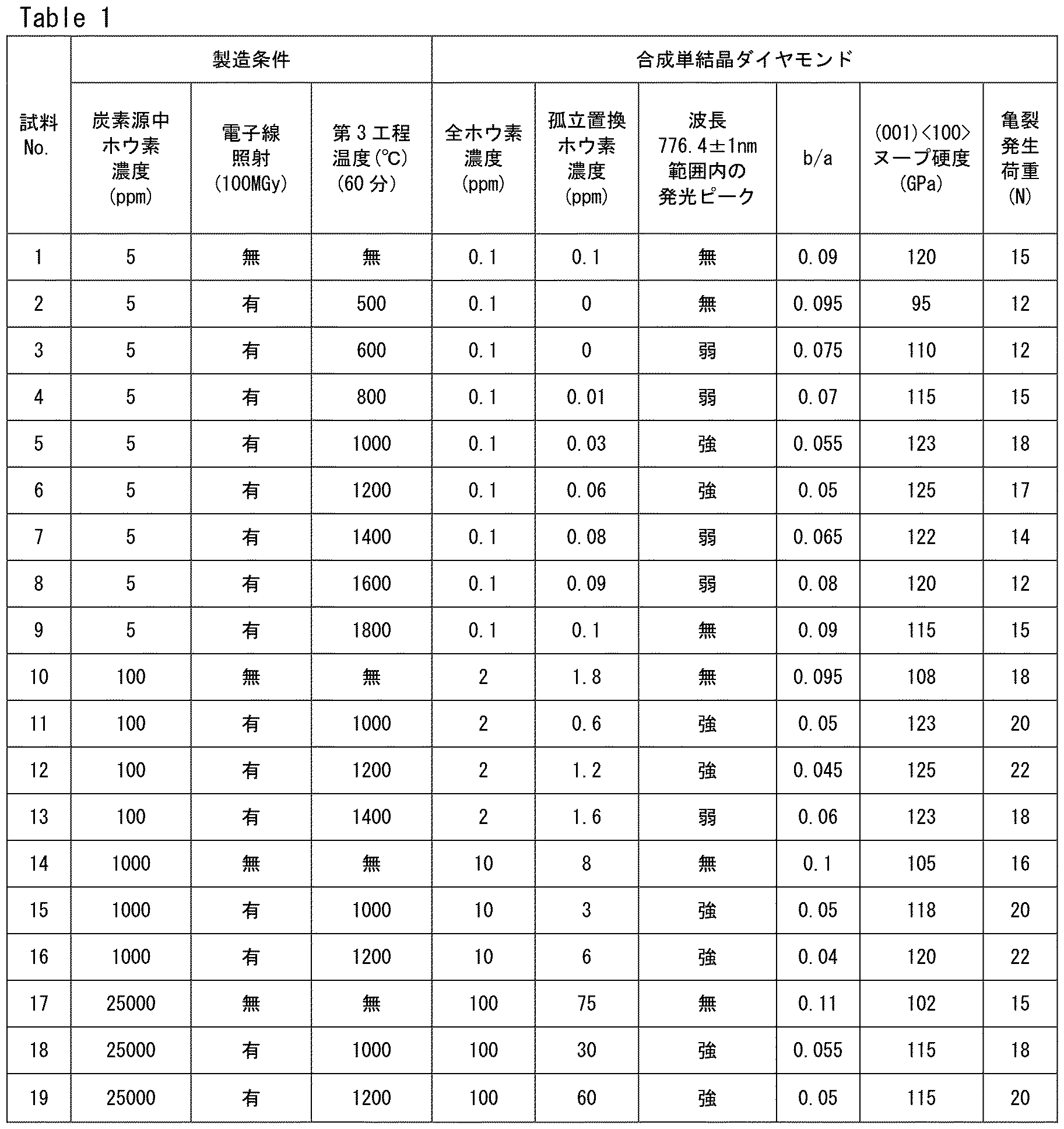
得られた合成単結晶ダイヤモンド(ただし、試料1、試料10、試料14、試料17は、第1工程で得られたダイヤモンド単結晶)について、全ホウ素原子濃度の測定、孤立置換型ホウ素原子濃度の測定、蛍光スペクトルの測定、(001)<100>のヌープ硬度の測定、(001)<110>のヌープ圧痕の対角線の比b/aの測定、及び、破壊強度試験を行う。全ての評価項目は、合成単結晶ダイヤモンドの{111}成長セクター部で評価する。
各試料の合成単結晶ダイヤモンド中のホウ素原子の原子数基準の濃度をSIMS分析により測定する。結果を表1の「合成単結晶ダイヤモンド」の「全ホウ素濃度(ppm)」欄に示す。
各試料の合成単結晶ダイヤモンド中の孤立置換型ホウ素原子の原子中基準の濃度を測定する。具体的な測定方法は実施形態1の(A1)~(A3)の手順に記載されているため、その説明は繰り返さない。結果を表1の「合成単結晶ダイヤモンド」の「孤立置換ホウ素濃度(ppm)」欄に示す。
各試料の合成単結晶ダイヤモンドの表面を鏡面研磨した後、波長488nmの励起光を照射して蛍光スペクトルを測定する。得られた蛍光スペクトルにおいて、蛍光波長776.4±1nmの範囲内における発光ピークの存在、並びに、その強弱を確認する。結果を表1の「合成単結晶ダイヤモンド」の「波長776.4±1nm範囲内の発光ピーク」欄に示す。該欄において、「強」とは波長776.4±1nmに発光ピークが存在し、かつ、該発光ピークの強度がダイヤモンドのラマン散乱光に相当する発光(波長521.9nm付近に現れるダイヤモンドのラマンピーク)の強度に対し50%以上であり、合成単結晶ダイヤモンドが1つの空孔と、1つのホウ素原子との結合体を含むことを示す。「弱」とは波長776.4±1nmに発光ピークが存在し、かつ、該発光ピークの強度が波長522nm付近に現れるダイヤモンドのラマン散乱光の発光強度に対し50%以下であり、合成単結晶ダイヤモンドが1つの空孔と、1つのホウ素原子との結合体を含むことを示す。「無」とは波長776.4±1nmの発光ピークが存在せず、合成単結晶ダイヤモンドが1つの空孔と、1つのホウ素原子との結合体を含なまいことを示す。
各試料の合成単結晶ダイヤモンドについて、(001)<100>ヌープ硬度を測定する。具体的な測定方法は実施形態1に記載されているため、その説明は繰り返さない。結果を表1の「合成単結晶ダイヤモンド」の「(001)<100>ヌープ硬度」欄に示す。(001)<100>ヌープ硬度が大きいほど、耐摩耗性に優れることを示す。
(001)<110>に形成したヌープ圧痕について、長い方の対角線の長さaと、短い方の対角線の長さbとを測定し、比b/aを算出する。結果を表1の「合成単結晶ダイヤモンド」の「b/a」欄に示す。b/aの値が小さいほど、弾性変形性が大きく、靱性が高く、耐欠損性に優れることを示す。
R50μmの球状のダイヤモンド圧子を準備し、室温(23℃)で、100N/minの負荷速度で各試料の合成単結晶ダイヤモンドに荷重をかけていき、試料に亀裂が発生した瞬間の荷重(亀裂発生荷重)を測定する。具体的な測定方法は実施形態1に記載されているため、その説明は繰り返さない。結果を表1の「合成単結晶ダイヤモンド」の「亀裂発生荷重」欄に示す。亀裂発生荷重が大きいほど、試料の強度が高く、耐欠損性が優れていることを示す。
試料3~試料8、試料11~試料13、試料15、試料16、試料18及び試料19は実施例に該当する。試料1、試料2、試料9、試料10、試料14、試料17は比較例に該当する。
Claims (5)
- 1つの空孔と、1つのホウ素原子との結合体を含む合成単結晶ダイヤモンドであって、
ホウ素原子の原子数基準の濃度は、0.1ppm以上100ppm以下である、合成単結晶ダイヤモンド。 - 前記合成単結晶ダイヤモンドは、JIS Z 2251:2009に準拠して、温度23℃±5℃、及び、試験荷重4.9Nの条件でヌープ硬度を測定する際に形成される(001)面における<110>方向のヌープ圧痕の対角線の長い方の対角線の長さaに対する短い方の対角線の長さbの比b/aが0.08以下である、請求項1に記載の合成単結晶ダイヤモンド。
- 前記合成単結晶ダイヤモンドの(001)面内の<100>方向におけるヌープ硬度は110GPa以上である、請求項1又は請求項2に記載の合成単結晶ダイヤモンド。
- 前記合成単結晶ダイヤモンドの表面に先端半径が50μmの球状のダイヤモンド圧子を100N/minの負荷速度で押し当てる破壊強度試験において、亀裂発生荷重が12N以上である、請求項1から請求項3のいずれか1項に記載の合成単結晶ダイヤモンド。
- 請求項1から請求項4のいずれか1項に記載の合成単結晶ダイヤモンドの製造方法であって、
溶媒金属を用いた温度差法により、ホウ素原子を原子数基準で0.1ppm以上100ppm以下の濃度で含むダイヤモンド単結晶を合成する第1工程と、
前記ダイヤモンド単結晶に、10MGy以上1000MGy以下のエネルギーを与える電子線及び粒子線の一方又は両方を照射する第2工程と、
前記第2工程後の前記ダイヤモンド単結晶に対して、600℃以上1800℃以下の温度を1分以上3600分以下加え、合成単結晶ダイヤモンドを得る第3工程と、を備える、合成単結晶ダイヤモンドの製造方法。
Priority Applications (2)
| Application Number | Priority Date | Filing Date | Title |
|---|---|---|---|
| JP2022560786A JP7754107B2 (ja) | 2020-11-04 | 2021-11-02 | 合成単結晶ダイヤモンド及びその製造方法 |
| US18/034,235 US20230383436A1 (en) | 2020-11-04 | 2021-11-02 | Synthetic single crystal diamond and method for producing same |
Applications Claiming Priority (2)
| Application Number | Priority Date | Filing Date | Title |
|---|---|---|---|
| JP2020184564 | 2020-11-04 | ||
| JP2020-184564 | 2020-11-04 |
Publications (1)
| Publication Number | Publication Date |
|---|---|
| WO2022097641A1 true WO2022097641A1 (ja) | 2022-05-12 |
Family
ID=81457212
Family Applications (1)
| Application Number | Title | Priority Date | Filing Date |
|---|---|---|---|
| PCT/JP2021/040399 Ceased WO2022097641A1 (ja) | 2020-11-04 | 2021-11-02 | 合成単結晶ダイヤモンド及びその製造方法 |
Country Status (3)
| Country | Link |
|---|---|
| US (1) | US20230383436A1 (ja) |
| JP (1) | JP7754107B2 (ja) |
| WO (1) | WO2022097641A1 (ja) |
Cited By (1)
| Publication number | Priority date | Publication date | Assignee | Title |
|---|---|---|---|---|
| WO2024210129A1 (ja) * | 2023-04-03 | 2024-10-10 | 住友電気工業株式会社 | 合成単結晶ダイヤモンド、合成単結晶ダイヤモンドの製造方法および赤外光学部品 |
Citations (2)
| Publication number | Priority date | Publication date | Assignee | Title |
|---|---|---|---|---|
| JP2012530676A (ja) * | 2009-06-26 | 2012-12-06 | エレメント シックス リミテッド | ファンシーな橙色の単結晶cvdダイヤモンドの製造方法及び得られた製品 |
| JP2018197178A (ja) * | 2017-05-24 | 2018-12-13 | 住友電気工業株式会社 | 多結晶ダイヤモンドおよびその製造方法、スクライブツール、スクライブホイール、ドレッサー、回転工具、ウォータージェット用オリフィス、伸線ダイス、切削工具、電極ならびに多結晶ダイヤモンドを用いた加工方法 |
Family Cites Families (2)
| Publication number | Priority date | Publication date | Assignee | Title |
|---|---|---|---|---|
| TWI457475B (zh) * | 2008-05-05 | 2014-10-21 | Carnegie Inst Of Washington | 超韌性單晶型摻硼鑽石 |
| US9255009B2 (en) * | 2009-06-26 | 2016-02-09 | Element Six Technologies Limited | Diamond material |
-
2021
- 2021-11-02 US US18/034,235 patent/US20230383436A1/en active Pending
- 2021-11-02 JP JP2022560786A patent/JP7754107B2/ja active Active
- 2021-11-02 WO PCT/JP2021/040399 patent/WO2022097641A1/ja not_active Ceased
Patent Citations (3)
| Publication number | Priority date | Publication date | Assignee | Title |
|---|---|---|---|---|
| JP2012530676A (ja) * | 2009-06-26 | 2012-12-06 | エレメント シックス リミテッド | ファンシーな橙色の単結晶cvdダイヤモンドの製造方法及び得られた製品 |
| JP2015155377A (ja) * | 2009-06-26 | 2015-08-27 | エレメント シックス リミテッド | 単結晶cvdダイヤモンドの処理方法及び得られた製品 |
| JP2018197178A (ja) * | 2017-05-24 | 2018-12-13 | 住友電気工業株式会社 | 多結晶ダイヤモンドおよびその製造方法、スクライブツール、スクライブホイール、ドレッサー、回転工具、ウォータージェット用オリフィス、伸線ダイス、切削工具、電極ならびに多結晶ダイヤモンドを用いた加工方法 |
Cited By (1)
| Publication number | Priority date | Publication date | Assignee | Title |
|---|---|---|---|---|
| WO2024210129A1 (ja) * | 2023-04-03 | 2024-10-10 | 住友電気工業株式会社 | 合成単結晶ダイヤモンド、合成単結晶ダイヤモンドの製造方法および赤外光学部品 |
Also Published As
| Publication number | Publication date |
|---|---|
| JPWO2022097641A1 (ja) | 2022-05-12 |
| US20230383436A1 (en) | 2023-11-30 |
| JP7754107B2 (ja) | 2025-10-15 |
Similar Documents
| Publication | Publication Date | Title |
|---|---|---|
| JP7462419B2 (ja) | 合成単結晶ダイヤモンド | |
| JP7517347B2 (ja) | 合成単結晶ダイヤモンド、それを備える工具、及び、合成単結晶ダイヤモンドの製造方法 | |
| JPWO2019077888A1 (ja) | 合成単結晶ダイヤモンド、工具、及び、合成単結晶ダイヤモンドの製造方法 | |
| KR20130041884A (ko) | 다이아몬드 공구 | |
| JP6582597B2 (ja) | ダイヤモンド単結晶、工具およびダイヤモンド単結晶の製造方法 | |
| TWI896695B (zh) | 合成單晶鑽石及其製造方法 | |
| JP7722370B2 (ja) | 合成単結晶ダイヤモンド及びその製造方法 | |
| WO2022264706A1 (ja) | 合成単結晶ダイヤモンド及びその製造方法 | |
| WO2022097641A1 (ja) | 合成単結晶ダイヤモンド及びその製造方法 | |
| JP7760754B1 (ja) | 単結晶ダイヤモンド素材および工具 | |
| JP7764631B1 (ja) | 単結晶ダイヤモンドおよび工具 | |
| TW202314068A (zh) | 合成單晶鑽石及其製造方法 | |
| JP2022139094A (ja) | 合成単結晶ダイヤモンド及びその製造方法 |
Legal Events
| Date | Code | Title | Description |
|---|---|---|---|
| 121 | Ep: the epo has been informed by wipo that ep was designated in this application |
Ref document number: 21889194 Country of ref document: EP Kind code of ref document: A1 |
|
| ENP | Entry into the national phase |
Ref document number: 2022560786 Country of ref document: JP Kind code of ref document: A |
|
| WWE | Wipo information: entry into national phase |
Ref document number: 18034235 Country of ref document: US |
|
| NENP | Non-entry into the national phase |
Ref country code: DE |
|
| 122 | Ep: pct application non-entry in european phase |
Ref document number: 21889194 Country of ref document: EP Kind code of ref document: A1 |