WO2022044315A1 - 学習装置、学習方法および学習プログラム - Google Patents
学習装置、学習方法および学習プログラム Download PDFInfo
- Publication number
- WO2022044315A1 WO2022044315A1 PCT/JP2020/032849 JP2020032849W WO2022044315A1 WO 2022044315 A1 WO2022044315 A1 WO 2022044315A1 JP 2020032849 W JP2020032849 W JP 2020032849W WO 2022044315 A1 WO2022044315 A1 WO 2022044315A1
- Authority
- WO
- WIPO (PCT)
- Prior art keywords
- objective function
- learning
- parameter
- input
- extended
- Prior art date
- Legal status (The legal status is an assumption and is not a legal conclusion. Google has not performed a legal analysis and makes no representation as to the accuracy of the status listed.)
- Ceased
Links
Images


Classifications
-
- G—PHYSICS
- G06—COMPUTING OR CALCULATING; COUNTING
- G06N—COMPUTING ARRANGEMENTS BASED ON SPECIFIC COMPUTATIONAL MODELS
- G06N20/00—Machine learning
-
- G—PHYSICS
- G06—COMPUTING OR CALCULATING; COUNTING
- G06N—COMPUTING ARRANGEMENTS BASED ON SPECIFIC COMPUTATIONAL MODELS
- G06N3/00—Computing arrangements based on biological models
- G06N3/02—Neural networks
- G06N3/08—Learning methods
- G06N3/092—Reinforcement learning
-
- G—PHYSICS
- G06—COMPUTING OR CALCULATING; COUNTING
- G06N—COMPUTING ARRANGEMENTS BASED ON SPECIFIC COMPUTATIONAL MODELS
- G06N5/00—Computing arrangements using knowledge-based models
- G06N5/04—Inference or reasoning models
- G06N5/045—Explanation of inference; Explainable artificial intelligence [XAI]; Interpretable artificial intelligence
Definitions
- the present invention relates to a learning device, a learning method, and a learning program for performing reverse reinforcement learning.
- Non-Patent Document 1 describes maximum entropy reverse reinforcement learning, which is one of reverse reinforcement learning.
- R (s, a) ⁇ ⁇ f (s, a).
- Algorithms used in machine learning including inverse reinforcement learning as described in Non-Patent Document 1 generally maximize or minimize the objective function at the time of learning, such as maximizing likelihood and minimizing error function. The calculation is done. However, there are cases where the objective function at the time of learning does not always sufficiently express the intended action.
- an object of the present invention is to provide a learning device, a learning method, and a learning program that can learn the degree to which the discrimination result is biased.
- the learning device accepts an input of an extended objective function obtained by multiplying each term indicating the score of each discrimination result in the objective function of the discrimination analysis by a bias parameter which is a parameter indicating the degree of bias of the score of the discrimination result.
- a bias parameter which is a parameter indicating the degree of bias of the score of the discrimination result.
- the learning method according to the present invention is an extended objective function in which a computer multiplies each term indicating the score of each discrimination result in the objective function of the discrimination analysis by a bias parameter which is a parameter indicating the degree of bias of the score of each discrimination result.
- the computer optimizes the weights of the logistic regression of the extended objective function, and the computer estimates the biased parameters by inverse reinforcement learning using the extended objective function of the logistic regression with the optimized weights set. It is characterized by doing.
- the learning program according to the present invention is an extended objective function in which a computer is multiplied by a biased parameter, which is a parameter indicating the degree of bias of the score of each discrimination result, with each term indicating the score of each discrimination result in the objective function of the discrimination analysis.
- Overweight parameters by inverse reinforcement learning using input processing that accepts input, optimization processing that optimizes the weights of logistic regression of the extended objective function, and extended objective function of logistic regression with optimized weights set. It is characterized in that an estimation process for estimating is executed.
- the model is quantitatively constructed based on the training data.
- the cross entropy error function is known as an objective function used when learning a model for performing binary discrimination.
- the cross entropy error function is represented by, for example, Equation 1 illustrated below.
- Equation 1 a i is a prediction model (output of the prediction model) for discrimination, and y i is correct answer data indicating a binary discrimination result such as abnormal or normal.
- the first term in ⁇ on the right side is a term indicating a score that increases when an abnormality is determined to be abnormal
- the second term in ⁇ on the right side increases when normal is determined to be normal. It is a term indicating the score to be performed.
- the "score for determining an abnormality as an abnormality” and the "score for determining a normality as normal” are treated equally.
- bias parameter a parameter indicating the degree of bias of the score of each discrimination result
- This bias parameter is different from the existing hyperparameters that indicate the weight of the score itself of the discrimination result, and is a parameter that indicates the degree to which the discrimination result is emphasized.
- the introduced biased parameter is estimated by reverse reinforcement learning.
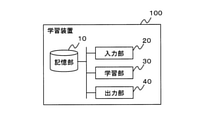
- FIG. 1 is a block diagram showing a configuration example of an embodiment of the learning device according to the present invention.
- the learning device 100 of the present embodiment is a device that performs reverse reinforcement learning that estimates a reward (function) from the behavior of a subject.
- the learning device 100 includes a storage unit 10, an input unit 20, a learning unit 30, and an output unit 40.
- the storage unit 10 stores information necessary for the learning device 100 to perform various processes.
- the storage unit 10 may store the decision-making history data (sometimes referred to as trajectory) of an expert used for learning by the learning unit 30, which will be described later, an objective function used for learning, and a prediction model.
- the aspects of the objective function and the prediction model are predetermined.
- an objective function obtained by multiplying each discriminant result term by a biased parameter is illustrated based on the cross entropy error function which is the objective function of the binary discriminant analysis.
- the objective function into which the weight loss parameter is introduced (hereinafter, may be referred to as an extended objective function) is represented by the following equation 2.
- Equation 2 exemplified below is the first term for calculating the score based on the first discriminant result in the objective function of the binary discriminant analysis, and the second term for calculating the score based on the second discriminant result, respectively. Shows an extended objective function multiplied by the discriminant parameters ⁇ 1 and ⁇ 2 .
- logistic regression is exemplified as a prediction model.
- Logistic regression is represented by Equation 3 exemplified below.
- x i is a feature vector and w is a weight for each feature.
- the decision-making history data used for reverse reinforcement learning includes, for example, address and gender, whether or not a specific product was purchased in the past, annual income, whether or not a family member is married, whether or not a specific commercial is viewed, and so on. Data including features such as the presence or absence of an Internet environment is used.
- the aspect of the objective function (that is, the extended objective function) in which the bias parameter is introduced is not limited to the function based on the cross entropy error function as exemplified in the above equation 2, and the aspect of the prediction model is also included.
- the logistic regression exemplified in Equation 3 above That is, if the objective function includes a weighting parameter that weights each score calculated according to the error from each prediction result (classification result) by the prediction model, the mode of the function is arbitrary.
- a parameter biased weight indicating the degree of bias of the score of each discriminant result is added to each term indicating the score of each discriminant result in the objective function of the discriminant analysis (here, the cross entropy error function).
- An extended objective function multiplied by the parameter is used.
- the storage unit 10 may store a mathematical optimization solver for realizing the learning unit 30 described later.
- the content of the mathematical optimization solver is arbitrary and may be determined according to the environment and the device to be executed.
- the storage unit 10 is realized by, for example, a magnetic disk or the like.
- the input unit 20 receives input of information necessary for the learning device 100 to perform various processes.
- the input unit 20 may accept, for example, the input of the above-mentioned decision-making history data. Further, the input unit 20 accepts the input of the objective function used for learning by the learning unit 30 described later. The contents of the objective function will be described later.
- the input unit 20 may accept the input of the objective function by reading the objective function stored in the storage unit 10.
- the learning unit 30 estimates the objective function (reward function) by performing reverse reinforcement learning based on the input decision-making history data. Specifically, the learning unit 30 of the present embodiment sets a logistic regression problem having an objective function as an extended objective function as an forward problem of inverse reinforcement learning, and estimates a biased parameter as the inverse problem.
- the learning unit 30 when the input unit 20 receives the extended objective function, the learning unit 30 generates an objective function in which a value is set in the biased parameter.
- the extended objective function the learning unit 30 uses an extended objective function obtained by multiplying each term indicating the score of each discrimination result in the cross entropy error function by a biased parameter.
- the learning unit 30 learns the prediction model by fixing the bias parameter. Specifically, the learning unit 30 fixes the bias parameter ⁇ and optimizes the set logistic regression problem.
- the learning unit 30 may update the logistic regression weight w by, for example, the gradient descent method using the partial differential of the logistic regression weight using the equation 4 illustrated below (specifically, the logistic regression weight w may be updated.
- the learning unit 30 estimates the decision-making content based on the generated prediction model. Specifically, the learning unit 30 applies the input decision-making history data to the optimized logistic regression to estimate the decision-making content of the expert.
- the learning unit 30 estimates the biased parameter so as to bring the estimated decision-making content closer to the decision-making history data, and updates the extended objective function. Since the method of bringing the decision-making content closer to the decision-making history data is the same as the method used in general reverse reinforcement learning, detailed description thereof will be omitted.
- the learning unit 30 After that, the learning unit 30 generates a final objective function (extended objective function) by repeating the learning of the prediction model and the update process of the bias parameter until a predetermined condition is satisfied.
- the output unit 40 outputs information about the generated objective function.
- the output unit 40 may output the generated objective function itself, or may output a biased parameter set according to the prediction result.
- the input unit 20, the learning unit 30, and the output unit 40 are realized by a computer processor (for example, a CPU (Central Processing Unit), a GPU (Graphics Processing Unit)) that operates according to a program (learning program).
- a computer processor for example, a CPU (Central Processing Unit), a GPU (Graphics Processing Unit)
- CPU Central Processing Unit
- GPU Graphics Processing Unit
- the program may be stored in the storage unit 10 included in the learning device 100, and the processor may read the program and operate as the input unit 20, the learning unit 30, and the output unit 40 according to the program.
- the function of the learning device 100 may be provided in the SaaS (Software as a Service) format.
- the input unit 20, the learning unit 30, and the output unit 40 may each be realized by dedicated hardware. Further, a part or all of each component of each device may be realized by a general-purpose or dedicated circuit (circuitry), a processor, or a combination thereof. These may be composed of a single chip or may be composed of a plurality of chips connected via a bus. A part or all of each component of each device may be realized by the combination of the circuit or the like and the program described above.
- each component of the learning device 100 when a part or all of each component of the learning device 100 is realized by a plurality of information processing devices and circuits, the plurality of information processing devices and circuits may be centrally arranged or distributed. It may be arranged.
- the information processing device, the circuit, and the like may be realized as a form in which each is connected via a communication network, such as a client-server system and a cloud computing system.
- FIG. 2 is a flowchart showing an operation example of the learning device 100 of the present embodiment.
- the input unit 20 accepts the input of the extended objective function (step S11).
- the learning unit 30 optimizes the weight of the logistic regression of the extended objective function (step S12), and uses the extended objective function of the logistic regression in which the optimized weight is set, and performs the biased parameter by reverse reinforcement learning. Is estimated (step S13). If the predetermined condition is not satisfied (Yes in step S14), the processes of steps S12 to S13 are repeated. On the other hand, when the predetermined condition is satisfied, the output unit 40 outputs information regarding the final extended objective function (step S15).
- the input unit 20 accepts the input of the extended objective function
- the learning unit 30 optimizes the weight of the logistic regression of the extended objective function, and the optimized weight is set for the logistic regression. Estimate the bias parameter by inverse reinforcement learning using the extended objective function of. Therefore, it is possible to learn the degree to which the discrimination result is biased.
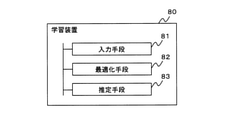
- FIG. 3 is a block diagram showing an outline of the learning device according to the present invention.
- the learning device 80 for example, the learning device 100
- the learning device 80 has each item indicating the score of each discriminant result in the objective function (for example, the cross entropy error function) of the discriminant analysis (for example, binary discriminant analysis).
- An input means 81 for example, an objective function shown in the above equation 2) that accepts an input of an extended objective function (for example, the objective function shown in the above equation 2) multiplied by a biased parameter (for example, ⁇ 1 , ⁇ 2 ) which is a parameter indicating the degree of bias of the score of the discrimination result.
- a biased parameter for example, ⁇ 1 , ⁇ 2
- the input unit 20 the optimization means 82 (for example, the learning unit 30) that optimizes the weight (for example, wT in the above equation 3) of the logistic regression of the extended objective function (for example, the above equation 3), and the optimization. It is provided with an estimation means 83 (for example, a learning unit 30) for estimating a biased parameter by inverse reinforcement learning using an extended objective function of logistic regression with a set weight.
- the input means 81 has a term for calculating a score based on the first discriminant result in the objective function of the binary discriminant analysis (for example, the first term in Equation 2) and a second discriminant result.
- the input of the extended objective function obtained by multiplying each of the terms for calculating the score based on (for example, the second term in Equation 2) by the discriminant parameter may be accepted.
- the input means 81 inputs, as an extended objective function, an extended objective function (for example, Equation 3 shown above) obtained by multiplying each term indicating the score of each discrimination result in the cross entropy error function by a biased parameter. You may accept it.
- an extended objective function for example, Equation 3 shown above
- the optimization means 82 updates the weight of the logistic regression of the extended objective function by the gradient descent method using the partial derivative of the weight of the logistic regression, and optimizes it (for example, by using the equation 4 shown above). May be.
- the estimation means 83 may estimate the decision-making content from the decision-making history data, and estimate the biased parameter so that the estimated decision-making content approaches the decision-making history data by reverse reinforcement learning.
- FIG. 4 is a schematic block diagram showing a configuration of a computer according to at least one embodiment.
- the computer 1000 includes a processor 1001, a main storage device 1002, an auxiliary storage device 1003, and an interface 1004.
- the learning device 80 described above is mounted on the computer 1000.
- the operation of each of the above-mentioned processing units is stored in the auxiliary storage device 1003 in the form of a program (learning program).
- the processor 1001 reads a program from the auxiliary storage device 1003, expands it to the main storage device 1002, and executes the above processing according to the program.
- the auxiliary storage device 1003 is an example of a non-temporary tangible medium.
- non-temporary tangible media include magnetic disks, magneto-optical disks, CD-ROMs (Compact Disc Read-only memory), DVD-ROMs (Read-only memory), which are connected via interface 1004. Examples include semiconductor memory.
- the program may be for realizing a part of the above-mentioned functions. Further, the program may be a so-called difference file (difference program) that realizes the above-mentioned function in combination with another program already stored in the auxiliary storage device 1003.
- difference file difference program
- the biased parameter is estimated by inverse reinforcement learning using the optimization means for optimizing the weight of the logistic regression of the extended objective function and the extended objective function of the logistic regression with the optimized weight set.
- a learning device characterized by having an estimation means.
- the input means is provided in each of the term for calculating the score based on the first discriminant result and the term for calculating the score based on the second discriminant result in the objective function of the binary discriminant analysis.
- the learning device according to Appendix 1 which accepts an input of an extended objective function multiplied by a discriminant parameter.
- Appendix 3 The learning device according to Appendix 1 or Appendix 2, wherein the input means receives the input of the extended objective function as the extended objective function, in which each term indicating the score of each discrimination result in the cross entropy error function is multiplied by the bias parameter.
- the optimization means is any one of Appendix 1 to Appendix 3 that updates and optimizes the weight of the logistic regression of the extended objective function by the gradient descent method using the partial differential of the weight of the logistic regression.
- the estimation means estimates the decision-making content from the decision-making history data, and estimates the biased parameter so that the estimated decision-making content approaches the decision-making history data by reverse reinforcement learning.
- the learning device according to any one of 4.
- the computer accepts the input of an extended objective function obtained by multiplying each term indicating the score of each discrimination result in the objective function of the discrimination analysis by the bias parameter which is a parameter indicating the degree of bias of the score of the discrimination result.
- the computer optimizes the weights of the logistic regression of the extended objective function, and the computer uses the extended objective function of the logistic regression set with the optimized weights, and the biased parameters are subjected to inverse reinforcement learning.
- a learning method characterized by estimating.
- Appendix 7 As an extended objective function, the computer calculates the score based on the first discriminant result in the objective function of the binary discriminant analysis, and the term for calculating the score based on the second discriminant result.
- the computer accepts the input of the extended objective function obtained by multiplying each term indicating the score of each discrimination result in the objective function of the discrimination analysis by the bias parameter which is a parameter indicating the degree of bias of the score of the discrimination result.
- the optimization processing for optimizing the weights of the logistic regression of the extended objective function, and the extended objective function of the logistic regression with the optimized weights set are subjected to inverse reinforcement learning.
- a program storage medium that stores a learning program for executing estimation processing.
- Appendix 9 A term for calculating a score based on the first discrimination result in the objective function of binary discrimination analysis and a term for calculating a score based on the second discrimination result as extended objective functions in computer input processing.
- the program storage medium according to Appendix 8 for storing a learning program for accepting an input of an extended objective function multiplied by a biased parameter in each of the above.
- the computer accepts an input of an extended objective function obtained by multiplying each term indicating the score of each discrimination result in the objective function of the discrimination analysis by the bias parameter which is a parameter indicating the degree of bias of the score of the discrimination result.
- the optimization processing for optimizing the weights of the logistic regression of the extended objective function, and the extended objective function of the logistic regression with the optimized weights set are subjected to inverse reinforcement learning.
- a learning program for executing an estimation process that estimates.
- Appendix 11 A term for calculating a score based on the first discriminant result in the objective function of binary discriminant analysis and a term for calculating a score based on the second discriminant result as extended objective functions in computer input processing.
- the learning program according to Appendix 10 in which each of the above is accepted for input of an extended objective function multiplied by a discriminant parameter.
- Storage unit 20 Input unit 30 Learning unit 40 Output unit 100 Learning device
Landscapes
- Engineering & Computer Science (AREA)
- Theoretical Computer Science (AREA)
- Software Systems (AREA)
- Physics & Mathematics (AREA)
- Artificial Intelligence (AREA)
- General Physics & Mathematics (AREA)
- Data Mining & Analysis (AREA)
- Evolutionary Computation (AREA)
- Mathematical Physics (AREA)
- Computing Systems (AREA)
- General Engineering & Computer Science (AREA)
- Medical Informatics (AREA)
- Computer Vision & Pattern Recognition (AREA)
- Computational Linguistics (AREA)
- Biomedical Technology (AREA)
- Molecular Biology (AREA)
- General Health & Medical Sciences (AREA)
- Biophysics (AREA)
- Life Sciences & Earth Sciences (AREA)
- Health & Medical Sciences (AREA)
- Information Retrieval, Db Structures And Fs Structures Therefor (AREA)
- Management, Administration, Business Operations System, And Electronic Commerce (AREA)
Priority Applications (3)
| Application Number | Priority Date | Filing Date | Title |
|---|---|---|---|
| PCT/JP2020/032849 WO2022044315A1 (ja) | 2020-08-31 | 2020-08-31 | 学習装置、学習方法および学習プログラム |
| US18/023,532 US20230316132A1 (en) | 2020-08-31 | 2020-08-31 | Learning device, learning method, and learning program |
| JP2022545247A JP7456512B2 (ja) | 2020-08-31 | 2020-08-31 | 学習装置、学習方法および学習プログラム |
Applications Claiming Priority (1)
| Application Number | Priority Date | Filing Date | Title |
|---|---|---|---|
| PCT/JP2020/032849 WO2022044315A1 (ja) | 2020-08-31 | 2020-08-31 | 学習装置、学習方法および学習プログラム |
Publications (1)
| Publication Number | Publication Date |
|---|---|
| WO2022044315A1 true WO2022044315A1 (ja) | 2022-03-03 |
Family
ID=80354994
Family Applications (1)
| Application Number | Title | Priority Date | Filing Date |
|---|---|---|---|
| PCT/JP2020/032849 Ceased WO2022044315A1 (ja) | 2020-08-31 | 2020-08-31 | 学習装置、学習方法および学習プログラム |
Country Status (3)
| Country | Link |
|---|---|
| US (1) | US20230316132A1 (https=) |
| JP (1) | JP7456512B2 (https=) |
| WO (1) | WO2022044315A1 (https=) |
Cited By (1)
| Publication number | Priority date | Publication date | Assignee | Title |
|---|---|---|---|---|
| JP2025530137A (ja) * | 2022-12-09 | 2025-09-11 | 三菱電機株式会社 | 事業資産における異常検出のための方法およびシステムならびに事業資産を修理するための方法 |
Families Citing this family (1)
| Publication number | Priority date | Publication date | Assignee | Title |
|---|---|---|---|---|
| TWI912128B (zh) * | 2025-02-04 | 2026-01-11 | 中華電信股份有限公司 | 用於資料分類的電子裝置及方法 |
Citations (2)
| Publication number | Priority date | Publication date | Assignee | Title |
|---|---|---|---|---|
| KR102132375B1 (ko) * | 2019-07-05 | 2020-07-09 | 한국과학기술원 | 딥 러닝 모델을 활용한 영상 진단 장치 및 그 방법 |
| WO2020158609A1 (ja) * | 2019-01-31 | 2020-08-06 | 国立大学法人東京工業大学 | 立体構造判定装置、立体構造判定方法、立体構造の判別器学習装置、立体構造の判別器学習方法及びプログラム |
-
2020
- 2020-08-31 US US18/023,532 patent/US20230316132A1/en active Pending
- 2020-08-31 JP JP2022545247A patent/JP7456512B2/ja active Active
- 2020-08-31 WO PCT/JP2020/032849 patent/WO2022044315A1/ja not_active Ceased
Patent Citations (2)
| Publication number | Priority date | Publication date | Assignee | Title |
|---|---|---|---|---|
| WO2020158609A1 (ja) * | 2019-01-31 | 2020-08-06 | 国立大学法人東京工業大学 | 立体構造判定装置、立体構造判定方法、立体構造の判別器学習装置、立体構造の判別器学習方法及びプログラム |
| KR102132375B1 (ko) * | 2019-07-05 | 2020-07-09 | 한국과학기술원 | 딥 러닝 모델을 활용한 영상 진단 장치 및 그 방법 |
Non-Patent Citations (1)
| Title |
|---|
| IMAI, TAKUJI: "NEC changes from one-off decision-making problem to practical use by reverse reinforcement learning of imitation learning that understands the intention of experts", NEC NIKKEI ROBOTICS, vol. 51, 10 September 2019 (2019-09-10), pages 22 - 26, ISSN: 2189-5783 * |
Cited By (2)
| Publication number | Priority date | Publication date | Assignee | Title |
|---|---|---|---|---|
| JP2025530137A (ja) * | 2022-12-09 | 2025-09-11 | 三菱電機株式会社 | 事業資産における異常検出のための方法およびシステムならびに事業資産を修理するための方法 |
| JP7851485B2 (ja) | 2022-12-09 | 2026-04-24 | 三菱電機株式会社 | 事業資産における異常検出のためのシステムによる異常検出方法、事業資産における異常検出のためのシステム、および事業資産を修理するために、事業資産における異常検出のためのシステムを使用する方法 |
Also Published As
| Publication number | Publication date |
|---|---|
| US20230316132A1 (en) | 2023-10-05 |
| JPWO2022044315A1 (https=) | 2022-03-03 |
| JP7456512B2 (ja) | 2024-03-27 |
Similar Documents
| Publication | Publication Date | Title |
|---|---|---|
| US12066918B2 (en) | System to track and measure machine learning model efficacy | |
| CN113761388B (zh) | 一种推荐方法、装置、电子设备及存储介质 | |
| US20190311258A1 (en) | Data dependent model initialization | |
| CN112308623A (zh) | 基于监督学习的优质客户流失预测方法、装置及存储介质 | |
| WO2017159403A1 (ja) | 予測システム、方法およびプログラム | |
| WO2017159402A1 (ja) | 共クラスタリングシステム、方法およびプログラム | |
| JP7456512B2 (ja) | 学習装置、学習方法および学習プログラム | |
| JP7207540B2 (ja) | 学習支援装置、学習支援方法、及びプログラム | |
| JP2022070561A (ja) | 判断結果提示プログラム、判断結果提示方法、及び、判断結果提示装置 | |
| GB2620586A (en) | Method and system of generating causal structure | |
| WO2018088277A1 (ja) | 予測モデル生成システム、方法およびプログラム | |
| Reyes et al. | FairPRS: adjusting for admixed populations in polygenic risk scores using invariant risk minimization | |
| JP2021174330A (ja) | 異種機械学習のアンサンブル学習による予測装置 | |
| JP4421971B2 (ja) | 解析エンジン交換型システム及びデータ解析プログラム | |
| JP6490271B1 (ja) | 情報処理装置、情報処理方法及び情報処理プログラム | |
| JP2021072057A (ja) | 情報処理装置および情報処理方法 | |
| JP6947229B2 (ja) | 最適化装置、最適化方法および最適化プログラム | |
| WO2018088276A1 (ja) | 予測モデル生成システム、方法およびプログラム | |
| Wang et al. | A cross-entropy based feature selection method for binary valued data classification | |
| JP2021168087A (ja) | 情報処理装置及びプログラム | |
| CN114943616B (zh) | 一种转账交易的风险控制方法及装置 | |
| JP7283548B2 (ja) | 学習装置、予測システム、方法およびプログラム | |
| JP7532300B2 (ja) | 情報処理方法、プログラム及び情報処理装置 | |
| JP7472998B2 (ja) | パラメータ推定装置、秘密パラメータ推定システム、秘密計算装置、それらの方法、およびプログラム | |
| JP7231027B2 (ja) | 異常度推定装置、異常度推定方法、プログラム |
Legal Events
| Date | Code | Title | Description |
|---|---|---|---|
| 121 | Ep: the epo has been informed by wipo that ep was designated in this application |
Ref document number: 20951564 Country of ref document: EP Kind code of ref document: A1 |
|
| ENP | Entry into the national phase |
Ref document number: 2022545247 Country of ref document: JP Kind code of ref document: A |
|
| NENP | Non-entry into the national phase |
Ref country code: DE |
|
| 122 | Ep: pct application non-entry in european phase |
Ref document number: 20951564 Country of ref document: EP Kind code of ref document: A1 |