WO2021245910A1 - 運転状態推定システム、学習装置、推定装置、状態推定器の生成方法、及び推定方法 - Google Patents
運転状態推定システム、学習装置、推定装置、状態推定器の生成方法、及び推定方法 Download PDFInfo
- Publication number
- WO2021245910A1 WO2021245910A1 PCT/JP2020/022274 JP2020022274W WO2021245910A1 WO 2021245910 A1 WO2021245910 A1 WO 2021245910A1 JP 2020022274 W JP2020022274 W JP 2020022274W WO 2021245910 A1 WO2021245910 A1 WO 2021245910A1
- Authority
- WO
- WIPO (PCT)
- Prior art keywords
- learning
- operating state
- information
- state
- flow contact
- Prior art date
- Legal status (The legal status is an assumption and is not a legal conclusion. Google has not performed a legal analysis and makes no representation as to the accuracy of the status listed.)
- Ceased
Links
Images




Classifications
-
- C—CHEMISTRY; METALLURGY
- C10—PETROLEUM, GAS OR COKE INDUSTRIES; TECHNICAL GASES CONTAINING CARBON MONOXIDE; FUELS; LUBRICANTS; PEAT
- C10G—CRACKING HYDROCARBON OILS; PRODUCTION OF LIQUID HYDROCARBON MIXTURES, e.g. BY DESTRUCTIVE HYDROGENATION, OLIGOMERISATION, POLYMERISATION; RECOVERY OF HYDROCARBON OILS FROM OIL-SHALE, OIL-SAND, OR GASES; REFINING MIXTURES MAINLY CONSISTING OF HYDROCARBONS; REFORMING OF NAPHTHA; MINERAL WAXES
- C10G11/00—Catalytic cracking, in the absence of hydrogen, of hydrocarbon oils
- C10G11/14—Catalytic cracking, in the absence of hydrogen, of hydrocarbon oils with preheated moving solid catalysts
- C10G11/18—Catalytic cracking, in the absence of hydrogen, of hydrocarbon oils with preheated moving solid catalysts according to the "fluidised-bed" technique
- C10G11/182—Regeneration
-
- B—PERFORMING OPERATIONS; TRANSPORTING
- B01—PHYSICAL OR CHEMICAL PROCESSES OR APPARATUS IN GENERAL
- B01J—CHEMICAL OR PHYSICAL PROCESSES, e.g. CATALYSIS OR COLLOID CHEMISTRY; THEIR RELEVANT APPARATUS
- B01J38/00—Regeneration or reactivation of catalysts, in general
- B01J38/04—Gas or vapour treating; Treating by using liquids vaporisable upon contacting spent catalyst
-
- B—PERFORMING OPERATIONS; TRANSPORTING
- B01—PHYSICAL OR CHEMICAL PROCESSES OR APPARATUS IN GENERAL
- B01J—CHEMICAL OR PHYSICAL PROCESSES, e.g. CATALYSIS OR COLLOID CHEMISTRY; THEIR RELEVANT APPARATUS
- B01J38/00—Regeneration or reactivation of catalysts, in general
- B01J38/04—Gas or vapour treating; Treating by using liquids vaporisable upon contacting spent catalyst
- B01J38/12—Treating with free oxygen-containing gas
- B01J38/30—Treating with free oxygen-containing gas in gaseous suspension, e.g. fluidised bed
-
- C—CHEMISTRY; METALLURGY
- C10—PETROLEUM, GAS OR COKE INDUSTRIES; TECHNICAL GASES CONTAINING CARBON MONOXIDE; FUELS; LUBRICANTS; PEAT
- C10G—CRACKING HYDROCARBON OILS; PRODUCTION OF LIQUID HYDROCARBON MIXTURES, e.g. BY DESTRUCTIVE HYDROGENATION, OLIGOMERISATION, POLYMERISATION; RECOVERY OF HYDROCARBON OILS FROM OIL-SHALE, OIL-SAND, OR GASES; REFINING MIXTURES MAINLY CONSISTING OF HYDROCARBONS; REFORMING OF NAPHTHA; MINERAL WAXES
- C10G11/00—Catalytic cracking, in the absence of hydrogen, of hydrocarbon oils
- C10G11/14—Catalytic cracking, in the absence of hydrogen, of hydrocarbon oils with preheated moving solid catalysts
- C10G11/18—Catalytic cracking, in the absence of hydrogen, of hydrocarbon oils with preheated moving solid catalysts according to the "fluidised-bed" technique
-
- C—CHEMISTRY; METALLURGY
- C10—PETROLEUM, GAS OR COKE INDUSTRIES; TECHNICAL GASES CONTAINING CARBON MONOXIDE; FUELS; LUBRICANTS; PEAT
- C10G—CRACKING HYDROCARBON OILS; PRODUCTION OF LIQUID HYDROCARBON MIXTURES, e.g. BY DESTRUCTIVE HYDROGENATION, OLIGOMERISATION, POLYMERISATION; RECOVERY OF HYDROCARBON OILS FROM OIL-SHALE, OIL-SAND, OR GASES; REFINING MIXTURES MAINLY CONSISTING OF HYDROCARBONS; REFORMING OF NAPHTHA; MINERAL WAXES
- C10G11/00—Catalytic cracking, in the absence of hydrogen, of hydrocarbon oils
- C10G11/14—Catalytic cracking, in the absence of hydrogen, of hydrocarbon oils with preheated moving solid catalysts
- C10G11/18—Catalytic cracking, in the absence of hydrogen, of hydrocarbon oils with preheated moving solid catalysts according to the "fluidised-bed" technique
- C10G11/187—Controlling or regulating
-
- G—PHYSICS
- G05—CONTROLLING; REGULATING
- G05B—CONTROL OR REGULATING SYSTEMS IN GENERAL; FUNCTIONAL ELEMENTS OF SUCH SYSTEMS; MONITORING OR TESTING ARRANGEMENTS FOR SUCH SYSTEMS OR ELEMENTS
- G05B13/00—Adaptive control systems, i.e. systems automatically adjusting themselves to have a performance which is optimum according to some preassigned criterion
- G05B13/02—Adaptive control systems, i.e. systems automatically adjusting themselves to have a performance which is optimum according to some preassigned criterion electric
- G05B13/0205—Adaptive control systems, i.e. systems automatically adjusting themselves to have a performance which is optimum according to some preassigned criterion electric not using a model or a simulator of the controlled system
- G05B13/026—Adaptive control systems, i.e. systems automatically adjusting themselves to have a performance which is optimum according to some preassigned criterion electric not using a model or a simulator of the controlled system using a predictor
-
- G—PHYSICS
- G05—CONTROLLING; REGULATING
- G05B—CONTROL OR REGULATING SYSTEMS IN GENERAL; FUNCTIONAL ELEMENTS OF SUCH SYSTEMS; MONITORING OR TESTING ARRANGEMENTS FOR SUCH SYSTEMS OR ELEMENTS
- G05B13/00—Adaptive control systems, i.e. systems automatically adjusting themselves to have a performance which is optimum according to some preassigned criterion
- G05B13/02—Adaptive control systems, i.e. systems automatically adjusting themselves to have a performance which is optimum according to some preassigned criterion electric
- G05B13/0265—Adaptive control systems, i.e. systems automatically adjusting themselves to have a performance which is optimum according to some preassigned criterion electric the criterion being a learning criterion
-
- G—PHYSICS
- G06—COMPUTING OR CALCULATING; COUNTING
- G06N—COMPUTING ARRANGEMENTS BASED ON SPECIFIC COMPUTATIONAL MODELS
- G06N20/00—Machine learning
Definitions
- the present invention relates to an operating state estimation system for estimating the operating state of an apparatus for manufacturing petroleum products, a learning device, an estimation device, a method for generating a state estimator, and an estimation method that can be used in the system.
- Refineries for refining crude oil to produce petroleum products produce petroleum products by separating the crude oil into multiple fractions with different boiling points in a distillation column and further processing and upgrading them in downstream equipment as necessary. do. For example, heavy fractions and residual oil (heavy oil) with low utility value are decomposed into high-value fractions such as gasoline by contacting them with a catalyst in a fluid state at a high temperature. The catalyst used to produce these is regenerated by burning carbon (cork) adhering to the surface, returned to the reaction column, and reused (see, for example, Patent Document 1). As a result, crude oil resources can be effectively utilized and the profitability of the refinery can be improved.
- cork burning carbon
- afterburn a phenomenon called afterburn (afterburning) may occur. If afterburn occurs, the flow contact cracking device may be damaged or the operation may not be continued, so it is necessary to suppress the occurrence of afterburn.
- the present invention has been made in view of such a situation, and an object thereof is to provide a technique for realizing suitable operation of a refinery.
- the operating state estimation system flows from information that can be acquired during operation of a flow catalytic cracking apparatus including a reaction apparatus using a catalyst and a regeneration apparatus that regenerates the catalyst.
- Flow contact cracking by a learning device that learns a state estimator for estimating the operating state of the contact cracking device and a state estimator learned by the learning device based on the information acquired during the operation of the flow catalytic cracking device. It is provided with an estimation device that estimates the operating state of the device.
- the learning device uses a learning data acquisition unit that acquires information acquired when the flow contact decomposition device was operated in the past as learning data, and a learning data acquired by the learning data acquisition unit by machine learning.
- the estimator inputs the operation data acquisition unit that acquires the information acquired during the operation of the flow contact cracking device and the information acquired by the operation data acquisition unit into the state estimator to determine the operating state of the flow contact cracking device. It includes an operating state estimation unit for estimation and an estimation result output unit for outputting information representing the operating state of the fluid cracking cracker estimated by the operating state estimation unit.
- This device includes a learning data acquisition unit that acquires information acquired when a flow contact decomposition device including a reaction device using a catalyst and a regeneration device that regenerates a catalyst has been operated in the past as learning data, and learning data.
- the learning unit learns the state estimator for estimating the operating state of the flow contact decomposition device from the information that can be acquired during the operation of the flow contact decomposition device by machine learning. , Equipped with.
- Yet another aspect of the present invention is an estimation device.
- This device has an operation data acquisition unit that acquires information acquired during the operation of a fluid cracking cracker including a reaction device that uses a catalyst and a regeneration device that regenerates the catalyst, and information acquired by the operation data acquisition unit.
- a state estimator machine-learned by a learning device that learns a state estimator for estimating the operating state of the flow contact cracking device using the information acquired when the flow contact cracking device was operated in the past as learning data. It is provided with an operating state estimation unit that estimates the operating state of the flow contact cracking device by inputting to, and an estimation result output unit that outputs information indicating the operating state of the flow contact cracking device estimated by the operating state estimation unit.
- Yet another aspect of the present invention is a method of generating a state estimator.
- This method is a step of acquiring information acquired when a fluid catalytic cracking apparatus including a reaction apparatus using a catalyst and a regeneration apparatus for regenerating a catalyst is operated in the past as learning data in a computer.
- learning data a step of learning a state estimator for estimating the operating state of the flow contact cracking device from the information that can be acquired during the operation of the flow contact cracking device by machine learning is executed.
- Yet another aspect of the present invention is an estimation method.
- a step of acquiring information acquired during operation of a flow catalytic cracking apparatus including a reaction apparatus using a catalyst and a regeneration apparatus for regenerating the catalyst in a computer, and a flow catalytic cracking of the acquired information.
- Information acquired when the device was operated in the past is used as training data to input to the state estimator machine-learned by the learning device to learn the state estimator for estimating the operating state of the cracking cracker.
- a step of estimating the operating state of the contact cracking device and a step of outputting information representing the estimated operating state of the fluid cracking device are executed.
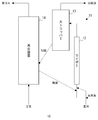
- FIG. 1 schematically shows the configuration of a fluidized catalytic cracking (FCC).
- the flow contact cracking device 10 includes a reaction device 11 and a regeneration device 14.
- the reactor 11 includes a riser 12 and a stripper 13.
- the riser 12 is a reaction tower for bringing the raw material oil into contact with the catalyst to obtain a product.
- Raw material oil, steam, and a catalyst are introduced into the bottom of the riser 12.
- the feedstock oil may be, for example, a wide range of fractions or residual oils having a boiling point higher than that of kerosene (about 170 ° C.), from kerosene, light oil to atmospheric residual oil.
- the catalyst may be particles containing, for example, zeolite, silica, clay minerals and the like.
- the riser 12 decomposes the raw material oil at a temperature of, for example, about 500 ° C., and supplies the decomposition product from the top to the stripper 13.
- the stripper 13 introduces steam into the decomposition product supplied from the riser 12 to remove the decomposed oil vapor adhering to the catalyst (stripping), and at the same time, separates only the catalyst downward and supplies it to the regeneration device 14.
- the cracked oil extracted from the top of the stripper 13 is further processed and upgraded by a downstream device.
- the regeneration device 14 regenerates the catalyst used in the riser 12.
- carbon (cork) adheres to the surface of the catalyst and the catalyst is inactivated.
- the regeneration device 14 regenerates the cork adhering to the surface of the catalyst by burning it at a high temperature, and supplies the regenerated catalyst to the bottom of the riser 12.
- a catalyst having coke on its surface and air are introduced into the regenerator 14. Exhaust gas containing carbon dioxide is discharged from the top of the regeneration device 14.
- the regeneration device 14 when a local decrease in the amount of air occurs, cork is incompletely burned due to lack of oxygen, the concentration of carbon monoxide in the exhaust gas increases, and afterburn occurs. When afterburn occurs, the regeneration device 14 may be damaged due to a temperature rise due to local heat generation, or the flow contact cracking device 10 may not be able to continue operation. Therefore, when operating the flow contact cracking apparatus 10, it is important to suppress the occurrence of afterburn in the regeneration apparatus 14.
- the learning device learns a state estimator for estimating the operating state of the flow contact cracking device 10 from the information that can be acquired during the operation of the flow contact cracking device 10 by machine learning. Then, the operating state estimation device estimates the operating state of the flow contact cracking device 10 by using the learned state estimator while the flow contact cracking device 10 is operating. Specifically, as a state estimator, the learning device determines whether the current operating state of the flow contact cracking device 10 is a state in which afterburn occurs in the reproduction device 14 or a state in which afterburn does not occur. Learn a feature amount calculator that calculates a feature amount for estimating whether the state is transitioning from a state in which no afterburn has occurred to a state in which afterburn has occurred.
- the operating state estimation device estimates the current operating state of the flow contact cracking device 10 based on the feature amount calculated by the feature amount calculator. Further, as a state estimator, the learning device learns an index predictor for predicting the value of the afterburn index indicating whether or not afterburn has occurred. The operating state estimation device estimates the future operating state of the flow contact cracking device 10 based on the index predicted by the index predictor. As a result, the operator can control the flow contact cracking device 10 while accurately grasping the operating state of the flow contact cracking device 10, so that the occurrence of afterburn in the regeneration device 14 can be suppressed.
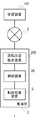
- FIG. 2 shows the configuration of the operating state estimation system according to the embodiment.
- the operating state estimation system 1 is a learning for learning a refinery 3 for refining crude oil to produce petroleum products and a state estimator for estimating the operating state of the fluid cracking device 10 of the refinery 3.
- the device 100 is provided.
- the refinery 3 and the learning device 100 are connected by an arbitrary communication network 2 such as the Internet or an in-house connection system, and are operated in any operation form such as on-premises, cloud, and edge computing.
- the refinery 3 is a control target device 5 such as an atmospheric distillation column and a fluid cracking device 10 installed in the refinery 3, and a control device 20 for setting a control amount for controlling the operating conditions of the control target device 5. And an operating state estimation device 200 that estimates the operating state of the flow contact cracking device 10 using the state estimator learned by the learning device 100.
- FIG. 3 shows the relationship between the afterburn index and the operating state of the regenerator of the fluid cracking cracker.
- the afterburn index is selected or calculated to take a positive value when no afterburn has occurred in the regenerator and to take a negative value when an afterburn has occurred. The positive and negative may be reversed.
- the afterburn index may be information that can be acquired from a sensor or device during the operation of the flow contact cracking device 10, or is predetermined from information that can be acquired from the sensor or device during the operation of the flow contact cracking device 10. It may be the information calculated by the formula or the calculation algorithm of.
- the operating state of the flow contact cracking apparatus 10 includes a normal state in which the afterburn index is positive, an afterburn state in which the afterburn index is negative, and a transition state in which the afterburn index changes from positive to negative or from negative to positive. ..
- the flow contact cracking device 10 is operating normally, but in the period (2), afterburn occurs in the regenerating device 14. It returns to the normal state in the period (3), but afterburn occurs again in the period (4).
- the transition state occurs in the period (5) and returns to the normal state in the period (6), but afterburn occurs again in the period (7) and the transition state occurs in the period (8).
- the feature amount calculator of the present embodiment calculates a feature amount having a lower number of dimensions from the multidimensional information acquired when the flow contact cracking device 10 is operated.
- the feature amount calculated from the multidimensional information by the feature amount calculator is classified into different clusters according to the operating state of the flow contact decomposition device 10 when the multidimensional information is acquired. As such, the feature amount calculator is learned.
- the learning device 40 retains the feature amount even if multidimensional information is dimensionally compressed / reduced by a method such as an autoencoder used for feature selection and feature extraction or a t-distributed stochastic neighborhood embedding method. Learn the feature amount calculator.
- FIG. 4 shows an example of the feature amount calculated by the feature amount calculator.
- the multidimensional information acquired when the flow contact cracking device 10 is operated as shown in FIG. 3 is reduced to two features, and the calculated two features are plotted in the two-dimensional coordinate space. did.
- the operating state estimation device 30 calculates the feature amount from the information acquired during the operation of the flow contact cracking device 10 by using the feature amount calculator learned in this way, and calculates the feature amount.
- the current operating state of the fluid cracking cracker 10 can be visually presented to the operator in an easy-to-understand manner. The operator can grasp the current operating state of the flow contact cracking apparatus 10 from the plot position of the current feature amount, and may shift to the afterburn state in the normal state, and the afterburn state in the afterburn state. It is possible to grasp the severity and so on.
- the information input to the feature amount calculator may be any information as long as it is information that can be acquired while the flow contact cracking device 10 is operating, but the operating state of the flow contact cracking device 10 is normal. It is desirable that the information has different values between the state and the afterburn state.
- the information input to the feature quantity calculator is, for example, the temperature inside the regenerator 14, the temperature distribution, the temperature and amount of the exhaust gas discharged from the regenerator 14, the carbon monoxide concentration in the exhaust gas, the carbon dioxide concentration, and the regeneration.
- the feature amount calculator is learned by any method for classifying or clustering the information that can be acquired when the flow contact decomposition device 10 is in operation according to the operating state of the flow contact decomposition device 10. good.
- the feature amount calculator may be learned by supervised learning or may be learned by unsupervised learning.
- the index predictor of the present embodiment calculates the predicted value of the afterburn index from the information acquired while the flow contact cracking device 10 is operating.
- the learning device 40 determines the afterburn index after a predetermined time has elapsed from the predetermined timing when the information acquired when the flow contact cracking device 10 was operated at the predetermined timing in the past is input to the index predictor. Learn the indicator predictor so that the predicted value is output from the indicator predictor.
- the index predictor inputs an estimated value estimated based on the information acquired when the flow contact cracking device 10 is operated and the information acquired when the flow contact cracking device 10 is operated to the input layer, and a predetermined time elapses. It may be a neural network or the like that outputs the predicted value of the later afterburn index from the output layer.
- the learning device 40 elapses from a predetermined timing when the information or estimated value acquired when the flow contact cracking device 10 is operated at a predetermined timing in the past is input to the index predictor.
- Various hyperparameters of the neural network may be adjusted so that the predicted value of the later afterburn index is output from the index predictor.
- FIG. 5 shows an example of the afterburn index predicted by the index predictor.
- the index predictor was trained using the information acquired when the flow contact cracking apparatus 10 was operated as shown in FIG. 3 and the value of the afterburn index 30 minutes later as training data.
- the index predictor was trained using the training data in the first half of each period (1) to (8), and the afterburn index in the latter half of each period was predicted using the trained index predictor. It was shown that the index predictor learned in this way can predict the afterburn index after 30 minutes with high accuracy.
- the operator can execute the operation management of the flow contact cracking device 10 in real time so that the afterburn index does not deviate from the predetermined range while monitoring the current value and the predicted value of the afterburn index. can.
- FIG. 6 shows an example of the afterburn index predicted by the index predictor. After 30 minutes predicted by inputting the information acquired when the flow contact cracking apparatus 10 was operated in a period different from the period shown in FIG. 5 into the index predictor learned as described above. The predicted value of the burn index and the actual value of the after burn index after 30 minutes were compared. It was shown that even if the data is unknown, the afterburn index after 30 minutes can be predicted with high accuracy by the index predictor learned as described above.
- the information input to the index predictor may be any information as long as it is information that can be acquired or can be guessed when the flow contact cracking device 10 is in operation.
- the information input to the index predictor may be selected based on the result of a fault tree analysis in which the occurrence of afterburn in the reproduction device 14 is a higher-level event.
- the weights of the plurality of types of information input to the index predictor may be adjusted based on the result of the fault tree analysis in which the occurrence of afterburn in the reproduction device 14 is a higher-level event.
- the index predictor can be learned according to the characteristics of the flow contact cracking device 10 and peripheral devices, so that the accuracy of the index predictor can be improved.
- the information input to the index predictor is, for example, the temperature inside the regeneration device 14, the temperature distribution, the temperature and amount of the exhaust gas discharged from the regeneration device 14, the carbon monoxide concentration in the exhaust gas, the carbon dioxide concentration, and the regeneration device.
- the learning device 40 is an afterburn index calculated by an index predictor learned by using specific information as learning data among a plurality of types of information acquired while the flow contact decomposition device 10 is operating.
- the weight of the information may be adjusted based on the difference between the predicted value and the predicted value of the afterburn index calculated by the index predictor learned without using the information as training data. It is considered that the larger the difference between the two, the greater the contribution to the afterburn index, and therefore the weight of the information may be increased. This makes it possible to further improve the accuracy of the index predictor.
- the operating state estimation device 30 has a predicted value of an afterburn index calculated by an index predictor learned using specific information as training data, and an index learned without using specific information as training data.
- the predicted value of the afterburn index calculated by the predictor may be presented to the operator. As a result, the operator can determine whether or not the specific information is the cause of the afterburn, so that the operator can execute appropriate control in order to avoid the occurrence of the afterburn.
- the learning device 40 may generate learning data by adjusting a plurality of types of information acquired while the flow contact cracking device 10 is operating at an offset time according to the type of information.
- the operating state estimation device 30 adjusts a plurality of types of information acquired while the flow contact cracking device 10 is operating at an offset time according to the type of information, and then inputs the information to the index predictor. do. For example, when the opening degree of the valve provided in the pipe is changed, the flow rate of the fluid flowing through the pipe changes immediately, but when afterburn occurs inside the regeneration device 14, the inside of the regeneration device 14 It takes time for the effects of local temperature changes to propagate to the surroundings. By adjusting the offset time in consideration of such response characteristics, the accuracy of the index predictor can be further improved.
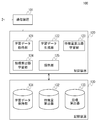
- FIG. 7 shows the configuration of the learning device 100 according to the embodiment.
- the learning device 100 includes a communication device 101, a control device 120, and a storage device 130.
- the communication device 101 controls wireless or wired communication.
- the communication device 101 transmits / receives data to / from the operating state estimation device 200 and the like via the communication network 2.
- the storage device 130 stores data and a computer program used by the control device 120.
- the storage device 130 includes a learning data holding unit 131, a feature amount calculator 132, and an index calculator 133.
- the learning data holding unit 131 stores the information acquired while the flow contact cracking device 10 is operating as learning data.
- the feature amount calculator 132 and the index calculator 133 are learned by the learning device 100.
- the control device 120 includes a learning data acquisition unit 121, a learning data generation unit 122, a feature amount calculator learning unit 123, an index calculator learning unit 124, and a provision unit 125.
- these configurations are realized by the CPU, memory, programs loaded in the memory, etc. of any computer, but here, the functional blocks realized by their cooperation are drawn. Therefore, it is understood by those skilled in the art that these functional blocks can be realized in various forms by hardware only, software only, or a combination thereof.
- the learning data acquisition unit 121 obtains information that can be acquired when the flow contact cracking device 10 is operating, such as various sensors, devices, devices, equipment, flow contact cracking devices 10, and control devices provided in the refinery 3. It is acquired from 20 or the like and stored in the learning data holding unit 131.
- the learning data generation unit 122 generates learning data for learning the feature amount calculator 132 and the index calculator 133 from the information stored in the learning data holding unit 131. As described above, the learning data generation unit 122 selects learning data from the information stored in the training data holding unit 131 based on the result of the fault tree analysis in which the occurrence of afterburn in the reproduction device 14 is a higher-level event. You may choose.
- the learning data generation unit 122 may generate learning data by executing preprocessing such as adjustment of an offset time according to the type of information on the information stored in the learning data holding unit 131.
- the learning data generation unit 122 may generate learning data by calculating or inferring another information from the information stored in the learning data holding unit 131.
- the feature amount calculator learning unit 123 learns the feature amount calculator 132 using the learning data generated by the learning data generation unit 122. As described above, even if the feature amount calculator learning unit 123 dimensionally compresses and reduces the multidimensional learning data by a method such as an autoencoder or a t-distributed stochastic neighborhood embedding method, the feature quantity calculator learning unit 123 of the flow contact decomposition device 10. The feature amount calculator 132 is learned so that the feature of the operating state is held in the feature amount having a low number of dimensions.
- the index calculator learning unit 124 learns the index calculator 133 using the learning data generated by the learning data generation unit 122. As described above, the index calculator learning unit 124 learns the index calculator 133 that inputs a plurality of learning data and outputs the predicted value of the afterburn index after the lapse of a predetermined time.
- the providing unit 125 provides the operating state estimation device 200 with the feature amount calculator 132 learned by the feature amount calculator learning unit 123 and the index calculator 133 learned by the index calculator learning unit 124.
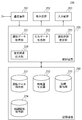
- FIG. 8 shows the configuration of the operating state estimation device 200 according to the embodiment.
- the operating state estimation device 200 includes a communication device 201, a display device 202, an input device 203, a control device 220, and a storage device 230.
- the communication device 201 controls wireless or wired communication.
- the communication device 201 transmits / receives data to / from the learning device 100 and the like via the communication network 2.
- the display device 202 displays the display image generated by the control device 220.
- the input device 203 inputs an instruction to the control device 220.
- the storage device 230 stores data and computer programs used by the control device 220.
- the storage device 230 includes an operation data holding unit 231, a feature amount calculator 232, an index calculator 233, and a correlation holding unit 234.
- the operation data holding unit 231 stores the information acquired when the flow contact cracking device 10 is in operation.
- the feature amount calculator 232 and the index calculator 233 are learned by the learning device 100 and are provided by the learning device 100.
- the correlation holding unit 234 holds a correlation between the coordinates of the feature amount output from the feature amount calculator 232 in the two-dimensional coordinate space or the three-dimensional coordinate space and the operating state of the flow contact cracking device 10.
- the control device 220 includes an operation data acquisition unit 221, an input data generation unit 222, an operation state estimation unit 223, and an estimation result output unit 224. These configurations can be realized in various forms by hardware only, software only, or a combination thereof.
- the operation data acquisition unit 221 obtains information that can be acquired when the flow contact cracking device 10 is operating, such as various sensors, devices, devices, equipment, flow contact cracking devices 10, and control devices provided in the refinery 3. It is acquired from 20 or the like and stored in the operation data holding unit 231.
- the input data generation unit 222 generates input data for input to the feature amount calculator 232 and the index calculator 233 from the information stored in the operation data holding unit 231.
- the input data generation unit 222 may execute the same preprocessing performed by the learning data generation unit 122 in the learning device 100 to generate the learning data on the information stored in the operation data holding unit 231.
- the operating state estimation unit 223 inputs the input data generated by the input data generation unit 222 to the feature amount calculator 232 and the index calculator 233, and acquires the estimation results output from each.
- the estimation result output unit 224 outputs the estimation result acquired by the operating state estimation unit 223.
- the estimation result output unit 224 displays on the display device 202 a diagram in which the feature amount calculated by the feature amount calculator 232 is plotted in the two-dimensional coordinate space or the three-dimensional coordinate space.
- the estimation result output unit 224 further displays the operating state of the flow contact cracking device 10 corresponding to the feature amount calculated by the feature amount calculator 232 with reference to the correlation stored in the correlation holding unit 234. Display on.
- the estimation result output unit 224 displays the predicted value of the afterburn index calculated by the index calculator 233 on the display device 202.
- FIG. 9 is a flowchart showing the procedure of the method of generating the state estimator according to the embodiment.
- the learning data acquisition unit 121 of the learning device 100 acquires information that can be acquired when the flow contact cracking device 10 is in operation (S10).
- the learning data generation unit 122 generates learning data for learning the feature amount calculator 132 and the index calculator 133 from the information acquired by the learning data acquisition unit 121 (S12).
- the feature amount calculator learning unit 123 learns the feature amount calculator 132 using the learning data generated by the learning data generation unit 122 (S14).
- the index calculator learning unit 124 learns the index calculator 133 using the learning data generated by the learning data generation unit 122 (S16).
- the providing unit 125 provides the operating state estimation device 200 with the feature amount calculator 132 learned by the feature amount calculator learning unit 123 and the index calculator 133 learned by the index calculator learning unit 124 (S18). ..
- FIG. 10 is a flowchart showing the procedure of the operating state estimation method according to the embodiment.
- the operation data acquisition unit 221 of the operation state estimation device 200 acquires information that can be acquired when the flow contact cracking device 10 is in operation (S20).
- the input data generation unit 222 generates input data for input to the feature amount calculator 232 and the index calculator 233 from the information acquired by the operation data acquisition unit 221 (S22).
- the operating state estimation unit 223 inputs the input data generated by the input data generation unit 222 into the feature amount calculator 232 and calculates the feature amount (S24).
- the operating state estimation unit 223 inputs the input data generated by the input data generation unit 222 into the index calculator 233 and calculates the afterburn index (S26).
- the estimation result output unit 224 outputs the estimation result acquired by the operating state estimation unit 223 (S28).
- 1 Operation state estimation system 2 Communication network, 3 Refinery, 5 Control target device, 10 Flow contact decomposition device, 11 Reaction device, 12 Riser, 13 Stripper, 14 Regeneration device, 20 Control device, 100 Learning device, 121 Learning data Acquisition unit, 122 learning data generation unit, 123 feature amount calculator learning unit, 124 index calculator learning unit, 125 providing unit, 131 learning data holding unit, 132 feature amount calculator, 133 index calculator, 200 operating state estimation device , 221 operation data acquisition unit, 222 input data generation unit, 223 operation state estimation unit, 224 estimation result output unit, 231 operation data holding unit, 232 feature amount calculator, 233 index calculator, 234 correlation holding unit.
- the present invention can be used as an operating state estimation system for suitably operating a fluidized cracking cracker in a refinery.
Landscapes
- Chemical & Material Sciences (AREA)
- Engineering & Computer Science (AREA)
- Oil, Petroleum & Natural Gas (AREA)
- Organic Chemistry (AREA)
- Chemical Kinetics & Catalysis (AREA)
- General Chemical & Material Sciences (AREA)
- Software Systems (AREA)
- Artificial Intelligence (AREA)
- Materials Engineering (AREA)
- Evolutionary Computation (AREA)
- General Physics & Mathematics (AREA)
- Medical Informatics (AREA)
- Computer Vision & Pattern Recognition (AREA)
- Physics & Mathematics (AREA)
- Theoretical Computer Science (AREA)
- Health & Medical Sciences (AREA)
- Automation & Control Theory (AREA)
- Computing Systems (AREA)
- General Engineering & Computer Science (AREA)
- Data Mining & Analysis (AREA)
- Mathematical Physics (AREA)
- Production Of Liquid Hydrocarbon Mixture For Refining Petroleum (AREA)
- Catalysts (AREA)
Priority Applications (6)
| Application Number | Priority Date | Filing Date | Title |
|---|---|---|---|
| KR1020227007991A KR20220047593A (ko) | 2020-06-05 | 2020-06-05 | 운전 상태 추정 시스템, 학습 장치, 추정 장치, 상태 추정기의 생성 방법, 및 추정 방법 |
| PCT/JP2020/022274 WO2021245910A1 (ja) | 2020-06-05 | 2020-06-05 | 運転状態推定システム、学習装置、推定装置、状態推定器の生成方法、及び推定方法 |
| JP2020556995A JP7301876B2 (ja) | 2020-06-05 | 2020-06-05 | 運転状態推定システム、学習装置、推定装置、状態推定器の生成方法、及び推定方法 |
| MYPI2022001318A MY203924A (en) | 2020-06-05 | 2020-06-05 | Operation state estimation system, training device, estimation device, state estimator generation method, and estimation method |
| TW110117016A TW202202608A (zh) | 2020-06-05 | 2021-05-12 | 運轉狀態推定系統、學習裝置、推定裝置、狀態推定器的生成方法以及推定方法 |
| US17/710,239 US20220220394A1 (en) | 2020-06-05 | 2022-03-31 | Operation state estimation system, training device, estimation device, state estimator generation method, and estimation method |
Applications Claiming Priority (1)
| Application Number | Priority Date | Filing Date | Title |
|---|---|---|---|
| PCT/JP2020/022274 WO2021245910A1 (ja) | 2020-06-05 | 2020-06-05 | 運転状態推定システム、学習装置、推定装置、状態推定器の生成方法、及び推定方法 |
Related Child Applications (1)
| Application Number | Title | Priority Date | Filing Date |
|---|---|---|---|
| US17/710,239 Continuation US20220220394A1 (en) | 2020-06-05 | 2022-03-31 | Operation state estimation system, training device, estimation device, state estimator generation method, and estimation method |
Publications (1)
| Publication Number | Publication Date |
|---|---|
| WO2021245910A1 true WO2021245910A1 (ja) | 2021-12-09 |
Family
ID=78830749
Family Applications (1)
| Application Number | Title | Priority Date | Filing Date |
|---|---|---|---|
| PCT/JP2020/022274 Ceased WO2021245910A1 (ja) | 2020-06-05 | 2020-06-05 | 運転状態推定システム、学習装置、推定装置、状態推定器の生成方法、及び推定方法 |
Country Status (6)
| Country | Link |
|---|---|
| US (1) | US20220220394A1 (https=) |
| JP (1) | JP7301876B2 (https=) |
| KR (1) | KR20220047593A (https=) |
| MY (1) | MY203924A (https=) |
| TW (1) | TW202202608A (https=) |
| WO (1) | WO2021245910A1 (https=) |
Cited By (1)
| Publication number | Priority date | Publication date | Assignee | Title |
|---|---|---|---|---|
| WO2023119544A1 (ja) * | 2021-12-23 | 2023-06-29 | 千代田化工建設株式会社 | プログラム、情報処理装置、及び方法 |
Families Citing this family (1)
| Publication number | Priority date | Publication date | Assignee | Title |
|---|---|---|---|---|
| JP7422962B2 (ja) * | 2022-02-02 | 2024-01-26 | 三菱電機株式会社 | 機器状態監視装置および機器状態監視方法 |
Citations (4)
| Publication number | Priority date | Publication date | Assignee | Title |
|---|---|---|---|---|
| US20020072465A1 (en) * | 2000-06-26 | 2002-06-13 | Nahas Nicholas C. | Process for minimizing afterburn in a FCC regenerator |
| JP2010505036A (ja) * | 2006-09-29 | 2010-02-18 | フィッシャー−ローズマウント システムズ, インコーポレイテッド | 異常状況の防止に使用される流動接触分解装置における触媒損失の検出 |
| CN104789256A (zh) * | 2015-03-26 | 2015-07-22 | 华东理工大学 | 一种催化裂化装置的收率实时预测方法 |
| US20190108454A1 (en) * | 2017-10-05 | 2019-04-11 | Honeywell International Inc. | Harnessing machine learning & data analytics for a real time predictive model for a fcc pre-treatment unit |
Family Cites Families (14)
| Publication number | Priority date | Publication date | Assignee | Title |
|---|---|---|---|---|
| WO2006046737A1 (ja) * | 2004-10-26 | 2006-05-04 | Yokohama National University | 多変数モデル解析システム、方法、プログラム、およびプログラム媒体 |
| US20070216683A1 (en) * | 2006-03-17 | 2007-09-20 | Honeywell International Inc. | Method and apparatus for displaying a third variable in a scatter plot |
| US20090095657A1 (en) * | 2006-11-07 | 2009-04-16 | Saudi Arabian Oil Company | Automation and Control of Energy Efficient Fluid Catalytic Cracking Processes for Maximizing Value Added Products |
| US8896605B2 (en) * | 2011-10-07 | 2014-11-25 | Hewlett-Packard Development Company, L.P. | Providing an ellipsoid having a characteristic based on local correlation of attributes |
| US9892238B2 (en) * | 2013-06-07 | 2018-02-13 | Scientific Design Company, Inc. | System and method for monitoring a process |
| US9465387B2 (en) * | 2015-01-09 | 2016-10-11 | Hitachi Power Solutions Co., Ltd. | Anomaly diagnosis system and anomaly diagnosis method |
| US10558933B2 (en) * | 2016-03-30 | 2020-02-11 | International Business Machines Corporation | Merging feature subsets using graphical representation |
| US10222787B2 (en) * | 2016-09-16 | 2019-03-05 | Uop Llc | Interactive petrochemical plant diagnostic system and method for chemical process model analysis |
| JP2018142097A (ja) * | 2017-02-27 | 2018-09-13 | キヤノン株式会社 | 情報処理装置、情報処理方法及びプログラム |
| US11593700B1 (en) * | 2017-09-28 | 2023-02-28 | Amazon Technologies, Inc. | Network-accessible service for exploration of machine learning models and results |
| JP2019089907A (ja) | 2017-11-13 | 2019-06-13 | Jxtgエネルギー株式会社 | 軽質オレフィンの製造方法 |
| RU2767009C1 (ru) * | 2018-02-15 | 2022-03-16 | Тийода Корпорейшн | Система поддержки установки условий работы завода, устройство обучения и устройство поддержки установки условий работы |
| US11574026B2 (en) * | 2019-07-17 | 2023-02-07 | Avanade Holdings Llc | Analytics-driven recommendation engine |
| JP7248823B1 (ja) * | 2021-06-09 | 2023-03-29 | 千代田化工建設株式会社 | 流体状態推定システム、学習装置、学習プログラム、推定装置、及び推定プログラム |
-
2020
- 2020-06-05 WO PCT/JP2020/022274 patent/WO2021245910A1/ja not_active Ceased
- 2020-06-05 KR KR1020227007991A patent/KR20220047593A/ko active Pending
- 2020-06-05 JP JP2020556995A patent/JP7301876B2/ja active Active
- 2020-06-05 MY MYPI2022001318A patent/MY203924A/en unknown
-
2021
- 2021-05-12 TW TW110117016A patent/TW202202608A/zh unknown
-
2022
- 2022-03-31 US US17/710,239 patent/US20220220394A1/en active Pending
Patent Citations (4)
| Publication number | Priority date | Publication date | Assignee | Title |
|---|---|---|---|---|
| US20020072465A1 (en) * | 2000-06-26 | 2002-06-13 | Nahas Nicholas C. | Process for minimizing afterburn in a FCC regenerator |
| JP2010505036A (ja) * | 2006-09-29 | 2010-02-18 | フィッシャー−ローズマウント システムズ, インコーポレイテッド | 異常状況の防止に使用される流動接触分解装置における触媒損失の検出 |
| CN104789256A (zh) * | 2015-03-26 | 2015-07-22 | 华东理工大学 | 一种催化裂化装置的收率实时预测方法 |
| US20190108454A1 (en) * | 2017-10-05 | 2019-04-11 | Honeywell International Inc. | Harnessing machine learning & data analytics for a real time predictive model for a fcc pre-treatment unit |
Cited By (4)
| Publication number | Priority date | Publication date | Assignee | Title |
|---|---|---|---|---|
| WO2023119544A1 (ja) * | 2021-12-23 | 2023-06-29 | 千代田化工建設株式会社 | プログラム、情報処理装置、及び方法 |
| WO2023119711A1 (ja) * | 2021-12-23 | 2023-06-29 | 千代田化工建設株式会社 | プログラム、情報処理装置、及び方法 |
| JPWO2023119544A1 (https=) * | 2021-12-23 | 2023-06-29 | ||
| JP7354477B1 (ja) * | 2021-12-23 | 2023-10-02 | 千代田化工建設株式会社 | プログラム、情報処理装置、及び方法 |
Also Published As
| Publication number | Publication date |
|---|---|
| MY203924A (en) | 2024-07-24 |
| JPWO2021245910A1 (https=) | 2021-12-09 |
| KR20220047593A (ko) | 2022-04-18 |
| TW202202608A (zh) | 2022-01-16 |
| JP7301876B2 (ja) | 2023-07-03 |
| US20220220394A1 (en) | 2022-07-14 |
Similar Documents
| Publication | Publication Date | Title |
|---|---|---|
| AU2025200676A1 (en) | Plant state operating analysis and control | |
| EP2408878B1 (en) | Automation and control of energy efficient fluid catalytic cracking processes for maximizing value added products | |
| CN104463343A (zh) | 一种预测催化裂化轻质油产率的方法 | |
| CN104392098A (zh) | 一种预测催化裂化汽油产率的方法 | |
| JP7248823B1 (ja) | 流体状態推定システム、学習装置、学習プログラム、推定装置、及び推定プログラム | |
| WO2006031749A2 (en) | Application of abnormal event detection technology to fluidized catalytic cracking unit | |
| WO2007149858A1 (en) | Methods and apparatus for process control using catalyst state estimation | |
| CN104463327A (zh) | 一种预测催化裂化焦炭产率的方法 | |
| JP7301876B2 (ja) | 運転状態推定システム、学習装置、推定装置、状態推定器の生成方法、及び推定方法 | |
| Sadighi et al. | Optimizing an industrial scale naphtha catalytic reforming plant using a hybrid artificial neural network and genetic algorithm technique | |
| Steurtewagen et al. | Machine learning refinery sensor data to predict catalyst saturation levels | |
| TWI829479B (zh) | 資訊處理程式、資訊處理裝置、及資訊處理方法 | |
| CN119758924B (zh) | 一种炼化装置参数控制方法、装置和设备 | |
| Kano et al. | Just-in-time statistical process control: adaptive monitoring of vinyl acetate monomer process | |
| Cristina | Neural Network Model Predictive Control System for Fluid Catalytic Cracking Unit | |
| CN107203661B (zh) | 一种催化裂化反应软测量辅助变量的选取方法及系统 | |
| Seng et al. | Transition classification and performance analysis: A study on industrial hydro-cracker |
Legal Events
| Date | Code | Title | Description |
|---|---|---|---|
| ENP | Entry into the national phase |
Ref document number: 2020556995 Country of ref document: JP Kind code of ref document: A |
|
| 121 | Ep: the epo has been informed by wipo that ep was designated in this application |
Ref document number: 20938634 Country of ref document: EP Kind code of ref document: A1 |
|
| ENP | Entry into the national phase |
Ref document number: 20227007991 Country of ref document: KR Kind code of ref document: A |
|
| NENP | Non-entry into the national phase |
Ref country code: DE |
|
| 122 | Ep: pct application non-entry in european phase |
Ref document number: 20938634 Country of ref document: EP Kind code of ref document: A1 |
|
| WWE | Wipo information: entry into national phase |
Ref document number: 522432112 Country of ref document: SA |
|
| WWR | Wipo information: refused in national office |
Ref document number: 522432112 Country of ref document: SA |