WO2021230318A1 - 持参薬仕分装置及び持参薬仕分方法 - Google Patents
持参薬仕分装置及び持参薬仕分方法 Download PDFInfo
- Publication number
- WO2021230318A1 WO2021230318A1 PCT/JP2021/018222 JP2021018222W WO2021230318A1 WO 2021230318 A1 WO2021230318 A1 WO 2021230318A1 JP 2021018222 W JP2021018222 W JP 2021018222W WO 2021230318 A1 WO2021230318 A1 WO 2021230318A1
- Authority
- WO
- WIPO (PCT)
- Prior art keywords
- drug
- brought
- sorting
- unit
- medicine
- Prior art date
- Legal status (The legal status is an assumption and is not a legal conclusion. Google has not performed a legal analysis and makes no representation as to the accuracy of the status listed.)
- Ceased
Links
Images







Classifications
-
- A—HUMAN NECESSITIES
- A61—MEDICAL OR VETERINARY SCIENCE; HYGIENE
- A61J—CONTAINERS SPECIALLY ADAPTED FOR MEDICAL OR PHARMACEUTICAL PURPOSES; DEVICES OR METHODS SPECIALLY ADAPTED FOR BRINGING PHARMACEUTICAL PRODUCTS INTO PARTICULAR PHYSICAL OR ADMINISTERING FORMS; DEVICES FOR ADMINISTERING FOOD OR MEDICINES ORALLY; BABY COMFORTERS; DEVICES FOR RECEIVING SPITTLE
- A61J3/00—Devices or methods specially adapted for bringing pharmaceutical products into particular physical or administering forms
Definitions
- the present invention relates to a brought-in drug sorting device for sorting drugs and a drug sorting device.
- Patent Document 1 discloses a drug discrimination system including a drug imaging device that captures an image of a drug and a computer that discriminates the drug based on the image data of the drug obtained by the drug imaging device.
- Patent Document 1 the drug discrimination system of Patent Document 1 is not always suitable for the operation of sorting the drugs brought by a plurality of patients by type.
- One aspect of the present invention is to realize a brought-in drug sorting device capable of automatically and efficiently sorting brought-in drugs on a patient-by-patient basis.
- the brought-in drug sorting device is a drug prescribed for one patient, and then a plurality of kinds of brought-in drugs brought to a medical institution.
- at least one first brought-in drug which is a drug prescribed to be taken at a predetermined time of administration, and the remaining second brought-in drug are separately accommodated, and the first brought-in drug and the above-mentioned first brought-in drug and the above-mentioned first brought-in drug are stored separately.
- the first collation unit that collates at least one feature of the brought-in drug with the reference data, and the first brought-in drug are housed in the second storage unit, and based on the collation result of the first collation unit, the said In the same section as the section containing the first brought-in drug, a sorting section for accommodating the second brought-in drug, which is considered to be the same type as the first brought-in drug, is provided.
- the brought-in drug sorting method is a drug prescribed for one patient, and then a plurality of kinds of brought-in drugs brought to a medical institution.
- the medicines at least one first-carrying medicine, which is a medicine prescribed to be taken at a predetermined time of administration, and the remaining second-carrying medicine, which are separately stored, are stored in the first storage unit.
- Reference data showing at least one feature of the first image pickup step of imaging the first carry-on drug taken out from the first storage unit and the first carry-on drug extracted from the image of the first carry-on drug is Alternatively, a determination step of determining reference data indicating information based on the feature, a first storage step of accommodating the first brought-in drug in the second storage portion after determining the reference data, and the first storage unit.
- the second brought-in drug is regarded as the same type as the first brought-in drug in the same section as the section containing the first brought-in drug. Includes a second containment step of accommodating the brought-in drug.
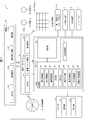
- FIG. 1 is a block diagram showing the overall configuration of the drug sorting device 1.
- FIG. 2 is a diagram showing a configuration example of the drug sorting device 1
- 2001 is a perspective view of the drug sorting device 1
- 2002 is a perspective view showing the basic configuration of the drug sorting area 2.
- the drug sorting device 1 includes a drug sorting area 2, a touch panel 3, a print output unit 4, a first RFID (Radio Frequency Identifier) reader / writer unit 5, and a packaging mechanism 6 (packaging unit). ), And a second RFID reader / writer unit 18.
- the drug sorting device 1 takes an image of each of a plurality of types of drugs, determines the type of the drug based on the image obtained as a result of the imaging, and sorts the drugs for each type. This treatment is performed in the drug sorting area 2.
- the drug sorting area 2 (internal configuration of the drug sorting device 1) will be described later.
- the drugs sorted by type are packaged or returned to the drug rack or the packaging machine after being visually inspected by the user.
- the plurality of types of drugs are drugs that are not contained in a container or the like, or drugs that are not packaged or the like, and as an example thereof, they are described as tablets or capsules.
- a plurality of types of drugs are returned drugs.
- the returned drug is a drug that is intended to be prescribed to each of the plurality of patients, or a post-preparation drug prescribed to each of the patients.
- the drug may include a drug that is returned as a "returned drug" at the pharmacy or hospital, or a drug issued by another pharmacy or hospital in addition to the adopted drug. It is a medicine.
- the brought-in drug is a drug (adopted drug) once prescribed to the patient at a certain medical institution, and then the drug that the patient brought to another medical institution for hospitalization, etc., and is being taken by the patient. ..
- the drug sorting device 1 can automatically perform processing from imaging to sorting after the drug is returned.
- the determination of the type of the drug is not limited to uniquely determining the type of the drug, and whether or not it is regarded as the same type based on at least one characteristic (eg, color, shape, size) of the drug is determined. You may point to discriminating. When regarded as the same type, a plurality of types having at least one feature the same or similar may be obtained as a discrimination result.
- the touch panel 3 accepts various user inputs on the operation unit 31, and displays various images (eg, an image showing the transition of the drug assortment, an image for visual inspection) on the display unit 32.
- the print output unit 4 prints a journal representing drug data (eg, data indicating a drug name and a patient name) relating to the drug after the visual inspection according to the user input after the visual inspection.
- the drug data may include image data showing a drug-specific image.
- the packaging mechanism 6 packages the sorted drugs. Since the drug sorting device 1 is provided with the packing mechanism 6, it is possible for the drug sorting device 1 to collectively perform the processing from the sorting of the returned medicine to the packing after the visual inspection. In particular, when the drug is charged into the packaging mechanism 6 by the transport / sorting unit 12, the processes from the sorting to the packaging can be automatically performed except for the visual inspection.
- the packaging mechanism 6 it is possible to adopt a packaging unit of a tablet packaging machine or a powder packaging machine that has been conventionally used.
- the drugs in the sorting cup 141 sorted by the same drug type can be packaged in one package or a plurality of packages.
- the “separate package” used in the description of the drug sorting device 1 has the meaning of “packaging the drug separately for each dosing time based on the prescription data” and “related to the prescription data”. It should be noted that the meaning of “simply packaging the medicines sorted in the second storage unit 14" is included.
- the first RFID reader / writer unit 5 is provided on the drug take-out side of the pedestal 19.
- the first RFID reader / writer unit 5 reads data regarding the drug stored in each sorting cup 141 stored in an RFID tag (not shown) provided at the bottom of each sorting cup 141 of the second accommodating unit 14.
- the data includes, for example, data indicating the number of stored drugs, drug identification data for identifying drugs (eg, GS1 code), and sorting cup identification information (RFID tag) for identifying the sorting cup 141. (Identification information given to).
- the drug data eg, drug name
- the image acquired by the imaging unit 13, and the like are stored in the storage unit 80 in association with the sorting cup identification information.
- the above data may include drug data (drug data after visual inspection) determined by visual inspection.
- the drug data after visual inspection may be written in the RFID tag.
- the drug data after visual inspection can be obtained when the drug stored in the corresponding sorting cup 141 is packaged by (1) a packaging mechanism 6 or a packaging machine different from the drug sorting device 1, or (2) a drug shelf. It is used when returning to.
- these drug data may also be stored in the drug database in association with the sorting cup identification information.
- the second RFID reader / writer unit 18 writes various data to the RFID tag or reads various data stored in the RFID tag.
- the second RFID reader / writer unit 18 is provided under the second accommodating portion 14. Specifically, it is provided so as to face the bottom of each sorting cup 141 when reading or writing data related to the drug stored in the RFID tag of each sorting cup 141.
- the drug sorting device 1 may be provided with a barcode reader 7.
- the bar code reader 7 reads, for example, a bar code indicating drug data of the drug printed on a drug package (packaging paper) in which the packaged drug is packaged by the packaging mechanism 6.
- the control unit 60a can perform processing based on the read barcode.
- the packaging mechanism 6 may be provided with a barcode printing mechanism (not shown) that prints a barcode indicating drug data of the drug packaged in the drug package on the drug package.
- the barcode reader 7 may be a reader that can read information indicating drug data printed on a drug package or the like. Further, the drug sorting device 1 does not necessarily have to be provided with the barcode reader 7. When the control unit 60a performs processing based on the above information, the control unit 60a may acquire the above information by communicating with an external device including a barcode reader 7.
- the drug sorting device 1 includes an opening / closing shutter 51 and an opening / closing door 52 that can open and close the drug take-out side.
- the drug sorting area 2 is mainly used as hardware in the first storage unit 11, the transport / sorting unit 12 (sorting unit), the imaging unit 13, the second storage unit 14, and the like.
- a standby tray 15, a collection tray 16, and a drug inlet 17 are provided.
- Each member except the transport / sorting unit 12 is provided on the pedestal 19.
- the first storage unit 11 stores a plurality of types of drugs returned by the user in a mixed state.
- the first accommodating portion 11 is divided into a plurality of accommodating portions.
- the first accommodating portion 11 may be provided so as to be rotatable with respect to the Z axis (center of the cylindrical shape).
- the control unit 60a may rotate the first storage unit 11 so that the transport / sorting unit 12 can easily acquire the drug, for example, at the timing when one storage unit becomes empty.
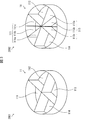
- FIG. 3 is a diagram showing a configuration example of the first accommodating portion 11.
- the first accommodating portion 11 has four accommodating portions 111 to 114 having substantially the same volume.
- two accommodation units 111 and 113 out of the four accommodation units shown in 3001 of FIG. 3 are further divided into three equal parts, each of which has three small accommodation units. It has portions 111a to 111c and three small accommodating portions 113a to 113c.
- the first storage unit 11 shown in 3001 of FIG. 3 is mainly used for sorting returned medicines
- the first storage unit 11 shown in 3002 of FIG. 3 is mainly used for sorting brought-in medicines.
- the first storage unit 11 shown in 3001 of FIG. 3 may be used when sorting the brought-in medicine. The method of using the first storage unit 11 when sorting the brought-in medicine will be described later.
- the transport / sorting unit 12 transports the drug stored in the first storage unit 11 to the receiving area where the image pickup unit 13 receives the drug.
- the transport / sorting unit 12 includes a second camera 121, a suction / shutter mechanism 122, and a transport mechanism 123.
- the second camera 121 sequentially images the first accommodating portion 11 in order to identify the drug to be transported.
- the second camera 121 is provided at the end of the transport / sorting unit 12 (specifically, at least in the housing including the suction / shutter mechanism 122) on the side facing the pedestal 19.
- the second camera 121 may be provided at the tip of the suction mechanism described later.
- the adsorption / shutter mechanism 122 includes an adsorption mechanism for adsorbing a drug specified as a transport target and a shutter mechanism for preventing the drug adsorbed by the adsorption mechanism from falling.
- the suction mechanism is provided so as to be movable in the Z-axis direction.
- the shutter mechanism is provided in front of the end portion so as to be movable substantially in parallel with the XY plane.
- the adsorption mechanism extends from the end, adsorbs the specified drug at the tip, and then returns to the position of the end.
- the shutter mechanism moves to a position facing the end portion and maintains the position of the shutter mechanism during drug transfer (closed state).
- the suction / shutter mechanism 122 moves to a position facing the drug loading table 133a of the drug holding mechanism 133 arranged in the receiving region
- the shutter mechanism moves to a position not facing the end portion (open state).
- the adsorption mechanism places the drug on the drug loading table 133a by stretching from the end and then releasing the adsorption state.
- the transport mechanism 123 moves the suction / shutter mechanism 122 in the X-axis and Y-axis directions. With this transport mechanism 123, it is possible to move the adsorption / shutter mechanism 122 when searching for a drug to be transported on the first storage section 11, or to transport the drug from the first storage section 11 to the drug loading table 133a. .. In addition, the drug can be transported from the drug loading table 133a to the second storage unit 14, the standby tray 15, or the collection tray 16.
- the image pickup unit 13 is placed on the drug placement table 133a and takes an image of the drug arranged in the arrangement area (imaging area) in which the drug to be imaged is arranged.
- the image pickup unit 13 includes a first camera 131 (imaging unit), a rotation mechanism 132, a drug holding mechanism 133, and an illuminator 134.
- the first camera 131 takes an image of the drug arranged in the arrangement area facing the first camera 131 in order for the control unit 60a to determine the type of the drug.
- the illuminator 134 emits light emitted from the drug when the drug is imaged.
- the rotation mechanism 132 rotates the first camera 131 so as to rotate around the arrangement area (the agent placement table 133a arranged at the position) in which the medicine to be imaged is arranged.
- the first camera 131 takes an image of the drug arranged in the arrangement region from a plurality of positions rotated by the rotation mechanism 132.
- the image pickup mechanism including the first camera 131 and the illuminator 134 is rotated so as to rotate around the arrangement area. Therefore, the first camera 131 can image the medicine from a plurality of directions while maintaining the positional relationship between the first camera 131 and the illuminator 134 with respect to the arrangement area.
- the drug holding mechanism 133 is a mechanism for holding a drug.
- the drug holding mechanism 133 includes a shaft portion that swivels around the Z axis as a rotation axis and extends substantially perpendicular to the Z axis, and two drug mounting tables (Petri dishes) 133a provided at each tip of the shaft portion. .. By turning the shaft portion, the two drug loading tables 133a can move between the receiving area (collection tray 16 side) and the arrangement area.
- the drug holding mechanism 133 moves the one drug loading table 133a from the receiving area to the arrangement area. And move. At this time, the other drug loading table 133a moves from the arrangement area to the receiving area.
- the first camera 131 takes an image of the medicine placed on one of the medicine placing tables 133a. Since the drug loading table 133a has transparency, the first camera 131 can image the drug mounted on the drug loading table 133a from various directions through the drug loading table 133a.
- one drug loading table 133a moves from the placement area to the receiving area, and the other drug loading table 133a moves from the receiving area to the receiving area. If the drug is not placed on the other drug loading table 133a, the drug conveyed from the first storage unit 11 can be placed on the other drug loading table 133a during the imaging. As a result, the first camera 131 can continuously image the drug.
- the second storage unit 14 stores drugs for each drug considered to be of the same type.
- the second storage unit 14 is provided with a plurality of compartments (drug storage positions) so that a plurality of drugs can be stored for each type.
- the second accommodating portion 14 is provided with a plurality of sorting cups 141 detachably placed.
- the control unit 60a determines the type of the drug based on the image of the drug captured by the image pickup unit 13, and determines the sorting cup 141 for storing the drug based on the determination result.
- the drug is transported and stored in the determined sorting cup 141 by the transport / sorting unit 12.
- the waiting tray 15 is a temporary storage unit in which the medicine is temporarily stored. For example, when the medicine is stored in all of the sorting cups 141, the medicine determined by the control unit 60a to be of a type other than the type of the medicine stored in each sorting cup 141 is temporarily stored in the waiting tray 15. Be placed. The medicine contained in the waiting tray 15 may be conveyed from the waiting tray 15 to the sorting cup 141 after the medicine is removed from the sorting cup 141.
- the collection tray 16 is a storage unit for storing an object (eg, a foreign substance other than a drug) whose type could not be identified by the control unit 60a.
- object eg, a foreign substance other than a drug
- foreign substances other than drugs include fragments of PTP (Press Through Pack) sheets.
- the control unit 60a also stores in the collection tray 16 a drug registered as a drug to be discarded in the drug database or a drug that the user wants to discard (eg, a drug having an old manufacturing date).
- the drug inlet 17 is for transporting the drug stored in the second storage unit 14 to the packaging mechanism 6 by the transport / sorting unit 12.
- a computer 60 for controlling and controlling each of the above-mentioned members (hardware) of the drug sorting device 1 is provided.
- the computer 60 includes a control unit 60a and a storage unit 80.
- the control unit 60a includes a transfer control unit 61, a sorting control unit 62, an image pickup control unit 63, a determination unit 64, a collation unit 65, an operation input unit 66, a display control unit 67, an RFID control unit 68, and a print output control unit 69.
- the packaging control unit 71 are included.
- the processing of the determination unit 64 will be described in the [Assortment processing of brought-in medicine] column described later.
- the transport control unit 61 controls the transport / sorting unit 12 to transport the drug contained in the first storage unit 11 to the receiving area. Specifically, the transport control unit 61 controls the suction / shutter mechanism 122 to execute a drug suction operation or a drug release operation by the suction / shutter mechanism 122. The transport control unit 61 controls the transport mechanism 123 to move the suction / shutter mechanism 122 in the X-axis and Y-axis directions.
- the sorting control unit 62 controls the transport / sorting unit 12 based on the determination result of the type of the drug (collation result by the collation unit 65), and determines the drug placed in the receiving area in the second storage unit 14. To the sorting cup 141, the standby tray 15, or the collection tray 16.
- the sorting control unit 62 Upon receiving the determination result of the drug, the sorting control unit 62 determines the sorting position for storing the drug, and stores the determination result and the determined sorting position in the storage unit 80 in association with each other. Specifically, the sorting control unit 62 determines whether or not the same determination result as the above determination result is stored in the storage unit 80.
- the sorting control unit 62 determines the sorting cup 141 associated with the stored discrimination result as the sorting position. Further, when the sorting position associated with the stored determination result (eg, estimated drug) is the waiting tray 15, the waiting tray 15 is determined as the sorting position. On the other hand, when the same discrimination result as the above discrimination result is not stored, the sorting cup 141 in which the drug is not stored (the sorting cup 141 whose sorting position is undecided) is determined as the sorting position. When the medicine is stored in all of the sorting cups 141, the waiting tray 15 is determined as the sorting position. The sorting control unit 62 may determine, as the sorting position, any of the sorting cups 141 of the second accommodating unit 14 instead of the waiting tray 15 for the estimated medicine.
- the sorting position associated with the stored determination result eg, estimated drug
- the sorting control unit 62 determines the sorting position
- the sorting control unit 62 controls the transport mechanism 123 in the same manner as the transport control unit 61 to move the transport / sorting unit 12 above the receiving area. Similar to the transport control unit 61, the sorting control unit 62 controls the second camera 121 and the adsorption / shutter mechanism 122 to adsorb the drug arranged in the receiving region. After that, the sorting control unit 62 controls the transport mechanism 123 to transport the drug to the determined sorting cup 141 or the standby tray 15.
- the sorting control unit 62 stores the medicine in the sorting cup 141 or the waiting tray 15 by releasing the adsorption after the medicine is conveyed. Further, the sorting control unit 62 counts the number of medicines stored in the sorting cup 141, associates them with the sorting positions, and stores them in the storage unit 80.
- the transfer control unit 61 After the sorting control unit 62 conveys the drug (drug after the determination is completed) of the drug loading table 133a arranged in the receiving area to the sorting position, the transfer control unit 61 is housed in the first storage unit 11. The drug is transported to and placed on the empty drug loading table 133a. As a result, the drug sorting device 1 can continuously discriminate the type of drug.
- the sorting control unit 62 receives a determination result indicating that the type of the drug could not be determined, since the substance arranged in the receiving area after the determination is a foreign substance, the foreign substance is collected in the collection tray 16. And transport.
- the data regarding the drug stored in the sorting cup 141 by the sorting control unit 62 is stored in the RFID tag provided in the sorting cup 141 by the second RFID reader / writer unit 18.
- the sorting control unit 62 causes the RFID control unit 68 to write data about the drug each time the drug is stored in the sorting cup 141. Further, the sorting control unit 62 stores the data in the storage unit 80.
- the image pickup control unit 63 controls the image pickup of the drug by the second camera 121 when the transport / sorting unit 12 adsorbs the drug to be transported.
- the transport control unit 61 and the sorting control unit 62 specify one of the drugs contained in the image captured by the second camera 121 as the drug to be transported.
- the image pickup control unit 63 controls the image pickup of the drug in the arrangement region by the image pickup unit 13, the swivel movement of the first camera 131 and the illuminator 134, and the movement of the drug holding mechanism 133.
- the image pickup control unit 63 stores the image captured by the first camera 131 in the storage unit 80.
- the collation unit 65 functions as a discriminating unit for discriminating the type of the drug based on the image of the drug captured by the first camera 131. Specifically, the collation unit 65 extracts the characteristics of the drug contained in the image by analyzing the image of the captured drug.
- the characteristics of the drug include, for example, size, shape, engraving, printing, secant line, and representative color (color of the engraved or printed area).
- OCR Optical Character Recognition
- the characteristics of the drug include the drug name (eg, identification code) indicated by engraving or printing, or identification information indicating the manufacturer (identification information for identifying the drug), and use. Other information such as deadlines is extracted.
- the collation unit 65 stores the extracted information indicating the characteristics of each drug in the storage unit 80 in association with the image of the drug.
- the feature extraction of the drug may be performed by a known technique.
- the collation unit 65 determines the type of drug by collating the characteristics of each drug with the drug database. For example, the collation unit 65 ranks drug data candidates related to the imaged drug from the drug database based on the representative color. After that, the collation unit 65 determines the type based on other features according to the above order.
- the collation unit 65 may narrow down the drug data candidates related to the imaged drug from the drug database by using pattern matching or the like based on the characteristics of the extracted drug. In this case, for example, at least one of the above-mentioned size, shape, engraving, print, score line, and representative color is used to narrow down drug data candidates. After that, the collation unit 65 performs OCR or the like, reads the identification information or the like displayed on the stamp or print, and further narrows down the types of drugs from the above candidates by using pattern matching or the like. Further, the collation unit 65 may rank the above candidates based on the degree of agreement between the characteristics of the extracted drug and the characteristics of the drug included in the drug database.
- the collation unit 65 determines that the drug (tablet or capsule) is based on at least a part of the target feature even if the feature (target feature) of the drug extracted by pattern matching or the like is not in the drug database. If estimated, the type of drug is determined as the estimated drug. In this case, the estimated drug can also be sorted into the second storage unit 14 or the waiting tray 15.
- the collation unit 65 may collate at least one of the target features with at least one of the features (collation features) of the drug extracted so far, and determine the type of the drug based on the collation result. I do not care. Specifically, when the collating unit 65 uses an image of the drug sorted in the sorting cup 141 as a reference image, the characteristic (target feature) of the drug contained in the image acquired thereafter is included in the reference image. Contrast with drug characteristics (matching characteristics). As a result, since the reference image can be used instead of the drug database to perform the above collation, the drug sorting process to the sorting cup 141 becomes possible even if the drug is not pre-registered in the drug database.
- the collation unit 65 outputs the determination result of the type of the drug to the sorting control unit 62. For example, when the type of drug can be specified as one, or when the number of candidates is narrowed down to within a predetermined number, drug data related to the drug is output as a discrimination result. In this case, the collation unit 65 stores the drug data related to the drug in the storage unit 80 in association with the image of the drug.
- the collating unit 65 When the collation unit 65 determines the type of the drug as the estimated drug, the collating unit 65 outputs the characteristics of the drug (characteristics of the product estimated as the estimated drug) as the discrimination result. On the other hand, when the collation unit 65 determines that the drug is registered as a drug to be discarded in the drug database, or when it is determined that the substance contained in the first storage unit 11 is a foreign substance other than the drug, the sorting target The fact that it is an external drug is output as a discrimination result.
- the operation input unit 66 and the display control unit 67 control the operation unit 31 and the display unit 32 of the touch panel 3, respectively.
- the RFID control unit 68 controls the first RFID reader / writer unit 5 and the second RFID reader / writer unit 18.
- the print output control unit 69 controls the print output unit 4 according to the user input received by the operation input unit 66.
- the packaging control unit 71 controls the transport / sorting unit 12 to transport the drug stored in the sorting cup 141 to the drug charging port 17. Further, the packaging control unit 71 controls the packaging mechanism 6 to package the medicine contained in each sorting cup 141.
- the computer 60 includes a storage unit 80.
- the storage unit 80 stores in advance a drug database (drug master) that manages drug data related to a plurality of types of drugs, and also stores images of drugs captured by the first camera 131.
- the image processed by the image pickup control unit 63 may be stored as an image of the drug.
- the various data stored in the storage unit 80 may not be managed by the storage unit 80, and may be managed by, for example, an external device.
- the control unit 60a may acquire the various data from the external device through a communication line such as the Internet, if necessary.
- the drug database may be updated by adding new drug data.
- sorting device 1 of the present embodiment it is possible to set a returned drug sorting mode for automatically sorting returned drugs and a brought-in drug sorting mode for automatically sorting brought-in drugs.
- the medicine sorting device 1 takes out a plurality of types of medicines stored in the first storage unit 11 one by one, and determines the type of the medicines based on the image of the taken out medicines. ..
- the drug sorting device 1 transports the drug to any of the second accommodating section 14, the standby tray 15, and the collection tray 16 based on the determination result. Therefore, in the returned medicine sorting mode, a plurality of types of medicines may be arbitrarily stored in the first storage unit 11, and it is not always necessary that the first storage unit 11 is provided with a plurality of storage units. Further, in the case of a returned drug, since there is no patient waiting for the sorting process, it is not necessary to improve the efficiency of the sorting process for the purpose of returning the drug to the patient immediately.
- the brought-in drug is required for the doctor to create a new prescription for the patient who brought the brought-in drug.
- the doctor considers the type of the drug to be brought and the content of the surgery, confirms whether there is a drug to be discontinued among the drugs to be brought, and then prepares a new prescription.
- the pharmacist will identify the brought medicine. Therefore, the drug sorting device 1 can support the pharmacist's identification and the doctor's prescription preparation work by sorting the brought-in drugs by patient type.
- the sorting process of the brought-in drug by the drug sorting device 1 is more efficient than the case of the returned drug. It is preferable that it is done well.
- the drug sorting device 1 of the present embodiment can further select the drug type-specific sorting mode and the drug type discrimination mode.
- the sorting mode for each drug type is a mode in which the brought-in drugs are sorted for each brought-in drug regarded as the same type, and then the brought-in drugs are packaged for each type.
- the drug type identification mode is a mode in which the brought-in drug is repackaged every time the drug is taken.
- the first storage unit 11 functions to classify and store the brought-in drugs on a patient-by-patient basis.
- the first containment unit 11 is a drug prescribed to one patient at one medical institution, and is at least one first of a plurality of types of brought-in drugs brought to another medical institution. It functions as a separate storage for the brought-in medicine and the remaining second brought-in medicine.
- the accommodating units 111 and 112 function as accommodating units for accommodating the brought-in medicine brought by one patient PA, and the accommodating units 113 and 114 are separate from the patient PA. It functions as a container for the medicine brought by the patient PB.
- predetermined dosing date is, for example, the dosing start date, but may be a specific day other than that.
- Each of the small accommodating portions 111a to 111c is prescribed as the first carry-on drug to be taken by the patient PA at each of the plurality of dosing times on the predetermined dosing date (predetermined dosing time), and the brought-in drug is taken.
- the small storage unit 111a is the medicine to be taken in the morning on a certain dose
- the small storage unit 111b is the medicine to be brought in for lunch on the day of administration
- the small storage unit 111c is the medicine to be brought to the small storage unit 111c for the evening dose on the day of administration. Is housed.
- the storage unit 112 is prescribed as a second carry-on drug to be taken by the patient PA at the same time as the plurality of dosing times on a dosing day other than the predetermined dosing date, and accommodates the remaining brought-in drug brought in. Act as something to do.
- the accommodating units 113 small accommodating units 113a to 113c
- the accommodating units 114 have the same functions as the accommodating units 111 and 112, and function as accommodating the first or second brought-in drug of the patient PB, respectively. ..
- the number of first brought medicines stored in the storage unit 111 is less than or equal to the number of second brought medicines in the storage unit 112. Therefore, the number of reference data to be described later created based on the image of the first brought-in drug can be reduced, and the second brought-in drug existing in excess of the number of the first brought-in drug can be sorted based on the small reference data. can. Therefore, the drug sorting device 1 can efficiently execute the sorting process of the brought-in drug.
- the accommodation unit 111 of the first storage unit 11 may be prescribed as the first carry-on medicine to be taken by the patient PA on a predetermined dosing date, and may function as a charge for accommodating the brought-in medicine. ..
- the storage unit 112 may function as a second carry-on medicine to be taken by the patient PA on a dosing day other than the predetermined dosing day, and to accommodate the remaining carry-on medicine brought in. No.
- the small storage unit 111a contains the medicine to be taken in the morning on a certain dose
- the small storage unit 111b contains the medicine to be taken in the evening on the day of the administration. Be housed.
- the medicines to be taken in the morning and evening on the days other than the day of the dose are stored. If it is prescribed to be taken in the morning, noon or evening of the day, the small containment unit 111a contains the medicine to be taken in the morning, noon or evening of a certain dosing day, and is contained in the storage unit.
- the brought-in medicine (residual brought-in medicine) for the morning, noon or evening dose on the day of taking other than the day of taking the medicine is accommodated.
- the accommodating unit 113 and the accommodating unit 114 function as accommodating the first or second brought-in drug of the patient PB, respectively.
- the accommodation unit 111 of the first storage unit 11 shown in 3001 of FIG. 3 is prescribed as the first carry-on drug to be taken by the patient PA at a predetermined time (predetermined administration time) on a predetermined administration date. It may function as a container for the brought-in medicine.
- the storage unit 112 may function as a second carry-on drug to be taken by the patient PA at a time other than a predetermined time, and to hold the remaining carry-on drug brought in.
- the storage unit 111 accommodates the medicine to be brought in the morning of a certain administration day, and the storage unit 112 stores the remaining medicine to be brought in.
- the accommodating unit 113 and the accommodating unit 114 function as accommodating the first or second brought-in drug of the patient PB, respectively.
- the number of the first brought-in medicines accommodated in the accommodating portion 111 can be set to be equal to or less than the number of the second brought-in medicines contained in the accommodating portion 112.
- the patient PA and PB are prescribed a drug for at least one day's dose, and it is sufficient that a plurality of dose times are set in one day.
- the accommodation location for the medicines brought by the patient PA and PB can be set arbitrarily.
- the accommodating portions 111 and 114 may be accommodating locations for the brought-in medicine of the patient PA, and the accommodating portions 112 and 113 may be accommodating locations for the brought-in medicine of the patient PB.
- the small accommodating portion may be provided in the accommodating portion 112 and the accommodating portion 114, and each small accommodating portion may accommodate the medicine to be brought in at any time.
- the first accommodating unit 11 may be further divided so that the first accommodating unit 11 can accommodate the first brought-in drug and the second brought-in drug of three or more patients on a patient-by-patient basis.
- the accommodation data indicating the accommodation unit in which the first and second brought-in medicines of one patient are accommodated and the accommodation unit in which the first brought-in medicine and the second brought-in medicine of another patient are accommodated is stored in advance. It is stored in the part 80.
- the first storage unit 11 may be capable of accommodating the first and second brought-in medicines of one patient.
- the second accommodating unit 14 functions as accommodating the first brought-in drug and the second brought-in drug for each patient and for each brought-in drug considered to be of the same type.
- a storage area for the brought-in drug is set for each patient.
- FIG. 4 is a plan view of the second accommodating portion 14. As shown by the alternate long and short dash line in FIG. 4, in the example of FIG. 4, the accommodation areas AR1 to AR4 are set as the accommodation areas for accommodating the medicines brought by the four patients.
- the storage position of the brought-in medicine in the first storage unit 11 (the position where the brought-in medicine is taken out) and the storage position of the brought-in medicine in the second storage unit 14 (the section in which the brought-in medicine is stored) are linked for each patient. It is managed as accommodation position data.
- the accommodation position data for example, the accommodation unit 111, the accommodation unit 112, and the accommodation area AR1 are associated with each other, and the accommodation unit 113, the accommodation unit 114, and the accommodation area AR2 are associated with each other and stored in the storage unit 80. ..
- the size and number of the accommodation areas can be set arbitrarily.
- the imaging unit 13 functions as an image of the first brought-in drug or the second brought-in drug taken out from the first accommodating unit 11 on a patient-by-patient basis.
- the image pickup unit 13 takes an image of the first brought-in medicines sequentially taken out by the transport / sorting unit 12. The same applies to the second brought-in drug.
- the determination unit 64 determines the reference data by, for example, one of the following two methods.
- the determination unit 64 stores the determined reference data in the storage unit 80.
- the determination unit 64 is reference data showing information based on at least one feature (eg, the size, shape, or representative color described above) of the first brought-in drug extracted from an image of the first brought-in drug. To determine.
- the determination unit 64 refers to, for example, a plurality of characteristics managed as drug data of the first brought-in drug acquired by collation of at least one feature of the first brought-in drug with the drug database by the collation unit 65. Determined as data.
- the collation unit 65 can compare the plurality of features of the first brought-in drug with at least one feature of the second brought-in drug.
- the determination unit 64 determines at least one feature of the first brought-in drug as reference data.
- the determination unit 64 determines, for example, the size, shape, and representative color of the first brought-in drug as reference data.
- control unit 60a can sort the second brought-in drug based on the characteristics of the first brought-in drug by using the reference data. Therefore, even if the type of the first brought-in drug is not accurately determined or narrowed down, the first brought-in drug and the second brought-in drug, which are considered to be the same type, may be contained in the same sorting cup 141.
- the determination unit 64 determining the characteristics of the first brought-in drug as reference data by the above method 2, the processing time (reference data creation time) of the determination unit 64 can be shortened.
- the collating unit 65 collates the reference data of the individual first brought-in drugs and determines whether or not the reference data can be regarded as the same. ..
- the collation unit 65 may consider that the reference data are the same when the degree of matching of at least one feature of the two first brought-in drugs to be collated is equal to or more than a predetermined value.
- the number of features for determining whether or not the degree of coincidence is equal to or greater than a predetermined value, and the predetermined value may be set by an experiment or the like.
- at least one feature of the second brought-in drug may be similarly processed in comparison with the reference data.
- the collating unit 65 functions as a first collating unit that collates at least one feature of the second brought drug extracted from the image of the second brought drug with the reference data determined by the determining unit 64.
- the collation unit 65 does not collate the characteristics of the second brought-in drug with the drug database, at least for the second brought-in drug.
- the reference data only the number of the first brought-in drug is stored in the storage unit 80. Therefore, the collation time can be shortened as compared with the case where the characteristics of the second brought-in drug are collated with all the drug data managed in the drug database. Further, by narrowing down the characteristics of the first brought-in drug included in the reference data (eg, the size, shape and representative color of the first brought-in drug), the collation time can be further shortened.
- the collation unit 65 narrows down the type of the first bring-in drug by collating at least one feature of the first bring-in drug with the drug database. 2 Functions as a collation unit. In this case, the collation unit 65 can accurately discriminate or narrow down the type of the first brought-in drug, and thus can accurately discriminate or narrow down the type of the second brought-in drug.
- the collating unit 65 will be described as having the functions of both the first collating unit and the second collating unit, but the control unit 60a has the first collating unit and the second collating unit as separate functions. You may have it.
- the transport / sorting unit 12 accommodates the first brought-in drug and the second brought-in drug in the second accommodating section 14 for each patient.
- the sorting control unit 62 controls the transport / sorting unit 12 and stores it in each sorting cup 141 of the second accommodating unit 14 based on the collation result of the reference data by the collating unit 65.
- the sorting control unit 62 will store the first drug.
- the brought-in medicine is stored in the sorting cup 141 in which the first brought-in medicine is already stored.
- the sorting control unit 62 will store the first drug. 1 Store the brought-in medicine in an unused sorting cup 141.
- the sorting control unit 62 also stores the first brought-in medicine to be sorted in the unused sorting cup 141. As a result, the sorting control unit 62 can sort all the first brought medicines stored in the first storage unit 11 into the second storage unit 14 for each of the first brought medicines that can be regarded as the same type.
- the transport / sorting unit 12 is placed in the same section as the section in which the first brought-in drug is housed, based on the collation result of the collation unit 65 with at least one feature of the second brought-in drug and the reference data. Accommodates a second carry-on drug that is considered to be of the same type as the carry-on drug.
- the sorting control unit 62 controls the transport / sorting unit 12 when at least one feature of the second brought-in drug is regarded as the same as any reference data, and the first brought-in drug corresponding to the reference data.
- the second brought-in medicine is stored in the sorting cup 141 in which the medicine is stored.
- the sorting control unit 62 controls the transport / sorting unit 12 to use the second brought-in drug as an unused sorting cup. It is stored in 141 (sorting cup 141 in which the first brought-in medicine is not stored).
- the drug sorting device 1 separately stores the first brought-in drug and the second brought-in drug in the first storage unit 11, and sorts the second brought-in drug based on the reference data of the first brought-in drug. Sorting process can be performed efficiently and in a short time.
- the returned medicine sorting mode the returned medicine is stored in an arbitrary position of the first storage unit 11 regardless of the patient.
- the drug sorting device 1 takes out the drugs stored in the first storage unit 11 one by one and stores them in the second storage unit 14 for each type determined based on the image pickup result by the image pickup unit 13.
- the drug sorting device 1 takes out the brought-in drugs stored in the first storage unit 11 for each patient, and the patient in the second storage unit 14. Sort by unit according to the medicines brought in as the same type. Therefore, the drug sorting device 1 can package the brought-in drug stored in the second storage unit 14 on a patient-by-patient basis.
- the user for example, a pharmacist
- the user can handle the brought-in medicines sorted by the medicine sorting device 1 on a patient-by-patient basis. Therefore, the user can efficiently perform the identification work of the brought-in drug.
- the user can efficiently perform the work of reusing (repackaging) the brought-in drug or returning it to the patient or its caregiver according to the new prescription (post-bringing drug instruction) by the doctor. Will be.
- control unit 60a does not determine the type of the medicine, but collectively stores the medicine in one sorting cup 141.
- the display control unit 67 brings the image of the brought-in medicine (image captured by the first camera 131) stored in each sorting cup 141 to the display unit 32. Display the type of medicine.
- the display control unit 67 displays the type of the brought-in drug on the display unit 32 as the collation result (narrowing down result). If the characteristics of the first brought-in drug are not collated with the drug database, the collating unit 65 collates the characteristics of any of the brought-in drugs stored in the sorting cup 141 with the drug database. Narrow down the types of drugs (determine the types).
- the display control unit 67 displays the narrowed-down types of brought-in medicine on the display unit 32.
- the user uniquely identifies the type of the brought-in drug by visually recognizing the display of the display unit 32, and inputs the specific result via the operation unit 31 (visual inspection).
- the operation input unit 66 associates the input specific result with the sorting cup identification information and stores it in the storage unit 80.
- the packaging mechanism 6 is for each of the first and second brought-in medicines (stored in the same sorting cup 141) contained in the same section of the second containing unit 14, the first brought-in medicine and the second brought-in medicine. Is packaged. Therefore, the packaging mechanism 6 can be packaged into the brought-in medicine for each type specified by the visual inspection. In addition, the packaging mechanism 6 packages the first brought-in drug and the second brought-in drug for each of the first brought-in drug and the second brought-in drug housed in the same section for each patient. Therefore, the packaging mechanism 6 can provide the user with the brought-in medicine packaged in patient units. In addition, since the brought-in medicine is packaged together for each patient, the user can easily return the brought-in medicine to the patient or his / her caregiver.
- 5001 and 5002 in FIG. 5 are diagrams showing an example of packaging by the packaging mechanism 6.
- the brought-in drug (drug names: DA1 to DA4) of the patient PA is stored in the accommodation area AR1 of the second accommodating portion 14, and the brought-in drug (drug names: DB1 to DB4) of the patient PB is secondly contained in the accommodation area AR1. It is assumed that they are accommodated in the accommodation area AR2 of the unit 14.
- 5001 in FIG. 5 is an example showing a state in which the brought-in drug of the patient PA is packaged
- 5002 in FIG. 5 is an example showing a state in which the brought-in drug of the patient PB is packaged.
- the packaging control unit 71 controls the transport / sorting unit 12 to take out the drugs one by one from the sorting cup 141 in which the drug having the drug name DA1 is stored in the storage area AR1 and via the drug charging port 17. , Transported to the packaging mechanism 6.
- drug DA1 Transported to the packaging mechanism 6.
- drug DA1 transported to the packaging mechanism 6.
- drug DA1 drug having drug names DA2 to DA4 and drug names DB1 to DB4.
- the packaging control unit 71 takes out all the drug DA1 from the sorting cup 141, conveys it to the packaging mechanism 6, and then packages the drug DA1 into one package by the packaging mechanism 6.
- the packaging control unit 71 controls the transport / sorting unit 12 during or after the packaging of the drug DA1 to take out all the drug DA2 from the sorting cup 141, and the packaging mechanism 6 packs one drug DA2.
- the drugs DA3 and DA4 are also packaged in the same manner.
- the packaging control unit 71 similarly packages the medicine brought in the accommodation area AR2 (patient PB).
- the packaging control unit 71 controls the packaging mechanism 6 to, for example, patient name, drug name (type of drug), number of drugs, and sorting date for each package. Print the information. By printing the above information on each package, the user can efficiently perform the above-mentioned work.
- the print output control unit 69 may print the above information in the journal. In this case as well, the user can efficiently perform the above-mentioned work by visually recognizing the journal.
- the user can easily convey the package containing the brought-in drug that the patient cannot take or the package containing the brought-in drug that the patient can take to the patient or his / her caregiver.
- the patient or his / her caregiver can easily determine whether or not to take the drug. Therefore, it is possible to reduce the possibility that the patient accidentally takes a brought-in drug that cannot be taken.
- the user can separate the package containing the non-doseable brought-in drug and hand only the takeable brought-in drug to the patient or his / her caregiver. In this way, by packaging the brought-in medicine for each patient type, it is possible to support the user's outpatient work such as returning the brought-in medicine described above. This support also supports, for example, patients who are hospitalized before surgery.
- the user may input that the brought-in drug is to be discontinued via the operation unit 31.
- the control unit 60a can specify the brought-in drug to be discontinued. Therefore, the control unit 60a adds information to the effect that the drug cannot be taken (eg, "Do not take this drug before admission” or "No need to take") to the above information on the packaging paper or journal. Can be printed. In this case, the user, the patient or the caregiver thereof can more easily determine whether or not to take the brought medicine.
- FIG. 5003 of FIG. 5 is a diagram showing a modified example of the packaging by the packaging mechanism 6.
- the packaging mechanism 6 crimps the horizontal crimping portion Cr1 and the vertical crimping portion Cr2 of the packaging paper to each package Pa, regardless of whether it is in the returned drug sorting mode or the brought-in drug sorting mode.
- the medicines contained in the second storage unit 14 are packaged for each type.
- the packaging mechanism 6 is, for example, while transporting the packaging paper by a pair of roller mechanisms (not shown) provided so as to extend in a direction substantially perpendicular to the transport direction of the packaging paper and sandwich the packaging paper.
- the horizontal crimping portion Cr1 is crimped, and the vertical crimping portion Cr2 is crimped at arbitrary intervals.
- the packaging control unit 71 controls the packaging mechanism 6 to package the brought-in medicine contained in the second storage unit 14 for each dosing time based on the prescription data.
- the packaging control unit 71 provides the vertical crimping portion Cr3 (partition) in each packaging Pa, so that each packaging Pa is divided into the first packaging region Pa1 and the second packaging. It may be divided into the area Pa2.
- the first sachet area Pa1 is an area for accommodating the brought-in drug that the patient can take
- the second sachet area Pa2 is an area for accommodating the brought-in drug that the patient cannot take (eg, the brought-in drug to be discontinued). Is.
- the brought-in drug can be separately packaged according to whether or not the drug can be taken.
- the packaging control unit 71 may print information such as that it can be taken in the first packaging area Pa1 and that it cannot be taken in the second packaging area Pa2 on the packaging paper. This can reduce the possibility that the patient will accidentally take a brought-in drug that cannot be taken.
- the package control unit 71 may package the non-doseable brought-in drugs together in addition to the brought-in drugs that can be taken. Further, as described above, the package control unit 71 can take the medicines that can be taken and the medicines that cannot be taken for each time of administration without distinguishing between the medicines to be taken and the medicines that cannot be taken in one package. You may separate the brought-in medicine and the brought-in medicine that cannot be taken into separate packages. When packaged in this way, the possibility that the patient accidentally takes a brought-in drug that cannot be taken can be further reduced.
- FIG. 6 is a diagram showing an example of a flow of sorting processing (bringing drug sorting method) and packaging processing of brought-in drugs by the drug sorting device 1.
- the transport control unit 61 controls the transport / sorting unit 12 to take out the first brought-in medicine of the patient PA housed in the storage unit 111 one by one and transport it to the imaging unit 13 (S1).
- the image pickup control unit 63 controls the image pickup unit 13 to take an image of the first brought-in drug (S2; first image pickup step).
- the determination unit 64 determines reference data using at least one feature of the first brought-in drug based on the imaging result (S3; determination step).
- the collation unit 65 collates the reference data with the reference data determined in S3.
- the sorting control unit 62 determines the sorting position (sorting cup 141) of the first brought-in drug in the storage area AR1 based on the collation result of the collation unit 65 and the storage position data. If the already determined reference data does not exist, the sorting control unit 62 determines the unused sorting cup 141 in the storage area AR1 as the storage position of the first brought-in drug based on the storage position data. After that, the sorting control unit 62 controls the transport / sorting unit 12 to store the first brought-in drug in the storage position determined in the storage area AR1 (S4; first storage step).
- the control unit 60a also executes the processes of S1 to S4 for the first brought-in drug of the patient PB accommodated in the accommodating unit 113, so that the first brought-in drug is accommodated in the accommodation position determined in the accommodation area AR2.
- the transport control unit 61 controls the transport / sorting unit 12 to take the second brought-in drug of the patient PA accommodated in the accommodating unit 112 by 1. They are taken out one by one and transported to the image pickup unit 13 (S5).
- the image pickup control unit 63 controls the image pickup unit 13 to take an image of the second brought-in drug (S6; second image pickup step).
- the collation unit 65 collates the imaging result with the reference data (S7; collation step).
- the sorting control unit 62 determines the sorting position of the second brought-in drug in the storage area AR1 based on the collation result, controls the transport / sorting unit 12, and stores the second brought-in drug in the sorting position (S8; Second accommodation step).
- the control unit 60a also executes the processing of S5 to S8 for the second brought-in drug of the patient PB accommodated in the accommodating unit 114, so that the second brought-in drug is accommodated in the accommodation position determined in the accommodation area AR2.
- the packaging control unit 71 controls the transport / sorting unit 12 to transfer the brought-in medicine contained in the accommodating area AR1 to the packaging mechanism 6. And transport. Prior to transporting the brought-in drug to the packaging mechanism 6, a visual inspection by the user is performed based on an image obtained by capturing the brought-in drug.
- the packaging control unit 71 controls the packaging mechanism 6 to package the brought-in medicine.
- the packaging control unit 71 also processes the brought-in medicine contained in the accommodation area AR2 in the same manner. In this way, the packaging control unit 71 packages the brought-in medicine contained in the second storage unit 14 on a patient-by-patient basis (S9).
- the control unit 60a accommodates the medicine brought by the patient PA accommodated in the accommodation unit 111 and the accommodation unit 112 in the accommodation area AR1, and then brings the medicine brought by the patient PB accommodated in the accommodation unit 113 and the accommodation unit 114. , May be accommodated in the accommodation area AR2. Further, the control unit 60a may accommodate the drug brought by the patient PA in the accommodation area AR1, execute the packaging process of the brought-in drug, and then accommodate the drug brought by the patient PB in the accommodation area AR2. ..
- the first accommodating unit 11 can accommodate the first and second brought-in medicines separately for each patient, and the imaging unit 13 is the first taken out from the first accommodating unit 11 for each patient. It has been described as an image of a brought-in drug or a second brought-in drug. Further, the transport / sorting unit 12 has been described as accommodating the first brought-in drug and the second brought-in drug in the second accommodating section 14 on a patient-by-patient basis.
- first and second brought-in drugs it is not necessary for the first and second brought-in drugs to be accommodated in the first accommodating section 11 on a patient-by-patient basis. That is, only the first brought-in drug and the second brought-in drug brought by one patient may be accommodated in the first accommodating section 11.
- the brought-in drug on the predetermined dosing day is used in the small accommodating portions 111a to 111c and 113a to 113c, respectively.
- the remaining medicines may be stored in the storage units 112 and 114.
- the drug sorting device 1 accommodates the first brought-in drug and the second brought-in drug brought by one patient in the first accommodating portion 11 through the above-mentioned treatment in the second accommodating portion 14. It doesn't matter. Even in this case, the drug sorting device 1 can efficiently and quickly perform the sorting process of the medicine brought by the patient. In addition, the drug sorting device 1 can support the efficient performance of the above-mentioned various tasks of the user by packaging the medicines brought by the patient for each type.
- the drug sorting device 1 may be communicably connected to an external device in which software for creating a brought-in drug identification report (brought-in drug identification software) is installed.
- the external device can create a brought-in drug identification report by receiving the drug data of the brought-in drug which is sorted by the drug sorting device 1 and whose type is specified by the user's visual inspection.
- control unit 60a may acquire the deadline and lot information of the brought-in medicine from the barcode printed on the packing paper at the time of dispensing (when the patient first receives the medicine). In this case, the control unit 60a can reprint the deadline and lot information of the brought-in medicine on the packaging paper or the journal after sorting the brought-in medicine.
- the control unit 60a When set to the drug type discrimination mode, the control unit 60a is contained in each of the daily doses (eg, the first packet in the plurality of packets) among the plurality of packets containing the brought-in drug brought by each patient.
- the type of medicine to be brought is determined for each packet, and each packet is repackaged. If, for example, three dose times of morning, noon, and evening are set for one day, the number of packages for the above daily dose is three. In the following description, it is assumed that three dosing times of morning, noon, and evening are set for one day, but the present invention is not limited to this.
- the user When set to the drug identification mode, the user removes the brought-in drug from one of the daily doses of the patient PP (here, the packet containing the brought-in drug for the morning dose), and the empty sorting cup 141. It is stored in (one section in the second accommodating portion 14).
- the display control unit 67 displays a selection image for selecting the dosing time of the first patient in a day on the touch panel 3.
- the selected image displays, for example, wake-up time, morning, noon, evening (evening), before going to bed, or other dosing time as selectable dosing times.
- the user selects "morning" as the dosing time.
- the display control unit 67 displays the first instruction image on the touch panel 3.
- the first instruction image is an image for urging the user to store the brought-in medicine in the empty sorting cup 141 and then place the sorting cup 141 on the first RFID reader / writer unit 5.
- the control unit 60a sets the RFID tag of the sorting cup 141 with the selected dosing time (here, “morning”) based on the above user input. Write the information shown.
- the control unit 60a writes information indicating the selected dosing time "daytime” on the RFID tag of the sorting cup 141 in which the brought-in medicine for the lunch dose of the patient PP is stored. Further, the control unit 60a writes information indicating the selected dosing time "evening" on the RFID tag of the sorting cup 141 in which the brought-in medicine for the evening dose is stored.
- 40 sorting cups 141 can be placed in the second accommodating portion 14 (see FIG. 4). Therefore, if there are 3 packages for daily dose (when 3 dose times are set for 1 day), the medicines brought for 13 patients are stored in separate sorting cups 141 for each daily dose time. can.
- the control unit 60a identifies that the carry-on drug stored in the sorting cup 141 is the bring-in drug for the second patient. Regarding the medicines brought by the patients after that, the control unit 60a identifies the medicines brought by the third, fourth, and so on patients in order.
- the control unit 60a controls each member, takes out the brought-in drug one by one for each sorting cup 141, images the brought-in drug, and uses the image-taking result and, for example, a drug database to determine the type of the drug. Discriminate or narrow down the type. The processing from the imaging of the brought-in drug to the determination of the type is as described above.
- the control unit 60a associates the discrimination result (narrowing-down result) and the captured image with the sorting cup identification information and stores them in the storage unit 80.
- the packaging control unit 71 takes out the brought-in medicine for each sorting cup 141 and packs the brought-in medicine.
- the package control unit 71 prints the patient's order (information indicating the number of patients), the dosing time, and the barcode on each package. For example, in the case of a medicine brought in for the morning dose of patient PP, the characters "first patient” and “morning" and a barcode are printed. The patient name may be printed instead of the patient's order.
- the display control unit 67 displays a visual audit image for the user to perform a visual audit on the touch panel 3.
- the discrimination result and the captured image are associated with the barcode. Therefore, the display control unit 67 can display the visual audit image including the discrimination result and the captured image.
- the visual audit image may display candidates for the type of drug to be brought so that the user can select it, or may display an area in which the type (eg, engraving) can be input.
- the print output control unit 69 prints the specified result (eg, drug name) in the journal. Bar code reading processing, visual auditing, and journal printing processing are performed for each package.
- the drug sorting device 1 stores the brought-in drug in the sorting cup 141 on a patient-by-patient basis and for each ingestion time in a day.
- the information indicating the patient (or the order of the patients) and the information indicating the dosing time in one day are linked and managed. Therefore, the drug sorting device 1 can repack the brought-in drug on a patient-by-patient basis and at each ingestion time in a day.
- the storage units 111 to 114 may function as accommodating medicines brought by different patients.
- the control unit 60a may not have the determination unit 64.
- the collation unit 65 collates at least one feature of the brought-in drug taken out from the first storage unit 11 with the drug database.
- the sorting control unit 62 stores each of the brought-in medicines considered to be of the same type in the second storage unit 14.
- the sorting control unit 62 stores the medicines determined to be of the same type in the same sorting cup 141, and stores the estimated medicine in a sorting cup 141 different from the sorting cup 141 stored for each type. do.
- the medicine brought by the patient PA housed in the storage unit 111 is stored in the storage area AR1
- the medicine brought by the patient PB housed in the storage unit 112 is stored in the storage area AR2.
- the medicine brought by the patient PC housed in the storage unit 113 is stored in the storage area AR3
- the medicine brought by the patient PD housed in the storage unit 114 is stored in the storage area AR4.
- the packaging control unit 71 packages the brought-in medicine for each specified type in patient units.
- FIG. 7 is a diagram showing another example of the first accommodating portion 11.
- the first accommodating portion 11 shown in FIG. 7 may be used.
- the first accommodating portion 11 has four accommodating portions 111 to 114 having substantially the same volume.
- the four accommodating portions 111 to 114 are further divided into four.
- the accommodating portion 111 has three small accommodating portions 111d to 111f and one medium accommodating portion 111g.
- the accommodating units 112 to 114 have three small accommodating units 112d to 112f and one medium accommodating unit 112g, three small accommodating units 113d to 113f and one medium accommodating unit 113g, and three small accommodating units 114d to. It has 114f and one medium accommodating portion 114g.
- the first storage unit 11 shown in FIG. 7 is mainly used for sorting brought-in medicines.
- each of the small accommodating units 111d to 111f functions as accommodating the first brought-in drug of a certain patient, similarly to the small accommodating units 111a to 111c shown in 3002 of FIG.
- the middle storage unit 111g functions as a storage unit for a patient's second brought-in medicine, similar to the storage unit 112 shown in FIG. 33002. Since the number of the first brought-in medicines accommodated in the small accommodating portions 111d to 111f is less than the number of the second brought-in medicines accommodated in the medium accommodating portion 113 g, the volume of the small accommodating portions 111d to 111f is set to the medium accommodating portion. It is smaller than the volume of 113g.
- the small accommodating portions 111d to 111f are arranged along the circumferential direction on the outside of the accommodating portion 111, and the accommodating portion 111 is arranged.
- a medium accommodating portion 113 g is arranged in the remaining region (inside).
- the accommodating portions 112 to 114 also have the same functions and configurations as the accommodating portions 111.
- the first brought-in drug and the second brought-in drug of patients PA to PD different from each other may be accommodated in the accommodating portions 111 to 114, respectively.
- the first storage unit 11 can store up to four people at a time.
- the medicines brought by the patients PA to PD whose dosing time is set to 3 times or less on a predetermined dosing day (eg, at least one of morning, noon, and evening), are accommodated in each of the accommodating portions 111 to 114. Will be done.
- the dosing time of a certain patient is set to 4 times or more on a predetermined dosing day, at least 2 or more of the accommodating portions 111 to 114 are used as accommodating places for the medicine brought by the patient.
- the second drug to be brought in at least one of the middle containments of at least two or more containments may be used.
- the first storage unit 11 can accommodate up to 3 people at a time.
- two accommodating portions eg, accommodating portions 111 and 112 are used as accommodating locations for the medicine brought by the patient. Is used.
- the small accommodating portions 111d to 111f and 112d to 112f are used as accommodating places for the first brought-in drug.
- the second brought-in medicine 111 g and / or 112 g of the middle storage portion is used.
- the drug sorting device 1 executes the packaging processing after visually inspecting the brought-in drug contained in the second storage unit 14 for each brought-in drug considered to be of the same type. doing. Not limited to this, when the drug sorting mode for each drug type is selected in the drug sorting device 1, the pre-visual inspection packaging mode and the post-visual inspection packaging mode may be selectable.
- the control unit 60a receives a user input for starting the visual inspection after sorting the brought-in medicine, and displays an image captured by the first camera 131 on the display unit 32. Do not execute.
- the control unit 60a automatically executes the packaging process without executing the above process after the first brought-in drug and the second brought-in drug are sorted into the second accommodating unit 14.
- the display control unit 67 causes the display unit 32 to display images of all the drugs stored in the sorting cup 141 designated by the user, for example, after the packaging process. As a result, the user can visually inspect the medicine stored in the sorting cup 141.
- FIG. 8 is a diagram for explaining an example of the packaging process in the pre-visual audit packaging mode.
- the medicine brought by a patient PR is sorted into five sorting cups 141a to 141e.
- the drug DA1 is stored in the sorting cup 141a, and the drug DA2 is stored in the sorting cup 141b.
- the brought-in medicine whose type is specified by the collation based on the above method 1 is stored.
- these sorting cups 141 store the first brought-in drug whose type is specified based on the collation using the drug database, and then the first brought-in drug is regarded as the same type as the first brought-in drug. 2 Bring medicine is stored.
- the brought-in medicine corresponding to any of the following (1) to (3) is stored (temporarily sorted) in a sorting cup 141 different from the sorting cups 141a and 141b.
- the brought-in medicine is stored in the sorting cups 141c and 141d.
- the collation unit 65 transfers the characteristics of the second brought-in drug extracted from the image captured by the first camera 131. By contrasting, it is determined whether or not to store in the same assortment cup 141. Further, in FIG. 8, by visual inspection after the packaging treatment, it is specified that the drug in the sorting cup 141c is the drug DA2 and the drug in the sorting cup 141d is the drug DA3.
- the collation unit 65 identifies that the brought-in drug is a half-tablet or a brought-in drug having another shape (deformed shape) based on the image captured by the first camera 131, the brought-in drug is brought in as described above. It is stored in a sorting cup 141 separate from the sorting cup 141 containing the medicine.
- the brought-in drug having other shapes refers to a brought-in drug having a shape other than a circle or an ellipse (excluding half tablets) when the brought-in drug is viewed in a plan view, and is, for example, 1/4 tablet.
- the brought-in drug identified as a half tablet is stored in the sorting cup 141e.
- the packaging mechanism 6 divides the brought-in medicine into medicine packages (packets) MP1 to MP5 for each of the sorting cups 141a to 141e, and prints the patient name and the drug name on each medicine package MP1 to MP5. do.
- medicine packages containing unspecified types of brought-in medicines such as medicine packages MP3 and MP4
- a print is made so that the fact can be specified instead of the drug name.
- the medicine packages MP3 and MP4 are printed with "temporary sorting" as the medicine name.
- the packaging mechanism 6 may also print information such as the number of drugs and the sorting date.
- the packaging mechanism 6 divides the brought-in medicine into a plurality of packages when the brought-in medicine stored in the sorting cup 141 cannot be contained in one medicine package (when the number exceeds the specified number that can be accommodated in one medicine package). .. In the example of FIG. 8, for example, since the sorting cup 141a contains 28 tablets, when the specified number is 10 tablets, the packaging mechanism 6 continuously produces 3 drug packages MP1. .. The number of drugs printed on each drug package may be the total number of drugs stored in each sorting cup 141 or the number of drugs contained in each drug package.
- the packaging mechanism 6 may print barcodes Ba1 to Ba5 on each of the medicine packages MP1 to MP5.
- the barcodes Ba1 to Ba5 include information for reading out an image for visually inspecting the medicines contained in the medicine packages MP1 to MP5, and for example, the sorting cup identification indicating the sorting cup 141 of the packing source. Contains information.
- the display control unit 67 displays an image of the drug stored in the sorting cup 141, which is managed in association with the sorting cup identification information. It can be displayed on the display unit 32. As a result, the user can perform a visual inspection after the packaging process.
- the print output control unit 69 may control the print output unit 4 to print the sorting results of the sorting cups 141a to 141e in the journals Jo1 to Jo5.
- the print output control unit 69 is stored in, for example, the sorting date of the medicine brought to the sorting cup 141, the drug name of the brought medicine, the stamp displayed on the brought medicine, and the sorting cup 141.
- Print information such as the total price of the medicines you bring, the number of medicines you bring, and the barcode.
- the drug name the drug name uniquely identified by visual inspection is printed.
- the barcode printed on the journals Jo1 to Jo5 contains information (eg, GS1 code) indicating the type of the brought-in drug uniquely identified by the visual inspection.
- the packaging mechanism 6 packages the brought-in drugs together for each patient.
- the packaging mechanism 6 separately packages the brought-in drug of which the type is specified and the brought-in drug which has been provisionally sorted and / or the brought-in drug in a deformed shape.
- the brought-in medicine having a deformed shape is not stored in the collection tray 16, it is possible for the user to classify the brought-in medicine for each patient after the brought-in medicine having a plurality of deformed shapes is stored in the collection tray 16. The sex can be reduced.
- the medicine brought by the patient PR is packaged as a series of medicine packages.
- the packaging mechanism 6 preferentially packages the brought-in drug whose type is specified, and then separates the provisionally sorted brought-in drug or the brought-in drug in a deformed shape into a series for each patient.
- a drug package group may be formed.
- the drugs DA1 and DA2 whose types are specified are preferentially packaged, and the provisionally sorted brought-in drug and half-tablet brought-in drug are subsequently packaged. As a result, a series of drug packages are formed.
- the packaging mechanism 6 may package the tentatively sorted brought-in drug and / or the deformed brought-in drug in patient units after the brought-in drug of the specified type is packaged in patient units.
- a series of first drug package groups in which the type-specified brought-in drug is packaged and a series of second drug package groups in which the provisionally sorted brought-in drug and / or the deformed form of the brought-in drug are packaged are , May be formed on a patient-by-patient basis. That is, the first and second drug package groups may be formed for each patient.
- the provisionally sorted brought-in drug is specified as drugs DA2 and DA3 by visual inspection, but the brought-in drug is a drug whose type cannot be specified (example: no stamp). You may.
- the packaging control unit 71 packages the medicines that cannot be reused even if they are the brought-in medicines whose types are specified, separately from the brought-in medicines whose types are specified, as in the case of the provisionally sorted brought-in medicines. It doesn't matter.
- the packaging control unit 71 may package the non-reusable drug after packaging the brought-in drug for which the type has been specified, as in the case of the provisionally sorted carry-on drug.
- non-reusable drugs for example, in a drug database, information indicating that the drug cannot be reused is associated with drug data related to the drug. Therefore, by referring to the drug database, the packaging control unit 71 separates the non-reusable drug from the brought-in drug whose type is specified (eg, after the brought-in drug whose type is specified is packaged). ) Can be packaged.
- the control unit 60a does not automatically execute the packaging process after the first brought-in medicine and the second brought-in medicine are sorted into the second storage unit 14, and visually inspects the user. Waits for the acceptance of user input to start the visual inspection.
- the control unit 60a starts the packaging process of the brought-in drug after the visual inspection of the brought-in drug stored in each sorting cup 141 is completed and the user input for starting the packaging process is received. That is, the control unit 60a executes the process until the packaging process is started, as described with reference to FIG.
- FIG. 9 is a diagram for explaining an example of packaging processing in the packaging mode after visual audit. Also in FIG. 9, as in FIG. 8, the medicines brought by a certain patient PR are sorted into five sorting cups 141a to 141e.
- the user can use the brought-in medicine stored in each sorting cup 141.
- a visual inspection is conducted.
- the type of the brought-in medicine stored in each sorting cup 141 is uniquely specified.
- the types of the brought-in medicines stored in the sorting cups 141a and 141b are specified as the medicines DA1 and DA2 by the collating unit 65.
- the types of brought-in drugs stored in the sorting cups 141a and 141b are identified as drugs DA2 and DA3 by visual inspection.
- the packaging control unit 71 is a brought-in drug stored in different sorting cups 141, but for the brought-in drug identified by visual inspection to be of the same type, Place in the same medicine package.
- the packaging control unit 71 controls the transport / sorting unit 12 to take out the brought-in medicine in order from these sorting cups 141, and the medicine inlet 17 Transport to.
- the packaging mechanism 6 can accommodate the brought-in medicine in the same medicine package. Similar to the pre-visual inspection packaging mode, if the brought-in drug cannot be contained in one package, the packaging mechanism 6 may be divided into a plurality of packages.
- the brought-in drug stored in the sorting cup 141b and the brought-in drug stored in the sorting cup 141c are both drug DA2. Therefore, the packaging mechanism 6 collectively packages these brought-in drugs into one or a plurality of drug packages MP2.
- the brought-in drug stored in the sorting cup 141d is identified as the drug DA3 by visual inspection, but is different from the types of brought-in drugs (drugs DA1 and DA2) stored in the sorting cups 141a and 141b. Therefore, the brought-in medicine stored in the assortment cup 141d is stored in a medicine package MP4 different from the medicine packages MP1 and MP2.
- the packaging mechanism 6 preferentially packages the brought-in drug for which the type has been specified, and the brought-in drug for which the type has not been specified and the brought-in drug for which the type has not been specified. / Or the medicine brought in a deformed shape may be packaged afterwards.
- the brought-in medicines whose types have been specified include the brought-in medicines whose types have been specified by visual inspection among the provisionally sorted brought-in medicines.
- the brought-in drug for which the type was not specified is the brought-in drug whose type was also specified by visual inspection among the brought-in drugs that were provisionally sorted. In the example of FIG.
- the drugs DA1, DA2 and DA3 whose types are specified are preferentially packaged, and the half-tablet brought-in drug is subsequently packaged to form a series of drugs.
- a package is formed.
- the package control unit 71 separates the brought-in drug with the specified type from the brought-in drug with the specified type for non-reusable drugs (eg, the brought-in drug with the specified type). It may be packaged (after being packaged).
- the packaging mechanism 6 may print barcodes Ba1, Ba2, Ba4, Ba5 on each of the medicine packages MP1, MP2, MP4, and MP5, as in the pre-visual inspection packaging mode.
- the type of medicine to be brought is specified by visual inspection before the packaging processing. Therefore, unlike the pre-visual inspection packaging mode, the barcodes Ba1, Ba2, Ba4, and Ba5 include information indicating the type of the drug to be brought (eg, GS1 code).
- the packaging mechanism 6 separates the brought-in drug at each dosing time based on the prescription data, instead of the taking-in-packing process for each brought-in drug stored in the sorting cup 141. It doesn't matter.
- the packaging mechanism 6 may package the brought-in medicine that the patient can take and the brought-in medicine that cannot be taken together in one medicine package, or as shown in 5003 of FIG. 5, the first minute.
- the carry-on drug that can be taken may be stored in the packet area Pa1, and the bring-your-own drug that cannot be taken may be stored in the second package area Pa2.
- the packaging control unit 71 may not target the medicine to be taken normally to be packaged by the packaging mechanism 6, and may leave the medicine as it is stored in the sorting cup 141.
- the user takes out the sorting cup 141 containing the brought-in medicine to be taken normally from the drug sorting device 1 and uses it as a new prescription drug for the patient who brought the brought-in medicine. It becomes possible to handle the medicine freely.
- Information on which carry-on drug is the carry-on drug to be discontinued may be specified by user input.
- the package control unit 71 may package the brought-in drug to be discontinued by the package mechanism 6 for disposal or return to the patient.
- the drug sorting device 1 that does not support the packaging process for the brought-in drug does not have to be provided with the packaging mechanism 6.
- the sorting control unit 62 may transport all the brought-in medicines to be discontinued to the collection tray 16 for the purpose of disposal.
- the sorting control unit 62 may store the brought-in medicine to be discontinued in the sorting cup 141 in the same manner as the brought-in medicine that is normally taken for the purpose of disposal or return to the patient.
- FIG. 10 is a diagram showing an example of a discrimination result image displaying the brought-in drug discrimination result.
- the display control unit 67 displays the display unit 32 on FIG.
- the discrimination result image as shown may be displayed.
- the discrimination result image includes the patient name, the dosing time of the day, the name of the drug to be taken at each taking time, and the image of the drug, and these information are displayed in a list. Will be done.
- the identification result image includes an issue button.
- the print output control unit 69 controls the print output unit 4 to list the discrimination results (eg, patient name, usage (name of drug to be taken at each dosing time and its quantity)). Is printed in the journal.
- the drug sorting device 1 can be linked with the brought drug identification software.
- control unit 60a when the control unit 60a receives the press of the issue button, the control unit 60a transmits the drug data of the brought-in drug whose type is specified by visual inspection to the external device in which the brought-in drug identification software is installed, thereby reporting the brought-in drug identification. You can have a book created.
- the drug to be sorted was the brought-in drug.
- the drug sorting device 1 may perform the sorting treatment adopted in the brought-in medicine sorting mode for the outpatient prescription drug stored in the first storage unit 11, or may perform the packing treatment after the treatment. good.
- Outpatient prescription drugs refer to drugs (prescription drugs) prescribed to outpatients.
- the prescription drug to be discontinued refers to, for example, a prescription drug that cannot be taken before surgery or needs to be withheld due to the content of surgery, or a prescription drug that may be discontinued when symptoms are alleviated.
- a prescription drug that is normally taken refers to a prescription drug that may be taken continuously.
- the patient or the caregiver receives the explanation about taking the prescription drug packaged for each type from the user, and in order to receive the prescription drug, the explanation about taking each prescription drug is linked to each prescription drug. Easy to understand.
- the patient or the caregiver can manage the prescription drugs packaged for each type in one medicine bag, it becomes easier to manage the prescription drugs at home. Such management makes it easier for the user, the patient, or the caregiver to identify the prescription drug to be discontinued when the user gives medication instruction remotely or the patient or the caregiver makes an inquiry by telephone. .. Furthermore, the possibility of missed doses or omissions can be reduced. In addition, it is possible to reduce the possibility of unnecessary administration such as continuing administration even though the symptoms are relieved.
- a character indicating that the prescription drug to be discontinued is contained in the medicine package containing the prescription drug to be discontinued by using magic or the like. Symbols or marks can be added. In this case, the patient or the caregiver can more easily determine whether or not to take the prescription drug.
- the user may input via the operation unit 31 that the prescription drug to be discontinued is subject to discontinuation.
- the control unit 60a can print information indicating that the drug cannot be taken on the medicine package (separate paper) or the journal, the user, the patient, or the caregiver can more easily determine whether or not the prescription drug can be taken. ..
- the effect of prescription drugs packaged for each type mentioned above is that by packaging the brought-in drug for each type, the brought-in drug to be discontinued and the brought-in drug for normal use are contained in separate drug packages. Can also be applied.
- the brought-in drug to be discontinued may include a brought-in drug that may be discontinued when symptoms are relieved.
- the control unit 60a may temporarily disuse the drug data that has not been packaged in the packaging machine for a predetermined period even if the drug data related to the drug is included in the drug database.
- the control unit 60a is communicably connected to the packaging machine, and can receive information indicating the type of the packaged drug and the date and time when the drug was packaged from the packaging machine. For example, if the control unit 60a determines that the drug has not been packaged even once for 30 days since the previous package, the drug is not returned to the drug sorting device 1, so that the drug is related to the drug in the drug database. Do not use drug data. As a result, the control unit 60a can exclude drug data related to drugs that are unlikely to be returned from the collation target when performing the discrimination process, so that the processing efficiency can be improved.
- control unit 60a may return the drug to the drug sorting device 1, so that the drug data can be returned to the control unit 60a. Allow use.
- control unit 60a may not use the drug data for the drug that has not been sorted in the drug sorting device 1 for a predetermined period even if the drug data related to the drug is included in the drug database.
- the drug database contains drug data of drugs (adopted drugs) used in medical institutions such as pharmacies or hospitals, but there are some drugs that have not actually been returned. Therefore, by disabling the drug data related to the drug as described above, the control unit 60a excludes the drug data related to the drug that is unlikely to be returned from the collation target when performing the discrimination process. Therefore, the processing efficiency can be improved.
- the control unit 60a permits the use of the drug data. You may do it.
- the drug data may always be used in the discrimination process regardless of the packaging frequency or the sorting frequency.
- the drug data relating to the drug may be accompanied by information to the effect that it is always used in the discrimination process (information indicating "absolute use").
- the control unit 60a does not use the drug data related to the drug even if the drug has no packaging record or sorting record for a predetermined period.
- drugs for example, there are drugs that are used differently depending on the season. Such drugs are not packaged at all at one time (eg, summer), but are more often packaged at other times (eg, winter). If the drug data is left unused due to the lack of sorting results at the time when the frequency of packaging of the drug is high, appropriate discrimination processing cannot be performed. In order to avoid such a situation, information indicating "absolute use" is attached to the drug data related to the drug.
- the user takes out the cassette from the packaging machine and causes the RFID reader provided in the packaging machine to read the data related to the drug stored in the RFID tag of the cassette.
- the data about the drug includes, for example, information indicating the type of drug (eg, GS1 code).
- the user carries the sorting cup 141 to the packing machine, and causes an RFID reader provided in the sorting machine to read data on the drug stored in the RFID tag of the sorting cup 141.
- the reading order of the data related to the above two drugs does not matter.
- the packaging machine collates the data on the above two drugs, and when it can be determined that the drug contained in the cassette and the drug stored in the sorting cup 141 are of the same type, the sorting cup 141 to the cassette is used. Allows the containment of drugs stored in.
- the packaging mechanism 6 includes the above-mentioned pair of roller mechanisms (not shown). By crimping the packaging paper with a pair of roller mechanisms, the drug can be packaged one by one, for example, by type or by time of administration.
- the roller mechanism is, for example, a heater roller that crimps the packaging paper by thermocompression bonding. In this case, in order to exert the crimping function of the heater roller, it is necessary to preheat the heater roller for a predetermined time (eg, about 10 minutes) before packaging.
- the packaging control unit 71 may, for example, When the packaging process is started, the heating of the heater roller is started. The packaging control unit 71 stops heating the heater roller after the packaging processing is completed. As a result, power consumption can be reduced, and the possibility that excess heat is released to the outside of the device can be reduced.
- control unit 60a may execute the following process, for example.
- the image pickup control unit 63 controls the second camera 121 and is inside the first storage unit 11 (eg, inside one storage unit). To take an image.
- the image pickup control unit 63 analyzes the captured image, recognizes the distribution of the drug inside the first storage unit 11, and determines which of the following categories (1) to (4) the distribution corresponds to. ..
- the control unit 60a starts the process of sorting all the drugs contained in the first accommodating unit 11, the image pickup control unit 63 executes the above process every time the agent is taken out from the first accommodating unit 11.
- the transport control unit 61 identifies the drug to be transported based on the image captured by the second camera 121. At this time, the transport control unit 61 identifies the drug to be transported from the drugs near the center. In this case, as the drug is taken out from the first storage section 11, the drug near the center disappears, and the state transitions to a state in which the drug exists only on the inner wall side of the first storage section 11 ((3) above). To transition to the state of (2)).
- the packaging control unit 71 starts heating the heater roller when the image pickup control unit 63 determines that the state is in the above (2) state.
- the remaining number of drugs contained in the first storage unit 11 is about 30.
- the remaining number of drugs contained in the first storage unit 11 is about 30.
- the above (2) Since one drug is taken out from the first storage section 11 and the time until the drug is stored in the second storage section 14 based on the determination result of the type of the drug is about 30 seconds, the above (2). It takes about 15 minutes from the above state to the time when all the medicines are contained in the second storage unit 14. On the other hand, it takes about 10 minutes for the temperature of the heater roller to rise to such an extent that the crimping function can be exhibited. Therefore, the inventors have found that by starting the heating of the heater roller in the state of (2) above, the temperature of the heater roller can be raised to the extent that the crimping function can be exhibited before the start of the packaging process.
- the packaging control unit 71 starts heating the heater roller when the state (2) is reached, that is, when the number of drugs contained in the first storage unit 11 is a predetermined number or less. This makes it possible to reduce the possibility that the waiting time will occur. Therefore, it is possible to shorten the time from the start of sorting the drug to the completion of the packing. In addition, even in the case where all the medicines stored in the waiting tray 15 are stored in the second storage unit 14 and then packaged, the same processing as described above may be executed.
- the display control unit 67 displays an ink out warning, and the packaging control unit 71 temporarily stops the packaging process.
- the packaging control unit 71 performs a printing process on the medicine package before storing the medicine in the medicine package. Therefore, when the packaging process is stopped, the packaging control unit 71 prints information on the drug to be packaged (eg, drug name, number of tablets, barcode) on at least one drug package.
- the display control unit 67 stops the warning display, and the packaging control unit 71 resumes the packaging process.
- the packaging control unit 71 discharges the medicine package printed up to the time when the packaging processing is stopped as an unnecessary medicine package, and outputs information about the drug scheduled to be packaged to a new drug package. Print again.
- the user who sees the blank package may determine that the drug was not contained in the medicine package due to the failure of the packaging mechanism 6. There is. That is, the user may determine that a blank package has occurred due to a failure of the packaging mechanism 6 even if the blank package is discharged due to the occurrence of ink shortage, not due to the failure of the packaging mechanism 6.
- the display control unit 67 performs an image relating to the drug corresponding to the drug data associated with the barcode (eg, for visual inspection of the sorted drug).
- the inspection image is displayed on the display unit 32. Therefore, the user may be anxious about losing the drug because the drug displayed on the display unit 32 is not contained in the drug package.
- the display control unit 67 indicates that the blank package is a drug package generated by the normal use state of the drug sorting device 1. , May display a message indicating that it is an unnecessary medicine package.
- the package control unit 71 prints the same barcode on each drug package. However, if the packaging control unit 71 temporarily stops the packaging process, the barcode (bar code number) printed on the drug package that was scheduled to package a certain drug when the packaging process is restarted. ) Is printed on a new drug package that separates the drug. In addition, the packaging control unit 71 invalidates the barcode printed on the drug package that was scheduled to be packaged. Therefore, the display control unit 67 can display the above message by recognizing that the barcode is invalid when the barcode is read.
- the user can confirm the above message when the bar code of the blank package is read by the bar code reader 7, and can recognize that the blank package is an unnecessary medicine package in the first place. Therefore, even if the printed blank is discharged, the user can recognize that the blank is not generated due to the failure of the packing mechanism 6. Therefore, it is possible to reduce the possibility that the user confirms the cause of the blank package or the user searches for the drug. In addition, the possibility that the user has anxiety about losing the drug can be reduced.
- FIG. 11 is a diagram showing a configuration example of the drug dispensing system 100.
- the drug payout system 100 is a system for paying out various drugs based on, for example, prescription data, and is a system provided in a medical institution such as a pharmacy or a hospital.
- the drug dispensing system 100 includes, for example, a drug shelf 110, a drug dispensing device 120, a dispensing management device 130, and a drug sorting device 1A.
- the payout management device 130 is communicably connected to the drug payout device 120 and the drug sorting device 1A.
- the drug shelf 110 is a shelf capable of storing various drugs that can be used in a pharmacy or a hospital where the drug dispensing system 100 is provided (that is, various drugs to be handled by the drug dispensing system 100).
- the drug shelf 110 is a shelf capable of storing various drugs that can be sorted by the drug sorting device 1A.
- the drug dispensing device 120 is a device that dispenses a drug based on, for example, prescription data.
- the drug dispensing device 120 may be provided with only one or a plurality of drug dispensing devices 120 in the drug dispensing system 100.
- Examples of the drug dispensing device 120 include a tablet packaging machine for packaging tablets, a powder packaging machine for packaging powder, and a PTP dispensing device for dispensing a PTP (Press Through Package) sheet for accommodating tablets.
- a case where the drug dispensing device 120 is a tablet packing machine (also simply referred to as a packing machine) will be described as an example.
- the drug dispensing device 120 includes a plurality of cassettes (not shown) for accommodating drugs for each type.
- the drug dispensing device 120 can accommodate drugs that can be sorted by the drug sorting device 1A in each of the plurality of cassettes.
- the payout management device 130 accepts input of information about the drug prescribed to the patient by the doctor (eg, the type of the drug (eg, drug name), the dose (number of the drugs), and the method of taking the drug).
- the payout management device 130 issues prescription data including the input information and transmits it to the drug payout device 120. In this way, the payout management device 130 manages the payout from the drug payout device 120.
- the drug payout system 100 includes a plurality of drug payout devices 120
- the payout management device 130 determines from which drug payout device 120 the drug is to be dispensed, and each drug payout device 120 includes information on the drug to be dispensed. Prescription data for each drug dispensing device 120 is issued.
- the drug sorting device 1A uses images of each of the plurality of types of drugs stored in the first storage unit 11 (see FIGS. 1 and 2) to capture each of the plurality of drugs. It is a device that sorts by type.
- the drug sorting device 1A may, for example, accept the drug paid out (packaged) by the drug dispensing device 120 as a returned drug and sort it by type.
- the drug sorting device 1A like the drug sorting device 1A, includes a packaging mechanism 6 (see FIGS. 1 and 2) for packaging the sorted drugs.
- the payout management device 130 manages the lot number and the expiration date of the drugs that can be sorted by the drug sorting device 1A.
- the lot number is a number that can specify the place and date of manufacture of the drug.
- the payout management device 130 is associated with information (drug identification information) indicating the types of drugs that can be sorted by the drug sorting device 1A, for example, in a storage unit (not shown) of the payout management device 130, and has a lot number and an expiration date. Manage the information that indicates.
- the payout management device 130 may manage these information by receiving from the drug payout device 120, or may manage these information by inputting to the payout management device 130 by the user. Further, the payout management device 130 may manage information indicating the lot number and the expiration date in association with the information indicating the type of the drug contained in the drug payout device 120.
- the payout management device 130 updates the lot number and expiration date of the filled drug when the drug payout device 120 is filled with the drug that can be the target of sorting by the drug sorting device 1A. Thereby, the payout management device 130 can update all the lot numbers and expiration dates of the medicines filled in the medicine payout device 120 to the latest state each time the medicine is filled in the medicine payout device 120.
- the dispensing management device 130 When a new drug is to be filled in the drug dispensing device 120, the dispensing management device 130 receives information from the drug dispensing device 120 or input by the user to indicate the type of the drug and a lot number. And the information indicating the expiration date is registered in association with each other. Further, the payout management device 130 transmits this information to the drug sorting device 1A. In this case, the drug sorting device 1A registers these information in the storage unit 80. These registration processes may also be referred to as renewal of lot number and expiration date.
- the payout management device 130 transmits information indicating the lot number and the expiration date to the drug sorting device 1A.
- the payout management device 130 transmits information indicating the lot number and the expiration date to the drug sorting device 1A at predetermined intervals.
- the predetermined period can be arbitrarily set by the user, and may be appropriately set or changed depending on, for example, the drug payout status in the drug payout system 100.
- the payout management device 130 dispenses information indicating the lot number and the expiration date at a fixed time (eg, when the information managed by the payout management device 130 is updated on a regular basis every day or when the date is changed). It is transmitted to the sorting device 1A.
- the payout management device 130 issues to the drug payout device 120 information indicating the lot number and the expiration date of the renewed drug among the plurality of managed lot numbers and the expiration date. It is transmitted to the drug sorting device 1A together with the prescribed prescription data.
- the payout management device 130 does not necessarily have to transmit information indicating the lot number and the expiration date to the drug sorting device 1A at predetermined time intervals (at a fixed time).
- the payout management device 130 may, for example, transmit information indicating the lot number and the expiration date to the drug sorting device 1A when the lot number and the expiration date are updated. That is, the payout management device 130 may send the lot number and the information indicating the expiration date to the drug sorting device 1A on time or at any time. Further, when the payout management device 130 transmits the information indicating the lot number and the expiration date, it is not always necessary to also transmit the prescription data issued to the drug payout device 120.
- the payout management device 130 updates the lot number and the expiration date of the filled drug by, for example, any of the following methods. do.
- Method ⁇ When a medical worker such as a pharmacist takes out a drug from the drug rack 110 and fills the drug dispensing device 120 with the drug, for example, the following operations and treatments are performed.
- a medical worker such as a pharmacist uses a barcode reader (not shown) provided in the drug dispensing device 120 to obtain barcode information (eg, GS1 code) attached to a drug taken out from the drug shelf 110. Have it read.
- the medical worker takes out the cassette containing the drug from the drug dispensing device 120.
- the medical staff is provided with the data regarding the drug stored in the RFID tag (not shown) of the cassette (eg, information indicating the type of the drug to be accommodated in the cassette) in the drug dispensing device 120. Have an RFID reader (not shown) read it.
- the drug dispensing device 120 collates the barcode information given to the drug taken out from the drug shelf 110 with the data (information) about the drug given to the cassette taken out from the drug dispensing device 120.
- the drug dispensing device 120 takes out the drug from the drug shelf 110 to the medical staff. Allow the drug to be contained in the cassette. As a result, the medical staff can fill the cassette with the medicine taken out from the medicine rack 110.
- the drug dispensing device 120 acquires information indicating the lot number and expiration date of the drug to be filled from the information of the barcode.
- the drug dispensing device 120 may receive information indicating the lot number and the expiration date by inputting via a touch panel (not shown) included in the drug dispensing device 120.
- the drug dispensing device 120 transmits the acquired lot number and information indicating the expiration date to the dispensing management device 130.
- the payout management device 130 determines whether or not the lot number and expiration date indicated by the received information match the lot number and expiration date corresponding to the drug to be filled, which is managed by the payout management device 130. do. When the payout management device 130 determines that the above two lot numbers and the expiration date do not match, the payout management device 130 updates the lot number and the expiration date indicated by the received information as the lot number and the expiration date of the drug to be filled.
- Method ⁇ When a medical worker such as a pharmacist takes out a drug from the drug rack 110 and fills the drug dispensing device 120 with the drug, for example, the following operations and treatments are performed.
- a medical worker such as a pharmacist inputs information indicating the lot number and expiration date of the drug to be filled in the drug dispensing device 120 via an operation unit (eg, keyboard) provided in the dispensing management device 130.
- the payout management device 130 determines whether or not the lot number and expiration date indicated by the input information match the lot number and expiration date corresponding to the drug to be filled, which is managed by the payout management device 130. judge.
- the payout management device 130 determines that the above two lot numbers and the expiration date do not match, the payout management device 130 updates the lot number and the expiration date indicated by the input information as the lot number and the expiration date of the drug to be filled.
- the drug dispensing device 120 determines whether or not the drug taken out from the drug shelf 110 is allowed to be stored in the cassette by the above collation.
- the healthcare professional may accommodate the drug in the cassette if the drug is permitted to be contained in the cassette. This work may be performed after or before inputting the information indicating the lot number and the expiration date to the drug dispensing device 120.
- FIG. 12 is a diagram showing an example of the control unit 60Aa of the drug sorting device 1A of the present embodiment.
- the drug sorting device 1A includes a computer 60A including a control unit 60Aa.
- the drug sorting device 1A is different from the drug sorting device 1 of the first embodiment.
- the control unit 60Aa includes a lot management unit 72 in addition to the functions provided by the control unit 60a (see FIG. 1) of the first embodiment.
- the control unit 60Aa may not include the determination unit 64.
- the lot management unit 72 manages the lot number and expiration date of the drug in association with the types of drugs that can be sorted by the drug sorting device 1A.
- the lot management unit 72 stores the lot number and the information indicating the expiration date acquired from the payout management device 130 in association with the information indicating the type of the drug.
- the lot management unit 72 may associate the acquired lot number and the information indicating the expiration date with the drug identification information managed in the drug database stored in the storage unit 80.
- the drug database for example, as drug data relating to a plurality of types of drugs that can be sorted by the drug sorting device 1A, an image of the drug (master image) captured in advance in association with the drug identification information of each of the plurality of types of drugs. ) Is managed.
- the lot management unit 72 updates the lot number and the expiration date managed by the storage unit 80 by receiving the lot number and the expiration date from the payout management device 130.
- the lot management unit 72 updates the lot number and the expiration date every predetermined period during which the information indicating the lot number and the expiration date is received from the payout management device 130.
- the payout management device 130 updates the lot number and expiration date managed by the payout management device 130 at the timing when the drug payout device 120 is filled with the drug. Therefore, with respect to the lot number and expiration date updated by the payout management device 130, the lot management unit 72 can update the lot number and expiration date managed by the storage unit 80 at the reception timing from the payout management device 130.
- the display control unit 67 may display the lot number and the expiration date managed by the lot management unit 72 on the touch panel 3 (see FIGS. 1 and 2). For example, it is assumed that the operation input unit 66 receives a user input to display the lot number and expiration date of any of a plurality of types of drugs managed in the drug database via the touch panel 3. In this case, the display control unit 67 specifies the lot number and expiration date of the drug specified by the user input from the information indicating the lot number and expiration date of the plurality of types of drugs managed by the lot management unit 72. The lot number and expiration date are displayed on the touch panel 3. This allows the user to confirm the lot number and expiration date of the desired drug.
- the lot management unit 72 changes the lot number and expiration date managed by the lot management unit 72 to the lot number and expiration date received by the user input. That is, the lot management unit 72 can update the lot number and the expiration date by user input even if the lot number and the expiration date are not received from the payout management device 130.
- the lot management unit 72 determines the number of drugs sorted by the transport / sorting unit 12 and the lot managed by the lot management unit 72 for each type of drug sorted by the transport / sorting unit 12 under the control of the sorting control unit 62. Correspond the number and expiration date.
- the sorting control unit 62 counts the number of drugs stored in the sorting cup 141 (see FIG. 2) and stores them in the storage unit 80 in association with the sorting position. Further, the sorting position is associated with the determination result of the type of the drug. That is, the sorting position and the drug identification information of the drug stored in the sorting cup 141 at the sorting position are stored in association with each other in the storage unit 80.
- the lot management unit 72 has, for the sorted drugs, the drug identification information, the information indicating the lot number and the expiration date, the information indicating the sorting position, and the number of drugs stored in the sorting cup 141 at the sorting position. Can be managed in association with the information indicating.
- the packaging mechanism 6 has a lot number corresponding to the drug to be packaged by the packaging mechanism 6 managed by the lot management unit 72 when the packaging mechanism 6 packages the drugs sorted by the transport / sorting unit 12. It also has a function as a printing unit that prints the expiration date on the packaging paper.
- the packaging mechanism 6 prints the lot number and the expiration date managed in association with the information indicating the sorting position of the drug to be packaged on the packaging paper for packaging the drug to be packaged.
- the packaging mechanism 6 prints the lot number and expiration date of the drug on the packaging paper for packaging the drug each time the drug is packaged. Printing on the packaging paper by the packaging mechanism 6 is controlled by the packaging control unit 71.
- the drug sorting device 1A manages the information indicating the lot number and the expiration date of the drugs that can be the target of sorting by the drug sorting device 1A, thereby packaging the sorted drugs into one package.
- the lot number and expiration date of the drug can be printed for each drug package). Therefore, the user can confirm the lot number and the expiration date of the medicine contained in the medicine package by visually recognizing the lot number and the expiration date printed on the medicine package. For example, at the drug return destination (eg, drug shelf 110 or drug dispensing device 120), the user can confirm the lot number and expiration date of the drug. Then, the lot number and expiration date of the drug can be managed at the return destination of the drug.
- the drug return destination eg, drug shelf 110 or drug dispensing device 120
- the user can confirm the lot number and the expiration date of the drug taken out from the drug sorting device 1A, it is possible to increase the possibility of improving the traceability of the drug sorted by the drug sorting device 1A.
- printing is performed on the packaging paper by the packaging mechanism 6, but the printing is not limited to this, and printing on the packaging paper may be performed by a printing unit provided separately from the packaging mechanism 6.
- Reference numeral 13001 in FIG. 13 is a diagram showing an example of the result of sorting (aggregation result) by the drug sorting device 1A
- reference numeral 13002 is an example of the drug packages MP11 to MP15 in which the drugs sorted by the drug sorting device 1A are packaged. It is a figure which shows.
- the payout management device 130 updates the information indicating the lot number and the expiration date of the drugs MA to MZ, and transmits the information to the drug sorting device 1A.
- the lot management unit 72 updates the information indicating the lot numbers and expiration dates of the drugs MA to MZ stored in the storage unit 80.
- the drug sorting device 1A sorts the drugs MA to ME after the update by the lot management unit 72 and on the same day.
- the lot management unit 72 manages the storage unit 80 for each of the medicines MA to ME, the information indicating the number of medicines contained in the sorting cup 141, and the information indicating the lot number and the expiration date. Therefore, as shown by reference numeral 13001 in FIG. 13, the display control unit 67 sets the number of drugs stored in the sorting cup 141, the lot number “1234”, and the expiration date “1234” for each drug MA to ME as the sorting result. "2022/12" can be displayed on the touch panel 3.
- the packaging control unit 71 controls the packaging mechanism 6 to package the drugs MA to ME contained in the sorting cup 141, respectively, and as shown by reference numeral 13002 in FIG. 13, the package MP11 to MP15. To discharge.
- the packaging control unit 71 obtains information indicating the lot number and expiration date of the drugs MA to ME by referring to the storage unit 80 before packaging the drugs MA to ME. Therefore, as shown by reference numeral 13002 in FIG. 13, the packaging control unit 71 controls the packaging mechanism 6 to use the drug packages MP11 to MP15 with the lot numbers “1234” of the drugs MA to ME and the expiration date. "2022/12" can be printed.
- Reference numeral 14001 in FIG. 14 is a diagram showing another example of the result of sorting (aggregation result) by the drug sorting device 1A, and reference numeral 14002 is a reference numeral 14002 of the drug packages MP21 to MP23 in which the drugs sorted by the drug sorting device 1A are packaged. It is a figure which shows an example.
- the drug dispensing device 120 is filled with the drugs MF to MJ having the lot number "5678" and the expiration date "April 2023".
- the filling of the drugs MF to MJ is performed by, for example, all the drugs MF to MJ having the lot number "1234" and the expiration date "December 2022" filled in the drug dispensing device 120 on April 1, 2021. This is performed when the drug is dispensed from the drug dispensing device 120.
- the payout management device 130 updates the information indicating the lot number and the expiration date of the drugs MF to MJ, and transmits the information to the drug sorting device 1A.
- the lot management unit 72 updates the information indicating the lot numbers and expiration dates of the drugs MF to MJ stored in the storage unit 80.
- the payout management device 130 and the drug sorting device 1A manage the drugs MA to ME and MK to MZ with the lot number "1234" and the expiration date "2022/12".
- the payout management device 130 and the drug sorting device 1A manage the drug MF to MJ with the lot number “5678” and the expiration date “2023/4”.
- the drug sorting device 1A sorts the drugs MA, MC, and MF after the update by the lot management unit 72 and on the same day.
- the display control unit 67 displays the number of drugs stored in the sorting cup 141 as a result of sorting the drugs MA and MC, the lot number “1234”, and the expiration date “2022”. / 12 "is displayed on the touch panel 3.
- the display control unit 67 causes the touch panel 3 to display the number of drugs contained in the sorting cup 141, the lot number “5678”, and the expiration date “2023/4” as the sorting result of the drug MF.
- the packaging control unit 71 controls the packaging mechanism 6 to package the drugs MA, MC, and MF stored in the sorting cup 141, respectively, and as shown by reference numeral 14002 in FIG. 14, the package MP21. ⁇ MP23 is discharged. Further, as shown by reference numeral 14002 in FIG. 14, the packaging control unit 71 controls the packaging mechanism 6 to supply the drugs MA and MC to the drug packages MP21 and MP22, respectively, before discharging the drug packages MP21 and MP22. The lot number "1234" and the expiration date "2022/12" are printed. Further, the packaging control unit 71 controls the packaging mechanism 6 to print the lot number “5678” and the expiration date “2023/4” of the drug MF on the drug package MP23 before discharging the drug package MP23. ..
- the drug sorting device 1A can print the updated lot number and expiration date on the packaging paper by managing the information indicating the updated lot number and expiration date.
- the drug dispensing system 100 transmits / receives information indicating the lot number and the expiration date, updates the information, and prints the information on the packaging paper.
- either the information indicating the lot number or the information indicating the expiration date may be transmitted, received, updated, and printed on the packing paper.
- the drug dispensing device 120, the dispensing management device 130, and the drug sorting device 1A manage either the information indicating the lot number or the information indicating the expiration date, and print it on the packaging paper.
- the lot number and the information indicating the expiration date are managed by calculating the expiration date from the lot number or calculating the lot number from the expiration date. You may.
- control blocks (particularly each part of the control unit 60a and the control unit 60Aa) of the drug sorting devices 1 and 1A may be realized by a logic circuit (hardware) formed in an integrated circuit (IC chip) or the like, or by software. It may be realized.
- the drug sorting device 1 includes a computer that executes a program instruction, which is software that realizes each function.
- the computer includes, for example, one or more processors and a computer-readable recording medium that stores the program. Then, in the computer, the processor reads the program from the recording medium and executes the program, thereby achieving the object of the present invention.
- the processor for example, a CPU (Central Processing Unit) can be used.
- the recording medium in addition to a “non-temporary tangible medium” such as a ROM (Read Only Memory), a tape, a disk, a card, a semiconductor memory, a programmable logic circuit, or the like can be used.
- a RAM RandomAccessMemory
- the program may be supplied to the computer via any transmission medium (communication network, broadcast wave, etc.) capable of transmitting the program. It should be noted that one aspect of the present invention can also be realized in the form of a data signal embedded in a carrier wave, in which the above program is embodied by electronic transmission.
Landscapes
- Health & Medical Sciences (AREA)
- Chemical & Material Sciences (AREA)
- Medicinal Chemistry (AREA)
- Pharmacology & Pharmacy (AREA)
- Life Sciences & Earth Sciences (AREA)
- Animal Behavior & Ethology (AREA)
- General Health & Medical Sciences (AREA)
- Public Health (AREA)
- Veterinary Medicine (AREA)
- Medical Preparation Storing Or Oral Administration Devices (AREA)
Priority Applications (2)
| Application Number | Priority Date | Filing Date | Title |
|---|---|---|---|
| JP2022522196A JP7598038B2 (ja) | 2020-05-14 | 2021-05-13 | 持参薬仕分装置及び持参薬仕分方法 |
| JP2024204243A JP2025024210A (ja) | 2020-05-14 | 2024-11-22 | 薬剤仕分装置 |
Applications Claiming Priority (6)
| Application Number | Priority Date | Filing Date | Title |
|---|---|---|---|
| JP2020-085364 | 2020-05-14 | ||
| JP2020085364 | 2020-05-14 | ||
| JP2020124572 | 2020-07-21 | ||
| JP2020-124572 | 2020-07-21 | ||
| JP2021080598 | 2021-05-11 | ||
| JP2021-080598 | 2021-05-11 |
Publications (1)
| Publication Number | Publication Date |
|---|---|
| WO2021230318A1 true WO2021230318A1 (ja) | 2021-11-18 |
Family
ID=78524519
Family Applications (1)
| Application Number | Title | Priority Date | Filing Date |
|---|---|---|---|
| PCT/JP2021/018222 Ceased WO2021230318A1 (ja) | 2020-05-14 | 2021-05-13 | 持参薬仕分装置及び持参薬仕分方法 |
Country Status (2)
| Country | Link |
|---|---|
| JP (2) | JP7598038B2 (https=) |
| WO (1) | WO2021230318A1 (https=) |
Citations (1)
| Publication number | Priority date | Publication date | Assignee | Title |
|---|---|---|---|---|
| JP2020025870A (ja) * | 2017-04-14 | 2020-02-20 | 株式会社湯山製作所 | 薬剤仕分装置 |
-
2021
- 2021-05-13 WO PCT/JP2021/018222 patent/WO2021230318A1/ja not_active Ceased
- 2021-05-13 JP JP2022522196A patent/JP7598038B2/ja active Active
-
2024
- 2024-11-22 JP JP2024204243A patent/JP2025024210A/ja active Pending
Patent Citations (1)
| Publication number | Priority date | Publication date | Assignee | Title |
|---|---|---|---|---|
| JP2020025870A (ja) * | 2017-04-14 | 2020-02-20 | 株式会社湯山製作所 | 薬剤仕分装置 |
Also Published As
| Publication number | Publication date |
|---|---|
| JP7598038B2 (ja) | 2024-12-11 |
| JP2025024210A (ja) | 2025-02-19 |
| JPWO2021230318A1 (https=) | 2021-11-18 |
Similar Documents
| Publication | Publication Date | Title |
|---|---|---|
| JP7381979B2 (ja) | 配薬支援システム | |
| JP6879427B2 (ja) | 薬剤仕分装置及び分包システム | |
| JP7700990B2 (ja) | 医薬品のための自動包装機及びその操作方法 | |
| JP7036178B2 (ja) | 薬品秤量装置、薬品秤量システム、薬品秤量プログラム、記録媒体 | |
| JP7477806B2 (ja) | 混注管理システム、混注管理プログラム、及び混注管理方法 | |
| JP7147939B2 (ja) | 配薬支援システム | |
| CN104244907B (zh) | 配药系统 | |
| JP2025116090A (ja) | 調剤支援システム | |
| WO2021230318A1 (ja) | 持参薬仕分装置及び持参薬仕分方法 | |
| JP7436780B2 (ja) | 分包データ生成装置、分包システム、包数決定装置、制限日決定装置、及び分包データ生成プログラム | |
| JP2022123798A (ja) | 薬剤払出システム、薬剤払出装置、情報処理装置、及び薬剤取扱装置 | |
| WO2026012865A1 (en) | A medication management system | |
| TW201009633A (en) | Method and system for reducing medication error rate | |
| JP2020144535A (ja) | 情報処理装置、方法及びプログラム |
Legal Events
| Date | Code | Title | Description |
|---|---|---|---|
| 121 | Ep: the epo has been informed by wipo that ep was designated in this application |
Ref document number: 21803661 Country of ref document: EP Kind code of ref document: A1 |
|
| ENP | Entry into the national phase |
Ref document number: 2022522196 Country of ref document: JP Kind code of ref document: A |
|
| NENP | Non-entry into the national phase |
Ref country code: DE |
|
| 122 | Ep: pct application non-entry in european phase |
Ref document number: 21803661 Country of ref document: EP Kind code of ref document: A1 |