WO2021230316A1 - 情報処理システムおよび方法 - Google Patents
情報処理システムおよび方法 Download PDFInfo
- Publication number
- WO2021230316A1 WO2021230316A1 PCT/JP2021/018207 JP2021018207W WO2021230316A1 WO 2021230316 A1 WO2021230316 A1 WO 2021230316A1 JP 2021018207 W JP2021018207 W JP 2021018207W WO 2021230316 A1 WO2021230316 A1 WO 2021230316A1
- Authority
- WO
- WIPO (PCT)
- Prior art keywords
- information
- pet
- unit
- data
- measurement data
- Prior art date
- Legal status (The legal status is an assumption and is not a legal conclusion. Google has not performed a legal analysis and makes no representation as to the accuracy of the status listed.)
- Ceased
Links
Images








Classifications
-
- A—HUMAN NECESSITIES
- A01—AGRICULTURE; FORESTRY; ANIMAL HUSBANDRY; HUNTING; TRAPPING; FISHING
- A01K—ANIMAL HUSBANDRY; AVICULTURE; APICULTURE; PISCICULTURE; FISHING; REARING OR BREEDING ANIMALS, NOT OTHERWISE PROVIDED FOR; NEW BREEDS OF ANIMALS
- A01K29/00—Other apparatus for animal husbandry
- A01K29/005—Monitoring or measuring activity
-
- A—HUMAN NECESSITIES
- A01—AGRICULTURE; FORESTRY; ANIMAL HUSBANDRY; HUNTING; TRAPPING; FISHING
- A01K—ANIMAL HUSBANDRY; AVICULTURE; APICULTURE; PISCICULTURE; FISHING; REARING OR BREEDING ANIMALS, NOT OTHERWISE PROVIDED FOR; NEW BREEDS OF ANIMALS
- A01K29/00—Other apparatus for animal husbandry
-
- G—PHYSICS
- G06—COMPUTING OR CALCULATING; COUNTING
- G06Q—INFORMATION AND COMMUNICATION TECHNOLOGY [ICT] SPECIALLY ADAPTED FOR ADMINISTRATIVE, COMMERCIAL, FINANCIAL, MANAGERIAL OR SUPERVISORY PURPOSES; SYSTEMS OR METHODS SPECIALLY ADAPTED FOR ADMINISTRATIVE, COMMERCIAL, FINANCIAL, MANAGERIAL OR SUPERVISORY PURPOSES, NOT OTHERWISE PROVIDED FOR
- G06Q50/00—Information and communication technology [ICT] specially adapted for implementation of business processes of specific business sectors, e.g. utilities or tourism
- G06Q50/10—Services
Definitions
- This disclosure relates to an information processing system and method for providing a service for grasping the health condition of a pet.
- Patent Document 1 describes that an animal toilet capable of calculating the weight of pet excrement is used to determine a change in the health condition of a pet. Further, Patent Document 2 describes a management server that determines the component composition contained in the food provided to the pet animal from the health condition obtained from the sensor attached to the pet animal and outputs the component composition information.
- Patent No. 6585523 Japanese Unexamined Patent Publication No. 2020-5534
- one of the purposes of this disclosure is to provide an information processing system and a method capable of detecting changes in the health condition of a pet by analyzing data on the behavior of the pet.
- a measurement data acquisition unit that acquires measurement data regarding a pet to be detected
- a detection unit that detects a change in the state of the pet based on the acquired measurement data
- the detected state of the pet An information processing system is provided that has an output unit that outputs information corresponding to the change in the above.
- the processor acquires measurement data regarding the pet to be detected, detects a change in the state of the pet based on the acquired measurement data, and detects the pet.
- Methods are provided, including outputting information corresponding to changes in state.
- One embodiment of the present disclosure comprises the following configurations.
- (Item 1-1) A measurement data acquisition unit that acquires measurement data about the pet to be detected, A detection unit that detects changes in the state of the pet based on the acquired measurement data, and An output unit that outputs information corresponding to the detected change in the state of the pet, and Information processing system.
- the detection unit detects changes in the state of the pet based on animal information obtained by applying it to a learning model created by machine learning based on the past measurement data of the pet to be detected.
- the information processing system according to 1-1.
- (Item 1-3) The information according to item 1-2, wherein the detection unit detects a change in the state of the pet by using at least one information of a combination of quantitative information and / or qualitative information and quantitative information contained in the animal information.
- Processing system. (Item 1-4) The item according to any one of Items 1-1 to 1-3, wherein the detection unit detects a change in the state of the pet based on the information obtained from the measurement data of the group corresponding to the pet to be detected.
- Information processing system. (Item 1-5) The information according to any one of items 1-1 to 1-4, wherein the detection unit detects a change in the state of the pet based on information obtained from past measurement data of the pet to be detected. Processing system.
- the detection unit detects the health risk of the pet based on the change in the state of the pet.
- the information processing system according to any one of items 1-1 to 1-5, wherein the output unit outputs information on the detected health risk of the pet.
- the output unit determines whether or not the detected detection status of the health risk satisfies the notification condition set according to the type of the health risk, and outputs when the notification condition is satisfied, Item 1-.
- the information processing system according to 6. (Item 1-8) The detection unit detects the change point of the measurement data and The information processing system according to item 1-6 or 1-7, wherein the output unit outputs information regarding the timing of the change point.
- a second measurement data acquisition unit for acquiring the measurement data of the second pet kept in the same environment as the pet to be detected.
- the detection unit determines the certainty of the health risk based on the comparison between the measurement data of the detection target and the measurement data of the second pet.
- the information processing system according to any one of 1-6 to 1-8.
- the output unit selects one or more solutions from the solution information storage unit that stores information about one or more solutions that can be proposed for changes in the state of the pet, and outputs information about the selected solution.
- the information processing system according to any one of items 1-1 to 1-9.
- (Item 1-11) Determination to determine the effectiveness or utilization of the solution by comparing the measurement data acquired in the first period prior to the proposal with the measurement data acquired in the second period after the proposal.
- the information processing system according to item 1-10 further comprising a unit.
- (Item 1-12) When the determination unit determines that the effect of the solution is low, The information processing system according to item 1-11, wherein the output unit outputs information about a solution different from the solution.
- the output unit selects a predetermined number of the solutions according to the priority from one or more solutions that can be proposed, and outputs information about the selected solution.
- the information processing system according to item 1-13, wherein the output unit preferentially selects a solution having a high track record of effects or a solution having a high track record of utilization in the past.
- the measurement data is acceleration data and is It is further equipped with a behavior information generation unit that calculates an index of a specific behavior from the acceleration data.
- the information processing system according to any one of items 1-1 to 1-14, wherein the detection unit detects a change in the state of the pet based on the index of the behavior.
- the processor Acquiring measurement data about the pet to be detected and To detect changes in the state of the pet based on the acquired measurement data, To output information corresponding to the detected change in the state of the pet, Including the method.
- FIG. 2-1 A measurement data acquisition unit that acquires measurement data about the pet to be detected, A risk evaluation unit that detects the health risk of the pet by applying the acquired measurement data to a learning model created by machine learning based on the past measurement data of the pet to be detected.
- a pet health abnormality notification system having a notification unit for notifying the detection result.
- the notification unit determines whether or not the detected status of the detected health risk satisfies the notification condition set according to the type of the health risk.
- the health abnormality notification system according to item 2-1 is to notify when the above notification condition is satisfied.
- the risk assessment unit detects the change point of the measurement data and The health abnormality notification system according to item 2-1 or 2-2, wherein the notification unit notifies information regarding the timing of the change point.
- a second measurement data acquisition unit for acquiring the measurement data of the second pet kept in the same environment as the pet to be detected is provided.
- the risk assessment unit determines the certainty of the health risk based on the comparison between the measurement data of the detection target and the measurement data of the second pet.
- the health abnormality notification system according to any one of items 2-1 to 2-3.
- FIG. 3-5 A measurement data acquisition unit that acquires measurement data related to pets, A detector that detects changes in the state of the pet based on the acquired measurement data, An information processing system including a solution proposal unit that selects one or more solutions from a solution information storage unit that stores one or more solutions that can be proposed for the change and proposes the solution to the user.
- FIG. 3-6 Determination to determine the effectiveness or utilization of the solution by comparing the measurement data acquired in the first period prior to the proposal with the measurement data acquired in the second period after the proposal.
- the information processing system according to item 3-1 further comprising a unit.
- the information processing system according to item 3-2 wherein the solution proposal unit proposes a solution different from the solution.
- Information processing system. (Item 3-9) The information processing system according to item 3-4, wherein the solution proposal unit preferentially selects a solution having a high past effect record or utilization record.
- the measurement data is acceleration data and is It is further equipped with a behavior information generation unit that calculates an index of a specific behavior from the acceleration data.
- the system according to the embodiment of the present disclosure monitors the health condition of the pet based on the measurement data obtained from various sensors such as the acceleration sensor and the weight sensor 8 attached to the pet, and detects an abnormality.
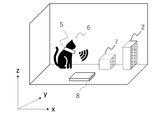
- the system of the present disclosure includes a server 1 and a pet sensor 5, a weight sensor 8, a communication terminal 2, and a user terminal 3 connected to the server 1 via a network such as the Internet.
- FIG. 1 shows one pet sensor 5, a weight sensor 8, a communication terminal 2, and a user terminal 3 for convenience of explanation, but each of a plurality of terminals is connected to the network of the system. It is possible.
- the pet sensor 5 to be attached to the pet may be, for example, an acceleration sensor, a temperature sensor, or the like.
- the weight sensor 8 there are one that measures the weight of the pet, one that measures the excrement of the pet (feces, urine), and one that measures the amount of food consumed by the pet (food, water), such as a bed, a toilet, and the like. It may be provided on the tableware itself, or it may be installed on a table on which they are placed.
- the data acquired by each sensor is transmitted to the server 1 via the communication terminal 2.
- the server 1 monitors the condition of the pet by analyzing the obtained data, evaluates the health risk, and provides the user with the necessary notification.
- health risk means that a person is likely to have a specific disease or is likely to have a disease in the near future.
- the server 1 monitors the pet's condition by analyzing the obtained data, detects changes in the health condition, and proposes a necessary solution. The proposed solution is evaluated for its effectiveness (whether the solution improves the condition) and its utilization (whether the solution is utilized) by analyzing the measurement data acquired thereafter.
- the server 1 can provide the service to the user terminal 3 via the application.
- the user terminal 3 downloads an application from the server 1 or another server, executes this application, and accesses the server 1 via web page browsing software such as a browser to send and receive information to and from the server 1. You can also receive services.
- the communication terminal 2 can acquire each data by performing short-range wireless communication with the weight sensor 8 and the pet sensor 5 mounted on an animal, for example, a cat 6. More specifically, first, as shown in FIG. 2, a collar-shaped (or pendant-shaped) wearable device is attached to an animal 6 such as a cat.
- the wearable device contains an accelerometer and / or a temperature sensor.
- the weight sensor 8 and the pet sensor 5 transmit data to a receiving device 7 installed in the same house through short-range wireless communication such as BLUETOOTH (registered trademark) LAW ENERGY (BLE), and the receiving device 7 is a router or the like.
- BLUETOOTH registered trademark
- LAW ENERGY BLE
- the weight sensor 8 and the pet sensor 5 may directly transmit data to the user terminal 3 via short-range wireless communication such as BLUETOOTH (registered trademark) LAW ENERGY (BLE).
- BLUETOOTH registered trademark
- LAW ENERGY BLE
- the receiving device 7 can be equipped with a Linux (registered trademark) -based operation system, and can also be equipped with various sensors such as a temperature sensor for measuring the temperature.
- the receiving device 7 may not be equipped with an OS, such as an embedded chipset.
- the pet sensor 5 is, for example, an acceleration sensor.
- the acceleration sensor 5 is a sensor that detects accelerations in three axial directions (x-axis, y-axis, and z-axis directions) orthogonal to each other, and is built in a collar attached to the neck of a cat.
- the front-back direction of the cat is defined as the X direction
- the left-right direction is defined as the Y direction
- the vertical direction is defined as the Z direction
- a collar is attached to the cat so that acceleration signals in each direction can be detected according to the movement of the cat. ..
- the type of sensor is not limited to this, and any sensing device that can acquire information on the movement of the cat, such as a gyro sensor and a motion sensor, can be adopted.
- the user terminal 3 may be a general-purpose computer such as a workstation or a personal computer, or may be a smartphone, a tablet, a mobile terminal, another information terminal, or the like.
- the server 1 and the user terminal 3 according to the present embodiment have the following hardware configurations.
- the following configuration is an example, and may have other configurations.
- the server 1 is connected to a database (not shown) and constitutes a part of the system.
- the server 1 may be a general-purpose computer such as a workstation or a personal computer, or may be logically realized by cloud computing.
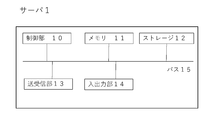
- the server 1 includes at least a control unit 10, a memory 11, a storage 12, a transmission / output unit 13, an input / output unit 14, and the like, which are electrically connected to each other through a bus 15.
- the control unit 10 is an arithmetic unit that controls the operation of the entire server 1, controls the transmission and reception of data between each element, and performs information processing necessary for application execution and authentication processing.
- the control unit 10 is a CPU (Central Processing Unit), and executes each information processing by executing a program or the like stored in the storage 12 and expanded in the memory 11.
- the memory 11 includes a main memory composed of a volatile storage device such as a DRAM (Dynamic Random Access Memory) and an auxiliary storage composed of a non-volatile storage device such as a flash memory or an HDD (Hard Disk Drive). ..
- the memory 11 is used as a work area or the like of the control unit (processor) 10, and also stores a BIOS (Basic Input / Output System) executed when the server 1 is started, various setting information, and the like.
- BIOS Basic Input / Output System
- the storage 12 stores various programs such as application programs.
- a database (not shown) storing data used for each process may be built in the storage 12.
- the transmission / reception unit 13 connects the server 1 to the network.
- the transmission / reception unit 13 may be provided with a short-range communication interface of Bluetooth (registered trademark) and BLE (Bluetooth Low Energy).
- the input / output unit 14 is an information input device such as a keyboard and a mouse, and an output device such as a display.
- the bus 15 is commonly connected to each of the above elements and transmits, for example, an address signal, a data signal, and various control signals.
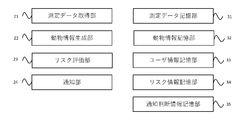
- FIG. 4 is a diagram showing a software configuration example of the server 1 in the system according to the first embodiment of the present disclosure.
- the server 1 includes a measurement data acquisition unit 21, an animal information generation unit 22, a risk evaluation unit 23, a notification unit 24, a measurement data storage unit 31, an animal information storage unit 32, a user information storage unit 33, a risk information storage unit 34, and a notification unit.
- the determination information storage unit 35 can be provided.
- the measurement data acquisition unit 21, the animal information generation unit 22, the risk evaluation unit 23, and the notification unit 24 are executed by the control unit 10 provided in the server reading the program stored in the storage 12 into the memory 11 and executing the program.
- the measured data storage unit 31, the animal information storage unit 32, the user information storage unit 33, the risk information storage unit 34, and the notification determination information storage unit 35 are realized and are provided by at least one of the memory 11 and the storage 12. Realized as part of.
- the measurement data acquisition unit 21 acquires data related to the state of the animal from various measurement data acquisition means.
- the measurement data acquisition unit 21 may include a behavior measurement data acquisition unit 211, a weight data acquisition unit 212, and an environmental data acquisition unit 213.
- Data on the condition of an animal includes data on the behavior, activity, physical condition, and surrounding environment of the animal.
- the measurement data acquisition means referred to here includes a device for acquiring data such as a pet sensor 5 such as an acceleration sensor, a weight sensor 8, and a camera. Further, various data acquired by the measurement data acquisition unit 21 are stored in the measurement data storage unit 31. As shown in FIG.
- the measurement data storage unit 31 may include a behavior measurement data storage unit 311, a weight data storage unit 312, and an environmental data storage unit 313, and the data acquired from the corresponding measurement data acquisition units 21 may be included. Will be stored.
- the measurement data acquisition unit 21 and the measurement data storage unit 31 may include an acquisition unit and a storage unit for acquiring other data such as animal body temperature data and image data.
- the behavior measurement data acquisition unit 211 receives the behavior measurement data detected by the pet sensor 5 and transmitted via the communication terminal 2 via the transmission / reception unit 13 of the server 1.
- the received behavior measurement data is stored in the behavior measurement data storage unit 311.
- the behavior measurement data can be stored in the storage built in the analysis server 9 shown in FIG.
- the behavior measurement data is acceleration data when the pet sensor 5 is an acceleration sensor.
- the behavior measurement data may be image data.
- the pet sensor 5 is, for example, an acceleration sensor.
- the acceleration sensor 5 is a sensor that detects accelerations in three axial directions (x-axis, y-axis, and z-axis directions) orthogonal to each other, and is built in a collar attached to the neck of an animal such as a cat. Will be done.
- the front-back direction of the animal is defined as the X direction
- the left-right direction is defined as the Y direction
- the vertical direction is defined as the Z direction
- a collar is attached to the animal so that acceleration signals in each direction can be detected according to the movement of the animal.
- the type of sensor is not limited to this, and any sensing device that can acquire information on the movement of animals, such as a gyro sensor and a motion sensor, can be adopted.
- the weight data acquisition unit 212 acquires weight data from the weight measuring means.
- the weight measuring means is not particularly limited as long as it is a device provided with a weight sensor 8 and capable of measuring the amount of food, the amount of excretion, and the weight. Depending on the application, it is preferable to have a shape (for example, a board type) on which pet items such as toilets, tableware, and water bowls can be placed.
- the weight measuring means and the server 1 are connected by a communication network. Weight data is preferably acquired in chronological order.
- the acquired weight data is stored in the weight data storage unit 312 together with the time information.
- the weight data storage unit 312 stores the weight data acquired by the weight data acquisition unit 212 for each weight measuring means.
- the weight data is preferably time series data stored together with the time data.
- the environmental data acquisition unit 213 acquires environmental data in which animals are bred. For example, the environmental data acquisition unit 213 acquires temperature data, room temperature data, humidity data, etc. obtained from thermometers and hygrometers installed indoors and outdoors. You may also obtain data on the climate of the area where the animals are located on the Internet. Further, the environmental data acquisition unit 213 acquires information on the disaster. Information on disasters is information on the occurrence of earthquakes, fires, floods, tsunamis, lightning strikes, tornadoes, and the like. Information on disasters may be acquired from various sensors installed indoors and outdoors, or disaster information provided on the Internet may be acquired, and the method is not particularly limited. The acquired environmental data is stored in the environmental data storage unit 313.
- the animal information generation unit 22 generates animal information regarding the activity of the animal to be measured by analyzing various measurement data. That is, "animal information" is obtained by generating meaningful information (weight of a specific measurement target, number of times of a specific action, time, etc.) from measurement data which is raw data. As shown in FIG. 6, the animal information generation unit 22 can include a behavior information generation unit 221, a weight information generation unit 222, and the like. Further, the data related to the animal generated by the animal information generation unit 22 is stored in the animal information storage unit 32.
- the animal information storage unit 32 may include a behavior information storage unit 321 and a weight information storage unit 322.
- the behavior information generation unit 221 generates animal behavior data based on the received behavior measurement data in cooperation with the analysis server 9 (or by a single process in the behavior information generation unit 221).
- the behavior information includes exercise data, sleep data, meal data, toilet data, position data, and the like stored in the behavior information storage unit 321. More specifically, as exercise data, aggregated data such as the presence or absence of exercise and how much activity is performed in a day with time, and as sleep data, how much is with sleep or not and how much in a day. Aggregated data such as whether you are sleeping, aggregated data such as how many times you ate meals with time and presence of eating behavior, and when you ate, how many times you drank water with water intake behavior and time Aggregated data such as when you drank, as toilet data, aggregated data such as how many times you stooled with time and presence of urination behavior, and when you urinate with time and presence of urination behavior.
- exercise data aggregated data such as the presence or absence of exercise and how much activity is performed in a day with time, and as sleep data, how much is with sleep or not and how much in a day. Aggregated data such as whether you are sleeping, aggregated data such as how
- the position data includes the direction in which the hair was moved, the position in which the hair was moved, and other data such as the time and number of times of hair styling. In short, it may be information such as the time and number of actions that can be given a specific label. Further, although not shown, the body temperature of the animal at the time of measurement may be measured.
- the behavior information generation unit 221 confirms the measurement data detected by the behavior measurement data acquisition unit 211. Subsequently, the action information generation unit 221 determines the action type based on the measurement data.
- the behavior type determination method can be realized by some known behavior analysis methods. For example, acceleration data (Gx, Gy, Gz) in the xyz axis direction obtained from the acceleration sensor 5 can be obtained by using wavelet conversion. , The signal with vibration is decomposed into period and amplitude for each time, the periodicity of the signal at each time is recognized as an action spectrum, and the action is performed by comparing with the action element registered in advance according to the similarity of the spectra. Can be classified.
- the acceleration data obtained from the acceleration sensor 5 is Fourier transformed, and the average value or peak value of the frequency component calculated along the time axis is set to the same or different animal behavior type (exercise, sleep, meal). , Toilet, etc.) to identify the behavior by comparing with the known frequency, and to obtain characteristic waveforms and spectral values based on the frequency component calculated by high-speed Fourier transform (FFT) of the acceleration component.
- FFT high-speed Fourier transform
- Behavior can be identified by extracting and comparing with known characteristic waveforms or spectral values corresponding to the same or different animal behavior types (exercise, sleep, diet, toilet, etc.).
- the behavior type can be estimated by grasping the posture of the animal from the postures ( ⁇ x, ⁇ y, ⁇ z) in each axial direction calculated by the acceleration sensor 5.
- the action information generation unit 221 When the action type is determined, the action information generation unit 221 generates the data indicating the action type as the action information together with the date and time when the measurement data is measured (or the date and time when the measurement data is received, the date and time when the action information is generated).
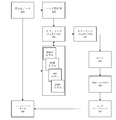
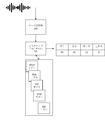
- Data preprocessing 102 is performed on the acceleration data 101 acquired from the acceleration sensor 5 in order to convert the spectrum data obtained by the above-mentioned wavelet transform or the component data obtained by the Fourier transform or the like.
- the data thus preprocessed is subsequently scored 103 by the binary model group.
- the binary model according to this embodiment is compared and analyzed with a model of activity that can be concretely expressed (interpreted) such as a WALK model, a RUN model, an EAT model, and a STAY model, and among the preprocessed 102 data. Score which behavior a particular part can be inferred to be. For example, as shown in FIG.
- scoring 104 by the multi-valued model group is performed.
- which binary model group should be prioritized based on machine learning. judge. For example, in the example shown in FIG. 8, "walking" is 91 and “running” is 62, and the evaluation score of "running" is relatively high. In this case, it is determined which binary model should be prioritized in this case from the combination of the input data to the past binary model group and the determination result.
- the accuracy of the data is improved by further evaluating the results of the binary model group specialized in the determination of each behavior by the multi-value model group.
- the determined action is further corrected based on the rule base. For example, if the binary model determines a behavior that is unlikely to occur suddenly, such as "running,” during a judgment section such as “eating” or “sleeping,” which often continues for a certain period of time due to the behavior of the cat. Or, if it cannot be determined, the prediction result of the binary model in this section is rejected, and the correction is performed to presume that it is another behavior according to the rule. When the correction is completed, the action label 106 registered in advance for the action is given.
- feedback 107 from the user is received. Specifically, as shown in FIG. 9, the current behavior is recorded (manually) while observing the animals under its control. By associating the recording with the data of the accelerometer, it is possible to collect teacher data by visual inspection or the like. The feedback data 108 thus obtained is accumulated and used to improve the accuracy of the model of the binary model group.
- the behavior information generated as described above is stored in the behavior information storage unit 321.
- the behavior information is preferably time-series data stored together with time data.
- the weight information generation unit 222 analyzes the weight data acquired by the weight data acquisition unit 212 to calculate various measurement targets (body weight, food amount, water intake amount, defecation amount, urination amount, etc.).
- the weight information generation unit 222 includes a weight calculation unit.
- the weight calculation unit analyzes the weight data acquired by the weight data acquisition unit 212 and outputs the weight information of the target measurement target.
- the weight acquisition means can set a plurality of measurement modes
- the weight calculation unit calculates the weight according to the set measurement modes.
- the measurement mode defines at least a measurement target as described below, and may be set by the user, or may be automatically set by recognizing an item mounted on the weight measuring means. An example of the weight calculation method for each measurement mode is shown below.
- FIG. 10 shows an example of measuring the amount of food, the amount of water intake, and the body weight.
- the difference ⁇ W1 between the weight before the animal is placed on the weight measuring means and the weight when the animal is placed can be regarded as the weight of the animal.
- the difference ⁇ W2 between the weight before the animal gets on the weight measuring means and the weight when the animal finishes eating and drinking and gets off is the amount of decrease in food or water, that is, the intake. It can be seen as the amount of food and water intake.
- the weight data is blurred due to the movement of the animal while the animal is on the weight measuring means, the average value or the weight data when the animal has stopped moving for a certain period of time is adopted. The optimum value may be adopted as appropriate.
- FIG. 11 shows an example of measuring the amount of excretion and body weight.
- time-series weight data behaves, for example, as shown in FIG.
- the difference ⁇ W3 between the weight when the animal enters the toilet and the weight when the animal leaves the toilet can be regarded as the weight of the animal.
- the difference between the weight before the animal enters the toilet and the weight immediately after entering the toilet may be adopted.
- the difference ⁇ W4 between the weight before the animal enters the toilet and the weight after the animal leaves the toilet can be regarded as the excretion amount. If the weight data is blurred due to the movement of the animal while the animal is in the toilet, it is optimal to use the average value or the weight data when the animal has stopped moving for a certain period of time. It is good to adopt the value.
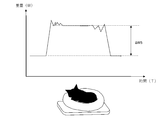
- FIG. 12 shows an example of measuring body weight.
- the time-series weight data behaves as shown in FIG. 14, for example.
- the difference ⁇ W5 between the weight when the animal enters the bed and the weight when the animal leaves the bed can be regarded as the weight of the animal.
- the weight calculation unit can estimate the weight of various measurement targets from the changes in the weight data over time.
- the type of measurement target and its calculation method are not limited to those described above, and can be set arbitrarily.
- the weight information generation unit 222 may further include a weight information evaluation unit.
- the weight information evaluation unit compares the weight information calculated by the weight calculation unit with the behavior data, and evaluates the certainty of the weight information.
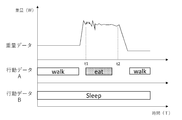
- the weight information evaluation unit refers to the behavior data from the behavior information storage unit 321 at the time (t1 to t2) when the weight information of the measurement target is acquired, and whether the behavior of the pet at that time matches the measurement target of the weight information. To confirm. For example, when the weight data fluctuates when the measurement is performed in the meal amount measurement mode, the change amount of the weight data is determined as the "meal amount" as described above, but the time zone (as shown in FIG. 13).
- the weight information evaluation unit determines that the weight information is probable when the behavior data in the same time zone as the weight information matches the weight information, and when the behavior data does not match, the weight information is used. It can be tagged or deleted as uncertain data.
- the weight information generation unit 222 may further include a weight type identification unit. If the behavioral data can be used to distinguish between eating rice and drinking water, or defecation and urination, the weight type identification unit calculates the weight.
- the weight information calculated by the unit can be specified more specifically. For example, in the food / water intake / weight measurement mode, when both the tableware and the water bowl are placed on the weight measuring means, ⁇ W2 indicates the total of the food amount and / or the water intake.
- ⁇ W2 indicates the total of the food amount and / or the water intake.
- the behavioral data in t1 to t2 indicate "meal"
- ⁇ W4 indicates the total of defecation volume, urine volume, or both, but the behavioral data in the time zone when the weight data was acquired was “defecation”. In this case, ⁇ W4 can be determined to be the amount of defecation. In this way, the weight type specifying unit can more specifically specify the measurement target of the weight information from the behavior data in the same time zone.
- the weight information generation unit 222 may further include an individual identification unit.
- the individual identification unit can determine which individual the weight information calculated by the weight calculation unit is based on in the case of a multi-headed animal. In the case of multi-headed animals, it is usually difficult to identify which individual is on one weighing means.
- the individual identification unit refers to the behavior data of each individual in the time zone (t1 to t2) when the weight data of the measurement target is acquired, and identifies the individual to which the weight information should be associated. In the example shown in FIG. 14, it is determined from the behavior data of the individual A and the individual B in t1 to t2 that the weight data acquired by the weight measuring means is that of the individual A who was eating. In this way, the individual identification unit can select an individual showing behavioral data that matches each weight information and add the individual information to the weight information.
- the individual may be identified from the waveform such as the acceleration data obtained from the sensor of each individual. It is known that even if the behavior is the same, each individual has a unique characteristic of the waveform. Individuals can be identified by comparing the characteristics of the behavioral waveform data in the time zone in which the weight data of the measurement target is acquired with the waveform of each behavior registered in advance.
- individual identification various methods may be adopted in addition to the above-mentioned methods.
- individual identification may be performed by analyzing an image obtained by an image acquisition means capable of photographing the weight measuring means.
- a moving image can be taken over time by an image acquisition means such as a video camera, and an individual on the weight measuring means can be identified by image recognition.
- the individual identification unit can identify an individual to which the weight information should be associated from the image data at the time when the weight data of the measurement target is acquired.
- the individual identification unit may identify an individual near the weight measuring means by the strength of the radio wave intensity such as BLUETOOTH (registered trademark) LAW ENERGY (BLE) for data including individual information from a pet's collar or the like.
- a BLE receiving means can be provided at or near the weighing means to recognize an individual closer to the weight measuring means.
- the individual identification unit may identify an individual by body weight.
- the individual can be identified by registering the body weight of the individual in advance and referring to the registered body weight when the body weight is calculated in each measurement mode.
- the individual identification unit can identify an individual by a plurality of methods, but one or more of them can be adopted, and individual identification may be performed by combining a plurality of methods.
- the weight information generated by the weight information generation unit 222 is stored in the weight information storage unit 322.
- the measurement target and the weight of the measurement target eg, the amount of food
- the measurement target and the weight of the measurement target may be stored for each measurement date and time.
- information on an individual name and an individual ID may be included.
- the user information storage unit 33 manages the basic information of the user (owner) and the basic information of the animals raised by the user.
- the basic information of the user includes information such as gender, age, occupation, and address.
- Basic information on animals raised by users includes name, type (dog, cat, etc.), breed, age, gender, place of residence, breeding environment (outdoor, indoor), genetic information, presence or absence of multi-headed breeding, health information, etc. ..
- Examples of health information include hospital visit history and medical history.
- Information on multiple animals can be registered for one user. Further, the basic information of these users and the basic information of animals are managed in association with, for example, a user ID given to the user. In addition, an ID may be given to the animal.
- the risk assessment unit 23 evaluates the health risk of the target animal based on the generated animal information. There may be a plurality of risk assessment methods, and the risk assessment unit 23 may evaluate the risk by any one method, or may perform a comprehensive evaluation by integrating the evaluation results by the plurality of methods. The evaluation method will be described later.
- the risk assessment unit 23 is an example of a detection unit.
- the server 1 in the present embodiment may include a risk information storage unit 34 that stores the correspondence relationship between the animal information data and the disease.
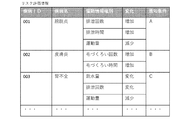
- FIG. 15 is a configuration example of risk information stored in the risk information storage unit 34.
- the risk of a particular disease is associated with the type of animal information data and its changes. Identification information such as ID may be given to the disease, and identification information may be appropriately given to animal information data and changes. For example, in the risk assessment of "cystitis", an increase in the number of excretion, an increase in the excretion time, and a decrease in the amount of exercise are used as indicators as animal information.
- the risk assessment of "dermatitis” the increase in the number of hair-growth and the increase in the hair-growth time are used as indicators as animal information
- the risk assessment of "renal failure” the amount of water consumed is used as animal information. Changes, changes in the number of excretion, and a decrease in the amount of exercise are used as indicators.
- conditions such as a predetermined threshold value can be included as a reference for change. The threshold value may be expressed numerically.
- the combination of these diseases and animal information is an example and can be changed as appropriate.
- the risk assessment of "cystitis” either the number of excretion times or the excretion time may be selected as an index.
- the risk assessment unit 23 determines whether or not the change in each animal information data corresponds to the condition for determining that there is a risk of a specific disease in the risk information storage unit 34.
- the risk information storage unit 34 can include information regarding notification determination conditions for determining whether or not to notify the user of each risk.
- FIG. 16 is an example of notification determination information. As shown in FIG. 16, a plurality of notification determination conditions may be prepared. For example, if the risk assessment unit 23 detects any abnormal value, it must be notified, if the abnormal value has been detected continuously for a predetermined number of days or more, it must be notified, and the abnormal value detection frequency is equal to or higher than the predetermined number. It is possible to set to notify when an abnormal value is detected by analyzing self-data and when an abnormal value is detected by comparative analysis of other individual data. .. Notification judgment conditions are not limited to these, and can be set as appropriate. Further, as shown in FIG.
- the notification condition may be changed according to the degree of abnormality. For example, if the degree of abnormality is low, the notification condition may be B, if the degree of abnormality is high, the notification condition may be A, and so on.
- the notification unit 24 provides the risk assessment result performed by the risk assessment unit 23.
- the notification destination may be the user who is the owner, a veterinarian, a pet insurance company, or the like. Further, the user may register another user as a notification destination in advance. Other users are those who watch over pets as co-owners, such as family and friends.
- a condition may be set for the notification so that excessive notification is not performed. In that case, confirm that the notification conditions set in the notification judgment information for each disease are satisfied and notify. In addition, the notification condition can be made selectable by the user.
- the notification unit 24 is an example of an output unit.
- the mode of output by the notification unit 24 is not particularly limited, and may be displayed on a terminal used by a user, a doctor, or the like, or may be output to a database of a server managed by a medical institution or a servicer. It may be output by printing on a print medium such as a paper sheet, or may be output by voice or the like.
- the risk assessment unit 23 may predict the disease by machine learning.
- a learning model can be created using the past animal information data of an animal having a clear morbidity history stored in the animal information storage unit 32 as input data and the disease data of the animal as teacher data.
- the risk assessment unit 23 applies the animal information data of the animal to be evaluated to the created learning model and evaluates the possibility of suffering from a specific disease.
- the animal information data used for prediction but one or more data such as the number / time / excretion amount of excretion related to the disease, the amount of activity, the number / amount of meals, and the number / time of hair styling are used. Is preferable.
- the animal information of the number of excretion and the amount of exercise immediately before the cystitis can be input data of the animal having a record of suffering from cystitis.
- the risk of cystitis can be evaluated by applying the animal information of the number of excretion times and the amount of exercise of the animal to the learning model.
- the animal information of the number of hair-growth times and the hair-growth time immediately before the onset of dermatitis is input data. Can be.
- the risk of dermatitis can be evaluated by applying the number of hair-dressing times and the hair-dressing time of the animal to the learning model.
- the risk assessment unit 23 may evaluate the health risk by analyzing the animal information of the individual to be evaluated and detecting the abnormal value. Since animals vary widely, it is useful to perform risk assessment by capturing changes in their own data.
- the risk assessment unit 23 reads the animal information of the individual to be evaluated from the animal information storage unit 32 and evaluates the risk by performing a predetermined process. For example, a case where the difference from the average value in the past predetermined period is equal to or greater than a predetermined ratio may be evaluated as having a risk.
- the risk assessment unit 23 may detect an abnormality in the same individual by comparing past animal information (or measurement data) with current animal information (or measurement data). good.
- the risk assessment department 23 may detect that the individual is not healthy, and the notification unit 24 may notify that the individual is not healthy.
- the threshold value for whether or not to notify may be determined for each individual, for example, or may be determined for each type of individual.
- the notification frequency of these abnormality detections by the notification unit 24 may be set as necessary. For example, since the amount of activity decreases while suffering from a disease, it may be possible to set it individually, such as not notifying the abnormality for a certain period of time.
- the notification unit 24 may adjust the frequency of notification, the mode of notification, and the like based on the history of the animal information described above.
- the risk assessment unit 23 may also determine the outlier by a statistical method. That is, the estimated value is calculated by the autoregressive model based on the animal information data which is the time series data, and when the actual animal information data is significantly different, it is judged that the data deviates from the past data series. be able to.
- the autoregressive model a known model such as an AR model, an MA model, an ARMA model, and an MRIMA model can be appropriately adopted according to the characteristics of the data.
- the Mahalanobis distance is calculated based on the animal information data which is the time series data, and when the Mahalanobis distance is large, it can be determined that the distance deviates from the set of the past data series.
- a known method for calculating the Mahalanobis distance can be used.
- weighted data that has been weighted so that the weight increases relatively according to the newness of the time-series data may be used.
- the risk assessment unit 23 may detect the change point indicating the time when the change of the data starts by statistical processing. That is, the risk assessment unit 23 searches for data that can be recognized as a sign of abnormality at a time point before the time point when the threshold value of abnormality is exceeded. By detecting the point of change, it is possible to grasp when the change began to appear, which is useful for the user to investigate the cause.
- the detection of abnormal values by analysis of self-data is not limited to the above method, and known methods of outlier detection and change point detection can be appropriately adopted.
- the risk assessment unit 23 may detect an abnormal value by comparing the animal information data of the individual to be evaluated with the animal information data of an individual different from the individual to be evaluated.
- the population of other individuals to be compared includes the individual and type to be evaluated (dog, cat, etc.), breed, age, gender, place of residence, breeding environment (outdoor, indoor), genetic information, presence or absence of multi-headed breeding, health information, etc. Similar individuals with one or more common attributes may be extracted. Further, these attributes may be regarded as "similar" with a certain width.
- the width can be set as appropriate, such as setting an individual as a similar individual.
- the group means a group classified according to attributes such as age and type of animals, for example. Thereby, when an individual is detected by comparison with a state different from the healthy state in the normal group, the notification unit 24 can notify that the individual is abnormal. Further, the notification unit 24 may decide whether or not to perform notification based on the comparison with the animal information related to the group. For example, the behavior of animals is seasonal.
- the risk of abnormality based on the increase or decrease of a specific behavior may be notified even though it is healthy. Therefore, it is possible to evaluate the risk more accurately by comparing not only the past and present animal information but also the animal information of the group.
- the risk evaluation unit 23 compares the animal information data of other individuals with the animal information data of the animal to be evaluated, and evaluates the health risk of the animal to be evaluated. For example, when the difference between the average value and the rate of change of animal information data in a predetermined period and the average value and the rate of change in a population of other individuals is a predetermined value (ratio) or more, the risk assessment unit 23 determines. It may be detected as abnormal. In addition, in the probability distribution in a group of other individuals, it can be detected as abnormal when it corresponds to a predetermined range of upper and lower ranks.
- the method for comparing the data of other individuals is not limited to the above, and a known method can be adopted as appropriate.
- the criteria for determining the health risk may be set in a plurality of stages. For example, it is possible to set a plurality of reference threshold values and determine the degree of abnormality (low / medium / high).
- which of the acquired animal information data is used for risk assessment can be selected according to the relationship between the animal information data registered in the risk information storage unit 34 and the disease.
- changes in behavior that appear as signs of animal diseases for example, if there is a change in water intake, a change in the number of toilets, or a decrease in the amount of exercise, there is a suspicion of renal failure and an increase in the number of toilets.
- Suspected diabetes if found, cystitis if increased frequency and time of toilets / decreased exercise, dermatitis if increased frequency and time of hairdressing. , Etc.
- this system it is possible to acquire data on the number, time, and amount of actions such as excretion, diet, amount of exercise, and hair-growth, so select relevant animal information data according to the disease risk you want to know. By analyzing and analyzing, the risk can be evaluated.
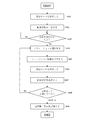
- FIG. 17 is an operation flow of the server 1 in the embodiment of the present disclosure.
- the measurement data acquisition unit acquires measurement data regarding the animal to be evaluated (S301).
- the measurement data is various data obtained from an acceleration sensor and a temperature sensor attached to an animal, a weight sensor for measuring the amount of food and excretion, and a weight sensor.
- the acquired measurement data is stored in the measurement data storage unit 31.
- the animal information generation unit 22 generates animal information based on the obtained measurement data (S302).
- Animal information is information obtained by analyzing the raw data, whereas the measured data is raw data obtained from the sensor, and each behavior (diet, excretion, play, sleep, walking, hairdressing, etc.) ) Number and time, weight data of meals and excretion, weight, etc.
- the generated animal information data is stored in the animal information storage unit 32.
- the notification unit 24 determines whether the notification condition stored in the notification determination information storage unit 35 is satisfied (S304). When the notification conditions are different for each disease, the notification conditions set for the target disease are read from the notification determination information storage unit 35, and it is determined whether or not the predetermined notification conditions are satisfied. When it is determined that the notification should be made, the output unit gives the notification by outputting the risk information to a predetermined notification destination such as a user terminal (S305).
- the present disclosure it is possible to detect changes in the pet's life and inform the user of the health risks of the pet.
- by flexibly setting the notification conditions for notifying the user of the detected abnormality it is possible to suppress the harmful effects caused by too many notifications.
- Modification 1 This modification is intended for a multi-headed user. In this modification, the certainty of the health risk detected in the evaluation target individual is judged based on the data of a plurality of individuals bred in the same environment as the evaluation target individual.
- the individual to be evaluated is the first animal
- the data of the animal is the first animal information
- the other animals bred in the same environment as the individual to be evaluated are the second animal
- the data of the second animal is used. It will be the second animal information.
- the measurement data acquisition unit 21 and the animal information generation unit 22 process the second animal in the same manner as the first animal, and continuously generate various animal information.
- the risk assessment unit 23 evaluates the health risk of the first animal, which is the individual to be evaluated, based on the first animal information. Then, when any risk is detected, the second animal information in the period in which the abnormality is detected is read out and compared. Then, it is confirmed whether or not the same tendency is seen in the second animal information. That is, if a tendency of a decrease in food intake is observed in the second animal information during the period in which a significant decrease in food intake is observed in the first animal information, it is a sign of deterioration in the health of the first animal. Rather, it is likely that other factors due to the rearing environment are involved.
- the room temperature is too high and the appetite is lost, and the environment near the tableware is different from usual (a new sounding object is near the tableware). Placed, etc.).
- the amount of activity of both animals increases, it is possible that they are excited by changes in the environment, such as the introduction of new toys or the arrival of visitors.
- the animal information shows abnormal values due to changes in the breeding environment, etc., even if the cause is not always clear. It can be determined that there is a possibility, that is, the probability of the detected health risk is low.
- the risk assessment unit 23 determines that it is not a health abnormality and does not notify it.
- the notification may be added with information that it may be affected by the breeding environment.
- Modification 2 In this modification, a modification of the method of detecting an abnormality by the risk assessment unit 23 will be described.
- the risk assessment unit 23 may detect an abnormality in an animal based on a comparison between animal information or measurement data and a threshold value based on a specific symptom. Further, even if the risk assessment unit 23 detects an animal abnormality based on the result of appropriately combining the above-mentioned comparison with the past animal information, the comparison with the animal information of the group, and the comparison with the threshold value. good. For example, the risk assessment unit 23 may detect a change in the state of an animal by using the statistical distribution of past animal information of an individual and the statistical distribution of past animal information of a group or the whole.
- a threshold value or the like specific to the individual may be set using the obtained statistical distribution. This can improve the accuracy of risk assessment.
- the information (parameters) included as animal information includes, for example, quantitative information such as urine volume, weight, and defecation volume, and information (qualitative information) related to qualitative activities such as drinking water, eating, and walking.
- quantitative information such as urine volume, weight, and defecation volume
- information qualitative information related to qualitative activities such as drinking water, eating, and walking.
- the risk assessment unit 23 can detect changes in the state of the animal based on these quantitative information, a combination of qualitative information and quantitative information, and the like.
- the risk assessment unit 23 may have some abnormality in the animal's thyroid gland based on the fact that the urine weight increases above a predetermined rate and the animal tends to walk or run longer. It may be detected.
- the size of the span acquired as animal information is not particularly limited.
- the span of the acquired animal information can be appropriately determined in units such as seconds, minutes, hours, days, weeks, and months. These spans can be appropriately determined according to the certainty required for each parameter included in the animal information (that is, the length of time required to detect a change in the state of the animal).
- the risk assessment unit 23 can detect abnormal behavior itself such as convulsions and coughing.
- FIG. 18 is a diagram showing a software configuration example of the server 1 in the system according to the second embodiment of the present disclosure.
- the server 1 includes a measurement data acquisition unit 21, an animal information generation unit 22, a detection unit 25, a solution selection unit 26, an output unit 27, a determination unit 28, a measurement data storage unit 31, an animal information storage unit 32, and a user information storage unit 33.
- the proposed reference information storage unit 36, the solution information storage unit 37, and the determination information storage unit 38 can be provided.
- the measurement data acquisition unit 21, the animal information generation unit 22, the detection unit 25, the solution selection unit 26, the output unit 27, and the determination unit 28 store the program in which the control unit 10 included in the server is stored in the storage 12 in the memory 11.
- the measurement data storage unit 31, the animal information storage unit 32, the user information storage unit 33, the proposal standard information storage unit 36, the solution information storage unit 37, and the determination information storage unit 38 are stored in the memory 11. And implemented as part of the storage area provided by at least one of the storage 12.
- each of the measurement data acquisition unit 21, the animal information generation unit 22, the measurement data storage unit 31, and the animal information storage unit 32 are the same as the functions of each function unit according to the first embodiment. Therefore, the description is omitted.
- the user information storage unit 33 manages the basic information of the user (owner) and the basic information of the animals raised by the user.
- the basic information of the user includes information such as gender, age, occupation, and address.
- Basic information on animals raised by users includes name, type (dog, cat, etc.), breed, age, gender, place of residence, breeding environment (outdoor, indoor), genetic information, presence or absence of multi-headed breeding, health information, etc. ..
- Examples of health information include hospital visit history and medical history.
- Information on multiple animals can be registered for one user. Further, the basic information of these users and the basic information of animals are managed in association with, for example, a user ID given to the user. In addition, an ID may be given to the animal.
- the priority of the solution is the order in which the types of solutions proposed in this system are preferentially selected. For example, if the types of solutions include the introduction of goods, the introduction of food, the use of medicines, the use of supplements, etc., and if you want to avoid the use of medicines or supplements as much as possible, set these priorities low.
- the user information storage unit 33 may store information on the priority of each solution, or may store information on solutions that should be avoided or selected in particular.
- the proposed standard information storage unit 36 is the state and its change of each index (weight, number / amount / time of meal / excretion, activity amount, hairdressing, play, number / time of various actions such as sleep, etc.) in animal information. You can set the criteria for proposing a solution.
- FIG. 19 is a configuration example of the proposal reference information stored in the proposal reference information storage unit 36.
- the proposed standard information is stored in which each standard is associated with an ID. For example, when the average value of body weight in the past week is increased by 10% as compared with the average value in the past predetermined period, "weight gain" (ID: 001) is detected.
- ID average value of body weight in the past week is increased by 10% as compared with the average value in the past predetermined period.
- the standard compared with other individuals may be set.
- animal species dogs, cats, etc.
- breeds American shorthair, Abyssinian, hybrids, etc. for cats
- age gender
- genetic information presence or absence of illness
- type of illness breeding environment (outdoor, indoor)
- multi-headed Individuals having one or more common attributes such as the presence or absence of a cat may be grouped into other individual data, and a statistical numerical value compared with the data of the other individual may be used as a reference.
- the standard may be set based on one index or may be defined based on a plurality of indexes.
- the calorie consumption of an animal is calculated from the body weight and the amount of activity, and a new index is obtained based on multiple data such as the increase / decrease in the calculated calorie consumption and the difference between the calorie intake and the calorie consumption. May be used as a reference.
- the type of index used to calculate the calorie consumption and the calculation formula may be appropriately selected.
- the solution information storage unit 37 detects the state or change of animal information (weight, number / amount / time of meal / excretion, amount of activity, number / time of various actions such as hairdressing, play, sleep, etc.). , Decide and remember what kind of solution to provide.
- FIG. 20 is a configuration example of information stored in the solution information storage unit 37.
- One or more solutions are associated with each animal's state or change.
- the solution can be anything that makes any changes to the life of the animal, such as the introduction of goods, the intake of medicines and supplements, changes in dietary content, changes in the breeding environment, etc.
- the solution is, for example, for weight gain, to introduce exercise equipment to increase the amount of exercise, to introduce a diet food, and if the number and time of hair-growth increase, dermatitis is suspected.
- a solution ID may be assigned to each solution.
- the solution ID may be given as a combination of the state or change of animal information and the content of the solution, for example, "change ID + solution ID".
- change ID + solution ID For example, in the example of FIG. 20, it is a solution for change ID: 001.
- "001001" is given to "introduction of exercise equipment”.
- the rule for assigning a solution ID is an example, and is not limited to this.
- Classification information for each type may be added to each solution.
- Classification information is, for example, "goods” for the introduction of exercise equipment and the use of Elizabethan collar, "meal” for the introduction of diet food, "medicine / supplement” for the use of dermatitis supplements, etc., but is not limited to this. ..
- Classification information is useful when prioritizing solutions according to user preference. For example, for users who want to avoid using medicines / supplements, it is possible to lower the priority of solutions to which the classification information of "medicines / supplements" is given.
- the classification information may also be given by the classification ID.
- the past performance of the effect and the degree of utilization is an index showing how effective or utilized the solution was when the solution was selected in the past, and may be the performance of other animal individuals or the target animal individual. It may be a track record of itself. By adding past effects and achievements of utilization, the priority of the solution can be adjusted.
- the past performance of utilization and effect can be calculated using, for example, the result of effect judgment / utilization judgment in animals for which the same solution has been proposed in the past.
- the “number of times the effect / utilization was“ yes ”/ number of past proposals” may be used as the actual result. For example, if the number of proposals in the past is 100, the number of times it is determined to be effective is 30 times, and the number of times it is determined to be utilized is 50, the effect result is 30% and the utilization degree result. Is 50%.
- the actual value may be "the number of times the effect / utilization was" yes "/ the number of past proposals" for the past proposed solution of the target individual. ..
- the determination information storage unit 38 includes information that serves as a reference for determining how much each solution is used and how effective it is.
- FIG. 21 is a configuration example of the determination information stored in the determination information storage unit 38.
- the utilization judgment criteria and the effect judgment criteria can be basically defined by the presence or absence of change or the amount of change in animal information.
- the utilization criterion for the solution of introducing exercise equipment can be judged by the fact that the amount of activity of animals has increased to a certain extent. Specifically, "the average amount of activity per day after introduction is It increased by 10% or more from the average value before the introduction.
- the determination standard may be specified by a reference numerical value (for example, the amount of change (difference) from the original numerical value or the value of the rate of change), or may be specified simply by increasing or decreasing the numerical value.
- the utilization level determination standard is not set.
- the detection unit 25 detects changes in the life of the animal from the animal information. In detection, we propose criteria for proposing solutions for each index (weight, number / amount / time of meal / excretion, amount of activity, number / time of various actions such as hairdressing, play, sleep, etc.) in advance. It is set in the information storage unit 36.
- the detection unit 25 applies the obtained animal information to the proposed standard information, and confirms whether or not there is anything that satisfies the standard. For example, when the detection unit 25 acquires the weight information of a certain day, the detection unit 25 calculates the average weight of the most recent week including the current day and compares it with the average value in the past predetermined period. When the latest average weight has increased by 10% from the past average weight, the detection unit 25 detects "weight gain" (ID: 001) and proposes a solution for weight gain. The detected information is output to 26.
- the detection unit 25 can also detect changes by an abnormality detection algorithm by machine learning. In that case, an abnormal value for predetermined motor information is detected by reading the newly obtained data into a learning model that machine-learns the time-series data of each measurement data (animal information) of the animal to be measured. can do.
- the solution selection unit 26 selects a solution to be proposed to the user based on the change in the animal information detected by the detection unit 25.
- the solution selection unit 26 reads out the solution associated with the detected change ID from the solution information storage unit 37. For example, when the ID of change is 001, two solutions of introduction of exercise equipment and introduction of diet food are set.
- the solution selection unit 26 may select all the solutions associated with the change ID, or may further select a predetermined number from them.
- the solution selection unit 26 conveys the solution ID of the selected solution to the output unit 27.
- the solution selection unit 26 may select a predetermined number or less of solutions. In that case, select the solution with the highest priority from the solutions with more than the specified number.
- the priority can be set based on the preference of the solution type registered in advance in the user's basic information, the past effect judgment result, and the utilization degree judgment result.
- the solution selection unit 26 reads the preference information associated with the user ID from the user information storage unit 33, and selects a solution of a type that matches the preferred solution type. Further, when selecting based on the past effect judgment result and the utilization degree judgment result, the solution selection unit 26 gives priority to the past effect judgment result or the utilization degree judgment result recorded for each solution. select.
- the output unit 27 outputs the contents of the solution to the user terminal 3 based on the selected solution ID.
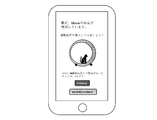
- FIG. 22 is a screen display example of the user terminal 3.
- the output contents include information on detected changes, an outline of the solution, past effect judgment results, utilization judgment results, links to EC sites, etc. (in the case of solutions related to the purchase of goods and food).
- the output unit 27 may be provided with an input button requesting the proposal of another solution.
- the solution selection unit 26 selects a different solution, and the output unit 27 displays it. For example, the solution selection unit 26 selects a solution having the next highest priority after the previously proposed solution.
- the determination unit 28 determines whether the solution has been executed (utilization degree) and whether it has been effective. In the determination, the user may input that the proposed solution has started to be executed. Alternatively, the start of execution may be determined based on the fact that the user has purchased the goods, foods, medicines, etc. proposed on the EC site, and that the proposed goods, etc. are recognized in the image of the pet breeding environment.
- the determination unit 28 analyzes the data acquired by the measurement data acquisition unit 21 after the solution is proposed or after the execution is started, and makes a determination in light of the utilization judgment standard or the effect judgment standard set in the judgment information storage unit 38. conduct. If the utilization criteria are met, it is determined that the animal has fully utilized the solution, and if the effectiveness criteria are met, it is determined that the solution has been effective. The determination may be made not only by the presence or absence of utilization and the presence or absence of effect, but also by numerically determining the degree of utilization and the degree of effect. The determination result is stored in a database such as the solution information storage unit 37 and the user information storage unit 33, and the output unit 27 outputs the determination result to the user terminal 3.
- the solution selection unit 26 may select another solution and propose it to the user again. In that case, exclude the proposed solution from the options and select another solution with the next highest priority.
- FIG. 23 is an operation flow of the server 1 in the embodiment of the present disclosure.
- the measurement data acquisition unit 21 acquires various measurement data on a daily basis (S401). Based on the measurement data, the animal information generation unit 22 generates exercise information such as weight, number / amount / time of meal / excretion, amount of activity, number / time of various actions such as hairdressing, play, and sleep ( S402).
- the solution selection unit 26 reads out the detected change from the solutions set in the solution information storage unit 37 (S404). If the number of solutions to be proposed is fixed, a predetermined number of solutions are selected based on the priority. The priority can be set based on the user's preference for classification of solutions and the good performance of past utilization / effects.
- the solution selection unit 26 transmits the selected solution ID to the output unit 27, and the output unit 27 outputs information related to the selected solution to the user terminal 3 (S405).
- the measurement data acquisition unit 21 After proposing the solution, the measurement data acquisition unit 21 acquires the measurement data and generates the animal information again (S406, S407). It is preferable that the measurement data acquisition unit 21 and the animal information generation unit 22 continuously acquire and analyze data regardless of whether or not a solution is proposed.
- the determination unit 28 determines the effect and the degree of utilization based on the data acquired after the proposal of the solution (S408).
- the determination unit 28 reads out the criteria for effect determination and utilization determination of the implemented solution from the determination information storage unit 38, and makes a determination according to the criteria. Further, the time after receiving the notification from the user that the solution has started to be executed can be set as the determination period of the effectiveness / utilization of the solution.
- changes in the pet's life can be detected and an appropriate solution can be proposed to the owner user, and the effect of the proposed solution can be verified based on the change in data. Also, if the owner is often absent, it is difficult to know how much the pet is using the solution given to the pet, but the degree of use can also be determined by analyzing the data.
- the solution selection unit 26 may select a solution suitable for the information on the change point based on the information on the change point of the pet's condition detected by the risk assessment unit 23.
- the risk assessment unit 23 may evaluate the health risk based on the information such as the utilization degree and effect information and the history of the solution selected by the solution selection unit 26.
- the risk assessment unit 23, the notification unit 24, the detection unit 25, the solution selection unit 26, the output unit 27, and the determination unit 28 may perform processing based on the information obtained by the functional unit according to another embodiment.
Landscapes
- Life Sciences & Earth Sciences (AREA)
- Environmental Sciences (AREA)
- Business, Economics & Management (AREA)
- Tourism & Hospitality (AREA)
- Animal Husbandry (AREA)
- Biodiversity & Conservation Biology (AREA)
- Human Resources & Organizations (AREA)
- Strategic Management (AREA)
- Economics (AREA)
- General Health & Medical Sciences (AREA)
- Biophysics (AREA)
- Marketing (AREA)
- Primary Health Care (AREA)
- Health & Medical Sciences (AREA)
- Physics & Mathematics (AREA)
- General Business, Economics & Management (AREA)
- General Physics & Mathematics (AREA)
- Engineering & Computer Science (AREA)
- Theoretical Computer Science (AREA)
- Housing For Livestock And Birds (AREA)
- Medical Treatment And Welfare Office Work (AREA)
Priority Applications (1)
| Application Number | Priority Date | Filing Date | Title |
|---|---|---|---|
| JP2022522194A JP7594305B2 (ja) | 2020-05-13 | 2021-05-13 | 情報処理システムおよび方法 |
Applications Claiming Priority (4)
| Application Number | Priority Date | Filing Date | Title |
|---|---|---|---|
| JP2020-084721 | 2020-05-13 | ||
| JP2020084721 | 2020-05-13 | ||
| JP2020-090781 | 2020-05-25 | ||
| JP2020090781 | 2020-05-25 |
Publications (1)
| Publication Number | Publication Date |
|---|---|
| WO2021230316A1 true WO2021230316A1 (ja) | 2021-11-18 |
Family
ID=78524436
Family Applications (1)
| Application Number | Title | Priority Date | Filing Date |
|---|---|---|---|
| PCT/JP2021/018207 Ceased WO2021230316A1 (ja) | 2020-05-13 | 2021-05-13 | 情報処理システムおよび方法 |
Country Status (2)
| Country | Link |
|---|---|
| JP (1) | JP7594305B2 (https=) |
| WO (1) | WO2021230316A1 (https=) |
Cited By (3)
| Publication number | Priority date | Publication date | Assignee | Title |
|---|---|---|---|---|
| JPWO2023113009A1 (https=) * | 2021-12-17 | 2023-06-22 | ||
| JPWO2023153439A1 (https=) * | 2022-02-11 | 2023-08-17 | ||
| WO2023191043A1 (ja) * | 2022-03-31 | 2023-10-05 | 古河電気工業株式会社 | 動物行動記録装置、動物行動記録方法及びプログラム |
Citations (5)
| Publication number | Priority date | Publication date | Assignee | Title |
|---|---|---|---|---|
| JP2018174885A (ja) * | 2017-04-20 | 2018-11-15 | シャープ株式会社 | 判定装置、端末装置、判定システム、プログラム及び判定方法 |
| US20190141959A1 (en) * | 2016-06-08 | 2019-05-16 | The Crown In Right Of The State Of New South Wales Acting Through The Department Of Primary Industri | System for monitoring pasture intake |
| JP6630906B1 (ja) * | 2019-08-01 | 2020-01-15 | 株式会社ハチたま | 情報提供装置、情報提供方法及び情報提供プログラム |
| JP2020005534A (ja) * | 2018-07-05 | 2020-01-16 | ソフトバンク株式会社 | 愛玩動物を管理する管理サーバ及び管理プログラム |
| JP2020005556A (ja) * | 2018-07-06 | 2020-01-16 | ユニ・チャーム株式会社 | 健康状態判定装置、健康状態判定システム及びプログラム |
-
2021
- 2021-05-13 JP JP2022522194A patent/JP7594305B2/ja active Active
- 2021-05-13 WO PCT/JP2021/018207 patent/WO2021230316A1/ja not_active Ceased
Patent Citations (5)
| Publication number | Priority date | Publication date | Assignee | Title |
|---|---|---|---|---|
| US20190141959A1 (en) * | 2016-06-08 | 2019-05-16 | The Crown In Right Of The State Of New South Wales Acting Through The Department Of Primary Industri | System for monitoring pasture intake |
| JP2018174885A (ja) * | 2017-04-20 | 2018-11-15 | シャープ株式会社 | 判定装置、端末装置、判定システム、プログラム及び判定方法 |
| JP2020005534A (ja) * | 2018-07-05 | 2020-01-16 | ソフトバンク株式会社 | 愛玩動物を管理する管理サーバ及び管理プログラム |
| JP2020005556A (ja) * | 2018-07-06 | 2020-01-16 | ユニ・チャーム株式会社 | 健康状態判定装置、健康状態判定システム及びプログラム |
| JP6630906B1 (ja) * | 2019-08-01 | 2020-01-15 | 株式会社ハチたま | 情報提供装置、情報提供方法及び情報提供プログラム |
Cited By (8)
| Publication number | Priority date | Publication date | Assignee | Title |
|---|---|---|---|---|
| JPWO2023113009A1 (https=) * | 2021-12-17 | 2023-06-22 | ||
| CN118401102A (zh) * | 2021-12-17 | 2024-07-26 | 日本电气通信系统株式会社 | 健康状况确定设备、健康状况确定方法和程序 |
| JP7823926B2 (ja) | 2021-12-17 | 2026-03-04 | 日本電気通信システム株式会社 | 健康状態把握装置、健康状態把握方法、及びプログラム |
| JPWO2023153439A1 (https=) * | 2022-02-11 | 2023-08-17 | ||
| WO2023153439A1 (ja) * | 2022-02-11 | 2023-08-17 | 豊田通商株式会社 | ペット管理システム |
| JP7741211B2 (ja) | 2022-02-11 | 2025-09-17 | 株式会社ネクスティエレクトロニクス | ペット管理システム |
| WO2023191043A1 (ja) * | 2022-03-31 | 2023-10-05 | 古河電気工業株式会社 | 動物行動記録装置、動物行動記録方法及びプログラム |
| EP4501104A4 (en) * | 2022-03-31 | 2025-07-23 | Furukawa Electric Co Ltd | ANIMAL BEHAVIOR RECORDING DEVICE, ANIMAL BEHAVIOR RECORDING METHOD, AND PROGRAM |
Also Published As
| Publication number | Publication date |
|---|---|
| JPWO2021230316A1 (https=) | 2021-11-18 |
| JP7594305B2 (ja) | 2024-12-04 |
Similar Documents
| Publication | Publication Date | Title |
|---|---|---|
| JP6873526B1 (ja) | 動物の行動情報を取得するサービスを提供するサーバ | |
| US11224380B2 (en) | Animal health system and method for monitoring performance | |
| RU2694196C1 (ru) | Системы и способы предоставления рекомендаций по здоровью, питанию и/или благополучию животных | |
| AU2021349773B2 (en) | System and method for monitoring motion of an animal | |
| JP7594305B2 (ja) | 情報処理システムおよび方法 | |
| CA3215537A1 (en) | System, method, and apparatus for pet condition detection | |
| JP2021177344A (ja) | ペット保険加入支援システム | |
| JP2022036278A (ja) | サーバ | |
| Stygar et al. | Measuring dairy cow welfare with real-time sensor-based data and farm records: a concept study | |
| CN116711654A (zh) | 一种宠物智能感应项圈及其控制方法 | |
| Vázquez-Diosdado et al. | Quantification of play behaviour in calves using automated ultra-wideband location data and its association with age, weaning and health status | |
| JP7693214B2 (ja) | 動物用重量測定システム及び方法 | |
| Bennett et al. | Valuation of animal welfare benefits | |
| Aunindita et al. | Use of machine learning and iot for monitoring and tracking of livestock | |
| KR20210114750A (ko) | Iot 기반의 반려동물 스마트 건강 관리 시스템 및 그 관리 방법 | |
| Botreau et al. | Integration of data collected on farms or at slaughter to generate an overall assessment of animal welfare | |
| JP7410555B2 (ja) | 動物共同見守りシステム | |
| JP7584814B2 (ja) | 情報処理装置 | |
| KR102590406B1 (ko) | 가축 생육 기반의 바이오인증 장치 | |
| Krishnan et al. | Sparrow search algorithm based BGRNN model for animal healthcare monitoring in smart IoT | |
| JP7755838B2 (ja) | 方法、情報処理装置およびプログラム | |
| Legge et al. | Milk consumption and behavior of calves in automated calf feeders as early indicators of weaning liveweight | |
| KR102574975B1 (ko) | Ai기반 반려견에 대한 건강검진대상 판별 방법 및 그 서버 | |
| KR20260064147A (ko) | 반려견 모니터링 시스템 및 그 방법 | |
| US20250021917A1 (en) | Evaluation apparatus, system, method, and program |
Legal Events
| Date | Code | Title | Description |
|---|---|---|---|
| 121 | Ep: the epo has been informed by wipo that ep was designated in this application |
Ref document number: 21802950 Country of ref document: EP Kind code of ref document: A1 |
|
| ENP | Entry into the national phase |
Ref document number: 2022522194 Country of ref document: JP Kind code of ref document: A |
|
| NENP | Non-entry into the national phase |
Ref country code: DE |
|
| 122 | Ep: pct application non-entry in european phase |
Ref document number: 21802950 Country of ref document: EP Kind code of ref document: A1 |