WO2021229950A1 - 通信装置、制御方法、およびプログラム - Google Patents
通信装置、制御方法、およびプログラム Download PDFInfo
- Publication number
- WO2021229950A1 WO2021229950A1 PCT/JP2021/014202 JP2021014202W WO2021229950A1 WO 2021229950 A1 WO2021229950 A1 WO 2021229950A1 JP 2021014202 W JP2021014202 W JP 2021014202W WO 2021229950 A1 WO2021229950 A1 WO 2021229950A1
- Authority
- WO
- WIPO (PCT)
- Prior art keywords
- communication device
- wireless link
- communication
- information
- wireless
- Prior art date
- Legal status (The legal status is an assumption and is not a legal conclusion. Google has not performed a legal analysis and makes no representation as to the accuracy of the status listed.)
- Ceased
Links
Images




Classifications
-
- H—ELECTRICITY
- H04—ELECTRIC COMMUNICATION TECHNIQUE
- H04L—TRANSMISSION OF DIGITAL INFORMATION, e.g. TELEGRAPHIC COMMUNICATION
- H04L9/00—Cryptographic mechanisms or cryptographic arrangements for secret or secure communications; Network security protocols
- H04L9/32—Cryptographic mechanisms or cryptographic arrangements for secret or secure communications; Network security protocols including means for verifying the identity or authority of a user of the system or for message authentication, e.g. authorization, entity authentication, data integrity or data verification, non-repudiation, key authentication or verification of credentials
-
- H—ELECTRICITY
- H04—ELECTRIC COMMUNICATION TECHNIQUE
- H04W—WIRELESS COMMUNICATION NETWORKS
- H04W12/00—Security arrangements; Authentication; Protecting privacy or anonymity
- H04W12/06—Authentication
-
- H—ELECTRICITY
- H04—ELECTRIC COMMUNICATION TECHNIQUE
- H04L—TRANSMISSION OF DIGITAL INFORMATION, e.g. TELEGRAPHIC COMMUNICATION
- H04L9/00—Cryptographic mechanisms or cryptographic arrangements for secret or secure communications; Network security protocols
- H04L9/32—Cryptographic mechanisms or cryptographic arrangements for secret or secure communications; Network security protocols including means for verifying the identity or authority of a user of the system or for message authentication, e.g. authorization, entity authentication, data integrity or data verification, non-repudiation, key authentication or verification of credentials
- H04L9/3271—Cryptographic mechanisms or cryptographic arrangements for secret or secure communications; Network security protocols including means for verifying the identity or authority of a user of the system or for message authentication, e.g. authorization, entity authentication, data integrity or data verification, non-repudiation, key authentication or verification of credentials using challenge-response
-
- H—ELECTRICITY
- H04—ELECTRIC COMMUNICATION TECHNIQUE
- H04L—TRANSMISSION OF DIGITAL INFORMATION, e.g. TELEGRAPHIC COMMUNICATION
- H04L9/00—Cryptographic mechanisms or cryptographic arrangements for secret or secure communications; Network security protocols
- H04L9/08—Key distribution or management, e.g. generation, sharing or updating, of cryptographic keys or passwords
- H04L9/0861—Generation of secret information including derivation or calculation of cryptographic keys or passwords
-
- H—ELECTRICITY
- H04—ELECTRIC COMMUNICATION TECHNIQUE
- H04W—WIRELESS COMMUNICATION NETWORKS
- H04W76/00—Connection management
- H04W76/10—Connection setup
-
- H—ELECTRICITY
- H04—ELECTRIC COMMUNICATION TECHNIQUE
- H04W—WIRELESS COMMUNICATION NETWORKS
- H04W76/00—Connection management
- H04W76/10—Connection setup
- H04W76/15—Setup of multiple wireless link connections
-
- H—ELECTRICITY
- H04—ELECTRIC COMMUNICATION TECHNIQUE
- H04W—WIRELESS COMMUNICATION NETWORKS
- H04W12/00—Security arrangements; Authentication; Protecting privacy or anonymity
- H04W12/04—Key management, e.g. using generic bootstrapping architecture [GBA]
- H04W12/041—Key generation or derivation
-
- H—ELECTRICITY
- H04—ELECTRIC COMMUNICATION TECHNIQUE
- H04W—WIRELESS COMMUNICATION NETWORKS
- H04W12/00—Security arrangements; Authentication; Protecting privacy or anonymity
- H04W12/04—Key management, e.g. using generic bootstrapping architecture [GBA]
- H04W12/043—Key management, e.g. using generic bootstrapping architecture [GBA] using a trusted network node as an anchor
- H04W12/0433—Key management protocols
-
- H—ELECTRICITY
- H04—ELECTRIC COMMUNICATION TECHNIQUE
- H04W—WIRELESS COMMUNICATION NETWORKS
- H04W84/00—Network topologies
- H04W84/02—Hierarchically pre-organised networks, e.g. paging networks, cellular networks, WLAN [Wireless Local Area Network] or WLL [Wireless Local Loop]
- H04W84/10—Small scale networks; Flat hierarchical networks
- H04W84/12—WLAN [Wireless Local Area Networks]
Definitions
- the present invention relates to a technique for establishing a link in wireless communication using a plurality of links.
- the IEEE 802.11 standard series is known as a wireless LAN communication standard established by the IEEE (Institute of Electrical and Electronics Engineers).
- LAN is an acronym for Local Area Network.
- the IEEE 802.11 standard series includes, for example, the IEEE 802.11a / b / g / n / ac / ax standard.
- OFDMA Orthogonal Frequency Division Multiple Access
- the establishment of the IEEE802.11be standard is being considered as a new standard for the IEEE802.11 series.
- one AP Access Point
- STA Service
- multiple wireless links via a plurality of different frequency channels, and performs wireless communication in parallel. Adoption of communication is being considered.
- the present invention provides a technique for efficiently establishing a plurality of wireless links in multi-link communication.
- the communication device When the communication device according to one aspect of the present invention establishes a second wireless link in addition to the already established first wireless link with the communication partner device, the communication device of the first wireless link It has an establishment means for establishing the second wireless link by using the information obtained by the authentication process executed at the time of establishment.
- FIG. 1 is a diagram showing an example of a network configuration.
- FIG. 2 is a diagram showing an example of hardware configuration of a communication device.
- FIG. 3 is a diagram showing a functional configuration example of the communication device.
- FIG. 4 is a diagram illustrating an example of the flow of the multi-link establishment process.
- FIG. 5 is a diagram showing an example of the flow of the link establishment process executed by the STA.
- FIG. 6 is a diagram showing an example of the flow of the link establishment process executed by the AP.
- FIG. 1 shows a configuration example of a wireless communication network according to this embodiment.
- the wireless communication network is, for example, a network 101 constructed by a communication device 102, and the network 101 is, for example, a wireless LAN (Local Area Network).
- the communication device 102 is configured to be able to operate as a wireless LAN access point (Access Point) that operates in the role of constructing the network 101.
- the access point may be referred to as "AP”.
- the communication device 102 when constructing a plurality of networks, the communication device 102 assumes that the BSSID of each network is the same.
- BSSID is an acronym for Basic Service Set Identity, and is an identifier for identifying a network.
- the communication device 102 also has the same SSID as shown in each network.
- SSID is an acronym for Service Set Identity and is an identifier for identifying an access point. That is, the communication device 102 of the present embodiment uses one SSID even when a plurality of connections are established.
- the communication device 103 is a station having a role of participating in the network 101. In the following, the station may be referred to as "STA".
- FIG. 1 Although only one AP is shown in FIG. 1, two or more APs can each construct a network. Further, in FIG. 1, only one STA is shown, but one or more STAs can participate in each of the networks constructed by one or more APs.
- the communication device 102 and the communication device 103 support the IEEE802.11be (EHT) standard, and can execute wireless communication conforming to the IEEE802.11be standard via the network 101.
- IEEE is an acronym for Institute of Electrical and Electronics Engineers.
- EHT is an acronym for Extremely High Throughput.
- EHT may be understood as an acronym for Extreme High Throughput.
- the communication device 102 and the communication device 103 can communicate in the frequency bands of the 2.4 GHz band, the 5 GHz band, and the 6 GHz band.
- the frequency band used by the communication device 102 and the communication device 103 is not limited to this, and different frequency bands such as the 60 GHz band may be used. Further, the communication device 102 and the communication device 103 can use the bandwidths of 20 MHz, 40 MHz, 80 MHz, 160 MHz, and 320 MHz for communication.
- EAP Extensible Authentication Protocol
- WPA-Enterprise can be used as a user authentication method for wireless LAN for Enterprise.
- EAP authentication user authentication is performed by the authentication server, and a large number of EAP messages are required to be exchanged between the STA-AP and the authentication server.
- the authentication server 106 is configured to execute EAP authentication at the time of establishing a link between the communication device 102 and the communication device 103.
- the authentication server 106 is connected to the communication device 102, for example, via a wired line or a wireless line. If the EAP authentication by the authentication server 106 is successful, the communication device 103 and the authentication server 106 generate a PMK that is a source of the temporary key used for encrypting the communication between the communication device 102 and the communication device 103. Then, the generated PMK is notified from the authentication server 106 to the communication device 102.
- the communication device 102 and the communication device 103 can execute multi-user (MU) communication in which signals of a plurality of users are multiplexed by executing OFDMA communication conforming to the IEEE802.11be standard.
- OFDMA is an acronym for Orthogonal Frequency Division Multiple Access.
- a frequency resource (RU, Resource Unit) having a predetermined frequency bandwidth obtained by dividing the entire frequency band is prepared.
- Each of these frequency resources is configured to contain a predetermined number of carriers, which are orthogonal to each other.
- RUs that do not overlap each other are assigned to each of one or more STAs. This allows the AP to communicate in parallel with the plurality of STAs.
- the communication device 102 and the communication device 103 are configured to be capable of executing multi-link communication in which links are established and communicated via a plurality of frequency channels.
- the frequency channel here is a frequency channel defined in the IEEE 802.11 standard series, and refers to a frequency channel capable of executing wireless communication conforming to the 802.11 standard series.
- 2.4 GHz band, 5 GHz band, and 6 GHz band are prepared as usable frequency bands, and a plurality of frequency channels are defined in each of these frequency bands.
- the bandwidth of each frequency channel is defined as 20 MHz. By bonding to adjacent frequency channels, a bandwidth of 40 MHz or more can be used in one frequency channel.
- the communication device 102 establishes a first radio link 104 using the first frequency channel and a second radio link 105 using the second frequency channel with the communication device 103. You can communicate over both links. In this case, the communication device 102 maintains the second radio link 105 using the second frequency channel in parallel with maintaining the first radio link 104 using the first frequency channel. As described above, the communication device 102 can improve the throughput in communication with the communication device 103 by establishing a plurality of wireless links using the plurality of frequency channels with the communication device 103. In the multi-link communication, the communication device 102 and the communication device 103 may establish a plurality of radio links having different frequency bands, or may establish a plurality of radio links having the same frequency band.
- the communication device 102 and the communication device 103 may establish and communicate with the first radio link 104 in the 2.4 GHz band and the second radio link 105 in the 5 GHz band. Further, the communication device 102 and the communication device 103 may establish a third radio link in the 6 GHz band in addition to the first radio link 104 and the second radio link 105. Further, the communication device 102 and the communication device 103 establish, for example, a first wireless link 104 using 1ch in the 2.4 GHz band and a second wireless link 105 using 5 channels in the 2.4 GHz band. You may do it. The communication device 102 and the communication device 103 may be used by mixing a plurality of wireless links having the same frequency band and wireless links having different frequency bands.
- the communication device 102 and the communication device 103 have a 5 GHz band in addition to the first wireless link 104 using 1ch of the 2.4 GHz band and the second wireless link 105 using 5 channels of the 2.4 GHz band.
- a third wireless link using 36ch may be established.
- the communication device 102 communicates with the communication device 103 using another frequency band even when a certain frequency band is congested. Can be done. Therefore, the communication device 102 can prevent a decrease in throughput in communication with the communication device 103 by establishing a plurality of wireless links with the communication device 103 in a plurality of frequency bands and communicating with the communication device 103.
- the channel spacing of the frequency channels of the plurality of radio links established by the communication device 102 and the communication device 103 is configured to be at least 20 MHz or more.
- the communication device 102 and the communication device 103 can transmit data obtained by dividing one data or a plurality of data to the other device via a plurality of wireless links. Further, the communication device 102 and the communication device 103 may transmit the same data via each of the plurality of wireless links. According to this, the communication via one link can be the backup communication for the communication via the other link. For example, the communication device 102 transmits the same data to the communication device 103 via the first radio link using the first frequency channel and the second radio link using the second frequency channel, and the first. It is assumed that an error has occurred in communication via the wireless link of. In this case, since the same data is transmitted via the second wireless link, the communication device 103 cannot receive the data transmitted from the communication device 102 via the first wireless link. It can be received via the second wireless link.
- the communication device 102 and the communication device 103 may use the wireless link properly according to the type of the frame to be communicated and the type of data. For example, when transmitting data related to a captured image, the communication device 102 transmits meta information such as a date, parameters at the time of imaging (aperture value and shutter speed), and position information via the first wireless link, and pixels. Information may be transmitted over a second radio link. Further, the communication device 102 may transmit the management frame via the first wireless link and may transmit the data frame including the data via the second wireless link.
- the management frame includes, for example, a Beacon frame, a Probe Request frame / Response frame, and an Association Request frame / Response frame.
- the management frame may include a Dissociation frame, an Authentication frame, a De-Authentication frame, an Action frame, and the like.
- the Beacon frame is a frame for notifying network information.
- the Probe Request frame is a frame that requests network information
- the Probe Response frame is a response that provides network information.
- the Associate Request frame is a frame that requests a connection
- the Associate Response frame is a response thereof, which indicates a connection permission or an error.
- the Dissociation frame is a frame for disconnecting the connection.
- the Authentication frame is a frame for authenticating the remote device
- the De-Autuation frame is a frame for interrupting the authentication of the remote device and disconnecting the connection.
- the Action frame is a frame for performing additional functions other than the above-mentioned functions.
- the communication device 102 and the communication device 103 are configured to send and receive management frames conforming to the IEEE802.11 standard series, such as the above-mentioned frames.
- the communication device 102 and the communication device 103 may be configured to be able to execute MIMO (Multiple-Input and Multiple-Output) communication.
- the communication device 102 and the communication device 103 have a plurality of antennas, and one communication device transmits different signals generated from a plurality of streams from each of the plurality of antennas using the same frequency channel. do.
- the communication device on the receiving side uses a plurality of antennas to simultaneously receive all the signals arriving from the plurality of streams, and separates and decodes the signals of each stream.
- MIMO communication Multi-Input and Multiple-Output
- the communication device 102 and the communication device 103 can communicate more data in the same time as compared with the case where MIMO communication is not executed.
- the communication device 102 and the communication device 103 may execute MIMO communication on some links or on each of all the links when performing multi-link communication.
- the communication device 102 and the communication device 103 correspond to the IEEE802.11be standard, but in addition to this, the communication device 102 and the communication device 103 may correspond to at least one of the legacy standards which are the standards prior to the IEEE802.11be standard. ..
- the legacy standard is the IEEE802.11a / b / g / n / ac / ax standard.
- the term "IEEE802.11 standard series" in the present embodiment refers to at least one of the IEEE802.11a / b / g / n / ac / ax / be standards.
- the communication device 102 and the communication device 103 may support other communication standards such as Bluetooth (registered trademark), NFC, UWB, Zigbee, and MBOA in addition to the IEEE802.11 standard series.
- UWB is an acronym for Ultra Wide Band
- MBOA is an acronym for Multi Band OFDM Alliance.
- OFDM is an acronym for Orthogonal Frequency Division Multiplexing.
- NFC is an acronym for Near Field Communication.
- UWB includes wireless USB, wireless 1394, Winet and the like.
- the communication device 102 and the communication device 103 may correspond to a communication standard for wired communication such as a wired LAN.
- the communication device 102 may be, for example, a wireless LAN router or a PC (personal computer). However, the communication device 102 is not limited to these, and may be any communication device capable of performing multi-link communication with other communication devices. Further, the communication device 103 may be, for example, a camera, a tablet, a smartphone, a PC, a mobile phone, a video camera, or the like. However, the communication device 103 is not limited to these, and may be any communication device capable of performing multi-link communication with other communication devices.
- the configurations and functions described in relation to the communication device 102 and the communication device 103 in the present embodiment are executed by an information processing device such as a wireless chip capable of executing wireless communication conforming to the IEEE802.11be standard. You may.
- An information processing device such as a wireless chip may include an antenna for transmitting the generated signal.
- the communication device 102 and the communication device 103 execute multi-link communication.
- multi-link communication if EAP authentication is executed every time a link is established, the overhead of EAP message exchange is large and it takes time to connect. Therefore, the communication device 102 and the communication device 103 of the present embodiment execute a process for efficiently establishing a plurality of links in view of such circumstances.
- the configuration of such a communication device 102 and the communication device 103, and an example of the flow of processing executed by these communication devices will be described.
- FIG. 2 shows the hardware configuration of the communication device 102 in this embodiment.
- the communication device 102 includes a storage unit 201, a control unit 202, a function unit 203, an input unit 204, an output unit 205, a communication unit 206, and an antenna 207.
- the configuration of FIG. 2 schematically shows at least a part of the functions of the communication device 102, and the communication device 102 may naturally include other configurations. Further, since the communication device 103 has the same hardware configuration as the communication device 102, the description thereof is omitted here.
- the storage unit 201 is composed of one or more memories such as ROM and RAM, and stores various information such as a computer program for performing various operations described later and communication parameters for wireless communication.
- ROM is an acronym for Read Only Memory
- RAM is an acronym for Random Access Memory.
- the storage unit 201 is composed of a storage medium such as a flexible disk, a hard disk, an optical disk, a magneto-optical disk, a CD-ROM, a CD-R, a magnetic tape, a non-volatile memory card, or a DVD, in addition to a memory such as a ROM or a RAM. May be done. Further, the storage unit 201 may include a plurality of memories and the like.
- the control unit 202 is composed of, for example, one or more processors such as a CPU and an MPU, and controls the entire communication device 102 by executing a computer program stored in the storage unit 201.
- the control unit 202 may be configured to control the entire communication device 102 in cooperation with the computer program stored in the storage unit 201 and the OS (Operating System). Further, the control unit 202 generates data or signals (wireless frames) to be transmitted in communication with other communication devices.
- CPU is an acronym for Central Processing Unit
- MPU is an acronym for Micro Processing Unit.
- the control unit 202 may include a plurality of processors such as a multi-core processor, and may control the entire communication device 102 by the plurality of processors.
- the control unit 202 controls the functional unit 203 to execute predetermined processing such as wireless communication, imaging, printing, and projection.
- the functional unit 203 is hardware for the communication device 102 to execute a predetermined process.
- the input unit 204 accepts various operations from the user.
- the output unit 205 outputs various outputs to the user via the monitor screen and the speaker.
- the output by the output unit 205 may be a display of a visual output (for example, a screen on a monitor screen), an audio output by a speaker, a vibration output, or the like.
- both the input unit 204 and the output unit 205 may be realized by one module as in the touch panel.
- the input unit 204 and the output unit 205 may each have a configuration integrated with the communication device 102, or may have a configuration that can be attached to and detached from the communication device 102.
- the communication unit 206 controls wireless communication in accordance with the IEEE802.11be standard. Further, the communication unit 206 may control wireless communication conforming to other standards included in the IEEE802.11 standard series in addition to the IEEE802.11be standard, or control wired communication such as a wired LAN. The communication unit 206 controls the antenna 207 to transmit and receive signals for wireless communication generated by the control unit 202. When the communication device 102 is compatible with the NFC standard, the Bluetooth standard, and the like in addition to the IEEE802.11be standard, the communication unit 206 may control wireless communication in accordance with these communication standards. When the communication device 102 can execute wireless communication conforming to a plurality of communication standards, the communication device 102 may have a communication unit 206 and an antenna 207 corresponding to the respective communication standards. The communication device 102 transmits / receives data such as image data, document data, and video data to / from the communication device 103 via the communication unit 206.
- Antenna 207 is an antenna capable of communication in the 2.4 GHz band, 5 GHz band, and 6 GHz band.
- the communication device 102 has one antenna, but may have different antennas for each frequency band. Further, when the communication device 102 has a plurality of antennas, the communication device 102 may have a plurality of communication units 206 corresponding to each antenna.
- the antenna 207 may be configured as a module integrated with the communication unit 206, or may be prepared separately from the communication unit 206.
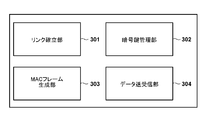
- FIG. 3 shows an example of the functional configuration of the communication device 102 of the present embodiment.
- the communication device 102 includes, for example, a link establishment unit 301, an encryption key management unit 302, a MAC frame generation unit 303, and a data transmission / reception unit 304 as its functional configuration.
- the configuration of FIG. 3 schematically shows the functions related to the present embodiment, and the communication device 102 has a function as a general communication device 102 and other functions according to the use of the communication device 102. Of course, it can include the function of. Further, since the communication device 103 has the same functional configuration as the communication device 102, the description thereof is omitted here.
- the link establishment unit 301 performs a process for establishing one or more wireless links used by the communication device 102 for data communication with the communication device 103.
- the link establishment process includes, for example, an Association process, an Association process, an EAP authentication process, and a 4-Way-Hand-Shake (4WHS) process.
- EAP authentication is successful, a PMK that is a source of a temporary key used for encrypting communication between the communication device 102 and the communication device 103 is generated in the communication device 103 and the authentication server 106, and the generated PMK is generated. Is notified from the authentication server 106 to the communication device 102.
- the PMK is used to generate a temporary encryption key in the 4WHS process.
- the link establishment unit 301 may execute connection processing of a plurality of wireless links in advance when connecting to the communication device 103, or may perform connection processing of another wireless link during communication on a predetermined wireless link. You may execute it later.
- the encryption key management unit 302 manages encryption keys such as PMK acquired by the link establishment unit 301 and temporary keys such as PTK and GTK generated by 4WHS.
- the encryption key management unit 302 also manages the PMKID in which the PMK and the ID of the remote device are associated with each other.
- PMKID is identification information corresponding to PMK. By such management, the encryption key management unit 302 can specify the corresponding PMK by specifying the ID of the remote device and the PMKID.
- the MAC frame generation unit 303 generates various management frames such as Associate Request / Associate Response, and MAC frames included in data frames and the like.
- the data transmission / reception unit 304 transmits a radio frame including the MAC frame generated by the MAC frame generation unit 303 and receives the radio frame from the remote device.
- FIG. 4 shows an example of a message sent and received between the communication device 102 and the communication device 103.
- This example shows an example when two wireless links are used.
- communication processing using the first frequency channel for example, 1ch in the 2.4GHz band
- the second frequency channel for example, 36ch in the 5GHz band
- the function of communicating with the first radio link on the first frequency channel is referred to as AP1, and the function of communicating with the second radio link on the second frequency channel is referred to as AP2. ..
- the function of communicating with the first radio link on the first frequency channel is referred to as STA1
- the function of communicating with the second radio link on the second frequency channel is referred to as STA2.
- the communication device 102 and the communication device 103 may be configured so that communication on two or more frequency channels can be executed in parallel by physically different communication circuits or the like.
- the communication device 102 and the communication device 103 may logically realize a plurality of AP functions and a plurality of STA functions while using a common communication circuit or the like. Further, the communication device 102 and the communication device 103 may physically and logically establish a plurality of wireless links in parallel using the functions of one AP and STA to perform communication.
- This process is started, for example, when the power of each of the communication device 102 and the communication device 103 is turned on. Further, in at least one of the communication device 102 and the communication device 103, this process may be started in response to an instruction from a user or an application to start multi-link communication. Further, in at least one of the communication device 102 and the communication device 103, this process may be started when the amount of data to be communicated with the other device becomes a predetermined amount or more.
- FIG. 4 shows only a part of the processes related to the present embodiment, various processes (for example, search request / response) in a general wireless LAN connection method are naturally executed.
- the communication device 102 and the communication device 103 perform the Authentication process of the first wireless link in the first frequency channel (S401).
- the communication device 103 transmits an Authentication Request frame for authentication to the communication device 102, and the communication device 102 transmits an Authentication Response frame to the communication device 103 as a response to the communication device 102.
- the SAE Simultaneus Authentication Equal
- the Authentication Request frame and the Authentication Response frame are exchanged a plurality of times.
- the communication device 102 and the communication device 103 perform an Association process of the first wireless link (S402).
- the communication device 103 transmits an Associate Request frame for connection to the communication device 102, and the communication device 102 transmits an Associate Response frame to the communication device 103 as a response to the connection request frame.
- the communication device 103 stores the MLDID (MultiLinkDeviceID), which is the identification information of the communication device 103, in the Association Request frame and transmits the information.
- MLDID MultiLinkDeviceID
- the communication device 102, the communication device 103, and the authentication server 106 exchange EAP frames such as the EAPOL-Start frame, and EAP authentication is executed (S403).
- EAP authentication is completed, a common PMK is held between the communication device 102 and the communication device 103.
- the communication device 102 and the communication device 103 execute a 4WHS process in order to generate a temporary key for encrypted communication (S404).
- the communication device 102 and the communication device 103 set the PTK, which is the encryption key used for the generated unicast communication, and the GTK, which is the encryption key used for the multicast / broadcast communication, on the wireless chip. ..
- the communication device 102 and the communication device 103 each store the PMKID associated with the ID of the other device and the PMK in the cache.
- the communication device 102 and the communication device 103 perform the process of establishing the second wireless link.
- the process of establishing the second wireless link may be executed immediately after the process of establishing the first wireless link, or may be executed after a certain amount of time has elapsed after the process of establishing the first wireless link.
- the communication device 102 and the communication device 103 perform an authentication process of the second radio link in the second frequency channel (S411).
- the communication device 103 transmits an Authentication Request frame for authentication to the communication device 102
- the communication device 102 transmits an Authentication Response frame to the communication device 103 as a response to the communication device 102.
- the Authentication Request frame and the Authentication Response frame are exchanged a plurality of times. Then, the communication device 102 and the communication device 103 perform an Association process of the second wireless link (S412). For example, the communication device 103 transmits an Associate Request frame for connection to the communication device 102, and the communication device 102 transmits an Associate Response frame to the communication device 103 as a response to the connection request frame.
- the communication device 103 stores its own MLDID and the PMKID associated with the communication device 102 in an Association Request frame and transmits the storage device 103.
- the communication device 102 receives the Association Request frame, the communication device 102 acquires the PMK corresponding to the MLDID and the PMKID from the cache.
- the PMK is held in the cache of the communication device 102 by the processing of S403 and S404. Therefore, the communication device 103 does not start EAP authentication, and the communication device 102 starts 4WHS (S413).
- the process of S413 is the same as the process of S404.
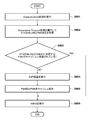
- the process of FIG. 5 can be realized, for example, by the control unit 202 of the STA executing the program stored in the storage unit 201.
- the present invention is not limited to this, and the processing of FIG. 5 may be realized by, for example, dedicated hardware such as a chip for wireless communication configured to execute the processing of FIG.
- the process of FIG. 5 may be realized by the processor inside the communication unit 206 of the STA executing a dedicated program.
- the STA executes an Authentication process with the AP (communication device 102) (S501). Then, the STA determines whether or not the same AP and another radio link have been established and are in use (S502). If the same AP and another radio link have been established and are not in use (NO in S502), the STA subsequently determines whether or not a radio link has been established with that AP in the past (S503). .. Then, the STA processes when there is a wireless link in use (YES in S502) or when the wireless link has been established in the past (YES in S503) with the AP of the execution partner of the Authentication process. To S504.
- the STA determines that a wireless link has not been established in the past with the AP of the execution partner of the Authentication process (NO in S503), the STA shifts the process to S505 without executing the process of S504.
- the determination of S502 to S503 is a determination of whether or not the PMK corresponding to the AP is cached, and for example, it is not necessary to determine whether or not the wireless link was actually established in the past. That is, the past PMK information may be deleted after a certain period of time, and the AP from which the corresponding PMK information has been deleted can be treated as an AP that "has never established a wireless link in the past".
- the STA executes the process of S503 not only when executing multi-link communication but also when executing single-link communication. That is, the STA also executes the determination of S503 when the wireless link is disconnected during the communication by establishing the single link and the link is established again. In this case, since the wireless link disconnected from the connection destination AP has been established in the past, the process shifts to S504.
- the STA since the STA has an established wireless link with the AP or has established the wireless link in the past, the PMK corresponding to the AP is cached. Therefore, the STA stores the PMKID in the Association Request frame. The PMKID is used to specify the PMK cached in the AP of the communication partner. Further, in S505, the STA stores the MLDID that identifies the own device in the Association Request frame. After that, the STA executes the Association process using the set Association Request frame (S506).
- the STA determines whether or not there is a wireless link in use with the AP that has executed the Authentication process (S507), and establishes the wireless link in the past. Judgment (S508) of whether or not there is is performed.
- the STA does not execute the processing of S509 and S510 when there is a wireless link in use with the AP (YES in S507) or when the wireless link has been established in the past (YES in S508).
- the process is transferred to S511.
- the STA means that the PMK is not cached if there is no radio link in use with the AP and no radio link has been established in the past (NO in S507 and S508).
- the STA executes EAP authentication, generates a PMK (S509), and saves the generated PMK in the cache (S510).
- the STA executes 4WHS processing with the AP of the connection establishment partner, and stores the PMKID notified from the AP in the cache.
- PMKID and MLDID are stored in the Association Request frame and transmitted to the AP, but the present invention is not limited to this.
- the PMKID and MLDID may be stored in another frame such as an Authentication Request frame and transmitted to the AP.
- the process of FIG. 6 can be realized, for example, by the control unit 202 of the AP executing the program stored in the storage unit 201.
- the present invention is not limited to this, and the processing of FIG. 6 may be realized by, for example, dedicated hardware such as a chip for wireless communication configured to execute the processing of FIG.
- the process of FIG. 6 may be realized by the processor inside the AP communication unit 206 executing a dedicated program.
- the AP executes an Authentication process with the STA (communication device 103) (S601).
- the AP executes the Association process and acquires the MLDID and PMKID that identify the STA from the Association Request frame received from the STA of the connection partner.
- the AP confirms whether or not the MLDID of the STA and the PMK corresponding to the PMKID are stored in the cache (S603). If the PMK corresponding to the STA's MLDID and PMKID is not stored in the cache (NO in S603), the AP waits for EAP authentication to be executed between the STA and the authentication server 106 (S604). ..
- the AP acquires the PMK obtained by the EAP authentication from the authentication server 106, and stores the PMKID corresponding to the acquired PMK and the MLDID of the STA in the cache (S605).
- the AP does not execute the processes of S604 and S605 when the PMK corresponding to the MLDID and PMKID of the STA is stored in the cache (YES in S603).
- the AP executes 4WHS processing with the STA and notifies the STA of the PMKID (S606).
- the communication device 102 and the communication device 103 establish the second wireless link while the first wireless link is established, the EAP authentication for the second wireless link is omitted. ..
- the EAP authentication for the second wireless link is omitted. ..
- the predetermined authentication process may be an authentication process performed via an external device such as the authentication server 106, which is different from the communication device 102 and the communication device 103, or may be an authentication process that does not go through the external device. You may.
- the present invention supplies a program that realizes one or more functions of the above-described embodiment to a system or device via a network or storage medium, and one or more processors in the computer of the system or device reads and executes the program. It can also be realized by the processing to be performed. It can also be realized by a circuit (for example, ASIC) that realizes one or more functions.
Landscapes
- Engineering & Computer Science (AREA)
- Computer Networks & Wireless Communication (AREA)
- Signal Processing (AREA)
- Computer Security & Cryptography (AREA)
- Mobile Radio Communication Systems (AREA)
Priority Applications (5)
| Application Number | Priority Date | Filing Date | Title |
|---|---|---|---|
| CN202180033919.9A CN115516894A (zh) | 2020-05-11 | 2021-04-01 | 通信装置、控制方法、以及程序 |
| EP21803157.3A EP4152884A4 (en) | 2020-05-11 | 2021-04-01 | Communication device, control method, and program |
| KR1020227042088A KR102823956B1 (ko) | 2020-05-11 | 2021-04-01 | 통신 장치, 제어 방법 및 컴퓨터 판독가능 저장 매체 |
| US17/970,695 US12463809B2 (en) | 2020-05-11 | 2022-10-21 | Communication apparatus, control method, and computer-readable storage medium |
| US19/353,668 US20260039468A1 (en) | 2020-05-11 | 2025-10-09 | Communication apparatus, control method, and computer-readable storage medium |
Applications Claiming Priority (2)
| Application Number | Priority Date | Filing Date | Title |
|---|---|---|---|
| JP2020083367A JP7465145B2 (ja) | 2020-05-11 | 2020-05-11 | 通信装置、制御方法、およびプログラム |
| JP2020-083367 | 2020-05-11 |
Related Child Applications (1)
| Application Number | Title | Priority Date | Filing Date |
|---|---|---|---|
| US17/970,695 Continuation US12463809B2 (en) | 2020-05-11 | 2022-10-21 | Communication apparatus, control method, and computer-readable storage medium |
Publications (1)
| Publication Number | Publication Date |
|---|---|
| WO2021229950A1 true WO2021229950A1 (ja) | 2021-11-18 |
Family
ID=78510473
Family Applications (1)
| Application Number | Title | Priority Date | Filing Date |
|---|---|---|---|
| PCT/JP2021/014202 Ceased WO2021229950A1 (ja) | 2020-05-11 | 2021-04-01 | 通信装置、制御方法、およびプログラム |
Country Status (6)
| Country | Link |
|---|---|
| US (2) | US12463809B2 (cg-RX-API-DMAC7.html) |
| EP (1) | EP4152884A4 (cg-RX-API-DMAC7.html) |
| JP (2) | JP7465145B2 (cg-RX-API-DMAC7.html) |
| KR (1) | KR102823956B1 (cg-RX-API-DMAC7.html) |
| CN (1) | CN115516894A (cg-RX-API-DMAC7.html) |
| WO (1) | WO2021229950A1 (cg-RX-API-DMAC7.html) |
Cited By (1)
| Publication number | Priority date | Publication date | Assignee | Title |
|---|---|---|---|---|
| WO2024232171A1 (ja) * | 2023-05-11 | 2024-11-14 | キヤノン株式会社 | 通信装置及びその制御方法、並びにプログラム |
Families Citing this family (2)
| Publication number | Priority date | Publication date | Assignee | Title |
|---|---|---|---|---|
| JP7397577B2 (ja) | 2019-02-28 | 2023-12-13 | キヤノン株式会社 | 通信装置、情報処理装置、通信方法、及び、プログラム |
| JP7465145B2 (ja) * | 2020-05-11 | 2024-04-10 | キヤノン株式会社 | 通信装置、制御方法、およびプログラム |
Citations (6)
| Publication number | Priority date | Publication date | Assignee | Title |
|---|---|---|---|---|
| WO2006098116A1 (ja) * | 2005-03-15 | 2006-09-21 | Nec Corporation | 無線通信システムにおける認証方式、それを備える無線端末装置と無線基地局、それらを用いた無線通信システム及びプログラム |
| JP2012531817A (ja) * | 2009-06-24 | 2012-12-10 | マーベル ワールド トレード リミテッド | 無線マルチバンドのセキュリティ |
| US20140323131A1 (en) * | 2013-04-30 | 2014-10-30 | Intellectual Discovery Co., Ltd. | Method and apparatus for supporting communication of multi-mode terminal |
| JP2016514411A (ja) * | 2013-03-01 | 2016-05-19 | クゥアルコム・インコーポレイテッドQualcomm Incorporated | 相互ワイヤレス接続を使用したピア接続性 |
| JP2018113849A (ja) | 2017-01-09 | 2018-07-19 | エルジー イノテック カンパニー リミテッド | 無線充電装置及びその方法 |
| JP2020064203A (ja) | 2018-10-18 | 2020-04-23 | コニカミノルタ株式会社 | 画像形成装置、画像形成装置の制御方法、および画像形成装置の制御プログラム |
Family Cites Families (27)
| Publication number | Priority date | Publication date | Assignee | Title |
|---|---|---|---|---|
| US8363617B2 (en) * | 2008-08-27 | 2013-01-29 | Symbol Technologies, Inc. | Selecting an access point from a plurality of access points |
| CN102264071B (zh) * | 2010-05-24 | 2016-08-17 | 三星电子株式会社 | 无线通信方法和无线发送/接收单元 |
| JP5693299B2 (ja) | 2011-03-03 | 2015-04-01 | キヤノン株式会社 | 通信装置およびその制御方法、並びにプログラム |
| CN102883316B (zh) * | 2011-07-15 | 2015-07-08 | 华为终端有限公司 | 建立连接的方法、终端和接入点 |
| US9204473B2 (en) * | 2012-01-11 | 2015-12-01 | Interdigital Patent Holdings, Inc. | Method and apparatus for accelerated link setup |
| US9451460B2 (en) * | 2012-02-07 | 2016-09-20 | Lg Electronics Inc. | Method and apparatus for associating station (STA) with access point (AP) |
| US8800010B2 (en) * | 2012-04-20 | 2014-08-05 | Cisco Technology, Inc. | Distributed group temporal key (GTK) state management |
| US9077772B2 (en) * | 2012-04-20 | 2015-07-07 | Cisco Technology, Inc. | Scalable replay counters for network security |
| US20150381577A1 (en) | 2014-06-30 | 2015-12-31 | Motorola Solutions, Llc. | System for, and method of, authenticating a supplicant, and distributing group keys to group members, in a multi-hop wireless communications network with enhanced security |
| US11412376B2 (en) * | 2014-09-05 | 2022-08-09 | Telefonaktiebolaget L M Ericsson (Publ) | Interworking and integration of different radio access networks |
| JP6684079B2 (ja) | 2015-11-17 | 2020-04-22 | キヤノン株式会社 | 通信装置、制御方法、及びプログラム |
| US10623951B2 (en) | 2016-03-09 | 2020-04-14 | Qualcomm Incorporated | WWAN-WLAN aggregation security |
| JP2018050133A (ja) | 2016-09-20 | 2018-03-29 | キヤノン株式会社 | 通信装置、制御方法、及びプログラム |
| JP7397577B2 (ja) | 2019-02-28 | 2023-12-13 | キヤノン株式会社 | 通信装置、情報処理装置、通信方法、及び、プログラム |
| JP7286396B2 (ja) | 2019-04-22 | 2023-06-05 | キヤノン株式会社 | 通信装置、通信装置の制御方法、およびプログラム |
| US11558750B2 (en) * | 2019-05-06 | 2023-01-17 | Intel Corporation | Security for multi-link operation |
| US11595442B2 (en) * | 2019-10-23 | 2023-02-28 | Semiconductor Components Industries, Llc | Multi-link wireless communications connections |
| JP7453774B2 (ja) | 2019-11-18 | 2024-03-21 | キヤノン株式会社 | 通信装置、情報処理装置、制御方法、及び、プログラム |
| SG10202000280YA (en) * | 2020-01-10 | 2021-08-30 | Panasonic Ip Corp America | Communication apparatus and communication method for multi-link secured retransmissions |
| JP7465145B2 (ja) * | 2020-05-11 | 2024-04-10 | キヤノン株式会社 | 通信装置、制御方法、およびプログラム |
| US11863978B2 (en) * | 2020-07-16 | 2024-01-02 | Qualcomm Incorporated | Fast basic service set transition for multi-link operation |
| US12543231B2 (en) * | 2020-07-24 | 2026-02-03 | Beijing Xiaomi Mobile Software Co., Ltd. | Method and device for communication on multiple links, and computer-readable storage medium |
| US20240089891A1 (en) * | 2022-09-09 | 2024-03-14 | Apple Inc. | Multi-Access Point Association |
| US20240090056A1 (en) * | 2022-09-09 | 2024-03-14 | Apple Inc. | Multi-Access Point Association |
| US20240236639A1 (en) * | 2023-01-10 | 2024-07-11 | Nxp Usa, Inc. | Roaming using distributed access point multi-link device groups |
| US20240259778A1 (en) * | 2023-01-30 | 2024-08-01 | Nxp Usa, Inc. | Multi-link setup of a roaming non-ap mld |
| US20240259777A1 (en) * | 2023-01-31 | 2024-08-01 | Nxp Usa, Inc. | Feature allocation between a roaming ap mld and affiliated ap mlds |
-
2020
- 2020-05-11 JP JP2020083367A patent/JP7465145B2/ja active Active
-
2021
- 2021-04-01 EP EP21803157.3A patent/EP4152884A4/en active Pending
- 2021-04-01 CN CN202180033919.9A patent/CN115516894A/zh active Pending
- 2021-04-01 WO PCT/JP2021/014202 patent/WO2021229950A1/ja not_active Ceased
- 2021-04-01 KR KR1020227042088A patent/KR102823956B1/ko active Active
-
2022
- 2022-10-21 US US17/970,695 patent/US12463809B2/en active Active
-
2024
- 2024-03-28 JP JP2024054628A patent/JP7688751B2/ja active Active
-
2025
- 2025-10-09 US US19/353,668 patent/US20260039468A1/en active Pending
Patent Citations (6)
| Publication number | Priority date | Publication date | Assignee | Title |
|---|---|---|---|---|
| WO2006098116A1 (ja) * | 2005-03-15 | 2006-09-21 | Nec Corporation | 無線通信システムにおける認証方式、それを備える無線端末装置と無線基地局、それらを用いた無線通信システム及びプログラム |
| JP2012531817A (ja) * | 2009-06-24 | 2012-12-10 | マーベル ワールド トレード リミテッド | 無線マルチバンドのセキュリティ |
| JP2016514411A (ja) * | 2013-03-01 | 2016-05-19 | クゥアルコム・インコーポレイテッドQualcomm Incorporated | 相互ワイヤレス接続を使用したピア接続性 |
| US20140323131A1 (en) * | 2013-04-30 | 2014-10-30 | Intellectual Discovery Co., Ltd. | Method and apparatus for supporting communication of multi-mode terminal |
| JP2018113849A (ja) | 2017-01-09 | 2018-07-19 | エルジー イノテック カンパニー リミテッド | 無線充電装置及びその方法 |
| JP2020064203A (ja) | 2018-10-18 | 2020-04-23 | コニカミノルタ株式会社 | 画像形成装置、画像形成装置の制御方法、および画像形成装置の制御プログラム |
Non-Patent Citations (1)
| Title |
|---|
| See also references of EP4152884A4 |
Cited By (1)
| Publication number | Priority date | Publication date | Assignee | Title |
|---|---|---|---|---|
| WO2024232171A1 (ja) * | 2023-05-11 | 2024-11-14 | キヤノン株式会社 | 通信装置及びその制御方法、並びにプログラム |
Also Published As
| Publication number | Publication date |
|---|---|
| JP7465145B2 (ja) | 2024-04-10 |
| JP2021180363A (ja) | 2021-11-18 |
| JP2024073666A (ja) | 2024-05-29 |
| JP7688751B2 (ja) | 2025-06-04 |
| KR102823956B1 (ko) | 2025-06-23 |
| CN115516894A (zh) | 2022-12-23 |
| US12463809B2 (en) | 2025-11-04 |
| US20260039468A1 (en) | 2026-02-05 |
| US20230041366A1 (en) | 2023-02-09 |
| KR20230005956A (ko) | 2023-01-10 |
| EP4152884A4 (en) | 2024-04-03 |
| EP4152884A1 (en) | 2023-03-22 |
Similar Documents
| Publication | Publication Date | Title |
|---|---|---|
| JP7688751B2 (ja) | 通信装置、制御方法、およびプログラム | |
| WO2021131974A1 (ja) | 通信装置、通信方法、およびプログラム | |
| US12532161B2 (en) | Communication apparatus, communication method, and storage medium | |
| JP7644607B2 (ja) | 通信装置、通信方法、およびプログラム | |
| JP7566477B2 (ja) | 通信装置、制御方法、およびプログラム | |
| JP7793739B2 (ja) | 通信装置、通信方法及びプログラム | |
| JP2025131793A (ja) | 通信装置、制御方法、およびプログラム | |
| WO2022259856A1 (ja) | 通信装置、通信方法、およびプログラム | |
| WO2021131975A1 (ja) | 通信装置、制御方法、およびプログラム | |
| JP7682663B2 (ja) | 通信装置、通信方法、およびプログラム | |
| JP2022188745A (ja) | 通信装置、通信方法、およびプログラム |
Legal Events
| Date | Code | Title | Description |
|---|---|---|---|
| 121 | Ep: the epo has been informed by wipo that ep was designated in this application |
Ref document number: 21803157 Country of ref document: EP Kind code of ref document: A1 |
|
| ENP | Entry into the national phase |
Ref document number: 20227042088 Country of ref document: KR Kind code of ref document: A |
|
| NENP | Non-entry into the national phase |
Ref country code: DE |
|
| ENP | Entry into the national phase |
Ref document number: 2021803157 Country of ref document: EP Effective date: 20221212 |