WO2021229670A1 - 会話補助装置、会話補助方法、会話補助プログラム - Google Patents
会話補助装置、会話補助方法、会話補助プログラム Download PDFInfo
- Publication number
- WO2021229670A1 WO2021229670A1 PCT/JP2020/018909 JP2020018909W WO2021229670A1 WO 2021229670 A1 WO2021229670 A1 WO 2021229670A1 JP 2020018909 W JP2020018909 W JP 2020018909W WO 2021229670 A1 WO2021229670 A1 WO 2021229670A1
- Authority
- WO
- WIPO (PCT)
- Prior art keywords
- sound
- space
- conversation
- conversation assisting
- assisting device
- Prior art date
- Legal status (The legal status is an assumption and is not a legal conclusion. Google has not performed a legal analysis and makes no representation as to the accuracy of the status listed.)
- Ceased
Links
Images









Classifications
-
- G—PHYSICS
- G10—MUSICAL INSTRUMENTS; ACOUSTICS
- G10K—SOUND-PRODUCING DEVICES; METHODS OR DEVICES FOR PROTECTING AGAINST, OR FOR DAMPING, NOISE OR OTHER ACOUSTIC WAVES IN GENERAL; ACOUSTICS NOT OTHERWISE PROVIDED FOR
- G10K11/00—Methods or devices for transmitting, conducting or directing sound in general; Methods or devices for protecting against, or for damping, noise or other acoustic waves in general
- G10K11/18—Methods or devices for transmitting, conducting or directing sound
- G10K11/24—Methods or devices for transmitting, conducting or directing sound for conducting sound through solid bodies, e.g. wires
-
- H—ELECTRICITY
- H04—ELECTRIC COMMUNICATION TECHNIQUE
- H04R—LOUDSPEAKERS, MICROPHONES, GRAMOPHONE PICK-UPS OR LIKE ACOUSTIC ELECTROMECHANICAL TRANSDUCERS; ELECTRIC HEARING AIDS; PUBLIC ADDRESS SYSTEMS
- H04R3/00—Circuits for transducers
-
- G—PHYSICS
- G10—MUSICAL INSTRUMENTS; ACOUSTICS
- G10K—SOUND-PRODUCING DEVICES; METHODS OR DEVICES FOR PROTECTING AGAINST, OR FOR DAMPING, NOISE OR OTHER ACOUSTIC WAVES IN GENERAL; ACOUSTICS NOT OTHERWISE PROVIDED FOR
- G10K11/00—Methods or devices for transmitting, conducting or directing sound in general; Methods or devices for protecting against, or for damping, noise or other acoustic waves in general
- G10K11/16—Methods or devices for protecting against, or for damping, noise or other acoustic waves in general
-
- G—PHYSICS
- G10—MUSICAL INSTRUMENTS; ACOUSTICS
- G10K—SOUND-PRODUCING DEVICES; METHODS OR DEVICES FOR PROTECTING AGAINST, OR FOR DAMPING, NOISE OR OTHER ACOUSTIC WAVES IN GENERAL; ACOUSTICS NOT OTHERWISE PROVIDED FOR
- G10K9/00—Devices in which sound is produced by vibrating a diaphragm or analogous element, e.g. fog horns, vehicle hooters or buzzers
- G10K9/12—Devices in which sound is produced by vibrating a diaphragm or analogous element, e.g. fog horns, vehicle hooters or buzzers electrically operated
-
- H—ELECTRICITY
- H04—ELECTRIC COMMUNICATION TECHNIQUE
- H04R—LOUDSPEAKERS, MICROPHONES, GRAMOPHONE PICK-UPS OR LIKE ACOUSTIC ELECTROMECHANICAL TRANSDUCERS; ELECTRIC HEARING AIDS; PUBLIC ADDRESS SYSTEMS
- H04R2499/00—Aspects covered by H04R or H04S not otherwise provided for in their subgroups
- H04R2499/10—General applications
- H04R2499/13—Acoustic transducers and sound field adaptation in vehicles
-
- H—ELECTRICITY
- H04—ELECTRIC COMMUNICATION TECHNIQUE
- H04R—LOUDSPEAKERS, MICROPHONES, GRAMOPHONE PICK-UPS OR LIKE ACOUSTIC ELECTROMECHANICAL TRANSDUCERS; ELECTRIC HEARING AIDS; PUBLIC ADDRESS SYSTEMS
- H04R3/00—Circuits for transducers
- H04R3/02—Circuits for transducers for preventing acoustic reaction, i.e. acoustic oscillatory feedback
Definitions
- the present invention relates to a conversation assisting device, a conversation assisting method, and a conversation assisting program for transmitting information by sound between two spaces separated by an isolated object.
- Non-Patent Document 1 there is a situation in which it is desired to transmit information between spaces in a state where they are separated into two spaces by an isolated object such as an automobile body.
- information transmission such as telephones and transceivers placed in both spaces for conversation, visual information transmission by writing or displaying characters on a tablet terminal, and data communication using a tablet terminal, etc. It is possible to transmit information by transmitting information.
- information is transmitted by a person inside the car opening the window glass and speaking into a person outside the car or a microphone.
- the prior art requires some device (eg, telephone, tablet terminal) or tool (eg, pen and paper for writing) in the vehicle to convey information without opening the window of the vehicle.
- some device eg, telephone, tablet terminal
- tool eg, pen and paper for writing
- the present invention has been made in view of such a situation, and it is not necessary to place a device or a tool in one of the separated spaces, and information is transmitted by sound while maintaining the separated state in the two spaces.
- the purpose is to provide the technology to do.
- the conversation assisting method of the present invention is executed in the first space in order to transmit an acoustic signal using the isolated space between the first space and the second space separated by the isolated object.
- the sound transmitted to the second space is emitted from the first space side to the isolated object with a predetermined intensity.
- the sound propagating in the isolated object is collected, and the sound other than the sound emitted from the collected sound is emphasized and output.
- information can be transmitted by sound without arranging a device or a tool in one space while maintaining a state in which the space is separated into two by an isolated object.
- FIG. 1 The figure which shows the functional structure example of the conversation assist device of Example 1.
- FIG. 2 The figure which shows the processing flow example of the conversation assist method of Example 1.
- FIG. 2 The figure which shows the functional structure example of the conversation assist device of Example 2.
- FIG. 2 The figure which shows the processing flow example of the conversation assist method of Example 2.
- FIG. Example 2 The figure which shows the processing flow example of the conversation assist method of Embodiment 1.
- FIG. 2 Example 2
- FIG. 3 The figure which shows the processing flow example of the conversation assist method of Example 3.
- FIG. 1 The figure which shows the processing flow example of the conversation assist method of Example 1.
- Example 3 The figure which shows the functional structure example of the conversation assist device of the modification 1.
- Example 3 The figure which shows the processing flow example of the conversation assist method of the modification 1.
- FIG. The figure which shows the processing flow example of the conversation assist method of Example 4.
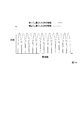
- FIG. The figure which shows the frequency characteristic of the 1st comb filter and the 2nd comb filter.
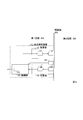
- FIG. 1 shows an example of the functional configuration of the conversation assisting device of the first embodiment
- FIG. 2 shows an example of the processing flow of the conversation assisting method of the first embodiment
- the conversation assist device 100 is arranged in the first space 810 in order to transmit an acoustic signal by utilizing the isolation 800 between the first space 810 and the second space 820 separated by the isolation 800.
- the conversation assisting method is performed in the first space to transmit an acoustic signal using the isolation 800 between the first space 810 and the second space 820 separated by the isolation 800.
- the conversation assisting device 100 includes a sound emitting unit 110, a sound collecting unit 120, and an emphasizing unit 150.
- the isolated object 800 is, for example, a vehicle, the first space 810 is a space outside the vehicle, and the second space 820 is a space inside the vehicle.
- the conversation assisting device 100 may be pressed against the window glass or the vehicle body.
- the sound transmitted to the second space is input to the conversation assist device 100.
- the sound emitting unit 110 transmits the sound transmitted to the second space from the first space 810 side to the isolated object 800 with a predetermined intensity (S110).
- the sound emitting unit 110 includes an amplifying means 111 that makes the sound transmitted to the second space 820 have a predetermined intensity, and a vibrating means 112 that vibrates the isolated object 800.
- An actuator, an exciter, or a speaker may be used as the vibrating means 112.
- the "sound transmitted to the second space" may include not only vibrations derived from voice but also sounds such as chimes and sounds of musical instruments.
- the sound collecting unit 120 collects the sound propagating through the isolated object 800 (S120).
- the sound collecting unit 120 has a pick-up means 121 that picks up the vibration of the isolated object 800 and an amplification means 122 that amplifies the picked-up sound.
- a vibration pickup, a microphone, or an acceleration sensor may be used for the pickup means 121.
- the emphasis unit 150 emphasizes and outputs sounds other than the sound transmitted by the sound emitting unit 110 (sound emitted) from the collected sound (S150).
- the techniques shown in the second and subsequent embodiments may be used.
- the doctor wears a headset with headphones and a microphone, and the medical staff possesses the conversation assist device 100.
- the medical staff presses the conversation assisting device 100 against the window glass of the vehicle when the doctor and the patient have a conversation, the doctor outside the vehicle and the patient inside the vehicle can talk.
- the outside of the vehicle is the first space and the inside of the vehicle is the second space.
- the inside of the vehicle may be the first space and the outside of the vehicle may be the second space.
- a predetermined question may be recorded, the recorded question may be sent from the first space, and the answer from the second space may be voice-recognized and recorded.
- the sound emitting unit 110 and the sound collecting unit 120 into separate housings and changing the position of pressing against the isolated object 800, it is difficult to collect the sound transmitted by the sound emitting unit 110 (sound emitted). You may. For example, the sound emitting unit 110 may be pressed against the side window, and the sound collecting unit 120 may be pressed against the front window.
- information is transmitted by sound without arranging a device or a tool in one space while maintaining a state in which the space is separated into two by the isolated object 800. can.
- FIG. 3 shows an example of the functional configuration of the conversation assisting device of the second embodiment
- FIG. 4 shows an example of the processing flow of the conversation assisting method of the second embodiment
- the conversation assisting device 101 is different from the conversation assisting device 100 in that the switching assisting device 101 is provided with the switch 130 and the emphasizing unit 150 has the blocking means 151.
- the emphasis unit 150 controls the intensity of the sound output from the emphasis unit 150 according to the state of the switch 130 (S130, S151). Specifically, when the switch 130 indicates a state in which sound is transmitted to the second space, the sound output from the emphasis unit 150 is blocked by the blocking means 151. Therefore, when the sound is transmitted from the first space 810 to the second space 820, the output from the emphasis section 150 is cut off.
- the switch 130 does not indicate the state of transmitting the sound to the second space, the blocking means 151 is not operated, so that the sound of the second space can be output from the emphasis unit 150. Moreover, the same effect as in Example 1 can be obtained.
- the state of the switch 130 may be switched by the operator in the first space.
- FIG. 5 shows an example of the functional configuration of the conversation assisting device of the second embodiment
- FIG. 6 shows an example of the processing flow of the conversation assisting method of the second embodiment
- the conversation assisting device 102 also includes a sensor 131 that detects contact of the sound collecting unit 120 with the isolated object 800. Then, the intensity of the sound output from the emphasis section 150 is controlled by the presence or absence of contact with the isolated object 800 detected by the sensor 131. Further, the emphasis portion 150 has a blocking means 151.
- the sensor 131 confirms the presence or absence of contact (S131).
- the enhancing unit 150 blocks the sound output from the enhancing unit 150 by the blocking means 151, and when in contact, the enhancing unit 150 outputs the sound in the second space without operating the blocking means 151. (S151). Therefore, it is possible to prevent the emphasis section 150 from outputting the sound generated when the conversation assisting device 102 is pressed against the isolated object 800.
- FIG. 5 shows an example of the functional configuration of the conversation assisting device of the second embodiment
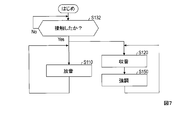
- FIG. 7 shows an example of the processing flow of the conversation assisting method of the second embodiment.
- the conversation assisting device 102 also includes a sensor 131 for detecting contact of the sound collecting unit 120 with the isolated object 800. Then, the intensity of the sound output from the emphasis section 150 is controlled by the presence or absence of contact with the isolated object 800 detected by the sensor 131. However, the emphasis section 150 does not have the blocking means 151.
- the conversation assisting device 102 does not process the sound emitting unit 110, the sound collecting unit 120, and the enhancing unit 150 until the sensor 131 confirms the contact (S132). Therefore, it is possible to prevent the emphasis section 150 from outputting the sound generated when the conversation assisting device 102 is pressed against the isolated object 800.
- FIG. 8 shows an example of the functional configuration of the conversation assisting device of the third embodiment
- FIG. 9 shows an example of the processing flow of the conversation assisting method of the third embodiment.
- the conversation assisting device 103 is different from the conversation assisting device 100 in that the conversation assisting device 103 includes a switch 135 and a blocking unit 136, and the enhancing unit 150 has the blocking means 151.
- the state of the switch 135 is switched by the operator in the first space.
- the conversation assisting device 103 switches between stopping the sound from the sound emitting unit 110 and stopping the output from the emphasis unit 150 by switching the switch 135.
- the conversation assisting device 103 confirms the state of the switch 135 (S135).
- the emphasis section 150 blocks the sound output by the blocking means 151 (S152).
- the sound emitting unit 110 emits a sound transmitted to the second space 820 (S110).
- the cutoff unit 136 cuts off the sound transmitted to the second space 820 (S136).
- the sound collecting unit 120 and the enhancing unit 150 operate. Therefore, when the conversation assisting device 103 transmits sound from the first space 810 to the second space 820, the output from the emphasis unit 150 is cut off. Further, when the state of the switch 135 indicates sound collection, the conversation assisting device 103 can output the sound in the second space from the emphasis unit 150.
- the operation of the sound emitting section 110 or the sound collecting section 120 may be controlled according to the state of the switch 135. For example, when the state of the switch 135 indicates sound emission, the output of the emphasis section 150 is stopped. Specifically, the operation of the sound collecting unit 120 or the emphasis unit 150 may be stopped. Then, the sound emitting unit 110 emits a sound transmitted to the second space 820 (S110). When the state of the switch 135 indicates sound pickup, the sound emitting unit 110 is not operated. Then, the sound collecting unit 120 and the enhancing unit 150 operate. Also in this case, when the conversation assisting device 103 is transmitting sound from the first space 810 to the second space 820, the output from the emphasis unit 150 is stopped. Further, when the state of the switch 135 indicates sound collection, the conversation assisting device 103 can output the sound in the second space from the emphasis unit 150. Moreover, the same effect as in Example 1 can be obtained.
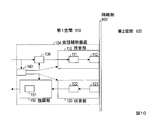
- FIG. 10 shows an example of the functional configuration of the conversation assisting device of the third embodiment
- FIG. 11 shows an example of the processing flow of the conversation assisting method of the third embodiment.
- the conversation assisting device 104 is different from the conversation assisting device 100 in that the speech assisting device 104 includes the utterance detecting unit 140 and the blocking unit 136, and the emphasizing unit 150 has the blocking means 151.
- the conversation assisting device 104 differs from the conversation assisting device 103 in that it includes an utterance detection unit 140 instead of the switch 135.
- the state of the switch 135 was switched by the operator.
- the utterance detection unit 140 automatically detects whether or not the sound transmitted to the second space 820 is input (S140).
- the conversation assisting device 104 determines that there is a sound transmitted to the second space 820, the output from the emphasis unit 150 is stopped, and the sound transmitted to the second space 820 is transmitted to the second space 820 with a predetermined intensity on the first space side. Sound is emitted from the isolated object (S110).
- the sound collection of the sound propagating through the isolation unit 800 may be stopped, or the operation of the emphasis section 150 may be stopped.
- the conversation assisting device 104 determines that there is no sound transmitted to the second space 820, the conversation assisting device 104 stops the sound emission to the isolated object 800 and collects the sound propagating through the isolated object 800 (S120). Then, the emphasis unit 150 outputs the sound of the second space 820 (S150).
- the conversation assisting device 104 may cut off the output from the emphasis section 150 by the blocking means 151 of the emphasis section 150 as a method of stopping the output from the emphasis section 150 (S152). Further, instead of stopping the sound emission, the conversation assisting device 104 may block the sound input by the blocking unit 136 (noise not determined to be the sound transmitted to the second space 820) (S136).
- the conversation assist device 104 When the conversation assist device 104 is transmitting sound from the first space 810 to the second space 820, the output from the emphasis unit 150 can be stopped. Further, the conversation assisting device 104 can output the sound of the second space from the emphasis unit 150 when the sound is not transmitted from the first space 810 to the second space 820.
- FIG. 12 shows an example of the functional configuration of the conversation assisting device of the fourth embodiment
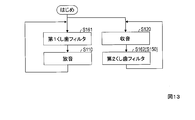
- FIG. 13 shows an example of the processing flow of the conversation assisting method of the fourth embodiment
- the conversation assisting device 105 differs from the conversation assisting device 100 in that the first comb tooth filter 161 is provided and the emphasis portion 150 has the second comb tooth filter 162.
- FIG. 14 shows the frequency characteristics of the first comb tooth filter and the second comb tooth filter. The horizontal axis is frequency and the vertical axis is gain. The solid line shows an example of the characteristics of the first comb tooth filter, and the dotted line shows an example of the characteristics of the second comb tooth filter.
- the comb filter may be realized by an FIR filter (Finite Impulse Response filter) or an IIR filter (Infinite Impulse Response filter). Further, after performing a short-time Fourier transform, the frequency characteristics of the comb tooth filter may be multiplied, and then a short-time inverse Fourier transform may be performed. As shown in FIG. 14, the pass area of the second comb tooth filter is the blocking area of the first comb tooth filter.
- the bandwidth of the pass band and the stop band may be 10 Hz to 200 Hz. For example, a pass band and a stop band may be formed alternately at intervals of 50 Hz.
- the sound transmitted to the second space 820 input to the conversation assist device 105 passes through the first comb tooth filter 161 (S161), and the sound emitting unit 110 emits sound to the isolation 800 with a predetermined intensity (S110). ). Further, the emphasizing unit 150 passes the output from the sound collecting unit 120 through the second comb tooth filter 162 (S162).
- the pass area of the second comb tooth filter is the blocking area of the first comb tooth filter. Since the emitted sound does not include the frequency component in the blocking region of the first comb tooth filter, only the emitted sound passes through the second comb tooth filter. That is, passing through the second comb tooth filter 162 emphasizes sounds other than the emitted sound.
- the vibration is derived from voice, it contains various frequency components, so the content can be heard even if it is passed through a comb filter.
- an artificial sound such as a chime is included in the sound transmitted to the second space 820, it may be devised to include various frequency components. Since the characteristics are set so as to be transmitted to either the first space 810 to the second space or the second space 820 to the first space 810 for each frequency band, the conversation assisting device 105 can be used for one-way communication. It is possible to transmit information by sound without arranging a device or a tool in one space while maintaining a state in which the space is separated into two by the isolated object 800.
- FIG. 15 shows an example of the functional configuration of the conversation assisting device of the fifth embodiment
- FIG. 16 shows an example of the processing flow of the conversation assisting method of the fifth embodiment.
- the conversation assisting device 106 is different from the conversation assisting device 100 in that the emphasis unit 150 has the echo canceling means 155.
- the echo canceling means 155 uses the sound transmitted to the second space 820 input to the conversation assisting device 106 to emphasize sounds other than the sound emitted from the collected sound (S155).
- An adaptive filter, a Wiener filter, an echo sublesser, or the like may be used for echo cancellation.
- the conversation assisting device 106 can transmit information by sound without arranging a device or a tool in one space while maintaining a state in which the space is separated into two by the isolated object 800 without making a one-way call.
- the recording unit 2020 of the computer 2000 shown in FIG. 17 is read with a program for executing each step of the above method, and the control unit 2010, the input unit 2030, the output unit 2040, the display unit 2050, and the like operate. It can be carried out by letting it.
- the output means 2040 includes the vibration means 112, and the input unit 2030 includes the pickup means 121.
- the input unit 2030 may include a microphone and the output unit 2040 may include headphones or the like.
- the program that describes this processing content can be recorded on a computer-readable recording medium.
- the recording medium that can be read by a computer may be, for example, a magnetic recording device, an optical disk, a photomagnetic recording medium, a semiconductor memory, or the like.
- the distribution of this program is carried out, for example, by selling, transferring, renting, etc. a portable recording medium such as a DVD or CD-ROM in which the program is recorded. Further, the program may be stored in the storage device of the server computer, and the program may be distributed by transferring the program from the server computer to another computer via the network.
- a computer that executes such a program first, for example, first stores a program recorded on a portable recording medium or a program transferred from a server computer in its own storage device. Then, when the process is executed, the computer reads the program stored in its own recording medium and executes the process according to the read program. Further, as another execution form of this program, a computer may read the program directly from a portable recording medium and execute processing according to the program, and further, the program is transferred from the server computer to this computer. You may execute the process according to the received program one by one each time.
- ASP Application Service Provider
- the program in this embodiment includes information used for processing by a computer and equivalent to the program (data that is not a direct command to the computer but has a property that regulates the processing of the computer, etc.).
- the present device is configured by executing a predetermined program on a computer, but at least a part of these processing contents may be realized in terms of hardware.
- Conversation assist device 110 Sound emitting unit 111, 122 Amplifying means 112 Vibration means 120 Sound collecting unit 121 Picking up means 130, 135 Switch 131 Sensor 136 Blocking unit 140 Speech detection unit 150 Emphasis Part 151 Blocking means 155 Echo canceling means 161 First comb tooth filter 162 Second comb tooth filter 800 Isolation 810 First space 820 Second space
Landscapes
- Physics & Mathematics (AREA)
- Engineering & Computer Science (AREA)
- Acoustics & Sound (AREA)
- Multimedia (AREA)
- Signal Processing (AREA)
- Soundproofing, Sound Blocking, And Sound Damping (AREA)
- Fittings On The Vehicle Exterior For Carrying Loads, And Devices For Holding Or Mounting Articles (AREA)
- Circuit For Audible Band Transducer (AREA)
Priority Applications (3)
| Application Number | Priority Date | Filing Date | Title |
|---|---|---|---|
| PCT/JP2020/018909 WO2021229670A1 (ja) | 2020-05-12 | 2020-05-12 | 会話補助装置、会話補助方法、会話補助プログラム |
| US17/915,447 US12452588B2 (en) | 2020-05-12 | 2020-05-12 | Conversation assisting apparatus, conversation assisting method, non-transitory computer-readable recording medium |
| JP2022522127A JP7409496B2 (ja) | 2020-05-12 | 2020-05-12 | 会話補助装置、会話補助方法、会話補助プログラム |
Applications Claiming Priority (1)
| Application Number | Priority Date | Filing Date | Title |
|---|---|---|---|
| PCT/JP2020/018909 WO2021229670A1 (ja) | 2020-05-12 | 2020-05-12 | 会話補助装置、会話補助方法、会話補助プログラム |
Publications (1)
| Publication Number | Publication Date |
|---|---|
| WO2021229670A1 true WO2021229670A1 (ja) | 2021-11-18 |
Family
ID=78525984
Family Applications (1)
| Application Number | Title | Priority Date | Filing Date |
|---|---|---|---|
| PCT/JP2020/018909 Ceased WO2021229670A1 (ja) | 2020-05-12 | 2020-05-12 | 会話補助装置、会話補助方法、会話補助プログラム |
Country Status (3)
| Country | Link |
|---|---|
| US (1) | US12452588B2 (https=) |
| JP (1) | JP7409496B2 (https=) |
| WO (1) | WO2021229670A1 (https=) |
Citations (3)
| Publication number | Priority date | Publication date | Assignee | Title |
|---|---|---|---|---|
| JP2006041743A (ja) * | 2004-07-23 | 2006-02-09 | Toshiba Corp | 通話装置 |
| JP2006138149A (ja) * | 2004-11-15 | 2006-06-01 | Inax Corp | 音響機能付き仕切り部材 |
| JP2008207622A (ja) * | 2007-02-23 | 2008-09-11 | National Univ Corp Shizuoka Univ | 音声情報伝達装置 |
Family Cites Families (3)
| Publication number | Priority date | Publication date | Assignee | Title |
|---|---|---|---|---|
| JPH02111987U (https=) * | 1989-02-20 | 1990-09-07 | ||
| WO2020245987A1 (ja) * | 2019-06-06 | 2020-12-10 | 日本電信電話株式会社 | 集音装置、到来方向推定装置、振動情報収集装置 |
| JP7754110B2 (ja) * | 2021-01-25 | 2025-10-15 | Agc株式会社 | 遮音装置 |
-
2020
- 2020-05-12 US US17/915,447 patent/US12452588B2/en active Active
- 2020-05-12 JP JP2022522127A patent/JP7409496B2/ja active Active
- 2020-05-12 WO PCT/JP2020/018909 patent/WO2021229670A1/ja not_active Ceased
Patent Citations (3)
| Publication number | Priority date | Publication date | Assignee | Title |
|---|---|---|---|---|
| JP2006041743A (ja) * | 2004-07-23 | 2006-02-09 | Toshiba Corp | 通話装置 |
| JP2006138149A (ja) * | 2004-11-15 | 2006-06-01 | Inax Corp | 音響機能付き仕切り部材 |
| JP2008207622A (ja) * | 2007-02-23 | 2008-09-11 | National Univ Corp Shizuoka Univ | 音声情報伝達装置 |
Also Published As
| Publication number | Publication date |
|---|---|
| US12452588B2 (en) | 2025-10-21 |
| JPWO2021229670A1 (https=) | 2021-11-18 |
| US20230147802A1 (en) | 2023-05-11 |
| JP7409496B2 (ja) | 2024-01-09 |
Similar Documents
| Publication | Publication Date | Title |
|---|---|---|
| JP5034595B2 (ja) | 音響再生装置および音響再生方法 | |
| JP6150988B2 (ja) | 特に「ハンズフリー」電話システム用の、小数遅延フィルタリングにより音声信号のノイズ除去を行うための手段を含むオーディオ装置 | |
| CN103959813B (zh) | 耳孔可佩戴式声音收集设备,信号处理设备和声音收集方法 | |
| US20170148466A1 (en) | Method and system for reducing background sounds in a noisy environment | |
| US20230353953A1 (en) | Voice input/output apparatus, hearing aid, voice input/output method, and voice input/output program | |
| EP2189974A2 (en) | System for Active Noise Control with Audio Signal Compensation | |
| JP4887968B2 (ja) | 音声会議装置 | |
| EP2605239A2 (en) | Method and arrangement for noise reduction | |
| JP2001056693A (ja) | 騒音低減装置 | |
| WO2009132270A1 (en) | Headset with integrated stereo array microphone | |
| CN104106112A (zh) | 消声装置 | |
| AU5806400A (en) | Feedback cancellation with low frequency input | |
| CN108353229B (zh) | 车辆中的音频信号处理 | |
| JP7563829B2 (ja) | イヤホン、音声処理方法および音声処理プログラム | |
| US10798479B2 (en) | Determination of effects of physical activity on electrical load devices | |
| JP2025529163A (ja) | ウェアラブルデバイス上の風雑音低減のための入力選択 | |
| WO2021229670A1 (ja) | 会話補助装置、会話補助方法、会話補助プログラム | |
| AU2005223798B2 (en) | Listening device with two or more microphones | |
| JP2007180896A (ja) | 音声信号処理装置および音声信号処理方法 | |
| US11081097B2 (en) | Passive balancing of electroacoustic transducers for detection of external sound | |
| US11894013B2 (en) | Sound collection loudspeaker apparatus, method and program for the same | |
| JP2007143008A (ja) | 収音切り替え装置及び収音切り替え方法 | |
| JP4365414B2 (ja) | 窓口通話装置 | |
| JP2023036332A (ja) | 音響システム | |
| JP3292098B2 (ja) | 聴覚補助装置 |
Legal Events
| Date | Code | Title | Description |
|---|---|---|---|
| 121 | Ep: the epo has been informed by wipo that ep was designated in this application |
Ref document number: 20935786 Country of ref document: EP Kind code of ref document: A1 |
|
| ENP | Entry into the national phase |
Ref document number: 2022522127 Country of ref document: JP Kind code of ref document: A |
|
| NENP | Non-entry into the national phase |
Ref country code: DE |
|
| 122 | Ep: pct application non-entry in european phase |
Ref document number: 20935786 Country of ref document: EP Kind code of ref document: A1 |
|
| WWG | Wipo information: grant in national office |
Ref document number: 17915447 Country of ref document: US |