WO2021229630A1 - 機械学習プログラム,機械学習方法および機械学習装置 - Google Patents
機械学習プログラム,機械学習方法および機械学習装置 Download PDFInfo
- Publication number
- WO2021229630A1 WO2021229630A1 PCT/JP2020/018777 JP2020018777W WO2021229630A1 WO 2021229630 A1 WO2021229630 A1 WO 2021229630A1 JP 2020018777 W JP2020018777 W JP 2020018777W WO 2021229630 A1 WO2021229630 A1 WO 2021229630A1
- Authority
- WO
- WIPO (PCT)
- Prior art keywords
- data
- model
- machine learning
- clustering
- group
- Prior art date
- Legal status (The legal status is an assumption and is not a legal conclusion. Google has not performed a legal analysis and makes no representation as to the accuracy of the status listed.)
- Ceased
Links
Images




Classifications
-
- G—PHYSICS
- G06—COMPUTING OR CALCULATING; COUNTING
- G06N—COMPUTING ARRANGEMENTS BASED ON SPECIFIC COMPUTATIONAL MODELS
- G06N5/00—Computing arrangements using knowledge-based models
- G06N5/02—Knowledge representation; Symbolic representation
- G06N5/022—Knowledge engineering; Knowledge acquisition
-
- G—PHYSICS
- G06—COMPUTING OR CALCULATING; COUNTING
- G06N—COMPUTING ARRANGEMENTS BASED ON SPECIFIC COMPUTATIONAL MODELS
- G06N3/00—Computing arrangements based on biological models
- G06N3/02—Neural networks
- G06N3/08—Learning methods
- G06N3/09—Supervised learning
-
- G—PHYSICS
- G06—COMPUTING OR CALCULATING; COUNTING
- G06N—COMPUTING ARRANGEMENTS BASED ON SPECIFIC COMPUTATIONAL MODELS
- G06N20/00—Machine learning
- G06N20/20—Ensemble learning
-
- G—PHYSICS
- G06—COMPUTING OR CALCULATING; COUNTING
- G06N—COMPUTING ARRANGEMENTS BASED ON SPECIFIC COMPUTATIONAL MODELS
- G06N3/00—Computing arrangements based on biological models
- G06N3/02—Neural networks
- G06N3/04—Architecture, e.g. interconnection topology
- G06N3/045—Combinations of networks
-
- G—PHYSICS
- G06—COMPUTING OR CALCULATING; COUNTING
- G06N—COMPUTING ARRANGEMENTS BASED ON SPECIFIC COMPUTATIONAL MODELS
- G06N3/00—Computing arrangements based on biological models
- G06N3/02—Neural networks
- G06N3/04—Architecture, e.g. interconnection topology
- G06N3/0464—Convolutional networks [CNN, ConvNet]
-
- G—PHYSICS
- G06—COMPUTING OR CALCULATING; COUNTING
- G06N—COMPUTING ARRANGEMENTS BASED ON SPECIFIC COMPUTATIONAL MODELS
- G06N3/00—Computing arrangements based on biological models
- G06N3/02—Neural networks
- G06N3/08—Learning methods
- G06N3/084—Backpropagation, e.g. using gradient descent
Definitions
- the present invention relates to machine learning technology.
- bias refers to a situation in which data groups (clusters) whose inputs are so similar that they cannot happen by chance are included in the teacher data. Such bias may occur due to circumstances such as restrictions on the teacher data that can be acquired.
- One aspect is aimed at suppressing overfitting.
- this machine learning program clusters a plurality of data, generates a model by machine learning using the data classified into the first group by the clustering, and is classified into the second group by the clustering. Using the data, let the computer perform a process that verifies the output accuracy of the generated model.
- overfitting can be suppressed.
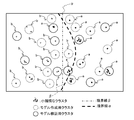
- FIG. 13 is a diagram for explaining overfitting in the machine learning method, and exemplifies teacher data arranged in the input data space.
- FIG. 13 an input data space in which a large number of minute points are arranged is illustrated. Each of the minute points represents the teacher data and is plotted at the position corresponding to the input data.
- a plurality of small-scale clusters are formed by locally collecting a plurality of teacher data (micropoints).
- a reference numeral a or a reference numeral b is attached to a cluster formed by a set of teacher data.
- These reference numerals a or b represent the output of the teacher data, the output of the teacher data constituting the cluster with the reference numeral a is a, and the output of the teacher data constituting the cluster with the reference numeral b is.
- the outputs are b respectively. That is, in the example shown in FIG. 13, it represents a binary classification that predicts a or b.
- the thick dashed line indicates the boundary of prediction when a high-precision model that can be answered correctly using the model creation data is created.
- the output of the teacher data located on the left side of the thick broken line is predicted to be b
- the output of the teacher data located on the right side of the thick broken line is predicted to be a.
- FIG. 1 is a diagram illustrating a hardware configuration of a computer system 1 as an example of an embodiment.
- the computer system 1 is a machine learning device, and realizes, for example, a neural network.
- the computer system 1 includes a CPU (Central Processing Unit) 10, a memory 11, and an accelerator 12.
- the CPU 10, the memory 11, and the accelerator 12 are connected to each other so as to be able to communicate with each other via the communication bus 13.
- the communication bus 13 performs data communication in the computer system 1.
- the memory 11 is a storage memory including a ROM (ReadOnlyMemory) and a RAM (RandomAccessMemory).
- a program executed by the CPU 10 described later and data for this program are written in the ROM of the memory 11.
- the software program on the memory 11 is appropriately read and executed by the CPU 10.
- the RAM of the memory 11 is used as a primary storage memory or a working memory.
- the RAM of the memory 11 also stores teacher data (model creation data, model verification data), information constituting the model, prediction results using the model, and the like.
- the accelerator 12 executes arithmetic processing necessary for the calculation of a neural network such as a matrix operation.
- the program (machine learning program) for realizing the function as the learning processing unit 100 is, for example, a flexible disc, a CD (CD-ROM, CD-R, CD-RW, etc.), a DVD (DVD-ROM, DVD-). It is provided in a form recorded on a computer-readable recording medium such as a RAM, DVD-R, DVD + R, DVD-RW, DVD + RW, HD DVD, etc.), a Blu-ray disc, a magnetic disc, an optical disc, a photomagnetic disc, or the like. Then, the computer (computer system 1) reads the program from the recording medium, transfers it to the internal storage device or the external storage device, stores it, and uses it. Further, the program may be recorded in a storage device (recording medium) such as a magnetic disk, an optical disk, or a magneto-optical disk, and provided to the computer from the storage device via a communication path.
- a storage device recording medium
- the program stored in the internal storage device (RAM or ROM of the memory 11 in the present embodiment) is executed by the microprocessor of the computer (CPU 10 in the present embodiment). .. At this time, the computer may read and execute the program recorded on the recording medium.
- FIG. 2 is a diagram illustrating a functional configuration of a computer system 1 as an example of an embodiment.
- the computer system 1 has a function as a learning processing unit 100.
- the learning processing unit 100 performs deep learning in a neural network, for example.
- the neural network may be a hardware circuit, or may be a virtual network by software that connects layers virtually constructed on a computer program by a CPU 10 or the like.
- Figure 3 shows the outline of the neural network.
- the neural network shown in FIG. 3 is a deep neural network including a plurality of hidden layers between the input layer and the output layer.
- the hidden layer is, for example, a convolutional layer, a pooling layer, a fully connected layer, or the like.
- the circles shown in each layer indicate the nodes that execute predetermined calculations.
- the neural network inputs input data to the input layer and sequentially executes predetermined calculations in a hidden layer composed of a convolution layer, a pooling layer, etc., so that information obtained by the calculation is sequentially executed from the input side to the output side.
- the processing in the backward direction that determines the parameters used in the processing in the forward direction in order to reduce the value of the error function obtained from the output data output from the output layer and the correct answer data (the processing in the backward direction).
- Backpropagation processing is executed.
- an update process for updating variables such as weights is executed based on the result of the back propagation process.
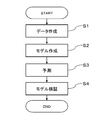
- the learning processing unit 100 includes a clustering processing unit 101, a data creation unit 102, a model creation unit 103, a prediction processing unit 104, and a verification unit 105.
- the clustering processing unit 101 creates a plurality of clusters (data groups) by performing clustering so that bias can be recognized for a plurality of teacher data.
- the teacher data may be stored in a storage device (not shown) in advance, or may be input from outside the computer system 1.
- the clustering processing unit 101 performs hierarchical clustering on a plurality of teacher data.
- FIG. 4 is a diagram for explaining a clustering method by the clustering processing unit 101 of the computer system 1 as an example of the embodiment.
- a dendrogram (tree diagram) in hierarchical clustering is illustrated.
- clustering is realized by repeatedly combining (grouping, merging) multiple input data according to the distance between the data.
- the clustering processing unit 101 realizes clustering by the farthest adjacency method.
- the distance between the data in the farthest adjacency method may be, for example, a Eugrid distance, and may be appropriately changed for implementation.
- a system administrator or the like can set the distance between data for forming the same cluster as a threshold value.
- the clustering processing unit 101 clusters the data whose distance between the data is less than the threshold value so as to form the same cluster.
- the threshold value corresponds to the merge stop condition of the cluster, and may be arbitrarily set by, for example, a system administrator or the like.
- the data D3 and D4 form one cluster C1.
- the data D8, D5, D7 form the cluster C2
- the data D2, D1, D6 form the cluster C5, respectively. Since the data D0 and D9 are far from other data, they independently form independent clusters C3 and C4, respectively.
- clusters C1 to C5 are guaranteed that the distance between the data in each cluster is less than the threshold value (5 in the example shown in FIG. 4), and realizes the bias of the data in the data space.
- the clustering processing unit 101 realizes clustering in which bias is recognized in the teacher data by using such a hierarchical clustering method.
- the cluster merge stop condition (threshold value) be the distance between the input data that can be regarded as due to the bias at the time of acquiring teacher data.
- This threshold value may be arbitrarily set by a person having domain knowledge about the target data, for example, based on the identity of the data.
- FIG. 5 is a diagram for explaining processing by the data creation unit 102 of the computer system 1 as an example of the embodiment.
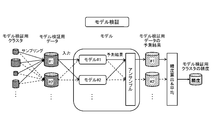
- the data creation unit 102 classifies a plurality of clusters created by the clustering processing unit 101 into a model creation cluster and a model validation cluster.
- the number of clusters for model creation and clusters for model validation can be changed as appropriate.
- a plurality of clusters may be randomly assigned to a model creation cluster or a model validation cluster to be classified, and the classification can be performed by appropriately changing the clusters.
- the clustering processing unit 101 may classify the plurality of clusters into model creation clusters or model validation clusters, and may be appropriately modified and carried out.
- machine learning and verification are executed using data of different clusters. That is, a machine learning model is created using the data of the first cluster (first group) among a plurality of clusters, and the output accuracy of the model is obtained using the data of the second cluster (second group). Perform verification.
- the modeling cluster may be a first group of data used to generate a model by machine learning.
- the model validation cluster may also be a second group of data used to validate the output accuracy of the generated model.
- the data creation unit 102 evenly samples (extracts) data from a plurality of model creation clusters to create model creation data.
- the reason for evenly sampling data from a plurality of model creation clusters is that there may be a bias in the number of data among the plurality of model creation clusters.
- the data creation unit 102 creates a plurality of model creation data by performing different sampling from the plurality of model creation clusters.
- the set of teacher data circled by a broken line indicates a model creation cluster
- the set of teacher data circled by a solid line indicates a model verification cluster
- clustering can be performed so that bias can be recognized for a plurality of teacher data.
- the verification unit 105 can reflect each data of the plurality of clusters in the verification, and the detection accuracy can be improved.
- the data creation unit 102 creates a plurality of model creation data
- the model creation unit 103 creates a plurality of models using these plurality of model creation data.
- the model creation unit 103 may create one model using the data of all the model creation clusters.
- the prediction processing unit 104 obtains accuracy by using a plurality of prediction results output based on the plurality of input data.
- each data of a plurality of clusters can be reflected in the verification, and the detection accuracy can be improved.
Landscapes
- Engineering & Computer Science (AREA)
- Theoretical Computer Science (AREA)
- Physics & Mathematics (AREA)
- General Engineering & Computer Science (AREA)
- Software Systems (AREA)
- Evolutionary Computation (AREA)
- Data Mining & Analysis (AREA)
- Computing Systems (AREA)
- General Physics & Mathematics (AREA)
- Mathematical Physics (AREA)
- Artificial Intelligence (AREA)
- Computational Linguistics (AREA)
- Life Sciences & Earth Sciences (AREA)
- Health & Medical Sciences (AREA)
- Biomedical Technology (AREA)
- Biophysics (AREA)
- General Health & Medical Sciences (AREA)
- Molecular Biology (AREA)
- Medical Informatics (AREA)
- Computer Vision & Pattern Recognition (AREA)
- Information Retrieval, Db Structures And Fs Structures Therefor (AREA)
Priority Applications (5)
| Application Number | Priority Date | Filing Date | Title |
|---|---|---|---|
| PCT/JP2020/018777 WO2021229630A1 (ja) | 2020-05-11 | 2020-05-11 | 機械学習プログラム,機械学習方法および機械学習装置 |
| JP2022522091A JP7409495B2 (ja) | 2020-05-11 | 2020-05-11 | 機械学習プログラム,機械学習方法および機械学習装置 |
| EP20934908.3A EP4152222A4 (en) | 2020-05-11 | 2020-05-11 | MACHINE LEARNING PROGRAM, MACHINE LEARNING METHOD AND MACHINE LEARNING DEVICE |
| CN202080099907.1A CN115427984A (zh) | 2020-05-11 | 2020-05-11 | 机器学习程序、机器学习方法以及机器学习装置 |
| US17/959,341 US20230021674A1 (en) | 2020-05-11 | 2022-10-04 | Storage medium, machine learning method, and machine learning apparatus |
Applications Claiming Priority (1)
| Application Number | Priority Date | Filing Date | Title |
|---|---|---|---|
| PCT/JP2020/018777 WO2021229630A1 (ja) | 2020-05-11 | 2020-05-11 | 機械学習プログラム,機械学習方法および機械学習装置 |
Related Child Applications (1)
| Application Number | Title | Priority Date | Filing Date |
|---|---|---|---|
| US17/959,341 Continuation US20230021674A1 (en) | 2020-05-11 | 2022-10-04 | Storage medium, machine learning method, and machine learning apparatus |
Publications (1)
| Publication Number | Publication Date |
|---|---|
| WO2021229630A1 true WO2021229630A1 (ja) | 2021-11-18 |
Family
ID=78525983
Family Applications (1)
| Application Number | Title | Priority Date | Filing Date |
|---|---|---|---|
| PCT/JP2020/018777 Ceased WO2021229630A1 (ja) | 2020-05-11 | 2020-05-11 | 機械学習プログラム,機械学習方法および機械学習装置 |
Country Status (5)
| Country | Link |
|---|---|
| US (1) | US20230021674A1 (https=) |
| EP (1) | EP4152222A4 (https=) |
| JP (1) | JP7409495B2 (https=) |
| CN (1) | CN115427984A (https=) |
| WO (1) | WO2021229630A1 (https=) |
Cited By (1)
| Publication number | Priority date | Publication date | Assignee | Title |
|---|---|---|---|---|
| WO2024122546A1 (ja) * | 2022-12-07 | 2024-06-13 | 株式会社サキコーポレーション | 撮像画像振り分け装置、撮像画像振り分け方法、データセットおよび学習システム |
Families Citing this family (3)
| Publication number | Priority date | Publication date | Assignee | Title |
|---|---|---|---|---|
| US12412124B2 (en) * | 2021-12-01 | 2025-09-09 | Capital One Services, Llc | Detecting category-specific bias using overfitted machine learning models |
| US12596940B2 (en) * | 2022-02-23 | 2026-04-07 | GE Precision Healthcare LLC | Smart training and smart deployment of machine learning models |
| CN117370554B (zh) * | 2023-09-25 | 2025-07-08 | 中和农信农业集团有限公司 | 一种衍生数据的验证方法、装置,终端设备及存储介质 |
Citations (5)
| Publication number | Priority date | Publication date | Assignee | Title |
|---|---|---|---|---|
| JP2016133895A (ja) * | 2015-01-16 | 2016-07-25 | キヤノン株式会社 | 情報処理装置、情報処理方法、及びプログラム |
| JP2018190125A (ja) * | 2017-05-01 | 2018-11-29 | 日本電信電話株式会社 | 抽出装置、分析システム、抽出方法及び抽出プログラム |
| JP2019045929A (ja) * | 2017-08-30 | 2019-03-22 | キヤノン株式会社 | 情報処理装置、情報処理方法、及びプログラム |
| JP2019066993A (ja) | 2017-09-29 | 2019-04-25 | 株式会社Screenホールディングス | 教師データ作成支援装置、分類装置および教師データ作成支援方法 |
| JP2019159538A (ja) * | 2018-03-09 | 2019-09-19 | オムロン株式会社 | データセット検証装置、データセット検証方法、およびデータセット検証プログラム |
-
2020
- 2020-05-11 WO PCT/JP2020/018777 patent/WO2021229630A1/ja not_active Ceased
- 2020-05-11 EP EP20934908.3A patent/EP4152222A4/en active Pending
- 2020-05-11 JP JP2022522091A patent/JP7409495B2/ja active Active
- 2020-05-11 CN CN202080099907.1A patent/CN115427984A/zh active Pending
-
2022
- 2022-10-04 US US17/959,341 patent/US20230021674A1/en active Pending
Patent Citations (5)
| Publication number | Priority date | Publication date | Assignee | Title |
|---|---|---|---|---|
| JP2016133895A (ja) * | 2015-01-16 | 2016-07-25 | キヤノン株式会社 | 情報処理装置、情報処理方法、及びプログラム |
| JP2018190125A (ja) * | 2017-05-01 | 2018-11-29 | 日本電信電話株式会社 | 抽出装置、分析システム、抽出方法及び抽出プログラム |
| JP2019045929A (ja) * | 2017-08-30 | 2019-03-22 | キヤノン株式会社 | 情報処理装置、情報処理方法、及びプログラム |
| JP2019066993A (ja) | 2017-09-29 | 2019-04-25 | 株式会社Screenホールディングス | 教師データ作成支援装置、分類装置および教師データ作成支援方法 |
| JP2019159538A (ja) * | 2018-03-09 | 2019-09-19 | オムロン株式会社 | データセット検証装置、データセット検証方法、およびデータセット検証プログラム |
Non-Patent Citations (1)
| Title |
|---|
| See also references of EP4152222A4 |
Cited By (2)
| Publication number | Priority date | Publication date | Assignee | Title |
|---|---|---|---|---|
| WO2024122546A1 (ja) * | 2022-12-07 | 2024-06-13 | 株式会社サキコーポレーション | 撮像画像振り分け装置、撮像画像振り分け方法、データセットおよび学習システム |
| JP2024081979A (ja) * | 2022-12-07 | 2024-06-19 | 株式会社サキコーポレーション | 撮像画像振り分け装置、撮像画像振り分け方法、データセットおよび学習システム |
Also Published As
| Publication number | Publication date |
|---|---|
| EP4152222A4 (en) | 2023-06-07 |
| US20230021674A1 (en) | 2023-01-26 |
| CN115427984A (zh) | 2022-12-02 |
| JP7409495B2 (ja) | 2024-01-09 |
| JPWO2021229630A1 (https=) | 2021-11-18 |
| EP4152222A1 (en) | 2023-03-22 |
Similar Documents
| Publication | Publication Date | Title |
|---|---|---|
| WO2021229630A1 (ja) | 機械学習プログラム,機械学習方法および機械学習装置 | |
| JP7047498B2 (ja) | 学習プログラム、学習方法および学習装置 | |
| WO2019088972A1 (en) | Training tree-based machine-learning modeling algorithms for predicting outputs and generating explanatory data | |
| KR20220026804A (ko) | 역강화학습 기반 배달 수단 탐지 장치 및 방법 | |
| JP2020119044A (ja) | 学習方法、学習プログラムおよび学習装置 | |
| US20220391555A1 (en) | Method and tool for designing a complex system | |
| CN112434733A (zh) | 一种小样本硬盘故障数据生成方法、存储介质及计算设备 | |
| JP2023515640A (ja) | 最適化パラメータセットを用いた技術システムの製造または制御 | |
| CN115080391A (zh) | 一种确定自动驾驶关键场景方法及装置 | |
| JP7532681B2 (ja) | 未知の安全でないシナリオの生成、自動運転車の改善、コンピュータシステム | |
| CN119150769A (zh) | 一种基于遗传算法的验证方法和装置 | |
| CN120494185A (zh) | 一种基于知识图谱的影响力预测方法及系统 | |
| CN113821975A (zh) | 一种燃料电池性能衰减预测方法及系统 | |
| CN117492993A (zh) | 边缘无服务平台中基于函数特征信息的资源配置方法 | |
| Biglari et al. | Towards a validity frame of multi-modal surrogate models for traffic simulation | |
| CN112036566A (zh) | 使用遗传算法选取特征的方法和装置 | |
| CN118519679A (zh) | 仿真模型生成及求解方法和装置 | |
| JP7666188B2 (ja) | 機械学習プログラム,情報処理装置および機械学習方法 | |
| CN118335319A (zh) | 基于虚拟人仿真的常见重大疾病早期预测方法 | |
| KR102689365B1 (ko) | 뉴럴 네트워크 장치 및 그 장치에서의 러닝 방법 | |
| CN114627640A (zh) | 一种智能网联汽车行驶策略的动态演化方法 | |
| CN117544422A (zh) | 防火墙虚拟化部署方法及系统 | |
| KR20240124786A (ko) | 약물 조합의 부작용 분석 장치 및 방법 | |
| Zhang et al. | Evolutionary design of a collective sensory system | |
| CN115454863A (zh) | 一种软件缺陷预测方法和系统 |
Legal Events
| Date | Code | Title | Description |
|---|---|---|---|
| 121 | Ep: the epo has been informed by wipo that ep was designated in this application |
Ref document number: 20934908 Country of ref document: EP Kind code of ref document: A1 |
|
| ENP | Entry into the national phase |
Ref document number: 2022522091 Country of ref document: JP Kind code of ref document: A |
|
| NENP | Non-entry into the national phase |
Ref country code: DE |
|
| ENP | Entry into the national phase |
Ref document number: 2020934908 Country of ref document: EP Effective date: 20221212 |