WO2021193614A1 - ヘッドアップディスプレイ - Google Patents
ヘッドアップディスプレイ Download PDFInfo
- Publication number
- WO2021193614A1 WO2021193614A1 PCT/JP2021/011947 JP2021011947W WO2021193614A1 WO 2021193614 A1 WO2021193614 A1 WO 2021193614A1 JP 2021011947 W JP2021011947 W JP 2021011947W WO 2021193614 A1 WO2021193614 A1 WO 2021193614A1
- Authority
- WO
- WIPO (PCT)
- Prior art keywords
- polarizing
- display
- image
- plate
- head
- Prior art date
- Legal status (The legal status is an assumption and is not a legal conclusion. Google has not performed a legal analysis and makes no representation as to the accuracy of the status listed.)
- Ceased
Links
Images




Classifications
-
- B—PERFORMING OPERATIONS; TRANSPORTING
- B60—VEHICLES IN GENERAL
- B60K—ARRANGEMENT OR MOUNTING OF PROPULSION UNITS OR OF TRANSMISSIONS IN VEHICLES; ARRANGEMENT OR MOUNTING OF PLURAL DIVERSE PRIME-MOVERS IN VEHICLES; AUXILIARY DRIVES FOR VEHICLES; INSTRUMENTATION OR DASHBOARDS FOR VEHICLES; ARRANGEMENTS IN CONNECTION WITH COOLING, AIR INTAKE, GAS EXHAUST OR FUEL SUPPLY OF PROPULSION UNITS IN VEHICLES
- B60K35/00—Instruments specially adapted for vehicles; Arrangement of instruments in or on vehicles
- B60K35/20—Output arrangements, i.e. from vehicle to user, associated with vehicle functions or specially adapted therefor
- B60K35/21—Output arrangements, i.e. from vehicle to user, associated with vehicle functions or specially adapted therefor using visual output, e.g. blinking lights or matrix displays
- B60K35/23—Head-up displays [HUD]
- B60K35/231—Head-up displays [HUD] characterised by their arrangement or structure for integration into vehicles
-
- B—PERFORMING OPERATIONS; TRANSPORTING
- B60—VEHICLES IN GENERAL
- B60K—ARRANGEMENT OR MOUNTING OF PROPULSION UNITS OR OF TRANSMISSIONS IN VEHICLES; ARRANGEMENT OR MOUNTING OF PLURAL DIVERSE PRIME-MOVERS IN VEHICLES; AUXILIARY DRIVES FOR VEHICLES; INSTRUMENTATION OR DASHBOARDS FOR VEHICLES; ARRANGEMENTS IN CONNECTION WITH COOLING, AIR INTAKE, GAS EXHAUST OR FUEL SUPPLY OF PROPULSION UNITS IN VEHICLES
- B60K35/00—Instruments specially adapted for vehicles; Arrangement of instruments in or on vehicles
- B60K35/20—Output arrangements, i.e. from vehicle to user, associated with vehicle functions or specially adapted therefor
- B60K35/21—Output arrangements, i.e. from vehicle to user, associated with vehicle functions or specially adapted therefor using visual output, e.g. blinking lights or matrix displays
- B60K35/22—Display screens
-
- G—PHYSICS
- G02—OPTICS
- G02B—OPTICAL ELEMENTS, SYSTEMS OR APPARATUS
- G02B27/00—Optical systems or apparatus not provided for by any of the groups G02B1/00 - G02B26/00, G02B30/00
- G02B27/01—Head-up displays
-
- G—PHYSICS
- G02—OPTICS
- G02B—OPTICAL ELEMENTS, SYSTEMS OR APPARATUS
- G02B5/00—Optical elements other than lenses
- G02B5/30—Polarising elements
-
- B—PERFORMING OPERATIONS; TRANSPORTING
- B60—VEHICLES IN GENERAL
- B60K—ARRANGEMENT OR MOUNTING OF PROPULSION UNITS OR OF TRANSMISSIONS IN VEHICLES; ARRANGEMENT OR MOUNTING OF PLURAL DIVERSE PRIME-MOVERS IN VEHICLES; AUXILIARY DRIVES FOR VEHICLES; INSTRUMENTATION OR DASHBOARDS FOR VEHICLES; ARRANGEMENTS IN CONNECTION WITH COOLING, AIR INTAKE, GAS EXHAUST OR FUEL SUPPLY OF PROPULSION UNITS IN VEHICLES
- B60K35/00—Instruments specially adapted for vehicles; Arrangement of instruments in or on vehicles
- B60K35/40—Instruments specially adapted for improving the visibility thereof to the user, e.g. fogging prevention or anti-reflection arrangements
- B60K35/415—Glare prevention
-
- B—PERFORMING OPERATIONS; TRANSPORTING
- B60—VEHICLES IN GENERAL
- B60K—ARRANGEMENT OR MOUNTING OF PROPULSION UNITS OR OF TRANSMISSIONS IN VEHICLES; ARRANGEMENT OR MOUNTING OF PLURAL DIVERSE PRIME-MOVERS IN VEHICLES; AUXILIARY DRIVES FOR VEHICLES; INSTRUMENTATION OR DASHBOARDS FOR VEHICLES; ARRANGEMENTS IN CONNECTION WITH COOLING, AIR INTAKE, GAS EXHAUST OR FUEL SUPPLY OF PROPULSION UNITS IN VEHICLES
- B60K35/00—Instruments specially adapted for vehicles; Arrangement of instruments in or on vehicles
- B60K35/40—Instruments specially adapted for improving the visibility thereof to the user, e.g. fogging prevention or anti-reflection arrangements
- B60K35/425—Anti-reflection arrangements
Definitions
- This disclosure relates to a head-up display.
- a head-up display device (hereinafter referred to as a HUD device) that displays an image on a display such as a display, reflects the image on a mirror, and projects the image on glass or the like as a virtual image has become widespread in automobiles and the like in recent years, and in particular, Various information can be displayed due to the high performance of the display.
- HUD devices are generally used to superimpose information or the like on the user's normal field of view. For example, in the case of an automobile, vehicle speed information or the like is displayed on a windshield, a combiner, or the like.
- a HUD device for a vehicle is provided with a translucent cover to prevent dust and dirt from entering from a projection port for projecting an image from the device body to a projection unit such as glass.
- a translucent cover (hereinafter referred to as the translucent cover), a resin material containing polycarbonate is generally adopted from the viewpoint of strength and prevention of scattering at the time of collision.
- the display portion inside the device is deteriorated by the load of heat and light due to the incident of external light (sunlight), and the display quality is deteriorated.
- various techniques such as shielding incident sunlight have been proposed.
- One of them has been proposed to give a light-transmitting cover a polarization characteristic in order to shield sunlight incident from the outside without lowering the brightness of the light emitted from the display unit (Patent Document 1). ..
- Patent Document 1 a cover having a gray-colored absorbent polarizing layer, it is possible not only to reduce the intrusion of sunlight, but also to hide the internal structure of the HUD device and to match the color tone with the dashboard.
- HUD devices have been designed not only to refine the projected display information but also to project information to a wider area of the windshield, and accordingly, a concave mirror (concave mirror) in the device has been advanced. Since the width of the light projected from the (also referred to as) becomes large, it is necessary to increase the area of the translucent cover through which the light is transmitted.
- the emitted light is generally polarized in the horizontal direction (hereinafter referred to as S-polarized light).
- S-polarized light the emitted light is generally polarized in the horizontal direction
- the absorption axis of the polarized sunglasses is generally in the horizontal direction, and the horizontal polarization reaching the driver is blocked by the polarized sunglasses, so that the display image (virtual image). ) Is difficult to see.
- an optical member such as a light-shielding polarizing plate, a retardation plate having a ⁇ / 4 wavelength or a ⁇ / 2 wavelength, or a film having a high retardation value of 3000 nm or more is used as a HUD.
- An optical member such as a light-shielding polarizing plate, a retardation plate having a ⁇ / 4 wavelength or a ⁇ / 2 wavelength, or a film having a high retardation value of 3000 nm or more is used as a HUD.
- Patent Documents 2 and 3 A method used for an optical path of an apparatus or a translucent cover has been proposed (Patent Documents 2 and 3).
- the production cost increases due to the increase in the materials used. .. Further, there are problems that the amount of light (luminance) from the display is reduced, the display image is colored due to the influence of the wavelength dispersion of the retardation plate, and the installation location of the optical member is limited. Further, when the above-mentioned optical member is arranged in the optical path, the concave mirror also becomes large in order to project an image showing information in a wide area, so that the concave mirror has a strong condensing action on the incident sunlight. Therefore, the amount of light absorbed by the optical member also increases, which may accelerate the deterioration of the optical member.
- the film having the above-mentioned high retardation value it is necessary to add it to the emitting side of the translucent cover, for example.
- the polarized light emitted from the display unit is installed in a predetermined optical axis relationship, for example, the polarizing layer and the roll-to-roll process cannot be performed, which may lead to a decrease in the production efficiency of the cover member. be.
- the cover member since the symmetry in the thickness direction of the translucent cover is impaired, the cover member may be deformed such as warped when exposed to a heat load due to sunlight for a long time. Further, this may distort the displayed image or cause it to fall out of the device. In particular, if the area of the translucent cover is large, this effect becomes remarkable.
- the present disclosure reduces the incident of sunlight into the HUD device, and allows the display image to be visually recognized even when wearing polarized sunglasses without using the retardation plate in the HUD device and the translucent cover.
- the purpose is to provide an up-display.
- the translucent cover by installing the translucent cover so that the transmission axis of the translucent cover having the polarizing layer and the polarization direction emitted from the display do not match, the visibility of the displayed image even when wearing polarized sunglasses I found that I could improve.
- one aspect of the present disclosure is a polarizing member including a polarizing layer, a support plate provided on at least one surface of the polarizing layer, a display for outputting an image containing a linearly polarized component, and the above.
- a housing for accommodating a display is provided, and the polarizing member is used as a light-transmitting cover that transmits the image to the outside of the housing, and the transmission shaft of the polarizing layer and the display output from the display.
- the angles formed by the polarization directions of the image are set so as to exclude the parallel and orthogonal angles, and the image transmitted through the polarizing member is a head-up display that projects a imaginary image including polarization in the horizontal and vertical directions as a projected image. Is.
- the transmission axis of the polarizing layer may be 5 to 45 degrees with respect to the polarization direction of the image output from the display.
- phase difference value (Re) of the polarizing film of the polarizing layer at a wavelength of 550 nm with respect to the polarization of the image output from the display is n ⁇ 550 ⁇ 150 nm (n is 0, 1, 2, ... Integer) may be used.
- the incident of sunlight into the HUD device is reduced, and the displayed image can be visually recognized even when wearing polarized sunglasses without using these retardation plates in the HUD device and the translucent cover.
- a capable head-up display can be provided.
- the HUD device 100 includes a housing 10, a display 12, a flat mirror 14, a concave mirror 16, a polarizing member (polarizing cover) 18, and a projection unit 20. Consists of including.
- the housing 10 houses components such as a display 12, a flat mirror 14, and a concave mirror 16 that make up the HUD device 100.
- the housing 10 is made of a material having mechanical strength such as plastic or metal.
- the display 12 is a device that outputs an image projected by the HUD device 100.
- the display 12 is composed of a liquid crystal display (LCD) or the like.
- the image light emitted from the display 12 is linearly polarized.
- the image light emitted from the display 12 generally has an S polarization component so as to maximize the brightness of the virtual image on the projection unit 20 in consideration of the influence of the Brewster angle (polarization angle) incident on the projection unit 20. Designed.
- the flat mirror 14 is provided to reflect the image light radiated from the display 12 toward the concave mirror 16.
- the concave mirror 16 is provided to reflect the image light arriving from the flat mirror 14 and reflect it toward the projection unit 20.
- the concave mirror 16 magnifies the image light at a desired magnification and projects it onto the projection unit 20.
- the polarizing member (polarizing cover) 18 is a translucent plate-shaped member attached to an opening provided in the housing 10.
- the polarizing member 18 is provided as a translucent cover so that the image light reflected by the concave mirror 16 is transmitted to the outside of the housing 10 and dust and dirt do not enter the inside of the housing 10.
- the configuration of the polarizing member 18 will be described later.
- the projection unit 20 receives the image light arriving from the concave mirror 16 and projects the virtual image as a projected image.
- the projection unit 20 can be a windshield of the vehicle. Further, as shown in FIG. 2, the projection unit 20 may be a combiner including a half mirror, a holographic element, and the like in order to secure the normal vision of the user. Further, the projection unit 20 may be configured so that the mounting angle and the mounting position can be changed with respect to the housing 10. As a result, the position and angle of the projection unit 20 can be adjusted so that the projected image can be easily seen according to the line of sight of the user.
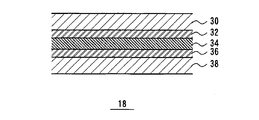
- the polarizing member 18 includes a polarizing plate 34 having a polarizing element.
- FIG. 3 shows a cross-sectional structure of an example of the polarizing member 18.
- the polarizing member 18 is configured by laminating a first support plate 30, an adhesive layer 32, a polarizing plate 34, an adhesive layer 36, and a second support plate 38. Further, as shown in FIG. 4, the polarizing member 18 may have a configuration in which the first support plate 30, the adhesive layer 32, and the polarizing plate 34 are laminated.
- the polarizing plate 34 is a layer containing a polarizer that transmits only light polarized in a specific direction.
- the polarizing plate 34 can be arbitrarily selected, but may be an absorption type polarizing plate.
- a polarizing plate obtained by dyeing a polyvinyl alcohol (PVA) film with a dichroic dye of an iodine-based or dye-based material, or a solution containing a dichroic dye such as a dye-based material is applied onto the substrate by coating or the like.
- a coating type polarizing plate that is coated and oriented to the surface can be used.
- Kuraray's VF-PS # 7500 or the like can be applied to the PVA film.
- the PVA film is, for example, dyed with a solution containing a dichroic dye, and then uniaxially stretched to a thickness of about 30 ⁇ m after stretching a film having a thickness of 75 ⁇ m before stretching.
- the PVA film is formed as the polarizing plate 34.
- This aspect is also generally referred to as a polarizing film (polarizing element film).
- the polarizing plate 34 may be made of a dye-based material.
- the dye-based material may be a dichroic dye.
- a dichroic dye such as an azo compound, an anthraquinone compound, a tetradine compound or a salt thereof is used as the dichroic dye, the durability of the optical properties under high temperature conditions and high temperature and high humidity conditions is improved. Not only is it excellent and the hue can be easily adjusted, but it is also preferable because it does not have a yellowish tint due to the waveform characteristics of the iodine-based polarizing plate.
- Azo compounds are more preferable because they have a high degree of polarization and excellent durability.
- the following dyes can be exemplified as the azo compound dye.
- R 1 represents a hydrogen atom, a lower alkyl group, a lower alkoxyl group, a hydroxyl group, a sulfonic acid group, or a carboxyl group
- R 2 to R 5 independently represent a hydrogen atom, a lower alkyl group, and a lower alkoxyl group.
- A represents a phenyl group having a substituent or a naphthyl group having 1 to 3 sulfonic acid groups
- R 1 represents a sulfonic acid group, a carboxyl group or a lower alkoxy group
- R 2 represents a sulfonic acid group, a carboxyl group, a lower alkyl group or a lower alkoxy group.
- both R 1 and R 2 are both.
- R 3 to R 6 are independent hydrogen atoms, lower alkyl groups or lower alkoxyl groups
- R 7 and R 8 are independent hydrogen atoms, amino groups, hydroxyl groups, sulfonic acid groups or carboxyls, respectively. Represents a group.
- M represents a transition metal selected from copper, nickel, zinc and iron; A 1 represents optionally substituted phenyl or optionally substituted naphthol; B 1 may be substituted. It represents a good 1- or 2-naphthol residue, the hydroxyl group of which naphthol is adjacent to the azo group and is complex-bonded to the transition metal represented by M; R 1 and R 2 are independent of each other. Represents hydrogen, lower alkyl, lower alkoxy, carboxyl, sulfo, sulfamoyl, N-alkyl sulfamoyl, amino, acylamino, nitro or halogen.
- a trisazo compound represented by the chemical formula (5) (In the formula, A 2 and B 2 each independently represent optionally substituted phenyl or optionally substituted naphthyl; R 3 and R 4 independently represent hydrogen, lower alkyl, lower alkoxy, respectively. Represents carboxyl, sulfo, sulfamoyl, N-alkylsulfamoyl, amino, acylamino, nitro or halogen; m represents 0 or 1).
- A represents a phenyl group or a naphthyl group substituted with a methyl group
- R represents an amino group, a methylamino group, an ethylamino group or a phenylamino group.
- Others for example, C.I. I. Direct Yellow 12, C.I. I. Direct Yellow 28, C.I. I. Direct Yellow 44, C.I. I. Direct Yellow 142, C.I. I. Direct Orange 26, C.I. I. Direct Orange 39, C.I. I. Direct Orange 71, C.I.
- Examples of commercially available dyes include Kayafect Violet P Liquid (manufactured by Nippon Kayaku Co., Ltd.), Kayafect Yellow Y, Kayafect Orange G, Kayafect Blue KW, and Kayafect Blue Liquid 400.
- the polarizing plate 34 may have a structure in which the polarizing film obtained by the above manufacturing method is bonded to a base material.
- the base material is a member that serves as a protective layer for the polarizing plate 34.
- the base material can be arbitrarily selected, and for example, a triacetyl cellulose (TAC) film, an acrylic film, a cyclic olefin film, or the like may be used.
- TAC triacetyl cellulose
- the thickness of the base material is not limited to this, but may be 20 ⁇ m or more and 200 ⁇ m or less.
- the polarizing layer includes any aspect of the polarizing plate 34 having a base material and having no base material.
- the adhesive layer 32 is a layer for bonding the polarizing plate 34 and the first support plate 30.
- the adhesive layer 36 is a layer for bonding the polarizing plate 34 and the second support plate 38.
- the pressure-sensitive adhesive or adhesive used for the pressure-sensitive adhesive layer 32 and the pressure-sensitive adhesive layer 36 is not particularly limited, and is a pressure-sensitive adhesive containing a material that imparts heat-shielding property and flame retardancy, which will be described later. May be good.
- the adhesive layer 32 and the adhesive layer 36 absorb (buffer) the force such as thermal stress when a force such as thermal stress acts between the polarizing plate 34 and the first support plate 30 or the second support plate 38. ) May be used as a material.
- the adhesive used for the adhesive layer is not particularly limited, but is an adhesive component obtained by blending an isocyanate compound, an epoxy compound, or the like with a polyvinyl alcohol resin, a urethane resin, or the like, or an acrylic resin or polyester resin. Etc., such as an adhesive component.
- the film thickness of the adhesive layer 32 and the adhesive layer 36 is generally in the range of 0.1 ⁇ m or more and 50 ⁇ m or less in consideration of the adhesion between layers and the appearance characteristics due to the waviness (optical distortion) of the cover member. It is appropriately selected according to the design.
- the method for forming the adhesive layer 32 and the adhesive layer 36 is not particularly limited.
- a solid component containing an acrylic or polyester resin and a curing agent is added to toluene or methyl ethyl ketone.
- a method may be used in which a pressure-sensitive adhesive composition diluted with a solvent such as (MEK) is applied to an object to be adhered, further laminated, and then the applied pressure-sensitive adhesive composition is cured. Further, the droplet method or the like may be applied.
- the first support plate 30 and the second support plate 38 are members for mechanically supporting the polarizing member 18. That is, the first support plate 30 is attached to the surface of the polarizing plate 34 via the adhesive layer 32. Further, the second support plate 38 is attached to the back surface of the polarizing plate 34 via the adhesive layer 36.
- the first support plate 30 and the second support plate 38 may include a flame-retardant plastic plate. That is, by forming the first support plate 30 and the second support plate 38 with a flame-retardant plastic plate, the HUD device meets the standard for mounting on an automobile or the like where flame retardancy is required as the polarizing member 18. 100 can be realized.
- the first support plate 30 and the second support plate 38 may be a polycarbonate (PC) plate, an acrylic resin plate, a cellulose plate, a nylon plate, or the like.
- the acrylic resin plate can be, for example, polymethyl methacrylate (PMMA) or the like.
- the first support plate 30 and the second support plate 38 may be made by treating a combustible material with non-combustibility. Considering the mechanical strength of the polarizing member 18, the first support plate 30 and the second support plate 38 may each have a thickness of 50 ⁇ m or more.
- the first support plate 30 and the second support plate 38 are made of polycarbonate (PC) mixed with at least one of a metal oxide, a halogen compound, and a phosphorus compound, or coated to make it flame-retardant. May be used. Considering the price, coloring, characteristics of polycarbonate (PC) and the influence on the environment, bromine may be used among the halogen compounds.
- PC polycarbonate
- the selected raw material may be kneaded with the polycarbonate (PC).
- first support plate 30 and the second support plate 38 may have a structure in which a plurality of layers are laminated instead of a single layer.
- the main plate may be a polycarbonate (PC) plate, and an acrylic resin plate may be laminated as a sub plate.
- first support plate 30 and the second support plate 38 those having a flat surface may be used so as not to cause distortion in the image transmitted through the polarizing member 18. Further, even if the first support plate 30 and the second support plate 38 have a low phase difference so as not to cause a phase difference in the transmitted light so that the light (polarized light) transmitted through the polarizing member 18 is not disturbed. good.
- an antiglare layer (AG: Anti-Glare) and antireflection
- a surface functional layer such as a layer (AR: Anti-Reflection) or a low reflection layer (LR: Low-Reflection) may be provided.
- the structure is vertically symmetrical along the film thickness direction of the polarizing member 18. May be.
- the mechanical strength of the polarizing member 18 can be increased.
- the warpage when thermal stress is applied to the polarizing member 18 can be prevented. It can be suppressed. That is, when the polarizing member 18 is heated by the irradiation of light from the display 12 or sunlight from the outside, the stress generated at the interface with the first support plate 30 on the surface side of the polarizing plate 34 and the polarizing plate 34 By balancing the stress generated at the interface with the second support plate 38 on the back surface side of the polarizing member 18, warpage (bending) or deformation of the polarizing member 18 can be suppressed. Such a configuration is particularly advantageous in the HUD device 100 for vehicles where heat resistance is required.
- the polarizing member 18 may have a configuration in which a plurality of polarizing plates 34 are laminated via an adhesive layer so that their transmission axes are parallel to each other.
- the polarizing plate 34 preferably has a structure in which the polarizing member 18 is bonded to the substrate in order to impart strength and rigidity to the polarizing member 18. Further, in order to suppress warpage and deformation due to thermal stress, it is preferable that the polarizing plates 34 are laminated with the same polarizing plate 34.
- first support plate 30, the second support plate 38, the adhesive layers 32 and 36, and the surface functional layer may contain a light absorber such as ultraviolet absorption and infrared absorption.
- the application of the light absorber for absorbing ultraviolet rays is for providing the polarizing member 18 with light resistance, and can block the ultraviolet rays contained in sunlight to suppress discoloration and resin deterioration of the polarizing member.
- the ultraviolet absorber include organic ultraviolet absorbers such as oxybenzophenone compounds, benzotriazole compounds, salicylic acid ester compounds, benzophenone compounds, cyanoacrylate compounds, and nickel complex salt compounds. These materials may be used alone or in combination of two or more.
- the blending ratio of the ultraviolet absorber in the resin film which will be described later, varies depending on the resin film forming material used and the material of the surface functional layer, but is preferably 0.1% by weight or more and 20% by weight, preferably 0.5% by weight.
- the blending amount is less than 0.1% by weight, the transmittance at a wavelength of 380 nm or less cannot be sufficiently lowered, and long-term light resistance cannot be obtained. If the blending amount exceeds 20% by weight, bleed-out (a phenomenon in which additives are raised on the surface of the film) may occur from the ultraviolet absorbing layer, and the bleed-out may be a defect in appearance.
- the application of the light absorber for infrared absorption is for providing a heat shield layer on the polarizing member 18, cuts infrared rays (heat rays) from sunlight, and causes the temperature inside the HUD device 100 to rise due to sunlight. It can be relaxed.
- the heat shield layer is a layer containing a material having a property of blocking (not transmitting) infrared rays, and is roughly classified into an absorption type that absorbs infrared rays and a reflection type that reflects infrared rays. Regardless of whether the polarizing member 18 is of the absorption type or the reflection type, it is desirable that the polarizing member 18 has little coloring in the visible light region and is excellent in transparency.
- the adhesive layers 32 and 36 constituting the polarizing member 18 may contain a material having a heat shield property, or a material having a heat shield property may be provided on the surface of any of the films constituting the polarizing member 18. It may be provided by forming a film.
- the transmittance of the polarizing member 18 can be set from the balance between the light-shielding effect of external light such as sunlight and the amount of polarized light emitted from the liquid crystal display (luminance of the emitted light).
- the natural light transmittance of the polarizing member 18 is preferably 30% or more and 50% or less, more preferably 35% or more and 45% or less, and particularly preferably 37.5% or more and 42.5% or less. That is, the linearly polarized light transmittance of the polarizing member 18 corresponding to this is preferably 60% or more and 95% or less, more preferably 70% or more and 90% or less, and particularly preferably 75% or more and 85% or less.
- the natural light transmittance When the natural light transmittance is less than 30%, the light-shielding effect of external light such as sunlight is enhanced, but the amount of light emitted from the display device may be blocked and sufficient display brightness may not be obtained. On the contrary, when the natural light transmittance exceeds 50%, a higher display brightness can be obtained, but the effect of shielding external light is diminished.
- the natural light transmittance can be measured by, for example, V-7100 manufactured by JASCO Corporation and U-4100 manufactured by Hitachi, Ltd. Specifically, a polarizing plate is produced, and the transmittance when one polarizing plate is used is the single transmittance Ys, and the transmittance when two such polarizing plates are stacked so that the absorption axis directions are the same.
- the transmittance is the parallel transmittance Yp, and the transmittance when the two polarizing plates are stacked so that the absorption axes are orthogonal to each other is defined as the orthogonal transmittance Yc.
- the spectral transmittance ⁇ is obtained at predetermined wavelength intervals d ⁇ (here, 5 nm), and is calculated by the mathematical formula (1).
- P ⁇ represents the spectral distribution of standard light (C light source)
- y ⁇ represents the two-degree visual field color matching function
- ⁇ represents the spectral transmittance.
- the transmittance of linearly polarized light is a transmittance obtained by measuring absolute polarized light incident on a polarizing plate so that the vibration direction of the absolute polarized light and the absorption axis direction of the polarizing plate of the present embodiment are orthogonal to each other.
- Absolute parallel transmittance Ky can be obtained by substituting the single transmittance Ys and the orthogonal position transmittance Yc obtained above into the mathematical formula (2).
- the absolute parallel transmittance Ky depending on the design of the display device and the waveform characteristics of the polarizing plate, for example, only the transmittance of a predetermined wavelength of each wavelength of 400 nm to 700 nm may be obtained, or may be obtained within a predetermined wavelength range. It may be expressed as an average value.
- the polarizing member 18 which can significantly cut the light (sunlight and the like) incident on the polarizing member 18 from the outside of the HUD device 100 and can transmit most of the light output from the display 12. can. Therefore, in this case, it is possible to realize the HUD device 100 having excellent image visibility and quality when the polarized sunglasses are not worn.
- ⁇ / 2 At least one layer of a retardation plate called / 4 ( ⁇ represents a wavelength) and a retardation plate having a high retardation value of 3000 nm to 10000 nm or more are arranged.
- a retardation plate for example, a stretched film of a resin containing polycarbonate, polyester, or the like or a polymer liquid crystal material coated on a base material and oriented can be used.
- the slow axis of the retardation plate is arranged so as to have a relationship excluding the parallel direction and the vertical direction with respect to the polarization direction emitted from the polarizing member 18 or the display 12.
- This optical axis relationship is to convert a part of the emitted S polarized light component into a P polarized light component (polarized light in the vertical direction), that is, to convert a linearly polarized light component into an elliptically polarized light component, thereby wearing polarized sunglasses. Even at times, the polarized sunglasses do not absorb all the light, so that the image of the projection unit 20 can be visually recognized.
- the amount of light emitted from the display 12 is adjusted by adjusting the arrangement of the slow axis angle of the retardation plate and further adjusting the arrangement of the optical axis of the polarizing plate 34. May be maximized.
- the use of the P-polarized component causes a problem of double image reflection and a decrease in image quality such as a decrease in image brightness when polarized sunglasses are not worn. Therefore, it is generally desirable to design the relationship between the retardation value of the retardation plate and the optical axis in consideration of the balance between the S-polarizing component and the P-polarizing component emitted from the polarizing member 18.
- the transmission axis direction of the polarizing member 18 May be arranged so as to have a relationship excluding the parallel direction and the vertical direction with respect to the emitted polarization direction.
- the angle formed by the polarization direction of the image output from the display 12 and the transmission axis T (axis shifted by 90 ° with respect to the absorption axis) of the polarizing member 18 is set. It is an angle excluding the angle of the parallel direction H and the angle of the orthogonal direction V.
- the traveling direction of the image light output from the display 12 is perpendicular to the paper surface.
- the angle ⁇ formed by the transmission axis T of the polarizing member 18 with respect to the polarization direction (parallel direction H) of the image output from the display 12 is arranged so as to be an angle of 1 ° or more and 45 ° or less. It is preferable, and it is preferable to arrange it so that it is 5 ° or more and 45 ° or less. From the viewpoint of achieving both visibility when wearing polarized sunglasses and when not wearing polarized sunglasses, it is more preferable to arrange the angle ⁇ in the range of 10 ° or more and 30 ° or less.
- the angle ⁇ is shown with the transmission axis direction of the polarizing plate 34 being 0 °, the counterclockwise direction from the transmission axis T being positive, and the clockwise direction from the transmission axis T being negative (minus:-). ..
- the positive and negative notations of the angle ⁇ are the same in principle.
- the angle ⁇ is in the range of 1 ° or more and 4 ° or less, sufficient brightness of the image cannot be obtained when wearing polarized sunglasses, and it becomes difficult to clearly see the image.
- the angle ⁇ exceeds 45 °, the visibility of the image when wearing polarized sunglasses is lowered, and the brightness of the image when not wearing polarized sunglasses is further lowered.
- an angle ⁇ excluding the angles of the parallel direction H and the orthogonal direction V can be used, but is the same as when the retardation plate is used on the optical path.
- the angle ⁇ should be arranged so as to be close to the parallel direction side so that the S polarization component is often used. preferable.
- the optical axis direction of the polarizing plate 34 may be arranged closer to the parallel direction in consideration of the occurrence of deformation due to the thermal stress of the polarizing member 18.
- the polarizing member 18 can maintain symmetry in the heat shrinkage direction, so that the occurrence of distortion of the polarizing member 18 due to thermal deformation can be reduced.
- the polarizing plate 34 is a polymer uniaxially stretched PVA film, it can be treated as having optically anisotropy like the above-mentioned retardation plate. That is, the effect of the angle ⁇ of the polarizing plate 34 described above can be expressed numerically as a retardation value (Re) in the polarizing film of the polarizing plate 34.
- the measurement of the retardation value of the polarizing film of the polarizing plate 34 is performed by a retardation measuring device (for example, KOBRA-WPR manufactured by Oji Measurement Co., Ltd.), but it is difficult in principle.
- a PVA film containing no dichroic dye is produced under the same production conditions as the polarizing film of the polarizing plate 34, or a polarizing plate having a low polarization characteristic that has little influence on the measurement.
- the measurement is performed using.
- the retardation value Re (550) having a wavelength of 550 nm of the polarizing film of the polarizing plate 34 was calculated to be 550 nm.
- the effect of the TAC substrate was optically negligible. This value suggests that the polarizing plate 34 has a small effect as a retardation plate.
- phase difference value in the polarizing film of the polarizing plate 34 can be expressed as follows.
- the phase difference value (Re (550)) of the polarizing film in the polarizing member 18 with respect to the polarization of the image output from the display 12 at a wavelength of 550 nm is n ⁇ 550 ⁇ 150 nm (n is 0, 1, 2, ... ⁇ It may be an integer).
- ⁇ 150 nm is a value in consideration of the tolerance range of the retardation value in consideration of the action effect of the retardation plate and the wavelength dispersion characteristic.
- the polarizing member 18 having the above-mentioned angle ⁇ can be manufactured, for example, by cutting out the polarizing plate 34 so as to have a predetermined optical axis relationship, and then laminating the first support plate 30 and the second support plate 38 or the like. Alternatively, after forming the roll or sheet-shaped polarizing member 18, it may be punched out by a blade mold (Thomson processing).
- the polarizing plate 34 of the polarizing member 18 is an achromatic polarizing plate (“achromatic color”) that exhibits a characteristic that the transmittance of the wavelength is substantially uniform over the wavelength range of visible light (380 nm to 780 nm, particularly 400 nm to 700 nm).
- a polarizing plate may be used.
- the characteristics of the polarizing plate can be expressed using, for example, hue values (a * , b * ) in the L * a * b * color system based on the transmittance measurement of Ys, Yp, and Yc. ..
- the dichroic dye forming the polarizer may be made of a dye-based material designed for the achromatic polarizing plate in consideration of durability and ease of hue adjustment.
- the following dyes can be exemplified as the azo compound dye which is a dye-based material suitablely designed for the above-mentioned achromatic polarizing plate.
- Ag 1 represents a phenyl group which may have a substituent or a naphthyl group having a substituent
- Bg and Cg are independently chemical formula 9 (BC-N) or chemical formula 10 (BC-P), respectively.
- Represented by, both or one of them represent the formula (BC-N)
- Xg 1 has an amino group which may have a substituent, a phenylamino group which may have a substituent, and a substituent.
- Rg 1 represents a hydrogen atom, an alkyl group having 1 to 5 carbon atoms, an alkoxy group having 1 to 5 carbon atoms, or an alkoxy group having 1 to 5 carbon atoms having a sulfo group, and k is 0 to 2.
- Rg 2 and Rg 3 independently represent a hydrogen atom, an alkyl group having 1 to 5 carbon atoms, an alkoxy group having 1 to 5 carbon atoms, or an alkoxy group having 1 to 5 carbon atoms and having a sulfo group).
- Ar 1 represents a phenyl group having a substituent or a naphthyl group having a substituent
- Rr 1 to Rr 4 are independently hydrogen atoms, alkyl groups having 1 to 4 carbon atoms, and 1 to 4 carbon atoms.
- j indicates 0 or 1
- Xr 1 has an amino group or a substituent which may have a substituent.
- a phenylamino group which may have a phenylamino group, a phenylazo group which may have a substituent, a benzoyl group which may have a substituent, or a benzoylamino group which may have a substituent).
- the polarizing member 18 has a configuration in which a plurality of polarizing plates 34 are laminated via an adhesive layer, at least one of the polarizing plates 34 on the exit side (outside of the HUD device 100) to the projection unit 20
- the transmission axis is arranged so as to have the above-mentioned angle ⁇ .
- LCD color IPS liquid crystal display
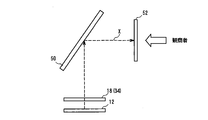
- the blue plate glass 50 was installed at a position where the polarized light emitted from the LCD was horizontally projected so that the brightness of the virtual image projected on the glass plate was maximized.
- the polarizing plate EHC-125U was installed on the LCD as a polarizing cover 18.
- the visibility of the virtual image of the blue plate glass 50 was evaluated by a sensory evaluation by the observer as follows.
- the observer was placed at a position where the virtual image of the blue plate glass 50 could be observed so that the arrangement relationship was such that the HUD device 100 of the vehicle was assumed.
- the visibility-corrected polarization degree Py 99.9%) was installed so that the absorption axis was horizontal, and the visibility of the virtual image on the surface of the blue plate glass 50 by the observer was confirmed.
- the brightness of the virtual image of the blue plate glass 50 was measured by lighting a white image on the LCD and measuring the virtual image projected on the blue plate glass 50 using a two-dimensional color luminance meter CA-2000 manufactured by Konica Minolta.
- the polarizing plate As shown in Table 1, in the cases of Examples 1 to 4 in which the transmission axis of the polarizing cover 18 is arranged at 5 ° to 45 ° with respect to the transmission axis of the polarizing layer on the front side (emission side) of the LCD, the polarizing plate is used. The virtual image could be visually recognized even when the 52 was arranged. Further, as shown in Comparative Examples 1 and 2, when the angle ⁇ is smaller than 5 °, the brightness of the virtual image when the polarizing plate 52 is arranged cannot be sufficiently obtained, and it is difficult to visually recognize the virtual image.
- the incident of sunlight into the device is reduced, and when the polarized sunglasses are worn without using the retardation plate in the HUD device 100 and the translucent cover.
- the HUD device 100 compatible with polarized sunglasses can be easily obtained by simply adjusting the arrangement of the translucent cover.
Landscapes
- Engineering & Computer Science (AREA)
- Chemical & Material Sciences (AREA)
- Combustion & Propulsion (AREA)
- Transportation (AREA)
- Mechanical Engineering (AREA)
- Physics & Mathematics (AREA)
- General Physics & Mathematics (AREA)
- Optics & Photonics (AREA)
- Polarising Elements (AREA)
- Instrument Panels (AREA)
Priority Applications (1)
| Application Number | Priority Date | Filing Date | Title |
|---|---|---|---|
| JP2022510534A JPWO2021193614A1 (https=) | 2020-03-27 | 2021-03-23 |
Applications Claiming Priority (2)
| Application Number | Priority Date | Filing Date | Title |
|---|---|---|---|
| JP2020-058090 | 2020-03-27 | ||
| JP2020058090 | 2020-03-27 |
Publications (1)
| Publication Number | Publication Date |
|---|---|
| WO2021193614A1 true WO2021193614A1 (ja) | 2021-09-30 |
Family
ID=77892174
Family Applications (1)
| Application Number | Title | Priority Date | Filing Date |
|---|---|---|---|
| PCT/JP2021/011947 Ceased WO2021193614A1 (ja) | 2020-03-27 | 2021-03-23 | ヘッドアップディスプレイ |
Country Status (3)
| Country | Link |
|---|---|
| JP (1) | JPWO2021193614A1 (https=) |
| TW (1) | TW202144858A (https=) |
| WO (1) | WO2021193614A1 (https=) |
Cited By (2)
| Publication number | Priority date | Publication date | Assignee | Title |
|---|---|---|---|---|
| WO2023176507A1 (ja) * | 2022-03-16 | 2023-09-21 | 株式会社小糸製作所 | 画像投影装置 |
| US20240280808A1 (en) * | 2021-05-25 | 2024-08-22 | Nippon Seiki Co., Ltd. | Head-up display and method for designing head-up display |
Citations (1)
| Publication number | Priority date | Publication date | Assignee | Title |
|---|---|---|---|---|
| WO2017094333A1 (ja) * | 2015-12-03 | 2017-06-08 | 株式会社デンソー | ヘッドアップディスプレイ装置 |
-
2021
- 2021-03-23 TW TW110110340A patent/TW202144858A/zh unknown
- 2021-03-23 WO PCT/JP2021/011947 patent/WO2021193614A1/ja not_active Ceased
- 2021-03-23 JP JP2022510534A patent/JPWO2021193614A1/ja active Pending
Patent Citations (1)
| Publication number | Priority date | Publication date | Assignee | Title |
|---|---|---|---|---|
| WO2017094333A1 (ja) * | 2015-12-03 | 2017-06-08 | 株式会社デンソー | ヘッドアップディスプレイ装置 |
Cited By (4)
| Publication number | Priority date | Publication date | Assignee | Title |
|---|---|---|---|---|
| US20240280808A1 (en) * | 2021-05-25 | 2024-08-22 | Nippon Seiki Co., Ltd. | Head-up display and method for designing head-up display |
| WO2023176507A1 (ja) * | 2022-03-16 | 2023-09-21 | 株式会社小糸製作所 | 画像投影装置 |
| JP2023136360A (ja) * | 2022-03-16 | 2023-09-29 | 株式会社小糸製作所 | 画像投影装置 |
| JP7837760B2 (ja) | 2022-03-16 | 2026-03-31 | 株式会社小糸製作所 | 画像投影装置 |
Also Published As
| Publication number | Publication date |
|---|---|
| JPWO2021193614A1 (https=) | 2021-09-30 |
| TW202144858A (zh) | 2021-12-01 |
Similar Documents
| Publication | Publication Date | Title |
|---|---|---|
| TWI713744B (zh) | 偏光構件、及具備該偏光構件之抬頭顯示器裝置 | |
| JP7116594B2 (ja) | 偏光部材及びそれを備えたヘッドアップディスプレイ装置 | |
| KR102062828B1 (ko) | 광학 필름, 광학 소자 및 영상 장치 | |
| CN111356945B (zh) | 偏光元件以及配备该偏光元件的平视显示装置 | |
| JP7195168B2 (ja) | 偏光板を備えた画像表示装置 | |
| TWI701460B (zh) | 抬頭顯示器裝置 | |
| JPWO2019117131A1 (ja) | 無彩色な偏光素子、並びにこれを用いた無彩色偏光板および表示装置 | |
| WO2021193614A1 (ja) | ヘッドアップディスプレイ | |
| EP3241044B1 (en) | Optical stack including reflective polarizer and compensation film | |
| WO2019088290A1 (ja) | 偏光部材及びそれを備えたヘッドアップディスプレイ装置 | |
| KR102748257B1 (ko) | 편광판 및 그것을 이용한 표시 장치 | |
| US12433140B2 (en) | Display and display system | |
| WO2025047563A1 (ja) | 透光カバー、投射口部材、及びヘッドアップディスプレイ装置 | |
| WO2026014356A1 (ja) | 光学積層体、偏光レンズ及びアイウェア | |
| TW202610811A (zh) | 光學積層體、偏光透鏡及眼用配戴具 | |
| HK1260587A1 (en) | Polarizing member and head-up display device comprising same |
Legal Events
| Date | Code | Title | Description |
|---|---|---|---|
| 121 | Ep: the epo has been informed by wipo that ep was designated in this application |
Ref document number: 21775773 Country of ref document: EP Kind code of ref document: A1 |
|
| ENP | Entry into the national phase |
Ref document number: 2022510534 Country of ref document: JP Kind code of ref document: A |
|
| NENP | Non-entry into the national phase |
Ref country code: DE |
|
| 122 | Ep: pct application non-entry in european phase |
Ref document number: 21775773 Country of ref document: EP Kind code of ref document: A1 |